
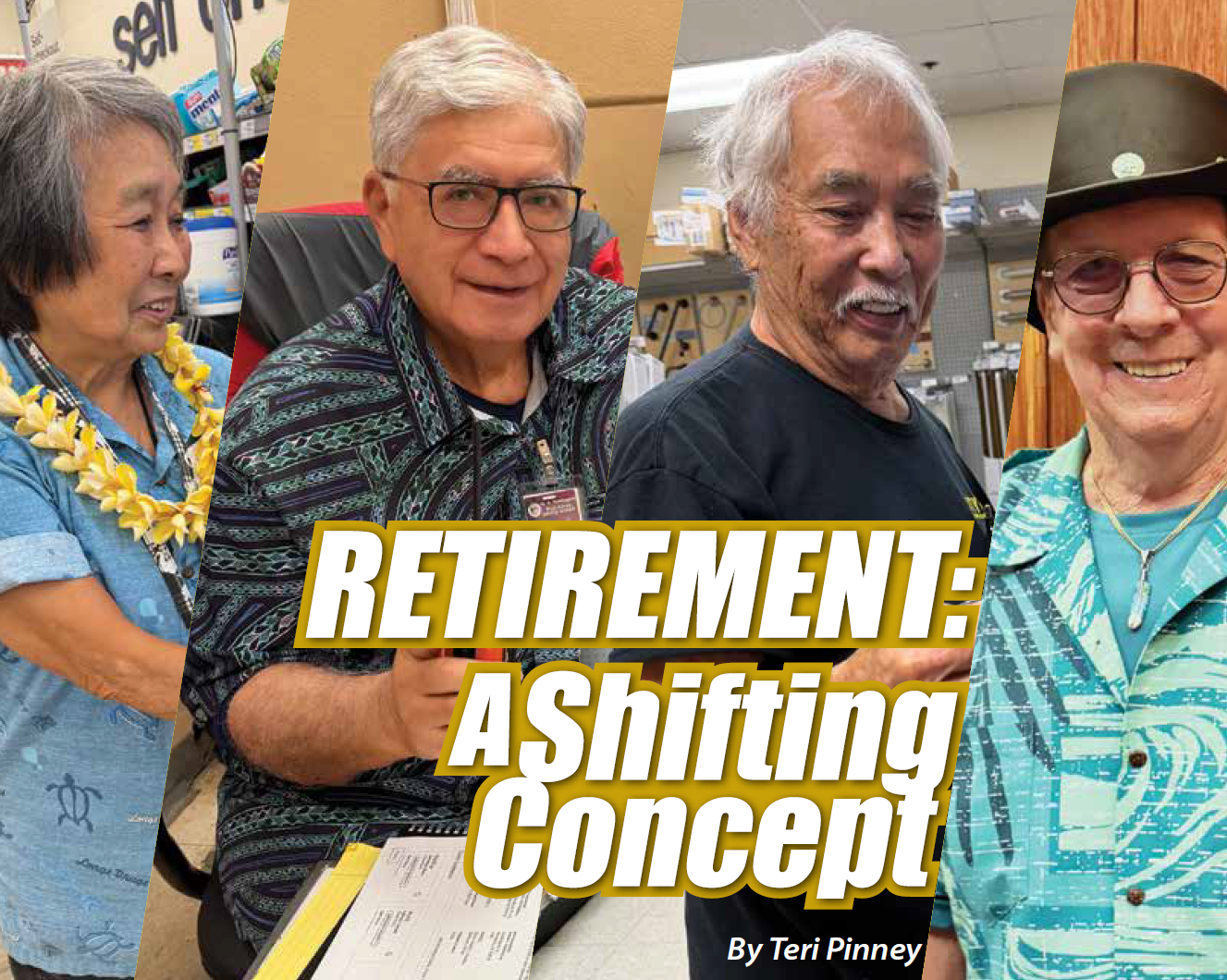
Across Hawai‘i, kūpuna are continuing to work — or returning to work — well beyond what previous generations considered retirement age. Their roles span a wide range of occupations, from educators and healthcare professionals to retail workers and security personnel. For many, retirement no longer means stepping away from work entirely. Instead, it has become a more flexible stage of life — one that allows for continued contribution, engagement and purpose.
Hawai‘i’s population is aging at a pace that is reshaping both its workforce and its economy. Today, nearly one in five residents in the state is age 65 or older. Projections indicate that this share will continue to rise steadily over the next decade as life expectancy increases and younger populations grow more slowly.
At the same time, older adults in Hawai‘i are remaining in the workforce at notably high rates. Approximately 28% of Hawai‘i residents age 65 and older are still employed — well above the national average of about 22%. In fact, Hawai‘i consistently ranks among the top states in the nation for workforce participation among seniors.
Several factors drive this shift. Hawai‘i has one of the highest costs of living in the country, prompting many older adults to continue earning income beyond traditional retirement age.
At the same time, longer life expectancy and better overall health mean that many kūpuna are both willing and able to remain active in the workforce. Employers are increasingly recognizing the value of experienced, reliable workers who bring stability, institutional knowledge and strong work ethics.
This is more than a passing trend. It reflects a fundamental shift in how work and retirement intersect in modern life — where retirement is no longer a fixed endpoint, but a flexible stage shaped by financial realities, personal fulfillment and the desire to remain engaged in the community.
A Second Chapter
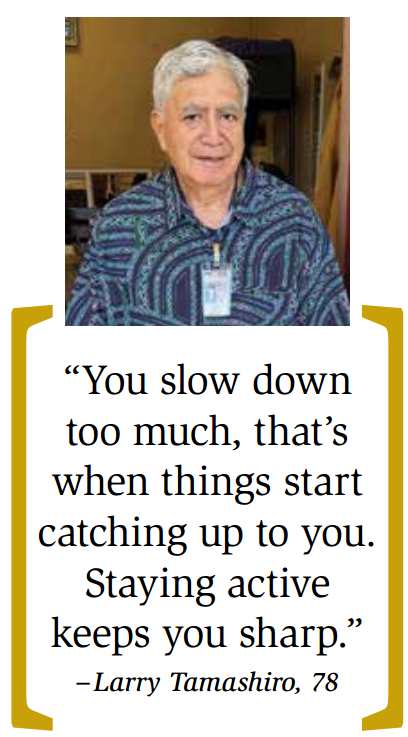
On a large campus just after sunrise, 78-year-old Larry Tamashiro, a retired Honolulu Police Department homicide detective sergeant, directs a team of security personnel, overseeing safety operations with the same steady authority and presence that defined his years in law enforcement.
“I thought I was done when I retired,” Larry says. “But this work I do — it matters. You’re protecting students. You’re helping create a safe place for them to learn.”
His law enforcement background brings a level of experience that cannot be quickly taught. He’s seen a lot over the years. From managing campus protocols to responding to incidents, Larry’s presence offers reassurance to staff, students and parents alike.
“You learn how to stay calm; how to read situations,” says Larry. “That doesn’t go away just because you retire.”
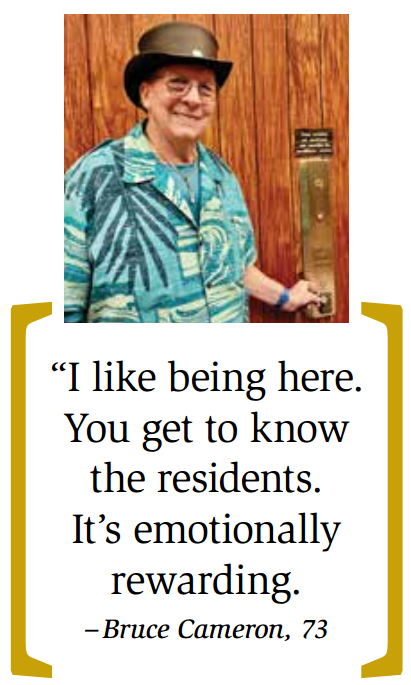
In a condominium lobby, Bruce Cameron, 73, stands at his post — greeting residents by name, managing deliveries and keeping a watchful eye on the steady flow of visitors. A quiet but constant presence, he has become part of the daily rhythm of the building, offering both familiarity and reassurance to those who pass through.
“You get to know the residents,” he says. “I’m helping people as young as 5 to as old as 100. “I like being here. It’s emotionally rewarding.”
But his role extends well beyond opening doors. Bruce is often the first to notice when something is out of place, the person to whom residents will turn for help and the consistent presence who brings a sense of order to the day. For him, the work provides structure, connection and a continued sense of purpose.
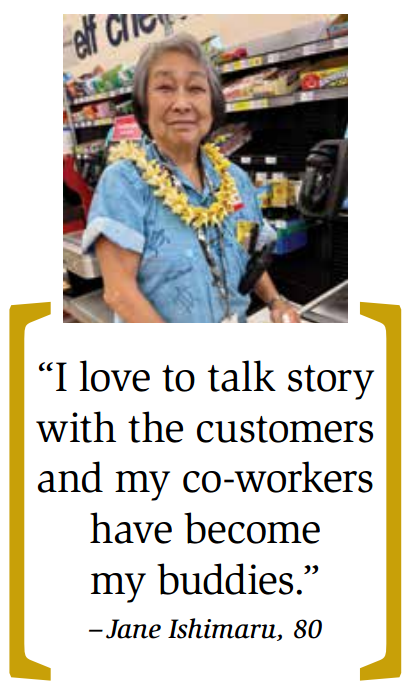
At an East O‘ahu drug store, 80-year-old cashier Jane Ishimaru provides a unwavering and familiar presence. She greets customers, assists at the self-service registers, helps shoppers locate items, restocks shelves and steps in to check out purchases when needed. She continues to work in part to help pay for a substantial mortgage, a responsibility that keeps her financially engaged.
“But it also keeps me active and I enjoy it,” she says. She encourages others her age to consider staying in the workforce, noting that even parttime work can bring both purpose and stability.
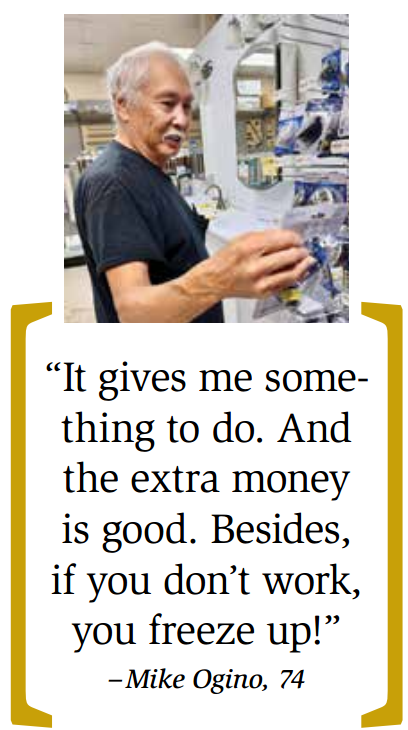
Mike Ogino, age 74, a custodian at a busy home supply retail store, says, “It gives me something to do. And the extra money is good. Besides, if you don’t work, you freeze up!”
These individual stories reflect a broader reality. For many older adults, work is not simply about supplementing retirement income or Social Security — it is about remaining connected, contributing in meaningful ways and continuing to show up where they are needed most.
While their roles differ, a common thread runs through each of their stories. These are not jobs taken on out of necessity alone. They reflect a desire to remain engaged, to contribute and to continue being a useful part of something larger than themselves.
Rethinking Retirement
For much of the 20th century, retirement followed a predictable path. Individuals stepped away from the workforce in their early to mid-60s, supported by pensions, personal savings and Social Security. Retirement offered leisure — travel, hobbies, time with family. It marked a clear transition — a well-earned chapter defined by rest and reward. But that model was built for a different time.
For many, retirement is no longer a fixed destination but a shifting concept. Financial realities, longer life expectancy and changing priorities have altered what it means to step away from work. In Hawai‘i, where the cost of living is among the highest in the nation, many seniors find that full retirement is not practical. Many discover that they do not want to fully disengage. Nowhere is this shift more visible than in the education industry.
Back to School
In workplaces across the islands, the line between “retired” and “working” has blurred. Nowhere is that more evident than in Hawai‘i’s schools, where kūpuna continue to show up day after day because the work still matters to them. Across the state, schools have become one of the most common and appealing places for older adults to continue working or to re-enter the workforce after retirement. Classrooms, campuses and training programs offer something many other industries cannot: a sense of purpose that feels immediate and tangible.
Whether working a few days a week as a substitute teacher or maintaining a full-time teaching role, many seniors find that education allows them to contribute in meaningful ways without the pressures often found in other professions. Substitute teaching has become a natural entry point. It offers flexibility, familiar routines and the opportunity to remain engaged without long-term commitments. For retired professionals — from former teachers to military personnel, business leaders and public servants — the classroom provides a space where life experience translates into real world value for students. Schools, in turn, benefit from dependable individuals who bring maturity, patience and a stable presence.
Some do choose to remain in education full time. Veteran teachers continue well into later stages of their careers, often serving as anchors within their schools. Their experiences become a resource for students and younger educators navigating the early years of teaching. Mentorship, both formal and informal, is a quiet but powerful contribution of these seasoned professionals.
At the post-secondary level, the pattern continues. Community colleges and universities
frequently rely on adjunct instructors and lecturers — many of whom are retired or semi-retired professionals. These individuals bring real-world experience into the classroom, bridging theory with practice. In fields such as business, healthcare and education, their insights can resonate strongly with students preparing to enter the workforce.
There are practical reasons why education has emerged as such a strong post-retirement pathway. The structure of the academic calendar, opportunities for part-time work and the ability to scale involvement up or down all make the field accessible. Just as important, however, is the cultural aspect. Teaching has long been viewed as a profession grounded in service, mentorship and community — values that align closely with what many older adults seek in this stage of life.
The demand for substitute teachers has increased over the past decade, driven by teacher shortages, rising enrollment pressures and the need for classroom continuity. Older adults have stepped into that gap. Substitute teachers who are retired professionals bring a unique level of classroom management. Their life experience has prepared them to handle unexpected situations.
Many retired educators return to the classroom not out of necessity, but because they miss it.
“There’s something about teaching that stays with you,” one long-time substitute shares. “You don’t forget what it feels like to help someone understand something for the first time.”
For others, working in education represents a new chapter entirely. Individuals who spent careers in business, military service or public administration are finding second careers bringing real-world experience directly into learning environments.
In this way, education has become more than a workplace for kūpuna. It has become a bridge between generations.
Why Continue to Work?
Research increasingly points to health as a key component of why older adults continue to work.
Studies suggest that remaining active — both mentally and physically — can contribute to overall well-being in later life. Continued engagement through work has been associated with lower rates of depression, improved cognitive function and a stronger sense of identity. Older adults who maintain regular routines and social interaction often report higher levels of life satisfaction. Work, even on a part-time basis, can provide both.
In Hawai‘i, where community and connection are deeply rooted in culture, these benefits are particularly meaningful. For many kūpuna, work is not simply about staying busy—it is about remaining an essential thread in the tapestry of daily life.
Hawai‘i’s high cost of living: This issue remains a driving force behind why many ku¯puna continue to work. Housing costs can be especially burdensome, while food, healthcare and transportation expenses continue to climb. For those on fixed incomes, even careful budgeting may fall short. Social Security alone is rarely sufficient. As a result, continued employment becomes less about choice and more about maintaining financial stability and independence as expenses increase.
Financial security: Not all workers have had access to pensions or long-term retirement savings. Continued employment provides stability and peace of mind. Full-time roles often include additional medical coverage, life and disability insurance, paid time off and access to wellness/employee assistance programs that support overall well-being.
Supporting family: Kūpuna often contribute to multigenerational households. Many kūpuna provide financial back-up and everyday stability for children and grandchildren. Their continued income can ease household burdens, strengthen family resilience and help bridge gaps that might otherwise strain the entire family unit. In many cases, their presence also allows younger family members to pursue work or education with greater flexibility, knowing support at home is steady and dependable.
Purpose and routine: Work provides structure and a sense of purpose. For many, it offers a reason to get up in the morning and stay engaged. Bruce puts it simply: “You don’t just sit around. You stay moving. You stay part of things.” That daily rhythm brings a sense of normalcy and momentum, reinforcing both physical activity and mental sharpness. It also creates a continued connection to the outside world — something that becomes more valuable, not less, with time.
Social connection: Workplaces provide daily interaction and connection — something that becomes increasingly important with age. Jane says, “I love to talk story with the customers and my co-workers have become my buddies.” These relationships add a sense of camaraderie and belonging that extends well beyond the job itself.
Staying active: Remaining mentally and physically active is another key motivator. Larry reflects: “You slow down too much, that’s when things start catching up to you. Staying active keeps you sharp.” The routine of showing up, moving through tasks and engaging with others helps maintain both physical mobility and cognitive strength. It’s not about pushing limits. It’s about keeping the engine running. That steady level of activity can make the difference between simply getting by and continuing to feel capable and independent.
Because they can: Many kūpuna continue working simply because they are able to do so. They’re physically capable, mentally sharp and still willing to contribute. Today’s older adults are healthier, more active and living longer than previous generations. Stepping away isn’t always necessary or desirable — it’s a choice, not a requirement. As long as they have the ability, many see no reason to step aside when they still have something to offer.
The Value of Experience
Doubts about kūpuna’s declining ability or resistance to change are at odds with reality, as older employees increasingly demonstrate adaptability. Employers are increasingly recognizing the advantages of older workers. Seniors bring reliability and a strong work ethic. They possess deep institutional knowledge and time-honed judgement that only seasoned workers can bring. They often require less supervision. Intuition and initiative are prevalent, as well as a high level of professionalism developed over decades.
In roles like Bruce’s, consistency builds trust. In positions like Larry’s, experience can be critical in high-stakes situations. For Jane and Mike, it’s about staying engaged and the social fulfillment that comes from being part of the daily rhythm of human contact.
Seniors also tend to have lower turnover rates, often serving as mentors to younger employees.
Challenges and Adjustments
Age discrimination remains one of the most persistent and often unspoken barriers facing older workers, particularly when it comes to hiring and advancement. Despite their contributions, working later in life comes with challenges. Physical demands may require adjustments. Employers may need to provide flexible schedules or modified duties. And technology continues to evolve, requiring ongoing learning and adaptation.
In many cases, even small accommodations — ergonomic workspaces or adjusted hours — can make a significant difference in sustaining long-term participation. Navigating new systems or workplace expectations can be frustrating, but many seniors persist with determination and a willingness to learn. These adjustments are not signs of limitation, but practical steps that allow experienced workers to continue contributing effectively.
Although the assumption that age equates to decline has proven to be a false one, there are still lingering stereotypes about older workers. These stereotypes will continue to be challenged as more kūpuna remain active in the workforce. However, age bias remains one of the most persistent barriers facing older employees, particularly when it comes to hiring and advancement.
Looking Ahead
As Hawai‘i’s population continues to age, the presence of ku¯puna in the workforce is expected to grow. What was once considered the exception is quickly becoming the norm. Organizations such as AARP Hawai‘i and the University of Hawai‘i Center on Aging are actively studying this shift.
For employers, it signals the need to rethink long-standing workforce models. Those who
adapt will benefit. Rather than asking how long older adults should remain in the workforce, the better question may be how to fully leverage what they bring. In many cases, experience and consistency are exactly what are needed. As this demographic grows, so does the opportunity to redefine a productive, multigenerational workforce.
Economic Contributions
The continued participation of older adults in Hawai‘i’s workforce carries broader economic implications. Working kūpuna contribute to consumer spending, tax revenues and overall economic stability. Their earnings circulate through local economies, supporting the communities in which they live. Their presence helps address workforce shortages and dependable staffing. In Hawai‘i, where geographic isolation and workforce limitations present unique challenges, the contributions of older workers are particularly significant. Across Hawai‘i, the image of retirement is evolving.
In office buildings, classrooms, storefronts and community spaces, older adults continue to show up — not because they must, but because they can and because they want to. Their presence challenges long-held assumptions about aging. It also offers something increasingly valuable in today’s fast-changing world: stability, perspective and lived experience.
Retired, Rewired, Rehired
In a society that often moves quickly toward what is new, kūpuna in the workforce serve as a reminder that experience still matters — and that some of the most valuable contributions come well into the later chapters of a career.
Kūpuna are redefining what it means to retire. They are not stepping away from life’s responsibilities or contributions. Instead, they are adapting — finding new roles, continuing old ones and remaining active members of their communities.
Bruce continues to stand at his post, greeting residents by name. Larry walks the school’s campus, ensuring safety and order among the student population. Jane moves between the self-service registers, helping customers and keeping the front-end running smoothly. Mike, the retail store custodian, takes ownership of his work — keeping the floors spotless, the aisles clear and the store ready for the next wave of customers, carrying out each task with care, consistency and a quiet determination to do the job right every time.
Different roles, different settings — but the same steady and intrepid presence. They show up, they contribute and they keep things moving. In a time when retirement once meant stepping aside, they offer a different picture — one where experience still matters, work still has value and purpose doesn’t fade with age.
For this writer, a 76-year-old woman balancing a full-time job alongside part-time magazine feature writing, retirement was never a finish line — it was a shift in direction.
The work looks different, but the drive remains the same. Purpose doesn’t taper off with age and neither does the willingness to contribute.

Leave a Reply