
The information printed on prescription medication labels is critical for your safety. The Drug Enforcement Administration mandates that consumers receive sufficient information to be able to independently take their medications and contact their pharmacy/physician if questions or issues arise.
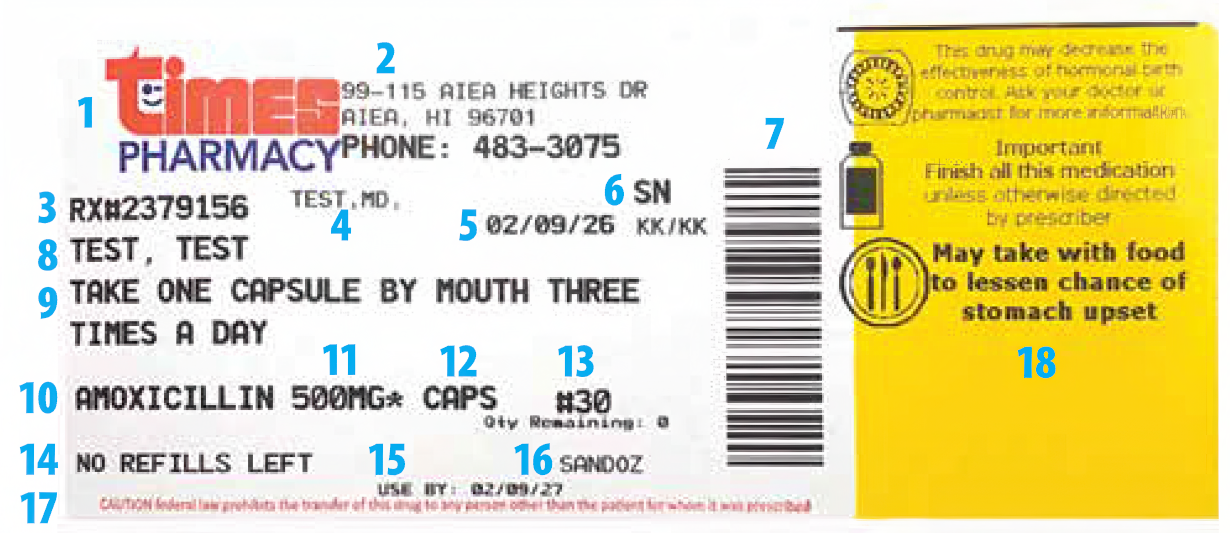
Reading from top of above label, left to right:
1) Pharmacy name
2) Pharmacy address and phone number
3) The pharmacy gives each prescription an identifier called an “Rx number.” If you call the pharmacy to request a refill or have questions about a specific medication, this number can be used in lieu of difficult-to-pronounce names. Each time your physician sends in a refill request, the Rx number will change.
4) Your physician’s name (in example: TEST, MD)
5) Date when the prescription was filled
6) To the right of the fill date is SN where the “S” stands for safety cap (child-resistant). If there is an “E” in the “S” position, it is an easy-open cap, so it is not child-resistant. The “N” in the SN combination stands for new prescription. An “R” in place of the “N” means it is a refill.
7) When scanned, the bar code reveals the National Drug Code (NDC) number, which pharmacy staff scan to verify they are dispensing the correct medication/dosage to the correct patient.
8) Your first and last name (in example: TEST, TEST) appears on the label above the instructions.
9) Instructions regarding how, when and how much of the medication should be taken
10) Name of medication
11) Strength of the medication in the form of a numeral and unit of measurement: e.g.
milligram, milliliter, etc.
12) Form of your medication: e.g. tablet, capsule, suppository, ointment, patch, etc.
13) Quantity of medication you receive
14) Number of refills you have left: Refills are valid one-year from the initial date you received the prescription.
15) Expiration date (in sample: use-by date) is on the bottom middle edge in small text
16) Manufacturing company (in sample: SANDOZ) that made the medication
17) Note that all prescriptions carry a warning (in sample: “CAUTION federal law prohibits the transfer of this drug to any person other than the patient for whom it was prescribed.”
18) The warning/precaution area (usually in a colored box) of the label alerts consumers and healthcare providers to serious side effects associated with the medication, even when used correctly.
Keep in mind that the label may not be a full reflection of all possible side effects. Ask your pharmacy for a medication guide with the complete list of possible side effects.
Remember, taking medications exactly as prescribed — correct dosage, time and duration — is essential for achieving the intended therapeutic effect, preventing treatment failure and managing chronic conditions.
Disclaimer: Be aware that there is no nationwide standard for prescription medication labels. The FDA requires the patient’s name and dosage instructions, but other details vary by state. Each state’s board of pharmacy is responsible for what goes on the Rx labels.

Leave a Reply