As we age, we’re faced with the dilemma of where and how we will live during the next phase of our lives. One of the most frequently asked questions is, “How do I know when it’s time to move?” Here are some questions that may help you to self-discover when it’s right for you:
Too many stairs?Do you feel that the stairs have become too difficult/dangerous to navigate?
Is your home too large? Do you need all that space now that the kids are out on their own? Are you living alone and concerned about security?Do you feel safe in your own home or would feel better living with others? Is your home/yard too much work?Have housework — and especially yardwork — become too difficult to keep up with? Are you too tired to cook and clean? Do you have the energy or desire? Would you like to make your own decisions about your next move?Or are you going to burden your loved ones with this important decision?
If you answered “yes” to even one of these questions, it may be time to start looking at the options available to you. It’s never too early to start planning for your future.
THE COMPLETE SOLUTION™
Powered by The Ihara Team of Keller Williams Honolulu RB-21303
1347 Kapiolani Blvd., Ste. 300, Honolulu, HI 96814
Dan Ihara (RA), CAPS, CLHMS, SRES RS-65892 808-256-7873
Julie Ihara (RA), SRES RS- 67440 808-754-2225 | ihara@iharateam.com www.iharateamhawaii.kw.com
As we age, we’re faced with the dilemma of where and how we will live during the next phase of our lives. One of the most frequently asked questions is, “How do I know when it’s time to move?” Here are some questions that may help you to self-discover when it’s right for you…
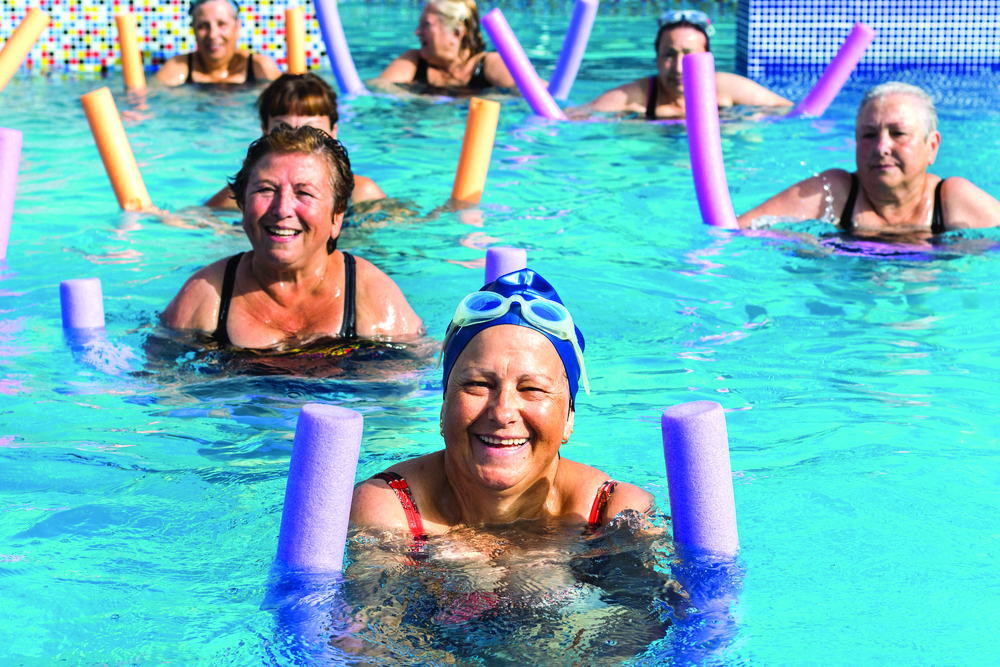
Happy New Year! The beginning of the year often means a fresh start and new goals for many aspects of our lives. Today, we’ll focus on our health and fitness, and the mind-body connection that can contribute to a healthier new you.
Exercise is one of the best gifts we can give our bodies. It helps keep bones and muscles strong and joints flexible. exercise reduces the risk of certain ailments, lowers the chance of falling, improves incontinence and increases energy levels.
Remember to check with your doctor and keep him or her informed about any changes to your movement routines, or if you’re starting a new exercise program.
■ Before and after exercise. Begin with deep breaths, shoulder rolls and gentle stretches. After your workout, cool down with a slower walk and more stretches. Stay hydrated; drink lots of water.
■ Enjoy the outdoors. Exercise can be any type of movement, such as walking or dancing the hula. Go for a swim. Work in the garden. Take the stairs instead of the elevator. Join friends for yoga or tai chi. Even if you’re vaccinated for COVID-19, practice safe social distancing in public, and wear a mask or face covering as directed.
■ Lifestyle coaching. A personal coach can take an active role in your health and help create a plan for reaching your goals. You can also ask friends and family to check in with you on your health goals, and send messages of encouragement to keep you motivated.
■ Step it up. Check out everybodywalk.org to start a walking program. Share an audiobook or podcast with your walking partner and chat about the latest story developments during rest breaks.
■ Emotional well-being. There are digital apps, such as myStrength (www.mystrength.com) and Calm (www.calm.com), to help your emotional well-being and resilience. MyStrength offers a personalized program that helps improve your mindfulness and change behaviors. Calm is a top app for meditation and sleep to help lower stress and reduce anxiety.
■ Recognize signs of depression. Know when to get help. Grief, stress, abuse, physical challenges, pain and loneliness can trigger depression. If you’re concerned about your mind and mood, talk to a behavioral health expert to help you adjust to changing life circumstances and improve your outlook.
Happy New Year! The beginning of the year often means a fresh start and new goals for many aspects of our lives. Today, we’ll focus on our health and fitness, and the mind-body connection that can contribute to a healthier new you.
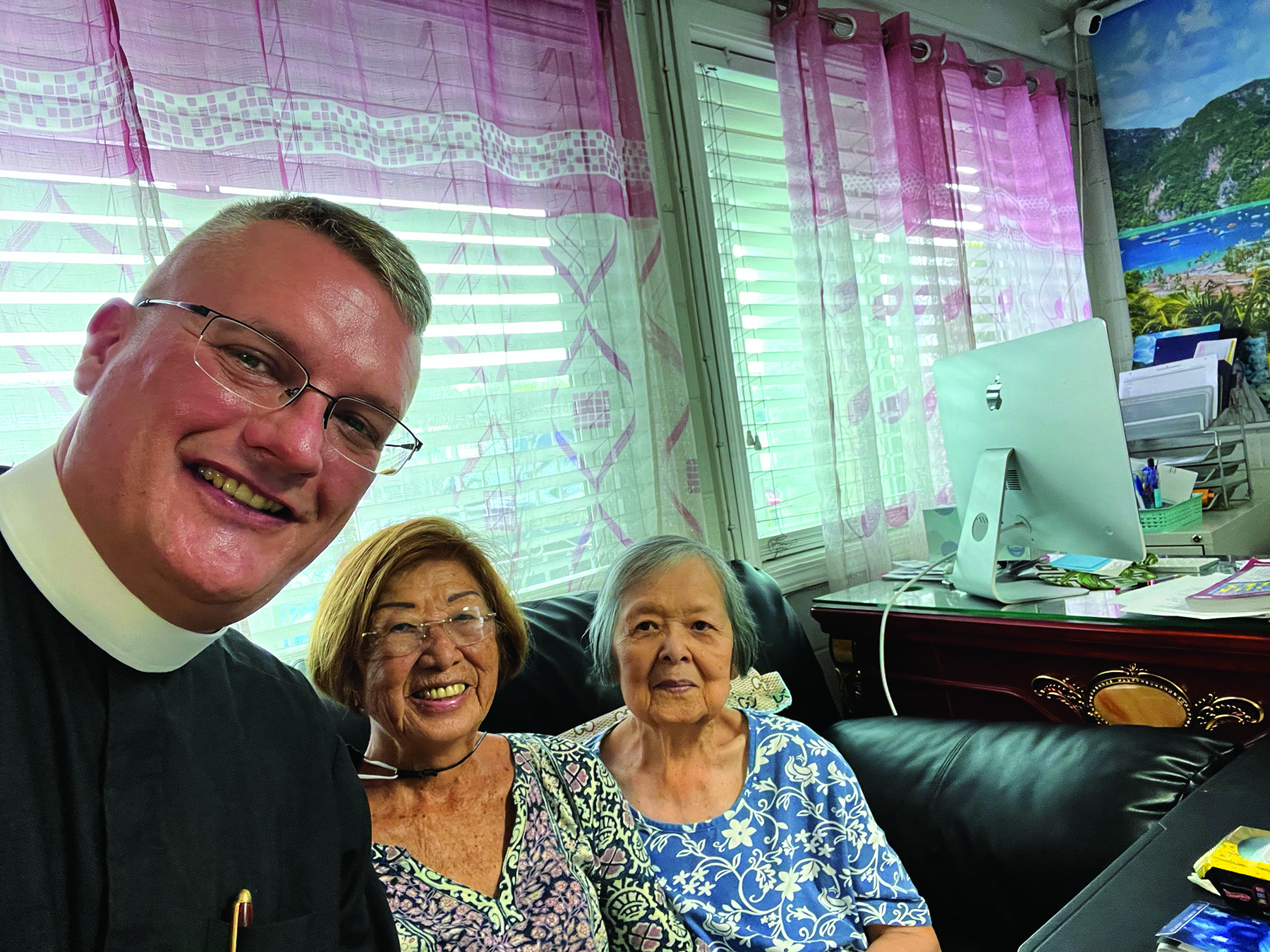
(L–R) Rev. Christopher Bridges with parishioners Edean Iwanaga and Lorraine Yap
During the height of the COVID-19 pandemic, members of Epiphany Episcopal Church in Kaimuki served as a testament to faith and dedication as they continued to attend services in person — when we were allowed to do so. It renewed me as a minister each and every Sunday.
Even before the vaccine became available, some members of the congregation who were more vulnerable due to age or illness attended church — despite the risks. They simply put on their masks, safely sat six feet apart, washed their hands, then folded them to worship God together, following the guidance of the Centers for Disease Control and Prevention.
Now that the vaccine is widely available, all the members of the church have demonstrated their love for their community by getting vaccinated, protecting themselves while helping the islands combat the virus.
Many studies indicate that religious practices substantially contribute to physical and mental health. All I have to do is look at my members who are in the 70-to-90-year-old age range who have been coming to church regularly. One of our members who lived to be 103 years old came to worship nearly every Sunday. Some of our elder members have attended since they were children.
Many of those who have gone on to be with Jesus in Heaven lived full lives as elders. They knew that coming to a place of worship — going to a sacred place to worship and committing to something beyond themselves — builds a bridge into their personal lives. Worshiping God in fellowship with other members of the congregation and sharing the ups and downs of life helps give them the ability to deal with the stress in their daily lives. I have been a witness to countless stories that back up this observation.
These grey-haired elders are an example of what St. Paul the Apostle called “mature faith — understanding the wisdom of God.” They rediscovered a secret that many have forgotten: Having faith and being a part of a sacred place of worship is important to well-being.
“I exhort the elders among you to tend the flock of God,” St. Peter said. So to all the elders out there, keep tending the flock at your church. The Bible says, when elders gather, God’s wisdom becomes known. So I would like more elders to gather with me at Epiphany to share that wisdom. But churches are not just a gathering place for the senior citizens. Ultimately, the connection with God is strengthened through church attendance by people of all ages.
During the height of the COVID-19 pandemic, members of Epiphany Episcopal Church in Kaimuki served as a testament to faith and dedication as they continued to attend services in person — when we were allowed to do so. It renewed me as a minister each and every Sunday.
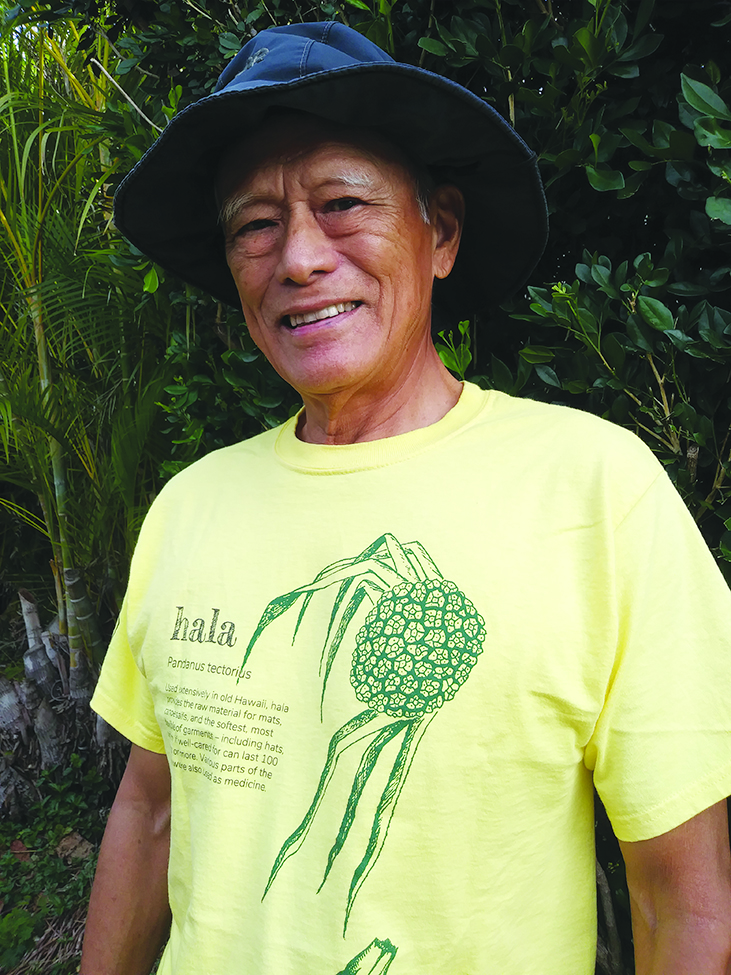
Lot Lau is putting his lifelong love of trees to good use. At age 81, he is a member of a Citizen Forester group whose efforts are aimed at helping to save the planet — one tree at a time.
“When I was young, I thought of trees only for climbing to get the fruit,” he recounts. “I preferred the Samoan palm variety. They bear coconuts much lower to the ground and are tall, stately, durable and strong. They sway gently in the breeze like a hula dancer. They give of themselves to benefit others.”
The Citizen Forester (CF) program works through the Smart Trees Pacific (www.smarttreespacific.org) nonprofit, offering community members of all ages information about the benefits of trees in our urban forests. CFs learn how to identify common species and how to collect measurements and assessments for a software application that reveals the ecological services of our trees. After completing training, CF teams inventory the trees in our public parks and streets.
There are more than 300 trained volunteers on O‘ahu and Kaua‘i. One group takes care of 74 trees along a quarter-mile stretch of a walking path at Diamond Head State Park. CFs like Lot care for the tree wells in Kaimuki.
“As a Citizen Forester, I am able to do more to reduce my carbon footprint,” says Lot. “I’m contributing to the effort to increase the canopy of trees in Kaimuki, to help make Kaimuki look greener, feel cooler, and capture carbon and hold water. I am reinforced by the dedicated program participants who serve as my role models.”
Lot says he has also been influenced by Lao Tzu, who wrote the main book of Taoism, the Tao Te Ching. Taoism holds that humans and animals should live in balance with the Tao — the universe. The Taoist ideal is one who changes themselves, becoming a good example to others. So changing oneself makes the world better.
“I have also learned there are various forms of the expression ‘do unto others’,” says Lot. “I believe that there is a connectedness between all forms of life. So, it is about living in harmony with nature. Current climate change effects demonstrate how harm to one is harm to another. So at the most basic level of self-interest and survival, trees are obviously very important to us humans.”
“But humans will never know much about our universe — that’s why religion is called a “faith.” For me, attending church reminds me how to how to treat others,” says Lot, “serving as a guide along right paths in a Christian tradition.”
Lot has chosen his path wisely — following God, Lao Tzu and his fellow CFs. And like his Samoan coconut trees, he strives to remain durable and strong — giving of himself to benefit others — bending instead of snapping under duress.
“But we are no longer in harmony with nature,” says Lot. “We have forgotten our connectedness. We are way behind the curve in response to climate change that could be mitigated by more and healthier trees, so I do what I can to help.”
Lot Lau is putting his lifelong love of trees to good use. At age 81, he is a member of a Citizen Forester group whose efforts are aimed at helping to save the planet — one tree at a time. “When I was young, I thought of trees only for climbing to get the fruit,”…
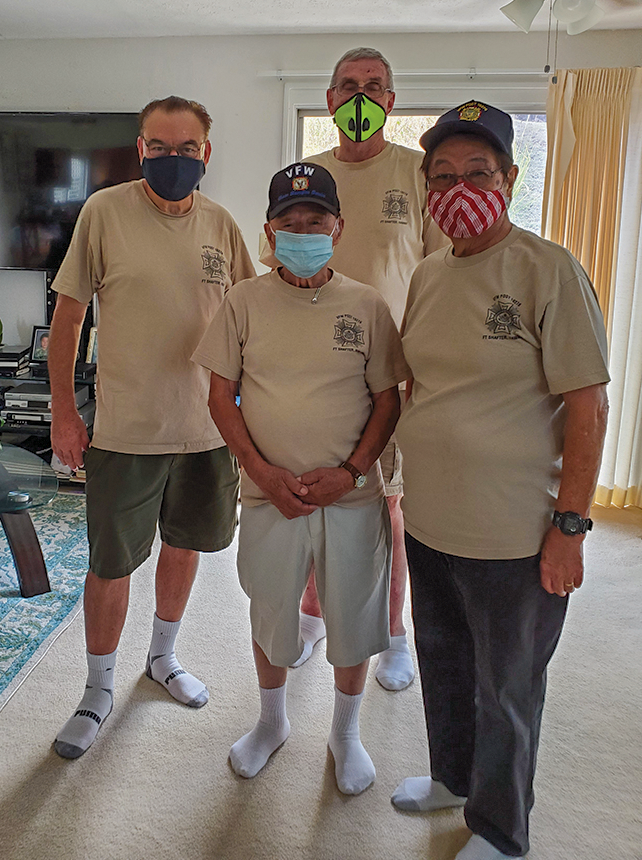
Jim’s bathroom work crew included (above, L–R) Cmdr. Mortimer, past post Cmdrs. Cal Sagara and Bob Breitscheider, and National Councilmember Stan Fernandez, all members of the Fort Shafter Post on O‘ahu.
The call came in. “Help! Papa needs an ADA compliant bathroom.” According to Adele, his granddaughter, “Papa refuses to come downstairs to shower because he says he already has a blankly-blank shower upstairs.” Jim “Papa” Raynor is a 98½-year-old WWII veteran.
Upon receipt of the call, four members of VFW Post 10276 went to the house, made a list of equipment needed, measured, went to the hardware store and were back on the job within two hours with their tools and supplies.
Four hours later, the grab bars and the rest of the equipment were installed and their comrade took an inaugural shower to break it in.
Joining the work crew downstairs in the kitchen, Jim thanked them for their efforts and then cussed them out for working so fast. “I wanted to spend a few more hours talking story about the old days that only veterans would understand.” So
post Cmdr. Steve Mortimer called the post chaplain, who scheduled weekly wellness calls.
The call came in. “Help! Papa needs an ADA-compliant bathroom.” According to Adele, his granddaughter, “Papa refuses to come downstairs to shower because he says he already has a blankly-blank shower upstairs.” Jim “Papa” Raynor is a 98½-year-old WWII veteran.
Major corporations, government agencies, healthcare organizations, small businesses and private individuals are all being targeted by ransomware. The law enforcement and cybersecurity communities believe many of the cybercriminals behind these attacks are connected to organized crime, anti-US entities or even terrorist groups. It is an ongoing challenge to identify hackers and bring them to justice.
Ransomware is a form of malware that encrypts the data on your computer and makes your computer inoperable until a “ransom” is paid to the hackers. Some versions of ransomware not only lock up your computer and data, but also make
copies of data that hackers can harvest and sell.
Payment demanded by the hackers is usually in the form of bitcoins (cryptocurrency). Some low-level hackers may even demand payment in the form of gift cards. Tracing the flow of the ransom is tedious, time-consuming and oftentimes, futile.
A computer gets infected with ransomware mainly due to user error, by clicking on a malicious link in an email or a message while using social media. Your computer can also get contaminated by opening an “infected” attachment in your email — a document, video or sound file.
Prevention Tips:
■ Be careful what you click on.
■ Back up your data. Backing up the entire hard drive is best. Use an external hard drive (not a USB thumb drive) that has its own power source and is connected with a USB cable.
■ Use a cloud service. This option may come with a fee depending on the size of the backup file.
■ Update your computer’s operating system and security software with the most current patches.
■ Install security software and make sure it is running before checking email or going online.
■ Be very suspicious when clicking on links when surfing the Web, those in your emails and when opening attachments. This also applies to messages from “friends” when using social media.
What to do if your computer becomes infected.
■ Turn off your computer and unplug it.
■ Contact a computer repair service. Explain that your computer has been infected but you have a backup they can use to restore your data.
■ Contact law enforcement and report the incident. Whether they may be able to open an investigation and track down the hackers will depend on what information you can provide them and their available resources. (Law enforcement will not restore your data. Their job is to investigate.)
The bottom line is the burden of keeping yourself safe is using safe computing habits and being wary of what you click on.
Contact me with questions about online security:
Christopher Duque | aikea808@gmail.com
Major corporations, government agencies, healthcare organizations, small businesses and private individuals are all being targeted by ransomware. The law enforcement and cybersecurity communities believe many of the cybercriminals behind these attacks are connected to organized crime, anti-US entities or even terrorist groups. It is an ongoing challenge to identify hackers and bring them to justice.
In 2010, I wrote a booklet for Career Partners International, a leading outplacement counseling firm, in which I compared the 20th century workplace with the 21st century workplace. In simple terms, I made the case that the once-upon-a-time dominant workplace of regular, full-time workers was fast becoming a workplace of workers who work part-time, some of the time, for free or for a fixed fee.
And here we are in 2021 and the change has happened — not because of the pandemic, as most would like us to believe, but because of economic, societal, technological, ergonomic and other obvious changes that were staring us in the face long before this pandemic.
If we work later in life some of the time, our mental and physical health will benefit.
As change is our new reality, the flexible options are specifically suited to older workers because…
• Cognitive decline is preventable for many of us by working in some capacity. Look up the advances active brain activity is having in staving off some forms of dementia. Many studies confirm that using your brain at part-time work helps to maintain your resiliency. A flexible work schedule is of particular benefit for mature workers because it allows more time for all aspects of health renewal.
• Mental health can be maintained by working flexibly for community or other socially interactive nonprofits. As Nina Vasan, MD, of the Stanford Lab for Mental Health, said, “Mental health is the bedrock of community and, vice versa, community is the bedrock of mental health.” In brief, doing good work is good for you, too.
Where can you find this work that will help maintain your mental and emotional fitness? The key is finding something that is meaningful to both you and your community.
• Consider businesses that deliver meals and groceries, offer video-based fitness, or repurpose clothing and household goods.
• Review other contributors to Generations Magazine. They are your network. The authors know where new opportunities are emerging.
• Read my last month’s article on new places to work — especially in a flexible way.
For more about the longevity benefits of working longer and later in life, search the Brooking Institute as well as the Harvard Institute. Be a workforce not a workhorse. Your brain will thank you.
In 2010, I wrote a booklet for Career Partners International, a leading outplacement counseling firm, in which I compared the 20th century workplace with the 21st century workplace. In simple terms, I made the case that the once-upon-a-time dominant workplace of regular, full-time workers was fast becoming a workplace of workers who work part-time, some…
An interview with Debbie Kim Morikawa, owner of GYMGUYZ
Why is it important that seniors continue to work on their fitness?
It’s always important to remain active to stay healthy and strong. Regular exercise is also great for brain health, boosting mood and energy, and speeding up recovery from an injury or illness. “Use it or lose it” applies to balance skills, agility, muscle strength and stamina.
As we age, there’s a natural tendency to slow down and do things more cautiously, which is sensible. The active older adult can usually maintain functional strength through everyday activities. However, living a sedentary lifestyle increases the risk of feeling stiffer, getting weaker and becoming less coordinated. Adapting to these changes may seem easy — until the day it becomes very apparent that the activities are not only too difficult to do — but also scary!
What are some warning signs that a fitness program may be needed?
Maintaining mobility is critical to independence. When walking, we spend about 40 percent of the time on one leg. Not being able to stand on one leg for a minimum of 20 seconds can be an indicator of muscle weakness, decreased balance skills or impaired brain health.
Other indicators of weakness or deconditioning are not being able to walk as far, feeling more tired or short of breath, or needing to take more rest breaks. Getting up from a low chair may take more effort or getting down to or up from the floor may require assistance.
Feeling the need to grab onto something for stability while walking or going up and down stairs versus wanting to be cautious or safe is a sign that something is off.
What should a senior look for when seeking out an exercise professional?
Look for someone who’s willing to take the time to understand your needs and do a comprehensive assessment of your posture and biomechanics (how you move) to identify any asymmetries, muscle imbalances or loss of flexibility.
Due to these imbalances, people often develop compensatory movement patterns or postural shifts that can affect balance skills, spinal alignment and joint integrity. Being unaware of any dysfunctional habits precludes your ability to correct them. Your training plan should address any issues revealed in the assessment while still focusing on your goals. You should be clear about the functional skills you want improved and ask how the assigned exercises will achieve those goals.
When looking for an exercise professional, a personal training certification or therapy license are important credentials. Equally important are the professional’s experience and skill. Someone who has the right personality fit and communication style can also have a great impact on the progress and success of your training program.
What’s the difference between personal training and physical therapy?
A licensed physical therapist’s skill is critical in the acute and rehabilitation phases of an injury or illness. Personal training can be complementary in the rehab phase and very beneficial post-rehab in progressing seniors to achieve their full functional capacity.
Physical therapists are highly trained in assessment and therapeutic modalities to address specific disorders or pain. Physical therapy is generally offered through a healthcare provider and is usually covered by health insurance. Therapists recommend the focus and length of treatment, but the insurance provider generally makes the final determination on how long a therapist can work with a client.
Because seniors may take longer to recover, therapists must often discharge a client with a home program.
This is where working with a personal trainer can be highly beneficial. A trainer can work with all areas in need of training and progress clients to achieve their maximum potential.
When is it important to pay someone to help you maintain/regain skills you may have lost?
When we lose the ability to function independently, when every movement causes pain or when we’re afraid to move because of a fear of falling or getting injured, we’ve lost some of our freedom to live well. Paying someone to keep us active and healthy, and to address these issues is simply a worthwhile investment in our health and quality of life.
Should I sign up for a class, go to the gym or have someone come to my home?
Not all instructors or classes are equal. If attending a class, it’s important to know your body and keep yourself safe in a class while getting the full benefit of the exercises.
Find an instructor who pays attention to your form and asks you questions, or provides cues about what muscles to use or what you should be feeling. Sometimes, performing exercises improperly can cause more harm than good.
Working out in a gym when properly trained on the equipment is a great way to focus on specific areas of strength and endurance. Even better is working with a trainer who understands functional fitness — exercises that help you with your everyday activities.
In-home personal training is ideal for those who don’t have the time or don’t want to get dressed, drive to a gym or class, or have to wear a mask during a workout. Again, working with a trainer familiar with functional fitness provides for a more practical workout with fewer distractions in a home setting. An additional benefit is the trainer’s ability to assess clients’ functional safety and limitations in their home environment, allowing the exercises to be more tailored to the clients’ functional needs.
What about virtual sessions?
One-on-one or small group sessions can be as effective as in-person exercises, depending on the skill of the professional and your ability to utilize technology to provide enough information for your trainer to know what your body is doing.
What is the typical cost?
Personal training fees can range between $50 to $150 a session, depending on whether you’re working with an individual personal trainer, a franchise like GYMGUYZ, or an upscale professional gym or club.
How must the industry change to meet the needs of an expanding senior population?
There’s a large group of seniors who are more interested in functional fitness. At GYMGUYZ, we take a therapeutic approach to exercise with seniors. We can use a common daily activity, such as getting up from a chair or stair climbing, as part of our exercise routine to produce quicker functional results.
What habits should soon-to-be seniors develop now for optimal fitness in the future?
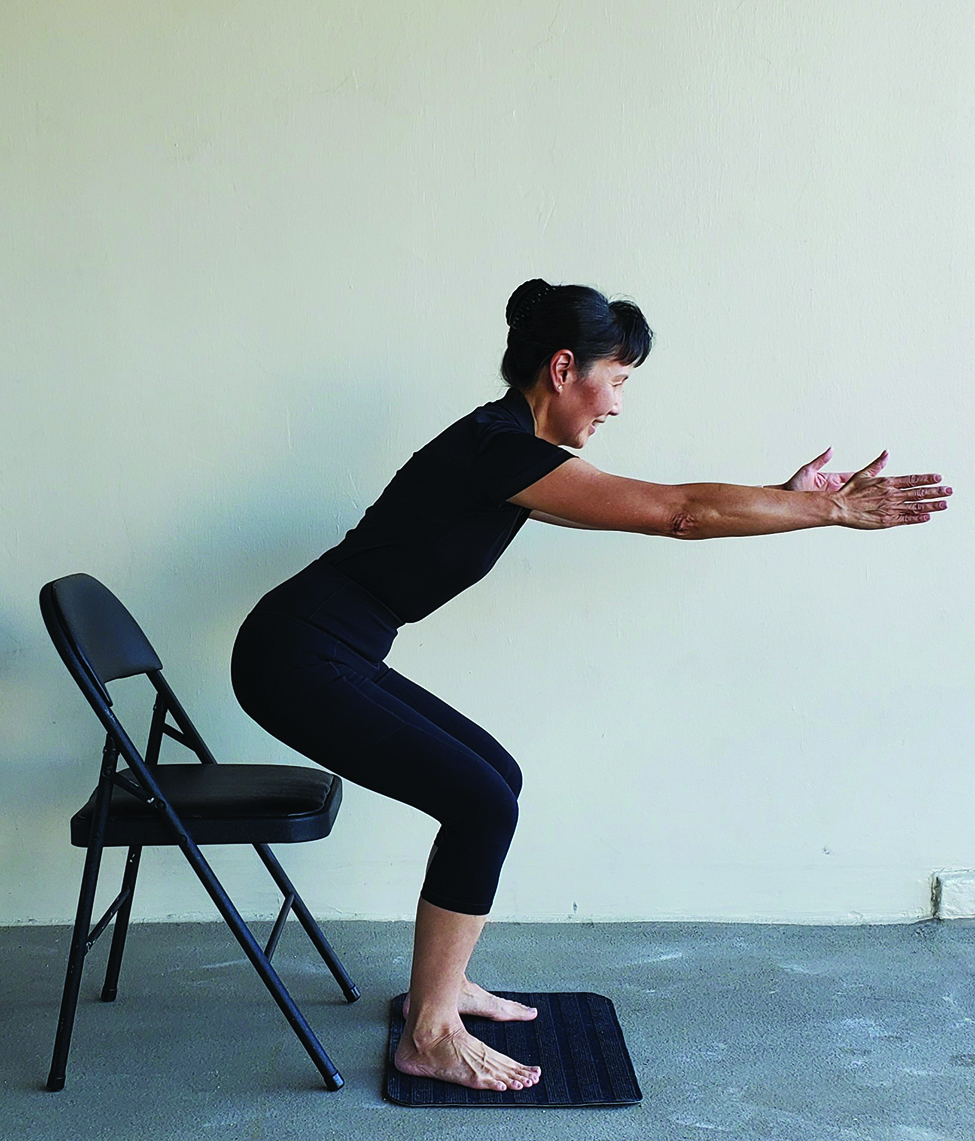
People of all ages should learn the proper way to do a “functional or modified bodyweight squat.” This movement is used in many daily activities — from getting up from a chair to lifting a grandchild. It is not a knee bend. Instead, bend at the hips, keep your back straight and push your butt back, allowing your knees to bend while keeping your weight on your heels. This protects your knees, strengthens your leg and butt, and keeps your bones strong. Repeat this squat five times whenever you sit and you’ve got the start to a great workout! It’s never too late or too early to begin a fitness routine and it can be as easy as transitioning from sitting to standing up.
Why is it important that seniors continue to work on their fitness? It’s always important to remain active to stay healthy and strong. Regular exercise is also great for brain health, boosting mood and energy, and speeding up recovery from an injury or illness. “Use it or lose it” applies to balance skills, agility, muscle…
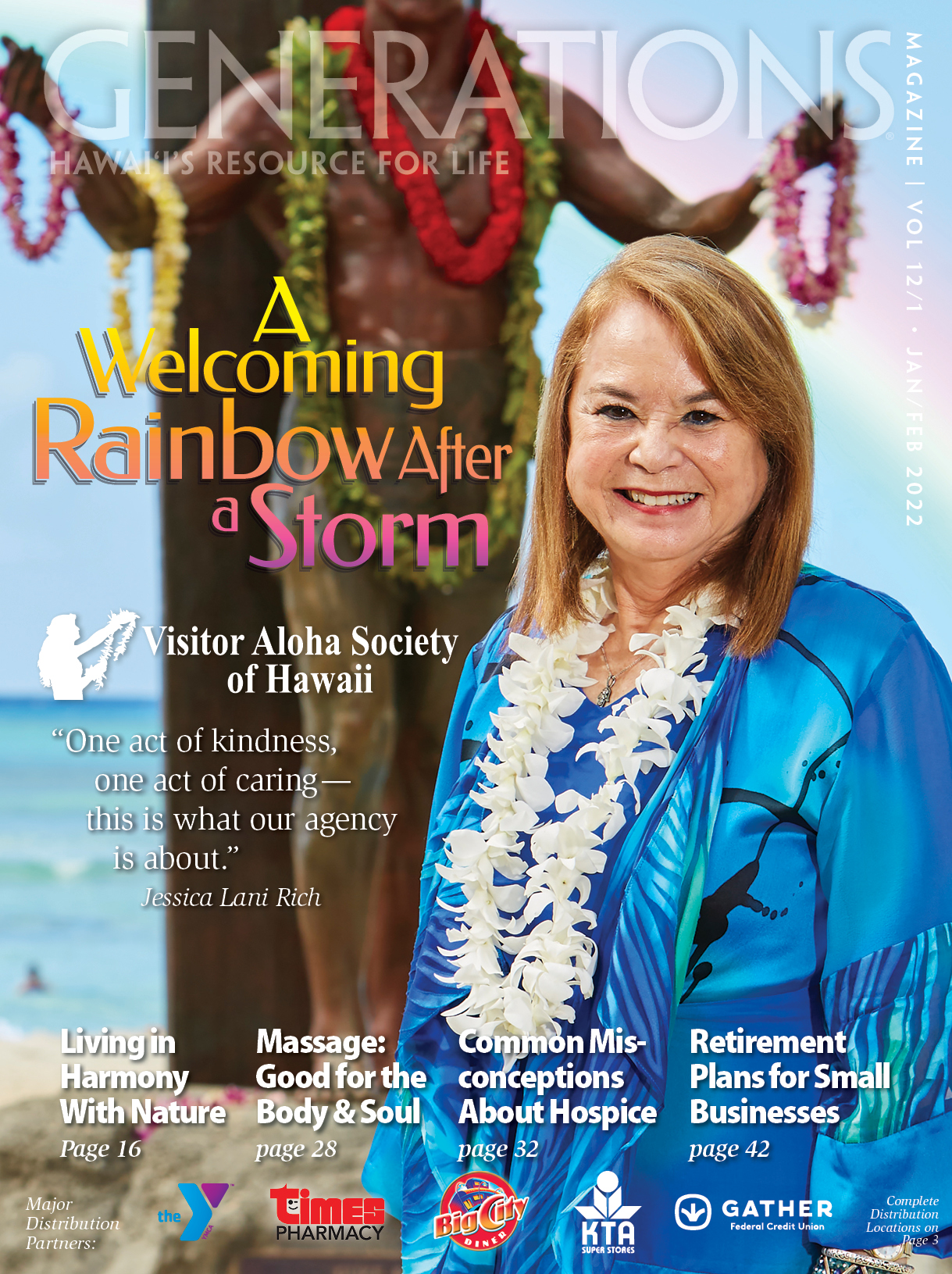
When the phone rings at Jessica Lani Rich’s office, it can be a really bad thing. And her phone rings a lot. Sometimes, the police call to tell her about a crime or a tragic accident. Other times, a social worker will call about an illness, an injury or even a death. And each time she answers the phone, Jessica answers the call. As president and CEO of the Visitor Aloha Society of Hawai‘i (VASH), Jessica leads a team of trained volunteers who provide comfort and support to visitors who have been victims of a crime or other adversity, and help them create a positive memory of their stay in our islands.
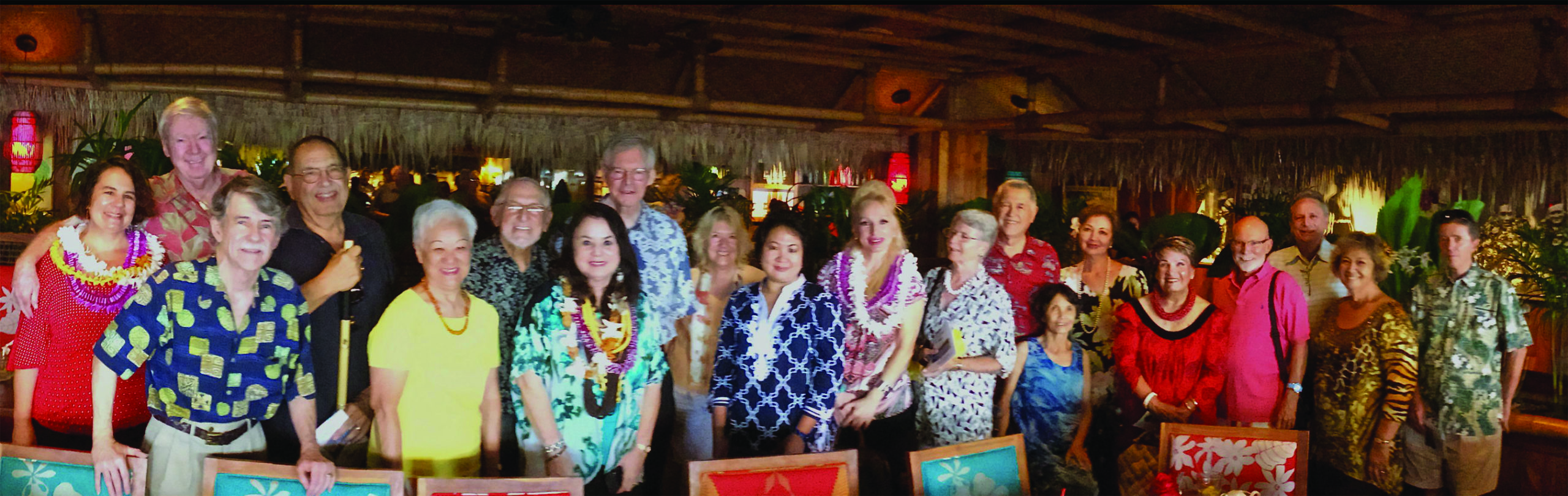
VASH has a dedicated cohort of trained volunteers. Most are lifelong Hawai‘i residents, several speak more than one language, many are seniors and each one finds the work to be very rewarding (2014 photo).
E Komo Mai: Welcome
Born in Hawai‘i and part Native Hawaiian, Jessica Lani Rich has devoted her life to helping others. For more than 20 years, she’s come to the aid of travelers who’ve found themselves in crisis thousands of miles from home — serving as chairman of the board at VASH for three years before becoming president and CEO.
“I care about our visitors,” says Jessica. “They’re hard-working people who save their money all year to visit Hawai‘i.” And the last thing they should expect is to be involved in a crime or an accident. But when something bad happens, the staff and volunteers at VASH do their best to make the travelers feel comforted, cared for and welcomed.
In 2019, the Visitor Aloha Society of Hawai‘i was called on to assist 1,897 visitors for incidents of theft, robbery, car break-ins, medical emergencies, drownings, near-drownings, deaths and more. “At first, people are angry or crying or distraught,” Jessica says. “You know, when they take your wallet and you’re on vacation, you feel violated. And when you feel violated, if someone shows up and takes care of you, makes sure that you’re alright, and walks you through the pain and the process, and makes you feel loved and cared for, you leave here with a different attitude.” And that’s really the bottom line.
“When we take one bad experience and turn it to good,” says Jessica, “the majority leave here feeling the aloha spirit.”
Tragedy Strikes
Scary Hawaiian Skies
One of the most memorable stories began with a fatal plane crash.
A 12-year old girl and her father, visiting from Seattle, were passengers onboard a glider that got caught in a wind and flew into the side of a mountain. While Ashley Streich and her dad were strapped in, upside down, unable to move for hours, the pilot died of his injuries.
As soon as Jessica got the call, she drove Ashley’s mom to The Queen’s Medical Center. “We didn’t know what condition they’d be in,” Jessica says. “Her heart was pounding. My heart was pounding, because we didn’t know.”
On His Last Leg
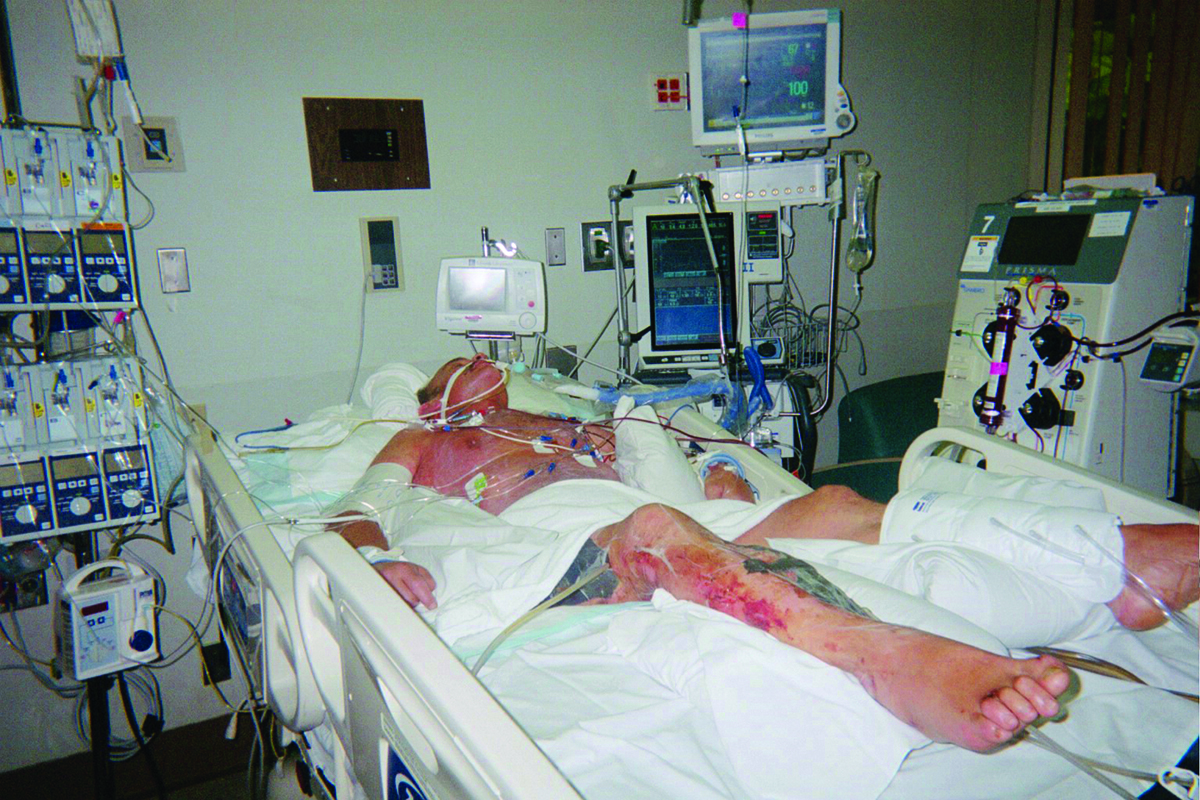
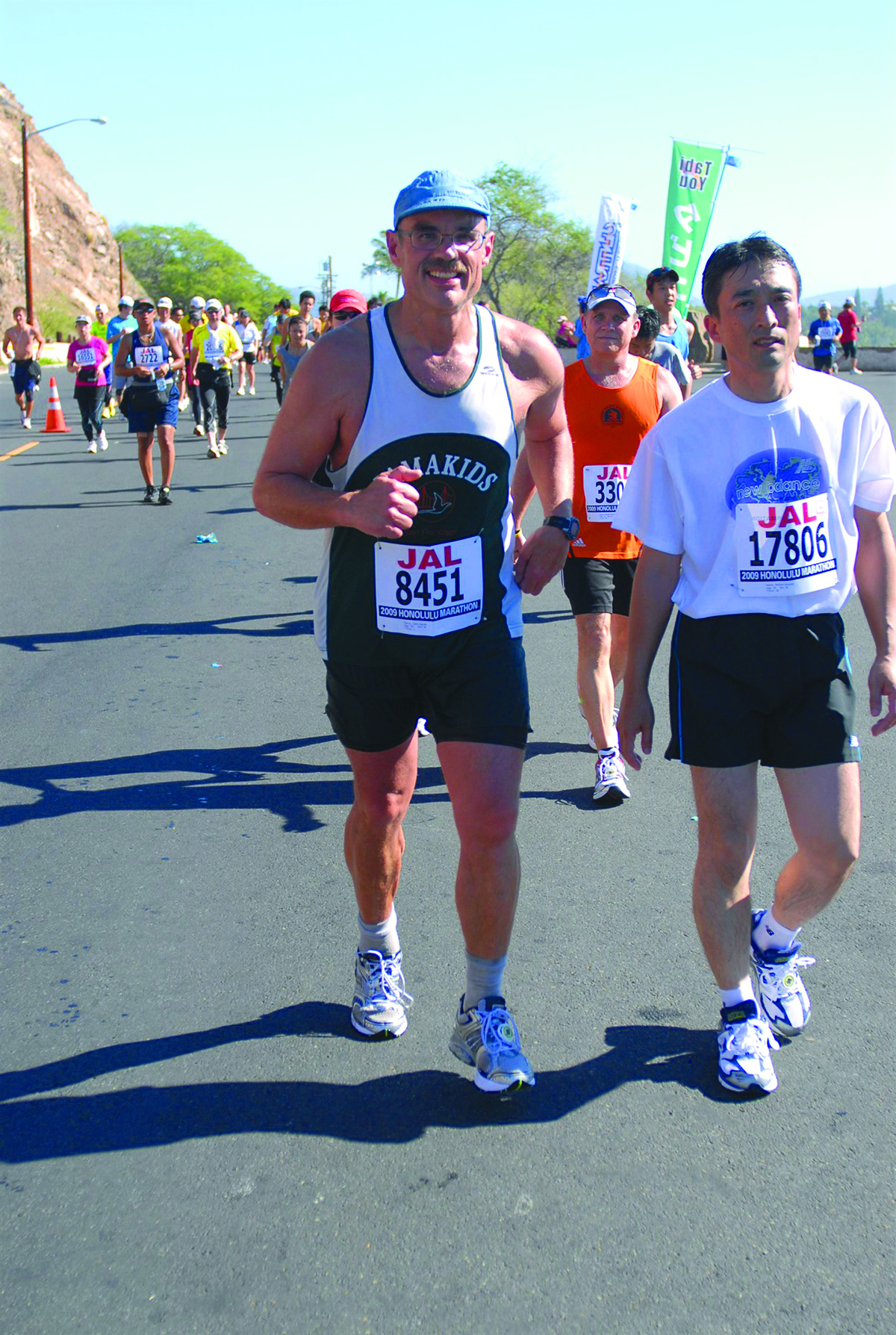
By the time Jessica met Gary Aguiar, he was near death and had been in a coma for weeks. His body was succumbing to the ravages of a flesh-eating disease. He had developed sepsis and was on dialysis. Suffering from multiple organ failure, the doctors had discussed amputating one of his legs. Yet, before all this, Gary was in top physical shape, even completing 43 marathons.
“He wasn’t expected to live,” Jessica recalls. “And we got called in to basically help the family.”
Against all odds, Gary survived that ordeal. And when he woke up at Kaiser Medical Center, he learned that he had been medevacked from Kaua‘i to O‘ahu, had spent 42 days in the ICU at three different hospitals, and at one point, had been read his last rites.
A Moment of Misery
The first time that Gizelle D’Souza met Jessica Lani Rich was a “moment of truth,” according to Gizelle’s husband, Chris. A few hours earlier, Gizelle had been brutally assaulted and robbed by an inmate who had escaped from the Waiawa Correctional Facility. The beating left Gizelle with a fractured jaw and eye socket that five years later, have still not completely healed.
“We were in an emotional turmoil,” says Chris.
Jessica Lani Rich: Her Life’s Calling
The empathy that Jessica Lani Rich feels for travelers and their loved ones comes from her own experience. “I know,” she says, “because it happened to me personally.”
Tragedy struck while Jessica’s father was honeymooning in El Salvador. She learned that her father had passed away, out of the US, thousands of miles from home, and realized there was very little she could do. “I couldn’t get a lot of information,” she recalls. “It was really a lonely feeling.”
After that experience, Jessica joined VASH and sought professional training in emergency response. “Specifically, my area of expertise is travelers; things that happen to travelers when they’re far away from home. They want someone to communicate with them, comfort them and let them know what’s going on.”
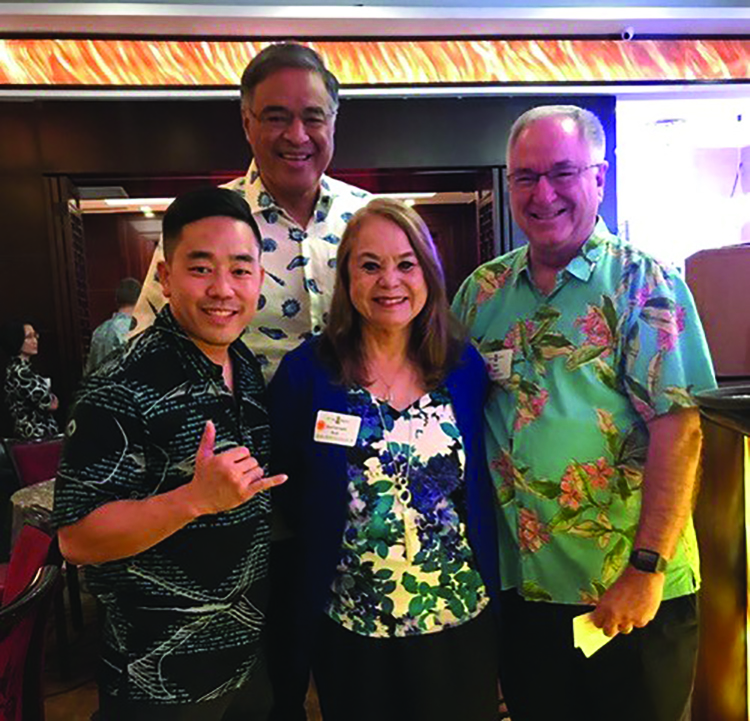
Jessica Lani Rich with Mufi Hannemann (Hawai‘i Lodging & Tourism Association president), Jared Higashi (HLTA director of Government and Community Affairs, and VASH board member), and Rick Egged (Waikiki Improvement Association president and VASH board member).
Jessica became certified in Critical Incident Stress Management by the International Critical Incident Stress Foundation, the leading organization in training emergency responders from all over the world in crisis intervention and disaster response. She also received training as a Stephen minister, which helps her comfort people in need. “Part of that training is to put your feelings aside and remember that your main purpose there is to do as much as you can for that visitor,” Jessica points out, adding that, “The professional training I received really is helpful. And I work with the most tragic situations.”
In many cases, the victim isn’t the one who needs support. “Sometimes the loved one becomes a secondary trauma victim,” Jessica notes, recalling an emotional time she accompanied the friend of a 22-year-old murder victim to the Medical Examiner’s Office to identify his friend’s body so it could be released to the grief-stricken family in California.
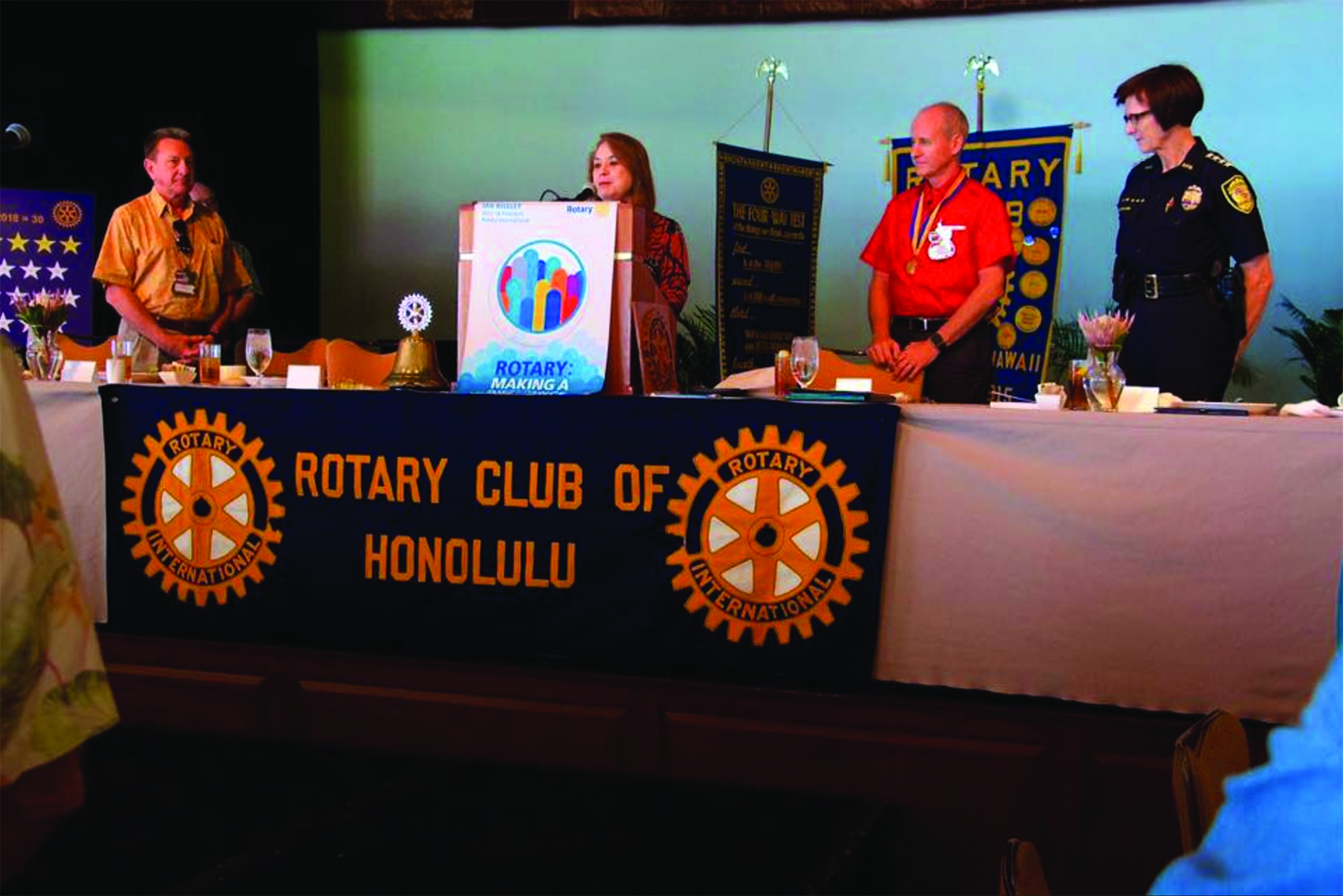
Jessica speaking to the Rotary Club of Honolulu.
Professional critical incident training has also been valuable in other cases, such as the time Jessica waited on the shore with a new bride while firefighters retrieved the body of her husband, who had drowned on the first day of their honeymoon. “You never get used to seeing someone in pain,” Jessica says softly. “What you do get used to is: I’m here to comfort them, I’m here to do all I can to show our visitors that I’m going to help them through this.”
“It’s not easy,” she admits. But fortunately for our visitors, Jessica and the volunteers at VASH are trained and ready for any number of incidents. Yet, if you look at Jessica’s background, you won’t see a straight line that brought her to the position she’s in now.
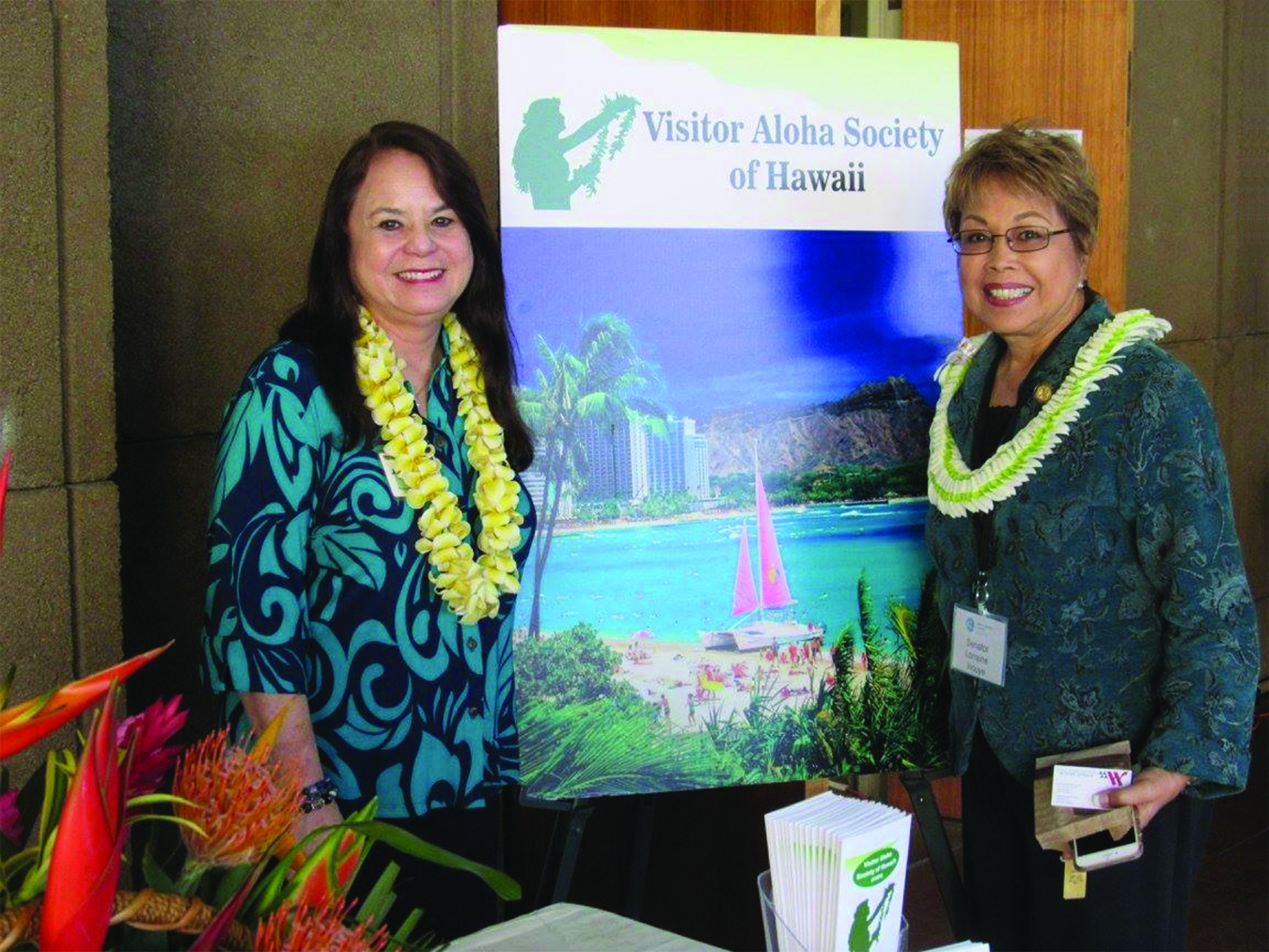
Jessica with Sen. Lorraine Inouye at the Hawai‘i State Capitol.
You might not expect Jessica’s career path to include radio announcer and news director, which she was for seven years at KUMU Radio. And you might not guess that she worked in public relations at Bishop Museum and the Honolulu Academy of Arts (now the Honolulu Museum of Art). But it’s those experiences and the skills she learned, and the people she met that have prepared Jessica Lani Rich for her role today.
“There isn’t a month goes by when somebody doesn’t say, ‘Oh, I wouldn’t have your job for anything,’” Jessica says. “And I have two responses to that. One is: Somebody needs to be there when visitors are away from home without the support of their family and friends. And the second is: Yes, it’s hard work.”
But Jessica says this is her life’s calling, “to help people in their darkest hour; to let them know that I may be a stranger, but I care. And that’s one of the things people need when facing a crisis — just to have someone there.”
Community Matters
When Jessica Lani Rich isn’t taking care of others, she’s often busy with community affairs. She proudly serves as the Pacific region representative for Travelers Aid International. She’s one of the area directors for the local Toastmasters International. She’s been on boards for the Waikiki Community Center, Rotary Club of Honolulu, American Diabetes Association and Ukulele Festival Hawaii. And she loves playing the ‘ukulele and singing with the Mele Rotarians.
Jessica is also proud of her son, the head women’s basketball coach at Mission College in California, and her husband, who’s a retired editor at McGraw-Hill and part-time English teacher at McKinley High School. Raised in California, Jessica received her Bachelor of Arts degree in communications from San Francisco State University and did her MA graduate work at the University of Hawai‘i at Mānoa.
As a passion project, Jessica produces and hosts a weekly television show that highlights people who are making a difference in the world. “I realized that life is short and I wondered what it is that I wanted to do. And I want to do something for our residents,” Jessica explains. Through the program, she’s featured more than 200 people and helped more than 60 nonprofits.
You can watch “Inspire You & Me” on the Family Broadcasting Corporation (KWHE TV-14, Spectrum Channel 11 at 8pm on Sundays) and on YouTube. “I feel that is my way of giving back to the community,” says Jessica.
After the Storm
Blue Hawaiian Skies
“We can’t take that negative experience away,” says Jessica. “It happened,” she says, referring to Ashley Streich’s plane crash.
A few days later—with no injuries beyond bruises — Ashley turned 13. When Jessica learned that the teen was a big Elvis fan, VASH threw an Elvis-themed birthday party. And filled with gratitude, the Streichs decided to continue their vacation instead of rushing back to Seattle.
When they did return home, Ashley hosted a swim-a-thon fundraiser for VASH. “I wanted to give back in some way that I could,” Ashley says. “They had just been so helpful for myself and my family.” Jessica says she was astonished by that. “A lot of times that we help people, they don’t even say thank you and you never see them again. Here, you have a teenage girl, and she was so grateful. I generally don’t see that kind of gratitude from adults.”
Today, Ashley is still an Elvis fan and still grateful to Jessica and VASH for giving her family a happy ending to their tragic visit. “She took me from crisis and trauma to feeling like I wanted to come back,” says Ashley who’s returned a number of times. Ashley’s boyfriend proposed to her here, and the two even had a Hawai‘i-themed wedding.
“Knowing that VASH was there for us was a huge comfort,” Ashley says. “In all honesty, you never want to meet them. But to know that they’re there makes it a thousand times better.” And for Jessica, “What’s emotional for me about this particular story is that on that day, “They had just been so helpful for myself
and my family.”
Ashley Streich could have died,” she says. “One act of kindness, one act of caring in a life-and-death situation — this is what our agency is about.”
Back on His Feet
Gary Aguiar would need to spend several more weeks in the hospital recovering from the ravages of a flesh-eating disease that almost took his life. When Gary’s wife and kids returned to the San Francisco Bay Area, Jessica arranged for volunteers to keep him company and lift his spirits. “That was great,” Gary remembers with a smile. “When I woke up, these VASH people were around. And the best part was “just having someone to talk to. It was kind of great, you know? Couple times a day, I had somebody showing up.”
“When I woke up, these VASH people
were around. And the best part
was just having someone to talk to.
It was kind of great, you know?”
In addition to VASH volunteers who kept Gary company for weeks, Jessica also coordinated daily visits from members of the Rotary Club of Honolulu. Gary is a Rotarian in Northern California and Jessica’s a member in Honolulu. The Rotary Club of Honolulu, the oldest and largest of these clubs in Hawai‘i, gave VASH its start in 1997, in cooperation with the Honolulu Police Department.
Those daily visits helped Gary Aguiar overcome extreme adversity and made him want to return some day. “I really like Hawai‘i,” he says with a smile. “I feel connected.”
Remarkably, within two years of nearly losing his leg — and his life — to a flesh-eating disease, Gary returned to Hawai‘i and actually completed the Honolulu Marathon.
A Moment of Magic
“Every time a business comes in touch with a customer is a moment of truth,” explains Chris D’Souza, who writes and teaches about business concepts. “That can be a good moment of truth or a bad moment of truth, or even a moment of misery. The moments of misery are the most dangerous for a business as this misery is contagious and can spread like a virus,” he cautions. “How the business handles a customer who, unfortunately, has a bad experience is important in this process.”
Gizelle D’Souza experienced a moment of misery when she was assaulted outside a restroom at Kailua Beach Park. Her husband, Chris, describes the scene as, “chaotic, miserable and uncertain.”
Fortunately for the couple from Australia, a social worker at Castle Medical Center called VASH and Jessica followed up with comfort and support. She arranged for Gizelle to consult with top medical specialists after Chris expressed concerns about possible long-term effects of the injuries. And Jessica also gave the couple tickets to spend a day at the Polynesian Cultural Center.
Gizelle and Chris are grateful that Jessica was there for them — not just on the day they first met, but again a year later, when they returned to Honolulu to testify in criminal court.
“We really appreciate all that Jessica has done for us,” says Chris, adding, “She was our rainbow after the storm.”
“I would describe Jessica as an angel in my time of need,” says Gizelle.
“Sometimes I help people who say they hate Hawai‘i and never want to come back,” says Jessica. And after the incident, the couple’s adult children encouraged them to return home. But they stayed and enjoyed their visits to Kaua‘i, Hawai‘i Island and Maui, as well as O‘ahu.
“Thanks mainly to Jessica and the resilience of Gizelle, who did not want to let adversity win, we decided to continue our holiday,” says Chris. “And we are glad we did. In this decision, Jessica played a big role, and we saw how remaining in Hawai‘i would help in our healing process.”
This is an example of how, “a moment of misery can be turned into a moment of magic,” he says. “A terrible tragic incident like the one we faced was mitigated to some extent by the healing aloha magic of Jessica and VASH. Our feelings toward Hawai‘i are so much better now.”
Gizelle agrees, saying that, “Jessica showed us the beautiful and kind side of Hawai‘i.”
“We really appreciate all that Jessica
has done for us. She was our rainbow
after the storm.”
For VASH, stories of success can often be stories of resilience and overcoming adversity. And for Jessica Lani Rich, the true measure of success is in the gratitude that people share in return, as well as their desire to return to Hawai‘i, even
after they experience a crisis here. Sometimes, Jessica adds gratefully, “They even look at me and our volunteers as forever friends.”
DONATIONS: The Visitor Aloha Society of Hawai‘i is a private, 501(c)(3) nonprofit organization funded by the Hawai‘i Tourism Authority. VASH is grateful to receive charitable donations from individuals, businesses and community organizations.
When the phone rings at Jessica Lani Rich’s office, it can be a really bad thing. And her phone rings a lot. Sometimes, the police call to tell her about a crime or a tragic accident. Other times, a social worker will call about an illness, an injury or even a death. And each time…
Two of the most frequently asked questions I hear are “How do I choose a trustee?” and “Am I choosing the right trustee?” Here are six criteria to help you choose the right fiduciary for you:
1) Do you TRUST him/her?Trust is crucial. You are trusting the fiduciary to care for you during periods of incapacity and to carry out your wishes when you pass.
2) Is he/she AVAILABLE? Ideally, the fiduciary will live near you or have immediate access to you when you need assistance.
3) Is he/she ABLE?Being a fiduciary can be stressful and require “running around” on your behalf. You will want to make sure your fiduciary is able to respect your values and beliefs so they are able to carry out your wishes.
4) Is he/she WILLING? Make sure he/she is willing to be your fiduciary.
5) Does he/she KNOW your beneficiaries? Having an existing relationship and understanding the needs of the beneficiaries is crucial to ensure the beneficiaries are taken care of.
6) Does he/she have any GHOST PLAYERS?Ghost players are people that may adversely influence the fiduciaries decision-making.
Your best choice will be a fiduciary who meets all these criteria. If no one suitable can act your fiduciary, hiring a professional third-party fiduciary to act on your behalf may be appropriate.
Two of the most frequently asked questions I hear are “How do I choose a trustee?” and “Am I choosing the right trustee?” Here are six criteria to help you choose the right fiduciary for you.
Only about 25 percent of family businesses survive for 15 years or more, and only about 25 percent of the “survivors” will survive the transition to the next generation. There are many contributing factors.
Most parents want to treat their children equally, but not all children are capable of running a business. And not all children want to continue in the family business, irrespective of their capabilities.
It is critical to take a sober look at your business and your descendants, and consider: Can my business be successful for another generation? Your business may have provided a brilliant solution to a pressing need back when you founded it, but markets, technology and spending patterns have changed since then. Unless your business is nimble enough to make adjustments, it may not continue to be viable.
Moreover, what is more important to you: the continuation of your business or passing on your wealth? These goals may go hand in hand, but if none of your children will carry on your dream, selling your business and passing on the proceeds may be your best option.
Your trusted advisors can help you leave the kind of legacy that best honors you, your business and your family.
Only about 25 percent of family businesses survive for 15 years or more, and only about 25 percent of the “survivors” will survive the transition to the next generation. There are many contributing factors.
In many parts of the country, home prices have been soaring. According to the National Association of Realtors, the median existing-home price rose more than 17 percent in the one-year period ending in March 2021. This reflects just how competitive the market has become for homebuyers.
If you are among those looking to purchase a new home, you should have a solid strategy in place before entering the market. Assume that any house you are interested in has drawn the attention of other potential buyers. In this environment, it helps to be prepared. Here are five steps that can put you in a more competitive position in today’s home buying market:
1) Get your financial house in order
A top priority is to have a good handle on your current financial situation. If you are already a homeowner, this means having a clear idea of the value your home will bring in today’s market and how much equity you have available. Another question is how much money you have set aside to cover a down payment on a mortgage or other expenses related to moving into a new place. It makes sense to sit down with your financial advisor so you are aware of your current financial capabilities to participate in today’s market.
2) Look to professionals for help
Seek out the guidance of a real estate professional. Finding an agent through a referral from someone you trust is the best way to identify a qualified agent. Don’t be afraid to interview more than one to find the right fit. Also, talk to a lending institution to get preapproved for a mortgage (if you require financing). This is especially important for first-time homebuyers who want to reassure sellers about their creditworthiness.
3) Consider all of your options
It is easy to get your heart set on a particular community or neighborhood. If the supply is limited in your targeted areas, you may need to expand your horizons. Drafting a list of the priorities that define your ideal home and setting can be helpful when reviewing available properties and narrowing down your choices. It can also open doors to other areas that may meet your needs. Also, be careful not to get too set on what you may imagine to be your “perfect” home. Flexibility is important in today’s market.
4) Set a budget and prepare to work with it
A deciding factor in assessing the affordability of a home is to calculate the maximum monthly mortgage payment and property taxes that can fit into your budget. This will help you determine a realistic price range for your circumstances. It is becoming more common today to see home prices bid up beyond the asking price. To prepare for that possibility, you might want to lower your sights a bit to make sure homes you are pursuing stay within your budget, even if you have to offer more than the list price of the home.
5) Be patient and persistent
Buying a home in such a competitive marketplace is not likely to happen overnight. The process may take some time. In many markets, there are a fair number of potential buyers for quality homes. Sellers have the upper hand right now. It may become frustrating at times, but persistence is necessary to find the right property and be in a position to present the winning offer. If buying a new home is a priority for you, stay committed to the idea and have faith that the right opportunity will come along at the right time.
In many parts of the country, home prices have been soaring. According to the National Association of Realtors, the median existing-home price rose more than 17 percent in the one-year period ending in March 2021. This reflects just how competitive the market has become for homebuyers. If you are among those looking to purchase a…

 As we age, we’re faced with the dilemma of where and how we will live during the next phase of our lives. One of the most frequently asked questions is, “How do I know when it’s time to move?” Here are some questions that may help you to self-discover when it’s right for you: