
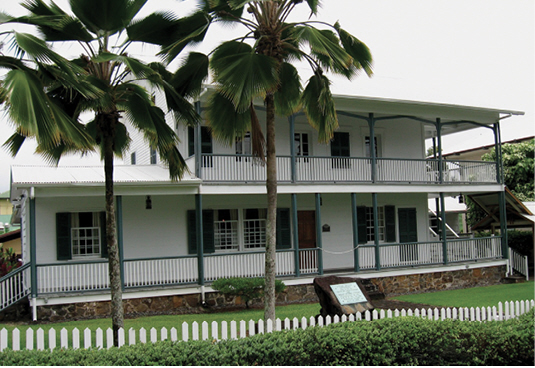
A few blocks mauka of Hilo Bay at 276 Haili Street is a white frame building with dark green trim and a surrounding veranda upstairs and down, in the style of nineteenth-century New England homes. A guided tour of the Lyman Mission House, listed on both the National and State Registers of Historic Places, gives visitors a colorful and accurate look at missionary life in 1800s Hilo. The Lyman Museum, which includes the adjacent Mission House, is one of only four accredited museums in Hawai‘i and is also a Smithsonian affiliate.
Sarah and David Belden Lyman were educator-missionaries of the American Board of Commissioners for Foreign Missions (ABCFM) in Massachusetts, assigned to the Hilo Mission in 1832. The very first missionary station in East Hawai‘i, the Hilo Mission had been established in 1824 at the village of Waiakea. The Lymans entered the Hawaiian mission field at a time of the “Second Great Awakening,” when thousands of converts were filling new churches throughout the Islands, including Hilo’s own Haili Church, founded in 1824. By 1840, over 90 percent of Hawaiians throughout the Islands attended Sunday services every week.
The Lymans also built a large thatched-roof meeting hall where they held religious services and educational programs each week. Later, as seasoned teachers, they were commissioned by Kamehameha III to found and administer the Hilo Boarding School for Hawaiian boys and young men. Native Hawaiians responded so favorably to missionary training in reading and writing that Hawai‘i became the most literate country on the planet.
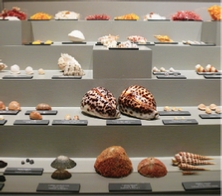
The Lyman Museum was established in 1931, with natural and cultural history collections housed in the Lyman family home, and a mission “To tell the story of Hawai‘i, its islands and its people.” In 1971, an adjacent museum building designed by architect Vladimir Ossipoff was constructed, and all the holdings were moved to this secure space with controlled environmental conditions and expanded room for exhibits. The Earth Heritage Gallery showcases the geological beginnings and natural habitats of the islands, while the Island Heritage Gallery tells the stories of the peoples and cultures of Hawai‘i. The Lyman Hawaiian shell collection is renown. The Museum’s collection of gems and minerals is the life’s work of a Lyman great-
The Museum upholds the Lyman tradition of lifelong learning by regularly hosting educational programs on the natural, cultural, and social history of Hawai‘i, engaging and informing the community and visitors alike. In October, local island historian Boyd D. Bond will present “A Broad History of Hawai‘i Island”; later in November, he will talk story about the complex life and colorful reign of Kauikeaouli (Kamehameha III).
For information on the many educational opportunities:
Lyman Museum, Hilo
808-935-5021 | www.lymanmuseum.org
 For many people, a pet is their best friend and loyal confidant. Losing a loved one is never easy, especially when you have to make the difficult decision of saying good-bye because your pet is suffering, or no longer enjoying a good quality of life. The Hawaiian Humane Society offers euthanasia and cremation services for pets who are ready to cross the Rainbow Bridge.

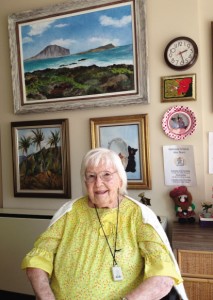 She and her late husband, Ralph came to Hawai’i from San Diego, California in 1962 when he was assigned to a US Department of Defense position. After her late husband’s death in 1999, she followed her longtime interests in oil painting, sewing, reading, and cartooning. Later, as a painter, she sought out people engaged in activities and based her paintings on photos with subjects ranging from people enjoying favorite pastimes at the beach or taking walks in Arcadia’s gardens where she resides to tourist attractions and peaceful landscapes.
 The Hawaii Chapter of the National Parkinson Foundation (NPF) is inviting the people of Hawai‘i to get ready to move on Saturday, October 25th at 9 am – noon at Honolulu Hale Civic Grounds for the 2nd annual Moving Day Hawaii. Moving Day events are held around the country to raise awareness about Parkinson’s disease and funds for Parkinson’s research and NPF programs.
 Moving Day Hawaii will feature a Movement Pavilion with yoga and hula, 3K walk, health fair and a kid zone. The event is designed for people living with Parkinson’s disease, their caregivers, friends and families. Studies show movement is beneficial and proven to help manage symptoms of Parkinson’s disease, improving flexibility and mobility. Vigorous exercise, such as biking and running has been shown to potentially slow down or delay progression of the disease. The aim is to encourage people to stay active and move for better health.