Category: Articles

  • Each Other – A Book Club’s Greatest Benefit

    Each Other - A Book Club’s Greatest Benefit
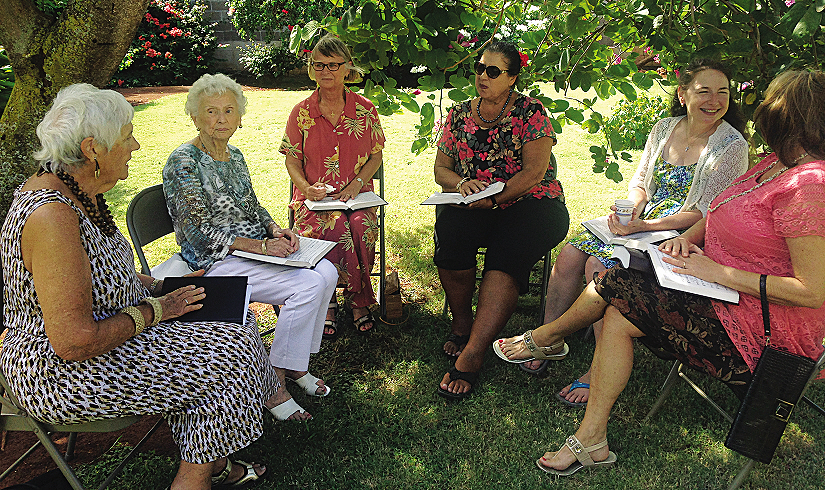
    Photo courtesy of Honu Media, LLC

    We age like a book and advance, hopefully, toward maturity through the rise and fall of the turning pages of our lives. Consequently, when members of the West Maui Book Club come together to discuss a novel, we’ll often share\ relevant chapters of our personal stories. For us, this is the greatest benefit of all.

    Kelli Lundgren, a member since 2013, says, “Since joining, I’ve listened to stories of personal travel to South America and Malaysia. Members shared accounts of being stranded in politically tense areas of the world and in compelling cultural and political experiences.” It “stirs the soul.”

    Mihaela Stoops, a member since 2011, adds, “This book club satisfies my need to have an intelligent conversation. It stimulates and challenges me, makes me learn new things and gives me new perspectives.” It’s “awesome.”

    Victoria Caputo, a member since 2010, says that at any age, a book club provides brain wellness through conversation and critical thinking.

    And according to Diane Pure, an original member in 2005, the West Maui Book Club creates a sense of community and support for one another. She enjoys sharing social time with talented women from different life and work experiences.

    Yes, we love to read and discuss our book selections, but sharing relevant wisdom gained through the saga of our lives is the greatest benefit of any book club. So why not join one and experience how your gained insights can help others? In return, expect your life to be enhanced by other members in new and thought-provoking ways.

    “There are no faster or firmer friendships than those formed between people who love the same books.” — Irving Stone


    WEST MAUI BOOK CLUB
    www.westmauibookclub.com
    Info@westmauibookclub.com
    We age like a book and advance, hopefully, toward maturity through the rise and fall of the turning pages of our lives. Consequently, when members of the West Maui Book Club come together to discuss a novel, we’ll often share\ relevant chapters of our personal stories. For us, this is the greatest benefit of all.…

  • It’s Never Too Late to Take the High Road

    Four mature Native Hawaiians, including two retirees, recently were ordained as deacons of the Episcopal Diocese of Hawai‘i. In the spring, “God willing and the people consenting,” they will become Episcopal priests.

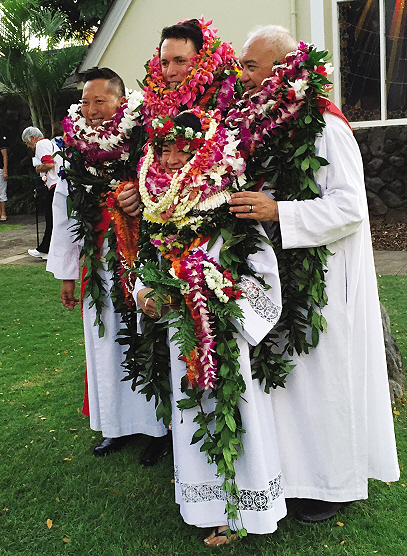
    (L–R) Phyllis Mahilani “Mahi” Beimes (in front, among the lei), L-R: Malcolm Keleawe, Paul Nahoa Lucas, John Hau‘oli Tomoso, Episcopal Deacons
    (L–R) Phyllis Mahilani “Mahi” Beimes (in front, among the lei), L-R: Malcolm Keleawe, Paul Nahoa Lucas, John Hau‘oli Tomoso, Episcopal Deacons

    Phyllis Mahilani “Mahi” Beimes is the first Native Hawaiian woman to be ordained in the worldwide Anglican communion. After she retired as a Pearl Harbor submarine electrician, her congregation called her to enter the priesthood. She and her husband live in Kane‘ohe; their children live nearby. She is a member of St. Johns-by-the-Sea in Kane‘ohe, as is Paul Nahoa Lucas, who answers his call for the priesthood from his position as a compliance lawyer for Kamehameha Schools. He and his family live in Ka’a’awa, and his youngest son is a college freshman on the mainland.

    Malcolm Keleawe Hee comes from a Buddhist upbringing. He excels as a special education teacher, and instructs teaching majors at Chaminade University. Malcolm, his wife and their two daughters’ faminies reside in Palolo. He is a member of Good Samaritan Church.

    John Hau‘oli Tomoso is executive director of Tri-Isles Conservation and Development Council Inc. His life has been deeply connected to social work in the Hawaiian community and he serves as kahuna pule for the Royal Order of Kamehameha. A member of Good Shepherd Church, he lives in Wailuku with his wife and mother; grandchildren are nearby.

    In Hawai’i, seniors who are called to serve the church as clergy undertake rigorous study and spiritual formation without either moving to a mainland seminary or disrupting familes and careers.

    These four deacons are completing a three-year formation program on O‘ahu, meeting for 10 weekends a year. Meetings include academic courses, monthly exams, practical workshops, spiritual development and worship. Each candidate has completed two years of church fieldwork.

    When ordained as priests, they will join a regional clerical team or a congregation; later, they may be called to serve any Episcopal church in Hawai‘i; some may even get a salary. Nine more students are preparing for ordination in 2018.

    Mature deacons and priests bring to their ministries valuable lifelong experience with Hawai‘i’s varied cultures and their deep roots in the community. Native Hawaiian priests honor the tradition of Queen Emma and Kamehameha IV, who in 1862 invited the Church of England to be established in Hawai‘i.

    For further information, call Reverend Linda Decker on Maui at 808-244-4656 or email her at office@goodshepherdmaui.org.

    Four mature Native Hawaiians, including two retirees, recently were ordained as deacons of the Episcopal Diocese of Hawai‘i. In the spring, “God willing and the people consenting,” they will become Episcopal priests. Phyllis Mahilani “Mahi” Beimes is the first Native Hawaiian woman to be ordained in the worldwide Anglican communion. After she retired as a…

  • Older Adults Adapting to Limb Loss

    Older Adults Adapting to Limb LossStatistics show that a majority of U.S. patients who require an amputation are age 65 and older. Amputation will likely intensify feelings of dependency, depression and helplessness: I’m too old now to learn to live without a limb. Who cares anyway? Who knows how many years I have to live?

    Limb loss is a serious challenge, and the more flexible and open-minded you are, the more quickly your body will heal and your lifestyle will adjust.

    A positive outlook and hard work can improve one’ recovery. Take 71-year-old Paula Harris, who was struck in a crosswalk by a truck and lost part of her right foot.

    “I have always been self-sufficient and it definitely took the wind out of my sails at first,”she said. “Anxiety and thinking I’ never walk again started to go away as soon as I began physical therapy. I found a PT who listened to all I was dealing with. Her encouragement and coaching kept my eye on the prize of walking again.”

    Paula’s sense of purpose motivated her to stay active and mobile. She looked beyond her age and pushed herself to higher levels of rehabilitation —driving, dancing and golf. If you are aging with limb loss, a new amputee or a caregiver, I hope Paula’s story will inspire you.


    Moon Physical Therapy, LLC
    320 Ward Avenue, Suite 107, Honolulu, HI 96814
    Aquatic, Land-based and Manual Therapy and
    Cardiopulmonary Rehab Programs
    808-597-1005 | www.moonpt.com

    Statistics show that a majority of U.S. patients who require an amputation are age 65 and older. Amputation will likely intensify feelings of dependency, depression and helplessness: I’m too old now to learn to live without a limb. Who cares anyway? Who knows how many years I have to live? Limb loss is a serious…

  • Medicare Frequently Asked Questions

    Here are some very common questions that people ask our SHIP staff and volunteers. If you have a question, visit our website, call us or schedule an appointment. We have the answers. If you want to help your community, become a SHIP Volunteer — it’s a very satisfying job.

    THREE COMMON QUESTIONS:

    Is Medicare only for people over 65 years old?

    Most Medicare beneficiaries are over 65, but people with certain disabilities or those who have received Social Security Disability Income for 25 months are eligible too. In Hawai‘i people with Medicare range from ages 18 to 100+ years old.

    Does Medicare pay for long-term care?

    Medicare does not pay the largest part of long-term “skilled nursing” care in a facility or in the home. Custodial and Interim care are also not covered. Some Medigap or advantage plans may cover very limited “skilled nursing” care after hospital stays. Private insurers offer long-term care policies.

    Does Medicare pay for dental?

    Original/Traditional Medicare does not pay for dental care. Some Medicare health plans have some coverage or a dental rider (additional insurance) that may be purchased.


    Hawai‘i SHIP (State Health Insurance Assistance Program)
    1-888-875-9229 | 808-586-7299
    help@hawaiiship.org | www.hawaiiship.org
    facebook.com: Hawaii SHIP

    This SHIP project was supported, in part, by grant number 90SA0004-02-00 from the U.S. Administration for Community Living, Department of Health and Human Services, Washington, D.C., 20201. Grantees undertaking projects under government sponsorship are encouraged to express freely their findings and conclusions. Points of view or opinions do not, therefore, necessarily represent official Administration for Community Living policy.

    Here are some very common questions that people ask our SHIP staff and volunteers. If you have a question, visit our website, call us or schedule an appointment. We have the answers. If you want to help your community, become a SHIP Volunteer — it’s a very satisfying job. THREE COMMON QUESTIONS: Is Medicare only…

  • Live and Die Without Regret

    No matter where we stand, when people close to us die, a moment of personal truth emerges based on our perspective.

    When we lose someone dear to us, we undergo a time of deep connection to those who are still living and to ourselves. We grieve. We rejoice. We replay special moments — laughing and crying together. We feel sadness and often regret. There is no right or wrong way to endure this transition.

    Thoughts from a Daughter of a Mom

    “When my mom died, it hit me… we sat going through jewelry and clothes in her closet… Each of us sisters shared bereavement, but each of us grieved differently. We expressed disappointment and sadness, summing up the personality of Mom in our own way, voicing incomplete messages like, “‘I wish I said,’ ‘I wish I did…”.

    To live and die without regret means to take this time to work backward — to reverse-engineer those memories step-by-step and fully express our thoughts; clear up any incomplete actions that we had hoped to carry out.

    We can’t put off tending to sadness or regret because each memory can become a constant replay: “I should have, could have, would have,” cluttering our minds. Feelings often plague a grieving survivor for many years — or for life.

    Take time today to reinvigorate your relationships and connect with your loved ones by being grateful and forgiving. Live rich and treasured lives together. You can do it with a little help.


    Life Coach Village, LLC
    2383 Beckwith St., Honolulu | 808-372-3478
    ap@annettepang.com | www.annettepang.com

    No matter where we stand, when people close to us die, a moment of personal truth emerges based on our perspective. When we lose someone dear to us, we undergo a time of deep connection to those who are still living and to ourselves. We grieve. We rejoice. We replay special moments — laughing and…

  • Joint Bank Accounts: Think Twice

    Earlier, I wrote about a woman from Waianae, who added her daughter to her bank account. The daughter was to use the money to pay contractors to remodel the mother’s home. This money was solely the mother’s, but instead of helping the mother, the daughter helped herself to the money (over $200,000) and disappeared.

    After writing that piece about how parents need to call the police when their children steal from them — I got inquiries about whether it was really theft since the mother placed the daughter on a joint account. The answer is yes. If the person you add to your bank account contributed nothing to the account, and that person takes money without your permission, a theft has occurred. Access is not ownership.

    Say for example that you let your neighbor borrow your car once. You gave him a spare set of keys but never take the time to get the keys back. One morning, your car is gone. Later you find the neighbor went joy riding. He committed the crime of unauthorized driving your car, a class “C” felony. Just because you let him drive the car before, and he had access to it, doesn’t mean he now has a controlling interest in the property.

    I caution people about adding others to their bank accounts. It may seem more convenient just to put another person on a bank account instead of writing checks or giving them cash when they need money, but a person runs a risk of becoming a victim of theft and similar crimes like the one mentioned above. Even if the person you add to the joint account is trustworthy, the more people who have access to your account, the greater the risk that it will be compromised — check register errors, a lost or stolen checkbook and identity theft are examples.

    One way to reduce the risk of theft of all your money is to create a separate, joint account for a particular purpose, like paying the bills. Only deposit enough money into that account to cover the bills. For example, if your monthly household expenses are $1,000, you can have your personal account automatically deposit that sum into a dedicated joint account with your family member who will be paying your bills. This may seem like humbug to set it up, but it will be much less effort than trying to recover from a crime committed by someone who could not resist the temptation of having access to large sums of money.


    To report suspected elder abuse, contact the ELDER ABUSE
    UNIT at: 808-768-7536 | ElderAbuse@honolulu.gov
    www.ElderJusticeHonolulu.com

    Earlier, I wrote about a woman from Waianae, who added her daughter to her bank account. The daughter was to use the money to pay contractors to remodel the mother’s home. This money was solely the mother’s, but instead of helping the mother, the daughter helped herself to the money (over $200,000) and disappeared. After…

  • Stay on Your Feet in 2016

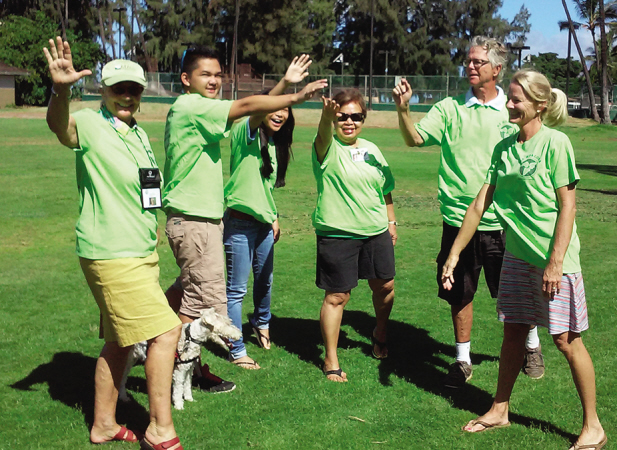
    This Na Hoaloha Team-4-Assessment includes high school students who want to “keep Tutu safe.” Since September, they have profided workshops and falls asssesments to residents of four senior housing facilities on Maui.
    This Na Hoaloha Team-4-Assessment includes high school students who want to “keep Tutu safe.” Since September, they have profided workshops and falls asssesments to residents of four senior housing facilities on Maui.

    Maui Na Hoaloha has made their falls prevention program, Stay on Your Feet, part of their regular service to clients. Teams-4-Assessment are trained to implement complete falls risk assessments, engage clients in falls prevention training and help clients physically make their living quarters safer. The need is great. Na Hoaloha is seeking more volunteers.

    Na Hoaloha currently services 440 home-bound clients with 200 trained volunteers. Their intergenerational approach allows young people to work with Stay on Your Feet assessment teams. Falls are the leading cause of fatal and non-fatal injuries in seniors, so this progran can decrease hospitalizations and deaths due to falls.

    Persons who have fallen once are at risk to fall again so the Team assesses fall history, medications, fitness, balance and vision. Teams also provide clients with nightlights, ensure pathways are clear and safe, and help clients plan for grab bar installation.

    “Na Hoaloha serves the highest risk seniors who wish to stay in their own homes and live independently,” says Candice Carter, executive director. “For a complete falls assessment, please call us.”


    NA HOALOHA
    P.O. Box 3208-61 N. Church St., Wailuku, HI 96793
    808-249-2545 | info@nahoaloha.org
    www.nahoaloha.org

    Maui Na Hoaloha has made their falls prevention program, Stay on Your Feet, part of their regular service to clients. Teams-4-Assessment are trained to implement complete falls risk assessments, engage clients in falls prevention training and help clients physically make their living quarters safer. The need is great. Na Hoaloha is seeking more volunteers. Na…

  • 2016 Tax Planning that Works for You

    Are you looking for ways to reduce capital gains tax on the sale of your appreciated assets, save and plan for the future or save on your income taxes? A planned gift can help you achieve your goals. It’s possible to increase your income now or in the future and save money on taxes — while you create your legacy and support charitable work in your community.

    Here are a few ideas to consider for year-end planning:

    • If you own low-yielding assets and want a higher income, a charitable gift annuity or charitable remainder trust may be worth exploring. In exchange for your charitable gift of cash or appreciated securities, you reap multiple benefits, including payments for your lifetime, a current income tax deduction and bypassing all or a portion of the capital gains on appreciated assets.
    • Making a charitable gift of your old, unneeded or obsolete life insurance policy can provide you with a charitable income tax deduction now and a reduced taxable estate later.
    • If your estate plans include leaving your residence to charity, you may wish to create a charitable life estate arrangement. You can make a charitable gift of your property today and receive a current income tax deduction while maintaining your lifetime use and enjoyment of the property.

    To see if these ideas may work for you, call your tax advisor.


    NATIONAL KIDNEY FOUNDATION OF HAWAII
    808-589-5976 | jeff@kidneyhi.org
    For Planned Giving: www.kidneyhawaii.org
    Main: www.kidneyhi.org | www.kidney.org

    Are you looking for ways to reduce capital gains tax on the sale of your appreciated assets, save and plan for the future or save on your income taxes? A planned gift can help you achieve your goals. It’s possible to increase your income now or in the future and save money on taxes —…

  • Cops, Killers and Corruption in the Aloha State Sunny Skies, Shady Characters

    Cops, Killers and Corruption in the Aloha State Sunny Skies, Shady CharactersIf truth is stranger than fiction, then this book is the strangest you will ever read. James Dooley, a former investigative reporter for The Honolulu Advertiser, KITV 4 News and Hawaii Reporter, details public corruption and criminality in Hawai‘i during the 70’s and 80’s. A lot of Dooley’s sleuthing formed the basis of the original essay called “Broken Trust,” printed in the old Honolulu Star-Bulletin and later published as a book. Dooley’s gripping memoirs of ties among celebrities, Teamsters, politicians and judges weaves a broad web of “how things were done in Hawai‘i.”

    Advertiser readers will remember crime stories about Kukui Plaza, Bishop Estate Trustees and a gangland hit on the son of Honolulu Prosecuting Attorney Charles Marsland, Jr., but Dooley’s editors scrubbed some of his stories, and information, connections and associations he reveals is this memoir might be surprising. As Dooley puts it, “The stories stood on their own, but like stands of bamboo, there was a dense root system underneath that stretched over time and distance, producing new shoots in surprising places.”

    This very well written book will grab your attention. Don’t pick it up until you clear your calendar — it’s a page-turner! Available for $18.99 from UH Press; paperback and Kindle from Amazon.com.

    If truth is stranger than fiction, then this book is the strangest you will ever read. James Dooley, a former investigative reporter for The Honolulu Advertiser, KITV 4 News and Hawaii Reporter, details public corruption and criminality in Hawai‘i during the 70’s and 80’s. A lot of Dooley’s sleuthing formed the basis of the original…

  • Honey, Will You Sign Me Up for Smart911?

    Register now for Smart911!™ Already, 1700 O‘ahu residents are signed up for this free program that saves lives, by filing important emergency information with Smart911.

    Honey, Will You Sign Me Up for Smart911?911 dispatchers need callers to give them vital information so they may dispatch EMTs and Firemen to emergencies. Many victims cannot give proper information: little children, victims of heart attacks and strokes, people who are choking, people who don’t speak English, or cannot hear what 911 is asking. Dispatchers lose precious minutes attempting to find out a callers’ exact location and information. With Smart911, they already know where you are and what medications you take. For elderly persons living alone, Smart911 is a very important breakthrough.
    However, sign-up for Smart911 is online and requires either a computer or a smartphone. So when your family asks you what you want for Christmas, tell them the best gift they can give is to help you sign up for Smart911.

    How It Works?

    You register critical information with 911: your disability, chronic disease or important medications. If your home is difficult to find or access, give 911 directions. Tell them if you have a dog. Tell them if you are not able to answer the door. In an emergency, 911 will be able to get to you without delay.

    If you are caregiving a loved one, helping them register for Smart911 is the most important holiday gift you can give.


    Register now at www.Smart911.com.
    For general assistance with the HPD: 808-529-3111.

    Register now for Smart911!™ Already, 1700 O‘ahu residents are signed up for this free program that saves lives, by filing important emergency information with Smart911. 911 dispatchers need callers to give them vital information so they may dispatch EMTs and Firemen to emergencies. Many victims cannot give proper information: little children, victims of heart attacks…

  • Book Review: A Nutritional Approach to Alzheimer’s Disease

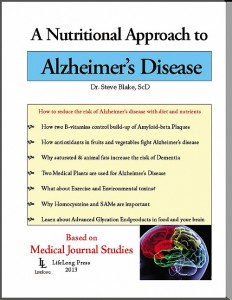
    Book Review: A Nutritional Approach to Alzheimer’s DiseaseWhen it comes to Alzheimer’s disease, anything that offers hope gets attention. Dr. Blake analyses the latest scientific information and results from his clinical trials with Alzheimer’s patients at Hawaii Pacific Neuroscience Institute on O‘ahu, and dishes us up a simple diet — berries, green vegetables, nuts and beans — to prevent and slow the progression of Alzheimer’s and related dementia. The subject is rocket science, but his book is easy to understand. Learn how powerful flavonoids in plant foods preserve brains cells and keep them active. See how how antioxidant vitamins protect our brain cells.
    One indicator of Alzheimer’s disease is the presence of amyloid plaques, little fuzz balls that get stuck in the brain and kill off brain cells. He explains ways to reduce these brain plaques, including taking vitamin B12 (little tabs that melt under your tongue, not pills) and eating plenty of green vegetables.

    Clogged brain arteries and tiny strokes cause trouble too. If we eat fewer animal fats, blood flow to our brains will increase. If you need a reason to improve your diet, this is it.

    A Nutritional Approach to Alzheimer’s Disease details 15 easy nutritional changes to help delay memory loss. Softcover book ($25) or PDF download ($9.95) are available at www.drsteve.com. Or by calling Lifelong Press, 808-280-6865.

    When it comes to Alzheimer’s disease, anything that offers hope gets attention. Dr. Blake analyses the latest scientific information and results from his clinical trials with Alzheimer’s patients at Hawaii Pacific Neuroscience Institute on O‘ahu, and dishes us up a simple diet — berries, green vegetables, nuts and beans — to prevent and slow the…

  • How You Can Reverse Aging and Disease

    At the end of the year, we realize that another year is going by, and chronologically, we’re a year older. Can we stop that clock and reverse our biological aging this coming new year? The answer is easily “yes” if we make a new year’s resolution to do so and stick to it. This article will get you started with the latest anti-aging tips; we’ll learn more in future issues. Here are three simple steps:

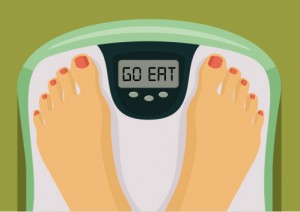
    1. EAT MORE TO WEIGH LESS.

    How You Can Reverse Aging and DiseaseYears ago, I pioneered a concept of eating more to lose weight. The effectiveness of this approach has withstood the test of time. Some of my patients report losing over 50 to 100 pounds over the years simply by using my food “Mass Index” table that shows which foods will help you to lose weight. This table can be found in most of my books, such as the Eat More, Weigh LessR Diet and my latest book. the “Peace Diet™.” For a sample of this table, go to www.askdrshintani.com and we’ll email it to you.

    2. EAT COLORFUL FOOD.

    How You Can Reverse Aging and DiseaseIn Japan, they say we should first “eat with our eyes.” In other words, food should be presented in a visually pleasing manner. This turns out to be great advice to help slow and reverse the aging process. The more colorful your food, the more anti-aging nutrients it is likely to contain. For example, green foods tend to have lutein and zeaxanthin, powerful antioxidant nutrients that prevent aging. Yellow and orange vegetables and fruit tend to have lot of carotenoids that help with vision, skin, heart and the immune system. Red vegetables tend to have lycopene, which can protect against some cancers — notably prostate cancer — and may also help to protect the brain. Blue and purple vegetables and fruit have anthocyanins, also known to help prevent memory loss. Purple-red vegetables and fruit such as grapes and blueberries have resveratrol in them that can protect the heart. In future articles, I’ll cover these nutrients in detail and explain what foods are rich in these and other anti-aging nutrients.

    3. ADOPT AN ANTI-CANCER LIFESTYLE.

    How You Can Reverse Aging and DiseaseCancer is now close to becoming the No. 1 cause of death in the U.S. It seems like we see more cases of cancer than ever before. In addition to smoking and alcohol consumption, diet and lifestyle factors may play as great or greater roles in causing cancer. Recently, the World Health Organization (WHO) came out with a statement that processed meats increase the risk of cancer. So avoiding processed meats would be a good health habit, in addition to eating colorful food.

    To start off the new year, make a resolution to get younger. You can start out by “losing weight by eating more” using my food “Mass Index” table. Then start reversing age and disease by eating more colorful foods and developing anti-cancer lifestyle habits. Call for more information.


    WELLNESS CENTER
    COMPLIMENTARY & ALTERNATIVE MEDICINE
    600 Queen St., Ste. C2, Honolulu HI 96813
    808-628-8784 | www.askshintani.com

    At the end of the year, we realize that another year is going by, and chronologically, we’re a year older. Can we stop that clock and reverse our biological aging this coming new year? The answer is easily “yes” if we make a new year’s resolution to do so and stick to it. This article…