Does someone know where you keep your important documents? Do your loved ones know what your last wishes are should something happen to you? Do you know what to do when a loved one is faced with an emergency?
There are many sad stories about people passing unexpectedly with no one knowing what that person’s wishes were or anything about their paperwork. Was there a will? Where might it be? What about a life insurance policy?
You can have peace of mind knowing you have protected your family and loved ones by taking the time to do a few important things.
What is appropriate for you? A will, a living trust or nothing? A will, at minimum, can name someone you trust to carry out your wishes. You can name a guardian for your underage children. A living trust does the same things as a will, but provides options for tax planning and avoids probate. In either case, consulting an attorney who specializes in estate planning will help you.
Everyone should have an Advance Health Care Directive, which informs your doctors and family about the medical treatments and life-prolonging procedures you want. This will help your family during a very difficult time and relieve them of the burden of guessing…
A Guide to Getting Affairs in Order organizes paperwork and makes wishes known.
Does someone know where you keep your important documents? Do your loved ones know what your last wishes are should something happen to you? Do you know what to do when a loved one is faced with an emergency?
Tucked in a quiet corner in Manoa Valley, Manoa Gallery is a neighborhood gem where fine arts and crafts by senior Hawai‘i artists Gregory Pai, Russell Lowrey, Cora Yee, Richard A Cooke III, Dennis Morton and Barbara Thompson reveal that inspiration and creativity never get old.
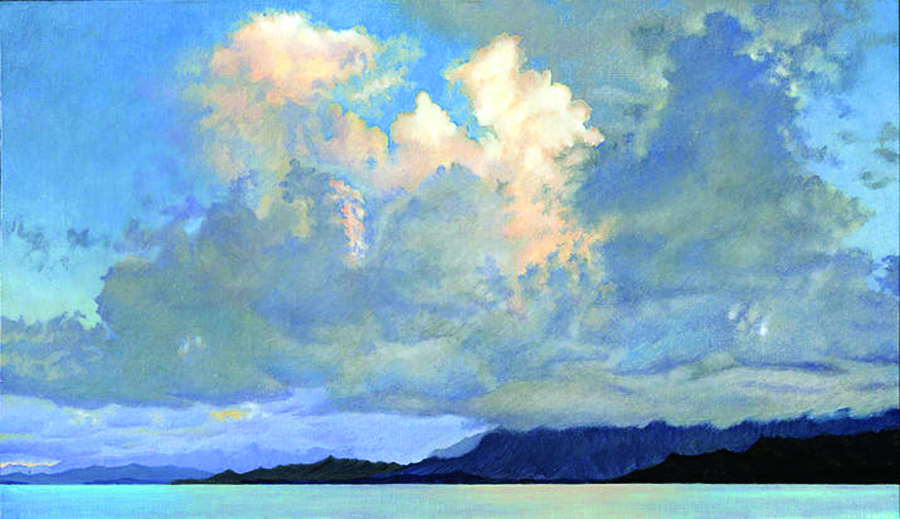
“Sunset over Kualoa,” oil on canvas, by Gregory Pai
Winner of national art awards, Gregory (born in 1945) was trained as an architect before becoming the chief economist for First Hawaiian Bank and the special assistant for Economic and Policy Affairs under two governors. Inspired by the spiritual beauty of the islands, jazz musician Gregory turned his serious attention to drawing and painting around 2000, when studying at the Honolulu Academy of Arts and the Grand Central Academy of Art in New York.
Now on view at Manoa Gallery, Gregory’s paintings capture the sublime quality of the Hawaiian skies at dusk and dawn, the embrace of mist across volcanic highlands and serene reflections in sacred Hawaiian ponds.
MANOA GALLERY
2964 East Manoa Rd., Ste. 1, Honolulu HI 96822
Tucked in a quiet corner in Manoa Valley, Manoa Gallery is a neighborhood gem where fine arts and crafts by senior Hawai‘i artists Gregory Pai, Russell Lowrey, Cora Yee, Richard A Cooke III, Dennis Morton and Barbara Thompson reveal that inspiration and creativity never get old.
by Jerome S Taniyama, Secretary, Hawai‘i Men’s Shed Association
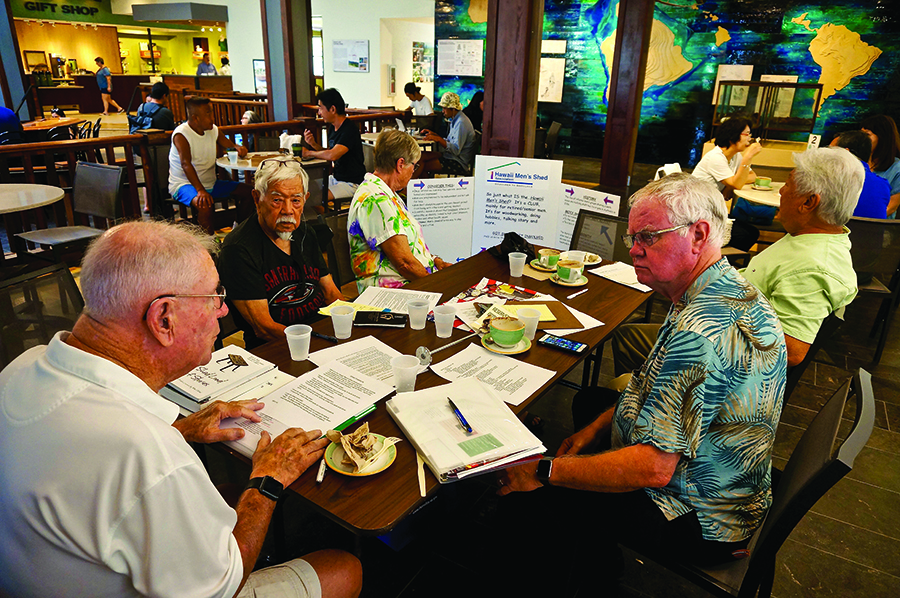
Back in late 2015 at a Rotary club meeting, I learned about the “men’s shed” program. To me, that term conjured up an image of an old workshop or storage building next to a residence. I was corrected by a fellow Rotarian who described the Men’s Shed as a club made up of senior men drawn by fellowship, and the desire to work on personal and group projects. In fact, over 10 years ago, the concept began in Australia through Rotary clubs that helped charter Men’s Shed to provide an opportunity for senior age men. There are now over 1,200 Men’s Sheds in Australia. The Australian government documented positive results in the mental and physical health of Men’s Shed members, and now provides funding subsidies to ensure their sustainability.
Men’s Shed members met to discuss the new location and a bike refurbishing project.
The Hawai‘i Men’s Shed Association officially chartered its shed on March 1, 2016, and filed legal paperwork with the state DCCA, tax office and IRS as a nonprofit. We saw no similar program or organization that would serve the social needs of senior men. Our Hawai‘i Men’s Shed is modeled after the Australian Men’s Sheds in regards to safety, daily operations and self governance. We run on a minimal budget with funds supplied by member donations and have no paid staff.
In January 2017, the Rotary Club of Honolulu Sunset adopted the Hawai‘i Men’s Shed as one of its community service projects. Our shed has also received recognition from and the support of Sen. Brickwood Galuteria, an advocate for ku¯puna services. We have also engaged in talks with Marlene Sai (at Na Ku¯puna Makamae Senior Center), the Waikiki Community Center and Kupu Hawaii regarding additional sites and programs.
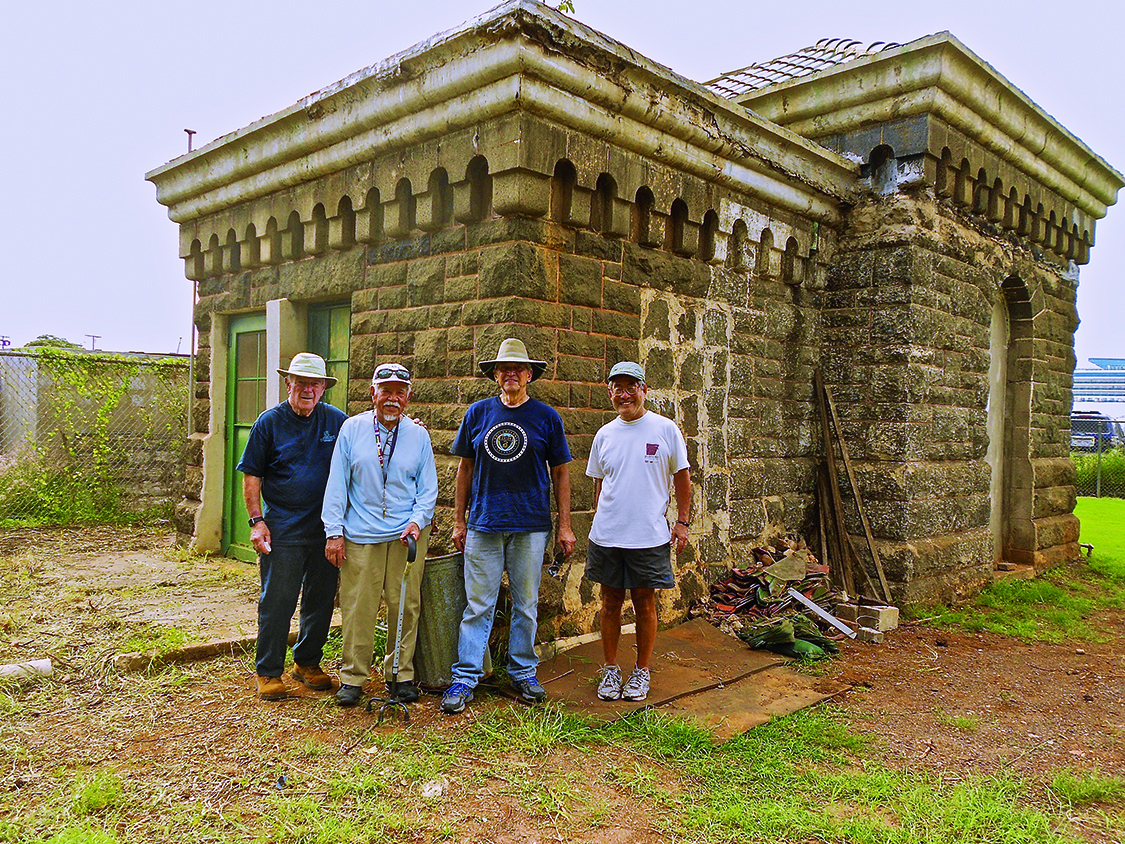
A workday project at the Na Kupuna Makamae Senior Center.
Our first shed location was at the Makua Alii Senior Center. Due to unforeseen circumstances, we vacated that site. But on Feb. 28, 2017, we rolled out a new shed site located in a DOT-Harbors warehouse at 5 Sand Island Access Road, where we plan to restore 35 used bicycles for disadvantaged youth. We are also looking toward building benches and bookshelves for our neighboring schools.
Our advisory board is made up of very qualified individuals from banking, healthcare, engineering, education, insurance, retail and wholesale businesses, as well as radio media. They have laid out a doable growth plan that includes additional shed locations, doubling our membership, community support and capital improvement fundraising for a permanent location.
We are affiliated with the Men’s Sheds in Australia, Ireland, New Zealand and the mainland, and network with them about how we can improve safety, and make our sheds more fun and viable in our community. n
Back in late 2015 at a Rotary club meeting, I learned about the “men’s shed” program. To me, that term conjured up an image of an old workshop or storage building next to a residence. I was corrected by a fellow Rotarian who described the Men’s Shed as a club made up of senior men…
by Scott Spallina, Senior Deputy Prosecuting Attorney
In the last issue, I covered the lessons my mother-in-law, “Mary,” taught me through her encounters with various scam artists she has met over the years. Unfortunately, those incidents were only the tip of the iceberg.
Shortly after Mary’s run-in with the Y2K hucksters, she met a charismatic man who advertised seminars that would “make money for attendees.” His scheme was simple — don’t pay your taxes. He claimed paying taxes was optional; nowhere in the tax code did it say you had to pay. Despite my advice, she supported this man, went to his criminal trial in federal court when he was indicted and was there when he was eventually sentenced to prison. Naturally, he claimed his conviction was the government’s attempt to stop him from “exposing the truth.” The only truth he did expose, however, was that people will believe anything — if its packaged well.
After this man’s incarceration, my wife and I discovered that we were expecting a baby. Mary wanted to insure financial stability for my growing family. She did this by investing in a local company that was going to create a website bigger than Ebay or Amazon — according to the owner. She was encouraged to bring in more people wanting to invest thousands of dollars to get in on the ground floor of this no-lose, get-rich opportunity. The contract they had her sign obligated her to pay monthly fees for their “trainings.” Although nothing else was promised in writing, verbal promises made by the owner during his speeches were plentiful. Articulate, passionate and good looking, he had hotel ballrooms filled with people applauding his high-energy speeches. Then, the government came and closed him down for illegal business practices. I suspect this was all some sort of pyramid scheme disguised as an investment opportunity. It was probably around this time I first heard the phrase, “A pretty package can hide toxic contents.”
Another time, my in-laws were fixing up a rental property and hired a cash-only repairman. They knew a friend of a friend who was unlicensed but known to do side jobs. They gave him money; he did not do the work (no contract was written up). When they hunted him down (literally) for the return of the money, he made excuses as to why he didn’t do the job but couldn’t return the cash. Because of his relationship with the family, tangential as it was, the breach of trust was more painful than that from the slick-talking con artists previously encountered.
It was this experience that led me to join a working group with the state Department of Commerce and Consumer Affairs (DCCA) to write legislation making it a felony crime for an unlicensed contractor to accept money for work.
In the next issue, I will conclude this series by sharing Mary’s encounter with a domestic terrorist group and how she invited a con artist into her home — literally.
_______________
To report suspected elder abuse, contact the Elder Abuse Unit at 808-768-7536 | ElderAbuse@honolulu.gov
In the last issue, I covered the lessons my mother-in-law, “Mary,” taught me through her encounters with various scam artists she has met over the years. Unfortunately, those incidents were only the tip of the iceberg.
It’s a gift to give… a smile, an encouraging word, a moment of your time. And the reward? The satisfaction of knowing you helped a kūpuna in need.
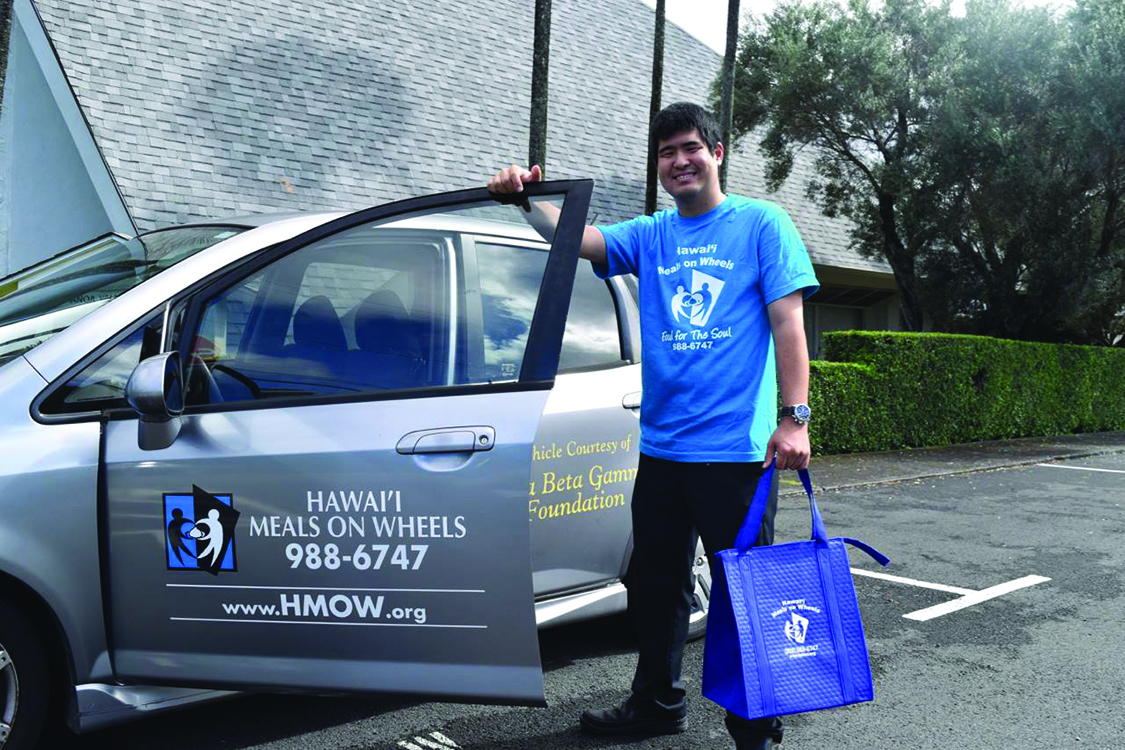
Since 1979, Hawaii Meals on Wheels has been serving hot meals to the kūpuna in need in our communities. The program started as a small committee formed by former State of Hawai‘i librarian Irmgard Hörmann and the Social Ministries Committee of the Lutheran Church of Honolulu. Over time, the organization grew as it sought to provide basic nutritional and human support to seniors who are unable to fully care for themselves. What started as two routes manned by six volunteers is now a collaborative effort involving 450 volunteers and over 50 routes that served more than 97,000 meals in 2016.
Hawaii Meals on Wheels provides hot, nutritious meals for seniors, delivering them to the homes of those who are unable to shop or cook for themselves and do not have someone currently caring for them.
By the year 2020, it is estimated that 25 percent of Hawai‘i’s population will be 60 years of age or older. Compared to the nation as a whole, the Aloha State has a disproportionately large population of seniors, many of whom may be unable to sufficiently care for themselves. Organizations like Hawaii Meals on Wheels strive to help seniors maintain a comfortable standard of living. For some who depend on these services, this may be the only meal they eat per day and the only personal interaction they experience.
Nonprofit programs such as this rely heavily on volunteer support. Not only do they help deliver meals, but they also monitor the welfare of these seniors, while providing them with interaction and companionship that many home-bound kūpuna would not otherwise receive. As the senior population in Hawai‘i continues to grow, so does the need for these services. Unfortunately, because the Meals on Wheels program relies on volunteer help, donations and government funding, not everyone who applies for the program can be accommodated. Not all seniors are fortunate enough to have family members who can care for them every day, nor are they able to afford senior care homes or in-home caregivers. Part of the issue is that those who lack the mobility, energy or capability to care for themselves are also unable to leave their homes — their struggle may go unnoticed. As a result, many people are unaware of the scope of their problems and do not reach out to help the kūpuna in their communities. However, almost anyone that wishes to lend a hand can do so in some way.
Meals on Wheels is always in need of volunteer drivers. In addition, those who wish to assist in other ways can help with the September fundraiser gala or administrative projects, or serve on the advisory panel. Meals on Wheels not only helps feed and care for our seniors in need, but also provides those who are healthy and active an opportunity to give back to a generation who once fed and cared for them.
HAWAII MEALS ON WHEELS
P.O. Box 61194, Honolulu HI 96839
Since 1979, Hawaii Meals on Wheels has been serving hot meals to the ku¯puna in need in our communities. The program started as a small committee formed by former State of Hawai‘i librarian Irmgard Hörmann and the Social Ministries Committee of the Lutheran Church of Honolulu. Over time, the organization grew as it sought to…
by Katherine Kama‘ema‘e Smith cover & feature photography by Brian Suda
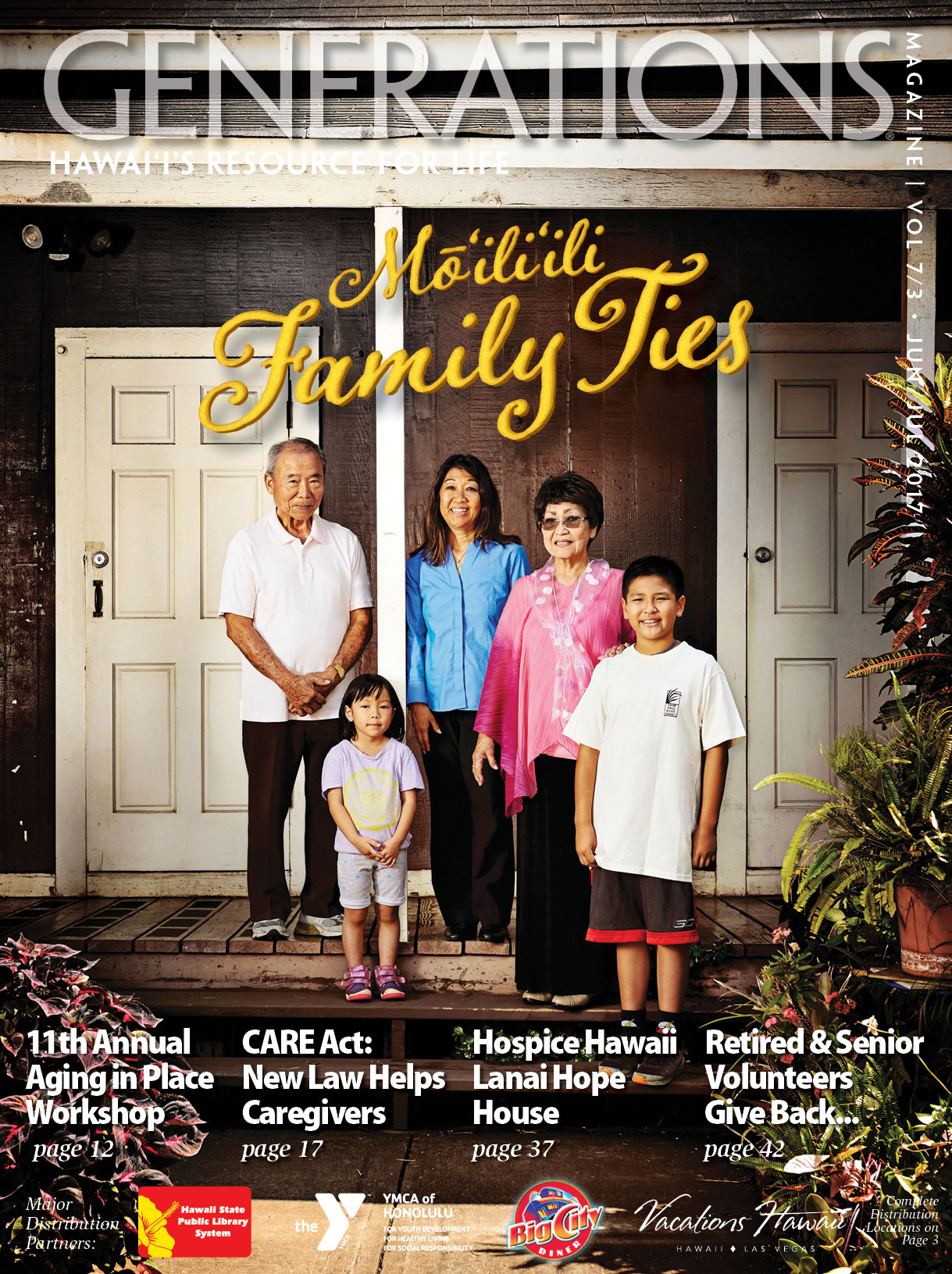
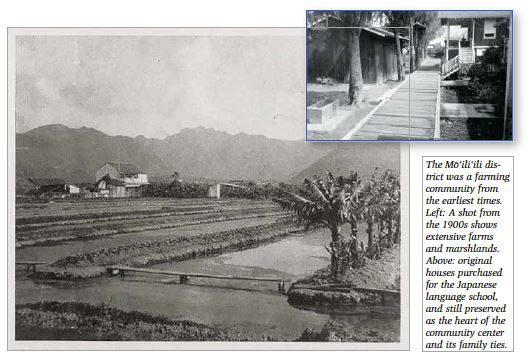
The traditions and language of the original Japanese immigrants to Hawai‘i in the late 1800s survived because they taught their children to venerate and value the culture of the homeland. In over six subsequent generations of American Japanese, no single organization has nurtured language and culture more than Mo‘ili‘ili Community Center on O‘ahu. In addition to supporting a thriving Japanese Language School for children, the center opens its doors five days a week to 300 to 500 senior members who come to participate in a wide array of arts, activities, educational programs and adult day care. This private nonprofit organization is the traditional bedrock of Mo‘ili‘ili families.
Executive Director Nadine Nishioka told Generations Magazine about the 115-year history of the center. In the 1890s, children of plantation worker families in Mo‘ili‘ili attended Japanese language school in the private home of Kihachi Kashi-wabara. Mo‘ili‘ili was a large marshland area at the bottom of Manoa Valley, behind Ala Wai (then a river) and Waikiki Beach flats. Lands adjacent to the many ponds and Kapaakea Springs were cultivated with rice, lotus and various vegetables. Along the dirt trails of this farming community were small shops and businesses, and wood-framed houses. Beside the homesteads, small plumes of smoke rose from wood stoves used for ofuros and cookhouses. Customs, foods, religious beliefs and common interests knit the residents of Mo‘ili‘ili into a harmonious community.
The Center’s Heritage
In the late 1800’s, when the sugar barons of Hawai‘i wanted to expand their plantations, they recruited farm workers and engineers from Japan. The men came first and soon brought in their wives. Freedom and work opportunities in Hawai‘i offered hope to young Japanese from a homeland ravaged by decades of war with China. Chinese invaders outlawed the practice of Japanese cultural traditions and Japanese language, so schools and temples were important features of a new life in Hawai‘i. For Japanese immigrants, plantation camps promised a second chance for success. In Mo‘ili‘ili, the community drew together and in 1928, purchased the language house and land that became the community center.
During WWII, the Mo‘ili‘ili community founded a formal council association. At that time, mainland Issei and Nisei were being interned in war camps, but in Hawai‘i, the Nisei first joined the civilian volunteer brigade and later entered the U.S. Army. The council was a hub for the community to gather and support one another. After the war, in 1945, they were awarded an official charter, and 20 years later, in 1965, this private nonprofit organization was formally named “Mo‘ili‘ili Community Center.”
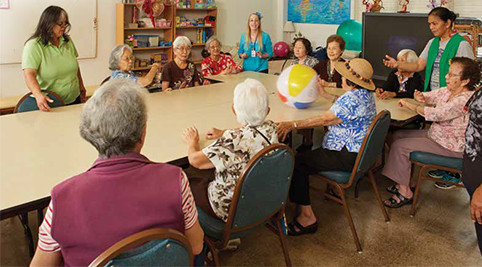
ADULT DAY CARE AND SENIOR ACTIVITY CLASSES AT MO’ILI’ILI COMMUNITY CENTER; COVER PHOTO OF BOARD MEMBERS, SENIOR AND CHILDREN ATTENDEES OF MO’ILI’ILI COMMUNITY CENTER; PHOTOS FOR GENERATION MAGAZINE
The Center Today
The business model for today’s center is simple and very successful. “Our members pay an annual membership fee that covers our overhead, salaries and operating expense,” said Nadine. “Next year, the fee will go up to $40 from $35 per person,” said Nadine. “Some seniors add a cash gift with their membership because they can afford it and they appreciate the benefits they are receiving here. For some seniors, the fee seems high but it all works out. We never turn away any seniors who may have difficulty paying the fee.” Professional planners say that successful community programs are designed and resourced at the grassroots level. Nadine agrees. She places the success of the center squarely on its members. “Our seniors know the programs they want and we just listen to them,” said Nadine. “They want mahjong, and they want it early in the day when they are alert and have a better chance of winning. They organize the games and find the prizes. Senior center staff members make sure the room is ready and oversee their plans. Mahjong starts at 7:30 am, and is so popular that our seniors are lined up and waiting in front of the door at 7 am.”
“Whenever MCC members have an idea for an activity or event, they make a plan and find the resources to put on the program,” said Nadine.
“We provide the space and scheduling and our members ensure the program or event’s success.”
One of the most popular weekly sessions is Rhythm & Life held every morning. This award-winning Japanese exercise and stretching program is designed for elders and choreographed to Japanese music. Rhythm & Life invites both actively mobile seniors (standing) and less mobile seniors (seated) to better fitness and improved blood circulation. The packed room is filled with intently engaged and happy faces as the participants work out to the beats of various rhythms and tunes. Other active options include outcome-based exercise, Zumba, classic tai chi and a special tai chi class for seniors with im-paired balance who want to rehabilitate themselves. This one is important for preventing falls. “I think one beauty of our center is that seniors who have lost a spouse or no longer live in their old neighborhoods may come here and socialize while they participate in healthy activities for body, mind and soul,” said Nadine. “We offer physical exercise, mental stimulation and ways to learn and participate, but socializing combats isolation and loneliness. Members have the opportunity to spend happy times with people who share memories of earlier times and traditional values.”
This benefit was certainly obvious to Generations staffers, who saw members chatting before and after yoga class and senior Zumba.
A display of the impressive artwork and handicrafts produced by MCC members proudly hangs in the center. It demonstrates the wonderful skills seniors can learn here. Traditional kumihimo is the art of braiding cords and ribbons. In ancient times, the samurai braided decorative laces for their armor; today, ties on haori jackets or obi kimono sashes are often crafted with kumihimo. When combined with beading, kumihimo art produces intricate and elegant bracelets. and festive dancing to enka music. Each year, Japanese teachers bring different traditional arts and crafts.
Art classes abound, with origami, shodo calligraphy and festive dancing to enka music. Each year, Japanese teachers bring different traditional arts and crafts.
Japanese Language at the Center
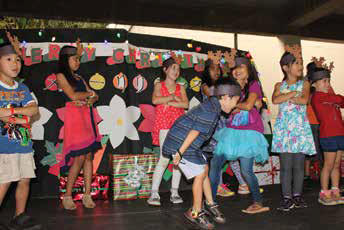
Language is the foundation of culture, and today, children are still learning Japanese at Mo‘ili‘ili. The intensely interactive program includes plays and performances that delight the whole family. The original mission of passing on the Japanese language to the next generation was a budding flower of the old Mo‘ili‘ili community. Today, the branches of that flowering plant produce a bouquet of family-based activities, arts and expressions. A few of the directors on the center’s board actually attended Japanese language classes at MCC when they were in grade school!
Today, K-5 children attend Japanese after-school classes every weekday and practice speaking Japanese with their parents, who learned it in the same facility. The whole family is able to speak Japanese with the grandparents. While many MCC programs are geared to elders, the center itself is oriented to fulfill the needs of the entire family, interacting across age groups as they do at home.
The Teens in Action program gives young volunteers in seventh grade or higher an opportunity to work as aids in the many children’s programs at MCC: After-school A+, Early Morning Care, and programs for school intercession, holidays and summer break.
Senior Programs at the Center
Cultural and community outreach events of MCC are all organized, planned and resourced by staff and member volunteers. Everyone pulls together to make the center a vibrant place where members can be proud of all they accomplish. Their volunteer work results in fun, satisfaction and benefits the community.
“Our members love singing karaoke, and performing both ‘auana hula and Japanese dance; when they learn a dance well, they like to perform it at homes for the elderly,” said Nadine.
“They recently organized performances at various senior daycare centers and nursing homes. We provide the transportation, they make their own costumes, and delight in bringing beauty and enjoyment to the other elders.” Another community service for which MCC recently became a partner is a version of Meals on Wheels. Instead of delivering meals to seniors’ homes, MCC drivers go out and bring elderly to the MCC dining hall for a hot meal. Coming to the center gives them the opportunity for socialization and conversation in a safe, happy environment. The new program is working very well. Nadine regrets that MCC does not have more space and staff for their very popular Kupuna Support Program. This adult daycare program is for frail as well as not-so-frail seniors who can use the restroom with very little assistance. They participate in a number of fun, healthy activities geared to stimulate their minds, bodies and souls. Palolo Chinese Home Catering provides a healthy lunch, which is included in the Kupuna Support Program fee — $55 a day.
“We always have a waiting list,” said Nadine. “The need for good adult care is so great that families are willing to be ‘on call’ for an opening of just one or two days when one of our regular clients is sick or traveling.”
By the end of Generation Magazine’s tour of MCC, it was clear that we could fill two issues with program details and still not cover every offering at this wonderful community center—transportation and escort services, excursions, counseling, special events and more.
Become a Center Member
If you are over 60 and live in Honolulu between Ward Avenue and Hawai‘i Kai, you are within the city area serviced by Mo‘ili‘ili Community Center. However, MCC also welcomes participants from all areas of O‘ahu. To learn more about the organization and its many programs, please visit www.moiliilicc.org.
This year, Mo‘ili‘ili Community Center is celebrating 115 years as a place of learning, health and enrichment. For many generations, the center has served families and created family ties throughout a broad community. MCC’s important work continues due to the generosity of many donors, grants and the Aloha United Way. If you wish to help them with a cash donation, remember that all donations to MCC support the programs, not the administration. Donations are tax deductible and every dollar helps the beneficiaries of the center.
MO‘ILI‘ILI COMMUNITY CENTER 2535 S King St., Honolulu HI 96826 Hours: M–F 8 am to 5 pm
808-955-1555 | Fax: 808-945-7033 | office@moiliilicc.org | www.moiliilicc.org
The traditions and language of the original Japanese immigrants to Hawai‘i in the late 1800s survived because they taught their children to venerate and value the culture of the homeland. In over six subsequent generations of American Japanese, no single organization has nurtured language and culture more than Mo‘ili‘ili Community Center on O‘ahu.
You hear it all the time: To stay healthy, we need to stay active. Yet as we get older, it can be difficult to find the energy and motivation to get out and exercise.
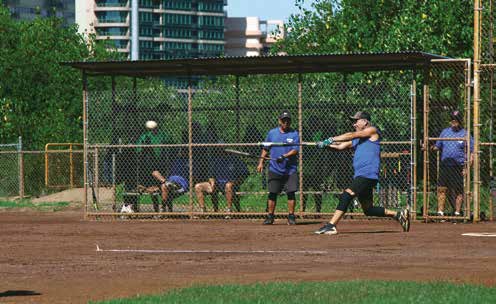
Makua Ali‘i, O‘ahu’s premier senior softball league, provides mature athletes an opportunity to stay active and social. The “slow-pitch” softball league is the perfect activity for those who miss the camaraderie and competition of their little league days.
The league is comprised of 18 teams and is open to players aged 60 and over. Each week, games are held at the Patsy T. Mink Central Oahu Regional Park (CORP) in Waipio. Game results published most Thursdays in the Honolulu Star-Advertiser. There is also a league exclusively for those 70 and over that plays on Friday mornings at Ala Wai Community Park. Even for those who are no longer able to participate in team sports, attending and watching the games is a great motivator to get out of the house and meet those who share interests and passions. After the game is the perfect time to talk story!
Francis Lum, an 80-year-old member of Waipio Makules, has been playing with the league since 1997 — 20 years and counting! Even after kneereplacement surgery, he’s still going strong and coming out each week.
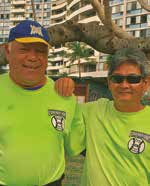
Francis Lum (left) and Danny Fujimoto (right) before their Monday game.
“I play Monday, Wednesday, Friday, then I come out practice Tuesday,” said Francis, “so that’s four days a week.”
It’s an exciting sport comprised of amazing people and a refreshing sense of community. Hearing everyone laughing, shouting encouragement and cracking jokes would make anyone passing by want
to join in the fun!
New players join the teams each season. When asked how experienced the newcomers usually are, Francis said, “It’s always different. Some people like myself — I came in and I didn’t have any experience.” For these players, it’s all about being with friends and having a good time. Of course, everyone gets older each year, so it’s good to see new faces. Francis’ advice to any one of the newbies planning on joining is “make sure you stretch good before you play. That’s the main thing.”
Sports aren’t only for the young guys. Knowledge and experience are just as important as raw strength and speed, and many of these players have more than just a few years of softball under their belts. The true test of their abilities comes during the state tournament held every year, when participating teams from O‘ahu and the outer islands compete for the championship in one of eight divisions.
Makua Ali‘i is the perfect opportunity for seniors to get much-needed fresh air and exercise in a social setting, while engaging in some fun and friendly competition.
Contact the Makua Ali‘i league to find out more about how you can join and play ball!
You hear it all the time: To stay healthy, we need to stay active. Yet as we get older, it can be difficult to find the energy and motivation to get out and exercise. Makua Ali‘i, O‘ahu’s premier senior softball league, provides mature athletes an opportunity to stay active and social. The “slow-pitch” softball league…
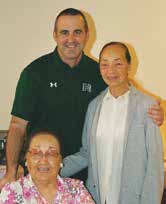
Nick Rolovich, head coach for UH-Ma¯noa, with club members of over 20 yrs., Liz Rathburn (sitting) and her sister Lydia Lake.
The Honolulu Quarterback Club (HQC), one of the nation’s oldest sports clubs, began in 1947 and is still going strong. There, you can hear little-known and personal stories from past and present sports greats. “You won’t find these sports stories on the front page of the newspapers,” said one long-time, regular attendee.
From the early days, legendary speakers came to share their remarkable stories and accolades from their respective sports. Some from the good ole days were KGU Radio’s Chuck Leahey, reporter Bill Kwon, swimmer Keo Nakama, surfer George Downey, golfers Ted Makalena and Jackie Pung, baseball pioneer and UH-famed Coach Les Murakami, and football greats “Squirmin’” Herman Wedemeyer and Rockne Freitas.
Some of the recent guest speakers have included UH coaches: Nick Rolovich, Bob Coolen, Dave Shoji, Mike Trapasso, Charlie Wade, Laura Beeman and Eran Ganot. Athletes from all islands and all sports have been guest speakers, as well as writer Dave Reardon, Star Advertiser writer Bob Sigall and broadcast personality Don Robbs.
If you are an avid sports enthusiast, sports nut or just love University of Hawai‘i sports, come on down to our Monday meetings and enjoy a wonderful Chinese luncheon buffet at a reasonable price ($15). Contact HQC for more information and upcoming speakers.
HONOLULU QUARTERBACK CLUB
Meeting: Every Monday, 11:30 am –1pm
Location: Maple Garden, 909 Isenberg St., Honolulu HI 808-220-6454 | HermanHStern@msn.com
The Honolulu Quarterback Club (HQC), one of the nation’s oldest sports clubs, began in 1947 and is still going strong. There, you can hear little-known and personal stories from past and present sports greats. “You won’t find these sports stories on the front page of the newspapers,” said one long-time, regular attendee. From the early…
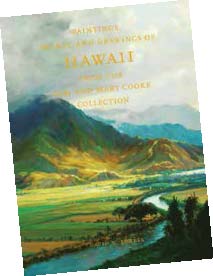
Hot off the press, Paintings, Prints and Drawings of Hawai‘i from the Sam and Mary Cooke Collection presents for the first time the private collection of Mary and the late Sam Cooke. Published by the Ma¯noa Heritage Center, this lavishly illustrated volume by David W. Forbes traces the history of Hawai‘i as seen through the eyes of western artists, from the arrival of Capt. James Cook to modern landscapes.
On the cover of the book is Hanalei Valley by D. Howard Hitchcock. It is a remarkable work— the taro fields in the center seem to glow with a spotlight of sun, echoing the luminosity of epic, 19th-century Manifest Destiny paintings by American landscape superstars Albert Bierstadt and Thomas Moran. It is just a taste of what’s to come between the covers.
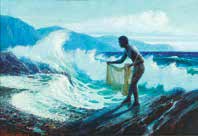
On the book cover is Hanalei Valley by D. Howard Hitchcock. Top-R.: Yellow Ginger – Koolau Cliffs by Lloyd Sexton; Bottom-R: Haleiwa Net Fisherman by Lionel Walden.
David W. Forbes said, “It’s an amazing collection. A remarkable man put together a remarkable collection, and he put it together because he had a love of this land and every work in this book shows that.”
The book is a preview of a private collection that the public will be able to see when Mary Cooke’s residence, Ku¯ ali‘i, eventually opens to the public as part of the Ma¯noa Heritage Center.
Ma¯noa Heritage Center is a 3.5-acre living classroom centered around Ku¯ ka‘o¯‘o¯, the last intact heiau in the greater ahupua‘a of Waiki¯ki¯, Native Hawaiian gardens and Ku¯ ali‘i, the Cooke’s 1911 Tudor-style home. Both Ku¯ ka‘o¯‘o¯ and Ku¯ ali‘i are listed on the National Register of Historic Places. The new 4,125-square-foot, LEED-certified Visitor Education Hale is scheduled to open this summer. Garden and heiau tours will be offered Monday through Friday by appointment.
Only 3,000 copies of the 252-page book have been printed
to date. Designed by Barbara Pope, it contains 155 stunning
images from the collection. Books are available at
the following locations:
MA¯NOA HERITAGE CENTER
Cost: $100 (Case pricing is also available) 808-988-1287 | www.manoaheritagcenter.org
HONOLULU MUSEUM OF ART 808-532-870 | www.honolulumuseum.org
LYON ARBORETUM 808-988-0456 | www.manoa.hawaii.edu/lyonarboretum
NA MEA HAWAI‘I 800-887-7751 | www.nameahawaii.com
NOHEA GALLERY 808-596-0074 | www.noheagallery.com
MA¯NOA GALLERY 808-468-2428 | www.manoagallery.com
All proceeds benefit Ma¯noa Heritage Center’s educational
mission, promoting the understanding and appreciation of
Hawai‘i’s natural and cultural heritage.
Hot off the press, Paintings, Prints and Drawings of Hawai‘i from the Sam and Mary Cooke Collection presents for the first time the private collection of Mary and the late Sam Cooke. Published by the Ma¯noa Heritage Center, this lavishly illustrated volume by David W. Forbes traces the history of Hawai‘i as seen through the…
From ProjectFocus Hawai‘i and the Wahiawa Community Based Development Organization (WCBDO) comes a visual storytelling, from both ends of life — as partners — Crossing Bridges.
On a sunny Saturday morning, students from Leilehua High School, Wahiawa Middle School, Island Pacific Academy and George Washington University sat down with 24 of Wahiawa’s most cherished ku¯ puna, who shared their stories of growing up and living in this former plantation town located in Central O‘ahu.
Life in Wahiawa has changed since its plantation days and it is for that reason Crossing Bridges was selected as Project- Focus Hawai‘i’s latest exhibit, so these memories could be captured and shared with the broader community. The exhibit title represents both a literal and figurative expression of this project. Not only does it signify the connection of bridges that bring residents and visitors into Wahiawa, it also reflects the importance of bridging generations through the sharing of oral histories.
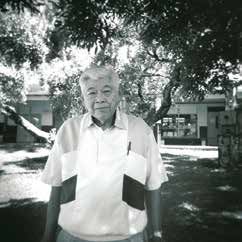
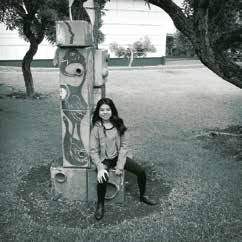
Shaianna “Shai” Niccole Llarinas
While life in Wahiawa was economically difficult, it was also culturally rich. The ku¯ puna shared their childhood memories about Wahiawa with their assigned student. Their stories revealed a simpler time, when kids could entertain themselves without the benefit of technology — or television, for that matter. These ku¯ puna shared stories from their “small kid days”— picking pineapple in the middle of a red dirt field, making their own toys or seeing the Japanese planes flying overhead as they attacked Pearl Harbor on Dec. 7, 1941.
As with all ProjectFocus Hawai‘i programs, photography is an integral part of the storytelling process. As the students documented the oral history, they also captured visual portraits of these elders. The photos and stories, along with the photos taken of the students by ProjectFocus Hawai’i co-founders Callies and Lisa Uesugi, were paired to form the basis for the exhibit.
Crossing Bridges made its community debut on Dec. 10, 2016, at a reception at the Wahiawa Hongwanji Church.
“We were very pleased to have this opportunity to highlight our outstanding seniors and their contributions to our community,” said Darin Uesugi, president of WCBDO. “Wahiawa is a hidden gem with much to offer by way of history, culture and business. We look forward to sharing these wonderful stories with the broader community.”
Crossing Bridges is currently on display at the Davies Pacific Center Mezzanine until Feb. 3, 2017. The exhibit will be displayed at various venues on O‘ahu throughout the year.
PROJECTFOCUS HAWAI‘I INC.
A nonprofit organization established in 2005 as a means
of giving at-risk children and others with challenges, including
our aging population, a healing voice through the
medium of photography.
For information and to view our gallery of images, go to www.projectfocushawaii.com.
From ProjectFocus Hawai‘i and the Wahiawa Community Based Development Organization (WCBDO) comes a visual storytelling, from both ends of life — as partners — Crossing Bridges. On a sunny Saturday morning, students from Leilehua High School, Wahiawa Middle School, Island Pacific Academy and George Washington University sat down with 24 of Wahiawa’s most cherished ku¯…
The City and County of Honolulu Department of Parks and Recreation (DPR) is now accepting registration for spring 2017. Fun and affordable classes, such as ceramics, painting, ‘ukulele, aerobics, yoga, tai chi, swimming and more are offered. Or, if you’re looking for an opportunity to make new friends or reconnect with old ones, join one of DPR’s senior citizens clubs. Clubs meet weekly, have guest speakers, participate in service projects, go on outings and socialize.
SPECIAL EVENTS FOR 2017 SPRING PROGRAM
2017 SENIOR VALENTINE DANCE
Feb. 7, 9 am – 12 pm
Neal S. Blaisdell Center Exhibition Hall
Free Admission; Parking $6
Come join us for a morning of fun and
line dancing. Dance to your favorite songs—
past and present.
SENIOR FUN WALK
April 7, 9 am
Patsy T. Mink Central O‘ahu Regional Park
This noncompetitive event promotes
health and wellness to the senior population.
Registration and walk information
will be out shortly.
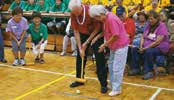
2017 SENIOR CLASSIC GAMES
March 23, 9 am – noon
Halawa District Park
DPR Senior Clubs enter teams to participate in
this annual event. Participants may enter events
such as “nine gates,” “tunnel vision,” “peg ball”
and “pin ball.” This activity was created with
seniors in mind. It keeps them active and
healthy. Call 808-973-7258 for information
regarding joining a club in your community.
MEMORIAL DAY LEI SEWING
May 26, 9 am
Sewing Sites: City Hall, Makua Ali‘i Senior
Center, Waipahu District Park, Kailua District
Park The Mayor’s Memorial Day Ceremony
takes place on Monday, May 29, 2017. To prepare
for the ceremony, 35,000 lei are sewn to honor
those who served our country. If you would like
to contribute flowers or assist in sewing lei,
visit one of the sewing sites above.
For more information regarding any of our activities and events, or to find a senior club in your community, call 808-973-7258 for assistance.
The City and County of Honolulu Department of Parks and Recreation (DPR) is now accepting registration for spring 2017. Fun and affordable classes, such as ceramics, painting, ‘ukulele, aerobics, yoga, tai chi, swimming and more are offered. Or, if you’re looking for an opportunity to make new friends or reconnect with old ones, join one…
Like the challenges of aging well, playing tennis at a mature age provides its own set of character trials and physical tests.
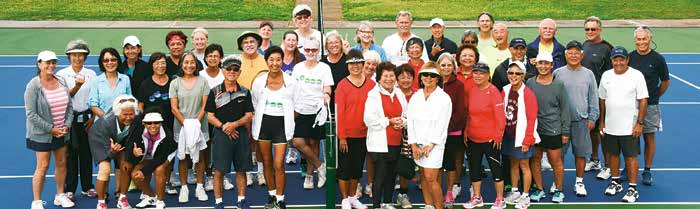
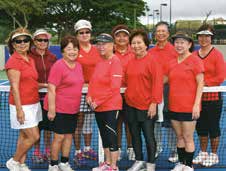
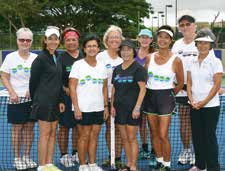
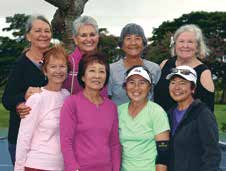
Of the almost one million tennis players in the U.S., about 2,000 compete annually in the USTA League 65 and Over Tennis National Championships. In December, over 100 “super seniors” from Hawai‘i Island, Maui and O‘ahu met at the Patsy T. Mink Central Oahu Regional Park in Waipio to compete in the 65 and over section championship playoffs. Ten teams competed at 6.0, 7.0 and 8.0 skill levels.
Of the 10, four teams claimed championship bragging rights, earning them elite berths on the grand stage — the USTA National League Tennis Championships in Surprise, Arizona, in May 2017: O‘ahu’s Na Kolohe 6.0 women, O‘ahu’s Cataract and Vision Center’s 7.0 men, Maui Magic’s 7.0 women and East Hawai‘i’s Tennisanity 8.0 women.
Maui Magic’s 7.0 women
Ask any of one of these players, who range in age between 65 and 90, and you’ll hear how tennis keeps them fit and happy.
“Tennis keeps us alive,” said Maui Magic Captain Jane Sakakihara, who also serves as a Maui tennis league coordinator. “It keeps us active and around friends.” She plays tennis three to four times a week with friends she’s been playing with for, well, years and years.
East Hawai‘i’s Tennisanity 8.0 women
Many intergenerational sports provide excellent health benefits, and some provide mental and emotional growth. But no other sport has ever been acclaimed for all age groups as one that develops great physical, mental and emotional benefits.
Tennis is a low-impact game that can be played at all levels and ages at every stage of life.
It’s never too late to take up the game. The adaptable human body can be trained and improved at any stage of life.
“You gotta be brave to face the challenges of aging and playing tennis well,” Sakakihara said “Just step up, take deep breath and swing.”
Like the challenges of aging well, playing tennis at a mature age provides its own set of character trials and physical tests. Of the almost one million tennis players in the U.S., about 2,000 compete annually in the USTA League 65 and Over Tennis National Championships. In December, over 100 “super seniors” from Hawai‘i Island,…



 Hot off the press, Paintings, Prints and Drawings of Hawai‘i from the Sam and Mary Cooke Collection presents for the first time the private collection of Mary and the late Sam Cooke. Published by the Ma¯noa Heritage Center, this lavishly illustrated volume by David W. Forbes traces the history of Hawai‘i as seen through the eyes of western artists, from the arrival of Capt. James Cook to modern landscapes.