Category: Living Life

  • Aloha Fried Rice

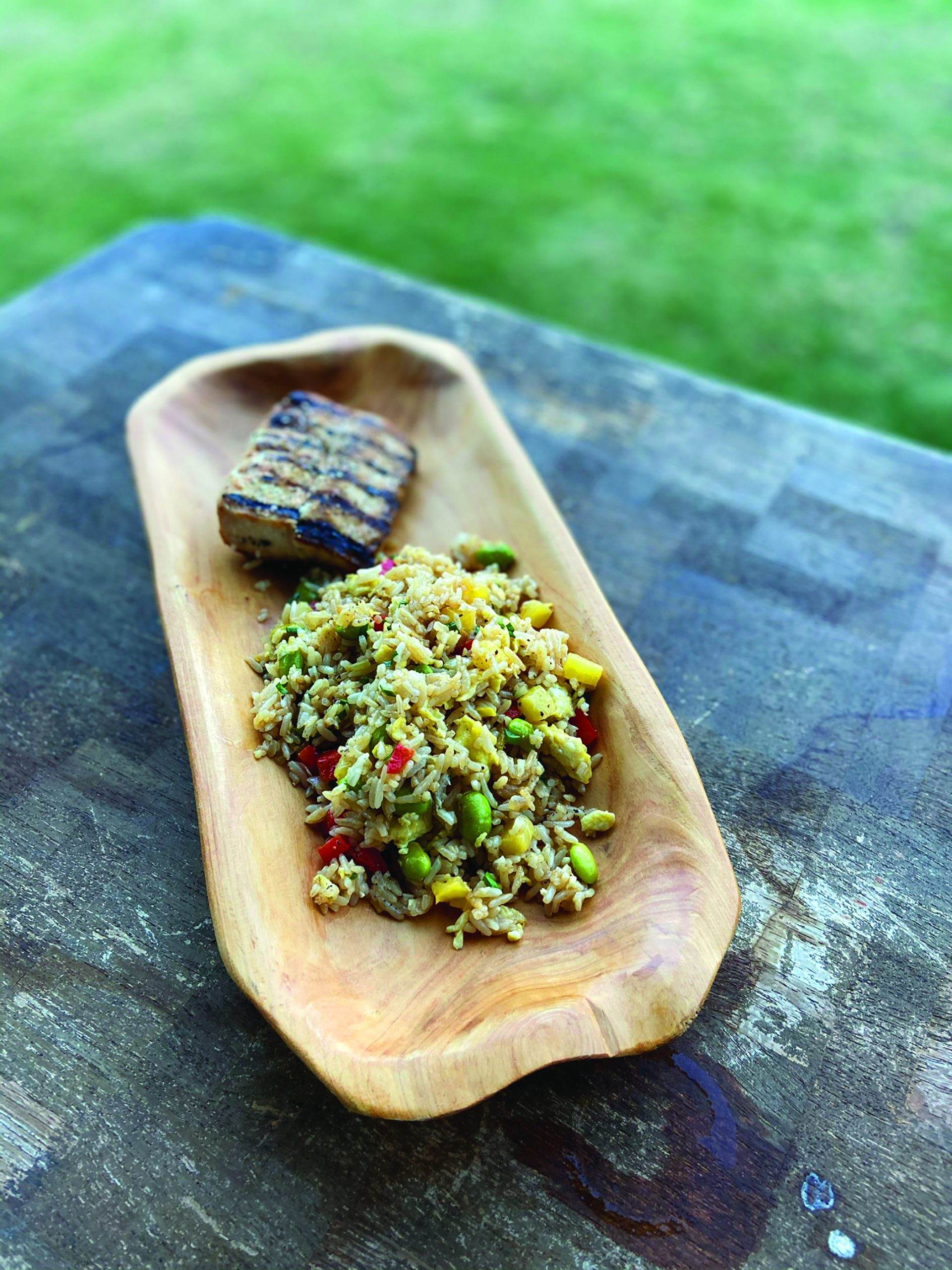
    Fried rice has long been a comfort food throughout the islands. Not only is this recipe a savvy way to repurpose leftover rice, it’s easy to dress up with vegetables and fresh pineapple. Serve it alongside meat or a hunk of grilled fish caught by one of our local fishermen, and you’ve got a Hawaiian Regional classic. Here’s the recipe.

    Ingredients:
    4 cups cooked and chilled rice
    3 eggs lightly beaten with a dash of salt and pepper
    2 cups chopped pineapple
    1 small onion (chopped)
    3 cloves garlic (minced)
    1 red bell pepper (chopped)
    1 cup frozen shelled edamame
    3 Tbsp. oil
    3 Tbsp. butter (divided)
    2 tsp. sambal (chili garlic paste)
    1/4 cup soy sauce (use tamari for a gluten-free option)
    Salt and Pepper
    Directions:
    1. Preheat a large, nonstick skillet on medium heat. Add oil and 2 Tbsp. of butter into the pan. Once the butter has melted, add the onions and sambal and cook until tender. Then add the red bell pepper, edamame and garlic. Season with salt and pepper. Cook until fragrant and take care not to burn the garlic.
    2. Turn the heat up slightly and add the cold rice. Cook for about 3 to 4 minutes until the rice has separated and softened. Then add the pineapple. Drizzle the soy sauce and fold it into the rice mixture and cook for another 3 minutes.
    3. Push the rice mixture to one side and melt 1 Tbsp. of butter on the other side and add the eggs and scramble constantly until slightly set.
    4. Fold everything together; season if needed. Cook until rice mixture is hot, then serve.

    Optional accompaniment: grilled meat or seafood.

    Prep time: 15 minutes | Cook time: 15 minutes
    Serves: 4


    CHEF KRISTIN MICHAELS
    info@ChefKristin.com | www.ChefKristin.com
    Facebook & Instagram: @ChefKristinMichaels

    Fried rice has long been a comfort food throughout the islands. Not only is this recipe a savvy way to repurpose leftover rice, it’s easy to dress up with vegetables and fresh pineapple. Serve it alongside meat or a hunk of grilled fish caught by one of our local fishermen, and you’ve got a Hawaiian…

  • Live Longer, Better, in the Blue Zone

    Six cultures around the world seem to have uncovered the secrets of longevity. For more than a decade, Dan Buettner, author of The Blue Zones Solution, worked to identify these hot spots of long life. Dan found places that not only had high concentrations of individuals over 100 years old, but also clusters of people who had grown old without health problems like obesity, cancer and diabetes.

    Dan found that diet is one of the factors contributing to their longevity. He distilled simple guidelines from his studies that reflect what the world’s longest-lived people ate. Dan suggests that the average American could live an extra 12 years if they optimize their lifestyle by eating a diet similar to the Blue Zones Diet. He says that by adopting some of the healthy eating principles into your life, you, too, can Live Longer, Better®.

    Blue Zones Diet Starter Kit
    • Eat 2 oz. or less of meat 5 times per month; 95% of your food should be plant-based.
    • Reduce dairy.
    • Consume only 7 tsps. of added sugar daily.
    • Eat no more than 3 eggs per week.
    • Eat less than 3 oz. of fish up to 3 times weekly.
    • Eat about 1 to 2 handsful of nuts a day.
    • Drink about 7 glasses of water per day.
    • Eat a half-cup of beans daily.
    • Don’t eat highly processed food.
    • Eat your largest meal at breakfast.
    • Cook the majority of your meals at home

    Healthy living is a lifestyle, not an activity

    The Blue Zones Diet is a guideline of what to eat for a long, healthy life. It’s not a short-term diet plan. None of the 100-plus-year-old people Dan interviewed participated in diet or even exercise programs. The world’s longest-lived people don’t pump iron, run marathons or join gyms. Instead, they are immersed in an environment designed to help them make the healthiest decisions. COVID-19 has indeed helped us to focus on eating most of our meals at home. In addition, our shopping environment can help make healthy choices easier for you and your family. Find the Blue Zones Meal Planner at https://meals.bluezones.com.

    Blue Zone-Approved Grocers in Hawai‘i
    HAWAI‘I ISLAND
    Foodland
    – Kamuela: Parker Ranch Center, #109
    – Kea‘au: 16-586 Old Volcano Road
    – Waimea: 66-1330 Mauna Lani Drive
    KTA
    – Kailua-Kona: 74-4494 Palani Road
    – Kamuela: 65-1158 Ma¯malahoa Highway
    – Keahou: 78-6831 Ali‘i Drive
    – Kealakekua: Konawaena School Road
    – Hilo: 321 Keawe St.
    – Hilo: 50 E. Puainako St.
    – Waikoloa: 68-3916 Paniolo Ave.
    Sack N Save
    – Hilo: 250 Kino‘ole St.
    – Hilo: 2100 Kanoelehua Ave., Ste. 101
    – Kailua-Kona: 75-5595 Palani Road
    MAUI
    Foodland
    – Kahului: 90 Kane St.
    – Wailuku: 370 Kehalani Village Drive
    Sack N Save
    – Wailuku: 790 Eha St.
    O‘AHU
    Down to Earth
    – Honolulu: 2525 South King St.
    – Kailua: 201 Hamakua Drive
    Foodland
    – Kailua: 108 Hekili St.
    – Kaneohe: 45-480 Kaneohe Bay Drive
    – Wahiawa: 823 California Ave.
    Whole Foods Market
    – Kailua: 629 Kailua Road, Ste. 100 n

    Six cultures around the world seem to have uncovered the secrets of longevity. For more than a decade, Dan Buettner, author of The Blue Zones Solution, worked to identify these hot spots of long life. Dan found places that not only had high concentrations of individuals over 100 years old, but also clusters of people…

  • Move US to Racial Justice


    MoveMeHawai‘i is a joint effort of the Beta Beta Gamma Foundation and the Hawaii State Bar Foundation with the objectives of educating the public about social justice issues, promoting community unity, and supporting organizations that provide legal or social services to the underserved. This October, MoveMeHawai‘i is presenting a free, online community education program, Move US to Racial Justice, which will include an award-winning film and a lively panel discussion about racial discrimination during World War II and how we can move together to combat systemic racism that continues today.

    A Documentary: ALTERNATIVE FACTS

    Throughout October, participants can view Alternative Facts: The Lies of Executive Order 9066, a compelling documentary about the false information and political influences that led to the World War II incarceration of Japanese Americans. This film, an Honorable Mention for the 2020 American Bar Association’s Silver Gavel Award, sheds light on the people, prejudice, and politics behind the lies and deliberate withholding of critical information that influenced the signing of the infamous Executive Order 9066 and US Supreme Court reviews of that order.

    Panel Discussion

    On Oct. 25 at 2 p.m., MoveMeHawai‘i will present a live, online panel discussion of the film and how it relates to the ongoing social injustices faced by US minority groups. The Black Lives Matter movement, Hawai‘i’s own racial issues, and alliances of people of all ethnicities in support of racial equality will be discussed by Jon Ozaki, the filmmaker and visionary of Alternative Facts; Camille Nelson, the new dean of the William S. Richardson School of Law and a leading scholar on critical race theory; and Avi Soifer, the immediate past dean of the law school and a constitutional law expert.

    Submit questions for the panelists in advance via the online registration form or use the online chatbox during the live panel. The discussion and the film will both be available through Oct. 31.


    MOVE ME HAWAI‘I (501(c) 3 nonprofit)
    For details, film and panel discussion registrations:
    MoveMeHawaii@gmail.com | www.MoveMeHawaii.org.
    Access links will be sent for the film, the live panel discussion and the recorded panel discussion.

    This October, MoveMeHawai‘i is presenting a free, online community education program, Move US to Racial Justice, which will include an award-winning film and a lively panel discussion about racial discrimination during World War II and how we can move together to combat systemic racism that continues today.

  • Organized. Happy. Safe.

    As we age, staying organized and living in an uncluttered space can help reduce the stress of transitioning into different phases of life. Many seniors find themselves needing or wanting to downsize from a family home to a smaller space, such as an apartment, retirement community or multigenerational family space. Taking the time to sort through possessions accumulated over the years will make downsizing or aging in place less stressful and improve your overall health. Here are tips to help you create an organized living space:

    • Keep only those belongings most precious to you. Share other items with family and friends who will treasure them or donate items to your favorite charity for someone else to enjoy.
    • Create large, open areas for easy mobility and cleaning. Remove any unused furniture and keep steps and hallways clear of clutter.
    • Make frequently used items accessible. Store items between waist- and upper thigh-level to prevent bending over or reaching overhead.
    • Label drawers and cabinets to make it easier for you and/or caregivers to find items.
    • Use clear or translucent boxes for storage.
    • Store important documents in a secure location.

    Living in a clean and organized home is beneficial at any phase of life. Just set aside a little time each day to declutter. Remember, don’t be afraid to ask family and friends for help!


    SIMPLY ORGANIZED by City Mill – Kahala Mall
    4211 Waialae Ave., Ste. #1200, Honolulu, HI 96816
    808-739-7007 | www.simplyorganizedhi.com

    As we age, staying organized and living in an uncluttered space can help reduce the stress of transitioning into different phases of life. Many seniors find themselves needing or wanting to downsize from a family home to a smaller space, such as an apartment, retirement community or multigenerational family space. Taking the time to sort…

  • Plan for Tomorrow Today

    {Play}

    To help relieve their families from stress at an already stressful time, an increasing number of people are planning their own funerals and designating their funeral preferences — sometimes paying for them in advance.

    It does not have to be a complicated process. In fact, many funeral providers have created preplanning guides that allow clients to document important details and wishes. Some providers offer online webinars to inform viewers of the options they have to preplan arrangements from the comfort of their homes.

    Preplanning will provide comfort to your loved ones and give them the confidence that comes from knowing they are honoring your wishes and following through with your plans exactly as you wanted.

    Be sure to tell your family about the plans you’ve made, including if you have prepaid. Preplanning your cemetery and funeral needs will make a difficult time just a bit easier for your family. Do it for yourself; do it for your family.


    VALLEY OF THE TEMPLES MEMORIAL PARK
    47-200 Kahekili Highway, Kaneohe, HI 96744
    808-824-3426 | fred.collins@vothi.com
    www.Valley-Of-The-Temples.com

    We will all face the inevitable some day. No one likes to think about their eventual passing, but loved ones can be spared anxiety and uncertainty about your final wishes if you take time now to preplan your cemetery and funeral arrangements.

  • 101 Caregiver Stories

    {Play}

    Currently, more than 29,000 people in Hawai‘i are living with Alzheimer’s disease, and over 65,000 family members and friends are providing their care, according the the Alzheimer’s Association website (www.alz.org/hawaii).

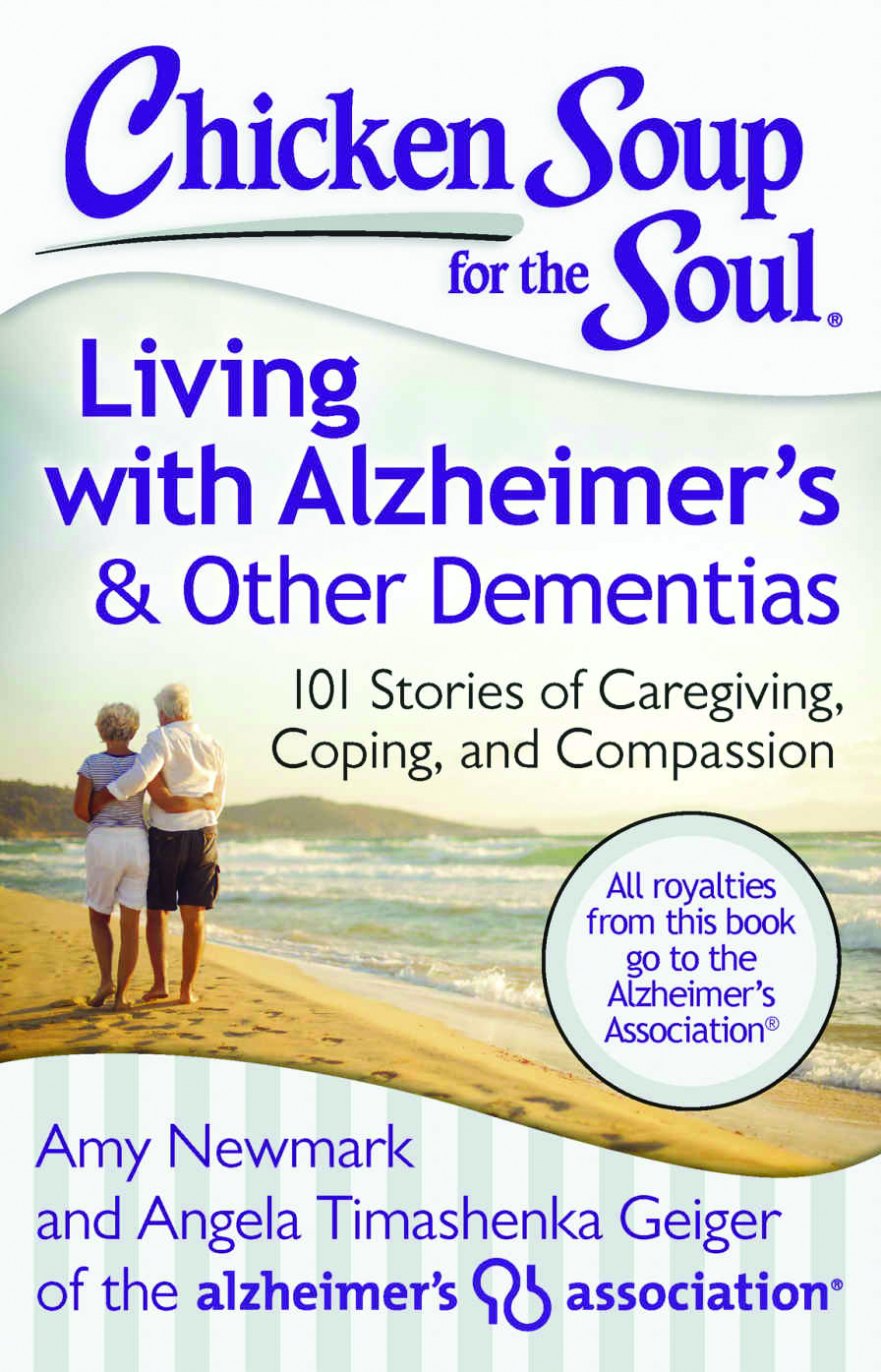
    Chicken Soup for the Soul Publishing offers Living with Alzheimer’s & Other Dementias: 101 Stories of Caregiving, Coping, and Compassion, a collection of personal stories of love and lessons written by caregivers especially for caregivers. This joint project with the Alzheimer’s Association aims to provide support, advice, encouragement and comfort for caregivers, as well as those living with Alzheimer’s. Chapters includes stories that touch on topics such as, what it’s like to have Alzheimer’s, advice from other families, keeping marriages strong and loving, the role of laughter, and powerful music and art therapies. The book is full of heartfelt reflections and heart wrenching truths told by those who have endured seeing a loved one in the clutches of a cruel thief.


    Chicken Soup for the Soul: Living with Alzheimer’s & Other Dementias: 101 Stories of Caregiving, Coping, and Compassion by Amy Newmark and Angela Geiger All royalties go to the Alzheimer’s Association. The book is available at most bookstores and online.

    If you are caring for a loved one with Alzheimer’s or another form of dementia, know that you are not alone. Know that you are not the only one who has experienced the wrath of these diseases or felt the roller coaster of emotions that accompanies watching a loved one disappear.

  • What’s Happening to Papa?

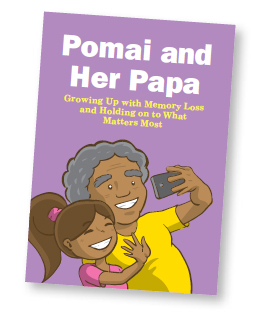
    Pomai has become worried as she sees Papa, her grandfather, become more forgetful. She wants Papa to play with her, but he is losing his memory and is no longer able to make poi with her or take her to the beach. In Pomai and Her Papa: Growing Up with Memory Loss and Holding On to What Matters Most, a short, illustrated storybook, Pomai sets off on her journey to learn how to help Papa and her family. She receives guidance from a teacher, social worker and doctor, who help her understand what is happening to Papa. The story educates young caregivers about dementia, including the most common form, Alzheimer’s disease, and offers age-appropriate ways to help.

    “People in Hawai‘i are especially affected by Alzheimer’s disease, in part because of the high rate of multigenerational homes here,” said Professor Colette Browne, one of the book’s co-authors.

    “Children are deeply affected by dementia in their families, and yet often they are not viewed as caregivers who need education and support.”

    This free booklet includes information on local and national resources where youth and families can seek answers and find support. It was written by Myron B. Thompson School of Social Work researchers at the University of Hawai‘i at Mānoa. It is published and distributed through Hā Kūpuna project, a resource center for Native Hawaiian elders and their families.


    FREE PDF:
    www.manoa.hawaii.edu/hakupuna/pomai-and-her-papa
    HARD COPIES:
    muneokas@hawaii.edu

    Pomai has become worried as she sees Papa, her grandfather, become more forgetful. She wants Papa to play with her, but he is losing his memory and is no longer able to make poi with her or take her to the beach. In Pomai and Her Papa: Growing Up with Memory Loss and Holding On…

  • Hiroshima Survivor Shares Story of Hope

    Lawrence Fumio Miwa was born in Hawai‘i in 1931 and lived in Hiroshima, Japan, from age 2 to 15. Now 89, he was 14 years old when the atomic bomb was dropped on Hiroshima, Japan, on Aug. 6, 1945. Although he was in school approximately 20 miles away from his Hiroshima home, he could see what happened. Seventy-five years later, he can still recall “that unforgettable morning,” when the bombers flew over the city. He remembers the blinding yellow flash from the atomic explosion. He thought at the time that it was the end of the world. He wondered if his family survived.

    Days later, he returned to the city and witnessed overwhelming casualties and total devastation. “People were suffering severe burns and their clothes were burned and tattered.”

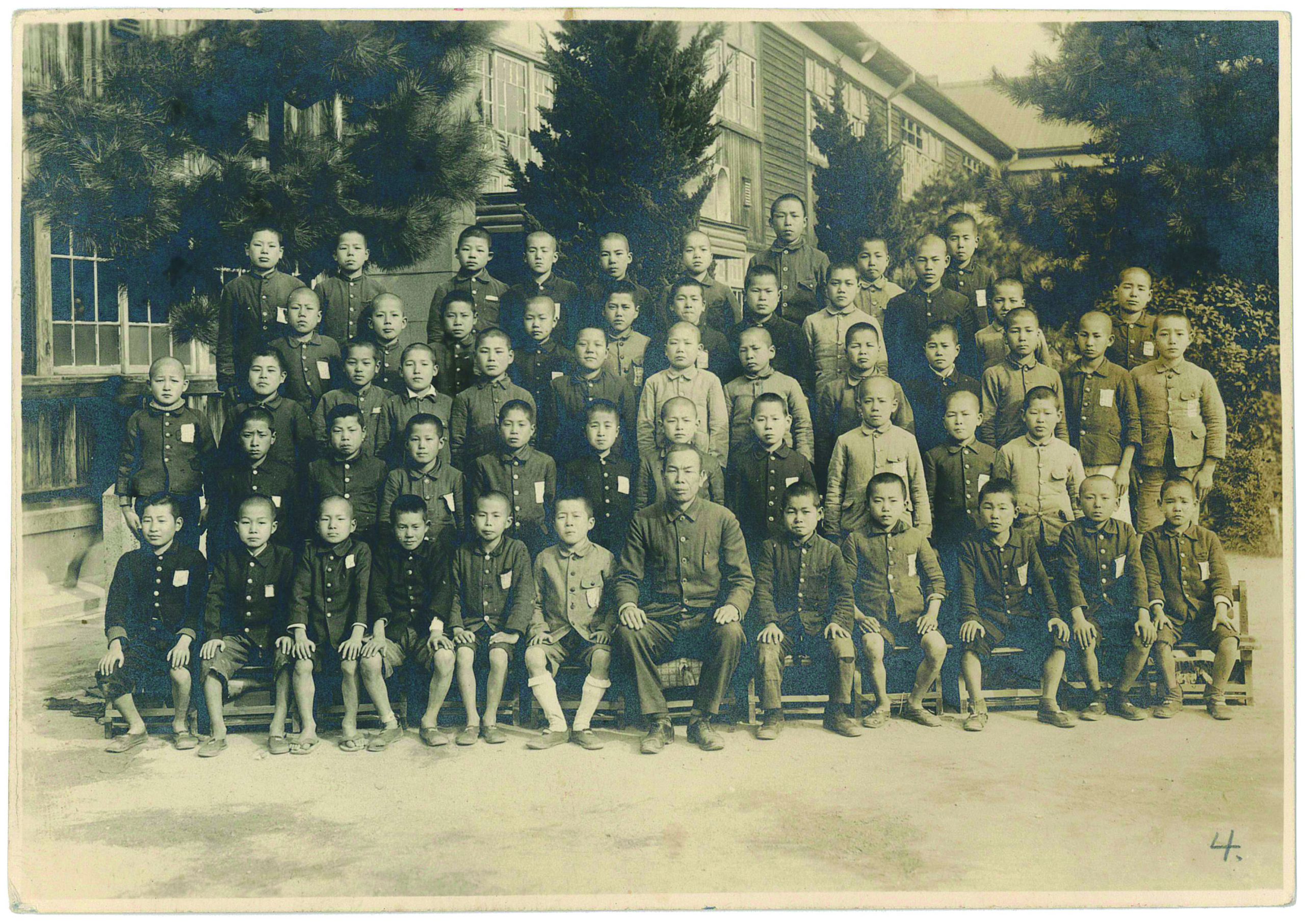
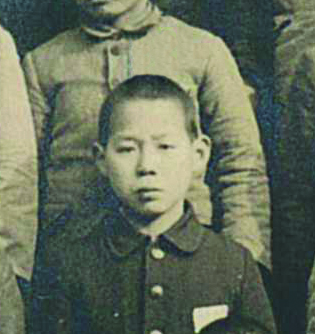
    Lawrence Fumio Miwa at age 12 in 1943, when he was a sixth grader at Misasa Elementary School. Below, at age 88, visiting Punahou Japanese classes in 2019.
    Lawrence Fumio Miwa at age 12 in 1943, when he was a sixth grader at Misasa Elementary School. Opposite, at age 88, visiting Punahou Japanese classes in 2019.

    Approximately 70,000 people were killed when the US military dropped an atomic bomb over Hiroshima during World War II. Tens of thousands later died from radiation exposure and cancer. Three days later, another atomic bomb was dropped over Nagasaki, killing about 40,000 people. The exact mortality figures will never be known. The destruction and overwhelming chaos made orderly counting impossible.

    “We didn’t know that that was the first atomic bomb,” he said. “On Aug. 15, our teacher allowed us to go back to the city — and for me, to find out if my parents and sister were still alive. When I arrived at the Hiroshima train station, there were no houses or buildings. The ground was burned and blackened. In that moment of time, I was the only person standing alone in the city where some 140,000 people had lost their lives. I was sure I had experienced a big turning point in my life.” Miraculously, his family survived.

    August marks the 75th anniversary of the bombings. Larry has devoted his life to sharing his story with the goal of working together to eliminate nuclear weapons.

    “It should not matter what nationality we are,” says Larry. “We are all human beings living together on our precious Earth. We all have a duty and responsibility to preserve humanity for our future  generations. We should work together, setting a goal of common sense and decency to eliminate all nuclear weapons and related materials, for the sake of world peace.”

    “No one, especially our children, should ever experience the horrors of nuclear weapons,” Larry said in a recent public presentation. “Please remember my story of survival. Overcoming animosity and making efforts to understand each other can lead to world peace and a better world for every one of us.”


    [box] Larry shared more thoughts at the University of Hawai‘i Matsunaga Institute for Peace via Zoom on August 5, 2020. You can see the recording here. [/box]


    The five-generation history of Miwa’s family is detailed in the book Tadaima! I Am Home by Tom Coffman.

    Lawrence Fumio Miwa was born in Hawai‘i in 1931 and lived in Hiroshima, Japan, from age 2 to 15. Now 89, he was 14 years old when the atomic bomb was dropped on Hiroshima, Japan, on Aug. 6, 1945. Although he was in school approximately 20 miles away from his Hiroshima home, he could see…

  • Friends Forever: Pet Therapy

    Lower your blood pressure and make a new friend. The Hawaiian Humane Society brings the joy of pets to seniors with its Pet Therapy program.

    The Hawaiian Humane Society has been dedicated to teaching and promoting the bond between humans and animals since 1897. The Society believes that compassionate and responsible care toward animals develops compassionate and caring people. In essence, all life has an intrinsic value that contributes to the quality of life.

    With Pet Therapy, the Hawaiian Humane Society brings the joy of pet visits to the elderly at hospitals, rehabilitation centers, nursing homes, hospices and other senior and health care facilities island-wide. The pet visits help seniors with medical and emotional issues. In fact, many medical studies have shown that pet visits reduce stress, anxiety and can even lower blood pressure. Visitations can also encourage seniors to become more physically active, emotionally responsive and cooperative with caregivers and doctors, leading to a better quality of life.

    Emotionally, pet visits enhance quality of life and bring joy to the Society’s clients. Pets provide us with entertainment, companionship, love and security. Animal visitations can ease loneliness, stress, and pain—especially for older folks.

    If you, or someone you love, is interested in pet visits, please contact the Society today.

    This Pet Therapy Program not only gives back to the community, but it also provides a way to strengthen bonds between owners and their pets. If you (and your furry friend) are interested in becoming participants, please contact the Society for details on Peet Visitation Assessments.


    Hawaiian Humane Society 356-2217 www.hawaiianhumane.org

    Lower your blood pressure and make a new friend. The Hawaiian Humane Society brings the joy of pets to seniors with its Pet Therapy program. With Pet Therapy, the Hawaiian Humane Society brings the joy of pet visits to the elderly at hospitals, rehabilitation centers, nursing homes, hospices and other senior and health care facilities…

  • The Hawaii Alliance for Retired Americans (HARA)

    2011 will be a year of change for most of us, especially if you’re a senior. Some things are out of our control, such as changes in Medicare enrollment, health care reform, the country’s (and our family’s) financial stability. That is why it’s important for us to affect change when and where we can.

    Are you at a place in your life where you want to do something to affect change? Are you a retired union member? If so, we have just the place for you to volunteer and start to affect change in our state.

    The Hawai‘i Alliance for Retired Americans (HARA) is the state affiliate of the Alliance for Retired Americans (ARA), a national advocate on senior and aging issues with more than 3 million members. ARA ensures social and economic justice and full civil rights for all citizens so we may enjoy lives of dignity, security and personal and family fulfillment. The alliance believes that all older and retired persons have a responsibility to create a society that incorporates these goals and rights. The alliance encourages seniors to take advantage of their retirement and use it as an opportunity to pursue new and expanded activities with their unions, civic organizations and communities.

    Founded in 2001, HARA consists of 10 organizations with shared goals. HARA ensures that our state is a good place to retire and age. It supports the aspirations of seniors to remain healthy and lead a full and productive life, while aging in place at home.

    HARA is a strong voice for Hawai‘i’s retirees and seniors; a diverse community-based organization with national roots; a grassroots organizer, educator, and communicator; and a trusted source of information for decision-makers.


    To learn more about HARA or to join, please email Al Hamai, HARA president, he will get you involved in advocacy work here in the Islands; hamaia001@hawaii.rr.com. For more information, please visit www.retiredamericans.org.

    Our Mission: HARA strives to better the health, economic security and quality of life for Hawai‘i’s seniors and retirees.

    Our Vision: That Hawai‘i’s seniors and retirees enjoy “choices,” which result in an improved standard of living and a better, higher quality of life.

    Our Legislative Agenda: Some issues that ARA/HARA are now engaged in include: Expand the Kupuna Care Program; protect and expand Social Security, Medicare and Medicaid; urge people to take advantage of the benefits under the new health reform act; safeguard pensions and other retirement benefits; provide adequate, accessible and affordable housing and transportation services; and educate members about issues affecting its members and families.

    2011 will be a year of change for most of us, especially if you’re a senior. Some things are out of our control, such as changes in Medicare enrollment, health care reform, the country’s (and our family’s) financial stability. That is why it’s important for us to affect change when and where we can.

  • Peopleʻs Open Market

    Founded in 1973, the People’s Open Market (POM) was formed to accomplish three goals:

    1. Provide the opportunity to purchase fresh agricultural and aquacultural products and other food items at low cost.
    2. Support the economic viability of diversified agriculture and aquaculture in Hawai‘i by providing market sites for local farmers, fishermen or their representatives to sell their surplus and off-grade produce.
    3. Provide focal point areas for residents to socialize.

    More than 1 million people shop at the 25 market sites each year. Each market operates once a week and lasts about one hour. Prices are usually 35% lower than retail stores. The POM staff closely regulates the markets. The staff conducts weekly price surveys at various stores to determine a recommended price for the POM vendors to follow. Vendors may sell below, but not over, the recommended prices. The staff also supervises the arrival and departure of the POM vendors to ensure safety for both vendor and consumer. Each vendor is monitored to ensure that they comply with all city, state and federal government rules and regulations, ordinances and laws affecting their participation in the POM.

    TYPES OF PRODUCE

    At the POM, you will find many kinds of ethnic fruits, vegetables and other food items that are not ordinarily available in grocery stores. Depending on the ethnic make-up of the neighborhood, you’ll find a variety of foods associated with the different ethnic groups. Fresh ocean and pond fish, as well as farmed shrimps and prawns, are available—many sold live. In addition, a variety of Hawai‘i-grown flowers, such as ginger, orchids and anthuriums are for sale.

    HISTORY OF THE OPEN MARKETS The beginning of the open markets is attributed to Mrs. Joyce Fasi. After hearing concerns of women in a discussion group regarding the high cost living in Honolulu and in particular the high cost of food, she relayed these thoughts to her husband, then Mayor Frank F. Fasi. Hence, the People’s Open Market was started to assist farmers with selling their “off-grade,” “ungraded” and surplus produce while lowering food costs for the citizens of Honolulu.

    The first People’s Open Market (POM) was started at the Banyan Court Mall location in Kalihi in November, 1973. People in other communities began requesting their own POMs. Soon, a caravan of POM farmer/vendors was traveling to various sites to help the public purchase low-cost food items.

    The city requires all vendors to be authorized to accept food stamps to help those who are on fixed incomes.

    SHOPPING TIPS

    The People’s Open Market (POM) vendors are bound by a set of rules and regulations, which ensure that the POM operates smoothly and fairly for vendors and as well as customers. It is the vendors’ responsibility to see that their customers follow the rules and regulations. They are subject to citations and disciplinary action, including dismissal from the program for failure to comply with the rules and regulations.

    Please cooperate with the POM vendors. Here are some of the POM shopping tips:

    Plan ahead! There will be times that the market will start or end a little earlier or later than officially scheduled (5–10 minutes) due to certain conditions such as traffic, road conditions, school, weather, etc.

    Things to keep in mind:

    • Do NOT bag or ask vendor to reserve items before the start of the market (sound of an air Horn)!
    • Do NOT cut in lines that vendors have formed!
    • Do NOT shoplift!
    • Do NOT squeeze or mistreat fruits and vegetables (papayas, tomatoes, etc.)!
    • Do NOT bring animals (except seeing eye/ working dogs)!
    • Do NOT litter!
    • Do NOT ride bicycles through the shopping area. Park on the sides of the POM.
    • Do NOT park illegally, double park or block driveways!
    • Park in marked stalls ONLY!
    • Bring your own shopping bags, packages and cartons!
    • Be careful when the POM vendors’ trucks and vans are entering or leaving a POM site!
    • Be considerate of other shoppers!
    • Bring small bills and coins!

    More than 1 million people shop at the 25 market sites each year. Each market operates once a week and lasts about one hour. Prices are usually 35% lower than retail stores. The POM staff closely regulates the markets. The staff conducts weekly price surveys at various stores to determine a recommended price for the…

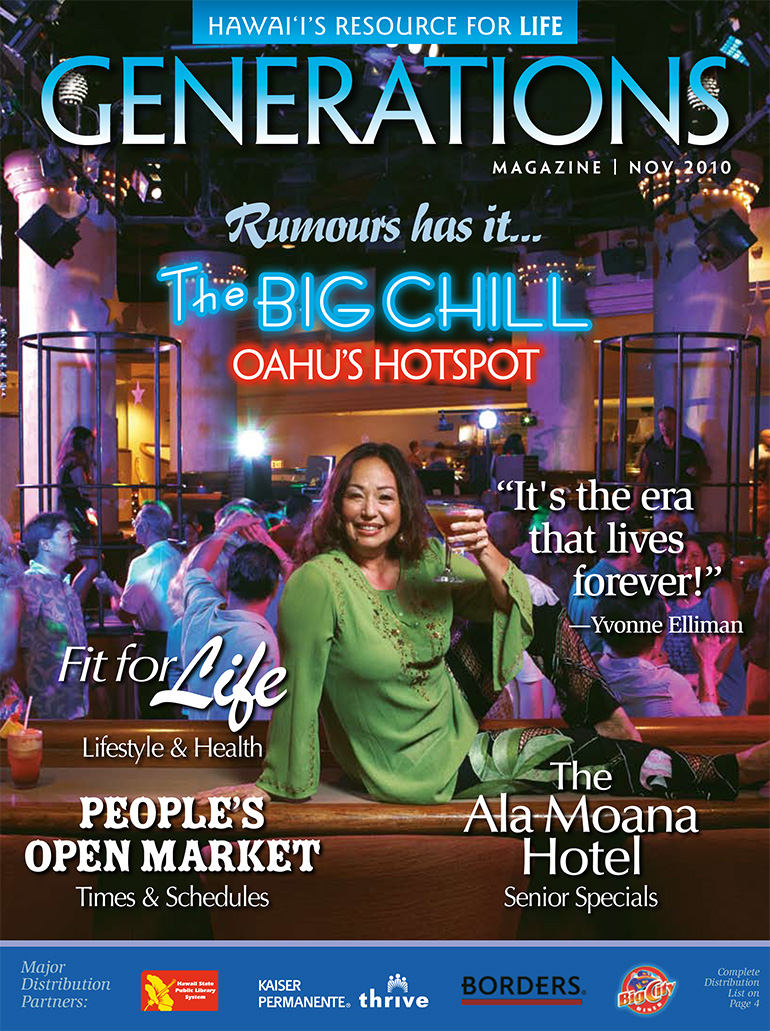
  • Rumours has it: The Big Chill

    Rumours has it: The Big Chill

    Remember watching the classic movie The Big Chill? Yes, it was the movie about a group of idealistic college buddies who had not seen each other for years. They reunite, reconnect and reminisce about the good ol’ days.

    The Big Chill, at Rumours Nightclub at the Ala Moana Hotel, was named after the classic movie. Malcolm Sur, the creator, original DJ and boogie man himself says he named the weekly event “The Big Chill” because he wanted a place where his friends could hang out, have a great time and party— something he felt Honolulu was lacking in the ‘80s.

    The Big Chill, home to the longest running nightclub in the state, is party central every Friday night. “Simply put, it’s all about the music,” Sur says.

    The passion for good music from “back in the day” still lives strong every Aloha Friday, from 5 p.m. to 9 p.m. For Friday-night regular, Jodi from Mililani, who has been coming to The Big Chill for more than 20 years, dancing is the greatest way to stay in good health and enjoy herself with good friends. “I’m with my girls, and no worries about work,” she says. “It’s Friday night!”

    Since 1984, Rumours Night Club has been a hotspot for company parties, class reunions and pau hana with friends. If you like to boogie down, it’s the place to go. The club has an extensive collection of hits from the ‘60s and ‘70s—from Motown and Marvin Gaye to The Temptations and Earth Wind & Fire. Then there are the “let’s get on the dance floor” songs by Rick James, Kool & The Gang and, of course, the King of Pop, Michael Jackson.

    According to Malcolm, there are people who have been coming to the club since day one. He calls them the “Original Chillers.” In fact, he heard of a story about an original chiller who recently passed away on the Mainland and in his obituary headline read, “Original Chiller is Gone.”

    Twenty-four years after opening, Malcom is starting to see some old familiar faces. The 20-somethings from the ‘80s are now empty nesters and are entering retirement. They have more free time … and they’re looking for a good time. Many of them are finding their way back to one of their favorite haunts, dancing the night away to the tunes of their times. Even Yvonne Elliman, a celebrated Hawai‘i recording artist from the ‘70s, still loves to come down to Rumours and groove to tunes like, “Play That Funky Music White Boy.”

    With new general manager Vince Depietro and assistant manager Pauline Keb, expect more to come in terms of parties. “Rumours Night Club and The Big Chill has withstood the test of time and the locals love our easy parking at the Ala Moana Center,” Keb says. She books parties in the club’s two private party rooms, which are always great for celebrating birthdays, class reunions, retirement parties and even yakudoshi.

    As the writer of this article, I’m also a regular patron of Rumours. I love the energy my fellow baby boomers still exhibit in their middle years. In fact, I celebrated my 50th yakudoshi at the Big Chill. What a party we had!

    The Big Chill, at Rumours Nightclub at the Ala Moana Hotel, was named after the classic movie. Malcolm Sur, the creator, original DJ and boogie man himself says he named the weekly event “The Big Chill” because he wanted a place where his friends could hang out, have a great time and party— something he…