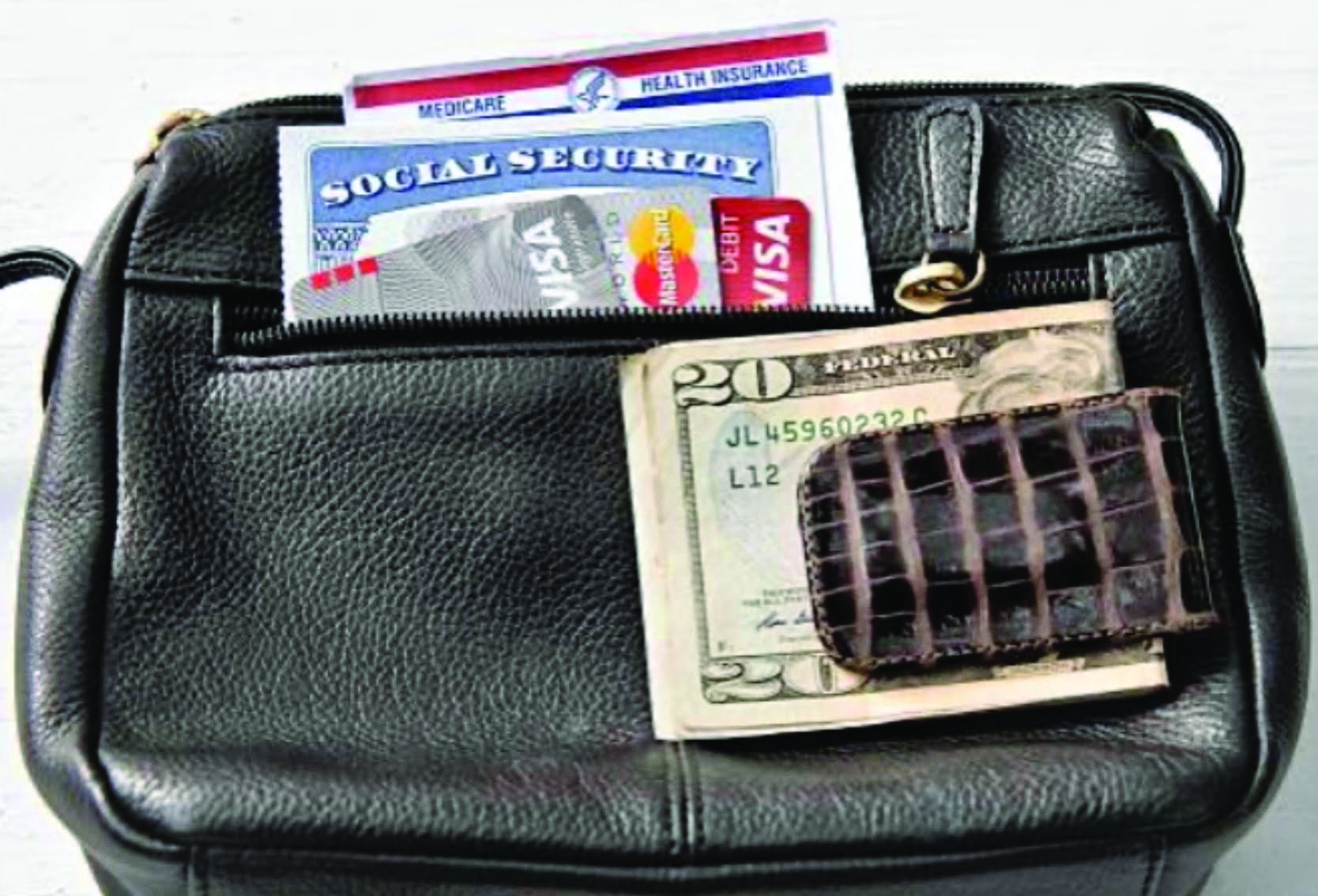
It’s time to begin your spring cleaning! This year, don’t forget to include your wallet, the home of your critical medical and insurance cards.
Do you know which cards you should carry or dispose of?
If you are retired, you can begin by disposing of your work insurance card. Your coverage ended when you retired.
Also, that Original Medicare card that displays your social security number is obsolete. Call the Social Security Administration at 1-800-772-1213 if you need a replacement Medicare card.
If you recently qualified for Medicare or changed plans, put your new member identification card in your wallet or swap it for the old one.
Providing the proper insurance card saves time, money and makes accessing healthcare services easier.
Healthcare providers count on you to provide them with your current insurance card so you can receive healthcare and the provider can file a claim for their services.
Having the correct card enables quicker processing and helps avoid billing errors, and treatment scheduling delays.
Take a moment to get more organized and clean out your wallet today.
It’s time to begin your spring cleaning! This year, don’t forget to include your wallet, the home of your critical medical and insurance cards. Do you know which cards you should carry or dispose of?
As we age, we’re faced with the dilemma of where and how we will live during the next phase of our lives. One of the most frequently asked questions is, “How do I know when it’s time to move?” Here are some questions that may help you to self-discover when it’s right for you:
Too many stairs?Do you feel that the stairs have become too difficult/dangerous to navigate?
Is your home too large? Do you need all that space now that the kids are out on their own? Are you living alone and concerned about security?Do you feel safe in your own home or would feel better living with others? Is your home/yard too much work?Have housework — and especially yardwork — become too difficult to keep up with? Are you too tired to cook and clean? Do you have the energy or desire? Would you like to make your own decisions about your next move?Or are you going to burden your loved ones with this important decision?
If you answered “yes” to even one of these questions, it may be time to start looking at the options available to you. It’s never too early to start planning for your future.
THE COMPLETE SOLUTION™
Powered by The Ihara Team of Keller Williams Honolulu RB-21303
1347 Kapiolani Blvd., Ste. 300, Honolulu, HI 96814
Dan Ihara (RA), CAPS, CLHMS, SRES RS-65892 808-256-7873
Julie Ihara (RA), SRES RS- 67440 808-754-2225 | ihara@iharateam.com www.iharateamhawaii.kw.com
As we age, we’re faced with the dilemma of where and how we will live during the next phase of our lives. One of the most frequently asked questions is, “How do I know when it’s time to move?” Here are some questions that may help you to self-discover when it’s right for you…
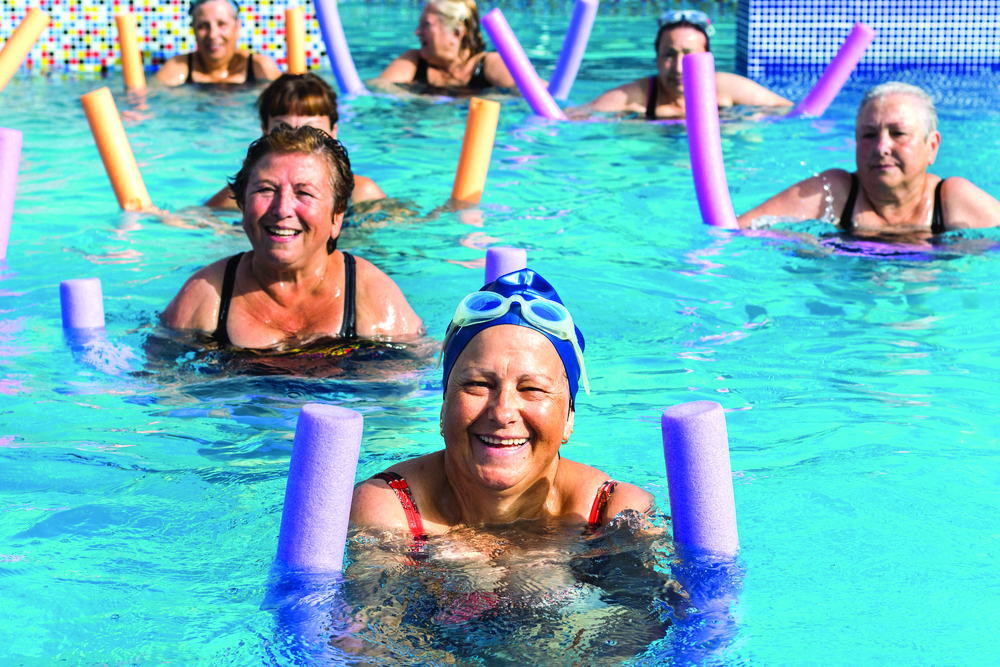
Happy New Year! The beginning of the year often means a fresh start and new goals for many aspects of our lives. Today, we’ll focus on our health and fitness, and the mind-body connection that can contribute to a healthier new you.
Exercise is one of the best gifts we can give our bodies. It helps keep bones and muscles strong and joints flexible. exercise reduces the risk of certain ailments, lowers the chance of falling, improves incontinence and increases energy levels.
Remember to check with your doctor and keep him or her informed about any changes to your movement routines, or if you’re starting a new exercise program.
■ Before and after exercise. Begin with deep breaths, shoulder rolls and gentle stretches. After your workout, cool down with a slower walk and more stretches. Stay hydrated; drink lots of water.
■ Enjoy the outdoors. Exercise can be any type of movement, such as walking or dancing the hula. Go for a swim. Work in the garden. Take the stairs instead of the elevator. Join friends for yoga or tai chi. Even if you’re vaccinated for COVID-19, practice safe social distancing in public, and wear a mask or face covering as directed.
■ Lifestyle coaching. A personal coach can take an active role in your health and help create a plan for reaching your goals. You can also ask friends and family to check in with you on your health goals, and send messages of encouragement to keep you motivated.
■ Step it up. Check out everybodywalk.org to start a walking program. Share an audiobook or podcast with your walking partner and chat about the latest story developments during rest breaks.
■ Emotional well-being. There are digital apps, such as myStrength (www.mystrength.com) and Calm (www.calm.com), to help your emotional well-being and resilience. MyStrength offers a personalized program that helps improve your mindfulness and change behaviors. Calm is a top app for meditation and sleep to help lower stress and reduce anxiety.
■ Recognize signs of depression. Know when to get help. Grief, stress, abuse, physical challenges, pain and loneliness can trigger depression. If you’re concerned about your mind and mood, talk to a behavioral health expert to help you adjust to changing life circumstances and improve your outlook.
Happy New Year! The beginning of the year often means a fresh start and new goals for many aspects of our lives. Today, we’ll focus on our health and fitness, and the mind-body connection that can contribute to a healthier new you.
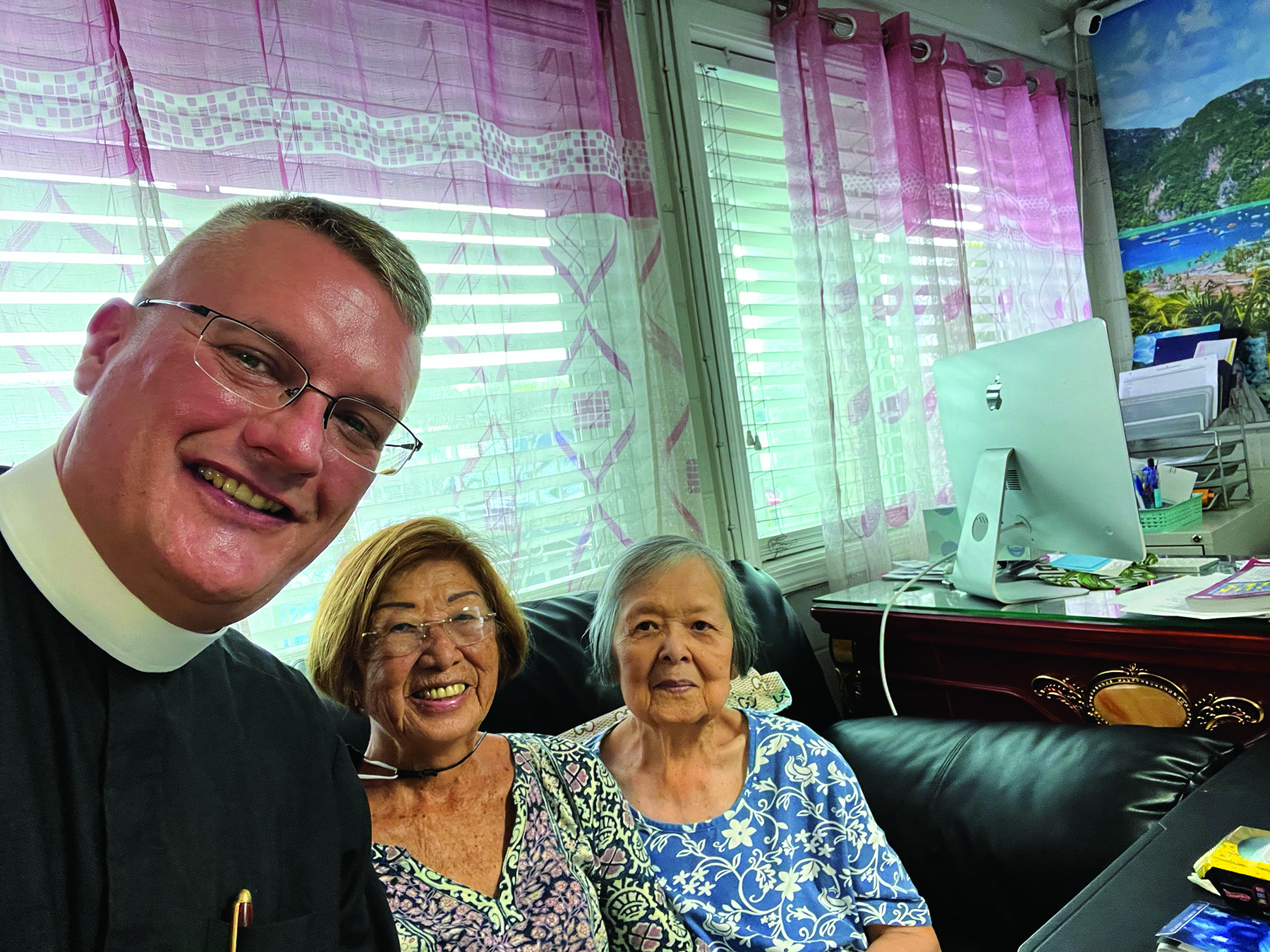
(L–R) Rev. Christopher Bridges with parishioners Edean Iwanaga and Lorraine Yap
During the height of the COVID-19 pandemic, members of Epiphany Episcopal Church in Kaimuki served as a testament to faith and dedication as they continued to attend services in person — when we were allowed to do so. It renewed me as a minister each and every Sunday.
Even before the vaccine became available, some members of the congregation who were more vulnerable due to age or illness attended church — despite the risks. They simply put on their masks, safely sat six feet apart, washed their hands, then folded them to worship God together, following the guidance of the Centers for Disease Control and Prevention.
Now that the vaccine is widely available, all the members of the church have demonstrated their love for their community by getting vaccinated, protecting themselves while helping the islands combat the virus.
Many studies indicate that religious practices substantially contribute to physical and mental health. All I have to do is look at my members who are in the 70-to-90-year-old age range who have been coming to church regularly. One of our members who lived to be 103 years old came to worship nearly every Sunday. Some of our elder members have attended since they were children.
Many of those who have gone on to be with Jesus in Heaven lived full lives as elders. They knew that coming to a place of worship — going to a sacred place to worship and committing to something beyond themselves — builds a bridge into their personal lives. Worshiping God in fellowship with other members of the congregation and sharing the ups and downs of life helps give them the ability to deal with the stress in their daily lives. I have been a witness to countless stories that back up this observation.
These grey-haired elders are an example of what St. Paul the Apostle called “mature faith — understanding the wisdom of God.” They rediscovered a secret that many have forgotten: Having faith and being a part of a sacred place of worship is important to well-being.
“I exhort the elders among you to tend the flock of God,” St. Peter said. So to all the elders out there, keep tending the flock at your church. The Bible says, when elders gather, God’s wisdom becomes known. So I would like more elders to gather with me at Epiphany to share that wisdom. But churches are not just a gathering place for the senior citizens. Ultimately, the connection with God is strengthened through church attendance by people of all ages.
During the height of the COVID-19 pandemic, members of Epiphany Episcopal Church in Kaimuki served as a testament to faith and dedication as they continued to attend services in person — when we were allowed to do so. It renewed me as a minister each and every Sunday.
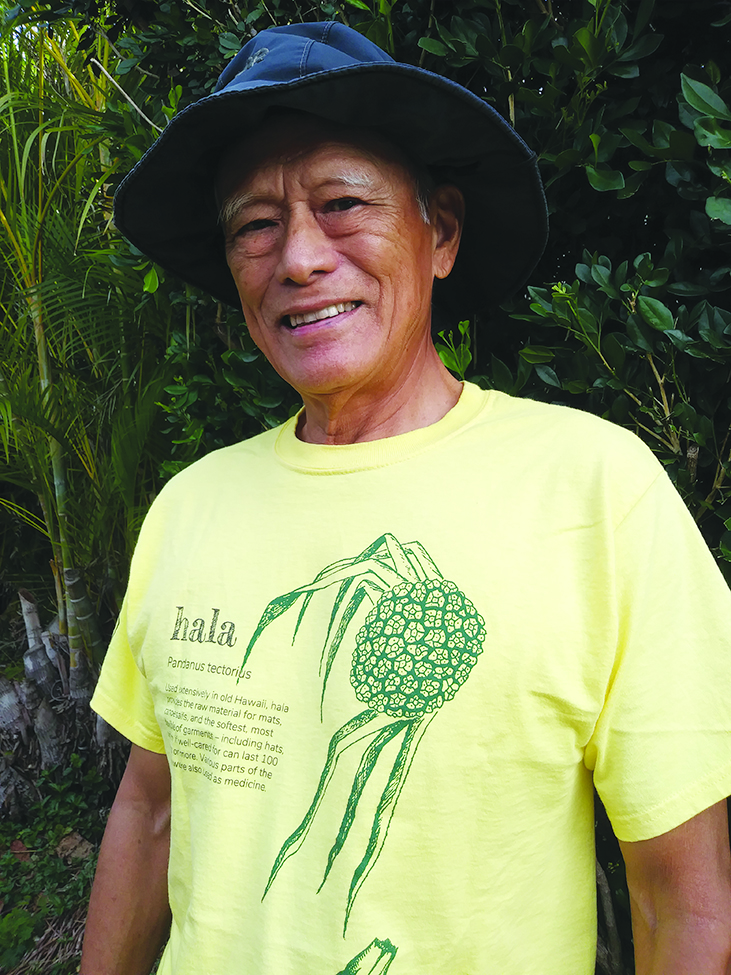
Lot Lau is putting his lifelong love of trees to good use. At age 81, he is a member of a Citizen Forester group whose efforts are aimed at helping to save the planet — one tree at a time.
“When I was young, I thought of trees only for climbing to get the fruit,” he recounts. “I preferred the Samoan palm variety. They bear coconuts much lower to the ground and are tall, stately, durable and strong. They sway gently in the breeze like a hula dancer. They give of themselves to benefit others.”
The Citizen Forester (CF) program works through the Smart Trees Pacific (www.smarttreespacific.org) nonprofit, offering community members of all ages information about the benefits of trees in our urban forests. CFs learn how to identify common species and how to collect measurements and assessments for a software application that reveals the ecological services of our trees. After completing training, CF teams inventory the trees in our public parks and streets.
There are more than 300 trained volunteers on O‘ahu and Kaua‘i. One group takes care of 74 trees along a quarter-mile stretch of a walking path at Diamond Head State Park. CFs like Lot care for the tree wells in Kaimuki.
“As a Citizen Forester, I am able to do more to reduce my carbon footprint,” says Lot. “I’m contributing to the effort to increase the canopy of trees in Kaimuki, to help make Kaimuki look greener, feel cooler, and capture carbon and hold water. I am reinforced by the dedicated program participants who serve as my role models.”
Lot says he has also been influenced by Lao Tzu, who wrote the main book of Taoism, the Tao Te Ching. Taoism holds that humans and animals should live in balance with the Tao — the universe. The Taoist ideal is one who changes themselves, becoming a good example to others. So changing oneself makes the world better.
“I have also learned there are various forms of the expression ‘do unto others’,” says Lot. “I believe that there is a connectedness between all forms of life. So, it is about living in harmony with nature. Current climate change effects demonstrate how harm to one is harm to another. So at the most basic level of self-interest and survival, trees are obviously very important to us humans.”
“But humans will never know much about our universe — that’s why religion is called a “faith.” For me, attending church reminds me how to how to treat others,” says Lot, “serving as a guide along right paths in a Christian tradition.”
Lot has chosen his path wisely — following God, Lao Tzu and his fellow CFs. And like his Samoan coconut trees, he strives to remain durable and strong — giving of himself to benefit others — bending instead of snapping under duress.
“But we are no longer in harmony with nature,” says Lot. “We have forgotten our connectedness. We are way behind the curve in response to climate change that could be mitigated by more and healthier trees, so I do what I can to help.”
Lot Lau is putting his lifelong love of trees to good use. At age 81, he is a member of a Citizen Forester group whose efforts are aimed at helping to save the planet — one tree at a time. “When I was young, I thought of trees only for climbing to get the fruit,”…
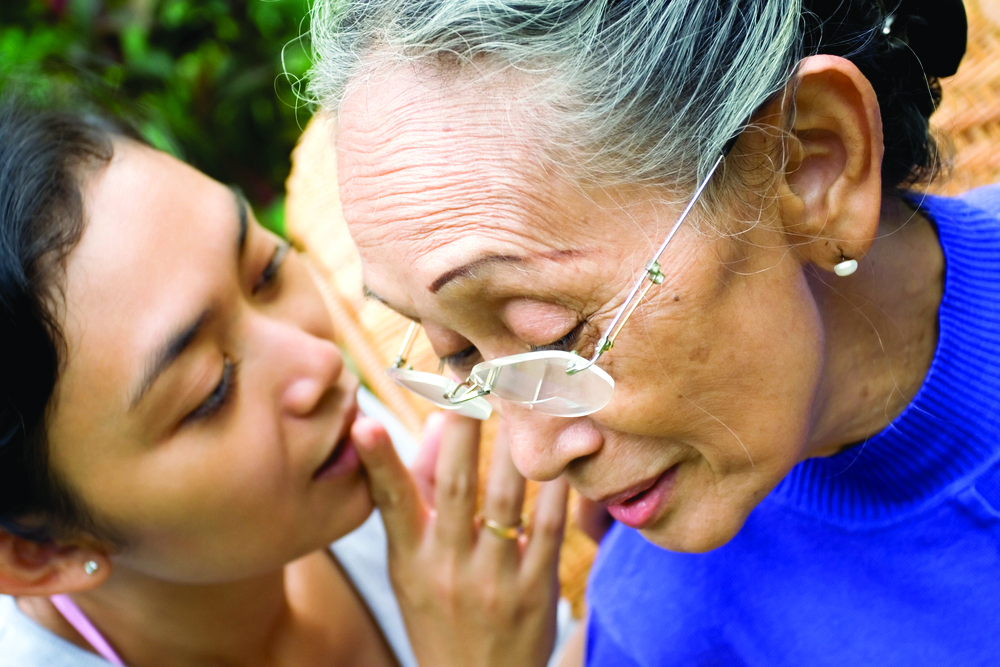
As an adult daughter, do you ever feel like a little girl when conversations with your mother end in misfires, teary rants or silence? You’re not alone — it happens this way for 43.5 percent of us. However, there’s hope. By using ASK Presetting, you can stop walking on eggshells.
ASK Presetting is a precise communication method that involves pre-framing and rehearsing questions, comments, words and tones to avoid emotional collateral damage. When presetting tough topics with your mother, for example, appeal to her sweet side; don’t make her feel wrong.
Using this method, you can head off hurtful words in as little as seven minutes and stop feeling verbally attacked. Start by sprinkling your conversations with these two-word phrases: “I feel,” “I’m open,” “I’m confused,” and “Tell me more,” when your mother’s (or father’s and siblings’) words cause anxiety.
If you’re discussing tough and tender topics, but she keeps pinpointing your mistakes, you can calmly express yourself using this method without squabbling. And you won’t require years of therapy, either. Instead, you’ll be communicated with her respectfully and with love.
ANNETTE PANG-LIFE COACH VILLAGE, LLC
2383 Beckwith St., Honolulu, HI 96822
808-372-3478 | ap@annettepang.com
www.annettepang.com
As an adult daughter, do you ever feel like a little girl when conversations with your mother end in misfires, teary rants or silence? You’re not alone — it happens this way for 43.5 percent of us. However, there’s hope. By using ASK Presetting, you can stop walking on eggshells.
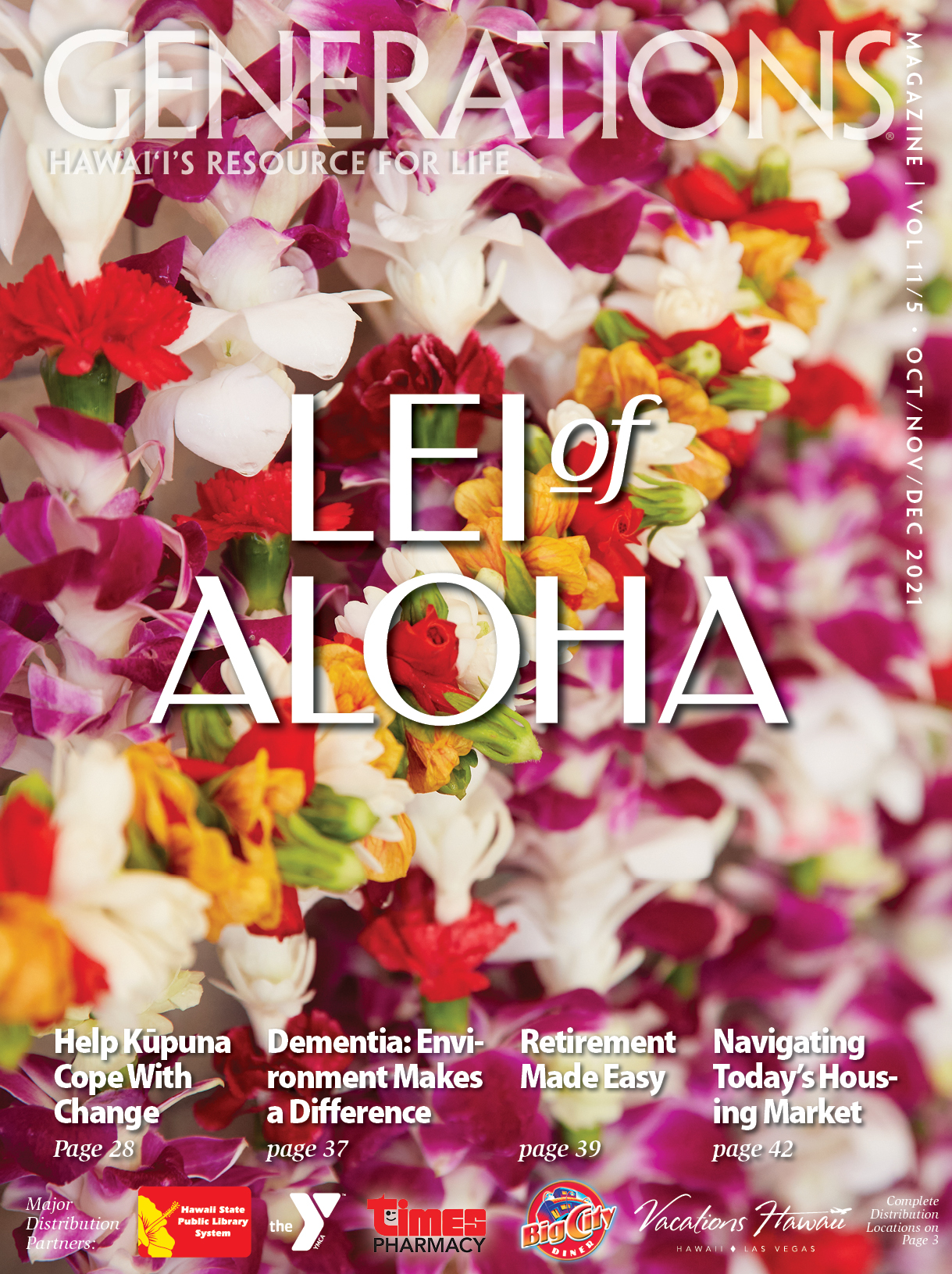
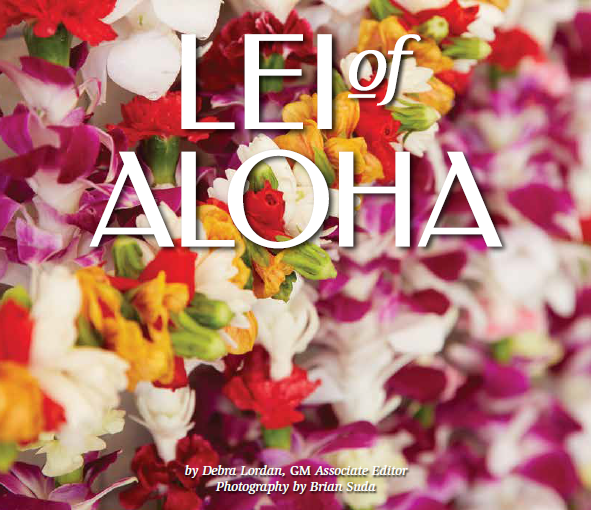
In Hawai‘i, any occasion can be made more special by the giving of a lei. Whether it’s for love, a celebration or to honor someone, you can choose the one that symbolizes the sentiment you want to convey or select the one that suits your taste. All represent the rich heritage of the lei.
Lei Day, May 1, is dedicated to the Hawaiian tradition of making and giving lei. But some may not know the the tradition entails much more than the officially dedicated day. The traditions that surround lei make them appropriate for many occasions. Hawaiian tradition also offers particular lei for celebrations and seasonal events.
Giving a lei symbolizes friendship, love, respect and honor. It is a gift for greeting someone warmly. It represents the spirit of aloha. Its beauty and meaning flow from the heart of the giver.
A Hawaiian Tradition
The tradition of adorning themselves with wreaths of local vines and flowers to honor their gods came to Hawai‘i with the Polynesians who settled here long ago. They brought with them many of the plants they needed for daily life — plants for medicinal use, plants for food and plants that they brought for their sweet scent for use as a personal embellishment.
In their new island home, lei came to signify royalty, rank, status and wealth. The geography of the area, the religion of its people and the tradition of the hula were all associated with the lei they wore. As time passed, they developed their own unique culture and traditions.
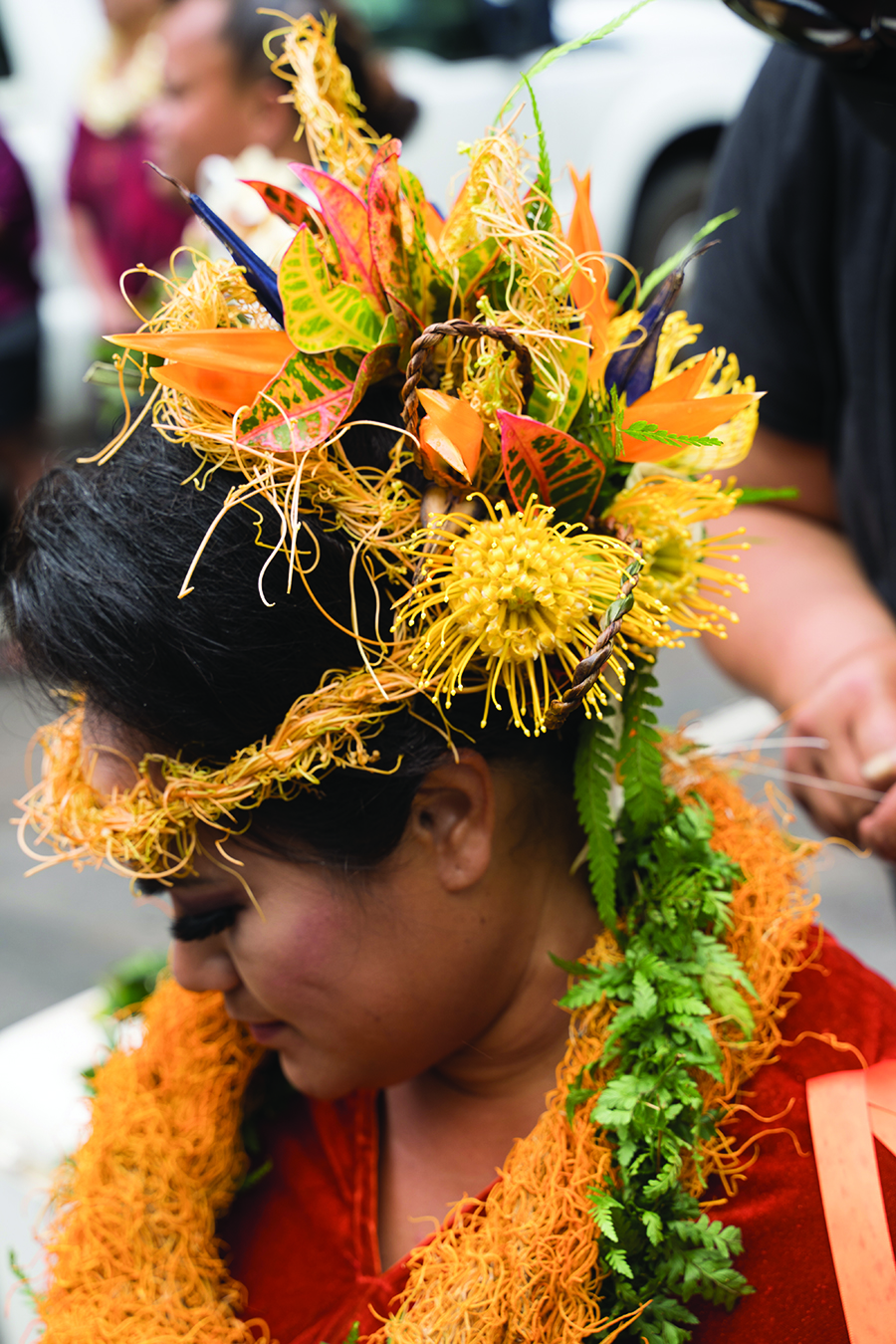
The new Native Hawaiians found many other items, including hala and maile, that could be fashioned into adornments. In Old Hawai‘i, lei were created with the lush flowers, vines and leaf stems of every kind from every island — even seaweed from the rich Hawaiian waters. Lei were also made with ivory, bone, seeds, kukui nuts, hair, teeth, shells and feathers.
The pupu lei was made from shells and the hulu manu lei was made from feathers. Niho palaoa lei were made of the bones of the walrus and whale held together by human hair, which were passed down through generations.
Other plants and materials were introduced later, such as the carnation, orchid and plumeria.
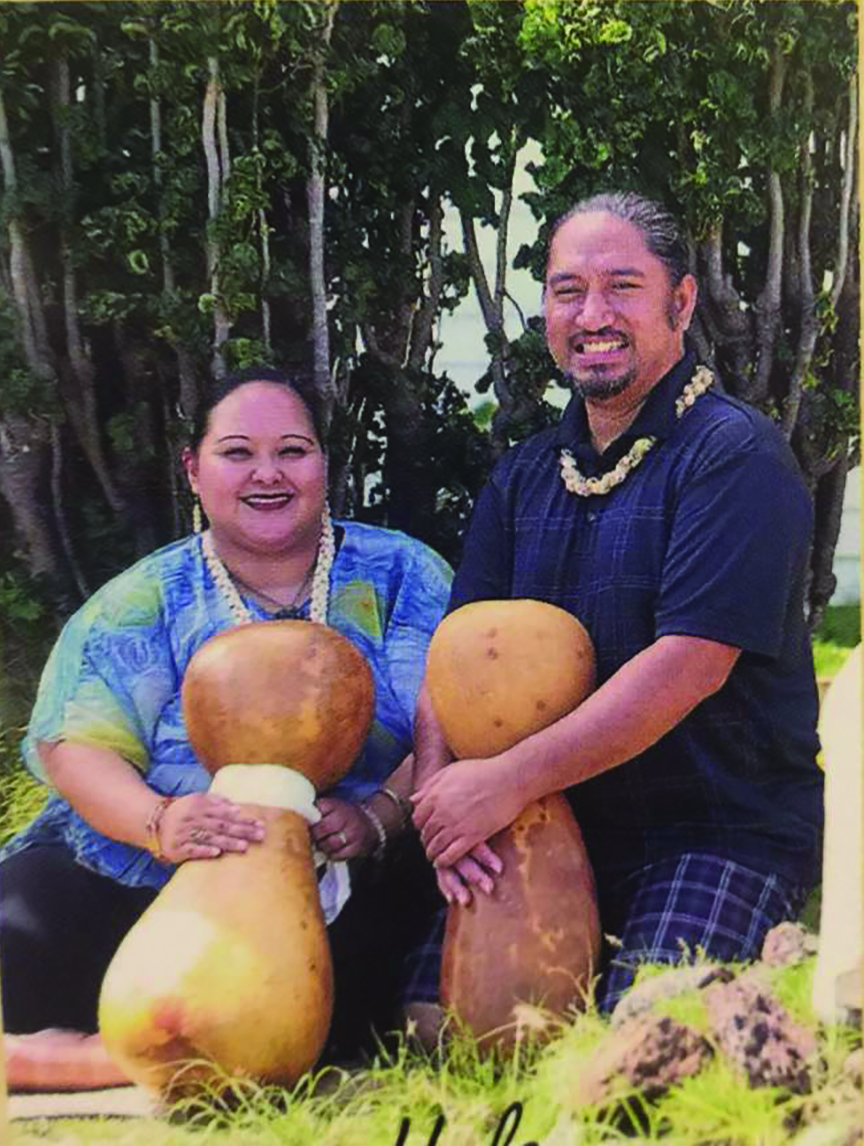
Kapono Kamaunu learned about Hawaiian culture, hula, chanting and more from Kumu Hula Keli‘i Tau‘ā.
Lei and Hula
What Kapono Kamaunu knows about lei and Hawaiian culture, he didn’t learn growing up. He was raised on O‘ahu, where his childhood activities and interests mostly revolved around Waikīkī Beach and sports. When he moved to Maui in 1993, he met Kumu Hula Keli‘i Tau‘ā, a teacher at Baldwin High School. As a freshman, he not only learned about hula and chanting, but other aspects of the Hawaiian culture, as well.
Kapono and his wife, Priscilla, became kumu hula 10 years later, offering training for hālau hula on Zoom since the pandemic began. They own and run a home-based hula implement-making business called “Na Kani O Hula.” Kapono works as a cultural advisor at the Fairmont Kealani and performs at the Old Lāhainā Lū‘au, as well.
“Through hula, we learned about lei-making, Hawaiian history and culture,” he says.
In Old Hawai‘i, the major types of lei were each related to different spirits and used for different reasons. Many were related to Hawaiian myths and religious customs, Kapono says.
“It goes back to hula,” says Kapono. “For most of the year, the lives of the Hawaiian people were strictly governed by a set of laws called ‘kapu.’ Everything they did was directed by these kapu, including hula. But during the Makahiki season (October or November through February or March), the ancient Hawaiian New Year festival in honor of Lono, many kapu were suspended. This time of year, kane (men) were allowed to perform hula on heiau, traditional religious temples. Makahiki was a time of peace, gathering and hula performances without restriction. For ceremonial purposes, hula dancers would wear lei.”
Kapono and his wife Priscilla own and run a home-based hula implement-making business.
Traditionally, hula dancers wear specific lei to reflect the dance they are performing, especially in a competition setting. Dancers tie in the story — the chant or mo‘ōlelo — its setting and the flowers, ferns and other materials found in the location relevant to the story, says Kapono.
“In hula, we say kinolau — the divine is everywhere, and everything is the divine. It is the physical embodiment of the many Hawaiian gods and goddesses.”
“After asking permission from Laka first, hula dancers would gather ferns, such as palapalai, laua‘e ferns and maile, for their adornments in ceremonial performances and other practices as well,” says Kapono. “The gathered vines, leaves or flowers were placed on the kuahu hula (hula altar) dedicated to Laka.”
“Whatever is in the song, we aim for the closest possible representation.”
“For example, Pele and her sister Hi‘iaka are represented by the red flowers of the ‘ohi‘a lehua brought to the islands by the Polynesians settlers. So when you do a dance about Pele, you would wear a haku (braided) lei or a lei po‘o made of ‘ohi‘a lehua, as well as a lei a‘i (a neck lei).”
For centuries, lei made from the fragrant leaves of maile have been used to communicate love, respect, blessing, enduring devotion, reverence, friendship and a desire for peace.
Traditional Meanings and Uses of Lei
One of the most popular of all the lei varieties was the maile lei, made from a leaf-covered vine with a sweet and spicy scent. This vine was worn around the neck, draping freely down to the waist. The maile lei was related to the spirit of the hula dance and represented Laka, the goddess of hula, as well as other sacred spirits.
For chieftains and members of royalty, the ilima was preferred. The full, lush lei was made from hundreds of delicate orange blossoms.
The ti plant has a long tradition of being planted outside homes to keep evil spirits away. Ti stalks were used to proclaim peace and to call a truce. A lei was made by tying ti leaves together. The open lei was worn by physicians and priests.
Limu kala, a type of seaweed, was gathered and used in many different ways — for religious purposes, as medicine, for consumption or as a lei. Traditionally, limu kala was gathering, fashioned into a lei and worn by a person suffering from an illness. The ill person or a kahuna would then pray to Kanaloa. When prayers were completed, the wearer of the lei would fully immerse him or herself in the ocean. In time, the lei would be swept into the sea as an offering to Kanaloa, in hopes of cleansing the wearer of the aliment.
Lei Traditions of Yesterday and Today
By fusing their island lifestyle with their sacred rituals and the natural elements around them, Hawaiians created lei that began to be worn for virtually every occasion by both commoners (maka‘ainānā) and chiefs (ali‘i) alike.
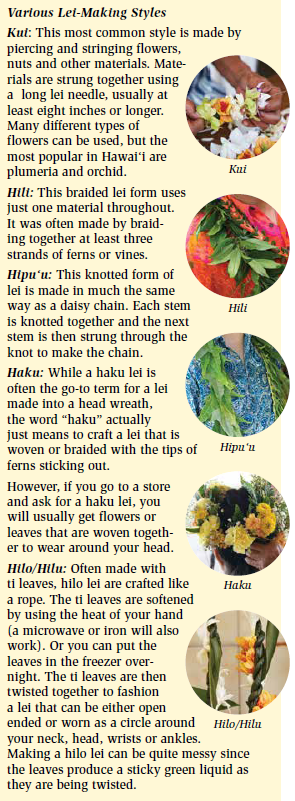
A lei po‘o is any lei that is worn around the head. What is often referred to as a haku lei is actually a lei po‘o crafted in the haku style.
“Today, lei are used for an array of occasions and it is widely accepted throughout Hawai‘i Nei that any type of lei can be worn by anyone and everyone,” says Kapono. “One thing that hasn’t changed is that the giving of a lei symbolizes giving your mana to someone else.”
Mana is a supernatural force that may be ascribed to persons, spirits or inanimate objects. It may be good or evil; beneficial or dangerous.
“When we are making lei, we want to ensure that we are putting the best of our spiritual energy into the lei,” says Kapono, “so when we give it to someone, we are giving them good energy, connection and love. Lei are the quintessential symbol
of love; of aloha.”
The type of flower made into a lei and gifted to a loved one has more to do with personal preference and seasonal availability than symbolism, says Kapono.
Although the lei of today are much like those worn in Old Hawai‘i when the first Polynesians settled the islands, their meaning and presentation has changed over the years.
Lei in Old Hawai‘i symbolized the status of the wearer and were presented by bowing and holding out the lei for the recipient to take.
“Traditionally, it was disrespectful to drape a lei over a person’s head, particularly when that someone was royalty,” says Kapono. “You do not want someone to interfere with your connection to Akua by having them cut off your mana.” This presentation method gave the recipient the option of taking it and putting it on themselves, giving it away, putting it on an altar or taking it to the ocean. “Because, just as lei are made and presented with love, they can also have bad intentions.”
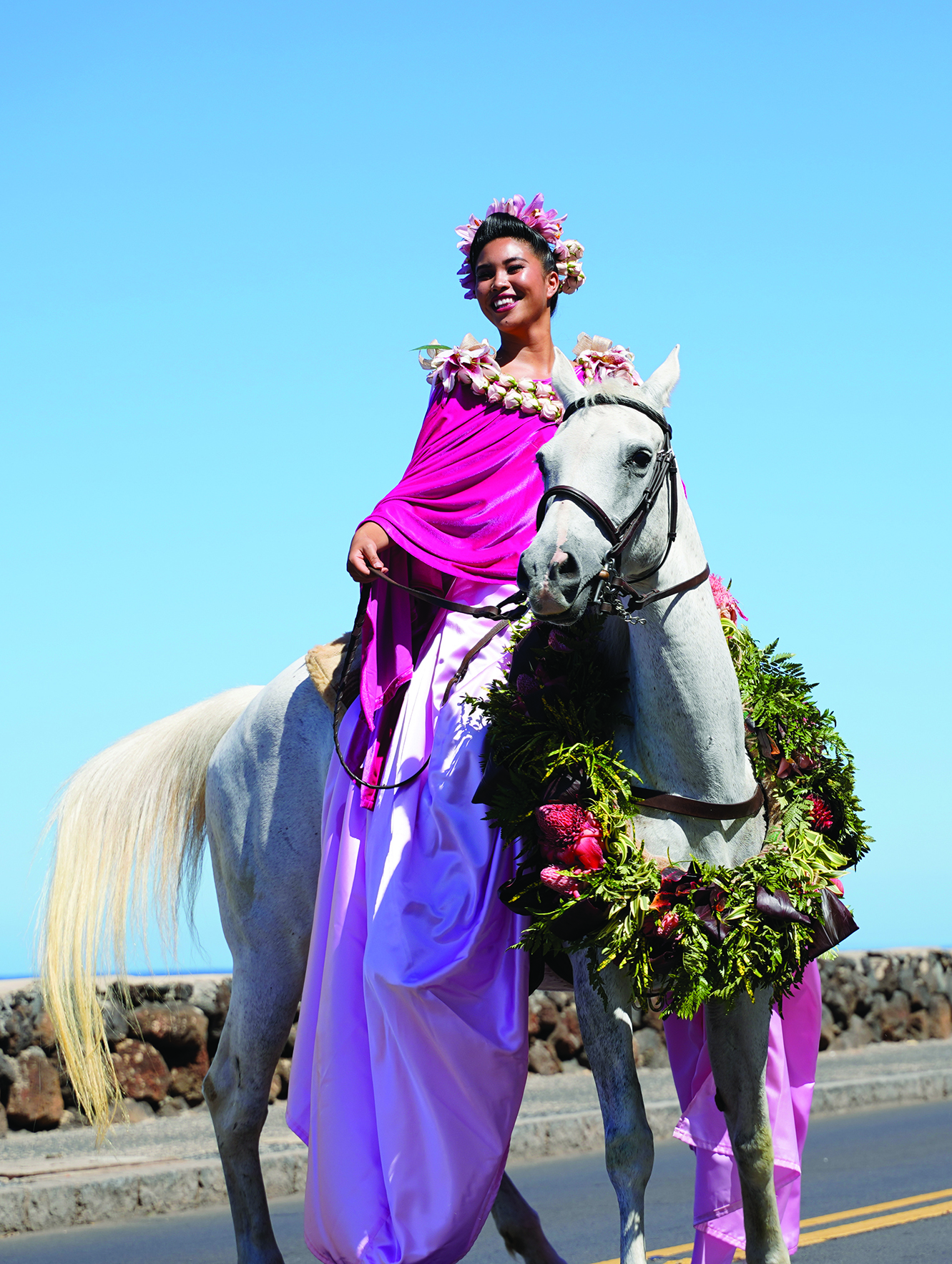
Adorned with a bounty of colorful lei, the regal pa‘u riders and their horses are the highlight of every parade
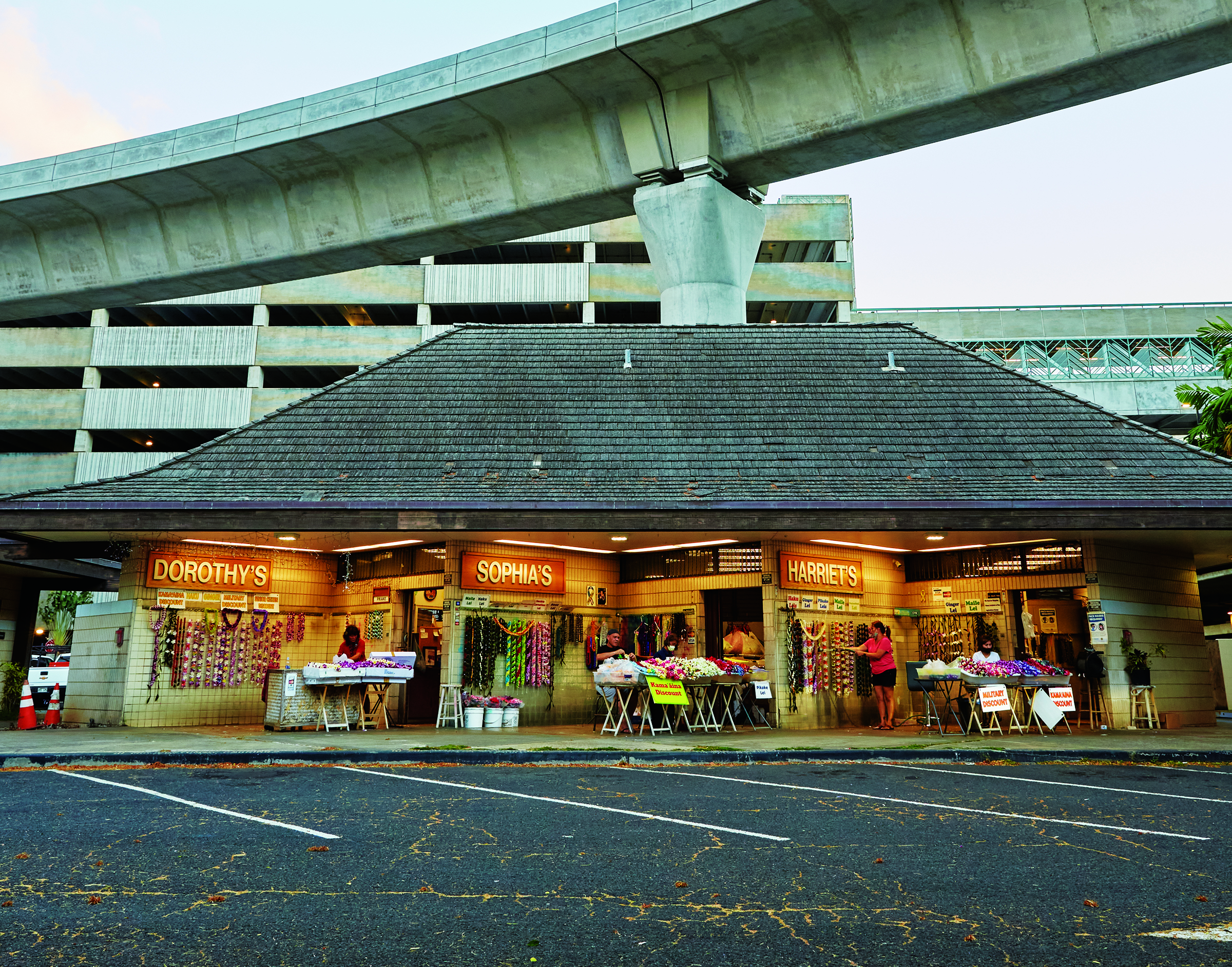
Around the 1840s, when Steamer Days or Boat Days began at Aloha Tower and Honolulu Harbor, visitors were greeted with armloads of lei. It may have been at this time that lei began to be placed over the heads of those arriving or departing, accompanied by a kiss on the cheek. That particular tradition came to a halt with the arrival of jet planes in the 1950s. To accommodate visitors, Daniel K. Inouye International Airport’s lei stands are located in the area.
Although most islanders believe that anyone can wear any type of lei for any occasion, Hawaiian tradition dictates the use of specific lei that are symbolic of the occasion, related to the season and dependent on the time of year the flower is in bloom. Worn at other times, it can bring the wearer bad luck.
For example, a lei made from the yellow, orange and red keys of the pineapple-like hala fruit interlaced with maile leaf or laua‘e fern can be worn at the beginning of Makahiki season, the Hawaiian New Year. Worn at this time, the hala lei invites good luck, pushes bad luck aside and prompts the wearer to forgive past grudges. However, worn at other times of the year, it can bring the wearer bad luck. The lei is associated with death and is often worn at funerals.
Although there is significant meaning associated with the giving of a lei, it is open to different interpretations by the maker, seller, giver or recipient. But it may be wise to be aware of certain traditional details.
“Some people still believe that it is inappropriate to give a pregnant woman a closed lei,” says Kapono. “An open lei may be given, as it symbolizes that the baby will be unencumbered and unharmed by the umbilical cord, ensuring it will not be tangled around its neck in the womb.”
Lei are often referenced as being created in a circle to symbolize love and the family circle. “Lei, like many of our nāmea Hawai‘i (Hawaiian arts), have grown and evolved into priceless artifacts that are shared around the world. Whether it’s an heirloom feather lei, a lei pupu that is passed down from generation to generation, or lei made from fragrant flowers and beautiful ferns, the joy of gifting and receiving a lei filled with the aloha spirit can brighten anyone’s day — even during the darkest of times.”
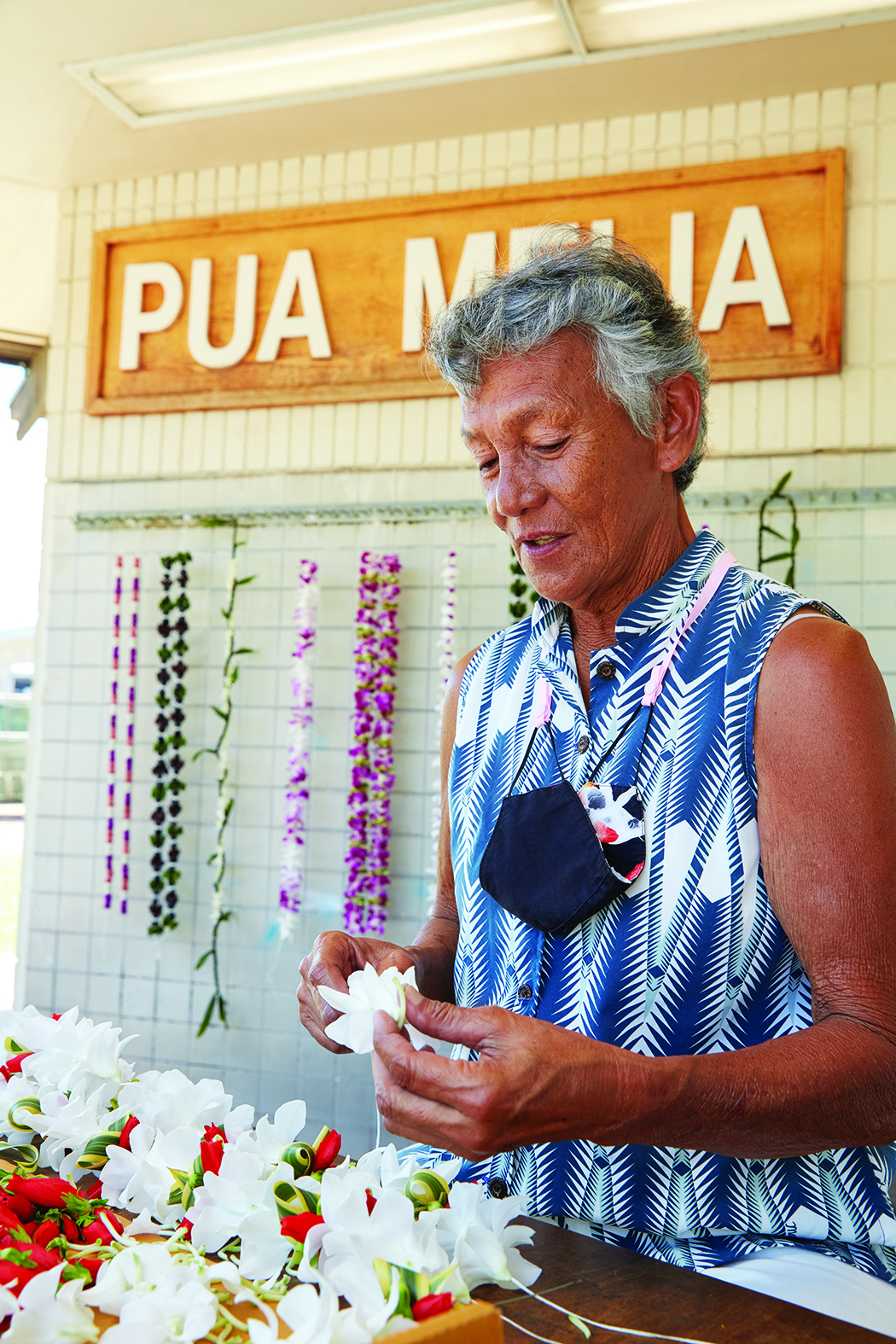
Ku‘ulei Ka‘ae makes and sells lei from Pua Melia, her stand near Daniel K. Inouye International Airport. Ku‘ulei’s family began selling lei four generations ago, beginning with her great-grandparents. The other women selling lei here are also descendants of the original Native Hawaiian airport lei sellers.Ku‘ulei Ka‘ae
A Family Tradition: Love From the Lei-Sellers
“That is what we have to offer in this pandemic — love. I know that when people receive lei, they feel the love we put into them,” says Ku‘ulei Ka‘ae, who makes and sells lei from her stand near Daniel K. Inouye International Airport. “I don’t think a lot of people realize what a lei can do for a person. The type of lei you give is a personal choice. Whether it is pikake, plumeria, ginger, pakalana or double tuberose, the giver must love the flower as it is a symbol and extension of their love for the recipient.”
Ku‘ulei’s family began selling lei four generations ago, beginning with her great-grandparents. They sold in different locations, such as Chinatown and Aloha Tower. Their daughter, Sophia Ventura, Ku‘ulei’s grandmother, had a 1932 Ford truck that her husband equipped with hooks for displaying the lei. She also sold lei at Fort DeRussy — the only lei seller there. She was later invited to set up shop near the access road of the then Aeronautics Aviation Airport.
Ku‘ulei was around 9 when the stands moved to Lagoon Drive in 1963. “My mother and I were the first ones to open our doors in this new building.” In the early 1990s, they were relocated to the concrete building they now occupy.
The women selling lei at this location are descendants of the original Native Hawaiian airport lei sellers. Since Ku‘ulei is the only daughter in her family, her mother gave her Pua Melia, the Airport Lei Stand she operates to this day.
“The only time I ever got a lei growing up was when my mom brought home a plumeria lei for May Day. I wondered, why a plumeria? I asked my mom why I couldn’t have a double carnation lei or pikake. She said, ‘Because the plumeria is the most beautiful flower. One day you will understand.’ The point was, when you get a lei, it is from the heart. It is aloha; it is love. When you are younger, you don’t really understand the depth and meaning.”
“Then when I was in ninth grade, she brought me a double carnation. I was so thrilled! When I went to school, I put it on. I took it off about a half-hour later and gave it to a friend because I realized it didn’t mean anything to me. It wasn’t from my mother’s heart. She only got it for me because I asked for it. Oh how I wished I had that plumeria lei — it meant the world to me! I realized what my mother was saying. The most beautiful lei comes from the heart.”
“I will wear your love as a lei,” Ku‘ulei recited in Hawaiian.”
Hawai‘i’s lei have become revered all over the world for their beauty and fragrance. “Today, many lei or hula practitioners teach the traditional art and practices of lei, continuing to strengthen our heritage through our younger generation, visitors and practitioners abroad so we can wrap a lei of peace and aloha around the entire world,” says Kapono.
Lei Day, May 1, is dedicated to the Hawaiian tradition of making and giving lei. But some may not know the the tradition entails much more than the officially dedicated day. The traditions that surround lei make them appropriate for many occasions. Hawaiian tradition also offers particular lei for celebrations and seasonal events.
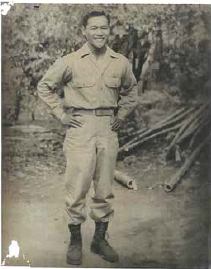
Filipino veterans such as the late Domingo Los Banos worked hard to educate the community about their role in WWII.
On July 26, 1941, President Franklin Roosevelt called upon all organized military forces of the Philippines into the service under the US Army Forces in the Far East. When Pearl Harbor and Manila were attacked on Dec. 7, 1941, these soldiers were brought into direct combat as the US officially entered World War II. During the Japanese invasion of the Philippines, US and Filipino soldiers fought together in many battles across the Philippine islands, including the battles in Bataan, Corrigedor, Luzon and Leyte.
BATAAN DEATH MARCH
The Japanese army had carefully orchestrated a unified military attack to conquer the Pacific and to defeat the US. The attack of the Philippines began 10 hours after Pearl Harbor. In a mere month, the Japanese captured the capital of Manila. The combined military forces held strong for three months on Bataan and the island of Corregidor, even with no naval and air support. But ultimately, the ravages of disease and starvation led to Gen. Edward King Jr. surrendering his 76,000 troops in Bataan.
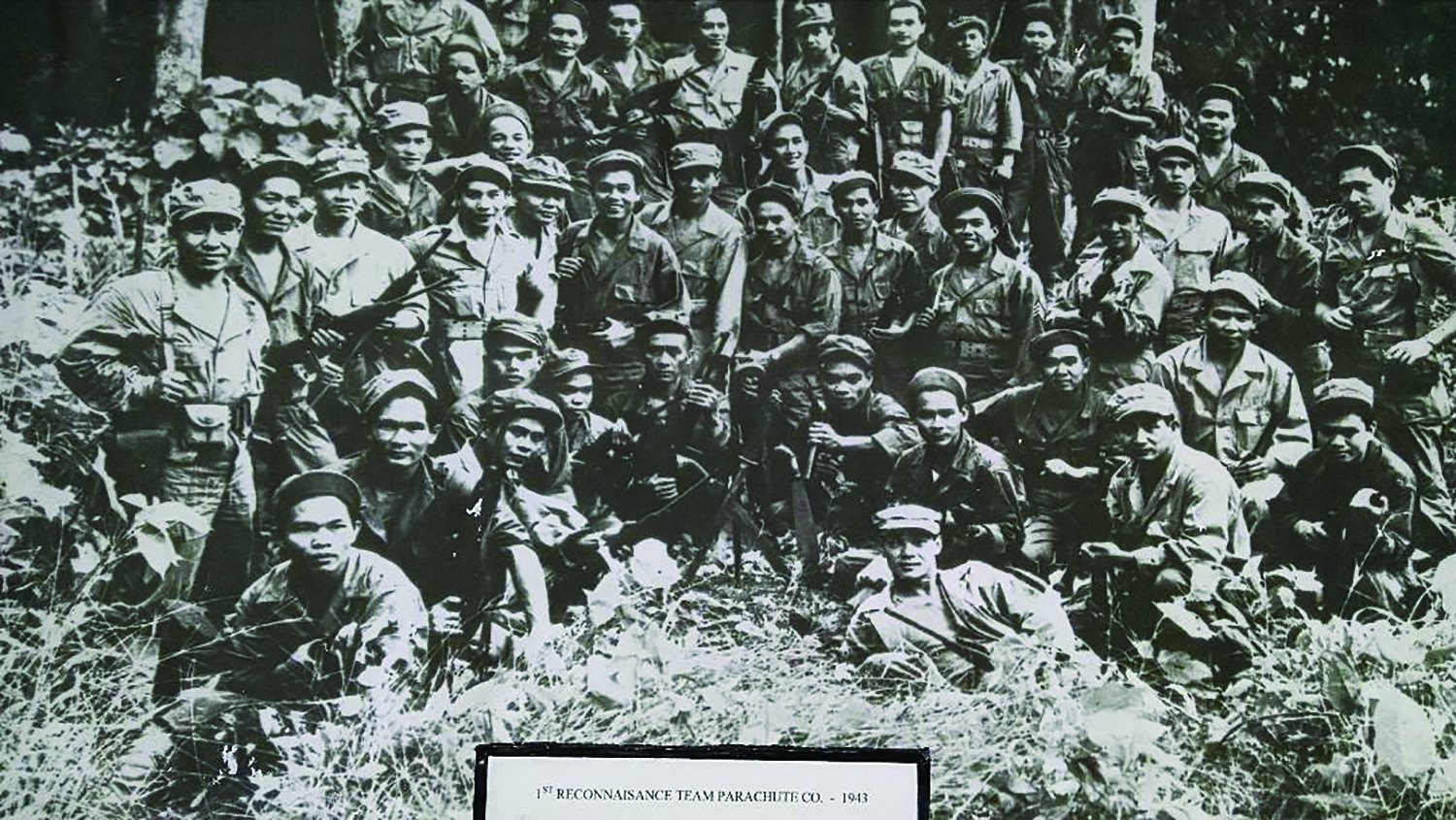
First Reconnaissance Team Parachute Company 1943.
During the Battle of Corregidor, the Japanese army forced Filipino and American prisoners of war to march 65 miles from the Bataan Peninsula to San Fernando — the brutal Bataan Death March. between 60,000 and 80,000 Filipinos and Americans marched through the jungles to confinement camps throughout the Philippines. They were deprived of food, water and medical attention — many were killed on the spot if they stopped to rest. During the march, approximately 1,000 Americans and 9,000 Filipinos died. The death march was formally designated by a military tribunal as a war crime.
Philippine soldiers of the 14th Engineers, Philippine Scouts, United States Army Forces Far East (USAFFE), prepare a railroad bridge for destruction.
JUSTICE DELAYED IS JUSTICE DENIED
President Franklin Roosevelt had promised the Filipino veterans GI benefits and the right to become US citizens to entice them to join the war. During WWII, millions of men and women of all races, from over 60 countries, served under the US flag. Despite the Japanese occupation, the Filipinos organized guerrillas in resistance and vowed to fight against the Japanese. By the end of that war, more than 260,000 individuals fought in the resistance movement. The bravery, heroism and dedication of the Filipino veterans played an integral part of leading Allied powers to victory.
However, the US consciously broke its promise to the Filipino soldiers. After the war, President Harry Truman signed laws that stripped away many promises of benefits and citizenship for Filipino veterans. The GI benefits and US citizenship promised them were denied by the Rescission Act of 1946. It stated that the service of Filipinos “shall not be deemed to be or to have been service in the military or national forces of the US or any component thereof or any law of the US conferring rights, privileges or benefits.”
Filipino veterans and their allies, including the Filipino Veterans Recognition and Education Project (FilVetREP), a nonpartisan, nonprofit, community-based, volunteer national initiative, had petitioned Congress to restore the promised benefits countless times over the years. Sen. Daniel Inouye from Hawai‘i submitted a Filipino Veteran’s Benefits bill every year for 18 years, but each year, Congress voted to deny those promised benefits.
FILIPINO VETERANS FINALLY RECOGNIZED
But the veterans never gave up. In 1990, Congress awarded citizenship to thousands of Filipino veterans and extended VA benefits to them. In 2009, Sen. Inouye’s bill finally passed, providing a one-time, lump sum payment to Filipino veterans. Sadly, these veterans were in their 80s or 90s by then or had passed on. Over 90 percent of the Filipino WWII veterans got nothing.
Seventy-five years after the US entered the war, Filipino veterans were nationally recognized and awarded the Congressional Gold Medal.
REPEALING THE RESCISSION ACT
Despite the long-delayed recognition of the contributions of Filipino veterans, the Rescission Act of 1946 has never been repealed.
As the FilVetREP organization (www.filvetrep.org) has stated, “It is time to repeal the Rescission Act… and correct a historic mistake upon thousands of Filipino WWII soldiers who gave their lives and limbs in a winning war in the Philippines over a brutal enemy; to restore upon them the honor, respect, and dignity they earned in war. They deserved nothing less.”
THE MISSION CONTINUES
MoveMeHawai‘i, a community education effort by the nonprofit Beta Beta Gamma Foundation, is planning an in-depth panel discussion providing more insights into this history. For dates and details about its community education plans, visit MoveMeHawaii.org. For more information about the Beta Beta Gamma Foundation, visit betabetagammafoundation.org.
On July 26, 1941, President Franklin Roosevelt called upon all organized military forces of the Philippines into the service under the US Army Forces in the Far East. When Pearl Harbor and Manila were attacked on Dec. 7, 1941, these soldiers were brought into direct combat as the US officially entered World War II. During…
“I don’t remember how to ride a bike!” “I’m too scared to ride in Honolulu traffic!” “I don’t have a bicycle.” These are some of the reasons Hawai‘i seniors give for not riding a bike.
The Hawaii Bicycling League (HBL) is here to help with the first two excuses. Honolulu-based HBL has recreational and educational programs for all ages. HBL’s Senior Cycling Program is back in action after a pandemic break. HBL is a great resource for seniors looking to get into biking for exercise and recreation. Activities for seniors include educational programs, fitness rides, group rides and even trike rides.
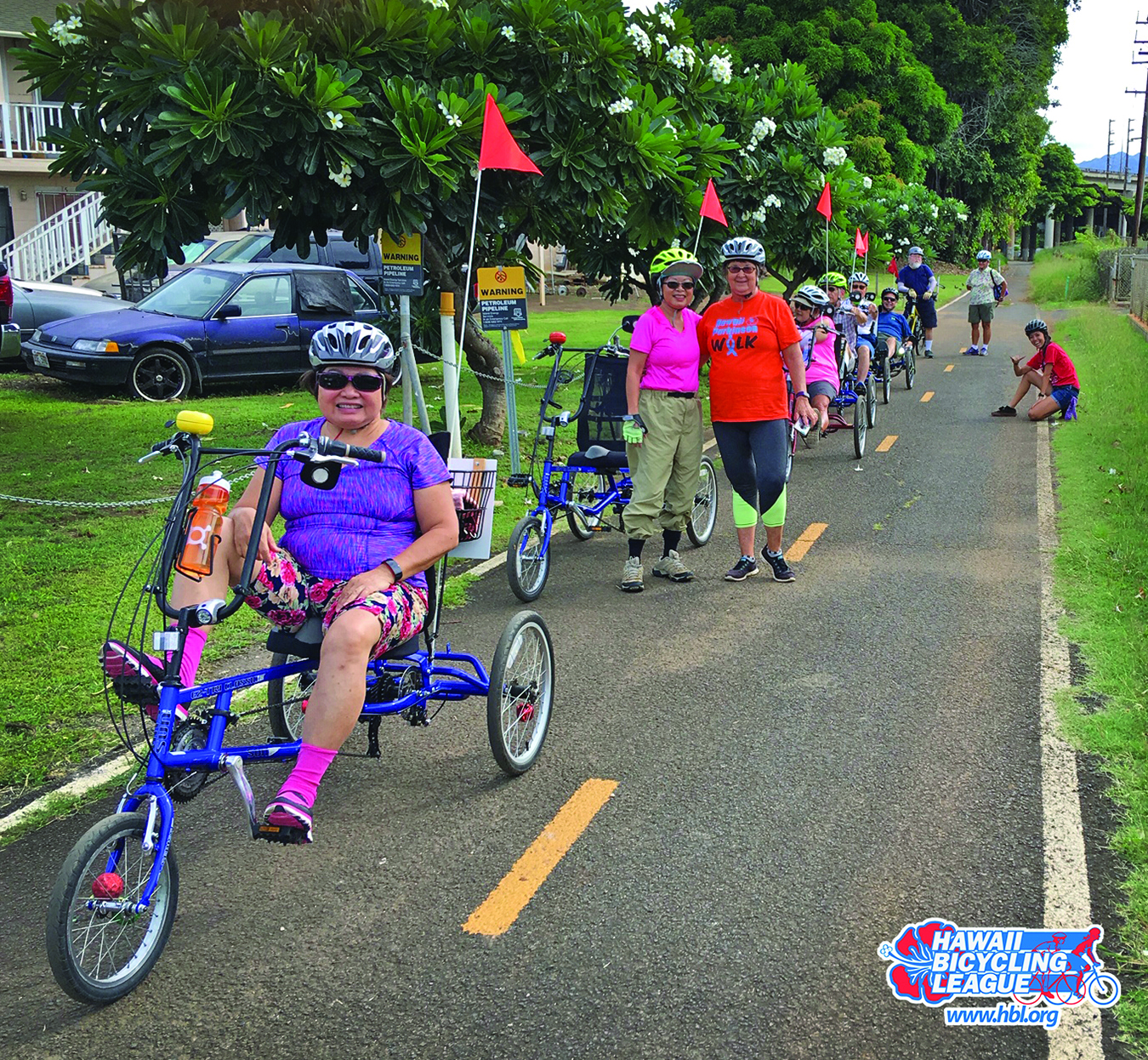
The Hawaii Bicycling League’s Senior Cycling Program events on the Pearl Harbor Bike Path are extremely popular. PC: Roger Au
For those who say they don’t remember how to ride, we say baloney! Scientists agree with the old expression, “just like riding a bike,” Once you learn to ride a bicycle, you never forget. According to Popular Science, cerebral coordination among several areas of the brain is so intense that the motions involved in cycling are never forgotten. It’s commonly referred to as “muscle memory.”
For those who say they’re afraid to ride in urban traffic, HBL offers route planning, precautions and other tips for riding in Honolulu. HBL Adult Education Director Malia Harunaga says maps are available that show bike lanes and which streets are the best — and the worst — for bicyclists.
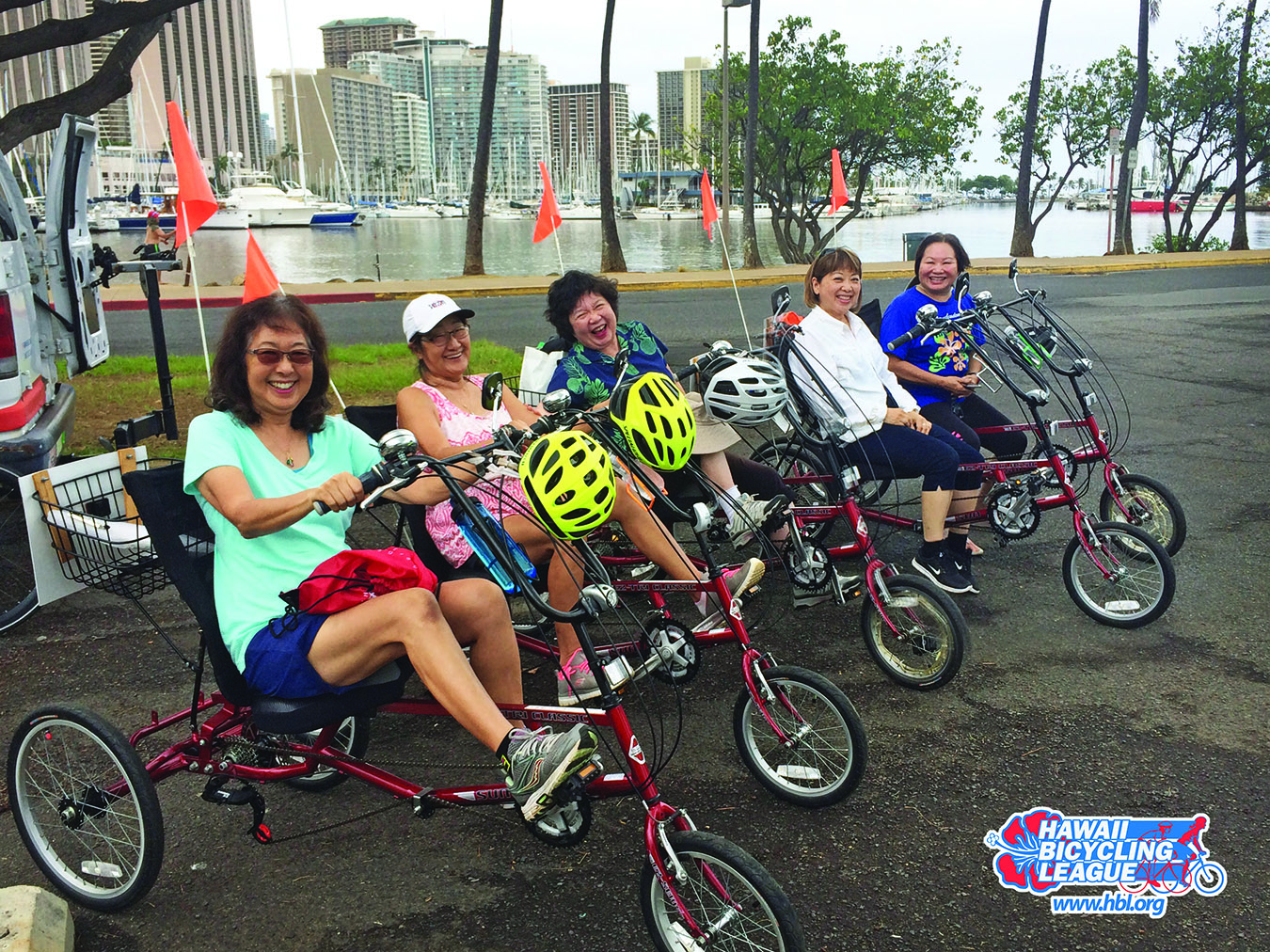
Adult trikes make biking possible for people who don’t feel steady enough for a two-wheeler. HBL, through a grant from the City and County Honolulu, has purchased eight recumbent tricycles that are great for people with back problems or poor balance. Trike rides on the Pearl Harbor Bike Bath are scheduled throughout the year (visit www.hbl.org) and are broken down into rides of varying lengths and degrees of difficulty.
If you don’t have a bike, O‘ahu’s Biki Bike bike-share program is a great alternative. HBL Executive Director Lori McCarney says she knows a man with Parkinson’s disease who started riding Biki Bikes. Now he says his Parkinson’s is much better and he’s able to do more things. For a Generations Magazine article about e-bikes, go to http://bit.ly/GM-E-Bikes.
“I don’t remember how to ride a bike!” “I’m too scared to ride in Honolulu traffic!” “I don’t have a bicycle.” These are some of the reasons Hawai‘i seniors give for not riding a bike. The Hawaii Bicycling League (HBL) is here to help with the first two excuses. Honolulu-based HBL has recreational and educational…
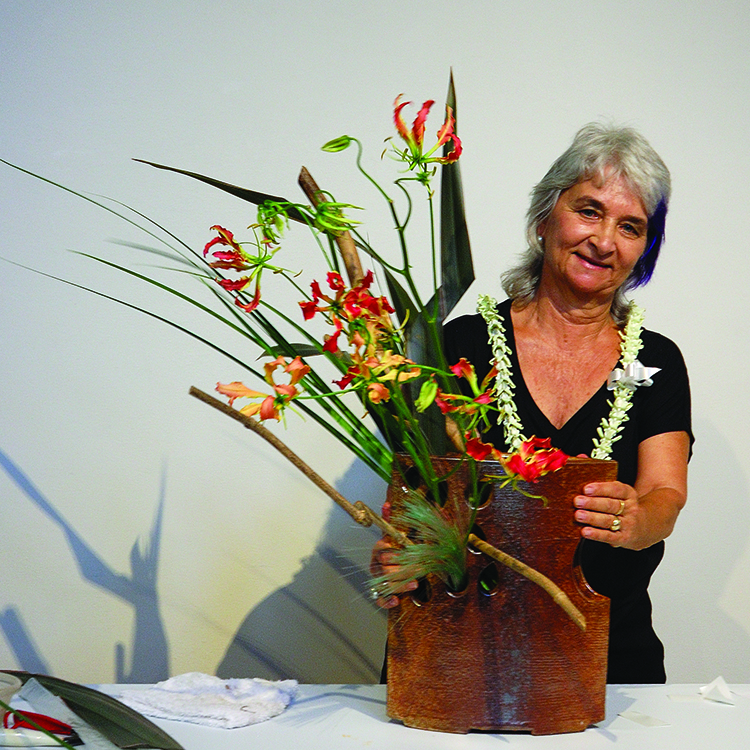
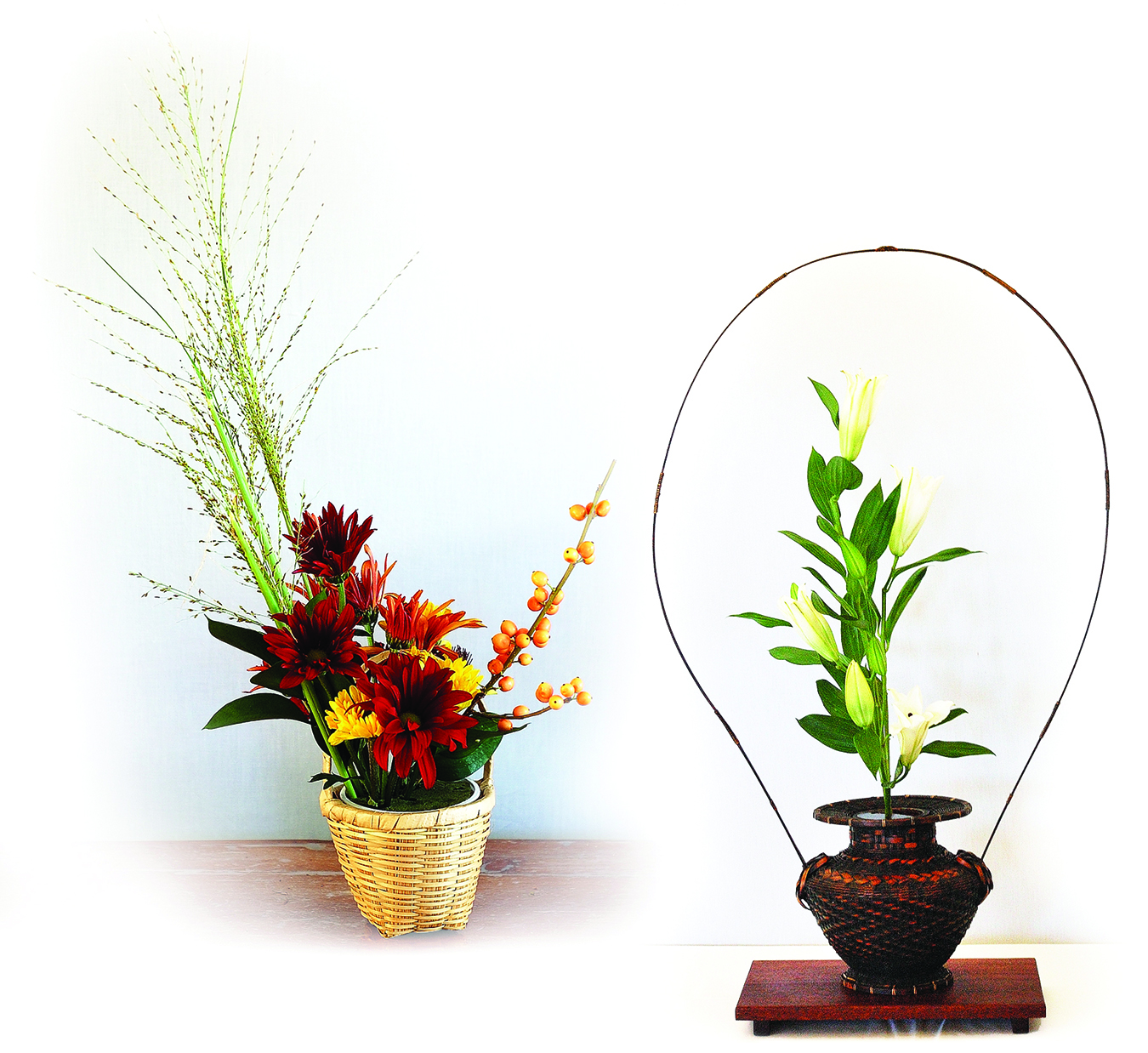
Hanakago, woven flower baskets used for ikebana, is the theme of this year’s Splendors of Ikebana, hosted by Ikebana International Honolulu Chapter 56 on Oct. 15 and 16. This popular event will be held at the Ala Moana Hotel Ilima Room.
Throughout its 50-year history, Ikebana International Honolulu Chapter 56 has adhered to its motto of spreading “Friendship Through Flowers.” From its inception, Chapter 56 has shared a mutual love of ikebana, the Japanese art of flower arranging, and Japanese culture through community service, educational activities and by organizing public floral exhibits.
This ancient art began over 600 years ago during the teaching of Buddhism. Originated by Buddhist priests, ikebana was initially practiced and developed among the nobility and families of the shogun. With time, the art form began to spread among samurai warriors who created arrangements prior to entering battle. Ikebana spread to people of various classes during the Edo period between 1600 and 1868.
Aspects present in ikebana are minimalism and asymmetry. Today, ikebanists from more than 60 countries belong to Ikebana International, which was founded in 1956 by Ellen Gordon Allen, a US general’s wife. Her desire was to unite and create worldwide friendship through flowers. Her friend, Pearl Jensen, founded Chapter 56 in 1961.
It is unclear how hanakago came to be. Some say they were first used in tea ceremony with the prevailing aesthetic derived from chabana practice and the 14th century influence of Chinese baskets. A legend describes how a Japanese noble riding in the country stopped at a humble farmhouse and asked for tea and a flower arrangement. The poor man took an ordinary basket, picked some wild flowers and placed it on the bare earth. It was simple, humble, yet beautiful.
Over 30 hanakago will be on display. Stop by and enjoy this ancient art. Admission is free.
Hanakago, woven flower baskets used for ikebana, is the theme of this year’s Splendors of Ikebana, hosted by Ikebana International Honolulu Chapter 56 on Oct. 15 and 16. This popular event will be held at the Ala Moana Hotel Ilima Room.
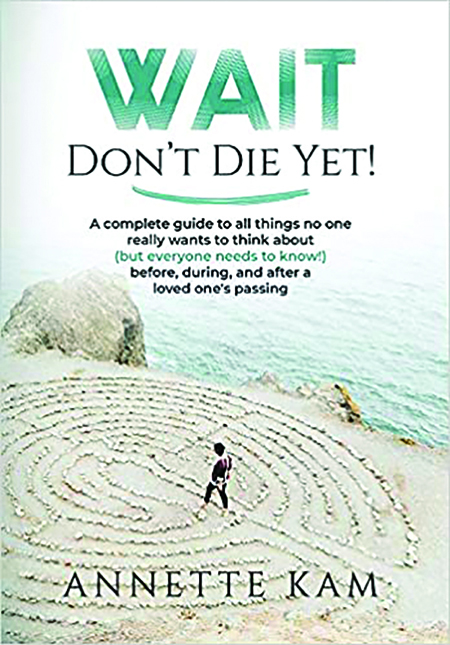
Annette Kam’s free eBook is “a complete guide to all thing no one really wants to think about (but everyone needs to know!).” The guidebook was written last year, after the author endured a heart-wrenching ordeal.
WAIT — Don’t Die Yet! is a step-by-step guide for adult children and spouses who are either preparing for their own death or someone else’s. The guidebook covers the basics of getting affairs in order, while also teaching you about the mundane tasks necessary around the time of death.
“A comprehensive tool that empowers rather than depresses you, this helpful approach allows you to deal with the practicalities of death while offering the hands-on guidance you need to make sure you have time to grieve,” says a review.
In Part One, the three-part book reveals the author’s story as she dealt with unknowns regarding the passing of her beloved in-laws. Part Two shares lessons she learned along the way. Part Three is a comprehensive guidebook that includes not only basic requirements, but also all of the things that no one thinks about — all of the necessary tasks you need to complete before, during and after death.
“There were over 110 things I wish I had known when I experienced it all and they are all incorporated in the guidebook,” says Annette.
Annette Kam’s free eBook is “a complete guide to all thing no one really wants to think about (but everyone needs to know!).” The guidebook was written last year, after the author endured a heart-wrenching ordeal. WAIT — Don’t Die Yet! is a step-by-step guide for adult children and spouses who are either preparing for…
Dad passed away many years ago. Mom is 79 and very active. She golfs, plays mahjong, exercises and, of course, plays with her grandkids. Although we’re grateful Mom is healthy, we’re also concerned because she now lives all alone in the large house we grew up in.
My siblings and I have noticed some changes in Mom. We were caught off guard during Sunday dinner, when she asked us, “Should I move? I don’t really feel safe living alone. Where would be the best place for me to live?”
We all just looked at each other. We all agreed that Mom’s safety and needs are priority No. 1. But what was the best answer to her question?
Here are five topics to consider when having a proactive conversation with loved ones about a potential move:
Physical Needs. Will my current home fit my needs for the remainder of my life? Do I have too many stairs to climb? What home renovations may be needed to accommodate all the stages of care I may require? Who is equipped and trained to help when advanced healthcare is needed? If my home isn’t the best place for me, what are my options? If it is determined that aging in place at home will not be possible, a move will be the next likely step. Senior living options include retirement communities, continuing-care retirement communities, assisted living facilities, senior co-housing communities, senior home-sharing, nursing homes or other facilities, depending on the level of care needed now or expected in the future.
Cognitive/Mental. Am I in an environment that will encourage my thirst for knowledge and continued growth? Will I be able to stay at home if my memory declines? Will I even be able to make my own decisions later in life? How can I plan now, in case I can’t later?
Emotional/Social.Will I be able to spend time with my friends and loved ones?
Financial. What options exist for the budget we have to work with?
Family Dynamics. How can I leave a legacy for my family?
Consider your answers to these questions and then begin your research. Knowing your choices can help make the process much easier.
THE COMPLETE SOLUTION™
Powered by The Ihara Team of Keller Williams Honolulu RB-21303
1347 Kapiolani Blvd., Ste. 300, Honolulu, HI 96814
Dan Ihara (RA), CAPS, CLHMS, SRES RS-65892 808-256-7873
Julie Ihara (RA), SRES RS- 67440 808-754-2225 | ihara@iharateam.com www.iharateamhawaii.kw.com
Dad passed away many years ago. Mom is 79 and very active. She golfs, plays mahjong, exercises and, of course, plays with her grandkids. Although we’re grateful Mom is healthy, we’re also concerned because she now lives all alone in the large house we grew up in.

 It’s time to begin your spring cleaning! This year, don’t forget to include your wallet, the home of your critical medical and insurance cards.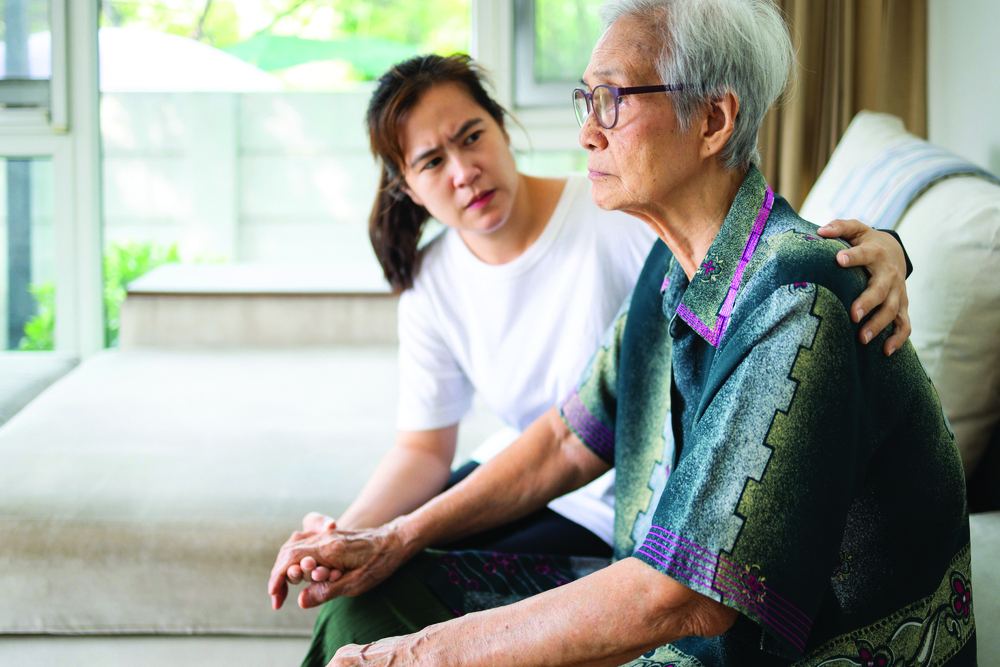
 As an adult daughter, do you ever feel like a little girl when conversations with your mother end in misfires, teary rants or silence? You’re not alone — it happens this way for 43.5 percent of us. However, there’s hope. By using ASK Presetting, you can stop walking on eggshells.