Happy Holidays to you and your families from Generations Magazine!
From our first issue with Kirk Matthews in August 2010, Generations Magazine has been dedicated to Hawai‘i’s seniors and their families to provide resourceful and trusted information. We make every effort to provide articles that inform, inspire and motivate you to live a better quality of life.
We are so thankful to all of our sponsors and business partners that support our magazine as they are the most trusted partners we could find. Please support these companies as well and thank them for their commitment to you, the senior.
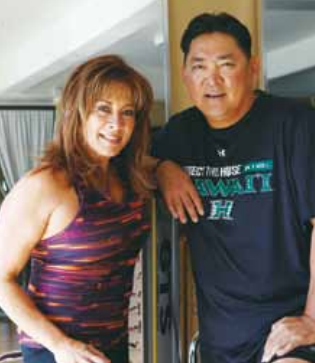
Percy Ihara and Diane Cadinha
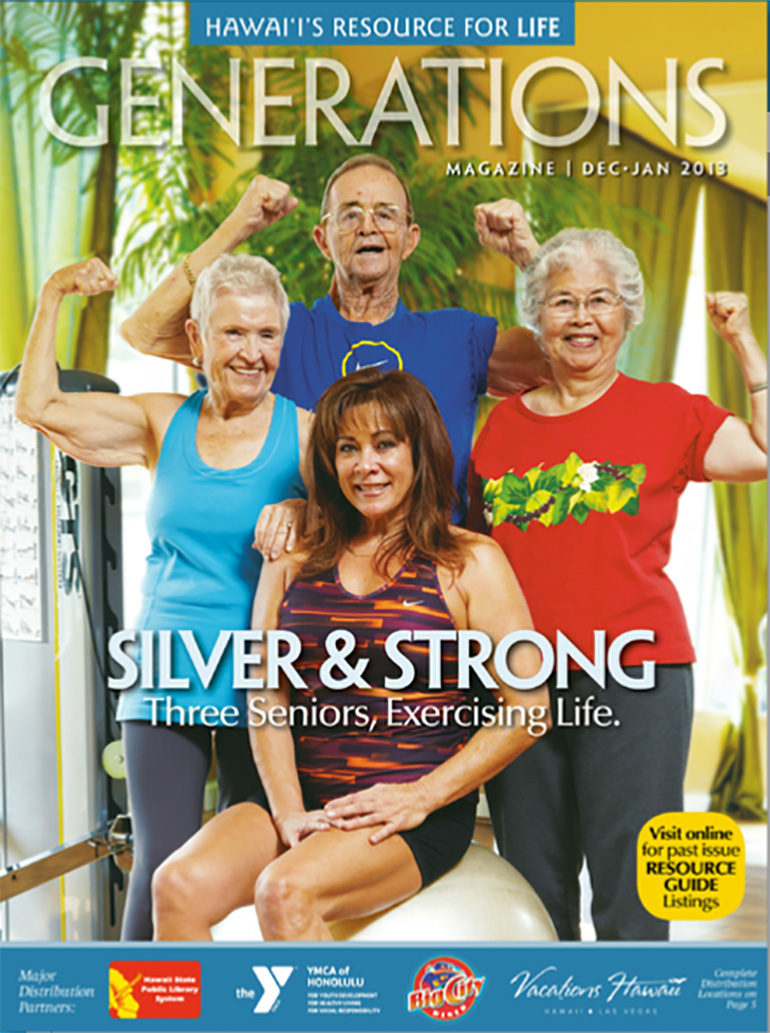
In this issue, we feature and thank three active seniors—Joan Packer, Victor Hawthorne and Doris Hara with their personal trainer Diane Cadinha on their stories. If you remember, we featured Joan in a story in our April/May issue earlier this year. After I read the article, I had to meet this 91 year old youngster. She inspired so many of our readers, including me, to get off our butts to exercise. According to Doris, Joan’s story inspired her to do something about her health now since Joan didn’t start exercising until later in her life, so she said she wanted to do this also.
As a procrastinator myself, I am now a believer in exercising and learning from a personal trainer to live a truly better quality of life to avoid health issues down the road. I have to thank personal trainer Diane Cadinha for working with me and teaching me the importance of exercise and also inspiring to put my health first and keep the body moving. If you want to avoid health issues, relieve stress and rejuvenate your body, call Diane or look for a personal trainer that specializes in working with seniors.
In 2013, please keep Generations Magazine in front of you as we continue to bring wonderful articles on healthy and active aging, as well as stories about seniors in our community who motivate us all to live well in Hawai‘i. We always love to hear from our readers, so please continue to write, email or call us to let us know what you want to read about.
Lastly, don’t forget to check us online at www.Generations808.com, as all our current and past issues are posted there, along with all past resource guides, and especially our most popular listing of “Senior Discounts.”
Happy Holidays to you and your families from Generations Magazine! From our first issue with Kirk Matthews in August 2010, Generations Magazine has been dedicated to Hawai‘i’s seniors and their families to provide resourceful and trusted information. We make every effort to provide articles that inform, inspire and motivate you to live a better quality of life. We…
In the months of September and October, thousands of local people go to the 9th island, Las Vegas, to try their luck in the casinos. But each year more and more baby boomer men go there to test their skills in winning the softball title and a championship ring.
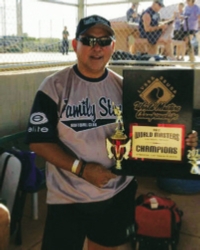
For the last several years, the Family Stones softball team from Honolulu, of which I am a player and member, has tried their luck at just that — being the champions of the Las Vegas Senior Softball Championships. Due to the increased popularity of senior softball, in this year the Las Vegas Senior Softball Championships. Due to the increased popularity of senior softball, in this year the Las Vegas Senior Softball Association (LVSSA) teamed up with the Senior Softball-USA (SSUSA) to hold the first annual Senior Softball World Championships. This year’s historic event created the largest tournament in the history of senior softball: combining over 450 teams in seven age brackets with nearly 5,000 players nationwide and Guam. The future of senior softball is growing for these baby boomers and older, from all over the world, and hopefully, you will see teams soon from Asia, Australia and South America.
This year’s Family Stones’ 50-year-old team entered the largest division in the tournament of 49 teams from 17 states. In the previous week, the 55 and 60 age groups played for the world championship and there were 4 teams from Hawai‘i that entered. However, they didn’t fare too well, winning only two games and losing 20.
When our 50’s team heard this news, we knew we were in for a battle of our softball careers, since we had four players over the age of 55 and three players in their 60’s. Over a three-day period to win the title in this double elimination tournament, we would have to win eight games in a row; and if we lost a game, we may have to play up to 14 games.
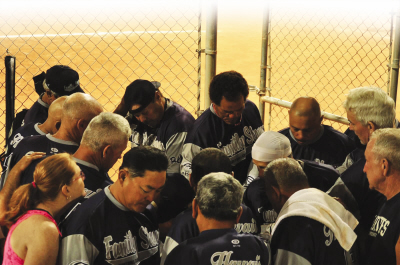
On the first two days of the tournament, our Stones’ team played well, winning six games and were only one of two teams undefeated while going into the final day of the tournament. In each game we were going up against bigger players, and definitely experienced and better too. Being the smaller team, it was a battle and a fight to win each game. Team captains Rudy Cagulada and Johnny Arroyo, Jr. reminded us to play as a team and keep our heads up if we make mistakes or don’t get a hit. They also reminded us that we were playing for two men who founded Family Stones some 40 years ago, Ben Naki and Bully Mactagone.
Entering the final day as one of only two undefeated teams, we faced a tough New Mexico team. We knew if we lost, we would have to play this same team again since this was a double elimination tournament.
From the first inning, our team fell behind as New Mexico went out to a huge lead, 8-1. Whether it was physical fatigue from playing seven games in three days or just nervousness, our team did not play well; and it looked like we were going to lose. By the final inning, things didn’t start out so good with the first two Stones’ batters getting out on two hard hits by Felix Mediola and Isaac Hatori. At this point, if you are a baseball fan or a Vegas gambler, you wouldn’t be betting on the losing team. Being down by four runs, two outs and no one on base, it seemed like it would take a miracle, at best, along with the baseball-God blessing the Stones’ team. “Fat chance,” said the New Mexico team, already planning to play us again for their world championship title.
Then, the Family Stones’ men suddenly woke up and hit two back-to-back singles and big Tom McCarthy hit a towering home run to centerfield to bring us within a run to tie and two runs to win the championship and title. The next two hitters and I came up with hits to set the stage with the bases loaded. Up next to bat, Joey Rodrigues comes up and singles to left field to bring in the tying and winning run with a furious slide at home plate by Fabian Loo. The whole field of Stones’ men and fans erupted as they finally won the title and World Championship! Players jumped up and down like we won the Little League World Series, hugging each other, and yes, some crying, including myself, saying, “We finally did it for Ben!”
Congratulations to our entire Family Stones’ team and fans for working and playing towards our goal for the championship and the ring. Kudos also go out to MVP Craig Ayala and all tournament players, Tom McCarthy, Johnny Arroy, Jr, Joey Rodrigues and Cris Ray. Yours truly won honorable mention from the Family Stones’ team.
On a final note at this year’s tournament, Hawai‘i should be proud as one of our own, Danny Ayala of Hilo was inducted into the Senior Softball Hall of Fame. As well as, a winner of several championship rings himself, is the father of Family Stones’ MVP shortstop, Craig Ayala. Danny was at each of his son’s games and I can still hear him yelling to me as I was ready to bat, “Take the first pitch!” I thank you Danny for all your inspirational and positive messages to all of us on the team. We finally did it for Ben…and for our love of the game.
In the months of September and October, thousands of local people go to the 9th island, Las Vegas, to try their luck in the casinos. But each year more and more baby boomer men go there to test their skills in winning the softball title and a championship ring. For the last several years, the…
Our tax system for the most part remains firmly based upon the calendar year. At year-end, it’s time to take a snapshot of your income, deductions and credits. Based on that data, your tax liability for the year can be computed. If year-end strategies are implemented before your tax liability is “set in stone” it can make a significant difference in what you owe for the tax year. Tax planning for year-end 2011 should use traditional year-end strategies as well as those that react to situations unique to this year.
Income/Deduction Shifting
The traditional year-end strategy of income shifting applies to 2011, but with an extra twist. Under traditional strategy, you time your income and deductions so that your taxable income is about even for 2011 and 2012 so your tax bracket does not spike in either year. If you anticipate a higher tax bracket for 2012, you may want to accelerate income into 2011 and defer deductions into 2012. If you anticipate a leaner 2012, income might be delayed through deferred compensation arrangements, postponing year-end bonuses, maximizing deductible retirement contributions and delaying year-end billings.
The twist for year-end 2011 is the uncertain future for the tax rates after 2012. Many political observers forecast that higher-income taxpayers will be asked to pay more, either through higher tax rates or more limited deductions. That may suggest a strategy in which income is not defer-red but is recognized now at lower tax rates still available in 2011 and 2012.
Roth Conversions
If you converted an Individual Retirement Account (IRA) to a Roth IRA in 2010, you were given an option - recognize all income in 2010 or defer that income, half into 2011 and half into 2012. If you elected to defer that income into 2011 and 2012, do not forget to figure that income into your year-end planning.
Life Changes
Marriage, divorce, the birth of a child, death, a change in job or loss of a job, and retirement are just some of the life events that trigger a special urgency for year-end tax planning. After December 31, 2011, it will be too late to alter most of your bottom-line tax liability for 2011.
Tax Extenders
A number of tax extenders are scheduled to expire after December 31, 2011. They include:
the state and local sales tax deduction
the higher education tuition
the teacher’s classroom expense deduction
Seniors age 70 ½ and older should also consider making a charitable contribution directly from their IRAs up to $100,000 and paying no tax on the distribution. This tax break, especially advantageous to those who do not itemize deductions, is scheduled to end for distributions made in tax years beginning after December 31, 2011.
For more information, call Tamilyn Masuda at 847-4422 or visit www.masudacpa.com.
Our tax system for the most part remains firmly based upon the calendar year. At year-end, it’s time to take a snapshot of your income, deductions and credits. Based on that data, your tax liability for the year can be computed. If year-end strategies are implemented before your tax liability is “set in stone” it…
Most travelers will tell you that having a guide when exploring new places can be very helpful. A case manager can be that guide as we begin to explore the options available to us as we age.
Case management is a holistic, comprehensive, multi-disciplinary approach to the planning and delivery of care and services to meet the needs of individuals in a cost-effective manner.
Currently in Hawai‘i, there are no regulations or licensure regarding case managers. Social workers provide case management under their licensure’s scope of service. Social workers, nurses and others can be certified through a number of certifying organizations such as the Commission for Case Manager Certification®, the American Case Management Association, Case Management Society of America and the American Nurses Credentialing Center.
Case management incorporates assessment; identification of needs; care and service plan development; advocacy; coordination and provision of necessary services; and referral linkages. The process includes monitoring, evaluating and documenting care and services. Participation by and education of the individual and/or representative is central to the provision of individualized case management services.
Some case managers focus on a particular population such as mental health or dialysis, while others are more general. Case managers can work alone or as part of an organization. Some provide only short term services. This is usually determined by the service plan and the client is discharged upon completion of the plan.
Other case managers provide ongoing case management. They are available as needed over a long period of time, often monitoring for potential problems or providing a safety net should a crisis arise. It is important to ask questions in order to be sure you are working with someone who can assist you.
It is important that you find a case manager that shares your philosophy and needs. The assessment and service plan are the most important tools a case manager uses. The assessment helps identify resources and needs so that together the case manager and individual can develop the map to explore the options available. Together, the exploration of this new territory can be less
confusing and more positive.
Some questions include:
How many years have you been providing case management services?
What is your certification or training? Are you licensed in your profession?
Do you belong to any professional organizations?
Are references available upon request?
Tell me about the process you follow.
Do you provide ongoing case management or are your services time limited?
Are you knowledgeable about dementia and associated care needs?
What is your philosophy on aging in place or need for placement?
Are you available for emergencies? Can I reach you easily?
How much do you charge for services? Will you provide me with a detailed list of charges?
Most travelers will tell you that having a guide when exploring new places can be very helpful. A case manager can be that guide as we begin to explore the options available to us as we age. Case management is a holistic, comprehensive, multi-disciplinary approach to the planning and delivery of care and services to…
The City & County of Honolulu offers a home rehabilitation loan program to owner-occupant homeowners on Oahu, whose incomes do not exceed 80% of the area median income. The loans can be used to repair and correct deteriorated and hazardous conditions on the property, such as damage caused by termites, leaky roof, faulty electrical wiring and plumbing. Loans may cover accessibility improvements to assist family members with disabilities and the installation of solar water heating and photovoltaic electric generation systems.
The City is aware many homeowners are unfamiliar with monitoring construction and therefore assists its clients by having inspectors oversee the project to ensure the work meets industry standard levels of quality and workmanship. All work on the project must be performed by a licensed contractor selected by the homeowner.
The loan limit is $75,000; however, loans over $75,000 will be considered on a case-by-case basis. The loan amount will also be subject to the available equity value in the property. Loans are currently offered with a zero percent interest rate and are based on a 15 or 20 year maturity. The City is able to taylor repayments to fit homeowners with a limited budget with a larger final \payment due at the end of the loan term. Qualified homeowner’s income levels are:
Household Member(s) / 2012 Income Limit
1 / 57700
2 / 65950
3 / 74200
4 / 82400
For information and an application, homeowners may call the Kapolei office at 808-768-3240 or the Honolulu office at 808-768-7076.
The City & County of Honolulu offers a home rehabilitation loan program to owner-occupant homeowners on Oahu, whose incomes do not exceed 80% of the area median income. The loans can be used to repair and correct deteriorated and hazardous conditions on the property, such as damage caused by termites, leaky roof, faulty electrical wiring…
If you need to change your name due to marriage, divorce, or any other reason, you will want to report the change to Social Security.
There are several reasons to report the change. One, is that the IRS and Social Security match computer records. If your name on your Social Security number and tax return do not match, it could delay the processing of your return as well as any tax refund you might be due.
It is important to make sure your Social Security records are up-to-date because your potential benefits are based almost entirely on the earnings maintained for you. If your employer reports earnings to the government under your new name, and your record still shows your old name, those earnings may not get credited to your Social Security earnings record. Missing earnings can lead to lower future Social Security benefits.
To change your name in Social Security’s records, you must apply for a new Social Security card. To apply, go to www.socialsecurity.gov/ssnumber/ and print out the form “Application Form SS-5”. That’s also the form you need if you want to apply for a replacement card. It also tells you what evidence you will need to submit.
Mail or take in your completed form to your local Social Security office with proper documentation. They must be originals or certified copies that clearly identifies you with your date and place of birth. The application includes information on what types of identity and documentation are needed for specific cases, and what sorts of documents can be accepted.
The application process is easy and is well described, along with other related information, at www.socialsecurity.gov/ssnumber.
If you need to change your name due to marriage, divorce, or any other reason, you will want to report the change to Social Security. There are several reasons to report the change. One, is that the IRS and Social Security match computer records. If your name on your Social Security number and tax return…
A new data analysis indicates that the potential for asbestos exposure in Hawai‘i and the U.S. Pacific Islands could be significantly higher than previously thought. The finding is serious as the latency period between exposure and disease with asbestos can be up to 50 years or more.
Shipbuilding and repair facilities located in the islands are one reason for the heightened risk. Prior to the mid-1970s, asbestos was heavily used in the maintenance and repair of ships. Pearl Harbor, Guam and the Commonwealth of the Northern Mariana Islands all had active military ports. Military and civilian workers at these sites were likely exposed to asbestos.
In addition, many asbestos-containing materials were used to construct military and civilian buildings in the 20th century. As these buildings begin to deteriorate, need repair or are destroyed, they can continue to cause asbestos exposure.
Asbestos exposure is the cause of mesothelioma, a rare cancer caused by the inhalation asbestos fibers. Mesothelioma victims typically do not begin to show symptoms of the disease until 10 to 40 years after the initial exposure. Most people diagnosed with mesothelioma are in their 50’s, 60’s or older and only start to show symptoms in the later stages of the disease.
Sadly, there is no cure.
This latency period creates information gaps regarding asbestos exposure and disease, especially in areas like the U.S. Pacific islands. The missing data is why professionals conclude that the actual prevalence of asbestos diseases is underestimated.
The Galiher Law Firm has been representing victims of mesothelioma in Hawai‘i for over 30 years. For information, visit GaliherLaw.com.
A new data analysis indicates that the potential for asbestos exposure in Hawai‘i and the U.S. Pacific Islands could be significantly higher than previously thought. The finding is serious as the latency period between exposure and disease with asbestos can be up to 50 years or more. Shipbuilding and repair facilities located in the islands…
As we turn the page from 2012 to 2013, it is not a bad time to focus on your Rule Book (the set of documents in which you lay out your estate plan) and make sure that the rules you have in place are still consistent with your wishes and your needs. How often you review your Rule Book is up to you, but it is important to appreciate that things change. As they do, your Rule Book can gradually become obsolete, and if you fail to update it, it may do more harm than good.
WHAT KINDS OF CHANGES IMPACT YOUR ESTATE PLAN?
Changes in your health. Like it or not, your health will change over time, and the general trend will not be for the better. Your doctors can do a lot to keep you going, but they have not discovered the Fountain of Youth yet. If you ever lose the capacity to update your estate plan, your family may be stuck with a Rule Book that does not meet your needs, and there may be little that can be done about it, short of taking an expensive foray through the court system.
Changes in your assets. Values go up, values go down. Those fluctuations can affect how your estate plan works. More importantly, it is important to take periodic stock of your assets and make sure they are all properly titled. If you have a revocable living trust, you probably should have all or most of your assets in the name of your trust. If you sell an asset that belongs to your trust, make sure the proceeds go into an account owned by your trust, and when the proceeds are reinvested, make sure the new assets are properly titled.
Changes in your family situation. Any time your family experiences a marriage, a divorce, a birth, or a death, you should have a look at your Rule Book. Other changes might impact what you want to say in your Rule Book as well. Those changes might be good, such as a child heading off to college, or not so good, such as the discovery that a family member has a drug problem or a debt problem.
Changes in the law. There have been some dramatic changes in the Federal and Hawai‘i estate tax laws over the past several years, and you can expect those kinds of changes to continue for the foreseeable future. Though the changes have caused uncertainty, they have also given rise to opportunities. Over the past two years, Hawai‘i laws relating to trusts and tenancy by the entirety have changed in some very positive ways that open the door to enhanced asset protection. Don’t miss out on what those new laws have to offer.
If you review your Rule Book at least once per year, you will probably be able to stay on top of all of these changes and be able to make appropriate updates to your estate plan. You should also sign a new durable power of attorney and advance health-care directive each year, even if there are no changes. The reason to update your power of attorney is that once it is more than a year old, many financial institutions will not honor it, and once it is five years old, nobody will honor it. The reason to update your advance directive is to force you to focus on it and make sure that it accurately reflects your wishes. It will not be called upon until you are unable to speak for yourself, so you need to get it right while you still have the capacity to do so.
Scott Makuakane, Attorney at Law Specializing in estate planning and trust law.
As we turn the page from 2012 to 2013, it is not a bad time to focus on your Rule Book (the set of documents in which you lay out your estate plan) and make sure that the rules you have in place are still consistent with your wishes and your needs. How often you…
QUESTION: Should I write instructions for my jewelry and other personal assets in my Will?
ANSWER: Yes. The best method to use is a “Personal Property Memorandum.”
State of Hawai‘i law allows you to legally make your own list of beneficiaries of tangible personal property. It is as simple as making the list in your own handwriting, signing and dating it.
Why make a Personal Property Memorandum?
Passing on keepsakes to those we care about and who we know will keep them can be a meaningful experience for each of us. And we hope that the recipient of these items will continue to find value and meaning in the personal keepsakes long after we are gone.
What other benefits in preparing this Personal Property Memorandum provide?
Helps reduce conflict. It reduces any conflict that might occur between siblings after parents die. A parent’s death can be a very stressful time as people are asked to deal with assets while they are grieving, causing strain in relationships. A parent making the decision can greatly reduce any conflict that might arise.
Reduces legal fees. A Personal Property Memorandum does not require the assistance of an attorney, thus eliminating attorney costs.
Enriches relationships. By fostering communication now, it can bring relationships closer when the giver engages in a conversation with each beneficiary, in person, to tell the story and the value of the item intended for them.
QUESTION: Should I write instructions for my jewelry and other personal assets in my Will? ANSWER: Yes. The best method to use is a “Personal Property Memorandum.” State of Hawai‘i law allows you to legally make your own list of beneficiaries of tangible personal property. It is as simple as making the list in your…
“Our bodies —regardless of age — can be transformed.” — Diane Cadinha, Certified Personal Trainer
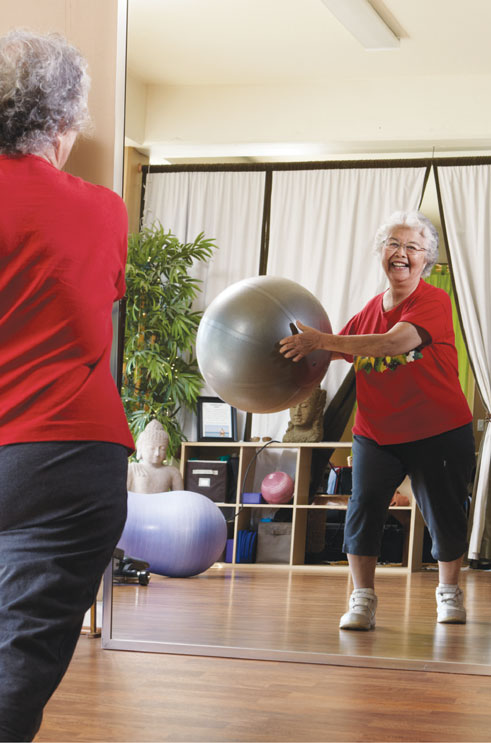
It’s important to recognize that exercise is not merely for sculpting young bodies. It is for everyone — especially seniors, who often have the most to gain. The benefits of senior fitness range from reaching a healthy weight and fighting off disease to better bone health and maintaining an independent lifestyle.
In 1997, certified personal trainer Diane Cadinha worked with her first senior client — Joan Packer, 77. “Watching Joan transform inspired me” Diane says. “It became clear to me how much a person’s quality of life could improve with diet and exercise — regardless of age.”
This started Diane’s passion to specialize in senior health. “Over the years I have seen how exercise, along with proper diet, slows down the aging process. The mind-body connection is big in keeping my seniors mentally sharp, strong and independent,” Diane says. “I learned working with seniors that it’s not over till it’s over.”
Diane’s fitness training also involves eating a healthy diet. She teaches her clients the importance of eating enough fruits and vegetables —5 to 7 servings a day, with 25 to 30 grams of fiber and healthy fats. “With the right fuel in the tank you have the energy to want to workout,” Diane says.
Fifteen years later, Joan continues to make fitness a priority. Now at 91, she inspires others to do the same. Below, we share Joan’s story, along with two other inspirational “strong and silver” seniors.
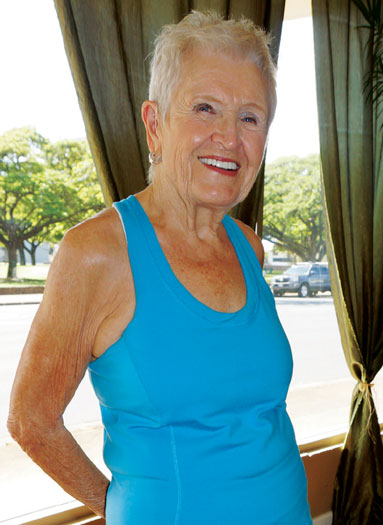
Big Guns — Joan Packer, 91
Joan: Hurdler Stretch. Helps relieve low back pain.
Joan Packer lived a fairly sedentary life in Booneville, Missouri, after retiring as a schoolteacher. When her husband passed away in 1984, she decided to move where her heart always wanted her to be — Hawai‘i. So 20 years ago Joan sold two farms back home and bought a condominium in Waikiki to begin her life anew.
Joan spent her first couple of years of retirement enjoying Hawai‘i. She noticed all the fit bodies walking and exercising at Kapiolani Park, and said to herself, I can do that. So she began a new routine of walking at the park, along with short swims in the warm Hawaiian waters.
As a former smoker Joan realized how much better she was feeling with her new found lifestyle, but she wanted to do more to get in better shape. So she decided to seek out a personal trainer. This is when she met Diane Cadinha and started working out with her twice a week. Fifteen years later, Joan says she feels better than when she was in her 50s. “I don’t really like to exercise,” she admits.“But I do it for the results. It keeps my body healthy and feeling good.”
One of her favorite exercises is something that she calls “rewards.” It’s a stretch she does at the end of her workout where she uses a foot strap connected to a cable to stretch her hamstrings.“It just feels so good,” she says, “and it also marks the end of the workout.”
“Tai Chi is my absolute favorite form of exercise … probably because it’s the least strenuous,” she smiles, “but I know that seniors need a mix of exercises… strength exercises for bone health, balance exercises to prevent falls and stretching to stay limber.”
Joan says in her previous life she used to have stiffness and various aches and pains and lacked balance and flexibility. Now, at 91, she has no physical complaints and takes no medication.
Currently, Joan walks the park just about every day, trains with Diane twice a week at her King Street studio, practices Tai Chi almost daily and swims when she can. Joan urges all retirees and seniors to keep a vigorous and healthy lifestyle by exercising every day with friends or a trainer. She does her best to avoid sitting down for more than three hours a day. She also suggests cutting out the sweets and prepared foods, and do your own cooking!
Joan’s two children who live on the Mainland are amazed (and mostly relieved) by their former couch-potato mother. They’re happy to see her as an independent, happy senior who wants stay healthy and enjoy an active retirement.
Well Balanced — Victor Hawthorne, 88
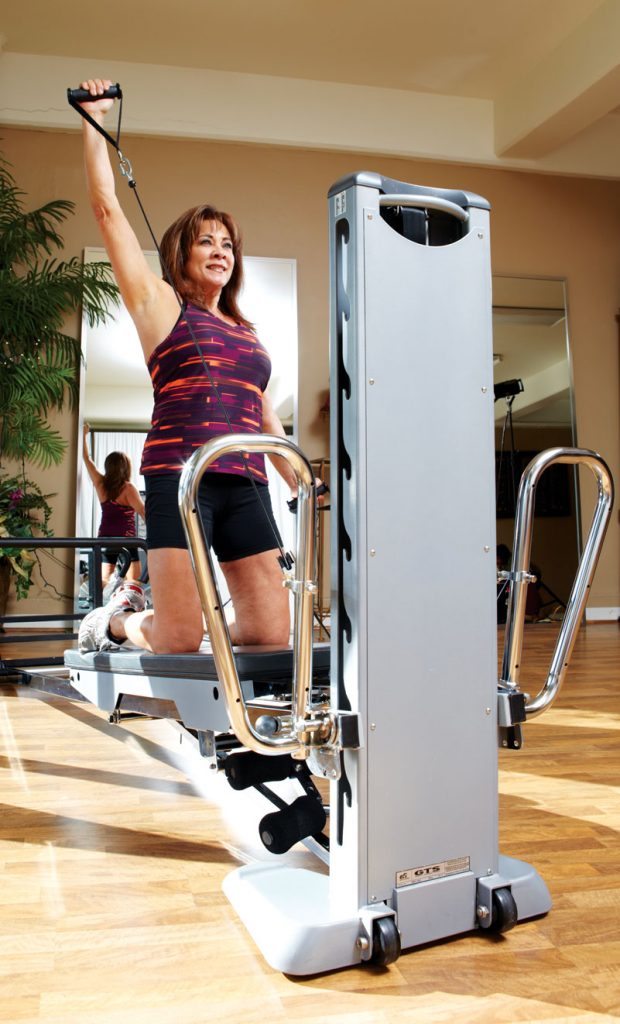
Victor: Kneeling Spinal Rotation. Great for golfers!
Victor Hawthorne retired at age 57 as an Army Colonel and, in his own words, he was “military healthy” for years while on the job. In his retirement he enjoyed playing golf and baseball and taking international cruises. Then, around the age of 75 he started to experience aches and pains and lose his ability to play his favorite sports. He dismissed it as a part of aging. However, when his balance became an issue, too, he realized he needed to do something about it.
Victor wanted to continue to play golf so he turned to personal trainer Diane Cadinha to keep him in top physical shape. Now 88 years young and just as active as he was in his 60s and 70s, Victor works out with Diane twice a week.
“I like how Diane teaches me the importance of strength and core body training — both very important for balance,” Victor says. “The weekly workouts have improved my balance and strength. I like the way I feel, and like that I can golf again.”
The benefits of working out are endless for Victor who says “don’t give up!” Exercise has improved his posture, and makes him feel strong enough to travel and visit with Mainland family. He has plans to go on a six-month world cruise in early 2013 and says he’ll continue his exercises aboard the cruise ship.
“You’re foolish to not start exercising to maintain your health,” he states energetically.“Do whatever it takes.”
Peer Inspiration — Doris Hara, 78
Doris Hara, a retired teacher was enjoying retirement and was active through her 60s. Life was good until her 70s when she began having joint problems and aches and pains. For her ailments, she was prescribed anti-inflammatory medications. She was worried that in the future she’d have to take even stronger medications as her pain worsened.
Then in April of 2012 Doris was reading Generations Magazine and stopped on a photo of a spry Caucasian lady in exercise clothes, flexing her muscles. She was amazed to learn that the lady, Joan Packer, was 91 years old. Furthermore that she had started exercising when she was 77 years old! What? Doris asked herself. I’m 77! You mean it’s not too late to start exercising? Doris was so impressed by Joan that she contacted Diane Cadinha for help.
Doris started exercising with Diane in May 2012, and has improved her health and function 100 percent. Previously, Doris had difficulty with everyday activities such as opening doors and jars, getting in and out of the car, and going up and down the stairs. Her biggest concern was getting up and down from the floor. She had completely lost that function.
“When I first came to Diane, I could only last two minutes on the elliptical machine (a stationary exercise machine that simulates walking or running). Now I’m up to 30 minutes,” Doris says. “My strength and balance keep improving. The pain in my wrists and ankles are almost nonexistent. And, yes, I’ve accomplished my biggest goal of getting up and down from the floor.”
Reverse Lunge w/ Spinal Twist. Great for balance.
Doris says that when Diane teaches an exercise she explains its health benefits and how it will help in everyday life. “That motivated me to do some of the exercises at home on the days I don’t see her. Also, connecting the movement to the mind empowers me on a daily basis.”
Diane also taught Doris how to incorporate more fruits and vegetables into her diet through “green smoothies. “I make them everyday,” Doris says. “I have so much more energy and peace of mind knowing I’m getting these important vitamins and minerals for my health and well being.”
Doris recommends finding a personal trainer like Diane who specializes in senior health. It’s life changing.
“You’re never too old to start exercising. I just turned 78! Just get started! I did!”
Exercise is one of the best ways to extend your quality of life. It helps us to maintain our health, function and immune system. Starting in our late 30s we lose about a quarter pound of muscle each year. This causes a chain reaction in our bodies. Our metabolism slows down and we start to gain weight, which can lead to other health issues such heart disease and diabetes. And, lack of exercise can lead to osteoporosis and loss of joint function. Some feel that exercise is too vigorous for seniors. This is not true! It’s more than okay for seniors to workout. Good health is needed for everyday activities such as walking up stairs, shopping and carrying packages.
To stay healthy and independent, four types of exercises are recommended:
Strength exercises build muscles and increase metabolism. They help with weight and keep blood sugar in check.
Balance exercises build leg muscles. The stability prevents falls and keeps you independent.
Stretching exercises give you more flexibi-lity and agility.
Endurance exercises are activities that increase your heart rate and breathing for 30 or more minutes. Start slowly. Maybe as little as 5 minutes of activity at a time. Gradually build up to at least 30 minutes of exercise on most or all days of the week.
*If you are over 50 years old, obese, suffer from an illness or have been inactive, see your doctor before you start a new fitness routine
It’s important to recognize that exercise is not merely for sculpting young bodies. It is for everyone — especially seniors, who often have the most to gain.
The holidays are a tough time to be in need, and unfortunately there’s way too much of that going around these days. Last year the U.S. Census Bureau said that 16% of people in the States live below the poverty line and that children in 3.9 million households across America went hungry.
These are heart breaking statistics, and many of us seek out charities to donate to during the holidays. Of course, doing so is a great idea, but donors should be wary before making that commitment. Unfortunately there is no shortage of con artists running bogus charities whose only purpose is to pad their own pockets.
How do you separate trustworthy charities from the scams? Here are a few tips to follow:
Check with Hawai‘i’s Better Business Bureau to see if a charity has met our twenty standards for accountability. Among other things BBB reviews a charities financial health and their accountability and transparency.
Check with our state attorney general’s office if a charity is registered to solicit here in Hawai‘i.
Ask for an IRS Form 990—any real charity should be happy to provide you with it. It is the IRS form that provides detailed financial information for potential givers.
Don’t click on any emails asking you to send money. Con-artists use the holidays to appeal to your philanthropic side — and they like to use email to reach out to you. Don’t fall for it. If you want to donate online, go to a charity’s homepage and follow the directions on their donations page.
When considering supporting a cause — find the answers to these questions: What portion of the donation will benefit the charity? What location will the charity use the funds in? How do they help those in need?
Giving to those less fortunate is really what the holidays are about. Make it easier for yourself to leave your mark by doing your homework and researching the charities you want to help.
The holidays are a tough time to be in need, and unfortunately there’s way too much of that going around these days. Last year the U.S. Census Bureau said that 16% of people in the States live below the poverty line and that children in 3.9 million households across America went hungry. These are heart…
This is your new year resolution: exhale. You’ve collected things through the years and you’re beginning to realize … there’s no room to breath — you see “clutter”. You know you need to declutter, but you just don’t know where to start.
You can start by exhaling.
Then begin with the least personal space, such as the least used room or closet. And ask yourself these questions. Do you really need it? When was the last time you’ve used it? When will you use it again? Is it replaceable? Does it fit comfortably in your home?
Next, use these 4 simple steps to conquering your clutter:
Create a goal: set a timeline in small steps.
S.O.R.T. your items in 4 piles: items to sell, offer, retain, and toss; then remove the items you’re not keeping off the property—literally.
Create a floor plan to maximize the space in your home.
Get organized by putting everything away in its “home” (its own place).
As you’ve asked yourself those questions while working through the 4 steps, you begin to process your emotions and feelings about those items. This will help you detach yourself from those things. As you declutter, you’ll find that once you get started and made progress, you’ll gain the confidence that you can actually finish it; and it will then become easier and faster.
Senior Move Managers and De-clutter Hawaii is Hawai‘i’s decluttering specialists. For information, free consultation or to learn more solutions to common decluttering issues, call 808-221-8345 or email at cynthia@smmhawaii.com. Also visit online to www.declutterhawaii.com or www.smmhawaii.com.
This is your new year resolution: exhale. You’ve collected things through the years and you’re beginning to realize … there’s no room to breath — you see “clutter”. You know you need to declutter, but you just don’t know where to start. You can start by exhaling. Then begin with the least personal space, such as the least used…


 For the last several years, the Family Stones softball team from Honolulu, of which I am a player and member, has tried their luck at just that — being the champions of the Las Vegas Senior Softball Championships. Due to the increased popularity of senior softball, in this year the Las Vegas Senior Softball Championships. Due to the increased popularity of senior softball, in this year the Las Vegas Senior Softball Association (LVSSA) teamed up with the Senior Softball-USA (SSUSA) to hold the first annual Senior Softball World Championships. This year’s historic event created the largest tournament in the history of senior softball: combining over 450 teams in seven age brackets with nearly 5,000 players nationwide and Guam. The future of senior softball is growing for these baby boomers and older, from all over the world, and hopefully, you will see teams soon from Asia, Australia and South America.
 Entering the final day as one of only two undefeated teams, we faced a tough New Mexico team. We knew if we lost, we would have to play this same team again since this was a double elimination tournament.
 Congratulations to our entire Family Stones’ team and fans for working and playing towards our goal for the championship and the ring. Kudos also go out to MVP Craig Ayala and all tournament players, Tom McCarthy, Johnny Arroy, Jr, Joey Rodrigues and Cris Ray. Yours truly won honorable mention from the Family Stones’ team.
 It’s important to recognize that exercise is not merely for sculpting young bodies. It is for everyone — especially seniors, who often have the most to gain. The benefits of senior fitness range from reaching a healthy weight and fighting off disease to better bone health and maintaining an independent lifestyle.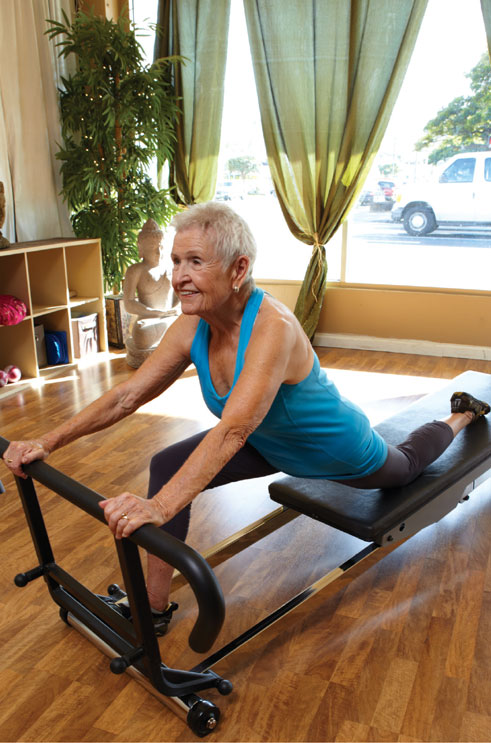
 One of her favorite exercises is something that she calls “rewards.” It’s a stretch she does at the end of her workout where she uses a foot strap connected to a cable to stretch her hamstrings.“It just feels so good,” she says, “and it also marks the end of the workout.”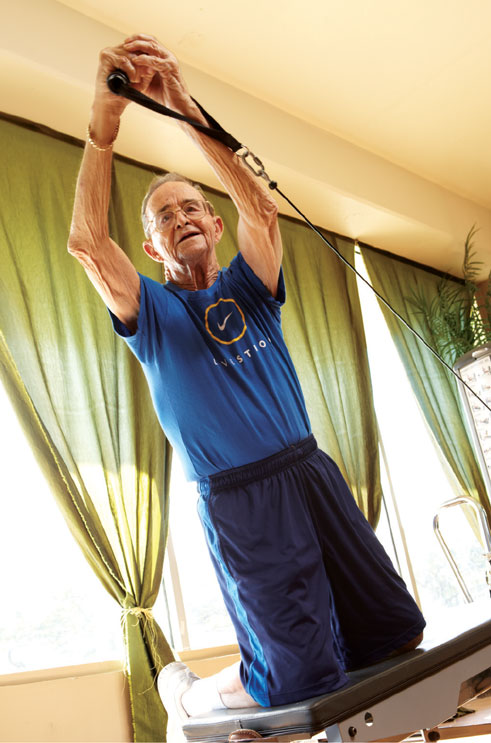
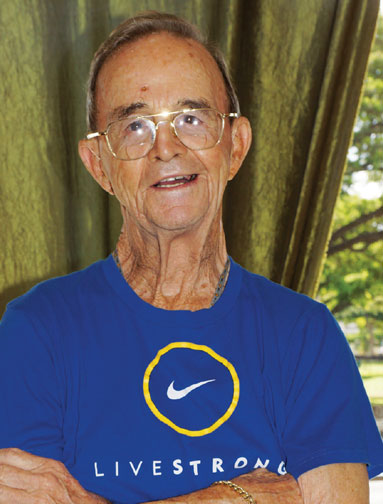 “I like how Diane teaches me the importance of strength and core body training — both very important for balance,” Victor says. “The weekly workouts have improved my balance and strength. I like the way I feel, and like that I can golf again.”
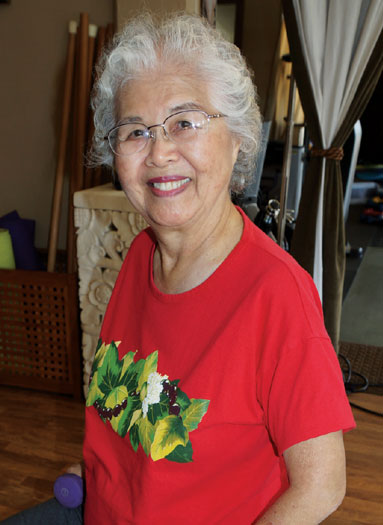 Doris Hara, a retired teacher was enjoying retirement and was active through her 60s. Life was good until her 70s when she began having joint problems and aches and pains. For her ailments, she was prescribed anti-inflammatory medications. She was worried that in the future she’d have to take even stronger medications as her pain worsened.