The Ombudsman is an officer of the legislature who investigates complaints about actions of executive branch agencies of the state and county governments. Our office has the power to obtain necessary information for an investigation and to recommend corrective action if a complaint is found to be substantiated.
State Ombudsman Robin Matsunaga
The Ombudsman serves as a neutral, independent intermediary between the citizen and the agency. We conduct our investigations in a fair and impartial manner. We do not provide legal advice, nor do we serve as legal counsel, advocate, or representative on behalf of any person or agency.
What should you do if you have a complaint?
In fairness to the agency involved, you should first try to resolve the complaint directly with the agency. Many times agency officials are eager to explain what they did and why they did it, or will correct the problem to your satisfaction. In many cases, you will be able to settle the problem on your own.
Here are some good common sense steps to take in trying to resolve any “consumer” problem, whether it involves a government agency or a company in the private sector:
Be prepared. Know what questions you are going to ask (it helps to write them down). Be sure to have any relevant information you need available before you contact the agency.
Keep records. Take notes, ask for the names and titles of employees you speak with, and save all of your correspondence.
If you do not want to contact the agency yourself, or if you complain to the agency and are not satisfied with its response, then feel free to contact us. We can conduct an investigation on your behalf.
We are authorized by law to receive inquiries on a confidential basis. If we can, we will investigate your complaint without revealing your identity, although this is not always possible. If you have concerns about confidentiality, please feel free to discuss them with us.
Most complaints can be made by telephone with no forms to fill out. Ways to contact us are either by phone, email, or mail:
Office of the Ombudsman
465 South King Street, 4th Flr.,
Honolulu, HI 96813
Open from 7:45 a.m.– 4:30 p.m. on weekdays, except for state holidays.
The Ombudsman is an officer of the legislature who investigates complaints about actions of executive branch agencies of the state and county governments. Our office has the power to obtain necessary information for an investigation and to recommend corrective action if a complaint is found to be substantiated. The Ombudsman serves as a neutral, independent…
In March of 2010, Congress passed and President Obama signed the Affordable Care Act — the new health insurance law. The law creates a new program — the Pre-Existing Condition Insurance Plan — to make health insurance available to you if you have been denied coverage by private insurance companies due to of a pre-existing condition.
If you’ve been locked out of the insurance market, the Pre-Existing Condition Insurance Plan program may be able to help you through 2014. In 2014, you will have access to affordable health insurance choices through a new competitive marketplace called an Exchange and you will no longer be discriminated against based on a pre-existing condition.
The Program:
Covers a broad range of health benefits, including primary and specialty care, hospital care, and prescription drugs. All covered benefits are available to you, even to treat a pre-existing condition.
Doesn’t charge you a higher premium just because of your medical condition.
Doesn’t base eligibility on income.
ELIGIBILITY
There are a few requirements to meet before you can enroll in the Pre-Existing Condition Insurance Plan – regardless of whether your program is run by the U.S. Department of Health and Human Services or your state. Applicants must:
Be a citizen or national of the United States or reside in the U.S. legally.
Have been without health coverage for at least the last six months. Please note that if you currently have insurance coverage that doesn’t cover your medical condition or are enrolled in a state high risk pool, you are not eligible for the Pre-
Existing Condition Insurance Plan.
Have a pre-existing condition or have been denied coverage because of your health condition.
If the Pre-Existing Condition Insurance Plan in your state is run by the U.S. Department of Health and Human Services, you can call 1-866-717-5826 (TTY 1-866-561-1604) and ask for an application or go to www.pcip.gov and go to “apply”.
How to Apply in Hawai‘i for the Pre-Existing Condition Insurance Plan
To apply, you will need to provide a copy of one of the following documents, which will be used to make a decision on your application:
A denial letter from an insurance company licensed in your state for individual insurance coverage (not health insurance offered through a job) that is dated within the past 12 months. Or, you may provide a letter dated in the past 12 months from an insurance agent or broker licensed in your state that shows you aren’t eligible for individual insurance coverage from one or more insurance companies because of your medical condition.
An offer of individual insurance coverage (not health insurance offered through a job) that you did not accept from an insurance company licensed in your state that is dated within the past 12 months. This offer of coverage has a rider that says your medical condition won’t be covered if you accept the offer.
A letter from a doctor, physician assistant, or nurse practitioner dated within the past 12 months stating your name and current or past medical condition, disability, or illness. This letter must also include the name, license number, state of licensure, and original signature of the doctor, physician assistant, or nurse practitioner.
For more information or the rates in Hawai‘i, please call the Hawaii State Health Insurance Assistance Program (SHIP)/ Sage PLUS Program at 586-7299 or 1-888-875-9229. We are a volunteer based Medicare counseling program for the State of Hawai‘i.
In March of 2010, Congress passed and President Obama signed the Affordable Care Act — the new health insurance law. The law creates a new program — the Pre-Existing Condition Insurance Plan — to make health insurance available to you if you have been denied coverage by private insurance companies due to of a pre-existing condition. If you’ve been locked out…
Hawaiian Seniors live long with good food, song and dance
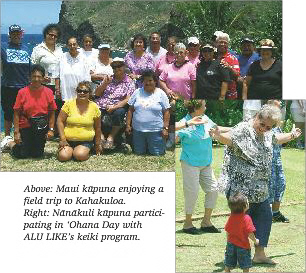
Ke Ola Pono No Na Kupuna Program (KOPP), meaning “good health and living for elders” is one of many projects operating within ALU LIKE Inc., a state-wide non-profit agency that helps Native Hawaiians achieve their potential for themselves, families and communities. KOPP enriches the lives of Native Hawaiian elders by preserving and restoring their health, sense of dignity and self-respect, while promoting cultural education and lifelong learning.
KOPP provides nutrition and supportive services to independent Native Hawaiians 60 years of age or older on the islands of Hawai‘i, Kaua‘i, Maui, Moloka‘i and O‘ahu.
KOPP offers Native Hawaiian seniors with several critical services. Daily nutritious congregate meals are available at project sites, whereas home delivered meals are provided to qualified individuals who are unable to attend site activities. To ensure that seniors have access to healthy meals, the program offers limited transportation services to/from the project sites and for shopping and health-related needs during regular program hours. In addition, outreach and referral services link participants to extra services such as recreation, education, health monitoring and nutrition counseling.
KOPP has also been very involved with the Chronic Disease Self-Management Program (CDSMP) through collaborations with the state Executive Office on Aging and the four county offices on aging. This evidence-based program, developed at Stanford University, has proven to be helpful for kupuna who are trying to manage one or more chronic condition.
Hawaiian cultural activities are an important part of the program. Participants may say they do not want to exercise, but they have no problem performing hula or playing their ‘ukulele or guitar for up to two hours. Kupuna love to entertain at senior fairs and other community events, however, the main focus is having a good time with each other. Kupuna are welcome to participate in mele (music) activities if they are experienced, or learning it for the first time.
Kupuna also engage in additional Hawaiian cultural activities including, ‘olelo (Hawaiian language), history, arts and crafts. Intergenerational cultural projects give ku¯puna a chance to give back to their community. Both kupuna and keiki benefit by creating a much-needed bridge between the generations and allow kupuna to return to their traditional role as cultural teachers.
For more information, please contact the Kupuna Program. Below are meeting times for every week of the month, except where noted.
O‘ahu: (808) 535-6700
Nanakuli: Mon. & Fri. 9:30 a.m.– 12:30 p.m.
Papakolea: Tues. 9:30 a.m.– 12:30 p.m.
Waimanalo: Wed. & Thur. 9:30 a.m.– 12:30 p.m.
Hawai‘i: (808) 961-2625
Kona: Mon. (once a month) 10 a.m.– 12 p.m.
Hilo: Tue., Thur. & Fri., 9 a.m.– 1 p.m.
Pahoa: Wed. 9 a.m.– 1 p.m.
Maui: (808) 242-9774
Paukukalo: Mon. thru Thur. 9 a.m.– 12 p.m.
Kaua‘i: (808) 245-8545
Anahola: Wed. 9:30 a.m.– 1 p.m.
Waimea: Thur. & Fri.9:30 a.m.– 1 p.m.
Moloka‘i: (808) 560-5393
Kaunakakai: Mon. & Thur. 9 a.m.– 1 p.m.
Ho‘olehua: Wed. 9 a.m.– 1 p.m.
Hawaiian Seniors live long with good food, song and dance Ke Ola Pono No Na Kupuna Program (KOPP), meaning “good health and living for elders” is one of many projects operating within ALU LIKE Inc., a state-wide non-profit agency that helps Native Hawaiians achieve their potential for themselves, families and communities. KOPP enriches the lives…
This year, Hawai‘i’s Better Business Bureau (BBB) will be turning 67 years old. The bureau was here from when Hawai‘i became a state to when one of its citizens became the U.S. President — and it’s still going strong. In fact, you could say that the BBB is a kupuna of local business.
As the BBB continues to grow and serve the people of Hawai‘i, it takes on local culture, values and traditions. The bureau’s position has become much like the kupuna of Hawaiian culture; a major source of wisdom and the transmitters of knowledge and training to younger generations. Simultaneously, it helps to keep kupuna safe as consumers.
While being the revered segment of Hawai‘i’s society, many of our kupuna are still at risk for becoming victims of fraud. According to Consumer Sentinel and the bureau’s own data, the rate of fraud against seniors continues to rise. With Hawai‘i’s senior population growing faster than the rest of the country (State of Hawai‘i Executive Office on Aging report and the 2010 US Census Data), it is safe to say that Hawai‘i’s kupuna could use every extra set of eyes and ears to help watch over them.
Hawai‘i’s BBB, through the BBB Foundation of Hawai‘i, contributes to the protection of kupuna through various educational outreaches. It offers informational presentations to many senior clubs on O‘ahu and the Neighbor Islands. It also staffs a table at every major senior fair in the state. Additionally, it serves on the Advisory Council of the Executive Office on Aging’s Senior Medicare Patrol program.
Hawai‘i’s BBB is the first place you come to get the answers if:
You are looking for an ethical business to patronize
You are looking for an honorable charity
You have questions about the trustworthiness of a business or charity
You have questions about a letter, email or phone call you’ve received
You have a complaint against a business or charity you would like resolved
Just as the Hawaiian culture believes one’s life essence (i.e., spiritual energy and ancestral knowledge) can be transmitted through the sharing of the ha, Hawai‘i’s BBB believes that it facilitates the perpetuation of our local culture and protects kupuna through sharing knowledge with seniors and the next generation.
Better Business Bureau of Hawai‘i 1132 Bishop Street #615, Honolulu, HI 96813-2813 Phone & Phone Hours: 808-536-6956 (O‘ahu) | 877-222-6551 (Neighbor Islands) | 808-628-3970 (Fax) 9:00 am – 2:00 pm, Mon. – Thurs., 9:00 am – Noon, Friday File Complaint: www.bbb.org/file-a-complaint/
Decades of service protect seniors from fraud This year, Hawai‘i’s Better Business Bureau (BBB) will be turning 67 years old. The bureau was here from when Hawai‘i became a state to when one of its citizens became the U.S. President — and it’s still going strong. In fact, you could say that the BBB is a kupuna…
How and why we’re not prepared for an increase in cases
Dementia is a degenerative neurological disease, which is incurable and fatal, rendering a person unable to care for himself/herself. It can deplete family members emotionally and financially, yet there is insufficient funding to research this disease.
In America more than 5.4 million people are presently diagnosed with Alzheimer’s disease. It is the sixth leading cause of death. Neurological diseases cannot be prevented, cured or even slowed down. Major diseases such as cancer, cardiovascular and HIV have decreased in death rates, whereas Alzheimer’s disease has increased by 66%, even though it is underdiagnosed.
Dr. Ken Dychtwald, founder and president of Age Wave, speaks of the “longevity revolution” caused by the progressive creation of antibiotics in the 1920s, the polio vaccine in 1950s, the increase in chronic disease management and the progress of medications, which have resulted in “more old people.” In 1900, the average age of death was 47 years, whereas in 2000 the average age of death was 78 years.
Dychtwald focused on the majority of the population, which is noted as the baby boomers born in 1946-1964. In the years 2000-2020, Dychtwald noted that a large portion of the population will be 55 or older. He states that society’s single greatest challenge will be that 1 in 2 people who are 85 or older will have dementia. There will not be enough resources to deal with this disease. Dychtwald calls for research to “wipe the disease out!”
Meryl Comer, CEO and president of Goeffrey Beene Foundation – Alzheimer’s Initiative, shares how caregivers hide the disease, bearing the brunt of the consequences while carefully protecting the dignity of the loved one.
Harry John, president and CEO of the Alzheimer’s Association, notes that our country spends $6 billion dollars on cancer research yearly, $4 billion on heart research yearly and $3 billion on HIV research yearly, whereas we only spend $1.5 billion on dementia. Results from this include decrease in deaths of a negative 3% to 8% in cancer, a negative 13% to 20% cardiovascular deaths, a negative 29% in HIV deaths and an increase of a positive 66% deaths in dementia. This does not reflect the huge number of the undiagnosed population with dementia.
Now is the time to act! Go to www.alz.org. Hit the ‘Advocate or Walk to End Alzheimer’s’ tab. Help in any way you feel comfortable. Help on the micro level by helping someone you know who is forgetful. Help on the macro level by speaking to our politicians and advocating for those inflicted Alzheimer’s.
For more information, contact Chris Ridley of the Alzheimer’s Association at 443-7360.
How and why we’re not prepared for an increase in cases Dementia is a degenerative neurological disease, which is incurable and fatal, rendering a person unable to care for himself/herself. It can deplete family members emotionally and financially, yet there is insufficient funding to research this disease. In America more than 5.4 million people are…
Aloha mai ka kou. I would like to introduce myself. My name is Wilson Angel. I am the art director for Generations Magazine; and a close friend and classmate of Percy Ihara, the publisher of this magazine.
In this issue, Generations Magazine wanted to direct our reader’s attention to the Hawaiian concept of kuleana. Growing up, I only knew kuleana simply as “your business,”—as in “mind your own business.” Not much depth to it. However, I never realized how much weight the word actually carried…until now.
As we mature and as we experience more of life, we all come to realize our own kuleana, or our own deep sense of responsibility.
My first, were my parents. I moved back to Hawai‘i after realizing my place was to be near them. And to care for them. It certainly was a big shift in my life that transcended outwards to everything around me. I had learned much from that point on. Which leads me to this issue’s cover story.
I am greatly fortunate in coming to know Kimokeo Kapahulehua, my kahu. As you will read about him, to me, he epitomizes kuleana…and aloha. Both words intertwined. Both words containing selflessness. In this day and age, we search for that purpose within us—when in fact, it always existed—we just need to be aware of it when it arises. As for Kimokeo, his awareness came as quick as a light bulb turning on. He has focused his kuleana to his ‘aina (land), his ‘ohana (family of all races), his culture and his spirit. He moves with determination and with loving embrace of aloha (sharing of the breath), selflessly contributing his time and energy to so many various organizations
and programs that support seniors, cancer survivors, the environment, whale and ocean protections, etc. So with his example of selflessness, it practically beckons us to also look into ourselves and ask what is our responsibility?
In coming to know your own kuleana, know this—it doesn’t have to be grand. It simply needs to be honest (from your heart) and true (from your soul). And with those, you then apply commitment (your action). It can be as simple as giving your aloha
Malama pono,
Wilson Angel, Art Director | Generations Magazine
Aloha mai ka kou. I would like to introduce myself. My name is Wilson Angel. I am the art director for Generations Magazine; and a close friend and classmate of Percy Ihara, the publisher of this magazine. In this issue, Generations Magazine wanted to direct our reader’s attention to the Hawaiian concept of kuleana. Growing up, I only…
While more Americans are living longer, they will inevitably cope with one or more chronic conditions and disability. Recent statistics reveal that more than 70 percent of individuals in their 80s have some degree of dementia or diminished capacity. In order to ensure that your wishes are followed, that you are properly cared for, and that you and your family do not experience undue stress or conflict—planning is no longer just a good idea, it is imperative. And, there’s no time like the present, as the Chinese proverb so poetically suggests. Many families wait until it is too late to engage in proper planning. This leaves them and their families in a crisis, often with family members (brothers/sisters) fighting with each other, causing unnecessary stress and leaving the family member (father/mother) without proper care.
Research is also revealing that traditional planning — estate plan, durable general power of attorney, advance healthcare directive and a trust — is sometimes not as effective as one had planned.
There are many reasons for this, including:
after signing estate plans, people do not fully understand what they completed or the decisions that will have to be made in the future
the documents that make up an estate plan do not usually provide much guidance in and of themelves
our goals and preferences may change, and few people review their plans from time to time to accommodate these changes
the appointed agents, representatives and trustees seldom understand the maker’s wishes
the maker’s wishes are not entirely known, and thus not fully honored
I suggest that we change our view so that signing one’s estate planning documents does not signify the completion of planning — rather, it represents the beginning of the planning process.
Estate planning should be less of an “transactional model” (the making and signing of our documents) and more of a “communications model” (the start of a conversation with our family, agents, trustees and care providers, who are the central role in this estate planning process).
“Only 29 percent of people create a living will or power of attorney for health care.”
~ 2007 AARP poll
The Communications Model to estate planning involves a 5-step approach:
Reflect on your personal experiences, values, desires and preferences
Talk to the person you are considering appointing to make medical or financial decisions for you should you become incapacitated
Appoint the person to speak for you when you are no longer able to speak. Work with a qualified estate planning attorney to create, review and tailor your advance health care directive, durable general power of attorney and trust
Share your ideas, wishes and decisions regarding your financial and health care preferences with family, friends, agents, trustees, health care providers
Review your estate plan from time to time to accommodate change (adding properties, changing beneficiaries, etc.).
The end of your life begins now While more Americans are living longer, they will inevitably cope with one or more chronic conditions and disability. Recent statistics reveal that more than 70 percent of individuals in their 80s have some degree of dementia or diminished capacity. In order to ensure that your wishes are followed,…
Recently, I reached my 50s, along with millions of other aging baby boomers. I can still remember when I was in my 20s and I thought 50 was old—really old! But, baby boomers are revolutionizing how we think about age … and, also about how we care for our post-war, baby-making parents.
Our parents—the Greatest Generation—are living well into their 80s and 90s. As such, boomers are challenged with making caregiving decisions more than any other previous generation.
Every week I have conversations with fellow boomers about caring for our parents. Comments run from I can’t keep taking time off from work to take my mom to the hospital and I’m tired of rushing home to fix dinner for dad to I am exhausted by the evening caregiving chores and I’m staying over nights because Dad has breathing issues and needs 24-hour care. These scenarios are typical for many families in Hawai‘i, where caregiving of some form or fashion happens in 1 in 4 households.
Regardless of how well your parents are aging, every family needs to have to “the talk.” I suggest that adult children and parents be proactive about this. Have a plan before you are faced with a major health issue.
If you are the adult child, ask your parents about who they’d like to take care of them, where they’ll be cared for, and how to pay for services in the case that family cannot provide adequate care.
Women have a 79% chance of needing care, and men you are not far behind at 69%.
~ According to AARP
Do they have long-term care insurance?
Where are their legal papers?
Where are their bank accounts?
Do they have an attorney?
If you are a parent, please make time to discuss caregiving with your spouse and children. Planning will ensure that you receive the care you want and deserve. If you do not plan with your children, they may have to make decisions for you … decisions that you may not agree with.
Where do they want to be cared for and how? Recently, I reached my 50s, along with millions of other aging baby boomers. I can still remember when I was in my 20s and I thought 50 was old—really old! But, baby boomers are revolutionizing how we think about age … and, also about how…
Following his inner guiding star, Kimokeo skillfully navigates the subterranean waters of his own inner world and kuleana.
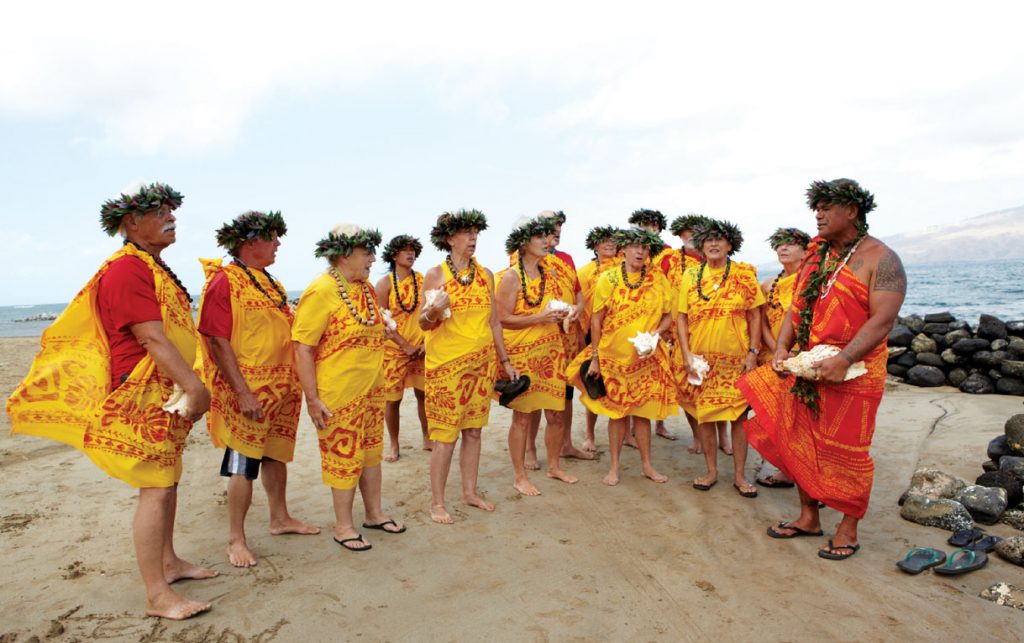
Maui Nui O Kama: (L–R) Kathy Holland, Adele Rugg, Natalie Stanfield, Dorinda Giles, Dottie Nykaza, Gail Dornstreich, Vicki Trail, Vanessa Kalanikau, Ed Mathay, Mike Shindler, Bud Nykaza, Rick Trail and Dan Holland.
In the Hawaiian tradition, the purpose of life —the meaning of our being here on Earth — is to fulfill a unique responsibility, our kuleana. This traditional way of looking at human existence addresses the age-old questions about the meaning of life, while grounding it in everyday practically. It invites each of us to reflect upon what our purpose may be — and how best to offer our gifts, talents and strengths to the world, intentionally and powerfully, for the enrichment of all beings.
Living among us in these modern times are Hawaiian elders whose kuleana is to share Native Hawaiian core values with future generations. In doing so, they ensure that traditional beliefs, such as kuleana, find new relevance in our modern-day world.
Kimokeo Kapahulehua, 64, is one of Hawai‘i’s wisdom keepers. (His surname refers to the sound of lehua branches rubbing against each other in the wind.) He is a kūpuna (elder) with extraordinary knowledge of the land and its people. As a pillar in the Maui community, he makes an incredible effort to address a vast number of issues — from engaging youth groups and restoring ancient fishponds, to tirelessly working toward land preservation and the eradication of invasive species.
Yet, Kimokeo didn’t always know his kuleana. Like most of us, he discovered it along his life’s journey.
As a precocious child he was a fast learner and a bit of a daredevil. He was very much a “doer” … much to the consternation of his parents, who often feared for his safety.
With the boundless mana (energy) of his robust nature, he was branded with the nickname “Bully,” as his parents viewed their super-active, chubby child as a kind of free-ranging bull. He was an intensely focused fireball of a child, typically engaged in the unrestrained pursuit of whatever claimed his attention.
Stories abound of how the clever boy managed to stow away on late night fishing forays that only adults were permitted to join and sought out his own superior, fishing spots. Even his grandfather, then chief of police, could not reel him in.
In his adolescence, he became the “King Kong” of Kaua‘i beaches, challenging the biggest waves — the more dangerous the better — on his primitive, wooden surfboard. At the age of 12, he discovered outrigger canoe paddling and participated in his first canoe race at age 14.
As an instinctive waterman, Kimokeo related to Kanaloa, the Hawaiian god of the ocean. He connected with idea that a fully lived life as a Hawaiian demands experience in and of the water. To become a complete person, he knew he must commune, profoundly and passionately, with the sea.
His bond to the ocean followed him into adulthood and later became a defining element of his kuleana.
Passion Finds A Practical Focus
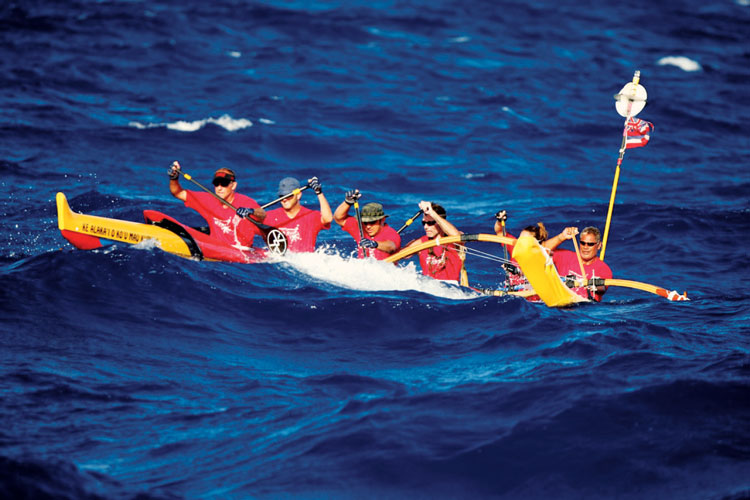
Voyage of the wa‘a towards Kure Atoll.
As he matured, an awareness of his life mission, or kuleana, began to crystallize. Something quite different lay ahead for him. His penchant for taking on risky challenges, separating from others and “winning” began to morph into a new, more benevolent kind of passion. He began to choose to give generously from his deep well of aloha (love energy) and serve as a mentor. He would become a dynamic, endlessly renewable source of kōkua (benevolent assistance) whose undeterred giving of his best self would shine forth into the world, personifying the Hawaiian principles of pono (doing what is right, in the fullest sense) and ma¯lama (taking good care of all that’s precious).
In the pidgin expression, “If can, can; if no can, no can,” he would have emphatic use for the first half of that affirmation only: If can, CAN!
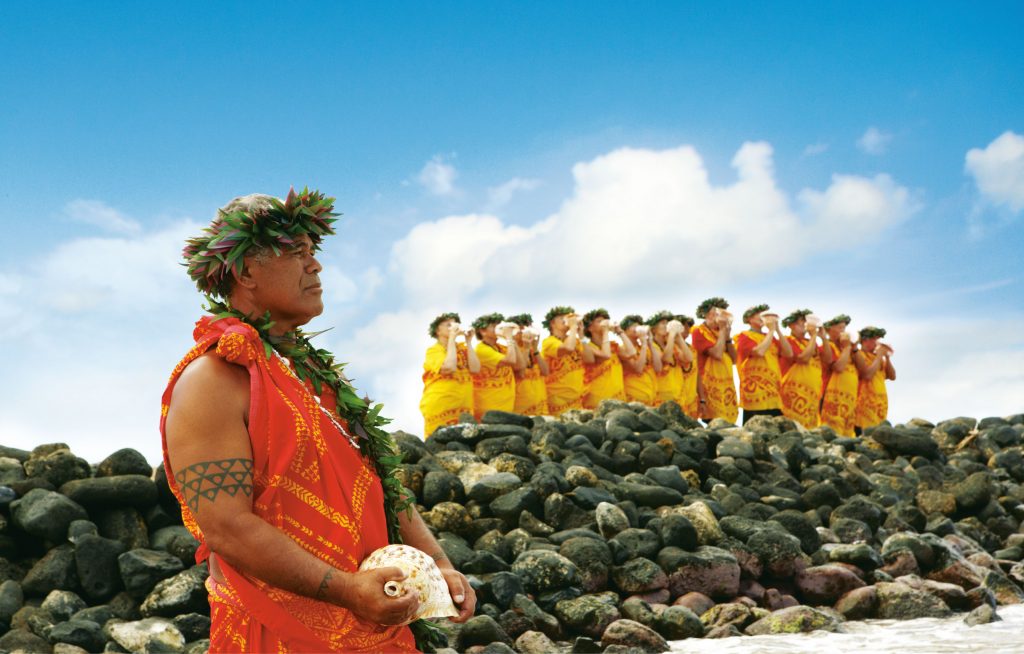
His Uncle Kawika, who had sailed on the famed Hōkūle’a to Tahiti in 1976, challenged him to “connect all of the Hawaiian Islands like a flower lei.” Historically, this would be a re-enactment of King Kamehameha II’s feat, only this time it would be a deliberate mission of peace.
Recognizing and accepting this as his responsibility (kuleana) to his family — and seeing it, too, as an extension of his commitment to perpetuate the Hawaiian culture — Kimokeo began a series of open-ocean canoe voyages in 2002 that traversed all the inter-island Hawaiian channels.
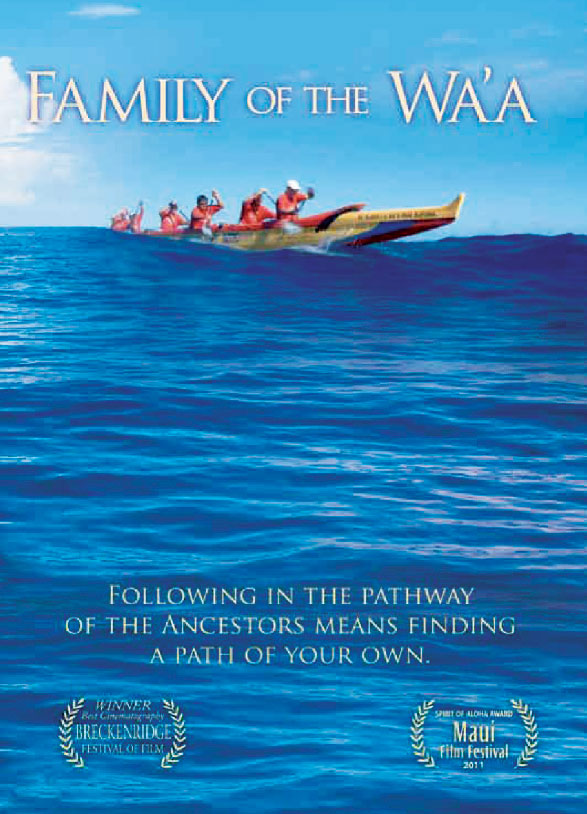
On these journeys, he was mostly accompanied by rock-star-quality crews; but, true to his all-embracing nature, he also chose to include recreational novices in their 60s. The series of voyages culminated in 2008 in an epic, 400-mile paddle from Laysan to Kure Atoll in the Northwest Hawaiian Island chain. It became the subject of a recent film directed by Alyssa Fedele, “The Family of the Wa’a.” (familyofthewaa.com).
Kumu Keli‘i Tau‘a. A renown cultural expert and spiritual leader, and an acknowledged master of Hawaiian music, hula and chants.
The lei connecting the Islands was finally complete, and Uncle Kawika’s vision accomplished. The entire Hawaiian archipelago had been bridged. The Islands, considered by Hawaiians to be sentient, living beings, could now rejoice in the reappearance of canoes into their remote worlds. Even distant Kure had now “seen” the coming again of the wa‘a, the living canoe, upon her waters.
By the mid-1990s, Kimokeo met Kumu Keli‘i Tau‘a, a modern Hawaiian like himself whose passion for Hawaiian culture, chant and protocol would raise his passion for canoe paddling to a higher octave. His life would be forever changed by the synergy and magic of that meeting.
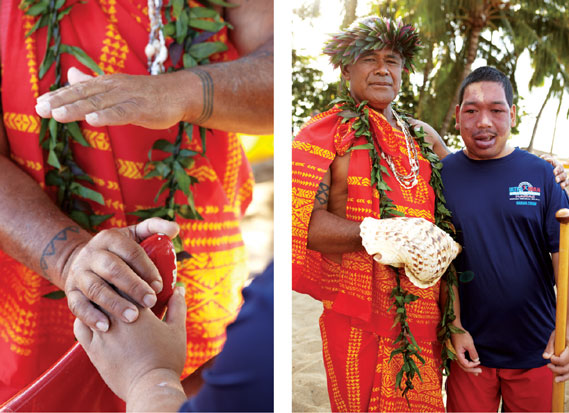
Kimokeo and Brandon from the Adaptive Paddling program for mentally and physically handicapped people.
The coming together of these two great Hawaiian men — one a waterman, the other a kumu hula (teacher)—formed the perfect partnership. It would ignite them both and offer “Bully” a new name — Kimokeo. He also had an evolved and awakened view of his own calling… he would become an educator, a whirring hub of community action and goodwill, offering his unique mana to everyone who cared to receive it. Once “born to be wild,” he had now become“re-born, to willingly share.”
In this newfound capacity as harmonizer, he blurred the boundaries between kanaka maole and haole. In Kimokeo’s view, native people and foreigners were “all one team.” Transcending prejudice, he spread his attention across all demographics — young and old, able-bodied and “adaptive,” native and newcomer.
Assuming the Mantle of Cultural Leader — a Kahu
In 2003, under the spiritual mentoring of Kumu Tau‘a, Kimokeo formed a cultural hālau, Maui Nui O Kama, and became its alaka‘i (leader). The hālau was an instrument in educating the public and in introducing Hawaiian ceremony to special occasions. The hālau became extraordinarily active in supporting families through rites of passage, such as the death of loved ones, and blessing homes, businesses, nature centers, roadways, hospitals, sports events and even film directors. Almost 10 years later, the hālau continues to be sought out and appreciated by many who’ve been touched by its ceremonies. Its members, predominantly non-Hawaiian, have become genuine practitioners of Hawaiian culture — with a legitimacy that only Kimokeo’s vision and attentive leadership could have bestowed.
The halau chanting with Kimokeo: (Front row, L–R) Dan Holland, Rick Trail, Kathy Holland, Dottie Nykaza, Vicki Trail, Adele Rugg, Natalie Stanfield, Gail Dornstreich, Kimokeo Kapahulehua. (Back row, L–R) Vanessa Kalanikau, Mike Shindler, Dorinda Giles, Ed Mathay, Bud Nykaza.
Kimokeo would also help restore lo‘i (taro fields) at Honokahau, Maui, and on land stewarded by Kawehi Ryder (brother of Hawaiian spiritual practitioner, Lei‘ohu Ryder) on La¯na‘i. He would direct the restoration of Ko‘ie‘ie, an ancient fishpond in the Ka‘ono‘ulu Ahupua‘a on Maui, by enlisting the help of the Native Hawaiian community, residents and visitors. His directive to all was simply to participate: “Carry at least one pōhaku (stone) into place.”
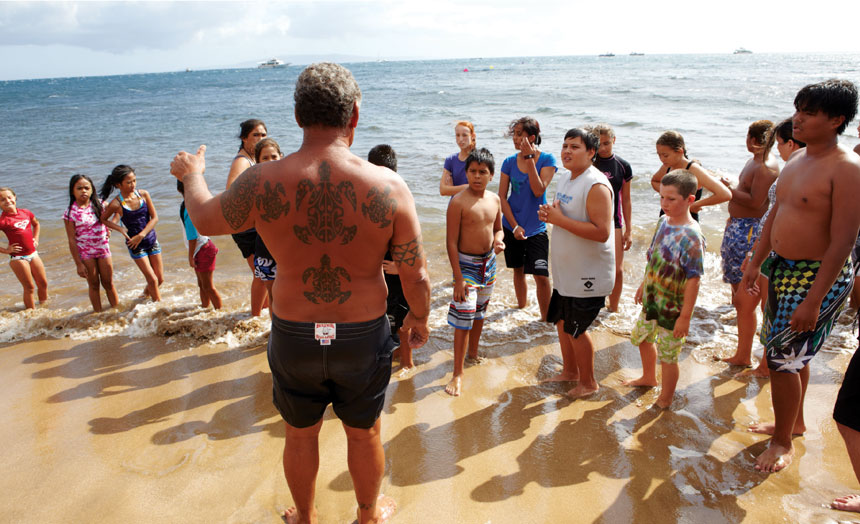
Kimokeo would also inspire cancer survivors (the so-called Mana‘olana “Pink Paddlers”) to accomplish things they’d never dared to dream, leading them on life-affirming paddles across wild, open ocean. He would even introduce adaptive (physically and emotionally challenged) paddlers to canoe racing, super-charging their self-esteem.
Forever a champion of the younger generation, Kimokeo was for several years director of the Kīhei Youth Center. And he continues to spearhead several fundraisers on its behalf. At a recent fundraiser to support teens participating in the 2012 World Sprints in Canada, he not only led the opening prayer and served as master of ceremonies, he also stepped up as an impromptu auctioneer to bump up the bid on an auction item that he felt was selling too low.
Under Kimokeo’s tutelage, hundreds of youngsters have found a passion for canoe racing. Indeed, introducing the younger generation to a pono, drug-free lifestyle has always been one of his major initiatives.
Hālau members Bud and Dottie Nykaza have had a special window on Kimokeo’s depth, versatility and seemingly boundless energy. Since the hālau’s inception, they have served—like a pair of extra heads and two pairs of extra arms and hands — as Kimokeo’s willing assistants, often on call day and night.
Bud, a 60-something recreational paddler and ace steersman on inter-island voyages, sees the tenderness underlying Kimokeo’s actions: “He’s comfortable enough with himself to show emotions publicly … never ashamed to shed tears,” Bud says. “Ever since I met him, I’ve felt a connection with him, the way a son would feel toward his father. He’s always watching out for my safety. His way is no drama, no hesitation …just results!”
Modern Hawaiians such as Kimokeo and Kumu Tau’a, who walk the walk — steadily and devotedly — and talk no more than necessary to get the job done are our mentors and wayshowers, our living examples of what’s truly pono.
Kimokeo notes that as we age and mature, our kuleana may also change. In fact, a quality of ma¯lie (calmness and steadiness) typically increases as you age. Ma¯lie can sometimes make it possible for elders to achieve goals that eluded them when they were younger and more harried.
Regardless of your age, it’s important to ask yourself, What is your kuleana? What is your responsibility, or role in life? What can you accomplish today that perhaps got away from you yesterday? And, how are you going to express your kuleana? What will it “look” like in practical, everyday life? And, perhaps most importantly, how will you share it and how may it benefit others?
Following his inner guiding star, Kimokeo skillfully navigates the subterranean waters of his own inner world and kuleana. In the Hawaiian tradition, the purpose of life —the meaning of our being here on Earth — is to fulfill a unique responsibility, our kuleana. This traditional way of looking at human existence addresses the age-old questions about the meaning…
There is something about retirement – the word retirement, the thought of retirement, the actual process of retirement – that brings mixed emotions. For some folks the word retirement causes excitement, for others terror. And, there are those who vacillate from one to the other. We retirees experience all of these emotions at one time or another. I know … I’m 75 years old, and have been retired for 32 years.
So what is the primary cause of terror? Fear! Fear of the unknown. Most of us are not prepared for retirement and being unprepared affects every area of our lives: spiritually, mentally, physically, emotionally, relationally and financially.
The literal definition of retirement alone is frightening.
The act of retiring. (That’s not so bad.)
Removal from service. (Now we go into denial. ‘I’m alright. That’s not going to happen for many more years.’)
Withdrawal into privacy or seclusion. (Now things begin to get heavy.) Removal, withdrawal, seclusion.
In this light, can you think of anything positive about retirement?
To top it off, our society and government doesn’t paint a pretty picture of retirement. The federal government predicts that the average person will be dead, busted or broke by the age of 65. And common statements such as ‘a person gets weaker as he or she gets older’ and ‘older people don’t contribute; they drain our resources’ don’t seem harmful when we’re younger, but as we get closer to retirement age, they begin to chisel away at our mental well being. Our self-esteem begins to waiver. Our self-image begins to slide downward. We begin to lose our sense of dignity and hope, our sense of being alive. Whether we are financially well off or not, it doesn’t matter. We fade off into seclusion mentally and physically, a place where self-destruction begins … “the beginning of the end.”
Bleak as the picture may seem for us retirees, there is hope. We can create for ourselves a new beginning.
All we need to do is draw a line in the sand and take the following four steps:
Declare: I’m a child of God, created for greatness and have something significant yet to do. This signifies purpose.
Dream: Imagine for a moment that you are living your final 24 hours. How would you approach the next few hours?
Decide: To act as if it is your last day.
Association: Hang out with like-minded people. People with common dreams, common goals, going in the same direction, supporting one another in a new beginning.
The key to a new beginning? Begin! Begin now!
When one thing ends, another begins. There is something about retirement – the word retirement, the thought of retirement, the actual process of retirement – that brings mixed emotions. For some folks the word retirement causes excitement, for others terror. And, there are those who vacillate from one to the other. We retirees experience all…
Tools to help you decide when’s the right time for you
These days, everyone is taking a new look at their finances — and no one is looking more closely than the millions of baby boomers who are nearing retirement age. While some boomers expected to retire at one of the traditional milestones, such as age 62, the current economy is forcing many of them to re-evaluate their plans. Many are wondering if they should work longer, or how their Social Security benefit — or their spouse’s benefit — would be affected if they continued working.
To help them find answers, Social Security has published a fact sheet called When To Start Receiving Retirement Benefits.
As most workers know, your choice of a retirement age — from 62 to 70 — can dramatically affect your monthly Social Security benefit amount.
If you choose to start receiving benefits early, the monthly payments will be reduced based on the number of months you receive benefits before you reach your full retirement age. The rate of reduction will depend on the year you were born. The maximum reduction at age 62 will be:
25 percent for people born between 1943 and 1954
30 percent for people born after 1959
If you wait until your full retirement age, your benefits will not be reduced. And if you should choose to delay retirement, your benefit will increase up to eight percent a year from your full retirement age until age 70. However, there is no additional benefit increase after you reach age 70, even if you continue to delay taking benefits.
Social Security also has created several retirement planners to help you make an informed decision. Social Security has an online calculator that can provide immediate retirement benefit estimates to help you plan for your retirement. The online Retirement Estimator uses information from your own earnings record, and lets you create “what if” scenarios. You can, for example, change your “stop work” date or expected future earnings to create and compare different retirement options.
Retirement decisions are unique to everyone. Make sure you are up to date with the important information you will need to make the choice that’s right for you.
Tools to help you decide when’s the right time for you These days, everyone is taking a new look at their finances — and no one is looking more closely than the millions of baby boomers who are nearing retirement age. While some boomers expected to retire at one of the traditional milestones, such as age 62,…
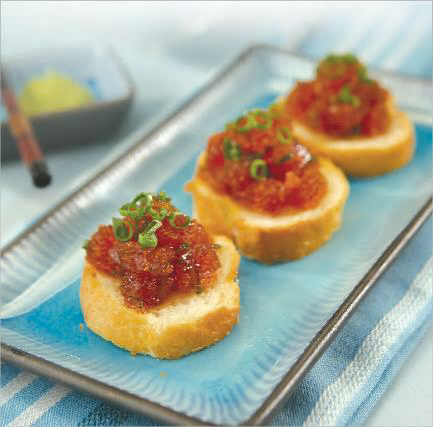
This is a great appetizer because of its big, two-level crunch. First, the happy pop of the tobikko, and then the satisfying crunch of the crostini.
Ingredients:
‘Ahi spread
2 lbs. ‘ahi, ¼-inch or less, diced
1/2 cup tobikko fish eggs
1/2 cup green onion, thinly sliced
2 Tbsp. sesame oil
1 Tbsp. light soy sauce
1/4 tsp. wasabi paste or wasabi oil
1/2 tsp. kosher salt, fresh ground
Black pepper, to taste
Crostini
1 baguette, sliced into rounds 1/4” thick
Extra-virgin olive oil
Garlic salt
Directions (Serves 10):
In a bowl, combine all of the ‘ahi spread ingredients and keep well chilled until ready to serve.
To make the crostini (you can also purchase prepared crostini), brush each slice of bread with a little olive oil, and bake at 400ºF for 10 minutes or until crispy. Remove from the oven and sprinkle with garlic salt or an herbed salt blend. Top each crostini with a rounded teaspoon of the ‘ahi spread and serve.
As a “casual gourmet” cook for more than 12, years, Chef Michi founded ‘Cooking Fresh For You’ in 2007. Her recipes center on healthy yet easy to prepare flavor-packed dishes. Visit www.cookingfreshforyou.com or contact Michi at cookingfreshforyou@gmail.com or (808) 286-6484.
This is a great appetizer because of its big, two-level crunch. First, the happy pop of the tobikko, and then the satisfying crunch of the crostini. Ingredients: ‘Ahi spread 2 lbs. ‘ahi, ¼-inch or less, diced 1/2 cup tobikko fish eggs 1/2 cup green onion, thinly sliced 2 Tbsp. sesame oil 1 Tbsp. light soy…


 KOPP provides nutrition and supportive services to independent Native Hawaiians 60 years of age or older on the islands of Hawai‘i, Kaua‘i, Maui, Moloka‘i and O‘ahu.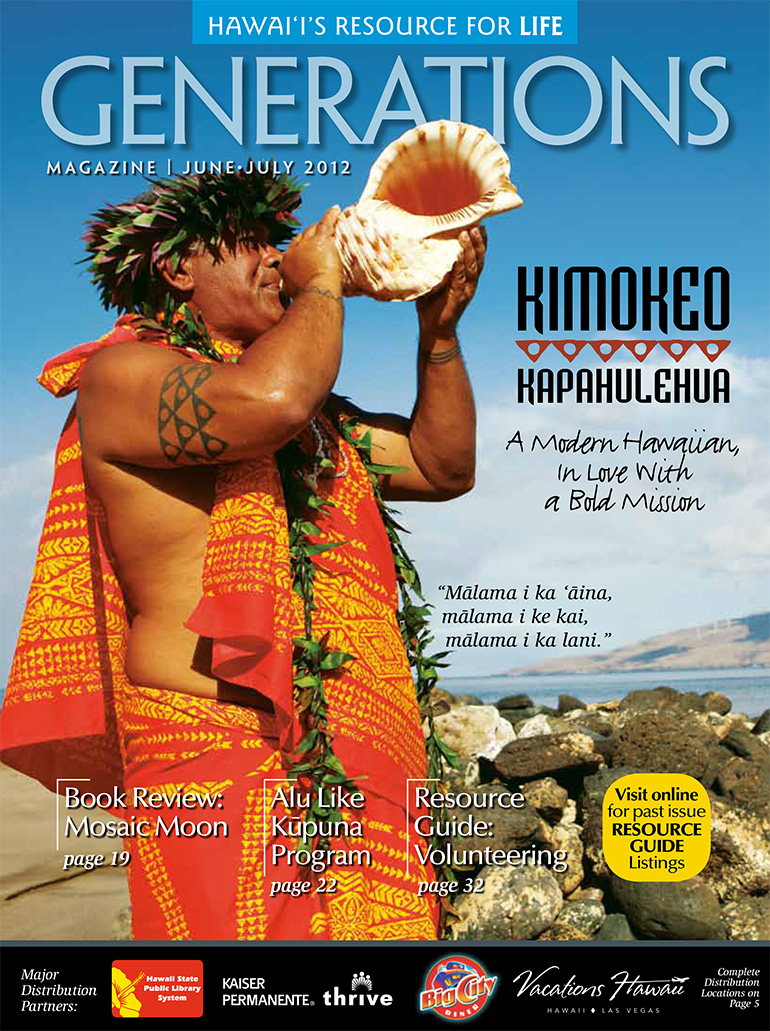
 His Uncle Kawika, who had sailed on the famed Hōkūle’a to Tahiti in 1976, challenged him to “connect all of the Hawaiian Islands like a flower lei.” Historically, this would be a re-enactment of King Kamehameha II’s feat, only this time it would be a deliberate mission of peace.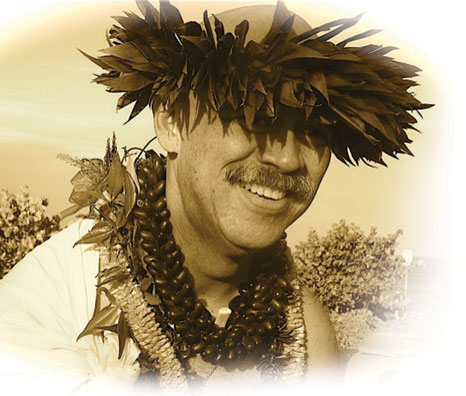
 This is a great appetizer because of its big, two-level crunch. First, the happy pop of the tobikko, and then the satisfying crunch of the crostini.