Category: Living Life

  • Children’s Book Explores Dementia

    Frances H. Kakugawa, a Hawai‘i Island native, began writing poetry a half-century ago, then stopped for some years to work for the public school system. But when she became the primary caregiver for her mother, she found that writing poetry helped ease her stress.

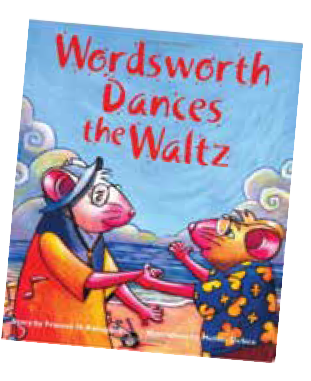
    Her multiple award-winning 2007 children’s book, Wordsworth Dances the Waltz, is dedicated to her mother, who was afflicted with Alzheimer’s disease. It is about families living with elders impacted by dementia. In this book, children are introduced to the concept that as grandparents age, they may behave differently and sometimes forget things.

    The book illustrates aspects of dementia and how the disease affects the entire family through Wordsworth, a Hawaiian mouse, who remembers a time when he and Grandma danced around the room. But now, Wordsworth must walk softly as not to disturb her.

    Because Wordsworth loves poetry, he finds comfort in writing verses that express his confusion over his grandma’s changing behaviors, and by recalling memories of more vibrant days. His poems also help his family understand that Grandma is still his loving grandparent and an important part of the family.

    If you are looking for an excellent tool to ease fears and explain changes in an elder loved one’s behavior, this book may be helpful.


    The book is illustrated by Melissa DeSica and available through Amazon. Call your nearest bookstore to purchase a copy locally. For children 9 and older.

    Frances H. Kakugawa, a Hawai‘i Island native, began writing poetry a half-century ago, then stopped for some years to work for the public school system. But when she became the primary caregiver for her mother, she found that writing poetry helped ease her stress.

  • Should You Insure Your Pet?

    If your pet is healthy, is pet insurance still necessary? The American Veterinary Association suggests pet insurance to defray costs, which can be around $250 for a simple treatment to over $8,000 if the condition is more serious. The over 85 million pet households in the US spend a whopping $75 billion on pet care annually.

    During the summer months, one of the biggest dangers for dogs is heat. They don’t sweat like humans and can suffer from heatstroke. Signs to look for are fatigue and loss of appetite. In addition, seeds found in grassy areas during the summer can cause skin problems, such as hives or rashes. If your pet can’t stop scratching, the area can become tender and an infection can set in, making matters worse, so it’s important to keep ticks and fleas under control, too.

    A recent PetMD article notes that a new medication for canines with osteoarthritis is available. Without insurance, a course of treatment can cost around $100 monthly.

    So do your homework regarding your particular furry or feathered friend. Closely review insurance coverage details for limitations and exclusions.

    Always check with your veterinarian about insurance options in order to provide a financial safety net for your beloved family member.


    GET2INSURANCE.COM FAMILY OFFICE
    1003 Bishop St., Ste. 2700, Honolulu, HI 96813
    800-226-3660 | martha@get2insurance.com
    Get2insurance.com

    If your pet is healthy, is pet insurance still necessary? The American Veterinary Association suggests pet insurance to defray costs, which can be around $250 for a simple treatment to over $8,000 if the condition is more serious. The over 85 million pet households in the US spend a whopping $75 billion on pet care…

  • Homemade Matcha Mochi

    Matcha is a powdered green tea that is rich in antioxidant compounds due to its special cultivation method. Traditionally, the tea bushes are covered with bamboo mats to shade the leaves from direct sunlight, therefore producing higher amounts of amino acids, chlorophyll and theanine. Matcha is known for its vibrant color and unique, bitter taste. Matcha is low-calorie and fat-free. Compared to other green teas, matcha is relatively high in caffeine.

    Consumption of matcha green tea is regarded as an effective dietary intervention to promote cognitive function. Studies also suggest that it has cardioprotective effects. Matcha green tea may also aid in lowering blood glucose levels.

    Try this matcha mochi recipe:

    Ingredients:
    1 box (16 oz.) mochiko flour
    2 cups white granulated sugar
    1 tsp baking powder
    4 Tbsp matcha powder (ceremonial grade)
    1 can (12 oz.) coconut milk
    1 tsp pure vanilla extract
    2 cups water

    Directions
    1) Preheat a conventional oven to 350 degrees.
    2) Thoroughly coat a 9-by-13-inch pan with avocado oil spray or just line the pan with parchment paper instead.
    3) In a mixing bowl, add the mochiko flour, sugar, baking powder and matcha powder, then blend well.
    4) In another mixing bowl, whisk the coconut milk, vanilla extract and water together.
    5) In the dry ingredients bowl, make a gaping hole in the middle of the ingredients. Pour the liquid ingredients in the hole, then incorporate everything together with a spoon spatula. Whisk well until smooth, then pour the batter into the well-greased pan.
    6) Cover securely with foil.
    7) Bake for one hour.
    8) When done, a toothpick inserted into the mochi should exit dry with few to no crumbs.
    9) Let mochi cool completely.

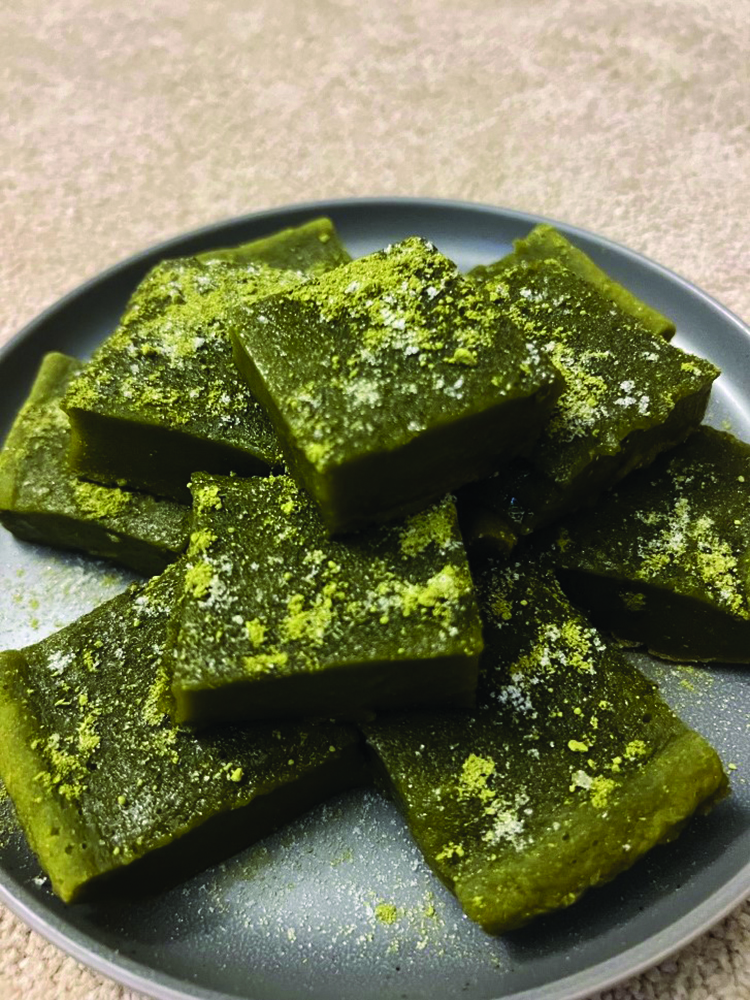
    Optional: Sprinkle the mochi lightly with matcha powder for enhanced matcha flavor. Cut with a plastic knife when ready to serve. (Yield: 24 squares)


    Do you have a favorite recipe and story to share? For consideration in the next issue, include a photo and mail them to Generations Recipe, PO Box 4213, Honolulu, HI 96812, or email them to Cynthia@generations808.com.

    Matcha is a powdered green tea that is rich in antioxidant compounds due to its special cultivation method. Traditionally, the tea bushes are covered with bamboo mats to shade the leaves from direct sunlight, therefore producing higher amounts of amino acids, chlorophyll and theanine. Matcha is known for its vibrant color and unique, bitter taste.…

  • Empathy vs. Sympathy

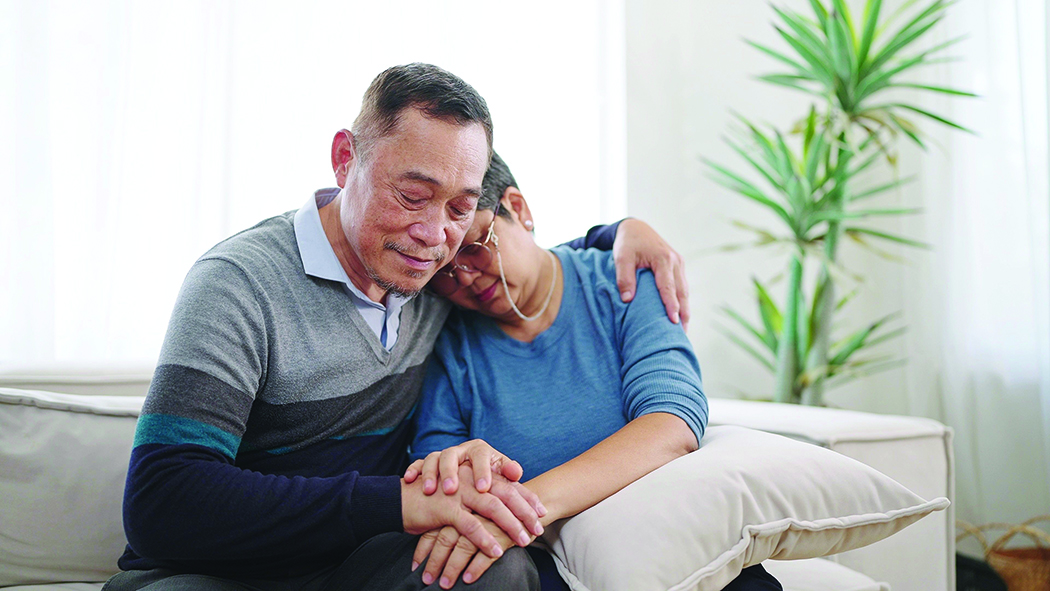
    As a society, we have faced much grief over the last few years. When in the mode of navigating care for ourselves or others, we often run into misconceptions about what we should or shouldn’t do.

    Often, the confusing part is actually clarifying the differences between empathy and sympathy. An online search reveals that “Empathy involves feeling what someone else feels, while sympathy doesn’t. Sympathy, instead, involves understanding someone else’s emotions, but from your own perspective.” Both are beautiful and healing for different reasons.

    But there is a raw beauty in empathy. It’s not about us trying to relate from our own lens, but rather, by stepping into the space or fear with the other person, hearing where they are coming from and connecting to that.

    When stepping into other’s grief or brokenness, it’s tempting to try to be optimistic and uplifting, and to start problem-solving. But what most of us need in times of sadness or grief is to feel heard, feel love and feel we are not alone. The gift of connection is healing.

    Check out professor, author and podcast host Brené Brown’s “Empathy vs Sympathy and the Power of Connection” on YouTube.


    BEREAVEMENT NETWORK OF HAWAI‘I
    Facilitated by KOKUA MAU (nonprofit)
    808-585-9977 | kokuamau.org
    kokuamau.org/grief-and-bereavement
    Learn more about grief and the healing process: Help For The Bereaved—The Healing Journey (https://kokuamau.org/wp-content/uploads/CtrOnAging-Booklet-5-REV_6-30-11.pdf).

    As a society, we have faced much grief over the last few years. When in the mode of navigating care for ourselves or others, we often run into misconceptions about what we should or shouldn’t do.

  • Writing Helpful Reviews: A Guide for Seniors

    Most customers read online reviews before purchasing a product or service. But when was the last time you wrote one? Remember, when you write a review, you are helping others and yourself.

    Expressing your gratitude for good experiences or sharing constructive feedback about less-than-stellar experiences both contribute to a company’s online reputation. Writing an authentic and constructive review about a brand’s products or services educates other consumers and alerts the business about any issues with your purchase.

    Don’t use reviews for revenge. Instead, focus on productive ways to address shortcomings. Complaint processes like those used at the Better Business Bureau encourage positive change.

    Where Should You Write a Review?

    BBB reviews go through a verification process. Businesses are always encouraged to respond, which helps paint a more balanced picture. When you read or write a BBB review, know that it’s hosted on a platform committed to authenticity and responsiveness.

    Your voice matters, so share your experiences and help others by contributing to a better shopping environment for everyone.


    BETTER BUSINESS BUREAU GREAT WEST+PACIFIC (nonprofit)
    800-460-0910 | info@thebbb.org | thebbb.org
    Ad or company clarification: bbb.org
    Report a scam: bbb.org/scamtracker
    File a complaint: bbb.org/file-a-complaint

    Most customers read online reviews before purchasing a product or service. But when was the last time you wrote one? Remember, when you write a review, you are helping others and yourself.

  • Maui Fires Spark Pioneering Spirit

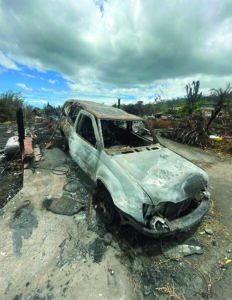
    It has been nearly a year since wildfires fueled by powerful winds from Hurricane Dora destroyed the town of Lahaina and parts of Kula. The wildfire that killed at least 101 people is the deadliest in the US in more than a century, and the most lethal natural disaster to occur in Hawai‘i since statehood in 1959.

    The Lahaina fire has caused extensive damage and significant financial losses. The fire affected 2,719 structures in the area—86% of them residential, leaving thousands displaced. The estimated cost to rebuild Lahaina is $5.52 billion.

    It makes sense that studies, assessments, evaluations, action plans, advisory committees, and planning boards mindful of history and culture will all be required to tackle the complex, monumental task of reconstructing an entire town.

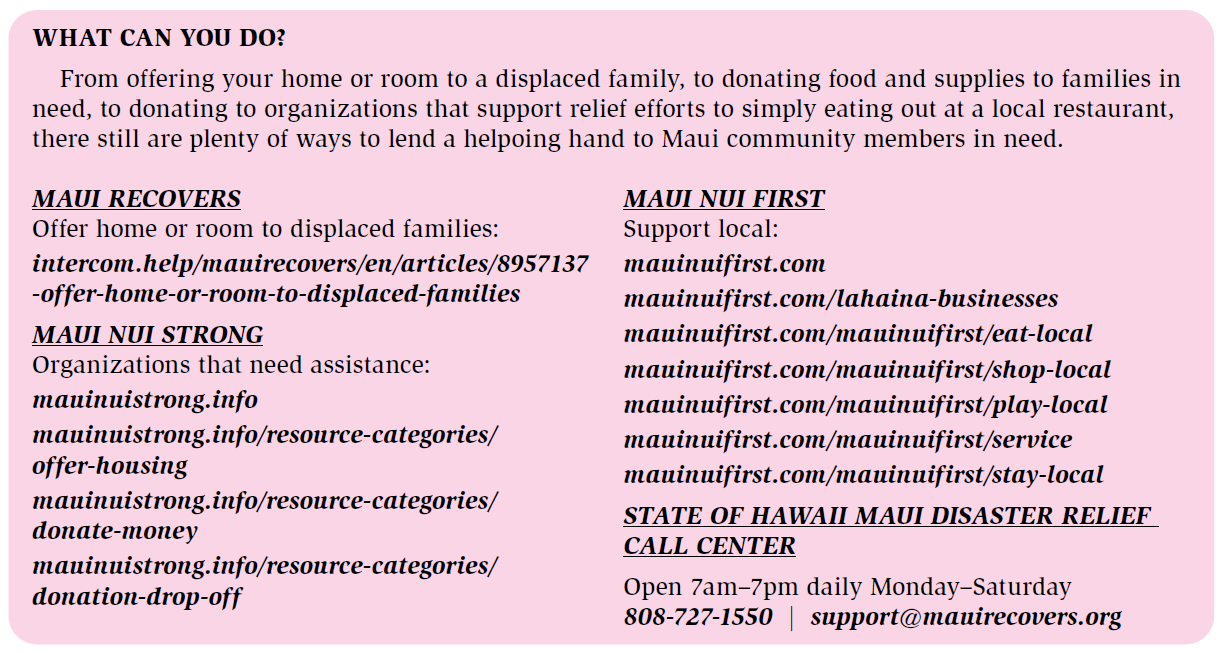
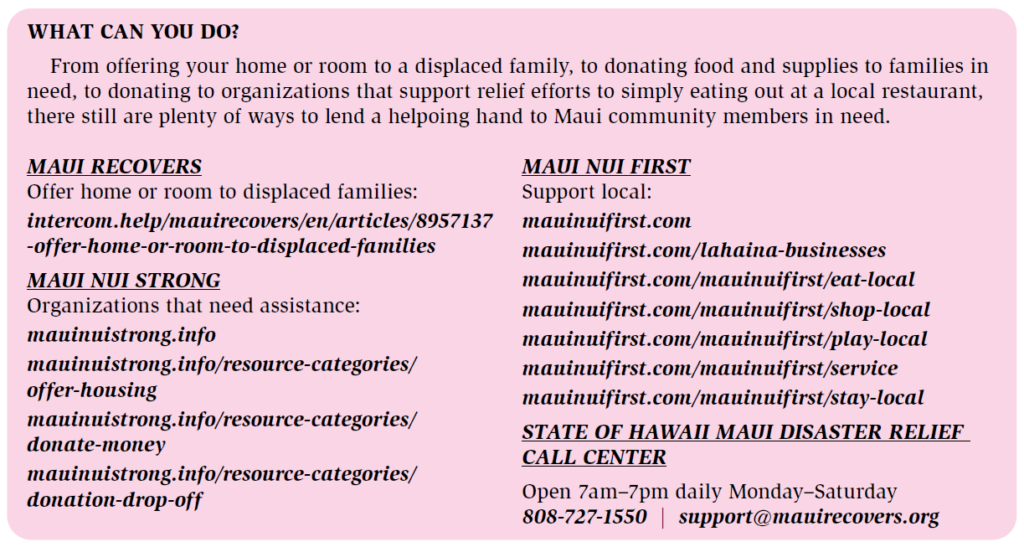
    But what can one person do that would have a positive impact in the aftermath of such devastation? Plenty. There are still many opportunities to lend a hand or open your pocketbook to those in need and help with the expiation of this disaster and the mitigation of future occurrences.
    Mālama Kula

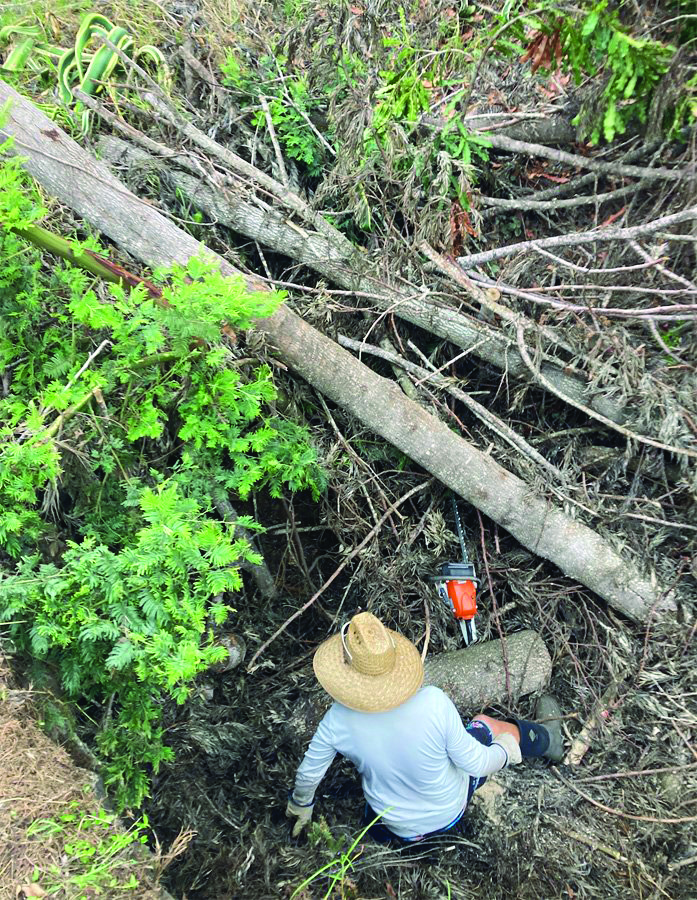
    In Kula, Kyle Ellison, who nearly lost his own home to the Upcountry fire, has emerged as a changemaker in his community. A big eucalyptus tree was blown down and fell on some power lines, which started a fire in the gulch near his home. While much of the focus has understandably been on Lahaina, sparks from the August fires were still flaring in Kula months later. Despite his own plight, or maybe because of it, he continues his battle on the front lines.

    Kyle founded Mālama Kula, an action-oriented, results-driven nonprofit organization, in order to provide disaster relief in response to the Kula fire, but he also aims to address many other challenges facing his community.

    Based in Kula, Mālama Kula helps provide programs, funding and services for community cleanup, and disaster relief and mitigation.

    “From day one of the Kula fire, our team had boots on the ground and rallied to help serve our neighbors,” says Kyle. “People donated whatever they had and rose up to help at a time when the community needed them most. During the Kula fire, we all became firefighters.”

    Twenty Kula homes were lost, Kyle says. In the days that followed, Kula residents rallied and gathered by the hundreds, helping to save properties and homes, and coming to the aid of neighbors, family and strangers dealing with what was left… and what was lost.
    “The Kula community is not going to wait until the next time we hear the crackling of burning trees 200 yards behind our houses to suddenly start thinking it’s time to do something,” says Kyle. “We need to make the changes now and take action to prevent what is threatening us. That is my mission and commitment. We’re not going to wait around for studies or a grant or the government. Instead, we will get up, put our boots on and go out and fix the problem ourselves. That has really been the silver lining in all of this—that the community has really banded together to fix our own problems and take care of ourselves.”

    Thanks to the ensuing Kona storms, the fires were finally doused, but the heavy rains brought their own set of problems. Without proper vegetation and watersheds, the rains caused landslides, rockslides and erosion hazards, with debris-tainted runoff flowing into gulches and eventually into the ocean via Kealia Pond and  Ma‘alaea Bay.

    “We are scattering wood chips from the downed trees on the burn zones to mitigate erosion and help the soil retain moisture,” says Kyle. “We also are working with the Kula Community Watershed Alliance to replant with native vegetation before invasive species can reestablish themselves. We’re turning back the hands of time by planting things that will create a thriving native watershed and keep moisture in the ground.”

    They are also working to establish an Upcountry green waste facility, clearing fire fuel from gulches and pushing for better infrastructure.

    Kyle has created tools, solutions and a structure for success. So roll up your sleeves and get out your wallet—there is still much we all can do.

    “Show up with a chainsaw or your checkbook. Either means we are going to get work done.” Get updates on workdays via email or Instagram.


    MĀLAMA KULA (nonprofit)
    A program of Ka ‘Ike Mau Loa O Ke Kai Hohonu
    PO Box 1134, Kula, HI 96790
    MalamaKula.org | malamakula@gmail.com
    instagram.com/malamakula

    It has been nearly a year since wildfires fueled by powerful winds from Hurricane Dora destroyed the town of Lahaina and parts of Kula. The wildfire that killed at least 101 people is the deadliest in the US in more than a century, and the most lethal natural disaster to occur in Hawai‘i since statehood…

  • The Gift of Whole-Body Donation

    Whole-body donation is a no-cost process and a profound act of generosity that allows individuals to contribute to the advancement of medical education, research and the improvement of healthcare practices. By donating your body to science, you make an enduring impact on the lives of future generations, enabling medical professionals to deepen their understanding of human anatomy, develop innovative medical procedures, and enhance the quality of patient care.

    Medical students, anatomists, surgeons and other healthcare professionals rely on donated bodies to study human anatomy in detail, providing a hands-on learning experience that textbooks alone cannot match. They gain a comprehensive understanding of anatomical structures, variations and disease processes, enabling them to develop more effective treatment strategies. In addition, researchers can study donated bodies to investigate the causes and progression of diseases, develop new medical technologies, and test novel treatment methods.

    Respect for the wishes of donors is of utmost importance. It is crucial that individuals who choose to donate to science understand the process involved, including the potential uses of their donation and the expected timeline for its utilization. Donor organizations uphold strict ethical guidelines, ensuring the utmost respect, dignity and reverence for donors’ contributions.

    The Donation Process

    Individuals must express their intention to donate and complete the necessary paperwork, including consent forms and medical history documentation. This paperwork can be completed during the life of the individual or following their death by the next of kin or agent. Upon passing, the body is transported to a storage facility. After the body has been utilized for educational or research purposes, it is cremated, and the remains are returned to the family or interred respectfully within 3 to 12 months.

    Whole-body donation serves as a gift to society, advancing medical education and promoting scientific progress. Donations embody the essence of altruism and leaves a lasting legacy, bridging the gap between medical knowledge and compassionate patient care. As we appreciate the selflessness of those who make this choice, we recognize the immeasurable impact they have on the future of healthcare and our collective well-being.


    KE OLA ‘UHANE
    P.O. Box 2831, Honolulu, HI 96803
    808-391-6041 | keolauhane@aeternitas.com
    844-330-7040 (24 hours/day)
    keolauhane.org

    Whole-body donation is a no-cost process and a profound act of generosity that allows individuals to contribute to the advancement of medical education, research and the improvement of healthcare practices.

  • Time for Spring Cleaning?

    The season of spring is often associated with a strong desire to do a deep, thorough cleaning of your home. It’s a global phenomenon practiced in big cities, rural communities and remote villages. Social scientists who have studied the annual ritual believe there are health benefits to decluttering, organizing and cleaning up your home. It seems people who adopt the annual habit experience more energy, a sense of accomplishment, contentment and sleep better.

    Why not extend this positive habit to organizing your health insurance paperwork? But where should you begin? Well, if you see your desk piled up with unopened mail, health cards, medical bills and health plan sale flyers, that’s a great place to start.

    First, sort through the clutter by separating insurance health cards, bills, letters and sales brochures. Look for any official government notices from Social Security or Medicare. Toward the end of each year, both agencies usually send notifications about increases in retirement benefits or changes to Medicare Part B premiums. If a letter looks suspicious or you are unsure about what to keep or what to throw away, call Medicare at 1-800-633-4227. Medicare takes calls 24/7, year-round, except for certain holidays.

    Next, discard old bills, and expired health cards and statements. It is very important to keep track of your current health cards and plan benefit documents. Contact your health plan provider to replace any lost or missing health, drug, dental and/or vision insurance cards. In an emergency, it is critical to have access to the information to avoid delays in care and uncovered claims.

    Lastly, take a moment to pay any outstanding healthcare bills and file them in your secured computer storage or other filing system.

    But if you have already selected a health plan for the year, there is no reason to hold on to sales solicitations. You will get a whole new bundle of sales material in the upcoming fall open enrollment season, so toss out the old as plans may change benefits and costs each year. It’s very easy to accumulate piles of mail during insurance year-end open enrollment periods. But rather than keeping unimportant, irrelevant documents, just shred and toss them (check with Medicare first if you need to).

    Finally, the key takeaway is you are likely to feel more secure, happy and have a sense of accomplishment if you do a little tidying up of your insurance paperwork. Once you are done, you just might enjoy the same benefits as those who practice the ritual of spring cleaning.


    GET2INSURANCE.COM FAMILY OFFICE
    1003 Bishop St., Ste. 2700, Honolulu, HI 96813
    800-226-3660 | martha@get2insurance.com
    Get2insurance.com

    The season of spring is often associated with a strong desire to do a deep, thorough cleaning of your home. It’s a global phenomenon practiced in big cities, rural communities and remote villages. Social scientists who have studied the annual ritual believe there are health benefits to decluttering, organizing and cleaning up your home. It…

  • Shrimp, Cucumber & Avocado Salad

    A salad made with shrimp, cucumber and avocado is perfect for family gatherings because it’s delicious, hearty and makes even the pickiest of eaters smile. The types of foods we eat directly affect our teeth, so that’s why it’s best to always have a bowl of fresh vegetables on the table. The vegetables in this recipe have many health benefits, including crunchy cucumbers, which will help clean the surfaces of your teeth as you chew. Did you know cilantro has deodorizing properties that may help freshen your breath? Also, don’t forget the health benefits of making your own sugar-free salad dressing for fewer cavity-causing calories. I hope readers enjoy making this healthy, low-carb, high-fiber dish that will help them live well and smile more!

    Ingredients:
    1/2 lb. cooked, peeled shrimp (can be grilled, boiled or sauteed)
    3–4 cucumber, Japanese or Persian preferred
    2 avocados
    2 tomatoes
    1/2 red onion (and/or bell peppers)
    1 fresh lime, juiced
    3–4 cilantro, chopped
    1/4 cup olive oil
    1/4 cup sushi vinegar
    lettuce (Mānoa or butter)
    salt & pepper to taste

    Directions:
    1. Cube the avocados and sprinkle them with a bit of the lime juice. Set aside in large bowl.
    2. Cut the cucumber, tomato and onion into bite-sized pieces. Add to the cubed avocado.
    3. Add grilled, boiled or sauteed shrimp to the bowl of veggies. Cut them in half if preferred.
    4. Add chopped cilantro to taste.
    5. For the dressing, mix the olive oil, sushi vinegar and lime juice in a small bowl. Blend well. Add salt and pepper to taste.
    6. Pour desired amount over veggie and shrimp mix. Toss lightly.
    7. Serve the veggie-shrimp mixture over a bed of lettuce. Serves 2–4.


    Do you have a favorite recipe and story to share? For consideration in the next issue, include a photo and mail them to Generations Recipe, PO Box 4213, Honolulu, HI 96812, or email them to Cynthia@generations808.com.

    A salad made with shrimp, cucumber and avocado is perfect for family gatherings because it’s delicious, hearty and makes even the pickiest of eaters smile.

  • Before Purchasing a Subscription Service…

    Senior couple, bills and reading documents in home for budget, planning financial assets and investment. Face of man, woman and thinking of paperwork, taxes or retirement savings for insurance policyThere are a few things you need to know before purchasing a subscription service. Tips to ensure you’re making a wise investment:

    1. Do your research. Before signing up, research the company by checking their social media accounts, consumer reviews and business ratings on BBB.org. Look for complaints or scams.
    2. Investigate free trials. Find out how long the trial period lasts, read the terms of the agreement, and learn how and when to cancel.
    3. Understand auto-renewals. Companies must send you a renewal notice ahead of time, and you should always check your bank and credit card statements to ensure the cost is what you expect.
    4. Know how to stop a subscription. There are three ways to stop automatic payments from your bank account: contact the company to revoke payment authorization, contact your bank or credit union, or give your bank a stop payment order.
    5. Cancel unwanted subscriptions. By canceling early, you’ll avoid paying for an extra subscription term.
    6. Watch out for scams. Scammers may offer you free trials or deals hoping you’ll sign up with your credit card number. But if it seems too good to be true, it probably is.


    There are a few things you need to know before purchasing a subscription service. Tips to ensure you’re making a wise investment:

  • Grieving the Loss of a Pet

    Remains and photographs of a deceased domestic cat. Grief of losing a pet.If you had a beloved pet as a child, you may have been overwhelmed with feelings of sadness and grief after he or she passed away. For many of us, this was our first experience with death. And as we age, we will most likely experience additional losses of our furry friends. Each and every time is sad and difficult.

    Our pets bring us joy and laughter. They bring out the best in us, encouraging our playful side. They love us unconditionally and do not judge us or criticize what we say or do. They are always happy to see us and they are present in a way that most people are not. They love our affection and reciprocate in kind with purring sounds or wagging tails. We can be uninhibited around them and tell them our most private thoughts. Like our human children, they depend on us and fill our homes with an abundance of love.

    So, when our pet dies, a relationship that once brought us pure love and joy now causes us great sorrow. A precious part of us is now gone.

    The decision to prevent your pet from experiencing the pain of dying through euthanasia, giving them instead a gentle, peaceful goodbye, sometimes comes with feelings of guilt, adding to our misery. Did I wait long enough? Did I wait too long with too much suffering? Did I make this difficult decision for my pet or for myself?

    It is common that we don’t talk about losing our pet. We may think others won’t understand our deep sorrow and grief, so we don’t share. We may think it is socially unacceptable to grieve an animal so deeply. A name for this is “disenfranchised grief.” It is like other losses we don’t share with others — for example, the loss of an unborn child, a job or a divorce. So, we suffer privately — in silence.

    The loss of your pet is undeniably painful and the grief you feel is valid and unique to your own experience and your special relationship. But it is helpful to talk with others who understand and can help you along your journey as you grieve, while allowing you space for your sadness. It is healthy and normal to honor your relationship with your pet by expressing that special love — even through your tears.


    BEREAVEMENT NETWORK OF HAWAI‘I
    Facilitated by KOKUA MAU (Nonprofit)
    808-585-9977 | kokuamau.org
    kokuamau.org/grief-and-bereavement
    Learn more about grief and the healing process: Help For The Bereaved — The Healing Journey (https://kokuamau.org/wp-content/uploads/CtrOnAging-Booklet-5-REV_6-30-11.pdf).
    PET BEREAVEMENT RESOURCES:
    – Hawaiian Humane Society
    hawaiianhumane.org/pet-loss-support-group
    – Arms of Aloha
    armsofaloha.com/grief-support
    – Why everyone Should Talk About Pet Death, E.B. Bartels
    ted.com/talks/e_b_bartels_why_everyone_should_talk_about_pet_death
    – Pet Loss Grief Explained by Sarah Hoggan
    youtube.com/watch?v=TkJGhQANjZo
    – The Association for Pet Loss and Bereavement
    aplb.org

    If you had a beloved pet as a child, you may have been overwhelmed with feelings of sadness and grief after he or she passed away. For many of us, this was our first experience with death. And as we age, we will most likely experience additional losses of our furry friends. Each and every…

  • It’s Time to Have Some FUN!

    Think about it… you worked many, many years, sacrificing your desire to do something different; something creative; something for yourself. Now you are retired and it is go time! It’s time to do something fun! What could be more enjoyable than going back to school to express your creativity through art?

    Classes for individuals age 55-plus are being held at the Honolulu Museum of Art (HoMA) at 1111 Victoria St. for just a couple hours a week. HoMA’s website says, “Art for Life classes are designed to unleash your creativity and self-expression and offer opportunities for new connections.”

    I had the great pleasure of sitting in on the Art of Life: Watercolor class for beginners, observing the gathering of eager, energetic and talented students. I was very impressed as I walked around the room and saw pencil drawings of objects that students brought from home.

    Everyone seemed to enjoy immersing themselves in the creative process. And the instructor, Mark Norseth, made it all very fun and interactive.

    Other classes that HoMA has available for seniors in Art for Life:
    • Mixed Media and Collage (all levels)
    • Ceramic Handbuilding (all levels)
    • Shibori Creations (all levels)

    Don’t they sound inviting?

    Spring 2024 registration is open and will close at the beginning of April, so sign up soon! The eight-week classes start on April 19. Tuition includes free parking and museum admission.

    View a complete list of class offerings at honolulumuseum.org/art-for-life.

    Prospective students can register online or in person at the art school front desk between 9am and 6pm, Thursday through Saturday (see below).


    HONOLULU MUSEUM OF ART SCHOOL
    1111 Victoria St., Honolulu, HI 96814
    808-532-8741 | artschool@honolulumuseum.org
    honolulumuseum.org/adult-classes

    Think about it… you worked many, many years, sacrificing your desire to do something different; something creative; something for yourself. Now you are retired and it is go time! It’s time to do something fun! What could be more enjoyable than going back to school to express your creativity through art?