Category: Column

  • Diving into Retirement

    The biggest surprise about retirement is that I am busier now than when I had a regular job. My to-do list seems to get longer every day, even though I know I am continually completing tasks. Keeping busy with meaningful work is good advice to anyone contemplating retirement.

    During my professional career, I earned a Ph.D. in ichthyology (the study of fishes) and was employed at the Waikiki Aquarium for 27 years, and then at the Georgia Aquarium for another nine years before retiring in 2011. One fact about biologists is that we continue doing the same kind of work in retirement as we did in our careers, except there is no longer a pay-check. Biologists never really lose what Rachel Carson called a “sense of wonder” when it comes to nature. My wife, Marj, and I find that sense of wonder underwater. I have been scuba diving for 52 years, and I suspect I will continue doing so until I can no longer strap on a scuba tank.

    Photo by Marj Awai
    Photo by Marj Awai

    I don’t spend much time in regular volunteer service, but I have found other ways to give back to others. I am often asked to create video programs for friends or colleagues, which is a challenge because of the time this takes, but it is also rewarding to share what we see underwater because we know most people will never have this opportunity. I have a YouTube channel under my name where I post most of my videos. One of the most viewed underwater videos is this one filmed in the coral reefs around the Solomon Islands: https://youtu.be/JIzUKyc36Q4

    As a former aquarium director, I am often asked to testify at the Legislature on behalf of friends or colleagues on issues for which I have the expertise or have a passionate interest. Anyone involved in preparing testimony and sitting for endless hours waiting to testify will know how time-consuming this can be, and sometimes it can be endlessly frustrating too.

    The more mundane activities that keep me busy include all the usual tasks such as yard work (which I do enjoy!), keeping up on household repairs, exercise (daily walks and bicycling), writing magazine articles, and some scientific papers too. I have also found that my 70-year-old brain can no longer remember what I had for breakfast, let alone what I did a week ago. So I created an e-diary on my computer where I keep track of our daily activities and add a “picture of the day.” I have also found that tracking expenses is essential to understanding where all the money goes. At the end of every day, I pull all the receipts from my pocket and enter them on an Excel spreadsheet. With luck and continued tracking, our retirement funds will last well into our 90s.

    Never a dull moment with so much to do!
    The biggest surprise about retirement is that I am busier now than when I had a regular job. My to-do list seems to get longer every day, even though I know I am continually completing tasks. Keeping busy with meaningful work is good advice to anyone contemplating retirement.

  • Portfolio Workers: Who Are They?

    They are the “Jugglers” of multiple opportunities who know a diversified work portfolio increases the probability of realizing financial and personal success, improves their sense of control and boosts feelings of security.

    What you need to know about portfolio work.

    Smart portfolio (multiple) ways of working are usually balanced between high risk and reasonable certainty as well as between long- and short-term growth. Many people compare it to investing time and money in the stock market for both short- and long-term financial returns.

    Others think of portfolio work as simultaneously diversifying their work between multiple interests and different markets. In this way, it creates a balance of income, interests, time and energy.

    Earning, learning and doing good.

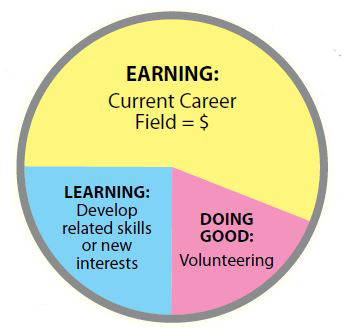
    In the following example, the first investment is doing project work in your established career field. This offers some income some of the time. Consider this aspect of your portfolio as work for current income.

    A second investment is the continued (formal) development of related skills or new interests to meet the demands of emerging market-driven trends. This aspect of a portfolio is working for learning and future financial return.

    A third investment is volunteering, which can be thought of as work done for personal satisfaction or for the benefit of others.

    A balanced diversified portfolio, with the relative amounts of time dedicated to earning, learning and doing good, is illustrated below.

    With the passage of time, the balance is likely to shift as different market-place needs, life goals and interests change.

    Advantages of managing a career portfolio

    You will…

    • Appreciate the opportunity to gain multiple income sources.
    • Expand your ability to shift emphasis as the marketplace continues to change.
    • Deepen your reputation as an expert.
    • Balance your energy between the various components of your portfolio.
    • Have some fun; give back to your community; gain more work/life balance.
    • Find new directions while doing meaningful work in your community.

    ———————

    NEW WORKFORCE HAWAII
    Carleen MacKay, Co-Founder
    916-316-0143  |  carleenmackayhi@gmail.com
    www.newworkforcehawaii.com

    Portfolio workers are the “Jugglers” of multiple opportunities who know a diversified work portfolio increases the probability of realizing financial and personal success, improves their sense of control and boosts feelings of security.

  • Language Matters: Avoiding Ageist Talk

    Ageism is discrimination and negative stereotyping on the basis of a person’s age. It permeates the media and everyday conversations to such an extent and in such subtle ways that people may accept negative stereotypes of older adults (“forgetful,” “grouchy,” “less competent”) as truth, unconscious of their bias. While not denying very real difficulties that may arise, later adulthood is a life stage that involves both opportunities and challenges, as do all stages of life.

    Language matters. The way we speak about or frame aging reflects and reinforces ageist attitudes.

    While trying to convey the significance of current demographic changes, it is easy to slip into an alarmist mode. The media and even  scholars often characterize population aging as  a natural disaster, a “silver tsunami,” threatening to overwhelm society. Re-framing the discussion of changing demographics in a more positive way avoids an ageist mindset: “As Americans live longer and healthier lives…”

    • Older adults are marginalized as outsiders, when referred to as “them” not “us.”
    • The medicalization of life experiences once regarded as non-pathological (e.g., childbirth, sadness, menopause) extends to the experience of aging, as well. Viewing the process of aging in a medical frame implies the older adult needs “care.” Old age may be labelled either a “problem” to be “fixed” or a fatalistic condition for which “nothing can be done.”

    In an attempt to counter ageist ways of speaking, the FrameWorks Institute developed the following evidence-based recommendations:

    • Redefine aging to include its positive aspects. Prevailing negative assumptions about “getting old” lead to fatalistic attitudes.
    • Avoid language like “senior citizens,” “aging dependents,” “the elderly.”

    A call for justice beats a plea for sympathy. Ac-knowledge that a just society strives to treat everyone as equal participants.

    • Acknowledge that social contexts and social policies shape the experience of old age, that health and financial security are not totally dependent on an individual’s planning and good decisions.
    • A new metaphor can shift perceptions of aging. Compare the process of aging to “building momentum,” the potential force of built-up experience and insight, and view older adults as sources of resources to be tapped.

    Remember, ageism is discrimination against your future self.

    ———-

    CENTER ON AGING — University of Hawai‘i at Mānoa
    2430 Campus Road, Gartley Hall, 201B, Honolulu HI 96822
    808-956-6124  |  map3@hawaii.edu

    www.hawaii.edu/aging/

    Learn more about ageism:

    • Ashton Applewhite (2016):

    This chair rocks: A manifesto against ageism

    • Applewhite TED talk on ageism:

    www.bit.ly/ApplewhiteTEDTalkAgeism

    Ageism is discrimination and negative stereotyping on the basis of a person’s age. It permeates the media and everyday conversations to such an extent and in such subtle ways that people may accept negative stereotypes of older adults (“forgetful,” “grouchy,” “less competent”) as truth, unconscious of their bias.

  • Are You Ready for 2019 and Beyond?

    January of 2018, I made a lifestyle change: I went vegan. In March, I added fish to my diet, so I am now pescatarian. I don’t eat meat, chicken, dairy, eggs and cheese. It’s been over a year now and I lost a few pounds. I’m still feeling great and I am also exercising.

    Seniors not only have to exercise and stay physically and mentally fit; they also need to make their money last longer. Social Security, regular investments (stocks, mutual funds) and retirement plans (401k, IRA) now have to account for an extended life span. We don’t want to spend our golden years in poverty and ill health.

    In the past, retirement money didn’t have to last very long. In 1965, men had a life expectancy of 68 years and women lived an average of 71 years. Men lived only three years past retirement age and women lived six years in retirement. Now that people are leading healthier lifestyles and taking advantage of advancements in science and medicine, retirees are living well into their 90s. Our money has to last for 20 to 30 years after we stop working.

    This month I made 70. Very fortunate my father is still alive; he’s 94 years old. My mother passed away two years ago at age 92. I have three children, nine grandchildren and twelve greats. I would like to spend many more years with them.

    Am I ready? Are you ready?


    Edward Motosue, his son Travis, and their team have provided the senior community with financial guidance and insurance expertise for 10 years.

    FINANCIAL BENEFITS INSURANCE 808-792-5194  |  www.fbihi.com

    Seniors not only have to exercise and stay physically and mentally fit; they also need to make their money last longer. Social Security, regular investments (stocks, mutual funds) and retirement plans (401k, IRA) now have to account for an extended life span.

  • Embracing Change

    Maggie threw her pen at the computer. “Oh no! I can’t find the email I just wrote to my grandson. I hate the computer! Why can’t we go back to the way things used to be before the technology monster took over, when we talked to each other in person or on the phone?” Remembering she has friends to call, she picked up the phone and dialed her 81-year-old friend Toni. Toni would understand.

    Maggie vented to Toni but heard only impassioned laughter. Finally, Toni gasped, “You know, Maggie, in the beginning I felt the same. I even thought to ignore my phone, let folks knock on my door like in the good old days. But then I saw a golden opportunity for us — brain exercises and memory boosters and unlimited learning we can do from home. Even better, the whole world is at our fingertips.”

    “But I don’t know how to…”

    Toni interrupted, “Hey, why don’t you come over this afternoon? My genius grandson taught me. He’d be happy to teach you, too.”

    Relieved, Maggie said, “Oh, what a divine offer! Having time with Jesse, who I adore, and learning to conquer this monster and train my brain all at the same time?”

    “Sure! Jesse loves you and feels so smart and important when he can help us!”

     “I’m in!” Maggie chimed in enthusiastically. “I’m so happy to have a private tutor to stretch my brain! Now I’ll be able to flow with the times. Can I bring my ‘smart’ phone and learn how to Instagram a photo to my grandson? I am looking forward to growing smarter and less confused.”

    “Sure.”

    Maggie hung up the phone before she remembered, “Now where is the message I was looking for? Where is the email I wrote? It disappeared.
    I’m so relieved I’m seeing Toni and Jesse this
    afternoon. I adore learning and new adventures. But it’s the personal touch that makes all the
    difference. Like talking to a neighbor or inviting
    a friend for tea.”

    “What if Toni and I created a new training for the young as a gratitude for Jesse’s generosity? We could teach them to slow down, greet the sun, and smell the roses. Maybe we can help change the whirlwind world stressing out the younger generations.”

    And so there you have it: my challenges of embracing change, which some wise person once said is the only constant. I wonder if the young will cross this bridge the same way.


    Pratibha Eastwood is a psychologist in private practice and a writer, currently preoccupied with the impact of aging. She loves taking life to the limit or beyond at any age.

    808-595-HOPE(4678)
    808-988-4JOY(569)

    Maggie threw her pen at the computer. “Oh no! I can’t find the email I just wrote to my grandson. I hate the computer! Why can’t we go back to the way things used to be before the technology monster took over, when we talked to each other in person or on the phone?” Remembering…

  • Ed Gayagas: ‘Don’t Give Up!’

    Find something you’re passionate about and stick with it! That’s the advice Ed Gayagas has followed for himself and the message he passes along to others.

    Ed lives on O‘ahu with his wife Norma and for as long as he can remember his passion has been martial arts. Growing up on Kaua‘i, Ed was a scrawny kid who avoided fights but once, when confronted by a bully, Ed decided “enough is enough” and started turning his life around with judo, jujitsu and taekwondo and the meditation practices those disciplines offer.

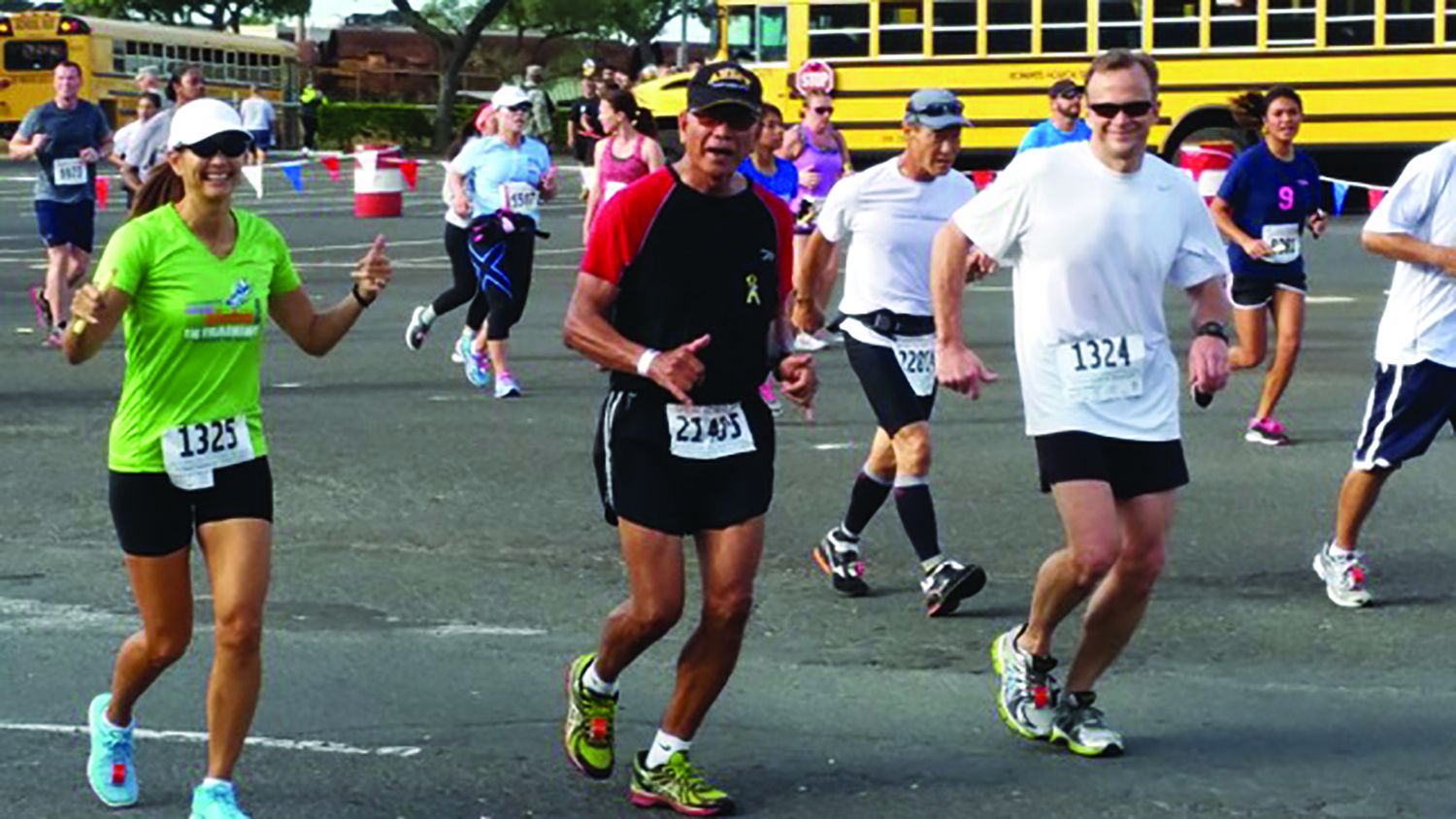
    He also found a love for the military and began a 30-year career with the Army that lasted until he retired in 1989. Ed is now 79 and among his other accomplishments has participated in the Great Aloha Run every year since its inception in 1985. That perfect attendance record was nearly shattered last year, however, when Ed fell ill with a rare form of brain cancer, primary central nervous system lymphoma.

    Doctors at both Tripler and Queen’s confirmed the diagnosis and gave Ed only a four percent chance of survival if the inoperable tumor went untreated. So, Ed began months of chemotherapy that zapped him of his strength and energy.

    But with the help of an early morning routine of exercise, meditation and deep breathing, along with a strong desire to compete again, Ed was able to cope with the chemo treatments. When they were over, Ed’s strength returned, and he now plans to run again for real.

    In last year’s Great Aloha Run, Ed was unable to run the entire distance but ran as much as he could, then got in a wheelchair and was pushed along until he felt he had recovered enough to run some more. It took about three hours, but Ed was able to finish the race and chalk up another year.

    Ed is relentless in his pursuit to be healthy and fit but other aspects of his life are no different than any other man of his age. In matters of diet, Ed tries to eat lots of vegetables but says he’s no vegetarian. “Steak is my favorite, aside from sweets,” Ed admits.

    As for his meditation practices, Ed says he doesn’t subscribe to one specific type of meditation — but rather has cherry-picked aspects of different philosophies that work for him. He encourages others to develop their own “style” — not only of meditation but also of exercise.

    When asked if he ever thought that he would be diagnosed with a life-threatening disease, he replied emphatically, “No!” He always assumed he would be on a healthy path and always strove for optimum health.

    “Don’t give up!” Ed repeatedly advises. Advice that is certainly working for him.

    Find something you’re passionate about and stick with it! That’s the advice Ed Gayagas has followed for himself and the message he passes along to others.

  • How My Watch Helped Me Set Goals

    I have learned a lot about setting goals from interacting with my smartwatch! The S.M.A.R.T. approach to setting goals has been around far longer than smartwatches, but the watches demonstrate perfectly the basic S.M.A.R.T. concepts originally created in 1981 by George T. Doran as a management tool but relevant for any type of goal.

    You can use the S.M.A.R.T. approach just as well with lo-tech pen and paper, but here is how my computerized watch helps me to set goals specifically for physical activity:

    Specific: Clearly state the goal you want to achieve. Previous vague promises to myself to increase physical activity did not work. My watch defines specific goals for each day: 30 minutes of exercise, one minute per hour of standing, and 300 calories worth of movement. Plus it reports my number of steps for the day!

    Measurable: Each day my watch measures and tells me what I’ve achieved in each category of activity, e.g., number of minutes I’ve spent exercising and standing and number of calories burned in general movement, using three rings to show my progress. For example, if I’ve exercised for 30 minutes, the watch alerts me with slight pressure to my wrist, a faint chime, and the quick flash of a swirling green celebratory ring. It then provides a brief message, e.g., “You’ve reached your exercise goal, Peggy! Good work!” Personalized feedback and positive reinforcement help!

    Attainable: The watch was calibrated to set initial goals based on my size and age. At first, my movement goal was 230 calories/day. I consistently achieved that, so the watch upped it to 300 calories, attainable but with a bit more challenge.

    Realistic: I have to admit, I don’t always make my goals. However, my watch doesn’t berate me when I slip up. Next day, it encourages me by reminding me I completed a weekly goal, or that I still have time to meet today’s.

    Time-related: Everything stops at midnight, when all three progress rings in whatever stage of completion melt away, and I am back to square one. I can refer to my weekly or monthly log, which helps me see the patterns of my activity, providing more feedback to help me adjust my exercise habits.

    Before deciding on your own fitness goals, discuss them with your healthcare provider first. Happy goal-setting!


    CENTER ON AGING — University of Hawai‘i at Mānoa
    2430 Campus Road, Gartley Hall, 201B, Honolulu HI 96822

    808-956-6124  |  map3@hawaii.edu
    www.hawaii.edu/aging/

    I have learned a lot about setting goals from interacting with my smartwatch! The S.M.A.R.T. approach to setting goals has been around far longer than smartwatches, but the watches demonstrate perfectly the basic S.M.A.R.T. concepts originally created in 1981 by George T. Doran as a management tool but relevant for any type of goal.

  • How to Make WORK…WORK for You!

    If you are 50, 60, 70 or 80 today and need — or want — to continue to work, there is an exciting, fast-rising world emerging; a world filled with new ways of working and earning your way in Hawai‘i!

    FREELANCING  is the first viable work choice we will consider. If ever there was an opportunity for qualified, older workers, freelancing is it! Age is not a barrier; current market-driven qualifications determine eligibility. Freelancers include independent contractors, moonlighters, temps, and diversified workers who have multiple skills needed by multiple employers. And, no, freelancing is not free. You charge by the hour or by the project.

    Before investigating selling your work or service by the hour, day or project as a freelancer, ask yourself: which of the following reasons to continue to work matter to you:

    ✦ I can’t imagine NOT working later in life as life expectancy is rising exponentially and continuing to work just makes common sense.

    ✦ I am having a great deal of difficulty finding a “job” at this stage of life, but I need a continued income stream and can’t afford to quit earning.

    ✦ I believe that continuing to work, in some capacity, adds a health and social benefit to my well-being.

    ✦ I look forward to the work and life balance that freelancing offers.

    Ideas to Explore

    Get yourself schooled in what freelancing is and what it can do for your career. Read what Daniel Pink, an author, futurist and expert, wrote in his book Free Agent Nation about free agency vs. jobs.

    Spend a few minutes each day reading additional information that will help you to get comfortable with freelancing as a worthwhile career choice. Learn more through Forbes magazine, The Economist and Hawaii Business magazine.

    Check out your skills against advertised opportunities and remember that learning new skills is everyone’s challenge as the world changes. AARP, local community colleges, the public libraries, adult schools (such as the McKinley Community School for Adults on O‘ahu) offer a full range of skills development. They are a step away from your phone.


    NEW WORKFORCE HAWAII
    Carleen MacKay
    916-316-0143  |  carleenmackayhi@gmail.com
    www.newworkforcehawaii.com

    Contact Carleen via her website and receive a free pdf book called New Ways to Work, co-written with Phyllis Horner.

    If you are 50, 60, 70 or 80 today and need — or want — to continue to work, there is an exciting, fast-rising world emerging; a world filled with new ways of working and earning your way in Hawai‘i!

  • The Stages of a Family Caregiving Career

    Family caregivers of older adults undergo fairly predictable stages in their caregiving careers. Each stage brings different challenges and requires different kinds of help for both the care receiver and family caregiver.

    Stage 1: The beginning

    The initial stage of a major illness represents a significant life transition for both the infirm elder and family caregiver, often requiring considerable
    adjustments in life goals, relationships, daily activities, and routines. Family caregivers may lack knowledge of the illness, impeding future planning.

    What is needed:

    • Information on the illness: possible causes, treatment options, expected trajectory
    • Emotional support: counseling services, support groups, peer counseling programs. Peer caregivers can share solutions to everyday issues and provide encouragement rooted in empathy.
    • Legal and financial planning: durable powers of attorney for asset management and healthcare decision-making; advance directives and wills; financial arrangements anticipating increased medical costs

    Stage 2: Being a caregiver

    This stage encompasses most of the caregiving experience and includes provision of home care and possible institutional placement.

    What is needed:

    • Continued education on the illness or condition and its expected trajectory
    • Formal training: classes in direct-care skills (e.g., safely transferring or bathing)
    • Home assessments and modifications for safety; guidance in use of relevant assistive devices
    • Coaching in behavior management techniques to deal with disruptive behaviors.
    • Guidance on preserving self-identity and quality of life for persons with dementia; training on effective communication techniques
    • Instruction in both time and stress management; help in setting limits, developing realistic standards, prioritizing goals, avoiding burnout
    • Counseling to deal with changing family dynamics, disagreements regarding management of the illness, and conflicts over division of caregiving labor and costs
    • Information on available community resources and payment sources and how to access them
    • In-home services to help with personal care (e.g., bathing, dressing, grooming); homemaking services (e.g., cleaning, laundry, shopping); home-delivered meals
    • Guidance in working effectively with home care aides
    • Exercise or rehabilitation programs for both care receiver and caregiver
    • Respite care, e.g., adult day care, extended overnight respite programs

    Stage 3: Completion of caregiving

    During the later stages of an illness, caregivers frequently drop social activities and neglect friendships as they attempt to address the ever-growing needs of their family member. When the elder dies, the caregiver often feels socially isolated.

    What is needed:

    • Emotional support to deal with bereavement and loss
    • Help in coming to terms with the end of caregiving, an integral part of self-identity for many
    • Exploring caregiving in other forms, e.g.,
      volunteering
    • Encouragement to re-engage and/or develop new activities to restore balance to a life previously structured by the caregiver role

    CENTER ON AGING — University of Hawai‘i at Mānoa, 2430 Campus Road, Gartley Hall, 201B, Honolulu HI 96822 | 808-956-6124 | map3@hawaii.edu | www.hawaii.edu/aging/

    Family caregivers of older adults undergo fairly predictable stages in their caregiving careers. Each stage brings different challenges and requires different kinds of help for both the care receiver and family caregiver.

  • Need to Work? Need to Earn?

    If your answer is “yes” to either question, then here are three immediate actions that will improve the return on your most important investment — YOU!

    1. Embrace the demands of change

    One in 4 of us are over 60 and life expectancy is increasing faster in Hawai‘i than in any other state. And if you live to age 65, add 22–25 years — a long time to sit on a white, sandy beach even if you can afford it and the knees still bend!

    Go beyond the past, familiar world of “jobs” and rekindle your excitement by looking at new ways to work; ways packed with opportunities for older workers.

    1. Continue to learn

    Combine your anticipated longer lifetime with meeting the fast-evolving new technical demands of work and you will soon see that, from start to finish, a lifetime of learning is a requirement for all generations to embrace.

    It’s easy to learn and there are countless, affordable and local opportunities available. Want to know where? Google it! Don’t know how? Ask your teenage child or grandchild for help! Further-
    more, most keiki can teach you the first steps to embracing everyday skills.

    1. Know where opportunity favors older workers

    The largest percentage of workers over age 55 are earning in new ways beyond the “old” world of jobs. Here are a few of the most obvious ways:

    Job sharing: Job sharing, or work sharing, is an arrangement where two people are retained on a part-time or reduced-time basis to perform a job normally fulfilled by one person working full time.

    Remote work: When you work from home; you can work for someone here, there or anywhere.

    Portfolio work: Balancing a portfolio of talents means using a number of efforts on behalf of many outcomes.

    Phasing: Rather than abruptly leaving a full-time position at the end of a lengthy career, why not phase out by reducing your work week and commitment over time?

    Freelancing: Freelancing generally means that you will work when an organization needs you.

    As to “how” to adjust to your longer working future… ah… that’s a subject for another time. For now, begin your journey by seeking inspiration from a choice that appeals to you.


    NEW WORKFORCE HAWAII Carleen MacKay, Co-Founder 913-316-0143 | carleenmackayhi@gmail.com | www.newworkforcehawaii.com

    Need to work? Need to earn? If your answer is “yes” to either question, then here are three immediate actions that will improve the return on your most important investment — YOU!

  • Who’s Turning 65 This Year?

    What do singer Cyndi Lauper, comedian Tim Allen, wrestler Hulk Hogan, attorney Marcia Clark and politician Jeb Bush have in common? They were born in 1953 and are turning 65 this year, along with many others who may not enjoy fortune or fame. Celebrity or not, if you share their birth year and you or a spouse/partner worked and paid Medicare taxes, you may qualify for valuable Medicare insurance benefits.

    Being unaware of the specific time periods to enroll in Original Medicare and Prescription Drug Plans, along with additional options that may be available in your region, can result in gaps in coverage or late enrollment penalties. In some cases, you may not be required to enroll at 65, or may have the option of a former employer’s retiree insurance coverage. You may also qualify at any age, if you are receiving Social Security Disability benefits and meet additional eligibility requirements.

    Celebrities may give a personal assistant or trusted advisor prior written authorization to contact Social Security on their behalf, but you may need to figure things out on your own. Start learning the basics by reading: www.ssa.gov/pubs/EN-05-10043.pdf

    When Singer Billy Joel was recently asked on his 69th birthday what it’s like to get older, he replied: “My best is yet to come!” So, figure out your Medicare insurance and prepare for your best!


    MEDICARE MOMENT WITH MARTHA
    A radio program with Martha Khlopin
    KHNR-690AM: Sat., 2 pm–2:30 pm, Sun., 9:30 am–10 am
    808-230-3379 | getmartha@aol.com

    What do singer Cyndi Lauper, comedian Tim Allen, wrestler Hulk Hogan, attorney Marcia Clark and politician Jeb Bush have in common? They were born in 1953 and are turning 65 this year, along with many others who may not enjoy fortune or fame. Celebrity or not, if you share their birth year and you or…

  • Living in the Moment with Momentia

    Momentia (rhymes with dementia) is an arts-based movement targeting persons with dementia and their care partners
    that “celebrates life in the moment.” It is a strengths-based grassroots movement to empower and energize those impacted by memory loss to remain connected and active in the community. It encourages them to take the lead in organizing a wide variety of dementia-friendly recreational activities that typically take place in “age neutral” public venues. Such activities include art classes, music, folk dance, improv, community gardening and walking groups, or simply hanging out at a Memory Cafe. Being involved in selecting and creating these activities enables persons with dementia to develop and participate in dementia-friendly communities, as they would like them to be.

    While not minimizing the challenges that accompany this disease, the movement encourages a positive, strengths-based stance that focuses on remaining abilities of persons with dementia to engage in and enjoy activities they find meaningful and to engage in and give back to the community. Momentia endorses the “new dementia story,” which proposes a radical rethinking of dementia life experiences: “(1) There is life beyond a diagnosis — a life that includes the possibility for joy in the midst of challenge. (2) Persons living with dementia remain a vital part of the community and deserve the opportunity to stay connected and engaged. (3) Persons living with dementia are the experts on their own experience and their valuable perspectives must be recognized. (4) By working together we can transform what it means to live with dementia in the community, changing the story from one of despair to one of hope.” (www.momentiaseattle.org/new-page-4).

    Local Momentia organizers work in teams of 8–12 community members and organizations and include persons with dementia, care partners, and persons working in dementia-friendly programs. Team members meet quarterly, maintain the website, mentor program development, and orchestrate events. The “Guiding Principles” of the movement require that any Momentia event: (1) Celebrates the strengths of persons living with dementia and includes their voices in decision-making and implementing programs; (2) Is open to the public and publicized to include both persons with dementia and all other members of the community, and takes place in a community setting; and (3) Involves an opportunity for engagement and empowerment in the community, a chance to connect with others and to make a difference.

    Momentia has the potential to impact those without dementia, as well. Momentia events are inclusive; anyone in the community can join them and are encouraged to do so. This level of participation requires that community members be “dementia aware,” i.e., informed about dementia, committed to principles of inclusion, respectful and lending support as needed.

    Hawai‘i is taking a big step toward developing dementia awareness through the Dementia Friends initiative, which is a partnership between Age-Friendly Honolulu, the Hawaii Alzheimer’s Disease Initiative at UH, and the State Alzheimer’s Disease and Related Dementias taskforce. It offers brief seminars on the basics of dementia to community groups and encourages participants to then use that knowledge to engage in positive interactions of some kind. For information, go to:
    www.agefriendlyhonolulu.com/dementia-friends/.


    CENTER ON AGING — University of Hawai‘i at Mānoa
    2430 Campus Road, Gartley Hall, 201B, Honolulu HI 96822
    808-956-6124 | map3@hawaii.edu
    www.hawaii.edu/aging/

    Momentia (rhymes with dementia) is an arts-based movement targeting persons with dementia and their care partners that “celebrates life in the moment.” It is a strengths-based grassroots movement to empower and energize those impacted by memory loss to remain connected and active in the community.