Category: Date

  • Retirement Planning Q&A

    Q: I’m trying to decide when to retire. Can Social Security help?
    A: The best place to start is with a visit to the
    online Social Security Statement. The statement provides you with estimates of benefits for you and your family as well as your earnings record and information you should consider about retirement and retirement planning.

    Easily access your statement online by creating a my Social Security account. To create an account, please visit www.socialsecurity.gov/myaccount.

    The “right” time to retire is different for everyone and depends on your individual situation. To help you make your own decision, we offer an online fact sheet, When To Start Receiving Retirement Benefits, that highlights some of the factors to consider. This publication can be found at www.socialsecurity.gov/pubs/10147.html.

    Q: I’m trying to figure out how much I need to save for my retirement. Does the government offer any help with financial education?
    A: Yes. For starters, you may want to find out what you can expect from Social Security with a visit to Social Security’s Retirement Estimator at www.socialsecurity.gov/estimator.

    The Financial Literacy and Education Commission has a website that can help you with the basics of financial education: www.mymoney.gov. Finally, check out the Consumer Financial Protection Bureau, which offers educational information on a number of financial matters, including mortgages, credit cards, retirement, and other big decisions on their website at www.consumerfinance.gov.


    For questions, online applications or to make an appointment to visit a SSA office, call from 7am–5pm, Mon–Fri:
    1-800-772-1213 (toll free) | www.socialsecurity.gov

    Q: I’m trying to decide when to retire. Can Social Security help? A: The best place to start is with a visit to the online Social Security Statement. The statement provides you with estimates of benefits for you and your family as well as your earnings record and information you should consider about retirement and…

  • Mobilizing in an Emergency

    Back in 2014, when a lava flow threatened Pāhoa, Generations Magazine learned just how “hands on” emergency response needs to be. Katherine Kama‘ema‘e Smith, former associate editor, joined a team of community volunteers on an evacuation outreach mission to seniors living in the path of the lava flow. Using an address list generated from the Hawai‘i County Office on Aging (HCOA) database, the volunteers went by van to canvass seniors to learn their needs and check on their preparedness for evacuation, should that be required.

    The Big Island again finds itself dealing with a large number of people displaced by a lava event. “The fast-moving lava flow from Kīlauea volcano on May 3, 2018, forced 1,500 residents out of their homes and in search of shelter,” says Kimo Alameda, County Executive on Aging.

    2014: The team from various departments of HCOA and ADRC gather in a specifically designed conference room nicknamed the “War Room”.
    2014: The team from various departments of HCOA and ADRC gather in a specifically designed conference room nicknamed the “War Room”.

    “The following day, two major earthquakes rocked Hawai‘i Island and the County of Hawai‘i needed an agency to take the lead in providing information, assistance, and referral. This is where government officials turned to the County’s Aging and Disability Resource Center (ADRC) in partnership with the County’s Housing Department. Together with a network of over thirty community providers, the Recovery, Information, and Assistance Center (RIAC) was set up to provide what the ADRC does best — provide accurate and timely information, assistance, referral, and options counseling.”

    So, what is it about the ADRC that placed it on the front line right from the beginning of this ongoing disaster?

    Nurse Dawn checks on the elderly until they are all out of danger.
    Nurse Dawn checks on the elderly until they are all out of danger.

    The Hawai‘i County Office of Aging was established in 1966 and today it works through the County, State Executive Office on Aging (EOA), and the Federal Administration on Aging to get its major funding to support its mission of providing a comprehensive and coordinated system of services that enable older people to live independently and with dignity. The ADRC’s role is to put that mission into practice. It is this long history of interaction with all three levels of government, as well as with community groups, that placed the county’s ADRC in an ideal position to coordinate a timely, effective response to the lava emergency.

    Kimo Alameda is interviewed by Allyson Blair from Hawaii News Now.
    Kimo Alameda is interviewed by Allyson Blair from Hawaii News Now.

    The county’s battle plan
    1) Anticipate. When the lava flow started on May 3, it was clear that people would lose their homes. Already tackling homelessness, the Community Alliance Homeless Partnership had a network of problem solvers already in place, and they quickly became the county’s Disaster Assistance and Recovery Team (DART).
    2) Identify needs. An intake form was agreed upon to capture survivors’ specific needs so that the DART could help them resolve those problems.
    3) Establish case management. Perhaps the most important step taken was to identify a case management agency to oversee the individuals and families displaced by the event. The Neighborhood Place of Puna was chosen for this role, and the DART partnered with Hawai‘i Community Foundation to pay for staffing for case management and a housing placement specialist.
    4) Share information. A shared database is critical for tracking survivors and accountability. Every agency with resources to contribute to the intake follow-ups was given administrative access, allowing the DART to see how that process was going and ensure that services or resources like rental assistance weren’t duplicated.

    June 2018  lava flows to the ocean at Kapoho. Photo courtesy of  the USGS
    June 2018 lava flows to the ocean at Kapoho. Photo courtesy of the USGS

    Kimo Alameda reports that, as at the end of June, “we have over 1,000 households in our database. Specifically, 477 households are seeking permanent housing, 139 airfare, 72 medical health, 66 food/water, 64 counseling, 46 legal counsel and 174 financial assistance. We also identified 231 elders, 164 disabled or medically fragile, 77 veterans, and 235 children. And, it’s important to note that these are conservative numbers because not all survivors have come to the DART for assistance. About 25 percent of the total households affected are seeking their own support from family and friends.”


    AGING AND DISABILITY RESOURCE CENTER
    808-643-2372 | TTY line 808-643-0889
    www.hawaiiadrc.org
    For more information on each island’s ADRC, go to
    https://generations808.com/august-september-2015/

    The Big Island again finds itself dealing with a large number of people displaced by a lava event. “The fast-moving lava flow from Kīlauea volcano on May 3, 2018, forced 1,500 residents out of their homes and in search of shelter,” says Kimo Alameda, County Executive on Aging.

  • Don’t Let the Vog Bring You Down

    When Tutu or Madame Pele creates, we are blessed with the growth of our ‘aīna. However, the gases she emits can be detrimental to many when our beautiful Hawaiian skies are filled with vog (volcanic smog).

    I visited Kīlauea several years ago with my hula sisters for the Merrie Monarch Festival. Walking toward the crater to bear ho‘okupu (offering) for Tutu Pele, my lungs suddenly tightened up and I was literally gasping for air. I struggled back to our bus, where I used my rescue inhaler and did some deep breathing exercises. Just the tiny bit of sulfur emitted almost sent me to the hospital.

    What does vog mean for folks with respiratory problems? Above all, keep all your meds in an area that you can easily access, including within arm’s reach at your bedside. Keep extra rescue inhalers in your car, at work, and in your purse.

    Take extra precautions to ensure you stay healthy, take your medications and drink lots of water. If you are a nebulizer user, be sure to have enough inhaler solution. Keep tubing and attachments clean and ready.

    Be open with your family and loved ones about how important it is to be prepared. Tell them what you need if you are ever in respiratory distress. If traveling, research emergency rooms ahead of time.

    And try to stay away from the vog!


    CARE CENTER OF HONOLULU
    1900 Bachelot Street, Honolulu HI 96817
    808-531-5302 | www.ccoh.us

    I visited Kīlauea several years ago with my hula sisters for the Merrie Monarch Festival. Walking toward the crater to bear ho‘okupu (offering) for Tutu Pele, my lungs suddenly tightened up and I was literally gasping for air.

  • A Five-generation Caregiver Team Challenge

    I don’t know if anyone is really prepared for family caregiving — it all happens so suddenly,” says Terri Jorgensen of Maui. She became a family caregiver in 2016, when Maui Memorial Hospital discharged her 101-year-old Grandma. Two years later, Terri heads a family of five generations, works full time and manages two households — one with five homecare aides providing care for Grandma and Terri’s 83-year-old mother.

    “Learning what kind of care is required is easy, but finding ways to provide it is very difficult. Since I have no bedside skills, I knew right away that I needed help. I am an outgoing sales professional, so servicing my clients and keeping in touch with the outside world makes me happy and healthy. Finding a balance among Mom’s, Grandma’s and my own needs was critical,” she says.

    Terri’s Grandma was living independently in Wailuku when she suddenly became ill. She returned from the hospital disabled and bedridden, so Terri began to care for her. A social worker helped her find in-home caregivers to help Grandma.

    The generational caregiving team. L-R: Terri, Megan and Ale‘a (baby), Kazue and Gladys.
    The generational caregiving team. L-R: Terri, Megan and Ale‘a (baby), Kazue and Gladys.

    In 2017, Terri’s dad, who was suffering with Alzheimer’s disease, was diagnosed with terminal cancer and passed away on Moloka‘i. Her mom went into a deep depression. Terri brought her mother to Maui to recover at Grandma’s house, but soon it became clear that her condition was not going to improve.

    Terri’s daughter also had come from O‘ahu to live with Terri after the birth of her baby. With so many loved ones to care for, Terri faced the financial and logistical issues of managing two households and a large team of homecare and service providers.

    “Caregiving is a group activity; one family caregiver cannot do it alone. Maui County services for elderly and disabled persons are a very big help, but managing all the services, appointments and care duty for my family is a huge job. I do the management part, and one of our aides schedules all shifts. We now have five aides covering days and weekend nights. I cover weekday nights but take respite on the weekends.

    “When Grandma got sick, a lot of people told me to take care of myself, but I didn’t get it. I wore myself out because I didn’t know what decisions to make, or where to get good information and assistance. There wasn’t enough time in the day to care for Grandma and Mom’s needs and maintain my strength. My auntie, who lives across the street, was good support and encouraged me to reach out for help. What I tell other caregivers now, is to reach out soon. Carefully assess your own physical and emotional needs — because if you get worn down or sick, your loved ones will suffer. My version of balance is to be a good businesswoman, and manage caregiving like a very important business project. This is my talent, and comfort zone. Family caregivers can find a personal balance that preserves who they are, and uses their talents.
    “Some days are very hard, but caregiving can be its own joyful reward. It makes me happy to know that I can provide care and do what is good for everyone. I am creatively carrying out my kuleana of caregiving, and my family is safe.”


    TERRI JORGENSEN, Independent Sales Rep
    Tjsalesandservices@gmail.com

    I don’t know if anyone is really prepared for family caregiving — it all happens so suddenly,” says Terri Jorgensen of Maui. She became a family caregiver in 2016, when Maui Memorial Hospital discharged her 101-year-old Grandma.

  • Repetitive Questioning in Alzheimer’s

    In home care, a question I often get is how to care for someone with Alzheimer’s who asks the same questions over and over again. To better understand and manage what’s going on, it helps to first know a bit on Alzheimer’s disease and dementia.
    Alzheimer’s is a type of dementia that affects memory, thinking, and behavior. It’s a progressive disease, where brain cells deteriorate and eventually a person can’t make sense of the world. When short term memory is affected, it can lead to repetitive behaviors, like stating or asking about the same things over and over. In essence, your loved one can’t recall having already asked a question because of their memory loss. A person with Alzheimer’s may be unsure of what’s around them, where they are, the passage of time, or recognizing anyone. All together it’s very unsettling, and a source of discomfort for them. Understanding how they feel, or describing their own feelings and needs, can also be lost in a person with Alzheimer’s disease.

    Affected by these conditions, your loved one isn’t trying to be annoying, or repeating questions because they need information. They’re really asking questions because of feeling lost, stressed and anxious, and need reassurance. As a caregiver, answering these questions can be difficult, and wear out your ability to care for a loved one. To help, caregivers should be prepared with some basic knowledge and awareness on how to respond:
    Keep it simple. Use short and simple responses. Reassure with a calm voice and gentle touch. Avoid complex explanations with multiple ideas when asked a question.

    Physical. See if there is discomfort, pain, or something physical at the root of the cause. For example, infections or side effects from medications can also cause changes in behavior and awareness in older adults.

    Realize it’s feelings. Know what triggers unpleasant feelings. For example, a lost sense of time can bring on anxious feelings. Try safe, repetitive, and soothing activities like sorting or folding familiar items, or dusting and wiping to keep hands and minds calmly occupied. Walks, listening to music, and looking at familiar photos or books can be pleasant diversions.

    Change the subject. Sometimes changing the subject can shift one’s attention enough to have a calming effect. Asking a simple question can also shift a person’s focus in the same way.

    Abilities. Check if you’re asking your loved one to do more than they’re able to. Accept your loved one as they are in the moment, and that they are doing the best they can.

    Above all, take a deep breath, give your loved one a reassuring hug, and try to see behind the behavior and words repeated. It’s also vital to keep up your own health, and have a support system including the local Alzheimer’s Association chapter, family, friends, and faith groups. Addressing repetitive questioning in Alzheimer’s and dementia can be a trying experience. But with knowledge and awareness, these moments shared with your loved one can be the most precious of gifts.


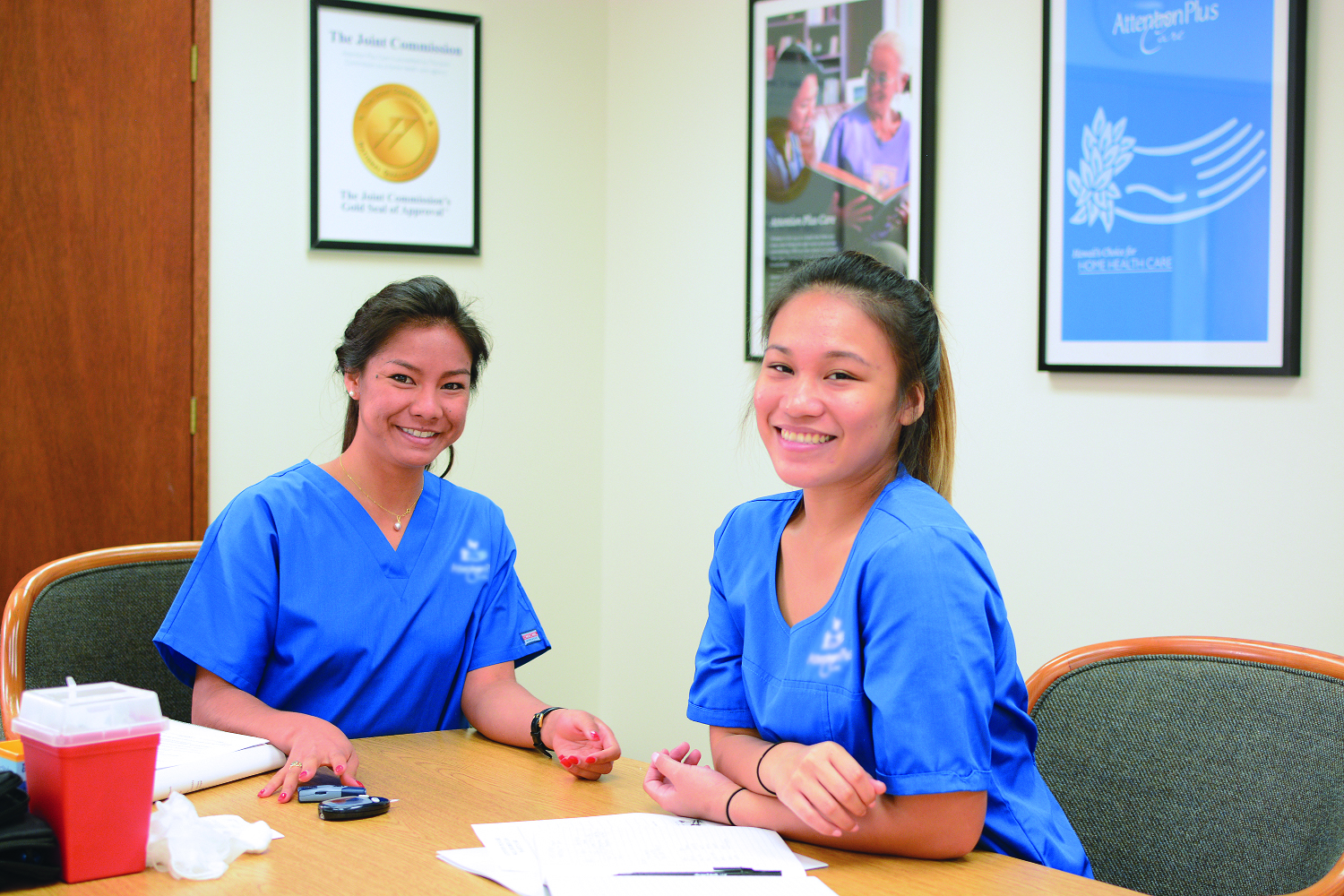
    ATTENTION PLUS CARE HOME HEALTH CARE
    Accredited by The Joint Commission
    1580 Makaloa St., Ste. #1060, Honolulu HI 96814
    808-739-2811 | www.attentionplus.com
    AGING IN HAWAII EDUCATIONAL OUTREACH PROGRAM by Attention Plus Care — a program providing resources for seniors and their families, covering different aging topics each month. For class information and upcoming topics, call 808-440-9356.

    In home care, a question I often get is how to care for someone with Alzheimer’s who asks the same questions over and over again. To better understand and manage what’s going on, it helps to first know a bit on Alzheimer’s disease and dementia.

  • Aquatic Physical Therapy for Chronic Pain

    If you are one of the 100 million Americans who experience chronic pain, know that physical therapy can be a safer alternative to potentially addictive medications. Physical therapy plays a vital role in helping to manage and overcome chronic pain through proper strengthening and flexibility exercises, manual therapies, posture and body mechanics instruction.

    Patients who have experienced extended periods of pain are often caught in a vicious cycle, where they move less because it’s painful, which leads to decreased strength, endurance, mobility and overall confidence. Their posture, muscle imbalances and emotional state all become worse.

    Physical therapists understand that, to overcome chronic pain, you must break the pain cycle and one of the best ways, is to move! But how can you exercise if every time you move, it’s painful? The answer is Aquatic Physical Therapy.

    When the water is at chest level, 80 percent of the body’s weight is reduced, which allows patients to strengthen in a comfortable environment where the body can heal faster. The warmth of the water relieves pain and increases relaxation — important aspects of controlling chronic pain. Aquatic therapy also provides psychological benefits improving feelings of self-worth and reducing stress and anxiety. If pain is limiting your mobility don’t give up, try aquatic therapy because freedom from pain is possible.


    Moon Physical Therapy, LLC
    320 Ward Ave., Ste. 107, Honolulu HI 96814
    Aquatic, Land-based and Manual Therapy and
    Cardiopulmonary Rehab Programs
    808-597-1005 | www.moonpt.com
    Like me on Facebook: Moon Physical Therapy, LLC

    If you are one of the 100 million Americans who experience chronic pain, know that physical therapy can be a safer alternative to potentially addictive medications. Physical therapy plays a vital role in helping to manage and overcome chronic pain through proper strengthening and flexibility exercises, manual therapies, posture and body mechanics instruction.

  • Tips for Buying Medications Online

    Purchasing medication and even filling prescriptions online can be a risky process, but the chances of being victimized can be greatly reduced by taking a few necessary precautions.

    Avoid email scams
    Try not to respond to email “spam.” But if you are inclined to do so, do your research to see how reputable the company is and make sure the email address is legitimate. Also check where the company is based and where the products are being shipped from. Steer clear of foreign-based companies.
    Save all email correspondence until you have received your product and are satisfied.

    Be website-wary
    If you are dealing with a vendor on a website, look closely at the URL to check that it’s not a slight misspelling of a trusted company, created to fool you. Also, check that it starts with “https:” and has a padlock icon on the left.
    It is also good practice to take a screencap of the webpage listing the product you’re buying. Press Help if you are unsure how to do this.

    Minimize credit card risk
    If you are using a credit card, use one with a low line of credit but enough to make the purchase.
    If a purchase was made by mistake, contact your credit card company’s fraud and security department immediately. They will flag any unauthorized billings from that company.

    And finally, review your credit card statements regularly to detect any inconsistencies.


    THE DEPARTMENT OF THE PROSECUTING ATTORNEY
    1060 Richards St., Honolulu HI 96813
    808-768-7400 | Office hrs: Mon – Fri, 7:45 am – 4:30 pm
    www.honoluluprosecutor.org/contact-us/

    Purchasing medication and even filling prescriptions online can be a risky process, but the chances of being victimized can be greatly reduced by taking a few necessary precautions. Avoid email scams Try not to respond to email “spam.” But if you are inclined to do so, do your research to see how reputable the company…

  • U.S. Army History in Waikīkī!

    Right here in Waikīkī there is more to learn about our famous nisei “Go For Broke” 442nd Infantry Regiment — at the U.S. Army Museum of Hawaii. It’s on the corner of Kalia and Saratoga Roads inside Fort DeRussy Military Reservation park.

    During World War II, U.S. Army Artillery “Battery Randolph” was located on the point. Coastal batteries were fortifications of cannon, tanks and ammunition, and bunkers strategically positioned for battle or defense. In modern warfare, batteries also facilitate battlefield communications, command operations and disbursement of artillery materials to gunnery crews.

    Courtesy of U.S. Army Museum of Hawaii
    Courtesy of U.S. Army Museum of Hawaii

    Battery Randolph’s main guns were removed before the museum began, but today, its holdings include choppers, tanks, cannon, and light weaponry as well as military photos from the Vietnam, Korea and WWII Pacific Theater eras. The exhibit represents the entire post-annexation military history of the U.S. Army in Hawai‘i, including key projects of U.S. Army Corps of Engineers throughout Hawai‘i.

    Of unique interest is the museum’s “Gallery of Heroes,” which displays commendations, Medals of Honor and Distinguished Service Crosses awarded to Hawai‘i veterans. It is a permanent tribute to our heroes, including the 442nd Infantry Regiment and nisei Military Intelligence Service during WWII.

    Leave plenty of time to see all the vintage U.S. Army photos and identify your family members who fought for freedom. The end of summer is a great time to take your grandchildren to the museum for a powerful educational adventure.
    Remember when you meet a veteran to thank them for their service.


    U.S. ARMY MUSEUM OF HAWAII
    2131 Kalia Road, (nr. Hale Koa Hotel) Honolulu HI 96815
    808-955-9552 | www.hiarmymuseumsoc.org
    Open 10 am – 5 pm, Tues.– Sat.
    Audio tours: $5.00 per person
    Parking: $3.50 for the first hour, $2.00 for additional hrs.
    Driving directions: see their website
    Bus routes to the museum: www.moovit.com

    Right here in Waikīkī there is more to learn about our famous nisei “Go For Broke” 442nd Infantry Regiment — at the U.S. Army Museum of Hawaii. It’s on the corner of Kalia and Saratoga Roads inside Fort DeRussy Military Reservation park.

  • Women on the WWII Home Front in Hawai‘i

    The measures that came into effect in wartime Hawai‘i were described by one man who helped create them, Maj. Gen. Thomas H. Green, as “a new experiment in government — a joint operation of the military, civilian business and the general public.”

    Bella Fernandez. Photo courtesy UH Archives
    Bella Fernandez. Photo courtesy UH Archives

    A great number of the general public were, of course, women and they played many roles on the home front. Bella Fernandez is noted as a “rated woman boat builder at the Pearl Harbor Navy Yard” on the back of a U.S. Navy photograph in the University of Hawai‘i Archives. Others did piecework at home for the armed services, some creating the camouflage netting that was put over the helmets U.S. soldiers wore, as Rosaline Ventura did. Her oral history in the UH Center for Oral History’s project “An Era of Change” also tells of day-to-day life under martial law for this mother of three young children — including toting a heavy gas mask with her wherever she went and making sure the keiki had theirs.

    Many women already worked in professions that could immediately make a useful contribution to the war effort. In the immediate aftermath of the bombing, all schools were closed for a time, but teachers were reassigned to assist in registering the entire population for ID cards. For public health reasons, everyone had to be immunized against typhoid, and nurses played their part in getting that done. Office workers formed a Women’s Volunteer Army Corps, many of its members working long hours in the offices of military staff.

    Children in gas masks. Photo courtesy of the Japanese Cultural Center of Hawai‘i
    Children in gas masks. Photo courtesy of the Japanese Cultural Center of Hawai‘i

    “Society women,” whose household and family obligations were taken care of by paid staff, volunteered for a myriad of roles. The Red Cross Motor Corps, composed of a group of about 38 women, operated a 24-hour ambulance service as part of Civil Defense. Others volunteered their time on the many committees that gave support to agencies created to deal with specific wartime needs, including the Evacuee Assignment Office.

    In total, 13,000 women and children were evacuated to the mainland, most of them dependents of military personnel. Hawai‘i’s Military Governor, Lt. Gen. Delos C. Emmons, resisted any mass evacuation of civilians of Japanese ancestry believing it would be illegal and would adversely affect the war effort. The military did, however, force many families from their homes and land. In her oral history, Ruth Yamaguchi tells how their home at Pu‘uloa was commandeered to house soldiers. Her father found work at Pearl Harbor and she herself left school before graduation to work at the Hawaiian Army Exchange.


    Find out more:
    • Hawai‘i Goes to War, by DeSoto Brown
    Has many photographs and is in your public library.
    Hawaii War Records Depository Photos (UH Archives)
    “An Era of Change: Oral Histories of Civilians in World War II in Hawaii”
    Japanese Cultural Center of Hawai’i 
    Martial Law in Hawaii, by Maj. Gen. Thomas H. Green USA (Ret.)

    The measures that came into effect in wartime Hawai‘i were described by one man who helped create them, Maj. Gen. Thomas H. Green, as “a new experiment in government — a joint operation of the military, civilian business and the general public.” A great number of the general public were, of course, women and they played many…

  • Who’s Turning 65 This Year?

    What do singer Cyndi Lauper, comedian Tim Allen, wrestler Hulk Hogan, attorney Marcia Clark and politician Jeb Bush have in common? They were born in 1953 and are turning 65 this year, along with many others who may not enjoy fortune or fame. Celebrity or not, if you share their birth year and you or a spouse/partner worked and paid Medicare taxes, you may qualify for valuable Medicare insurance benefits.

    Being unaware of the specific time periods to enroll in Original Medicare and Prescription Drug Plans, along with additional options that may be available in your region, can result in gaps in coverage or late enrollment penalties. In some cases, you may not be required to enroll at 65, or may have the option of a former employer’s retiree insurance coverage. You may also qualify at any age, if you are receiving Social Security Disability benefits and meet additional eligibility requirements.

    Celebrities may give a personal assistant or trusted advisor prior written authorization to contact Social Security on their behalf, but you may need to figure things out on your own. Start learning the basics by reading: www.ssa.gov/pubs/EN-05-10043.pdf

    When Singer Billy Joel was recently asked on his 69th birthday what it’s like to get older, he replied: “My best is yet to come!” So, figure out your Medicare insurance and prepare for your best!


    MEDICARE MOMENT WITH MARTHA
    A radio program with Martha Khlopin
    KHNR-690AM: Sat., 2 pm–2:30 pm, Sun., 9:30 am–10 am
    808-230-3379 | getmartha@aol.com

    What do singer Cyndi Lauper, comedian Tim Allen, wrestler Hulk Hogan, attorney Marcia Clark and politician Jeb Bush have in common? They were born in 1953 and are turning 65 this year, along with many others who may not enjoy fortune or fame. Celebrity or not, if you share their birth year and you or…

  • Living in the Moment with Momentia

    Momentia (rhymes with dementia) is an arts-based movement targeting persons with dementia and their care partners
    that “celebrates life in the moment.” It is a strengths-based grassroots movement to empower and energize those impacted by memory loss to remain connected and active in the community. It encourages them to take the lead in organizing a wide variety of dementia-friendly recreational activities that typically take place in “age neutral” public venues. Such activities include art classes, music, folk dance, improv, community gardening and walking groups, or simply hanging out at a Memory Cafe. Being involved in selecting and creating these activities enables persons with dementia to develop and participate in dementia-friendly communities, as they would like them to be.

    While not minimizing the challenges that accompany this disease, the movement encourages a positive, strengths-based stance that focuses on remaining abilities of persons with dementia to engage in and enjoy activities they find meaningful and to engage in and give back to the community. Momentia endorses the “new dementia story,” which proposes a radical rethinking of dementia life experiences: “(1) There is life beyond a diagnosis — a life that includes the possibility for joy in the midst of challenge. (2) Persons living with dementia remain a vital part of the community and deserve the opportunity to stay connected and engaged. (3) Persons living with dementia are the experts on their own experience and their valuable perspectives must be recognized. (4) By working together we can transform what it means to live with dementia in the community, changing the story from one of despair to one of hope.” (www.momentiaseattle.org/new-page-4).

    Local Momentia organizers work in teams of 8–12 community members and organizations and include persons with dementia, care partners, and persons working in dementia-friendly programs. Team members meet quarterly, maintain the website, mentor program development, and orchestrate events. The “Guiding Principles” of the movement require that any Momentia event: (1) Celebrates the strengths of persons living with dementia and includes their voices in decision-making and implementing programs; (2) Is open to the public and publicized to include both persons with dementia and all other members of the community, and takes place in a community setting; and (3) Involves an opportunity for engagement and empowerment in the community, a chance to connect with others and to make a difference.

    Momentia has the potential to impact those without dementia, as well. Momentia events are inclusive; anyone in the community can join them and are encouraged to do so. This level of participation requires that community members be “dementia aware,” i.e., informed about dementia, committed to principles of inclusion, respectful and lending support as needed.

    Hawai‘i is taking a big step toward developing dementia awareness through the Dementia Friends initiative, which is a partnership between Age-Friendly Honolulu, the Hawaii Alzheimer’s Disease Initiative at UH, and the State Alzheimer’s Disease and Related Dementias taskforce. It offers brief seminars on the basics of dementia to community groups and encourages participants to then use that knowledge to engage in positive interactions of some kind. For information, go to:
    www.agefriendlyhonolulu.com/dementia-friends/.


    CENTER ON AGING — University of Hawai‘i at Mānoa
    2430 Campus Road, Gartley Hall, 201B, Honolulu HI 96822
    808-956-6124 | map3@hawaii.edu
    www.hawaii.edu/aging/

    Momentia (rhymes with dementia) is an arts-based movement targeting persons with dementia and their care partners that “celebrates life in the moment.” It is a strengths-based grassroots movement to empower and energize those impacted by memory loss to remain connected and active in the community.

  • Memories from the Ewa Queen

    Born in ‘Ewa to plantation workers, Sadie (Yasui) Kaya had the best childhood ever. Her memory of growing up there is so strong today, at the age of 103, that she sang a childhood song to me: “Ewa is our happy home. Yes, yes, oh yes. Never from her shall we roam. No, no, oh no. Oh how happy now are we, when we see the DPD. Soon the waters we shall see. Sing, children, sing.”

    Sadie, her four brothers and a sister enjoyed ‘Ewa’s playgrounds, gyms and baseball fields. Like her brothers, Sadie was quite an athlete. Her sister Lorraine owned the Ewa Tavern with husband Eddie, who Sadie said was a great cook. This well-known restaurant had patrons coming from as far as Barbers Point for delicious meals and pies.

    Sadie married and worked at the Ewa School’s cafeteria on Renton Road. She told me that the “Lincoln, the Frontiersman” statue was donated by Katherine Burke. My research showed Katherine McIntosh Burke was a teacher and principal there from 1919 to 1927. The statue was unveiled on February 12, 1944 and a celebration is held every year on Lincoln’s birthday in front of it.

    Her great memories of ‘Ewa make Sadie very happy. She is called the “Ewa Queen” by her friends and the staff of the Care Center of Honolulu. I thanked her for sharing those memories, which she said “many Ewa people will remember too.”


    Stories for and about seniors and their caregivers are always worth sharing, such as 100th birthday announcements. Send stories and photos to Sherry Goya.
    808-722-8487 | sgoyallc@aol.com

    Born in ‘Ewa to plantation workers, Sadie Kaya had the best childhood ever. Her memory of growing up there is so strong today, at the age of 103, that she sang a childhood song to me: “Ewa is our happy home. Yes, yes, oh yes. Never from her shall we roam. No, no, oh no.…