Category: Date

  • Kupuna For Common Grace

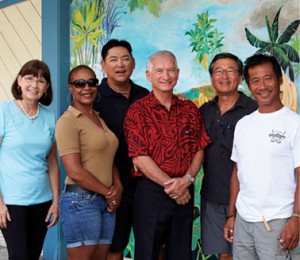
    Jay Jarman and Kevon
    Jay Jarman and Kevon

    “Matching the kindness of a neighborhood church with the needs of a kid in a public school,” is the motto of Common Grace, created in 2002. This homegrown organization partners members of neighborhood churches and service clubs with elementary school students at breakfast, lunch or after-school time to offer kindness to kids. Many seniors volunteer with Common Grace.

    It all started with the Principal of Queen Lydia Lili‘uokalani Elementary telling Jay Jarman and Pastor Ron Arnold of Kaimuki Christian Church that they have lonely children on their campus. She asked, “Would any of your church family members like to come once in a while to sit and talk and make friends with our kids?”

    Today, Common Grace partners with twenty-one elementary schools, interacting with approximately 150 students. They are supported by the State of Hawai‘i Department of Education Superintendent, and received the 2007 Partnership in Education Award. Jay Jarman, Executive Director, received the 2009 Outstanding Advocate for Children and Youth Award from the Hawaii State Legislature.

    If you want to be a friend to a lonely little kid, you may contact Common Grace: 808-282-6194. Mentors complete a two-hour training session and pass a background check and work in teams to offer mutual support and built-in back-up in case you are not able to be with your child at your regular meeting time. For more information visit: www.commongrace.org.

    “Matching the kindness of a neighborhood church with the needs of a kid in a public school,” is the motto of Common Grace, created in 2002. This homegrown organization partners members of neighborhood churches and service clubs with elementary school students at breakfast, lunch or after-school time to offer kindness to kids. Many seniors volunteer…

  • Preserving Hilo’s Past: The Lyman Museum

    Photo by W Nowicki
    Photo by W Nowicki

    A few blocks mauka of Hilo Bay at 276 Haili Street is a white frame building with dark green trim and a surrounding veranda upstairs and down, in the style of nineteenth-century New England homes. A guided tour of the Lyman Mission House, listed on both the National and State Registers of Historic Places, gives visitors a colorful and accurate look at missionary life in 1800s Hilo. The Lyman Museum, which includes the adjacent Mission House, is one of only four accredited museums in Hawai‘i and is also a Smithsonian affiliate.

    Sarah and David Belden Lyman were educator-missionaries of the American Board of Commissioners for Foreign Missions (ABCFM) in Massachusetts, assigned to the Hilo Mission in 1832. The very first missionary station in East Hawai‘i, the Hilo Mission had been established in 1824 at the village of Waiakea. The Lymans entered the Hawaiian mission field at a time of the “Second Great Awakening,” when thousands of converts were filling new churches throughout the Islands, including Hilo’s own Haili Church, founded in 1824. By 1840, over 90 percent of Hawaiians throughout the Islands attended Sunday services every week.

    The Lymans also built a large thatched-roof meeting hall where they held religious services and educational programs each week. Later, as seasoned teachers, they were commissioned by Kamehameha III to found and administer the Hilo Boarding School for Hawaiian boys and young men. Native Hawaiians responded so favorably to missionary training in reading and writing that Hawai‘i became the most literate country on the planet.

    Generation Magazine-on2014k-2
    Photo courtesy by the Lyman Museum

    The Lyman Museum was established in 1931, with natural and cultural history collections housed in the Lyman family home, and a mission “To tell the story of Hawai‘i, its islands and its people.” In 1971, an adjacent museum building designed by architect Vladimir Ossipoff was constructed, and all the holdings were moved to this secure space with controlled environmental conditions and expanded room for exhibits. The Earth Heritage Gallery showcases the geological beginnings and natural habitats of the islands, while the Island Heritage Gallery tells the stories of the peoples and cultures of Hawai‘i. The Lyman Hawaiian shell collection is renown. The Museum’s collection of gems and minerals is the life’s work of a Lyman great-grandson, is described by the Smithsonian as one of the ten best in the U.S.

    The Museum upholds the Lyman tradition of lifelong learning by regularly hosting educational programs on the natural, cultural, and social history of Hawai‘i, engaging and informing the community and visitors alike. In October, local island historian Boyd D. Bond will present “A Broad History of Hawai‘i Island”; later in November, he will talk story about the complex life and colorful reign of Kauikeaouli (Kamehameha III).


    For information on the many educational opportunities:
    Lyman Museum, Hilo
    808-935-5021 | www.lymanmuseum.org

    A few blocks mauka of Hilo Bay at 276 Haili Street is a white frame building with dark green trim and a surrounding veranda upstairs and down, in the style of nineteenth-century New England homes. A guided tour of the Lyman Mission House, listed on both the National and State Registers of Historic Places, gives…

  • Adjusting Your Money Mindset

    Money is a powerful influence on our lifestyle, emotions and behaviors. If you’re serious about improving your financial life, examine your money mindset

    Acknowledge your personal history. If you grew up in poverty, you may have an underlying sense of scarcity–never having “enough.” If you were accustomed to abundance, you may not know how to manage money wisely. Such patterns may prevent you from earning what you’re worth, saving adequately, spending responsibly or being more philanthropic.

    Evaluate your emotional response to money. Is your mood tied to your assets? Does your bank account define you? When money occupies the driver’s seat, anxious thoughts can prevent you from making reasonable choices.

    Stop playing these money mind-games.

    • I’ll be happy when I make more money. Happiness comes from within. It is important to enjoy the successes you’re experiencing today as well as working on future goals.
    • Money is the only thing that matters. Money is an important means to an end. Worshipping money at the expense of people, nature, art and ideas may lead to loneliness and disappointment.
    • Money is meaningless. This harmful idea feeds reckless spending, de-motivate your work life, and stress those who depend on your productivity. Money should be treated with respect and not frittered away.

    Let go of the past. Stop beating yourself up for your financial mistakes. Reframe regrets as lessons and opportunities to grow. People recover from a failed business, job loss, stock tumble, or tax trouble. Keeping an open mind and focus on what you can do now.

    Curtail the time spent thinking about money. Dwelling on dollars and cents or fantasizing about winning the lottery doesn’t get you any closer to your goals. Step back; switch gears and identify\ tried and true actions to help you reach your goals. Daydream for short bursts of time; then get back to the business of living.

    Enlist a financial ally. A skilled financial advisor will be very familiar with mental, emotional and behavioral landmines you want to avoid on the road to a solid financial future. With tools to plan, save, and invest, within your timeframe and budget, you can live without financial stress, now and In the future. Look to your advisor for guidance and encouragement to sharpen your mental game and develop a new money mindset.


    Michael W. K. Yee, CFP
    1585 Kapiolani Blvd., Suite 1100, Honolulu
    808-952-1222 ext. 1240 | michael.w.yee@ampf.com
    Michael W K Yee, CFP®, CFS®, CRPC®, is a Financial Advisor CERTIFIED FINANCIAL PLANNER practitioner™ with Ameriprise Financial Services, Inc. in Honolulu, HI. He specializes in fee-based financial planning and asset management strategies and has been in practice for 26 years.
    Ameriprise Financial, Inc. and its affiliates do not offer tax or legal advice. Consumers should consult with their tax advisor or attorney regarding their specific situation.
    Brokerage, investment and financial advisory services are made available through Ameriprise Financial Services, Inc. Member FINRA and SIPC.
    © 2014 Ameriprise Financial, Inc. All rights reserved. File # 975765

    Money is a powerful influence on our lifestyle, emotions and behaviors. If you’re serious about improving your financial life, examine your money mindset Acknowledge your personal history. If you grew up in poverty, you may have an underlying sense of scarcity–never having “enough.” If you were accustomed to abundance, you may not know how to…

  • October – November 2014

    October – November 2014

    WANT THIS ISSUE?

    Download your own personal copy of this issue in PDF format. Click the button below:

    DOWNLOAD IT NOW

    Grassroots Wisdoms: A Winner For Hawai’i Island

  • Crossing the Rainbow Bridge

    Generations Magazine- Crossing the Rainbow Bridge - Image 01For many people, a pet is their best friend and loyal confidant. Losing a loved one is never easy, especially when you have to make the difficult decision of saying good-bye because your pet is suffering, or no longer enjoying a good quality of life. The Hawaiian Humane Society offers euthanasia and cremation services for pets who are ready to cross the Rainbow Bridge.

    In the emotional period following your pet’s death, it’s important to know that no two people grieve the same. Recovering from grief often involves finding positive ways to fill the void created by the loss.

    There are many ways to celebrate your pet’s life to help you during the grieving process:

    • Record happy memories in a journal or a letter.
    • Make a photo album or collage.
    • Plan a memorial service.
    • Volunteer to help animals.
    • Make a donation in memory of your pet to the Humane Society.
    • Your pet’s name will be listed in the Society’s community newsletter.

    Grieving the loss of a pet is natural and anyone struggling can attend the Pet Loss Support Group. The group meets the first Tuesday of each month, from 6 p.m. to 7 p.m. at the Hawaiian Humane Society. Meetings are facilitated by counselor Rosemarie Grigg.

    While a pet may be gone, their memory lives on with the people who loved them.


    Hawaiian Humane Society
    808-356-2222 | www.HawaiianHumane.org

    For many people, a pet is their best friend and loyal confidant. Losing a loved one is never easy, especially when you have to make the difficult decision of saying good-bye because your pet is suffering, or no longer enjoying a good quality of life. The Hawaiian Humane Society offers euthanasia and cremation services for…

  • Hospice & Part D Prescription Medications

    Earlier this year the Centers for Medicare & Medicaid Services (CMS) clarified the criteria for determining payment responsibility under the Part A hospice benefit and Part D prescription drug benefit for individuals who are under the Medicare hospice benefit. This was done to help prevent duplicate payments. CMS has issued a new guidance that requires denial of Part D claims on the basis of Prior Authorization (PA) for Medicare members who choose the hospice benefit after May 1, 2014.

    What is a “prior authorization” of a prescription drug?

    This is usually when the Medicare Part D plan will cover a particular drug, but your doctor must first show the plan that it is medically necessary for you to have that particular drug. The plans also do this to be sure that the drugs are used correctly. In this new scenario the Medicare Part D plan must confirm who is responsible for paying for the drug; the hospice benefit or the prescription drug benefit. This will also reduce the number of inaccurate claims.

    What medications does hospice benefit pay?

    This benefit will pay for medications that ease the suffering and help in pain management in a terminal condition. The Medicare approved Hospice provider will supply the medications and the copayment to the individual will be no more than $5.00 per prescription.

    What does Medicare Part D pay for?

    Your Part D plan will pay for those maintenance prescriptions not related to the hospice benefit. Medications for things like high blood pressure, heart disease, diabetes and other chronic conditions. Under this new guidance these medications will require prior authorization,

    What can I or my caregiver do so that there is not a delay in getting the medications I need?

    First, whenever possible order your refills at least seven days before your current prescription runs out. Call your Medicare Part D plan to ask for the forms and process in requesting a “coverage determination”. Talk with your hospice provider or nurse on what prescription drugs are under your hospice benefit.

    Please call for more information about this or other Medicare subjects. We have trained and certified counselors available to help navigate the Medicare health care system. If you have a group that would like more information about the upcoming Medicare Open Enrollment Period (October 15 – December 7, 2014) we are available for community presentations and annual Medicare screenings. And always, we are looking for individuals who would like to help their community by becoming a Hawaii SHIP Volunteer.


    Hawaii SHIP (State Health Insurance Assistance Program)
    1-888-875-9229 | 808-586-7299
    help@hawaiiship.org | www.hawaiiship.org
    For 2014 Medicare updates: www.medicare.gov

    Earlier this year the Centers for Medicare & Medicaid Services (CMS) clarified the criteria for determining payment responsibility under the Part A hospice benefit and Part D prescription drug benefit for individuals who are under the Medicare hospice benefit. This was done to help prevent duplicate payments. CMS has issued a new guidance that requires…

  • When Home is Anything But Sweet

    Hawaii has the largest number of Homeowner’s Associations (HOA) per capita than other state. In these structured communities, residents agree when purchasing their homes to follow certain rules to ensure a certain quality of life is maintained for residents. They pay monthly fees to maintain amenities like, common areas, landscaping and pools, also other expenses, including hiring lawyers to enforce the rules. Governing body of HOA is the Association Board made up of residents elected to their position and to act in the community’s best interest. These communities, are only as good as the members elected to the Boards. Run well and responsibly, neighborhoods become everything residents desire and more. Run poorly, abuse can occur.

    An increasing number of instances nationwide where these Boards, hiding behind the excuse of enforcing the rules, have abused their powers, often times targeted the elder members of their community, using harassment, confusion, shame and fear in order to financially bully them.

    One example, when Walter (not his real name) returned home from a trip, he discovered in his mailbox letters from his HOA Board, fining him for not maintaining his lawn — an HOA violation. Since he was comfortable speaking up at previous Board meetings, he ignored the correspondence with the intent of explaining the circumstances of his trip at the next meeting. Before the next meeting, he received a letter from an attorney the Board hired, threatening legal action if Walter didn’t pay not only the original fine, but also the legal expenses the lawyer charged to write the letter. Walter found himself not only the target of the Board that didn’t appreciate his outspokenness, but the subject of a lawsuit demanding thousands of dollars in unreasonable legal expenses.

    Actions that can be taken to minimize harm done and protect yourself and home.

    If you are being treated unfairly by a HOA:

    • Learn your HOA’s rules and the consequences.
    • Know what fee’s you’ve agreed to pay for.
    • Know how fee increases are set, how often they occur, how much is in the HOA’s reserve fund, and the operating expenses and the budget.

    If you feel abuse is occurring:

    • Keep records: document abuses and keep all your correspondences with your HOA.
    • The worst thing is refusing to pay HOA fees and not telling your reasons — the risk is foreclosure.
      Call the Department of Commerce and Consumer Affairs at 586-2643.
    • Seek out legal advice from an attorney specializing in defending homeowners from HOA; depending on your circumstances, they may take the case on contingency (pay if you win).

    To report suspected elder abuse, contact the Elder Abuse
    Unit at: 808-768-7536 | ElderAbuse@honolulu.gov

    Hawaii has the largest number of Homeowner’s Associations (HOA) per capita than other state. In these structured communities, residents agree when purchasing their homes to follow certain rules to ensure a certain quality of life is maintained for residents. They pay monthly fees to maintain amenities like, common areas, landscaping and pools, also other expenses,…

  • Solutions to the De-Clutter Dilemma

    As Baby Boomers and their parents retire, many are choosing to downsize to a simpler life. With their children out of the nest, many are seeking a more comfortable living environment as they age. Many are choosing to spend their retirement years living in a smaller home, retirement community, or with their adult children. This transition is often too overwhelming and very stressful. With years of memories and accumulated “stuff” in their home, they simply don’t know where to begin. With little to no help available, many aren’t able to make the move so they stay where they are even if they know that other living options would be better for them.

    The Good News is, now there is a solution to this growing issue developing in our community of retirees.

    Senior Move Managers LLC, also dba De-clutter Hawaii, was formed by Dan and Julie Ihara in October 2010. After years of servicing senior clients in their Real Estate business, they have created efficient, friendly tools that help Seniors downsize their personal belongings. They’ve learned ways that help people de-clutter their home and detach from their personal belongings. In January of 2011, they joined the National Association of Senior Move Managers (NASMM) as the first and only Senior Move Management firm in Hawai‘i. Dan’s niece, Cynthia Goya Arnold, is the Vice President of Operations and manages the day-to-day services for their clients. Since the inception, Senior Move Managers has helped hundreds of clients move into Retirement Communities, Condos, as well as helped clear out family Estates where parents have passed on.

    We’ve seen it all: from the vacant “hoarder home” to the everyday Senior who has lived in the same home for 80 years. No job is too big, or too small for us to help. We have also been called on to downsize and de-clutter homes to make them safer and more functional for those choosing to stay at home and age in place. No matter what your age, most people can use help with de-cluttering their home. Each client receives customized services based on their personal situation. We do anything to help our clients minimize stress. Seniors like that we’re insured, bonded and nationally certified with the NASMM.

    Senior Move Managers offers a free one hour consultation to determine your goals, create a plan and schedule to meet those goals. Senior Move Managers is part of The Complete Solution for Seniors who also helps seniors with finding alternative living environments, improve the value of their home and sell their home for the highest price within your time frame.

    We started this business to help families through an often challenging phase of life. As a local, family-owned and operated business, we treat you like our family. Call us and you’ll see our passion to serve and compassion for Seniors. Cynthia Arnold at 808-221-8345, or Dan Ihara at 808-256-7873.

    As Baby Boomers and their parents retire, many are choosing to downsize to a simpler life. With their children out of the nest, many are seeking a more comfortable living environment as they age. Many are choosing to spend their retirement years living in a smaller home, retirement community, or with their adult children. This…

  • Editor’s Note

    I can still remember my first conversation with myself in early 2010 when I took over Generations Magazine (GM), I said to myself, “now what do I do?” Well, my first call was to my classmate and partner Wilson Angel, GM Art Director and to make a long story short, he said “he was all in.” Next call was to my good friend, Kirk Matthews at KHON2 News Elderhood Project’s to see if he would be our first cover story and I still remember what he said, “are you crazy!” He said, “You are busy as it is and now you want to take on this huge task of providing our much loved seniors and their families with their own magazine?” I said yes, and he graciously became our first cover story after a round of golf. Love you Kirk!

    Fast forward to this August/September 2014 issue, 5 years later and we are still committed to our mission of providing valuable and resourceful information to our Kupuna and their families. We are so blessed to have so many supporters and followers of GM. Special thanks goes out to our original business partners from 2010 that have and are still in GM as our partners and who truly believe in serving our senior population; Kirk Matthews and KHON2 News, my brother and one of the top realtors in Hawai‘i, Dan Ihara with Keller Willliams, 15 Craigside and Arcadia Community Services, Michael Yee, CFP, Ameriprise Financial Inc., Scott Makuakane with Est8Planning Counsel, LLLC, Attorney Stephen Yim, Craig and Sandy Watanabe from Captain Cook Coin, and Mike Rossell producer of our beloved Senior Fair that always happens the last weekend in September at the Blaisdell Exhibition Hall.

    A big “Mahalo” goes out to Vacations Hawaii and Boyd Gaming’s Kevin Kaneshiro and Director of Marketing Ashlen Manos for their years of sponsorship and support. I could not think of a better partner in all these years to have on our cover for our Senior Fair issue than our favorite California Hotel & Casino, known as “the Cal,” and yes, the 9th Island. A special “Mahalo” to David Lebby, VP and General Manager of the Cal and Main Street Station Hotel, Casino & Brewery for always taking special care of our Hawai‘i seniors.

    Don’t forget to stop by at our 8th annual Aging in Place Workshop at the Ala Moana Hotel on Saturday August 23rd. Thank you to our sponsors KHON2’s Elderhood Project, AARP Hawaii, Vacations Hawaii (Yes we will be giving away a Vegas Trip), Straub Clinic and Hospital, AlohaCare, The Plaza Assisted Living, Kokua Care, De-clutter Hawaii and Cardon Outreach.

    FYI — Our website www.Generations808.com still and always will have all our past issues including our very first issue with Kirk Matthews from 2010. Our site has many resources such as our GM calendar of future senior events around the island, list of GM business partners, listen to all our Generations Radio segments and past “Aging in Place” workshop presentations, as well as all our past resource guides and articles.

    Live well this summer!,

    Generations Magazine- Editor's Note- Image 01

    Percy Ihara, Editor/Publisher

    Generations Magazine- Editor's Note- Image 02


    I can still remember my first conversation with myself in early 2010 when I took over Generations Magazine (GM), I said to myself, “now what do I do?” Well, my first call was to my classmate and partner Wilson Angel, GM Art Director and to make a long story short, he said “he was all…

  • Signs of the Economic Times

    The state of the economy can make a big difference in our lives. It affects opportunities in the job market, drives stock market, determine prices and influences buyer behavior.

    When economy is robust, there’s optimism in the air. Companies’ hire, investors invest and consumers spend. When economy is sluggish, mood is somber, companies struggle to make a profit, investors are more cautious and consumers tighten their wallets.

    How do we know if the economy is doing well?

    Economic indicators that go hand-in-hand with economic health, provide clues. Direct economic indicators go up when economy is rosy and down when economy tanks. Other factors have an inverse relationship with the economy. These inverse factors fall and rise opposite the strength of the economy.

    Leading economic indicators are considered most important factors to watch. Unlike lagging economic indicators that appear after economic change, these indicators come first, helping economists predict the direction of the economy. Here are some of the most discussed leading economic indicators.

    Consumer Price Index (CPI) — Is a consolidated measure of price of goods and services over time at the consumer level. Observed changes in CPI help determine inflation and cost of living, help shape our monetary policy. Measured by the Bureau of Labor Statistics, the CPI is calculated for food, energy and other consumer goods. Further analysis within these categories reveal what influences price fluctuations.

    Prices of some goods and services are more influential than others. For example, we are a nation of automobile owners; price of gas is closely watched. When prices get too high or too low, government may intervene with policies intended to cap consumer costs and spur economic activity.

    Producer Price Index (CPI) — Prices paid at the store, the Producer Price Index (PPI) considers what wholesalers pay for U.S. goods and services (food and energy, not factored). Wholesale prices influence consumer prices; PPI can be a useful predictor of impending inflation.

    U.S. Import and Export Price Indexes — Our nation relies on foreign trade to sustain economic activity. Price we charge foreign trading partners for goods and services, can reveal a good deal about our economic standing. Fluctuations in supply and demand, competition and stability of our global partners make these measures more vulnerable to variability.

    Productivity and Costs — Productivity statistics tell how well our economy is working. When businesses are able to do more in less time, profits rise, in turn paves the way for more investment, more jobs and prosperity.

    Real Earnings — Looks at real average hourly earnings to estimate consumer-buying power. Comparing real earnings to the CPI, shed light on how far the U.S. dollar can go.

    New Construction — Housing starts and building permits are regularly monitored by the financial industry, they reflect both business growth and consumer confidence.

    Employment Situation — Stock market tends to perk at announcement of new hires and fewer unemployment claims. Investors like a healthy economy. Job security also tends to give consumers more confidence.

    Visit the Bureau of Economic Analysis at www.bea.gov and U.S. Census Bureau at www.census.gov. Apply what you learn with your financial advisor, who can help you consider important financial decisions.


    Michael W. K. Yee, CFP
    1585 Kapiolani Blvd., Suite 1100, Honolulu
    808-952-1222 ext. 1240 | michael.w.yee@ampf.com
    Michael W K Yee, CFP®, CFS®, CRPC®, is a Financial Advisor CERTIFIED FINANCIAL PLANNER practitioner™ with Ameriprise Financial Services, Inc. in Honolulu, HI. He specializes in fee-based financial planning and asset management strategies and has been in practice for 26 years.
    Ameriprise Financial, Inc. and its affiliates do not offer tax or legal advice. Consumers should consult with their tax advisor or attorney regarding their specific situation.
    Brokerage, investment and financial advisory services are made available through Ameriprise Financial Services, Inc. Member FINRA and SIPC.
    © 2014 Ameriprise Financial, Inc. All rights reserved. File # 823751.

    The state of the economy can make a big difference in our lives. It affects opportunities in the job market, drives stock market, determine prices and influences buyer behavior. When economy is robust, there’s optimism in the air. Companies’ hire, investors invest and consumers spend. When economy is sluggish, mood is somber, companies struggle to…

  • Retrofit Your Home for Aging

    Most seniors prefer living in the home they know and love, but as tasks become harder and unmanageable, seniors will either hire an in-home caregiver, move in with their children or decide to move to an assisted living facility.

    Aging-in-place, or moving in with family, is a more comfortable option, but may require re-modeling the home to make it safe. These improvements may consist of ramps, walk-in showers, wheel chair accessibility and more. When a home is no longer safe, or care becomes unmanageable for the family, finding the right retirement community is the next step.

    There are several types of retirement communities available, such as assisted living facilities, skilled nursing homes, Continuing Care Retirement Communities (CCRC) and Adults Residential Care Homes (ARCH’s) available. Prices can be as high as $120,000 yearly or low-income housing options are available. Knowing the differences between these options will help you decide where you will feel more comfortable. Site visits are a must.

    Kahala Associates Senior Concierge offers free seminars on many senior related topics year round. Here are two upcoming events:

    August 30th — Home Safety & Improvement Tips Join guest speaker Curt Kiriu with C.K. Independent Living Builders.

    October 18th — Senior Housing Option Seminar Learn about the different retirement communities and how they differ.

    For more information and to register (seating is limited), email Seniors@LaneyRE.com or call 808-282-1399.

    Most seniors prefer living in the home they know and love, but as tasks become harder and unmanageable, seniors will either hire an in-home caregiver, move in with their children or decide to move to an assisted living facility. Aging-in-place, or moving in with family, is a more comfortable option, but may require re-modeling the…

  • Living Life At Its Fullest!

    Can you imagine, a century ago men were still relying on buttons and women on painful corsets. Vacuum cleaners and washing machines had just become commercially available, though too expensive for many families. That’s Winifred Mann’s era, born 1910.

    Winnie turned 104 on May 1 and her friends at Arcadia made sure she got a Big Birthday Bash with wine, cheese and crackers.

    Winnie has seen many changes in her 104 years; a Midwesterner from Nebraska, she lived through WWI, WWII, and The Great Depression of the 30’s, even the days of the 1960’s Hippie Counter Culture Movement, what a change!

    Generations Magazine- Living Life At Its Fullest!- Image 01She and her late husband, Ralph came to Hawai’i from San Diego, California in 1962 when he was assigned to a US Department of Defense position. After her late husband’s death in 1999, she followed her longtime interests in oil painting, sewing, reading, and cartooning. Later, as a painter, she sought out people engaged in activities and based her paintings on photos with subjects ranging from people enjoying favorite pastimes at the beach or taking walks in Arcadia’s gardens where she resides to tourist attractions and peaceful landscapes.

    Winnie still manages to keep active as she enjoys life here in Hawai‘i. “Happy 104th Birthday, Winifred Mann!” and Generations Magazine wishes you many more to come!


    If you know of any other centenarians, send us a photo and something about him/her. Contact Sherry Goya: 808-722-8487 | SGoyaLLC@aol.com

    Can you imagine, a century ago men were still relying on buttons and women on painful corsets. Vacuum cleaners and washing machines had just become commercially available, though too expensive for many families. That’s Winifred Mann’s era, born 1910. Winnie turned 104 on May 1 and her friends at Arcadia made sure she got a…