WANT THIS ISSUE?
Download your own personal copy of this issue in PDF format. Click the button below:


WANT THIS ISSUE?
Download your own personal copy of this issue in PDF format. Click the button below:
Compassionate volunteers of Project Dana help seniors in need
Over the years, I have spoken to countless people who believed they had won the lottery. They told me on the phone that they knew it was the real thing or they stopped by my office to show me letters, emails, credit cards or business checks proving they had struck it rich and beat the odds.
The chance of winning the lottery is 296 million to one.
They were confident about their soon-to-be riches, but their families advised them to meet with me because these “winners” had already spent thousands of dollars on alleged taxes and fees to support the purported prize.
In past issues of Generations Magazine, I have highlighted these scams, identifying earmarks proving the non-existence of lotteries, sweepstakes, government grant money giveaways and insurance bonus payments.
Those telltale signs included:
◆ Instructions to keep a secret that they won money (so no one could verify the truth)
◆ Instructions to act very soon or the money would be lost (to create a sense of urgency)
◆ Advance payment (for alleged taxes or fees) before they received money
 When I explained these signs, many seniors politely nodded their heads, but they still believe they had won. They went through the motions of listening only to placate the person who brought them into my office. After hearing the shtick from the con men who informed them of their lottery winnings, they believed they were of that .000006 percent of the public who wins.
My approach to these victims changed when I met “Edith.” Over the course of six months, she had sent $135,000 to someone claiming to represent a mainland lottery. Edith was very guarded and skeptical that our discussion applied to her.
She had developed a relationship with the alleged lottery worker and trusted him enough to follow his instructions. Edith believed that despite all the warning signs I pointed out to her, she was extremely lucky to have won a lottery in Hawai‘i.
Talking to Edith gave me an idea: What if I could prove she didn’t win the lottery instead of telling her she was a scam victim? As a trial attorney, isn’t my job to convince people, using the law and objective facts? I thought that I could undo scam artists’ brain washings using this logic. And I made a case to Edith to prove she had a zero percent chance of winning a lottery.
In the Dec/Jan 2018 issue of Generations, I will cover the legal arguments that prove that winning the lottery in Hawai‘i is impossible.
To report suspected elder abuse, contact the Elder Abuse Unit at 808-768-7536 | ElderAbuse@honolulu.gov
Over the years, I have spoken to countless people who believed they had won the lottery. They told me on the phone that they knew it was the real thing or they stopped by my office to show me letters, emails, credit cards or business checks proving they had struck it rich and beat the…
Estate-planning attorneys offer three types of estate plans: the one-size-fits-all, default “state plan;” the standard “black and white” plan; or the “meaningful” estate plan.
If you do nothing, the State of Hawai‘i has the Guardianship and Probate Court, which is a plan for each Hawai‘i resident upon incapacity and death. The state also has the Table of Consanguinity, listing your beneficiaries — to decide who will be in charge of handling your estate.
The standard “black and white” estate plan carefully crafts legal documents, while focusing on avoiding probate and minimizing taxes. Most often, these plans resemble every other estate plan, with the lawyers focused mainly on the “form” of the plan.
People may believe that because they consulted a lawyer, everything is complete and will not cause undue stress or conflict when they die.
But the sad fact is that there is more trust litigation occurring now than ever before and fractures in family relationships appear to be on the rise.
The simple reason? When we provide the foundation of the estate plan, we focus on the “how to” and diminish the “why,” meaning our intentions, feelings and hopes for our loved ones. In other words, our “voice.”
The “meaningful” estate plan incorporates the client’s own voice in the foundation of the estate plan. Statistics show that not only are the client’s choices honored and respected, family relationships are stronger and family fights are fewer.
It’s not too late to start a plan that reflects your “whys”— for you and your loved ones.
Stephen B. Yim, Attorney at Law
2054 S. Beretania St., Honolulu HI 96826
808-524-0251 | stephenyimestateplanning.com
Estate-planning attorneys offer three types of estate plans: the one-size-fits-all, default “state plan;” the standard “black and white” plan; or the “meaningful” estate plan. If you do nothing, the State of Hawai‘i has the Guardianship and Probate Court, which is a plan for each Hawai‘i resident upon incapacity and death. The state also has the…
Public charities are not shy about asking us for money — they depend on our gifts to carry out their philanthropic purposes.
Deciding which charities to support can be a difficult task, because there are many worthy causes and most of us do not have unlimited bank accounts from which to draw.

The following are some suggestions for wise, charitable giving:
Do Your Homework
The good works of charities often overlap and some groups are more effective than others. To help you rate and compare established charities, visit websites such as www.charitynavigator.org and www.charitywatch.org. Know how much of your gift will go to charitable work versus administrative and fundraising overhead. Of course, running a charity costs money. Raising money also costs money. If these expenses exceed 25 percent of a charity’s revenue, you should ask why. If the charity cannot offer a good explanation, you may want to consider giving to other groups, instead.
Don’t Sell an Appreciated Asset for Cash
If you own Apple stock that you bought in 2006 for $10 per share, don’t sell it now at $150 per share to raise the cash for a charitable gift. You will be allowed an income tax deduction for your cash gift, but you also will be liable for capital gains tax on the difference between the $150 sale price of the stock and the $10 spent to buy that stock.
As a result, you will have less after-tax cash for the charity and your deduction will be limited to the amount of your gift. Instead, think about giving the stock to the charity and receive a larger deduction. The charity then can sell the stock and convert to cash.
The charity will not have to pay capital gains tax and you will receive a deduction for the full, fair-market value of the stock at the time you bestow the gift.
Give from Your Retirement Plan Assets
If you give retirement plan assets to your loved ones upon your death, they’ll likely pay income tax on those assets, resulting in less cash in their pockets. However, if you give those same assets to charity, there will be no income tax payable. To the extent that you can, name charities as beneficiaries of your retirement plan assets and use your non-taxable assets for making gifts to individuals.
If you have reached the age of 70-1/2 and have taken required minimum distributions (RMDs) from your retirement plan, you can give up to $100,000 of your annual RMD to charity. You will not get a deduction for your gift, but you will not have to pay income tax on the gifted portion of your RMD. This works out to be a “win-win” for you and the charity.
SCOTT MAKUAKANE, Counselor at Law
Focusing exclusively on estate planning and trust law.
www.est8planning.com
O‘ahu: 808-587-8227 | maku@est8planning.com
Public charities are not shy about asking us for money — they depend on our gifts to carry out their philanthropic purposes. Deciding which charities to support can be a difficult task, because there are many worthy causes and most of us do not have unlimited bank accounts from which to draw. The following are some suggestions…
Think about this analogy: When an airplane is preparing to land, it doesn’t descend 30,000 feet in a matter of seconds. Rather, it happens gradually. The pilot adjusts to the landscape and weather conditions to assure a soft landing.
In the years leading up to retirement, treat your investment portfolio in a similar manner. Prepare to protect your assets. Adjust as dictated by market and economic conditions to help assure a soft landing in retirement.
 Adjusting your portfolio means taking steps to downshift as retirement nears, reducing some of the risks that may exist in your asset mix. While you were focused on building wealth in the years leading up to retirement, your focus should change as you approach the end of your working years. It’s important to protect your hard-earned wealth, while positioning your portfolio to generate your retirement paycheck.
Dealing with Unpredictability
Money invested in assets that vary in value — including stocks and bonds — are subject to periodic fluctuations. In prior years, you may have had time to ride out market turbulences and overcome short-term losses once markets recovered. But, if you wait until retirement to adjust your portfolio, you may be unpleasantly surprised by an untimely market downturn. This unpredictability could result in a “hard landing” for your portfolio, leaving you with less money in retirement, compared to your plans.
For example, a couple with $1 million saved for retirement may plan to withdraw $40,000 annually from that account (assuming they withdraw 4 percent of the principal value annually to sustain 25 years in retirement). If all the money was invested in stocks and the portfolio sustained a 25 percent decline prior to retirement, the value would drop to $750,000, leaving the couple with $30,000 a year. In contrast, if they had strategically positioned the portfolio prior to their retirement, they may have protected themselves from the market’s downturn.
A Gradual Process
The shift from wealth accumulation to income generation in your portfolio should happen over time. One approach is to gradually reduce your positions in assets that are subject to greater market volatility in the years leading up to retirement. That may mean reducing your portfolio’s exposure to stocks and increasing positions in fixed-income investments.
However, not all your money needs to be moved out of stocks, even in retirement. Equities historically have offered more growth potential than many other types of investments. Given today’s long-life expectancies, you want to be prepared for the likelihood that living costs will be higher 20 or 30 years from the time you begin retirement. For this reason, stocks may make sense for you. You may want to reduce your emphasis on investments that maximize capital appreciation and instead, emphasize stocks that tend to be less volatile and pay competitive dividends.
Other strategies may come into play, too, such as annuities that provide lifetime income in retirement, or alternative investments that can diversify your portfolio. A financial advisor can help you determine an appropriate strategy as you prepare for a smooth landing in retirement.
MICHAEL W. K. YEE, CFP
1585 Kapiolani Blvd., Ste. 1100, Honolulu HI 96814
808-952-1222, ext. 1240 | michael.w.yee@ampf.com
Michael W. K. Yee, CFP®, CFS®, CLTC, is a Financial Advisor, Certified Financial Planner ™ practitioner with Ameriprise Financial Services, Inc. in Honolulu, HI. He specializes in fee-based financial planning and asset management strategies and has been in practice for 30 years.
Investment advisory products and services are made available through Ameriprise Financial Services, Inc., a registered investment adviser.
Ameriprise Financial Services, Inc. Member FINRA and SIPC.
© 2017 Ameriprise Financial, Inc. All rights reserved. File #1822778
Think about this analogy: When an airplane is preparing to land, it doesn’t descend 30,000 feet in a matter of seconds. Rather, it happens gradually. The pilot adjusts to the landscape and weather conditions to assure a soft landing. In the years leading up to retirement, treat your investment portfolio in a similar manner. Prepare…
Have you taken your car in for its 10,000-mile service checkup? If you are like most car owners who need a reliable car that can go the distance, you schedule an appointment the moment your mechanic sends a reminder. The bumper-to-bumper inspection requires a trained professional to perform an extensive list of tests, including a battery check, look under the hood, and a review of fluid levels and brakes.
But how do you respond when your healthcare provider sends you a checkup notice? Do you keep up with your body’s maintenance?
Did you schedule your free annual Medicare wellness visit, a comprehensive examination to check if critical systems are functioning well?
Remember, your body functions just like any machine. To perform optimally, you need to go in for your 365-day service checkup and stay up to date with your preventive screenings.
You may not be that excited about scheduling the tests; you may ignore the notices because you really don’t want anyone hammering your knees to check reflexes, and asking for a blood draw and urine sample to “check your fluids.”
Here’s a tip: When you get your auto’s annual service check notice, give your health provider a call to find out if you are overdue for your personal health service checkup.
If you are, get it scheduled.
MEDICARE MOMENT WITH MARTHA
A radio program with Martha Khlopin
KHNR-690AM:
Saturdays, 2 pm–2:30 pm
Sundays, 9:30 am–10 am
808-230-3379 | getmartha@aol.com
To learn more about free Medicare wellness visits, go to:
www.medicare.gov/coverage/preventive-visit-and-yearly-wellness-exams.html
Have you taken your car in for its 10,000-mile service checkup? If you are like most car owners who need a reliable car that can go the distance, you schedule an appointment the moment your mechanic sends a reminder. The bumper-to-bumper inspection requires a trained professional to perform an extensive list of tests, including a…
 The Social Security Administration is serious about safeguarding what’s important to you, as we continue to evaluate and improve our protection programs.
Our robust, easy-to-use cyber security program is a vital part of keeping you safe and secure.
Most people who conduct online business use the SSA portal, “my Social Security.”
This can be found at www.socialsecurity.gov/myaccount/.
Since “my Social Security” became available in May 2012, more than 30 million people have created and used their own accounts. The design puts you in control — whether you’re using a computer, smartphone or tablet.
If you already are receiving benefits, the “my Social Security” website allows you to:
◆ Request a replacement Social Security card if you meet certain requirements.
◆ Receive your benefit verification letter.
◆ Check your benefit and payment information and earnings record.
◆ Change your address and phone number.
◆ Start or change direct deposit of your benefit payment.
◆ Request a replacement Medicare card.
◆ Get a replacement SSA-1099 or SSA-1042S form for tax season.
Even if you have not started receiving benefits, “my Social Security” can help you. For example, the site allows you to receive a Social Security card if you meet certain requirements, check the status of your application or appeal, and access other resources.
Since June 10, 2017, we have required a second method to check the identification of “my Social Security” account holders who register or sign in. This is in addition to the first layer of security, which is a username and password.
Using the second method, you either can choose your cell phone or your email address. Using two identification methods helps to protect your account from unauthorized use and potential identity fraud.
If you select email as your second method, you can ensure that the one-time security code email does not go into your spam or junk folder by adding NO-REPLY@ssa.gov to your contact list.
The “my Social Security” portal automatically adjusts to the size of the screen and device you use — such as a tablet, smartphone or computer.
No matter what type of device you choose,
the SSA provides full, easy-to-use access to your personal “my Social Security” account.
For questions, online applications or to make an appointment to visit a SSA office, call from 7am–7pm, Mon–Fri:
1-800-772-1213 (toll free) | 1-800-325-0778 (TTY)
www.socialsecurity.gov
The Social Security Administration is serious about safeguarding what’s important to you, as we continue to evaluate and improve our protection programs. Our robust, easy-to-use cyber security program is a vital part of keeping you safe and secure. Most people who conduct online business use the SSA portal, “my Social Security.” This can be found…
In March, during a mainland trip to visit our college daughter, I started receiving phone calls from old family friends whom I haven’t heard from in years. What I thought were surprise hellos were concerned calls.

My mother, Kimiko Suzuki, 88, had reached out to them due to a sudden onset of fluid buildup in her legs.
Three years earlier, my dad, at age 84, had passed away from a heart attack. My mother, a year older than my dad, still was physically and mentally strong. She had continued with the family business, which kept her active and filled with a sense of purpose.
But now, her ability to walk was greatly hindered due to fluid buildup in her legs, later diagnosed as edema from stage 3 kidney failure. The edema prevented her from getting around the house, and even preparing meals for herself.
When my wife and I returned from our trip, I quickly transferred my mother to our home, intending to care for her for as long as we could. However, within a few days, I quickly found my mission had become impossible.
Our home is a three-story townhouse. The nearest restroom was next to a flight of stairs. With her inability to walk, even with a walker, she grew fearful of going to the restroom. A simple bath took nearly an hour because the full bathroom is located on the third floor.
When I went to work and left her alone during the day, I realized my action bordered on neglect.
A little over a week after trying to adjust to this life, my mother suddenly said the most striking thing to me: “It would be all right if I went to a retirement home.” These words were significant because in the first days of her stay with us, she insisted on not being put in any sort of foster care.
I must thank my mother for realizing her illness was beyond the limits of our family’s ability to care for her. I still feel guilty for sending my mother to Kalākaua Gardens. I
visited her daily during lunch or dinner and spent two hours with her. After a short adjustment period, my mother found her way at Kalākaua Gardens.
I didn’t have a concrete plan in place when my mother fell ill. I now realize the importance of learning in advance about aging.
Every family’s decision will be different based on a variety of factors — the degree of illness, number of caregivers and money available for care. I do not feel there is one right way. I made the best decision for my family based on our situation. Others may second-guess my decision.
If your parents live long enough, you will go through what I have. Please prepare. Be realistic about your role as a caregiver.
I thought I could do more, but I admit that I reached the limits of my abilities.
I want to thank everyone at Kalākaua Gardens for their assistance. They truly are angels.
I also want to thank my wife for her understanding and patience, and for helping us to adjust to our family’s changes.
HELPFUL RESOURCES
In caregiving, gain as much knowledge as you can about elderly needs and care. Some helpful resources:
AARP HAWAII
1132 Bishop St., Ste. 1920, Honolulu HI 96813
www.aarp.org/states/hi./
(toll-free) 866-295-7282
In March, during a mainland trip to visit our college daughter, I started receiving phone calls from old family friends whom I haven’t heard from in years. What I thought were surprise hellos were concerned calls. My mother, Kimiko Suzuki, 88, had reached out to them due to a sudden onset of fluid buildup in…
As home healthcare providers, we’re often asked if a senior can live alone at home. While each situation is different, seniors who are alone can have additional risks that affect their health and well-being.
In 2016, the Administration on Aging reported 29 percent, or 13.3 million older adults age 65 and over, lived alone at home. Many seniors living alone experienced loneliness, social isolation and declining health, requiring more care from other persons. Despite these outcomes, nearly 90 percent of older adults still preferred to maintain their independence for as long as possible.
 At some point in time, caregivers for seniors may have to decide if leaving their loved ones alone is an option — even for short periods. This decision can be heartbreaking and difficult for both caregivers and seniors alike. Seniors should be involved in this decision-making process and include family members, friends and other care-providing professionals.
“Individuals who are fiercely independent and have declining health may need more time to accept care,” said Carol Samples, RN and CEO for Attention Plus Care. “It’s never an easy decision. Having a support system in addition to a team of caregivers can be a great help.”
A caregiver always should consider the safety risks of seniors when deciding if they can be alone or not. For those with health or sensory problems, new or developing symptoms may go undetected without proper assessment.
Caregivers should seek alternatives to solo living if seniors have medical conditions and receive care for cognitive impairment or memory loss; physical mobility; poor vision, hearing, eating, drinking and swallowing; personal hygiene or orientating to their environment.
Additional warning signs for seniors that being alone may not be safe include:
◆ Not recognizing common hazards
◆ Wandering or getting lost at home
◆ Ignoring sounds signaling danger
◆ Not recognizing family from strangers
◆ Needing assistance to prevent falls
◆ Inability to get help in an emergency
◆ Medical conditions needing monitoring
◆ Not complying with prescribed treatment
◆ Not caring for wounds or infections
◆ Negative changes in mood or routines
Much can be done for seniors alone at home. Studies show that while isolated seniors had a 59 percent greater risk of mental and physical decline, those having more meaningful relationships with others were less likely to experience declines. In other words, it’s not the quantity but the quality of relationships that counts.
“Experienced home healthcare providers know this and caregivers can really make a difference for our seniors in this way,” Samples said. “It’s finding that connection.”
ATTENTION PLUS CARE HOME HEALTHCARE
Accredited by The Joint Commission
1580 Makaloa St., Ste. 1060, Honolulu HI 96814
808-739-2811 | www.attentionplus.com
AGING IN HAWAII EDUCATIONAL OUTREACH PROGRAM by Attention Plus Care — a program providing resources for seniors and their families, covering different aging topics each month. For class information and upcoming topics, call 808-440-9356.
As home healthcare providers, we’re often asked if a senior can live alone at home. While each situation is different, seniors who are alone can have additional risks that affect their health and well-being. In 2016, the Administration on Aging reported 29 percent, or 13.3 million older adults age 65 and over, lived alone at home.…
 Core training is one of the most popular concepts in the field of fitness and physical therapy. Core stability training is often associated with strengthening your abdominal muscles — the “abs.” The ab muscles play a very important role, but the core also includes multiple muscles in the mid-lower back, pelvic floor, hips and buttocks.
This ring of muscles, or the “internal belt,” holds us up during the day, reducing falls, decreasing back pain and improving posture and even bladder control.
Whether you are lifting your grandchild or playing your favorite sport, your core muscles help maintain the body in proper alignment to avoid injury.
I often see patients who fall victim to the latest fitness trends that train the core improperly, leading to spine or leg injuries. Crunches, side-bends and rotational exercises with weights or kettlebells are not bad, but as we age, they often create more problems than benefits.
Exercises that engage the muscles by bracing the entire trunk — as though you are wearing an internal belt rather than sucking the stomach in and flexing forward — are more effective in improving core stability.
If you have poor posture and a weak core, try this simple, effective exercise to begin developing core control:
This simple exercise will tighten your internal belt and help you avoid injuries.
Moon Physical Therapy LLC
320 Ward Ave., Ste. 107, Honolulu HI 96814
Aquatic, Land-Based and Manual Therapy, and
Cardiopulmonary Rehab Programs
808-597-1005 | www.moonpt.com
Like me on Facebook: Moon Physical Therapy LLC
Core training is one of the most popular concepts in the field of fitness and physical therapy. Core stability training is often associated with strengthening your abdominal muscles — the “abs.” The ab muscles play a very important role, but the core also includes multiple muscles in the mid-lower back, pelvic floor, hips and buttocks. This ring…
For thousands of years, the tradition of calligraphy has been considered the highest form of art in many ancient cultures. In China and Japan, for instance, calligraphy, or “beautiful writing,” has served as more than just an alluring visual. The roots of understanding and deep contemplation that come through the art uplift all aspects of one’s life.
The practice of becoming a calligrapher requires unwavering focus and refined tactile skills. The art form is transmitted in a deep, meditative state from the writer, through the brush to paper and offers a profound way to further develop body, mind and spirit.
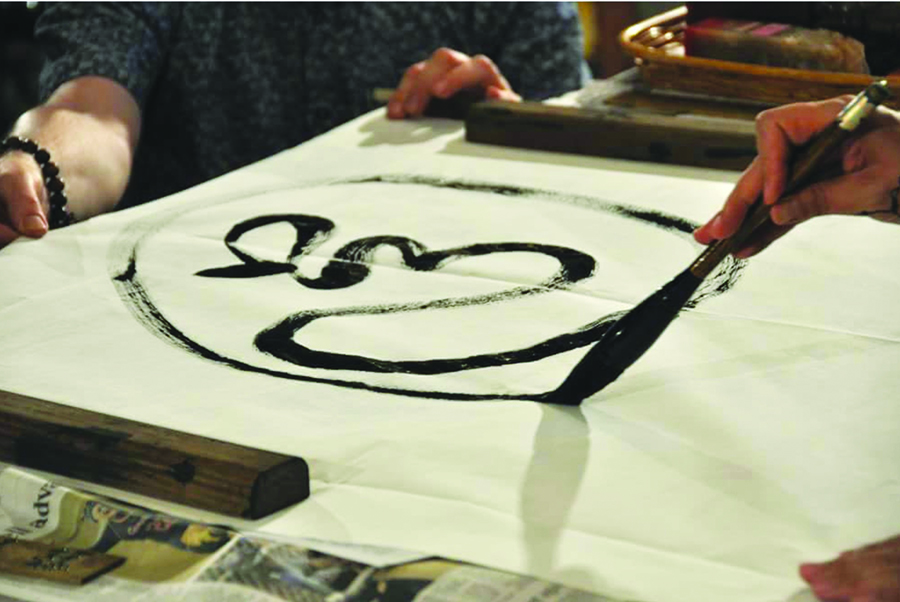 My teacher, Dr Zhi Gang Sha, is the sole lineage holder of the rare, ancient form of Yi Bi Zi Chinese calligraphy taught by 103-year-old Professor Li Qiu Yun. This unique form of one-stroke writing carries high-level messages to promote a harmonious, positive life.
The intricate characters combine to describe the greatest qualities of life —love, forgiveness, compassion and service to others. The positive affirmations, concentration and meditative aspects lead to harmonious mindsets, attitudes and beliefs.
Tao calligraphy is unique because it utilizes a powerful movement practice. The message is traced with the hands or whole body while chanting the positive message. The art is a fun, powerful way to help people move and meditate. Benefits of regular tracing include better circulation, stress reduction, relaxation and mental clarity.
LUNA ACUPUNCTURE & WELLNESS LLC
503-853-2866 | James@LunaAcupunctureWellness.com
www.LunaAcupunctureWellness.com
For thousands of years, the tradition of calligraphy has been considered the highest form of art in many ancient cultures. In China and Japan, for instance, calligraphy, or “beautiful writing,” has served as more than just an alluring visual. The roots of understanding and deep contemplation that come through the art uplift all aspects of…
A simple way to protect your online identity is to use strong passwords. Use any or combine all five of these steps to create strong passwords.
Other tips to keep in mind:
✦ Use different passwords for different accounts.
✦ Write down your password in a secure place.
✦ Do not keep passwords in your wallet or bag.
✦ Do not post passwords to your computer screen.
✦ Do not store passwords on any technical device.
✦ Change passwords once every three months.
Immediately change your passwords when alerted of a security breach. Cybercrime is a very real threat in our Internet-connected society — so take precautions.
THE DEPARTMENT OF THE PROSECUTING ATTORNEY
1060 Richards St., Honolulu HI 96813
808-768-7400 | Office hrs: Mon – Fri, 7:45 am – 4:30 pm
www.honoluluprosecutor.org/contact-us/
A simple way to protect your online identity is to use strong passwords. Use any or combine all five of these steps to create strong passwords. Step 1 Select a non-English word at least eight characters long — for example, the Hawaiian word kapakahi, meaning “crooked.” Step 2 Convert one letter to a number. In “kapakahi,” the…