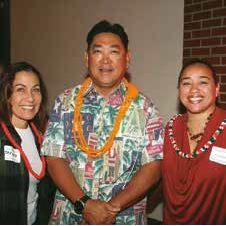
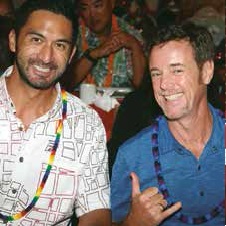
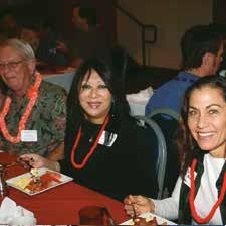
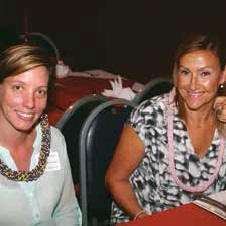
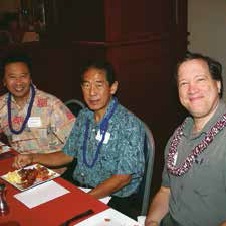
Generations Magazine roving photographer David Livingston captures movers and shakers attending senior events and facility grand openings around the islands.
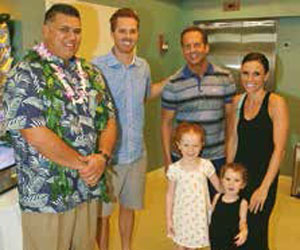
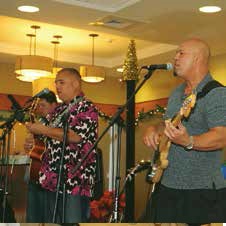
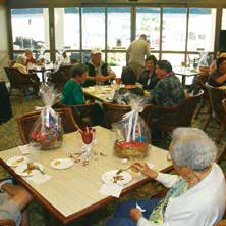
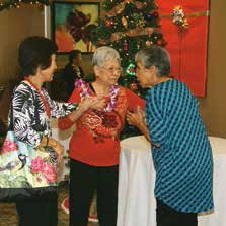
Kala¯kaua Gardens, a premier senior assistedliving community, held its grand opening in early December. Residents and friends alike enjoyed stellar performances and great food.
The other grand event was, of course, GM’s brunch at Dave & Busters, where partnerships and friendships among all who support the welfare of our senior community were celebrated.
Generations Magazine roving photographer David Livingston captures movers and shakers attending senior events and facility grand openings around the islands. Kala¯kaua Gardens, a premier senior assistedliving community, held its grand opening in early December. Residents and friends alike enjoyed stellar performances and great food. The other grand event was, of course, GM’s brunch at Dave…
“ I didn’t really choose Waikīkī — my feet were already permanently planted here in the sands of my ancestors. Waikīkī is my kuleana and it makes me whole.” — Jeff Apaka
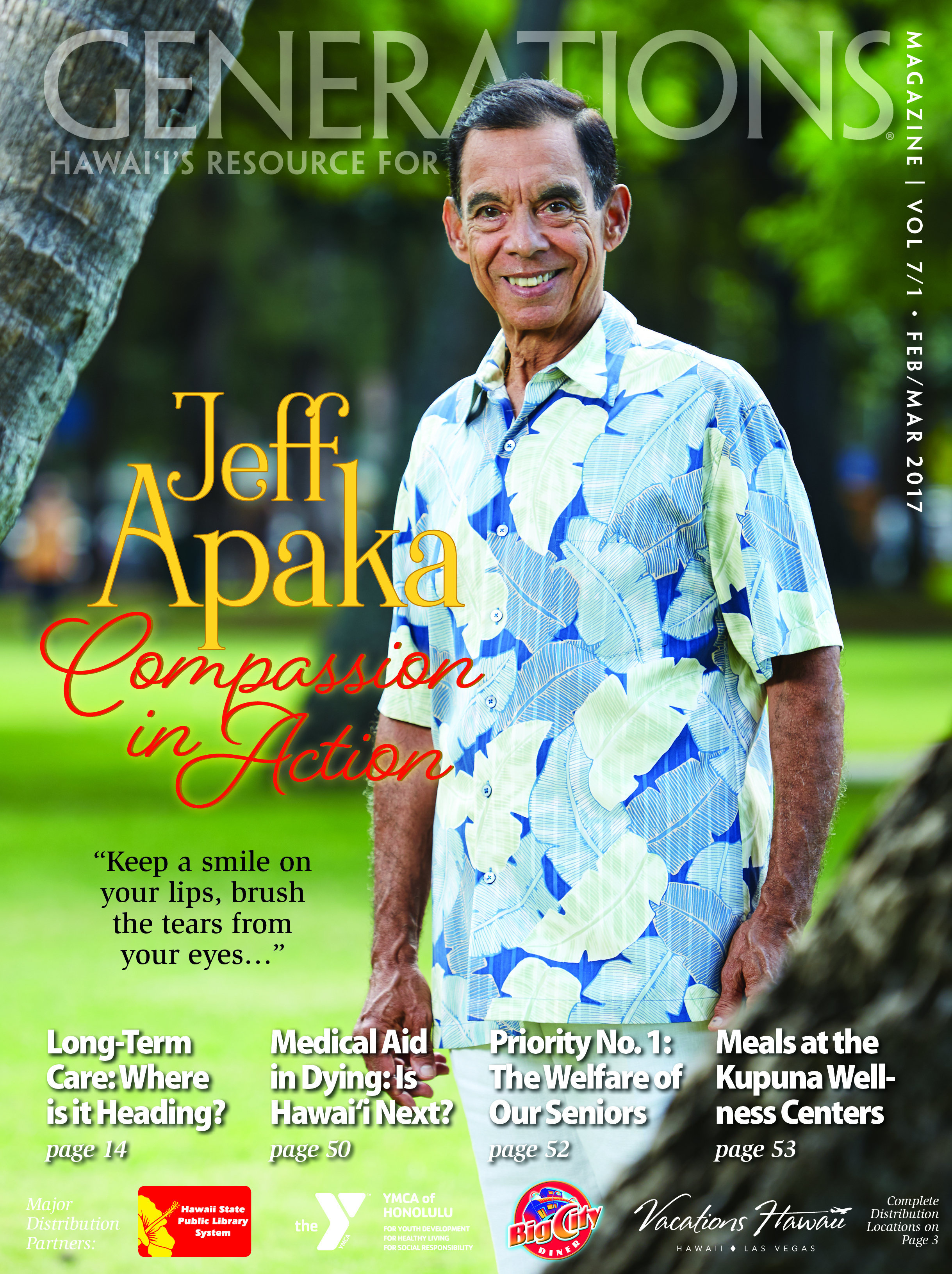
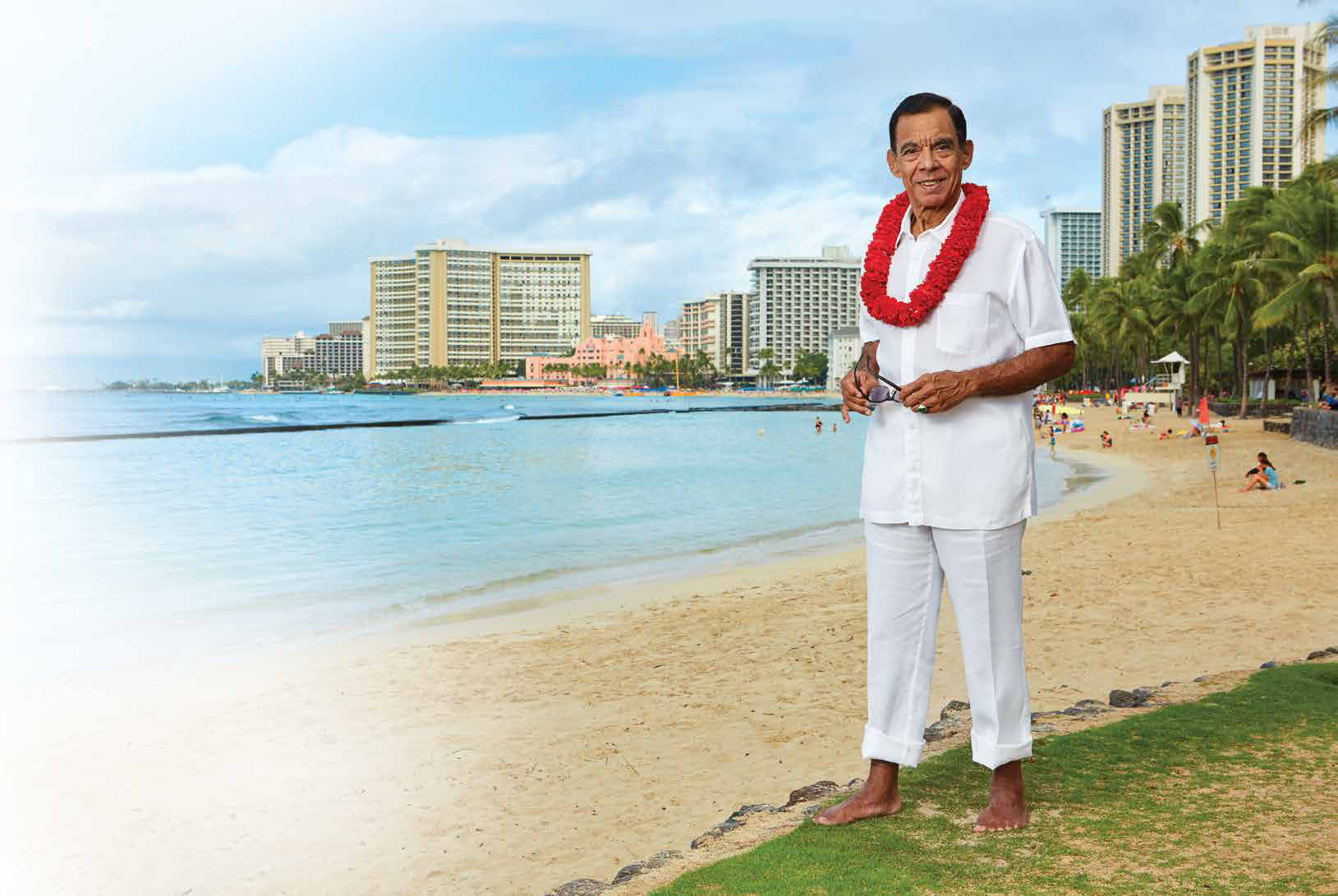
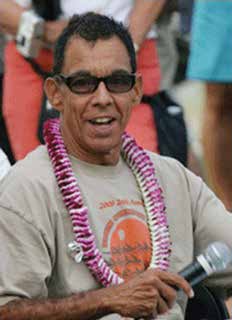
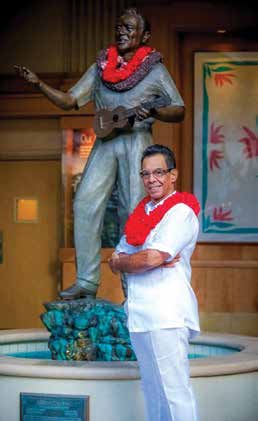
Hawai‘i greets the rest of the world at Waikīkī. Each year, millions of tourists compare their Hawai‘i brochures to the first impressions they get from the world’s most famous beach community. Jeff Apaka grew up there, entertains there, works as community relations director for Waikīkī Community Center and sits on the Waikīkī Neighborhood Board No. 9. He is a serious advocate for his community.
Hawai‘i operates on a delightful mix of pragmatism and altruism. We are very practical people who can make something from nothing, solve problems and find a way to do whatever is needed. We don’t think about rewards as much as we care about helping others. The highest praise is when a kūpuna says we are “nice.” That one word means we manage our kuleana (responsibilities) well, respect our community and try to make decisions that help people around us feel more comforted, happy and secure.
Jeff Apaka is nice. He is part Hawaiian, part Chinese and a few more parts; he embodies the finest Hawaiian traits. In his roles as a professional “showman” and a compassionate community leader, he taps into his gift of kindheartedness and uses his innate talents to make life in Hawai‘i a little better for everyone.
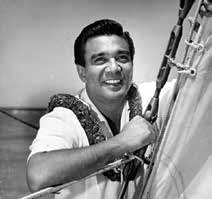
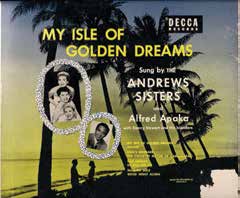
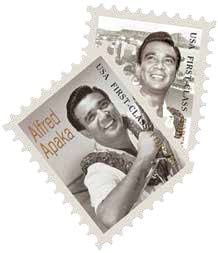
Alfred Apaka, 1919 –1960
It wasn’t easy getting to where he is. Jeff’s father, renowned romantic baritone Alfred ‘Aholo Apaka, died at age 40 when Jeff was just 13. Besides a career as an entertainer and producer, Jeff had a family kuleana to care for two of his elders. Blending his gift of compassion into his entertainment talents led him to a long career with Waikīkī Community Center as a community relations director. Now in his own kūpuna years, Jeff is a protector of his beloved Waikīkī community, and the elders who live there.
His early life was split between Hawai‘i and Beverly Hills. When he was 6, the movies and TV drew the Apaka family to Beverly Hills with the help of Bob Hope. Billboards, neon lights and Hollywood glitz fascinated little Jeff, with bigger-than- life director, actor and studio executive “neighbors” like Caesar “Butch” Romeo and The Andrews Sisters. Beverly Hills High School schoolmates included Rob Reiner, Rick Dreyfus and Albert Brooks.
Alfred Apaka’s crossover career was hot. From his start at Don the Beachcomber (now The International Marketplace), his records began selling on the mainland. Postwar thirst for Hawaiian music was driven by a hundred thousand veterans who had fallen in love with the romantic, soothing airs of steel guitars, ‘ukulele and island tunes sung by luscious Hawaiian voices like Apaka’s. In the ’50s, aloha shirts were the rage and the “Hawaii Calls” radio show broadcast around the world. Sellout crowds at The Lexington Hotel’s Hawaiian Room in New York City clamored for the tunes of Alfred Apaka, “the darling of Manhattan;” Mahi Beamer; John Kameaaloha Almeida; Haunani Kahalewai; Nina Keali’iwahamana; Clara Inter (Hilo Hattie); and the Ray Kinney band.
Jeff’s dad appeared on “The Ed Sullivan Show” and “The Dinah Shore Show.” Bob Hope helped him get a contract to help Henry J. Kaiser popularize his new Hawaiian Village Hotel in Waikīkī. The sky was the limit.
Fame often takes its toll on families. When Jeff was in the fourth grade, his parents divorced and he returned to Honolulu with Mom. He began exploring his own performing talents. During eighth grade at San Rafael Military Academy, tragedy struck — Alfred’s heart suddenly failed during a game of handball — and Dad was gone.
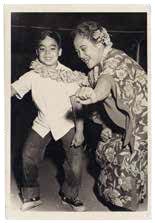
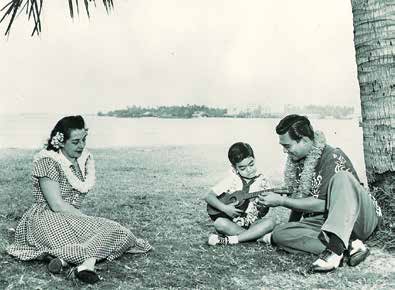
Alfred Apaka teaching his son, Jeff, the ‘ukelele as Mom watches. Above, auntie shows Jeff some hula.
Jeff took it hard. He spent two years at a Jesuit seminary in Canada before returning to Beverly Hills High School, where he graduated in 1964. He went alone to his audition for the American Academy of Dramatic Arts in New York City, and joined a class with Danny Devito and Melanie Safka. He also took acting classes at Fordham University and in 1968, he was singing the mainland nightclub circuit when he had an offer to debut in Honolulu with his own show at the Monarch Room of the Royal Hawaiian Hotel. Things started to happen; he was signed to Capitol Records. Among all the Waikīkī entertainers, Jeff was always the baby; the youngest.
In performing arts, Jeff is his own man. “My voice is like my dad’s but not as romantic — my strength is as a song and dance showman. I had piano and violin lessons when I was young and I love music, but Dad wanted to be a physician, not a singer. He encouraged me to do well in in my studies, but creating live productions is my passion; I can do almost anything onstage.” Jeff also writes skits, directs and produces. His creativity, eye for detail and organization skills make him a talented event producer and manager.
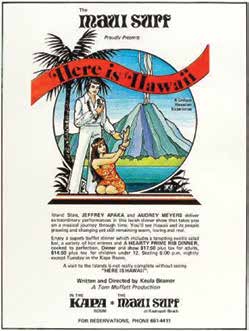
From 1979 to 1983, Jeff starred with Audrey Meyers in the popular “Here is Hawai‘i” stage show written by Keola Beamer and produced by the late Tom Moffatt at the Maui Surf Hotel (now The Westin Maui Resort & Spa).
“That was my favorite gig. We had live rain, snow, an erupting volcano and falling stars onstage. For the “Honolulu City Lights” number, a big moon glowed over a silhouette of the Honolulu skyline as the lights came on in the buildings. A great show transports the audience to their deepest emotions: love, longing, joy and laughter. That’s why we had so much fun doing it and audiences loved it,” said Jeff. “Smiling and laughter is so important to health and longevity, and nothing brings more joy to people than live shows.”
After the Maui show, Jeff returned to Waikīkī to become a caregiver for his maternal grandmother and paternal grandfather. Nobody ever gets training for family caregiving. When the time came, he had the right stuff to honor his kūpuna and keep himself going — compassion and lots of energy.
After his kūpuna passed, Jeff built a career, first entertaining passengers as a cruise director on The Independence and The Constitution. Later, he produced the shows.
“During this time, I was also the chief barker for Variety Club: A Children’s Charity. On Christmas Eve, 1928, a club for entertainers in Pittsburgh found a baby abandoned in their theater and took her to raise. Today, Variety Clubs in many states aid children,” said Jeff. The chief barker (club board president) organizes fundraising events. Jeff’s success with Variety Club of Hawai‘i impressed the late Gerri Lee, who then recruited him to run fundraising events for the Waikīkī Community Center.
Compassion and Business
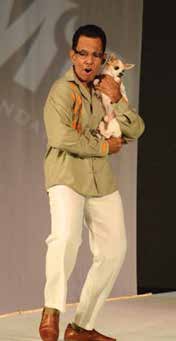
On the flip side, Jeff Apaka is a community leader. In the tradition of Hawaiian performers, his “day job” is critical for residents of Waikīkī. Last month, he celebrated 25 years as community relations director for the WCC on Paoakalani Avenue. In his spare time, he has been serving on the Waikīkī Neighborhood Board No. 9 for the last 18 years. Waiki¯ki¯ residents often see Jeff strolling with Ponoli‘i (the righteous one), his 13-year-old Chihuahua—a kūpuna “puppy.”
“When I grew up on Launiu Street, homes had gardens, hedges, coconut trees — no highrises. The Waikīkī neighborhood was full of Hawaiian families. Local kine beach boys ruled the beach and tourism was just beginning to boom. Later, mainland surfers moved in and brought drugs with them. The stretch from Liliuokalani Avenue to Kapahulu Avenue came to be called ‘The Jungle,’ a pejorative description that portrayed our home as tenement housing for kānaka maoli.”
“That was not the truth. Hawaiian seniors residing in this moderate- living community wanted nothing to do with addicts, who not only ran the streets but also renamed old shore breaks so that the Hawaiian names eventually became lost.
In 1977, Sen. Hiram Fong Jr. and Gov. George Ariyoshi founded the WCC by putting Gerri Lee’s Waikīkī Senior Program in the old St. Augustine parochial school buildings and Dr. Chong’s Waikīkī Health in the vacant convent. Today, WCC also includes the Early Learning Center for preschoolers and an active thrift store.
The board members, staff and donors of WCC developed a very successful nonprofit, offering Waikīkī residents senior health, wellness and prevention programs, and individual case coordination services for frail seniors at risk for homelessness. Caroline Hayashi, president of the nonprofit, said, “Our workshops, activities and educational programs meet the physical, cognitive, social, emotional and well-being needs of our kūpuna. We have over 70 different activities for seniors every month, from exercise to leisure interests — and free parking for all our
activities.”
May 8, 2017, is the 25th anniversary of the WCC fundraiser, The Duke Kahanamoku Beach Challenge (formerly, the Ala Wai Challenge). Jeff built this paddling race around some of Hawai‘i’s most celebrated watermen — Tommy Holmes, Blue Makua, Michael Tongg, Nappy Napoleon and the late Myron (Pinky) Thompson. Now, this huge public event is held at Hilton Hawaiian Village on Duke Kahanamoku Beach, where the lawn comes alive with crafters and live entertainment. Canoes bring in dignitaries to the mauka end of the lagoon for a traditional Hawaiian welcoming protocol to bless the spirited competition and fun!
“When I was new at WCC, I wondered how I could pull off something like this, but the strength and inspiration of my kūpuna and my friends in the community led the way to success,” said Jeff. “It’s a great cause because we help so many kūpuna and keiki.
“Helping is fun. I like escorting seniors on travel tours to outer islands twice a year. At Thanksgiving, I plan a buffet dinner for kūpuna who have no family here or on the mainland. The Waikīkī Beach Marriott Resort & Spa and my musician friends help with food, beverage and entertainment.”
Jeff’s roots in Waikīkī are deep. “We all crave identity. I knew my middle name, ‘Aholo,’ was connected to Dad’s Hawaiian lineage, but our ties to Queen Lili‘uokalani explain my deep affection for Waikīkī and Maui’s red carnations. Actually, I did not really choose Waikīkī — my feet were already permanently planted here in the sands of my ancestors. Waikīkī is my kuleana and it makes me whole.”
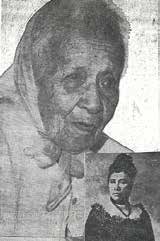
Princess Lili‘uokalani adopted Jeff’s grand-aunt, Lydia Ka‘onohiponiponiokalani ‘Aholo, when she was 7 days old, after her mother died in Lahaina, Maui. Lydia played in the princess’s gardens on Wainani Way, Waikīkī, when Lili‘u’s land, Hamohamo, was an open meadow stretching across Paoakalani Street and the Ala Wai Canal to Kapahulu and out to the beach. Lydia attended Kawaiaha‘o Seminary School for Girls. She was the first graduate of Kamehameha School in Kalihi and its first Hawaiian language instructor. Lydia’s father, Luther ‘Aholo, taught at Lahainaluna Seminary. “Aunty Lydia ‘Aholo told Alfred Apaka to honor Queen Lili‘uokalani by wearing a double lei of sweet, tiny red carnations that grew in Luther and Keahi’s yard on ‘Aholo Road in Lahaina. Today, whenever Jeff performs, he wears white to set off the traditional ‘Aholo double red carnation lei — and his father’s jade ring.
Lydia Ka‘onohiponiponiokalani ‘Aholo
Jeff talks about the future with the same energy and compassion that he puts into all his work. “I wish all kids could experience the mainland living. It would help them relate better to visitors, and allow them to better appreciate Hawai’i Nei. The ‘āina connects everything and we must do what we can to protect it. Waikīkī ahupua‘a extends up Mānoa Valley. A lot of the kingdom is underneath the concrete of Waikīkī.”
Jeff recently finished five years starring in and producing a Hawaiian show at the Hilton Hawaiian Village. “Visitors still come to Hawai‘i to hear live Hawaiian music,” he said. He is looking for a permanent theater home in Waikīkī for an updated live show.
Jeff worries about Waikīkī kūpuna on fixed incomes, and especially those who are being displaced by high-rise condominiums. “Just a small increase in the cost of living forces seniors to make choices about what they can afford to buy. Sometimes the choice is between rent and food.
Every little thing we can do for them that saves them money helps them keep going and stay in their homes. I hope everyone who reads this article will support the Waikīkī Community Center. I hope Waikīkī families will seek WCC services, participate in our programs, volunteer or donate.”
Feeling pity doesn’t help others; action does, but requires a lot of courage. Jeff does not shrink from his desire to help others. He finds a way to get things done, like the Hawaiians of old.
“Mahalo to all the community leaders and people who have worked with me through the years; I know your love for this place.”
Jeff makes me think of one Alfred Apaka lyric, “Keep a smile on your lips, brush the tears from your eyes…” Jeff energizes his deep compassion to help kūpuna, keiki and their families — and dry up their tears. It’s a powerful talent. Perhaps Jeff’s recipe for success is worth a try.
Lend Your Support for a USPS Alfred Apaka Stamp
Jeff is leading a campaign for a commemorative stamp in 2019, Alfred Apaka’s 100th birthday. The U.S. Postal Service counts on the Stamp Advisory Committee to decide who gets honored. We need thousands of letters from the entire Hawai’i community to win their attention. Write a short note today and send it to:
Citizen’s Stamp Advisory Committee
475b L’endant Plaza SW, Rm. 3300
Washington, DC 20260-3501
Sample Letter:
Aloha to All Committee Members,
Please consider commemorating Alfred Apaka (1919–1960) on a U.S. Postal Service stamp in 2019.
Before jet travel, the romantic voice of Alfred Apaka broadcast throughout the world live on “Hawaii Calls,” “The Ed Sullivan Show” and “The Dinah Shore Show,” making fans everywhere dream of visiting the Hawaiian Islands. In the dynamic years leading to statehood, Apaka’s popularity drew audiences to all Hawai‘i entertainers and a new genre of American music.
Mahalo for your kind consideration!
Hawai‘i greets the rest of the world at Waikīkī. Each year, millions of tourists compare their Hawai‘i brochures to the first impressions they get from the world’s most famous beach community. Jeff Apaka grew up there, entertains there, works as community relations director for Waikīkī Community Center and sits on the Waikīkī Neighborhood Board…
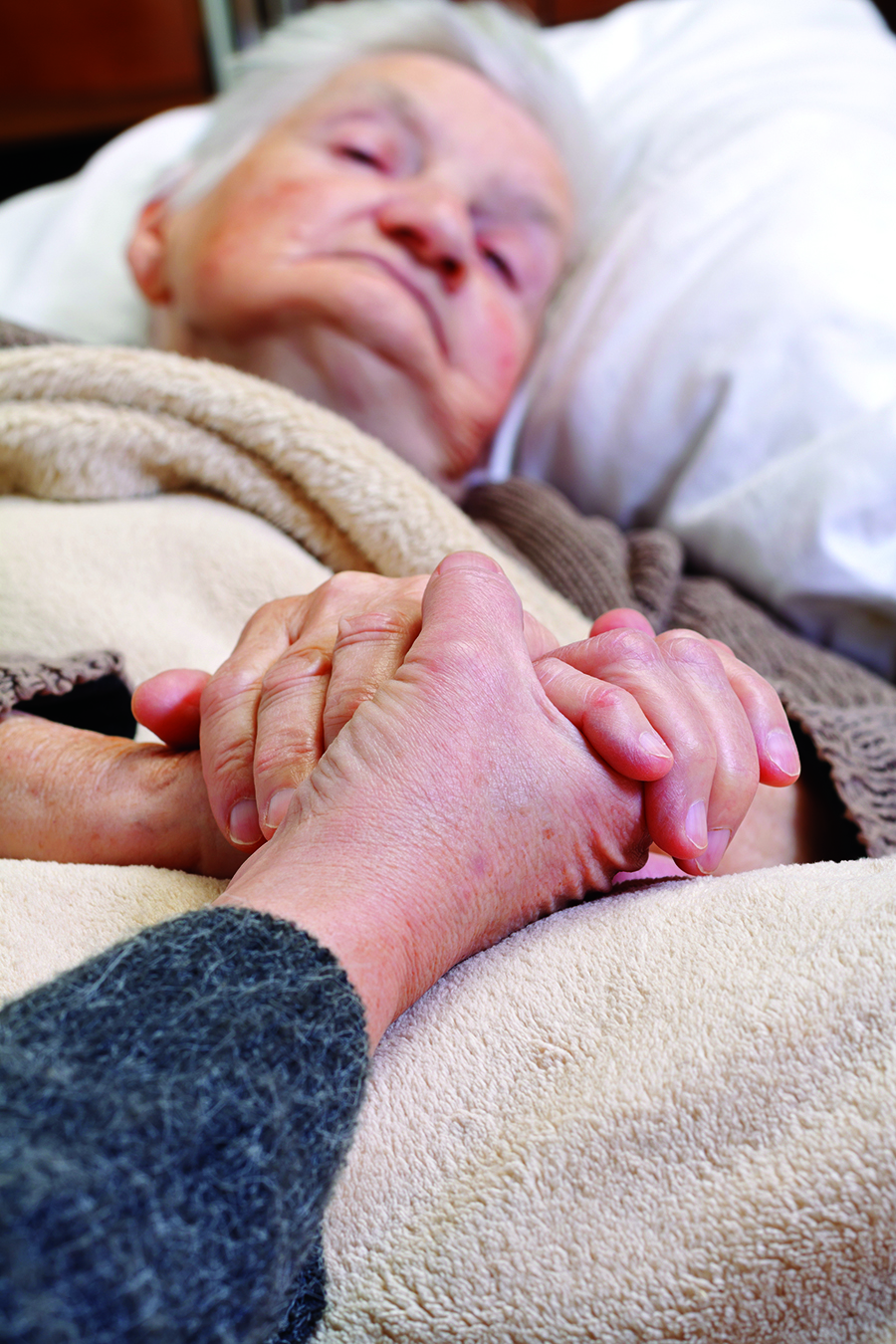
Ten thousand people die each year in Hawai‘i. For some terminally ill, the medical care they receive is insufficient to ease their pain, loss of autonomy or feelings of indignity as they begin the dying process.
In Hawai‘i, these individuals have limited options to end their suffering if the dying process becomes unbearable. Current choices include: refusing medical treatments you don’t want, palliative care (pain management) or voluntarily stopping eating and drinking (VSED). However, individuals often aren’t aware of these options and physicians do not always offer them. More importantly, none of them result in a quick or peaceful death.
Kama‘a¯ina are becoming aware that they have the right to direct their own healthcare and the people of Hawai‘i overwhelmingly support adding a medical aid in dying possibility to the range of end-of-life care (QMark, November 2016).
Medical aid in dying, also known as death with dignity, is when a terminally ill, mentally capable individual who has a prognosis of six months or less to live requests, obtains and — if his or her suffering becomes unbearable — self-administers medication that brings about a peaceful death.
Medical aid in dying is currently authorized in six states (Oregon, Washington, Montana, Vermont, California and Colorado) and Washington, D.C., offering large numbers of Americans a say regarding their living and dying process. Each state’s regulatory and procedural requirements are slightly different, but all the legislation includes the following provisions, among others:
• The dying person must be fully informed about all their options;
• The dying person must request the prescription from a physician and be free from undue influence or coercion;
• The dying person must be able to self-administer the medication;
• Wills, contracts, insurance and annuity policies are not affected by a person choosing aid in dying.
In the more than 30 combined years of medical aid in dying in the authorized states, there has not been a single instance of documented abuse. Two decades of rigorously observed and documented experience in Oregon shows that the law works as intended, with none of the problems opponents had predicted.
It’s time, Hawai‘i. Compassion & Choices Hawaii is working to change our laws to allow medical aid in dying in the Aloha State. As of this writing, a bill is before our legislators… this could be the year that Hawai‘i residents finally have the range of end-of-life options they deserve.
Want to help? In December 2016, four former Hawai‘i governors — George Ariyoshi, John Waihe‘e, Ben Cayetano and Neil Abercrombie— wrote an opinion piece for the Star-Advertiser urging lawmakers to pass the bill.
Now is the time to let your elected officials know that you also support the practice.
You can also make a donation. Thanks to a generous $250,000 challenge grant from the Joyce Stupski Family Fund of the Hawai‘i Community Foundation, every donation to Compassion & Choices
Hawaii will be matched dollar for dollar.
You can also volunteer. Join Compassion & Choices Hawaii’s team of advocates to help ensure that we have the full array of end-of-life choices by emailing msteiner@compassionandchoices. org or by contacting C&C HI directly.
Ten thousand people die each year in Hawai‘i. For some terminally ill, the medical care they receive is insufficient to ease their pain, loss of autonomy or feelings of indignity as they begin the dying process. In Hawai‘i, these individuals have limited options to end their suffering if the dying process becomes unbearable. Current choices…
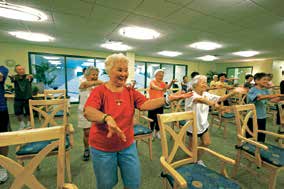
Balance. It’s something everyone takes for granted without a second thought about how crucial it is to daily living. However, it’s wise not to underestimate the importance of having good balance, especially in our senior years.
In addition to an increased risk of falls, poor balance and mobility can limit daily living activities and participation in leisure-time activities. Thus, it is essential to incorporate balancebuilding exercises into physical activity programs. Equally as important is a proper training progression to not only maintain or improve balance, but to ensure safety while practicing these exercises.Below is an outline of the components of a properly progressive balance training program.
Balance training exercises should start with placing the feet in a series of positions that gradually reduce the base of support, holding each stance for 10 to 30 seconds. These exercises provide subtle changes in balance, similar to those experienced in everyday life, allowing your body to learn how to respond appropriately so balance is maintained while standing still:
Feet together as close as possible
Semi-tandem (one foot ahead of the other as if taking a step)
Full tandem (heel of one foot directly in front of the toes of the other foot)
Standing on one foot
Gradually, introduce additional exercises that do the following:
Add dynamic movements to react to disturbances and changes in balance (leaning or stepping in different directions, lateral and forward reaching, picking up an object from the floor and tandem walking)
Reduce visual input by closing the eyes or dimming the lights
Challenge the vestibular system by moving the head from side to side
Challenge the somatosensory system by standing on foam pads or another type of unsteady surface
Another important progressive component is the modification of the use of hand support.
General guidelines for a proper progression of hand support include:
Holding onto a chair with both hands
Holding on to the chair with only one hand
Using just one finger to balance
Moving both hands free of the chair, but keeping them nearby — just in case
The key to balance exercises is to challenge yourself within your personal comfort zone. Progressing too rapidly can actually contribute to a fall. Many seniors perform these exercises with the assistance of wellness trainers as spotters. The spotter’s role is to stand by to steady participants, ensuring they do not fall, a necessary component of safety and effectiveness allowing seniors to challenge themselves and improve to more advanced types of exercises.
Balance. It’s something everyone takes for granted without a second thought about how crucial it is to daily living. However, it’s wise not to underestimate the importance of having good balance, especially in our senior years. In addition to an increased risk of falls, poor balance and mobility can limit daily living activities and participation…
Aches and pains, having to avoid certain things, imbalance — people often have the misconception that these problems are a natural part of aging. There are physiological changes that naturally occur with aging, but these should only be contributing factors rather than the determining factor. The key factor is that the human body is highly adaptable. The unfortunate aspect is that this applies to both the bad as well as the good.
If the body is not challenged to move the correct way, it will naturally develop bad habits that ingrain deeper as time passes. The body’s high adaptability becomes a detriment in that it masks the problem until it grows big enough to cause pain. Higher levels of pain cause greater compensations, which in turn, cause greater deviation from normal, healthy movement.
Like any bad habit, it can take a lot of mental effort to correct. Fortunately, in most cases, the amount of physical effort is minimal in comparison to the mental effort. So, by reversing the unconscious bodily bad habits into normal movement, pain, lack of mobility, instability, etc., should all be resolved.
Muscles provide roughly 80 percent of the body’s stability and even 90-plus-year-old muscles retain high adaptability. Benefits can be achieved through therapy aimed at restoring normal protection and movement of muscles.
PRIME PHYSICAL THERAPY, INC.
600 Queen Street, C-2, Honolulu HI 96813 808-286-0914 | www.primepthawaii.com
Aches and pains, having to avoid certain things, imbalance — people often have the misconception that these problems are a natural part of aging. There are physiological changes that naturally occur with aging, but these should only be contributing factors rather than the determining factor. The key factor is that the human body is highly…
In the world of natural medicine, nothing is so commonly misunderstood as homeopathy. Even among well-educated consumers who can name the best supplements for every condition under the sun, mystery prevails…
Homeopathy is vastly different than allopathic medicine. Food, herbs, supplements and most allopathic medicines work on the biochemical level: Chemical constituents are digested and utilized.
Homeopathy works on the bioenergetic level. Working through the body’s energy system and bearing some similarities to acupuncture, homeopathic medicine may deliver messages almost instantly through the body’s nerve pathways. Homeopathic medicines relieve everything from allergies to arthritis pain to flu symptoms.
Developed by Dr. Samuel Hahnemann more than 200 years ago, “homeopathy” means “similar suffering.” By using trace amounts of natural substances, which at high doses caused symptoms similar to those he was aiming to treat, Hahnemann created nontoxic treatments that safely awakened the body’s healing response.
One of the greatest appeals of homeopathy is its universal safety.
Regardless of age, health conditions or the use of other medications, homeopathy is nontoxic.
Today, hundreds of scientific studies have demonstrated homeopathy’s efficacy, and it’s now covered by many national healthcare plans.
In the world of natural medicine, nothing is so commonly misunderstood as homeopathy. Even among well-educated consumers who can name the best supplements for every condition under the sun, mystery prevails… Homeopathy is vastly different than allopathic medicine. Food, herbs, supplements and most allopathic medicines work on the biochemical level: Chemical constituents are digested and…
The in-home care business is one of the fastest and largest growing industries nationwide, and the demand for services will continue to grow into the foreseeable future. In fact, over the next 15 years, the entire baby boomer generation will pass the age of 65; consequently, when that occurs, there will be nearly 84 million seniors living in America—nearly onefifth of our national population.
In the last census, about 204,700 people over the age of 65 lived in Hawai‘i. Estimates suggest that nearly 40,000 of the state’s seniors will need some sort of long-term care services by 2030.
With an aging population comes an increasing demand for healthcare, which is why the industry is expected to grow 8 percent over the next four years. This demand will be heightened for those who choose to age in place. The term “aging in place” is relatively new in gerontology and has many meanings. It has been defined as “remaining living at home in the community, with some level of independence.” Aging in place has been shown to have health and emotional benefits over institutional care. Scientific evidence indicates that patients heal more quickly at home, which promotes cost savings. Studies have also shown that the longer elders remain independent from institutional care, the better their overall physical and emotional health remains.
The success of the increased growth of in-home care services brings its own set of challenges, such as the recent shortage of nurses, physicians, support staff and other practitioners.
While the number of home healthcare professionals has already tripled over the past 25 years, there is not enough to meet the growing demand for in-home and community-based services. In the case of in-home care services, this means increasing difficulty in finding quality caregivers. Consequently, home care agencies have been forced into fierce competition to hire and pay top wages for the most qualified caregivers. The sparse availability of qualified caregivers has made it critical for in-home care providers to offer flexible schedules to ensure constant field support, while providing continuity to their consumers. The delicate balance between home healthcare professionals, in-home care agencies and consumers is starting to take a toll on the ability to provide services within the community. In fact, many consumers are being turned away for the simple fact that most caregivers are unavailable for the minimal three hour shifts. They are seeking more stable hours, better commuting options, more consistent work hours and an increase in wages.
It is more important than ever to join together as a community to develop programs that support the fields of gerontology and geriatrics and create opportunities to ensure competent healthcare professionals are being utilized across the state.
Stories for and about seniors, events and other topics are always worth sharing, including 100th birthday announcements. Contact Sherry at: 808-722-8487 | SGoyaLLC@aol.com
ALTRES MEDICAL
967 Kapiolani Blvd., Honolulu HI 96814 888-868-1600 | 808-591-4960 | F: 808-591-4915 Melissa.mansfield@altres.com Altresmedical.com
The in-home care business is one of the fastest and largest growing industries nationwide, and the demand for services will continue to grow into the foreseeable future. In fact, over the next 15 years, the entire baby boomer generation will pass the age of 65; consequently, when that occurs, there will be nearly 84 million…
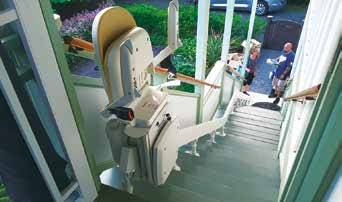
Do you know someone who has fallen and experienced detrimental effects on their physical health, confidence and emotional state? A “stairlift” is a viable solution for those who want to stay in their homes and it provides peace of mind for the family.
Wearing the correct foot wear does not in itself prevent a fall. Additional key “steps” help reduce the risk of falling:
• Try to keep as active as possible in order to maintain muscle strength and aid balance.
• Wear correct, supportive foot wear. Womenshould avoid wedge heels (get more advice from a specialist).
• Get your eyesight checked.
• Get your medication checked by your doctor or pharmacist, particularly when a new medication is added.
• Ensure that your home has adequate lighting, especially from the bedroom to the bathroom. Many falls occur first thing in the morning while rushing to the toilet.
• Consider modifications to the home, such as hand rails, bath grab rails or a stairlift.
• Ensure your seating is at a correct height to enable you to stand without too much effort.
Do you know someone who has fallen and experienced detrimental effects on their physical health, confidence and emotional state? A “stairlift” is a viable solution for those who want to stay in their homes and it provides peace of mind for the family. Wearing the correct foot wear does not in itself prevent a fall.…
Every year, 60,000 Americans are diagnosed with Parkinson’s disease (PD). Of those, many will rely on their families for support.
We often define illness as a term relevant only to the one suffering from a particular disease, yet PD reaches far beyond the individual. For example, those serving as caregivers for their loved ones often focus all of their energy on supporting them, sometimes at the expense of themselves.
Dennis Ideta, a member of the Hawai‘i Parkinson Association, is familiar with the strain placed on care partners of those with PD. After more than five years in this role, he has compiled some insights on how to handle the accompanying emotional strain. Here is some of his advice:
PATIENCE IS KEY
For some, the biggest challenge is the initial turmoil that follows diagnosis. For others, it is the years that follow. “Do not let the person with Parkinson’s feel sorry for themselves,” said Ideta, “Once in a while is okay, but not continually.” There is currently no cure for Parkinson’s disease; however, there are certain measures that can be followed in order to manage its progression.
DON’T TAKE IT PERSONALLY
After a certain point, a person suffering from PD may become identified with their condition. When tensions mount, which can happen when PD interferes with our lives, we must remember that it is not their fault; they are not their disease. “Be flexible but firm when necessary,” said Ideta. Our priority is their safety and happiness.
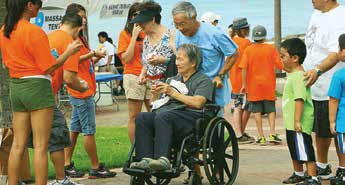
The annual walk for Parkinson’s disease.
ACCEPT LIMITATIONS
In order to face our limitations, we must accept them. Upon initial diagnosis, some experience a period of denial. Mr. Ideta mentions that his wife “also had a hard time telling other people she had the disease and kept it quiet.” Rejecting the obstacles created by PD can make it seem impossible to overcome them.
TAKE PART IN A SUPPORT GROUP
Many of us forget the importance of community. Some assume that the weight of PD is one that is shouldered by the family alone; however, by working together, we can help one another achieve a higher level of health and happiness. Not only can others serve as invaluable resources for advice and suggestions, but as emotional support, as well. While our loved ones rely on us as caretakers, care partners can rely on each other so we can be there for those who need us.
The Hawai‘i Parkinson Association is one local resource specifically for those affected by PD. Its website contains a wide range of resources, including information on local clinical trials, assistive devices and local events. The association also hosts support groups that are open to those diagnosed with PD and their care partners.
While PD undoubtedly can be a source of anger and frustration, together we can help the love shine through.
Every year, 60,000 Americans are diagnosed with Parkinson’s disease (PD). Of those, many will rely on their families for support. We often define illness as a term relevant only to the one suffering from a particular disease, yet PD reaches far beyond the individual. For example, those serving as caregivers for their loved ones often…
I’ve been a volunteer caregiver for about 25 years now and know well that it is undoubtedly the most difficult and underappreciated job on the planet. However, in caring for my own father, I found that it is also a privilege and a sacred trust, sharing the most meaningful moments of your loved one’s life. But amid the cleaning, meal planning and cooking, and arranging medications and doctor visits, exhaustion can consume you, making time pass by without you being able to fully appreciate precious final years — possibly even days.
I am most grateful for the time we had to just sit and talk over dinner, watch TV, or discuss current events and politics. Over the dinner table, the greatest blessings were stories of my parents’ early life growing up with my grandparents, aunts and uncles, about how they met and fell in love, and handled the challenges of their careers and young parenthood. Even if I’d heard the stories many times before, I was so thankful for the repetition so I could remember them later.
I am so fortunate that I was able to reduce my work hours significantly during this time, as I fully realize many caregivers must juggle work and family obligations in addition to caregiving responsibilities. One of the first things I did to celebrate my retirement was to go on a cruise with my parents, husband and daughter. Yes, it took some work to manage the wheelchairs, walkers and extra baggage — and it was expensive — but the experience was priceless. We saw the Panama Canal, and Central and South America, but what I remember most was our daily walks on the promenade deck, marveling at all the shades of blue on the open ocean, and enjoying a fine-dining experience every night with lovely, leisurely and stimulating dinner conversations.
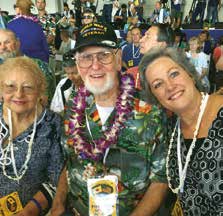
I arranged to take my mom and dad, a WWII veteran, to the 2015 Pearl Harbor commemoration on Dec. 7. The honor and privilege of sitting among those aging heroes is one I will never forget or take for granted. My father has always been my hero, but it filled my heart with joy to witness him being accorded such respect and gratitude by people who did not have the pleasure of really knowing him. After the early morning program, we had lunch together and I learned more about my parents’ wartime experiences and my dad’s years of service in the Navy and National Guard.
I guess what I’m saying is that the love that we share with friends and family is the only thing that really matters in the end. Even in my volunteer caregiving experience, I found the greatest blessings in those quiet moments when stories of a precious life unfold. Take time to sit and talk, hold hands, share hugs and listen with your heart wide open. The treasures you find will rejuvenate and inspire you for the rest of your life.
I’ve been a volunteer caregiver for about 25 years now and know well that it is undoubtedly the most difficult and underappreciated job on the planet. However, in caring for my own father, I found that it is also a privilege and a sacred trust, sharing the most meaningful moments of your loved one’s life.…
Kokua Council, one of the oldest senior citizen advocacy groups in Hawai‘i, plays an important role in a complex web of community organizations. Kokua’s main focus is on the informational, advocacy and educational needs of seniors.
Kokua complements and supplements the agendas and actions of national and local agencies, and coalitions such as AARP, HGEA retirees, Kupuna Caucus, the Caregivers Coalition and the Center on Aging, just to name a few. Kokua’s niche and strengths are the experience and wisdom of a board of directors who individually and collectively have been engaged and respected voices for seniors for some 40 years. Among our leaders and advisors are long-time advocates such as Laura Manis, Sam Cox, Tony Lenzer, Larry Geller, Marilyn Seely, T.J. Davies, Barbara Service and Lyn Moku.
The Kokua Council are government watchdogs, taking care that the laws are well-written and most importantly, enforced in ways that serve their intended purpose and benefit. Kokua believes that no government, no matter how well intended, can see the whole picture, or can fully understand the impacts of its actions or inactions.
Kokua also believes in stimulating, facilitating and sponsoring an ongoing public dialogue regarding issues of importance.
For many years, Kokua Council has sponsored monthly public meetings, where movers, shakers, experts and leaders come to explain, discuss and make cases for policy positions. When there is a new state or city administration, Kokua invites new administrators to address its members.
Recently, Kokua established a Windward Chapter, where retirees on Windward O‘ahu can engage seniors and, their elected representatives in informational and educational meetings.
In the last several years, Kokua Council has sponsored debates among mayoral and congressional candidates. Its annual Community Priority Setting Forum draws participation from a wide range of community organizations, each sharing their agendas and seeing collaborative support.
Over 50 individuals, including members of the Legislature, joined the council’s 2016 forum.
Of particular interest and concern are the most vulnerable among us: the physically, financially, emotionally, mentally and politically frail. As Hawai‘i’s aging population grows and its needs intensify, Kokua Council recognizes that many cannot effectively express or advocate for their personal and family needs. Too often, government hearings are held in places and at times that are challenging for seniors. Federal and state health and human services systems are layered with complex and often befuddling eligibility rules and barriers. Services are not always available at times and in areas where there is need.
This year, Kokua Council filed suit against the state Department of Health over its failure to follow the law and post timely and complete inspection reports.
Seniors and their family members are encouraged to attend Kokua Council’s monthly meetings (fourth Monday of each month), become members and even serve on its board of directors.
c/o Harris United Methodist Church
20 South Vineyard Blvd., Honolulu HI 96813
Larry Geller, Kokua Council President | 808-540-1928
Meetings are held on the fourth Monday of each month.
At each meeting, topical issues are presented for discussion
and possible action. View the details online at www.kokuacouncil.blogspot.com/
Kokua Council, one of the oldest senior citizen advocacy groups in Hawai‘i, plays an important role in a complex web of community organizations. Kokua’s main focus is on the informational, advocacy and educational needs of seniors. Kokua complements and supplements the agendas and actions of national and local agencies, and coalitions such as AARP, HGEA…
The Kupuna Wellness Centers provide free lifestyle and wellness programs for older adults (60 years and over) operated by Lanakila Meals on Wheels. The centers provide a wide range of activities to support the physical fitness, cognition and emotional well-being of its participants. Activities include fitness classes, nutritional education, crafts, guest speakers and outings. The centers also provide a daily, nutritionally balanced meal. The goal is to create thriving communities where older adults can make friends and engage in stimulating activities that enrich their lives. Five Kupuna Wellness Centers throughout O‘ahu serve the community.
Kupuna Wellness Center Locations
Phone Number
Hours of Operation
Address
SNI Jisso Center
808-352-0286
Mon.– Fri. 8:30 am – 12:30 pm
47-451 Hui Aeko Place Kaneohe HI 96744
Pohulani Elderly Apartments
808-352-0294
Mon.– Fri. 9 am – 1 pm
626 Coral St. Honolulu HI 96813
West Loch Elderly Village
808-220-9941
Mon.– Fri. 8:30 am – 12:30 pm
91-1472 Renton Road Ewa Beach HI 96706
Waianae District Park
808-220-6681
Mon.– Fri. 9 am – 1 pm
85-601 Farrington Hwy. Waianae HI 96792
Waianae District Park
808-227-9623
Mon.– Fri. 8 am – noon
1139A Kilani Ave. Wahiawa HI 96786
Lanakila Meals on Wheels also provides free meals for older adults (60 years and over) at partner service provider locations*. Older adults can enjoy a free, nutritionally balanced meal, as well as other activities provided by partner services at six group sites on O‘ahu.
For more info on Lanakila Meals on Wheels, call 808-356-8519 or email cr@lanakilapacific.org.
The Kupuna Wellness Centers provide free lifestyle and wellness programs for older adults (60 years and over) operated by Lanakila Meals on Wheels. The centers provide a wide range of activities to support the physical fitness, cognition and emotional well-being of its participants. Activities include fitness classes, nutritional education, crafts, guest speakers and outings. The…

 Ten thousand people die each year in Hawai‘i. For some terminally ill, the medical care they receive is insufficient to ease their pain, loss of autonomy or feelings of indignity as they begin the dying process.
 Balance. It’s something everyone takes for granted without a second thought about how crucial it is to daily living. However, it’s wise not to underestimate the importance of having good balance, especially in our senior years.
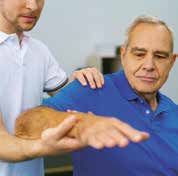 Aches and pains, having to avoid certain things, imbalance — people often have the misconception that these problems are a natural part of aging. There are physiological changes that naturally occur with aging, but these should only be contributing factors rather than the determining factor. The key factor is that the human body is highly adaptable. The unfortunate aspect is that this applies to both the bad as well as the good.
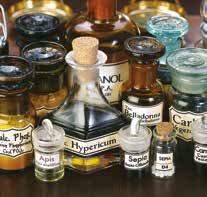 Homeopathy works on the bioenergetic level. Working through the body’s energy system and bearing some similarities to acupuncture, homeopathic medicine may deliver messages almost instantly through the body’s nerve pathways. Homeopathic medicines relieve everything from allergies to arthritis pain to flu symptoms.
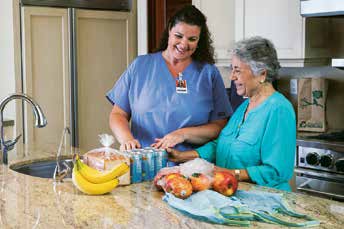 The in-home care business is one of the fastest and largest growing industries nationwide, and the demand for services will continue to grow into the foreseeable future. In fact, over the next 15 years, the entire baby boomer generation will pass the age of 65; consequently, when that occurs, there will be nearly 84 million seniors living in America—nearly onefifth of our national population.
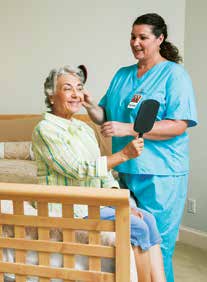 The success of the increased growth of in-home care services brings its own set of challenges, such as the recent shortage of nurses, physicians, support staff and other practitioners.
 Do you know someone who has fallen and experienced detrimental effects on their physical health, confidence and emotional state? A “stairlift” is a viable solution for those who want to stay in their homes and it provides peace of mind for the family.
 Every year, 60,000 Americans are diagnosed with Parkinson’s disease (PD). Of those, many will rely on their families for support.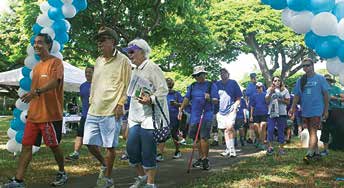
 I’ve been a volunteer caregiver for about 25 years now and know well that it is undoubtedly the most difficult and underappreciated job on the planet. However, in caring for my own father, I found that it is also a privilege and a sacred trust, sharing the most meaningful moments of your loved one’s life. But amid the cleaning, meal planning and cooking, and arranging medications and doctor visits, exhaustion can consume you, making time pass by without you being able to fully appreciate precious final years — possibly even days.
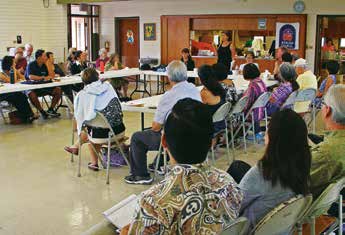 Kokua Council, one of the oldest senior citizen advocacy groups in Hawai‘i, plays an important role in a complex web of community organizations. Kokua’s main focus is on the informational, advocacy and educational needs of seniors.