Category: December – January 2014

  • Frank, as Always: Big-Band Musical Baggage

    Generations Magazine - Go For Broke Monument, Los Angeles - Image 01When Generations invited me to write an article about my high school days, one of the first memories that came to mind was of riding in the backseat of my dad’s 1959 Chevy Impala every morning, heading to school and listening to his favorite radio program.

    In the 50s, there was this DJ named Hal Lewis (aka J. Akuhead Pupule) but I really wasn’t “tuned in” to his show, however, he amused my dad and constantly made him laugh out loud. Aku broadcasted from the “Tree House” at the International Market Place in the early 1960s and played big-band music and stand up singers like Frank Sinatra, Vic Damone, Dean Martin, The Lennon Sisters, The McGuire Sisters, etc. I’ve come to realize now that what I listened to back then affected me for the rest of my life. (Keep that in mind … your kid is being shaped while sitting in the back seat of your car. I have people come up to me and say they listen to my radio show now because their mom and dad used to listen to me in the morning, too.)

    When not with dad, I would listen to this other guy named Elvis Presley on KPOI. So the music that came from dad’s radio each morning was something I had to endure. And to see my dad moving his shoulders to the music, it was kinda goofy! But oddly enough, sitting back there all those years, I started to appreciate the big-band sound and recognize the songs and the people who sang them — Tony Bennett and Nat King Cole. But I had no idea as to the weight of this music and what it meant to my father’s generation — The Greatest Generation.

    It wasn’t until much later that I realized I was a product of the generation who grew up in the U.S. during the deprivation of the Great Depression, and then went on to fight in World War II. I’m a WWII baby. A baby boomer!

    The Greatest Generation dealt with segregation, detention, internment, prejudice and so much more. Yet, many national figures and heroes came out of those trying times. Martin Luther King, for example, came from the Greatest Generation and he spoke eloquently from the depths of disparity, rising up and changing our country and the world forever. And the 442nd Regimental Combat Team and 100th Infantry Battalion local boys who gave more than most … these men were not going to let anything get in their way in achieving their best.

    The Greatest Generation went for it!

    And when I think back on riding in my dad’s car, I feel like I was on the end of a very long shooting star, streaking across the midnight sky. I really had no idea what my parents had gone through but I knew that everything was changing.

    All I’m saying is we must always holomua, keep moving and look forward, but never forget what was laid down before us.


    Join the conversation with Frank B. Shaner on Facebook and experience his art online at www.frankbshaner.com.

    Generations Magazine - Go For Broke Monument, Los Angeles - Image 02
    “The Greatest Generation” … Go for Broke!
    Oil on canvas, 24” x 18”

    When Generations invited me to write an article about my high school days, one of the first memories that came to mind was of riding in the backseat of my dad’s 1959 Chevy Impala every morning, heading to school and listening to his favorite radio program. In the 50s, there was this DJ named Hal…

  • Important Notice: Your Medicare Plan Not Offered in 2014?

    Every year, a few weeks before Halloween, I get dozens of calls from Medicare beneficiaries with questions about Medicare’s Annual Enrollment Period, which begins October 15 and ends December 7. It is the time when Medicare beneficiaries can decide to keep their existing health plan or select a new plan that becomes effective January 1 of the following year. I provide tips to help callers review their options. This year, in addition to those calls, my voicemail overflowed with seniors who received an unexpected letter from about their Medicare health coverage. The notice explained that their Medicare plan would not be offered in 2014 and was ending December 31, 2013. As a result, they would need to take action and select a new plan by December 31, 2013, or their coverage would revert to Original Medicare only.

    SO HERE ARE MY TOP FIVE TIPS:

    Tip 1: You qualify for a special enrollment period from October 15 to February 28, 2013. So now is the time to consider your options. If you don’t take action by December 31, you’ll have Original Medicare coverage only, and will lose prescription drug coverage unless you join a separate Medicare prescription drug plan.

    Tip 2: Decide to join another Medicare Advantage health plan because your plan has notified you that your existing plan will no longer be offered. If you wait until after February 28 to join a new plan with prescription drug coverage, you may have to pay a late-enrollment penalty.

    Tip 3: Call Medicare 24 hours, 7 days a week at 1-800-MEDICARE for help.

    Tip 4: Refer to the 2014 Medicare & You Handbook for detailed information.

    Tip 5: For help comparing plans: Call Hawai‘i’s State Health Insurance Assistance Program, Sage PLUS at 1-888-875-9229. All counseling is free.


    Martha Khlopin hosts the popular weekly radio program “Medicare Moment with Martha — The World of Medicare” sponsored by AlohaCare. It airs on KHNR-690AM on Saturdays from 11–11:30 a.m. and on KGU-99.5FM on Sundays from 10–10:30 a.m. For info, call (808) 973-0754, mkhlopin@alohacare.org.

    Every year, a few weeks before Halloween, I get dozens of calls from Medicare beneficiaries with questions about Medicare’s Annual Enrollment Period, which begins October 15 and ends December 7. It is the time when Medicare beneficiaries can decide to keep their existing health plan or select a new plan that becomes effective January 1…

  • Solar Savvy: Tips from the Industry Pros

    Generations Magazine - Solar Savvy: Tips from the Industry Pros - Image 01Look around. Gleaming new solar panels are going up on roofs all over Hawai‘i. It’s no wonder — with our exorbitant electricity rates, year-round sun and substantial tax credits, installing a PV system in Hawai‘i makes so much sense, especially if you’re on a fixed income. Homeowners who educate themselves before investing will enjoy reliable energy savings for generations to come.

    Here are four tips from the pros:

    • Be aware of sales gimmicks like cash rebates or free trips. Because of the tax credits involved, the government frowns upon these kinds of incentives. Avoid being vulnerable to an audit.
    • Insist on a reputable solar panel manufacturer. There are literally dozens of new brands jumping on the PV bandwagon. You are making an investment that should last decades. Will the company be around to honor its warranty?
    • Ask if the provider employs its installers. Many providers use sub-contractors to handle the all-important installation aspects. If something goes wrong two years down the road, you don’t want your provider passing the buck.
    • Be sure to hire a full-service, licensed solar company. Look for the state’s C-60 Solar Power Systems Contractor license. This ensures your provider has passed rigorous testing and has the necessary experience with solar, roof work, hookups and permitting to do a top-notch job.

    Alternate Energy
    803 Ahua St., Honolulu, HI 96819
    808-842-5853 | www.AlternateEnergyHawaii.com

    Look around. Gleaming new solar panels are going up on roofs all over Hawai‘i. It’s no wonder — with our exorbitant electricity rates, year-round sun and substantial tax credits, installing a PV system in Hawai‘i makes so much sense, especially if you’re on a fixed income. Homeowners who educate themselves before investing will enjoy reliable…

  • UH Press Presents: IF IT SWINGS, IT’S MUSIC: THE AUTOBIOGRAPHY OF HAWAI’I’S GABE BALTAZAR, JR.

    Generations Magazine - UH Press Presents: IF IT SWINGS, IT’S MUSIC: THE AUTOBIOGRAPHY OF HAWAI’I’S GABE BALTAZAR, JR. - Image 01Hawai‘i’s legendary jazz musician Gabe Baltazar, Jr. has thrilled audiences since the late 1940s with his powerful and passionate playing. In his memoir, If It Swings, It’s Music, Gabe takes readers along the long road to becoming one of the very few Asian Americans who has achieved worldwide acclaim as a jazz artist.

    Born in Hilo and raised in Kalihi-Palama, Gabe (Gabriel Ruiz Hiroshi Baltazar Jr.) was encouraged by his father, an accomplished musician, to take up the clarinet and saxophone. As a teenager during World War II, Gabe performed with the Royal Hawaiian Band but spent his weekends playing in swing bands. After establishing himself in the West Coast jazz scene, in 1960 he rose to prominence as lead alto saxophonist of the famed Stan Kenton Orchestra. The group recorded more than a dozen albums and won two Grammy Awards.

    From 1964 to 1969, Gabe recorded with Dizzy Gillespie, James Moody, Oliver Nelson. He was also a regular in the Los Angeles recording studios, and he filmed with Pat Boone, Phyllis Diller and Glen Campbell. In 1969, Gabe returned to Hawai‘i to work as assistant director for the City and County of Honolulu’s Royal Hawaiian Band, a post he held until 1985. He brought jazz to the public schools and went on to become Hawai‘i’s premier jazz artists. Now 84, he mainly performs informal gigs with friends and family.

    Gabe’s memorable encounters with the greatest names in jazz is fond record of days past. (University of Hawai‘i Press, paperback, $24.99)

    Hawai‘i’s legendary jazz musician Gabe Baltazar, Jr. has thrilled audiences since the late 1940s with his powerful and passionate playing. In his memoir, If It Swings, It’s Music, Gabe takes readers along the long road to becoming one of the very few Asian Americans who has achieved worldwide acclaim as a jazz artist. Born in…

  • Welcome to the Generations808.com Homepage

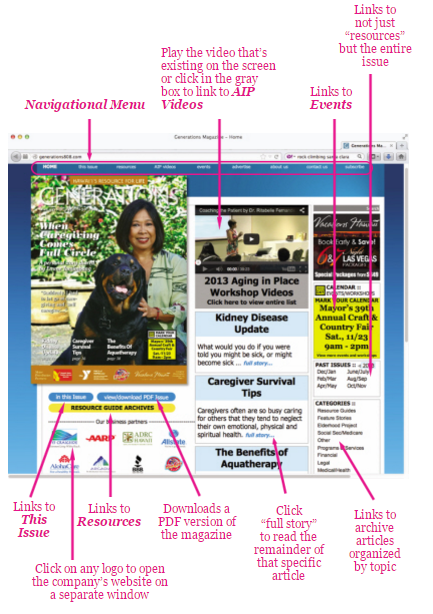
    Main navigation menu: Use these topics to navigate to the various pages in our site. As you run the cursor over the word, it’ll become bold. These topics will always exist on every page. Throughout the homepage, there are also various other buttons that’ll take you to any one of these topics.

    Home is the main page.

    This Issue will take you to the current issue’s table of contents with live\ links to individual articles.

    Resources will take you to resource guide archives.

    AIP Videos show a list of the Aging In Place Workshop speakers.

    Events: contains the events calendar.

    Advertising contains all of our advertising and marketing information.

    About Us is just a little background.

    Contact Us via mail, phone or email.

    Subscribe provides a subscription form so you can enjoy Generations Magazine delivered to your door every other month.

    Generations Magazine - Welcome to the Generations808.com Homepage - Image 01

    Main navigation menu: Use these topics to navigate to the various pages in our site. As you run the cursor over the word, it’ll become bold. These topics will always exist on every page. Throughout the homepage, there are also various other buttons that’ll take you to any one of these topics. Home is the…

  • Hawaii Connector Must Be Consumer Friendly, Accountable and Sustainable

    Beginning in January 2014, Hawai‘i residents who are without health insurance, small businesses, and those who are self-employed will be able to be covered by insurance purchased through an online marketplace known as the Hawaii Health Connector. The Connector was established by the state Legislature in 2011 to offer health plans to the public under the Affordable Care Act.

    After more than $200 million in federal dollars, the Hawaii Connector was last in the nation to provide plan information. It has a long way to go to become the reliable and consumer-friendly organization that Hawai‘i deserves. Equally important, it must be able to sustain operations without federal funds in 2015 — just 14 months away.

    AARP wants the Connector to succeed, but as of the beginning of November its website was minimally functional. Navigation is cumbersome and tools consumers need are lacking. To be consumer friendly, the website needs to add major features such as:

    • tools to assist in understanding plan choices
    • quality of care information, including quality ratings for hospitals, physicians and other providers
    • patient experience information that allows patients to rate their providers
    • complaint data

    Accountability and transparency are major concerns. The Connector was created by the Legislature as the only private, non-profit exchange in the nation. It allowed HMSA, Kaiser, and Hawaii Dental Service to have voting board members despite clear conflicts of interest. The concept was championed by Sen. Roz Baker of Maui. Arguments were that a private entity, freed of the restraints of government bureaucracy, would be more nimble and cost effective.

    But as a private entity, the Connector is not subject to the State Sunshine Law. In an attempt to remedy this lack of openness, Sen. Les Ihara introduced SB 830 that would have required the Connector to comply with open meeting and notice provisions. The bill was held in the Consumer Protection Committee, chaired by Sen. Baker, and it never saw the light of day.

    During the informational briefing to the Legislature on October 9, there were lots of outreach anecdotes. Consumer outreach and education is critical. The Connector Board should take the lead on a specific outreach plan to reach Hawai‘i’s 100,000 uninsured residents.

    The deadline for all exchanges in the nation to be self-sustaining is rapidly approaching. Sustainability is a federal mandate and the Connector needs to deal with it quickly. An early Connector estimate put its 2015 operating costs at nearly $16 million. It needs to identify revenue to match. The Connector Board needs to provide the direction and pull out all stops to become sustainable. There must not be any last-minute surprises. The Connector has to come through. After a huge investment in federal tax dollars, Hawai‘i’s taxpayers must not be asked to pay the difference in 2015 and beyond or — worse yet — bailout the Connector by making it a state agency.

    Generations Magazine - Hawaii Connector Must Be Consumer Friendly, Accountable and Sustainable - Image 01

    Beginning in January 2014, Hawai‘i residents who are without health insurance, small businesses, and those who are self-employed will be able to be covered by insurance purchased through an online marketplace known as the Hawaii Health Connector. The Connector was established by the state Legislature in 2011 to offer health plans to the public under…

  • Home Care for Stroke Survivors

    Gernations - 2014-12-01 - Homecare for Stroke Survivors - Image 01

    Caring for stroke survivors at home can be overwhelming for anyone. Getting outside help from home care agencies can make a difference in your ability to balance your life with your loved one’s needs.

    Ask the following questions to find a trustworthy company with qualified, reliable caregivers who are also compassionate and dedicated.

    Does the provider send a Registered Nurse (RN) to meet the family and develop a plan of care for the caregivers to follow?

    As part of the admission process, an RN Clinical Manager should meet you and your family at the home, assess the family dynamics, perform a head-to-toe physical assessment, provide a home safety inspection and develop a customized care plan for the caregivers to follow. An RN should be available to you 24/7 to provide support.

    Are caregivers supervised and evaluated by a Registered Nurse?

    On a regular basis an RN should:

    • Perform assessments of the patient and make any changes to the care plan
    • Ensure that the family is satisfied with the caregiver and the services the agency is providing
    • Assure the family that they are there as a resource for all parties


    HiHealthCare, 745 Fort Street, Honolulu, HI 96813
    808-534-7815 | info@hihealthcarehawaii.com
    hihealthcarehawaii.com

    Caring for stroke survivors at home can be overwhelming for anyone. Getting outside help from home care agencies can make a difference in your ability to balance your life with your loved one’s needs. Ask the following questions to find a trustworthy company with qualified, reliable caregivers who are also compassionate and dedicated. Does the…

  • Represent: Neighbor Island Seniors

    I was attending a legislative hearing some years ago dealing with senior issues. The hearing went on for some time as the committee members talked about significant health care problems affecting seniors in Honolulu. At some point, a respected senior advocate from Maui raised his hand and said, “Excuse me, this NOT the state of O‘ahu. It’s the state of Hawai‘i.”

    Everyone laughed because what he said was exactly true. Half of the state’s population lives on the Neighbor Islands. And, Maui alone has nearly 32,000 seniors — a number that is expected to increase to approximately 54,000 by 2020.

    On the Neighbor Islands, hospitals and senior care facilities are often few and far between. Family members may be miles — or islands — apart. There are higher costs for gas, groceries — virtually everything seniors count on for quality of life. We hope that policymakers and institutions keep that in mind when making decisions that could impact seniors across the state.

    In this issue, Generations Magazine visits Maui as a starting point for this conversation about our Neighbor Island seniors and their families, but I feel certain other Neighbor Islands will soon be given more consideration, not just by the magazine but by those people helping seniors as they age.

    The fact is, I’m thinking about some waterfront property on Moloka‘i. I might be able to afford it if I live in one of those little storage sheds from Sears. I’ll have to talk to Mrs. Matthews first.


    The Elderhood Project airs on KHON2 Friday Morning news at 5:45a.m. and Thursday at 5p.m.

    I was attending a legislative hearing some years ago dealing with senior issues. The hearing went on for some time as the committee members talked about significant health care problems affecting seniors in Honolulu. At some point, a respected senior advocate from Maui raised his hand and said, “Excuse me, this NOT the state of…

  • Mind & Body: Sober Seniors

    Generations - 2014-12-01 - Mind & Body Sober Seniors - Image 01According to the National Survey on Drug Use and Health conducted in 2012, nearly 41 percent of adults 65 years of age or older drink alcohol. Most of them don’t have a drinking problem, but some of them drink too much. Men are more likely than women to have problems with alcohol.
    What are the effects of alcohol on aging?

    Seniors are more sensitive to alcohol because they metabolize alcohol more slowly than younger people. As a result, alcohol stays in their bodies longer. Also, the amount of water in the body goes down with age, causing a higher percentage of alcohol in their blood than younger people after drinking the same amount of alcohol.

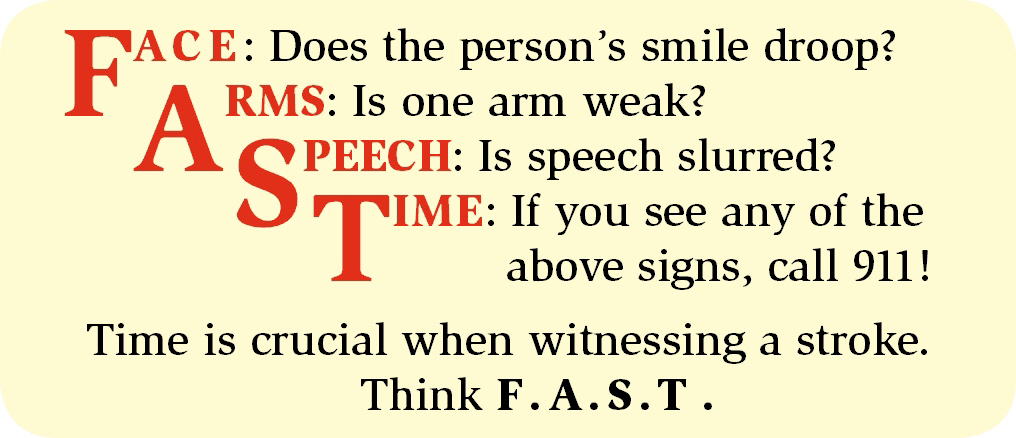
    Aging lowers the body’s tolerance for alcohol. This means that older adults can experience the effects of alcohol, such as slurred speech and lack of coordination, more easily than when they were younger. A senior can develop problems with alcohol even though his or her drinking habits have not changed.

    What are the health consequences?

    Heavy drinking can damage the liver, the heart and the brain. It can increase the risk of developing certain cancers as well as damage muscles and bone. Drinking too much alcohol can worsen some health conditions such as diabetes, gout, hypertension, heart failure, liver problems and memory problems. Other health issues include mood disorders such as depression and anxiety.

    Does alcohol interact with medications?

    Many medications interact with alcohol, for example taking aspirin or other blood thinners and drinking alcohol may increase the risk of stomach bleed. Tylenol and alcohol can increase risk of liver damage. Mixing alcohol with some medicines can cause sleepiness, confusion, lack of coordination, nausea, vomiting or headaches.

    How much is one alcoholic drink?

    • one 12-ounce can or bottle of regular beer, ale or wine cooler
    • one 8- or 9-ounce can or bottle of malt liquor
    • one 5-ounce glass of wine
    • one 1.5-ounce shot glass of hard liquor such as whiskey, gin, vodka or rum

    Are there any benefits to drinking alcohol?

    Studies have shown that light to moderate drinkers — men who have one or two drinks a day and women who have one-half or one drink a day — are less likely to develop or die of heart disease than people who drink more or not at all. Moderate amounts of alcohol raises the level of high-density lipoprotein (HDL) also known as good cholesterol, which is associated with greater protection against heart disease. The risks of drinking must be considered along with the potential benefits. For example, as little as one drink a day can slightly raise the risk of breast cancer in some women, especially those who are past menopause or who have a family history of breast cancer.

    How much alcohol is safe to drink?

    Healthy seniors should not drink more than three drinks a day or a total of seven drinks a week. However, people can still have problems within these limits. Depending on their health and how alcohol affects them, seniors may need to drink less than these limits or not at all.

    Do you need to stop drinking for better health?

    For help and resources, please visit www.hawaiiislandrecovery.com/resources.

    According to the National Survey on Drug Use and Health conducted in 2012, nearly 41 percent of adults 65 years of age or older drink alcohol. Most of them don’t have a drinking problem, but some of them drink too much. Men are more likely than women to have problems with alcohol. What are the…

  • Conversations About Wishes

    Gernations - 2014-12-01 - Conversations About Wishes - Image 01 Auntie K was having trouble breathing at home and her son called 911. She is now in the Intensive Care Unit. The doctor asks the family, “What would your mother want us to do if she could speak for herself right now? She’s having more trouble breathing. Do you want us to “‘do everything?’”

    Unfortunately, this is a very common scenario at hospitals in Hawai‘i. Sometimes, even when people have thought about these things and discussed them with their doctor, they haven’t sat down and talked with their family. And, yet, it is the family that the doctors and nurses turn to for answers.

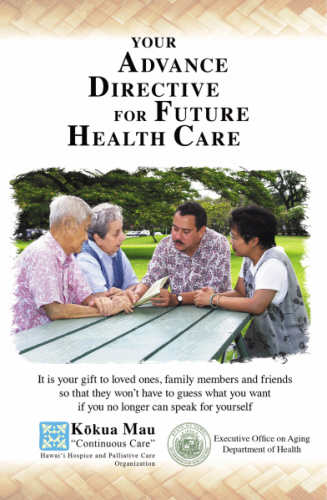
    No one says that conversations about these things are easy. They are not easy. So how do you get started? Who should be involved? In Hawai‘i, one place to turn is Kokua Mau, Hawai‘i Hospice and Palliative Care Organization. Kokua Mau knows these conversations are crucial and it invites you to use its free resources to help explore options and begin the conversation.

    Kokua Mau is a group of volunteers from many organizations and professions who have joined together “to weave a lei of caregiving and support so that the people of Hawai‘i facing serious illness can live in the place of their choice, with relief of pain and suffering and according to their values, beliefs and traditions.” (Kokua Mau Mission Statement)

    Gernations - 2014-12-01 - Conversations About Wishes - Image 02Kokua Mau has information for individuals, families and health professionals. Its website (www.kokuamau.org), has direct links to community resources, such as downloadable Advance Directive forms and printable information that covers topics that we often find difficult to talk about. For instance:
    • If someone is not able to eat, what are the pros and cons of tube feeding? (You can view or download a guide for decision making about tube feeding on Kokua Mau’s website.)
    • What is POLST? (Physicians Orders for Life-Sustaining Treatment, a portable doctor’s order that makes your wishes known.)
    • What are the pros and cons of CPR for someone who is elderly and frail? (Did you know that among this group CPR is less than 5 percent effective?)

    Along with written resources, Kokua Mau has a Speakers Bureau that can meet with your group to start the conversations that we all need to have.

    As our state’s nonprofit hospice and palliative care organization, Kokua Mau recently received national recognition with the 2013 Trailblazer Award from the National Hospice and Palliative Care Organization.

    So, what happened with Auntie K? Fortunately her son and other family members began to remember that when her brother had been hospitalized, Auntie K had spoken of what she would want if that happened to her. Because of this, they were able to come together as a family and follow her wishes. The members of Kokua Mau hope that with the use of its free resources, none of you will ever end up at the bedside of your loved one wondering what she or he would have wanted.


    Kokua Mau, Hawai‘i Hospice & Palliative Care Organization
    808-585-9977 | info@kokuamau.org
    www.kokuamau.org

    Auntie K was having trouble breathing at home and her son called 911. She is now in the Intensive Care Unit. The doctor asks the family, “What would your mother want us to do if she could speak for herself right now? She’s having more trouble breathing. Do you want us to “‘do everything?’” Unfortunately,…

  • Downsize & Declutter the Easy Way

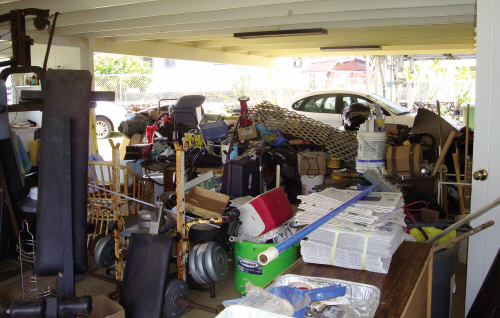
    Generations Magazine - Downsize & Declutter the Easy Way - Image 01Most of us who have lived in the same home for decades have collected a good amount of personal treasures. And before you know it, you’re shocked by all the things you own. Some people may call these things clutter or trash, but to the owner these things could be a lifetime of memories. The difficulty comes when we have to think about downsizing or decluttering because it’s a safety concern (trip hazard), or we need more open space for a walker or wheelchair or move to a smaller home. Many say that they have “so much stuff” that it’s “just overwhelming.” Sometimes people even become trapped by their own personal belongings and can’t seem to break the “cycle.”
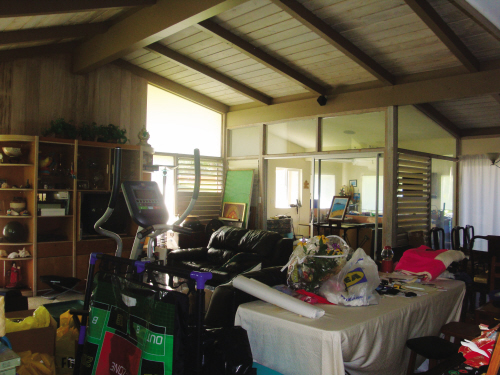


    Over the past three years, Senior Move Managers has helped more than 300 clients downsize and declutter their homes.

    The most frequently asked questions include:

    • Where do I start?
    • How do I get rid of all my things?
    • I really hate to throw everything away, where should all my things go?
    • Are there places that I can donate or sell my valuable items?
    • I may need it later, so should I store it or do something else with it?

    If you’re like most people, starting the process can be the most challenging step. However, once the ball starts rolling, people can see the progress and experience what success actually feels like. Sorting through belongings (and emotions) becomes easier, and the feeling of accomplishment changes attitudes toward the clutter. This is a sign that the homeowner is on his/her way to some significant changes in life.

    Here are some decluttering tips:

    • Schedule a time to start and set mini goals so that you can see progress over time.
    • S.O.R.T. your things into four categories: Sell, Offer, Retain and Toss. Everything in your home can fit into one of these four “piles.”
    • Begin with high-traffic areas to increase safety, since safety is the first concern.
    • Limit the number of new items coming into your residence. Even if an item is on sale, hold off on buying it and bringing it into your home. It will come on sale again when you really need it.

    When you SORT through your items, ask yourself the following questions:

    • Do I really need it?
    • When was the last time I used it?
    • When will I use it again?
    • How often do I use it?

    These questions will help you think about each item and figure out which SORT pile it belongs in. They will also help you detach from your belongings.

    There are many small steps that lead to success. The most important step is to ask for help. Going through belongs is a big job — emotionally and physically. Items can be large, heavy and dangerous. When you decide to downsize or declutter, make sure you have some helping hands.


    For information, call Dan Ihara, Senior Move Managers
    808-256-7873 | www.smmhawaii.com

    Generations Magazine - Downsize & Declutter the Easy Way - Image 02
    Before
    Generations Magazine - Downsize & Declutter the Easy Way - Image 03
    After

    Most of us who have lived in the same home for decades have collected a good amount of personal treasures. And before you know it, you’re shocked by all the things you own. Some people may call these things clutter or trash, but to the owner these things could be a lifetime of memories. The…

  • Message from The Editor – December / January 2014

    The end of this year was highlighted with an island hop to Maui, where Generations Magazine discovered why some of the happiest seniors in Hawai‘i call the Valley Isle home. The cover story, Maui Mindset, explores how Maui County is committed to its seniors and their families … and how seniors are eager to give back.

    Part of the “Maui Mindset” is the county’s philosophy of taking care of each other, says Ruth Griffith, Kaunoa Senior Services administrator. In the story she noted, “Maui County is made up small communities and residents are very civic minded. We look out for one another. Even our seniors who receive support services want to give back to the community in any way they can. Maui seniors play a vital role in maintaining our thriving communities.”

    However, just as with many other areas, Maui is facing a growing senior population. By 2020, the county expects the number of people turning 60 to double. In response, Maui is working with its Baby Boomers to redefine what it will mean to be a healthy and engaged senior over the next two decades.

    Thank you to our Generations Magazine staff for venturing to Maui for a whirlwind tour of Maui — including a 3 a.m. wake up call to catch sunrise at Haleakala.

    Generations Magazine is now in its fourth year and we are so excited to move further into our communities and bring you more engaging stories, trusted resources and valuable programs and services.

    For 2014, we look forward to expanding our distribution points and posting more information on our website (www.Generations808.com). We’re also planning on more workshops, presentations and our 8th annual KHON2 Elderhood Project Aging in Place Workshop on Saturday August 23 at the Ala Moana Hotel. And going forward, we’re offering free digital copies of each magazine … just email a request at Percy@Generations808.com.

    Starting with this issue, we welcomed our new full-time associate editor Aimee Harris. She will be handling all of the magazine’s editorial content, so if you have stories or programs that would be of interest to our seniors, feel free to contact her at Aimee@Generations808.com.

    Live well,

    Generations - 2014-12-01 - Editors Note - Image 01

    Percy Ihara, Editor/Publisher

    Generations - 2014-12-01 - Editors Note - Image 02

    P.S. A special mahalo to Dana Acosta of Kaunoa Senior Services for coordinating a full day of interviews and events for Generations Magazine.

    Generations - 2014-12-01 - Editors Note - Image 03
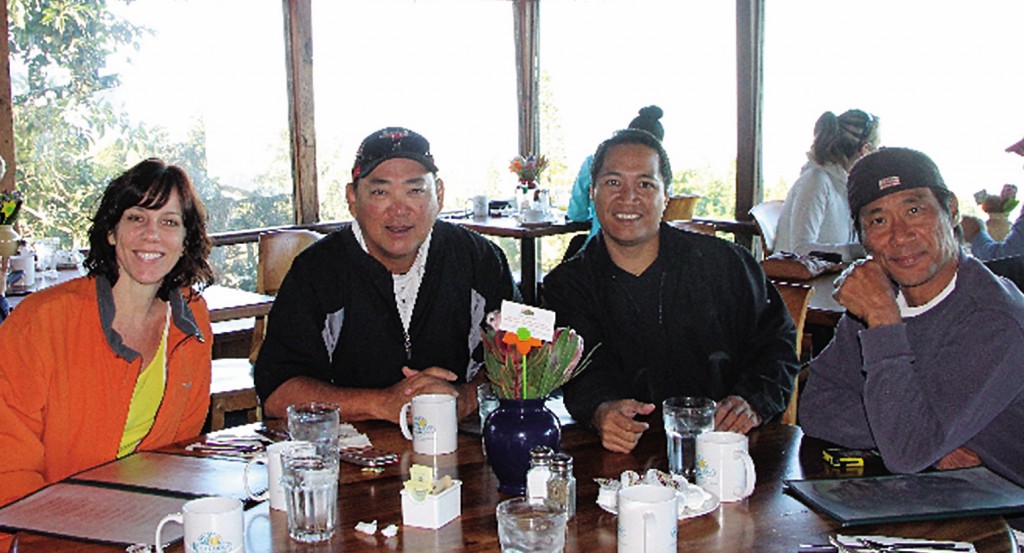
    Generations enjoys breakfast at Kula Lodge, Maui, aftera stunning Haleakala¯ sunrise (left to right): Aimee, Percy, Peterson and Wilson.
    Generations - 2014-12-01 - Editors Note - Image 04
    Aimee and Percy, bundled up for Haleakala sunrise

    The end of this year was highlighted with an island hop to Maui, where Generations Magazine discovered why some of the happiest seniors in Hawai‘i call the Valley Isle home. The cover story, Maui Mindset, explores how Maui County is committed to its seniors and their families … and how seniors are eager to give…