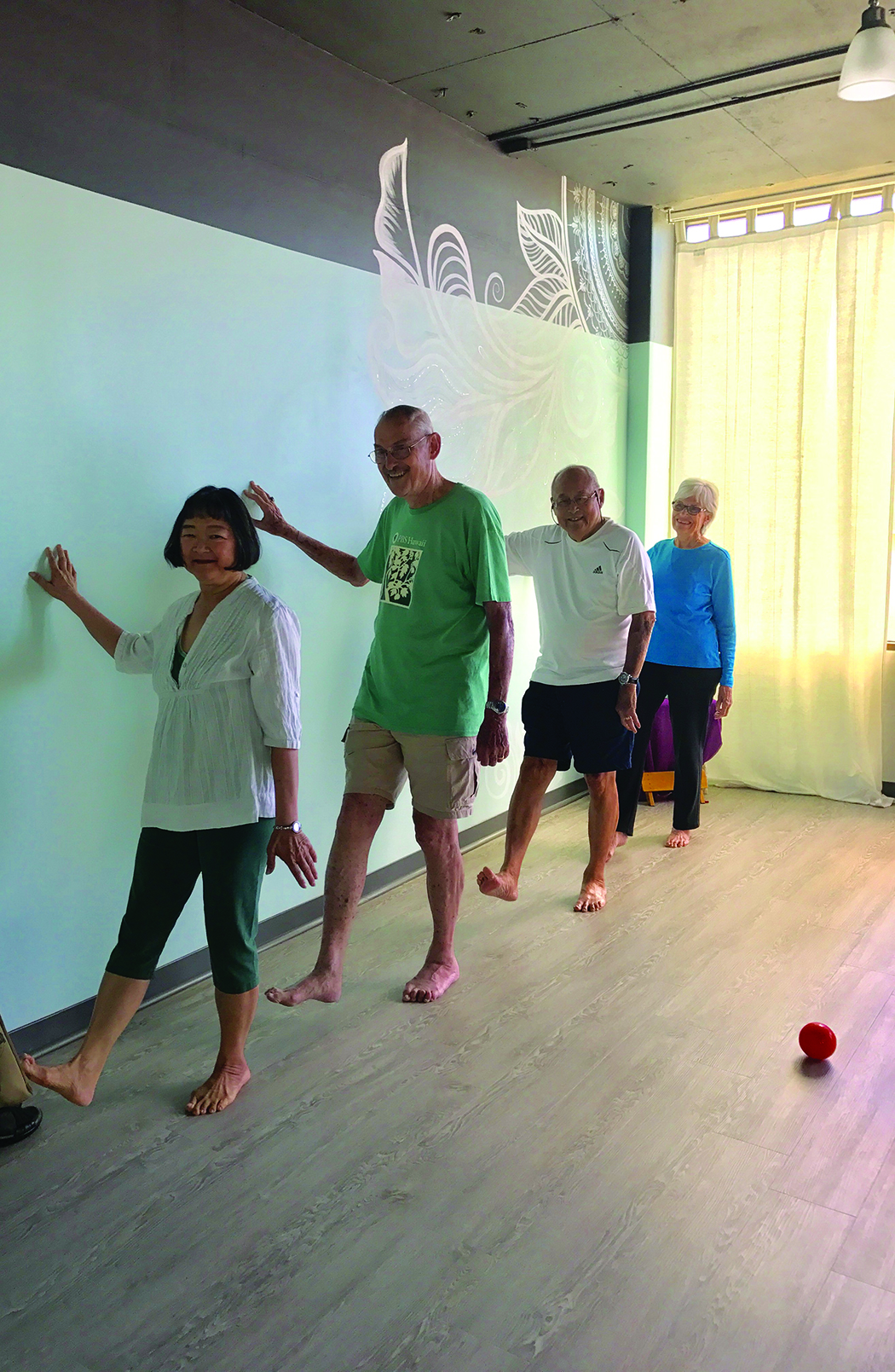
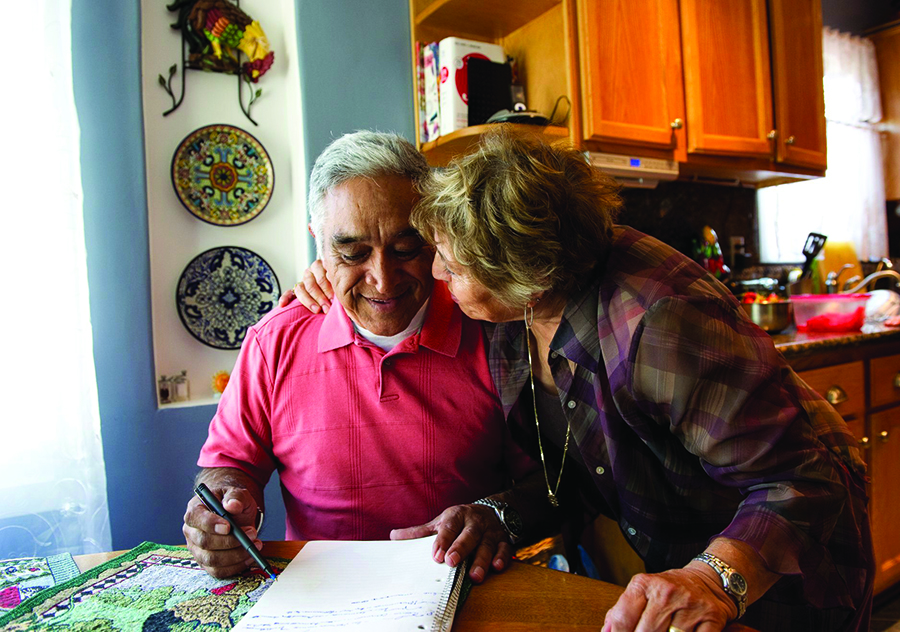
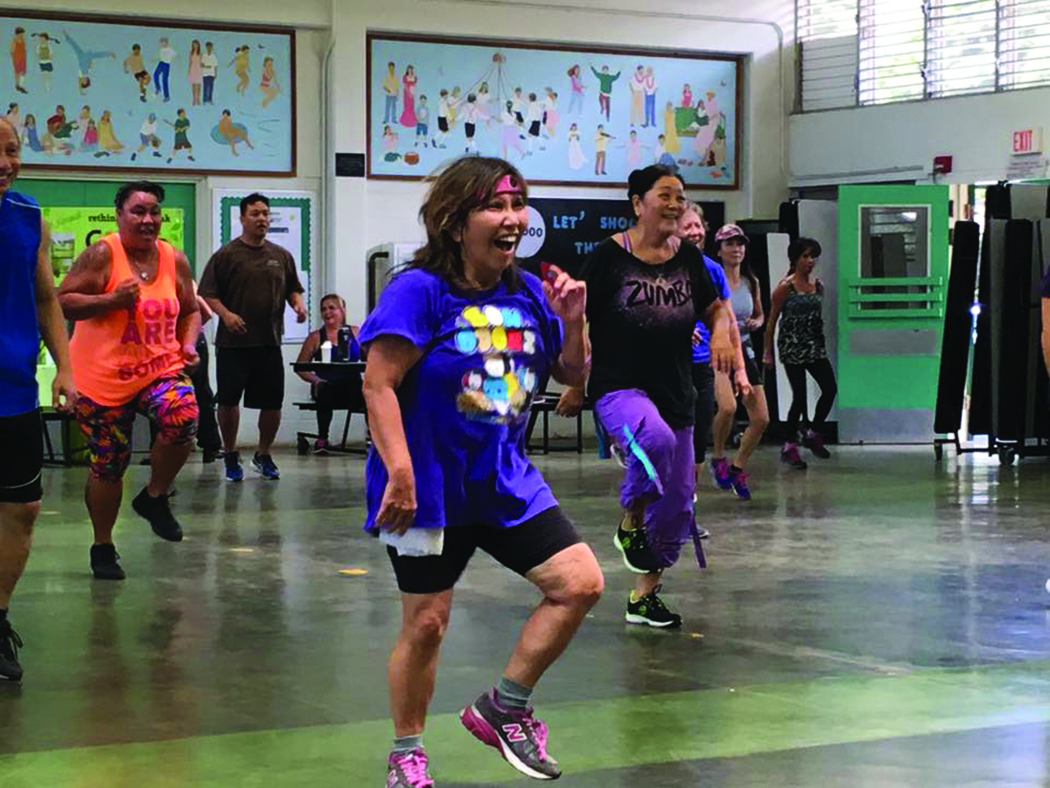
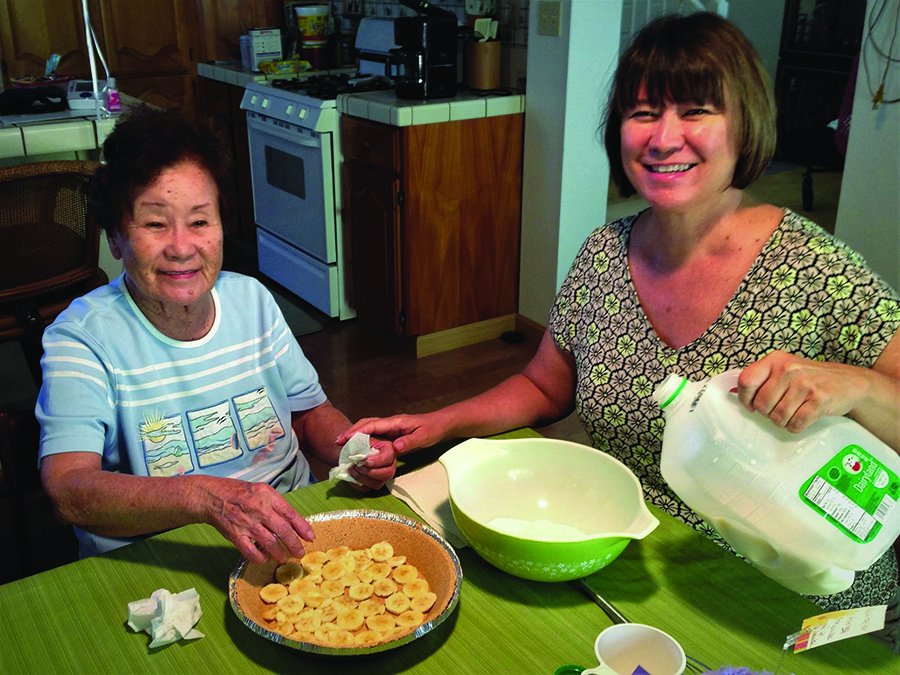
(L–R) Elvira Lee, Tom Glass, George and Grace Lee work on optimal posture, balance and coordination.
Joseph Pilates truly was ahead of his time with his holistic approach to exercise.
“Contrology [now called ‘Pilates’] is designed to give you suppleness, natural grace and skill that will be unmistakably reflected in the way you walk, in the way you play and in the way you work,” Pilates said. “You will develop muscular power with corresponding endurance, ability to perform arduous duties, to play strenuous games,to walk, run or travel for long distances without undue body fatigue or mental strain.”
Students say that Pilates “woke up muscles I never knew I had.” “I feel relaxed yet energized.” “I now have better posture and little to no pain.”
Pilates is founded on the principals of breath, centering, precision, concentration, flow and control. A Pilates routine inherently moves the practitioner mindfully through different planes and ranges of motion, which is essential in stimulating the body and mind. Although there are classical exercises that are quintessential to Pilates, there are limitless variations. It doesn’t matter your age, gender, physicality — anyone can do it.
BENEFITS OF PILATES
• Balance & Coordination: Better equilibrium, steadiness, confidence and overall balance.
• Strength & Stamina: Improves muscle and skeletal strength and endurance.
• Flexibility & Mobility: Improves muscular flexibility and joint health.
• Improves Circulation & Detoxification: Activates the lungs and pumps the heart to move debris out of the body via the bloodstream.
• Mental Health: Clears the mind and promotes better brain function.
• Resilience: Strengthens the nervous system, which increases resilience to daily stressors.
• Vibrancy: Promotes better sleep, which builds energy and the immune system.
• Self-Care: Teaches how to care for yourself and inspires you to want to take care of yourself.
• Inspires: Staying active and improving diet.
• Pain-Free: Reduces or removes physical pain.
• Accessible: Pilates mat exercises and techniques are with you wherever you go. A Pilates routine can be enhanced by props and equipment, but they are not required.
Pilates will meet you where you are at today so you can enjoy all that life has to offer.
Joseph Pilates truly was ahead of his time with his holistic approach to exercise. “Contrology [now called ‘Pilates’] is designed to give you suppleness, natural grace and skill that will be unmistakably reflected in the way you walk, in the way you play and in the way you work,” Pilates said. “You will develop muscular…
The Alzheimer’s Association, formed in 1980, is the country’s leading voluntary health organization in Alzheimer’s care, support and research. Its mission is to continue to lead the way to end Alzheimer’s and all other dementia by driving risk reduction and early detection, and by advancing vital, global research regarding treatment and prevention in it’s continuing efforts to find a cure.
The association is currently the leading voice for Alzheimer’s disease advocacy, fighting for critical research and care initiatives at both the state and federal levels.
SERVICES PROVIDED
■ Information and Referral. The association provides basic disease information, referrals to community resources and providers, and support for persons living with Alzheimer’s or another dementia, their families and the general public.
■ Care Consultation. The association assists individuals and families in planning for and coping with Alzheimer’s and other dementia. Care consultations may include an assessment of needs and safety, emotional support and information on available resources.
■ Education Programs. The association offers a variety of credible, evidence-informed education programs and training for caregivers, the general public and professionals.
■ 24/7 Helpline. The association offers around-the-clock support for families. Trained dementia care experts are ready to listen and assist with referrals to local community programs and services, dementia-related education, crisis assistance and emotional support.
■ COVID Messaging. The association has successfully transitioned its support groups, education programs and family care consultations to a virtual format — through either phone or live video delivery — to ensure uninterrupted care and support services to local families. The number of support groups statewide and programs specific to addressing concerns regarding COVID-19 and caregiving have also been increased.
ADVOCACY & SUPPORT
The COVID-19 pandemic presents additional challenges, especially financial, for more than 5 million Americans living with Alzheimer’s, their caregivers, the research community and the nonprofits serving these vulnerable populations. The pandemic will continue to challenge health systems across the nation and affect decisions such as care planning. But thankfully, Congress can act to help the Alzheimer’s and dementia community by including provisions to support the community during this crisis. These key provisions include:
• $354 million for Alzheimer’s research activities at the National Institutes of Health
• $20 million to implement the BOLD Infrastructure for Alzheimer’s Act at the Centers for Disease Control and Prevention which will establish centers of excellence that expand and promote the evidence base for effective population-based interventions to improve dementia outcomes
Contact Sen. Brian Schatz and Congressman Ed Case and ask them for their continued support. Also ask them to gain the support of other members of Congress regarding these provisions.
Sign up online and encourage others to become Alzheimer’s Association volunteers at www.alz.org/advocate or by calling 800-272-3900.
The Alzheimer’s Association, formed in 1980, is the country’s leading voluntary health organization in Alzheimer’s care, support and research. Its mission is to continue to lead the way to end Alzheimer’s and all other dementia by driving risk reduction and early detection, and by advancing vital, global research regarding treatment and prevention in it’s continuing…
Hawai‘i’s first lady, Dawn Amano-Ige, is a wife (married to Gov. David Ige), a mother of three, a sister and a daughter. Dawn’s mother, Mitsue Amano, provided childcare for the Ige kids when Dawn was a young, working mother and David was a new legislator. Today, at 94 years old, Mitsue is no longer the family’s caregiver. That’s now Dawn’s role.
Mitsue has Alzheimer’s disease.
When Dawn first learned of her mother’s diagnosis, she had very little idea of exactly what she and her family would face as caregivers. She recalls being given a fact sheet from the Alzheimer’s Association and learning that she was one of 65,000 in Hawai‘i caring for more than 29,000 people living with Alzheimer’s disease and other dementia.
Nearly 5 percent of Hawai‘i’s residents care for someone living with Alzheimer’s disease. And since the start of the COVID-19 pandemic, that number has increased. In March 2020, all adult day care services closed, and many residential facilities sent patients home to their families to allow for increased social distancing and reduced staffing. People who weren’t already full-time caregivers suddenly found themselves in exactly that position.
“My mother has no short-term memory and she knows that,” says Dawn. “I always greet her by saying, ‘Hi Mom — do you know who I am?’ as I hope the first two words will serve as the enduring clue as to who I am.”
‘Hi Mom — do you know who I am?’
Five years ago, Dawn began noticing slight changes in her mother. Mitsue repeated herself often, started walking with a shuffle and displayed memory issues. Over time, the family noted more changes. “For me,” Dawn says, “my mother refused to do anything. She said she was tired and refused to self-care.”
And sadly, Dawn says, “I think she was recognizing that her disease was changing her, and change is scary and unacceptable when it affects your memory.” Dawn was told that this was a phase and there would be a time when her mother wouldn’t complain at all; but she found that hard to believe.
The family cared lovingly for Mitsue in her home, as she wished. But at one of the most challenging times for the governor’s family, just weeks after the missile alert crisis, Mitsue took a hard fall and was whisked to the emergency room, admitted to the hospital and transported to a nursing home that provided 24-hour care. She never moved back home. And now, she’s at that phase — she rarely complains.
“I learned that my story is not uncommon, but experienced by many,” Dawn says. “Each of our journeys is different, but some of the struggles are the same and heartbreaking.”
“As a caregiver, there are two things I hold on to,” says Dawn. “First, despite the mental deterioration caused by the disease, my mother’s core self remains. And that’s important to me. Despite the memory loss and changes in personality, I believe she will always be who she is in her heart and ours. That is never lost or forgotten.”
“The second is to enjoy the moments. because of her short-term memory, good moments also repeat themselves. I enjoy seeing the surprise on her face when I tell her again that her son-in-law is governor of Hawai‘i.” Mitsue also takes pride in hearing news of her grandchildren because she provided much of their care in their early years. Dawn is delighted to share that her children come home each year to celebrate their grandmother’s birthday — but not for her own birthday or her husband’s.
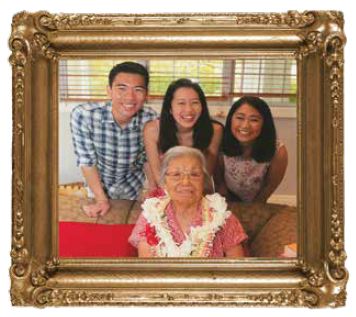
A family portrait: (L–R) Gov. David Y. Ige, Mitsue Amano, Byron Amano, First Lady Dawn Amano-Ige.
Walk the Walk to End Alzheimer’s Disease
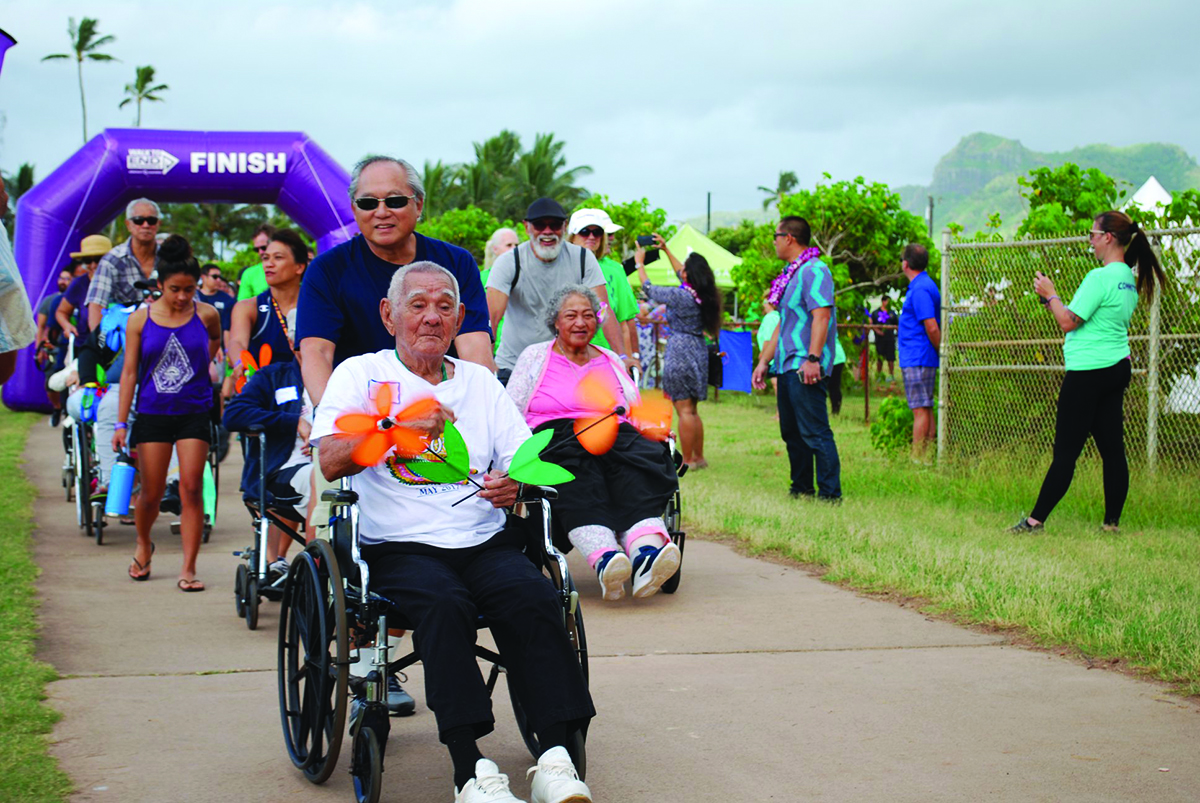
When Dawn and her brother became the primary caregivers for their mother, she reached out to the Alzheimer’s Association in Hawai‘i for information about the disease and tips for caregivers. She also attended the Walk to End Alzheimer’s, where she met many other caregivers and people living with the disease.
“Alzheimer’s is not an easy disease to deal with. You see parts of their personality leave them, or they leave them temporarily, and they forget who different people are in their family. I think that’s really where it hits the heart.”
“When my mother was first diagnosed, I attended a walk because I thought the cause was so important. And to see so many people affected by Alzheimer’s is quite eye-opening,” she says.
The first lady felt such a strong connection to the cause and the people she met at the event that she offered to serve as the statewide honorary chair for the 2020 Walk to End Alzheimer’s on O‘ahu, Maui, Kaua‘i and Hawai‘i Island.
A Product of Her Community
In her role as first lady, Dawn draws on her experience as an educator and businesswoman to support causes she’s passionate about: education, literacy, healthcare and youth.
Dawn is a product of the Ewa Plantation. Like her father, she was actually born in Ewa at the plantation hospital and attended Ewa Elementary, ‘Ilima Intermediate and Campbell High School.
Among the first in her family to graduate from college, Dawn has a bachelor’s degree in journalism and a professional diploma in elementary education from the University of Hawai‘i at Mānoa, and a master’s degree in business from Chaminade University of Honolulu.
And like her mother, Dawn worked for many years in the Hawai‘i Department of Education (HIDOE) as a third grade teacher at Waiau and Waimalu Elementary Schools, and vice principal of Kanoelani Elementary and Moanalua High School. Before that, she served as the marketing director of Kapi‘olani healthcare system and an account executive at the public relations firm of Stryker Weiner Associates. Her resume shows an authentic belief in the causes she continues to support in the community today.
Jump Start Breakfast in Schools
One of the causes Dawn feels most passionate about is feeding Hawai‘i’s children and making sure they start each day with a nutritious breakfast. She recently partnered with Hawai‘i’s public schools and community nonprofit organizations to help kids “Jump Start Breakfast” in schools. And of course, the inspiration for supporting this program comes from her mother, who was once a school cafeteria baker.
“Eating breakfast is important to helping our keiki grow up strong, healthy and academically successful,” Dawn said in an op-ed co-written with HIDOE Superintendent Christina Kishimoto and others.
Hawai‘i ranks last in the nation in school breakfast participation, but kids who eat breakfast have better attendance, can achieve 17.5 percent higher scores in math and are 20 percent more likely to graduate from high school.
Last fall, the program piloted a Grab ’n Go model where kids could pick up free breakfast in the cafeteria and eat it outside or even in the classroom. Dawn is proud that this Grab ’n Go model was used for school meal distribution during the COVID-19 pandemic and may continue to be used in the new school year.
The First Lady reads aloud in a weekly Facebook podcast, “Storytime with Dawn.”
‘Ohana Readers Promoting Literacy
Dawn is also passionate about early education, and is proud of the ‘Ohana Readers literacy program that puts books in the hands of children and encourages families to read together. It’s a partnership with several nonprofit organizations, including the Hawai‘i State Library System, the Friends of the Library of Hawai‘i, Hawai‘i Department of Human Services and Dolly Parton’s Imagination Library.
“Research shows that children are ready to learn in their earliest years,” she points out. “And this program provides no-cost opportunities for learning from birth through age 4. ‘Ohana Readers encourages family read-aloud time, an activity that increases the vocabulary and language skills of our children, and contributes to their growing knowledge of the world.”
Expansion of the program begun on Moloka‘i and Lāna‘i, is on hold during the ongoing pandemic. But the first lady continues to promote literacy by reading books aloud to children through her Facebook page.
Fading Memories
Mitsue Fukuda was born in 1925 in the small town of Hōnaunau on the Island of Hawai‘i and raised on a small coffee farm in Kealakekua, south of Kona. Memories from her youth have begun to fade away.
After World War II, Mitsue married Sakuji Amano. They lived on O‘ahu, working and raising a family on the Ewa Sugar Plantation. Sakuji was born in Honolulu, raised on the plantation and educated through the seventh grade at Ewa Elementary School.
Mitsue’s grandchildren, (L–R) Matthew, Amy and Lauren, helped care for her.
Back at the plantation, Sakuji worked as a crane operator and Mitsue worked nearby as a baker in the Campbell High School cafeteria. Both their jobs were demanding, with long hours. Mitsue’s shift began early in the mornings so she could begin preparing school lunches for hundreds of hungry high school students. In her small plantation community, Mitsue was known as a good cook who enjoyed gardening, and often shared baked goods with friends and family. And together with Sakuji, she raised their children to value hard work and education. Sakuji died in 1989 at the age of 69, leaving his family with fond memories, except for his wartime stories that he never shared.
Mitsue and Sakuji have a son, a daughter and several grandchildren. One grandchild lives in Washington, DC; two live in Washington State; and their daughter lives at Washington Place.
Dawn Amano-Ige and David Ige, Mitsue and Sakuji’s daughter and son-in-law, have lived at the official residence of Hawai‘i’s governors as first lady and governor since 2014. Until 1917, Washington Place had been the private home of Queen Lili‘uokalani, who lived there with her husband. And today, First Lady Dawn Amano-Ige is leading efforts to make the historic executive mansion more accessible to visitors through new technologies and educational experiences such as virtual tours and iPad apps.
Now in the year 2020, it’s clear to see that Mitsue has collected a lifetime of memories — through her own experiences and those of her late husband, their children and grandchildren. But with hindsight that is 20/20, it has also become clear that Mitsue’s memories have faded away and most are completely gone.
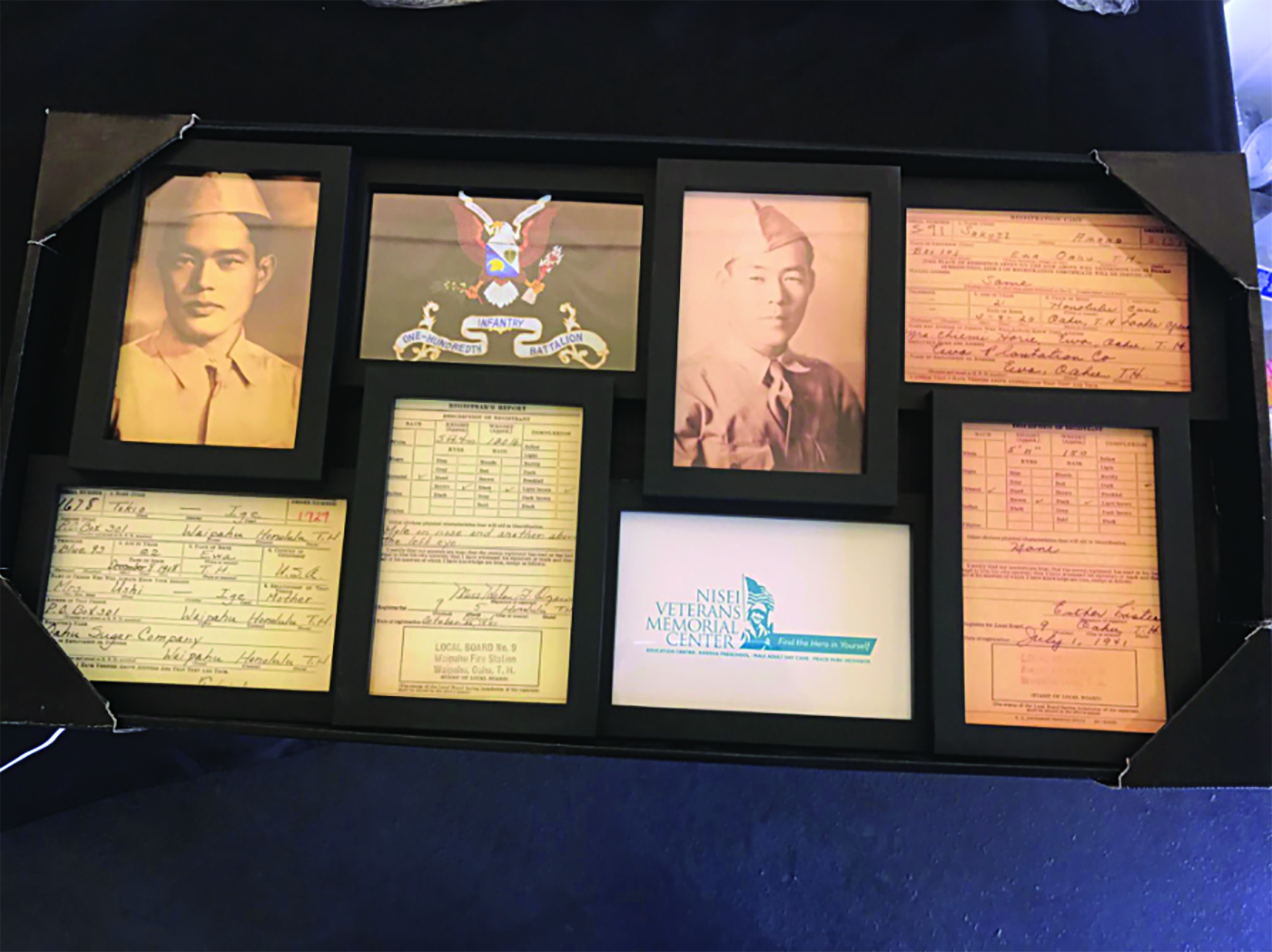
Gov. David Ige and First Lady Dawn Amano-Ige are proud of both their fathers: Tokio Ige (L) and Sakuji Amano (R) who served with the 442nd Regimental Combat Team during WWII.
Holding On
“I remember going out to my grandfather’s home in Kona when he was alive,” recalls Dawn. “Our relatives would get together there during the summer. My Mom showed me how she picked coffee very much the old-fashioned way — by hand. She could go down a branch of coffee beans and just pick the red ones and leave the green ones behind. It was amazing that she could do it so quickly. It’s a vivid memory for me.”
These are the memories that Dawn holds onto.
“My grandfather came to Hawai‘i to look for a better life and the promise of prosperity,” says Dawn. When Mitsue had a family of her own, she enjoyed telling stories about her small kid times in the small town of Kealakekua.
Dawn has even fewer memories from her father and regrets that she knows little of his WWII experiences. He served with the 100th Infantry Battalion, Company C, which was part of the 442nd Regimental Combat Team, the most decorated unit for its size and length of service in US military history.
“My father spoke little of war and its hardships. David and I speak about this quite often because the strength our fathers carried were so important to our history, and serves as an inspiration to us.”
“We are living through difficult times now. I often think about my parents and how their generation also lived through difficult times — they endured and were never bitter about it. Growing up, they stressed to us the value of working hard, doing well and overcoming challenges without complaining. I admire that about my parents and their parents,” Dawn says.
“I know we’ll be able to get through these difficult times. We have to stay focused, work together as a community and forge ahead. So that’s how I look at their experiences — as an inspiration for me.”
Adjusting to ‘A New Normal’
Dawn and her husband haven’t seen Dawn’s mother since mid-March, due to safety precautions in the face of COVID-19.
“We can’t go into the nursing home. And of course, we don’t want to put anyone at risk. We need to keep the residents and the employees safe,” says Dawn.
“An Alzheimer’s patient in a nursing home has to adjust because he or she is missing the physical touch and close proximity of family, which I think are so important. It’s a natural human instinct to want and need those things. And right now, that’s all on hold. We have to look for different ways of communicating. So what can we do instead? We can use technology for virtual visits. Writing letters or having our young ones draw pictures are simple but meaningful ways to connect. Music is also another source of comfort. And I am so appreciative of the caregivers and nurses in my mother’s nursing home, as they are providing the extra care and attention patients need during this time.
Looking Toward a Better Future
“Alzheimer’s and dementia affect so many people we love — and it seems that everyone knows someone affected by Alzheimer’s,” says Dawn. “And we want to do all we can to help them on their journey through this.”
“One way I deal with it is to remember that it’s the disease and not the person, when difficult times occur. And that’s helped me a lot — knowing that it’s a disease where you treat the symptoms like you would in any other disease. And that way, it’s much easier to cope with.”
Admittedly, navigating the healthcare system is daunting, says Dawn. “Many of us take our loved ones through homecare, emergency room, hospital and nursing home. Each of these organizations have decision-making structures that seem mysterious and I’ve simply had to muddle through it all,” she adds. “There are a lot of nice brochures out there. But often, the information must be put in proper context.” Dawn suggests turning to healthcare workers, social workers, care coordinators, support groups, publications like Generations Magazine and organizations like the Alzheimer’s Association for help and resources.
“It’s important to connect; to interact; to know that you’re not alone in this situation,” she adds. “And it’s comforting to know, when you’re met with challenging times, that other people have gone through it — that they have solutions to the same problems. And many have ideas that can make it work. I think those things are important.”
And what’s truly important, Dawn says, is coming together and sharing resources. “Finding the cure is a priority. Together, let’s do all we can to help create a future without this disease and make the place we live a little better.”
Hawai‘i’s first lady, Dawn Amano-Ige, is a wife (married to Gov. David Ige), a mother of three, a sister and a daughter. Dawn’s mother, Mitsue Amano, provided childcare for the Ige kids when Dawn was a young, working mother and David was a new legislator. Today, at 94 years old, Mitsue is no longer the…
During the coronavirus pandemic, most adult day centers and community senior centers have closed or cut their services, and families across the state have had to scramble to provide caregiver services at home. If you’re now caring for a loved one with memory or other health issues, follow these tips and find links to resources below.
Tip 1: Stay healthy. Caregivers need to stay healthy in order to protect and take care of those with dementia. Taking care of yourself is as important for you as it is for your loved ones — without you, they will be even more vulnerable.
• Take breaks and find enjoyable things to do. Remember to take breaks, because this job is hard. Walk, swim or go running in a park.
• See if family members or others can help you. You really can’t do this alone. That could be family, calabash cousins or even hired help. You need to maintain that work-life balance in your life.
• Have meals and groceries delivered. Limit the quantity and duration of your shopping trips.
• Ask your primary care physician (PCP) to refill 90 days of medication rather than a 30-day supply. Have medications mailed to you for fewer trips and less worry.
• Seek support through groups. It’s important to talk to other people and other caregivers, especially during this time of social isolation. Look for events on the Alzheimer’s Association website.
Tip 2: Plan ahead. If you’re the only person taking care of someone with memory issues, you need to create a backup plan for care for your loved one in case you get sick.
Tip 3: Advance Care Planning. This is very important. Talk with those with dementia about:
• Their wishes in case a life-threatening situation arises. For loved ones with dementia, it’s important to prepare ahead with advance-care planning. Write down what they want to happen if and when they get sick and may require hospitalization or hospice care.
• Healthcare power of attorney. It’s also important for patients with memory issues to designate someone they trust if they get sick and can’t make decisions for themselves. Ask your primary care physician for these forms or visit these websites: Kokua Mau (kokuamau.org), Prepare for Your Care (prepareforyourcare.org).
Tip 4: Keep in Close Contact. Social distancing is necessary during the COVID-19 pandemic, but social isolation is stressful for patients with dementia. Keep in close touch with your loved ones with dementia, especially if you’re not living with them. Loved ones may be feeling confused, and may not remember what’s going on or understand why their family can’t visit them if they’re in a care home. This can cause anxiety and sadness. So make regular phone calls; send emails to tech-savvy seniors. Mail or drop off care packages. Stop by to wave from the outside. Many facilities now have iPads to help residents connect with family members via Facetime, Zoom or Blue Jeans. Little things like these can make a loved one with dementia feel a lot better.
Tip 5: Maintain a Routine. It’s important to maintain a regular schedule for patients with dementia. They really thrive with a routine. Any kind of deviation may cause confusion, anxiety, agitation and mood changes. With social distancing restrictions, patients who used to go to senior centers suddenly can’t attend anymore. They may not understand why. Develop new routines to put them at ease.
Loved ones with dementia should wake up and go to bed at a regular time, and eat meals at the same time each day. You might also enhance your own routine by adding a regular daily walk or other activities.
Tip 6: Keep Active. What kinds of things can you do to keep a loved one with dementia active? Take them on walks, and get fresh air and sunshine. That is really good for the mind and for the sleepwake cycle. Of course, wear a mask and keep a safe distance from other people. Be creative when planning home-based activities. Dust off old board games and play cards — there’s Monopoly, checkers, solitaire, poker and many other activities to chose from. Listening to music is also very therapeutic. Reading books engages the mind. Talking on the phone is a great way to socialize at this time.
Tip 7: Eat Healthy. It’s important to maintain your energy that keeps you alert, mentally sharp and emotionally balanced.
• Eat a well-balanced diet. Eat a little bit of everything — fruits, vegetables, protein, dairy. It can be okay to have an occasional piece of cake —
a small portion is best.
• Consider using a meal delivery service. Meal delivery services can be lifesavers. Be sure to select well-balanced menu options.
• Limit canned, processed and prepared frozen foods. During this time, you might not be going to the grocery store as much, and you might have stocked up on a lot of spam, canned foods and frozen meals. Be cautious. A lot of these are high in salt. And if your loved one with dementia has a history of heart failure or heart problems, this is something to watch.
Tip 8: Calm Your Emotions. We’re all under a lot of stress, balancing a lot of things on our plate. So be aware that patients with dementia can really pick up on these emotions. That’s why it’s really important for caregivers to find ways to relax and de-stress themselves.
If you’re feeling anxious or angry or frustrated or worried, patients with dementia can pick up on that and react in destructive or challenging ways. If your loved one with dementia is feeling anxious, reassure him or her (and yourself) that things are going to be okay. Change the topic, turn on an old movie, go for a walk or have a snack. Distractions can help, but limit watching or reading the news.
Tip 9: Avoid Elder Abuse Scams. Check in with people with dementia to see if they are getting emails, mail or calls that are potential scams.
Tip 10: Call Your PCP if You Feel Sick. Don’t wait to take action because you are afraid to go to the doctor or emergency room. Many physicians are able to help you over the phone or via telemedicine. Take notes on your symptoms so you will have ready all the information your doctor may need during your call.
During the coronavirus pandemic, most adult day centers and community senior centers have closed or cut their services, and families across the state have had to scramble to provide caregiver services at home. If you’re now caring for a loved one with memory or other health issues, follow these tips and find links to resources…
The Alzheimer’s Association, formed in 1980, is the country’s leading voluntary health organization in Alzheimer’s care, support and research. Its mission is to continue to lead the way to end Alzheimer’s and all other dementia by driving risk reduction and early detection, and by advancing vital, global research regarding treatment and prevention in it’s continuing efforts to find a cure.
The association is currently the leading voice for Alzheimer’s disease advocacy, fighting for critical research and care initiatives at both the state and federal levels.
SERVICES PROVIDED
■ Information and Referral. The association provides basic disease information, referrals to community resources and providers, and support for persons living with Alzheimer’s or another dementia, their families and the general public.
■ Care Consultation. The association assists individuals and families in planning for and coping with Alzheimer’s and other dementia. Care consultations may include an assessment of needs and safety, emotional support and information on available resources.
■ Education Programs. The association offers a variety of credible, evidence-informed education programs and training for caregivers, the general public and professionals.
■ 24/7 Helpline. The association offers around-the-clock support for families. Trained dementia care experts are ready to listen and assist with referrals to local community programs and services, dementia-related education, crisis assistance and emotional support.
■ COVID Messaging. The association has successfully transitioned its support groups, education programs and family care consultations to a virtual format — through either phone or live video delivery — to ensure uninterrupted care and support services to local families. The number of support groups statewide and programs specific to addressing concerns regarding COVID-19 and caregiving have also been increased.
ADVOCACY & SUPPORT
The COVID-19 pandemic presents additional challenges, especially financial, for more than 5 million Americans living with Alzheimer’s, their caregivers, the research community and the nonprofits serving these vulnerable populations.
The pandemic will continue to challenge health systems across the nation and affect decisions such as care planning. But thankfully, Congress can act to help the Alzheimer’s and dementia community by including provisions to support the community during this crisis. These key provisions include:
• $354 million for Alzheimer’s research activities at the National Institutes of Health
• $20 million to implement the BOLD Infrastructure for Alzheimer’s Act at the Centers for Disease Control and Prevention which will establish centers of excellence that expand and promote the evidence base for effective population-based interventions to improve dementia outcomes
Contact Sen. Brian Schatz and Congressman Ed Case and ask them for their continued support. Also ask them to gain the support of other members of Congress regarding these provisions.
Sign up online and encourage others to become Alzheimer’s Association volunteers at www.alz.org/advocate or by calling 800-272-3900.
The Alzheimer’s Association, formed in 1980, is the country’s leading voluntary health organization in Alzheimer’s care, support and research. Its mission is to continue to lead the way to end Alzheimer’s and all other dementia by driving risk reduction and early detection, and by advancing vital, global research regarding treatment and prevention in it’s continuing…
Lawrence Fumio Miwa was born in Hawai‘i in 1931 and lived in Hiroshima, Japan, from age 2 to 15. Now 89, he was 14 years old when the atomic bomb was dropped on Hiroshima, Japan, on Aug. 6, 1945. Although he was in school approximately 20 miles away from his Hiroshima home, he could see what happened. Seventy-five years later, he can still recall “that unforgettable morning,” when the bombers flew over the city. He remembers the blinding yellow flash from the atomic explosion. He thought at the time that it was the end of the world. He wondered if his family survived.
Days later, he returned to the city and witnessed overwhelming casualties and total devastation. “People were suffering severe burns and their clothes were burned and tattered.”
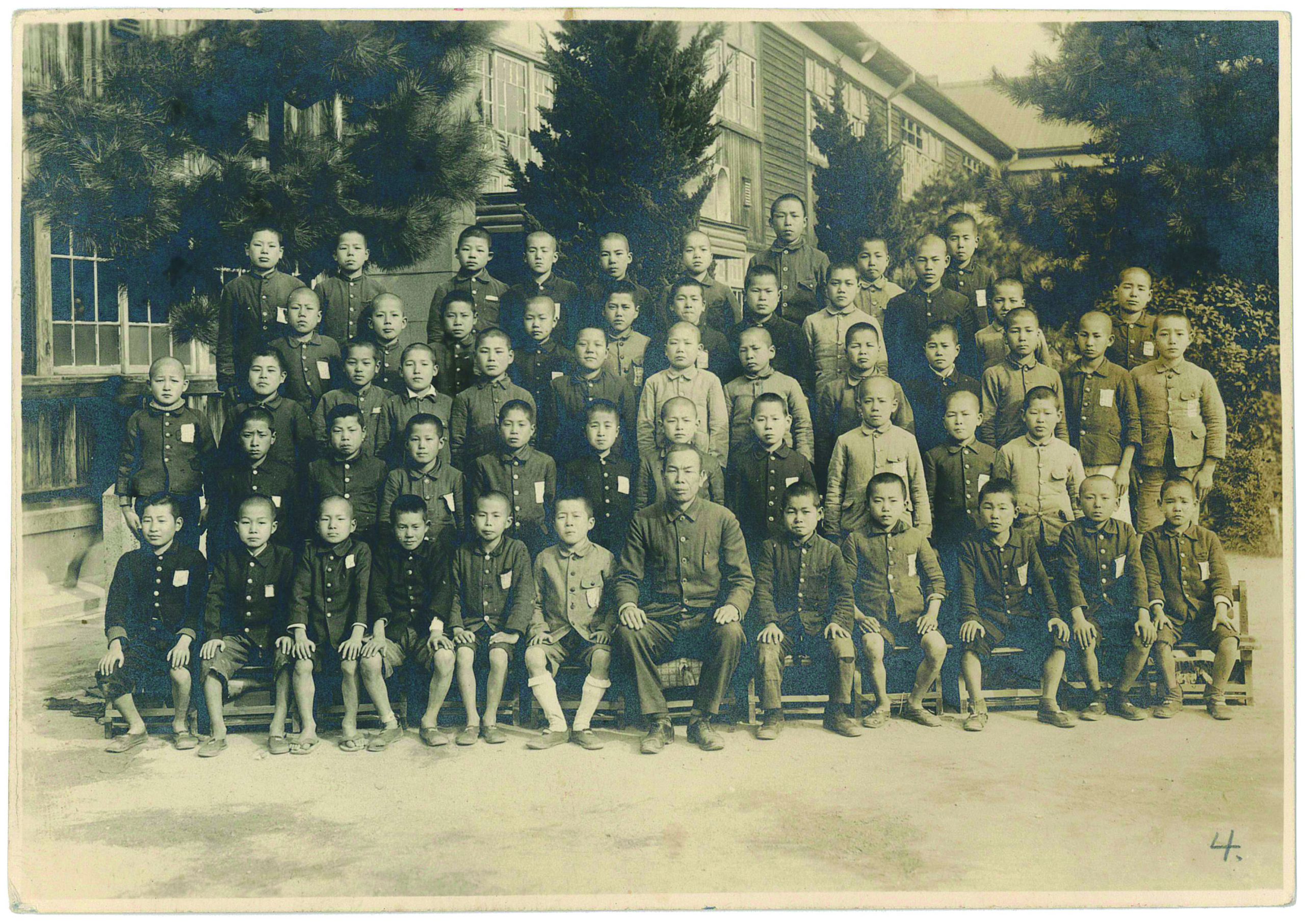
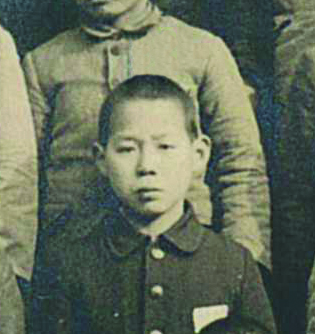
Lawrence Fumio Miwa at age 12 in 1943, when he was a sixth grader at Misasa Elementary School. Opposite, at age 88, visiting Punahou Japanese classes in 2019.
Approximately 70,000 people were killed when the US military dropped an atomic bomb over Hiroshima during World War II. Tens of thousands later died from radiation exposure and cancer. Three days later, another atomic bomb was dropped over Nagasaki, killing about 40,000 people. The exact mortality figures will never be known. The destruction and overwhelming chaos made orderly counting impossible.
“We didn’t know that that was the first atomic bomb,” he said. “On Aug. 15, our teacher allowed us to go back to the city — and for me, to find out if my parents and sister were still alive. When I arrived at the Hiroshima train station, there were no houses or buildings. The ground was burned and blackened. In that moment of time, I was the only person standing alone in the city where some 140,000 people had lost their lives. I was sure I had experienced a big turning point in my life.” Miraculously, his family survived.
August marks the 75th anniversary of the bombings. Larry has devoted his life to sharing his story with the goal of working together to eliminate nuclear weapons.
“It should not matter what nationality we are,” says Larry. “We are all human beings living together on our precious Earth. We all have a duty and responsibility to preserve humanity for our future generations. We should work together, setting a goal of common sense and decency to eliminate all nuclear weapons and related materials, for the sake of world peace.”
“No one, especially our children, should ever experience the horrors of nuclear weapons,” Larry said in a recent public presentation. “Please remember my story of survival. Overcoming animosity and making efforts to understand each other can lead to world peace and a better world for every one of us.”
[box] Larry shared more thoughts at the University of Hawai‘i Matsunaga Institute for Peace via Zoom on August 5, 2020. You can see the recording here. [/box]
The five-generation history of Miwa’s family is detailed in the book Tadaima! I Am Home by Tom Coffman.
Lawrence Fumio Miwa was born in Hawai‘i in 1931 and lived in Hiroshima, Japan, from age 2 to 15. Now 89, he was 14 years old when the atomic bomb was dropped on Hiroshima, Japan, on Aug. 6, 1945. Although he was in school approximately 20 miles away from his Hiroshima home, he could see…
Shoppers across the county and around the globe cleaned out shelves of toilet tissue, disinfectant sprays/wipes, rubbing alcohol and hand sanitizers during the beginning of the outbreak of COVID-19 pandemic.
Stores were overwhelmed due to fears of supply chain disruptions, although none occurred.
Even though items that were scarce during the initial phase of the pandemic have been restocked in most stores, some of us must still fight the urge to hoard in preparation for what may come this fall and beyond. Keep in mind, the impact of over-acquiring affects the entire community.
Pharmacies have even been dealing with people hoarding certain medications in hopes that they may be used as treatment in the future. Buying up existing medications puts people who truly need them at risk if they are forced to go without.
There are some strategies to quell the natural impulse to acquire more than is needed. Start by taking stock of the items you already have at home and and assess how long they will last. Make a pragmatic list of what and how many supplies you will need to tide you over to your next shopping trip — not the next decade.
When shopping, stick to the items on your list. Then, you’ll be less likely to succumb to anxiety-driven purchases triggered by the sight of empty shelves or thoughts of supermarkets closing.
If shopping is “your thing,” expand your experience by helping people in your community who may need it. Add their list to yours and enjoy!
Making sure you are doing all you can to manage stress is also helpful. Why not try 30 minutes of daily, moderate cardiovascular activity, muscle relaxation, mindfulness meditation exercises and other enjoyable activities.
Shoppers across the county and around the globe cleaned out shelves of toilet tissue, disinfectant sprays/wipes, rubbing alcohol and hand sanitizers during the beginning of the outbreak of COVID-19 pandemic. Stores were overwhelmed due to fears of supply chain disruptions, although none occurred.
I’d like to introduce you to a friend of mine. His name is Depression. I didn’t like being around him, but he dropped in whenever he felt like it.
Over time, I began feeling like the little bird in this picture. I was barely keeping my balance and felt very alone even when I wasn’t. Depression made it difficult for me to see clearly; my eyes were closed.
But I didn’t give up. My belief in God gave me hope. I can see now that it is hope for the future that moved me onto the road to recovery. I also began following the advice of a friend who told me to just “take one day at a time.”
I also learned this: “A major depression is the membership fee to an exclusive club. It enables one to move freely among the other members.”
You might be amazed to learn how many people struggle with depression. It’s very likely that one day you’ll meet someone who is also going through a tough time. Because you‘ve “been there,” you’ll be able to encourage this person and give them hope for the future, too.
You are probably wondering why I called Depression my friend. It’s because being able to help someone through something you have gone through is a true blessing. God has given you the opportunity to be a part of His response to someone’s prayer.
Jesus said, “Love one another. As I have loved you, so you must love one another.” So please take care and be kind when an opportunity to be a blessing to someone presents itself. And don’t forget to make your family and friends a priority in your life. You will not regret it.
I’d like to introduce you to a friend of mine. His name is Depression. I didn’t like being around him, but he dropped in whenever he felt like it.
As a veteran who is “getting up there,” how to live out my last years comfortably without being a burden is more than a passing thought. Fortunately, there are 100 Veterans Affairs Community Living Centers (CLCs) across the country. Their mission is to restore the veteran to his or her highest level of physical and/or psychological well-being before being discharged to their own home.” CLCs also provide nursing home-level care.
Tripler Army Medical Center is a 60-bed CLC facility that offers the comforts of home as much as possible. It provides convalescent care, rehabilitation, geriatric and geri-psychiatric assessment to eligible veterans in an inpatient setting.
Veterans must be enrolled in the VA Health Care System to receive this care.
CLCs provide activities for veterans of all ages in a family-friendly setting for visitors. Pets are also allowed to visit or live in the CLC. Organizations visit to host games, sing and hold barbecues, giving veterans an opportunity to talk story.
Veterans may also receive nursing home-level care, which includes help with activities of daily living, as well as nursing and medical care.
This level of care helps prevent declines in health and provides comfort at the end of life.
As a veteran who is “getting up there,” how to live out my last years comfortably without being a burden is more than a passing thought. Fortunately, there are 100 Veterans Affairs Community Living Centers (CLCs) across the country. Their mission is to restore the veteran to his or her highest level of physical and/or…
There is plenty of evidence revealing that work boosts cognitive health. Delaying full-time retirement means mitigating the risk of several types of dementia, including Alzheimer’s.
Evidence shows that:
• Work gives us purpose and a social environment (online or in person) that creates community.
• Work requires learning, unlearning and relearning — solid reasons to continue to learn new ways to work.
Almost 30 percent of us are over 60. But the flexible workforce favors those prepared at any age. What better time to learn? Community colleges, adult learning schools and four-year universities are awash with learning opportunities that you can take advantage of from your home.
Online learning also reduces social isolation without having to leave the comfort and safety of your home. Check out ThirdAge.com, Senior-Net.com and AARP.org. Many other sites are just an internet search away.
If you need support to attain the help you need, reach out to me at carleenmackayhi@gmail.com and this 81-year-old worker will do her best to help get you started in your pursuit of a rejuvenated career.
There is plenty of evidence revealing that work boosts cognitive health. Delaying full-time retirement means mitigating the risk of several types of dementia, including Alzheimer’s.
As we age, we may not be able to do some things as well as we used to. But there’s one important thing we can do today with greater power and effectiveness: We can vote!
Throughout our history, people have fought and died for the right to vote. But this pivotal right has not always been as accessible as it is today. When our country was established, voting was limited to white men of property. Voting was determined by state law, not by the United States Constitution or federal law.
As the country evolved, states began eliminating the property requirement for voting. Only some states allowed former slaves and women to vote. In 1870, the Fifteenth Amendment to the Constitution was adopted, giving African Americans (and other non-whites) the right to vote. Fifty years later, the Nineteenth Amendment was adopted, giving women the right to vote.
But despite the Fifteenth Amendment, southern states continued to deny African Americans their right to vote by various means, including poll taxes (which were barred by the Twenty-Fourth Amendment), violence and death. Finally, in 1965, largely because of the civil rights movement led in part by Rev. Martin Luther King Jr., Congress passed the Voting Rights Act to enforce the Fifteenth Amendment in southern states. Yet despite these gains, efforts to suppress the African American vote in the South continue to this day.
The Twenty-Sixth Amendment was adopted in 1971, setting the minimum voting age at 18. Before that, just three states allowed those under 21 the right to vote. Hawai‘i was one of them.
At the county level, we vote for mayors, council members, prosecutors and county charter amendments. At the state level, we vote for governors, lieutenant governors, legislators and state constitutional amendments. At the federal level, we vote for president, vice president, two senators and two representatives.
We are very fortunate to live in one of the most convenient and safest states in which to vote. Any citizen who is 18 years or older and a resident of the state can register to vote and vote by mail. The latter is particularly important during the COVID-19 pandemic. There are no impediments. There are no efforts to disenfranchise voters or suppress the vote as seen in other states.
However, less than half the people in our state who are eligible to register and vote actually do so. “No right is more precious in a free country than that of having a voice in the election of those who make the laws under which… we must live.” Encourage your family and friends to vote.
The Honorable Daniel Foley served as an Associate Judge of the Hawai‘i Intermediate Court of Appeals. He is a well-known civil rights attorney who taught at William S. Richardson School of Law, University of Hawai‘i.
As we age, we may not be able to do some things as well as we used to. But there’s one important thing we can do today with greater power and effectiveness: We can vote!