Category: April – May 2021

  • Care Lessons Learned from COVID-19

    Beginning in March 2020, recreation therapists, activity directors and staff were faced with the daunting task of making their activities safe for their residents. Groups were cancelled; family members, volunteers and outside entertainment were no longer allowed inside of nursing homes. Much more time was devoted to cleaning and social distancing.

    Now it’s been almost a year and the new normal has provided insights that will stick with us even as we (hopefully) get to return to some semblance of pre-pandemic normalcy. Here are some things we’ve learned:\

    Senior woman with caregiver or healthcare worker indoors, using tablet. Coronavirus concept.

    Video Chat Apps Will Stay

    As staff have become experts at using FaceTime, Zoom and Skype, residents will continue to enjoy getting to call their family members and see them face-to-face. For example, one resident was able to connect with family off-island and talked to them even more than he did pre-pandemic. These regularly scheduled calls allow for connections to continue with friends and family near and far, despite the inability to travel.

    Don’t Underestimate Virtual Offerings

    Virtual classes have allowed activity staff to provide kūpuna with more ways to stay engaged and feel part of the community. High school students in California performing jazz via Zoom, a virtual art class with supplies and assistance from staff and getting to see famous symphonies performing free online holiday concerts all offer great possibilities for future programs.

    Compassion is Still No.1

    Lastly, though this is not new, the pandemic has shown the importance of human connection. Staff working in nursing homes have provided the love and attention that family members would normally be able to give, while simultaneously keeping those outside connected and assured that those inside are being well-cared-for. It has been a heart-wrenching balancing act, but for many of us working in this setting, our ability to love and care for kūpuna has increased and the attention to detail we have learned will stick with us even as we overcome and move past COVID-19.


    MANOA COTTAGE KAIMUKI
    748 Olokele Ave., Honolulu, HI 96816
    808-426-7850 | info@manoacottage.com
    www.manoacottage.com

    Beginning in March 2020, recreation therapists, activity directors and staff were faced with the daunting task of making their activities safe for their residents. Groups were cancelled; family members, volunteers and outside entertainment were no longer allowed inside of nursing homes. Much more time was devoted to cleaning and social distancing.

  • Home Cleaning Help for the Elderly

    Photo of Family cleaning house or new apartment together and having fun. Moving and start up, Cleaning House, residence, living, health conceptHome cleaning might be a simple activity for some of us. However, this could be the opposite to our elderly family  members and friends. Even daily upkeep might require tremendous effort on their part. That is why, as ‘ohana, it is our duty to help and share the spirit of aloha. If you are involved in your elderly family’s home’s upkeep, these four tips could save you time, effort and money.

    1. Declutter the fridge.

    This task can be quite overwhelming even for younger people. However, a simple decluttering could save your elderly family member the time and effort to look for their food and snacks inside the fridge. You can even try using organizing trays for soda, condiments and fruits.

    2. Clean your microwave regularly.

    The microwave could be the next best thing since television for our seniors. However, frequent use could lead to a mixed smell of all the foods we heat and eat. A simple kitchen hack to remove smells from your microwave is to heat a mixture of one tablespoon of lemon juice with a half-cup of water in a microwave-safe bowl for three minutes. Let it stand for a minute or two, and voila! Just wipe it clean with a paper towel and your microwave is as good as new!

    3. Throw away expired medication.

    This is very important, as seniors tend to take numerous medications over time. They might mix up old and expired medication with new ones. This is potentially dangerous if not overseen. The good thing is that most drugs can be placed in the household trash with proper handling. You can always call your pharmacist if you have questions about disposal for a particular drug.

    4. Hire a caregiver or make it a family activity.

    Sometimes, we don’t have the time to do everything for our elderly family and friends. That is why we should make it into a family activity so we get to regularly check on them and make them feel cared for. If your schedules are tight, hiring caregivers or a senior-friendly cleaning company may be a great your choice for your family.


    MALAMA NUI HOME CARE LLC
    500 Ala Moana Blvd., Bldg. 7, Honolulu, HI 96813
    808-439-4058 | malamanuillc@gmail.com
    malamanui.com

    Home cleaning might be a simple activity for some of us. However, this could be the opposite to our elderly family  members and friends. Even daily upkeep might require tremendous effort on their part. That is why, as ‘ohana, it is our duty to help and share the spirit of aloha. If you are involved…

  • To Place or Not to Place, That is the Question

    The decision to move to senior living involves a variety of factors based on several circumstances, including finances.

    Professionals across the country have different answers to the question of whether “to place or not to place” a loved one in senior living. Some feel that older adults should stay in their home with paid caregivers. Others think that older adults would receive enhanced care and retain a higher quality of life if they were with others their own age, with more activities and socialization.

    The dilemma of why someone should move into assisted living can be mutually exclusive to making the actual decision in the first place. Family members can have all the reasons in the world their loved one should make a move, but that doesn’t mean they make the decision to place their loved one. Family members must find a balance between safety, finances, and common sense to make the decision that is right for them.

    FOUR STYLES

    One study concluded that there were four distinct decision-making styles when it comes to deciding to place a loved one. These categories included Scramblers, Reluctant Consenters, Wake-Up Callers, and Advance Planners.

    Families who utilize the expertise of a placement agent usually populate the Scramblers and Reluctant Consenters category types.

    ■ Scramblers are usually in a crisis situation resulting from a serious injury or a quick onset of an illness or disease. A sudden fall, stroke, or worsening of a pre-existing condition, along with the added pressure of a pending hospital discharge, can make the family feel the need to quickly find a senior living environment.

    ■ Reluctant Consenters are older adults who are “pushed” to make the decisions due to a noticed decline in their ability to function independently — perhaps because of a health condition. These older adults may not have been victim to an acute onset of issues, but a more constant decline of functioning from conditions like emphysema, heart conditions, dementia, or Alzheimer’s disease The family and the older adult may have noticed the decline for some time before any intervention was discussed.

    ■ Wake-Up Callers are usually victims of a “near-miss” situation. A severe fall may have kept the older adult on the floor  for hours, even without a fracture, for example. He or she may have suffered from dehydration or mild confusion resulting from the fall itself. This group tends to wait until several “wake-up calls” are received before making the final decision to move into senior living. This group is usually the target group for in-home caregiving services.

    ■ Advance Planners are those who have researched long-term care options for many years while they were very healthy. They have strategies for “if ” scenarios and are ready and committed to making the needed changes on the fly.
    MORE CHOOSE GROUP LIVING

    It is essential to know how today’s older adults feel about where they prefer to live as they age. A 2019 Harris Poll  concluded that attitudes have changed regarding senior housing over the years. Back then, an AARP study (2012) revealed that nine out of 10 older adults wanted to stay in their own home as they age. The recent Harris Poll showed that the percentage feeling the same way now about aging in place has dropped significantly.

    Twenty-four percent of those polled reported that they prefer to move into an assisted living community at some point, rather than continue living in their own home. A startling finding was that only 5 percent indicated wanting to live with a family member. The lowest findings (1 percent) preferred a nursing home or the services of an adult daycare center.

    Fifty-eight percent of respondents reported the reason for choosing assisted living was due to the professional care services offered. Other reasons published included not being a burden on families, wanting a familiar, consistent surrounding and the affordability of the care received.

    Understanding the differences in decision-makers and older adults’ preferences is essential. Finances living due to medical reasons require at least eight to 24 hours of supervised or hands-on care daily.

    FINANCES

    At eight hours of private duty services at $25 to $28 per hour, families can expect to pay $200 to $250 per day, or about $6,000 to $7,500 monthly, to maintain a safe and somewhat independent environment at home. The 2019 Genworth Assisted Living Cost study (2019) showed that the average cost of assisted living nationwide was $4,051 per month. In-home caregiving services can cost 33 percent higher in cases that need more hours of supervision.

    While some older adults have long-term care insurance that pays for private-duty caregiving services, many of these  policies have lifetime caps. This means that once the capitation lifetime rate is achieved, the long-term care insurance coverage stops, and actual private pay begins. It’s also true that depending where the older adult lives, care can cost much more than the insurance policy covers from the get-go. A policy may cover as little as a third of costs.
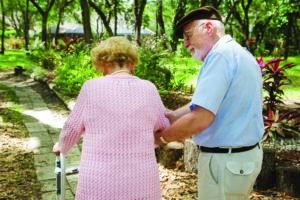
    WHEN TO MOVE

    Understanding the finances behind senior living compared to staying at home is important when comparing dollars; the next dilemma is considering when a move makes sense. The most common reasons to make a move to senior living rather than staying at home with a paid caregiver are:

    • Living alone and needing supervision and hands-on assistance with everyday activities, like showering, getting dressed, personal care and housekeeping.
    • Meal preparation and proper nutrition is crucial to maintain an older adult’s health. When someone has difficulty cooking, preparing, or making healthy choices when it comes to nutrition, it could be a wake-up call.
    • Medication management is vital, especially the more medications an older adult takes. Older adults who are hypertensive, diabetic or have other conditions can have serious health complications if their medications are forgotten or not taken on a timely basis.
    • Loneliness and depression should be taken seriously. The recent death of a spouse can cause loneliness, depression and a need for companionship. Even if a spouse passed away years ago, depression could be caused by regretting plans that never happened. Assisted living holds with it the opportunity for a variety of activities and socialization.
    • Health-related issues are the reasons for a move for Scramblers and Reluctant Consenters. Arthritis, failing eyesight, and a whole host of health-related deficits can make living at home a potential crisis.\

    Referral and placement agents with the CSA® and CPRS credentials are overwhelmingly qualified to help families during their decision-making process. Their knowledge of local community care options makes their expert guidance invaluable. Referral and placement agents work with no cost to family members and are available nationwide. Families, as well as professionals, can find qualified and certified agents at www.CSA.us and www.NPRAlliance.org.

    In conclusion, the question “to place or not to place” is a significant decision for families and older adults to make. In a perfect world, families have time and will include their loved ones on all decision-making. However, life doesn’t always go as planned. Knowing the signs that extended care is needed, as well as the cost, can make the journey of long-term care easier. Getting advice from a qualified placement agent with professional credentials can make the transition into senior living a safer and easier route to take.


    This article has been provided courtesy of the
    SOCIETY OF CERTIFIED SENIOR ADVISORS®
    800-653-1785 | Society@csa.us
    www.csa.us

    The decision to move to senior living involves a variety of factors based on several circumstances, including finances. Professionals across the country have different answers to the question of whether “to place or not to place” a loved one in senior living. Some feel that older adults should stay in their home with paid caregivers.…

  • Chinese American Culture, Identity, Home

    Photo of Darien Hsu Gee
    Darien Hsu Gee

    What does it mean to be Chinese American?

    How are we reflected in the people we love and us in them?

    What obligation do we have to those who share our blood?

    How does a woman claim her life as her own?

    Where is my true home?

    Big Island bestselling novelist Darien Hsu Gee explores the answers to these questions through her poetic memoir and award-winning poetry, which debuted last fall in Allegiance and Other Small Histories.

    In Allegiance, a collection of micro-essays and prose poems, Darien explores her Chinese American identity and themes of belonging. Darien navigates the complexity of family dynamics in search of her identity.

    As a first-generation Chinese American, she portrays a feeling of spiritual homelessness as she charts her itinerant journey through her lyrical narrative of Asian diasporic experiences.

    “Gee is a marvelously direct writer of powerful autobiographical vignettes, each one telling in its quiet ferocity for personal revelation, each a momentary, lyric ascent above everyday confusion,” says fourth-generation Japanese American poet Garrett Hongo.

    Other Small Histories, a collection of poems, was selected as a Poetry Society of America 2019 Chapbook Fellowship winner by Patricia Smith, who called the book “a lush and lyrical chronicle of a walking back, a mesmerizing merge of research, vision and invention that gradually crafts a story of the women in her matriarchal line.” One critic wrote, “These luminous narratives explore complex familial relationships with spare, controlled prose. Gee is an eloquent writer whose voice resonates well past the last page.”

    Darien is the author of six novels, five of which have been translated into 11 languages. Three were written under the name Mia King.

    She holds a BA from Rice University and an MFA from the Rainier Writing Workshop at Pacific Lutheran University. She serves as series editor for the Hali‘a Aloha micro-memoir and hybrid publishing program. She and her family currently live in Waikōloa on the Big Island.


    DARIEN HSU GEE
    www.dariengee.com
    Other Small Histories: Poems: http://bit.ly/PoemsGee
    Allegiance: Micro Essays: http://bit.ly/AllegianceGee
    Hali‘a Aloha Series: http://bit.ly/HaliaAlohaGee

    What does it mean to be Chinese American? How are we reflected in the people we love and us in them? What obligation do we have to those who share our blood? How does a woman claim her life as her own? Where is my true home? Big Island bestselling novelist Darien Hsu Gee explores…

  • Ching Ming Festival Honors Ancestors

    When Douglas D.L. Chong thinks about celebrating Ching Ming as a child, he remembers waking up before dawn to the smells of home cooking. Sitting in traffic en route to the Mānoa Chinese Cemetery, a line of cars backs up all the way to University Avenue. Finally, around 7am, his family would reach their oldest ancestors’ grave sites, arriving there at the same time as about 40 other relatives.

    “There were literally thousands of thousands of Chinese; hundreds of families,” he recalls. Chong is the president of the Hawaii Chinese History Center. “You’d bring all the kids; all the grandchildren. Everybody had to go to these rituals. It was a big thing — the only time the whole clan would get together.”

    “This is where family history, family lore and connections are made,” he says, “but always invoking the spirits of those ancestors, asking them to bless the offspring.”

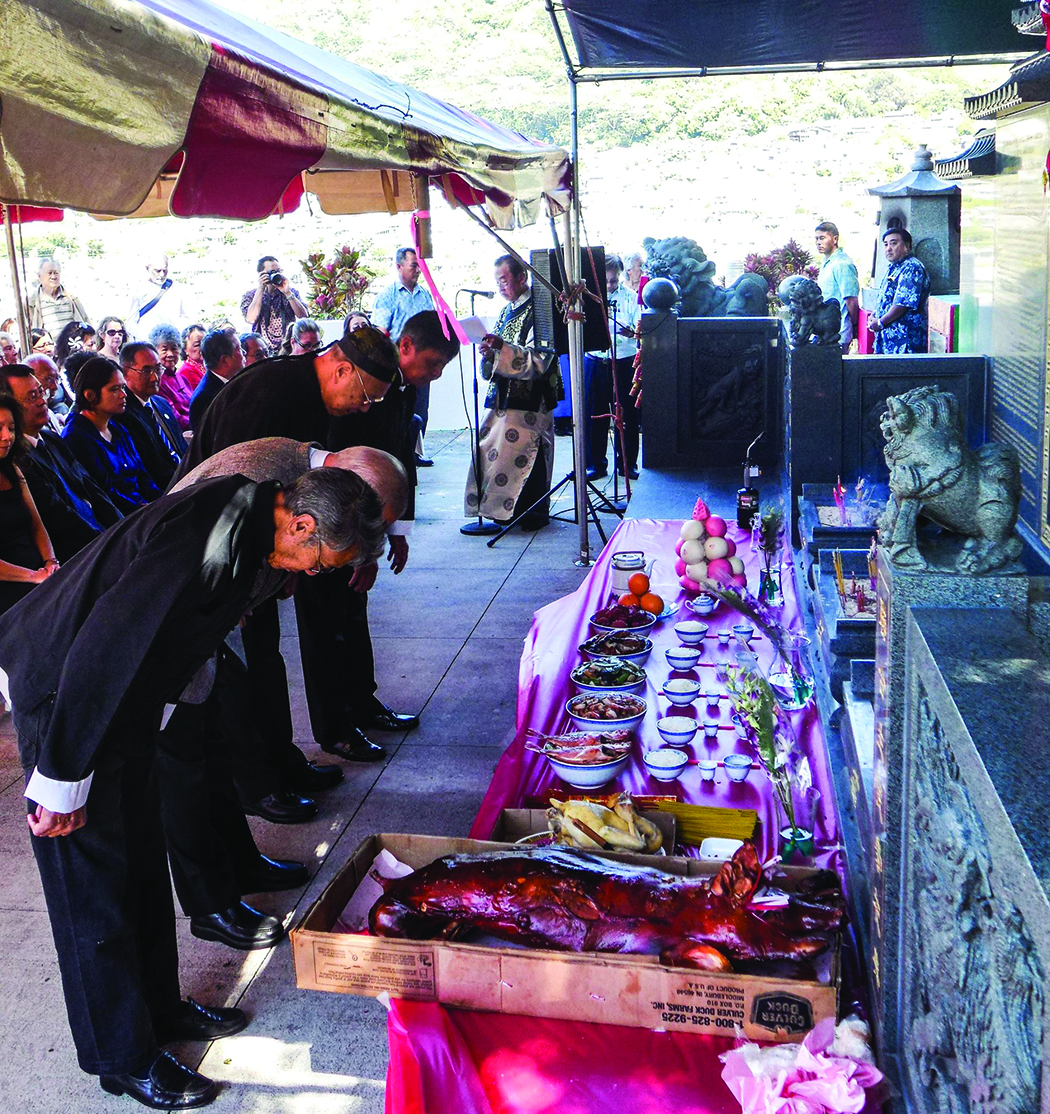
    A springtime ritual paying homage to family ancestors, the Ching Ming Festival is still celebrated in Hawai‘i each April. A month-long period during which families clean grave markers and pay respects to deceased parents, grandparents, great-grandparents (and so on), it begins with a community gathering. This year, due to the pandemic, the United Chinese Society hosted a private opening ceremony April 4 at the Tomb of the Grand Ancestor in Mānoa.

    Started in the 1850s, the Mānoa Chinese Cemetery sits on the ‘Akāka peak on the east side of former ag lands, surrounded on three sides by the Ko‘olau Mountains. ‘Akāka offers a clear view to the water — the Pacific Ocean — thus adhering to important concepts of feng shui, the practice of aligning oneself with nature.

    “You have to be facing the water in feng shui,” Chong said. “That water is the blood of the Earth dragon — the dragon of the Earth.”

    Opening ceremonies of Ching Ming this year included some of the usual trappings, but gatherings were smaller. Still, Chinese families will gather at the 10 Chinese cemeteries on O‘ahu, or the dozen cemeteries on Big Island and Maui.  Graves will be tidied and cleaned. Before cemetery caretakers were employed, Ching Ming was one of the few times in the year grass and foliage would be manicured, said Michelle Choy, a past president of the Chinese Chamber of Commerce who is active in the Chinese community. She typically attends five or so Ching Ming graveside ceremonies with family and friends; this year, she’ll likely attend only two.

    While each family has its own traditions, the most traditional graveside ceremony is a long one involving symbolic grave decorations and five traditional dishes presented along with drinks and incense. A whole roast pig is presented.

    Sometimes, paper objects — including spirit money — are burned so as to send an ancestor into the afterlife with all the necessary resources. Douglas and Michelle mentioned offering spirit money to ancestors who liked to go to Las Vegas.

    With its focus on filial piety, the ritual begins and ends with firecrackers and includes each relative bowing several times to the ancestor.

    Douglas feels satisfied and pleased watching his grandchildren and children perform Ching Ming rituals, which begin for his family at the site of his grandfather’s grave on a hillside in Mānoa. One of his grandsons is a student at Maryknoll, learning one of the five dialects of the Chinese language Douglas himself speaks.

    “It’s my hope once they are exposed to it, they internalize it to make it a part of themselves,” he said. “My main theme in all of this is not cultural identity. This isn’t my cultural identity; it’s not my culture. It’s my own true self-identity.”

    When Douglas D.L. Chong thinks about celebrating Ching Ming as a child, he remembers waking up before dawn to the smells of home cooking. Sitting in traffic en route to the Mānoa Chinese Cemetery, a line of cars backs up all the way to University Avenue. Finally, around 7am, his family would reach their oldest…

  • How to Be a Positive Communicator

    photo of a happy family

    If you feel some tension in your relationships, you are not alone. So do your part at home to protect loved
    ones’ feelings and emotions.

    Keys to Successful Communication

    • Rotate chores and praise each person for doing a slam dunk job.
    • LOL — Listen out loud to each other and avoid making comments.
    • Use connecting conversations to soothe feelings by cutting out criticism, pushy words and rolling your eyes.
    • Remember, your kūpuna may be confused, so speak slowly, smile and give hand massages.
    • Introduce fun games and interactions. Kūpuna can become feisty competitors during bean bag toss and balloon volleyball.

    Pivot Negativity to Positivity

    –  I can’t pay my bills. (resignation)
    I’ll apply for assistance. (hopeful)
    –  I’m trapped at home! (anger)
    +  So I have more time for fun! (fun)
      I can’t go out and eat. (helpless)
    +  Let’s order takeout! (a good solution)
      Why now? Why me? (victim)
    +  I’m grateful I’m in good health. (appreciation)

    What seem like bitter trials are sometimes blessings in disguise. Practicing an attitude of gratitude can make all the difference.


    ANNETTE PANG-LIFE COACH VILLAGE, LLC
    2383 Beckwith St., Honolulu, HI 96822
    808-372-3478 | ap@annettepang.com
    www.annettepang.com

    If you feel some tension in your relationships, you are not alone. So do your part at home to protect loved ones’ feelings and emotions.

  • Kapu Breakers Help During Pandemic

    Photo of Angela Keen
    Angela Keen

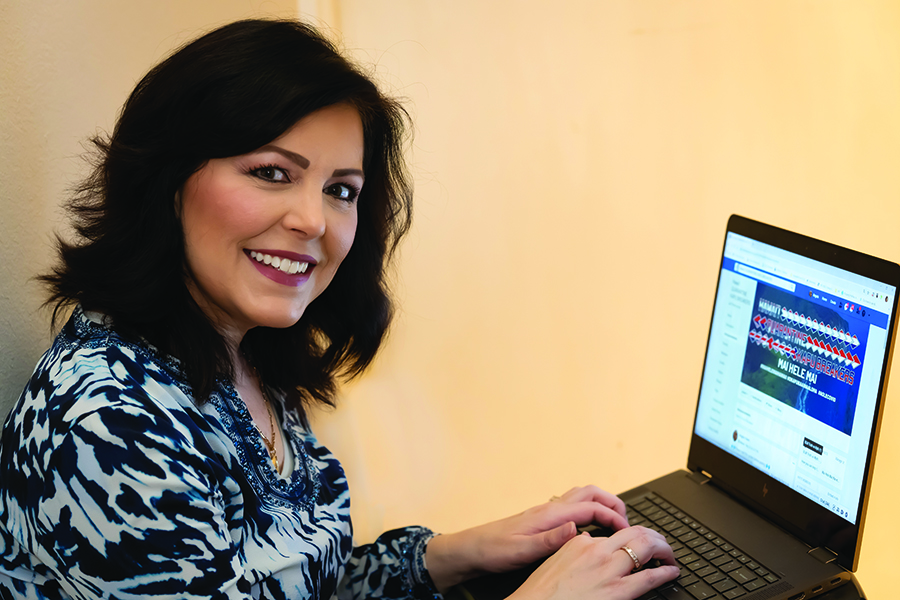
    Former TV news reporter Angela Keen helps track down residents and visitors statewide who are not in compliance with the state’s COVID-19 quarantine rules and mask mandate through the Hawai‘i Quarantine Kapu Breakers, a volunteer, community action group on Facebook.

    Angela joined the leadership team in March 2020. “The group enables me to use my journalism and reporting skills to investigate the people suspected of breaking quarantine,” says Angela. The original founder left the group last May, leaving Angela in charge.

    Angela also has personal reasons for getting involved in the group. “I am a COVID-19 survivor,” says Angela. “I had the virus when the group started. My situation was serious — it took me eight weeks to recover. I felt it was my kuleana to help prevent others from contracting it.”

    About 6,000 active members share tips through the group’s private Facebook page. Angela likens it to a neighborhood watch, aiding law enforcement to help stop the spread of COVID-19.

    “We are a unique group of professionals mixed with a few ku¯ puna,” says Angela. “Many kumu and ku¯ puna in the group are my advisors and mentors — to make sure we do things pono. Many feel our efforts help the ku¯ puna and others at high risk. But most of our members work in the tourism industry.” The group has lead teams in every county and members on all islands.

    Through these tips and information, she builds a digital file and sends it to the Hawai‘i attorney general’s office, where it is reviewed by the AG’s lead special investigator and his team. The quarantine breaker is usually arrested within 48 to 72 hours.

    As of this writing, HQKB has helped to identify more than 74 violators.

    Angela and her group also lobbied for a better statewide mask mandate. The group assists in enforcing it by holding weekend monitoring events. When they see unmasked people, they approach with a mask and a flyer explaining the mandate.

    The group also gets tips on large group gatherings. “For large parities, we ask people to call the non-emergency number of their local police department. Reports on mask or distancing issues at restaurants go to the state Department of Health.”

    Of those identified as kapu breakers, about 70 percent are tourists and 30 percent are locals.

    Angela has currently focused on lobbying, and working with state and county leaders.

    Find the group at www.facebook.com/groups/KapuBreakers. Membership is by referral only; nonmembers can report possible violations by emailing quarantinebreakers@gmail.com.

    Former TV news reporter Angela Keen helps track down residents and visitors statewide who are not in compliance with the state’s COVID-19 quarantine rules and mask mandate through the Hawai‘i Quarantine Kapu Breakers, a volunteer, community action group on Facebook.

  • Senior Pickleball is Exploding!

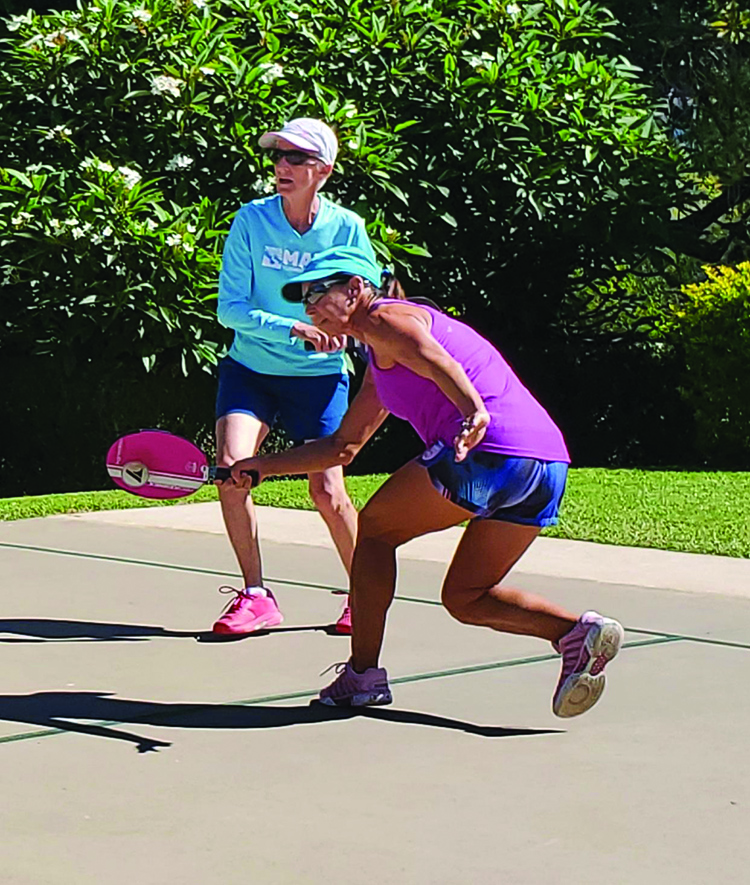
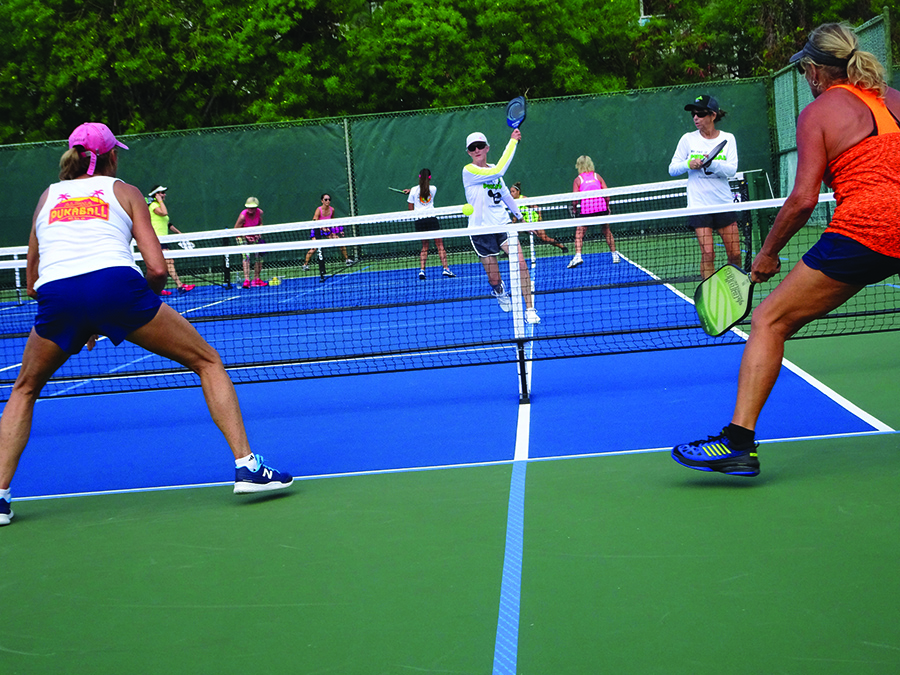
    Megan Crouse and Judy Teltscher LeLevier. PC: Laurie Loney
    Megan Crouse and Judy Teltscher LeLevier. PC: Laurie Loney

    Beginning players love the game immediately, because it is easy to learn, once you master the somewhat unconventional scorekeeping method. It’s fun at any skill level, providing exercise and social interaction, even during the pandemic.

    “I give lessons to local and visiting players; the majority are seniors,” says Laurie Loney, one of Maui’s four USA Pickleball ambassadors. “They have fun immediately! Most become hooked instantly and recruit their friends to join in.”

    Ambassadors like Laurie are volunteer representatives and unofficial spokespersons for USA Pickleball who promote goodwill and help grow the sport in their area.

    Laurie, a senior player, instructor and state gold medalist, estimates that about 80 percent of Maui’s 500-plus players are over 50, adding that the under-50 age group is also growing quickly.

    “The latest numbers show that Hawai‘i’s over- 50 players comprise about 70 percent of total players in the state,” says Jack Hodges of Kaua‘i, the state’s USA Pickleball ambassador. “We also have a very large group of under-50 players and a large group of players over age 70 on Kaua‘i, as well.”

    Megan teamed up with Laurie Loney for the 2019 Maui Pukaball Tournament. PC: Irene Bowering
    Megan teamed up with Laurie Loney for the 2019 Maui Pukaball Tournament. PC: Irene Bowering

    Laurie, who has had her own court for 18 years, says there were several private courts in South Maui back in the ’70s and ’80s. Since popularity of the game has increased at such a fast rate, players have commandeered existing tennis and basketball courts, awaiting designated, county -built pickleball courts. Private tennis clubs, such as Kapalua, Royal Lahaina, Wailea and the Maui Country Club, are accommodating pickleball play. There are also dedicated county courts at Waipuilani and Lahaina Civic. “But the current public facilities are becoming overwhelmed,” says Laurie. “The need for more courts is great.”

    Especially after COVID-19 restrictions were put in place, many pickleball fans are also playing in their driveways, neighborhood cul-de-sacs or condo parking lots. Some are even building their own 20-by-44-foot cement or asphalt courts on their private property.

    Looking for a game? Visit www.places2play.org or download the USA Pickleball Places2Play app.


    USA PICKLEBALL
    Hawai‘i Ambassador Jack Hodges
    808-634-4049 | jhodges26@mac.com
    Please adhere to your local COVID-19 safety regulations when playing or waiting to join a pickleball game.

    Pickleball is growing fast among fun-loving athletes and non-athletes alike. The paddle-and-ball game has become especially attractive to baby boomers and former tennis players. There is less acreage to cover for aging legs and the ball moves slower than in a typical tennis match.

  • Defying the Silver Tsunami Stereotype

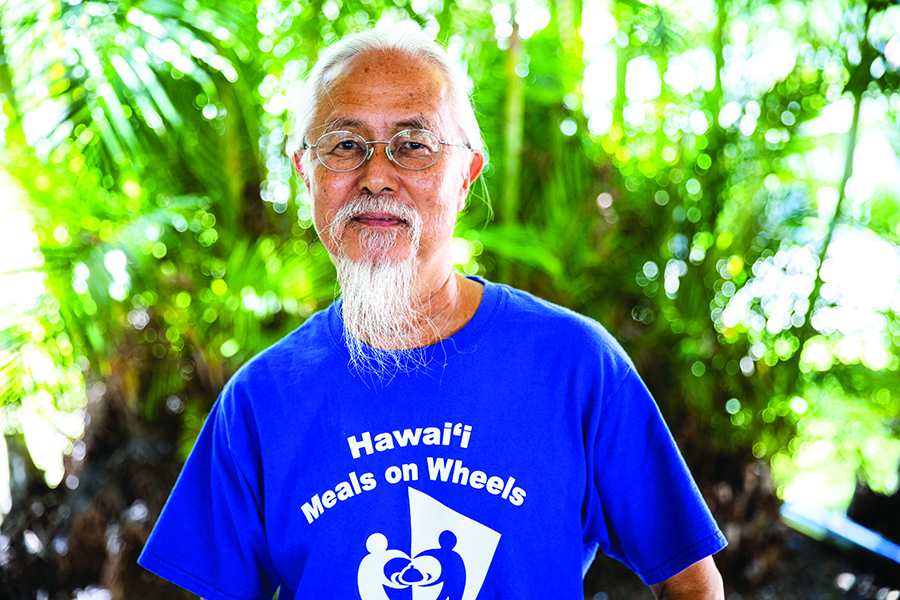
    Doug Matsuoka started working at Hawaii Meals on Wheels (HMOW) seven years ago as a part-time delivery driver. But his previous computer experience opened the door to his current job as the IT (information technology) and digital media coordinator, and “YouTube guy.”

    He was an early adopter of computer technology, building his own microcomputer from a kit in the early 1980s. Doug learned his trade through various jobs.

    Doug worked as the director of technology for the Honolulu Board of Realtors for six years before coming to HMOW. As the years passed, Doug became aware of a growing chasm between his personal ideology and the goals of a real estate organization that grew more prosperous while homes became further out of reach for an increasing number of would-be owners. This crisis of conscience prompted Doug to quit his well-paying job.

    He left at age 57. His father died at 60, so assuming he may face the same fate, he wanted to spend his remaining time immersed in political activism — a socially conscious decision not based on dollar signs. He soon expended his savings and found himself homeless.

    “The problem, if I can call it a problem, was that I lived longer than my dad did,” Doug says.

    But it was through this political activism that he got to know the now-former executive director of HMOW, who eventually offered him a job.

    “I am not making the money that I once did, but I get to do what is beneficial to the community,” he said. “It is important how you make a living and I finally understand that completely now. It’s the best job I’ve ever had.”

    Pre-pandemic, about 500 HMOW volunteers — most of them seniors — delivered hot meals every day. “That’s what seniors do when their work obligations are finished… they still want to serve their community,” says Doug. However, now more meals are delivered by staff members rather than senior volunteers, due to safety concerns.

    Doug says that even though he and the seniors he knows have a lot to offer, when people talk about the Silver Tsunami, many think of older people only as consumers of social services. “It’s interesting getting older, because you age into a unique form of discrimination. Day by day, you start becoming aware of microaggressions — indirect, subtle, unintentional discrimination.”

    “People worry about meeting the demands of our growing older population, when actually, a lot of the older people are economically productive and serving the community,” says Doug. “Seniors run nonprofits, businesses… including the man who holds the highest office in the country.”

    Even so, seniors are often stereotyped. “Their biggest threat is their stereotype threat — the risk of conforming to the stereotype,” says Doug.

    Doug will soon be 69. “Old guys like me are not conforming to the stereotype. We are doing what we can in the community,” says Doug. “I am not alone. There are many my age and older who are social service providers, not consumers. I wish that was the senior stereotype: productive people who are a resource for the community.”

    Their professional experience and life perspectives continue to sculpt seniors into one of society’s most valuable resources.


    HAWAII MEALS ON WHEELS (501(c) 3 nonprofit)
    P.O. Box 61194, Honolulu HI 96839
    808-988-6747 | www.hmow.org

    Doug Matsuoka started working at Hawaii Meals on Wheels seven years ago as a part-time delivery driver. But his previous computer experience opened the door to his current job as the IT and digital media coordinator, and “YouTube guy.” He was an early adopter of computer technology, building his own microcomputer from a kit in…

  • Silver Lining of a COVID Cloud

    When we all closed our doors, fluffed our couch pillows and settled in for what we thought was only going to be a two-week lockdown, no one could have imagined where we would be in 2021. We’re here now and life has a breeze of normalcy amid the chaos. Zoom family celebrations or business meetings are regularly scheduled in our calendars, delivery drivers know our routines and we’ve become more okay with staying in.

    Supply and restaurant delivery are some of the conveniences the disabled and aged communities have needed for so long. Yet, seemingly overnight, these options are now available. Farmers markets are doing drive-by delivery, offices switched entirely to remote work and schools became “anywhere,” using distance learning.

    And along the way, members of the disabled and senior communities have found that they can get a break from sheltering in place and stay safe by taking a drive, using their auto adaptive equipment. During their solo drive, they can avoid the virus. Their vehicle becomes a safe haven, an escape and a silver lining in this dark pandemic cloud. So taking care of your vehicle is more important than ever to stay safe and healthy in 2021.


    SODERHOLM MOBILITY, INC.
    2044 Dillingham Blvd., Honolulu, HI 96819
    P: 808-834-1417 | F: 808-834-1070
    www.soderholmbus.com
    Soderholm Sales and Leasing Inc.
    PO Box 19010, Honolulu, HI 96817

    When we all closed our doors, fluffed our couch pillows and settled in for what we thought was only going to be a two-week lockdown, no one could have imagined where we would be in 2021. We’re here now and life has a breeze of normalcy amid the chaos. Zoom family celebrations or business meetings…

  • New Rules for the New Game of WORK

    Our changing workplace dynamic at this stage of life requires a new set of rules to help us navigate our careers.

    ■ The first rule of the “new game:” To remain financially secure, most of us (over 50 percent) will need to continue to work — in some capacity — much later than in past generations.

    ■ So-called “entitlements” and social systems set up to ensure cradle-to-grave support are rapidly becoming obsolete in all countries and nations. People who count on these entitlements are going to be in for an unpleasant surprise.

    ■ Organizations will never again hire full-time “office workers” to solve short-term problems. They will keep very few people who do not serve their immediate needs because the world is in play. Technology and innovation are not birthrights. Work that can be done somewhere else by someone else will be!

    ■ “Work” is to the 21st century what “jobs” were to the 20th. Many people will do more than one thing and serve several clients or customers at any given time. Portfolio careers, so long predicted, are now a fact, along with highly specialized
    careers that support marketplace needs.

    ■ There is opportunity awaiting those who plan and act, because change will continue to be fast and discontinuous, meaning that frequent upgrading of competencies, reinvention and innovation are, now and forever, part of the new rules of the game. Careers that served millions once-upon-a-time in the not-so-distant past may now be obsolete or so materially changed that they bear little resemblance to once-familiar careers.

    ■ Those who model their career planning after our strategic business (yes, your career is your business) model, will succeed while many others will live hand-to-mouth in an economy that favors the consistently prepared. We will present this business planning model in our next article.

    ■ “Why am I here and has my life mattered?” This question arises in virtually everyone’s life. You will matter in ways never previously imagined in younger lifetimes.

    Remember, those who ask this question at mid-career have the time to create the meaningful lives they long for and deserve. Those who don’t, won’t!


    NEW WORKFORCE HAWAII
    Carleen MacKay
    916-316-0143 | carleenmackayhi@gmail.com
    www.linkedin.com/in/carleenmackay

    Our changing workplace dynamic at this stage of life requires a new set of rules to help us navigate our careers. The first rule of the “new game:” To remain financially secure, most of us (over 50 percent) will need to continue to work — in some capacity — much later than in past generations.

  • Morning Habits Bring All-Day Joy

    Have you ever observed how you wake up? Are you quick to rise or slow to get moving? Do you wake up happy or with a sense of dread, or is your mind already dealing with problems?

    If feeling better is important to you, consider starting your day more deliberately. When you first wake up, smile! Smiling has positive chemical effects in the brain, including the release of dopamine, endorphins and serotonin, the happy hormones that help lower stress, anxiety and can aid in lowering heart rate and blood pressure.

    Make a positive declaration that feels good to you, and if possible, say it aloud and express it with your body. It can be a simple thing like, “I am healthy!” or “I feel bright!” Try different phrases until you find one that resonates with you. Then, take a moment to thank your body and brain for keeping you alive while you slept. Your internal systems worked hard detoxing, purging, processing and rebuilding, all without any work or thought on your part. When you take that moment to appreciate your body’s functions, you might even start to feel your body responding to your attention.

    The first time you do this, it may feel strange, but after a week, you will feel the difference!


    KAIMUKI BODY & BRAIN
    3569 Harding Ave., #B, Honolulu, HI 96816
    808-738-5522 | www.bodynbrain.com/kaimuki

    Have you ever observed how you wake up? Are you quick to rise or slow to get moving? Do you wake up happy or with a sense of dread, or is your mind already dealing with problems? If feeling better is important to you, consider starting your day more deliberately.