Category: Programs & Services

  • Memorializing Can Lift the Burden of Regret

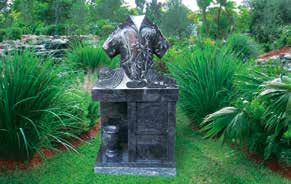
    regretMany families in Hawai‘i now choose cremation and scattering their loved one’s ashes into nature. Scattering can be a profoundly moving experience, but it’s also a decision that should be considered very carefully — because once it’s done, it can’t be undone.

    Without a plan in place, families may experience heartbreaks. Often, in times of sorrow, family members having to make quick, gut-wrenching decisions about what to do with their loved one’s remains later feel regret.

    Months or even years later, with the clarity that comes with time, families realize that they wish they’d kept a portion of their loved one’s remains in a spot where they could visit, reflect and feel close. The regret over not having a permanent memorial can linger indefinitely.

    It is natural to want to remember those who have touched our lives in a tangible way, and it’s important for those left behind to visit a place where the name of their loved one is still present. Consider a permanent memorial. It’s a wonderful way to honor a life and inspire future generations.


    VALLEY OF THE TEMPLES
    47-200 Kahekili Highway, Kaneohe HI 96744
    808-824-3427 | www.valley-of-the-temples.com

    Many families in Hawai‘i now choose cremation and scattering their loved one’s ashes into nature. Scattering can be a profoundly moving experience, but it’s also a decision that should be considered very carefully — because once it’s done, it can’t be undone. Without a plan in place, families may experience heartbreaks. Often, in times of…

  • Make a Retirement Resolution

    It’s 2017 and one year closer to retirement. Whether you’re at your very first job or wrapping up a successful career, there are always new things to learn when it comes to saving for the future. So why not make retirement planning part of your New Year’s resolution?

    Putting money in a high-yield savings account (if you can find one) is always smart, but you can do even more. The U.S. Department of the Treasury now offers a retirement savings option called “myRA.” There’s no minimum to open the account, you can contribute what you can afford and you can withdraw funds with ease. To learn more about myRA, visit www.myra.gov.

    Hopefully, your employer chips in a little. An employer-sponsored retirement plan or 401(k) can be a useful way to set aside funds for retirement, especially if your employer offers to match what you invest. If you don’t work for an employer who offers this type of plan, there are many other plans designed to help you save for retirement.

    From solo 401(k)s to traditional and Roth IRAs, there are programs designed to fit a multitude of budgets.

    Social Security is funded by taxes you pay while you work. To get estimates of future benefits and check your earnings record for accuracy, you can create a “my Social Security” account at www.socialsecurity.gov/myaccount.

    Along with giving up bad habits in this New Year, start a good one that can make a lasting, positive difference.


    For questions, online applications or to make an appointment
    to visit a SSA office, call from 7am–7pm, Mon–Fri:
    1-800-772-1213 (toll free) | 1-800-325-0778 (TTY)
    www.socialsecurity.gov

    It’s 2017 and one year closer to retirement. Whether you’re at your very first job or wrapping up a successful career, there are always new things to learn when it comes to saving for the future. So why not make retirement planning part of your New Year’s resolution? Putting money in a high-yield savings account…

  • Keeping the Mind Engaged for Life

    1
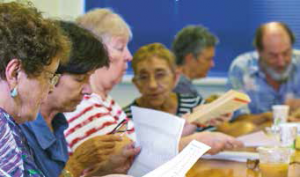
    “It’s really an important part of my life,” said member Jeanne Nowaki. “The classes are interesting, but the bonus is meeting people from different fields.”

    Osher Lifelong Learning Institute at the University of Hawai‘i at Mānoa was founded in 1996-97, when a group of community elders, retired professors and university administrators established the Academy for Lifelong Learning (ALL). Its mission was to strengthen connections between the university and the community, and promote lifelong learning, leadership, and community service for older learners. A generous endowment from The Bernard Osher Foundation emphasizes providing older adults with opportunities to learn purely for the joy of learning.

    What is the Osher Lifelong Learning Institute?
    OLLI-UHM is an educational membership program offering noncredit, college-level courses and other activities to encourage learners ages 50 and over to engage their minds, enrich their lives and serve the community.

    Older adults are a resource for society, with continuing social, developmental and intellectual needs. OLLI-UHM provides a forum to meet those needs and validate their contributions.

    How does the program benefit participants?
    We know that lifelong learning keeps the mind sharp, fighting cognitive impairment most effectively when mentally challenging activities are combined with active social engagement. That is exactly what OLLI-UHM excels at, providing members with an ever-expanding array of courses, workshops, film series, arts events, museum tours and more, in an engaging supportive social environment.

    Who teaches classes?
    Classes are taught on a volunteer basis by active and retired professors, as well as community members who are experts in a particular subject. Some members teach in areas entirely different than their professional expertise, as they expand their knowledge base with post-retirement passions. Members may be students in one class and the instructor or facilitator in another.

    As Jack Sullivan, a member since the program started in 1996, said, “They love their subject so much they are willing to do this without pay.”

    How can people sign up?
    The OLLI-UHM 2017 Spring Term will run from Jan. 23 to April 28, with no classes during UH’s Spring Break the last week of March. We offer noncredit courses and special events on a wide-range of topics and disciplines.

    The spring course brochure will be completed and available by mid-December.

    Contact Carole at mandryk@hawaii.edu or 808-956-8224 to learn more about workshops and special events, and to be added to the mailing list.


    COLLEGE OF SOCIAL SCIENCES
    University of Hawai‘i at Mānoa
    2500 Dole St., Krauss Hall 113-C, Honolulu HI 96822
    808-956-8224

    Osher Lifelong Learning Institute at the University of Hawai‘i at Mānoa was founded in 1996-97, when a group of community elders, retired professors and university administrators established the Academy for Lifelong Learning (ALL). Its mission was to strengthen connections between the university and the community, and promote lifelong learning, leadership, and community service for older…

  • Grandparents Provide ‘Roots & Wings’

    sylvan
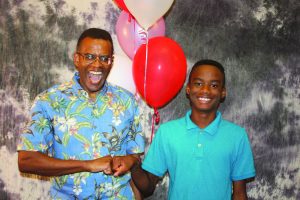
    Chaplain Ken Revell and his grandson are happy with the significant academic progress Brandon has made with the help of Sylvan Learning Center.
    The U.S. Department of Health and Human Services’ National Center for Health Statistics reports that fatherless children are at a dramatically greater risk for drug and alcohol abuse, mental illness, suicide, poor educational performance, teen pregnancy and incarceration.

    My mission is not to debate or vet the validity of these statistics or to “drop dimes” on fathers who are missing in action, because many fathers are doing the best they can with what they have.

    I will say that my role as a grandpa to Brandon Revell is to stand in the gap and be a part of the solution.

    The challenge for me is how I will move Brandon from adolescence and the so-called “turbulent teen years” to adulthood.

    Essentially, the questions are: How do I provide my grandson with roots and wings? How do I build on, augment and refine the foundation his parents sought to put in place.

    While there are several components involved in this challenge, one immediately comes to mind as a key — education. Instilling in Brandon an appetite for learning is a critical component of helping him to be a successful human being.

    I was given legal custody of Brandon in 2014, when the roles of surviving spouse and single parent were added to my already full plate as a full-time soldier.

    As Brandon and I navigated and developed our new relationship together, I could see he was a bright kid who was full of untapped potential. However, academically, he was on life support — and the situation was critical. A code blue was imminent if I did not act quickly.

    As providence would have it, my chaplain assistant recommended Sylvan Learning Center, promising me that it was a tried and proven program for his kids with academic challenges.

    Enrolling Brandon in Sylvan Learning Center was one of the best decisions I made. Sylvan’s intervention played a critical role in improving his grades, increasing both his reading and math skills, as well as providing an environment conducive to learning.

    Sylvan Learning Center provided the assessment tools and tutoring methodology needed to take a tough situation and turn it around.

    I am happy to report that Brandon has made significant progress, and he is currently in the 10th grade. I attribute much of this success to the professionals at the center.

    While we tout Boy Scouts, Girl Scouts and youth programs as tools to help shape our grandchildren’s character, I see investing in a good tutoring program as another critical tool to move our grandkids in the right direct — particularly those who are struggling academically.

    We are far from perfection in this adventure and we still have a ways to go in this journey, but I am confident we are on the right track.

    Brandon and I highly recommend Sylvan.


    SYLVAN LEARNING SYSTEMS
    4211 Waialae Ave., Ste. 30, Honolulu HI 96816
    808-735-8811 | www.sylvanlearning.com/kahala

    The U.S. Department of Health and Human Services’ National Center for Health Statistics reports that fatherless children are at a dramatically greater risk for drug and alcohol abuse, mental illness, suicide, poor educational performance, teen pregnancy and incarceration. My mission is not to debate or vet the validity of these statistics or to “drop dimes”…

  • Social Security is Here to Stay

    It’s healthy to be skeptical in a world of uncertainties. But rest assured, there’s no reason to think Social Security won’t be here for you well into the future.

    Recently, the Social Security Board of Trustees released its 76th annual report to Congress, presenting the financial status of the Social Security trust funds for the short term and over the next 75 years. We’re pleased that legislation signed into law by President Barack Obama last November averted a near-term shortfall in the Disability Insurance (DI) trust fund that was detailed in a previous report.

    With that small, temporary reallocation of the Social Security contribution rate, the DI fund will now be able to pay full benefits until 2023, and the retirement fund will be adequate into 2035. It is important that members of Congress act well before 2023 in order to strengthen the finances of the program. As a whole, Social Security is fully funded until 2034; after that it is about threequarters financed.

    Many people wonder if Social Security will be there for them. Here’s a fact that will relieve any skepticism you might have: the increased cost of providing Social Security benefits for baby boomers is less than the nation’s increase in spending was for public education when baby boomers were children.

    Put your skepticism aside and know that Social Security is with you today and will be with you tomorrow. Read the entire report at www.socialsecurity.gov/OACT/TR/2016.


    For questions, online applications or to make an appointment
    to visit a SSA office, call from 7am–5pm, Mon–Fri:
    1-800-772-1213 (toll free) | 1-800-325-0778 (TTY)
    www.socialsecurity.gov

    It’s healthy to be skeptical in a world of uncertainties. But rest assured, there’s no reason to think Social Security won’t be here for you well into the future. Recently, the Social Security Board of Trustees released its 76th annual report to Congress, presenting the financial status of the Social Security trust funds for the…

  • Missions of Help and Hope

    Some of the most helpful nonprofits for seniors are small operations that cannot afford to advertise. We will be helping them by getting their message to you. Read below to learn how the volunteers and coordinators in these noteworthy organizations may help you and your family.

    PATIENT NAVIGATION PROGRAM
    nonprofit-patient-navigationThe nonprofit Pacific Cancer Foundation offers programs and support groups in Maui County. Its Patient Navigation Program plays an important role in connecting patients to their healthcare providers, including transportation, coordinating services and meeting their non-clinical needs.

    “When someone is first diagnosed with cancer, they go to the navigator,” said Nancy La Joy, PCF’s executive director. “The navigator helps him or her with anything needed along the journey.”

    Shari Osajima, a highly trained certified patient navigator, helps patients and their loved ones find resources and services.

    “What I enjoy most is meeting the patients and their family,” said Shari, “initially getting to know them and working with them to address some of their issues. Part of my job is to teach them and guide them to be advocates for themselves.”

    One of the greatest challenges for patients in Maui County is interisland transportation. PCF flies medical professionals and staff to Maui from O‘ahu. Local community agencies provide transportation to and from appointments on-island.

    Call PCF to learn more about the about the foundations and its Patient Navigation Program.

    At Maui Memorial Medical Center, the PCF Navigation Office is located near the Radiation Oncology Department.


    PACIFIC CANCER FOUNDATION
    95 Mahalani St., Ste. 8, Wailuku, Maui HI 96793
    808-242-7661
    navigator@pacificcancerfoundation.org
    www.pacificcancerfoundation.org

    EMPOWERING WOMEN

    untitledNa Wahine Ho‘omana, a women’s resource center on Maui, offers education on health and wellness, support groups and guidance.

    Na Wahine Ho‘omana offers a holistic and nutrition workshop, self-defense and self-empowerment programs, and more to women of all ages.

    A weekly Women Will Support Group is held on Tuesdays and Thursdays, from 5:50 to 6:30 pm in Ki¯hei, where woman share experiences and help each other stand up for themselves. The turnout for the support groups is usually small (one to eight attendees) with a total of 32 women registered. Their ages range from 28 to 70.

    “It’s hard to say why that elderly women attend the group,” said Na Wahine Ho‘omana President Donna Stockwell. “It may be due to declining health, an increased feeling of vulnerability or a loss of power that some experience as they age.

    “It’s natural stuff; it’s the aging process,” Donna said about women’s concerns.

    Na Wahine Ho‘omana was formed in 2014 by women wanting to make a difference in the lives of South Maui women and their families.

    The nonprofit, 100 percent volunteer-based organization would like to find a permanent home “where it is open and where people can just come by to be safe,” said Donna. “We are striving to be that all-inclusive clearing house of resources that’s connected and bridged with different agencies.”


    NA WAHINE HO‘OMANA
    Trinity by-the-Sea, 100 Kulanihakoi St., Ki¯hei, Maui
    Donna Stockwell, President
    808-280-3118 | donnastockwell@nawahinehoomana.org
    www.nawahinehoomana.org

    Some of the most helpful nonprofits for seniors are small operations that cannot afford to advertise. We will be helping them by getting their message to you. Read below to learn how the volunteers and coordinators in these noteworthy organizations may help you and your family. PATIENT NAVIGATION PROGRAM The nonprofit Pacific Cancer Foundation offers…

  • Medicaid Program To the Rescue

    Medicaid is a federally funded insurance program that is administered by the State of Hawai‘i. Persons of all ages can become eligible if they meet certain income and resource requirements. Coverage can vary from total coverage of all services to a little-known program that will cover your Medicare Part B premiums, called the “Specified Low-Income Medicare Beneficiary Program” (SLMB).

    If you are eligible for Medicare Part A, you may qualify for SLMB. The Medicaid SLMB program pays your Medicare Part B monthly premiums, which are generally $104.90. You can find your Medicare Part B premium on your annual Social Security Award letter as a deduction from your Social Security Income. If you qualify for SLMB, this deduction will stop, and your monthly Social Security check will increase by $104.90.

    Qualification for the SLMB program, like all Medicaid programs, is based on your monthly income and your countable resources. Countable resources can include bank accounts, stocks and the cash value of life insurance policies, as well as other assets.

    In 2016, for a single person, resources must be below $7,280 and monthly income must be below $1,367. For a couple, the resource limit is $10,930 and combined monthly income must be below $1,843. If you qualify for Medicaid benefits this program, you could see an annual increase in your income of $1,258.80!

    To see if you qualify or to apply, go to www.mybenefits.hawaii.gov.


    CARDON OUTREACH SERVICES
    680 Iwilei Road, Ste. 570, Honolulu HI 96817
    808-566-6666  |  www.cardonoutreach.com

    Medicaid Program To the Rescue by Cassandra Stewart, Executive Director, Cardon Outreach from the Oct-Nov 2016 issue of Generations Magazine, Hawai‘i’s Resource for Life

  • ‘Silent Teachers’ Help Future Doctors

    Body donation to the John A. Burns School of Medicine (JABSOM) is a highly personal decision with positive and far-ranging effects on our community, which may not be immediately apparent to most people. These benefits are like ripples in a pond, always expanding.

    OctNov2016 - silentteachers_image1A donation serves future doctors as the best way to learn anatomy during their training. The knowledge imparted to JABSOM medical students through your donation helps provide quality healthcare for our entire community and for generations to come. Every donor is a “silent teacher,” also educating medical and allied medical professionals in Hawai‘i.
    Medicine continually evolves, requiring continuing education. Last year, over 600 surgeons attended JABSOM workshops to learn new medical interventions that will directly benefit their patients.

    Your donation might also become a “mentor” for allied medical professionals, such as EMT students from Kapi‘olani Community College, who are learning life-saving emergency medicine techniques. Your body may help train Hawai‘i Life Flight teams of advanced nurses and doctors, who transport injured and critically ill patients every day. None of this would be possible without the altruistic gift of body donation.

    After our mentors and silent teachers have educated our healthcare students and professionals, we respectfully prepare them for cremation. The cremains are either returned to the family for private rites or held until our annual memorial service, depending on the stated wish of the donor. At our 2016 annual memorial service, we honored 150 donors, and over 500 family and friends attended. Later that afternoon, cremains of those who chose to be scattered at sea were paddled out beyond Magic Island by medical students and the Ānuenue Canoe Club. Family and friends watched the canoes as Celtic Pipes and Drums of Hawai‘i played in the background.

    Body donation for medical education and research requires legal forms to be completed and returned to the JABSOM office.

    The University of Hawai‘i’s Willed Body Program is the only whole body donation program in the state of Hawai‘i directly benefiting your community. For more information or to obtain a donor form, contact us using the information below.


    UNIVERSITY OF HAWAI`I 
JOHN A BURNS SCHOOL OF MEDICINE
    651 Ilalo Street, BSB 110, Honolulu HI 96813
    Willed Body Program
    
808-692-1445  |  wbdonor@hawaii.edu
    
jabsom.hawaii.edu/donors/willedbody/

    ‘Silent Teachers’ Help Future Doctors by Steven Labrash, CFSP, Director UH Willed Body Program from the Oct-Nov 2016 issue of Generations Magazine, Hawai‘i’s Resource for Life

  • We Salute Veterans Every Day

    SSA Logo Pantone 289-185Every day is Veterans Day at Social Security. An expedited process for Social Security disability applications is available to any military service member who became disabled during active duty on or after Oct. 1, 2001, regardless of where the disability occurred — at home or in the line of duty. Expedited processing is also available to veterans who have a compensation rating of 100 percent — permanent and total disability (P&T) — regardless of when it occurred. Some dependent children and spouses of military personnel may also be eligible for benefits.

    Visit our Wounded Warriors website, www.socialsecurity.gov/woundedwarriors, for answers to commonly asked questions and additional information about disability benefits available under the Social Security and Supplemental Security Income (SSI) programs. See our fact sheet: “Disability Benefits For Wounded Warriors.”

    You can also find the “Social Security for Wounded Warriors” webinar on expedited disability benefits for veterans and active duty military personnel online at www.socialsecurity.gov/socialmedia/webinars.

    Keep in mind that the requirements for disability benefits available through Social Security are different from those of the Department of Veterans Affairs and require a separate application. Read our publication, “Military Service and Social Security,” to learn more. It’s available at www.socialsecurity.gov/pubs.

    Thank you to all our nation’s brave veterans!


    For questions, online applications or to make an appointment to visit a SSA office,
    call from 7am–7pm, Mon–Fri:
    1-800-772-1213 (toll free)  |  1-800-325-0778 (TTY)

    www.socialsecurity.gov

    We Salute Veterans Every Day by Jane Yamamoto-Burigsay, Social Security Public Affairs Specialist in Hawai‘i from the Oct-Nov 2016 issue of Generations Magazine, Hawai‘i’s Resource for Life

  • How to Chill Hot and Spicy…

    As a relationship coach, I find that one of the biggest problems for family caregivers is communication collapse, especially when talking with family members and parents who are aging, ill or dying. Seemingly simple topics, such as how to wash dishes or how to celebrate a birthday, can explode into a hot confrontation.

    As an imperfect human, I often feel impatient, too. What sets me apart from my clients is that I know how to patch things up and return to peace.

    What technique helps you keep your conversations authentic and relevant, but still kind? Here are things that don’t work: force, bullying, clamming up, stuffing your feelings or crying yourself to sleep.

    Trained coaches lead vision exercises so clients can picture themselves in career or home situations as high-level communicators and peacekeepers. In groups and private sessions, vision therapy yields “aha moments.” Caregivers can then approach their present situation differently, boost their inner game and learn to communicate peacefully. Accountability comes from and answering uncomfortable questions, such as, “What was my tone of voice” or “How did others react to my gestures?”

    The key to ending arguments is to accept imperfections and apply proven approaches and new mindsets. Rivalries don’t get resolved when the referee is frail. As mature adults, now is the time to appreciate siblings’ personalities. Family members can enjoy a sweet reunion during a loved one’s transition when they put aside the hot and spicy behaviors of their teenage years.


    LIFE COACH VILLAGE, LLC
    808-372-3478  |  www.annettepang.com
    www.legendarywisdoms.com/senior-caregiver-coaching/

    How to Chill Hot and Spicy by Annette Pang, Relationship Life Coach from the Oct-Nov 2016 issue of Generations Magazine, Hawai‘i’s Resource for Life

  • To ‘B’ or Not to ‘B’

    OctNov2016 - tob_image1That is the question many Medicare beneficiaries are asking when they become eligible for Medicare insurance due to age. Beneficiaries collecting social security cash benefits (available as early as 62) are generally notified a few months before their 65th birthday that they are scheduled for enrollment into Medicare Part A & Part B, unless they opt out.
    Those who are not receiving cash benefits must apply on their own and only receive enrollment guidance by contacting social security. For most beneficiaries who meet eligibility rules, the 2016 standard monthly Part B premium is $121.80. However, Part B premiums are income-adjusted. High earners may pay more. Medicare beneficiaries who work at a company with 20 or more employees and have group health insurance through their job or as a dependent spouse may choose to delay Part B. Their group coverage covers Part B services. Yet, some employers require a dependent spouse to take Medicare Part A & Part B after aging into Medicare to remain in the retiree group plan. Medicare may become primary in that situation and the group retiree plan becomes a secondary payor. There is no one-size-fits-all in the Medicare universe. To avoid potential penalties or gaps in coverage, contact your company’s benefits specialist or Social Security to discuss your specific situation and steps. So to take Medicare Part B or not to take Medicare Part B — that is the question.


    MEDICARE MOMENT WITH MARTHA
A radio program with Martha Khlopin
    KHNR-690AM: 
Saturdays, 2pm-2:30pm
, Sundays, 9:30am-10am
    808-230-3379  |  getmartha@aol.com

    To ‘B’ or Not to ‘B’ by Martha Khlopin, Host of “Medicare Moment with Martha” from the Oct-Nov 2016 issue of Generations Magazine, Hawai‘i’s Resource for Life

  • The Sons & Daughters of the 442nd RCT

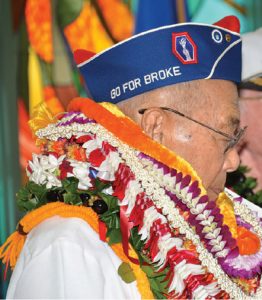
    OctNov2016 - thesonsdaughters_image1The Sons & Daughters was established in 1993 as a chapter of the 442nd Veterans Club, which is made up of Nisei veterans who fought two battles in World War II.

    “We will never forget the dedication, sacrifice and courage of our fathers,” the Sons & Daughers website states. “It is through their accomplishments that we are here today.”

    The nation’s highest award for combat valor, the Medal of Honor, was conferred upon 21 members of the 100th Infantry battalion of the 442nd Regimental Combat Team of World War II.

    On Oct. 5, 2010, the Congressional Gold Medal was awarded to the 442nd Regimental Combat Team and the 100th Infantry Battalion, as well as the 6,000 Japanese-Americans who served in the Military Intelligence Service during the war.

    In 2012, the surviving members of the 442nd RCT were made chevaliers of the French Légion d’Honneur for their actions contributing to the liberation of France during World War II and their heroic rescue of the Lost Battalion outside of Biffontaine, France.

    Sons & Daughters Honolulu club President Grace Fujii said that their work involves supporting Nisei veterans and helping preserve the history of the 442nd RCT, the most highly decorated unit in U.S. military history.

    This past year, they assisted at the 73rd annual banquet of the 442nd veterans and began planning for a memorial boulder at the National Memorial Cemetery of the Pacific at Punchbowl. They are now exploring the possibility of reinstating the docent program at Punchbowl and will participate in events this December for the 75th anniversary of the attack on Pearl Harbor.

    Regular membership is for all lineal descendants of a World War II soldier of the 442nd RCT and associate membership is available to those who are interested in the 442nd.

    “We welcome new members at any time,” said Grace. “It’s a great way to become involved in community activities, remember our veterans and learn about our World War II history.” To learn more, email or call the club.


    442ND VETERANS CLUB
    933 Wiliwili St., Honolulu HI 96826
    808-949-799  |  sons-daughters@442SD.org

    The Sons & Daughters of the 442nd RCT by Stephanie Kim, Generations Magazine Intern from the Oct-Nov 2016 issue of Generations Magazine, Hawai‘i’s Resource for Life