I didn’t enroll in Medicare Part B back when my Part A started a few years ago. Can I enroll now?
A
It depends. The general enrollment period for Medicare Part B, medical insurance, begins January 1 and runs through March 31. Keep in mind that, although there is no monthly premium for Medicare Part A, there will be a premium for your Medicare Part B. And in most cases, that premium goes up each 12-month period you were eligible for it and elected not to enroll. If you are covered by a group healthcare plan based on your employment or the employment of a spouse, you may qualify for a special enrollment. For more information, please read our “Medicare” booklet, or talk to your personnel office before you decide.
Q
What can I do if my Medicare prescription drug plan says it won’t pay for a drug that my doctor prescribed for me?
A
If your Medicare prescription drug plan decides that it won’t pay for a prescription drug, it must tell you in writing why the drug isn’t covered in a letter called a “Notice of Denial of Medicare Prescription Drug Coverage.” Read the notice carefully because it will explain how to ask for an appeal. Your prescribing doctor can ask your Medicare drug plan for an expedited redetermination (first level appeal) for you, if the doctor tells the plan that waiting for a standard appeal decision may seriously harm your health.
The general enrollment period for Medicare Part B, medical insurance, begins January 1 and runs through March 31. Keep in mind that, although there is no monthly premium for Medicare Part A, there will be a premium for your Medicare Part B. And in most cases, that premium goes up each 12-month period you were…
In 2019, a new Medicare Advantage Open Enrollment Period, from January 1 to March 31, will begin and is expected to run annually. If you’re enrolled in a Medicare Advantage Plan, you’ll have the opportunity to switch to another Medicare Advantage Plan or to Original Medicare Parts A and B. You can also sign up for a standalone Medicare Part D Prescription Drug Plan (if you are covered by Original Medicare), or drop your Medicare Part D Prescription Drug Plan altogether. If you are happy with the plan you have, and your plan renews, you do not have to take any action and your existing plan will continue.
OPEN ENROLLMENT January 1- March 31, 2019
For those qualifying at age 65 or due to a disability, you may have a different enrollment period. Best to call Medicare to get information about your specific situation. There is no “one size fits all” with Medicare.
Get more information:
Visit www.medicare.gov
Call Medicare at 1-800-Medicare, 24/7 daily
Contact your local State Health Insurance
Program (SHIP) for unbiased advice.
MEDICARE MOMENT WITH MARTHA
A radio program with Martha Khlopin
KHNR-690AM: Sundays 9:30am–10am
In 2019, a new Medicare Advantage Open Enrollment Period, from January 1 to March 31, will begin and is expected to run annually. If you’re enrolled in a Medicare Advantage Plan, you’ll have the opportunity to switch to another Medicare Advantage Plan or to Original Medicare Parts A and B.
Although improved fitness plays a significant role in improving overall health and reducing your risk for disease, Medicare usually does not cover exercise classes or the services of a personal trainer. However, when medically necessary, Medicare Part B may cover occupational and physical therapy, which could include some exercise and fitness training. This coverage only applies if your physician specifically prescribes the therapy.
Medicare Part B helps pay for physical and occupational therapy deemed medically necessary by your doctor. He or she must prescribe and regularly review the therapy, which must be provided by a Medicare-certified therapist on an outpatient basis. There may be limits or a cap on the total amount of therapy services you can receive without additional approval from Medicare.
Medicare Advantage (MA) plans (also known as Medicare Part C) must offer at least the same coverage as Original Medicare. They may also offer extra benefits, including exercise program coverage. MA plans are not required to offer that benefit, so first research plans at https://www.medicare.gov/find-a-plan or call the Hawaii SHIP Program on 1-888-875-9229.
Most important is to work with your partner physician to improve your physical lifestyle and get ready for that big race!
Kaiser Permanente Hawaii is an HMO plan with a Medicare contract but does not represent Medicare in any way.
Although improved fitness plays a significant role in improving overall health and reducing your risk for disease, Medicare usually does not cover exercise classes or the services of a personal trainer. However, when medically necessary, Medicare Part B may cover occupational and physical therapy, which could include some exercise and fitness training.
Falling isn’t fun for anyone, but as we get older falling can have serious, life-changing effects. These injuries can require skilled nursing care — or worse, falls can be fatal.
Prevention help is free
The good news is that falling can often be prevented. Since 60 percent of falls occur at home, making sure you are as safe as possible there is a top priority. You can get a fall prevention assessment for free from the highly experienced volunteers at Project Dana.
In the past year, more than 100 seniors and their caregivers took advantage of Project Dana’s fall prevention services led by Mike Hirano. Mike has been doing home safety assessments for 11 years and knows this proactive approach can help maintain health and independence. However, Mike says, “Some people don’t think it will happen to them or some don’t want to admit they’ve fallen to their caregivers.” The reality is, as Mike explains, “You can be perfectly healthy, but one bad fall can put you flat on your back in bed. It’s difficult for a caregiver to take care of someone in that situation.”
Bars and handrailsClear the clutterManage Medications
Assessments cover high-risk issues
According to the Hawai‘i State Department of Health, the risk of falling can be decreased with regular exercise, eye exams, medication reviews, and making one’s home safer.
The Project Dana assessment includes education about how these areas affect fall risk. For example, over-the-counter medications can interact with prescription medications. This can cause someone to become dizzy or drowsy and lose balance. Mike and his team emphasize discussing any new medication or vitamin supplement with a pharmacist or physician.
The assessment also includes walking through the house to identify issues. Mike says, “Some things we see everywhere, like loose area carpets by a door or in the bathroom. Unless you have one with non-slip backing, you can slip or trip over it.”
There is a special focus on areas where people spend most of their time and the pathways between those areas. Homes with a lot of clutter are especially high-risk environments.
“We give them information and if they think it’s serious enough, hopefully they do something about it,” says Mike. “It’s good if caregivers are there, so they can help accomplish the tasks.”
Project Dana has affiliates on O‘ahu, Big Island, Maui and Kaua‘i. Please call for details.
Falling isn’t fun for anyone, but as we get older falling can have serious, life-changing effects. These injuries can require skilled nursing care — or worse, falls can be fatal. The good news is that falling can often be prevented.
One question that is frequently asked by people about to turn 65 who have health insurance through an employer is:
“Do I need to enroll in Medicare?”
Good question! If you or your spouse are still working when you turn age 65 and have insurance through your employer you may consider delaying Medicare Part A and Part B until you retire if you have Creditable Coverage, which means coverage as good as Medicare.
Or you can choose to elect your Part A, which is premium-free, and delay Part B until retirement. Depending on the size of the group, one plan would be primary while the other would be secondary.
The first step is to contact your (or your spouse’s) HR Department to make sure that your current coverage is creditable and find out how it will work with Medicare before you make your decision. When coverage through your employer ends you will be provided with a Special Enrollment Period that lasts for eight months, in which you will want to sign up for Medicare so you will not incur a penalty.
Another step you might want to take is to contact a licensed, experienced agent to assist you in researching the Medicare Advantage Plans, Medicare Supplement Insurance and Prescription Drug Plans that are available in your area.
One question that is frequently asked by people about to turn 65 who have health insurance through an employer is: “Do I need to enroll in Medicare?” Good question! If you or your spouse are still working when you turn age 65 and have insurance through your employer you may consider delaying Medicare Part A…
Social Security benefits are paid each month. Generally, new retirees receive their benefits on either the second, third, or fourth Wednesday of each month, depending on the day in the month the retiree was born. In general, here’s how we assign payment dates: There are exceptions. For example, children and spouses who receive benefits based on someone else’s work record will be paid on the same day
as the primary beneficiary.
For others, we may issue your payments on the 3rd of each month. Among other reasons, we use that payment date if:
✓ you filed for benefits before May 1, 1997;
✓ you also receive a Supplemental Security
Income (SSI) payment; or
✓ your Medicare premiums are paid for by the state where you live.
Those receiving SSI payments due to disability, age, or blindness are paid on the 1st of each month.
If your payment date falls on a federal holiday or weekend, expect to receive that month’s payment on the weekday immediately prior.
For questions, online applications or to make an appointment to visit a SSA office, call from 7am–5pm, Mon–Fri: 800-772-1213 (toll free) | www.socialsecurity.gov
Social Security benefits are paid each month. Generally, new retirees receive their benefits on either the second, third, or fourth Wednesday of each month, depending on the day in the month the retiree was born.
Volunteering is a popular antidote to feelings of isolation that can occur as we age. Here are two programs that enable seniors to share their time and skills with younger generations.
Encore: Gen2Gen
Child and Family Service (CFS) has served the needs of vulnerable populations in Hawai‘i since 1899. In partnership with a national nonprofit, Encore, CFS offers many ways for volunteers aged 50+to support that important work.
Volunteer coordinator, Encore Fellow Kevin Henry, can find a place for you no matter if you have only a few hours a month or if you feel you don’t have any special skills. Doing inventory at a donation center or mentoring about financial literacy are just two examples.
Foster Grandparent Program
If you are aged 55+and can work a minimum of 15 hours a week, you can apply to be a Foster Grandparent volunteer with the Dept. of Human Services. There are certain health and other requirements.
As a Foster Grandparent volunteer, you’re a role model, a mentor, and a friend. Serving at educational institutions, you help set a child on the path toward a successful future.
Volunteering is a popular antidote to feelings of isolation that can occur as we age. Here are two programs that enable seniors to share their time and skills with younger generations.
According to Kathryn Coleman, Director at the Centers for Medicare and Medicaid (CMS), a final rule issued in April 2018 has redefined the “primarily health related” supplement benefit definition. As a result, CMS expects Medicare Advantage plan sponsors to begin offering services for enrollees needing assistance with Activities of Daily Living (ADL) or Instrumental Activities of Daily Living (IADL). Plans are not required to provide any of the services and restrictions may apply, but it is a first step toward utilization of Medicare insurance for long-term services. That’s great news for caregivers of Medicare beneficiaries on limited incomes who did not make provision for non-medical care as they age. The list below details possible options resulting from CMS’s new ruling. This list is not exhaustive.
In-home support for individuals with disabilities and/or medical conditions needing help with ADLs and IADLs
Respite care for caregivers from a personal care attendant or short-term institutional care
Stand-alone memory fitness benefit
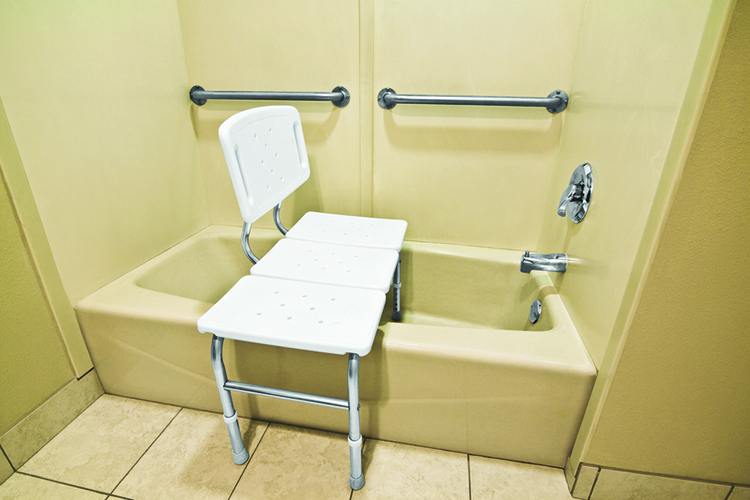
Non-Medicare-covered home and bathroom safety devices and modifications to prevent injuries
Transportation to/from doctor visits, the pharmacy or physical therapy with a health aide
Over-the-counter items not covered by Medicare or prescription drug plans
Whether Medicare Advantage plans implement any of these services in 2019, or beyond, there will be a growing interest and high demand for long-term services and support as Medicare enrollees age.
MEDICARE MOMENT WITH MARTHA
A radio program with Martha Khlopin
KHNR-690AM: Sundays 9:30am–10am 808-230-3379 | getmartha@aol.com
According to Kathryn Coleman, Director at the Centers for Medicare and Medicaid (CMS), a final rule issued in April 2018 has redefined the “primarily health related” supplement benefit definition. As a result, CMS expects Medicare Advantage plan sponsors to begin offering services for enrollees needing assistance with Activities of Daily Living (ADL) or Instrumental Activities…
Q: I’m trying to decide when to retire. Can Social Security help?
A: The best place to start is with a visit to the
online Social Security Statement. The statement provides you with estimates of benefits for you and your family as well as your earnings record and information you should consider about retirement and retirement planning.
Easily access your statement online by creating a my Social Security account. To create an account, please visit www.socialsecurity.gov/myaccount.
The “right” time to retire is different for everyone and depends on your individual situation. To help you make your own decision, we offer an online fact sheet, When To Start Receiving Retirement Benefits, that highlights some of the factors to consider. This publication can be found at www.socialsecurity.gov/pubs/10147.html.
Q: I’m trying to figure out how much I need to save for my retirement. Does the government offer any help with financial education?
A: Yes. For starters, you may want to find out what you can expect from Social Security with a visit to Social Security’s Retirement Estimator at www.socialsecurity.gov/estimator.
The Financial Literacy and Education Commission has a website that can help you with the basics of financial education: www.mymoney.gov. Finally, check out the Consumer Financial Protection Bureau, which offers educational information on a number of financial matters, including mortgages, credit cards, retirement, and other big decisions on their website at www.consumerfinance.gov.
For questions, online applications or to make an appointment to visit a SSA office, call from 7am–5pm, Mon–Fri: 1-800-772-1213 (toll free) | www.socialsecurity.gov
Q: I’m trying to decide when to retire. Can Social Security help? A: The best place to start is with a visit to the online Social Security Statement. The statement provides you with estimates of benefits for you and your family as well as your earnings record and information you should consider about retirement and…
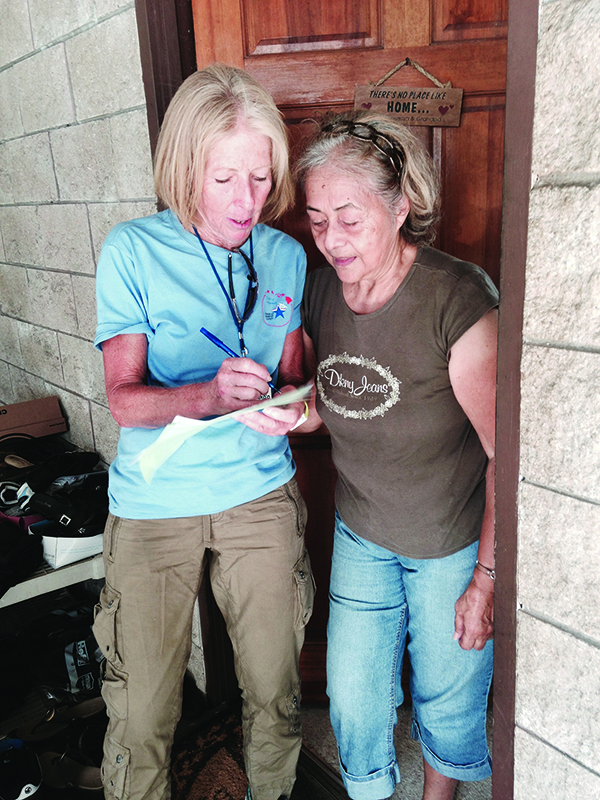
Back in 2014, when a lava flow threatened Pāhoa, Generations Magazine learned just how “hands on” emergency response needs to be. Katherine Kama‘ema‘e Smith, former associate editor, joined a team of community volunteers on an evacuation outreach mission to seniors living in the path of the lava flow. Using an address list generated from the Hawai‘i County Office on Aging (HCOA) database, the volunteers went by van to canvass seniors to learn their needs and check on their preparedness for evacuation, should that be required.
The Big Island again finds itself dealing with a large number of people displaced by a lava event. “The fast-moving lava flow from Kīlauea volcano on May 3, 2018, forced 1,500 residents out of their homes and in search of shelter,” says Kimo Alameda, County Executive on Aging.
2014: The team from various departments of HCOA and ADRC gather in a specifically designed conference room nicknamed the “War Room”.
“The following day, two major earthquakes rocked Hawai‘i Island and the County of Hawai‘i needed an agency to take the lead in providing information, assistance, and referral. This is where government officials turned to the County’s Aging and Disability Resource Center (ADRC) in partnership with the County’s Housing Department. Together with a network of over thirty community providers, the Recovery, Information, and Assistance Center (RIAC) was set up to provide what the ADRC does best — provide accurate and timely information, assistance, referral, and options counseling.”
So, what is it about the ADRC that placed it on the front line right from the beginning of this ongoing disaster?
Nurse Dawn checks on the elderly until they are all out of danger.
The Hawai‘i County Office of Aging was established in 1966 and today it works through the County, State Executive Office on Aging (EOA), and the Federal Administration on Aging to get its major funding to support its mission of providing a comprehensive and coordinated system of services that enable older people to live independently and with dignity. The ADRC’s role is to put that mission into practice. It is this long history of interaction with all three levels of government, as well as with community groups, that placed the county’s ADRC in an ideal position to coordinate a timely, effective response to the lava emergency.
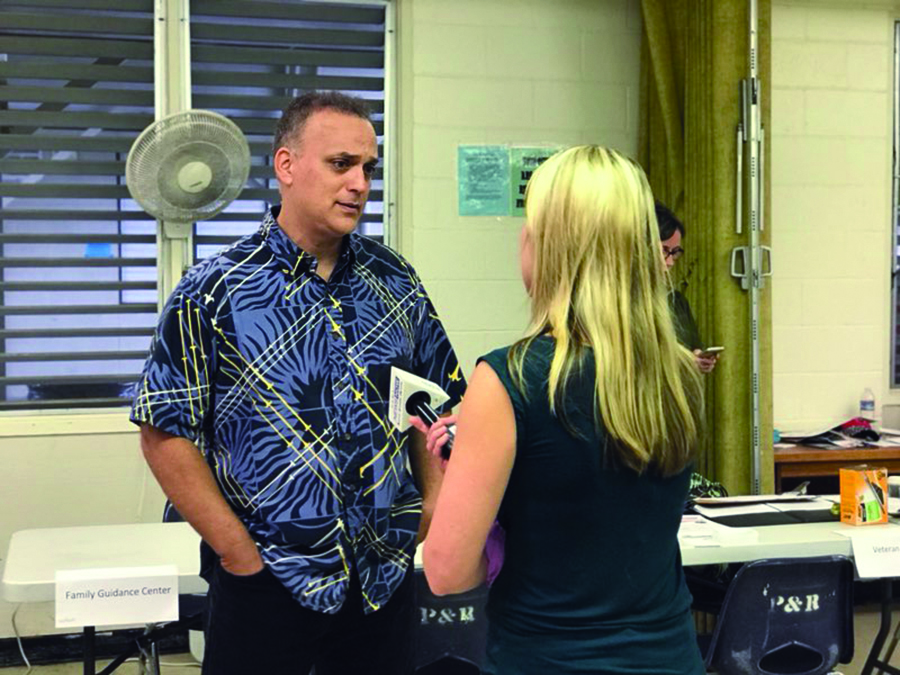
Kimo Alameda is interviewed by Allyson Blair from Hawaii News Now.
The county’s battle plan 1) Anticipate. When the lava flow started on May 3, it was clear that people would lose their homes. Already tackling homelessness, the Community Alliance Homeless Partnership had a network of problem solvers already in place, and they quickly became the county’s Disaster Assistance and Recovery Team (DART). 2) Identify needs. An intake form was agreed upon to capture survivors’ specific needs so that the DART could help them resolve those problems. 3) Establish case management. Perhaps the most important step taken was to identify a case management agency to oversee the individuals and families displaced by the event. The Neighborhood Place of Puna was chosen for this role, and the DART partnered with Hawai‘i Community Foundation to pay for staffing for case management and a housing placement specialist. 4) Share information. A shared database is critical for tracking survivors and accountability. Every agency with resources to contribute to the intake follow-ups was given administrative access, allowing the DART to see how that process was going and ensure that services or resources like rental assistance weren’t duplicated.
June 2018 lava flows to the ocean at Kapoho. Photo courtesy of the USGS
Kimo Alameda reports that, as at the end of June, “we have over 1,000 households in our database. Specifically, 477 households are seeking permanent housing, 139 airfare, 72 medical health, 66 food/water, 64 counseling, 46 legal counsel and 174 financial assistance. We also identified 231 elders, 164 disabled or medically fragile, 77 veterans, and 235 children. And, it’s important to note that these are conservative numbers because not all survivors have come to the DART for assistance. About 25 percent of the total households affected are seeking their own support from family and friends.”
The Big Island again finds itself dealing with a large number of people displaced by a lava event. “The fast-moving lava flow from Kīlauea volcano on May 3, 2018, forced 1,500 residents out of their homes and in search of shelter,” says Kimo Alameda, County Executive on Aging.
Have you heard these questions before: “How do I get my Mom to let go of her things?”, “Why does my Dad not want to get rid of his junk?” and “I’m not making much progress with them, what am I doing wrong?” Most times the answer isn’t black and white, as it really depends on the emotional attachment a person has to those items. Every item has a memory or a story that tugs at their heart, and for those reasons, they can’t get rid of them.
So how do you help family members let go of what they treasure when the need arises to downsize to a smaller home or simply de-clutter the one they are living in now? One way is to ask neutral questions like:
“When was the last time you used it?”
“How often do you use those items?”
“When will you use it again?”
Another way is to bring in professionals. They will ask those same questions of clients as they work through years of personal belongings. They understand that people have a hard time letting go, but they also have an unbiased opinion about the actual value, rather than the perceived value, of those treasures.
Have you heard these questions before: “How do I get my Mom to let go of her things?”, “Why does my Dad not want to get rid of his junk?” and “I’m not making much progress with them, what am I doing wrong?” Most times the answer isn’t black and white, as it really depends…
I’m applying for disability benefits. Do I automatically receive Medicare benefits if I’m approved for disability benefits?
A
You will receive Medicare after you receive disability benefits for 24 months. When you become eligible for disability benefits, we will automatically enroll you in Medicare. We start counting the 24 months from the month you were entitled to receive disability, not the month when you received your first payment. Special rules apply to people with permanent kidney failure and those with “Lou Gehrig’s Disease” (amyotrophic lateral sclerosis). Learn more about Social Security disability benefits by reading our publication at www.socialsecurity.gov/pubs/10029.html.
Q
I have been getting Social Security disability benefits for many years. I’m about to hit my full retirement age. What will happen to my disability benefits?
A
When you reach “full retirement age” we will switch you from disability to retirement benefits. But you won’t even notice the change because your benefit amount will stay the same. It’s just that when you reach retirement age, we consider you to be a “retiree” and not a disability beneficiary. To learn more, visit our website at www.socialsecurity.gov/disability
For questions, online applications or to make an appointment to visit a SSA office, call from 7am–5pm, Mon–Fri:

 Q
Q




 Or you can choose to elect your Part A, which is premium-free, and delay Part B until retirement. Depending on the size of the group, one plan would be primary while the other would be secondary.
 Social Security benefits are paid each month. Generally, new retirees receive their benefits on either the second, third, or fourth Wednesday of each month, depending on the day in the month the retiree was born. In general, here’s how we assign payment dates:
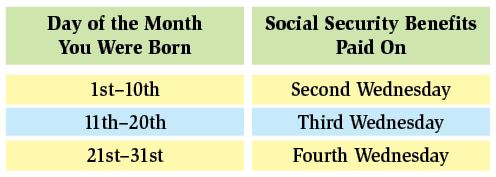 There are exceptions. For example, children and spouses who receive benefits based on someone else’s work record will be paid on the same day