Category: Living Life

  • Discussing End-of-Life Care Empowers You

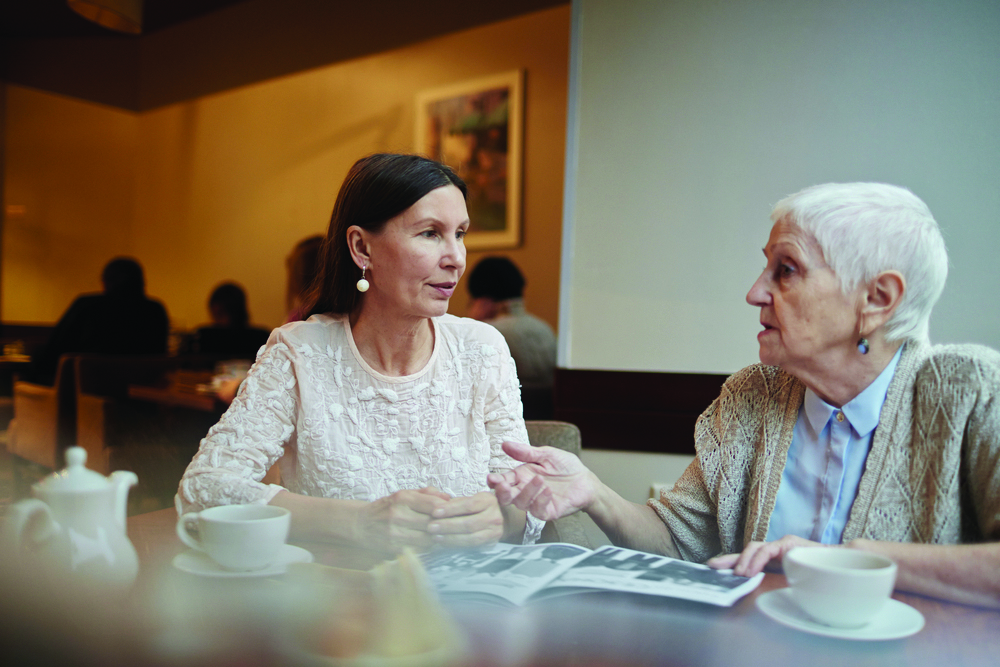
    Elderly females talking and looking through magazine in cafe

    While they can be difficult conversations to navigate, early discussions about end-of-life care can help you and your ‘ohana navigate the stress that arises alongside health challenges.

    It might seem like there is never a good time to bring up the topic, especially in the absence of major medical events. But it’s better to discuss your wishes well before times of crisis. Consider starting conversations at upcoming family gatherings; weaving discussions into the everyday lives of family and friends may reduce the stress of beginning to discuss your goals or wishes with your loved ones.

    Here are three tips for conversations about end-of-life wishes:

    The conversation should be around your wishes.
    Research the differences between hospice, palliative care, in-home care, nursing home facilities and other care options to determine your goals for different stages of your end-of-life journey.
    Write it down. Create a living document replete with details. Make these discussion points easily accessible to designated family members.

    A power of attorney, advance care directive and an informed healthcare team can work together in concert to help achieve your goals.


    ISLANDS HOSPICE
    820 Mililani St., Ste. 400, Honolulu, HI 96813
    808-550-2552 | islandshospice.com

    While they can be difficult conversations to navigate, early discussions about end-of-life care can help you and your ‘ohana navigate the stress that arises alongside health challenges.

  • Create a Legacy: 1031 Exchange

    Imagine living life on your terms, free to focus on family, friends and your passions. Few among us don’t desire to live this way. Passive income streams can help lead you to this reality. There are many ways to begin forming them.

    Baby boomers, in particular, would do well to be thinking about passive income streams. A 1031 is one way of creating a passive income stream.

    A 1031 exchange is a powerful tool used to defer capital gains taxes when selling one investment property and purchasing another. By deferring taxes, one can reinvest their profits into larger and more profitable properties, creating a larger estate for future generations. Additionally, a 1031 exchange allows investors to pass their properties to heirs with minimal tax consequences.

    For mature adults, incorporating a 1031 exchange into a real estate plan can be a key component of legacy planning. Incorporating a 1031 exchange into your real estate plan requires careful planning and execution. With the right guidance and execution, a 1031 exchange can be an effective strategy for achieving your financial goals and planning for your legacy.


    THE COMPLETE SOLUTION™
    Powered by The Ihara Team of Keller Williams Honolulu RB-21303
    1347 Kapiolani Blvd., Ste. 300, Honolulu, HI 96814
    Dan Ihara (RA), CAPS, CLHMS, SRES RS-65892
    808-256-7873
    Julie Ihara (RA), SRES RS- 67440
    808-754-2225 | ihara@iharateam.com
    iharateamhawaii.kw.com

    Imagine living life on your terms, free to focus on family, friends and your passions. Few among us don’t desire to live this way. Passive income streams can help lead you to this reality. There are many ways to begin forming them.

  • Breeze Through the Airport with TSA Cares

    Back view of an airport male employee transporting a disabled female traveler to a plane

    Going through security at the airport is stressful. The lines are long. People around you are losing their minds. Airport air conditioning is way too cold, and when you finally get to the security scanner, TSA officials are shouting confusing directions: “Take your shoes off!” “Pour out that water!”

    But this unavoidable airport experience shouldn’t stop you from traveling. A program called “TSA Cares” is available to anyone who needs assistance, free of charge.

    TSA Cares isn’t picky about what qualifies you for assistance. Here are some example qualifiers:

    • Difficulty standing or waiting in line
    • Difficulty understanding instructions
    • Mobility limitations
    • Use of mobility aids or support devices
    • Internal/external devices that should
    not go through the metal detector
    • Traveling with medically necessary
    liquids over the standard 3.4 oz.

    A passenger support specialist will meet you before security and guide you through.

    To use this program, you or a loved one can call 855-787-2227 up to 72 hours before a flight, or go to request assistance. TSA Cares will take care of the rest.

    Requesting this assistance is a great way to prevent airport stress and ensure you get off island.


    MANOA COTTAGE KAIMUKI
    748 Olokele Ave., Honolulu, HI 96816
    808-800-4089 | info@manoacottage.com
    manoacottage.com

    Going through security at the airport is stressful. The lines are long. People around you are losing their minds. Airport air conditioning is way too cold, and when you finally get to the security scanner, TSA officials are shouting confusing directions: “Take your shoes off!” “Pour out that water!”

  • Crazy Little Thing Called Love!

    Hearts were racing, booties were shaking and the music kept playing! Smiles and laughter donned the floor. It was hard to resist just getting caught up and joining in the fun.

    The city and county’s Department of Parks and Recreation (DPR) Senior Citizens Program made a splash this year hosting an annual event Valentines Day dance titled Crazy Little Thing Called Love. Sponsored by Bank of Hawaii and DPR. Music by the Royal Hawaiian Band. 850 hearts (people) attended!

    Local celebrities: comedians, singers, newscasters, HPD, HFD, even the mayor were paired up with seniors. Volunteered MC, Rodney Villanueva, was tantalizing, witty and humorous. This is certainly an even to look forward to next year again, 2024!


    CITY AND COUNTY OF HONOLULU
    DEPT. OF PARKS & RECREATION
    1541 Kalākaua Ave., Honolulu, HI 96813
    808-768-6895 | honolulu.gov/parks
    DPRseniorcitizens@honolulu.gov

    The city and county’s Department of Parks and Recreation (DPR) Senior Citizens Program made a splash this year hosting an annual event Valentines Day dance titled Crazy Little Thing Called Love. Sponsored by Bank of Hawaii and DPR. Music by the Royal Hawaiian Band. 850 hearts (people) attended!

  • Can You Trust Wristband Health Readings?

    wristband health technologyRapid advances in healthcare technology allow many older adults to monitor their vital signs with a glance at their wrist. But is the wristband health technology accurate?

    You’ve probably seen or heard of the multitude of health monitors you can strap on your wrist. And you might assume that they have passed testing to show that they are accurate and reliable. Well, think again.

    Most wrist-worn health monitoring products that come on the market are not approved by the FDA. For example, Fitbit, Samsung and Apple devices all detect blood oxygen levels. However, none of them tie those readings to any medical conditions, so they did not need clearance from the agency before they were made available to consumers.

    FDA Approved

    There is one outlier. The Withings ScanWatch, which scans for abnormal heart rhythms via an EKG feature and also warns about breathing issues during sleep with a blood oxygen sensor, is the first unit to garner FDA approval on both features. The ScanWatch monitors blood oxygen levels, heart rate and movement to flag breathing problems that could indicate chronic obstructive pulmonary disease or sleep apnea, according to a company spokesman.

    A study of the pulse oxygen feature was published in the Journal of Medical Internet Research and found that readings from the smartwatch and a standard pulse oximeter were virtually the same. An ongoing trial is evaluating whether or not the ScanWatch can accurately diagnose sleep apnea. Fitbit and Apple are working on similar products.

    Sleep experts see the smartwatch as a potential means to diagnose sleep apnea at an early stage; the condition often goes undiagnosed. However, experts are cautious since doctors normally use other measurements in combination with those indicated by the watch to make a final diagnosis.

    How Do Wearables Work?

    Smartwatches shine a broad-spectrum LED onto the user’s skin and evaluate changes in the light that is reflected back. Some sensors in development use several discrete laser outputs from a single chip, enabling assessments of a variety of biometric markers including those in blood, interstitial fluids and different layers of skin.

    As time goes on, you can expect wearables with a greater variety of health measurements and increased accuracy. But before you buy, make sure to do your homework and check how accurate the data is.

    Hot Tip: Place your fitness tracker in a pocket near your hip for a more accurate step count. If you must wear it on an arm or hold it, use your non-dominant side.


    SCSA (Society of Certified Senior Advisors)
    The SCSA educates and supports specialists in aging dedicated to improving lives of older adults.
    1-800-653-1875 | csa.us
    Sources:
    scmp.com/lifestyle/gadgets/article/3132243/apple-watch-monitor-blood-pressure-blood-sugar-and-alcohol-levels
    modernhealthcare.com/technology/fda-approves-blood-oxygen-and-ecg-monitoring-smartwatch
    ncbi.nlm.nih.gov/pmc/articles/PMC7055753/theverge.com/2021/10/12/22722333/withings-fda-clearance-blood-oxygen-heart-rhythm
    techradar.com/news/no-the-next-apple-watch-wont-measure-blood-glucose-and-alcohol
    health.harvard.edu/heart-health/how-accurate-are-wearable-heart-rate-monitors

    Rapid advances in healthcare technology allow many older adults to monitor their vital signs with a glance at their wrist. But is the wristband health technology accurate? You’ve probably seen the multitude of health monitors you can strap on your wrist. And you assume that they have passed testing to show that they are accurate…

  • Lifelong Learning in Hawai‘i

    The population structure in the U.S. is rapidly changing. Increased life expectancy, strong immigration and a fertility rate of presently 1.64 children per woman — higher than in other developed countries — will cause a population increase from 336 million (2023) to 373 million (2053). The population ages 60 and older will experience the strongest growth, and their share in the total population is expected to increase from 12 percent (1950) to 28 percent (2050). These developments are also visible in Hawai‘i. Estimates suggest that more than a quarter of the population in the state will be aged 60+ by 2030.

    These demographic developments create new societal challenges, such as for retirement and healthcare systems, but education in older age has the potential to transform such challenges into opportunities. A 2019 study by Xu et al. in JAMA Neurology found lifelong learning and engagement in cognitive training to be one of the most significant modifiable factors in reducing the risk of dementia and depression. Also other research suggests that learning provides numerous benefits for kūpuna with respect to cognitive functioning, overall well-being and health, self-confidence and social inclusion.

    Although learning in old age benefits society and the individual, enrollment data indicate that traditionally older adults have been underrepresented in organized education. Nevertheless, mature adults in our community can choose from a rich assortment of educational programs and providers, including the following:

    Osher Lifelong Learning Institutes: As one of the 125 OLLIs in the United States, the OLLI at the University of Hawai’i at Mānoa (OLLI-UHM) is a membership-based educational program that offers mature adults aged 50+ a wide array  of non-credit college-level courses, workshops, lectures and other events that enrich the mind and foster a community of learners. Classes are held at the UH Mānoa campus or online via Zoom and include topics such as arts, music, history, politics, health and mindfulness. Membership ($75 per term, $50 for new members) is open to all interested kūpuna and entitles individuals to enroll in 3+ courses per term.

    University of Hawai‘i: At multiple campuses (e.g., UH Mānoa, Windward Community College, Kauai Community College), kūpuna can take university classes free of charge through their Senior Citizen Visitor Programs (SCVPs). While the various SCVPs can differ in their administration, they typically do not require formal educational degrees and grant course access on a space available basis with prior registration and faculty approval.

    Outreach College: At UH Mānoa offers a diverse array of non-credit and credit courses to help participants of all age groups pursue personal growth and  professional development.

    Department of Parks and Recreation’s Senior Citizens Program: With 32 locations on O‘ahu, these programs strives to improve the quality of life of kūpuna in the community through various activities, such as business meetings, speakers, community service, excursions and luncheons.

    Front Porch’s Well Connected: For kūpuna over the age of 60 who want to take classes from the comfort of their home, this national non-profit organization program provides an array of educational programs in person and online.


    HAWAII PACIFIC GERONTOLOGICAL SOCIETY
    (501(c) 3 nonprofit)
    PO Box 3714, Honolulu, HI 96812
    Sherry Goya, HPGS Executive Director
    808-722-8487 | Sgoyallc@Aol.com
    hpgs.org

    The population structure in the U.S. is rapidly changing. Increased life expectancy, strong immigration and a fertility rate of presently 1.64 children per woman — higher than in other developed countries — will cause a population increase from 336 million (2023) to 373 million (2053). The population ages 60 and older will experience the strongest…

  • More Seniors Try Marijuana

    More Seniors Try Marijuana

    As cannabis becomes more accepted in the medical community, a rising number of seniors are trying it, especially for pain.

    Ileane Kent, 80, has spent years vaping nightly. A breast cancer survivor, she got a medical marijuana card in June 2020 so she wouldn’t have to risk going to her supplier’s house. Barbara Blaser, 75, dealt with the pain and anxiety produced by a complicated surgery with edible marijuana, which came in the guise of a chocolate-covered blueberry every morning and evening. Harry B. Lebowitz, 69, enjoys smoking a joint in his backyard every night while his partner drinks her vodka and soda.

    Cannabis Use Among Seniors Rising

    A recent analysis culled from the National Survey of Drug Use and Health concluded that the use of marijuana among those over 65 rose 75% from 2015 to 2018 — from 2.4% to 4.2%. It jumped again in 2019 to include 5% of seniors. The lead author expects the trend, which is particularly strong among women and the affluent, to continue to increase sharply.

    “It’s rare to see that much change in a three-year period,” said William Jesdale, an epidemiologist at the University of Massachusetts.

    Legality of Marijuana Use

    Although most marijuana use remains illegal at the federal level, researchers theorize that the increasing number of states legalizing pot combined with the trend away from prescribing opioids for pain has boosted the number of seniors willing to give cannabis a try.

    The $17.5 billion legal cannabis industry has taken note, with some dispensaries offering senior discounts and free delivery. Retailers have sent cannabis advocates to talk to residents in assisted living facilities or picked up seniors at a retirement development to bring them to the dispensary, complete with a catered lunch, product information and a special discount.

    Does Pot Work?

    The efficacy of products containing marijuana is still debatable. The effect of pot was “modest” to alleviate nausea and vomiting due to chemotherapy, muscle spasms caused by multiple sclerosis, some sleep disorders and chronic pain, according to a National Academy of Science report.

    Older adults adding pot to other medications and/or alcohol may be at increased risk of negative drug interactions and falls. Cannabis is known to increase heart rate and possibly blood pressure, but a Journal of the American College of Cardiology review failed to find direct evidence linking cannabis to coronary events.

    Of more concern is seniors combining cannabis with anti-seizure medications and/or blood thinners, since there is little room for error. Talk to your doctor if you use cannabis and are planning to have surgery. Anesthesia drugs and post-operative pain management may require adjustment.

    Like many healthcare professionals, researcher Dr. Benjamin H. Han advocates a “start low, go slow” regimen and he warns older patients who smoked pot in their youth about higher THC concentrations in modern products. Typically, seniors seek marijuana to treat four conditions: pain, insomnia, neuropathy and anxiety. There is also research supporting the use of cannabis to improve cognitive function.

    Many Ways to Take Cannabis

    There are four main routes to take cannabis: inhalation, oral, sublingual and topical. All are a little different and you may have to try more than one to find what works for you.

    Inhalation delivers active compounds to your lungs and compounds are delivered to your brain in about 15 minutes. There are two ways to inhale: smoking and vaping. Smoking involves burning cannabis flower. Vaping uses a device to heat the cannabis flower or concentrate to just below the point of combustion, releasing the active compounds into a vapor.

    Oral ingestion takes place through edibles or tinctures. Edibles include cannabis-infused drinks, baked goods and gummies. It may take anywhere from 20 minutes to three hours to feel the effect.

    Sublingual administration. Tinctures are created by steeping cannabis in alcohol. The liquid is placed under the tongue using an eye dropper, where it is absorbed by the many blood vessels located there and the rest travels to the stomach. The benefit is an immediate effect from the cannabis absorbed into the blood and a delayed effect from the cannabis that travels to your digestive tract.

    Topical products deliver cannabinoids through the skin via pads or cream to deliver localized relief, usually for muscle soreness or joint pain. No matter what product you use, you won’t get any psychoactive effects from topical application. It may take an hour or two for effects to kick in.

    How Much THC?

    Ask your doctor or other healthcare professional how much to use, and make sure they know what other drugs you’re taking. Start with a very low dose and  remember some methods of ingestion are slow to take effect.

    “Older adults generally need less, because their metabolism has slowed,” says Eloise Theisen, president of the American Cannabis Nurses Association and a geriatric nurse-practitioner. “They can have a delayed onset, so it’s easier to overconsume, especially with products that taste good.”

    Another concern is the accidental consumption of edibles by children. It is very important that you treat your edibles like poison and keep them somewhere safe. A large dose can cause changes in a child’s blood pressure, heart rate, severe tiredness, trouble breathing and even coma.

    Consult With Your Doctor First

    Cannabis may become an important part of your healthcare regimen. Marijuana may help you sleep better or free you from constant pain. It could reduce anxiety and worry. It’s more available than ever, and there are endless resources to help you decide how you’d like to try it. Just remember to consult with your doctor first, start with a very low dose and make sure to keep your cannabis products away from children.


    SCSA (Society of Certified SeniorAdvisors)
    The SCSA educates and supports specialists in aging dedicated to improving lives of older adults.
    800-653-1875 | csa.us

    As cannabis becomes more accepted in the medical community, a rising number of seniors are trying it, especially for pain.

  • Time Flies When You’re Having Fun

    photo of Frank B. Shaner
    Frank B. Shaner

    I’m turning 75 in a month. I’m ok with that. But then I think to myself, “Wait a minute! It was just 1965 a week ago! What the hell happened?” Smack dab in the middle of the 1960s, my innocence ended.

    I graduated from Kaimuki High School, experienced the Bay of Pigs, and the assassinations of JFK, Martin Luther King Jr. and Bobby Kennedy. The Vietnam conflict was still raging, Jimi Hendrix died of an overdose and there was “one small step for man, one giant leap for mankind.” I joined the Army and traveled overseas, then left the army and went to college. All this happened just moments ago — or so it seems. I’d never really looked back before now.

    My life has been a roller coaster ride. And it’s been one hell of a trip, hanging on to this rocket, gripping this monster with my arms and legs wrapped around this force of nature, and having the time of my life. Yes, there have been rough patches, but I’ve always found myself surfacing on the other side, arising to embrace a new day and tackling the latest challenge.

    I like to think of myself as a realist. I know we are all going to die and that 75 is actually not the new 50. Sorry to disappoint you. It ends up that 75 is really more like — wait for it — the old 74. What is also true is that time does fly by when you’re having fun. Sometimes I’m having so much fun in life (and this might be difficult to understand) that sometimes I won’t bathe, just so I can keep all the beautifulness of the day on me. Think about it: When you shower, you’re scrubbing the remains of the day off your body and watching it all go down the drain. The residue of those good moments does not have to go down the drain.

    So just to slow life down, I sometimes choose to be introspective and contemplative — in other words, miserable. You know, when you have those days and you think, “Damn, will this goofy day ever end?” But you actually need a couple of those days every once in awhile to stretch out time, so life won’t fly by so fast. Therefore, every now and then, I throw in one of those days, just to slow down the momentum.

    So there’s my simple philosophy at turning 75. Have the time of your life every day if you can. Bathing is optional after a good day. Decelerate time by throwing in an occasional rotten one. Don’t be afraid to have a downhearted day now and then.

    After almost seven-and-a-half decades of life, I’ll leave you with just a few more insights. Don’t be afraid to live well, no matter how old you are. Don’t let this time wormhole throw you for a loop. Appreciate it for its time-bending effects.

    The biggest mistake we make in life is thinking we have endless time, so just keep letting the good times roll until they can’t hele on no mo’.

    I like to think of myself as a realist. I know we are all going to die and that 75 is actually not the new 50. Sorry to disappoint you. It ends up that 75 is really more like — wait for it — the old 74. What is also true is that time does…

  • McDating: Romance Under Golden Arches

    (L–R, front) George, Venetia, (back) Millie,Jr. Lee, Siri, Annette (background) and Ann
enjoy cards and camaraderie each week at
George’s house.
    (L–R, front) George, Venetia, (back) Millie, Jr. Lee, Siri, Annette (background) and Ann enjoy cards and camaraderie each week at George’s house.

    Turns out, you just might find more than two all-beef patties, special sauce, lettuce, cheese, pickles, onions on a sesame seed bun at your local McDonald’s.

    Venetia Angel, 63, routinely visited her local McDonald’s in Pukalani on Maui. One evening, she approached a group of senior ladies who were playing cards. She noticed them there often. That evening, she asked what they were playing. Although she did not know the game called “books and straights,” they insisted she join them the next night. Before she knew it, she was meeting the group, aged from 60-something to 93, at McDonald’s for cards, camaraderie and coffee six nights a week, from 7 to 11 pm, when the fast food venue closed.

    And as it happens, a group of senior men (70 to to 90-plus) who regularly met at an adjacent convenience store migrated to McDonald’s around that same time, when the store downsized the number of booths it offered customers who liked to people-watch. Some went elsewhere, but several found a new roosting place under the Golden Arches. They just happened to seat themselves right next to the ladies’ table to drink their coffee and talk story. The ladies soon found themselves reserving that adjacent table for the gentlemen.

    “They weren’t part of our group, but they became part of our group,” says Venetia. “If we had a birthday to celebrate, we would make sure to bring enough cupcakes for the gentlemen.”

    Eventually, Venetia found herself calling to check on them if they didn’t show up or if their card game was cancelled. “I was just checking to see if they were ok,” says Venetia, named the “mother hen” of the group.

    The two groups soon became enmeshed, setting the stage for a budding senior love story.

    “This is how it started,” says Venetia. “A gentlemen who always seemed to position himself close to me heard I was going to go to Costco to have my tires changed. ‘What are you going to do while you’re waiting?’ Charley asked. ‘How about I pick you up and take you to lunch? I’m buying,’ he said.” Because her late husband, the love of her life, could never be replaced, she never even considered spending time with another man. “That last comment convinced me to take a chance,” Venetia says.

    When Charley, in his mid-70s, picked her up, he opened her door and even reaching across her to fasten her seatbelt. She was impressed with his old-school etiquette. But that ended when he reached across the lunch table and tried to hold her hand. “We’re not dating!” she said.

    Later, her asked her to spend his birthday with him. “Why don’t you go with your daughter instead?” said Venetia. “No, I want to go with you,” said the smitten senior. He let her pick the restaurant. Before they dined, they stopped at the hospital to visit one of the men’s group members. His daughters said, “Oh, you look so nice together! You look like you are ready for a fun date.” “We are not on a date!” Venetia again insisted. But to Charley, it was a date. He continued to hover over Venetia every chance he got.

    So when the McDonald’s ladies asked him to join in the card game, he sat right next to the target of his new-found affection, swinging his arm over the top of the bench behind Venetia. “So now you are a couple?” the ladies asked. “No, no, no,” Venetia responded reflexively. After noting some flirtatious behavior by two of the other senior ladies, Venetia said, “You know, Charley, I think you should ask one of the other ladies to go out with you.”

    He soon started dating Annette, who was in her late 60s. They found new love, comfort and companionship in each other in their golden years, spending every day together at her home, and sharing meals at McDonald’s or Sheik’s. They held hands as Charley pecked tender kisses on her cheek.

    But Annette’s Alzheimer’s was getting worse. The ladies’ group suggested that she move in with him or he move in with her “so he could watch out for her and so could we.”

    But eventually, she was moved into a care facility on O‘ahu.

    “Charley got real sad when his girlfriend moved away,” says Venetia.

    About a half-dozen members of the group who had met at McDonald’s for over a year before the pandemic, started cautiously and carefully meeting at George’s home in 2020. George was one of the men’s group members. “His son thought is would be perfect, so we could keep him company as we played cards, even though he doesn’t usually play.” Most of the time, five of them met at the 90-year-old’s home, masked and vaccinated, only one day a week, bringing food to share with the entire group, chipping in money for toilet paper and utility costs, and sharing information about current boosters.

    Heartbroken Charley stopped by, searching in vain for Annette. Although she may have forgotten him due to her dementia, Charley would never forget his Annette.

    “I ended up spending a lot of time with George,” says Venetia. “I have my own room in his home. I’m there almost all the time cooking, sweeping, sanitizing, and taking him to his appointments and surgery. I’m not his caregiver. We’re friends. We have each other.”

    If Venetia was asked, she would say they, too, are not dating. “We just all got to know each other just sitting at McDonald’s and talking. Now we are family.”


    Turns out, you just might find more than two all-beef patties, special sauce, lettuce, cheese, pickles, onions on a sesame seed bun at your local McDonald’s. Venetia Angel, 63, routinely visited her local McDonald’s in Pukalani on Maui. One evening, she approached a group of senior ladies who were playing cards. She noticed them there…

  • A Perfect Match Forged in Honesty

    An IBM executive from Croatia ranking high on the intellect scale meets a “spiritual hippy” from Hawai‘i ranking high on the intuitive scale — a feminist and natural caretaker, formerly a gourmet vegetarian caterer, hospice worker, midwife, organic farmer and house sitter.

    Do Opposites Attract?

    As it turns out, their bonds run very deep. Their commonalities are not merely superficial junctures because their initial interactions superseded the usual Dating 101 themes and banter.

    Rose Singarella and Mladen Karcic, both 53 when they met through an online dating site, did not wade in the shallows during their initial conversations, but plunged right into the deep end. Mladen’s mother was seriously ill; Rose was still recovering from the loss of her fiance. She had promised him that she would look for love again. So with pain still fresh from her own loss, Rose sought to help Mladen grapple with his mother’s illness and eventual death. It just doesn’t get any deeper than that.

    Leaving the Door Open

    “There wasn’t anything in particular that Mladen said in his profile,” Rose said. “It was simple, straightforward and just so real. More than anything he said, I just intuitively knew he was honest, genuine and had integrity. So I wrote to him, even though I was in Santa Fe and he lived in Virginia.”

    Rose had expanded her search from the Santa Fe area where she was housesitting to the entire US after several fruitless matches. “I was determined to meet my soulmate,” says Rose. “I just knew he was out there.”

    Mladen had confined his search to the Virginia-DC area, so when he got Rose’s inquiry from almost 2,000 miles away, he responded by saying he didn’t think a long-distance relationship was going to work. But he changed his mind the next day. He emailed her with an apology for being so curt, and said he was willing to explore.

    “I left the door open,” Mladen said. They emailed each other regularly for a few weeks. Shortly thereafter, he took his profile off the internet due to emerging priorities. “My mother is dying of cancer,” he told Rose, “and I need to drive up to New York every weekend to be with her.” Rose wrote him a long letter about grief, loss and dying, which struck a chord with Mladen.

    During the weekly five-hour drive each way, they talked via cell phone. “We were not talking about romance,” says Rose. Other than discussing that they both were seeking a long-term relationship, they did not talk about marriage or even dating. “We were talking about grief, loss, spirituality and the aging process,” says Rose. “I had a lot of compassion for what he was going through.” Their conversations formed a deep bond between the two.

    “I always say it was his dying mother who brought us together,” says Rose.

    They continued their remote conversations for the next three months, not yet meeting each other face to face. Shortly after his mother passed, Mladen emailed Rose: “I’ve got to get to Santa Fe as quick as I can to meet the angel who got me through one of the worst times of my life.” A few weeks later, they finally met.

    Pursuing the Possibilities

    They both decided to move forward with the relationship. Rose thought it was important to cultivate their relationship by seeing each other as often as possible, so they promised each other they would meet frequently, at least every two weeks, taking advantage of Mladen’s cross-country business trips for IBM.

    During their fourth or fifth date, Rose told Mladen, “‘I can’t imagine living without you.’ It was very clear to me that he was my life-mate. You know when you know. But Mladen thought I was a little bit nuts.” Although he was flattered, he was also shocked. It took him about a year to catch up to Rose’s level of commitment.

    They continued meeting at various locations across the country for about six months, when, during one of Mladen’s visits to Santa Fe, he said, “I’m not leaving without you.” So she packed her sparse worldly possessions in her car and they drove to Virginia together. They were married in 2012, eventually transitioning to Maui in July 2020. The fact that they were able to share such pain on that level so quickly is a testament to their willingness to honestly and courageously wade into tender and perilous territory — cutting to the core — cutting to the quick. The pressure did not crush, but rendered a diamond, resilient and beautiful, crystalizing into a deep relationship.

    A Fairytale Ending

    At age 66, it is clear today that the Kīhei couple are not opposites, but complementary companions — pieces of a puzzle that fit together perfectly in love and life — an impeccable matchup of talents and temperaments.

    “I feel so close to her, like she really understands me,” says Mladen. “We are really compatible. We both enjoy travel, culture and music. But more than that, she has taught me a lot and has brought a lot to the relationship. She is very nurturing. I feel very well taken care of.”

    Rose still feels the same way that she did the day of her blurted-out announcement so many years before. The secret to their success, she says, is honesty, truth and lack of pretense. Add to that, the bravery it takes to expose vulnerabilities.

    Be True to Yourself & Others

    Rose recommends that prospective dating site users be honest in their portrayal of themselves through both words and images in their profile — as much as individuals are able to have the personal insight to relay the truth about themselves. “Sometimes it is difficult to talk about yourself. But the worst thing you could do to yourself and a prospective match is lie. Don’t be tempted to include white lies in your profile about your age or even a few pounds. Do not be deceitful about past wives and existing children. Don’t take glamour photos. Be natural; be yourself. It becomes obvious when you meet the person if they lied on their profile.”

    She recommends having a trusted friend review your profile and photos before posting them. “Make sure the type of message you are sending is in line with what you are seeking, whether it is a long-term relationship or a fling.”

    Rose recommends that app users expand their search area as much as possible. “Chances are your soulmate may not live on the same island or even continent as you do. We would never have met if it wasn’t for Match.com, and we wouldn’t have ignited this relationship if I hadn’t expanded my search area and he hadn’t  reconsidered an initial long-distance relationship. And you must consider traveling and even moving. I don’t believe you can cultivate a relationship if you spend a lot of time apart.”

    Sharing the Love

    Rose and Mladen met Susan Schwartzkopf (see “Spreading Happiness One Chocolate at a Time,” pg. 14) when she responded to an ad they placed to sell their  furniture. Susan had just arrived on Maui that morning and moved into an unfurnished condo. Upon their meeting, Rose thought, “This girl is going to be my friend.” Rose is now in the process of helping Susan with her online dating profile. She also offered to review Susan’s preliminary picks for red flags.

    The internet is infested with scammers and posers ready to pounce on unsuspecting prey. This may be exponentially true for online dating sites. It even has its own name: Cat-phishing is an online romance scam and a form of fraud.

    “I learned a lot about online dating,” says Rose. “I want to protect her.”


    Rose Singarella and Mladen Karcic, both 53 when they met through an online dating site, did not wade in the shallows during their initial conversations, but plunged right into the deep end. Mladen’s mother was seriously ill; Rose was still recovering from the loss of her fiance. She had promised him that she would look…

  • Spreading Happiness One Chocolate at a Time

    Valley Isle Chocolates, a small family business on Maui, is beginning the New Year with a new kitchen space, new equipment, new packaging and new ideas for the future. Now, they are very busy making chocolates, developing recipes and selling their wares at many farmers markets and local brick-and-mortar stores. At the end of last year, Susan Schwartzkopf “and sons” moved production from their certified home kitchen to a commercial kitchen space in Kahului.

    “It’s really taken off very quickly,” says Susan, “and we’ve grown very quickly, as well.”

    Susan’s son, Samual, had been coming to Maui regularly, farming with friends here. He wanted to live here permanently, so he bought almost eight acres in Ha¯na that he and his best friend, Sam Phillips, have planted with turmeric, citrus, bananas, lilikoi and pineapple. They are now preparing the land for a cacao orchard,  clearing it and planting a panax windbreak. Samual and Sam, who are now in their mid-30s, have known each other since high school.

    “Sam is like my second son,” says Susan. “I call them ‘my Sams.’” Susan moved to Ki¯hei almost two years ago to join them in their new venture. Her mother had just passed away from a long chronic illness, giving Susan the freedom to pursue new interests and adventures. Because her decision to move to Maui coincided with the height of the pandemic, she rented an apartment sight unseen. “I had never been here before. It was quite a leap.”

    Samual is also an experienced chef and restaurant manager. He also took over a catering business and had opened a restaurant in Vermont, unfortunately, just before the peak of the pandemic, ending that endeavor but leading him to another. These serendipitous events sparked his permanent move to Maui. “We came up with the idea of cacao because we wanted to be good stewards of the land on Maui, and contribute to the economy and culture,” says Susan. “So we started studying and learning everything we could about cacao and chocolate. As we learned more, our ideas began to grow.”

    In 2021 they produced their first chocolate products, giving them away to friends and family — their built-in taste testers and unofficial quality controllers. Next, they bought their own roaster, a key to making perfect chocolate. They went on to tweak and perfect their recipes until they were market-ready just a few months later, starting in Kīhei.

    Until their orchard produces cacao beans, they have been getting their ethically sourced, raw cacao beans from small farms around the world, including from the Kona area. Currently, there are growers in Hāna and Lahaina, as well, but Susan and the Sams are looking forward to using their own home-grown Maui beans in the future. For now, they are producing organic, small batch, single-origin chocolates from beans they import from small farms in Madagascar, Trinidad, Ecuador,
    Panama, Tanzania and Indonesia.

    The three chocolatiers began by experimenting with recipes, but basically, all of their products use three ingredients — roasted cacao, coco butter (also from the bean) and organic cane sugar. Variations include recipes with Hawai‘i sea salt or Maui macadamia nuts.

    The co-owners and roommates “all do everything.” They use their new malanger, which grinds the cocoa bean nibs, and a tempering machine. They use their own recipes to make their special chocolates, temper it themselves, pour it into molds and then package everything — products and samples — by hand. Preprinted labels have made the process a bit quicker. Previously, Susan would hand-write the type of chocolate on the labels. Their 100 percent hands-on efforts — with the Sams doing the heavy lifting at the farm and chocolate production, and Susan taking care of finance, business and marketing end — are propelling this enterprise forward. As well as a wide range of chocolate products, they have also begun selling a few new products — cacao shell tea, roasted whole beans and cacao nibs; simply, broken up cocoa beans. They’re basically chocolate in it’s purest form.

    Dark chocolate increases “good” HDL cholesterol, which can help lower the risk of heart attack and stroke. Cacao contains healthy fats and other compounds that have been attributed with increasing the levels of the hormones serotonin and dopamine in your brain, which impacts your mood. A chef in Lahaina has even requested the roasted nibs as a palette cleanser or amuse-bouche for her restaurant clientele. “Of course, they are not sweet,” says Susan. “It is a taste that people really either like or aren’t so crazy about.”

    As for the future — it looks sweet. Although the three chocolatiers “can’t make their products fast enough,” they are developing plans for expansion, continuing to experiment and are looking into other products, such as specialized holiday chocolates, including for Valentine’ Day. They have a part-time employee as well, but foresee the need for more help in the near future.

    “It is a beautiful plant and product, and a beautiful thing to do — growing on Maui and producing something that so many people love,” says Susan. “There is no such thing as too much chocolate. The more chocolate the better!”


    VALLEY ISLE CHOCOLATE — Maui
    Susan Schwartzkopf, Co-Owner
    802-451-6964 | valleyislechocolate@gmail.com
    www.valleyislechocolate.com
    Visit the website for store and farmers market locations.

    Valley Isle Chocolates, a small family business on Maui, is beginning the New Year with a new kitchen space, new equipment, new packaging and new ideas for the future. Now, they are very busy making chocolates, developing recipes and selling their wares at many farmers markets and local brick-and-mortar stores. At the end of last…

  • How to Downsize the Right Way

    Downsizing sounds like a great idea… until  you begin to wrap your head around the massive task of moving. The thought of leaving a longtime home, with all of its associations — the height chart on the laundry room doorframe, the grave of a beloved pet — can be heart-wrenching. Add to that the cost of moving and the burden of offloading half (or more) of your possessions, and the project can quickly overwhelm even the most capable older adult.

    The best way to tackle downsizing, according to the experts, is by breaking the process down into smaller, more manageable bits that you can accomplish in a matter of hours or days. Professional organizer Susan Santoro recommends taking photos of your home before you dig into decluttering.

    “These photos will help you if you have any moments of regret over items you’ve let go,” says Susan. “You should also take photos of each item that is special to you that you will be letting go.”

    Then, start with drawers that hold unsentimental items, such as leftover electronics, and go from there. Set a time limit and a goal for the number of spaces to go through each day.

    Divide Into Piles

    There are many ways to tackle cleaning out your home, from the KonMari (https://konmari.com) method of keeping only that which sparks joy, to Project 333 (https://bemorewithless.com/project-333) which advocates keeping only 33 pieces of clothing and accessories. One trick that works for most people is to completely empty the drawer, closet, box or whatever space you’re working on and divide items into three piles.

     The keep pile is for items you are sure you want to hold on to.
     The donate pile is for things that have useful life left, but that you don’t need anymore.
     The trash pile is for possessions that, upon reflection, no one will find value in. You can make a separate pile for trash items with sensitive information that need to go through a shredder before getting discarded.

    Kids Don’t Want It All

    Don’t make the mistake of keeping numerous items for children or grandchildren without asking them.

    “Talk with children and family to determine what items they would like to keep and what they are not interested in,” suggests Susan. “This information will make it easier for you to make decisions.”

    Because younger generations are more interested in experiences than stuff, “understand that your children may want very few items, regardless of how special those items are to you,” says Susan. Sadly, it’s unlikely anyone wants your china. Instead, check out ideas online (search for “family china nobody wants”).

    Do not criticize their choices or try to shove extra items their way. Instead, think of the joy your “unwanted” items will give someone who runs across them on eBay or in a thrift shop. If you think you have a friend who would love to get your unclaimed juicer, make sure that they don’t feel obligated to accept your gift.

    That being said, offer to keep items available only until a certain date. If someone really wants it, they’ll find a way. Mark the offer on your calendar and toss or donate the items that have not been picked up by the “expiration date.”

    Paperwork

    Photos can be kept as is or filed electronically. If the task seems mind boggling, hire someone to digitize them for you. Go through them first and keep only the best of those with recognizable people and places.

    You only need to keep the last seven years of tax returns. Prior iterations should be shredded and used as packing material or recycled. Check with your attorney or accountant regarding other documents. Business documents and agreements belong in a safe or safe deposit box, with digital copies on your computer.

    Furniture

    Measure your new space and make sure your existing furniture will fit. You’d be surprised how many people fail to do this and find themselves with a moving van full of unworkable couches and tables! Instead find a furniture layout app (https://niblockhomes.com/top-5-furniture-layout-apps) to use. If you still have the big, bulky pieces popular a decade or two ago, consider donating them and getting sleek new pieces for your new place.

    We all tend to hang on to things that are imbued with sentimental value. If a spouse has passed away, most of us will want to keep the old bed and their favorite chair. We look at the dining room set and think of all the meals served there as the kids grew up.

    Downsizing is a good time to take a photo of these relics for memory’s sake and switch to items that will be a better fit in your new life. It’s not disrespectful, it’s simply moving on to the next phase of life that will be here whether you spend it sleeping in a king-size bed or a double.

    Sell It

    You may be able to sell unwanted items, but make sure not to become so involved in making a small amount of money that your move is delayed. Some people hold a garage sale and make everything free on the last day. You can advertise multiple items on Craigslist and then make them all available on one day, at one time to save yourself a lot of hassle. You can even choose to use eBay or Facebook Marketplace, but be aware it can be a time-intensive process unless you are willing to take offers. Perhaps you have a family member who will post items for you in exchange for a cut of the profits. If you have very valuable items, you can contact an estate liquidator or even a museum.

    Get rid of bulk items. You do not need to bring a huge pack of batteries or toilet paper from Costco. Tell your inner frugal-Meister to take a deep breath and learn to walk past the bulk sales aisle, as much as it may hurt at first.

    Hire Help

    Downsizing can take months or years in some homes. Start as early as you can, but know that sometimes getting help with the task is the smartest way to go. The National Association of Productivity & Organizing Professionals (www.napo.net) is a good place to find someone who organizes for a living and will be able to help with everything from your emotional well-being to how to post that paisley chair on Craigslist.

    A professional organizer can be used just to get you started or as a stalwart partner for the whole process. These are not cleaners; they are not there to do your windows. Organizing pros can help you make those tough decisions, whisk away items that are bound for the dump and tell you funny stories about other clients they’ve had to keep your spirits up while you both work. They can also search a book collection for old stock certificates that may have been hidden between pages (true story!) and they’ll know where to get grandpa’s stamp collection valued.

    Whether you’re planning a move or not, there is no time like today to pare down your possessions. Consider it a gift to your heirs, who will otherwise have to go through everything themselves eventually.

    You may find that you begin to feel a weight come off your shoulders as possessions leave and your home becomes more spacious and airy. You may even begin to think of new projects you’d like to tackle as you master downsizing!


    SCSA (Society of Certified Senior Advisors)
    The SCSA educates and supports specialists in aging dedicated to improving lives of older adults.
    1-800-653-1875 | www.csa.us

    Downsizing sounds like a great idea… until  you begin to wrap your head around the massive task of moving. The thought of leaving a longtime home, with all of its associations — the height chart on the laundry room doorframe, the grave of a beloved pet — can be heart-wrenching. Add to that the cost…