
Experience may help develop intuition and that intuition just might prove to be more effective when diagnosing a patient’s illness than cold technology. Human insight in this AI-infested world may detect the essence and spirit of a patient that technology alone is incapable of understanding. Dr. Myron E. Shirasu, in his early 90s, has treated four generations of patients relying on more than 50 years of medical experience that has led to profound insights into each of his patients. The human touch of this old-school physician, characterized by active listening, kindness and respect, combines thorough, hands-on physical exams with empathetic, unhurried and personalized care, fostering deep trust. His art-of-medicine approach utilizes the power of touch to diagnose, comfort and connect, rather than relying solely on data and test results.
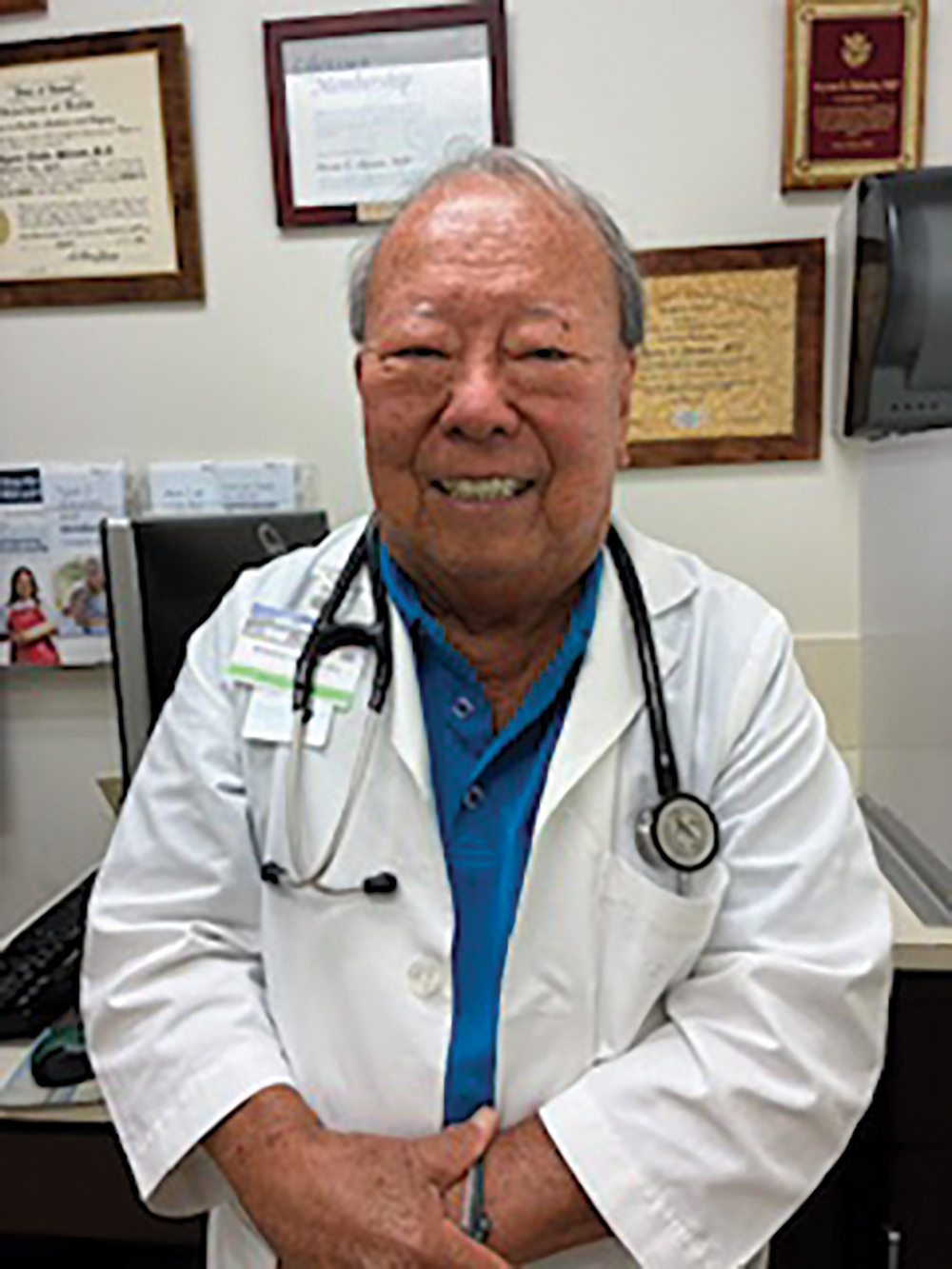
Dr. Shirasu is a country boy who “pulled himself up by his bootstraps” to become a successful Honolulu physician. He was born in Shimane, Japan, and came to Hawai‘i at the age of 3. His father was a Buddhist priest assigned to Hilo Hongwanji. But like many Buddhist priests during WWII, he was incarcerated in a concentration camp, ending up in Tule Lake, California. Dr. Shirasu’s mother and his siblings were also held there. When they returned to Hawai‘i, his father was assigned as the head priest of Olaa Hongwanji (now Puna Hongwanji) in Hawai‘i.
Myron attended Olaa Elementary and Intermediate Schools in Kea‘au, then Hilo High School. After graduation, he attended the University of Hawai‘i at Mānoa. Originally, he intended to become to become a dentist and enrolled at the University of Oregon. To make ends meet, he worked part-time as a hospital orderly in Eugene, where a physician urged him to go to med school. Consequently, Dr. Shirasu had to decide between dental school and medical school. He was accepted at both schools, but the medical school responded first, making his decision for him. He studied at the medical school in Portland for five years.
While there, he faced cruel racial discrimination. Looking back, he believes he made the correct decision.
He returned to Honolulu, and completed his internship and residency at Queen’s Hospital. He joined Central Medical Clinic in Honolulu in 1967, where he continues to practice at age 89.
Many of my older patients prefer my oldschool treatment. They like it when I take time to explain things in a way they can understand. They don’t want to be rushed in and out.”
Dr. Shirasu makes the hospital rounds—without charge. Currently, hospital rounds are done by specialists referred to as hospitalists. He says, “My patients look forward to and appreciate my visits. I believe they rest and sleep better after my visits. The old-time bedside manner ensures a quicker recovery. But most of the younger doctors don’t make hospital rounds nowadays.”
“In the past, medical school concentrated on science courses,” he says. “Now, pre-med education has broadened to produce well-rounded professionals, preparing doctors who will treat patients as a whole human being. The physician must be knowledgeable of the social aspects of the patient as well as the physical makeup.”
“I have been asked to join other clinics, but Central Medical Clinic has been very accommodating, very professional in their treatment of patients and most importantly, the doctors there have wonderful bedside manners,” he says. “I suppose you can teach new doctors bedside manners, but I think they are inborn—from the heart.” His inherent, heartfelt approach continues to help patients feel valued, reduces their anxiety and improves overall treatment outcomes.
Dr. Shirasu says, “At my age, I don’t have to treat patients anymore. Treating patients is not a job. I enjoy it. I have no regrets becoming a doctor. All my patients are like family to me. Being a doctor is the best profession there is because you are always helping people.”
Leave a Reply