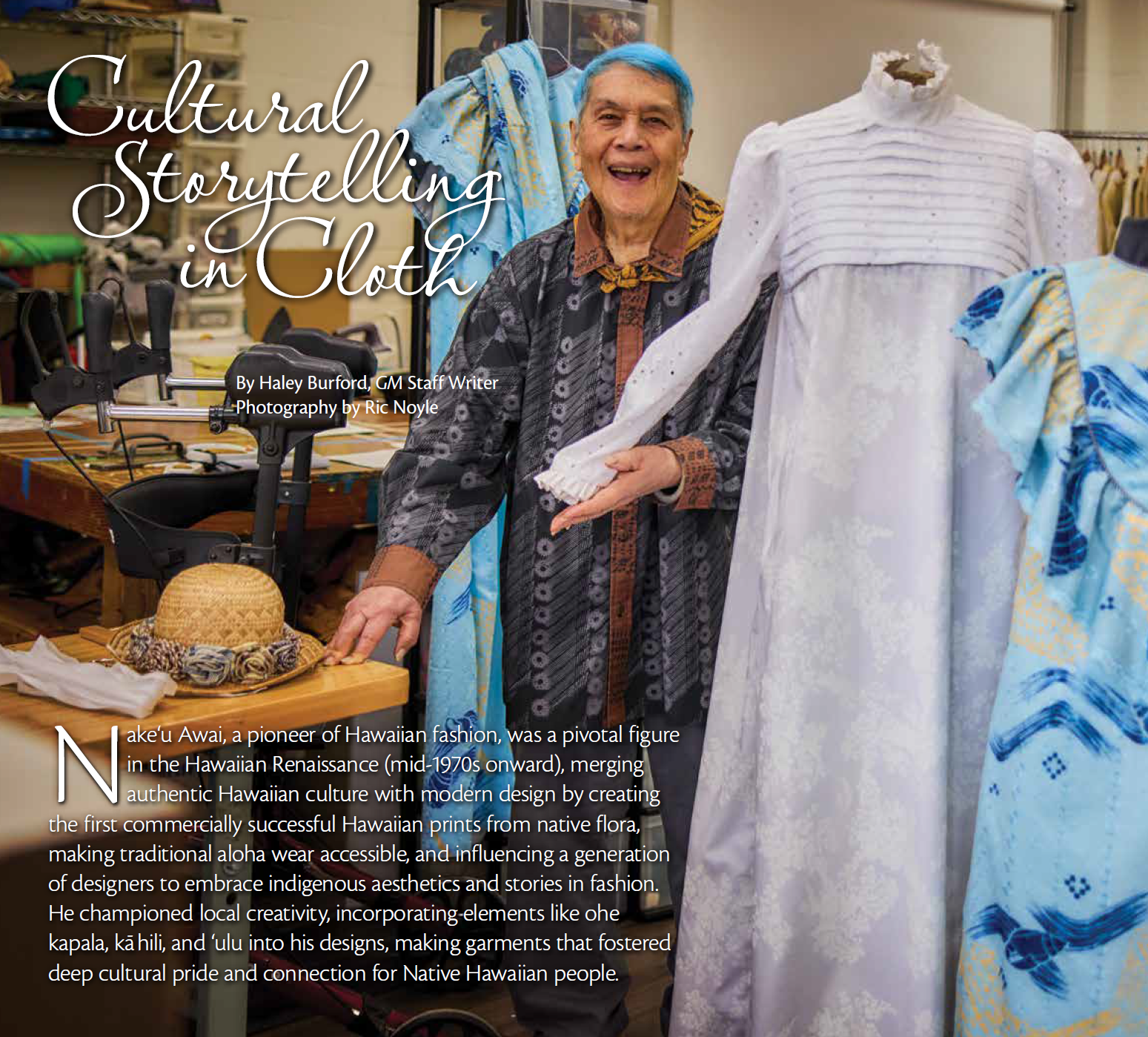
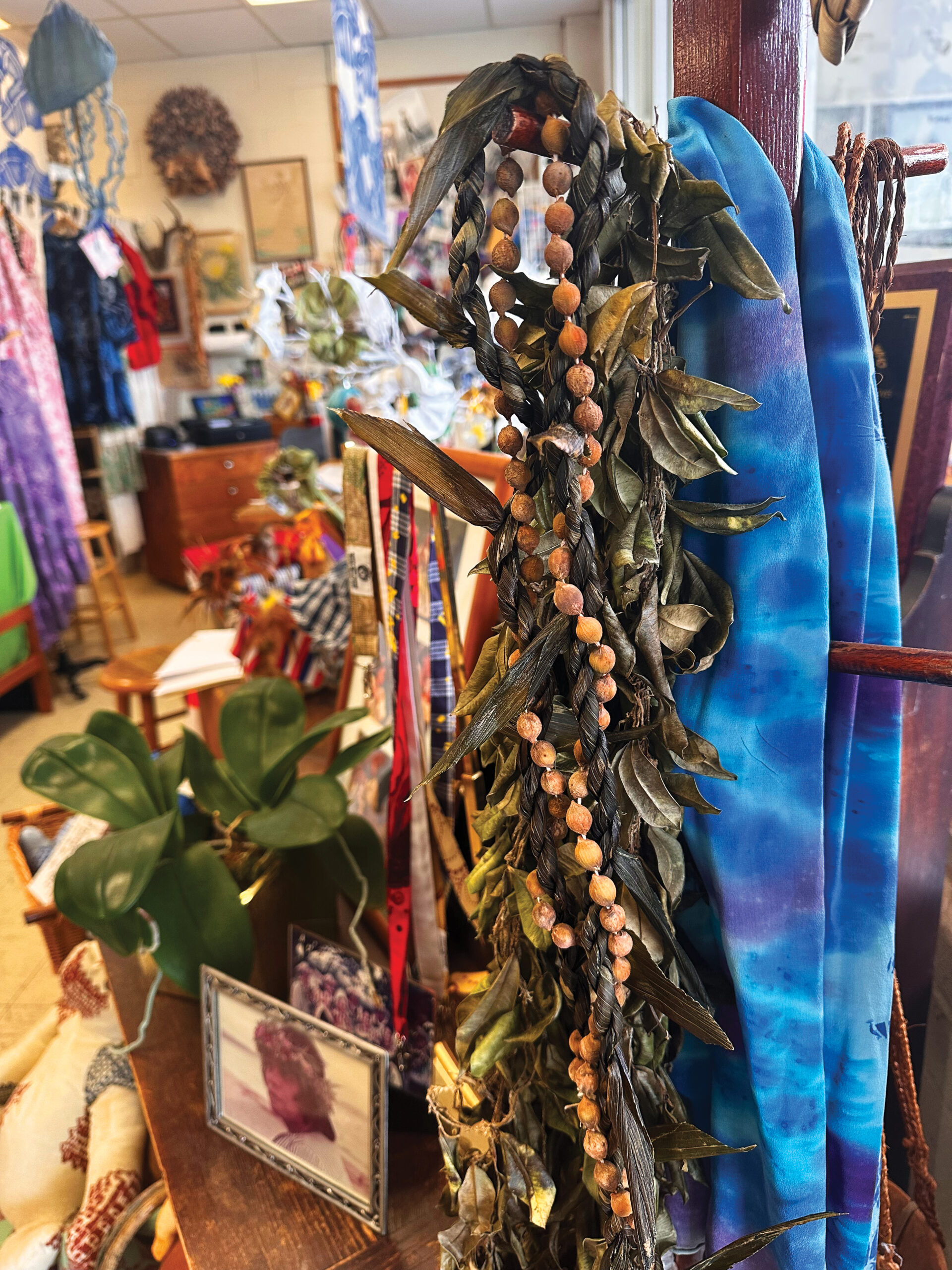
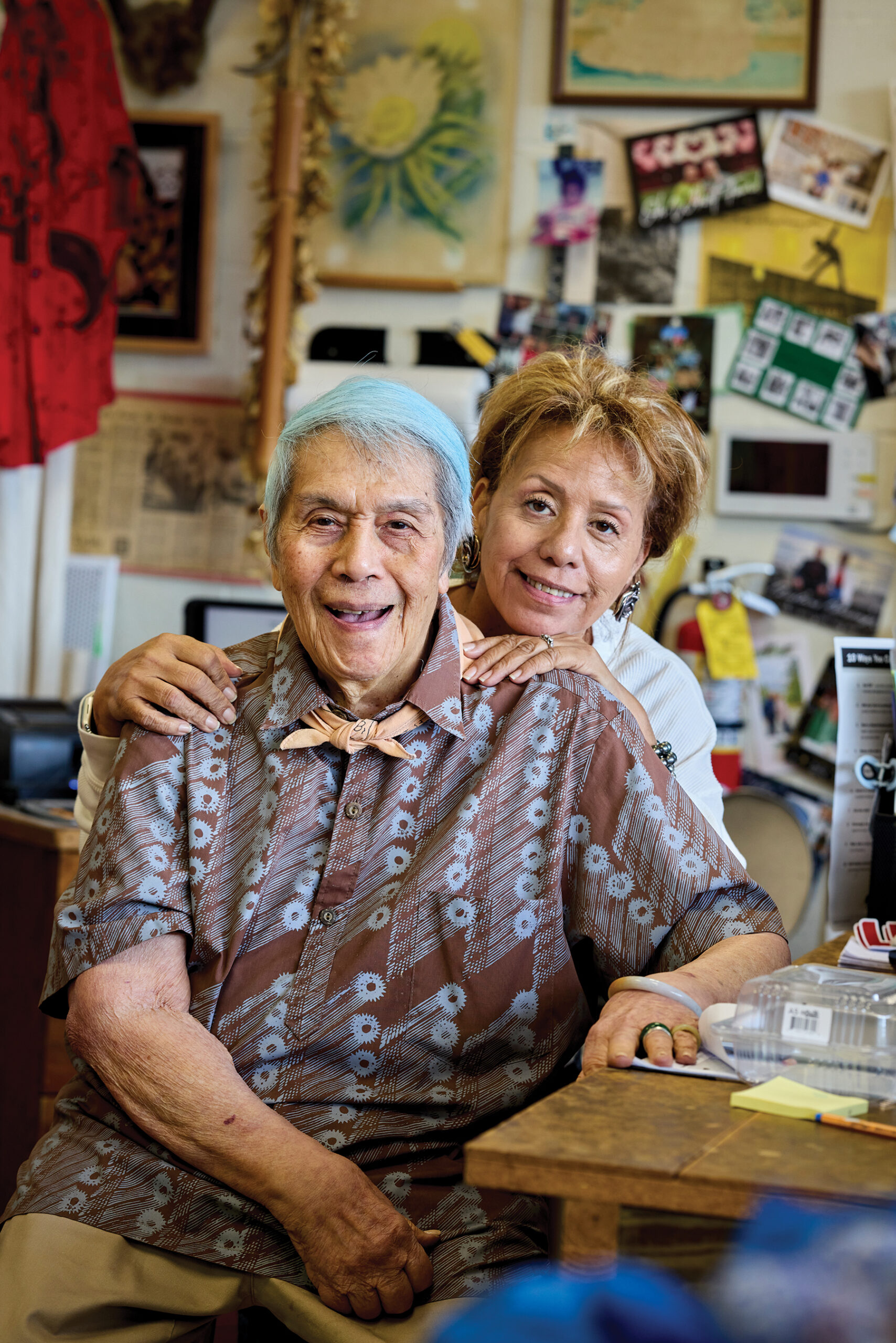
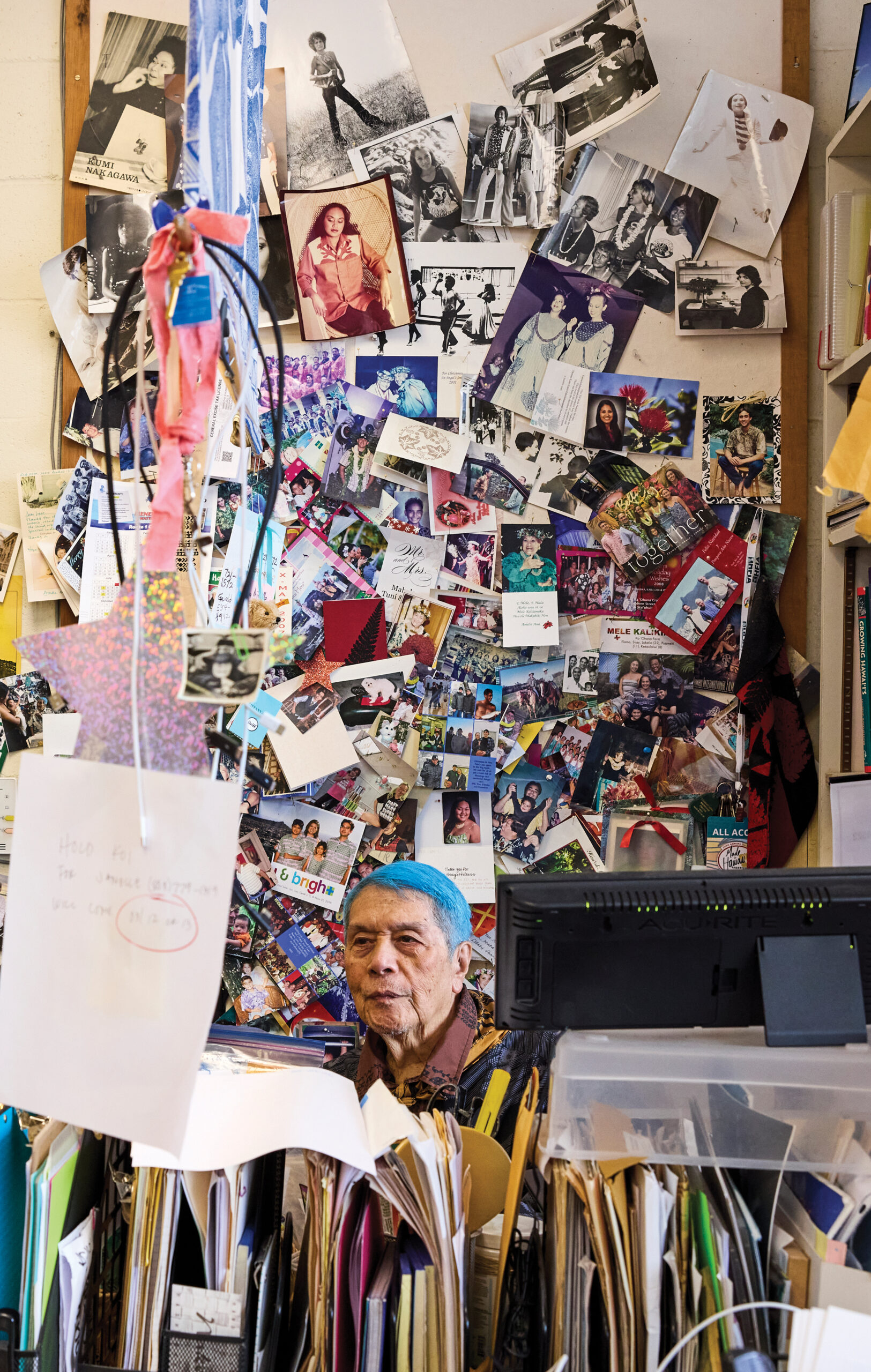
Upon entering his O‘ahu shop at 1613 Houghtailing St. where he’s outfitted the people of Hawai‘i for decades, Nake‘u Awai, age 87, sits at his desk, sporting his classic outfit — an aloha shirt, slacks and signature neckerchief. His hair is dyed blue. It is fading, he says, and he needs to get it redone soon. He is surrounded by varying textures of memorabilia: receipts, books, curated pieces of art, holiday photos from customers and family and, of course, racks and racks of clothing, lovingly designed by his hand and heart. On shelves around the front of the shop are framed photos of people who walked in his fashion shows, of hula dancers whose hālau he outfitted for Merrie Monarch, of memories with friends and fellow designers, of precious moments with family. In this space, Nake‘u has intertwined his personal life with his professional life, conveying to anyone who walks in that he has lived a life as intricate and meaningful as his designs.
According to his niece, Marvi Rosehill Ching, Nake‘u’s mission statement has always been “to be able to serve and present to the world designs that are special to him — which is every single one.” Carrying with him the sentimentality and homesickness he felt while living overseas, Nake‘u set about designing clothing by and for Hawai‘i’s people. He was the first to locally create his prints with native flora and motifs that would later become known as Hawaiian print. He revived and popularized the holokū and mu‘umu‘u, producing the first to be sold at Carol & Mary, an iconic store that specialized in women’s fashion, and Liberty House, making sure his pieces were accessible to all.
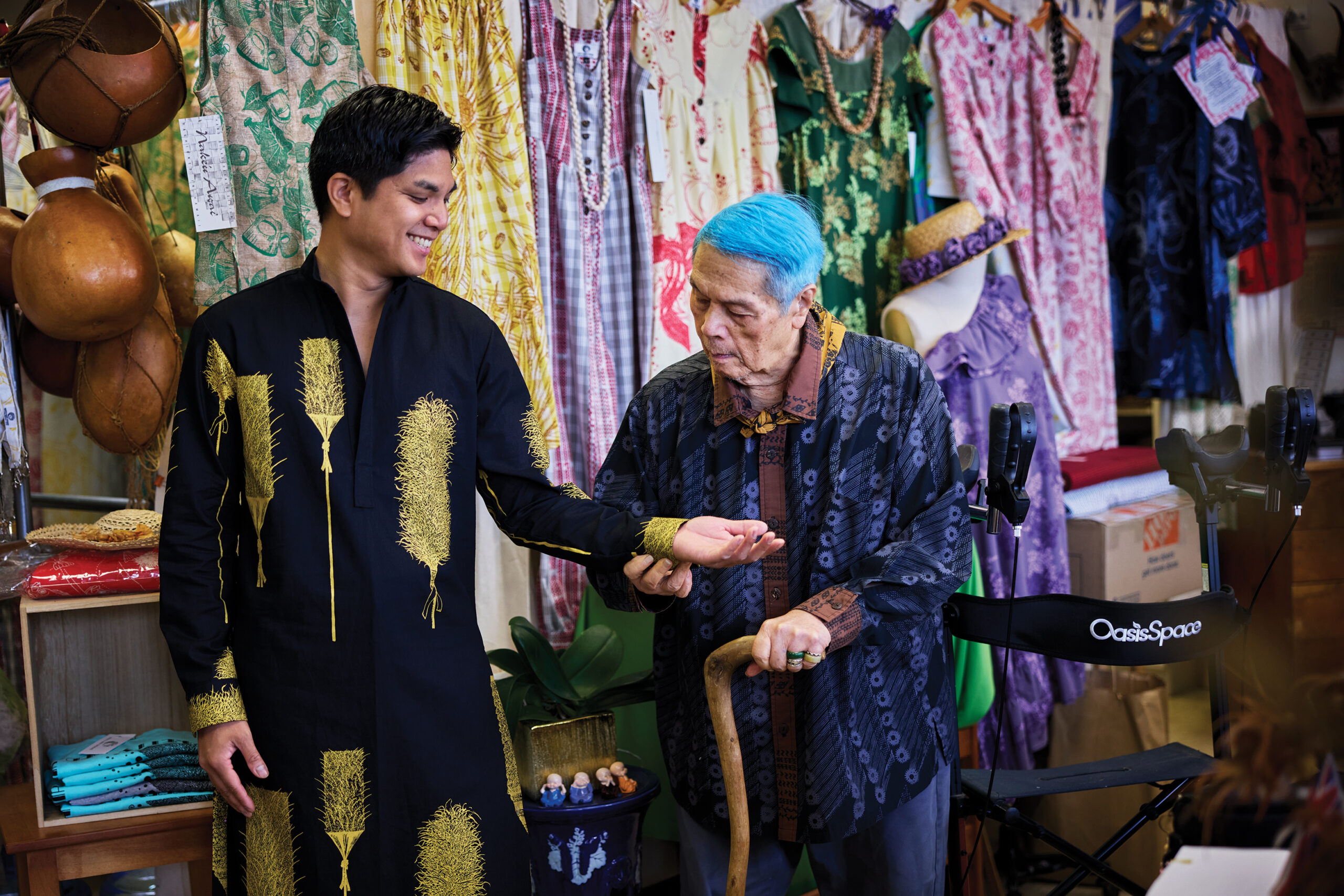
He’s never felt the need to advertise himself, letting the designs do the talking. On the surface, Nake‘u’s designs are beautiful and speak to an admiration for the beauty of Hawai‘i, but upon closer inspection amidst the memory archive that is his store, it becomes clear that his designs are also his way of memorializing his love for home, in one way, what Marvi calls a “fabric footprint.” From his very first design to his recent last, the legacy of Nake‘u Awai is also the legacy of the clothing.
An Artist in Bloom
Nake‘u grew up with his three siblings in O‘ahu’s Punchbowl, the son of a land abstractor and an educator. Already, in his youth, he took interest in the arts. The Golden Wall Theatre supported his love for performance and the YWCA was where he learned hula and tap dance. He eventually earned a degree in drama from the University of Washington, venturing to New York where he lived for several years, joining a touring company for Flower Drum Song. He sang and danced in Europe, Reno and Hollywood in the years that followed.
It would be a while before he was known as “the grandfather of Hawaiian fashion.” Nake‘u learned macramé from a friend, and it was then that he started to gain an awareness of designing clothing, making a business of selling macramé. In Hollywood, Nake‘u’s choreographer mentor, Claude Thompson, expressed faith in his costuming abilities, granting him his first opportunity to outfit a group of performers. Later, on the set of a Don Ho TV special in Lahaina, Nake‘u realized he could make a career out of fashion design.
He finally found his way back home in the early 1970s. At the time he was entering the scene, local fashion was only local in name. Fabrics were imported from Japan, England or the US, and designs only had to have ambiguous and colorful flowers to be deemed “Hawaiian.” This disconnect between local clothing and local communities found its origin in missionaries bringing outside fabric with them to the islands, pushing kapa (Hawaiian cloth made of beaten mulberry fibers) to the periphery, spreading the influence of Western design elements in Hawai‘i.
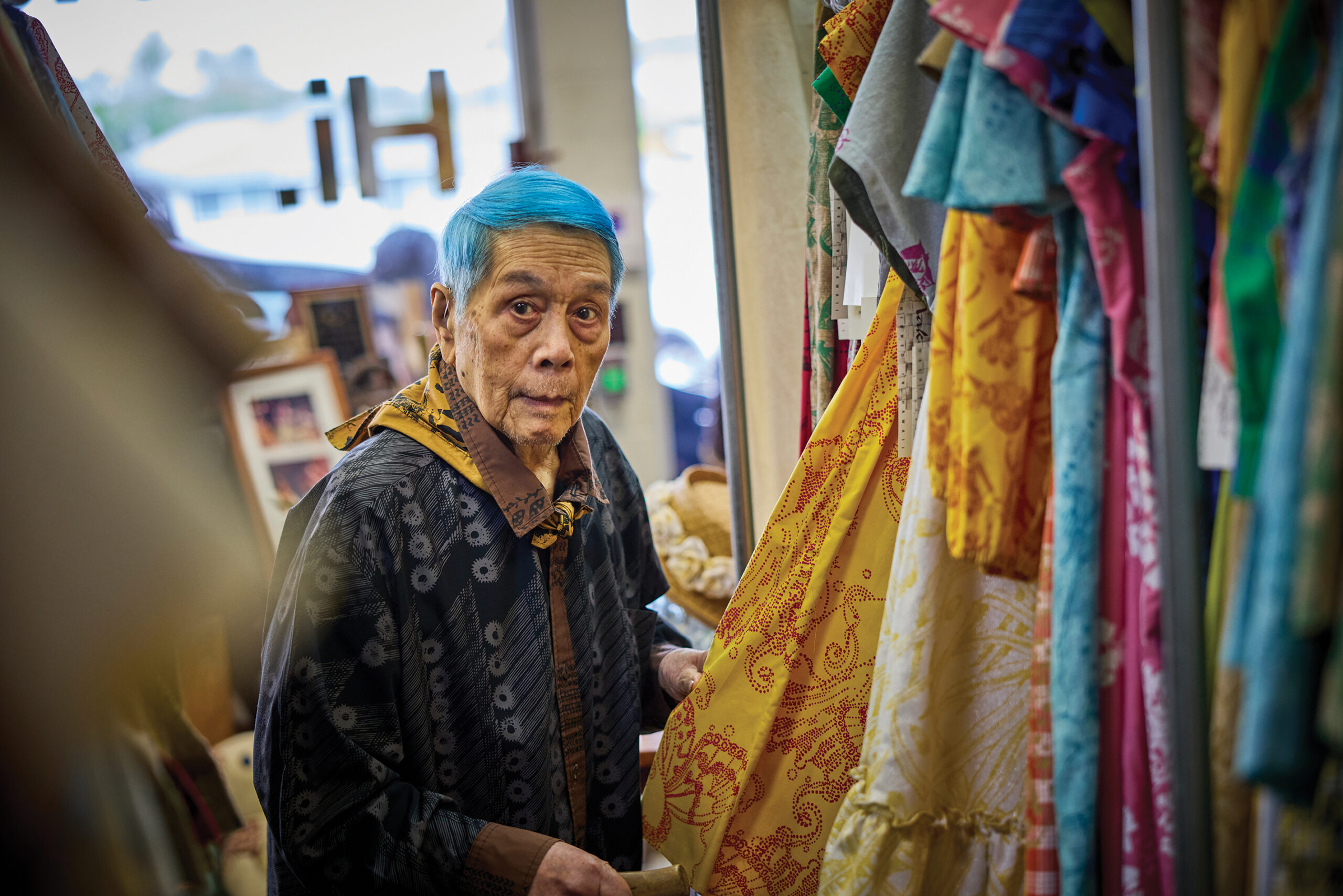
Enter Nake‘u Awai. At the start of his design career, he first utilized palaka fabric for its historical relevance in clothing plantation workers and paniolo, unifying the people of Hawai‘i across ethnicity and class. As he kept on, he worked with different cloth blends — cotton, linen and the like. When he wasn’t designing, Nake‘u was selling his work at craft fairs, organizing fashion shows (his first being at Hawaiian Mission Houses in 1974, a place that holds many memories for him), outfitting hālau and more. He went about bringing into a physical reality his love and longing for his home through his designs, turning love into a life’s work.
Bougainvillea
His very first design is still in the shop today, and brings back memories of companionship and collaboration in his earlier years as a designer. “My first print was ‘Bougainvillea,’ Nake‘u says, “which was done by a university friend of mine. After that, the next artist that did prints for me was a guy named Hiko Hanapi,” a Native Hawaiian artist, educator and community activist who advocated for the furthering of Native Hawaiian art. Another artist: “The artist that did most of my prints became a long-time friend of mine, Richard Vyse.” Vyse was a fashion illustrator who did high-fashion sketches for Liberty House and Carol & Mary. “The first thing I got from him was at an art show in some shop in Hawai‘i Kai; I bought a drawing of Princess Ka‘iulani.” Then, he points at something on the wall above him, hanging cozily amongst the oodles of pinned photos and pieces of paper. There, on the wall, was a drawing of the princess. “It’s not that one,” he reveals, “it was a sketch. But, anyway, I bought the Vyse piece, and that’s how I met Richard Vyse.”
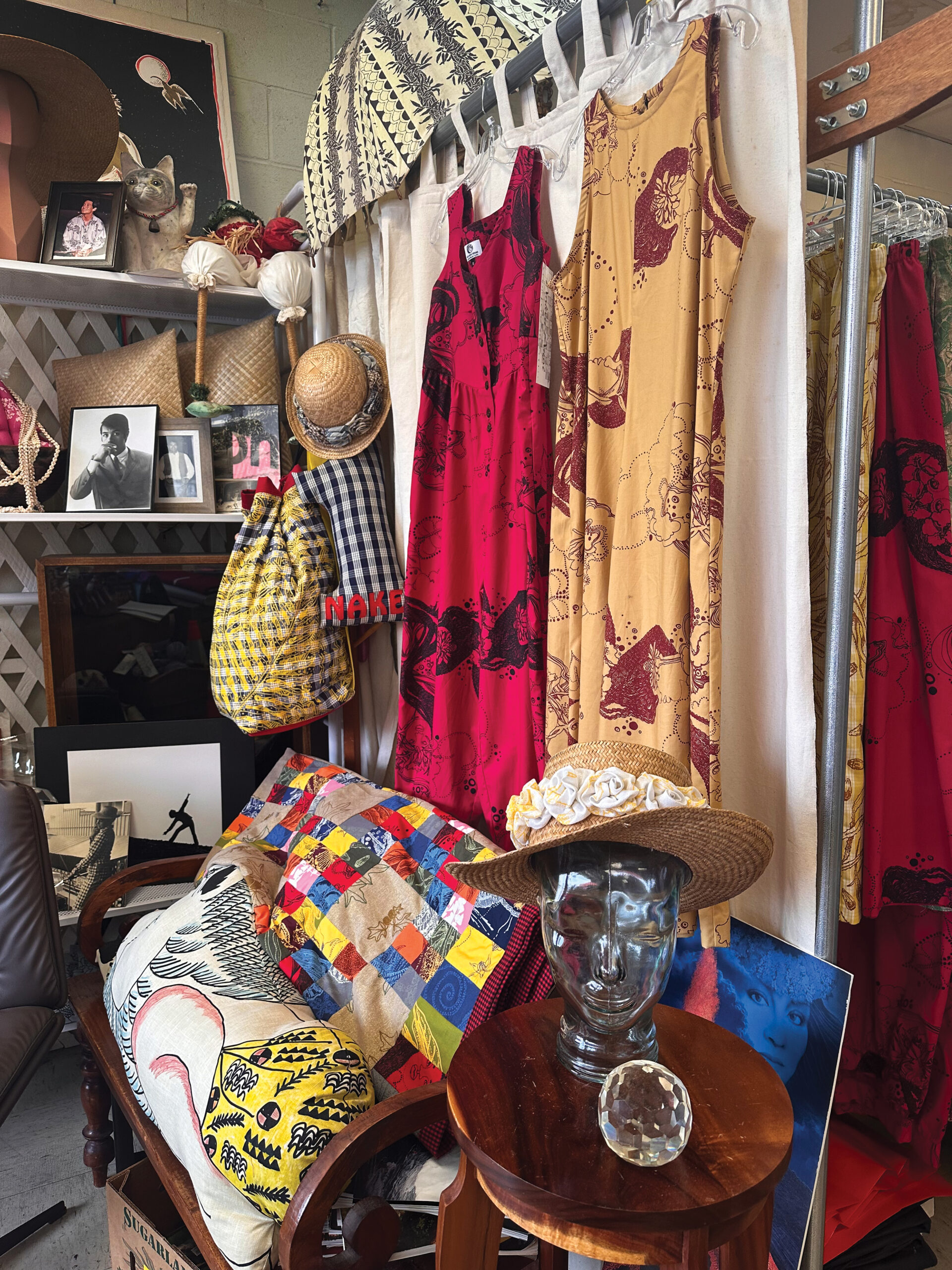
Marvi grabs one of the mu‘umu‘u hanging on the wall, a retro green and purple Boat Day garment. Boat Days in Hawai‘i historically refer to the festive, mid-20th century (1920s to 1950s) arrivals of Matson luxury liners at Honolulu Harbor that departed from San Francisco. The Boat Day style was designed with kūpuna in mind — specifically, Nake‘u was thinking of his mother. The sleeves are regal and the off-shoulder yolk with ruffles adds an elegance to the mu‘u. “Most of them have a signature dot pattern. That’s how you can figure out that it’s a Richard Vyse, because he does his with dot, dot, dot, dot.” Today, Vyse is still producing art in Maryland. “He’s around Nake‘u’s age,” Marvi says, “so, when they met, they were very young spring chickens, and they grew together.” Nake‘u adds to that, “He’s a survivor, like I’m a survivor, too.”
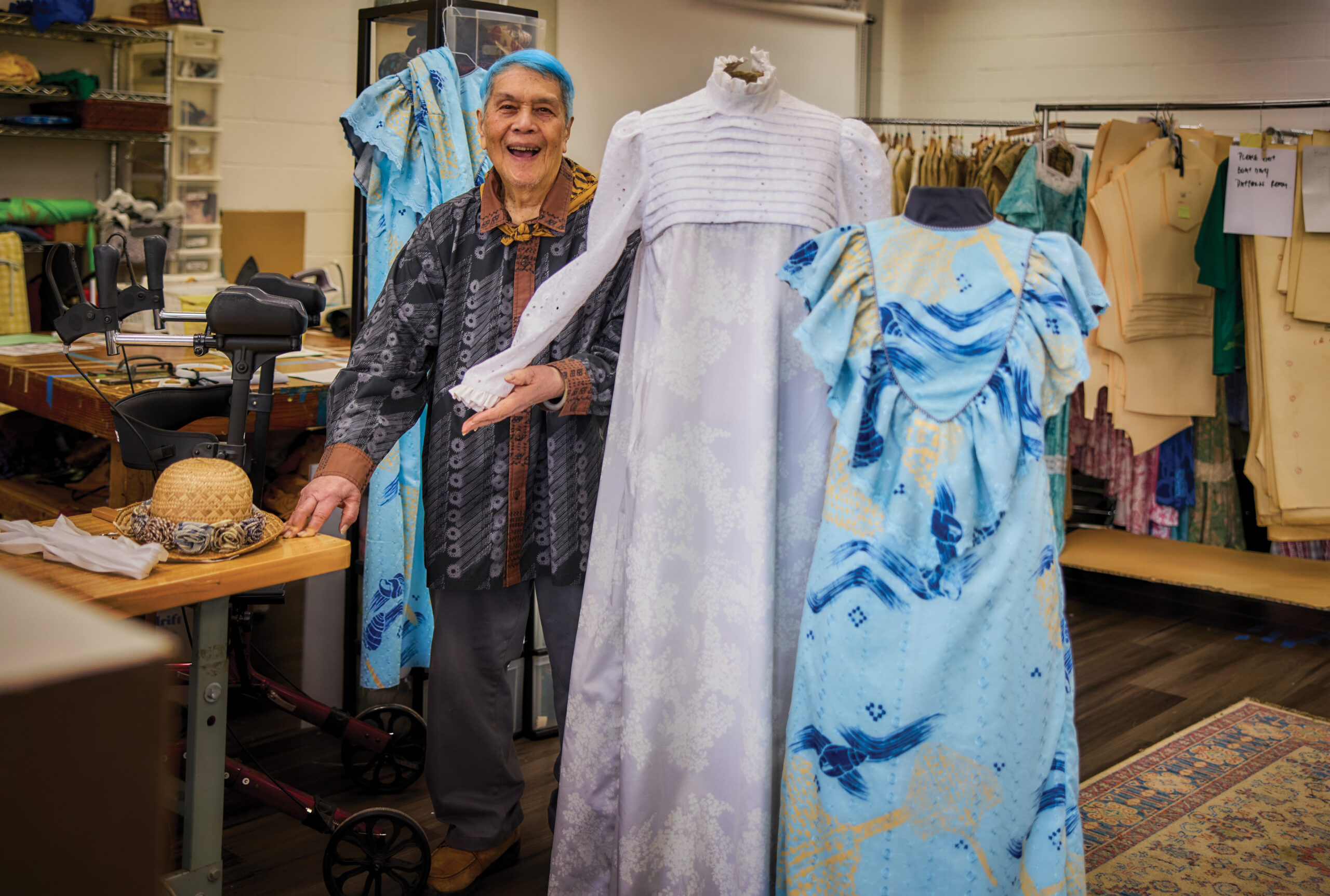
As Nake‘u speaks, Marvi excuses herself to grab another dress from somewhere in the orderly jungle of racks of clothing. A couple of minutes pass until she returns, a beautiful white dress in blue flower print in hand. “Bougainvillea: This was his very first print, in the very fabric. Feel the cloth,” she says, bringing it closer for all to see and feel. The dress is cummerbund-style, brought in at the waist to accentuate the figure — truly a vintage piece. Once she puts the dress up on the wall, Marvi and Nake‘u begin a back-and-forth discourse about when and by whom it was worn. “Was it that one? No, they’re wearing Papalina. So many photo albums. There’s another one, way in the back. I remember that.” Designs and clothing are outward-facing items; the meaning behind them usually becomes secondary to the look they create. To Nake‘u, though, his designs and clothing gesture to everything within — memories of friends, collaborators and home.
Ka‘iulani on Horseback
Nake‘u is no longer working on new designs, but his most recent include ones named “Kona Road” and notably, “Ka‘iulani on Horseback,” a strong and wide fashion show print. A dress with the print on it sits prettily and boldly on a mannequin, originally released in violet on powderpuff blue fabric. Another way in which the design is unique is that it is a “difficult” print, because the design is so extensive and detailed that in order to properly show the scene of Princess Ka‘iulani riding in its full flourish, yards of material must be used. In other words, Ka‘iulani on Horseback accentuates fuller figures, affirming Nake‘u’s promise to make clothes by and for the people of Hawai‘i, ensuring that everyone feels beautiful, regardless of shape or size.
Nake‘u has always been an admirer of Princess Ka‘iulani. Another one of his designs was named in honor of her, The Kaiulani, with its full sleeves and high neck, similar in look to the dresses the princess often wore. “The State Foundation gave me a scholarship to do an event on the life of Ka‘iulani, so I did a whole lot of research on her, and as I’m doing the research, I fell in love with her,” he says.
Known for her intelligence, free-spirit and beauty, Princess Ka‘iulani was the
daughter of Princess Miriam Likelike, and the last heir apparent to the throne of the Hawaiian Kingdom as Queen Lili‘uokalani’s niece. She loved to surf and paint, and made the acquaintance of many, including a poet, Robert Louis Stevenson, whose poem about the princess calls her “the island rose, light of heart and bright
of face” (“Ka‘iulani,” 1889). In Nake‘u’s program, “I had a wahine who played Ka‘iulani. The artist who did the Bougainvillea print, her brother was an actor at the University of Hawai‘i — he played Robert Louis Stevenson, Ka‘iulani’s buddy, who used to visit her.” The last segment of the program was her passing away at the age of 23 from sickness that came on after horseback riding in a rainstorm without a coat. For her entire life, Princess Kaʻiulani embodied the will to be free, fighting for herself, her people and the independence of her kingdom until the end. Nake‘u still has a strong connection to the princess today. Like Ka‘iulani, Nake‘u advocated for his art and his home with fearless, steady devotion.
Overcoming the Odds
To get to this point, though, Nake‘u has faced many challenges. It isn’t easy running a small business that (successfully) strives to be fully locally designed, produced, sold and worn in an industry as competitive and commercial-leaning as fashion. In fashion design, risks are required. Now, he’s made a name for himself, but in the beginning of his design career, Nake‘u took a back seat to businesses like Carol & Mary and Liberty House in the production world because he was just a small business, and because he prioritized maintaining his creative expression rather than following the trends. To Nake‘u and his sister, Marvi’s mother, it was always about creativity.
Over the years, people in the business have tried to deceive and betray him, and to them, Marvi says, “Screw all you guys. We came, we conquered and we’re still standing strong. That says a lot about his depth and it tested his vulnerability. I am, as his bulldog, to protect him, till forever. Because nobody’s gonna do that again.” When you hold true and steadfast to what you believe in, nothing’s gonna shake you — Nake‘u’s and his family’s story is testament to that.
The rhythm and relationships that have developed over the years matter; there is only one printer doing silk screens in Hawai‘i, and Nake‘u built and maintained that partnership into the present day. Everything is still produced in Hawai‘i with cotton blends. Nake‘u has always believed in making local and buying local, a continuously implemented belief that sets him apart from those who have followed. When asked about how he sees fashion changing with the times, Nake‘u says, “I’m glad to see people are still interested in mine.” From outfitting dancers in Hollywood to singers like the Brothers Cazimero, Nake‘u has truly embodied what it means to live and love local.
Taking Care of Business
Nowadays, Nake‘u continues in his duty of watching over his shop and serving customers. He doesn’t design anymore, nor does he do fittings — Marvi and Gerald Chun take care of that — but he still stays involved from behind the desk. Gerald is in charge of the shop’s social media account, and the shop recently opened an online website where customers can order pieces directly to their door. Nake‘u remains faithful to his style and his designs, but sometimes they tweak certain styles to see if the younger generation would be interested, like turning what was originally a dress into a blouse and culottes to have more casual, coordinated pieces that can be mixed and matched.
So, it is obvious that Nake‘u’s brand has evolved in the technological sense, but the traditional, core aspects of the business have remained constant. One example lies in the clothing itself: When posting pictures of a blue garment, “if you don’t have the lighting right,” explains Marvi, “what is really a beautiful chambray blue turns out cream on social media. There’s nothing like true blue.” While being able to adapt to changing times is invaluable to any business — especially a small, local one — Nake‘u and his family maintain that the beauty of the clothing will always stand the test of time (and cameras).
His designs have an “if you know, you know” cultural relevance. Nake‘u’s never been flashy or felt the need to advertise himself, so those who know a dress is a Nake‘u piece are in on a chic fashion “secret.” Many of his dresses are passed down from generation to generation, adding to this “insider” quality. It also helps that the clothes are made well enough to last decades. “Everybody that comes in says, ‘I’m holding onto it because I know it’s gonna last a lifetime,’” adds Marvi. “There’s been kūpuna who have walked in with their mu‘u on looking brand new. You take care of it, it will take care of you — and it’ll live longer than you.”
He still hosts his fashion shows. “Coming up, I’ve already thought of a Christmas show,” he says, pride apparent in his voice. “Last year, I did it at the Ko‘olau Ballroom, and we’re planning to go back again.” This year’s event is called “Come!
Ra-pa-pum-pum,” “because I’m gonna use the ipu,” he adds, demonstrating playing the gourd drum on the surface of his desk. Many of the people who have taken the stage in his fashion shows before still do to this day. “Singers, dancers, some sing and dance.” Singer, dancer, whatever — everyone who walks Nake‘u’s shows must perform. “That’s the story of showbiz.”
The Beauty of Nake‘u Awai
At 87, Nake‘u is still thriving and going strong — independent, living at home with a companion and “still very on it,” according to Marvi. Having been in business for almost 53 years, Nake‘u has always abided by his mission statement to present his designs — all special and all reminiscent of his home — to the world. This sentiment sprouted from the feelings he experienced when he was overseas performing in Europe and the continental US. But, this begs the question, what exactly was it that made him choose to “stay home” for the rest of his life? After going from place to place in his professional performing career, Nake‘u unveils the reason why he came back home and stayed for good: “I saw that my parents were much older. I felt that I should come home and take care of them.” Said plain and simple, Nake‘u came home, making a life’s work out of passion and loyalty.
“Picture, now, you’re coming home and everything is special,” Marvi says. “People ask, ‘What is your most special design?’ And he says, ‘I don’t know.’ I think to myself, ‘Yeah, you don’t, because everything is genuine and everything is a treasure to you.’” That’s the first thing to remember about Nake‘u.
The second is that everyone should be able to wear a Nake‘u piece, no matter their size, frame, whatever. To be able to keep the same styles for everyone has always been his thing. For example, the earlier mentioned purple and green boat day mu‘u is a piece styled in the ’70s and ’80s. “It’s resurrected itself,” Marvi says. “It’s kind of retro and old, but it is appealing to a certain few. That’s the beauty of him — he will not change.”
The third thing to remember is that, in doing this work, Nake‘u has documented decades of native and indigenous flora that may eventually go extinct due to changes in climate and an increase in invasive species. Like the poem Stevenson wrote for Princess Kai‘ulani, when you truly care about a person or a place and can see the beauty in it in any light, art pours from the fingertips and stands the test of time.
Being a fashion designer, like any form of artistic expression, literally requires wearing your heart on your sleeve and putting your all into what you create. The clothing that Nake‘u Awai has masterfully produced has been worn by grandparents, parents and children, a cycle that will certainly continue into the future. People wear Nake‘u’s designs, his love letters to home, to fashion shows, graduation ceremonies, to work, to the beach and so on, donning the man’s artwork in the land upon which they are based and crafted. His audience, then, shares the same appreciation for the islands that he feels.
Through memories etched in cloth, he has designed an archive people can put on. What it has always been about, for Nake‘u Awai, is the remembrance of home, and the hope to never forget the beauty of Hawai‘i.