
Tag: scam

  • Don’t Be Duped By a Text Message

    There’s been a marked increase in text messages with a spoofed Caller ID that ask the recipient to click on a hyperlink — that’s always the objective of this type of scam. It is their methodology to hijack your device.
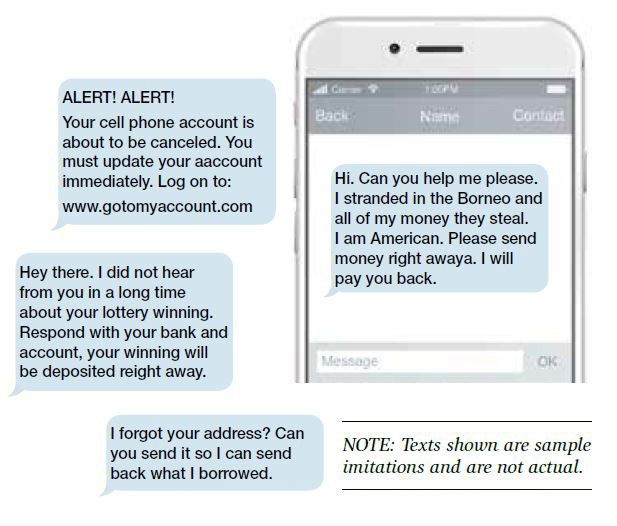
    Graphic showing examples of spoofed text messagesTwo Major Risks

    1. The recipient does not know who really sent the message.
    2. The hyperlink may redirect the message recipient to a website where malicious software may compromise the recipient’s cellphone.

    These programs may allow “spying” on your calls and text messages, and stealing personal and financial information and passwords. The program may even take control of the cell phone’s functions, such as the camera and/or microphone.

    Signs of Caller ID Spoofing

    • If the message is written using bad grammar and/or misspelling.
    • The message creates a sense of urgency and demands an immediate response.
    • The Caller ID is not in your address book — a big red flag!

    You should never respond to a text message from an unknown sender.

    Prevention Tips

    • Keep your address book current to include financial services you use regularly.
    • If you receive a text message with a hyperlink, do not click on it until you can determine it is legitimate. Use Google to determine the validity of the web address in the text message. Do the same with the Caller ID of the sender.
    • If neither is legit, do not reply to the sender and/or click on the hyperlink.
    • If it is legit, contact the sender of the message through other means; do not reply to the text message. If it is a company, find its contact phone number and call them to verify that they sent the message.

    THE DEPARTMENT OF THE PROSECUTING ATTORNEY
    1060 Richards St., Honolulu HI 96813
    808-768-7400 | Office hrs: Mon – Fri, 7:45 am – 4:30 pm
    www.honoluluprosecutor.org/contact-us/
    There’s been a marked increase in text messages with a spoofed Caller ID that ask the recipient to click on a hyperlink — that’s always the objective of this type of scam. It is their methodology to hijack your device. Two Major Risks include: The recipient does not know who really sent the message; and…

  • Lottery/Sweepstakes: An Overview

    If I were to open a crime college, a place to learn the fine art of thievery, one class that would assuredly be on the curriculum would be Advance Fee Frauds, commonly known as sweepstakes and lottery frauds. This con involves the victim being told the lie that money is coming their way (usually from lottery winnings, insurance refunds or inheritance) but a fee/tax/processing charge has to be paid first to receive it. This one scheme is responsible for more money being stolen in Hawai‘i than any other crime.

    According to the Better Business Bureau, nearly 500,000 people have reported this fraud to various enforcement agencies in North America from 2015 to 2017. In that time, funds lost totaled $344,414,685. However, studies have shown only 1 in 25 cases are even reported to the police.

    These scams tend to originate outside of the U.S., mainly in countries such as Jamaica and Costa Rica. Losses to fraud in Jamaica in 2015 (those that had been discovered) amounted to over $38 million. Money that resulted from these scams has been used to buy guns and drugs within Jamaica. In fact, so much money is being made in Jamaica from this scam, that organized crime has dramatically increased, resulting in deadly gang wars between rival fraud groups spilling out onto the streets. As a result of these problems, a State of Emergency has been declared for Jamaica.


    Countries such as Jamaica and Costa Rica both have large English-speaking populations, which is effective when speaking to potential victims. They claim they are from somewhere within the U.S., giving a false sense of security to victims, and slowly convince them they are not being scammed.

    Costa Ricans tend to use Voice Over Internet Protocol (VOIP), also known as internet phones, which give them the ability to change their area code. They often claim to be from a government agency to give potential victims a false sense of security when providing payment for taxes, fees, transportation, and/or security, for their “winnings.”

    Operations in Canada, Israel, Spain, and the Philippines have been linked to these sweepstakes/lottery scams, too. They tend to “spoof” phone numbers, resulting in area codes that appear to come from within the U.S. — Las Vegas or Washington D.C. area codes are often used.

    The takeaway from all this is people need to realize that there is no “free lunch” and they are not lucky enough to get something for nothing. As I explained in the Oct/Nov 2017 and Dec/Jan 2018 issues (online at www.generations808.com under “Wisdoms”), a person in Hawai‘i has a ZERO percent chance of winning the lottery. Too many people have fallen victim to this scam and have fueled crime and violence all over the world.


    To report suspected elder abuse, contact the Elder Abuse Unit at 808-768-7536 | ElderAbuse@honolulu.gov

    If I were to open a crime college, a place to learn the fine art of thievery, one class that would assuredly be on the curriculum would be Advance Fee Frauds, commonly known as sweepstakes and lottery frauds. This con involves the victim being told the lie that money is coming their way (usually from…

  • ‘What’s My Line?’ Elder Abuse-style

    In the 1960s, there was a game show called “What’s My Line?” that featured a panel of four celebrities who would try to guess what line of work a guest on the show was in. This panel would ask Yes/No questions about the individual’s career and every time the answer was No, the guest would win a small amount of money. It was very entertaining watching the panelists guessing if someone was an airline pilot or a rocket scientist. Often their guesses hinged on how a particular person looked or their confidence when they gave an answer.

    We often have these preconceived notions of who people are by how they dress or speak to us. I see this each time I give a presentation and ask the simple question, “What does a con artist look like?” The answers I receive are oftentimes humorous. Descriptions of used car salesmen and politicians are shouted out, with visuals of “shifty eyes,” bad toupees, rapid speech, and loud aloha shirts added in for effect. Audience members are confident they would be able to clearly spot a criminal if they were to meet one.

    When I tell of the cases the Elder Abuse Unit has prosecuted over the years, and relate who the perpetrators of these crimes were, the audience becomes unsure of their scam artist radar. They sit in disbelief hearing of the daughter who took $200,000 from her mother, leaving her unable to pay the mortgage and facing foreclosure. Or the caregiver who stole all the wife’s jewelry when she was hired to care for the disabled husband. Or the pleasant woman who simply walked into the house of an elderly couple in ‘Aiea and pretended to know them, distracting the couple while her husband entered the home and took items from the bedroom.

    Over and over, I hear from victims about how nice the criminal looked or how polite he sounded over the telephone. Or maybe they felt sorry for him because of the sob story he told. Con men do not wear black cowboy hats to signify they are the bad guys. Oftentimes they are only revealed to be dishonest after the crime has been completed.

    It’s difficult, however, to go through life being paranoid, suspecting every stranger you meet as having criminal intent.

    Here are some simple ways to safeguard yourself from being a victim:

    • When hiring someone for a job, get a written contract and include any spoken promises in it.
    • Hire a licensed worker and verify their license by calling 808-587-4272.
    • Check references.
    • Don’t rush into a deal; if they can’t wait 24 hours something is wrong.
    • Be comfortable saying “no thank you” and hanging up the phone or shutting the door immediately. (You may feel this is being rude, but a common tactic for shysters is to make you feel guilty for asserting yourself).


    To report suspected elder abuse, contact the Elder Abuse Unit at 808-768-7536 | ElderAbuse@honolulu.gov

    “What does a con artist look like?” The answers I receive are oftentimes humorous. Descriptions of used car salesmen and politicians are shouted out, with visuals of “shifty eyes,” bad toupees, rapid speech, and loud aloha shirts added in for effect.

  • Beware of ‘Spoofing’

    Telephone scams have been around for years, even before the birth of the internet, and they are just as dangerous as their online counterparts. Because modern telephone networks use digital technology, it is easy for cybercriminals to manipulate what appears in the Caller ID to trick you into thinking you are receiving a call from a trusted source. This tactic is called “spoofing.”

    Listen for these red flags:

    ◆ A sense of urgency. The caller wants you to act immediately or something bad will happen.

    ◆ The caller advises payments be made using gift cards or prepaid debit card.

    ◆ You are asked to download and install programs onto your computer to fix the “problems” the caller claims your computer has.

    Some Safety tips:

    ◆ Do not provide any personal or bank information to the caller or confirm any information.

    ◆ Do not respond to any voice messages to contact a telephone number the caller provided without checking first by calling the customer service number on the company or government website.

    ◆ Do not download any programs the caller says you need, or confirm your computer’s type.

    You can find more tips on these websites:

    www.bit.ly/HawaiianElectric_FraudProtection

    www.bit.ly/Microsoft_AvoidPhoneScams

    www.bit.ly/IRS_SpamReporting


    THE DEPARTMENT OF THE PROSECUTING ATTORNEY
    1060 Richards St., Honolulu HI 96813

    808-768-7400  |  Office hrs: Mon – Fri, 7:45 am – 4:30 pm
    www.honoluluprosecutor.org/contact-us/

    Telephone scams have been around for years, even before the birth of the internet, and they are just as dangerous as their online counterparts. Because modern telephone networks use digital technology, it is easy for cybercriminals to manipulate what appears in the Caller ID to trick you into thinking you are receiving a call from…

  • Is It Time for Medicare?

    Were you a high school senior in 1972, singing Alice Cooper’s classic hit, “School’s Out” (for Summer)? Then you may be turning 65 soon and wondering if you need Medicare insurance. Figuring it out on your own may leave you clicking through a lot of scam websites and staring at a mountain of brochures and flyers that arrived in the mail. Medicare was created in 1965 to provide security and peace of mind, not cause you to lose your mind, patience or your money.

    These tips will help you keep your cool:

    ◆ Call Social Security at 1-800-772-1213 or visit their website at www.ssa.gov, at least three months before your 65th birthday to ask them to determine your Medicare eligibility and enrollment dates.

    ◆ Contact the employee benefits specialist for your own or a spouse’s current or former employer to see if you qualify for retiree medical insurance benefits.

    ◆ Check with Medicare at 1-800-633-4227 or www.medicare.gov to learn about Medicare premiums, late enrollment penalties and Medicare insurance options available in your county.

    The peace of mind that comes with understanding how Medicare works will have you humming a different tune: “Summertime” (and the Living is Easy)!


    MEDICARE MOMENT WITH MARTHA
    A radio program with Martha Khlopin
    KHNR-690AM:
    Sat., 2 pm–2:30 pm, Sun., 9:30 am–10 am

    808-230-3379 | getmartha@aol.com

    Were you a high school senior in 1972, singing Alice Cooper’s classic hit, “School’s Out” (for Summer)? Then you may be turning 65 soon and wondering if you need Medicare insurance. Figuring it out on your own may leave you clicking through a lot of scam websites and staring at a mountain of brochures and…

  • Boo! Now Give Me Your Money

    Fear has always been a tool criminals use to get money from others. Whether it is created by holding a weapon to a cashier to get their compliance, or simply using a verbal threat against someone on the street to make him/her surrender their wealth, a robber wants his victim to believe they have to act quickly to avoid being harmed.

    The Office of the Prosecuting Attorney’s Elder Abuse Unit has seen fear also being used to scam seniors out of their money and assets. Unlike direct threats to their safety, however, many fear-based scams involve the illusion that the victim will lose their wealth, their security, or someone close to them if they don’t act quickly.

    One such scam that is occurring in Hawai‘i is the Distressed Relative Scam. This scam relies on the victim making a quick emotional decision, before they have time to verify the facts or to ask for advice from others. The victim will get a message, either a telephone call or an email, relating to them that a family member is in dire straights and money will solve the problem.

    An example of the charade can include a “doctor” calling the victim to inform them that their family member was injured while traveling and money needs to be sent immediately so that the loved one can be saved. Another has involved the con-man (or woman) claiming to be their grandchild or some other relation to the victim and informing them they were unlawfully arrested and need bail money to escape the mistreatment they are receiving in jail.

    Generations - 2014-02 - Boo Now Give Me Your Money - Image 01
    The Scream by Edvard Munch (1893)

    The perpetrator of this scam goes on to instruct the victim how they can either wire the money to them or tells them to get a Green Dot loadable charge card from Walgreens or Wal-Mart and put money into the card’s account and relay the account number on the back of the card to them.

    When hearing about this scam in the light of day, one can easily realize that there is something suspicious about the above scenarios. But as any parent or grandparent will tell you, the call they dread the most is one informing them that someone precious to them needs help. It is a message like this that will force them to panic and act before they think clearly about what is being said.

    Fear is also incorporated into other types of scams seniors encounter — such as when seniors receive a call from “the bank” saying that suspicious activity is occurring on their account, and then they are asked to give the caller their personal account information so that “the bank” can secure the account’s money. Additional scams include the lottery and sweepstakes scams featured in the December/January 2014 issue of Generations, and Sweetheart Swindles featured in the August/September 2013 issue.

    If you are ever contacted by someone and feel pressured to make a decision out of fear, then it is time to stop and verify the facts. This can be as easy as calling a relative to compare notes or calling Crime Stoppers at 808-955-8300.


    To Report Suspected Elder Abuse, call:
    Adult Protective Services
    808.832.5115
    ElderAbuse@honolulu.gov
    or visit www.ElderJusticeHonolulu.com.
    All reports are confidential.

    Fear has always been a tool criminals use to get money from others. Whether it is created by holding a weapon to a cashier to get their compliance, or simply using a verbal threat against someone on the street to make him/her surrender their wealth, a robber wants his victim to believe they have to…

  • Sweetheart Swindles

    An elderly man was in the gym working out with his trainer when they saw an attractive young woman enter the workout area and begin to exercise. The older man asked his trainer what machine he should use to impress the young woman. The trainer replied he should use the ATM machine in the lobby.

    This joke highlights two reasons why scams are often targeted against the elderly. First, seniors have more money and assets than any other segment in our community. And second, seniors are (or perceived to be) lonely, oftentimes surviving their spouse of many years. It is for these two reasons that the Elder Abuse Unit, as well as the Honolulu Police Department, has seen an increase in the crimes known as Sweetheart Swindles.

    Although this scam takes on several distinct forms, the scam artist finds a lonely senior, makes promises of companionship, and convinces him/her to give/loan the scam artist large sums of money or property.

    How do scam artists find lonely seniors? Very easily. If you Google “senior dating,” you will find 160 million websites in less than a second. As seniors become more comfortable with using the computer, they get exposed to websites that promise that companionship is at the tip of their fingers.

    Sally (alias), thought lightning struck twice in her life when she met “Sam,” a man who had the same values and beliefs she shared with her deceased husband. She “met” Sam on a well known dating site when he replied to her profile and sent her pictures he claimed to be of himself. The emails quickly became telephone calls filled with words of romance and security. However, they could not begin their fairytale romance until he completed some business he was conducting in London. Sam shared that his financial trouble relating to his business was the only thing preventing him from flying to Hawai‘i and sweeping her off her feet. Once Sally offered to help, she began a journey that would result in her losing $160,000, by wiring money overseas as a loan to help Sam. With her money gone, so was Sam.

    Unfortunately, the police were not able to retrieve the money lost by Sally, but they have been able to recover moneys taken in other Sweetheart Swindles that have occurred in Hawai‘i. This only happens, however, when the crime is reported, which, given the humiliation and betrayal felt by victims of this scam, is not very often. If you suspect you are being targeted in this type of scam or have any questions relating to elder abuse in general, please contact us.


    To Report Suspected Elder Abuse, call:

    Adult Protective Services
    808.832.5115
    ElderAbuse@honolulu.gov
    or visit www.ElderJusticeHonolulu.com.

    All reports are confidential.

    An elderly man was in the gym working out with his trainer when they saw an attractive young woman enter the workout area and begin to exercise. The older man asked his trainer what machine he should use to impress the young woman. The trainer replied he should use the ATM machine in the lobby.…

  • Better Business Bureau: Scammers Take Advantage of Health Reform

    Con artists are always seizing on the public’s financial struggles and confusion in order to make a quick buck. Not long ago we saw them come out of the woodworks during the housing crisis and now we are seeing a pattern again as health care reform laws are upheld.

    Scammers are already trying to cash in on the fact that there is still confusion about health reform. Hawai‘i’s BBB is warning consumers that these scammers are trying to sell fake “Obamacare” policies over the phone and other health care policies under the guise of being able to be grandfathered into a policy before the Patient Protection and Affordable Care Act is “official”. Some of these scam artists have even set up toll-free numbers to sell these fake policies.

    The con-artists attempt to create a sense of urgency by telling consumers that there is a limited enrollment period and coverage is required by law. Often, these thieves can’t explain what is covered by the policy nor do they have any answers related directly to healthcare that are not very general.

    Here are a few things to keep in mind if someone solicits you about obtaining new health insurance.

    • There is no open enrollment period currently associated with the new law, so if the salesperson is pressuring you to buy the policy because the price or option is only good for a short time, be wary.
    • You may have heard that all Americans will be required to purchase health insurance under the new law, but this requirement does not go into effect until 2014 for most people. If a salesperson implies you have to purchase coverage now, hang up the phone immediately.
    • If a salesperson claims that by getting a different coverage now that you will be “grandfathered” or exempted from changes required by the health care reform law in the future. It is a red flag as this is no longer true.

    Hawai‘i’s BBB recommends that you don’t sign a contract or send money before you check out the company you plan on doing business with. Consumers have resources such as Hawai‘i’s BBB and the States Insurance Commissioner (808-586-2790, 808-586-2799, www.hawaii.gov/dcca/ins/)that they can check with before doing business with a company. Stay safe, healthy and informed!


    Complaints or Questions, contact BBB:

    808-536-6956 (O‘ahu)
    877-222-6551 (Neighbor Islands)
    www.bbb.org/file-a-complaint/

    Con artists are always seizing on the public’s financial struggles and confusion in order to make a quick buck. Not long ago we saw them come out of the woodworks during the housing crisis and now we are seeing a pattern again as health care reform laws are upheld. Scammers are already trying to cash…