Category: Date

  • Gardening & People With Dementia

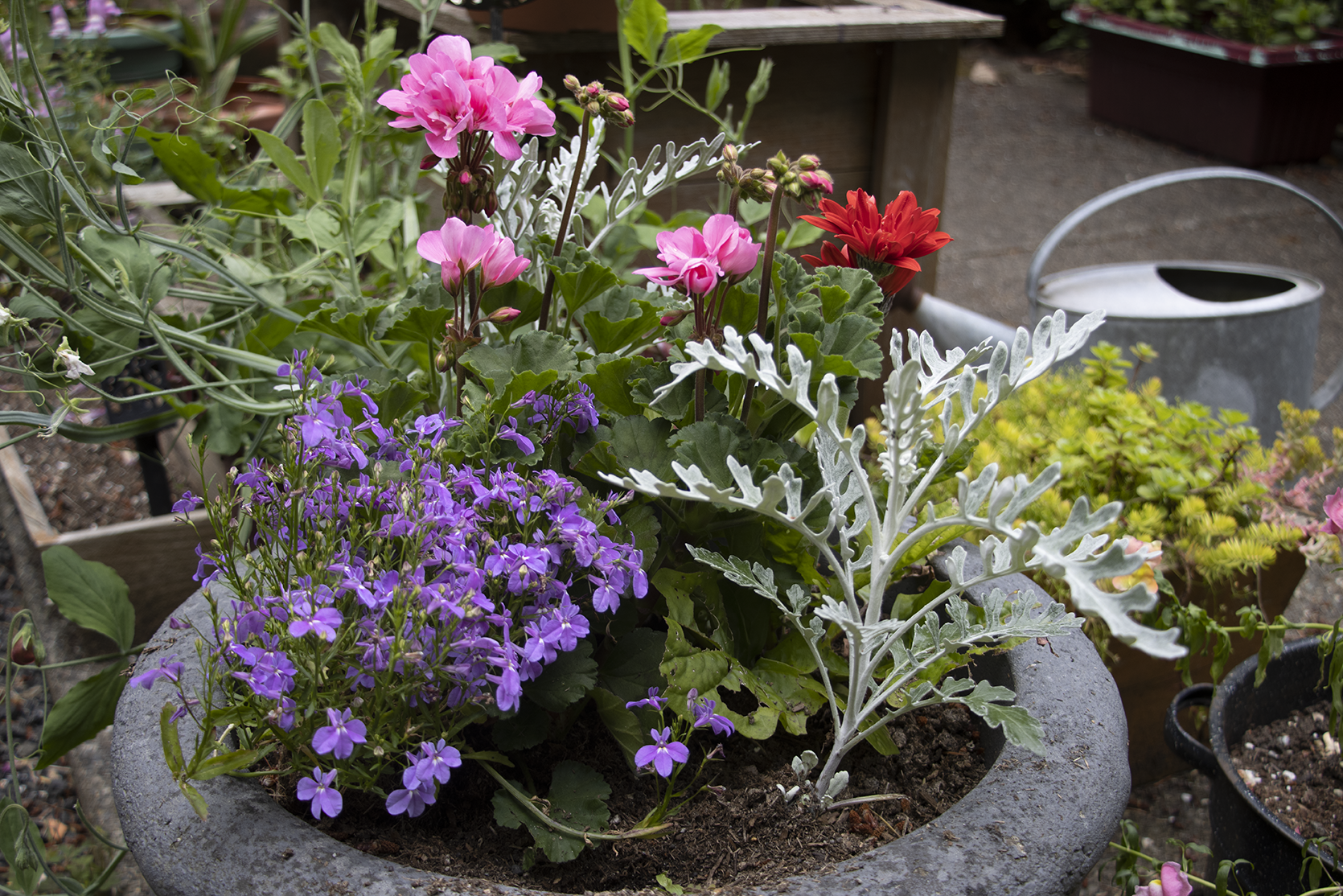
    According to a 2021 research review on the impact of gardening in dementia treatment, exposure gardening activities has shown many benefits for the dementia population. Some of these benefits include reduction in depression and aggressive behaviors, an increase in engagement, improved mood and an increased sense of purpose.

    Studies have shown that the act of being in nature reduces the levels of cortisol and saliva amylase — both biomarkers for stress in the body — further supporting gardening’s positive impact on health.

    And though it can’t cure dementia or reverse the effects of aging, gardening is an activity that provides tangible results. Plants grow and fruits can be harvested.

    Tasks can be completed, and a sense of accomplishment  often comes with time spent weeding or seeing a flower bloom. For many kūpuna it has the added benefit of bringing back memories of past gardens tended.

    Gardening activities can include simple tasks like watering and weeding to simply wandering through the pastoral setting and enjoying peaceful moments. Though more
    research needs to be done on its effect, the consensus is that the life of a kupuna can continue to blossom through gardening.


    MANOA COTTAGE KAIMUKI
    748 Olokele Ave., Honolulu, HI 96816
    808-800-4089 | info@manoacottage.com
    manoacottage.com

    According to a 2021 research review on the impact of gardening in dementia treatment, exposure gardening activities has shown many benefits for the dementia population. Some of these benefits include reduction in depression and aggressive behaviors, an increase in engagement, improved mood and an increased sense of purpose.

  • Perspectives on Aging

    The average life span has increased more in the past century than in all the years humans previously existed. As approximately 10,000 baby boomers (those born  between 1944 and 1964) are turning 65 every day, it would appear that we will have a large influx of aging people over the next couple decades who may need services appropriate for “old people.” But is 65 really old?

    There are multiple factors that determine if one is considered old. In other words, the high number of years someone has been on this Earth does not necessarily define them as being old. Twenty years ago, a 65-year-old may have looked and acted different than the 65-year-old of today. In today’s world of medical technology, health products and smarter lifestyles, it may be hard to identify and categorize our ku¯ puna. With advances in healthcare and the pursuit of healthy lifestyles, it is possible that today’s 65-year-old looks and feels younger — more like a 45-year-old.

    After gaining years of experience working and caring for the elderly, I can imagine many ways to describe what “aging” means. Aging looks different depending on your perspective.

    Here is a rather dour perspective from the population in question regarding getting older based on a study conducted by Human Development Specialist Nina Chen: “Getting older means more years to add to your life, less active, less hair, more medicine, more wrinkles, arthritis and more forgetful. When people get older, they lose their dignity and independence. Being old means not being able to do anything.”

    Positive outlooks documented in the study included: “Being old means more experiences and having privileges, for instance, senior discounts, senior centers, affordable housing for seniors and senior support groups. Getting older means getting wiser. Older people are just like a walking library. They have true stories — not fiction.”

    Individual self-worth and dignity are important factors as we age. For older individuals, this means living life to the fullest each day and doing what you want to do. Lifestyle choices and changes can enhance the way we age. Below are some changes that may improve how we age:

    • Stop smoking to allow more oxygen into your body’s cells.
    • Stop drinking alcohol to keep your tissues in a healthy state.
    • Exercise consistently to maintain mobility.
    • Eat healthy foods to give your body the fuel it needs to regenerate cells.
    • Drink more water so toxins absorbed from the environment will be flushed out.
    • Stay out of the sun to avoid skin damage.
    • Make and keep friends to stay engaged and thriving in society.
    • And keep in mind that retirement leads to less stress. The age of retirement for full Social Security benefits is now 70.

    Don’t have regrets about what you haven’t experienced. Get out there and seize the day!


    ATTENTION PLUS CARE HOME HEALTHCARE
    Accredited by The Joint Commission
    1580 Makaloa St., Ste. 1060, Honolulu HI 96814
    808-739-2811 | attentionplus.com
    AGING IN HAWAII EDUCATIONAL OUTREACH PROGRAM
    by Attention Plus Care — a program providing resources for seniors and their families, covering different aging topics each month. For class information and upcoming topics, call 808-440-9356.

    The average life span has increased more in the past century than in all the years humans previously existed. As approximately 10,000 baby boomers (those born  between 1944 and 1964) are turning 65 every day, it would appear that we will have a large influx of aging people over the next couple decades who may…

  • Laughter is the Best Medicine

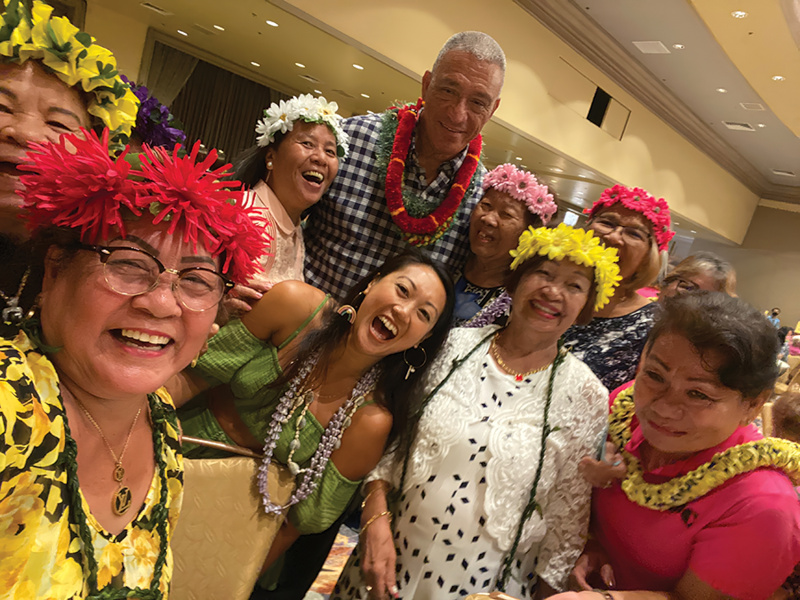
    Jenna Pascual taught Laughter Yoga to over 400 attendeesat the MEO 50th Annual Kupuna Event at the
Grand Wailea on July 30.
    Jenna Pascual taught Laughter Yoga to over 400 attendees at the MEO 50th Annual Kupuna Event at the Grand Wailea on July 30.

    Many forms of yoga have been developed over the centuries by serious practitioners who strive for the benefits of mind-body balance. Popular styles of yoga include Ashtanga, Hatha, Iyengar and many more. But if the thought of mindful meditation in a somber setting is not your cup of chai tea, there is good news for you.

    Laughter Yoga, a relatively new, alternative form of yoga that incorporates laughter with movement and breathing exercises, aims to cultivate joy, spark creativity, reduce stress and even boost your immune system, says Jenna Pascual, a Certified Laughter Yoga Leader and Life Coach on Maui. She started her Laughter Yoga career teaching at senior community centers in San Francisco before being hired to teach the technique at companies like Google, LinkedIn and Salesforce. She now offers a variety of laughter sessions on Maui and is willing to travel off-island, and host virtual sessions, as well.

    The practice designed by Dr. Madan Kataria in India in 1995 combines playful exercises and deep breathing to promote wellness, happiness and lots of laughter. Proving that laughter really is contagious, the practice has spread rapidly around the world, with about 5,000 laughter yoga clubs worldwide — roughly 200 of those in the US.

    “It’s called laughter yoga because of the deep belly, yogic breathing that takes place when we laugh,” says Jenna. “It helps people live happier, healthier lives.”

    The practice involves prolonged, voluntary laughter. This type of yoga is based on the idea that you can “trick” your body. Studies show that laughter can be faked; the human body does not recognize the difference between “real” and “simulated” laughter. Both provide similar physiological and psychological benefits.

    So laughter really is the best medicine, whether sparked by a joke or induced voluntarily using Laughter Yoga. More giggles and guffaws are just what the doctor ordered, according to the Mayo Clinic. Sustained laughter for 10 to 15 minutes a day can produce a range of health benefits. Laughter increases your heart rate and oxygen levels, which both improve the functioning of blood vessels and blood circulation. Laughing can help relieve pain, may help reduce blood pressure, and may also help protect you against a heart attack and other cardiovascular problems. Laughter can also help improve your self-esteem, lessen your stress, depression and anxiety and may make you feel happier.

    No yoga mats or poses are needed. Breathing exercises are used to prepare the lungs for laughter, followed by a series of laughter exercises that combine acting and visualization techniques. Laughter exercises are interspersed with breathing exercises. Sessions may start with gentle warmup techniques that include finger exercises
    to stimulate acupressure points, which activates organs. Ho, ho, ha, ha, ha! Warmups may also include imaginary bubble popping movement and laughter, and rollercoaster laughing.

    If those don’t break down inhibitions and make you feel good, nothing will! Go ahead! Feel better by laughing along with Jenna.

    “He who laughs, lasts!” — Mary Pettibone Poole


    JENNA PASCUAL
    Certified Laughter Yoga Leader & Life Coach
    jennapascual@gmail.com
    jennapascual.com
    instagram.com/jennapascual
    facebook.com/laughwithjenna

    Many forms of yoga have been developed over the centuries by serious practitioners who strive for the benefits of mind-body balance. Popular styles of yoga include Ashtanga, Hatha, Iyengar and many more. But if the thought of mindful meditation in a somber setting is not your cup of chai tea, there is good news for…

  • Hawai‘i’s King of Tropical Music

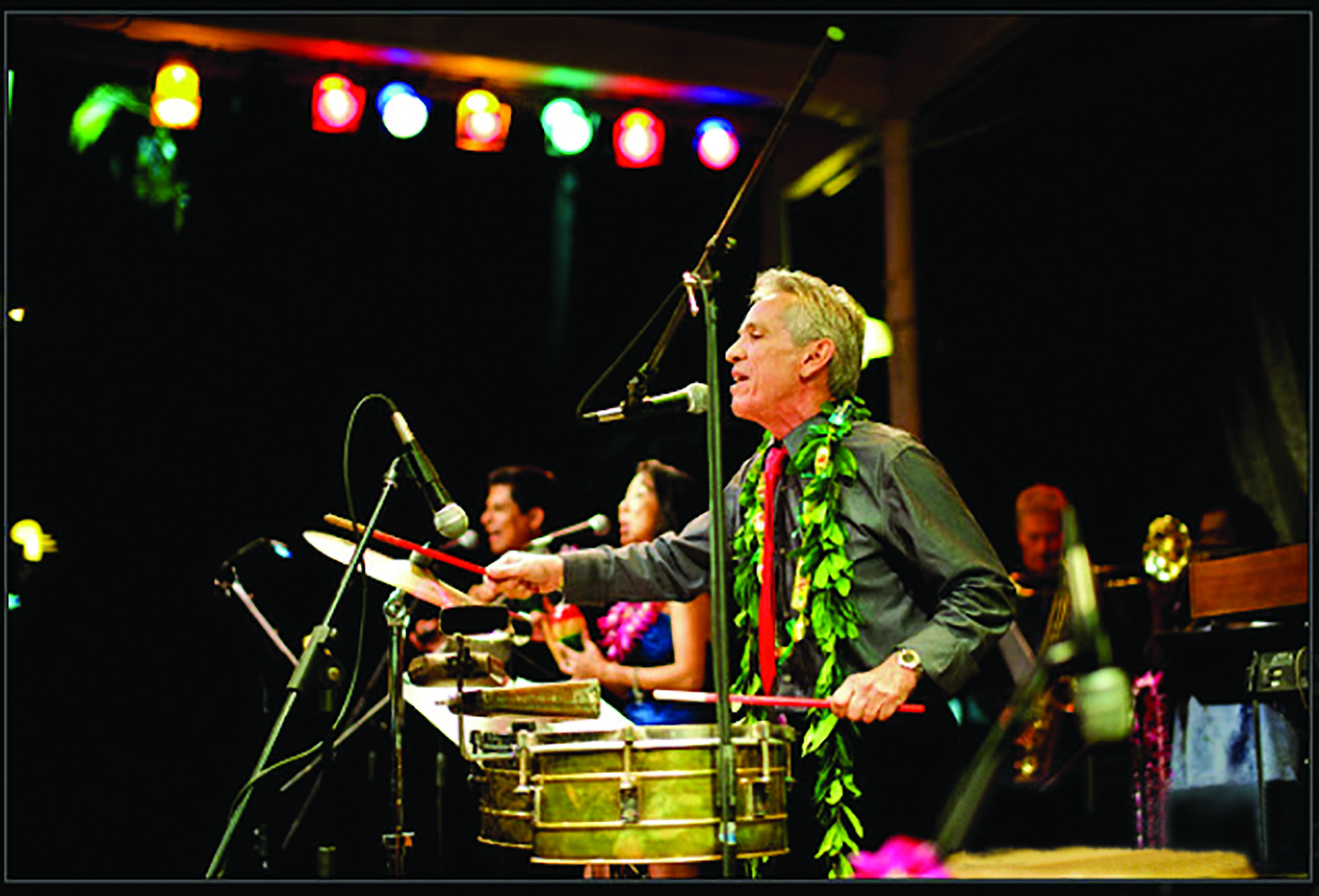
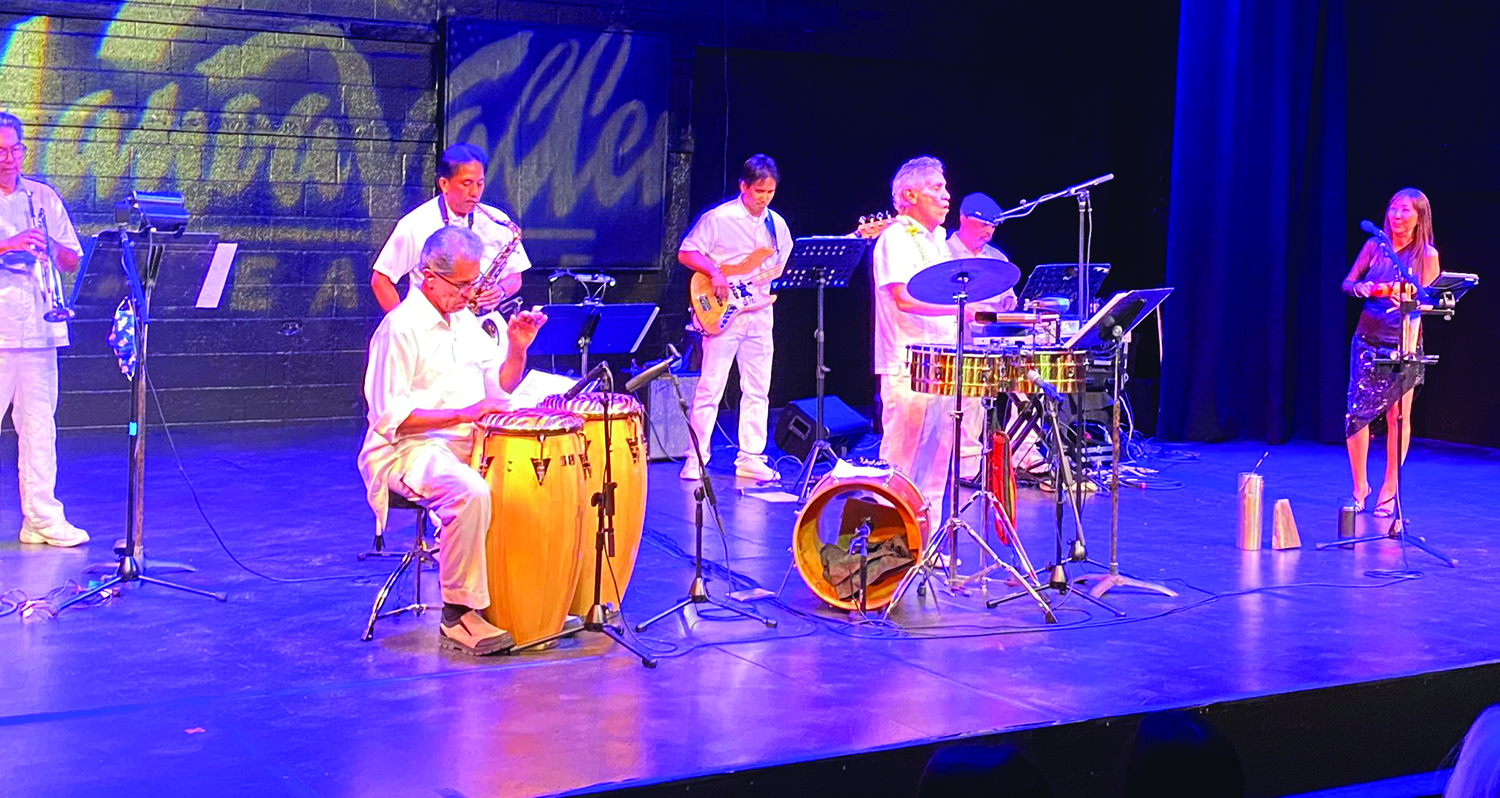
    At 71, Rolando Sanchez has the energy of a man half his age. Scratch that. He has the energy of a man a quarter of his age. If you’ve been in Hawai‘i for any length of time, you’re familiar with the charismatic percussionist/singer/band leader Rolando Sanchez, known for his high-energy shows that established Latin dance music in the islands that has continued for over 40 years.

    Born in Masaya, Nicaragua, on Oct. 6, 1951, Rolando spent only a few of his childhood years in Central America. The political instability of the country was at question and his parents wanted a better life for their children, so they moved to the Bay Area in 1966, where he attended school and developed his musical talents.

    He fondly recalls gathering his mother’s pots and pans and beating them with a wooden spoon — his very first drum kit that would propel him as a percussionist.

    While growing up, his talent matured and he joined a variety of local San Francisco bands, which led to a stint as opening act for B.B. King. While on tour, Sanchez found his way to Hawai‘i where he eventually settled in 1984. One of the first things he did after arriving in Honolulu was enroll in a six-week course at the University of Hawai‘i at Mānoa to learn aspects of music other than percussion, which he knew well. But unfortunately, his music career would have to wait. Bills had to be paid, so he took a job with a pedicab company  and peddled tourists around Waikīkī. It was on those pedicab rides that he was able to discover the hottest nightclubs where the tourists wanted to go. That gave him knowledge about the club scene — but he had no band to accompany him.

    Coincidentally, it was also during pedicab rides that he discovered some very accomplished street performers in Waikīkī. He found two excellent musicians and his trio was born.

    A regular gig at Anna Bananas became so popular that Rolando knew he needed to move to Waikīkī clubs in order to grow and add a little “sauce” to Hawai‘i’s music scene. He told the band they needed to “clean up,” wear matching outfits and make a good showing. It worked. The trio and subsequent band, Rolando Sanchez and Salsa Hawaii, was off to the races, with gigs at The Row Bar, Compadres, Black Orchid, Trappers, Gussie L’Amours and Nick’s Fishmarket — some venues now only long-forgotten memories.

    Reviewers Wayne Harada and John Berger made the crowds even bigger in a town where lively, upbeat and danceable salsa was practically unheard of. But Rolando established himself as el rey de la musica tropical en Hawaii (the king of tropical music in Hawai‘i) when he brought contemporary Latin salsa to mainstream Honolulu nightclub audiences in the late ’80s.

    Rolando’s enthusiasm and determination to bring Hispanic music to the forefront led him in 1989 to establish an annual Latin Music Festival to celebrate Hispanic Heritage Month. What started as a modest festival at The Row Bar turned into a major event on Kalakaua Avenue.

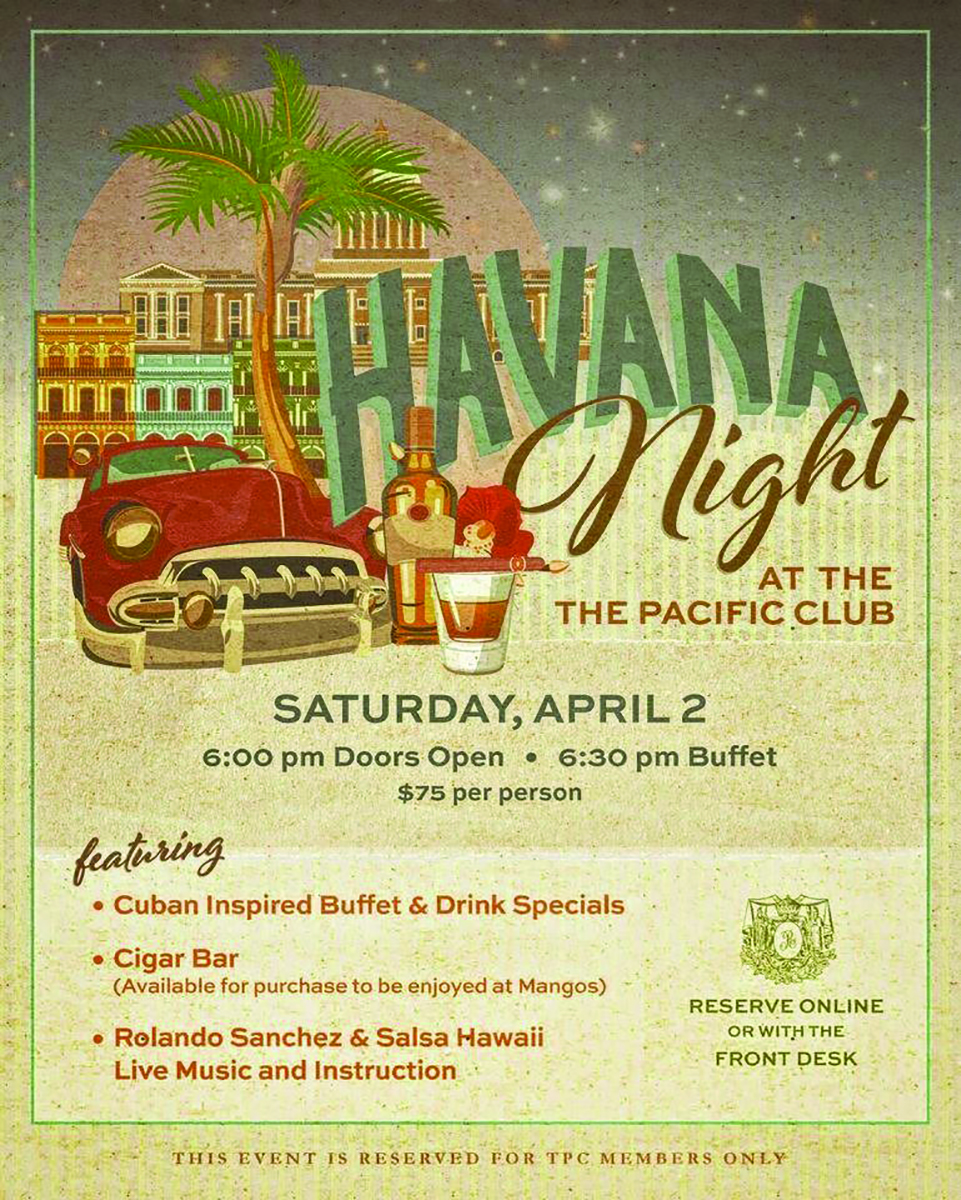
    The enthusiasm   continues to this day and he still plays at major events. A recent fundraiser at the Pacific Club sold out. More shows are in the pipeline for 2023, but his focus right now is on a new record that he plans to release in the coming months.

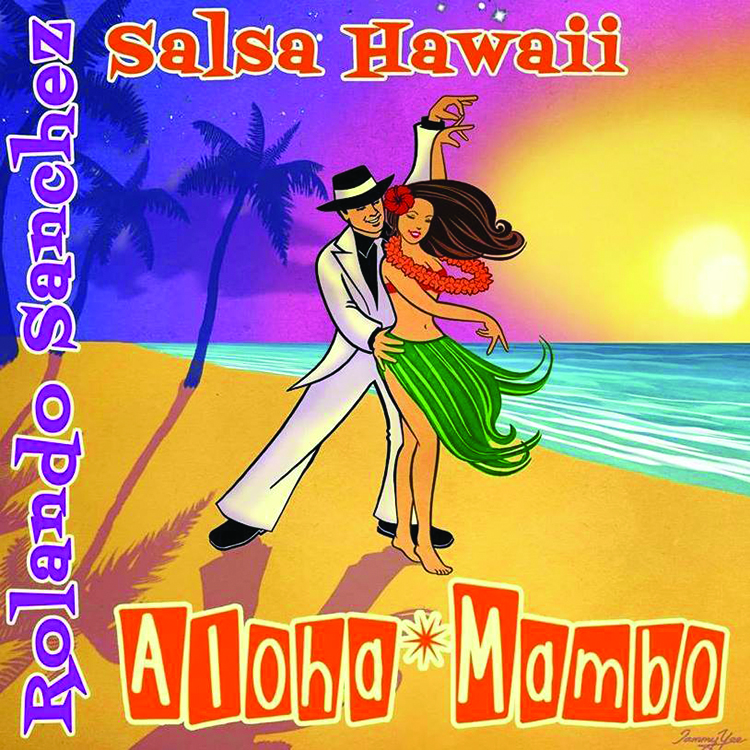
    Up next are more concerts and special events, along with his regular Sunday afternoon radio show on KNDI Radio 1270AM. Sadly, the nightclub scene has been floundering in recent years, the pandemic notwithstanding. Rolando says there are some clubs operating, but hiring DJs is more economical than hiring bands. His main focus in 2023 will be a return to the studio to record a new single featuring three of the female vocalists who have been with the band through the years: Lin Brown, Judi Palrmeira and Jules Kam.

    When asked if today’s younger generation is into salsa, Sanchez emphatically says “Yes! They are just as enthusiastic about the music as their parents and grandparents were 40 years ago.” He says he’s excited to see Latin music flourishing in Hawai‘i and proud that he’s been an integral part of it.


    ROLANDO SANCHEZ — SALSA HAWAII RSC Music Hawaii
    808-342-0911 | sanchezr015@hawaii.rr.com
    rolandosanchez-salsahawaii.com
    For a calendar of upcoming events: 
    rolandosanchez-salsahawaii.com/p/rolandos-calendar.html
    Music by Rolando Sanchez & Salsa Hawaii is available at music.apple.com and music.amazon.com. Or search for “Rolando Sanchez” online.

    At 71, Rolando Sanchez has the energy of a man half his age. Scratch that. He has the energy of a man a quarter of his age. If you’ve been in Hawai‘i for any length of time, you’re familiar with the charismatic percussionist/singer/band leader Rolando Sanchez, known for his high-energy shows that established Latin dance…

  • Eating Together

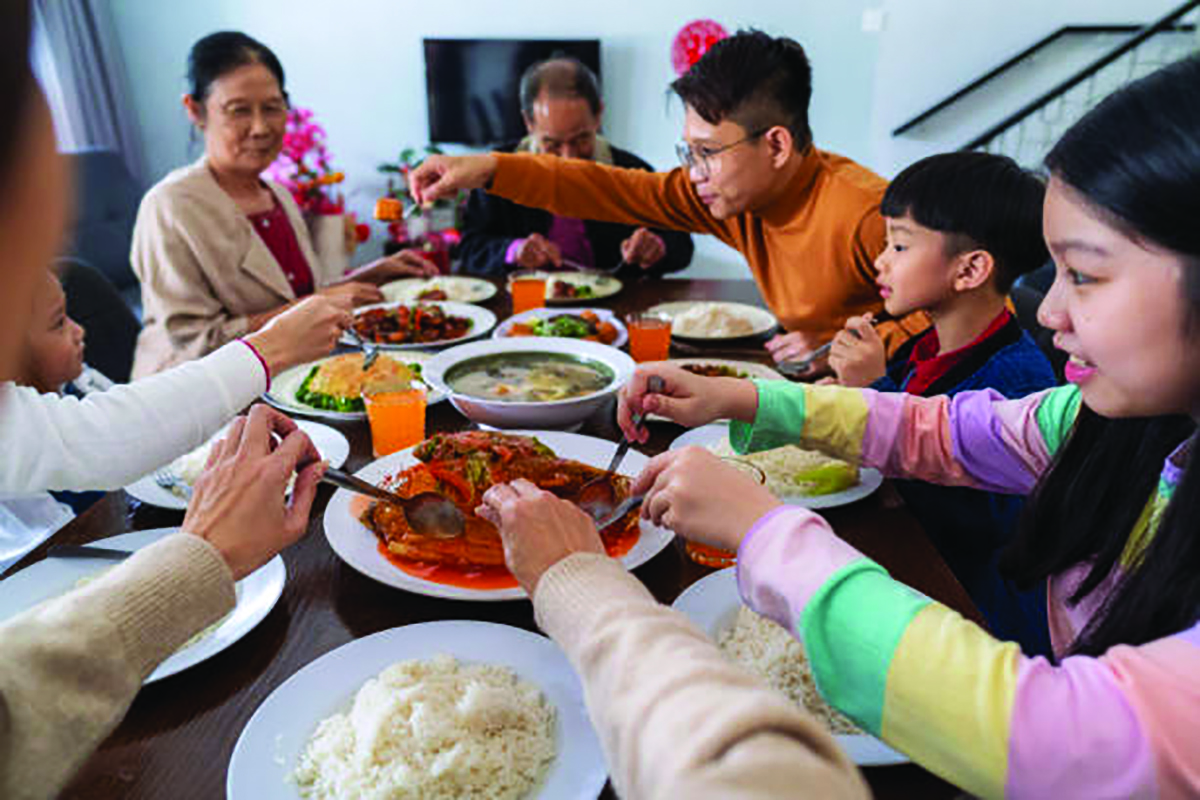
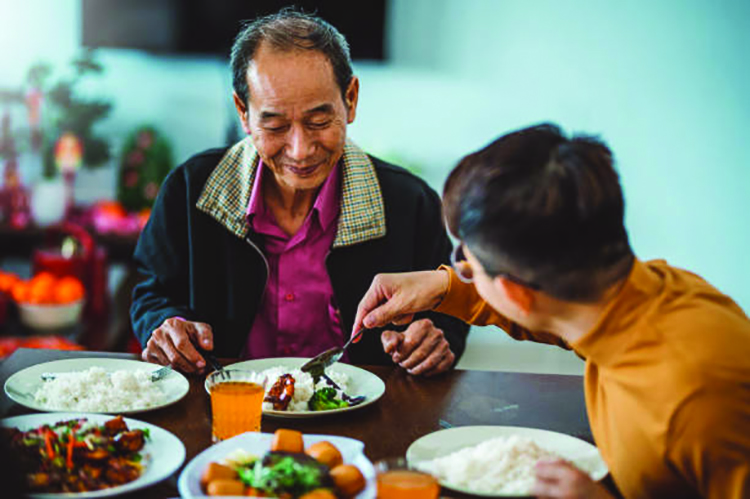
    Here in Hawai‘i, the idea of multiple generations sharing meals together under one roof isn’t reserved for just the holidays. Hawai‘i has the highest percentage of multigenerational households in the country, with nearly 8 percent of households statewide classified as multigenerational — at least three generations living under one roof. This household structure represents one of the most beautiful things about Hawai‘i. It embodies the word ‘ohana and exemplifies the concept of an extended family. The people within it are bound by a genuine sense of mālama, kokua and kuleana. Especially during the holidays, compassion, loyalty and aloha radiate throughout the home.

    While tradition plays a significant role for families living together, the decision can’t be entirely linked to cultural sensibilities. For a lot of families, it’s a necessity due to the state’s high cost of living — the highest in the country. The pandemic has only exacerbated the lack of affordable housing. In order to make rent, many local families have no choice but to pool their incomes just to keep a roof over their heads — and more obstacles abound — obstacles like hunger.

    But food insecurity and hunger don’t affect everyone in the household equally. Keiki and kūpuna are especially vulnerable. In these extraordinarily trying times, as parents often work multiple jobs to provide extra support, kūpuna may try to ensure food security for their grandchildren by foregoing their own needs. Therefore grandparents in multigenerational households can experience hunger at more than twice the rate of those in homes with no grandchildren. Through their own sacrifice, members of a household in Hawai‘i never lose sight of what it means to take care of one another.

    But to help ensure every member of the household has the nourishment they need, Hawai‘i Foodbank offers special nutritional support through programs such as Food 4 Keiki, ‘Ohana Produce Plus, the Senior Food Box Program, and new initiatives like the Seniors Farmers’ Market Nutrition Program.

    Hawai‘i Foodbank works closely with its network of more than 200 food partner agencies to provide food for families affected by the pandemic while continuing to provide assistance to those who were already struggling with hunger.

    No longer associated with a stigma, these free resources provide an akamai strategy for kūpuna and their ‘ohana. It is simply a sign of the times for many seniors and their families.

    FOOD 4 KEIKI

    Hunger deprives our keiki of more than just  food. The fact is, a child’s chance for a bright tomorrow starts with getting enough nutritious food to eat today.

    Ensuring our keiki receive the nutrition they need to excel in school relieves the pressure on kūpuna who sacrificed their own needs. The Food 4 Keiki School Pantry Program serves as a critical food resource for young students, their siblings and their families. The school pantries provide after-school snacks for young students, as well as additional family food bags to take home. Bags are filled with canned proteins, canned meals, dry goods, snacks and more. For pantry times and locations, visit www.hawaiifoodbank.org/keiki.

    For more information on Food 4 Keiki and its programs, or to start one in your area, contact Marielle Terbio, director of community engagement and strategic initiatives, at marielle@hawaiifoodbank.org or 808-954-7869.

    ‘OHANA PRODUCE PLUS

    ‘Ohana Produce Plus is a mass, mobile food distribution program that enables Hawai‘i Foodbank to bring food directly into the communities where it is needed most. ‘Ohana Produce Plus provides hungry keiki, kūpuna, families and individuals greater access to fresh fruits and vegetables plus other supplementary food items.

    For more than 20 years, the program has distributed millions of pounds of fresh produce, assorted dry goods and non-perishable food items to underserved communities — all at no cost to its recipients. Participants in this program include families with low income, individuals with disabilities, the homeless, working poor and more. For many people, ‘Ohana Produce Plus is their only source of fresh fruits and vegetables.

    Go to “Distribution Times and Locations” at www.hawaiifoodbank.org/ohana to find a location near you. It is recommended that potential beneficiaries of this program call in advance to confirm service hours and requirements.

    SENIOR FOOD BOX PROGRAM

    This program provides a monthly box of quality USDA food to low-income kūpuna in Hawai‘i.

    For participating kūpuna, the Commodity Supplemental Food Program (CSFP) provides more than just food and nourishment. It also helps to combat the poor health conditions often found in kūpuna who are at risk of hunger and experiencing food insecurity. CSFP helps vulnerable kūpuna from having to choose between food and other basic needs. The food in each Senior Food Box can play an important role in combatting the health consequences of senior hunger, and ultimately, can help kūpuna avoid costly hospitalizations and nursing home placements.

    Senior Food Boxes are specifically designed to supplement needed sources of nutrients typically lacking in participants’ diets. Boxes may include cereal, grains, dry beans, rice and a variety of canned fruits and vegetables and shelf-stable foods.

    Participants must be at least 60 years of age. Each applicant must self-declare that their household income is at or below 130 percent of the US Federal Poverty Income Guidelines for the State of Hawai‘i. Applicants must reside in the service area to which they are applying for. Find other eligibility requirements and distribution locations, and download the application at hawaiifoodbank.org/csfp. Mail it to: Hawai‘i Foodbank, 2611 Kilihau St., Honolulu, HI 96819.

    SENIORS FARMERS’ MARKET NUTRITION PROGRAM

    The Seniors Farmers’ Market Nutrition Program (SFMNP) is designed to provide low-income kūpuna with access to locally-grown fruits, vegetables, honey and herbs.

    Every year, Hawai‘i Foodbank partners with the State of Hawai‘i Office of Community Services and the US Department of Agriculture, Food and Nutrition Service to organize the Senior Farmers’ Market Nutrition Program. Hawai‘i’s SFMNP offers eligible seniors $50 worth of coupons (10 coupons valued at $5 each) to obtain eligible foods without charge from participating farmers, farmers’ markets and roadside stands that have been approved to accept SFMNP coupons. Through SFMNP, kūpuna are provided with nutritious foods as well as education to emphasize the relationship of proper nutrition to good health.

    Find other eligibility requirements and locations, and download the application at hawaiifoodbank.org/sfmnp. Mail it to: Hawai‘i Foodbank, 2611 Kilihau St., Honolulu, HI 96819.

    HELP NOURISH EVERY MEMBER OF OUR ‘OHANA

    As we look toward the holiday season and 2023, let’s join together to help families eat together and achieve long-term food security and address the nutritional needs of each generation. Donate today at https://hawaiifoodbank.org/donate. Volunteer at volunteer@hawaiifoodbank.org. Let’s help ensure that no one in the house goes hungry.


    HAWAI‘I FOODBANK, O‘AHU & KAUA‘I
    2611 Kilihau St., Honolulu, HI 96819
    808-836-3600 | hawaiifoodbank.org
    THE FOOD BASKET, HAWAI‘I ISLAND
    40 Holomua St., Hilo, HI 96720
    808-933-6030 | hawaiifoodbasket.org
    MAUI FOOD BANK, MAUI COUNTY
    760 Kolu Street, Wailuku, HI 96793
    808-243-9500 | mauifoodbank.org

    Here in Hawai‘i, the idea of multiple generations sharing meals together under one roof isn’t reserved for just the holidays. Hawai‘i has the highest percentage of multigenerational households in the country, with nearly 8 percent of households statewide classified as multigenerational — at least three generations living under one roof. This household structure represents one…

  • Giving Your Voice to Charity: Inspiring Real Change With Advocacy

    Alzheimer’s Association Hawaii Chapter Community Advocates brought their cause to Capitol Hill in Washington, DC, this year: (L–R) Dr. Poki‘i Balaz, Kathy Wyatt, Amy Truong, Calvin Hara and Ron Shimabuku, the director of Public Policy and Advocacy for Alzheimer’s Association Hawaii Chapter. Courtesy photo.
    Alzheimer’s Association Hawaii Chapter Community Advocates brought their cause to Capitol Hill in Washington, DC, this year: (L–R) Dr. Poki‘i Balaz, Kathy Wyatt, Amy Truong, Calvin Hara and Ron Shimabuku, the director of Public Policy and Advocacy for Alzheimer’s Association Hawaii Chapter. Courtesy photo.

    Especially during this time of year, many of us shift our mindsets to consider how we can spread aloha and do good in the world. Giving back to our community  comes in many forms. There are ways that take no money — donating your voice and time. “Activist philanthropy” is a newer term, but it simply relates to people who embrace the role of public advocate to raise awareness and bring precedence to essential issues. These people are speaking up and sharing their stories to inspire real change.

    “When my mom was diagnosed with younger-onset Alzheimer’s disease, we felt helpless initially, not knowing what it was, feeling so lost and not knowing what to do,” recalls Amy Truong, community advocate for the Alzheimer’s Association Hawaii Chapter.

    “We started realizing that this disease is definitely in our communities, but no one is talking about it. Some people don’t even know what it is.”

    Over 200,000 families in the US face the unique challenges of younger-onset Alzheimer’s disease, which has no cure. This form of Alzheimer’s affects people younger than 65 years old. Research has examined the role genetics play, but it’s not fully understood why most cases of younger-onset Alzheimer’s appear at such a young age. First, many families and even doctors don’t expect someone so young to develop Alzheimer’s.

    “When she started showing symptoms of cognitive decline in her early fifties, we thought it was because my mom wasn’t working anymore, and like those on summer vacation, you’d lose track of the days,” shares Amy. “When her cognitive abilities declined even further, we knew we had to get her to the doctor. That took some time, and it wasn’t easy to convince her to go to the doctor. Then there was a sense of relief when she got diagnosed, but I didn’t walk out of the doctor’s office with a single brochure on how to receive support, or any idea of how we would move forward and what to expect next. It slowly started changing when we began reaching out to the Alzheimer’s Association and kupuna organizations for support.”

    Civic Engagement as a Centerpiece for Charity

    Amy’s mom was 59 years old when she was finally diagnosed with younger-onset Alzheimer’s. There was a huge barrier for her family to qualify for insurance through Medicare and additional financial support because her mom was under 65. At first, they were denied, because the government had to be careful of fraudulent applications. But Amy and her father were relentless. She obtained letters of support from the Alzheimer’s Association and Dr. Oanh Meyer from the UC Davis Alzheimer’s Disease Center, where her father was an active participant in Alzheimer’s caregiver research and studies. She went to court and her family kept fighting, but admits her father was close to giving up. He didn’t think they would get approved after being rejected the first time.

    “In Asian communities, and other communities of color such as Blacks, Hispanics, Native Hawaiian and Native Americans, there is a stigma in going to the doctor as well as certain levels of mistrust and fear of being mistreated or ignored when you do go,” Amy says. “Our family knew we had to share our experience, especially since we’re going through this disease so much earlier. I don’t want any other family like mine to feel helpless, lost, and confused while their loved one is declining in cognitive and physical abilities.”

    In 2018, Amy started volunteering and fundraising for Alzheimer’s disease in her community in full force. She raised the second highest amount of money for the Walk to End Alzheimer’s on O‘ahu and she served as the co-chair for The Longest Day to support the Alzheimer’s Association Hawaii Chapter. Soon, she transitioned her volunteer work over to advocacy and became the Advocacy State Champion. She also served as the Alzheimer’s Association State Ambassador to achieve federal and state policy priorities by engaging with Hawai‘i’s elected officials to increase support for people living with Alzheimer’s disease and their families, and continue research for effective treatment and ultimately, a cure.

    During her time as an ambassador, she gave her voice to the cause and saw a direct impact when Congress with the passing of the Supporting Older Americans Act of 2020 — which reauthorized the Older Americans Act (OAA) — and includes key provisions of the Younger-Onset Alzheimer’s Disease Act, which ensures  Americans living with Alzheimer’s disease and other dementia will have access to vital and affordable services regardless of age. The bill passed one year before Amy’s mom 65th birthday.

    Finding the Courage to Give Your Voice

    As it would be for most people, it was difficult for Amy’s dad to take on the caregiving role. Even though she was showing signs of decline at the time, they traveled and saw the world together. Together, they visited Hong Kong, Japan, Vietnam, Jamaica, Mexico and France. Amy’s father didn’t know at the time that those years of traveling were among the last she would be able to undertake. Over time, traveling got more complicated. She would have moments of confusion. But having that time together meant everything to them.

    When Amy’s father was feeding her mother at a restaurant, a stranger came up to him and just patted him on the shoulder for encouragement. We can all give the gift of support by acknowledging caregivers with simple words and actions.

    As the disease progressed and continues to progress to this day, everyday tasks got even more difficult. She wandered and needed help to get dressed, bathed and fed. Eventually, she became incontinent, and lost her ability to walk and speak.

    Amy encouraged her dad to reach out using the Alzheimer’s Helpline, as well as other local organizations that help the aging community and served as a lifeline for their family.

    By learning about the warning signs of Alzheimer’s disease (www.alz.org/alzheimers-dementia/10_signs), we can help recognize it and support families early in the game. Starting the conversations and sharing your experiences not only inspires others, but contributes to a pendulum shift to equality.

    “Since I joined the Alzheimer’s Association, it is great to see they are now expanding their focus on diversity and research in health disparities in Asian, Black, Hispanic and Native Hawaiian communities,” Amy shares, “Improvements in science must be made for these populations. Our representation rises when we share our voices and make them heard.”

    Every action and voice — big or small — will help. We may not all be public speakers, but we can certainly share resources and kind words with a caregiver. And this year, when you’re thinking about your holiday giving list, consider giving your voice to charity. Your voice and your story are precious gifts to those who must confront
    Alzheimer’s each and every day.


    If you know someone struggling with younger-onset or Alzheimer’s disease, or a related dementia — there is support:
    24/7 Helpline 800-272-3900
    alz.org/Hawaii
    alz.org/help-support/i-have-alz/younger-onset
    To join a support group or get more information: 808-591-2771
    Donate to the Walk to End Alzheimer’s in your community until Dec. 31, 2022: act.alz.org/aloha


    Especially during this time of year, many of us shift our mindsets to consider how we can spread aloha and do good in the world. Giving back to our community  comes in many forms. There are ways that take no money — donating your voice and time. “Activist philanthropy” is a newer term, but it…

  • A Gift from the Heart

    A Gift from the Heart

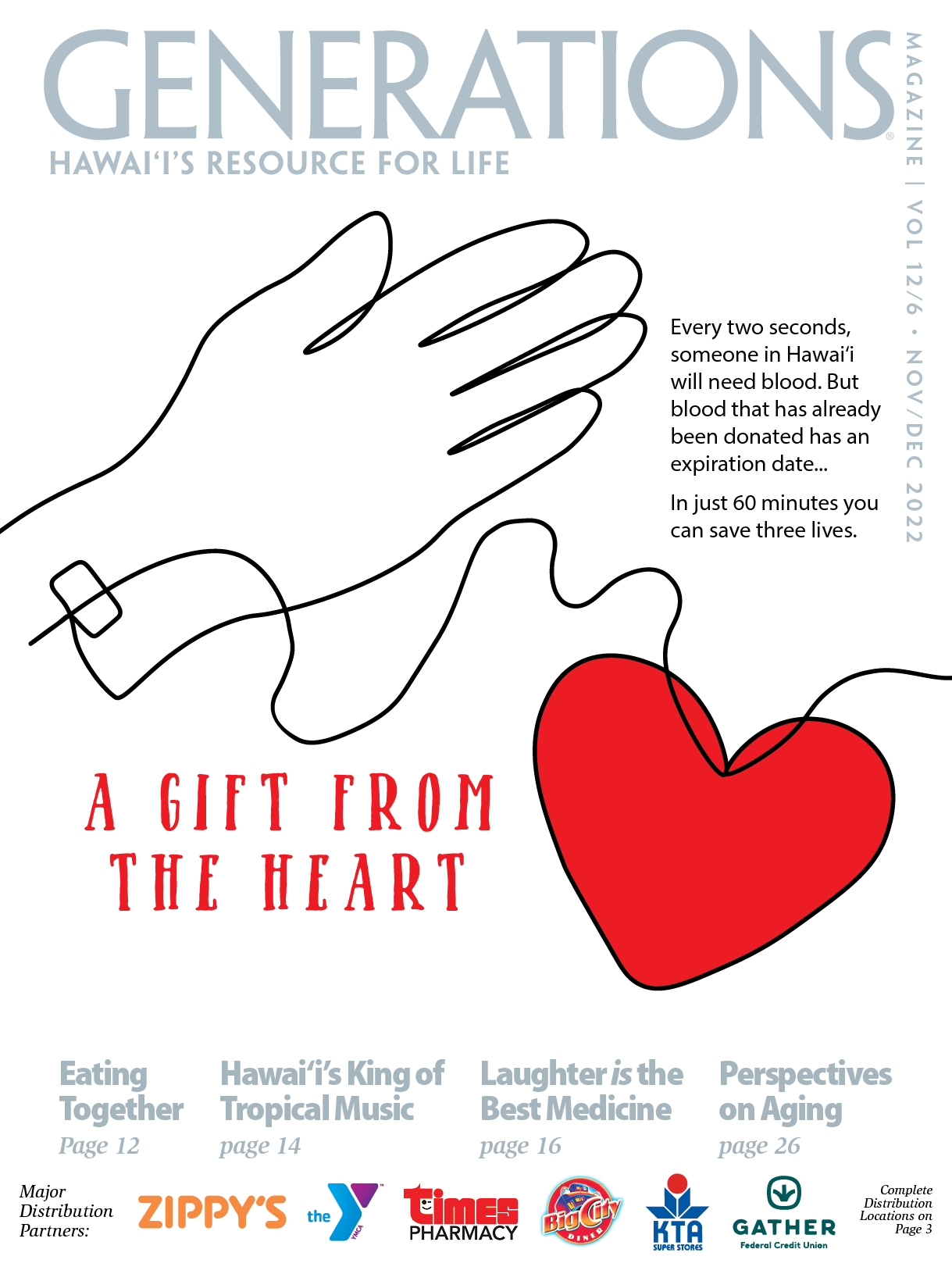
    Blood cannot be produced in a lab or anywhere else. It only has one source — volunteer donors. In Hawai‘i alone, 200 donors are needed every single day, yet only 2 percent of Hawai‘i’s population are donors. You can help save lives by learning how easy it is to donate blood and host a blood drive.

    The Need Never Decreases

    The mission of Blood Bank of Hawaii (BBH) is to provide a safe and adequate blood supply for all the civilian hospitals throughout the state to meet patients’ needs.  Each and every day patients count on volunteer donors. One in seven people entering the hospital will need blood.
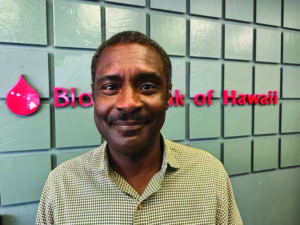
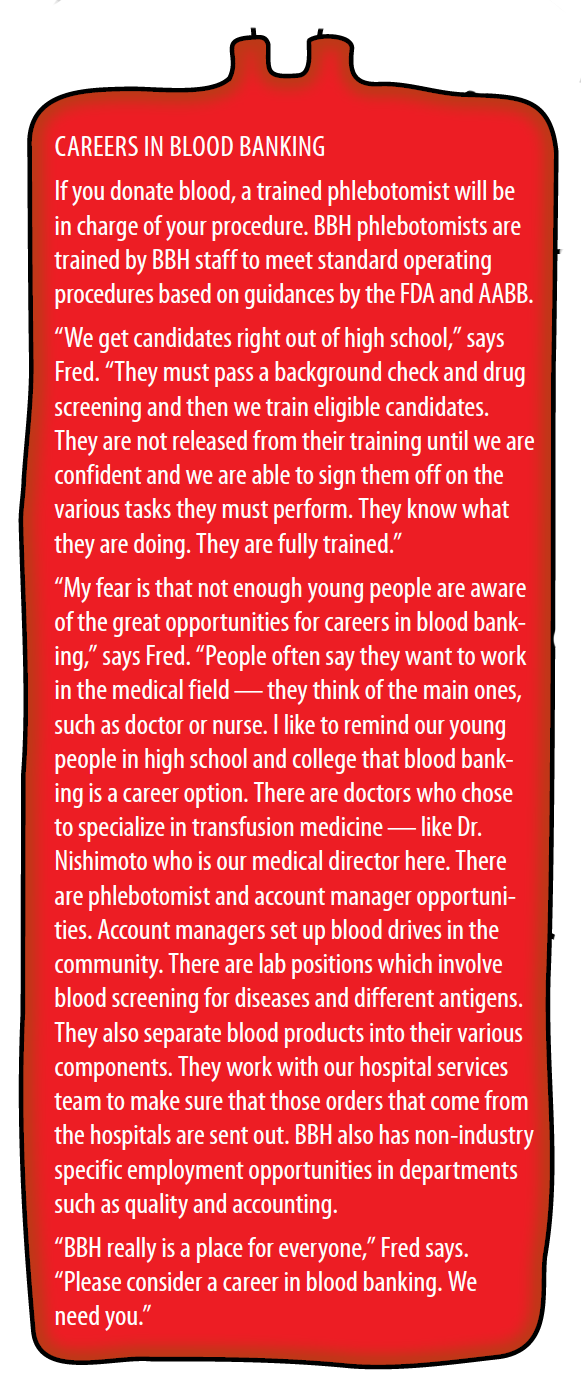
    BBH Donor Services Director Fred McFadden has been in the blood banking field for over 17 years, starting as an account manager.

    BBH is open daily, because 150 to 200 blood donors are needed every day. Because blood is perishable, says Fred, every donation contributes to our community’s ongoing needs. The need for donations never decreases; at certain times of the year, it actually increases.

    There are seasonal dips in donations, says Fred. “Roughly 12 to 13 percent of the blood we collect annually comes in from high school blood drives. Combined with colleges, that’s about 20 percent of the blood we collect every year. During the pandemic, these students were not on campus, where the drives are usually conducted. That is also why we see dips in donations during the summer months and during the holidays.”

    People are also distracted during the holiday season and often travel during the summer months, and not prioritizing blood donation.

    “This put a strain on the blood supply during those times,” says Fred. “That is why January has been designated as National Blood Donor Month — a time to recognize the importance of giving blood and honor the donors who make BBH’s life-saving mission possible.”

    Safety Factor

    The blood supply is the safest it’s ever been due to multiple layers of safety nets built into the process.

    “We do everything we can to keep both the donor and the recipient safe,” says Fred.

    BBH follows strict US Food and Drug Administration (FDA) and Association for the Advancement of Blood & Biotherapies (AABB) donation procedures. State-of-the-art blood bags are used for collections and adequate iron levels are verified through technology. BBH uses physical distancing protocols and requires that donors and staff wear masks.

    The eligibility requirements themselves help keep donors safe, including the donor history questionnaire, which is part of the screening process. But volunteer blood donation is key to keeping our blood supply safe, as there is no motivation to hide information. The questionnaire screens out people who may be in the higher risk category.

    Then, of course, all blood products go through extensive testing, including screening it for HIV and other diseases that can be transferred through transfusion, prior to it being distributed to hospital partners. Blood that is positive for any of these diseases is destroyed and by law, the blood donor is notified that there is something of concern that they should know about.

    Fear Factor

    A recent study by Ohio University psychologists has discovered a key reason that people are fearful about donating blood. It’s not the needles. It’s not the pain. It’s not even the sight of blood. It’s a fear of fainting.

    The reality of people fainting before a donation is less than 4 percent; less than 1 percent faint during or after a donation. Better public education could dispel these and other fears.

    “If, through education, we can show them what their donation actually does, that knowledge can override an aversion to needles, a fraction of a second of a pin prick and other fears potential donors might have,” says Fred.

    Although fainting rarely happens at blood donation, there are some preventative measures that ensure you will be in top condition to donate. Donors can best prepare by eating iron-rich foods, such as lean meat and dark-green vegetables. “Of course, this is important at all times for good health, but certainly in the weeks and days leading up to your appointment,” says Fred.
    Fred says, simple steps can lessen the chance of any type of negative reaction.

    “First, we require folks to have had a very good meal prior to donation,” says Fred. “That is key. We do not want someone to donate on an empty stomach. We  also want you to be fully hydrated. Drink 8 to 10 glasses of water before donating. And part of that is avoiding caffeine prior to your donation. Also, get a good night’s sleep the day before your appointment.”

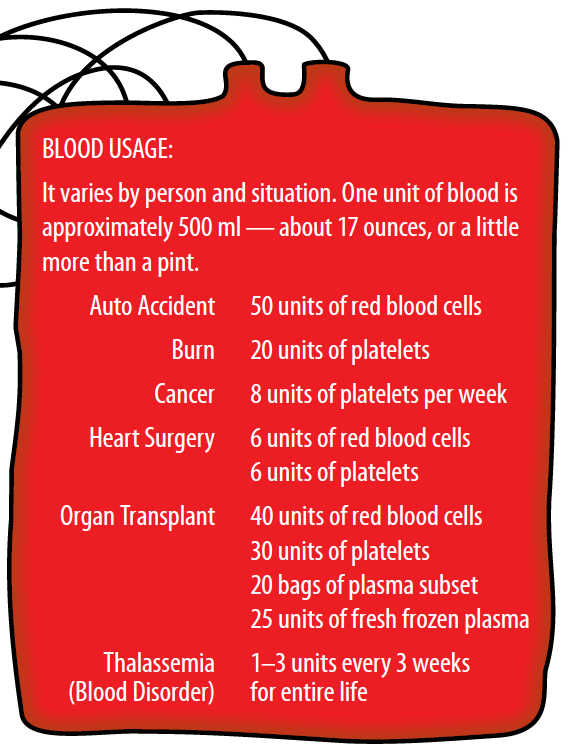
    The human body circulates between six and 12 pints of blood, depending on body size. The standard 500ml donation (about one pint) removes a significant volume, so after donating, BBH recommends donors resting for about 15 minutes, and consuming a drink and snack before leaving. The meal and hydration are also important post-donation actions.

    Time Factor

    Another reason why people say they don’t donate is the time factor. But the entire process for a whole blood donation only takes about 1 hour. The actual collection of a typical donation takes only 5 to 8 minutes.

    And that is the reason BBH has convenient fixed sites in dense population areas as well as regularly scheduled blood mobile pop-ups in Windward, Waikele and other areas. “Part of the convenience is going to where people gather,” says Fred. “And what is more convenient than where they work?”

    A minimum number of donors is needed in order for business leaders to become BBH partners and host a drive. BBH works with a “champion” on-site — anyone at any level of an organization with a heart to serve their community and save lives through blood donation — who forms committees to gather eligible participants, and get them to sign up and make an appointment. BBH has an online appointment calendar donors can use or the committee can make appointments for their volunteers.

    “So instead of coming to the blood bank, if you have a large enough group and a committed committee of people to make it a success, we can work with them and host a drive on site,” says Fred.

    Pre-pandemic, a larger percent came in through these mobile blood drives. During the pandemic, a greater number of people come to the centers or pop-up locations. “But we still need those mobile blood drives because that is where the vast majority of new blood donors come from,” says Fred.

    Yet even beyond the fear and time factors, the No. 1 reason people don’t donate is that they’ve never been asked. Mentioning your donation lifestyle to a friend or family member and inviting them to join in the life-saving mission is imperative to keeping a healthy and robust blood supply.

    Donor Benefits

    In addition to knowing you have saved lives with your donation, there are additional benefits. The donor starts by filling out a questionnaire, then a phlebotomist reviews the responses and conducts a mini-physical, which includes checking blood pressure, temperature and hemoglobin levels to ensure donors are in good health and can safely donate blood.
    For the safety of the bank, post donation reports describe the condition of the blood, determining whether it is usable by the bank. For example, one of the main causes of deferral is low hemoglobin.

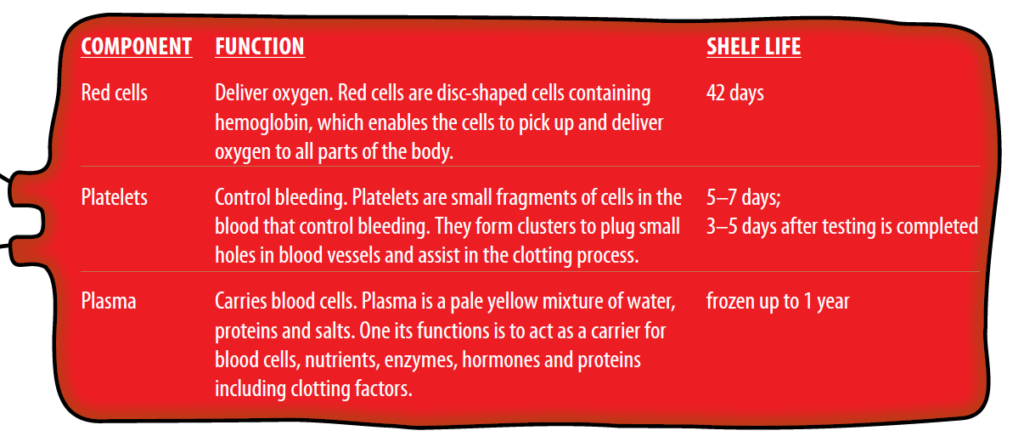
    Your red blood cells contain hemoglobin, a molecule comprised of protein and iron, which carries oxygen to the body tissue and gives blood its red color. Giving a pint of blood requires starting at a high-normal hemoglobin level so that your blood count will remain in the normal range after you have donated.

    The most frequent cause of low hemoglobin is an iron-poor diet maintained over an extended period of time. Low hemoglobin doesn’t necessarily mean you’re sick
    or anemic, but in rare cases where hemoglobin count is abnormally low, donors are advised to consult their doctor.

    You can help build your hemoglobin level by eating a consistent diet of foods that contain iron. Download BBH’s brochure (www.bbh.org/wp-content/uploads/2020/04/AGuideToHemoglobin_112016.pdf) to find out about foods that will keep your blood in donor-ready condition.
    Who Needs Blood, How Much?

    “So many of the things in our hospitals that we think of as routine now — from baby’s being born through C-section, to organ transplants, colonoscopies and heart surgery — all rely on blood being available at the time the procedure is done,” says Fred. “Many physicians will not start a procedure unless blood is ready and waiting in the operating room just in case it’s needed.”

    “I think we take it for granted because blood banks do their jobs to make sure an adequate supply is available, but of course, we could not do it without blood donors and the organizations that hold blood drives,” says Fred.

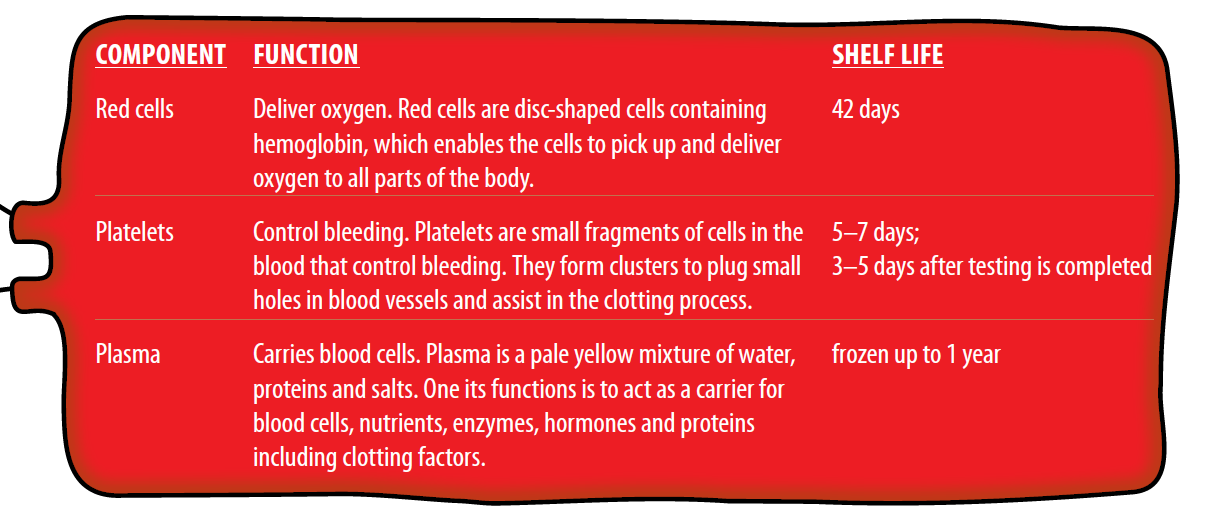
    A whole blood donation is about 1 pint or 1 pound of blood. Your one pint donation can save three lives. If whole blood is broken down into three components — red blood cells, plasma and platelets — each component could go to three different individuals.

    You can spare 1 pint easily. Your body has an amazing capacity to replace all the cells and fluids that have been lost. Your body will replace the blood volume (plasma) within 48 hours. It will take four to eight weeks for your body to completely replace the red blood cells you donated
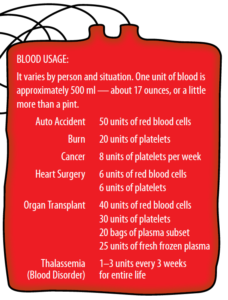
    Duration, Types & Frequency of Donations

    “Ideally, donors give the blood products needed the most based on their blood type, body type, hospital need and eligibility,” says Fred.

    Donors can give whole blood, which contains red blood cells, plasma and platelets. Processing after the donation extracts specific blood components. Whole blood can be donated once every 56 days (about two months). Platelets can be donated once every two weeks (on O‘ahu, only at the Young Street Center).

    During automated collections called MAX donations, specific blood components are collected via a machine with a built-in centrifuge and remaining components are returned back to the donor (similar to dialysis). These donors have some additional height and weight requirements, and the process takes a bit longer.

    With the MAX program, you are giving specific components.

    “With whole blood, we are taking almost a pint of what flows out of your body,” says Fred. “During a MAX donation, we are taking only certain components. If we are just taking 2 units of red cells, then instead of being eligible to donate whole blood in 56 days, it extends that to 112 days before you can donate again. For example,
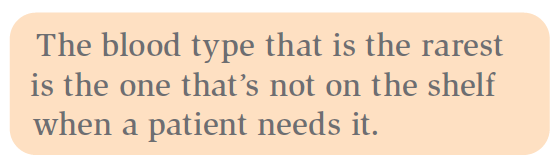
    O-minus — the universal donor — is such a small percentage of the population and even a smaller percentage of them donate.

    The ABCs & Os of Blood Typing

    Blood is a living tissue that circulates through arteries and veins, delivering oxygen to every part of the body. Your blood type is inherited. Blood typing is universal. Donating blood is one of the ways people find out their blood type. Blood typing is always conducted before a patient receives a blood infusion.
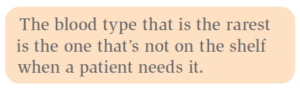
    Although all blood is made of the same basic elements, not all blood is alike. There are four major human blood groups A, B, AB and O, which are determined by the presence or absence of two chemical markers, or antigens “A” and “B” on the surface of red blood cells. This classification of human blood types is known as the ABO Blood Group System.

    There is another surface antigen called D or Rh, the presence or absence of which makes a blood group positive (+) or negative (–). These are known as sub-types or sub-groups.

     About 6 percent of the population on the mainland has A¯ type blood. In Hawai‘i, Rh-negative blood types are half as common, with A¯ making up only 2.6 percent of Hawai‘i’s donor population.

     A+ is the second most common blood type both in Hawai‘i and the mainland.

     This type makes up only 0.8 percent of Hawaii’s donor population.

     This blood type is much more common among Asian populations. So it makes sense it’s prevalent here. Even here with lots of B+ donors, sudden high usage of B+ results in unexpected shortages.

     As a universal donor, anyone can receive your blood. In an emergency when there’s no time to match the blood type, you save the day. On the mainland, 7 to 8 percent of the population has O¯ blood; in Hawai‘i, only 3 percent. As the universal red blood cell donor, you can help everyone, but only O¯ donors can help you. Which is also why those with O¯ blood types are always needed! Also, your red blood cells are safest for newborn infants with under-developed immune systems.

     This is the most common blood type in Hawai‘i and is always in high demand. Because your red cells can be given to anyone with a positive blood type, your red cells are more impactful than your platelets or plasma. For O+donors, the need for your blood changes with patients’ needs. Depending on the day you come in, you may be asked to donate platelets and/or plasma. You want as many O+ donors also donating so there is blood on the shelves should you need it. As an O+donor, you can only receive O type blood.

     In Hawai‘i, Rh-negative blood types are half as common. AB¯ makes up only 0.4 percent of our donor population.

     In Hawai‘i, we are lucky to have a higher percentage of AB+ donors. Although it may be small in percentage, it is mighty for patients with uncontrolled bleeding, liver disease and trauma. As the universal plasma donor, your plasma can be given to anyone regardless of their blood type.

    Hawai‘i is also known for its rare blood types, in particular for Jk3¯, due to our unique population mix. Jk3¯ blood is found more in Polynesians, East Asians and Southeast Asians than in any other ethnic group in the world. Hawai‘i’s diverse racial population includes about 10,000 who carry this rare blood type, but only 110 have been identified by BBH. Of these, 18 actively donate.

    “So there is a real need for an ethnically diverse blood donor base.” says Fred. “Chronically transfused — patients with Thalassemia or sickle cell anemia, for example — will develop antibodies to the antigens on blood cells. So it’s important that we try to find matches that are as close to them as possible. Sometimes that is found within the same ethnicity — but not always. We don’t see all of our ethnic groups equally committed and involved in donating blood.”

    If you are wondering why you should donate blood if there are not many people with your blood type, remember, it only takes one person in need with your blood type to make it the most important. Lots of people with your blood type means your blood type is the most needed. All donations are welcome.

    Donor Superstars
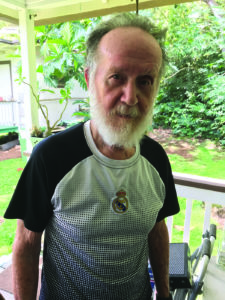
    There is no age limit for donors. “In fact, our most frequent donors are seniors,” says Fred.

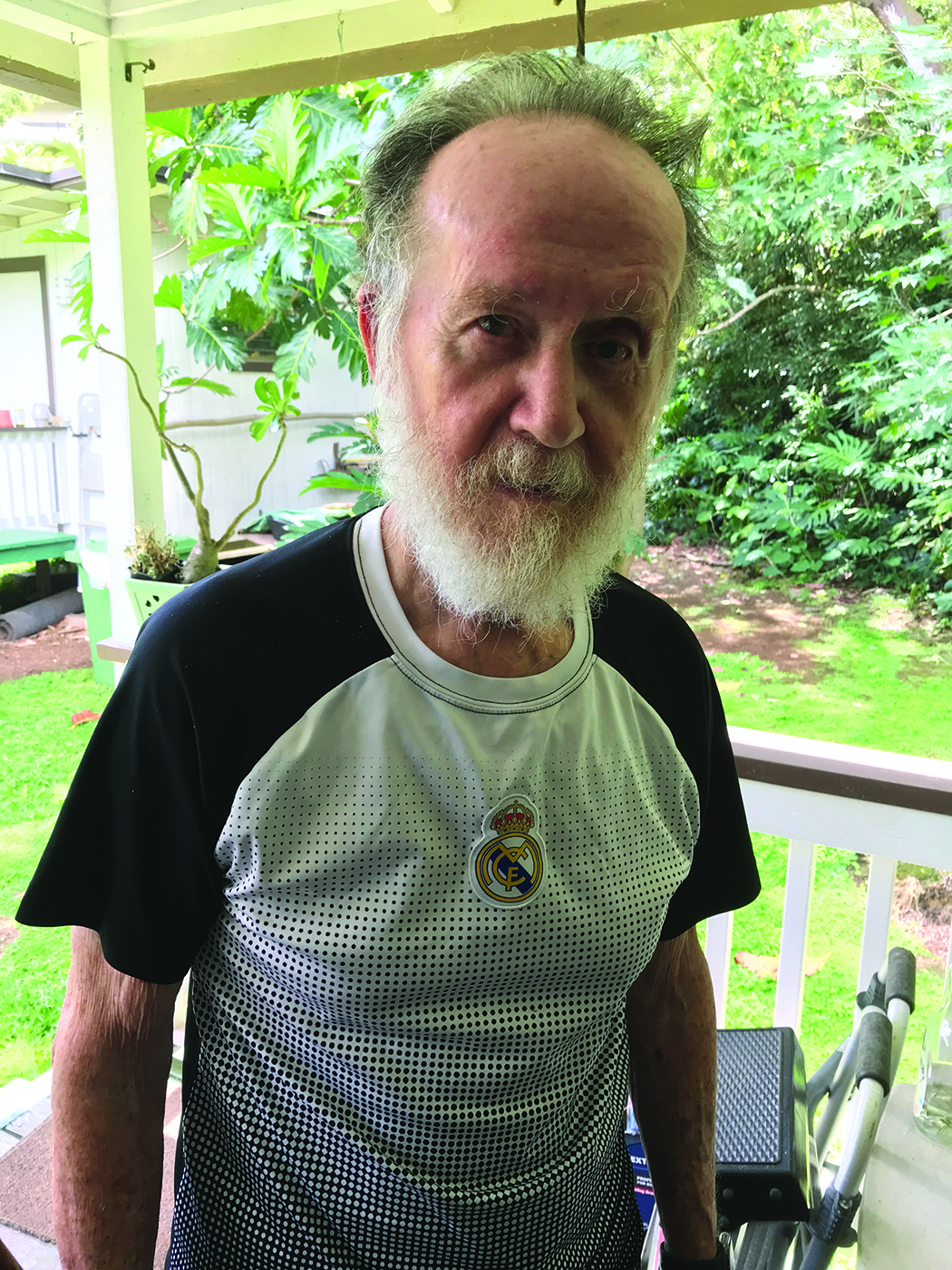
    John Flanagan of Kane‘ohe, age 90 on his next birthday, is a retired Kapi‘olani Community College professor. He has made 436 donations, potentially saving over 1,300 lives.

    He first began donating when he was in the military in his 20s. “In American Samoa, they had no way of storing blood, so when they needed blood, they had to get a donor immediately and I would always answer the call,” says John.

    His own firsthand experience helped shape a lifetime of giving. When John was 8 years old, was hit by a car and “badly damaged.” His uncle, who was the same blood type, was patched directly to John, saving his life.

    When he and his wife moved to Hawai‘i, he donated his O+ blood regularly. Soon he started donating platelets as a MAX donor at the Young Street facility. One particular phlebotomist used flattery to ensure his continued donations.

    “Oh, you have very nice veins,” she said. John laughed at the recollection. Then she proceeded to explain the MAX equipment and process “in a very thorough and knowledgeable way.”

    “Everybody was so happy that I was there and treated me so well that I just kept doing it.” Every time he hit a donation benchmark, 100 or 200 donations, “they
    would make a big deal out of it,” John recalls. “It is a rewarding experience.”
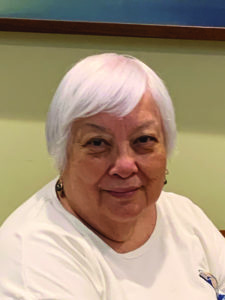
    Pauline Mitchell, turning 80 on her next birthday, lives in the Salt Lake area. One of BBH’s top female donors, she has given her A+ blood 305 times, potentially saving 915 lives. She had been donating sporadically for a long time, then regularly for about 35 years, beginning when her father was badly injured.

    “Thankfully, there was blood when my father needed it.”

    Later, one of her classmates had heart surgery when Pauline was giving whole blood. A coworker’s baby needed a transfusion in-utero when she was giving platelets. “I like to think that my donations helped,” says Pauline.

    “Someone saved my father’s life. Someone saved my classmate’s life. Someone saved my coworker’s baby. I am grateful to them, and I know I saved lives, as well. Donating blood is a way to thank them — by giving blood to save somebody else. It takes an hour out of my life about four to six times a year. How hard is that?”

    Her son has just passed the 106-unit mark at age 37. “Between us, we have given about 11 to 12 gallons of blood. “It’s become a way of life.”
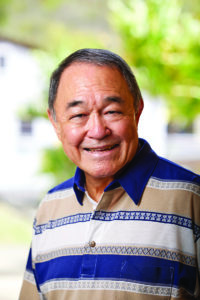
    Barry Suda, 77, of Kuliouou, a Vietnam combat veteran, has donated blood since he returned from the war in the early ’70s. He began donating blood when he got a job near the blood bank when it was located at The Queen’s Hospital and eventually moved to Dillingham, then the Young Street facility. In the early days, he says, Primo Brewing would donate to the blood bank, providing a bottle of beer to each donor.

    He has lost track, he says, but has given his O+ whole blood over 100 times, potentially saving over 300 lives. As the most common blood type in Hawai‘i, O+ is  always in high demand.

    “Blood can only come from another person,” says Barry. “You can’t make it in a lab. I’m thankful that I can donate. I just decided it’s the right thing to do. It doesn’t hurt and it doesn’t take long to donate. You feel good about it!”

    Blood Drives: How, Where & When?
    Whether you want to compete with these superstars, or just make a first-time donation to see for yourself how easy it is, go to “Become a Donor”  (bbh.org/become-donor) and scroll down the list of topics that will address most eligibility questions. To calm your qualms about donating, view “What is it Like to Give Blood?” (youtu.be/tudK55JlrfA). Then make an appointment by calling 808-848-4770.

    Blood is collected at fixed sites, along with bloodmobiles that travel to O‘ahu’s neighborhoods providing convenience for donors (bbh.org/about/location).

    To find other blood drives being held in November and December, go to bbh.org/#blooddrive and make an appointment.

    In addition to fixed sites and pop-up locations, BBH account managers work in the community organizing blood drives with businesses, places of worship, service clubs, and high schools and universities to create Community Lifesaver Clubs. There is a real need for these sponsored mobile drives. To start a blood drive, go to bbh.org/get-involved.

    Time to Roll Up Your Sleeves!

    Blood is needed 24/7/365. You just never know who will need it or when, but the need never ends. With only 2 percent of the population giving blood to save the lives of everybody else, even one donation can make a difference.

    “It’s the blood on the shelf that saves lives now,” says Fred. “You can pick any tragedy in our nation’s history and you’ll see people in those or nearby communities line up to donate blood. The thing to remember is blood has an expiration date and it is constantly in need — not only in times of tragedy. We also need you for the organ transplants, C-sections, trauma cases, heart surgeries, cancer patients and the chronically transfused that happen every day.”

    For many, the most important blood type is the one that’s needed when your loved one ends up at the hospital. So we all have a part to play. Not everyone is eligible, but even if you can’t donate, encourage someone else. Share this article.


    BLOOD BANK OF HAWAII (501(c) 3 nonprofit)
    1907 Young Street, Honolulu, HI 96826
    808-848-4770 | bbh.org
    Facebook: facebook.com/bloodbankhawaii
    Twitter: @bloodbankhawaii
    Instagram: bloodbankhawaii

    The mission of Blood Bank of Hawaii is to provide a safe and adequate blood supply for all the civilian hospitals throughout the state to meet patients’ needs. Each and every day patients count on volunteer donors. One in seven people entering the hospital will need blood. Blood cannot be produced in a lab or…

  • Beware of ‘InstaScams’

    Ransomware Malware Attack. Business Computer Hacked. Files EncryptedThere are always two sides of the same coin. Social media has made it possible for everyone to stay more connected over the years and across the miles. It’s reconnected old friends and kept families close. Unfortunately, it’s also given scammers the ability to become more sophisticated and creative.

    From phishing emails to phone scams, there always seems to be a new tactic being used by people trying to get between you and your money. The latest hunting ground is Instagram. But the good news is that by staying alert, you can avoid many common social media scams, including those on Instagram.

    First, you must recognize a scam. Here are some common signs:

    • You receive messages from people or accounts asking you to claim a prize.
    • You receive a message from someone you don’t know requesting money.
    • You receive messages from unverified accounts of what seem like large companies or public figures. Verified accounts always have a blue badge with a checkmark near the name.
    • A direct message appears to come from a familiar account, but it asks you to click on a suspicious link.
    • You receive messages or posts that contain poor spelling and/or grammatical errors from users you don’t recognize.
    • Someone claiming to be from Instagram security asks for your private account information — usually under the guise of “securing your account.”
    • You receive a request to move your conversation off Instagram and continue it on a less public and less secure setting.

    If something feels suspicious, trust your gut. You should never give an unknown person or online account the benefit of the doubt.

    Here are a few easy ways to protect yourself:

    • Don’t click on suspicious links.
    • Make your account private.
    • Enable two-factor authentication.
    • Check your login activity.
    • Block suspicious accounts.
    • Research suspicious accounts.

    If you have any questions or think you may be a victim of fraud, contact your financial institution immediately.

    Most financial institutions have fraud prevention and protection measures in place that can help you minimize or eliminate the damage. Always stay informed, stay alert and remember that if it seems too good to be true, it is.


    GATHER FEDERAL CREDIT UNION
    (Kukui Grove, Līhu‘e, Kapa‘a, Kōloa, ‘Ele‘ele, Waimea)
    808-245-6791 | info@gatherfcu.org
    gatherfcu.org

    There are always two sides of the same coin. Social media has made it possible for everyone to stay more connected over the years and across the miles. It’s reconnected old friends and kept families close. Unfortunately, it’s also given scammers the ability to become more sophisticated and creative.

  • A Journey of Compassion, Empathy & Courage

    A Journey of Compassion, Empathy & Courage

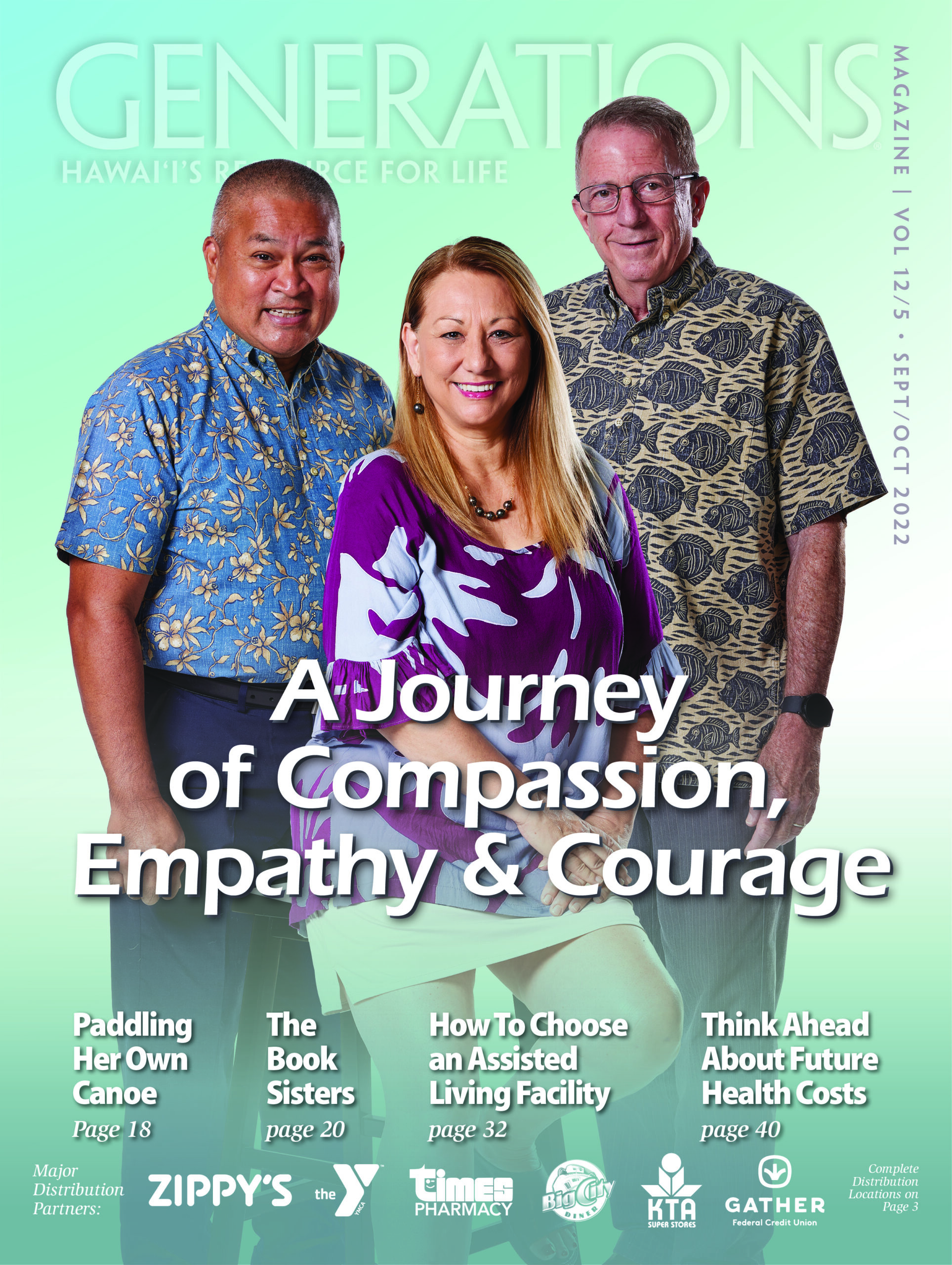
    A common thread runs through a tapestry of three stories. Having experienced the caregiving role themselves, Savina Makalena, Gary Simon and Gary Powell all saw the need to support individual caregivers and the various entities involved in providing that support. And seeing that need, they all decided to help fulfill it, each in their own way.

    Savina Makalena nurtured and protected her mother since childhood by helping her learn English and assisting with the many formal and informal interactions of daily life. So, when her mom began showing signs of dementia, Savy naturally stepped into the role of primary caregiver. Gary Simon and wife Akemi were just about to start their own family when his mother-in-law’s almost imperceptible transition into dementia meant learning what to expect, and how to achieve a workable living and caregiving environment. Gary Powell was thrust into his caregiving role helping to tend to his grandfather, who suffered a series of strokes when Gary was a teenager.

    Chances are high that we all know someone in our circle of acquaintances, friends and family who have had a similar  experience: the sibling who is empathetic, nurturing and blessed with patience who becomes the natural choice to be a parent’s caregiver — a friend who shares with you their struggle to prepare for their caregiving role as a loved one’s health deteriorates. And then there are those who suddenly find themselves caring for a family member following a serious medical event like a heart attack or stroke.

    You may even be a family caregiver yourself, but feel unsure whether or not you have the compassion, empathy and  courage to continue on what may be a very difficult journey.

    Each of the people featured stresses that emotional wellness is a key coping strategy. For Gary Simon, that was achieved by accepting what couldn’t be changed and seeing caregiving as a final gift for his mother-in-law in acknowledgement of the gift she and her husband gave him — his beloved wife, Akemi. Gary Powell’s remembrance of the look in his grandfather’s eyes the first time he had to be helped with personal hygiene blossomed into the awareness that dignifying a care recipient parent by not treating them as a child helps maintain emotional balance. For Savy Makalena, the key to emotional wellness is being able to freely share what you’re going through with compassionate others who have had similar experiences and aren’t going to judge you.

    COMPONENTS OF CAREGIVING

    Gary Powell spent his childhood surrounded by his extended family at Sunset Beach on the North Shore of O‘ahu, where he was born.

    “My parents, my aunt, my grandparents — everyone lived here. When I was about 13, my grandfather had a pretty severe stroke. When he came home from hospital, he was having trouble walking. I was given the task of taking him down to the beach, which was close to their house, and walking in the sand to try to strengthen his legs, and get him more mobile and safer on his feet. So, I would come home from school, take Grandpa walking on the beach, bring Grandpa back; do anything my grandparents needed doing at their house. Sometimes I would eat with them; sometimes not, but after everyone was settled for the rest of the day, I would go home and do my 13-year-old things.

    “I did this for quite a long time, but Grandpa did reach a point where walking was not something he could do. One day when I was at my aunt’s house, she said, ‘Your grandpa needs your help cleaning up in his bathroom.’ I was not prepared for that. However, I did it. It was OK. I helped him get a bath, but what I remember most is the expression in his eyes. It wasn’t embarrassment as much as it was ‘my  grandson will never see me the same.’ That look in his eyes has kind of haunted me. Through the rest of my life, I’ve been involved in caregiving in some aspect in literally every position; every life incident that I’ve ever been in. There has always been a component of caregiving, either for an older individual or an individual with physical or mental disabilities.”

    The Caregiver Foundation

    Although he didn’t equate what he was doing with “caregiving” at the time, the jigsaw puzzle pieces of Gary’s many life experiences eventually assembled themselves into a clear vision of how he could use his professional skills to support family caregivers and their care recipients.

    He established The Caregiver Foundation (TCF) in 2008, on a mission to provide practical and emotional support to seniors, disabled adults, and their caregivers. The services that TCF provides “preserve dignity, enable independence, and promote acceptance in all facets of life” and are designed to help caregivers, adults planning for or seeking caregiving, and the families of care recipients.

    The foundation has clients on O‘ahu, Kaua‘i, Maui, Moloka‘i and the Big Island.

    “We do not give legal advice. We do not give financial advice,” Gary explains. “Although we have the capacities in both of those areas, that’s not what we do. We partner with professionals in the community. We’re able to bridge between the individual and their attorney or their CPA to make sure that the client is really understanding what they’re doing.” TCF also partners with other caregiving organizations.

    ‘Let’s Help It Roll’

    Gary was part of the group that established the Hawai‘i Family Caregivers Coalition (HFCC), which started when Hawai‘i participated in a project designed to create coalitions at the state and local level. Funding for the 2004 project was provided by the US Administration on Aging and it was conducted by the AARP Foundation. The coalition was created following a two-day training period, in which 27 organizations participated. Then followed a couple of years when, Gary says, the coalition was “casting about for exactly what do we do and how do we do it. Participating in the creation of the HFCC  broadened my understanding of what other organizations were already doing.”

    The big takeaway for Gary was that “we’re all trying to accomplish the same thing.” When he later founded TCF, Gary saw the best way to help clients was to partner with existing organizations. “If we find an organization that has the capacity to do something for our client, we’re going to try and tie into that. It saves the client money and it helps another organization fulfill its purpose. We don’t want to reinvent the wheel. If it’s rolling, let’s help it roll.” You don’t have to be a fee-for-service client to access the foundation’s educational resources, which also make full use of those partnerships.

    On the third Tuesday evening of every month, TCF hosts free online webinars as a service to the community. The June  webinar featured Catholic Charities Hawaii, which is celebrating its 75th anniversary this year. The “Learn More” webpage on TCF’s website provides links to information about topics such as aging, caregiving and how to finance care costs.

    “Right now, we have 71 different workshops available to the community. Those are never charged for. We’re working on turning them into a Virtual College of Caregiving, but they’re also standalones on a wide, wide range of topics. We’re happy to send that list to anybody who wants to look at it.”

    Meeting Practical Needs

    For its fee-paying clients, TCF focuses on two major areas. “When we started the first caregiver support group, I noticed right away that the questions people had were more into my business background than into my caregiving background. The two areas they were not prepared for were the legal aspects and the other was their emotional health in caregiving. The practical areas are so essential and so neglected that caregivers who have waited too long end up having to go to court to address them, to get a legal rendering by a judge, because the individual receiving care is now incapacitated and cannot sign a power of attorney [POA], cannot sign anything, legally.”

    Client services include, for example, daily money management, guardianship, trusteeship and power of attorney. Gary acts as the agent for medical POAs, sometimes having to make very difficult decisions regarding end-of-life issues.

    He explains that “You have to have been able to communicate so you know what they would want. If that wasn’t possible, then you have to make decisions based on the best information you can find to determine what they would have decided. If nobody knows, then you’re doing what’s called ‘substituted judgment’ and you’re doing things in that person’s best interest.”

    A Better Perspective

    Gary addresses caregivers’ emotional health by suggesting they adopt a change in perspective. “When we’re caregivers for  seniors, we’re in the process of saying goodbye to that person. They’re not going to get better. You can’t cure aging. If we understand that, the work is still going to be same but it’s a way of saying goodbye. I have seen that perspective change make a huge difference in the stress level of family caregivers. It makes it emotionally much easier.”
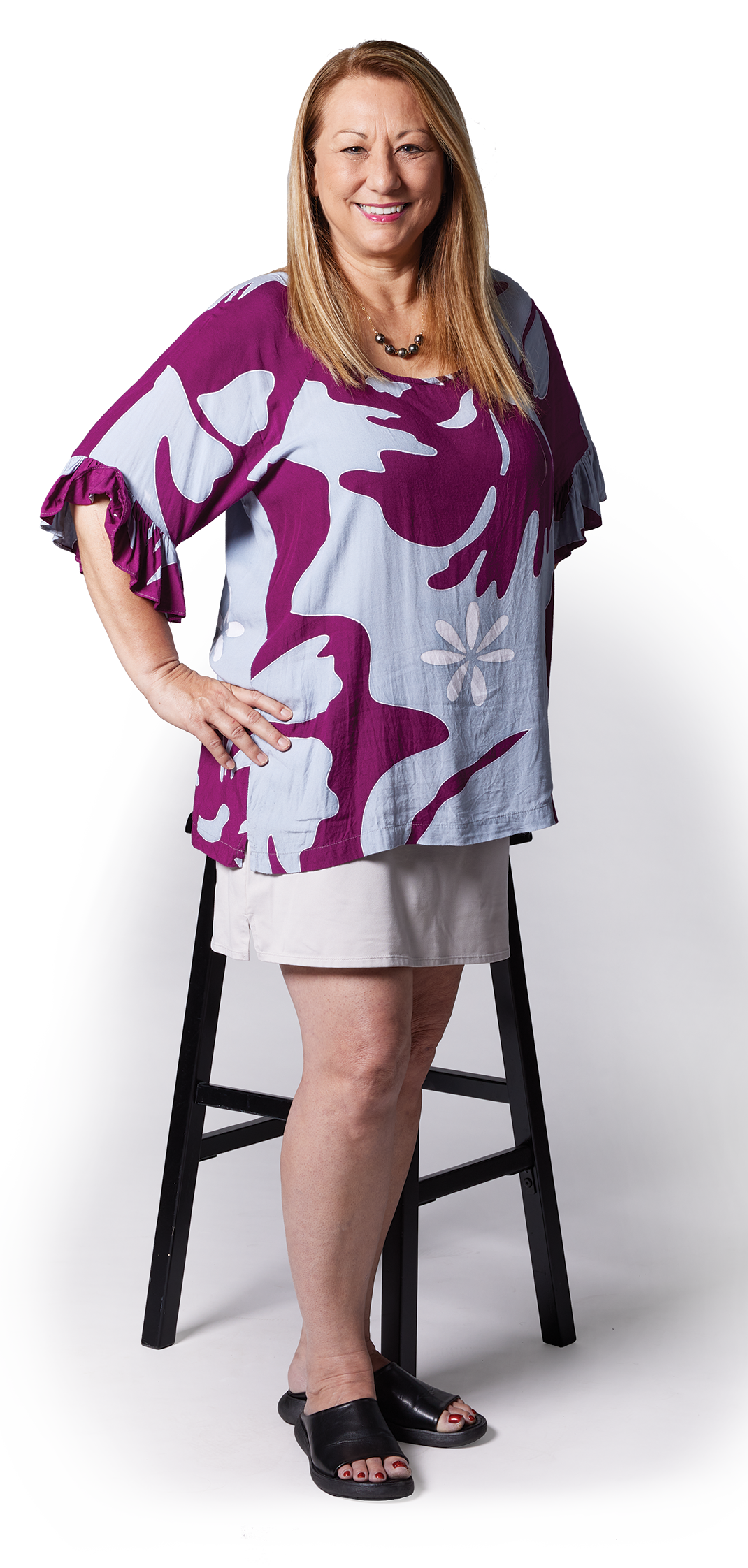
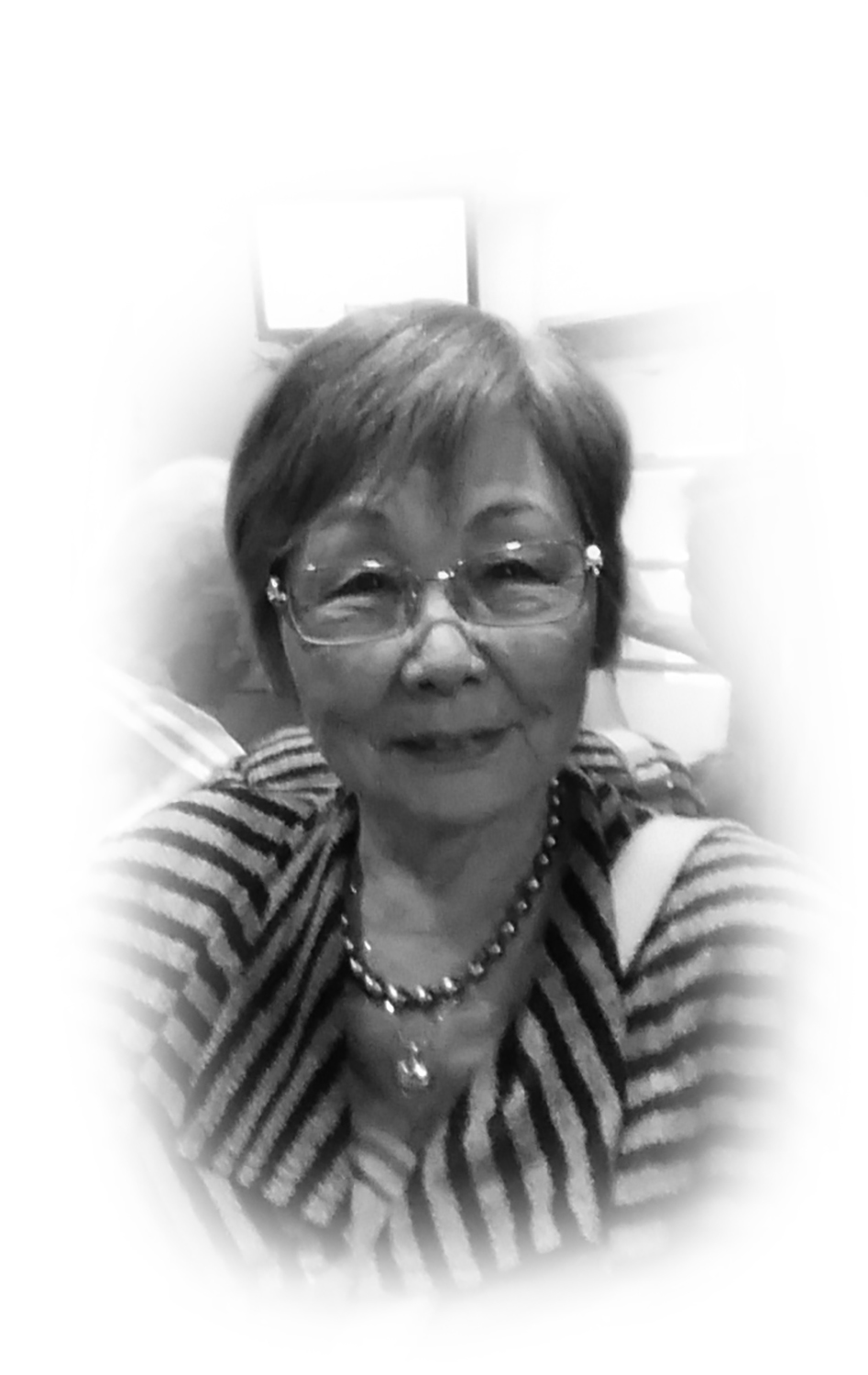
    He is also adamant that family caregivers shouldn’t approach their role as if they’ve become their parent’s parent. “No you have not! You’ve become their caregiver, yes, you may have become their bookkeeper, you may have become their cook, their housecleaner and everything else, but never their parent. Even if they cannot understand you, they don’t know you and everything is absolutely nuts — you are still the child and they are the parent. Somewhere back in that damaged brain there’s a realization of what’s happening. If you make it where a person feels they have lost their position in your life, that’s a pretty painful path for them.” That is the pain he saw in his grandfather’s eyes all those years ago.

    THE ROCKY ROAD OF CAREGIVING 

    Gary Simon became closely acquainted with how courageous caregivers are when he was the executive director of St. Francis Hospice. He speaks of seeing “the sacrifices they made to give the best to their loved ones, to give their care recipients a last gift. And I’ve also seen the ugly side, where caregivers just didn’t have the resources to support their care recipient. They’ve said, ‘OK, I’ve got to choose between family and food, and being a caregiver.’ I saw that struggle, where there are multiple demands upon a caregiver.” A combination of his professional and personal experiences led to a lifetime of participating at a board level in Hawai‘i’s network of caregiving support agencies advocating for better resources for caregivers.

    The Long, Rough Patch

    Gary and his wife, Akemi, were married in 1993 and built a house on Akemi’s mother’s property, ready to start married life and raise a family. Within their first year there, however, they began to see that all was not right with beloved Okaasan.

    “She was a terrific cook — ‘ono, ‘ono food. But her dishes began to taste odd, like cardboard and paper.” Repeating questions, erratic sleeping and eating, and forgetfulness surfaced as other telltale signs of the onset of dementia.

    “There were many things and they were beginning to become more frequent. The big one was constantly forgetting her purse somewhere. Once okay, twice okay, the third time, enough! It precipitated my wife being forced into retirement. I use that word ‘forced’ because if she hadn’t, the situation would have gone south really fast. My mother-in-law had become a mentally vulnerable adult.”

    Step by step, the young couple transitioned into her house in order to provide round-the-clock watchfulness and care.

    Speaking of his personal experiences at a caregivers symposium put on by the Alzheimer’s Association in June, Gary shared that “The mileage can be rough. Our mileage was rough, and it was a long road — 26 years. But the journey was worth it for what it did for me — to see how I want to be treated; therefore, how I should treat others. Wisdom, patience, tolerance — don’t judge. You don’t know what people are carrying. Do you go to Safeway and notice people just don’t look happy? Maybe they’re caregivers, too. They may be going through that long, rough patch.”

    Shikata Ga Nai

    Gary also shared how the deeply cultural Japanese phrase “shikata ga nai” (“it can’t be helped” or “nothing you can do about it”) helped him through the rough patches.

    “For many years, I used to get upset, perturbed or resentful about the way life was turning out for all of us, especially my mother-in-law.” Some of her repetitive questions, such as, “When are you leaving?” would take on a life of their own. “I was thinking, ‘Mom, you’re ungrateful. I’m here helping you!’” It took him a lot of time to learn that he was making a problem out of something that was just a result of her illness. “That’s not the her that she was.” Shikata ga nai. Gary sees the rough patches as “part of making us better humans. The journey is rough, the mileage is rough, but in the end, it makes us all better.”

    “Being a caregiver for my mother-in-law was one of the ways I could honor my wife and both her parents. Her father had passed away before we married. This is kind of flippant, but they did right by me. They gave me Akemi and I wanted to do all I could by giving her mother good love.”

    Gary and Akemi’s beloved Okaasan passed away peacefully in the home they all shared in 2019.

    Advocating for Kūpuna

    Accepting the inevitable effects of a loved one’s illness, however, did not mean that Gary was willing to accept that difficulties arising from public policy — or a lack of it — could not be remedied. Along with the advocacy he was able to incorporate into his 30-year career with St. Francis Healthcare System, Gary contributed his time and skills to the advocacy efforts of many task forces and nonprofit groups. He is the past president of the Hawai‘i Family Caregiver Coalition, the
    current AARP Hawai‘i volunteer state president, and was a member of the Statewide Task Force on Alzheimer’s Disease and Related Dementias. His term as member and chair of the State of Hawai‘i Policy Advisory Board for Elder Affairs (PABEA) ended in June. Gary is also a member of the boards of The Arc in Hawaii, Kokua Council and Palolo Chinese Home.

    Thanks to the efforts of several advocacy groups, undertaken at both the legislative and departmental level, in 2017, a program aimed at keeping caregivers in the workforce was signed into law. “It was meant for people like my wife — for people to maintain employment so that they don’t compromise their day-to-day income or their retirement benefits,” Gary explains.

    Enabling caregivers to remain in the workforce ensures that their work skills and experience are still available to benefit the community as a whole, Gary adds.

    A Coalition of Care

    Each year, a joint report on aging and disability issues is published by the Hawai‘i Family Caregiver Coalition (HFCC). The report is intended as a guide for legislators, organizations and citizens, and it calls attention to priority issues. It is a joint project of the HFCC, the Policy Advisory Board for Elder Affairs, the Executive Office on Aging, the Hawai‘i Pacific Gerontological Society, the Maui County Office on Aging and St. Francis Healthcare System of Hawaii. Gary describes his various roles with most of those organizations as “having my feet in multiple pools of water.”

    He also explains that it is not difficult to find enthusiastic board members for the HFCC, of which he was president for seven  years until 2021. “We’re fortunate to have both providers in there, and people who are experienced in advocacy and program development. The current president, Kathy Wyatt, operates adult day care centers. We’ve always had a seat at the table for Maui County Office on Aging. The board covers the breadth of government, private and nonprofit.”

    Outreach and Education

    Gary became volunteer state president for AARP Hawai‘i in 2019, just before he retired from St. Francis Healthcare. He sees outreach and education as an important part of that role. In June, he moderated four sessions about disaster preparedness for AARP members and made sure to include information specific to caregivers.

    “The designated shelters in Hawai‘i are not caregiver/care-recipient friendly. In all likelihood, if there’s a disaster, you’re going to have to shelter at home with your care recipient. What if your loved one is on an oxygen concentrator? There are ways out, like getting a generator, but on the whole, education for caregivers about disaster preparedness is what we need to think about.”

    The AARP website has links to the many local and national resources available for caregivers. As the website says, “Caregiving may be one of the most important and challenging roles you’ll ever take on. No matter where you are in your caregiving journey — starting to plan; taking care of a family member in your home, in a facility, or from a distance; or managing end-of-life caregiving responsibilities — having resources at your fingertips will make the process easier.”

    BORN INTO CAREGIVING

    Savina (Savy) Makalena began caring for her mother as a small child.

    “I was the one who had to take care of her. She grew up very sheltered. Even as a young child, I was her caretaker and her protector. She was from Japan, so she didn’t speak English well, or read or write it. So I taught her what I learned in school. But she still wasn’t quite very good at it. I had to translate everything. I translated recipes. I read magazines and newspapers to her.

    “Later, I became a mother and then a grandmother. I ended up going full circle, taking care of my mother again. Both my father and mother needed my care. I took care of my father for the last seven years, until he passed. Now my mother is in her final stages of dementia and in hospice care. I also help care for my mother-in-law. She’s actually very good on her own and lives with us. And now the love of my life is managing a rare blood cancer.”

    Keeper of the Lore

    Born and raised in Hawai‘i, Savy cherishes how she grew up in a community.

    “If I misbehaved, a slippah could come flying out of any direction from any aunty. They would correct me. I also grew up with the understanding that there was always one person who was selected to receive the honorific position to be the caregiver of the kupuna. It became an honor because the lore then was passed to you if you were the one selected. The entire family rallied behind that person to make sure they were given every support they needed in order to receive the lore and care for the kupuna.”

    Although she is keenly aware that society has changed, Savy is adamant: “We still need to recognize that one person ends up becoming the one to care for that kupuna. So as a society, as a community, as a family, we have to support that person in some way or another.”

    A Nonprofit is Born

    Coping with the day-to-day tasks needed to care for their loved one often leaves the caregiver feeling exhausted, isolated and depressed. Having experienced all that herself, Savy decided to find a way to help caregivers overcome these problems.

    “I realized how difficult it is to be a caregiver and to get resources and to get support, so I decided to start a nonprofit and brought in a few of my acquaintances — my business partner friends—who were going through the same thing. We started Gimme a Break. We decided that we were going to provide resources and support, and some sort of respite for caregivers when we could.” Their aim is to restore the joy of caregiving.

    The mission of Gimme a Break, a nonprofit, is “to care for caregivers by giving an emotional and physical break as well as resources for continued well-being.” Its advisory board members range in age from their 30s to their 60s — all have experience as caregivers. Gimme a Break had barely started when the pandemic hit. But in 2021, it began a physical presence at ‘Ohana Hale Marketplace. This year, it moved to Windward Mall.

    “We’re now discovering a whole new community on the Kane‘ohe side. There are a lot of caregivers who normally wouldn’t come into town, but we’re now able to reach them. We have people walk in all the time, every day. We’re there Tuesdays through Saturdays. They come in and we sit down with them. Lots of tears. A lot of hugs. But also, a lot of help and a lot of support.”

    The resource center has a supply of community partners’ flyers and rack cards, and Gimme a Break holds regular mini resource fairs so that caregivers can learn directly from those partners.

    Help Accessing Resources

    Savy’s personal caregiving experience with the difficulty of accessing resources is one of the driving forces of Gimme a Break’s mission.

    “I called so many places and no one answered me back,” she says. “No caregiver has time for that. No one does. Now I have people who will answer me back and we have resources that we can connect people to. That’s something big. We also have a community of support and we’ve seen the difference that makes to caregivers as we’ve grown. We see it in our caregivers when they come in with their shoulders down and they leave with their shoulders high again, with smiles on their faces and gratitude in their hearts.”

    Face-to-face interaction was impossible when the pandemic hit, so “in that time, we were working online on social media, mostly Facebook. We’re now on every platform for every age group: Facebook, Instagram, LinkedIn and Tik-Tok —  anywhere that we can reach caregivers.”

    During National Family Caregivers Month in November, Gimme a Break will hold a Caregiver of the Year contest on  Facebook to create awareness of of caregivers’ stories. Then, on Dec. 3 at the Elks Lodge in Waikīkī, it will hold its Caregiver of the Year Awards Gala to recognize all caregivers and the Caregiver of the Year.

    Advocacy and Education

    Savy is the vice president of the Hawai‘i Family Caregiver Coalition, seeing it as a way to advocate for caregivers and get very involved with what’s going on in the field of caregiving. Although advocacy is not the focus of Gimme a Break, she explains, “I personally focus on advocacy because it’s necessary and it goes hand-in-hand with our passion for what we do — passion for the mission of supporting caregivers.” Part of that mission is education, especially in terms of helping people anticipate what they will encounter on their caregiving journey.

    Gimme a Break offers a series of support sessions that cover the steps that you need to take and the things you need to have in order.

    “We have resources that help them discuss that. We do it with no agenda. It’s a user-friendly environment for a caregiver. We’re here to provide them with knowledge to help them bring back the joy of caregiving. We’ll do that through resources. We’ll do that through support. We’ll do that through community.”


    All three of our featured caregivers use their particular skill set and personal experience regarding what was difficult in their caregiving journey to ease the way for others.

    Gary Powell’s financial and legal skills enable him to run a nonprofit foundation that shoulders the weight of those burdens for both caregivers and care recipients. Gary Simon’s administrative background is a good fit with organizations like the AARP and the Hawai‘i Family Caregiver Coalition that focus on education and advocacy. Savy Makalena’s experience in social media marketing enables her to create a vibrant community of caregivers, and both an online and physical space in which to learn, share and care for each other.

    All three are keenly aware that they cannot do this alone. By providing referrals to other organizations that specialize in particular fields of caregiving and links to online resources, they guide caregivers on their journey.


    THE CAREGIVER FOUNDATION
    thecaregiverfoundation.org
    AARP
    states.aarp.org/hawaii/caregiver-resources
    GIMME A BREAK
    gab808.org
    Facebook: www.facebook.com/gab808
    Instagram: @gimmeabreak808hi
    ALZHEIMER’S ASSOCIATION
    alz.org/help-support/caregiving
    HAWAII FAMILY CAREGIVER COALITION
    hfccoalition.org/index.php/education-resources


    A common thread runs through a tapestry of three stories in the September-October 2022 issue of GENERATIONS MAGAZINE. Having experienced the caregiving role themselves, Savina Makalena, Gary Simon and Gary Powell all saw the need to support individual caregivers and the various entities involved in providing that support. And seeing that need, they all decided…

  • The Book Sisters

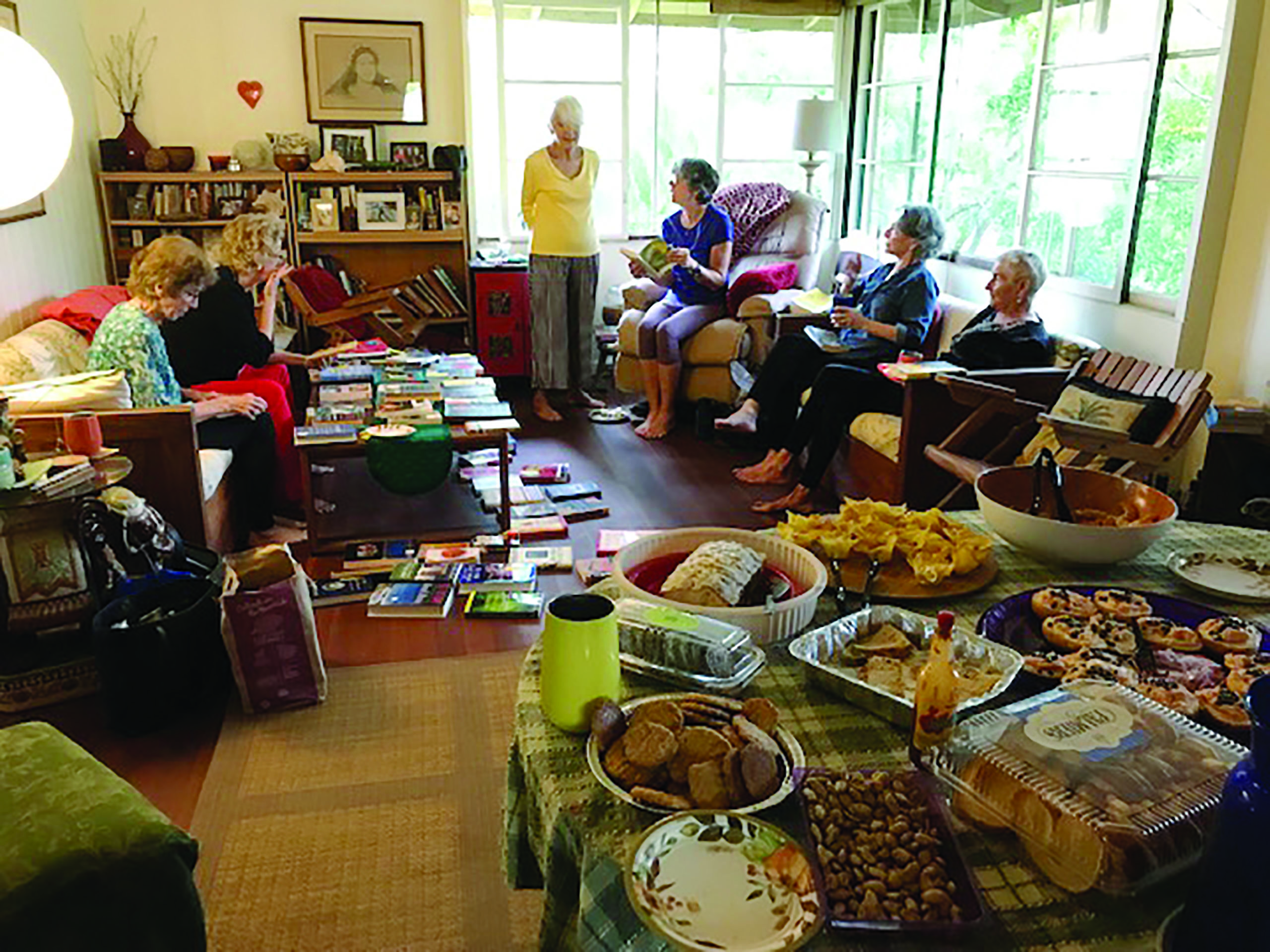
    It’s not your ordinary book club. This all-women book club has a long history, having begun around 1980, says Ginny Meade, who joined in mid-’81. “It’s an amazing group of women from all walks of life. It all started because of our love of books and reading.”

    When Ginny joined, she said, an artist, an attorney and a writer were the “ring leaders.” One by one, new members drifted in by the invitation of other members, including several doctors.

    “I had put off joining because I thought everybody else was smarter than me,” said Ginny. Unduly insecure about her membership in the group, Ginny became the club’s “faithful scribe,” sending out email invitations for each meeting.
    As a Kaimukī community leader, it was a natural evolution. And early on, she realized that she had a deep connection with this eclectic group.

    This intrepid group of accomplished women possesses important commonalities: a voracious intellectual appetite and a willingness to tackle the tough topics. At the end of the day, that was enough to sustain the group for over 40 years.

    There were rules that determined who could join the Women’s Literary Society of Greater Honolulu (WLSOGH) was growing at such a pace that it would soon overflow the host’s home.

    “We were uppity back then,” Ginny laughs. “So we made rules. First, you were allowed to invite a guest only once a month. The group would decide whether or not to accept the guest, giving the invitee the option to join if they liked us, too.”

    The meetings had a “semi-formal” structure. The person who suggested reading the book was usually the one to lead the discussion, posing discussion questions about the book.

    “The interesting thing is that the discussions weren’t strictly about the book,” says Ginny. “They became more about our feelings that arose from reading it. Most often, our discussions became really wide-ranging and comprehensive, reaching far beyond the contents of the book.”

    The group would also invite authors to their meetings, including the likes of former Honolulu Advertiser Publisher Thurston Twigg-Smith, author of “Hawaiian Sovereignty. Do the Facts Matter?” Authors from near and far were also invited, some traveling from the mainland to appear at this meeting of discerning women.

    But their appetites were not for the written word and intellectual discourse alone. The dining table was covered with culinary delights of all kinds, wine and fizzy beverages. The ambiance opened opinions, loosened lips and sparked creativity.

    Pūpū evolved into dinner, for a time, themed to the book. A book by Dostoevsky prompted the host to offer borscht. A  meeting discussing “A Brief History of Time” featured Chinese food, as they ascertained “that is what geeks eat.”

    Well really, sustenance was necessary; the club’s book list was not for the faint of heart. More often than not, they would “go deep.”

    Titles on the 2022 list include “The Chancellor: The Remarkable Odyssey of Angela Merkel” and “Confessions of an Economic Hit Man.” “They’re all across the board. That’s how we roll.”

    “We didn’t always agree on the books and we didn’t mince words,” says Ginny. “One meeting started with the opening comment, ‘I hated this book!’ It went on to be one of the longest meetings and most deeply discussed books we ever read.  So we realized we didn’t need to agree for a meeting to be successful.”

    This discovery lead them to “The Molly Principle.” First, calculate how many years you have left. Then calculate how many books you want to read. Then, if you pick up a book and you don’t like it, it’s ok to put it back down. Members could invoke The Molly Principle at any meeting, excusing them from reading or discussing the book of the month. They could still attend the meeting. The group has recently switched their focus to books about World War II and South Africa.

    The book list is always decided at the annual retreat. The book nomination and voting ritual was a serious, long-weekend affair, often accompanied by music, partying, hot-tubbing, beach walking, tap dancing and consumption of a cold creamy, blender cocktail with an X-rated name. That’s when the tap dancing ensues…

    But it is not all about unbridled drinking, dancing and merriment. A retreat that included a hike on Molokai inspired Ginny to pursue a degree in horticulture. “It has been quite a life-changer for most of us,” Ginny says about the group.

    Originally, many joined the club because it was simply “time to get back to reading” after families were raised and careers ended. Although their initial intention was to indulge in food for thought with like-minded ladies, by drilling even deeper than the topics offered in their books, the club facilitated lifelong bonds.

    “There’s about 40 of us who are still involved,” said Ginny. About half are local and the rest are on the mainland — most, former islanders.

    “It’s hard to put a label on what our book club was ever about,” says Ginny. “It’s a bit of everything. When we began, we were all in our 40s. Now we are in our 80s. We have become grandmas and widows and have seen a lot of change.”

    “But for as long as I can remember, we began our meetings by chatting about what each person has been doing in the last month,” says Ginny. “Eventually, someone says, ‘Lets get to the book.’”

    “Through the years, we became a close group of dear friends and confidants that has not only endured, but grown stronger and deeper. When life hands us tragedies and challenges, we are always and faithfully there to support each other. So that’s the most valuable aspect of this club — total support among 40 women over 40 years.”

    “It’s way beyond what’s between the covers of a book,” Ginny says. “We’re not just analyzing a book; we are analyzing everything in life.”

    It’s not your ordinary book club. This all-women book club has a long history, having begun around 1980, says Ginny Meade, who joined in mid-’81. “It’s an amazing group of women from all walks of life. It all started because of our love of books and reading.”

  • Grief and Bereavement — Part II

    A senior lady sits waiting in the reception area of a robotics company in Cambridge, a city renowned for being one of the top three technology hubs in the world.Continuing from my last article, I believe that clients really want the estate planning attorney to help them meet their needs so that they can reduce their fear, anxiety and anticipatory grief in light of their knowledge of their inevitable death.

    These needs include the desire 1) for the client to grow, develop and enjoy the most meaningful life possible; 2) not to burden friends and family; 3) to establish and build strong family/friend relationships, and to know these relationships will persevere after death; 4) to make the transition after death as easy as possible; and 5) to ensure that loved ones dependent on the client during their lifetime have security, sustenance and shelter.

    Avoiding probate and minimizing taxes are not ends in themselves, but doing these things helps the client minimize any burden placed on survivors and allows for more available resources for the surviving loved ones’ care. When we shift our perspective away from lineal matters, such as probate and taxes, and focus on the natural, often non-lineal, human emotions underlying the needs of each client when deciding to make an estate plan, we realize that we, as estate planning attorneys, must develop an additional skill set above and beyond technical tax and probate law, and utilize “the softer skills of counseling.”


    STEPHEN B. YIM, ATTORNEY AT LAW
    2054 S. Beretania St., Honolulu, HI 96826
    808-524-0251 | stephenyimestateplanning.com

    Continuing from my last article, I believe that clients really want the estate planning attorney to help them meet their needs so that they can reduce their fear, anxiety and anticipatory grief in light of their knowledge of their inevitable death.

  • Walk to End Alzheimer’s

    You probably know someone with Alzheimer’s, the most common type of dementia that’s currently affecting some 5.8 million Americans and growing so rapidly that as many as 14 million may be affected by 2060.

    Dementia is not a disease but the general term for the loss of memory and cognitive abilities, especially in people over 65. Alzheimer’s is a progressive disease that worsens over time and in its late stages, individuals lose the ability to carry on a conversation and generally succumb to the disease four to eight years after diagnosis.

    Current research, however, is showing progress in the removal of one of the main causes or hallmarks of Alzheimer’s disease in the brain, called “amyloid,” also known as plaques, with the potential to slow down the progression of the disease for those who are in the early stages of Alzheimer’s. While this is certainly nowhere near a cure, the science is leading us in the right direction toward better treatments and ultimately, a cure for this terrible disease that impacts so many families across our state.

    But research costs money — lots and lots of money. To help, the Alzheimer’s Association of Hawai‘i is joining other chapters across the country in holding the annual Walk to End Alzheimer’s — the largest event to raise awareness and funds for Alzheimer’s care, support and research. After a two-year pandemic gap, the Hawai‘i walks are once again taking place throughout the islands: in Hilo on Sept. 17, in Kapa‘a on Oct. 1, on Maui on Oct. 22 and in Honolulu on Nov. 5.

    Participants can register as teams or individuals, and businesses can put together groups. Children can also participate (bikes, skateboards or wheelie footwear are discouraged). Strollers are fine and it’s OK to take your well-behaved dog if it’s on a leash. It’s a fun day offering fresh air and exercise, while helping to raise the much-needed funds for research and awareness. On O‘ahu, this year’s goal is $335,000.

    There’s no registration fee, but participants are encouraged to make a personal donation and commit to raise funds in the fight against Alzheimer’s If you raise $100 or more before the event, you’ll receive a free T-shirt to wear during the walk. All donations are tax deductible.

    You can get complete details about this year’s Walk to End Alzheimer’s on its website as well as important information about the disease: what it is, how is it diagnosed, what are the symptoms, what are the stages of the disease and what treatments are available.


    WALK TO END ALZHEIMER’S (501(c) 3 nonprofit)
    808-518-6654 | Jmgeorge@alz.org
    alz.org/hawaii

    You probably know someone with Alzheimer’s, the most common type of dementia that’s currently affecting some 5.8 million Americans and growing so rapidly that as many as 14 million may be affected by 2060.