WANT THIS ISSUE?
Download your own personal copy of this issue in PDF format. Click the button below:

WANT THIS ISSUE?
Download your own personal copy of this issue in PDF format. Click the button below:
Maintaining a close relationship is more than saying, “I love you.”
I am honored that Marian University accepted me into the Masters of Thanatology program this past Fall. “Thanatology? What is that?” is the common remark I hear when I tell people of my new adventure.
A thanatologist is a designated thinker about death. They help people die better than they otherwise might.
I believe every estate-planning attorney is a thanatologist. But we, like many of our clients, allow the underbrush of life, such as tax and probate, to cover up what we really face — our mortality.
In his book, A Commonsense Book of Death: Reflections at Ninety of a Lifelong Thanatologist, Dr. Edward Shneidman sets out 10 Criteria for a Good Death (page 132). Of the 10 criteria, two directly relate to estate planning.
First, it is common sense and good manners to complete the administrative chores associated with death, specifically to have a certified will and, if possible, a living trust. “Every responsible adult should assist his loved ones by doing these thanatological chores.”
Dr. Shneidman refers to the second criteria that directly relates to estate planning as “generative.” He states that a good death has a quality of being generative because, living between your parents and grandchildren, you take pains to relay family stories to the younger generation before you die.
Please consider taking on this thanatological chore of making your estate plan. Take the time to pass on family stories.
 Stephen B. Yim, Attorney at Law
2054 S. Beretania St., Honolulu HI 96826
I am honored that Marian University accepted me into the Masters of Thanatology program this past Fall. “Thanatology? What is that?” is the common remark I hear when I tell people of my new adventure. A thanatologist is a designated thinker about death. They help people die better than they otherwise might. I believe every…
On average, I get one to three calls a day from the public seeking advice about elder abuse. Fortunately, only about 20 percent of the calls involve matters needing my office’s involvement. The rest are from people that see “elder abuse” in our name and hope we can help with their situation. It is a learning experience for me as I research various resources available to seniors. (These are real calls with minor facts changed to protect the identity.)
 “Hi. My wife has spent over $30,000 on a gifting program. She doesn’t think it is a scam but she has given these people a lot of money and hasn’t gotten anything in return. I think it is pyramid scam.”
Pyramid/Gifting Scams are considered investment frauds and can be reported to the Department of Commerce and Consumer Affairs (DCCA) office at 1-877 HI-SCAMS (1-877-447-2267). Additionally, you can report it to the Financial Crimes Unit at the Honolulu Police Department (HPD) at 808-732-3609.
“I want to report a timeshare company that signed up my dad. He didn’t know what he was signing and wants to get out of the contract. He is on a fixed income and should have never been qualified to make the purchase.”
For complaints against individual companies, DCCA’s Consumer Protection Division (808-587-4272) can investigate claims and seek civil restitution in certain instances.
“We just discovered that my brother stole $20,000 from my dad, but he doesn’t want to do anything about it. What can we do?”
This is a common call we get, and unfortunately, if the victim — the parent — doesn’t want to prosecute, law enforcement can’t really get involved (in most situations).
“Can someone from your office speak to our group about elder abuse?”
Yes. We have done over 400 presentations to various senior groups and organizations in the past 10 years.
“I live in the mainland and just discovered my father gave over $400,000 to two men he hired to do some house repairs. He says they are nice men who bring him lunch when they stop by. He doesn’t believe they are con men and doesn’t want the police involved.”
This is similar to the situation above concerning the son stealing from the dad. If he doesn’t want to prosecute the matter, the police can do very little.
What we see happen a lot is that the children will berate the parent to the point that the parent will stop speaking to the child. This then allows the con artist free rein to continue taking advantage of the senior. I caution children to adopt a non-judgement tone with their folks in order to get more information regarding the situation. In this situation, the daughter was able to convince her dad that these men didn’t have the father’s best interest at heart, and he allowed law enforcement to get involved.
To report suspected elder abuse, contact the Elder Abuse Unit at 808-768-7536 | ElderAbuse@honolulu.gov
On average, I get one to three calls a day from the public seeking advice about elder abuse. Fortunately, only about 20 percent of the calls involve matters needing my office’s involvement. The rest are from people that see “elder abuse” in our name and hope we can help with their situation.
 Disney theme parks receive millions of visitors each year. Many park-goers repeat their visits annually, if not more often. Most of the time, their visits are routine (or as routine as they can be in a magical place). From time to time, however, guests do the unexpected. Disney cast members have a code language they use when referring to unusual events. The purpose of the code is to avoid alarming other guests. For example, if someone vomits on property, Disney staff refer to it as a “protein spill.” A particularly rude or difficult visitor is referred to as a “treasured guest.” The phrase, “Have a magical day,” even when uttered with a Disney smile, can mean the opposite when a guest has been especially troublesome.
One Disney code phrase is particularly interesting. A “white powder event” might sound like a staff member has discovered illegal drugs on property or there was a potentially dangerous chemical spill from which guests must be shielded. However, the phrase is used when someone attempts to spread the ashes of a deceased loved one on park premises. Many people ask to have their ashes spread at places that hold treasured memories for them, and Disney theme parks are not the exclusive venue for these requests.
More often than you realize, human ashes are scattered covertly at sports stadiums, concert halls and golf courses. Of course, these activities are inappropriate, and they are generally unlawful.
Disposing of your cremated remains on your own private property is generally not a problem, at least within the United States. Each state has its own laws when it comes to the practice, and federal laws and regulations apply when remains are scattered within the ambit of federal jurisdiction. Not surprisingly (as every Disney cast member knows), many people proceed without checking the applicable rules. While a “white powder event” may go unnoticed, it is important to realize it can be the subject of criminal prosecution.
In Hawai‘i and other states blessed with beautiful coastal areas, it is common for ashes to be scattered at sea. While this is a beautiful gesture, it may violate the federal Clean Water Act, which requires cremated remains be scattered at least three nautical miles from land in water that is at least 800 feet deep. This means no scattering at beaches or wading pools. On top of this, the EPA requires 30 days advance notice of a scattering at sea. If you have lived in Hawai‘i for any length of time, you know that these rules are rarely observed or enforced. However, this does not give anyone license to flout the law.
If you would like your ashes to be spread somewhere special after you pass away, get advice from your attorney as you complete your estate plan. That way, you can tailor your request to ensure that none of your loved ones will end up in jail for carrying out your wishes.
SCOTT MAKUAKANE, Counselor at Law
Focusing exclusively on estate planning and trust law.
est8planning.com
O‘ahu: 808-587-8227 | maku@est8planning.com
Many people ask to have their ashes spread at places that hold treasured memories for them, and Disney theme parks are not the exclusive venue for these requests.More often than you realize, human ashes are scattered covertly at sports stadiums, concert halls and golf courses.
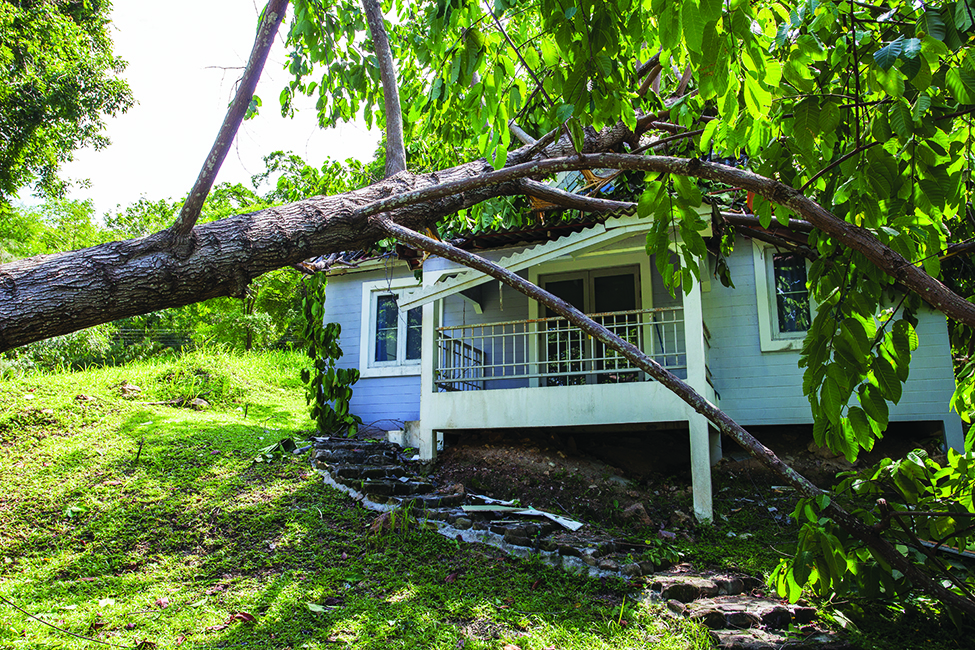
The wrath of natural disasters has been on full display in recent weeks as hurricanes, earthquakes, wildfires and floods have ravaged large swaths of the world. While our first thoughts go to the victims of these tragic events and the challenges ahead for recovery, it may also cause you to step back and think about your own preparedness for a natural disaster. If you’re feeling under prepared, from a financial standpoint, for the possibility of an unwelcome weather event, consider creating an emergency plan.
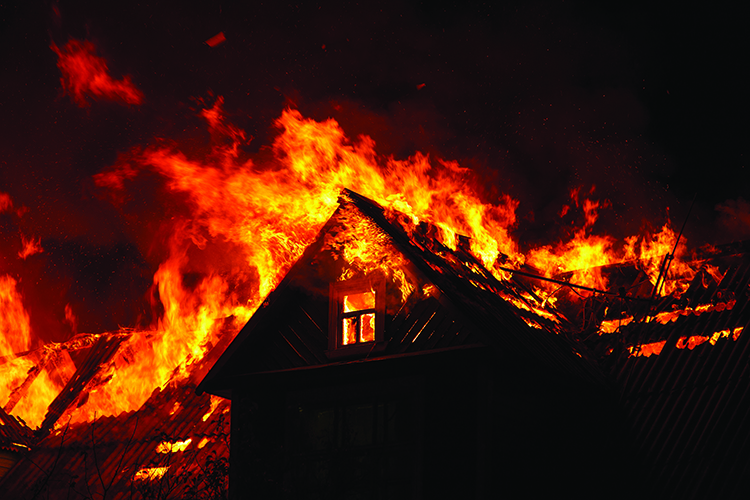 Create A Plan. Just as you plan ahead for your retirement or children’s college tuition, you need to prepare for risks related to a financial emergency. Any type of unforeseen event could jeopardize your financial security. Work with your financial advisor, estate planner and attorney to identify and address potential financial risks.
Protect Your Property. One common concern in such events is catastrophic damage to your home. Start by making sure your property is appropriately insured. Review your homeowner’s insurance policy to make sure there is sufficient coverage for unforeseen events. Remember that typical home insurance does not include coverage for flood damage, which needs to be purchased separately. Homeowners may assume they are not at risk of such damage, but unusual circumstances might mean your risk is greater than you think, so it’s best to double check. Those who rent their living space should consider renter’s insurance.
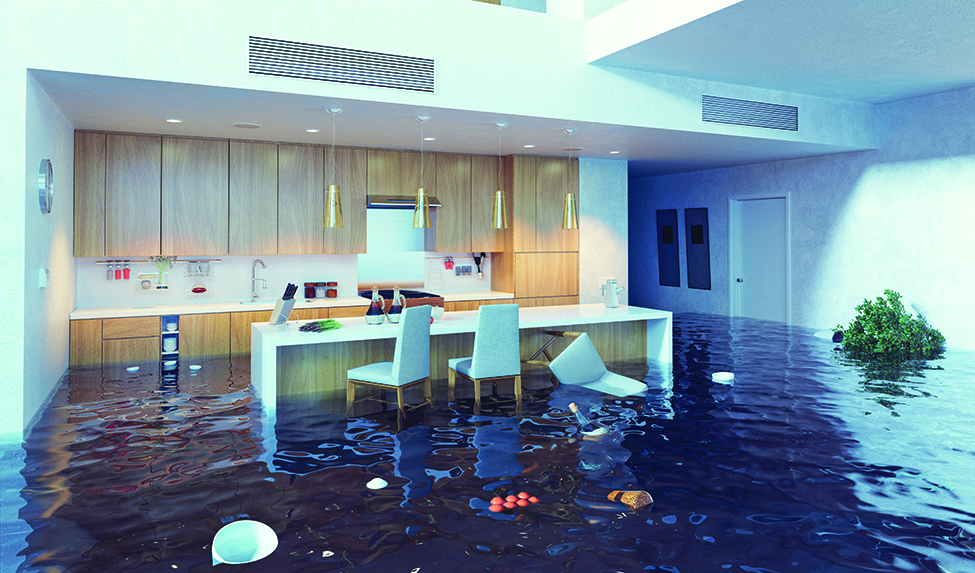 In the case of disasters like a flood or tornado, you want to make sure you have sufficient coverage for possessions, including valuables, vehicles (e.g. cars, boats, ATVs), and technology. Maintain good records of the valuable items you own and keep them in a safe place. It can be helpful to take pictures of your property before and after an event to help the insurance claims process.
Establish An Emergency Fund. A general rule of thumb is to have at least three-to-six months’ worth of expenses saved in case of an emergency. Consider saving more if you have children or live in an area where severe weather threats are more common. Keep these funds in accounts that offer liquidity like a money market fund or in bank savings. Make sure you have some cash on hand in case power outages or other issues prevent ATMs from working.
The money you set aside could be used for temporary housing, medical care or to cover your essential expenses if you’re unable to return to work. The funds can also jump-start your relief and clean-up efforts.
 Safeguard Your Information. When unanticipated events occur, you will need access to your financial information and personal identification documents. Store copies of your insurance policies, financial account statements, medical information, Social Security cards, driver’s licenses, passports and other important records in a secure location, such as a bank safety deposit box or a secure electronic vault. Having documentation readily available allows you to quickly verify your identity and work through your emergency plan after disaster strikes.
Recent events remind us of the importance of having an emergency financial plan in place to help protect against worst-case scenarios.
MICHAEL W. K. YEE, CFP
1585 Kapiolani Blvd., Ste. 1100, Honolulu HI 96814
808-952-1222, ext. 1240 | michael.w.yee@ampf.com
Michael W. K. Yee, CFP®, CFS®, CLTC, CRPC ®, is a Financial Advisor, Certified Financial Planner ™ practitioner with Ameriprise Financial Services, Inc. in Honolulu, HI. He specializes in fee-based financial planning and asset management strategies and has been in practice for 33 years.
Investment advisory products and services are made available through Ameriprise Financial Services, Inc., a registered investment adviser.
Ameriprise Financial Services, Inc. Member FINRA and SIPC.
© 2017 Ameriprise Financial, Inc. All rights reserved. File #1892811
The wrath of natural disasters has been on full display as hurricanes, earthquakes, wildfires and floods have ravaged large swaths of the world. While our first thoughts go to the victims of these tragic events, it may also cause you to step back and think about your own preparedness for a natural disaster.
Recognizing the growing burden of Alzheimer’s disease and other dementias, the U.S. Centers for Disease Control and Prevention (CDC) and Alzheimer’s Association launched “The Healthy Brain Initiative” in 2013 to improve the diagnosis of dementia, and find and institute preventive measures.
 Kuakini Medical Center is the home of several internationally renowned epidemiological research studies. The Kuakini Honolulu Heart Program (HHP) began in 1965 to study heart disease and stroke in 8,006 Japanese-American men on O‘ahu born 1900–1919. The Kuakini Honolulu-Asia Aging Study (HAAS) is an extension of the HHP, and was created to study dementia and other diseases of aging. It started in 1991 when the men were 71 to 93 years of age and is one of very few studies in the world that can associate risk factors from mid-life with outcomes in old age. Thirteen examination cycles were completed.
Some findings from the studies:
◆ The rates of Alzheimer’s were similar in Japanese-American men compared to Caucasians, but vascular dementia (stroke-related) was more common in Japanese-American men.
◆ Walking protected against future risks of developing dementia. Men who walked less than a quarter-mile daily had an 80 percent increase in the risk of developing new dementia compared to men who walked more than two miles daily.
◆ Men with untreated high blood pressure in mid-life had almost five times the risk of Alzhei-mer’s or vascular dementia 25 years later.
KUAKINI MEDICAL CENTER
347 N. Kuakini St., Honolulu, Hawai’i 96817
Recognizing the growing burden of Alzheimer’s disease and other dementias, the U.S. Centers for Disease Control and Prevention (CDC) and Alzheimer’s Association launched “The Healthy Brain Initiative” in 2013 to improve the diagnosis of dementia, and find and institute preventive measures.
Aging is a natural process that no one wants to face alone. Many people choose to live alone in their home as they age, but find themselves depressed, lonely and not eating right. There are many benefits to living in a retirement community. Ever wake up and: Wonder what you’re going to do for the day? Not eat a healthy meal because you don’t want to travel to the grocery store? Feel sick and don’t want to get out of bed?
Do you miss social encounters? Have you ever fallen and could not get to the phone to call for help? I like to think of a retirement community as a group of friends enjoying what they deserve in life, including laughter, entertainment, quality meals, carefree living and an extended family that cares about your well-being.
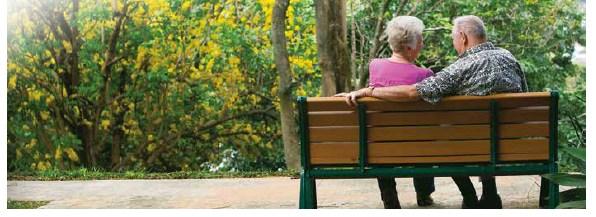 Today, an increasing number of families are turning to retirement communities for their aging loved ones. Living in a retirement community, you can experience vibrant and beautiful living spaces that promote wellness, recreation, socialization and healthy choices, not to mention the feeling of having additional services as you age.
When family members visit their loved ones in a retirement community, they’ll often find them exercising in the pool, arranging tropical floral bouquets, laughing with old and new friends, volunteering in the community thrift store or gardening. The best part, however, is knowing that your Mom or Dad has physical and emotional support in a safe environment with well-trained staff.
As we know, being active is one of the best ways to maintain good overall health. Many retirement communities offer wellness programs with a variety of fitness levels to set the pace you desire. You may be thinking, “What type of wellness programs?” Consider classes in tai chi, yoga, hula, water fitness exercises and strength and balance exercises. It’s important to find a community that meets your needs and your interests.
You might have to downsize your current home, but there are specialists who can help you find the right pieces to bring with you as you move into a retirement community. You will be surrounded by the things you love in life to make your new home feel special.
POHAI NANI
Contact: John Gruhler III | 808-236-7835
pohainani.org
Aging is a natural process that no one wants to face alone. Many people choose to live alone in their home as they age, but find themselves depressed, lonely and not eating right. There are many benefits to living in a retirement community.
Christmas came early for “Hawaii Five-0” fans last year. The Five-0 production team flawlessly executed the eighth season’s Sunset on The Beach premiere. The event attracts thousands of fans from across the world, cheering as the cast arrive at the red carpet, like former Honolulu resident Judy Glassmaker, who returns every year, and says, “The new season is awesome. Older fans like me, who grew up watching the original series, should watch with their grandkids.”
The seventh season opened with a surreal dialogue between the original McGarrett (Jack Lord) and the new McGarrett (Alex O’Loughlin), who says, “Sometimes, it feels like this job of mine has taken everything good from me… I’m really starting to wonder whether any of it is worth it.” The original McGarrett replies, “Son, your worth is measured in… the people you save…”
Likewise, those transitioning to Medicare say that aging, retirement or change in health status can leave them feeling worthless. I remind them that in the ’60s, their generation changed the world. They fought for the rights of others and a world filled with peace and love. So, to those newly eligible for Medicare, it’s time to put down those picket signs, upgrade to Facebook, get your Medicare insurance and enjoy family and friends who love and cherish you, no matter your age.
Continue to lobby for change via your mobile device as you “Rock On!”
 MEDICARE MOMENT WITH MARTHA
A radio program with Martha Khlopin
KHNR-690AM:
Sat., 2 pm–2:30 pm, Sun., 9:30 am–10 am
808-230-3379 | getmartha@aol.com
To learn more about free Medicare wellness visits, go to:
www.medicare.gov/coverage/preventive-visit-and-yearly-wellness-exams.html
Hawaii Five-0 flawlessly executed the eighth season’s Sunset on The Beach premiere. The event attracts thousands of fans from across the world, cheering as the cast arrive at the red carpet, like former Honolulu resident Judy Glassmaker, who returns every year and who grew up watching the original series.
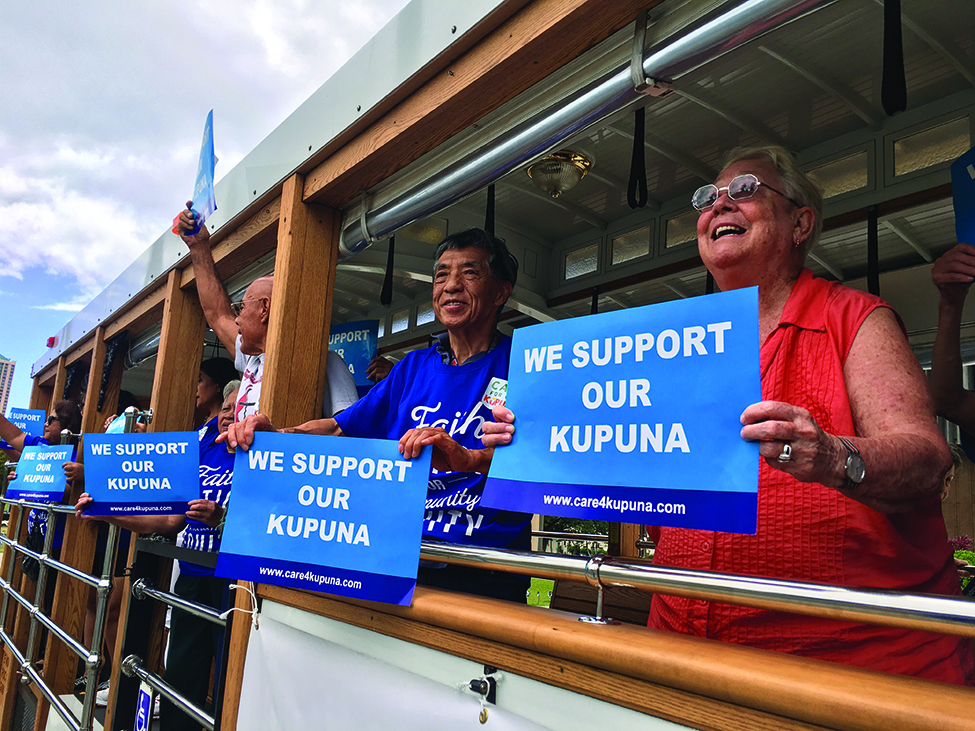 In 2017, Hawai‘i legislators and Gov. David Ige created the Kupuna Caregivers Program. This program helps family caregivers who work at least 30 hours per week outside the home by providing a $70-per-day benefit in services that could help make home caregiving for aging family members more affordable. It could help provide services such as home healthcare workers, extra help preparing meals, adult daycare costs or transportation when a family caregiver is not available. The program is subject to the availability of funds and paid directly to contracted service providers (not the family caregiver).
To be eligible, family caregivers must:
The care recipient cannot reside in a long-term care facility and must have impairments of at least two activities of daily living, or two instrumental activities of daily living, or one activity of daily living and one instrumental activity of daily living, or substantive cognitive impairment requiring substantial supervision.
Applying for the program includes:

When given the choice, most kūpuna prefer aging at home. This is true for both emotional and financial reasons. Our extended ‘ohana are incredible caregivers but providing that care can create its own financial and emotional stress. According to the Genworth 2017 Annual Cost of Care Survey, the cost of home healthcare in Hawai‘i was more than $10,000 higher than the national average. This is why family members often seek to provide care themselves.
But when the caregiver is working full-time, adding care duties to the obligations of a job outside the house brings additional personal strain for the caregiver. Care duties can have an effect on job performance, too: Arriving late after helping an elder get settled or off to adult daycare, reducing hours at work to help take care of a kupuna, or turning down a promotion because of caregiving duties at home. The Kupuna Caregivers Program addresses the needs of both ku¯puna and family caregivers. This is what makes it unique in the nation.
Interested caregivers should contact the Aging and Disability Resource Center (ADRC) as soon as possible to apply at 808-643-2372. This also is the number to call to receive further information.
From Jan. 1 to June 30, 2018, a total of $600,000 is available to provide these services. FACE, Caring Across Generations, AARP and other organizations will ask the Legislature to provide more money effective July 1, 2018. To support this effort to advocate for the Kupuna Caregivers program, visit Care4Kupuna.org.
KUPUNA CAREGIVERS PROGRAM
In 2017, Hawai‘i legislators and Gov. David Ige created the Kupuna Caregivers Program. This program helps family caregivers who work at least 30 hours per week outside the home by providing a $70-per-day benefit in services that could help make home caregiving for aging family members more affordable.
Inside her Mo‘ili‘ili condo, Yoko Futa, an 83-year-old former clerk for the State Department of Transportation, volunteers for about 10 hours a week, helping patients at Queen’s hospitals. Yes, she volunteers from her own home.
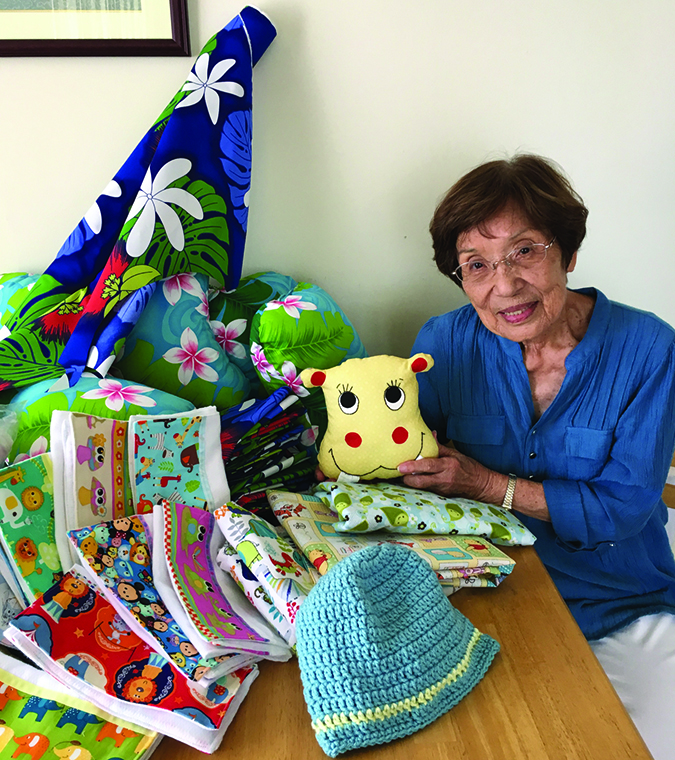
Futa is a member of The Queen’s Medical Center’s Volunteers in Place program, a way for community-minded people and groups to serve at home, centers or sites.
Program participants are crafters who create oncology caps, lap blankets, newborn baby beanies and Hawaiian-print heart pillows, created from donated materials. “There are people who want to be of service to others, but maybe they no longer drive, have limited mobility, or simply prefer to stay at home or with their own groups,” said April Light, volunteer program manager at Queen’s. “This program offers them an opportunity to contribute and make a difference in our patients’ lives.”
“For me, when you’re retired, you have nothing but time,” Futa said. “Now I’m doing something I really enjoy and putting my time to good use. The end result is something that is needed, so it makes you feel good.”
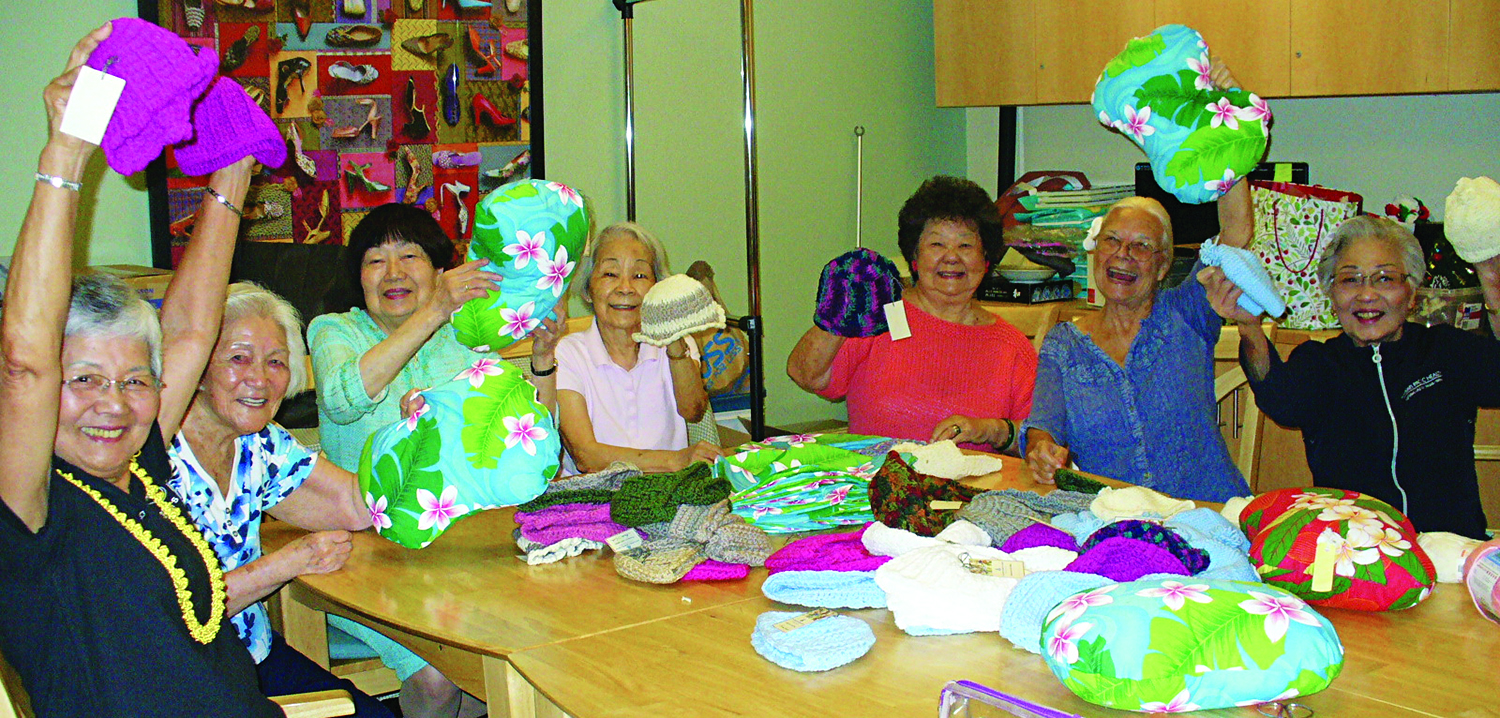
The Volunteers in Place program immediately appealed to the residents of 15 Craigside, a retirement community in Nu‘uanu. A group of about a dozen women — the oldest is 92 — meet Monday mornings to knit, crochet, sew or stuff pillows.
“We laugh, we roar, sometimes we’re so loud,” said volunteer Willie Faria. Another volunteer,
Violet Irinaka, joked, “It keeps you out of trouble.”
Last June, Pearl City resident Barbara “Bobbie” Omoto retired from the University of Hawai‘i Athletic Department where she served as secretary for the men’s basketball team. Now, the 73-year-old grandmother devotes her love for crocheting to Queen’s patients. “I get a sense of joy from doing this,” Omoto said. “I’m happy if I can make something that someone can use, and they can be happy, too. That’s enough for me.”
SEEKING VOLUNTEERS
If residents of your retirement community can knit, crochet or sew and are interested in the program, or in donating Hawaiian-print fabric, stuffing or knitting and crocheting supplies, please call Queen’s Volunteer Services at 808-691-4397.
THE QUEEN’S MEDICAL CENTER
Volunteers in Place program (VIP)
808-691-4397
queensmedicalcenter.org/be-a-volunteer-home
Yoko Futa, an 83-year-old former clerk for the Dept. of Transportation, volunteers for about 10 hours a week, helping patients at Queen’s hospitals. Yoko Futa is a member of The Queen’s Medical Center’s Volunteers in Place program, a way for community-minded people and groups to serve at home, centers or sites.
Many family caregivers come home to Hawai‘i to assist aging parents. But how about caregiving overseas? When my mother died, Dad was 93 years old and was already slipping into dementia. His younger brother (in his late 80s), had retired to Luzon, Philippines, with his wife and insisted on providing care for his older brother, who had done so much for him and his family. He converted a part of his home to accommodate Dad and a live-in caregiver.
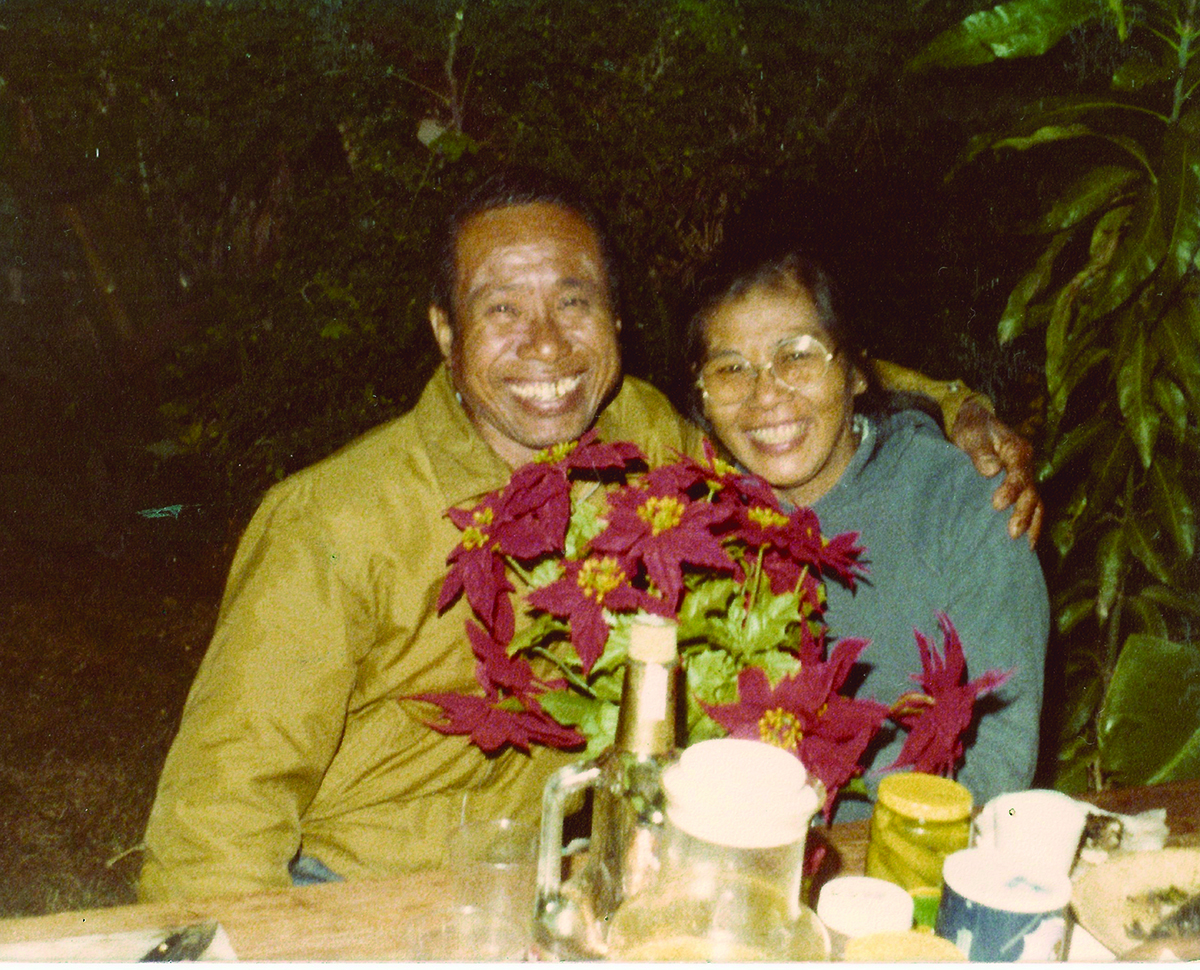 Dad’s retirement income was enough to pay for his 24-hour care there. Luckily, the US dollar’s value made it possible to get the quality… and personal care needed. Plus, his health was good and he didn’t need heavy medical attention — whew!
I had hoped Dad was good with this plan, but the reality of logistics took my brother and me by surprise. To make this move there was plenty to consider, like dual Philippine citizenship in case he needed to utilize the country’s social services and an international bank that offered online banking. My wife and her family there played a critical role lining up qualified caregivers fluent in Ilocano and English — communication was top on our list.
We spent a couple of weeks in Luzon interviewing well-qualified candidates and hired the finalists for one full shift to be sure they were both compatible with and acceptable to Dad. We wanted a focused companion, who would take initiatives and look for changes in health and behavior as Dad’s condition progressed, but foremost one who cared. Uncle was our ears and eyes.
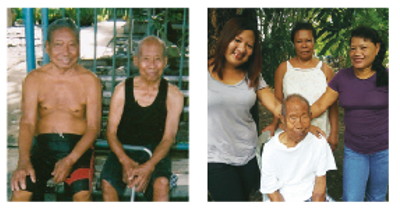
At times, I felt guilty skirting the experience of truly caring for my father personally. Unlike some of my friends who had given up their personal lives to do just that. The 12-hour Manila flight and six-hour bus ride to La Union province every six months was our only contact with Dad, who was too hard of hearing to converse by phone. I wondered if it was the right thing, taking him so far away. I promised to bury him next to Mom. Though the process of bringing his remains home was complicated, I did it. Uncle got to honor his older brother and in turn he relieved us from some of the financial burden required to set up the same personal care here in the States.
All I can say is every family is unique. Caregiving from far away is a logistical maze with very careful planning… and soul searching, even when you have dedicated professionals that your loved one trusts, and a supportive family overseeing the care. Dad was happy and was cared for with love — that’s what mattered most. (Publisher’s advice: Do your research. Speak with legal, financial and health professionals experienced in overseas care.)
Many family caregivers come home to Hawai‘i to assist aging parents. But how about caregiving overseas? When my mother died, Dad was 93 and slipping into dementia. His younger brother had retired to the Philippines, with his wife and insisted on providing care for his older brother, who had done so much for his family.
How does one keep the interest of the elderly? It can be challenging. Nature walks, painting, board games, puzzles, word and picture games are among the typical activities of the elderly.
How does one maintain their interest level? This is where you have to be creative and think “outside the box.” Daily walks become nature walks and scavenger hunts. Giving ordinary activities “new” names to spice it up a bit is a good idea. It gives everyone something to look forward to and may excite them. Some examples: Dancing Tuesdays (exercise day), Bingo Wednesdays, Spa and Salon Thursdays, and Happy Hour Fridays. You can’t forget about Donut Saturdays and Spaghetti Sundays.
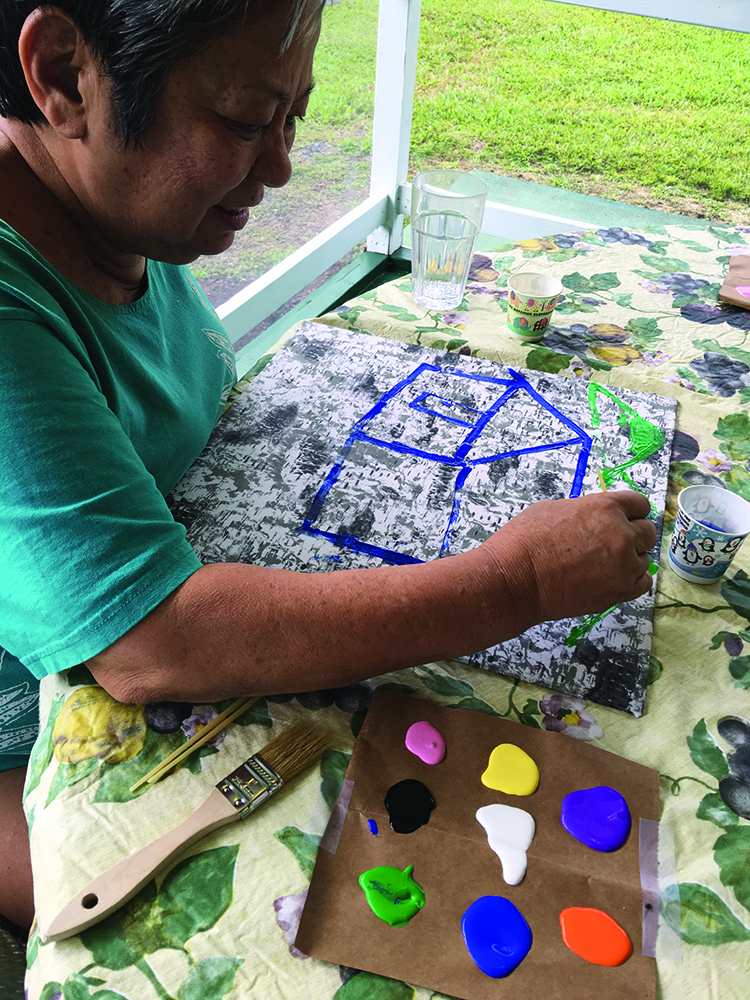 Make a space in your home, or assisted living facility, where the residents can display their works of art. Painting is an all-time favorite, and having a “Hallway of Art” will be of interest to the painters as well as family, friends or visitors. There can also be “Gallery Night” to show off the paintings to see these masterpieces.
It’s all about being creative, thinking outside the box and creating life-enriching activities that stimulate the whole person — the body, mind and soul of each individual.
KINOLAU HOME MALAMA, LLC
15-1735 19th St., Kea‘au, HI 96749
808-982-5415 | facebook.com/kinolauhomemalama
How does one keep the interest of the elderly? It can be challenging. Nature walks, painting, board games, puzzles, word and picture games are among the typical activities of the elderly.