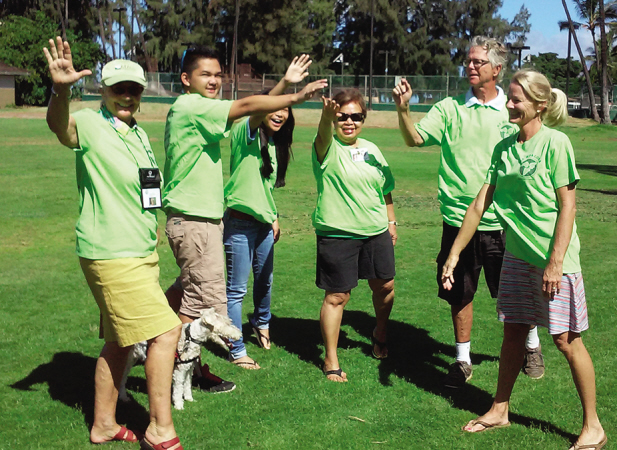
Senior health and wellness fairs are held on all islands to promote education, entertainment, food and fun. It was my honor to be a VIP at the Helemano Plantation’s Moon Festival Country Fair in Wahiawa on Sept. 17. I met the founder, president and CEO, Susanna Cheung, learned about her background, and felt her passion to assist the community with a wellness center which sits on part of their 50-acre property.
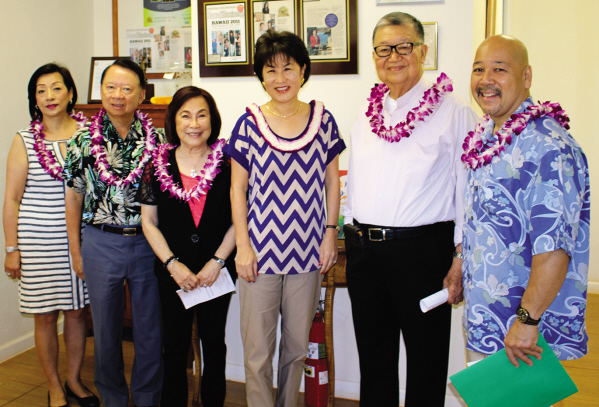
Christina Chen, Dr. Ming Chen, Susanna F. Cheung, First Lady Dawn Amano-Ige, Ho-Ming Cheung and Councilman Ernie Martin.
Hawai‘i’s First Lady Dawn Amano-Ige and Honolulu City Council chairman Ernie Martin talked about being impressed with the Susanna’s facilities, programs, staff, and volunteers. There was a variety of entertainment, with a private tour and special oxtail soup lunch in the well-known Country Inn Restaurant, plus the best pineapple pie I ever tasted.
The Ho-Ming and Susanna Cheung Foundation were the event sponsors. I know it was their generosity that paid for the bento lunch and transportation for the Koolau Seniors to attend (I’m a little partial to them because I’m from Kaneohe), along with senior groups from Pearl City, Waipahu, and other areas of O‘ahu. All attendees enjoyed their day of celebration with Helemano Plantation.
To learn more about Helemano Plantation’s senior educational classes and facilities, visit them at 64-1488 Kamehameha Hwy (next to Dole Plantation) or call 808-622-3929.
Stories for and about seniors and their caregivers are always worth sharing, like a 100 birthday announcement, call Sherry at 808-722-8487.
Senior health and wellness fairs are held on all islands to promote education, entertainment, food and fun. It was my honor to be a VIP at the Helemano Plantation’s Moon Festival Country Fair in Wahiawa on Sept. 17. I met the founder, president and CEO, Susanna Cheung, learned about her background, and felt her passion…
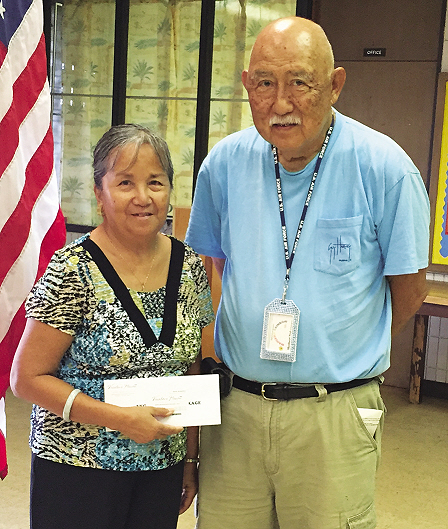
Winner Jeannette Shounk and Herb Nakagawa, president of Wahiawa Rainbow Senior Club
Wahiawa – Jeanette Shounk of Wahiawa Rainbow Seniors Club won a free Vacations Hawaii Las Vegas travel package for two. The round trip air fare and four night stay is provided by Vacations Hawai‘i, the popular travel company that specializes in mainland destinations for people in Hawai‘i. Presenting the prize were both our Generations Magazine representative Sherry Goya and Wahiawa Rainbow Seniors Club President Herb Nakagawa.
Seniors were able to participate in the drawing at the GM booth at the 2015 Seniors Fair. Thousands of seniors, many accompanied by loved ones and caregivers, reviewed the many exhibits. There was a new focus on health and fitness activities and products for active seniors.
A special thank you to everyone who came by to see us, and Congratulations Jeanette!
Wahiawa – Jeanette Shounk of Wahiawa Rainbow Seniors Club won a free Vacations Hawaii Las Vegas travel package for two. The round trip air fare and four night stay is provided by Vacations Hawai‘i, the popular travel company that specializes in mainland destinations for people in Hawai‘i. Presenting the prize were both our Generations Magazine…
The Hawaii Parkinson’s Association (HPA) is a nonprofit volunteer group comprised of people with Parkinson’s disease, caregivers, family members, health care professionals, educators and leaders in the business community. Our mission is to support ongoing research into the cause of and cure for Parkinson’s disease, and to educate patients, caregivers, and the public about how to live well with Parkinson’s, here and now.
Hawaii Parkinson Association was established in 1996, and in 2012 affiliated with the National Parkinson Foundation. Beginning January 1, 2016, the organization will again reorganize as HPA and all funds raised by HPA will stay in Hawai‘i to support our local mission.
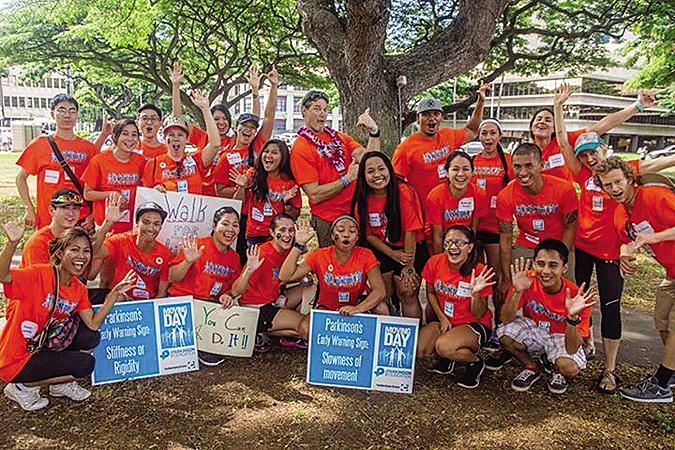
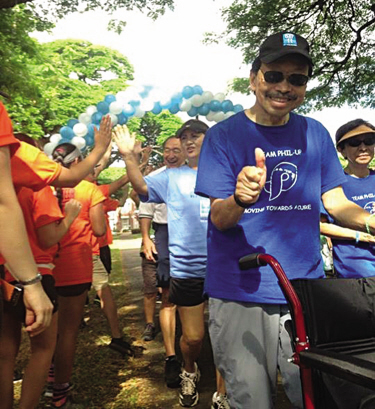
In October, a large number of supporters join a walk for Parkinson’s awareness at the HPA “Moving Day” event. To learn more email: movingday@parkinson.org.
Parkinson’s disease is a chronic, progressive neurological disease that causes brain cells controlling movement to die without being replaced. The most noticeable symptoms of Parkinson’s disease include slowness of movement, tremor, rigidity and difficulty with posture and balance. Parkinson’s disease is the second most common neurological disease in the nation.
In addition to having a strong support network at home and in the community, exercise and physical activity are keys to living well with Parkinson’s disease. HPA acts as the hub of information for people living with Parkinson’s disease in Hawaii as well as their caregivers.
We currently manage eight support groups for patients and caregivers. HPA also funded the development of exercise classes designed specifically for people living with Parkinson’s, which YMCA of O‘ahu offers at six of their locations. HPA offers educational seminars and workshops throughout the year on important topics: medication management, deep brain stimulation therapy, physical activity and exercise, and how patients may gain access to local clinical trials.
People living with Parkinson’s disease need not face the future alone or with uncertainty. Listen to what Sheldon Hershinow from O’ahu has to say:
“I am deeply grateful for the range of information that Hawaii Parkinson’s Foundation provides. I’ve gained valuable insights from symposia, workshops and support group meetings, allowing me to ask my own neurologist the right questions and to select the best machines for me at the gym. The organization has led me to enjoy twice-weekly movement classes that encourage me to do my best without worrying about any shortfall.”
The Hawaii Parkinson’s Association (HPA) is a nonprofit volunteer group comprised of people with Parkinson’s disease, caregivers, family members, health care professionals, educators and leaders in the business community. Our mission is to support ongoing research into the cause of and cure for Parkinson’s disease, and to educate patients, caregivers, and the public about how…
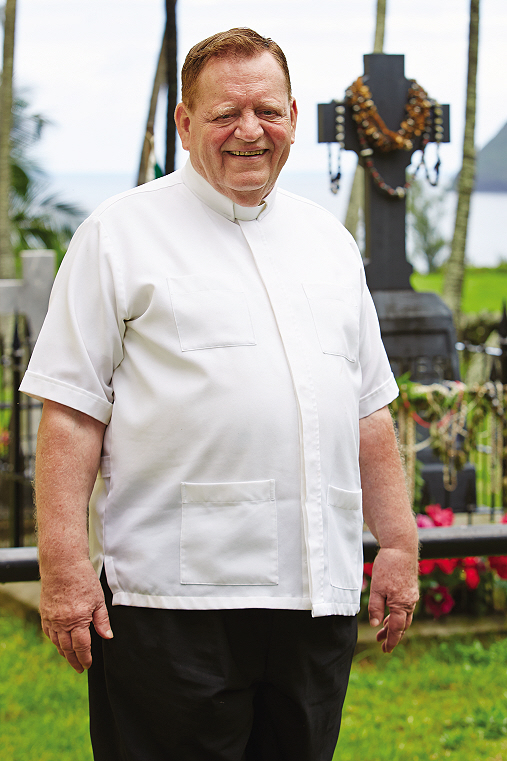
Father William F. Petrie, sscc, looking over Kalaupapa Settlement from the cross atop the Kauhako crater.
Bill Petrie is a priest with the Congregation of the Sacred Hearts of Jesus and Mary — the same order as St. Damien. With Mother Marianne Cope, the Sisters of St. Francis of Syracuse and volunteer Joseph Dutton, Damien brought the love of God and dignity to Hansen’s disease patients exiled at Kalaupapa.
Inspired by the life of St. Damien, Father Bill worked 25 years in India with Mother Teresa of Calcutta, helping the poorest of the poor and many who were afflicted with Hansen’s disease. Now he serves as Pastor of St. Damien Church on Moloka‘i and supports Catholic ministry to the last Hansen’s disease patients in Hawai‘i.
Many seniors and baby boomers returning to the church and looking for the God of their youth, are inspired by the story of Damien’s love for God and the patients of Kalaupapa. Faith, hope and love help us face uncertainties at the end of life. Father Bill’s joy and enthusiasm are infectious and people want to be around him — like St. Damien won the hearts of patients in Kalaupapa.
So we asked Father Bill to share his wisdom on new beginnings — the transitions of life. His counsel is simple: change will come, so embrace closure and take time to prepare for the next step on your path. His kind, humble words offer a quiet oasis amid the chaos of our boisterous world.
Take a few moments to hear what father Bill learned from the joy, peace and love of Mother Teresa and Saint Damien.
My Beginning as a Priest
Without realizing it, we face many new beginnings in our lives, some small and others life changing events. One such new beginning was my being inspired to become a Catholic priest after reading the life of Father Damien of Moloka‘i, a vision so profound that it was to lead me to work with Mother Teresa of Calcutta helping Hansen’s disease patients in India. I started by writing a letter. Mother Teresa didn’t answer, so I sent a second note with a $250 donation, for her work with the poorest of the poor. Again, no response. Then my superiors gave me permission to visit India, so I wrote her again, saying I wanted to help with the work and giving her the flight, time and day of my Calcutta arrival.
Father Bill Petrie’s life path began with being inspired by St. Damien. It led to priesthood, and 25 years working with the poor and Hanson’s disease patients in India with Mother Teresa.
Wow, no one was at the airport to meet me! I thought, am I just doing my own thing or is this truly an inspiration from God? After spending the night in a city lodge, I found a telephone book and the number of the Missionaries of Charity, the religious society that Mother Teresa founded in 1950. Anxiously making the phone call, I heard a voice answer and then stated who I was — I wished to speak to Mother Teresa, and my purpose was to volunteer and help with her Hansen’s disease work. The delicate but firm voice said: “This is Mother Teresa; come right over.”
We became friends the first moment we met. The chemistry between us created a bond and new beginning that would last 25 years, from 1975 to 2000. Mother Teresa explained that she never received my letters or the donation, but it didn’t make any difference. I made this journey to the unknown in faith, and there was a place for me in the Hansen’s disease work.
Another phase of my life was beginning. I was to realize that closure must be followed by a neutral time of reflection and preparation for a new beginning. I had worked in a loved-filled parish setting for several years, and leaving it was difficult for both the people in my life and me. That was closure. The old expression, “love is being able to let go,” won out. Then a neutral time followed when I spent almost a year preparing, obtaining more medical knowledge and learning rehabilitation skills. Then I remember it well — June 29, 1975, at 33 years old — my new beginning started. I can compare the experience to the date of a graduation or marriage.
Learning to cherish the dates of new beginnings starts with your remembering your birthday. And remembering the first day of a new adventure develops a sense of gratitude. Being grateful is the very foundation of obtaining happiness. Seeing both the good and the bad learning opportunities, accepting what life brings, and letting go of negative aspects allows us to be ready to move on. Taking things as they come or as they are “given” brings ongoing satisfaction with yourself and all your daily activities.
Beginning to Grow in Wisdom
Reading books about St. Damien eventually allowed me to see Damien as a role model for my life. I learned about the people who supported his work, Franciscan sister Saint Marianne Cope, who spent over thirty years at Kalaupapa and Joseph Dutton, a layman who worked in Kalaupapa for forty-two years. That these people freely and willingly embraced serving people rejected by the world, gave me a sense of awe. What made them do it, in those days, when there was little understanding of Hansen’s disease or its transmission.
My association with Blessed Mother Teresa gave me insights into their Moloka‘i beginnings. I had experienced some of the hope and tender joy that sustained them, brought them happiness, complete fulfillment and daily work satisfaction. Mother Teresa told me that the most important part of helping the suffering is to “be there.” Saint Damien, Saint Marianne, and Joseph Dutton were experts at “being there.” This lesson could be applied by any faith-filled person and especially by caregivers who might be reading this article.
After three years working at one of Blessed Mother Teresa’s Hansen’s disease Rehabilitation Centers, I was assigned to assist her missionary sisters in another location to help construct another rehab facility. The Catholic Church in that area had an “Archdiocesan Leprosy Office.” At my request, the Bishop changed the name to a “Human Life Center” for promoting personal, interpersonal and community growth, based on the prayer of Jesus, who asked God that we “would have life abundantly.” The life that Blessed Mother Teresa was living and imparting was exactly that — abundant life, full of productive faith, hope and dignity. I think abundant life is also what Damien, Marianne and Joseph Dutton were able to help the patients of Kalaupapa achieve. The Moloka‘i trio was successful despite the isolation of Kalaupapa and Kalawao. With limited resources and support, they offered the patients many new beginnings. With modern communications and the jet age, Blessed Mother Teresa exercised her faith and shared the abundant spiritual life in over 120 countries around the world.
Everyone has Charisma
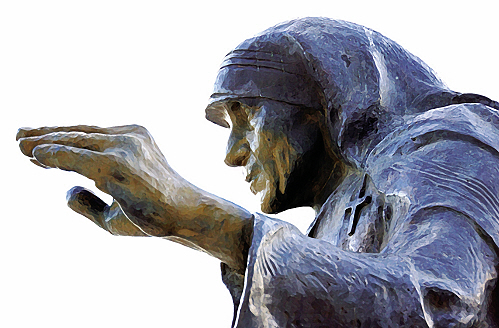
Mother Teresa
Do we have that which Blessed Mother Teresa had — that drive that made her love for God and neighbor so powerful? We may call it charisma, one of those divine gifts that we receive at birth. Each person has to discover what his or her gifts are. It is not a specific characteristic but a variety of different aspects of our personality. Our individual charisms have an impact when we create energy — when we do or say things. Becoming charismatic is going out and getting involved in life, putting your skills to use, experiencing excitement, creating joy and even accepting the pains and sorrows of life. Blessed Mother Teresa saw Saint Damien as one of her role models. His work inspired, strengthened and nourished her Hansen’s disease medical and rehabilitation work. Saint Damien was a Catholic priest of the Congregation of the Sacred Hears of Jesus and Mary, the same order to which I belong. Mother Teresa brought me to New Delhi to meet Prime Minister Rajiv Gandhi and said: “India needs Fr. Damien’s Congregation.” This encounter created another new beginning, a religious formation program in India for men and women who felt called to join the same religious family as Saint Damien. The charism of our religious congregation is “to contemplate, witness and proclaim the mystery of God’s love.”
Significant Others in Our Lives
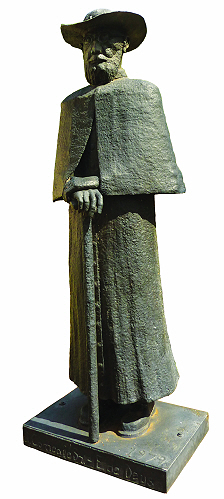
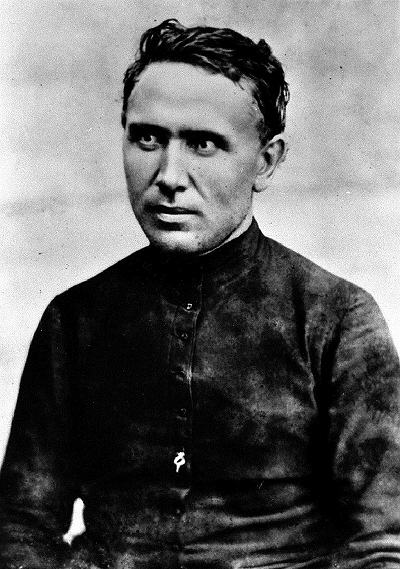
Saint Damien, photo credited to Sacred Hearts Archives, Rome
Spiritually charismatic individuals empower people around them. Through Blessed Mother Teresa’s sponsorship for 25 years in India, it was possible for me to experience many new beginnings, starting medical clinics, creating informal education programs, and acquisition of land for the construction of hundreds of houses for homeless Hansen’s disease patients. Especially important was helping the children of patients — to protect their health, encourage education and provide skill training for employment. The lives of
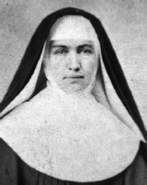
Saint Marianne
Damien, Marianne and Dutton inspired me, but it was my association with Blessed Mother Teresa that empowered me to share Damien’s vision with others and continue his work. “Significant others,” has nothing to do with having a special partner. Rather it is recognition of what has happened in my life because of their inspiration. Blessed Mother Teresa and Saint Damien were significant others for me and countless people. Anyone who accepts them as role models, gets energized.
Sacred Presence
There is a quality that all people have in varying degrees. I call it “sacred presence.” I experienced it when working in India. Blessed Mother’s mobile clinic distributed medicine once a week. One week there were no medical supplies, so the clinic didn’t take place. The following week when the medicines arrived, one of the patients asked Mother Teresa where she was last week. She responded that they didn’t come because there were no medicines. The patient replied that it didn’t make any difference if there were no medicine — she should have come anyway. Wow! What a powerful lesson that was for me. Distribution of medicine, food or clothing was not as important as the presence of Mother Teresa herself. That’s when the concept of sacred presence became a reality for me. In some ways, we are all practicing it when we attend a wake of a deceased person. We don’t need to be concerned about what we will say to the bereaved family because just being present affirms and uplifts those in mourning. Sacred presence is the best gift we can bring to a wedding, a graduation, or a reunion. When individuals are filled with God’s love, they have a spiritual empowerment, which radiates to others. My understanding of Saint Damien is conveyed to me by some insights Mother Teresa taught her volunteers. She would tell them that it’s not how much you give, but the love you put into the giving. When gathering with other people, make sure everyone leaves a happier and better person. Smiling at someone is an action of love, a gift to that person. Small gestures exercise and strengthen the sacred presence that surrounds us when we love God and our neighbor.
Despite all that Damien had to endure, we marvel at his sacred presence when he wrote that he was the happiest missionary in the world! His spiritual joy enriched everyone who was around him. He confessed that he received his strength kneeling at the altar, in prayer. Don’t we all need a daily silent and prayerful time? A rich celebrity once admitted to Mother Teresa that he felt guilty in her presence because of the great work she did for the poor. He was comparing his life to hers and felt that he fell a little short. Her simple answer was stunning — she didn’t tell him to change his ways. she encouraged him to be holy in his life, just as she was called to be holy in her life. Her response consoled and energized him. Mother Teresa was inspiring him with her presence and encouraging him to live abundantly.
Discovering Sacred Places at Kalaupapa
The word “sacred” is derived from the Latin word sacre, which means restricted or set apart. An extraordinary person, place or object can be designated as sacred, and may seem to have a different reality from natural or normal things. The sacred is always connected with divinity and religion. One of the oldest sacred places on earth is the Holy Land, visited for millennia by pilgrims and tourists. In Asia, people visit the sacred Taoist and Buddhist mountains. The tourist travels on a vacation; the pilgrim journeys as a purposeful spiritual act. There are many sacred places in the world connected to the sacred presence of an individual. A pilgrimage to Kalaupapa/Kalawao on the island of Moloka‘i can be a very memorable vacation, a peaceful retreat for making life decisions, or even a new beginning. Over eight thousand Hansen’s disease patients lived and died on this sacred land. Hundreds of dedicated workers and medical personnel lived at Kalaupapa/ Kalawao, often at great sacrifice. For Catholics, the lives of Saint Damien and Saint Marianne are a source of inspiration. The Latter Day Saints, Protestant churches and Buddhists all have a history of committed individuals in ministry here. By making a pilgrimage to Kalaupapa, you learn the historical context for the canonized saints and countless other holy people who died here.
A view to Kalaupapa pier from the courtyard of St. Francis Catholic Church. Photo courtesy of Father Pat.
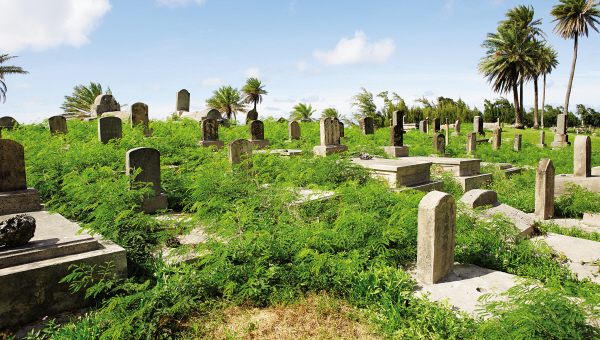
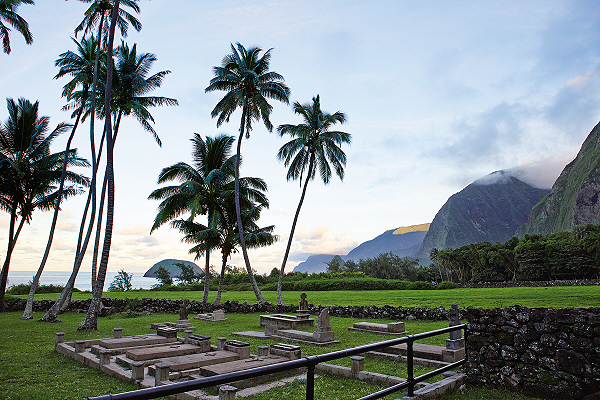
Papaloa Cemetary, resting place of some of the 8000+Kalaupapa residents
HANSEN’S DISEASE
An ancient disease described in Bible was called “leprosy” in English, after the Latin, lepra, meaning “scaly.” Today we call it Hansen’s disease, named for Dr. Gerhard Henrik Armauer Hansen, a Norwegian physician who identified the bacterium that causes the disease, Mycobacterium leprae. Hansen’s disease is transmitted among humans the same way we pass on colds. In the past 20 years, modern antibiotics have cured over 200 million cases of Hansen’s disease worldwide.
Beginning to Learn About Kalaupapa
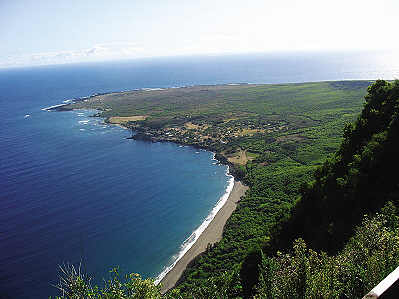
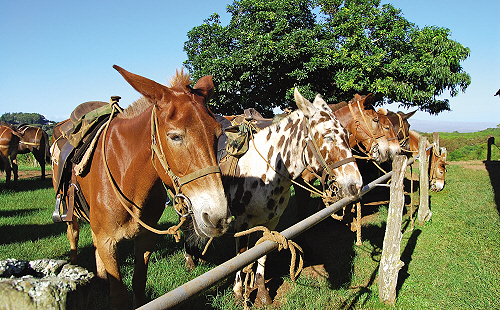
Unless a patient or worker personally invites you to visit Kalaupapa, the only way to tour the settlement is on an approved four-hour Damien Tours and arranged access via Makani Kai airlines or Kalaupapa Mule Tour. The mule train descends a path down a majestic 1800-foot cliff that separates Kalaupapa from the rest of Moloka‘i Island.
The success of a spiritual journey to a sacred destination always depends on the individual. When you visit Kalaupapa, I recommend taking time for silent reflections at each special site Damien Tours visits. Breathtaking views of huge cliffs we call the “Pali” and the rock-bound coast that isolate Kalaupapa from the rest of the world end with the arrival of your nine-passenger plane at Kalaupapa landing strip, one of the few USA airports without TSA equipment and security personnel. The open-air pavilion, a picnic area for residents, echoes bygone days of trust and goodness. Your tour guide, the driver of an old school bus, awaits at the Kalaupapa welcome sign.
Photo provided by Wikipedia
On the road to the settlement, Papaloa Cemetery is the first reminder of the eight thousand plus patients who died here. So many graves on a little spit of land make us reflect upon our own death and funeral. Saint Damien and Mother Marianne saw funerals as celebrations and liberation from the burdens of life to a new heavenly life — another new beginning.
Next, the bus passes the Mormon Church, a reminder that Hansen’s disease was without boundaries. The driver points out the Kalaupapa pier, and we try to imagine steamers mooring offshore and small rowboats bringing patients ashore. Damien always came to welcome the saddened newcomers. Many were overcome with grief, knowing they could never return home to their loved ones. Exile was permanent.
The bus stops briefly at St. Francis Catholic Church, where a Congregation of the Sacred Hearts priest celebrates Mass every morning. Nearby stands the Congregational church. These three churches are a reminder that faith in God gave generations of patients strength, hope and meaning to their lives. Only the convent and St. Elizabeth Chapel remain on the spacious land that once housed and ministered to hundreds of girls and women, giving them love, care, protection and dignity. The Bishop family supported a home for girls where St. Marianne and the Franciscan Sisters ministered to single females and young girls, some of whom were orphans. On ruins of a former hospital destroyed by fire is a new clinic where a medical staff attends to several patients and workers still living in the settlement.
Another vacant parcel of land marks the site of the Baldwin Home for boys and men. Volunteer Joseph Dutton and the Sacred Hearts Brothers were the caretakers for the men.
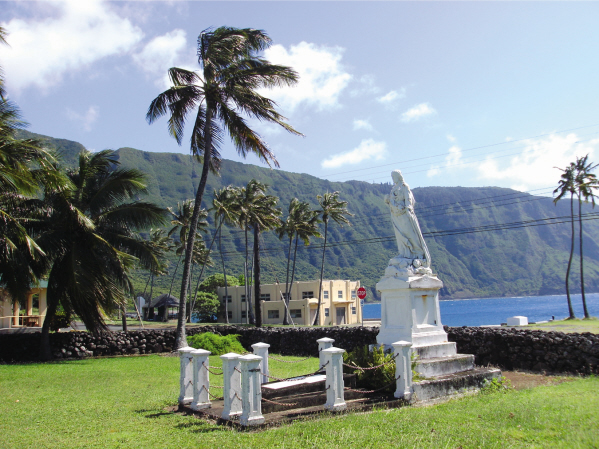
The tour stops at the memorial grave of Saint Marianne, who also started Kapiolani Home for Girls on O‘ahu and Mauilani Hospital on Maui. This joyful nun used to say she worked “not for reward, but for God.”
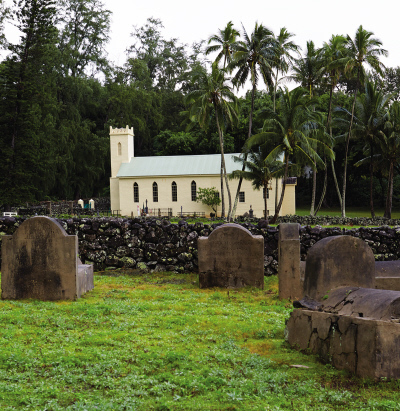
A view of St. Philomena Catholic Church from the south, across open fields of unmarked and marked gravesites.
Next, the bus drives by former patient homes and the visitors’ reception center. The patients’ cafeteria is still used every day, and a former movie hall is used for holiday celebrations during the year. The bus turns left on Damien Road, which leads to Kalawao where the original settlement was established. The first structure seen is the Siloama Church, constructed by the patients one year after arriving in 1866. A boundary wall separates the compound where St. Damien lived and constructed the Saint Philomena Catholic Church. Beside the church are the original graves of St. Damien and Joseph Dutton. The sacred land surrounding the church holds over one thousand unmarked graves. A memorial will be constructed to remember the names of all the 8,000 or more patients who died in Kalaupapa and Kalawao.This is very sacred ground; peace and quiet envelop you. Take time to quietly sit, meditate or pray. Across the road are the remains of the original home for boys and girls, before the settlement moved to Kalaupapa. Old photographs are helping the National Park Service renovate the landscape as Kalawao looked over a century ago.
Deep silence, broken only by wind and surf, draws every tourist or pilgrim inward. They have personal thoughts about the sorrow and pain endured by the Hansen’s disease patients who lived here. Kalaupapa calls us to reflect — it is a memorial to closure, extended quiet, neutral time of preparation, and accepting new beginnings.
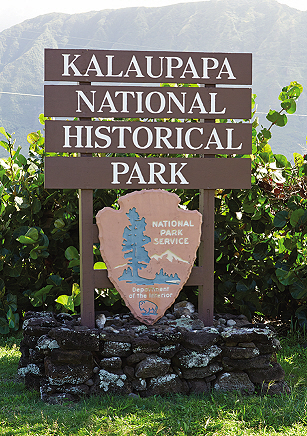
The road continues. Today, National Park Service workers are preparing Kalaupapa and Kalawao for the time when there are no more Hansen’s patients living here. The settlement will be preserved and managed as a national historic park. I am privileged to be the Pastor of St. Damien in Kaunakakai, and to be able to assist residents and workers in Kalaupapa as they transition. I minister to my congregation in the tradition of St. Damien and St. Marianne, with the training of Mother Teresa. I, too, am a happy missionary. Like my special “others,” I look forward, with joy and gratitude, to more new beginnings.
For the adventurous, a Damien Tour begins with a mule ride on a switchback trail descending 1800 feet.
FATHER DAMIEN TOURS
The only way to visit Kalaupapa is through Father Damien Tours. They operate a four-hour tour of Kalaupapa Settlement and Kalawao daily (except Sunday). There are three ways of getting to Kalaupapa:
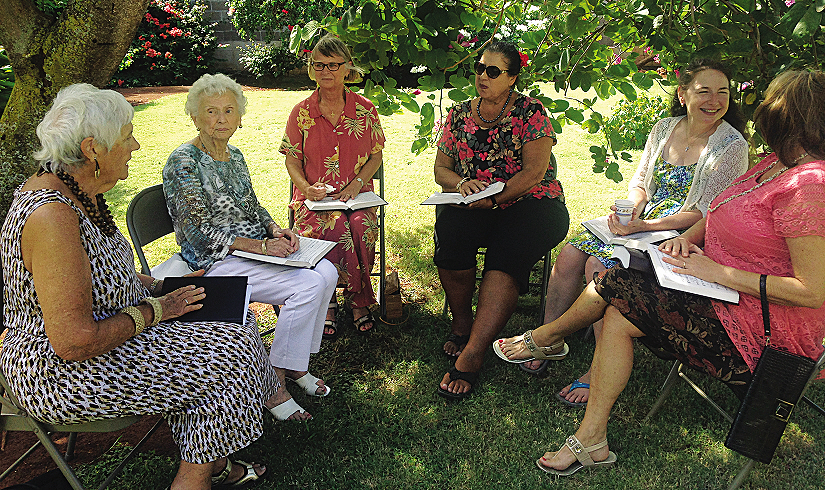
We age like a book and advance, hopefully, toward maturity through the rise and fall of the turning pages of our lives. Consequently, when members of the West Maui Book Club come together to discuss a novel, we’ll often share\ relevant chapters of our personal stories. For us, this is the greatest benefit of all.
Kelli Lundgren, a member since 2013, says, “Since joining, I’ve listened to stories of personal travel to South America and Malaysia. Members shared accounts of being stranded in politically tense areas of the world and in compelling cultural and political experiences.” It “stirs the soul.”
Mihaela Stoops, a member since 2011, adds, “This book club satisfies my need to have an intelligent conversation. It stimulates and challenges me, makes me learn new things and gives me new perspectives.” It’s “awesome.”
Victoria Caputo, a member since 2010, says that at any age, a book club provides brain wellness through conversation and critical thinking.
And according to Diane Pure, an original member in 2005, the West Maui Book Club creates a sense of community and support for one another. She enjoys sharing social time with talented women from different life and work experiences.
Yes, we love to read and discuss our book selections, but sharing relevant wisdom gained through the saga of our lives is the greatest benefit of any book club. So why not join one and experience how your gained insights can help others? In return, expect your life to be enhanced by other members in new and thought-provoking ways.
“There are no faster or firmer friendships than those formed between people who love the same books.” — Irving Stone
We age like a book and advance, hopefully, toward maturity through the rise and fall of the turning pages of our lives. Consequently, when members of the West Maui Book Club come together to discuss a novel, we’ll often share\ relevant chapters of our personal stories. For us, this is the greatest benefit of all.…
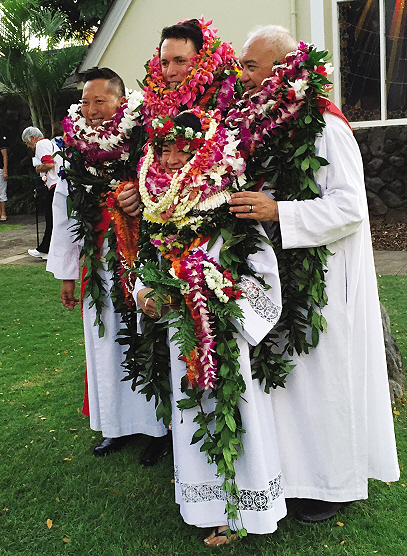
Four mature Native Hawaiians, including two retirees, recently were ordained as deacons of the Episcopal Diocese of Hawai‘i. In the spring, “God willing and the people consenting,” they will become Episcopal priests.
(L–R) Phyllis Mahilani “Mahi” Beimes (in front, among the lei), L-R: Malcolm Keleawe, Paul Nahoa Lucas, John Hau‘oli Tomoso, Episcopal Deacons
Phyllis Mahilani “Mahi” Beimes is the first Native Hawaiian woman to be ordained in the worldwide Anglican communion. After she retired as a Pearl Harbor submarine electrician, her congregation called her to enter the priesthood. She and her husband live in Kane‘ohe; their children live nearby. She is a member of St. Johns-by-the-Sea in Kane‘ohe, as is Paul Nahoa Lucas, who answers his call for the priesthood from his position as a compliance lawyer for Kamehameha Schools. He and his family live in Ka’a’awa, and his youngest son is a college freshman on the mainland.
Malcolm Keleawe Hee comes from a Buddhist upbringing. He excels as a special education teacher, and instructs teaching majors at Chaminade University. Malcolm, his wife and their two daughters’ faminies reside in Palolo. He is a member of Good Samaritan Church.
John Hau‘oli Tomoso is executive director of Tri-Isles Conservation and Development Council Inc. His life has been deeply connected to social work in the Hawaiian community and he serves as kahuna pule for the Royal Order of Kamehameha. A member of Good Shepherd Church, he lives in Wailuku with his wife and mother; grandchildren are nearby.
In Hawai’i, seniors who are called to serve the church as clergy undertake rigorous study and spiritual formation without either moving to a mainland seminary or disrupting familes and careers.
These four deacons are completing a three-year formation program on O‘ahu, meeting for 10 weekends a year. Meetings include academic courses, monthly exams, practical workshops, spiritual development and worship. Each candidate has completed two years of church fieldwork.
When ordained as priests, they will join a regional clerical team or a congregation; later, they may be called to serve any Episcopal church in Hawai‘i; some may even get a salary. Nine more students are preparing for ordination in 2018.
Mature deacons and priests bring to their ministries valuable lifelong experience with Hawai‘i’s varied cultures and their deep roots in the community. Native Hawaiian priests honor the tradition of Queen Emma and Kamehameha IV, who in 1862 invited the Church of England to be established in Hawai‘i.
For further information, call Reverend Linda Decker on Maui at 808-244-4656 or email her at office@goodshepherdmaui.org.
Four mature Native Hawaiians, including two retirees, recently were ordained as deacons of the Episcopal Diocese of Hawai‘i. In the spring, “God willing and the people consenting,” they will become Episcopal priests. Phyllis Mahilani “Mahi” Beimes is the first Native Hawaiian woman to be ordained in the worldwide Anglican communion. After she retired as a…
Statistics show that a majority of U.S. patients who require an amputation are age 65 and older. Amputation will likely intensify feelings of dependency, depression and helplessness: I’m too old now to learn to live without a limb. Who cares anyway? Who knows how many years I have to live?
Limb loss is a serious challenge, and the more flexible and open-minded you are, the more quickly your body will heal and your lifestyle will adjust.
A positive outlook and hard work can improve one’ recovery. Take 71-year-old Paula Harris, who was struck in a crosswalk by a truck and lost part of her right foot.
“I have always been self-sufficient and it definitely took the wind out of my sails at first,”she said. “Anxiety and thinking I’ never walk again started to go away as soon as I began physical therapy. I found a PT who listened to all I was dealing with. Her encouragement and coaching kept my eye on the prize of walking again.”
Paula’s sense of purpose motivated her to stay active and mobile. She looked beyond her age and pushed herself to higher levels of rehabilitation —driving, dancing and golf. If you are aging with limb loss, a new amputee or a caregiver, I hope Paula’s story will inspire you.
Moon Physical Therapy, LLC 320 Ward Avenue, Suite 107, Honolulu, HI 96814 Aquatic, Land-based and Manual Therapy and Cardiopulmonary Rehab Programs 808-597-1005 | www.moonpt.com
Statistics show that a majority of U.S. patients who require an amputation are age 65 and older. Amputation will likely intensify feelings of dependency, depression and helplessness: I’m too old now to learn to live without a limb. Who cares anyway? Who knows how many years I have to live? Limb loss is a serious…
Here are some very common questions that people ask our SHIP staff and volunteers. If you have a question, visit our website, call us or schedule an appointment. We have the answers. If you want to help your community, become a SHIP Volunteer — it’s a very satisfying job.
THREE COMMON QUESTIONS:
Is Medicare only for people over 65 years old?
Most Medicare beneficiaries are over 65, but people with certain disabilities or those who have received Social Security Disability Income for 25 months are eligible too. In Hawai‘i people with Medicare range from ages 18 to 100+ years old.
Does Medicare pay for long-term care?
Medicare does not pay the largest part of long-term “skilled nursing” care in a facility or in the home. Custodial and Interim care are also not covered. Some Medigap or advantage plans may cover very limited “skilled nursing” care after hospital stays. Private insurers offer long-term care policies.
Does Medicare pay for dental?
Original/Traditional Medicare does not pay for dental care. Some Medicare health plans have some coverage or a dental rider (additional insurance) that may be purchased.
Hawai‘i SHIP (State Health Insurance Assistance Program) 1-888-875-9229 | 808-586-7299 help@hawaiiship.org | www.hawaiiship.org
facebook.com: Hawaii SHIP
This SHIP project was supported, in part, by grant number 90SA0004-02-00 from the U.S. Administration for Community Living, Department of Health and Human Services, Washington, D.C., 20201. Grantees undertaking projects under government sponsorship are encouraged to express freely their findings and conclusions. Points of view or opinions do not, therefore, necessarily represent official Administration for Community Living policy.
Here are some very common questions that people ask our SHIP staff and volunteers. If you have a question, visit our website, call us or schedule an appointment. We have the answers. If you want to help your community, become a SHIP Volunteer — it’s a very satisfying job. THREE COMMON QUESTIONS: Is Medicare only…
No matter where we stand, when people close to us die, a moment of personal truth emerges based on our perspective.
When we lose someone dear to us, we undergo a time of deep connection to those who are still living and to ourselves. We grieve. We rejoice. We replay special moments — laughing and crying together. We feel sadness and often regret. There is no right or wrong way to endure this transition.
Thoughts from a Daughter of a Mom
“When my mom died, it hit me… we sat going through jewelry and clothes in her closet… Each of us sisters shared bereavement, but each of us grieved differently. We expressed disappointment and sadness, summing up the personality of Mom in our own way, voicing incomplete messages like, “‘I wish I said,’ ‘I wish I did…”.
To live and die without regret means to take this time to work backward — to reverse-engineer those memories step-by-step and fully express our thoughts; clear up any incomplete actions that we had hoped to carry out.
We can’t put off tending to sadness or regret because each memory can become a constant replay: “I should have, could have, would have,” cluttering our minds. Feelings often plague a grieving survivor for many years — or for life.
Take time today to reinvigorate your relationships and connect with your loved ones by being grateful and forgiving. Live rich and treasured lives together. You can do it with a little help.
No matter where we stand, when people close to us die, a moment of personal truth emerges based on our perspective. When we lose someone dear to us, we undergo a time of deep connection to those who are still living and to ourselves. We grieve. We rejoice. We replay special moments — laughing and…
Earlier, I wrote about a woman from Waianae, who added her daughter to her bank account. The daughter was to use the money to pay contractors to remodel the mother’s home. This money was solely the mother’s, but instead of helping the mother, the daughter helped herself to the money (over $200,000) and disappeared.
After writing that piece about how parents need to call the police when their children steal from them — I got inquiries about whether it was really theft since the mother placed the daughter on a joint account. The answer is yes. If the person you add to your bank account contributed nothing to the account, and that person takes money without your permission, a theft has occurred. Access is not ownership.
Say for example that you let your neighbor borrow your car once. You gave him a spare set of keys but never take the time to get the keys back. One morning, your car is gone. Later you find the neighbor went joy riding. He committed the crime of unauthorized driving your car, a class “C” felony. Just because you let him drive the car before, and he had access to it, doesn’t mean he now has a controlling interest in the property.
I caution people about adding others to their bank accounts. It may seem more convenient just to put another person on a bank account instead of writing checks or giving them cash when they need money, but a person runs a risk of becoming a victim of theft and similar crimes like the one mentioned above. Even if the person you add to the joint account is trustworthy, the more people who have access to your account, the greater the risk that it will be compromised — check register errors, a lost or stolen checkbook and identity theft are examples.
One way to reduce the risk of theft of all your money is to create a separate, joint account for a particular purpose, like paying the bills. Only deposit enough money into that account to cover the bills. For example, if your monthly household expenses are $1,000, you can have your personal account automatically deposit that sum into a dedicated joint account with your family member who will be paying your bills. This may seem like humbug to set it up, but it will be much less effort than trying to recover from a crime committed by someone who could not resist the temptation of having access to large sums of money.
Earlier, I wrote about a woman from Waianae, who added her daughter to her bank account. The daughter was to use the money to pay contractors to remodel the mother’s home. This money was solely the mother’s, but instead of helping the mother, the daughter helped herself to the money (over $200,000) and disappeared. After…
This Na Hoaloha Team-4-Assessment includes high school students who want to “keep Tutu safe.” Since September, they have profided workshops and falls asssesments to residents of four senior housing facilities on Maui.
Maui Na Hoaloha has made their falls prevention program, Stay on Your Feet, part of their regular service to clients. Teams-4-Assessment are trained to implement complete falls risk assessments, engage clients in falls prevention training and help clients physically make their living quarters safer. The need is great. Na Hoaloha is seeking more volunteers.
Na Hoaloha currently services 440 home-bound clients with 200 trained volunteers. Their intergenerational approach allows young people to work with Stay on Your Feet assessment teams. Falls are the leading cause of fatal and non-fatal injuries in seniors, so this progran can decrease hospitalizations and deaths due to falls.
Persons who have fallen once are at risk to fall again so the Team assesses fall history, medications, fitness, balance and vision. Teams also provide clients with nightlights, ensure pathways are clear and safe, and help clients plan for grab bar installation.
“Na Hoaloha serves the highest risk seniors who wish to stay in their own homes and live independently,” says Candice Carter, executive director. “For a complete falls assessment, please call us.”
Maui Na Hoaloha has made their falls prevention program, Stay on Your Feet, part of their regular service to clients. Teams-4-Assessment are trained to implement complete falls risk assessments, engage clients in falls prevention training and help clients physically make their living quarters safer. The need is great. Na Hoaloha is seeking more volunteers. Na…

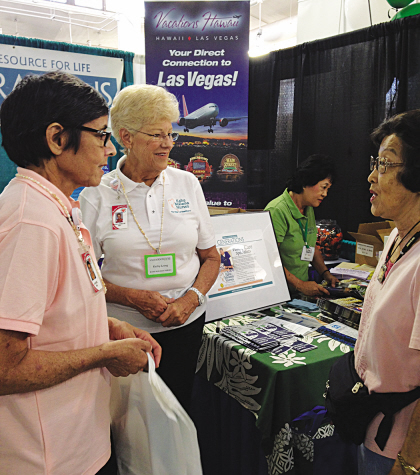 Seniors were able to participate in the drawing at the GM booth at the 2015 Seniors Fair. Thousands of seniors, many accompanied by loved ones and caregivers, reviewed the many exhibits. There was a new focus on health and fitness activities and products for active seniors.
 The Hawaii Parkinson’s Association (HPA) is a nonprofit volunteer group comprised of people with Parkinson’s disease, caregivers, family members, health care professionals, educators and leaders in the business community. Our mission is to support ongoing research into the cause of and cure for Parkinson’s disease, and to educate patients, caregivers, and the public about how to live well with Parkinson’s, here and now.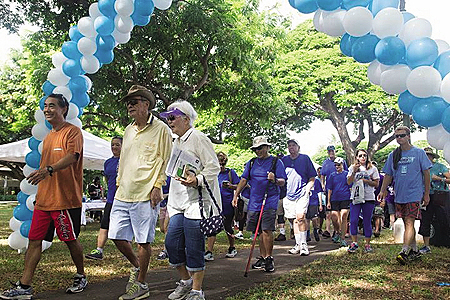
 People living with Parkinson’s disease need not face the future alone or with uncertainty. Listen to what Sheldon Hershinow from O’ahu has to say: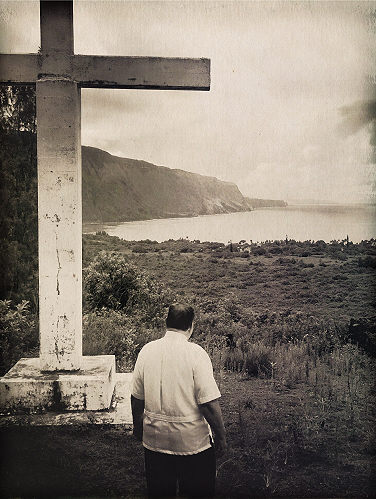
 Statistics show that a majority of U.S. patients who require an amputation are age 65 and older. Amputation will likely intensify feelings of dependency, depression and helplessness: I’m too old now to learn to live without a limb. Who cares anyway? Who knows how many years I have to live?