Category: Dec 2020 – Jan 2021

  • COVID-19 Testing & Virus Symptoms

    When should you get tested for COVID-19? Which of the three main types of tests for COVID-19 will you be given?

    Three main types of tests for the coronavirus

    1) Molecular Testing: This FDA-approved method tests for the virus’ DNA or genetic material. This type of testing is typically processed in a certified lab where it could take 24 to 48 hours or longer to get results. Although, none of the tests are 100 percent accurate, this one is preferred  or the best accuracy.
    2) Antigen Testing: This FDA-approved method is a rapid test that can produce results within 15 minutes. This test is very useful for screening due to its quick turnaround time. However, it is less accurate than molecular testing. A negative test result may need to be confirmed by a molecular test.
    3) Antibody Testing: This blood test result will reveal whether or not you have been infected by the coronavirus in the past. It may take weeks for antibodies to be detected in your blood after contracting the virus. This test is not used to diagnose coronavirus.

    When should you get a test?

    According to the Centers for Disease Control & Prevention (CDC), people with COVID-19 have exhibited a wide range of symptoms — ranging from mild to severe. Symptoms may appear two to 14 days after exposure to the virus. The following list includes some, but not all possible symptoms.

    • Fever or chills
    • Cough
    • Shortness of breath or difficulty breathing
    • Fatigue
    • Muscle or body aches
    • Headache
    • New loss of taste or smell
    • Sore throat
    • Congestion or runny nose
    • Nausea or vomiting
    • Diarrhea

    The CDC will continue to update this list of symptoms as it learns more about COVID-19.*

    Please be responsible; wear your mask and practice social distancing.


    OHANA PACIFIC MEDICAL
    Hawaii’s Premiere Telemedicine & Health Monitoring Program
    808-930-9858 | www.ohanapacificmedical.org
    Call to make an appointment or for more information about COVID-19 testing and receiving a test.
    * Source: Centers for Disease Control & Prevention (CDC)
    www.cdc.gov/coronavirus

    When should you get tested for COVID-19? Which of the three main types of tests for COVID-19 will you be given?

  • How to Avoid Age-Related Muscle Loss

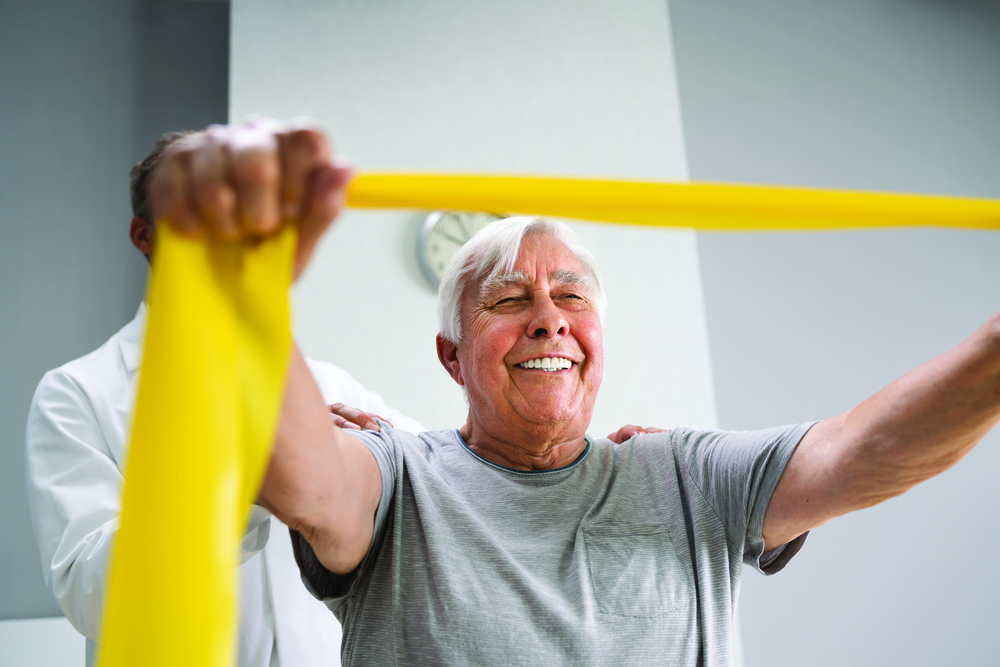
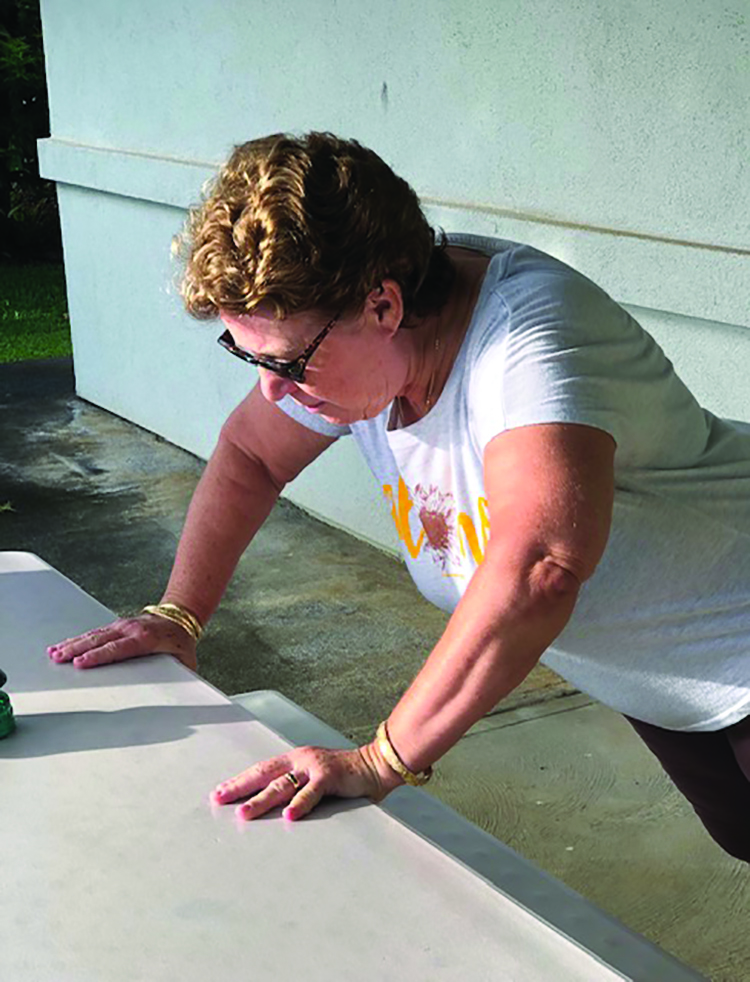
    Sarcopenia is age-related loss in muscle mass. Although muscle mass declines 1 to 2 percent per year after age 50, exercise can reduce this loss. Resistance training using bodyweight, machines or weights is the most effective way of building muscle. {Play}

    Sarcopenia makes exercising more difficult, which unfortunately, makes you want to exercise less, contributing even less stimulation of your muscles, leading to more muscle loss. But you can slow down this vicious cycle.

    So now we know that strength training is important. If you have access to some weights or bands, use them. If you don’t have weights, get creative! Water bottles, filled gallon jugs and even bottles of wine will do.

    Be careful not to overexert yourself. Steady breathing and good form are important.
    Be careful not to overexert yourself. Steady breathing and good form are important.

    How Many Reps are Best?

    More repetitions at lower weights? Or lower repetitions at higher weights? If you are an active person, you’ll want to aim to use a weight/resistance band that really challenges you at a maximum of 15 reps. The lower the reps to get to the point of muscle exhaustion, the better. So if you are just  beginning to exercise, start with the higher reps and a lower weight.

    Good: maximum of 15 reps, 2 to 4 sets
    Better: 8 to 12 reps, 2 to 4 sets
    Best: 6 to 10 reps, 2 to 4 sets

    Be conscious of your limits. Pain in your joints means stop.
    Be conscious of your limits. Pain in your joints means stop.

    Focus on doing exercises using multiple joints and the big muscles of your body.
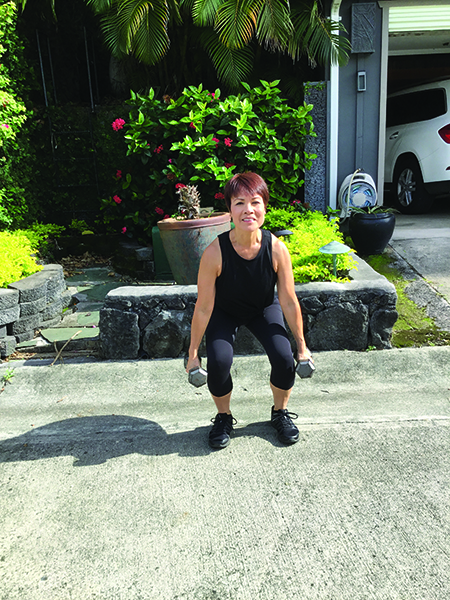
    • Squats or chair squats
    • Lunges or deep walks
    • Dead lifts
    • Bent-over rows or pull-ins using bands
    • Lat pulls or pullups (use assistance if needed)

    As a bonus, resistance training also helps build bone density. Aim for two to three sessions a week for 30 to 60 minutes a day for best results. Just remember, some activity is better than none! And be sure to take it slow. Awareness and self-focus is key to exercising safely.


    FRAN PATOSKIE
    CPT, GFI, Certified Fascianation Method Practitioner
    808-349-5598 | franpatoskie@gmail.com

    Sarcopenia is age-related loss in muscle mass. Although muscle mass declines 1 to 2 percent per year after age 50, exercise can reduce this loss. Resistance training using bodyweight, machines or weights is the most effective way of building muscle. Sarcopenia makes exercising more difficult, which unfortunately, makes you want to exercise less, contributing even…

  • Lewy Body Dementia & Parkinson’s Disease

    Lewy body disease includes two types of dementia — Lewy body dementia (LBD) and Parkinson’s disease dementia (PDD). Parkinson’s starts with an abnormal accumulation of alpha synuclein protein that is found mainly at the tips of neurons in specialized structures called “presynaptic terminals” in different parts of the brain. LBD precedes a Parkinson’s diagnosis, while PDD develops after the changes of Parkinson’s have occurred. Currently, 1.4 million people in the US
    are coping with LBD. It’s is the third most common type of dementia after Alzheimer’s and vascular dementia.

    Unusual Features

    LBD exhibits many unusual features, such as variable levels of awareness and consciousness. Those with LBD display rapid shifts between orientation and confusion, alertness and drowsiness, and being attentive or unfocused. Changes in the processing of visual information are prominent, with visuospatial changes such as struggling with depth perception, location and the interrelationships with objects. There can be mistakes in decoding positional information, such as above or below, inside or outside, and left or right.

    Psychiatric Symptoms

    Compared to other types of dementia, those with LBD display a range of psychiatric symptoms that include simple or complex visual hallucinations. A simple visual hallucination might be seeing a kitten in the room. A complex visual hallucination could involve people, actions and purpose. Sometimes hallucinations are pleasant, warm or reassuring, while others are confusing, frightening or even terrifying.

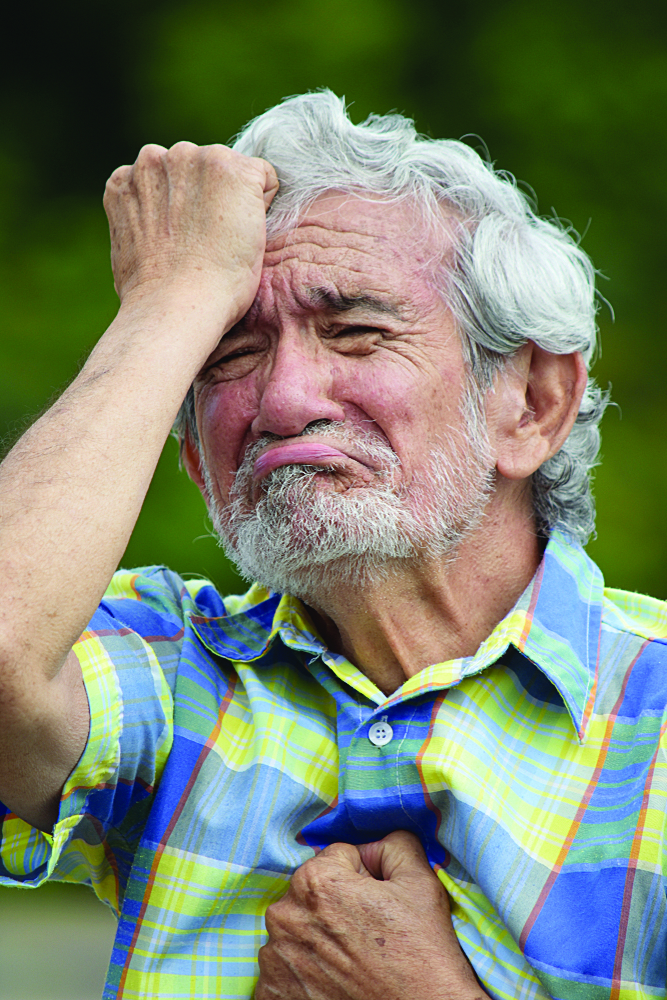
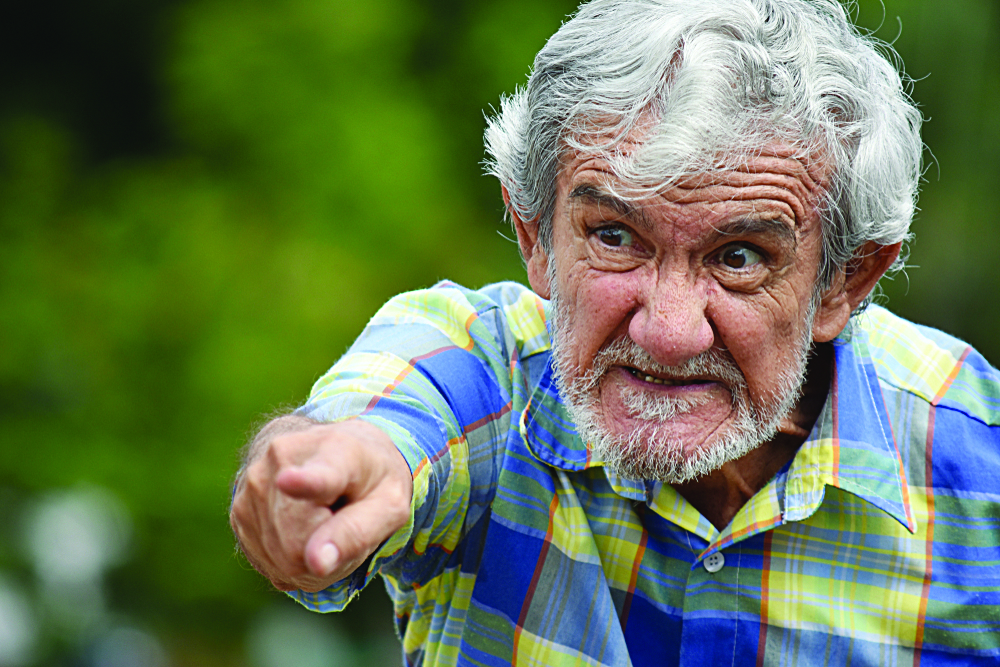
    People with LBD can develop delusions (fixed beliefs that do not reflect reality), such as jealousy delusions that a spouse is unfaithful, or persecutory  delusions of being threatened or maltreated. These delusions are very real to the person with LBD, and can trigger a huge outpouring of emotions and misunderstandings. Agitation and anxiety can be triggered in those living with LBD, as well as their families and caregivers.

    Motor Symptoms

    These changes can simultaneously occur with the motor symptoms of Parkinson’s, such as slowness, tremors, and difficulties with posture and balance. There are also many non-motor symptoms of Parkinson’s, such as dizziness, fainting and falling due to uncontrolled changes in blood  pressure. People with LBD can also have severe difficulties with constipation, excessive drooling and abnormal temperature regulation.

    Meds, Research & Clinical Trials

    Medications to treat the symptoms of LBD may be less effective than with other types of dementia. Sometimes the medications have a paradoxical effect. Instead of helping to reduce hallucinations, the medications actually make the hallucinations worse.

    It is important to work closely with your medical team to find the best treatments for you. Your team could include neurologists, geriatrics specialists, psychiatrists and physical therapy experts who will help protect your comfort and safety.

    The Clinical Research Center at Hawaii Pacific Neuroscience (HPN) is running new clinical trials for dementia caused by Alzheimer’s, Parkinson’s and traumatic brain injury. Refer to the contact information below for more information.


    HAWAII PACIFIC NEUROSCIENCE
    2230 Liliha St., #104, Honolulu, HI 96817
    For an appointment, call or text: 808-261-4476
    Dedicated Research Hotline: 808-564-6141
    info@hawaiineuroscience.com
    www.HawaiiNeuroscience.com

    Lewy body disease includes two types of dementia — Lewy body dementia (LBD) and Parkinson’s disease dementia (PDD). Parkinson’s starts with an abnormal accumulation of alpha synuclein protein that is found mainly at the tips of neurons in specialized structures called “presynaptic terminals” in different parts of the brain. LBD precedes a Parkinson’s diagnosis, while…

  • Nutrition Facts Food Labels Explained

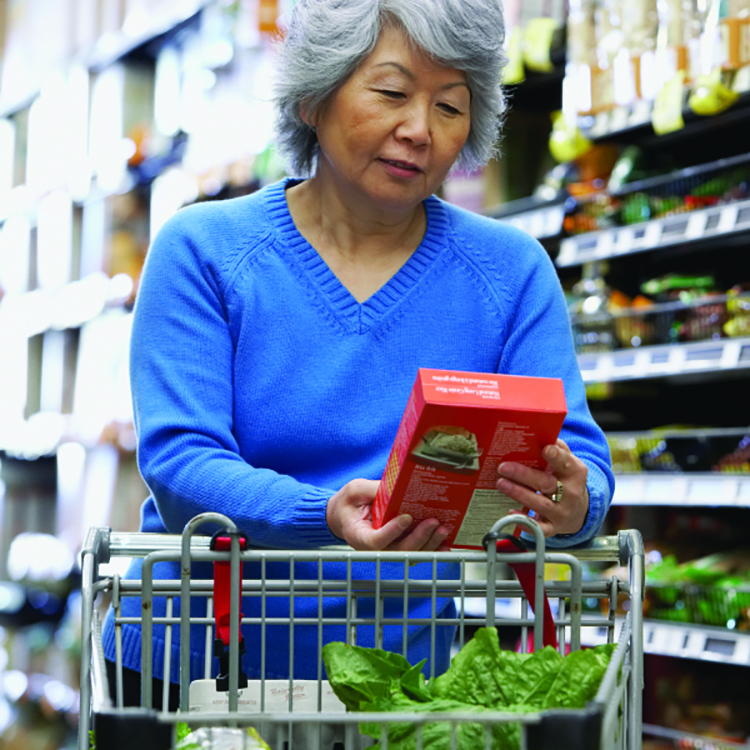
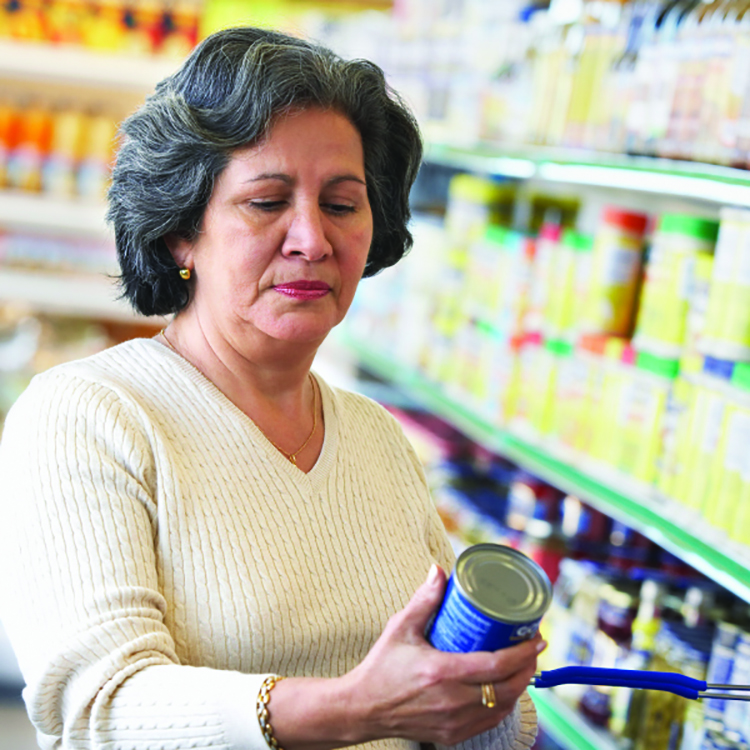
    Making healthy dietary choices can help you feel your best and stay active. It can also help you lower your risk of developing some health conditions that are common among older adults.

    The US Food and Drug Administration (FDA) has a tool to help you make informed food choices that can have positive effects on your health and wellness. It is called the Nutrition Facts label and you can find it on packaged foods and beverages.
    Understanding the Nutrition Facts Label

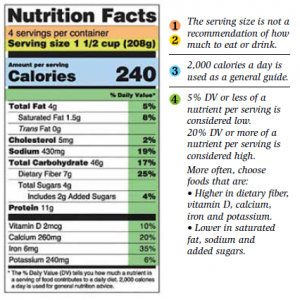
    The following key terms are intended to make it easier for you to use the Nutrition Facts labels to make informed food choices.

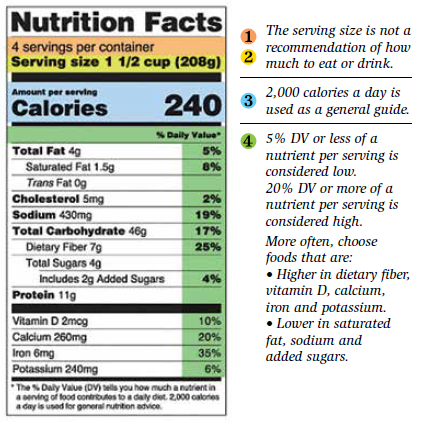
    [1] Servings Per Container shows the total number of servings in the entire food package or container. One package of food may contain more than one serving. For example, if you eat or drink two servings, you are getting double the calories and double the nutrients that are listed on the label.

    [2] Serving Size is based on the amount of food that is usually eaten at one time. Serving size is not a recommendation of how much to eat. The nutrition information listed on the label is usually based on one serving of the food; however, some containers may also have nutrition information listed for the entire package.

    [3] Calories refers to the total number of calories in a serving of the food. To achieve or maintain a healthy body weight, balance the number of calories you eat and drink with the number of calories your body burns.

    The general guide for calorie consumption per day is 2,000. Your calorie needs may be higher or lower and vary depending on your age, sex, height, weight and physical activity level. Check your calorie needs at www.ChooseMyPlate.gov/MyPlatePlan.

    [4] %Daily Value (%DV) shows how much a nutrient in a serving of the food contributes to a total daily diet. The Daily Values are reference amounts (in grams, milligrams or micrograms) of nutrients to consume or not to exceed each day.

    Use the %DV to determine if a serving of the food is high or low in an individual nutrient. You can also use the %DV to compare food products (make sure the serving size is the same). For example, if you eat one serving of a food and it provides 10% DV of dietary fiber, then for that day, you have eaten 10% of your dietary fiber daily goal.

    As a general guide, 5% DV or less is considered low; 20% DV or more is considered high.

    Nutrients and Your Needs

    Nutrients are substances in your food that keep your body working well. Eating too much or too little of some nutrients may increase your risk of certain chronic conditions, such as heart disease and high blood pressure.

    Older adults have different nutritional needs than other age groups. The Nutrition Facts label can help you monitor some of the nutrients in your diet.
    Get More of These Nutrients: Dietary Fiber, Vitamin D, Calcium and Potassium

    Many older adults do not get the recommended amount of these nutrients. Compare and choose more foods in order to get more of these nutrients on most days.

    Dietary fiber is a type of carbohydrate that cannot be easily digested. It can speed up the movement of food and waste through the body, increasing the frequency of bowel movements. Diets higher in dietary fiber may reduce the risk of developing cardiovascular disease. The Daily Value for dietary fiber is 28 grams (g) per day.*

    Calcium is a mineral that is important for bone health. It also helps with muscle and nerve function, blood clotting and hormone secretion. Diets higher in calcium can reduce the risk of developing osteoporosis (weak and brittle bones). The Daily Value for calcium is 1,300 milligrams (mg) per day.*

    Vitamin D helps your body absorb calcium and is important for bone health. It also plays a role in blood pressure management, hormone production, and immune and nervous system function. Diets higher in vitamin D can reduce the risk of developing osteoporosis (weak and brittle bones). The Daily Value for vitamin D is 20 micrograms (mcg) per day.*

    Potassium is a mineral that helps with fluid balance and heart, muscle and nervous system function. The Daily Value for potassium is 4,700 mg per day.*
    Consume Less of These Nutrients: Saturated Fat, Sodium and Added Sugars

    Most older adults get too much of these nutrients. Compare and choose foods in order to consume less of these nutrients each day.

    Saturated fat is found in higher amounts in animal products. An exception is seafood, which is generally low in saturated fat. Unsaturated fats are found in higher amounts in plant-based oils (e.g., canola and olive oils), nuts, seeds and seafood. Diets in which unsaturated fats are eaten in place of saturated fats and within the recommended daily limits for calories are associated with a reduced risk of developing cardiovascular disease. The Daily Value for saturated fat is less than 20 g per day.*

    Sodium is a mineral commonly found in table salt and in many commercially processed, packaged and prepared foods. The body needs sodium in relatively small amounts. Sodium is important for fluid balance as well as muscle and nervous system function. Diets higher in sodium are associated with an increased risk of developing high blood pressure, which can raise the risk of heart attacks, heart failure, stroke, kidney disease and blindness. Since blood pressure often rises with age, limiting your sodium intake becomes even more important each year. The Daily Value for sodium is less than 2,300 mg per day.*

    Added sugars include sugars that are added during the processing of foods (such as sucrose or dextrose), foods packaged as sweeteners (such as table sugar), sugars from syrups and honey, and sugars from concentrated fruit or vegetable juices. Diets high in calories from added sugars can make it harder to meet nutrient needs while staying within calorie limits. The Daily Value for added sugars is less than 50 g per day.*

    Older adults should more often look for foods with a higher %DV of dietary fiber, vitamin D, calcium and potassium. Older adults should also look for foods with a lower %DV of saturated fat, sodium and added sugars more often. Talk to your healthcare provider about which nutrients you should track closely for your overall health.

    *Based on a 2,000-calorie daily diet.


    US FOOD AND DRUG ADMINISTRATION
    www.fda.gov/nutritioneducation
    1-800-SAFEFOOD (toll free):
    MTWF, 10a–4p, Th 12:30p–1:30p EST (- 6 hrs PST)
    Closed on federal holidays
    Visit www.ChooseMyPlate.gov for more information about making healthy food choices.

    Making healthy dietary choices can help you feel your best and stay active. It can also help you lower your risk of developing some health conditions that are common among older adults. The US Food and Drug Administration (FDA) has a tool to help you make informed food choices that can have positive effects on…

  • Caregiving Tips for the Holidays

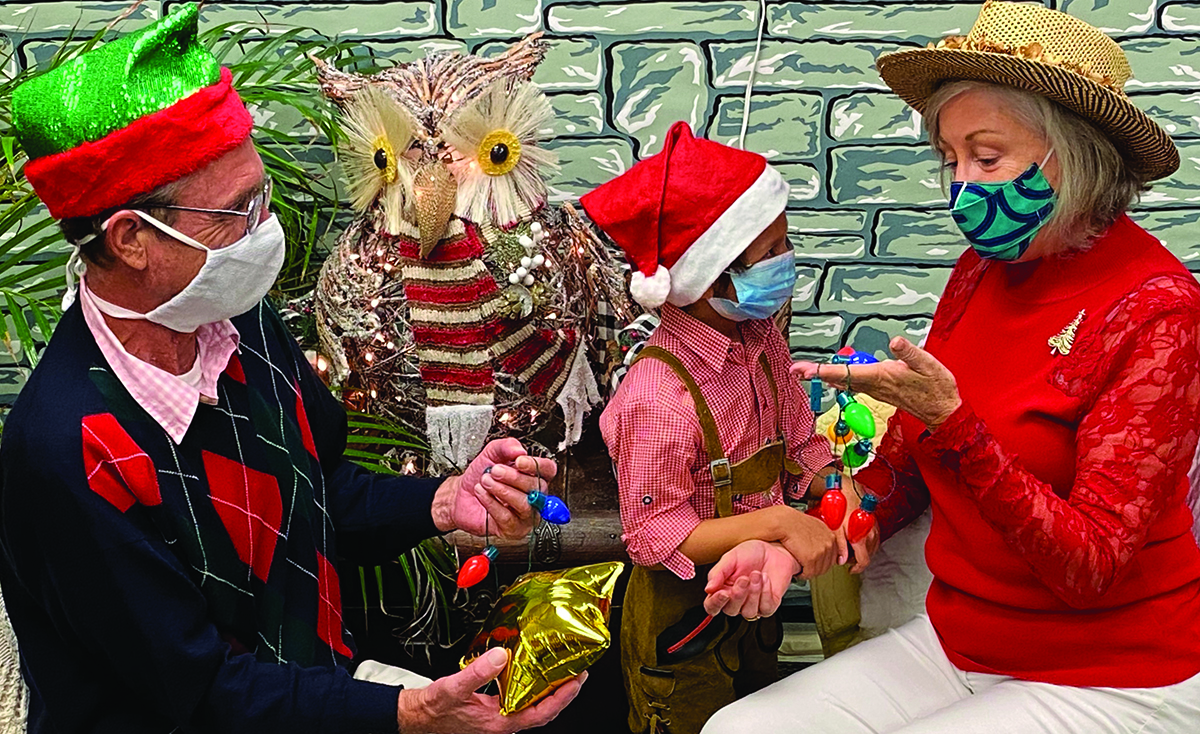
    Holidays are a time of fellowship and unity with family and friends. Yet, the holidays can be difficult for families when a loved one is diagnosed with Alzheimer’s or dementia. Caregivers may feel  overwhelmed with balancing care and managing holiday traditions. A person living with Alzheimer’s or dementia may feel that something is missing but may not be able to express their feelings. In addition to the common stressors that arise during the holidays, the challenges of COVID-19 add layers of complexity. The pandemic has interrupted the overall connectedness of families and friends and has magnified the sense of overwhelm and isolation that many caregivers face, especially during the holidays.

    Keeping with physical distancing and public health recommendations, here are some tips to consider to minimize stress and maximize joyful time together:

     Make sure that everyone understands your caregiving situation and has realistic expectations about what you can and cannot do. Give yourself permission to do only what you can.
     Involve the person in safe, manageable holiday preparation activities. Ask him or her to help you prepare food, wrap packages or decorate or set the table. (Avoid using artificial fruits and vegetables as decorations because a person living with dementia might confuse them with real food. Blinking lights may also confuse the person.)
     Maintain the person’s normal routine as much as possible so that holiday preparations don’t become disruptive or confusing. Taking on too many tasks can wear on both of you.
     Build on traditions and memories. These may look and feel a little different this year, but you may also experiment with new traditions that might be less stressful or a better fit with your caregiving responsibilities.
     Provide people with suggestions for useful and enjoyable gifts for your loved one, such as an identification bracelet or membership in a wandering response service (contact the Alzheimer’s Association 24/7 Helpline at 800-272-3900 for more information). Or, suggest comfortable, easy-to-remove clothing; favorite music; photo albums of family and friends; or favorite treats.
     Advise people not to give dangerous tools or instruments, utensils, challenging board games, complicated electronic equipment or pets as gifts.
     Involve the person in gift-giving, depending on his or her abilities and preferences. For example, someone who enjoys baking can help make cookies and pack them in holiday tins. Or you may want to buy a gift the person can wrap.
     Suggest a gift certificate or something that will help make things easier, like housecleaning; lawn, handyman or laundry services; gift cards; or even respite services (when it is deemed safe).
     Prepare for post-holiday letdown. Arrange in-home care so you can rest, enjoy a movie or have lunch with a friend.
     Prepare for some downtime. A short nap or some quiet time in a room away from activity can provide a nice break for someone with Alzheimer’s. Often, a short nap is all that is needed to enable them to rejoin the festivities.
     Don’t forget to give yourself time to relax. If you are the primary caregiver, you need to take time to tend to your own emotional health so you can enjoy the holidays with your loved one. For more information and holiday tips, contact Tonya Tullis at 808-518-6651 or email her at tshammondtullis@alz.org.


    ALZHEIMER’S ASSOCIATION (501(c) 3 nonprofit)
    Online Community: www.alzconnected.org
    Online Education: www.training.alz.org
    Support Groups & Programs: www.alz.org/hawaii
    24/7 HELPLINE: 800-272-3900
    Hawai‘i Office: 808-591-2771

    Holidays are a time of fellowship and unity with family and friends. Yet, the holidays can be difficult for families when a loved one is diagnosed with Alzheimer’s or dementia. Caregivers may feel  overwhelmed with balancing care and managing holiday traditions.

  • One of the Best Decisions I Ever Made

    My wife, May, was diagnosed with breast cancer in 2005 at age 39. In 2015, after being diagnosed with pancreatic cancer, she underwent a Whipple procedure, whereby some of her pancreas, small intestine, stomach and other parts were removed.

    We moved to Hilo from Rhode Island, and designed and built our house, a project that began in 2014. After laying out the initial floor plan, May added a sunroom. That was her room — by hers, I mean that was the room she expected her hospital bed to be put into. She knew she was destined for an untimely — and probably unpleasant — death, and she wanted to be able to see the sun and feel the breeze while it happened. If she had to die, it was clear May desperately wanted to do it at home. We moved into our house on Thanksgiving week in 2017.

    For nearly two months, I helped her walk, eat, drink, medicate, bathe and desperately try to sleep. I wish I knew about hospice early in my wife’s disease progression. You always think — “I don’t need any help, I can handle this.” I didn’t want to admit it, but the fatigue and overwhelm swiftly brought me to my knees.

    I finally made the call. May began receiving weekly visits at our home from a hospice nurse. The night of Jan. 22, May woke more than 10 times. I finally admitted to myself that I could no longer go on. When May got up, I told her that I thought it was time to switch to hospice inpatient care. She  immediately agreed — I realized later that she had arrived at that conclusion independently, and she had been waiting for me to arrive at that decision, too. May was essentially free from pain and nausea, and she stayed that way for the next 13 days. I was able to be with her, but also, finally, mercifully, able to get some sleep, too.

    In October, for our 20th wedding anniversary, we had been snorkeling off Maui. Less than four months later, on Feb. 3, 2019 — a Sunday — May fell asleep for the last time. She finally left me just before 1am Wednesday while I slept on the sofa in her room.

    I have few regrets. However, I wish with all my heart that we had moved her into hospice’s inpatient care earlier than we did. Yes, I was capable of caring for her, but she needed the professional care, facilities and specialized medication only hospice could provide. The people and the facility were magnificent. Hospice care was created to eliminate “terminal suffering.” I wish I understood that sooner. The peaceful look on May’s face as she slipped away confirmed that hospice was indeed, the best decision I ever made.


    HAWAI‘I CARE CHOICES (formerly Hospice of Hilo)
    1011 Wai‘nuenue Ave., Hilo, HI 96720
    Lani Weigert, Community Relations Manager
    808-969-1733 | 808-283-3777
    www.hawaiicarechoices.org

    My wife, May, was diagnosed with breast cancer in 2005 at age 39. In 2015, after being diagnosed with pancreatic cancer, she underwent a Whipple procedure, whereby some of her pancreas, small intestine, stomach and other parts were removed.

  • Safe Family Activities for the Holidays

    Amid all the COVID-19 restrictions, there is a bright spot — the opportunity for families to celebrate the holidays together by engaging creatively in a way that’s enjoyable and safe for everyone.

    While younger members of the family are on the go and ready to run around the house, seniors (especially those with dementia) will prefer quieter, more structured activities. Family members with Alzheimer’s or dementia will not be able to tolerate crowds or loud noises that can lead to irritation and challenging behaviors. Therefore, it’s important to separate the two, so everyone has a good time. Here are some examples of things to do that seniors will enjoy:

    • Playing simple card and board games
    • Decorating stockings for members of the family
    • Crafts, like making a quilt or a holiday wreath
    • Baking holiday cookies together
    • Having a gift wrap party
    • Writing holiday cards together
    • Decorating the house together
    • Watching old movies with snacks on-hand
    • Listening to favorite music
    • Scrapbooking of family past activities

    Quilting is a good example of an activity that will get everyone involved. Seniors can assist with the selection of sentimental or personal fabrics. Sewing can be done by hand or machine. Suitable machines are available for under $100 these days. Once completed, the handcrafted quilt can be finished into a blanket or framed, becoming a personalized keepsake that will be treasured for many generations. This year’s holiday season will be challenging and some seniors may be missing the normal festivities with visitors from outside the household. Planned, tranquil activities and staggered extended family visits can make the holidays safer and more comfortable. Avoid large crowds at Grandma’s house this year by planning ahead and making sure everyone gets a chance to see her. The desire to be together can be accomplished in a different way if families work together and set up time slots. Here are some ideas on how to celebrate with Grandma during the holidays without spending the entire day with her.

    • Use an iPad and Zoom or FaceTime while singing a holiday song.
    • Create holiday cards using photos of the kids and drop them off at her home — but try to keep the visit short.
    • Instead of cooking at your senior’s home, make a festive meal or dessert ahead of time and if the weather is good, set up the table outside.
    • Create a sign-up log for extended family ahead of time in order to avoid a crowded home.
    • Dress up the doorway or entry and have friends and family drop gifts outside the home with a note of holiday cheer and well wishes.

    As with anyone coming in from outside the household, make sure you ask the questions needed to ensure your senior is safe over the holidays. Being together can be a wonderful experience — as long as families are responsible and creative with their holiday plans.


    ATTENTION PLUS CARE HOME HEALTHCARE
    Accredited by The Joint Commission
    1580 Makaloa St., Ste. 1060, Honolulu, HI 96814
    808-739-2811 | www.attentionplus.com
    AGING IN HAWAII EDUCATIONAL OUTREACH PROGRAM
    by Attention Plus Care — a program providing resources for seniors and their families, covering  different aging topics each month. For class information and upcoming topics, call 808-440-9356.

    Amid all the COVID-19 restrictions, there is a bright spot — the opportunity for families to celebrate the holidays together by engaging creatively in a way that’s enjoyable and safe for everyone. While younger members of the family are on the go and ready to run around the house, seniors (especially those with dementia) will…

  • Overcoming Insurmountable Odds

    In life, we have sunshine and rainbows and clouds and storms,” says Liane K. Chong on her website. It is a apt introduction to her inspirational autobiography, Hope Inspires Strength: How One Woman Overcame Insurmountable Odds. She tells readers how she faced challenges with courage, the right mindset and by finding hope where none seemed to exist. It’s a moving, powerful story about strength, focus, perseverance and determination.

    Liane and her husband and daughter were living an enviable life in Hawai‘i. Hardships began.

    She suddenly lost her father at the young age of 54. Soon after, her mother developed a debilitating disease that left her paralyzed and in need of constant care. So at age, 31, Liane took over the daunting task of caring for her mother. Then, a few months later,  they found out that their newborn baby boy had cortical blindness, cerebral palsy, autism, and might never walk or talk.

    Liane chose not to give up. She chose to succeed. Not only did she survive, she thrived, becoming a successful entrepreneur.

    The author’s story will surely refocus anyone feeling like life has become too overwhelming. Her legacy of hope is bound to help you find your strength.


    For more information and to order the book:
    www.lianekchong.com | lianekchong@gmail.com
    A 30-minute interview with Liane: https://youtu.be/C85ga3F5Y7s

    In life, we have sunshine and rainbows and clouds and storms,” says Liane K. Chong on her website. It is a apt introduction to her inspirational autobiography, Hope Inspires Strength: How One Woman Overcame Insurmountable Odds. She tells readers how she faced challenges with courage, the right mindset and by finding hope where none seemed…

  • Have More Fun Aging With Cool Devices

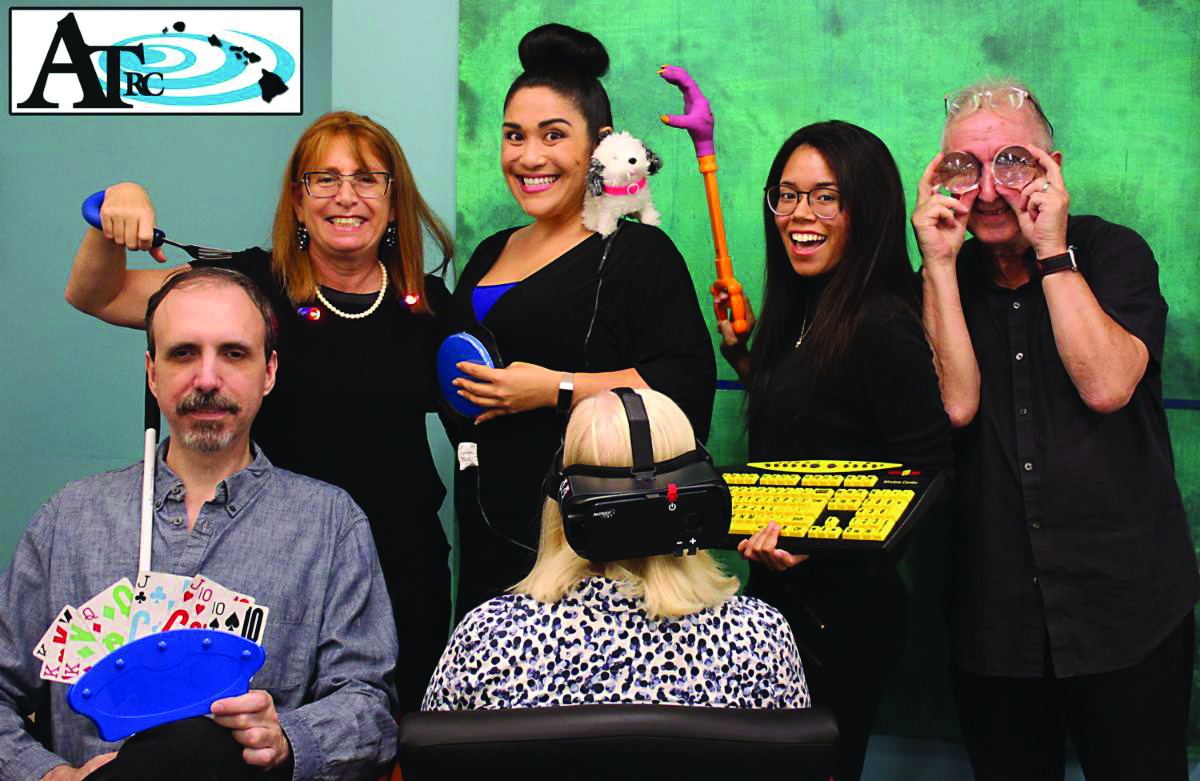
    The gang’s all here to help you adapt to aging with some cool devices: (L–R, front) Monty Anderson-Nitahara, Barbara Fischlowitz-Leong, (back) Katie Friedman, Hannah Diaz, Janelle Feliciano and Harvey Gordon
    The gang’s all here to help you adapt to aging with some cool devices: (L–R, front) Monty Anderson-Nitahara, Barbara Fischlowitz-Leong, (back) Katie Friedman, Hannah Diaz, Janelle Feliciano and Harvey Gordon

    As we mature, our bodies may no longer work the way they once did — our eyes and ears are not quite as sharp; our hands not quite as steady. We may find ourselves straining to see the TV; we may no longer be able to read our favorite publications; we may need to ask people to speak up or repeat themselves.

    Fortunately, technology can help us regain
    what was lost due to aging. These tools fall into two different categories: durable medical equipment (DME), which includes wheelchairs, walkers and walking sticks; and assistive technology (AT), which includes magnifiers, talking computers, audible books and document readers.

    Ask a professional to help you find what works best for you. At ATRC, we specialize in helping you identify the exact device and model that fits you — at no cost. Call us for more information.


    ASSISTIVE TECHNOLOGY RESOURCE CENTERS OF HAWAI‘I (501(c) 3 nonprofit)
    200 N. Vineyard Blvd., Ste. 430, Honolulu, HI 96817
    808-532-7111 | monty@atrc.org | www.atrc.org

    As we mature, our bodies may no longer work the way they once did — our eyes and ears are not quite as sharp; our hands not quite as steady. We may find ourselves straining to see the TV; we may no longer be able to read our favorite publications; we may need to ask…

  • Auntie M’s Family-Favorite Spare Ribs

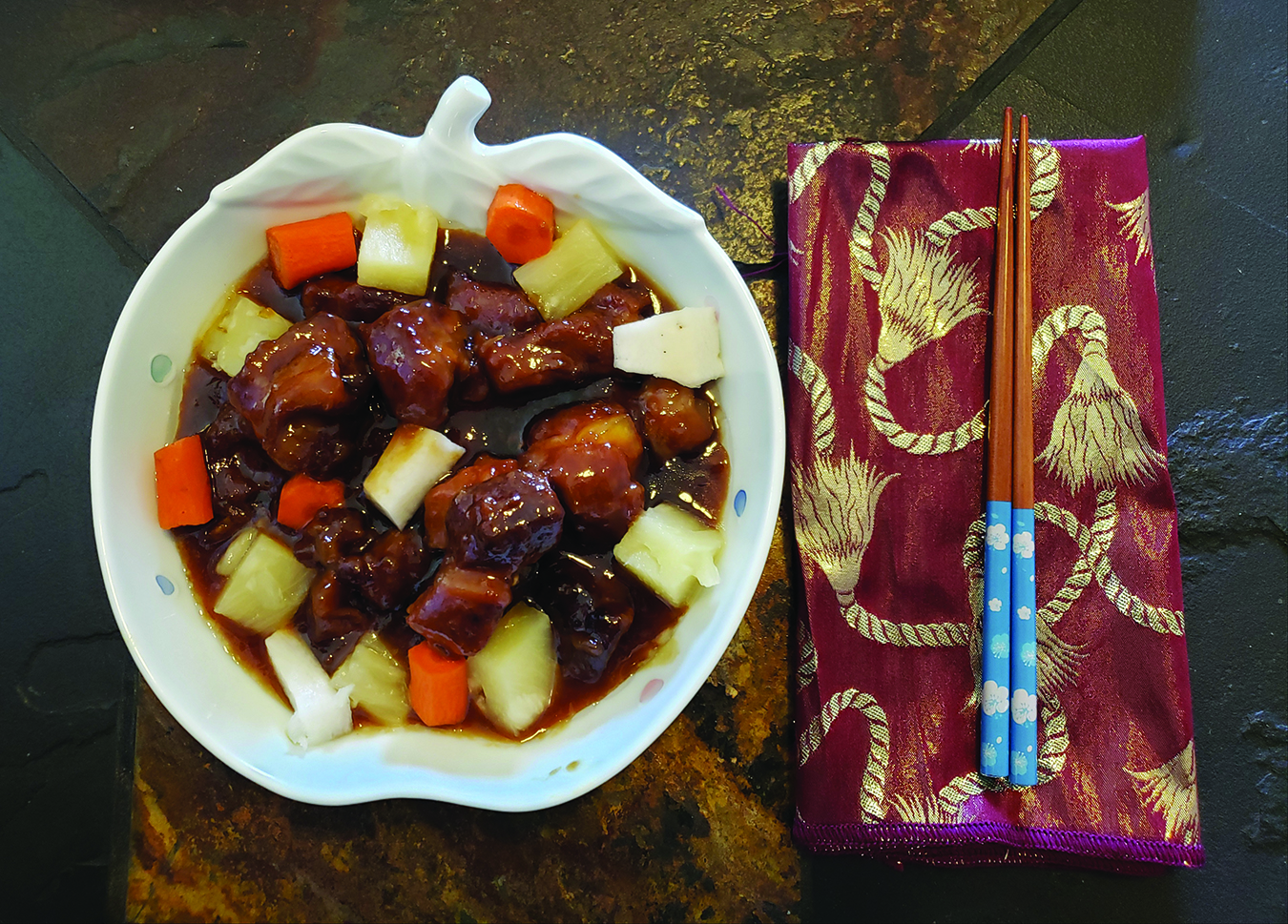
    When I was a newlywed, I was given this very special recipe from Aunty Matsue (Inouye) Omori, Sen. Daniel Inouye’s aunt. Aunty is remembered for her special recipes and her dedication as a third grade teacher at Pu‘unēnē School.

    Ingredients:
    2 lbs. soft-bone pork spare ribs (precut in cubes or regular)
    1 cup vinegar
    2 cups brown sugar
    2 cloves garlic (pounded)
    1 small piece ginger (pounded)
    2 tsp. Chinese thick soy sauce
    2 tsp. shoyu
    1 tsp. salt
    1 can pineapple chunks
    1 each turnip & carrot
    1/2 cup stock (taken from boiling ribs)

    Directions:
    Preparing the ribs: If not precut, cut the ribs in small, 1-inch, bite-sized cubes. Rinse the ribs in a medium pot by pouring boiling water over them, then drain. Add enough water to cover the ribs. Boil for 2 minutes, drain the water into a separate container and keep it to be added as stock.

    Mixing ribs and sauce: Mix all of the ingredients, including the stock, with the ribs. Let the ribs soak and marinate in the sauce for 4 hours or even overnight in the refrigerator.

    Cooking the ribs: Take the ribs out of the sauce and place them in a separate container. (Reserve the marinade.) Dredge the ribs with all-purpose flour. In a separate pot, brown the ribs in cooking oil (olive oil is okay), then drain the excess oil. Pour the sauce back in with the ribs (option: add 1 tsp. red wine or to taste).

    Cook on medium heat for about 30 minutes until tender. Add 1 tsp. cornstarch to thicken sauce; add more to desired thickness.

    Garnish with pineapple chunks or small cubes, or thin-cut white turnips and carrots.


    Do you have a favorite recipe and story to share? For consideration in the next issue of Generations Magazine, mail your story and recipe to Generations Food & Story, PO Box 4213, Honolulu, HI 96812, or email them to wilson@generations808.com.

    When I was a newlywed, I was given this very special recipe from Aunty Matsue (Inouye) Omori, Sen. Daniel Inouye’s aunt. Aunty is remembered for her special recipes and her dedication as a third grade teacher at Pu‘unēnē School.

  • A Woman on a Journey of Well-Being

    How did I get to be 65 and retired?  And what happens now? Those were two questions I was asking myself this past April as my birthday and retirement occurred without much fanfare due to the COVID-19 pandemic. But, I had been planning this for over five years. So, let’s go back a few years…

    Like most people, my life journey has had its ups and downs, but in my 30s and 40s, I started to take notice of how stress was impacting my health, and began my quest to find the resources and tools that could support my wellness. There were several signposts along the way that signaled I needed to stop and take a wellness inventory. And, there were two major life events that changed the course for me. They both involved the health of my youngest child, who at the age of 5 was hit by a car and was in a body cast for three months. When he was 19, he was diagnosed with a brain tumor. Jacob Michael passed away three years later.

    In both cases, while I took on an intense caregiver role, I was also made keenly aware of how I needed to find ways for self-care. I went on to work in a caregiving capacity through my role with the American Cancer Society.

    But I continued to see signs and impacts of stress in my life and those around me, so I extended my search for resources and tools that I could use and share with others. I found simple tools that I could easily deploy on a daily basis.

    A short, guided meditation. Breathing is an essential part of any meditation — slow and controlled at a natural pace.

    “Begin by sitting in a comfortable position with nothing in your lap. It can be in a chair or on a cushion on the floor or against a wall for support. Just don’t lie down. Close your eyes. Begin to breathe slowly and rhythmically. Relax your head and shoulders. Feel the tension drain from your face. Breathe. Relax your chest and arms. Feel the tension melt away. Breathe. Relax your belly, hips and buttocks. Let go completely. Breathe. Relax your legs and feet, letting all the tension just drip away. Breathe.

    Use of essential oils. The sense of smell can be very powerful. It can invigorate you or slow you down. It has the potential to place you in an emotional state — preferably, calm and happy.

    I like to do exercises that fit my abilities. I know I’m personally not aiming for any triathlon. Enjoyment aligned with abilities is key.

    Eating healthier — not dieting, was something I sought to  change entirely.

    When I turned 60, I decided to focus my energy toward sharing these ideas with various caregivers and others who may need my help — work I started before my son got sick. I focused on wellness and helping others through life’s transitions by connecting them to resources for health, wellness and self-care.

    The journey continues…


    ALAKAI‘I ASSOCIATES LLC, Kaneohe
    808-554-2081 | lani_almanza@alakaiassociates.com
    www.alakaiassociates.com

    How did I get to be 65 and retired?  And what happens now? Those were two questions I was asking myself this past April as my birthday and retirement occurred without much fanfare due to the COVID-19 pandemic. But, I had been planning this for over five years. So, let’s go back a few years…

  • Aloha Fried Rice

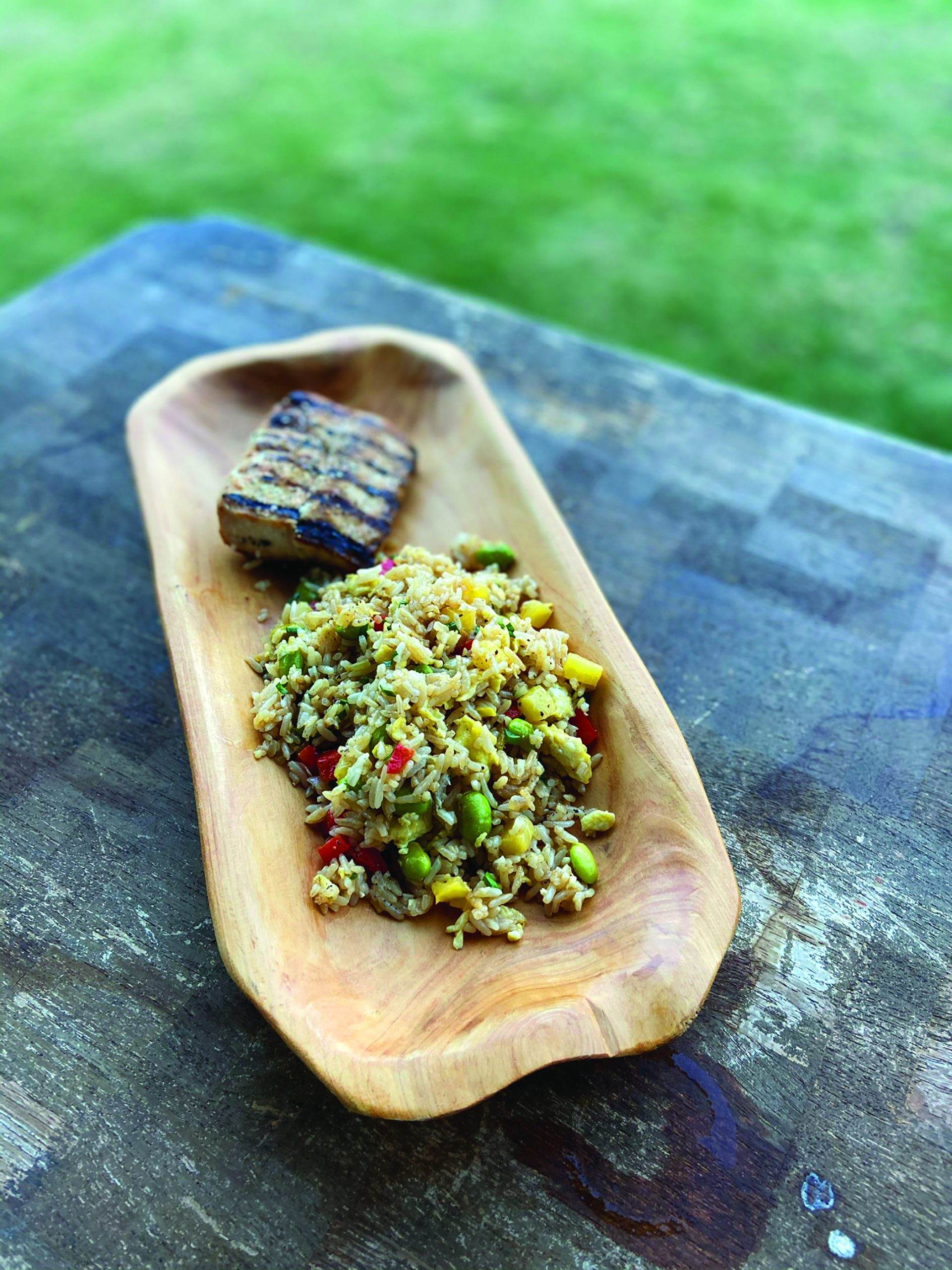
    Fried rice has long been a comfort food throughout the islands. Not only is this recipe a savvy way to repurpose leftover rice, it’s easy to dress up with vegetables and fresh pineapple. Serve it alongside meat or a hunk of grilled fish caught by one of our local fishermen, and you’ve got a Hawaiian Regional classic. Here’s the recipe.

    Ingredients:
    4 cups cooked and chilled rice
    3 eggs lightly beaten with a dash of salt and pepper
    2 cups chopped pineapple
    1 small onion (chopped)
    3 cloves garlic (minced)
    1 red bell pepper (chopped)
    1 cup frozen shelled edamame
    3 Tbsp. oil
    3 Tbsp. butter (divided)
    2 tsp. sambal (chili garlic paste)
    1/4 cup soy sauce (use tamari for a gluten-free option)
    Salt and Pepper

    Directions:
    1. Preheat a large, nonstick skillet on medium heat. Add oil and 2 Tbsp. of butter into the pan. Once the butter has melted, add the onions and sambal and cook until tender. Then add the red bell pepper, edamame and garlic. Season with salt and pepper. Cook until fragrant and take care not to burn the garlic.
    2. Turn the heat up slightly and add the cold rice. Cook for about 3 to 4 minutes until the rice has separated and softened. Then add the pineapple. Drizzle the soy sauce and fold it into the rice mixture and cook for another 3 minutes.
    3. Push the rice mixture to one side and melt 1 Tbsp. of butter on the other side and add the eggs and scramble constantly until slightly set.
    4. Fold everything together; season if needed. Cook until rice mixture is hot, then serve.

    Optional accompaniment: grilled meat or seafood.

    Prep time: 15 minutes | Cook time: 15 minutes
    Serves: 4


    CHEF KRISTIN MICHAELS
    info@ChefKristin.com | www.ChefKristin.com
    Facebook & Instagram: @ChefKristinMichaels

    Fried rice has long been a comfort food throughout the islands. Not only is this recipe a savvy way to repurpose leftover rice, it’s easy to dress up with vegetables and fresh pineapple. Serve it alongside meat or a hunk of grilled fish caught by one of our local fishermen, and you’ve got a Hawaiian…