Throughout our youth, most of us will experience muscle growth up until the age of 30. Thereafter, we begin to lose some muscle mass, strength and performance. This steady decline is called sarcopenia and is the “use it or lose” part of the natural aging process. It often goes unnoticed in our earlier years, as we have more muscle than needed to perform everyday tasks like standing or getting out of bed.
Sarcopenia affects physically inactive adults more, and after age 30 individuals may lose somewhere of 3 to 5 percent of muscle mass or more with each passing decade. This decline in muscle mass and strength accelerates after the age of 60. While age-related sarcopenia occurs more in physically inactive adults, physically active adults may also experience it, which suggests there are multiple causes for sarcopenia.
Having low muscle mass can also be a strong predictor of frailty, disability and injuries related to mobility problems. A report from the American Society for Bone and Mineral Research found that individuals with sarcopenia had more than twice the risk of incurring bone fractures and disability from a fall. Because of these risks, it is vital to maintain the muscles we have and be as active as we can. “It takes work, dedication, and a plan, but it is never too late to rebuild muscle and maintain it. Older adults can increase muscle mass lost as a consequence of aging,” says Dr. Thomas Storer, Director of the Laboratory of Exercise Physiology and Physical Function at Harvard-affiliated Brigham and Women’s Hospital.
So, what can we do to protect ourselves from sarcopenia? Older adults and caregivers can be encouraged to know muscle and strength building can be done the same way 70-year-old Arnold Schwarzenegger does it: through exercise and nutrition. The Centers for Disease Control and Prevention (CDC) recommend older adults participate in muscle-strengthening activities a minimum of three days a week. Strength training may involve using weights, resistance bands or exercise machines. Studies have also shown that individuals who started earlier and had exercise habits in their middle age had a lower occurrence of muscle loss later in life.
Older adults who are physically inactive also tend to have inadequate nutritional intake, eat smaller meals and feel less thirsty, all of which can contribute to sarcopenia. Good nutrition and eating healthy sources of protein, including fish, nuts and lentils, combined with regular strength or resistance training, have shown to be more effective in managing sarcopenia. Studies have also shown that combining muscle-strengthening exercises with improved protein nutrition positively affects sarcopenia more than diet modification or exercise alone.
So, start early, and ask your health professional about sarcopenia, nutrition, exercise and treatments specific to your needs. Everyone should be proactive and learn more about exercise and the right nutrition to manage sarcopenia. It sounds simple and it is: activity and nutrition go a long way to maintaining our muscles and strength. Getting older is just a number. It’s what we DO that matters.
ATTENTION PLUS CARE HOME HEALTH CARE
Accredited by The Joint Commission
1580 Makaloa St., Ste. #1060, Honolulu, HI 96814 808-739-2811 | www.attentionplus.com
AGING IN HAWAII EDUCATIONAL OUTREACH PROGRAM by Attention Plus Care — a program providing resources for seniors and their families, covering different aging topics each month. For class information and upcoming topics, call 808-440-9356.
Throughout our youth, most of us will experience muscle growth up until the age of 30. Thereafter, we begin to lose some muscle mass, strength and performance. This steady decline is called sarcopenia and is the “use it or lose” part of the natural aging process. It often goes unnoticed in our earlier years, as…
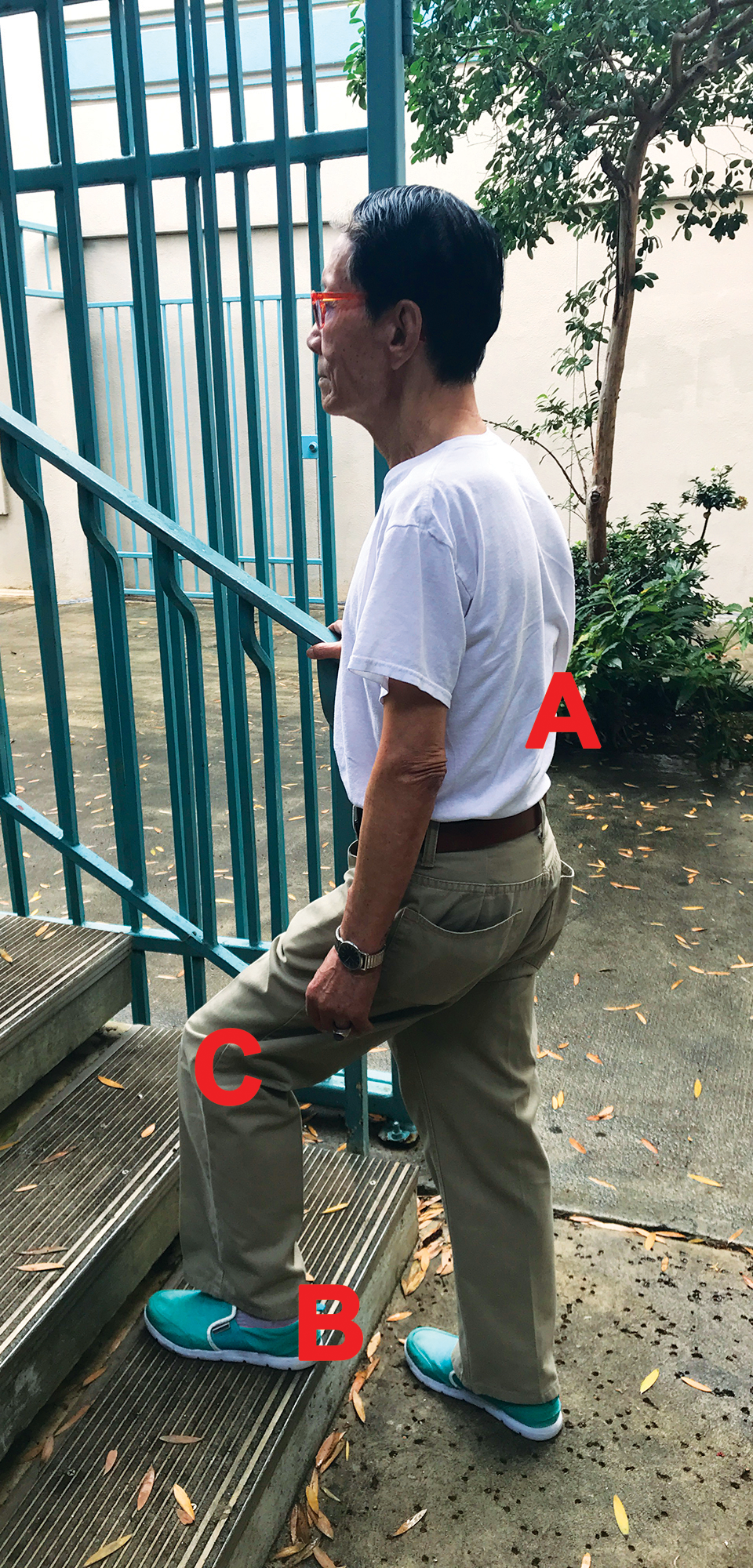
In our younger years we didn’t think twice about sprinting up and down steps. As we age, however, climbing a flight of stairs can often seem like scaling a mountainside due to limited mobility and pain. According to Harvard Health Publishing, the force on each knee is 2 – 3 times your body weight when you go up and down stairs. So, if knee or back pain has you avoiding stairs, follow these simple steps to regain your independence and freedom of movement.
Stand tall (A) and tighten your core muscles to protect your spine, place one hand on the rail to maintain balance and set your entire foot on the step (B). As you step up, apply more weight through your heel rather than your toes and engage your buttock muscles as you straighten your leg to move up on the step. Try to avoid leaning forward and pulling yourself up using the hand-rail, instead keep the knee aligned with your toes (C) and focus on the larger muscles of the hip (hamstrings and gluteals) to take the pressure off the knee joint.
Following these simple tips may not immediately resolve your pain, but with practice and strengthening your core and lower extremity muscles as you use correct mechanics, you will allow your body to adapt so that you can enjoy taking the stairs every day.
Moon Physical Therapy, LLC
320 Ward Ave., Ste. 107, Honolulu HI 96814
Aquatic, Land-based and Manual Therapy and
Cardiopulmonary Rehab Programs 808-597-1005 | www.moonpt.com
Like me on Facebook: Moon Physical Therapy, LLC
In our younger years we didn’t think twice about sprinting up and down steps. As we age, however, climbing a flight of stairs can often seem like scaling a mountainside due to limited mobility and pain. According to Harvard Health Publishing, the force on each knee is 2 – 3 times your body weight when you go…
Twenty-nine years ago, Honolulu resident Joan Davis decided to reclaim her health. “I was having some health problems,” she says. “It was time to make a change.”
So, the then-49-year-old bought a pair of athletic shoes and joined the “Saturday Amblers,” a walking group that met at Kapiolani Park every Saturday morning. A few weeks later, a member of Faerber’s Flyers, a women’s running group, nudged her into signing up for a 5K “fun run” at the park. With no running experience to speak of, Davis was initially hesitant, but decided to give it a try. To her astonishment, 3.1 miles later, she had won a medal in her age division. “My love of running blossomed from there,” she recalls.
Not long after her triumphant 5K debut, she laced up her running shoes once again and finished a 15K race at Hickam Air Force Base. “I told myself: ‘If I can do a 15K… well, I guess I could do a marathon, too,’” she laughs. She started a training regimen, and in December of 1990, ran the Honolulu Marathon at the age of 50. That’s when Davis says she realized how far she’d come — literally — in her health and fitness journey.
And looking back on it now, it was really just the beginning.
Joan Davis feeling good at the National Senior Games in California.
Davis went on to cross the Honolulu Marathon finish line eight more times, and if that weren’t impressive enough, she also completed dozens of 5Ks, 10Ks, and a handful of half-marathons — in Hawai‘i, on the mainland, and as far away as Australia, Indonesia, and China.
In 1995, her life took yet another unexpected turn when a friend asked her to join the Hawaii Masters Track Club. As the track and field club’s first female member, she added the javelin throw, discus, shot put, and hammer throw to her expanding athletic repertoire. “If you told me 30 years ago that I’d be a hammer thrower, I wouldn’t have believed you,” she laughs.
In 2001, Davis learned she’d qualified for the National Senior Games, a multi-sport, biennial competition for men and women ages 50 and over. Since then, she’s competed in seven National Senior Games and has racked up her fair share of medals, ribbons, and trophies; she’s also earned All-American status. In 2015, she placed 14th in the javelin throw, 16th in the discus, and 17th in the shot put in the women’s 75 – 79 age division. And Davis isn’t stopping there: She has her sights set on competing internationally, too.
For Davis, athletics is far more than a recreational pastime — it’s a passion. So much, in fact, that she readily accepted a friend’s invitation to attend a luncheon at the Honolulu Quarterback Club (HQC) 15 years ago, and five years later, joined HQC’s board of directors as its secretary. Since then, she’s added a few other titles to her expanding résumé: Hawaii Masters Track Club secretary, president of Faerber’s Flyers, state representative for the Road Runners Club of America, and first vice president in charge of race operations for the Mid-Pacific Road Runners Club.
Apart from the physiological benefits of exercising regularly, Davis, now 77, says there’s a social component that makes it twice as fulfilling.
And she will be the first to tell you that embracing an active lifestyle can be a true game-changer. “I encourage everyone to try it,” she says. “It’s never too late to start.”
HONOLULU QUARTERBACK CLUB
Maple Garden, 909 Isenberg St., Honolulu HI 808-220-6454 | HermanHStern@msn.com
Meeting: Every Monday, 11:30 am – 1 pm
It all started with a new pair of shoes. Twenty-nine years ago, Honolulu resident Joan Davis decided to reclaim her health. “I was having some health problems,” she says. “It was time to make a change.” So, the then-49-year-old bought a pair of athletic shoes and joined the “Saturday Amblers,” a walking group that met…
One of the most common problems I encounter investigating a cybercrime is that the victim fails to provide any records and/or documentation to support their claim that they have been victimized. This is often also true of others reporting the crime, either with the victim or on their behalf.
Lack of documentation is most prevalent in cases involving online fraud. Here are a few good steps to take every time your purchase or acceptance of a contract involves the internet:
• Print the webpage — a simple and quick method. Print the displayed offer, sale, or service you are interested in. At the bottom of the printout will usually be the URL (webpage address) and the date and time the printout was done. After purchasing, print out any on-screen confirmation
of sale, receipt of funds, delivery notices, etc.
• Bookmark the webpage(s). This is also a good way of record keeping and being able to return to that particular webpage.
• Print your email. Solicitations offering the sale of items and/or services and purchase confirmations and receipts, delivery notices, etc. received in your email should be printed out as good practice. In addition, all emails involving the transaction should NOT be deleted, but saved in a separate folder.
• Obtain bank or credit card statements reflecting transactions to further assist investigations.
Again, prevention is the key: “If it’s too good to be true…”
One of the most common problems I encounter investigating a cybercrime is that the victim fails to provide any records and/or documentation to support their claim that they have been victimized. This is often also true of others reporting the crime, either with the victim or on their behalf. Lack of documentation is most prevalent…
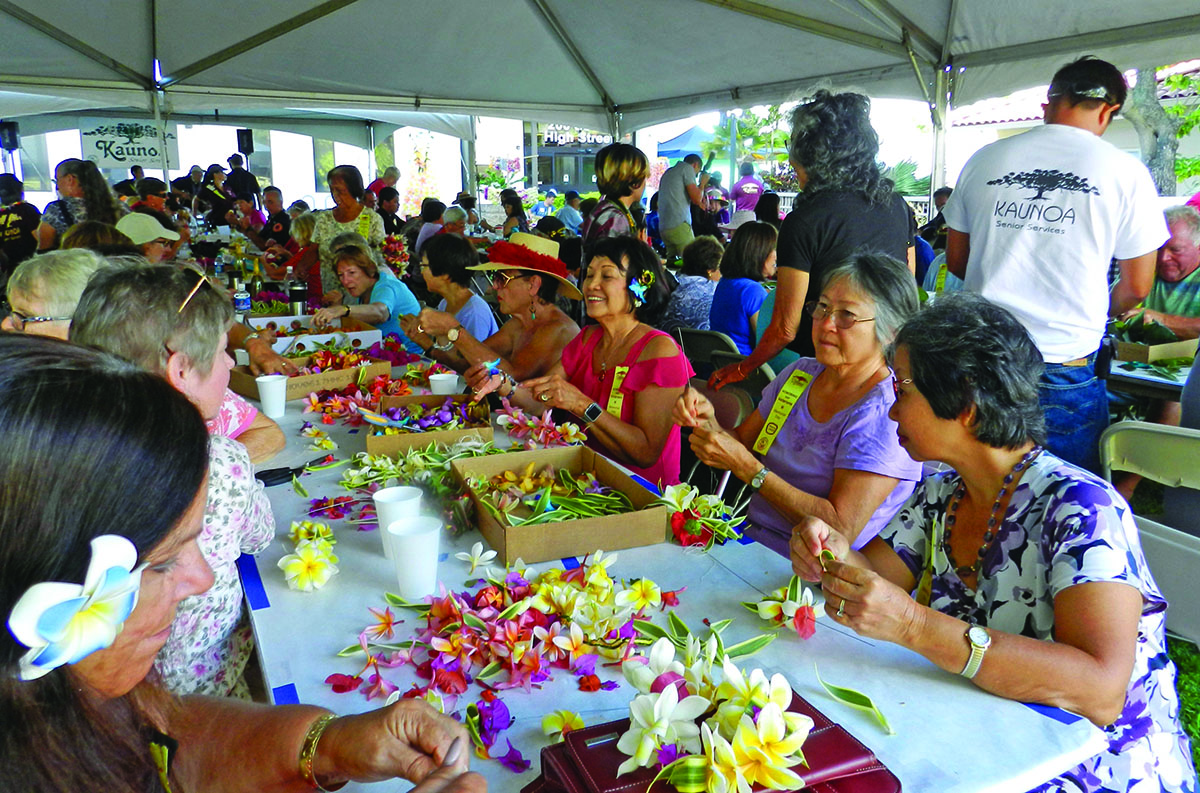
As Mayor Alan M. Arakawa has said, “As we sew lei together, we express our gratitude for their service, and for the many ways these men and women helped shape the community we live in today, ‘Blossoms for the Brave’ is a wonderful opportunity to meet up with old friends and neighbors as we remember our fallen heroes who gave their lives to serve our country.”
For the past five years, the Maui community has come together on the Friday before Memorial Day to participate in a lei-making event in order to make more than 2,846 lei for all the veterans’ graves at Maui Veterans Cemetery in Makawao.
This year the event will take place on Friday, May 25, from 9am – noon on the front lawn of the Kalana O Maui (County) Building in Wailuku.
Korean War Veteran Warren Nishida (right) salutes 2017 Blossoms event accomplishments by volunteers (right).
The free event is co-hosted by Kaunoa Senior Services, a division of the Maui County Department of Housing and Human Concerns, and the Office of Mayor Alan Arakawa. It will feature live entertainment, ti leaf lei-making instruction, and the opportunity to contribute to a noble cause. Kaunoa spearheads the event to remind the community and educate youth that Memorial Day is a time to honor and reflect upon the sacrifices made by Americans in combat, a solemn occasion marked by ceremony and prayer.
Numerous community partners help assure a successful event, including the Maui Korean War Veterans, AARP Hawaii, Kihei Youth Center, and Hale Makua residents, staff and volunteers. Also vital to the realization of the greater goal are Kaunoa’s own program participants at the Congregate Nutrition Centers and Leisure/Wellness programs throughout Maui County, including West Maui Senior Center, Hana, Lāna‘i, and Moloka‘i. Homebound seniors in Kaunoa’s Meals on Wheels and Assisted Transportation programs are encouraged to participate by contributing flowers from their yards and gardens, giving them a sense of pride and keeping them connected to community.
Volunteers with the Retired & Senior Volunteer Program (RSVP) help in every aspect of this major undertaking, from planning logistics and teaching lei-making classes in advance of the event, to the flower donation awareness campaign and publicity, to collection and preparation of flowers, greenery, and ti leaves on event day.
Parking and a free shuttle to the County Building will be available from the Ichiro “Iron” Maehara Baseball Stadium parking lot.
As Mayor Alan M. Arakawa has said, “As we sew lei together, we express our gratitude for their service, and for the many ways these men and women helped shape the community we live in today, ‘Blossoms for the Brave’ is a wonderful opportunity to meet up with old friends and neighbors as we remember…
Most of us recognize the importance of establishing a legal will to document and ensure that our material goods are passed on to the persons and/or causes of our choice. But how many of us have written comparable documents to ensure that our values and beliefs, our parting thoughts and wishes, also are documented and passed on to those we love?
The tradition of ethical wills provides guidance for writing such documents. Sometimes called legacy letters, ethical wills provide a way to transmit one’s life lessons, feelings, and final thoughts to future generations. There is no format or right way to write one. It might contain family history and stories; expressions of blessings and love or perhaps forgiveness; articulation of cultural and spiritual values, traditions, and beliefs; validation of pride in children and grandchildren and hopes for their future well-being; expressions of gratitude and requests for ways one would like to be remembered — all the cherished intangibles, the knowledge and wisdom accumulated over a lifetime, to be preserved and shared with those most dear. Your ethical will might be of far greater value to your descendants than your legal will.
How do you write an ethical will? Again, there is no one right way to do it. You might start by thinking of the most important events in your life and experiences or persons of greatest significance. Why did the events or people hold such import? When have you felt most happy, content, worthy? Can you see common elements or patterns in these memories? What are the life lessons that you want to share and underscore to those you love?
The process of writing an ethical will or legacy letter is similar to writing a life review. The act of identifying, documenting, and reflecting on the most important elements of a lifetime helps to put things in perspective and find meaning in one’s existence. Both have the potential to foster and promote personal growth. The ethical will differs from a life review in that it goes beyond reflection and review; its primary purpose is to share the outcome of that review with those who matter.
One of my favorite examples of an ethical will was presented as a lecture, given by Randy Pausch, a professor at Carnegie Mellon University who died of pancreatic cancer at the age of 47. He shared his life lessons with his students in the moving, witty, and profound “The Last Lecture: Really Achieving Your Childhood Dreams,” which is available on YouTube: www.bit.ly/LectureVideo.
One need not be at the end of life to write an ethical will. It is just as relevant to review and evaluate one’s life at times of major transitions and share those reflections with those closely impacted by that transition. An excellent example of such a legacy letter was written by Barack Obama, “A Letter to My Daughters,” penned at the start of his presidency, January 18, 2009, available online: www.bit.ly/LifeLegacies.
Most of us recognize the importance of establishing a legal will to document and ensure that our material goods are passed on to the persons and/or causes of our choice. But how many of us have written comparable documents to ensure that our values and beliefs, our parting thoughts and wishes, also are documented and…
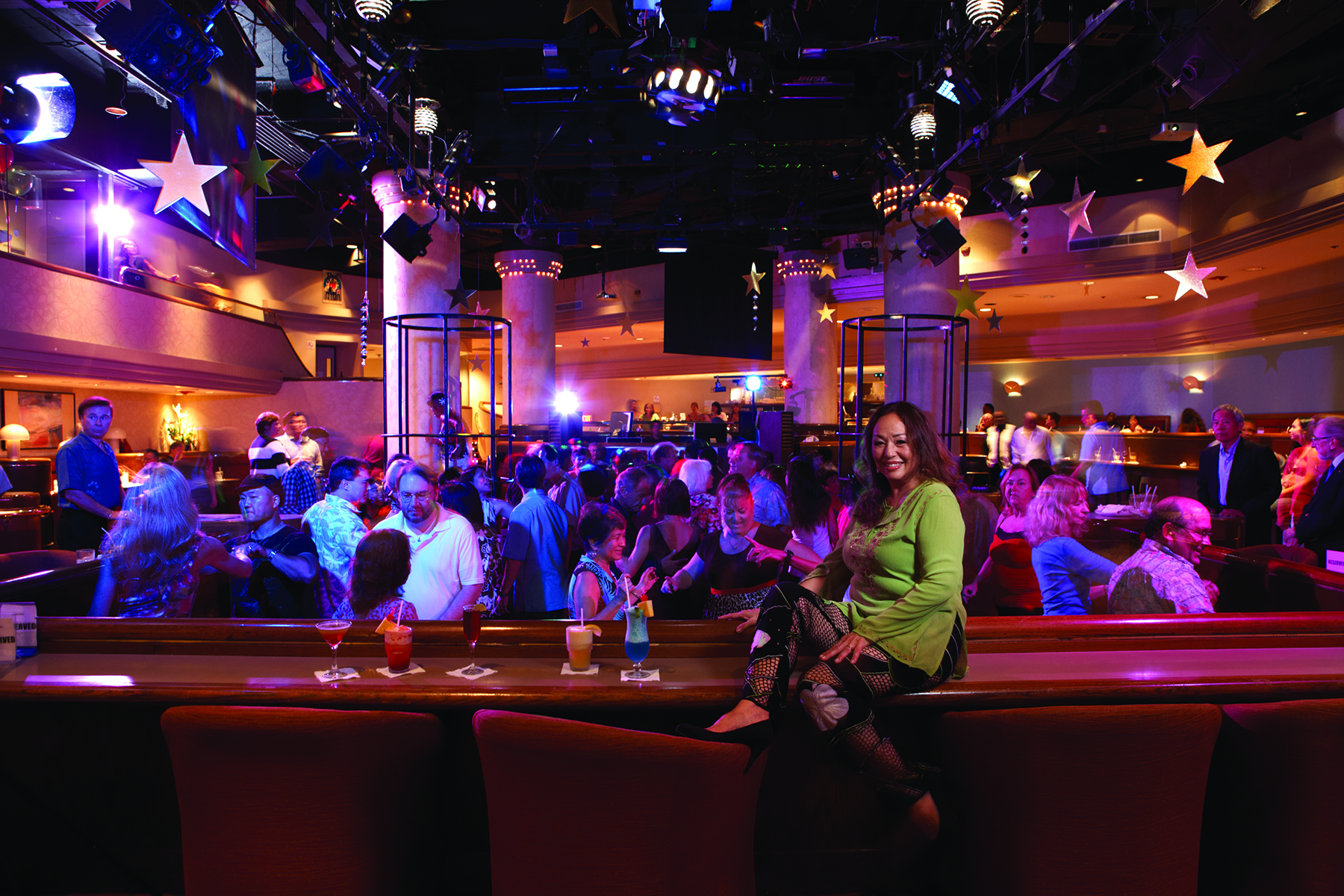
As a Medicare educator and radio host, it’s my passion to keep up with changes that impact Medicare beneficiaries. My radio listening audience is well into their 60s and 70s and octogenarians listen, too. Some are ’69 and ’70 graduates of Roosevelt, Kalani, Kaimuki, and McKinley high schools. Each year, they sponsor “Battle of the Bands” reunion dances with live music. The dancing goes on for hours.
The energy and enthusiasm always bring me to my feet. I am younger but can hardly keep up on the dance floor. One or two dances and I have to sit back and watch all the fun.
If you have ever shared that feeling, then it is worth checking out if your Medicare plan covers an exercise program or movement class that will help you hold your own on the dance floor.
Call your doctor and schedule your free Medicare annual wellness visit. Ask if you can start an exercise program. Then rejuvenate and put a “spring” back in your step!
MEDICARE MOMENT WITH MARTHA
A radio program with Martha Khlopin
KHNR-690AM: Sat., 2 pm–2:30 pm, Sun., 9:30 am–10 am 808-230-3379 | getmartha@aol.com
As a Medicare educator and radio host, it’s my passion to keep up with changes that impact Medicare beneficiaries. My radio listening audience is well into their 60s and 70s and octogenarians listen, too. Some are ’69 and ’70 graduates of Roosevelt, Kalani, Kaimuki, and McKinley high schools. Each year, they sponsor “Battle of the Bands”…
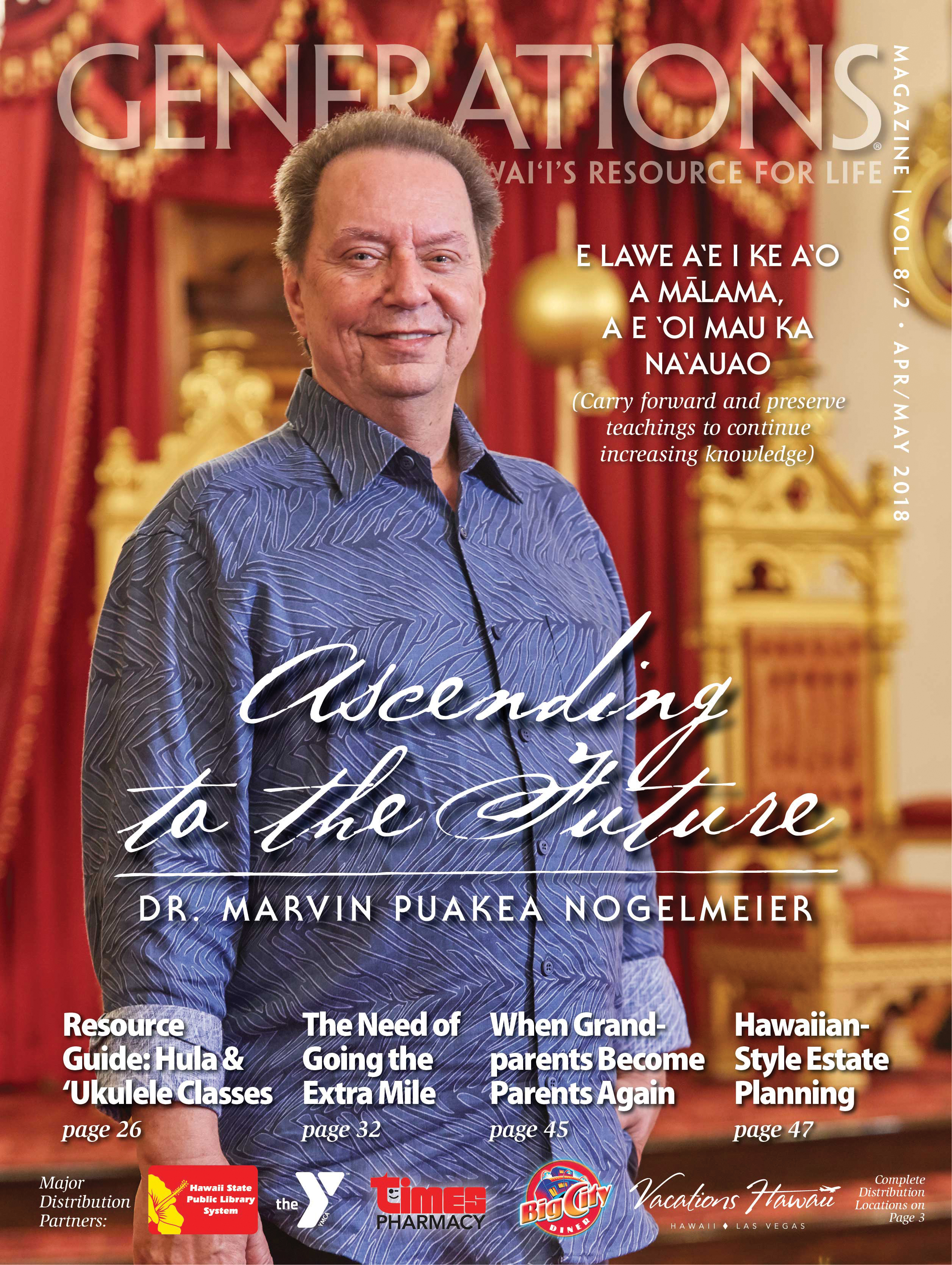
A living and vibrant culture rests on two bedrock foundations: a living language, and land that reveres places connected to the history, beliefs and hopes of its people. One of the people at the nexus of language revival in Hawai‘i is Dr. Marvin Puakea Nogelmeier, PhD, Professor of Hawaiian Language at the University of Hawai‘i, Mānoa; Po‘o/Director of The UH Institute of Hawaiian Language Research and Translation; the Director of UH Sea Grant’s Center for Integrated Science, Knowledge, and Culture; and the Executive Director of Awaiaulu. He calls himself an “unlikely” person to have become a Hawaiian cultural expert, but his works say otherwise. His life work has built mightily on the foundations that his mentors lovingly shared with him; his many students are equipped to steward the language and knowledge into the future.
Hawaiian Cultural Renaissance
By 1970, there were so few fluent speakers that the language was in danger of becoming extinct within a generation. The Hawaiian Dictionary, by Pukui and Elbert, “Hawaiian Astronomy” by Professor Rubellite Johnson, and histories by S.M. Kamakau and J.P. ʻĪʻī and others were archival reference materials. The oral tradition had been all but lost, and schools were teaching “about” the Hawaiian language.
A movement to teach children to speak Hawaiian resulted in Pūnana Leo preschools, Hawaiian Immersion Schools (K-12), and cultural reference materials like Māmaka Kaiao: A Modern Hawaiian Vocabulary, through University of Hawai‘i Press. Some of us have been fortunate to hear a kupuna mānaleo (native-speaking elder) fluently tell the story of his birthplace and recite the genealogy of his ancestors, but soon their voices will be heard only on audio tapes.
Is the revival strategy working? A couple of weeks ago, in a local restaurant, I sat next to a large table of college students celebrating a birthday. Their joyful conversation was entirely in Hawaiian, although the group was ethnically diverse. Yes, Hawaiian language is growing again! Immersion school teachers now instruct the children of their first students, who speak Hawaiian at home!
Climbing up from near extinction required bold moves by dedicated elders, linguists and teachers — with the cooperation and resolve of many students and volunteers. In 1972, 18-year-old Marvin Nogelmeier was on a walkabout trip to Japan, stopping on O‘ahu for the weekend — and 46 years later, this self-described “optimist” has built upon and freely shared the knowledge, wisdom and culture that his mentors and teachers entrusted to him. The result is the ascendancy of Hawaiian culture for all of us.
Puakea – White Flower and Fair Child
Dr. Nogelmeier is not Hawaiian, but his resonant baritone voice narrates significant documentaries about Hawaiian culture. When we ride TheBus in Honolulu, he announces every stop along the route. His fluency and clear pronunciation reach out to a broad public base, and his translation and interpretation projects are quietly moving the language renaissance to a new level.
He says that being a Haole has both disadvantage and advantage. “Sometimes I am isolated,” he says with a smile, “but with that comes a certain kind of freedom and flexibility. In a sense, I got to pick my own ‘family’ of mentors and we all get along.”
The story of his mentors and how he applied the knowledge that they shared is quite remarkable. Young Nogelmeier first found work in Wai‘anae as a goldsmith and quickly made friends among local crafters and cultural practitioners. His affinity for the arts and native curiosity led him to join Mililani Allen’s first men’s class in her hula school, Hālau Hula o Mililani.
“Hula was life-changing for me. The girls’ class was an hour long but the boys’ class lasted four to five hours. We were empty calabashes that Mililani wanted to fill with knowledge of the songs, chants and motions we performed. She opened the doorway for us to learn Hawaiian ways, including language, chant and beliefs. Mililani’s teacher, Aunty Maiki Aiu Lake, gave me one of her own names, Puakea, which means white flower and fair child,” he says.
Before long, Nogelmeier was learning to chant under the tutelage of two icons of Hawaiian Studies, Aunty Edith Kawelohea McKinzie, author of Hawaiian Genealogies and Aunty Edith Kanaka‘ole, Kumu Hula, chanter, and Nā Hōkū Hanohano award composer.
Discovering Mentorship — The Hawaiian Teaching Method
“I remember one day in the middle of chant presentation an older man came over and spoke to me in Hawaiian. When I apologized that I didn’t speak the language, he then asked, ‘You are saying the words correctly, but how do you know what you are chanting? How can you know how well you did?’
“Uncle Luka Kanaka‘ole’s compliment and question made me want to learn Hawaiian. Auntie Edith McKinzie offered to teach me and some other chant students basic language in a weekly back-porch session. Soon after, I found someone to study under. June Gutmanis, a researcher in Hawaiian culture, had Mr. Theodore Kelsey living with her, a Hawaiian speaker who helped June with her translations and interpretation of Hawaiian writings. Kelsey was born in Washington state in 1891 and his mother, hired as a teacher, brought him to Hilo in 1892. ‘Ōlelo Hawai‘i was still in common use for business, government and daily life, and as Mr. Kelsey said, ‘If you wanted to have friends, you learned to speak Hawaiian.’”
When Nogelmeier asked Mr. Kelsey to teach him Hawaiian, Kelsey replied, “No; I am not a teacher.” His main interest was to translate and interpret the “Kumu Lipo,” an expansive Hawaiian creation and genealogy chant that takes many hours to recite.
The next week at June’s house, Nogelmeier greeted Mr. Kelsey properly with, “Aloha kāua,” and Kelsey responded with some long sentences in Hawaiian.
“I didn’t get it all, but answered what I could,” says Nogelmeier. “For Hawaiians, protocol and how things are approached are as important as the message. By simply attempting to ‘talk story,’ I had demonstrated my intention to learn and opened the door to a mentoring relationship that lasted nearly a decade.”
Nogelmeier calls all his teachers “mentors,” because this one-on-one coaching method is the Hawaiian model for teaching. Learning and teaching depend on social relevancy and “chemistry” that encourage a flow of knowledge and insight. When teacher and student find one another through a shared interest or goal, the outcome is positive.
Nogelmeier attributes his deep interest and skills as a translator to Theodore Kelsey, whom he describes as a Victorian gentleman.
“He would not translate for June any passages that he considered sexual, political or vulgar, but he would go through them with me. I would then share them with June for her research. It was a working triangle that preserved the literature as it was written. Mr. Kelsey was also a fine photographer who documented Lili‘uokalani’s funeral in 1917. His love for language and history led him to dedicate his life to preserving important Hawaiian literature — documenting, translating and interpreting became his life mission,” says Nogelmeier.
Becoming a Kumu ‘Ōlelo Hawai‘i (Hawaiian Language Teacher)
In 1978, Nogelmeier was 25 years old and learning Hawaiian from one of the then-rare fluent speakers. His friends could not understand his interest in Hawaiian culture, but he pursued a degree at Leeward Community College, where he studied under Noelani Loesch. She strongly encouraged his work with Mr. Kelsey, linking it into the university classroom.
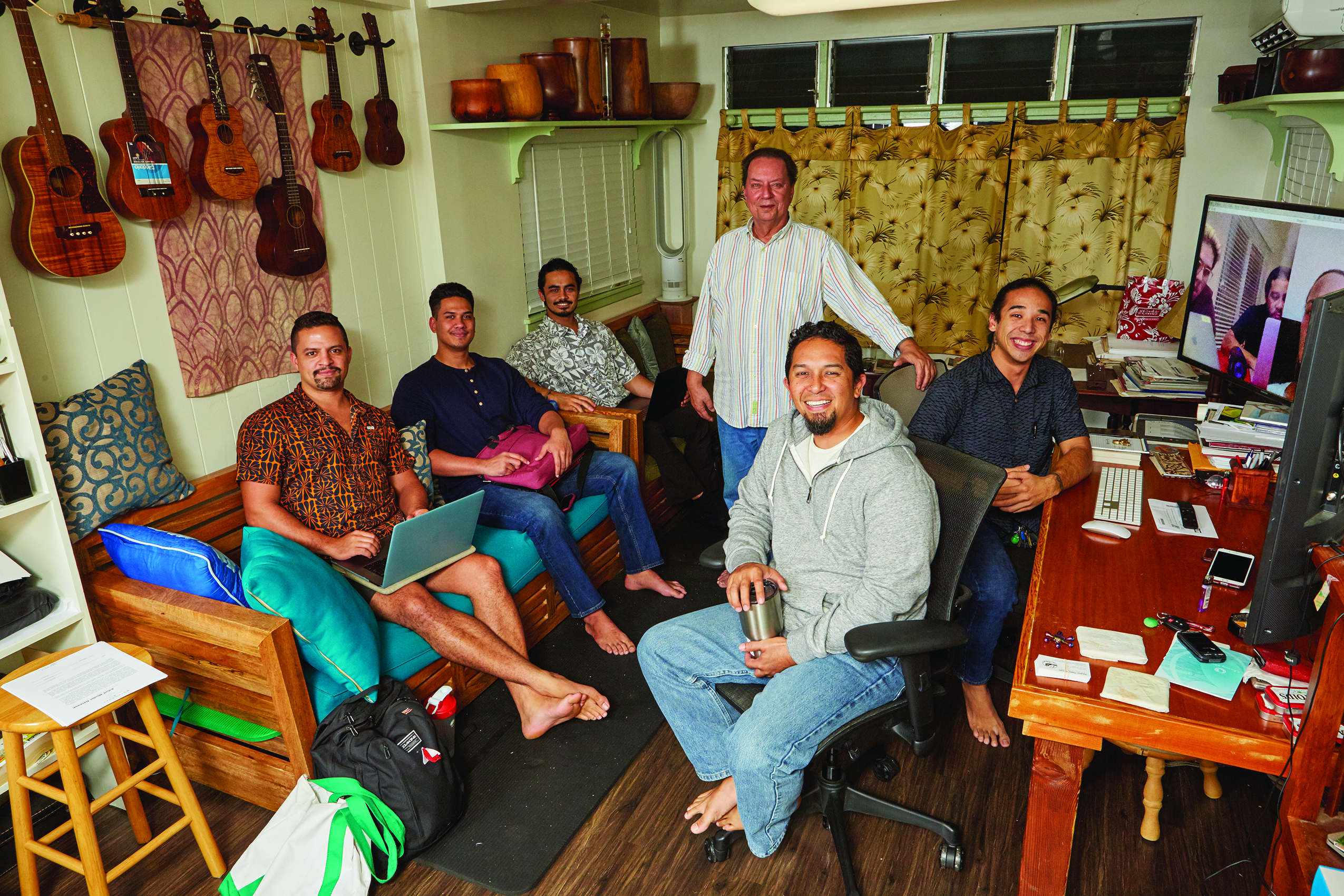
Dr. Nogelmeier’s Awaiaulu translation project uses Skype to connect O‘ahu, Moloka‘i, Maui, Hawai‘i, and Aotearoa/New Zealand. L–R: Ha‘alilio Solomon, Keawe Goodhue, Ka‘iuokalani Damas, Puakea Nogelmeier (standing), Kamuela Yim, Kalikoaloha Martin.Two out of 100 newspapers published in old Hawaiian.
“There were so many who taught me along the way, but the discipline learned under Theodore Kelsey’s tutelage allows me to do my work today. We would spend the first hour translating a passage of chant, but many more hours researching all the places names, mythical references, connotations of words and phrases, and the personal aspects of author style and story line. For Mr. Kelsey, a complete interpretation required deep analysis.”
Puakea excelled at language and for three and a half decades, he has been teaching the Hawaiian language at the university level. Many of the Hawaiian Immersion teachers who trained under him are now training new teachers.
Unlocking the Gate to Hawaiian History
A revived Hawaiian language began to grow in the university and in charter schools throughout Hawai‘i. Words for modern developments were coined, like lolo uila (electric brain) for “computer” and leka uila (electric letter) for email. But all the Hawaiian literature written in the 1800s by authors who knew the stories of the great chiefs was difficult to access, even by Hawaiian speakers. Less than 3 percent had been translated into English, and there were only a few Hawaiian trained translators. While language teachers were fluent in modern classroom language, they had never been encouraged to develop the skills to translate old writings. And translation is a full-time job that requires intense focus.
“The other issue is that Hawaiian language we use today in the university setting is different from the language written down 150 years ago. We do not speak English the way our grandparents did. Hawaiian is the same,” says Nogelmeier.
The Hawaiian Newspaper Initiative
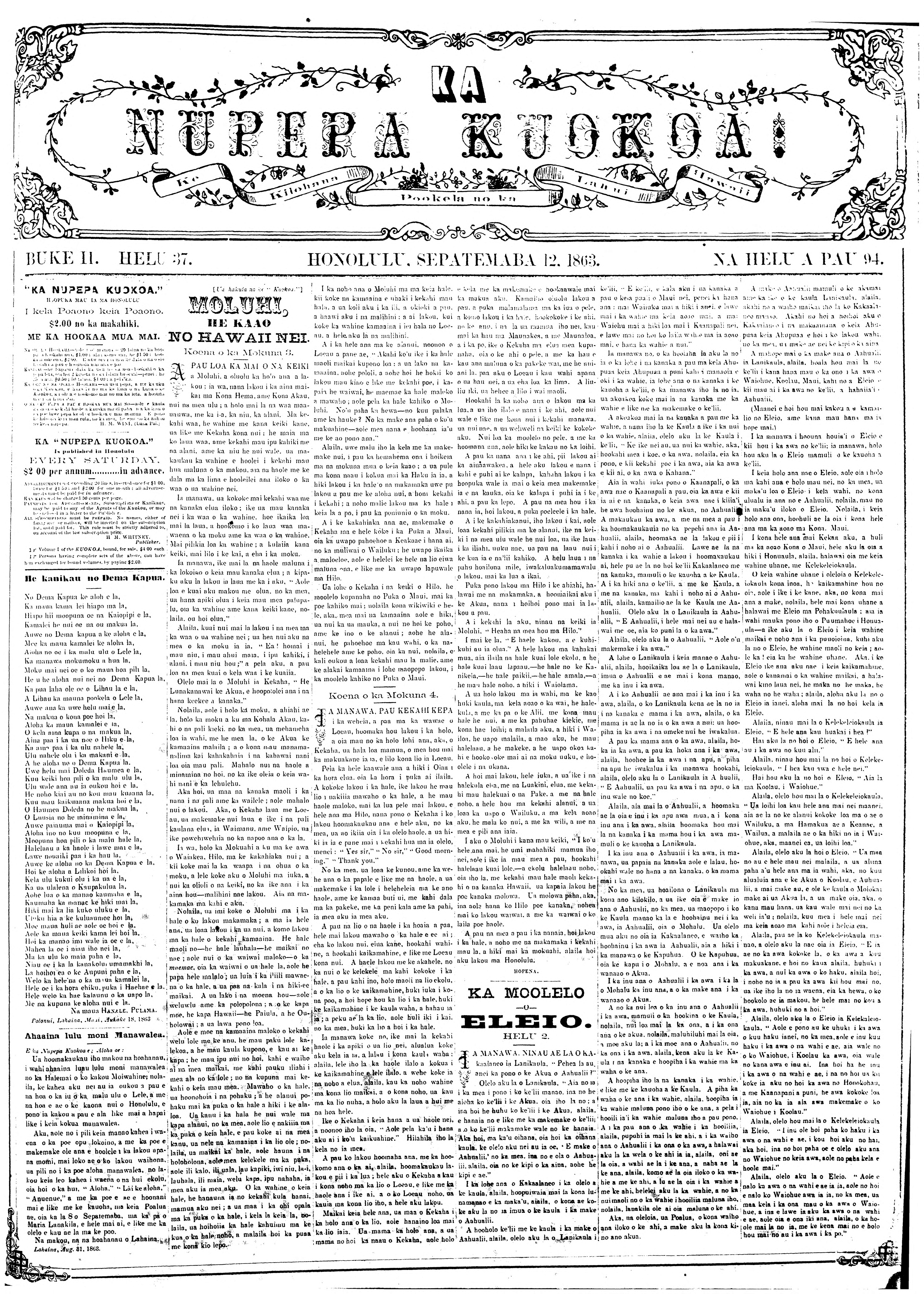
In 2001, the Hawaiian Newspaper Initiative was born. Although the Hawaiian language was an oral tradition before 1820, the Sandwich Isles Missionaries worked with Hawaiians to codify the Hawaiian alphabet, learned the language, and joined in teaching Hawaiians to read and write. By mid-century, Hawai‘i was one of the most literate nations on earth. Between 1834 and 1948, 100 different Hawaiian-language newspapers published over 125,000 pages, 76,000 of which were preserved, archived and indexed on microfilm. The deteriorating microfilm could not be searched by keyword. Therefore, the newspaper initiative sought to transcribe all the newspaper stories and ads into searchable Hawaiian-language digital print files. The body of literature was immense — equivalent to more than 1 million letter-sized pages of copy. The transcription process of typing each page was slow going.
In 2011, a huge public awareness campaign called “‘Ike Kū‘oko‘a: Liberating Knowledge,” recruited 7,500 volunteers in 12 countries to transcribe newspaper pages. The Office of Hawaiian Affairs also provided funds to have newspapers electronically scanned, so by the end of 2012, all the extant newspaper archives were digitized and searchable, by Hawaiian keyword. Nevertheless, only a few Hawaiian-speaking researchers were able to read and understand primary source records like these. Others were relying on poor English translations because that was all they had.
Preserving Knowledge
In 2003, while finishing his Ph.D., “Mai Pa‘a i Ka Leo,” (don’t restrict the historical voice) Nogelmeier was asked a profound question by his former student Dwayne Nakila Steele, owner of Grace Pacific Corporation: “Are we preserving language or preserving knowledge?” Obviously, the two are connected. Language expresses knowledge, and knowledge is the basis for the ideas language expresses. Nakila was really asking, “Does preserving the language do enough? Don’t we have to preserve the historical ideas and knowledge so that the modern language has a cultural foundation to rest upon?”
Puakea Nogelmeier approaches challenges in much the same way ancient Hawaiians did: Problem-solving is an intellectual sport — melding tried and true methods with creative alternatives to produce a practical outcome. He looks for simple answers, never takes his eye off the goal, and delights in the process along the way. This time, he applied Hawaiian mentoring to the problem of developing a large team of translators.
Nakila’s Dream: Awaiaulu: Hawaiian Literature Project
In 2004, Puakea and Nakila collaborated to create a stable of skilled Hawaiian translators who could, over time, confidently translate nearly all the Hawaiian newspaper body of literature.
Mentoring takes an extraordinary commitment by both mentor and student. Puakea created the program as a stand-alone nonprofit organization and began mentoring two interns, who would learn a method of translation and interpretation he distilled from Kelsey and others like Sarah Nākoa and Kamuela Kumukahi. Nakila funded the interns for two years. Candidates had excellent language skills with demonstrated work in the Hawaiian language. Their training now focused on the process of translation and interpretation of small chunks of the huge literature archive. Interns graduated to became “resource people,” qualified to both translate and also mentor more interns.
Four years ago, Kalei Kawa‘a of Moloka‘i Hawaiian Immersion School and Kamuela Yim, a teacher who is now with the DOE’s Office of Hawaiian Education, became translator trainees for Awaiaulu.
“When they tackle a story, trainees may spend one hour drafting a line-by-line translation of a selection written by Samuel Manaiakalani Kamakau, and then work four more hours smoothing and contextualizing the story,” says Nogelmeier.
Although Hawaiian vocabulary is quite precise, words may have different connotations or meanings depending on how they are used within a sentence pattern. Translation relies heavily on context. Analyzing word choice, sentence construction and references to places, nature, persons, practices and legends are critical. To add to the complexity, Hawaiians prized authors who crafted double meanings, wordplay and poetic references. Translators must explore all levels of meaning and note them for the reader. When you read a Hawaiian story, always read the editor’s notes.
“From these small beginnings we now have 18 people mentoring trainers, training translators or learning how to be a translator,” says Nogelmeier.
A Legacy of Knowledge and Language
Now, the number of translators and persons skilled at presenting newly-translated Hawaiian literature is increasing exponentially. Many famous stories about pre-contact Hawai‘i were published in Hawaiian newspapers as weekly or monthly columns. When a full story is translated, Awaiaulu publishes it as a book, available to the public. Nogelmeier’s translation of Ka Mo’olelo O Hi’iakaikapoliopele: As Told by Ho’oulumahiehie was published in 2013 and earned several literary awards. See all their publications at www.Awaiaulu.org.
The successful mentoring program at Awaialua is preserving Hawaiian literature and knowledge for our entire community.
Dr. Nogelmeier recalls the time when Mr. Kelsey, then 89 years of age, said to June Gutmanis, ‘I think Puakea will carry on my work.’”
If Samuel Kamakau, prolific author of 19th century Hawaiian nūpepa articles, were alive he might close this story this way:
Oh reader, whether you interpret the great translator’s statement as wishful thinking, a sideways request or a prophetical vision, the outcome and manifestation are clear. No more will the stories, legends and myths — nay, the stories of our great chiefs that thrilled our great-grandparents’ hearts — be hidden away. Our children will delight in the celebrations, political intrigue, dirges and simple stories of farmers and fishers who loved this ‘āina before them.
Pīpī holo ka‘ao. (So the story goes)
2018: Year of the Hawaiian
This year is a good time to read a Hawaiian story, or learn Hawaiian language. Ask your local immersion school about community adult classes, or inquire at your local senior center. It’s a fun mental exercise for brain health, and a way to learn the history and culture of the land we love.
A living and vibrant culture rests on two bedrock foundations: a living language, and land that reveres places connected to the history, beliefs and hopes of its people. One of the people at the nexus of language revival in Hawai‘i is Dr. Marvin Puakea Nogelmeier, PhD, Professor of Hawaiian Language at the University of Hawai‘i,…

 So, what can we do to protect ourselves from sarcopenia? Older adults and caregivers can be encouraged to know muscle and strength building can be done the same way 70-year-old Arnold Schwarzenegger does it: through exercise and nutrition. The Centers for Disease Control and Prevention (CDC) recommend older adults participate in muscle-strengthening activities a minimum of three days a week. Strength training may involve using weights, resistance bands or exercise machines. Studies have also shown that individuals who started earlier and had exercise habits in their middle age had a lower occurrence of muscle loss later in life.