Category: Wisdoms

  • Educating Adult Children About Saving

    Many parents, in addition to planning for their own future, care deeply about helping their children find their financial footing as they enter adulthood. Having spent decades building up their nest eggs for retirement, they recognize the power of long-term financial planning and hope their children will capture the same benefits by starting to invest while they are young. Convincing someone just starting off in their careers to set aside money for retirement — which to them, may seem like light years away — can be a tough sell. But, initiating the conversation in a respectful and educated manner may eventually compel them to make it a priority. If you’re a parent looking for guidance in this area, consider the following discussion pointers.

    First, recognize the challenges young professionals may face

    Those starting their career often face two challenges in establishing their nest egg. The first is feeling that they have all the time in the world to save for retirement. The second challenge is that young adults are balancing numerous priorities with their newfound financial independence. Acknowledge and be realistic about these hurdles, even as you make the case for setting aside money for retirement.

    Then, outline the key reasons for making retirement savings a priority

    1. Retirement may come sooner and last longer than they may think. The average American can spend any time between a few years to over 40 years in retirement. And while some retirees choose to continue earning a paycheck, the majority are relying on their savings to cover expenses. This means the costs to live the way you want in your later years — traveling, pursuing your hobbies, engaging with family — can easily surpass one million dollars.
    2. They will likely balance financial priorities throughout their lives. Learning how to manage priorities and save for multiple goals at the same time is a valuable skill. Deciding to be thoughtful about saving, investing and spending money today can help young professionals set a strong financial foundation as their income grows.
    3. Young professionals have a huge advantage in saving: time. A modest amount saved over several decades has the potential to grow into a significant sum due to the power of compound interest. Consider sharing the following example: Imagine if you saved $100 per month beginning at age 25, which is the equivalent of a little more than $3 per day. If the money was invested, earning an average annual return of seven percent, the savings would amount to nearly $367,000 by age 70. Now, suppose you waited until age 35 to start your retirement fund. If you invested $200 a month, still earning seven percent per year, your savings would grow to about $355,000. That’s still impressive, but it required you saving twice as much money per month than if you began ten years earlier.
    4. They control their own destiny, but they can learn from your successes and mistakes with money. As adults, your children are ultimately responsible for saving for their retirement. But, chances are, they could stand to benefit from the wisdom you’ve gained from decades of saving and investing. Opening up about your experiences — both smart money moves and missteps you’ve made over the years — may help them capture opportunities and avoid mistakes as they work to build their nest eggs.

    If you or your child would like assistance crafting a retirement saving strategy, reach out to a financial advisor. Together you can find a way to balance the items most important to you.


    MICHAEL W. K. YEE, CFP
    1585 Kapiolani Blvd., Suite 1100 Honolulu, HI 96814
    808-952-1222, ext. 1240 | michael.w.yee@ampf.com
    Michael W. K. Yee, CFP®, CFS®, CLTC, CRPC ®, is a Private Wealth Advisor, Certified Financial Planner ™ practitioner with Ameriprise Financial Services, Inc. in Honolulu, HI. He specializes in fee-based financial planning and asset management strategies and has been in practice for 31 years.
    Investment advisory products and services are made available through Ameriprise Financial Services, Inc., a registered investment adviser.
    Ameriprise Financial Services, Inc. Member FINRA and SIPC.
    © 2018 Ameriprise Financial, Inc. All rights reserved. File # 2171757

    Many parents, in addition to planning for their own future, care deeply about helping their children find their financial footing as they enter adulthood. Having spent decades building up their nest eggs for retirement, they recognize the power of long-term financial planning and hope their children will capture the same benefits by starting to invest…

  • Hiring a Private Caregiver Can Be Tricky

    When hiring a caregiver, you may be tempted to try to make the process as simple as possible by treating the caregiver as a “private contractor.” You tell the person “I will pay you so much an hour, and you deal with the IRS and the State when it comes time to pay taxes.” After all, taking on the responsibilities of withholding taxes (and then paying the taxing authorities), buying Workers’ Compensation insurance, paying Social Security and Medicare tax, and all the rest, can be a real pain. However, the IRS and the State will take the position that the caregiver is an “employee,” that you are an “employer,” and that all the legal obligations that attach to those labels are applicable to your situation.

    IRS Publication 926 gives very helpful guidance to those hiring household employees, including caregivers. Go through that publication, which can be found at https://www.irs.gov/forms-pubs/about-publication-926, and consider all the questions it poses, several of which might surprise you. For example, can your prospective caregiver legally work in the U.S.? How do you verify that, and what records must you keep to prove that you satisfied your obligation to verify the caregiver’s status? You can find all the resources and forms you will need for that on the U.S. Citizenship and Immigration Services website www.uscis.gov/i-9-central or call 800-375-5283.

    Depending on your budget, it may make sense to look into local employment or caregiver agencies. This simplifies your job, because you can contract with the agency, and the agency will be the caregiver’s employer and will deal with all of the details of being an employer. You will pay a premium for this kind of service, but the agency’s experience and employment expertise may make the extra cost seem like a bargain.

    Another set of issues arises if you opt to be the employer of a caregiver, and then your employee is injured on the job. If you have made sure to carry the right kinds of insurance, you will be fine. However, the consequences of failing to do so can be financially disastrous. An agency will probably carry Workers’ Compensation insurance, but you should be sure to talk with your personal insurance professional to find out if there is anything else you should do to protect yourself through your homeowner’s and umbrella policies.

    The bottom line is that you should never hire a caregiver without carefully considering your legal responsibilities and potential liabilities, and making sure they are addressed. Ask your trusted advisors — your CPA, your lawyer, and your insurance professional — for guidance, and check out the resources cited above. You will be glad you did.


    SCOTT MAKUAKANE, Counselor at Law
    Focusing exclusively on estate planning and trust law.

    www.est8planning.com
    808-587-8227 | maku@est8planning.com

    When hiring a caregiver, you may be tempted to try to make the process as simple as possible by treating the caregiver as a “private contractor.” You tell the person “I will pay you so much an hour, and you deal with the IRS and the State when it comes time to pay taxes.” After…

  • Overcoming Securities Fraud

    Only one out of every 44 cases of financial abuse among the elderly ever gets reported and even fewer make it to trial. This is the true story of one of those cases.

    This story starts with the death of a woman’s son in Afghanistan. Following his tragic passing, the government paid her more than $500,000 in death benefits. So, she took the money to a broker and told him that it was everything she had for retirement and, in addition, she wanted to access about half of it to buy a home with her daughter. The broker, after listening to her story, placed the money in securities called Real Estate Investment Trusts (REITS) and Limited Partnerships.

    The securities paid a dividend for about two years. And then the dividends got smaller. And smaller. Finally, when she wanted to cash out half of her money, the investments that she was in prevented her from doing so.

    Sensing something was seriously wrong, she sought out legal representation. Her situation was identified as textbook securities fraud, and after a settlement she won back her finances.

    Before approaching an advisor to invest your money, you should check for any past disciplinary actions against them by calling the Department of Commerce and Consumer Affairs at 808-586-2744, or using the Financial Industry Regulatory Authority’s (FINRA) BrokerCheck website, http://brokercheck.finra.org/

    If you suspect you are a victim of securities fraud, seek out a legal firm that includes a practice specializing in that area.


    CLAY CHAPMAN IWAMURA PULICE & NERVELL
    info@paclawteam.com
    Scott Batterman: 535-8410 | Gerald Clay: 535-8405
    www.PacLawTeam.com/securities-fraud

    Only one out of every 44 cases of financial abuse among the elderly ever gets reported and even fewer make it to trial. This is the true story of one of those cases.

  • ‘What’s My Line?’ Elder Abuse-style

    In the 1960s, there was a game show called “What’s My Line?” that featured a panel of four celebrities who would try to guess what line of work a guest on the show was in. This panel would ask Yes/No questions about the individual’s career and every time the answer was No, the guest would win a small amount of money. It was very entertaining watching the panelists guessing if someone was an airline pilot or a rocket scientist. Often their guesses hinged on how a particular person looked or their confidence when they gave an answer.

    We often have these preconceived notions of who people are by how they dress or speak to us. I see this each time I give a presentation and ask the simple question, “What does a con artist look like?” The answers I receive are oftentimes humorous. Descriptions of used car salesmen and politicians are shouted out, with visuals of “shifty eyes,” bad toupees, rapid speech, and loud aloha shirts added in for effect. Audience members are confident they would be able to clearly spot a criminal if they were to meet one.

    When I tell of the cases the Elder Abuse Unit has prosecuted over the years, and relate who the perpetrators of these crimes were, the audience becomes unsure of their scam artist radar. They sit in disbelief hearing of the daughter who took $200,000 from her mother, leaving her unable to pay the mortgage and facing foreclosure. Or the caregiver who stole all the wife’s jewelry when she was hired to care for the disabled husband. Or the pleasant woman who simply walked into the house of an elderly couple in ‘Aiea and pretended to know them, distracting the couple while her husband entered the home and took items from the bedroom.

    Over and over, I hear from victims about how nice the criminal looked or how polite he sounded over the telephone. Or maybe they felt sorry for him because of the sob story he told. Con men do not wear black cowboy hats to signify they are the bad guys. Oftentimes they are only revealed to be dishonest after the crime has been completed.

    It’s difficult, however, to go through life being paranoid, suspecting every stranger you meet as having criminal intent.

    Here are some simple ways to safeguard yourself from being a victim:

    • When hiring someone for a job, get a written contract and include any spoken promises in it.
    • Hire a licensed worker and verify their license by calling 808-587-4272.
    • Check references.
    • Don’t rush into a deal; if they can’t wait 24 hours something is wrong.
    • Be comfortable saying “no thank you” and hanging up the phone or shutting the door immediately. (You may feel this is being rude, but a common tactic for shysters is to make you feel guilty for asserting yourself).


    To report suspected elder abuse, contact the Elder Abuse Unit at 808-768-7536 | ElderAbuse@honolulu.gov

    “What does a con artist look like?” The answers I receive are oftentimes humorous. Descriptions of used car salesmen and politicians are shouted out, with visuals of “shifty eyes,” bad toupees, rapid speech, and loud aloha shirts added in for effect.

  • By Invitation Only

    Ideally, estate planning is “by invitation only.” Most people misunderstand this to mean that we, as the lawyers, are the ones doing the inviting. In actuality, it’s you, the clients, who are doing the inviting, by inviting us into your unique and textured lives.
    Each person has deep concerns they want to address based on their unique life stories. By inviting us into their lives, it helps us to understand them and their concerns, so that we can hopefully help to make things better for them and their family.

    This is true even when it seems that people only want to talk about probate and taxes. Estate planning is so much more than that. When people start the conversation by saying they want to avoid probate or minimize taxes, what they are often saying is that they worked so hard to accumulate things and they want to leave as much as they can for their beneficiaries to make life easier for them.

    Many people don’t feel comfortable with this foundational human element and stay safe in “content, worth and procedure,” and avoid “context, value, and process.” However, it is each client’s unique story that provides the context and builds the foundation for each estate plan. It is the value underlying the worth of assets that provides meaning. Because life is in constant change, estate planning is a process of self-reflection and conversation, rather than solely the making of a document or going through probate.

    When you see your estate planning attorney, tell your story and write it down. It will make all the difference in the world.


    Stephen B. Yim, Attorney at Law
    2054 S. Beretania St., Honolulu HI 96826
    808-524-0251 | www.stephenyimestateplanning.com

    Ideally, estate planning is “by invitation only.” Most people misunderstand this to mean that we, as the lawyers, are the ones doing the inviting. In actuality, it’s you, the clients, who are doing the inviting, by inviting us into your unique and textured lives.

  • Boost the Impact of Charitable Giving

    If philanthropy is part of your financial strategy, you may want to look for methods of giving that go beyond traditional monetary donations. Recent changes in the tax landscape may also be a reason to take another look at how you give financially. Here are four increasingly popular strategies that can work for you:

    Gift highly appreciated stocks or other assets

    If you hold stocks or other investments for more than one year that have gained value, liquidating the asset to make a charitable donation may result in a taxable long-term capital gain. One potentially more efficient way to maximize the value of your donation is to give appreciated stock directly to a charity. The charity would receive an asset it can continue to hold or immediately sell and you would not count the gift as taxable income. Additionally, the market value of the stock at the time the gift is made is generally deductible from your adjusted gross income if you itemize your deductions (subject to income-based limitations). Check to ensure the charity accepts this type of donation.

    Establish a charitable trust

    Another way to consider gifting assets is to set up a charitable trust. Trusts can help you manage highly appreciated assets in a more tax-efficient manner while, in some cases, allowing you to split assets among charitable and non-charitable beneficiaries. The timing of each gift and the flexibility you want dictates the type of trust that works best. With a Charitable Lead Trust, a charity is funded with income from assets placed in the trust for a specified time, after which, the remaining assets revert to other named beneficiaries, such as your heirs. In a Charitable Remainder Trust, the reverse occurs. The trust makes regular income payments back to you or another beneficiary. After a period of time specified in the trust, the remaining assets are directed to the named charities. These trusts have specific rules and are generally established through a professional. Another option is to choose a donor-advised fund, which allows you to make a large donation that may be immediately deductible from taxes, but gives you flexibility to recommend gifts to charities spread out over a period of years.

    Maximize donations through your employer

    Your employer may offer the convenience of making contributions through payroll deductions, allowing you to give systematically with each paycheck. In addition, your employer may match a certain donation amount, which can add to the impact your gift makes. If you have access to these or other workplace giving programs, check to see if the charities you care about are eligible to receive this type of donation.

    Make a charitable individual retirement account (IRA) donation

    If you have reached age 70-½, you are required to take distributions from your traditional IRA each year. If you don’t need the money to meet your essential and lifestyle expenses, you may prefer to avoid the resulting tax bill by taking advantage of the Qualified Charitable Distribution rule. It allows you to transfer funds directly from your IRA to a qualified charitable organization. This is a tax-efficient way to shift up to $100,000 out of an IRA each year. By doing so, you may avoid having to claim income (and subsequent tax liability) since you would not receive the required distribution.
    As you consider these and other gifting strategies, consult with your financial advisor and tax advisor to ensure the gifts you make are most effective for your goals and consistent with your overall financial plan.


    MICHAEL W. K. YEE, CFP
    1585 Kapiolani Blvd., Ste. 1100, Honolulu HI 96814
    808-952-1222, ext. 1240 | michael.w.yee@ampf.com

    Michael W. K. Yee, CFP®, CFS®, CLTC, CRPC ®, is a Private Wealth Advisor, Certified Financial Planner ™ practitioner with Ameriprise Financial Services, Inc. in Honolulu, HI. He specializes in fee-based financial planning and asset management strategies and has been in practice for 30 years.

    Ameriprise Financial, Inc. and its affiliates do not offer tax or legal advice. Consumers should consult with their tax advisor or attorney regarding their specific situation.

    Investment advisory products and services are made available through Ameriprise Financial Services, Inc., a registered investment adviser.

    Ameriprise Financial Services, Inc. Member FINRA and SIPC.
    © 2018 Ameriprise Financial, Inc. All rights reserved. File #2089125.

    Another way to consider gifting assets is to set up a charitable trust. Trusts can help you manage highly appreciated assets in a more tax-efficient manner while, in some cases, allowing you to split assets among charitable and non-charitable beneficiaries

  • Three Documents Everybody Needs

    There are three estate planning documents that every competent adult living in the State of Hawai‘i should have. Of course, “competency” can be an elusive quality, but once a Hawai‘i resident has turned 18, the law of our State presumes that person to be competent. So if you have children or grandchildren getting ready to leave Hawai‘i for college in the fall — or even
    if they are staying in the Islands for the indefinite future — and if they are at least 18 years of age, they should have in place a durable power of attorney, an advance health care directive, and a HIPAA authorization. (HIPAA refers to the Health Insurance Portability and Accountability Act of 1996.)

    Durable power of attorney
    A durable power of attorney gives authority to other people to deal with one’s assets. The person who signs the power of attorney is called the principal, and the person appointed to act on the principal’s behalf is called the agent. Under Hawai‘i law, an agent owes fiduciary duties to the principal, and the agent can get in big trouble for failing to carry out those duties. Without a power of attorney in place, it might be necessary to institute an involved court proceeding if a person is absent or incapacitated at a time when something must be done with the person’s assets. This might be the case if the person is in an accident and cannot access his or her funds to pay for care or for regular obligations, such as rent.

    Advance health care directive
    You would use an advance health care directive to give authority to other people to make health care decisions for you if you are unable to communicate those decisions for yourself. If, for example, you were unconscious and you needed surgery, who would sign the consent forms for you? If you have an advance health care directive in place, your hand-picked health care agent could sign on your behalf. Your health care agent could also make other decisions for you, including end-of-life decisions. Without an advance health care directive in place, decision-making for you could be tricky, and your family could be forced into court in order to have a judge appoint someone to make decisions for you.

    HIPAA authorization
    Finally, a HIPAA authorization gives medical providers permission to talk to a person’s duly-appointed health care agents and anyone else the person wants to be privy to his or her health information. This permission is critical for actual decision-makers, because without it, a doctor can refuse to divulge anything about the person for whom decisions need to be made. Not a great position for the decision-makers to be in. They would have authority to make decisions, but no access to the specific information upon which decisions would be based. The patient may also want to give medical providers permission to talk with family members or others who do not have a decision-making role, but who the patient might nevertheless want to keep in the loop in the event of a hospitalization.

    Talk with your trusted advisers about getting these documents in place for yourself and your loved ones.


    SCOTT MAKUAKANE, Counselor at Law
    Focusing exclusively on estate planning and trust law.
    www.est8planning.com
    808-587-8227 | maku@est8planning.com

    There are three estate planning documents that every competent adult living in the State of Hawai‘i should have. Of course, “competency” can be an elusive quality, but once a Hawai‘i resident has turned 18, the law of our State presumes that person to be competent.

  • Salesman or Scammer?

    Better Business Bureau - Generations Magazine - April-May 2013In Hawai‘i, we must always be on the lookout for scammers going door to door posing as trustworthy salespeople. They may be offering lawn care, home improvement services, alarm systems, and more, and also pretending to be legitimate companies just to get you to trust them.

    Five tips to help protect you and your home

    1) Research. Ask for identification such as a permit, business license or business card. Research the company through www.BBB.org to view what their complaint history is and their BBB rating.

    2) Resist pressure. Do they need an answer now? Avoid sellers who encourage you to sign a contract or put down a deposit right away.

    3) Obtain everything in writing. If you decide to do business with a door-to-door salesperson make sure you get everything in writing.

    4) Know your rights. Under Hawai‘i’s law on door-to-door sales, a buyer is entitled to a full refund if a cancellation notice is sent in writing within three business days.

    5) Pay using a credit card. Payment by credit card is the safest method since certain consumer protections are provided. Make sure you obtain a receipt that documents any payments that are made and keep it for your records.

    Most importantly, stay safe. If a salesperson or contractor gets irate, difficult, or if you feel unsafe in any way, close the door and call the police.


    BETTER BUSINESS BUREAU NORTHWEST + PACIFIC
    1132 Bishop Street #615, Honolulu HI 96813

    808-536-6956  |  info@hawaii.bbb.org

    For information or to report a scam, visit ScamTracker
    at www.bbb.org/scamtracker, or call the main office Monday–Friday from 8 am – 4 pm.

    In Hawai‘i, we must always be on the lookout for scammers going door to door posing as trustworthy salespeople. They may be offering lawn care, home improvement services, alarm systems, and more, and also pretending to be legitimate companies just to get you to trust them. Five tips to help protect you and your home

  • Adding up Elder Abuse Numbers

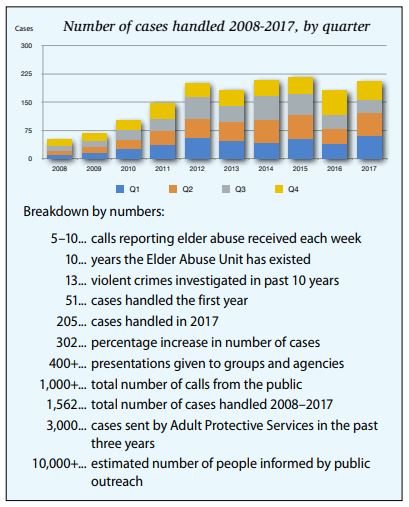
    I went to law school because math wasn’t my strength and I liked to argue (just ask my wife on both accounts). In considering my dislike of figures, it’s ironic that I am often asked to summarize my work in numbers.

    I have been with the Prosecutor’s Office now for over 22 years, and 10 years ago created the Elder Abuse Unit. This unit was the first (and still is the only) team in Hawai‘i dedicated to prosecuting felony offenses where the victims were 60 years of age or older. At the beginning of it all, there was only one attorney (me) and one staff member. Over the years, however, we have grown to four attorneys, two staff, one paralegal, and two student interns (in total we have had 32 volunteer student interns over the years).

    The cases we handle include everything from property crimes like burglary and auto thefts to sex assaults (there is a rape trial going on right now as I write this article) to violent crimes, including murder. In most cases — whether referred to us by Adult Protective Services or received directly — people do not want to get the police involved. National studies show that only 1 in 25 elder abuse cases are reported to the police.


    One thing I wanted the Elder Abuse Unit to be was a resource for educating the public about elder abuse and providing information about preventing one from being a victim of this crime. Besides giving free presentations and trainings to various groups and agencies, our unit has had an information booth at The Good Life Expo (Hawai‘i Seniors’ Fair) for the past nine years. Attendance at that event ranges from 20,000 to 26,000 people each year.

    Lastly, I have written 28 articles about elder abuse for Generations Magazine over the years (all issues can be found on this website). Now it is 29 articles.

    CORRECTION TO CHART: The Elder Abuse Unit prosecuted over 500 violent crimes, 13 of which were murders.


    To report suspected elder abuse, contact the Elder Abuse Unit at 808-768-7536  |  ElderAbuse@honolulu.gov

    I have been with the Prosecutor’s Office now for over 22 years, and 10 years ago created the Elder Abuse Unit. This unit was the first (and still is the only) team in Hawai‘i dedicated to prosecuting felony offenses where the victims were 60 years of age or older.

  • Our Care, Our Choice

    Before you panic about the new “Hawai‘i Aid in Dying Law,” it’s a great law but not for the reasons you may think.

    Governor Ige signed the Our Care, Our Choice Act on April 5, 2018 and it will become law on January 1, 2019. The new law’s purpose is to establish a regulated process whereby a mentally competent adult resident of Hawai‘i with a terminal illness and less than six months to live may choose to end life with a prescription.

    The Act provides that any individual desiring to take advantage of this law must first go to counseling, and this is where the true benefit of this law rests. Studies performed in California found that going through this regulated process ultimately rendered the drugs unnecessary.

    The studies revealed that, of those seeking assisted death only a quarter actually did so once engaged in the mandatory counseling process. For the first time, a qualified professional took the time to find out what distressed them, what quality of life meant to them, and in doing so helped them gain control of their lives, resulting in better quality of care.

    In all areas of estate planning whether it relates to finances, health care, end of life decisions or who gets what, when and why, the key to successful estate planning — ensuring that your intentions are honored — is through the process of deep reflection as to what is meaningful to you, and then engaging in crucial conversations with loved ones, care providers, and other professionals. It is never simply the making of a document.


    Stephen B. Yim, Attorney at Law
    2054 S. Beretania St., Honolulu HI 96826

    808-524-0251  |  www.stephenyimestateplanning.com

    Before you panic about the new “Hawai‘i Aid in Dying Law,” it’s a great law but not for the reasons you may think. Governor Ige signed the Our Care, Our Choice Act on April 5, 2018 and it will become law on January 1, 2019. The new law’s purpose is to establish a regulated process…

  • What do all Those Designations Mean?

    In today’s world of wondering whether information is reliable or not, it is critical to protect our kūpuna and their families. You may hear or see an advertisement for a business professional with a bunch of initials after their name and wonder what do all those initials really mean? Does it mean they know more than another professional, are they certified to sell more things or is it just a way to market themselves more?

    There are literally hundreds of business professional designations with initials that you see after a person’s name.

    To make sense of this alphabet soup of financial and other designations, you need to find out about the educational and certifying process for those designations. Then you can decide whose certification can be relied upon.

    Certification of competence in a specified subject or areas of expertise, and of the integrity of an agency, firm, group, or person is awarded by a duly recognized and respected accrediting organization.

    What to look for in checking out designations is an “Accredited Designation.” This means the professional is required to do continuing education on an annual basis and not just take a test once and use the designation for life. It is vitally important to check the professional out on the state Department of Commerce and Consumer Affairs (DCCA) website at www.cca.hawaii.gov or call 808-587-3222, and with the industry’s professional association.

    Step 1:
    Ask “Are you licensed to sell me this product or service?”

    Legitimate business professionals — including brokers, investment advisers, insurance and real estate agents — must be licensed with the state Department of Commerce and Consumer Affairs and in “good standing.” If they say they aren’t licensed, say goodbye — and don’t buy.

    The DCCA’s Professional & Vocational Licensing Division licenses 51 different professions and vocations, and has a database you can search using the name of the business or individual:

    www.pvl.ehawaii.gov/pvlsearch/

    Step 2:
    Check if the designation is accredited.

    Many state securities and insurance regulators do not allow financial professionals to use a designation — in particular a “senior” designation — unless it has been accredited by either the American National Standards Institute (ANSI) or the National Commission for Certifying Agencies.

    Numerous state regulators also allow financial professionals to use a designation if the organization that awards the designation is on the Department of Education’s list of Accredited Agencies, and the designation does not primarily apply to sales and/or marketing.

    It is always good practice to take the time to look into the accreditation of the professionals you turn to for advice before applying your trust, in order to protect your own valuable resources.

    In today’s world of wondering whether information is reliable or not, it is critical to protect our kūpuna and their families. You may hear or see an advertisement for a business professional with a bunch of initials after their name and wonder what do all those initials really mean?

  • Mastering Change

    Class reunions are poignant reminders of change. With each passing year, our classmates grow a little grayer, perhaps a little balder, and maybe a little more expansive at the midsection. Good thing we are not like our classmates, right? Actually, we are. Father Time is catching up with all of us. That sobering fact should inspire us to reflect each year on our estate plans and whether they still do what we want them to do.

    No matter how well we plan, our estate plans are going to veer off course. It is impossible to predict when that will happen, but it will. Ironically, change is one of the few constants in our lives. If we want our estate plans to work when they are called upon, we need to review them at least annually and keep them as up-to-date as we can. Here’s why.

    The law changes

    Our estate plans are subject to federal, state, and county laws, regulations, and ordinances, not to mention court decisions. The government seems to love changing the rules on us. Keeping up with those changes is critical, but difficult for the average person who does not deal with the law and stay current with its variations. Thus, we should consult the folks who do stay on top of those things (our estate planning attorneys, financial planners, and certified public accountants) about the changes that may require revisions to our estate planning documents and, perhaps, the estate planning strategies that have worked for us in the past but are now inadequate.

    Our health changes

    Not to rub it in here, but with age can come changes that impact our ability to make sound decisions and handle assets for ourselves and our loved ones. About 70 percent of us are going to be completely incapacitated for some period in our lives, and we need to have safeguards in place to address those kinds of eventualities. As our health changes, our estate plans may need to change.

    Our financial situation changes

    Over time, as we acquire and divest ourselves of assets, the assumptions that underlie our estate plans may go out of date. For example, I may have removed my residence from my trust in order to secure a home equity line of credit. If I don’t remember to put it back into my trust after the credit line becomes effective, my home may need to go through probate before it can be passed on to my loved ones. That can come as an unpleasant — but preventable — surprise.

    Our relationships change

    If you are like most people, the list of people you trust to make decisions on your behalf has changed over the past 10 years. Wouldn’t it be a good idea for your estate plan to reflect your current list? Having the wrong trustee can turn out to be a disaster.

    Reviewing your estate plan annually is like changing the oil in your car or seeing your dentist every six months. You don’t have to do any of those things, but you will have much better outcomes if you do.


    SCOTT MAKUAKANE, Counselor at Law
    Focusing exclusively on estate planning and trust law.

    www.est8planning.com
    808-587-8227  |  maku@est8planning.com

    Class reunions are poignant reminders of change. With each passing year, our classmates grow a little grayer, perhaps a little balder, and maybe a little more expansive at the midsection. Good thing we are not like our classmates, right? Actually, we are. Father Time is catching up with all of us. That sobering fact should…