Category: Wisdoms

  • Three Documents Everybody Needs

    There are three estate planning documents that every competent adult living in the State of Hawai‘i should have. Of course, “competency” can be an elusive quality, but once a Hawai‘i resident has turned 18, the law of our State presumes that person to be competent. So if you have children or grandchildren getting ready to leave Hawai‘i for college in the fall — or even
    if they are staying in the Islands for the indefinite future — and if they are at least 18 years of age, they should have in place a durable power of attorney, an advance health care directive, and a HIPAA authorization. (HIPAA refers to the Health Insurance Portability and Accountability Act of 1996.)

    Durable power of attorney
    A durable power of attorney gives authority to other people to deal with one’s assets. The person who signs the power of attorney is called the principal, and the person appointed to act on the principal’s behalf is called the agent. Under Hawai‘i law, an agent owes fiduciary duties to the principal, and the agent can get in big trouble for failing to carry out those duties. Without a power of attorney in place, it might be necessary to institute an involved court proceeding if a person is absent or incapacitated at a time when something must be done with the person’s assets. This might be the case if the person is in an accident and cannot access his or her funds to pay for care or for regular obligations, such as rent.

    Advance health care directive
    You would use an advance health care directive to give authority to other people to make health care decisions for you if you are unable to communicate those decisions for yourself. If, for example, you were unconscious and you needed surgery, who would sign the consent forms for you? If you have an advance health care directive in place, your hand-picked health care agent could sign on your behalf. Your health care agent could also make other decisions for you, including end-of-life decisions. Without an advance health care directive in place, decision-making for you could be tricky, and your family could be forced into court in order to have a judge appoint someone to make decisions for you.

    HIPAA authorization
    Finally, a HIPAA authorization gives medical providers permission to talk to a person’s duly-appointed health care agents and anyone else the person wants to be privy to his or her health information. This permission is critical for actual decision-makers, because without it, a doctor can refuse to divulge anything about the person for whom decisions need to be made. Not a great position for the decision-makers to be in. They would have authority to make decisions, but no access to the specific information upon which decisions would be based. The patient may also want to give medical providers permission to talk with family members or others who do not have a decision-making role, but who the patient might nevertheless want to keep in the loop in the event of a hospitalization.

    Talk with your trusted advisers about getting these documents in place for yourself and your loved ones.


    SCOTT MAKUAKANE, Counselor at Law
    Focusing exclusively on estate planning and trust law.
    www.est8planning.com
    808-587-8227 | maku@est8planning.com

    There are three estate planning documents that every competent adult living in the State of Hawai‘i should have. Of course, “competency” can be an elusive quality, but once a Hawai‘i resident has turned 18, the law of our State presumes that person to be competent.

  • Salesman or Scammer?

    Better Business Bureau - Generations Magazine - April-May 2013In Hawai‘i, we must always be on the lookout for scammers going door to door posing as trustworthy salespeople. They may be offering lawn care, home improvement services, alarm systems, and more, and also pretending to be legitimate companies just to get you to trust them.

    Five tips to help protect you and your home

    1) Research. Ask for identification such as a permit, business license or business card. Research the company through www.BBB.org to view what their complaint history is and their BBB rating.

    2) Resist pressure. Do they need an answer now? Avoid sellers who encourage you to sign a contract or put down a deposit right away.

    3) Obtain everything in writing. If you decide to do business with a door-to-door salesperson make sure you get everything in writing.

    4) Know your rights. Under Hawai‘i’s law on door-to-door sales, a buyer is entitled to a full refund if a cancellation notice is sent in writing within three business days.

    5) Pay using a credit card. Payment by credit card is the safest method since certain consumer protections are provided. Make sure you obtain a receipt that documents any payments that are made and keep it for your records.

    Most importantly, stay safe. If a salesperson or contractor gets irate, difficult, or if you feel unsafe in any way, close the door and call the police.


    BETTER BUSINESS BUREAU NORTHWEST + PACIFIC
    1132 Bishop Street #615, Honolulu HI 96813

    808-536-6956  |  info@hawaii.bbb.org

    For information or to report a scam, visit ScamTracker
    at www.bbb.org/scamtracker, or call the main office Monday–Friday from 8 am – 4 pm.

    In Hawai‘i, we must always be on the lookout for scammers going door to door posing as trustworthy salespeople. They may be offering lawn care, home improvement services, alarm systems, and more, and also pretending to be legitimate companies just to get you to trust them. Five tips to help protect you and your home

  • Adding up Elder Abuse Numbers

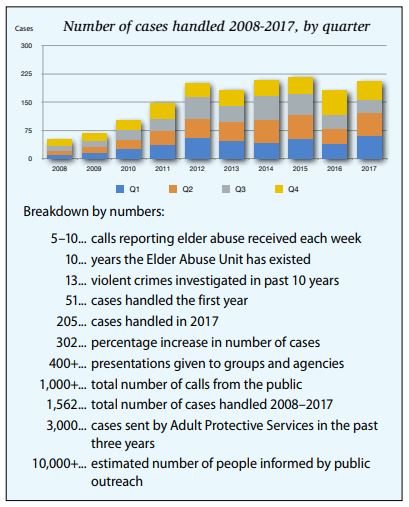
    I went to law school because math wasn’t my strength and I liked to argue (just ask my wife on both accounts). In considering my dislike of figures, it’s ironic that I am often asked to summarize my work in numbers.

    I have been with the Prosecutor’s Office now for over 22 years, and 10 years ago created the Elder Abuse Unit. This unit was the first (and still is the only) team in Hawai‘i dedicated to prosecuting felony offenses where the victims were 60 years of age or older. At the beginning of it all, there was only one attorney (me) and one staff member. Over the years, however, we have grown to four attorneys, two staff, one paralegal, and two student interns (in total we have had 32 volunteer student interns over the years).

    The cases we handle include everything from property crimes like burglary and auto thefts to sex assaults (there is a rape trial going on right now as I write this article) to violent crimes, including murder. In most cases — whether referred to us by Adult Protective Services or received directly — people do not want to get the police involved. National studies show that only 1 in 25 elder abuse cases are reported to the police.


    One thing I wanted the Elder Abuse Unit to be was a resource for educating the public about elder abuse and providing information about preventing one from being a victim of this crime. Besides giving free presentations and trainings to various groups and agencies, our unit has had an information booth at The Good Life Expo (Hawai‘i Seniors’ Fair) for the past nine years. Attendance at that event ranges from 20,000 to 26,000 people each year.

    Lastly, I have written 28 articles about elder abuse for Generations Magazine over the years (all issues can be found on this website). Now it is 29 articles.

    CORRECTION TO CHART: The Elder Abuse Unit prosecuted over 500 violent crimes, 13 of which were murders.


    To report suspected elder abuse, contact the Elder Abuse Unit at 808-768-7536  |  ElderAbuse@honolulu.gov

    I have been with the Prosecutor’s Office now for over 22 years, and 10 years ago created the Elder Abuse Unit. This unit was the first (and still is the only) team in Hawai‘i dedicated to prosecuting felony offenses where the victims were 60 years of age or older.

  • Our Care, Our Choice

    Before you panic about the new “Hawai‘i Aid in Dying Law,” it’s a great law but not for the reasons you may think.

    Governor Ige signed the Our Care, Our Choice Act on April 5, 2018 and it will become law on January 1, 2019. The new law’s purpose is to establish a regulated process whereby a mentally competent adult resident of Hawai‘i with a terminal illness and less than six months to live may choose to end life with a prescription.

    The Act provides that any individual desiring to take advantage of this law must first go to counseling, and this is where the true benefit of this law rests. Studies performed in California found that going through this regulated process ultimately rendered the drugs unnecessary.

    The studies revealed that, of those seeking assisted death only a quarter actually did so once engaged in the mandatory counseling process. For the first time, a qualified professional took the time to find out what distressed them, what quality of life meant to them, and in doing so helped them gain control of their lives, resulting in better quality of care.

    In all areas of estate planning whether it relates to finances, health care, end of life decisions or who gets what, when and why, the key to successful estate planning — ensuring that your intentions are honored — is through the process of deep reflection as to what is meaningful to you, and then engaging in crucial conversations with loved ones, care providers, and other professionals. It is never simply the making of a document.


    Stephen B. Yim, Attorney at Law
    2054 S. Beretania St., Honolulu HI 96826

    808-524-0251  |  www.stephenyimestateplanning.com

    Before you panic about the new “Hawai‘i Aid in Dying Law,” it’s a great law but not for the reasons you may think. Governor Ige signed the Our Care, Our Choice Act on April 5, 2018 and it will become law on January 1, 2019. The new law’s purpose is to establish a regulated process…

  • What do all Those Designations Mean?

    In today’s world of wondering whether information is reliable or not, it is critical to protect our kūpuna and their families. You may hear or see an advertisement for a business professional with a bunch of initials after their name and wonder what do all those initials really mean? Does it mean they know more than another professional, are they certified to sell more things or is it just a way to market themselves more?

    There are literally hundreds of business professional designations with initials that you see after a person’s name.

    To make sense of this alphabet soup of financial and other designations, you need to find out about the educational and certifying process for those designations. Then you can decide whose certification can be relied upon.

    Certification of competence in a specified subject or areas of expertise, and of the integrity of an agency, firm, group, or person is awarded by a duly recognized and respected accrediting organization.

    What to look for in checking out designations is an “Accredited Designation.” This means the professional is required to do continuing education on an annual basis and not just take a test once and use the designation for life. It is vitally important to check the professional out on the state Department of Commerce and Consumer Affairs (DCCA) website at www.cca.hawaii.gov or call 808-587-3222, and with the industry’s professional association.

    Step 1:
    Ask “Are you licensed to sell me this product or service?”

    Legitimate business professionals — including brokers, investment advisers, insurance and real estate agents — must be licensed with the state Department of Commerce and Consumer Affairs and in “good standing.” If they say they aren’t licensed, say goodbye — and don’t buy.

    The DCCA’s Professional & Vocational Licensing Division licenses 51 different professions and vocations, and has a database you can search using the name of the business or individual:

    www.pvl.ehawaii.gov/pvlsearch/

    Step 2:
    Check if the designation is accredited.

    Many state securities and insurance regulators do not allow financial professionals to use a designation — in particular a “senior” designation — unless it has been accredited by either the American National Standards Institute (ANSI) or the National Commission for Certifying Agencies.

    Numerous state regulators also allow financial professionals to use a designation if the organization that awards the designation is on the Department of Education’s list of Accredited Agencies, and the designation does not primarily apply to sales and/or marketing.

    It is always good practice to take the time to look into the accreditation of the professionals you turn to for advice before applying your trust, in order to protect your own valuable resources.

    In today’s world of wondering whether information is reliable or not, it is critical to protect our kūpuna and their families. You may hear or see an advertisement for a business professional with a bunch of initials after their name and wonder what do all those initials really mean?

  • Mastering Change

    Class reunions are poignant reminders of change. With each passing year, our classmates grow a little grayer, perhaps a little balder, and maybe a little more expansive at the midsection. Good thing we are not like our classmates, right? Actually, we are. Father Time is catching up with all of us. That sobering fact should inspire us to reflect each year on our estate plans and whether they still do what we want them to do.

    No matter how well we plan, our estate plans are going to veer off course. It is impossible to predict when that will happen, but it will. Ironically, change is one of the few constants in our lives. If we want our estate plans to work when they are called upon, we need to review them at least annually and keep them as up-to-date as we can. Here’s why.

    The law changes

    Our estate plans are subject to federal, state, and county laws, regulations, and ordinances, not to mention court decisions. The government seems to love changing the rules on us. Keeping up with those changes is critical, but difficult for the average person who does not deal with the law and stay current with its variations. Thus, we should consult the folks who do stay on top of those things (our estate planning attorneys, financial planners, and certified public accountants) about the changes that may require revisions to our estate planning documents and, perhaps, the estate planning strategies that have worked for us in the past but are now inadequate.

    Our health changes

    Not to rub it in here, but with age can come changes that impact our ability to make sound decisions and handle assets for ourselves and our loved ones. About 70 percent of us are going to be completely incapacitated for some period in our lives, and we need to have safeguards in place to address those kinds of eventualities. As our health changes, our estate plans may need to change.

    Our financial situation changes

    Over time, as we acquire and divest ourselves of assets, the assumptions that underlie our estate plans may go out of date. For example, I may have removed my residence from my trust in order to secure a home equity line of credit. If I don’t remember to put it back into my trust after the credit line becomes effective, my home may need to go through probate before it can be passed on to my loved ones. That can come as an unpleasant — but preventable — surprise.

    Our relationships change

    If you are like most people, the list of people you trust to make decisions on your behalf has changed over the past 10 years. Wouldn’t it be a good idea for your estate plan to reflect your current list? Having the wrong trustee can turn out to be a disaster.

    Reviewing your estate plan annually is like changing the oil in your car or seeing your dentist every six months. You don’t have to do any of those things, but you will have much better outcomes if you do.


    SCOTT MAKUAKANE, Counselor at Law
    Focusing exclusively on estate planning and trust law.

    www.est8planning.com
    808-587-8227  |  maku@est8planning.com
    Class reunions are poignant reminders of change. With each passing year, our classmates grow a little grayer, perhaps a little balder, and maybe a little more expansive at the midsection. Good thing we are not like our classmates, right? Actually, we are. Father Time is catching up with all of us. That sobering fact should…

  • If Inflation Returns, Are You Ready?

    Inflation is the normal state of affairs in the U.S. economy. Most economists consider an annual increase in the cost-of-living of two or three percent per year to be a manageable level of inflation. This increase usually is a good trend, because it is an indication of a growing economy.

    While inflation has not been a concern in recent decades, the 1970s and early 1980s are remembered as a time when inflation created major economic challenges. In some years during this timeframe, the cost-of-living (as measured by the Consumer Price Index or CPI) increased more than 10 percent per year.

    Signs of an inflation uptick

    Through much of the current economic recovery, which began nine years ago, inflation has remained modest. Some economists and analysts believe this could change going forward. One key factor that could contribute to an accelerated inflation rate is the unemployment rate, which dipped to its lowest level in years. This may mean employers will have to start offering higher wages to attract and retain qualified staff, which could trigger higher inflation. Another contributing factor could be that most global economies are simultaneously experiencing economic growth. This synchronized expansion may continue to stimulate demand for products and services, leading to faster price increases. Investors are also watching for the impact of the recent tax reform legislation, which could contribute to inflation should consumers spend more, and prices rise.

    Watch the Federal Reserve

    Follow actions taken by the Federal Reserve (the Fed). It targets an annual inflation rate of 2 percent, a goal it has had little difficulty maintaining in recent years. If the Fed begins lifting the short-term interest rates it controls more quickly than expected, it may be a sign that Fed policymakers are concerned that the threat of higher inflation is upon us. If the Fed raises rates quickly, consumers could see rising interest rates and a more volatile stock market.

    The potential impact on your bottom line

    While no one can predict what will happen in the future, you should consider how to respond to a changing environment for living costs. If inflation increases rapidly, the impact can be dramatic for consumers. When prices of everyday items begin to noticeably increase, consumers could have less disposable income. The greatest impact can often be on big-ticket items. For example, the price of houses or cars could begin to climb. In select housing markets, this has already happened even though the broader inflation rate has, at least until now, remained subdued.

    Does that mean you should quickly adjust your spending? While it may seem prudent, you must be careful not to let short-term economic trends overly influence your long-term financial strategy.

    Prepare your portfolio

    In what has generally been a period of low inflation (the 1980s through now), stocks and bonds have both performed consistently well. In the 1970s, when inflation was much higher, stocks lagged their historical averages and bonds were negatively affected by rising interest rates.

    If inflation rises, interest rates historically have tended to follow that trend. If inflation should begin to accelerate, bond yields may as well. This could hurt bond investors, as existing bond holdings can lose value when yields rise in the broader bond market.

    If you are concerned that inflation risks will become a concern, this may be a good time to review your portfolio with your financial advisor.


    MICHAEL W. K. YEE, CFP
    1585 Kapiolani Blvd., Ste. 1100, Honolulu HI 96814

    808-952-1222, ext. 1240  |  michael.w.yee@ampf.com

    Michael W. K. Yee, CFP®, CFS®, CLTC, CRPC ®, is a Financial Advisor, Certified Financial Planner ™ practitioner with Ameriprise Financial Services, Inc.

    Ameriprise Financial, Inc. and its affiliates do not offer tax or legal advice. Consumers should consult with their tax advisor or attorney regarding their specific situation.

    Investment advisory products and services are made available through Ameriprise Financial Services, Inc., a registered investment adviser.  

    Ameriprise Financial Services, Inc. Member FINRA and SIPC.

    © 2018 Ameriprise Financial, Inc. All rights reserved. File #2042638

    Inflation is the normal state of affairs in the U.S. economy. Most economists consider an annual increase in the cost-of-living of two or three percent per year to be a manageable level of inflation. This increase usually is a good trend, because it is an indication of a growing economy. 

  • Don’t Give Wrongdoers a Free Pass

    Recently, I took my youngest daughter to the Punahou Carnival, where waiting in line for the adult rides she has now graduated to is sometimes 40 minutes. As we were getting close to the front, I noticed four young adults walk several feet in front of us and stand in line. It took me a moment to realize these people were cutting in. I approached and politely informed them where the end of the line was. One of the group replied that they had been standing in line all along. Unsure of myself now, I asked the man in front of me if this were true, to which he replied, “It’s only four people.” I looked back at the group and told them to get in the back of the line. After a moment, they went to some place that wasn’t near me. The man in front of me looked down and didn’t say anything to me or his two kids.

    In handling hundreds of elder abuse cases over the years, I have heard excuses being made all the time as to why someone should not be held accountable for bad behavior. For a variety of reasons, people allow wrongdoers and criminals to get away with their actions without incurring any consequences. The excuses range from “it’s not a big deal now” to “I am sure it won’t happen again” to “I don’t want to upset anyone.” Invariably, however, the unchecked misdeeds don’t stop and, in fact, get worse.

    The biggest excuse-makers for people behaving badly are parents. Countless times I have seen a mom or dad turn a blind eye to their adult child’s misconduct, only to suffer worse later on. For instance, the father who refused to have his son arrested for stealing $12,000 by forging his name on checks he stole from him. The father convinced himself — without any evidence to support this belief — that the son wouldn’t do it again. Two months later, he called the police. This time he wanted his son arrested for new charges — the son took $20,000 from his aunt, the father’s sister.

    Door-to-door con men, who convince a senior that yard work or construction needs to be done, then take an upfront payment and disappear, get away with their crimes multiple times because their victims feel it is only a “minor” crime, or that it is too much hassle to report it to the police. One of the first such con men the Elder Abuse Unit prosecuted was arrested for deceiving six people by claiming he would do tree trimming then disappearing after receiving the money upfront. After his arrest, eight more victims were discovered who initially didn’t want to call the police. When the story made the news, 20 more people called our offices saying they were also victims but never reported their crimes for a variety of reasons.

    Crime, like a cancer, doesn’t disappear when it is ignored. It often spreads and becomes more serious in the long run. If someone has committed a wrongdoing against you, hold that person accountable for their actions. It will save you or someone else more suffering in the future.


    To report suspected elder abuse, contact the Elder Abuse Unit at 808-768-7536 | ElderAbuse@honolulu.gov

    Recently, I took my youngest daughter to the Punahou Carnival, where waiting in line for the adult rides she has now graduated to is sometimes 40 minutes. As we were getting close to the front, I noticed four young adults walk several feet in front of us and stand in line. It took me a…

  • Distributions – Consider Two Standards

    As an estate planning attorney, I have the privilege of observing how families decide how to distribute their assets between and among their children. I have come to understand that there are two distinct standards that parents use to determine the gift.

    First, there is the standard of meeting needs. As parents, we observe the needs and wants of our children and do our best to meet both. One child might need or want a musical instrument because of their interest in music, and another child may need volleyball shoes as her interest is in volleyball. While the dollar worth of the musical instrument may not match the dollar worth of the volleyball shoes, we meet each child’s needs and wants equally. This standard parent is alive.

    It becomes difficult and near impossible to meet needs and wants once the parent dies, as they are no longer around to make those observations. At best, they can make an educated guess based on prior experience. However, situations change dramatically during the course of life, and what one needs or wants today could be entirely different tomorrow. Because of this uncertainty, many parents shift the standard from “needs and wants” to “equal worth” after they die.

    Often, parents think of their Last Will and Testament or Living Trust as the last letter to their children, and many children receive these as a statement of how much their parent loves them. And most parents want their children to know that they are loved equally.


    Stephen B. Yim, Attorney at Law
    2054 S. Beretania St., Honolulu HI 96826
    808-524-0251 | www.stephenyimestateplanning.com

    As an estate planning attorney, I have the privilege of observing how families decide how to distribute their assets between and among their children. I have come to understand that there are two distinct standards that parents use to determine the gift. First, there is the standard of meeting needs. As parents, we observe the…

  • Irrevocable Life Insurance Trust Benefits

    Including a trust that owns life insurance in your estate planning strategy can have the following benefits:

    MANAGEMENT. If you have a large estate and plan to pass a significant inheritance to children, an Irrevocable Life Insurance Trust (ILIT) enables you to appoint someone to manage the trust’s assets. The trustee you select could be an individual, such as one of your adult children, or a financial institution. Be sure to select someone qualified to manage significant assets.

    INCOME RATHER THAN PRINCIPAL. Many times, parents have one or more children who will not act responsibly if they receive a substantial or lump-sum inheritance, so they designate an insurance trust to receive the insurance proceeds. The trust holds and invests the trust assets and then pays income to the children, either for a specified number of years, with a lump-sum payout of the trust balance at the end of such term, or for the lives of the children. The trustee may also be given the discretion to distribute principal to the beneficiaries to cover education expenses or unanticipated healthcare or other needs.

    TAX SAVINGS. If your estate is more than the federal exemption, it may be subject to taxes at a very high rate. An ILIT is an attractive planning tool for individuals with taxable estates. The trust can be used to leave an inheritance to family that is exempt from federal estate and income taxes. For this reason, many people like to combine a charitable remainder trust (CRT) with an insurance trust. With the CRT, parents can fund a trust, tax-free, that pays them income for life and the ILIT will provide their children with an inheritance.


    National Kidney Foundation of Hawaii
    808-593-1515 | www.kidneyhi.org | www.kidney.org

    Including a trust that owns life insurance in your estate planning strategy can have the following benefits: MANAGEMENT. If you have a large estate and plan to pass a significant inheritance to children, an Irrevocable Life Insurance Trust (ILIT) enables you to appoint someone to manage the trust’s assets. The trustee you select could be…

  • Hawaiian-Style Estate Planning

    Estate planning is the process of protecting that which is important (far beyond simply financial or physical assets) and then passing those important things on to our loved ones and future generations. Many concepts that are central to Hawaiian culture are particularly applicable to estate planning. Starting with the concept of ‘ohana (a very inclusive notion of family) all the way through lōkahi (a sense of unity — especially appropriate at the passing of a loved one), estate planning and the culture of our Islands interweave to form a rich tapestry of aloha.

    The term ha‘aha‘a describes an attitude of humility, which promotes family harmony at stressful times. Stress may arise in dealing with the emotions associated with illness and death, and it may arise in dealing with the distribution of the assets of the deceased. It takes a measure of humility for family members to form closer bonds in light of these trials.

    Sometimes, dealing with issues surrounding the disposition of a loved one’s remains, much less the disposition of assets, requires family members to talk out differences and come to consensus regarding what is the right, or pono, thing to do, as well as respecting the wishes of the deceased and the living. It is not uncommon for different family members to have different views of what a deceased person’s wishes were in various contexts. This may result in disagreements that can be both heated and destructive.

    A complicating factor is that all of the disputing parties may be right, on some level. The deceased may have had many conversations with different members of the ‘ohana over the course of many years. It is easy to see how one family member could remember instructions given on one date that conflict with instructions given to another family member on another date. If both family members can come together through the process of ho‘oponopono, or making things right through talking out differences, a consensus may be reached that is healing and positive for all involved.

    Ho‘oponopono is a delicate process, and a successful conclusion may depend on the leadership of an experienced individual who can help family members clearly express their views and then validate those views so that all involved can both understand and respect the feelings and positions being communicated. Although ho‘oponopono may be employed after the fact in resolving disputes, it can also be used while the senior family member is still alive to head off disputes and instill unity in the family, who will hopefully have a clear memory of what was communicated during the ho‘oponopono process.

    Finally, the concept of mālama, or caring for and perpetuating one’s legacy, infuses and motivates Hawaiian-style estate planning. This extends from caring for one’s family to caring for one’s community through charitable giving. People from Hawai‘i tend to be generous when it comes to giving back to organizations that have benefited their families, such as hospice providers, hospitals, and church-related organizations.

    Remembering our root values helps to ensure that we are leaving a legacy of aloha.


    SCOTT MAKUAKANE, Counselor at Law
    Focusing exclusively on estate planning and trust law.
    www.est8planning.com
    808-587-8227 | maku@est8planning.com

    Estate planning is the process of protecting that which is important (far beyond simply financial or physical assets) and then passing those important things on to our loved ones and future generations. Many concepts that are central to Hawaiian culture are particularly applicable to estate planning. Starting with the concept of ‘ohana (a very inclusive…

  • Working Part-Time in Retirement

    Traditionally, retirement means leaving the workforce to pursue decades of relaxation. However, today’s retirees and pre-retirees are reshaping what it means to leave the workforce. Retirement may be an opportunity to pursue a small business, start consulting or land a side job that explores your passions. If your next phase includes earning an income, there are some financial considerations to keep in mind:

    Social Security could be reduced

    If you haven’t yet reached full retirement age (65 or older) and already collect benefits, the wages you earn through continued work could result in reduced Social Security payments. In 2017, an individual earning more than $16,920 who hasn’t reached full retirement age will see a $1 reduction in Social Security benefits for every $2 earned above that level. The earnings limit is higher in the year you reach full retirement age, and no longer applies after you reach full retirement age. If you haven’t already claimed Social Security, you may wish to delay your benefits to earn a higher amount later in life.

    Prepare for higher taxes

    If you are taking income from retirement accounts or generating earnings from your savings or investments, at least some of that money is subject to tax. Earning income from work may move you into a higher marginal tax bracket, meaning those distributions and investment earnings could be taxed at a higher rate. Be prepared for a potential bump in your tax bill.

    Keep saving money

    Ongoing work may allow you to preserve your retirement savings for later in life and even continue to build those savings. As long as you have earned income, you can put money away in tax-advantaged retirement plans. This includes an employer-sponsored plan, if it is available to you, a traditional IRA, or a Roth IRA. Contributions to traditional IRAs can only continue up to the year in which you turn 70-1/2. If you earn income past that point, you may be able to continue making contributions to a Roth IRA indefinitely, based on your income level.

    Pay attention to health insurance

    Even if you retain health care coverage from an employer, you should consider signing up for Medicare Part A at age 65. There is generally no cost, and it provides coverage for care in hospitals and other institutions. Talk to your employer about whether you should sign up for Medicare Part B (a monthly premium applies). You may be able to delay doing so if you are covered by your employer’s plan without being subject to a 10 percent annual penalty for delaying enrollment in Part B. Check the rules carefully before you turn 65.

    Whatever your motivation for continuing to earn a paycheck, the income you earn could impact several aspects of your financial life. Evaluating and planning for the effects working will have on your finances may help you feel more confident about living decades in retirement.


    MICHAEL W. K. YEE, CFP
    1585 Kapiolani Blvd., Ste. 1100, Honolulu HI 96814
    808-952-1222, ext. 1240 | michael.w.yee@ampf.com

    Michael W. K. Yee, CFP®, CFS®, CLTC, CRPC ®, is a Financial Advisor, Certified Financial Planner ™ practitioner with Ameriprise Financial Services, Inc.

    Ameriprise Financial, Inc. and its affiliates do not offer tax or legal advice. Consumers should consult with their tax advisor or attorney regarding their specific situation. Investment advisory products and services are made available through Ameriprise Financial Services, Inc., a registered investment adviser.

    Ameriprise Financial Services, Inc. Member FINRA and SIPC.
    © 2017 Ameriprise Financial, Inc. All rights reserved. File #1909079

    Traditionally, retirement means leaving the workforce to pursue decades of relaxation. However, today’s retirees and pre-retirees are reshaping what it means to leave the workforce. Retirement may be an opportunity to pursue a small business, start consulting or land a side job that explores your passions. If your next phase includes earning an income, there…