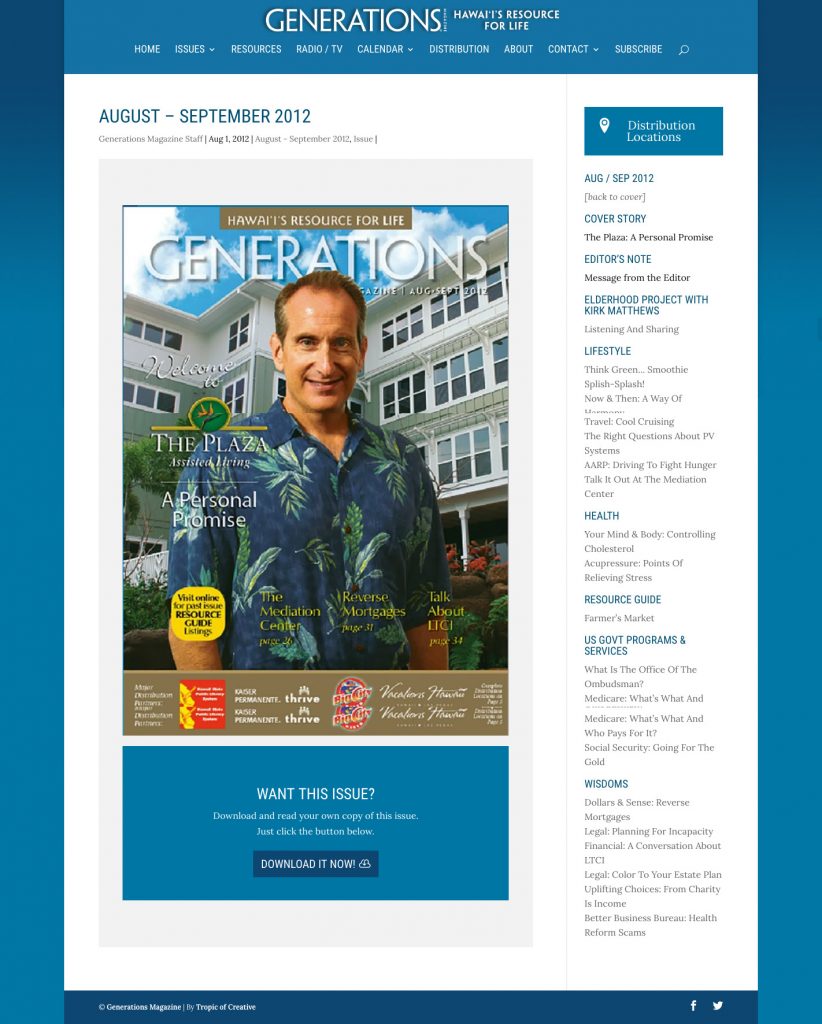
Seeing Coach Murakami on the cover made me think about how much Medicare and baseball have in common. Practice and being prepared for the big game is one way to hit a home run. It’s the same idea with Medicare.
Innings (In Medicare they are called Enrollment Periods)
Initial Enrollment Period is when you are first eligible for Medicare Part A and/or Part B either due to turning 65 years old; certain disabilities or 24 months after receiving Social Security Disability Benefits (SSDI). The seven-month initial enrollment period begins three months before your date of eligibility and three months after the month you are eligible. There could be penalties if you delay enrollment.
General Enrollment Period is every year from January 1 – March 31. If you miss your initial enrollment period and there is a premium assigned to that benefit, you can enroll during this inning, but your coverage will not start until July 1. If you qualify and are eligible for premium free Medicare Part A, you can enroll at any time (in that benefit only).
Special Enrollment Periods(SEP) occurs when you have qualified health coverage or special circumstances to delay enrolling in Medicare. Special circumstances could be if a person is covered by a qualified ACTIVE employer group health plan. The best time to see if you might qualify for a SEP is before you are eligible so that you aren’t assessed a penalty for not enrolling. Note: COBRA is not an “active” group health plan.
Medicare Supplement (Medigap) Open Enrollment Period (OEP) Medigap has a 6-month period that starts the first month you are eligible AND enrolled in Medicare Part B. This is when you can take advantage of plans sold in Hawai‘i regardless of your health status. Once your Medigap OEP, begins it cannot be changed.
Medicare Annual Enrollment Period (AEP) for Medicare Advantage Plans and Drug plans is annually from October 15 – Dececember 7. It is the opportunity to change, add or drop Medicare health and drug plans.
Coaches of Medicare:
Social Security Administration (SSA) “entitles” individuals for Medicare. In most cases Medicare premiums are deducted from an individual’s benefit. SSA is also in charge of qualifying individuals for help paying for Medicare’s prescription drug program. SSA also determines enrollment periods and penalties for Medicare Part B. Call your local office at 1-800-772-1213 to make an individualized appointment.
Centers for Medicare & Medicaid Services (CMS) is the federal agency that the Medicare program. Medicare is just one program (very large) under CMS. For more CMS information, visit www.cms.gov/history.
State Health Insurance Assistance Programs (SHIP) are a CMS grant and the goal is to provide Medicare beneficiaries with information and assistance with benefits. Hawai‘i’s SHIP is the Sage PLUS Program and we are volunteer-based and in the Executive Office on Aging.
Other Team Members That Affect Your Medicare
The following players may affect your Medicare coverage and who pays first.
Retirement medical coverage through former employment
Military or Veterans benefits
State assistance due to limited income and assets
Active employer group health coverage through yourself or a spouse
Game Strategies Start studying Medicare about four months before you are eligible. Become a SHIP Volunteer and learn about Medicare, help your community and stay active. For more information about Medicare call the Hawai‘i SHIP/Sage PLUS Program at 586-7299 or e-mail help@hawaiiship.org.
Enjoy the Seventh Inning Stretch!
Seeing Coach Murakami on the cover made me think about how much Medicare and baseball have in common. Practice and being prepared for the big game is one way to hit a home run. It’s the same idea with Medicare. Innings (In Medicare they are called Enrollment Periods) Initial Enrollment Period is when you are…
Joan Packer did not start working out until age 77. She had been a smoker for 20 years and never exercised. When she first came in she couldn’t walk upstairs without holding on to the railing. Now at 90, she does the elliptical for 30 minutes without holding on to anything. Her goal was to lose weight and regain her health so she could stay independent.
Poor balance and lack of strength are big issues as we age. Resistance exercise is a must to preserve muscle mass and body function. It’s also important to get enough protein, fruits and vegetables.
Joan admits it was challenging at the beginning. “I could barely do a bicep curl with 2 lbs., now I use 15 lbs. Seeing Diane twice a week has changed my life. My strength and balance are much better and I have never been more flexible. My sciatica pain has also disappeared.”
When Joan went to visit her daughter in Seattle, they went for a hike up Mt. Rainier. To her surprise she went up the path and left her daughter trailing behind.
Joan’s last bone density exam showed she has the bones of someone in her thirties. She takes no medications, has no aches or pains, and still drives her car. Joan says she is in better shape now than 30 years ago. All from proper diet and exercise.
Joan is a role model for all my clients, including 87-year-old Victor who works hard to keep up with her. Whenever I introduce a new movement, the first thing everyone asks is: “Does Joan do this?” She sets the bar for all of us.
As a trainer, I’m constantly researching new movement patterns and approaches to connect the mind to the body. The more movements you learn, the more synapses you develop, and the sharper your mind stays.
Working with seniors has changed the way I think about aging. Joan is living proof that it is never too late to grow young again, in mind, body and spirit!
Diane Cadinha is a certified fitness trainer and lifestyle coach. She has been in the fitness industry for more than 25 years. She works out of two studios, in Mililani and Honolulu. Contact her at shapingup@hawaii.rr.com or call 221-3905.
Joan Packer did not start working out until age 77. She had been a smoker for 20 years and never exercised. When she first came in she couldn’t walk upstairs without holding on to the railing. Now at 90, she does the elliptical for 30 minutes without holding on to anything. Her goal was to…
Watching your kids or grandchildren play hard in a team sport can be a lot of fun. It’s great to be involved and to be a source of encouragement. It’s equally important to keep them safe while playing high-contact sports and to know when they should take a break.
A study commissioned by the National Football League (NFL) found that former players ages 30 to 49 are diagnosed with memory-related disorders at a rate of 19 times the national average. Chronic traumatic encephalopathy is a progressive neurological disorder found in people who have suffered some kind of brain trauma. Dementia pugilistica is the progressive end-stage of the chronic traumatic encephalopathy. This is a type of dementia that may affect amateur or professional athletes who suffer concussions. In the past, it was commonly known as “punch drunk syndrome.”
Symptoms include:
Vary, depending on which part of the brain was damaged from the head injury
Problems with memory
Unsteady gait
Speech problems
Behavior and personality changes
Poor concentration
Why does this occur?
The cause of the brain injury is the cumulative effect of repetitive sub-concussive blows. Although the syndrome is not well understood, it’s believed that repetitive blows to the head can cause loss of neurons or brain cells, scarring of brain tissue, protein build up in the brain, damage to the cerebellum, damage to the blood vessels in the brain, senile plaques and neurofibrillary tangles.
How is dementia pugilistica diagnosed?
Memory and neuropsychological testing performed in the physician’s office will clinically diagnose dementia pugilistica. A CT scan test may show bone fractures as well as the presence of hemorrhage, hematomas, contusions, brain tissue swelling or tumors. A MRI test helps to detect subtle changes in brain tissue.
Can athletes prevent this?
Parents and grandparents play an important role in encouraging children to use protective gear when playing contact sports. A Grade 1 concussion is always treated with rest and continued observation. The athlete should not return to play until he/she receives a medical clearance. And athletes should follow the coach’s advice for rest periods.
Athletes who return to play too soon after a concussion are at risk for second-impact syndrome, an often-fatal swelling of the brain caused by a second blow before the first is healed. Take collisions on the field seriously and seek medical attention.
Dr. Ritabelle Fernandes, MD, MPH, FACP is Clinical Associate Professor at the Geriatric Medicine Department of the John A. Burns School of Medicine, University of Hawai‘i. She is board certified in Geriatric medicine, Hospice and Palliative Medicine, Internal Medicine and Home Care. She is a practicing physician at the Kokua Kalihi Valley and Kalihi-Palama Health Center.
Watching your kids or grandchildren play hard in a team sport can be a lot of fun. It’s great to be involved and to be a source of encouragement. It’s equally important to keep them safe while playing high-contact sports and to know when they should take a break. A study commissioned by the National…
We all have choices to make in our lives, and if we are thoughtful about the opportunities and problems we face, some of our choices can be uplifting for our families and communities. The same can be said about our local institutions
Organ Transplant Legislation
Recently the Hawai‘i legislation was passed to allow organ transplantation in Hawai‘i. The new law paves the way for Queens Medical Center to open an organ transplant center in Honolulu. This choice is truly uplifting.
The new law ensures that Hawai‘i patients and their families can get the care they need to fight kidney disease without the expense and hassle of getting on another state’s transplant list or scheduling Mainland medical trips.
Gov. Abercrombie spoke of the legacy of local transplant care in Hawai‘i and the vision of early health care pioneers. In the tradition of caring for our ‘ohana, the Governor said, “This was a collaborative effort in which the Legislature, community members and health providers understood that lives were at stake. I’m grateful that we are able to make a positive difference.”
National Kidney Foundation of Hawai‘i
The NKFH is pleased to have advocated on behalf of kidney patients for an organ transplant center in Hawai‘i. It is estimated that 156,000 people in Hawai‘i have kidney disease, with another 100,000 at risk of incurring the disease. Some of these people will one day need a kidney transplant.
To emphasize the importance of local organ transplantation, the NKFH invited a few kidney patients who are waiting for transplants to attend the legislative sessions and signing ceremony. Their stories reveal just how important the transplant center is for Hawai‘i’s residents.
Patient Story
Kidney patient, Fernando, attended the signing ceremony. He was diagnosed with chronic kidney disease (CKD) following a bout with pneumonia. He’s been on dialysis for nearly four years and has been on the transplant list for two years. He says that the disease has impacted his family because he has to stay away from the grandchildren when they get colds, out of concern that he will get sick and have pneumonia, which could lead to kidney related complications. Fernando walks regularly, follows a diet suitable for CKD patients, and has a good attitude about his dialysis treatments. With a twinkle in his eye, Fernando says that he considers the dialysis sessions as a “part-time job” that pays him with good health.
We at the NKFH are grateful for the work done by our elected leaders, the inspiration of dedicated kidney patients, and the faithful help of friends and supporters who make the “uplifting choice” to help us accomplish of our mission. Mahalo.
We all have choices to make in our lives, and if we are thoughtful about the opportunities and problems we face, some of our choices can be uplifting for our families and communities. The same can be said about our local institutions Organ Transplant Legislation Recently the Hawai‘i legislation was passed to allow organ transplantation…
I’d like to welcome our new readers and the many new website visitors. Generations Magazine has been updating and tinkering with its website to better serve you with resources and important events that may be of interest to you and your family. Go to www.generations808.com to view all our past issues and resource guides, current events, support group meetings and regular columns such as Social Security, AARP Hawaii and Dr. Ritabelle.
This issue’s cover story features famed UH baseball coach Les Murakami. We talk about his early days on Kaua‘i and how he became the first full-time head baseball coach for UH, plus his recovery nearly 12 years after his massive stroke.
His doctors call him the “miracle man” because at 75 he works out nearly every day and goes to therapy to improve his speech and mobility. Thank you Coach and Mrs. Murakami for sharing your story with our readers. You are the best. Keep it up, Coach.
Some other wonderful stories in this issue include the Sakura House, a unique adult day center focusing on Japanese speaking clients, a health and fitness article about 90-year-old superwomen Joannie and ATRC, one of the most resourceful agencies catering to the physically challenged.
Lastly, don’t forget our 6th annual Aging in Place Workshop, May 26th, at the Ala Moana Hotel
Live Well,
Percy Ihara, Publisher & Editor
I’d like to welcome our new readers and the many new website visitors. Generations Magazine has been updating and tinkering with its website to better serve you with resources and important events that may be of interest to you and your family. Go to www.generations808.com to view all our past issues and resource guides, current events, support group…
The FELLOWS (Fellowship, Education, Lifelong Learning Opportunities With Seniors) Program at Wai‘alae School was launched in the 1998-1999 school year and was based on a senior-center-within-a-school model. A demonstration project of the Hawai‘i Intergenerational Network, the program aimed to bring adult volunteers (age 55 or older) into Wai‘alae School to support the students’ academic and social growth, while providing a social setting for the volunteers.
Nearly 15 years later, the FELLOWS Program is an active and important part of Wai‘alae School. There are about 20 volunteers whose experiences as FELLOWS range from a few weeks to more than 13 years. They are in the classroom, in the library and at schoolwide activities, such as our recent Fun Fair.
Here are a few comments from Wai‘alae School teachers and their FELLOWS.
This relationship is beneficial for all of us. I rely on volunteers to support my literacy program, the children enjoy their company and I know Grandma Esther and Miss Ginny walk away from C-3 with a happy heart. We have developed a close relationship and I look forward to seeing both of them every week!
~Mrs. Gracie, Teacher
Having FELLOWS in my classroom is very important to the students and me. They provide emotional support, like having a grandparent to talk to.
~Mrs. Wakata, Teacher
I’ve always marveled at how the volunteers spend so much unhurried time with the students. I’m always in a rush, trying to reach each child and teach every piece of the curriculum. The volunteers have no such constraints and I love how that immediately puts the students at ease.
~Mrs. Ching, Teacher
When I saw an article about FELLOWS in the paper, I found the idea of working with students very appealing, something where I could contribute. So now, in my eleventh year of volunteering, I am a much happier and more fulfilled retiree.
~Barney, volunteer since 2001
It feels good to be useful. Added benefits are lots of hugs.
~Harriet, volunteer since 2000
The most rewarding experience I’ve had with this program are the unsolicited hugs I receive from students at the end of each day!
~Maedene, volunteer since 2003
Let’s just say that it’s the leg hugs that are the most important. Nobody else in my life gives me leg hugs.
~Jeanne, volunteer since 2002
Off campus, when you hear a “little voice” calling your name just to say ‘hi’ and perhaps introduce you to their parents — it’s very rewarding.
~Jackie, volunteer since 2005
The FELLOWS Program allows me to give back to the students and help the teachers. I can share with the school some of my working skills.
~Bob, volunteer since 2008
For more information, please email melanie@waialae.edu or call 733-4880, extension 236.
The FELLOWS (Fellowship, Education, Lifelong Learning Opportunities With Seniors) Program at Wai‘alae School was launched in the 1998-1999 school year and was based on a senior-center-within-a-school model. A demonstration project of the Hawai‘i Intergenerational Network, the program aimed to bring adult volunteers (age 55 or older) into Wai‘alae School to support the students’ academic and…
Many families across Hawai‘i already know how the new health care law, the Affordable Care Act, is helping them. They’ve been able to maintain health care coverage for their college-age children, or buy health insurance after being previously labeled “uninsurable.” Many more have obtained discounts on expensive prescription drugs.
Still, you may be wondering, What’s in the new health care law for me?
AARP’s Health Law Guide, www.aarp.org/healthlawguide, can create a personalized report that tells you how the law will help you. If you are uninsured, your report will identify coverage you may be eligible to receive.
Because different parts of the law will go into effect over a number of years, it’s a good idea to learn about the changes that are in store for you this year. In addition to providing your personalized report, the AARP Health Law Guide can help you stay on top of the law as it is implemented.
A few changes you may appreciate right now:
If you’re at risk of reaching the Medicare Part D doughnut hole—the threshold at which you’re responsible for a higher portion of your drug costs — you will receive a 50 percent discount on brand-name drugs and a 14 percent discount on generic drugs while you’re in the coverage gap.
If you have Medicare, you can receive preventive care services such as mammograms, immunizations and screenings for cancer and diabetes, as well as an annual wellness visit, at no cost to you. If private insurers consider you “high-risk” due to prior or current health problems, and if you have been uninsured for at least six months, you may buy insurance through the Pre-Existing Condition Insurance Plan (PHIP). For more information go to http://aarp.us/wPdv2k.
If you have an uninsured adult child under age 26, you may be able to add him/her to your family’s existing insurance plan.
If you get sick, you will not lose your coverage as long as you continue to pay the premiums.
Whether you currently have health coverage or not, it’s important to get the facts about how the law could impact your situation. In less than five minutes, AARP’s Health Law Guide can help you figure out how the new law benefits you and your family, how the law works with your current coverage, and what other health coverage may be available.
Many families across Hawai‘i already know how the new health care law, the Affordable Care Act, is helping them. They’ve been able to maintain health care coverage for their college-age children, or buy health insurance after being previously labeled “uninsurable.” Many more have obtained discounts on expensive prescription drugs. Still, you may be wondering, What’s…
“Don’t give up… I still exercise six days a week.”
Former UH Coach Les Murakami had an award-winning baseball coaching career at the University of Hawai‘i. He coached more than 500 players in a victory-studded career that stretched from 1971 to his retirement in 2001. But his retirement didn’t come by choice. On Nov. 2, 2000, Murakami suffered a severe stroke. He underwent surgery to relieve pressure on his brain and remained in critical condition following the operation.
For the past 12 years, Coach Murakami hasn’t given up on his recovery. He attends rehabilitation sessions several times a week to regain control of the left side of his body that was weakened by the stroke. His main goal is to be as independent as possible.
Generations Magazine recently sat down with Coach to check on how he’s doing. We wanted to hear about the new stroke recovery technology he’s been using at the Rehabilitation Hospital of the Pacific … and to reminisce a little bit about playing ball.
GM: For the fans who may not know, where did you grow up and can you tell us a little bit about your small-kid days?
LM: I was born in Makaweli, Kaua‘i, and lived there until the age of I0. My family moved to O‘ahu in I947. I attended Queen Ka‘ahumanu Elementary School and then from the 7th grade I attended St. Louis, where I graduated in 1954.
GM: Can you tell us some of your most memorable stories of the good old days growing up? Did you have any mentors or athletes that you idolized?
LM: On Kaua‘i, I played war games in the forest, basketball in the gym and went fishing with friends in the Shinsato Reservoir. When my family moved to O‘ahu, I played football and baseball with friends at the Bodaiji Temple on Birch Street.
At St. Louis High School my mentor was Coach Francis Funai — even though he cut me when I turned out for baseball in my sophomore year. I did eventually make the team, and in my senior year we won the state baseball title over Mid-Pacific Institute. I learned all of the fundamentals of baseball from Coach Funai. He was a very soft spoken man. Very strict, but very fair.
I also admired Larry Yagi, a shortstop who played for Rural Redsocks of the Hawai‘i Baseball League. He made difficult plays look easy.
GM: What kind of influence were your parents on you? Were you always involved with sports?
LM: My parents, Henry and Shino Murakami, had a great influence on me, of course. I learned ‘academics before baseball’ and that honesty was the best policy. Today, my motto is still “my word is as good as gold.” My parents sacrificed a lot to send my brother and me to St. Louis High School, and later to Santa Clara University, which is a private California college. I was offered a baseball scholarship from Fresno and other schools, but my parents turned them down. They wanted me to focus on education first — not just play ball.
My parents were my greatest fans. They attended all my games and went on all the road trips. When we hosted visiting teams, my mom cooked and made sandwiches for my team.
My father owned Ace Appliance in Mo¯‘ili‘ili and he sponsored “The Cubs,” which was the first baseball team I coached in 1953 when I was I7 years old.
GM: How did you actually get involved in starting UH baseball and why?
LM: By the time I was approached by UH athletic director Paul Durham about coaching the UH baseball team, I was already winning championships as coach for two teams — the “Midas Muffler” softball team and the Japanese-American “Sheridan AC” baseball team. I turned Mr. Durham down three times, as there was no field and scholarships to give players, but he persisted. When he asked me the fourth time, I finally agreed. My family encouraged me, Take it. There’s nothing more for you to win.
Mr. Durham dreamed big and pushed tirelessly to get UH baseball off the ground. He attended the yearly collegiate baseball conventions and asked if any of the Mainland teams would come play in Hawai‘i. Legendary Coach Rod Dedeaux with the University of Southern California was one of the first to bring his team out to play the Rainbows. The teams played … and UH lost all 6 games.
GM: What were those early days like with no field and no scholarships?
LM: Terrible! Thank goodness for my family and friends who believed in me.
Long time friend and assistant coach since 1980, Carl Furutani stands proudly with Coach Les Murakmi.
GM: What was the UH stadium like in the ’70s?
LM: In the ’70s, Mrs. Murakami (Dot) called it the “Aluminum Stadium” and when Derek Tatsuno pitched, the line to buy game tickets wrapped around the stadium. A special thanks goes to Rose Nishi who lead the volunteer crew, while Dot and other concession volunteers cooked and prepared extra food for the large crowds.
GM: You are well known for being the first full-time UH head baseball coach. How did your wife and family deal with your passion for baseball?
LM: My wife and children have been very supportive, and they all had their turn working the baseball concession in the early years. Dot and my friends fed the boys until the end. We were always a team. Dot was always there and always found ways to get the program going.
GM: Reflecting for a second, any regrets in life or in baseball?
Jerry Ono, Physical Therapist, helps Coach Les utilize the Tibion Bionic Leg at the Rehab Hospital.
LM: Yes, my only regret is that I did not win the College World Series in 1980. I came in second against Arizona.
GM: Do you think baseball has changed?
LM: Baseball has not changed. The equipment has! Players are bigger, stronger and faster.
A Game Changer
GM: Since your stroke in 2000, how has life been for you?
LM: Since the stroke, life has changed drastically for me. Unfortunately, I’m not as independent as l used to be, but I stay as active and social as possible with my family and others. I go out for a couple of hours daily.
GM: What type of therapy are you receiving for the stroke?
LM: I go to therapy at the Rehabilitation Hospital of the Pacific. They give me excellent care, and keep me focused on recovery. My walking continues to get better and my speech has improved to almost 100 percent.
And, my physical therapist Jerry Ono “busts my ass” to work hard and get better. I can not thank him enough.
GM: How has Rehab’s high-tech equipment come into play with your therapy?
AlterG’ differential air pressure technology provide precise unweighting in small increments to as low as 20 percent of the patient’s body weight. This precision gives patients the ability to set the exact point where exercise becomes pain free and provides clinicians a way to accurately measure a patient’s rehabilitation progress.
LM: Luckily for me, Rehab offers a full rehabilitation program and leads the way in stroke therapy equipment. They use technology to do what’s never done before. I get to use the hospital’s AlterG’s Anti-gravity Treadmill. It’s the only one in Hawai‘i.
During therapy, the treadmill and I are in a ‘bubble’ and I’m strapped in at the waist. The ‘bubble’ fills with air, and the adjusted air pressure takes the weight of my legs. It feels like I’m walking on the moon, with little gravity. The treadmill lets me practice walking, get some exercise and keep my weight under control.
GM: You have had a caregiver five days a week for 10 years now. How are you affording this extra cost?
LM: My wife Dot made me buy long-term care insurance after our experience with my mother’s Alzheimer’s disease. I didn’t want to buy insurance at the time, but Dot convinced me.
GM: Do recommend long-term care insurance?
LM: Oh, yeah. I couldn’t be where I am today without it. As Dot says, “Your life is more important then your house. She loves me, but no one can be with someone for 24 hours a day. She needs a break and time for herself, too.
Wife, Dot, and Les Murkami.
GM: What do you do to keep active in life?
LM: Monday through Friday I exercise at different facilities. I meet and talk to people all the time at the mall or wherever we go to say, “Hi.”
Sunday is family day. We go to church, and then maybe we go to the movies, watch my grandkids’ games, go to a UH football or baseball game or watch special sporting events on T.V., invite friends over to the house — stay connected.
GM: What’s life like as a grandparent?
The grandchildren (Lt–Rt) Madixx, Maxx, and Erin.
LM: At times, it’s frustrating because l cannot physically demonstrate to my 10-year-old grandson, Maxx Muramoto, the fundamentals of pitching, fielding and hitting. His 6-year-old sister Madixx is playing her first season of baseball, too. They keep me busy and active. I love them very much.
When I’m in rehab, Dot spends time with our grandchildren, especially our 7-year-old granddaughter Erin Murakami. She has spinal muscular atrophy. She uses her eyes, ears, and little movements in her hands and feet to communicate. She is smart. She is my inspiration. She’s a very strong spirit and she never gives up. The doctors gave her a few years to live. She’s going to be 8 years old in June.
I wouldn’t trade my family for all the tea in China or for all the gold in Fort Knox.
GM: What would you say to other stroke victims in dealing with their rehab?
LM: Don’t give up and don’t stay home. After all this time, I still exercise six days a week. People can’t believe the good shape I’m in, especially at the age of 75 and as a stroke survivor.
Stroke Prevention Guidelines
Know blood pressure (hypertension): Have blood pressure checked yearly by a doctor or at health fairs, a local pharmacy or supermarket or with an automatic blood pressure machine.
Identify atrial fibrillation (Afib): Afib is an abnormal heartbeat that can increase stroke risk by 500%. Afib can cause blood to pool in the heart and may form a clot and cause a stroke. A doctor must diagnose and treat Afib.
Stop smoking: Smoking doubles the risk of stroke. It damages blood vessel walls, speeds up artery clogging, raises blood pressure and makes the heart work harder.
Control alcohol use: Drink only in moderation –no more than two drinks each day.
Know cholesterol levels: Cholesterol is a fatty substance in blood that is made by the body. It also comes in food. High cholesterol levels can clog arteries and cause a stroke.
Control diabetes: Many people with diabetes have health problems that are also stroke risk factors. A doctor and dietician can help manage diabetes.
Manage exercise/diet: Excess weight strains the circulatory system. Exercise five times a week. Maintain a diet low in calories, salt, saturated and trans fats and cholesterol. Eat five servings of fruits and vegetables daily.
Transient Ischemic Attack (TIA): A TIA is a temporary episode of stroke-like symptoms that can last a few minutes to 24 hours but usually causes no permanent damage or disability. TIA and stroke symptoms are the same. Recognizing and treating a TIA can reduce stroke risk. Up to 40 percent of people who experience a TIA may have a stroke. Courtesy of the National Stroke Association’s Stroke Prevention Advisory Board, www.stroke.org.
“Don’t give up… I still exercise six days a week.” Former UH Coach Les Murakami had an award-winning baseball coaching career at the University of Hawai‘i. He coached more than 500 players in a victory-studded career that stretched from 1971 to his retirement in 2001. But his retirement didn’t come by choice. On Nov. 2,…
My dad, James Kensei Higa, never had a headache in his life. When someone in our family had a headache he would ask, What does it feel like? Imagine living 84 years and never having a headache! My dad always slept soundly and seldom worried about anything. Dad went to heaven in 2005.
My mom, Sue Sumiko Higa, on the other hand, worried enough for both of them. She worried when her grandson got sick, she worried about having enough money, and she worried that I would do poorly when I preached my Sunday sermons. She was always relieved when I didn’t mess up. Did my mom have headaches and sleepless nights? She had quite a few of them. My mom also lived 84 years and went to heaven in 2009.
Is there a correlation between sleepless nights, worry and headaches? I’m not a doctor, but I believe there is. As a pastor my understanding about God is that He doesn’t want worry to be a part of your life. Instead, He wants you talk to him about your struggles. Worrying can be habit forming and that’s why some people become “worry warts.” Are you a “worry wart?” Talk to God about your problems, he loves you and he will help you not to worry as much.
At one time all three of my sons were in their twenties and living on the Mainland. Instead of worrying about them, I would pray, Lord, please watch over my sons, help them to make wise decisions and bless them. Then, instead of worrying, and having sleepless nights, I would fall fast asleep, just like my dad.
The next time worry tries to enter your mind turn to God and ask Him to help you. I believe that He will bring peace to your heart and mind. When you’re having a worry-filled and sleepless night, look to God. If that doesn’t work for you, then open the Bible and start reading. If you still can’t sleep, come to my church on Sunday … perhaps my sermon might put you sound asleep!
Honolulu Christian Church, 2207 O‘ahu Avenue, Honolulu | 808-973-4345 English Sunday services: 7:45am & 10:45am Sunday School (all ages): 9:30am Japanese Sunday services: 8:00am & 9:20am We have a wonderful Senior Fellowship group, come and visit with us!
My dad, James Kensei Higa, never had a headache in his life. When someone in our family had a headache he would ask, What does it feel like? Imagine living 84 years and never having a headache! My dad always slept soundly and seldom worried about anything. Dad went to heaven in 2005. My mom,…
“Wow! Time flies! We will already have our third anniversary soon!?” Sakura House, which opened in 2009, is the only adult day care program that provides Japanese-English bilingual services in Hawai‘i.
As I get know Hawai‘i local people better, I noticed that they value ohana and respect kupuna like we, Japanese, do. It is natural for us to take care of our kupuna when they get older. When I discovered this cultural similarity, I was so happy and felt comfortable to be here in Hawai‘i.
My caregiving experience includes taking care of my parents, both of whom had terminal cancer. There was no doubt that I would take care of them. I felt happy to do so. It was an opportunity to show my gratitude to my parents who had raised me with their love. However, as the level of care got more demanding, I asked myself, Why can’t I do this for Dad with a smile? or How can I do this without scolding Mom? Eventually, I admitted, Oh no! This is much more difficult than I thought!
Taking care of loved ones … I still believe that it is a chance to repay them for caring for us. However, if you’re working, raising children or babysitting grandchildren, it can become an emotional, physical and financial burden. When you are unhappy, you’re unable to provide meaningful, quality care to others. I know this very well through my experience. We are human and nobody is perfect. It is very normal in these circumstances to need help. In the beginning, you or your loved may resist help from others. However, once you accept it, you will surely see and feel the rewards.
At the Sakura House, I ask my staff to be mindful of our purpose, remembering that it is our mission to take care of senior participants on behalf of their ohana. As such, we treat our seniors and their caregivers like an extended family.
We respect our seniors and offer culturally sensitive care. Perhaps even more importantly, we become friends with our participants and share good times and smiles.
“Wow! Time flies! We will already have our third anniversary soon!?” Sakura House, which opened in 2009, is the only adult day care program that provides Japanese-English bilingual services in Hawai‘i. As I get know Hawai‘i local people better, I noticed that they value ohana and respect kupuna like we, Japanese, do. It is natural…
What does this all mean? You hear it regularly in the news: “The dollar rose today against other major currencies,” or “The dollar lost ground today on foreign exchange markets.” Just like stocks or bonds, currency’s value can fluctuate in comparison to each other on a daily basis.
For example, at the start of 2011, it would have cost approximately $1.34 to purchase one euro (the European common currency). By the end of April, the U.S. dollar lost value, and $1.48 was required to buy a single euro.
Why should you care? Because currency fluctuations affect anyone who buys goods made in other countries, travels abroad or invests globally. In other words, almost all of us are impacted on some level.
The impact of fluctuating currency values
Consider what happens if you are traveling overseas. If the dollar loses value compared to the currency of the country you’re visiting, it will cost more to make purchases in that region. If the dollar strengthens, your buying power will improve.
In terms of the larger economy, U.S. companies seeking to sell products overseas will benefit when the dollar is weaker because this makes it cheaper for other countries to purchase American-made goods. In general, multi-national companies that sell American goods around the world will generate more profits from sales during periods of a weak dollar.
As an investor in overseas stocks, you also may benefit when the dollar is declining in value. Suppose you invest $1,000 in a European company at a time when the exchange rate is $1.25 U.S. per euro. Your investment would be worth 800 euros. If after one year, the investment appreciates by five percent, it will be worth 840 euros. But if at the same time, the U.S. dollar had weakened to $1.35 per euro, your investment would be equivalent to $1,134, representing a much more sizable gain of 11 percent. The bulk of the return, in this case, comes from the euro gaining strength. By contrast, if the dollar gained ground during that period, your investment, when sold, would be worth less after being converted back into U.S. currency.
An unpredictable market
One of the significant challenges of the currency market is that it is very unpredictable in the short run. Any number of factors can come into play in determining the strength of a specific currency. A currency tends to become more valuable when the demand for it exceeds available supply. A number of factors can affect the exchange rate. For example, the dollar may be more attractive to others if interest rates here are higher and bond investors can gain a yield advantage by putting their money in bonds from U.S. issuers. Currencies may also thrive if a nation’s economy is strong (relative to other world markets) and business activity is high.
But movements in currency values can also be affected by the actions of speculators who may try to take actions that affect the short-term direction of the exchange rate.
Overall, it is important to understand that the changing value of the dollar is a factor to consider when investing in global companies or purchasing foreign products, though the risk associated may not be largely influential.
What does this all mean? You hear it regularly in the news: “The dollar rose today against other major currencies,” or “The dollar lost ground today on foreign exchange markets.” Just like stocks or bonds, currency’s value can fluctuate in comparison to each other on a daily basis. For example, at the start of 2011,…
Founded in 1973, the People’s Open Market (POM) was formed to accomplish three goals:
Provide the opportunity to purchase fresh agricultural and aquacultural products and other food items at low cost.
Support the economic viability of diversified agriculture and aquaculture in Hawai‘i by providing market sites for local farmers, fishermen or their representatives to sell their surplus and off-grade produce.
Provide focal point areas for residents to socialize.
More than 1 million people shop at the 25 market sites each year. Each market operates once a week and lasts about one hour. Prices are usually 35% lower than retail stores. The POM staff closely regulates the markets. The staff conducts weekly price surveys at various stores to determine a recommended price for the POM vendors to follow. Vendors may sell below, but not over, the recommended prices. The staff also supervises the arrival and departure of the POM vendors to ensure safety for both vendor and consumer. Each vendor is monitored to ensure that they comply with all city, state and federal government rules and regulations, ordinances and laws affecting their participation in the POM.
TYPES OF PRODUCE
At the POM, you will find many kinds of ethnic fruits, vegetables and other food items that are not ordinarily available in grocery stores. Depending on the ethnic make-up of the neighborhood, you’ll find a variety of foods associated with the different ethnic groups. Fresh ocean and pond fish, as well as farmed shrimps and prawns, are available—many sold live. In addition, a variety of Hawai‘i-grown flowers, such as ginger, orchids and anthuriums are for sale.
HISTORY OF THE OPEN MARKETS
The beginning of the open markets is attributed to Mrs. Joyce Fasi. After hearing concerns of women in a discussion group regarding the high cost living in Honolulu and in particular the high cost of food, she relayed these thoughts to her husband, then Mayor Frank F. Fasi. Hence, the People’s Open Market was started to assist farmers with selling their “off-grade,” “ungraded” and surplus produce while lowering food costs for the citizens of Honolulu.
The first People’s Open Market (POM) was started at the Banyan Court Mall location in Kalihi in November, 1973. People in other communities began requesting their own POMs. Soon, a caravan of POM farmer/vendors was traveling to various sites to help the public purchase low-cost food items.
The city requires all vendors to be authorized to accept food stamps to help those who are on fixed incomes.
SHOPPING TIPS
The People’s Open Market (POM) vendors are bound by a set of rules and regulations, which ensure that the POM operates smoothly and fairly for vendors and as well as customers. It is the vendors’ responsibility to see that their customers follow the rules and regulations. They are subject to citations and disciplinary action, including dismissal from the program for failure to comply with the rules and regulations.
Please cooperate with the POM vendors. Here are some of the POM shopping tips:
Plan ahead! There will be times that the market will start or end a little earlier or later than officially scheduled (5–10 minutes) due to certain conditions such as traffic, road conditions, school, weather, etc.
Things to keep in mind:
Do NOT bag or ask vendor to reserve items before the start of the market (sound of an air Horn)!
Do NOT cut in lines that vendors have formed!
Do NOT shoplift!
Do NOT squeeze or mistreat fruits and vegetables (papayas, tomatoes, etc.)!
Do NOT bring animals (except seeing eye/working dogs)!
Do NOT litter!
Do NOT ride bicycles through the shopping area. Park on the sides of the POM.
Do NOT park illegally, double park or block driveways!
Park in marked stalls ONLY!
Bring your own shopping bags, packages and cartons!
Be careful when the POM vendors’ trucks and P vans are entering or leaving a POM site!
Be considerate of other shoppers!
Bring small bills and coins!
Market Scheduled Areas
Mondays: Honolulu City Area
Tuesday: Leeward-Central Area
Wednesday: Honolulu City Area
Thursdays: Windward Area
Fridays: Leeward Area
Saturdays: Kalihi-Hawaii Kai Area
Sundays: Leeward Area
People’s Open Market
M : Manoa Valley District Park
2721 Kaaipu Avenue, 6:45a.m. – 7:45a.m.
M : Makiki District Park
1527 Keeaumoku Street, 8:30a.m. – 9:30a.m.
M : Mother Waldron Park
525 Coral Street, 10:15a.m. – 11:00a.m.
M : City Hall Parking Lot Deck
Alapai and Beretania Streets, 11:45a.m. – 2:30p.m.
T : Waiau District Park
Komo Mai Drive, 6:30a.m. – 7:30a.m.
T : Waipahu District Park
94-230 Paiwa Street, 8:15a.m. – 9:15a.m.
T : Wahiawa District Park
N. Cane St. & California Ave., 10:00a.m. – 11:00a.m.
T : Mililani District Park
94-1150 Lanikuhana Avenue, 11:45a.m. – 12:30p.m.
W : Palolo Valley District Park
2007 Palolo Avenue, 6:30a.m. – 7:30a.m.
W : Old Stadium Park
2237 South King Street, 8:15a.m. – 9:15a.m.
W : Queen Kapiolani Park
Monsarrat and Paki Streets, 10:00a.m. – 11:00a.m.
R : Waimanalo Beach Park
41-741 Kalanianaole Hwy., 7:15a.m. – 8:15a.m.
R : Kailua District Park
21 South Kainalu Drive, 9:00a.m. – 10:00a.m.
R : Kaneohe District Park
45-660 Keaahala Road, 10:45a.m. – 11:45a.m.
R : Halawa District Park
99-795 Iwaiwa Street, 7:00a.m. – 8:00a.m.
F : Ewa Beach Community Park
91-955 North Road, 9:00a.m. – 10:00a.m.
F : Pokai Bay Beach Park
85-037 Pokai Bay Road, 11:00a.m. – 11:45a.m.
S : Banyan Court Mall
800 North King Street, 6:15a.m. – 7:30a.m.
S : Kaumualii Street
700 Kalihi Street, 8:15a.m. – 9:30a.m.
S : Kalihi Valley District Park
1911 Kam IV Road, 10:00a.m. – 10:45a.m.
S : Salt Lake Municipal Lot
5337 Likini Street, 11:15a.m. – 12 Noon
S : Hawaii Kai Park-n-Ride
300 Keahole Street, 1:00p.m. – 2:00p.m.
Su : Kapolei Community Park
91-1049 Kamaaha Loop, 7:00a.m. – 8:30a.m.
Su : Royal Kunia Park-n-Ride
Kupuna Lp./Kupuohi St., 9:30a.m. – 11:00a.m.
Su : Waikele Community Park
94-870 Lumiaina Street, 11:30a.m. – 12:30p.m.
Founded in 1973, the People’s Open Market (POM) was formed to accomplish three goals: Provide the opportunity to purchase fresh agricultural and aquacultural products and other food items at low cost. Support the economic viability of diversified agriculture and aquaculture in Hawai‘i by providing market sites for local farmers, fishermen or their representatives to sell…