It is that magical time of the year. The pumpkins are at the open markets, the air is a bit cooler and it’s time for your Medicare Check-Up. You don’t need to see your doctor for this checkup, just sit down and reflect back on the past year.
Questions to ask yourself:
Have my medical needs changed?
Am I taking more medicine than I did in 2012?
Have I experienced an ambulance ride, emergency room or hospital stay?
Am I in the best plan for my circumstances?
Do I have the coverage that I need and is it affordable?
Is there anything new in the market?
Do I need to change plans?
Open Enrollment begins October 15, 2012 and ends December 7, 2012.
This is an opportunity to change, drop or add a plan that will begin on January 1, 2013. Plans may begin marketing their 2013 products on October 1, 2012, and at that time we will know whether or not plans will leave Hawaii or if new plans will be available.
Some changes to expect with Medicare Part D – the drug plan, include:
Those who reach the coverage gap will continue to see discounts on certain drugs. While in the gap, patients will receive a 21% discount on all generics and a 52.5% discount on all brand-name drugs covered by the plan. These discounts are automatically applied at the pharmacy.
Starting in 2013, Part D plans are allowed to cover benzodiazepines and certain barbiturates, such as those used in the treatment of epilepsy, cancer or a chronic mental disorder. With barbiturates, plans may require “prior authorization” (meaning the plan will not provide coverage until the doctor submits a request to the plan and receives approval) to verify treatment. Previously, “benzos” and “barbs” were previously excluded drugs from Part D coverage lists.
Enrollment changes for Medicare Health and Drug plans are as follows:
New special enrollment period for People in Certain Low-Performing Plans: In an effort to promote better plan quality and better choice, Medicare will be sending notices to those who are in a Part D drug plan or Medicare Advantage health plan that fail to get at least a 3-star quality rating for three straight years. The notice lets them know about a Special Enrollment Period to enroll in a 4- or 5-star plan. For more information, visit www.medicare.gov or call 1-800-633-4227 after October 15, 2012.
Low-Performing Plans and the Medicare Plan Finder: In order to promote high-performing plans, Medicare is disabling the online enrollment feature in the Medicare Plan Finder (MPF) tool for low-performing plans (3 or fewer stars for three consecutive years). These plans will have a low-performing icon, along with a message warning consumers of the plan’s poorly rated performance. Individuals still interested in enrolling will get another message letting them know they will need to call the plan directly to enroll.
Now, the great news … you are not alone and we will not let you fall behind. The Sage PLUS Program/Hawaii SHIP is the Medicare Counseling Program for the State of Hawaii. Our certified volunteers can walk you through the Medicare Check-Up and assist you in understanding your options. Contact SHIP at 1-888-875-9229 (toll free). Leave your name, phone number and your zip code so that we can connect you with a certified volunteer in your area. Or, e-mail help@hawaiiship.org or visit www.hawaiiship.org.
It is that magical time of the year. The pumpkins are at the open markets, the air is a bit cooler and it’s time for your Medicare Check-Up. You don’t need to see your doctor for this checkup, just sit down and reflect back on the past year. Questions to ask yourself: Have my medical…
Grief does not discriminate. No matter who you are, losing a loved one can be an overwhelming life experience. Imagine dealing with looking for important documents and organizing burial wishes while dealing with the loss. Many people don’t realize the need for getting affairs in order before they or a loved one dies. Being prepared protects families and loved ones, and alleviates stress for everyone involved.
A few years ago, Karen O’Neil, a certified wellness counselor, flew to the Mainland to her children’s aid to help cope with the passing of their father — her ex-husband. Not only did the family grieve together, but they had to work together to get all of his affairs in order. His passing was just four weeks after the terminal diagnosis of several months, and they barely got everything tended to.
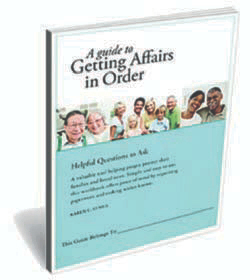
Now as an author, publisher and speaker, Karen has developed the workbook, A Guide to Getting Affairs in Order. The workbook helps families have peace of mind by guiding them to communicate and to avoid an unfortunate situation during grievance. Her intent is to take the scary and uncomfortable out of the conversations people need to have so they may begin to understand the importance of organizing documents and letting their last wishes be known. There is some solace knowing someone is doing everything exactly as it was wanted.
How to prepare for the worst case scenario. Grief does not discriminate. No matter who you are, losing a loved one can be an overwhelming life experience. Imagine dealing with looking for important documents and organizing burial wishes while dealing with the loss. Many people don’t realize the need for getting affairs in order before…
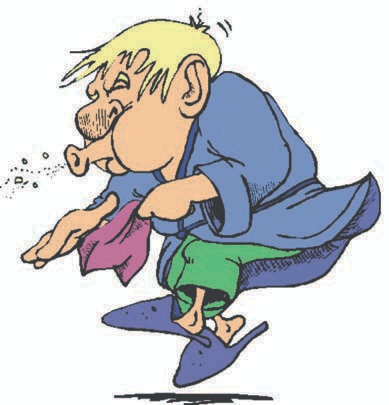
The flu shot is a vaccine that helps to prevent the flu, an illness caused by infection with the influenza virus. Viruses are very small germs that cause illnesses. Flu is a contagious disease, with symptoms such as fever, cough, headaches, body aches, sore throat and fatigue. For older people, especially those who have chronic diseases such as diabetes or heart disease, the flu can be very serious and even life threatening.
The influenza pandemic of 1918-1919, also known as the Spanish Flu, killed more people than World War I. During the 1918 pandemic approximately 20 percent to 40 percent of the worldwide population became ill. An estimated 50 million people died, including nearly 675,000 in the United States.
WHO SHOULD GET THE FLU SHOT?
All people 50 years and older
Persons with diabetes or chronic problems of the lungs, heart or kidneys
Persons whose immune system may be weakened, such as HIV, cancer or organ transplant patients
Residents of nursing homes, care homes, foster homes and other chronic care facilities
Staff working in nursing homes, hospitals and health centers
WHY DOES A PERSON NEED A SHOT EVERY YEAR?
Flu viruses change often and each year’s virus is just a little different than the year before. Since different forms of the viruses appear each winter, a new vaccine is manufactured each year according to the circulating strain that will fight the viruses most likely to occur that year. The protection received from a flu shot also lessens with time, especially in older people. This is another reason why seniors need a flu shot every year. It helps keep seniors protected from the flu and stay healthy. Flu season is usually between November and April. It takes at least two weeks for the shot to start working, so try to get the flu shot in October or early November.
ARE THERE SIDE EFFECTS TO THE SHOT?
The flu shot is safe and most people have no problem. Seniors cannot catch flu from the vaccine because flu shots are made with a killed virus. A person may experience soreness or redness around the site of the shot for up to a few days. A few people do have a headache or a low-grade fever for about a day after they get the shot. Because eggs are used to make the flu vaccine, people who are allergic to eggs should not receive a flu shot.
THINGS TO REMEMBER ABOUT THE FLU
The flu can be dangerous for older people
The flu can be prevented
Older people need a flu shot every year
Medicare pays for the flu shot
The flu shot is a vaccine that helps to prevent the flu, an illness caused by infection with the influenza virus. Viruses are very small germs that cause illnesses. Flu is a contagious disease, with symptoms such as fever, cough, headaches, body aches, sore throat and fatigue. For older people, especially those who have chronic…
Former broadcaster, Linda Coble, says all voices are meant to be heard.
Linda Coble and students of Abraham Lincoln Elementary, Honolulu
As a budding broadcaster in the 1960s, Linda Coble struggled to have her voice heard in the news business.
In those days, women were not on the air. Yet, Hawai‘i offered her something that the Mainland couldn’t — a foot in the door atLinda Coble as a newsroom secretary. She quickly moved from making coffee to reporting the news. In fact, she later became the first female TV news anchor in Hawai‘i.
She worked at ABC’s Channel 4 for a couple of years before being lured to KGMB by Bob Sevey, where she reported the news for 15 years.
By the mid-1980s, Coble was a well-established broadcast journalist and a household name in the Islands. She was invited to join the Rotary Club of Honolulu, which was newly opened to women due to a U.S. Supreme Court ruling in 1987. In 2000-2001, Coble became the statewide governor of Hawai‘i’s Rotary clubs, the first woman to hold the post.
Soon thereafter, she left TV news for morning radio on KSSK to work with Michael Perry and Larry Price. Radio allowed her to comment on the news, rather than simply report on it. This gave her the freedom to promote community organizations such as Kids Voting Hawai‘i, which is supported by Rotary Clubs statewide.
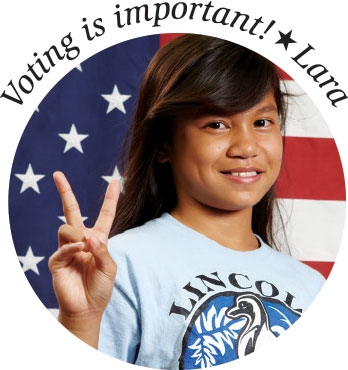
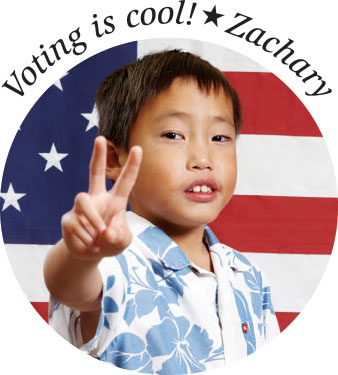
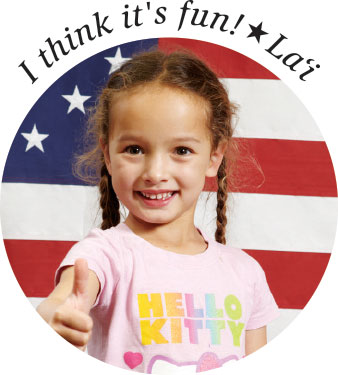
Kids Voting Hawai‘i is a non-profit, nonpartisan, grassroots organization. Its mission is two-fold: to prepare schoolchildren for a lifetime of voting, and to encourage adult voter participation.
Actually, Hawai‘i’s seniors set a great example for young voters. According to AARP Hawai‘i, 90 percent of local seniors said they voted in 2010, and seniors cast 1 out of every 3 ballots in state. They are a big force in voting. Since many seniors have been around since statehood, they take voting seriously. They know what there is to gain … and what is at risk.
Coble, 65, has been a glass-ceiling breaker and community volunteer since arriving in Hawai‘i in 1969. This month, we talk with Coble about how she found her voice on the air and in the community.
GM: We know that you moved out to the Islands in your 20s, but where did you grow up? What is your background?
LC: I was 2 years old when my parents moved from urban New York to earthy Portland, Oregon. I’ve been told that I was terrified of grass … I was truly a city girl. I guess my dad missed the concrete jungle, because he walked out when I was 5 and my sister was a baby. I still remember holding the door for him. Mom held us together, working as a mural artist/interior designer with a woman, who eventually became our step-grandmother. I’m convinced mom’s example of determination made an enormous difference in the success of her girls.
Later came my brother, and we moved to interracial Northeast Portland, where neighborhoods and schools were mixed. Our African-American neighbor (the principal of my grade school) built a fence when we moved in next door. I learned to get along with people of all races at an early age … an experience that was invaluable, especially once I was living in Hawai‘i and working in the media.
GM: So, what brought you to Hawai‘i and kept you here?
LC: When it was time to declare a major at the University of Oregon, I had to face the fact that I wasn’t a good speller, so I finally surrendered my journalistic fantasies and turned to broadcast journalism.
I received an Oregon Association of Broadcasters scholarship that enabled me to continue studies and graduate with a degree that I proudly flashed during interviews at TV stations throughout Oregon.
During one interview, a manager at the CBS affiliate in Portland told me, “Come back when you have had more experience, and a sex change operation.” I was devastated. My grandmother sympathetically sent me to Hawai‘i for a week to visit a girlfriend in Pearl City.
While on Oahu, I tracked down Jim Manke, the president of the Hawai‘i Association of Broadcasters. Manke was also the news director at the ABC station. He gave me a job as the newsroom secretary in 1969 (on the same day we landed a man on the moon!)
Hawai‘i became my new home. I was so happy when my sister, Cameron Maheras, soon followed and became a force in the fashion world here.
Eventually, I was reporting stories and became the first female TV news anchor in Hawai‘i. Bob Sevey noticed and hired me away to KGMB a couple years later.
GM: Did you have a mentor in broadcasting?
LC: I would say that every reporter and anchor at KGMB considered Bob Sevey as a mentor. What an ethical, accurate, fair newsman! And he genuinely cared about his team. I was at KGMB for 10 years, until my stepfather died in 1981. During that time, the CBS affiliate in Portland, KOIN TV, was recruiting for its first female anchor. Sevey generously said he would ‘hold the chair’ for me here, while I went to Portland to be with mom and apply at KOIN TV news. (Yes, the manager who had suggested a sex change operation was still there! I should have walked in and said in my deepest voice, I’m baaaaak.)
When I arrived at KOIN, a man stopped me in the parking lot. He shared with me that the women reporters upstairs were upset because they wanted that job. He went on to share the culture of the newsroom, ballpark figures on how much my male co-anchor was earning, along with other insights. I asked, Why are you telling me all this? He joked that I was taking his job. (In fact, he was just filling the evening news chair until a female co-anchor was hired). For whatever reason, he was moved to give me the inside scoop before I went upstairs to sign-on. That was how I first met Kirk Matthews. The station had a January birthday party the next year, and Kirk and I discovered we were born on the same day—the same year. We fell in love.
Ratings were great, but I was so homesick and longed for Hawai‘i. Engaged, Kirk and I moved back to the Islands.
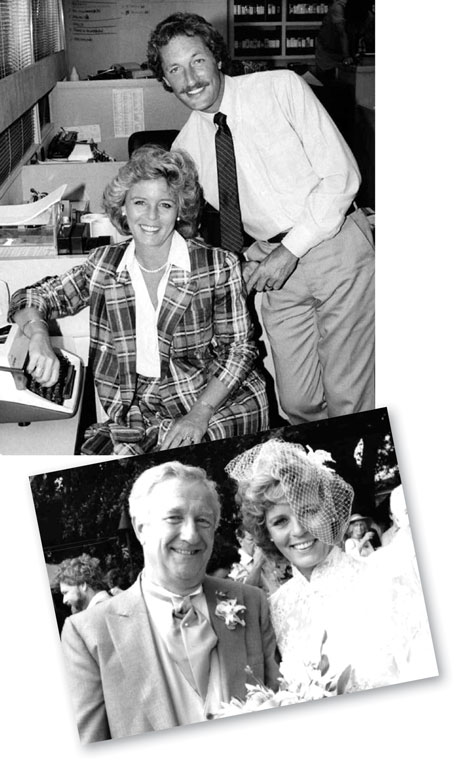
Sevey walked me down the aisle in 1984, during our double wedding ceremony with my sister Cammy and Bill Maheras. Sevey was not only a professional role model, he was like a dad to me.
GM: What was your most favorite interview or story?
LC: I was fortunate to cover entertainment icons and U.S. Presidential visits. When President Gerald Ford was here for a packed day of activities, ending with a Pearl Harbor ceremony, I was the only reporter who managed to talk my way into the motorcade. My cameraman and I scooped the others, every stop along the way. In fact, I was the only reporter who got an interview with the President.
The interview was on the tarmac, just before he departed. I was hunched over trying to untangle the microphone cord and when I stood up, I nearly knocked the President’s teeth out with the top of my head. Microphone in hand, I asked Mr. Ford about his experience at the Arizona Memorial.
When I returned to the station bursting with pride, Sevey admonished me for not following the ‘protocol’ and demanded that I share the film with the other stations. That was the first and last time my mentor and I didn’t see eye to eye.
GM: If you had one wish to interview someone in this world, or cover an event, who or what topic would this be?
LC: I would like to be with the world’s leaders when they announce that the crippling disease Polio has been eradicated. Rotarians around the globe have been fighting polio for three decades. We are nearing the finish line.
Students statewide, K-12, have the opportunity to log on, learn about the candidates and vote at www.kidsvotinghawaii.org.
GM: What drives you to community service?
LC: I love the advice John Wooden shared with his UCLA basketball team: Be more concerned about your character than your reputation, because your character is what you really are, while your reputation is merely what others think you are.
I was in a profession where reputation — and ratings — ruled. At first, I joined boards and organizations because it was a good thing for the station to have my name on a letterhead. But over time, community service became more of a motivation than a motive.
As a person (not a media personality), I care about the prevention of child abuse, the need for a Big Sisters organization, foster kids and the civic education of our youth.
In 1987, when Rotary International raised the ‘testosterone curtain’ and allowed women to be inducted, I joined the Rotary Club of Honolulu. It was a year before leaving TV news to head to KSSK to work with Michael Perry and Larry Price every morning. With radio, I found an avenue for ‘service above self’— a way to make a difference with wonderful, dedicated businesses and community leaders.
GM: Kids Voting Hawai‘i is one of your volunteer passions. Why is this organization very important to you?
LC: Kids Voting Hawai‘i, an affiliate of Kids Voting USA, grooms our youth to be informed voters and civically engaged, responsible citizens. It prepares students to get into the habit of voting, and inspires the adults in their families to vote.
In 1995, when I was serving as the first woman President of the Rotary Club of Honolulu, Lyla Berg brought the Kids Voting idea to the club, and we ran with it. Rotarians statewide staffed the adult polling sites, where K-12 students went with their folks to cast their own paper ballots. By 2002, Kids Voting Hawai‘i shifted to cyberspace, and Hawai‘i students were the first in the nation to vote statewide by computer, thanks to the cutting-edge Internet technology of Commercial Data Systems.
Kids Voting Hawai‘i continues to provide K-12 students with curriculum and classroom activities that address civic responsibility and compliment the Hawai‘i State Social Studies Standards. Our youth are inspired to explore the candidates and student issues, and engage their peers and parents in discussion. This hands-on experience in democracy is made possible by volunteers, including retired educators with Alpha Delta Kappa.
In the last Presidential General Election, nearly 120,000 students cast their ballots online. From October 22 through November 6, students will have the opportunity to go online and cast ballots anywhere there is an Internet connection.
Everywhere I go, I invite folks my age, who are retired, talented and looking for meaningful ways to spend their time to find a need and fill it. Your experience is a gift. Your knowledge will rub off on younger generations. You will set an ideal example for your friends, who also may have some time on their hands that can be spent wisely.
During my career, I never got closer to the movers and shakers than the length of my microphone cord. With Rotary membership, I have the opportunity to share weekly fellowship at meetings and roll up my sleeves to work side by side on community projects with wonderful friends who are making a difference in the community.
Over time, community service became more of a motivation than a motive. ~Linda Coble
Kids Voting Hawaii
Students statewide, K–12, have the opportunity to log on, learn about the candidates and vote atwww.kidsvotinghawaii.org.
To vote from October 22 through November 6 (election night), students need:
Student password
Family’s precinct
District number
This will gain students access to virtually the same ballots you adult voters will see at the polls. Ask your children or grandchildren if they are voting online. If they haven’t received a student password from their teacher, please encourage the school to provide the opportunity to their voice be heard and vote.
You Snooze, You Lose
The state Office of Elections and county clerks can register voters. You must re-register if you have changed your name or your address.
To register you must be 18, a citizen of the United State and a legal resident of Hawai‘i.
• In Person: Visit the Office of the City or County Clerk where you reside to complete an Affidavit on Application for Voter Registration.
• By Mail: Mail the completed Affidavit on Application for Voter Registration to the Office of the City or County Clerk where you reside. Voter Registration Forms are available at your:
• Satellite City Hall
• Public libraries
• U.S. Post Offices
• Phone Directory
• State services agencies
• University of Hawai‘i System
• Office of Elections: www.hawaii.gov/elections
• The major political parties also sponsor voter registration online at www.gophawaii.com and www.oahudemocrats.org.
Questions?
Office of Elections: 808-453-8683
City & County of Honolulu: 808-768-3800
County of Hawai‘i: 808-961-8277
County of Maui: 808-270-7749
County of Kauai: 808-241-4800
Upcoming Important Events
Oct. 30: General election absentee applications must be received by the City/County Clerk where you reside no later than 4:30 p.m.
Nov. 6: General Election (Polling place hours: 7 a.m.– 6 p.m.)
Voter Turnouts
Hawai‘i general election turnout has been dramatically slipping. It has gone from a high in 1959 of 93.6 percent (or 78.1 percent a little more than 20 years ago in 1990) to a low 52.7 percent in 2006.
As a budding broadcaster in the 1960s, Linda Coble struggled to have her voice heard in the news business. In those days, women were not on the air. Yet, Hawai‘i offered her something that the Mainland couldn’t — a foot in the door…
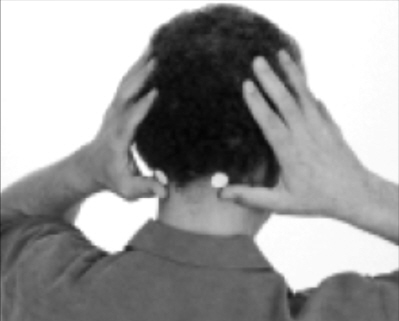
Everybody suffers from stress from time to time, given the tremendous challenges, options and responsibilities in our busy lives. Stress depresses respiration and causes shallow breathing which can lead to irritability, frustration and fatigue. Many people turn to unhealthy habits like smoking, overeating, and excessive drinking to counteract stress. Instead, you can follow this 10-minute, self-care acupressure routine to alleviate everyday tensions.
Shoulder & Neck Tension Relief
This 10-minute self-care routine is shown sitting, although you can also practice these techniques lying down.
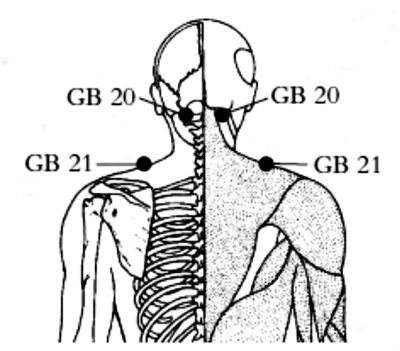
STEP 1 — Shoulder Grasp: Curve your fingers of both hands, and place them on the tops of your shoulder muscles (GB 21), close to the base of your neck. Gradually apply firm pressure directly on to your shoulder tension. Simply let the weight of your arms relax forward, keeping your fingers curved like a hook. Sink deeply into the muscles as they soften and relax. Hold for one minute as you take slow, deep breaths. Then let your hands relax in your lap. Gently shrug your shoulders up and down to encourage them to relax.
STEP 2 — Neck Press: Interlace your fingers behind your neck, and let your head hang forward, with your elbows close together, pointing down toward your lap. Inhale deeply, raising your head as you stretch your elbows out to the sides; let your head tilt back. Exhale as your head relaxes forward and your elbows come close together in front of you. Repeat this exercise for two minutes; then let your hands float back into your lap. Keep your eyes closed and deeply relax for one minute.
STEP 3 — Press GB 20: Close your eyes, and place your thumbs on GB 20 (underneath the base of your skull in the indentations that lie about three inches apart). Apply firm pressure for one minute.
STEP 4 — Press GV 24.5: Bring the palms of your hands together. Close your eyes, placing your middle fingertips between your eyebrows on GV 24.5 (in the indentation above the bridge of your nose). To collect your thoughts and rejuvenate yourself, breathe slowly and deeply for three minutes as you focus your attention on the gentle touch of this point. Deeply relax in a chair or on your back, eyes closed, to gain the full benefits.
Everybody suffers from stress from time to time, given the tremendous challenges, options and responsibilities in our busy lives. Stress depresses respiration and causes shallow breathing which can lead to irritability, frustration and fatigue. Many people turn to unhealthy habits like smoking, overeating, and excessive drinking to counteract stress. Instead, you can follow this 10-minute,…
Family vacations are essentially quality time. It can take a lot of planning, especially if you want to visit multiple destinations on one trip. To minimize planning time and maximize quality time, choose a cruise vacation.
Cruises are all-inclusive: cooking, cleaning, serving. There’s no need to plan moving from place to place, or scheduling daily activities — where to eat or sleep — the cruise ship and crew does it all for you. It’s truly time for rest and relaxation with family and friends, like the Tan family who loves to cruise.
The only decisions you need to make are where to cruise and which shore excursions to enjoy — those are fun to decide as a family.
The Tan family on their Alaskan cruise.
For example, families love cruising the coast of Alaska — the great frontier. It offers gorgeous sceneries, spectacular mountain scapes and glaciers the size of a small state and lots of opportunities for family fun. The Inside Passage is also unforgettable, with everything from misty rainforests to craggy fjords. Many itineraries include a visit to Skagway, a town born in the excitement of the gold rush of 1898. While in port, families can visit a gold rush camp, hike on a glacier or take a wildlife-watching tour.
To explore more options for cruises, from shore excursions to discounts that will build lasting memories for your family, talk with Cruise Holidays Hawaii, your personal cruise experts. Call 808-596-7447 or visit www.chhawaii.com.
Family vacations are essentially quality time. It can take a lot of planning, especially if you want to visit multiple destinations on one trip. To minimize planning time and maximize quality time, choose a cruise vacation. Cruises are all-inclusive: cooking, cleaning, serving. There’s no need to plan moving from place to place, or scheduling daily…
Generations Magazine interviewed Mike Yee on his expertise on long-term care insurance (LTCI) and to learn more about this important policy and common questions asked.
GM: I understand you are a national leader in the LTCI industry. Could you elaborate your accomplishment?
MY: Actually, I happen to be the # 1 LTCI producer for John Hancock in the US for 2010 and 2011, which includes some 51,000 agents nationwide. That was not something I was striving for, as I would give it up any day if it meant that more professionals understood and recommended it. The results were more a reflection of my conviction, knowing what I know now about aging and long-term care.
GM: Is caregiving a huge problem in Hawai‘i and why? Where do you see these important long-term care issues in the future?
MY: The number of people needing care in Hawai‘i is staggering now and will grow in the future. There is a difference between being a companion, care manager, and caregiver. Family and friends have personal and financial lives of their own, increasing the demand for private paid homecare, assisted living, and nursing home care services. How to pay for these services is the challenge. There are already concerns about not having enough money from Medicare, Medicaid, and Social Security.
Currently, there is LTCI, life insurance with LTCI riders, and annuities with LTCI riders. Each with benefits and drawbacks; no “one size fits all.” Hawai‘i will be best served by combining public and private resources and advocating advanced financial planning for LTCI, sooner is better than later. Heading off now could be a win-win for all, better for the senior, better for the caregiver, better for the state, better for all.
GM: Do you have LTCI and why?
MY: At age of 54, my wife and I both own LTCI. We bought it at a time when we still have a mortgage, private school tuition, and college costs ahead of us. After a required physical to participate as assistant scoutmaster with the Boy Scouts, my doctor told me that I had high blood pressure and the beginning of diabetes. He gave me an ultimatum, “either lose 25 lbs. in the next 6 months or go on medication. Diabetes and high blood pressure can’t be felt. Left untreated, you can either have a stroke or heart attack.” Affordability and insurability have no correlation. I was smart enough to know it could happen to me; and if it did, I worry more about the ones I love and what would happen to them, than myself.
For more information, please contact Michael W. K. Yee at (808) 952-1240
Generations Magazine interviewed Mike Yee on his expertise on long-term care insurance (LTCI) and to learn more about this important policy and common questions asked. GM: I understand you are a national leader in the LTCI industry. Could you elaborate your accomplishment? MY: Actually, I happen to be the # 1 LTCI producer for John…
Leaving one’s legacy, in my opinion, involves much more than writing a Will to say who gets your things when you die. It involves reaching into your past and telling your life story including recalling specific memories, telling of family history, expressions of love and regret, and granting or requesting forgiveness. It also involves looking into the future to express values, hopes and wishes for loved ones. It is not only comforting for our loved ones to receive a personal written legacy, it can also be satisfying for you to know that your loved ones will receive your personal written legacy if you die suddenly.
Sadly, not many individuals make a Will. Statistics reveal that about 30% of individuals make an estate plan. Significantly fewer people take the time to write a personal legacy. Understandably this is difficult to do as we must face death and pause from our fast-paced lives long enough to reflect and write. And the world now is calling to each of us to do just that. According to the 2012 Allianz Life Insurance Company of North America American Legacies Pulse Study, 86% of baby boomers said that family stories are the most important aspect of their legacy, rather than receiving assets.
My hope for our community is that we establish this personal writing as part of a ritual in preparation of death. Long ago, our ancestors wrote their own Will. They would tap into stone admonishments such as “don’t drink, don’t smoke, marry
a Doctor or don’t marry a Doctor.” Now things have become so complicated that people hire lawyers to write their Will for them, and in the course of writing the legal documents, the lawyer bleaches out all of the heartfelt personal statements.
I ask my clients after they sign their estate planning documents to tell me what color they are. Perplexingly, they respond: “black and white.” Yet, everyone’s life is everything but black and white, it is colorful, full of depth, and is dynamic.
I urge you to go beyond the legal estate plan and write your own personal legacy to put the color back into your estate plan, add your voice into your plan and provide you with peace of mind knowing that your heart will be felt. It also provides your loved ones with a lasting personal legacy providing comfort in years to come.
I created a booklet for my clients to use to write their personal legacy, called My Heartfelt Will. I encourage each of my clients to take time out of their busy lives to sit quietly and contemplatively to write their own personal legacy. I tell them that they are doing a great job as they just completed their estate plan and are among the 30% of people to do so, and this gives them the opportunity to take the next very important step and create their own personal legacy.
Stephen B. Yim, Attorney at Law 2054 S. Beretania Street, Honolulu, HI 96826
Leaving one’s legacy, in my opinion, involves much more than writing a Will to say who gets your things when you die. It involves reaching into your past and telling your life story including recalling specific memories, telling of family history, expressions of love and regret, and granting or requesting forgiveness. It also involves looking…
If you are concerned about how your investments are performing in today’s financial markets, you are not alone. Whether you are trying to build a retirement nest egg, or already living on one, it is important to make informed choices.
Sometimes people would like to help support the mission of an organization such as ours, but they are uncertain about what to do in the current economy. There is a way that you can help and create a more secure future for you and your family, regardless of how the economy fares. It’s called a charitable gift annuity and it is a way for you to help with the good work of a charity now and receive fixed income for the rest of your life.
What is a Charitable Gift Annuity?
A Charitable Gift Annuity is an agreement between you and a qualified charitable organization. When you transfer your cash or appreciated property to the charity, the charity agrees to pay you income for the rest of your life. Your payment will be fixed, which means that your income will never change. Your rate is based on your age at the time you make the agreement with the charity (or, if you decide to defer receipt of the income until a later time, the age at the time the income is to begin).
Hawaii law requires a charity to satisfy certain requirements in order to be able to enter into a charitable gift annuity agreement. It’s important to know that the charity of your choice meets those requirements. Not every charity does.
What are the Benefits?
There are many benefits to establishing a Charitable Gift Annuity. In addition to fixed income for life, you will receive a charitable income tax deduction to reduce your taxes in the year you make your gift. If you make a gift of appreciated property such as stock or real estate, you may also avoid paying some of the capital gain tax on the sale of your property.
What’s My First Step?
Since a Charitable Gift Annuity payment rate is based upon your age, you might want to start by requesting a charitable gift annuity illustration from a charitable organization. This will give you some information and will also enable you to make sure the charity qualifies to make charitable gift annuities in Hawaii. You will then be able to evaluate your potential benefits.
It is also a good idea to talk with your accountant or other tax advisor to determine how the tax benefits of a charitable gift annuity will fit with your overall tax situation and retirement income sources. A simple call to the planned giving office of your favorite charitable organization is a good way to get the information your accountant or other tax advisor will need to properly advise you.
National Kidney Foundation of Hawaii 1314 South King St., #304, Honolulu, Hawaii 96814
If you are concerned about how your investments are performing in today’s financial markets, you are not alone. Whether you are trying to build a retirement nest egg, or already living on one, it is important to make informed choices. Sometimes people would like to help support the mission of an organization such as ours,…
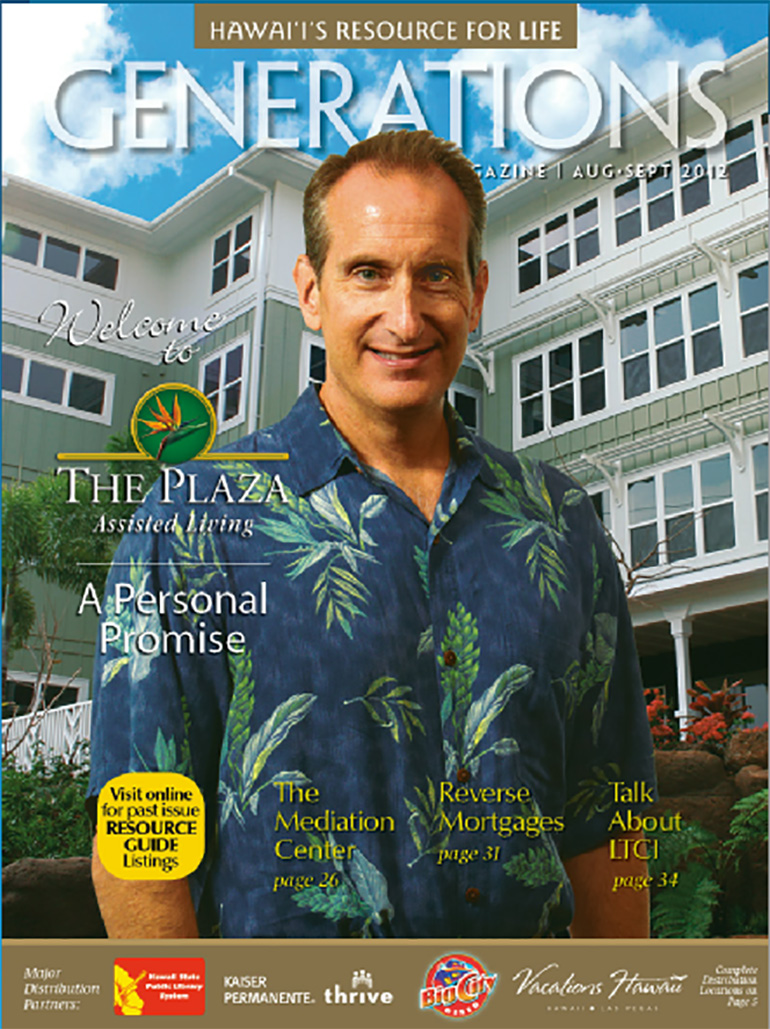
A personal promise creates new, affordable homes for hundreds local seniors
In the early 1990s, local businessman Steve Metter searched for a safe and affordable place for his aging father to live. Faced with limited options, it became his mission to build a quality community for the people of Hawai‘i who faced the same situation. Steve’s determination was the foundation for The Plaza Assisted Living.
Today, The Plaza is planning to open its third property — The Plaza at Moanalua. Construction is moving quickly and plans are to open the doors to new residents by October of this year. Generations Magazine recently sat down with Steve to learn more about Hawai‘i’s senior housing challenges, and hear about how The Plaza’s newest community may help local families.
GM: What prompted the idea of starting an assisted living property in Hawai‘i?
SM: In the early 1990s, my development partner Mike Wood and I recognized the need for a new type of senior housing in Hawai‘i. We both had middle-class parents in assisted living communities on the Mainland. After my mom passed away, my wife and I wanted to bring my dad to Hawai‘i to be closer to the rest of our family. After looking around we were unable to find a senior housing rental that provided a high quality experience and affordable care. We were disappointed that the quality assisted living communities in Honolulu required high buy-in fees and long-term commitments that make them out of reach for many middle-class families. We believed that the local community deserved a rental assisted living option that could provide the same level of care expected from the most exclusive communities. We made a promise to our parents that we would develop and operate high quality, affordable assisted living in Hawai‘i.
Steve Metter’s parents.
GM: Transitioning from a caregiver for your parent to building an assisted living community is quite a leap, without experience in this area of expertise. How was the process moved forward?
SM: We knew we needed to find a good business partner. We started our search by attending assisted living conferences and visiting communities on the Mainland. Our search eventually put us in touch with Sound Health Management and Development, Inc., an assisted living management and development company out of Seattle, WA. Sound Health, led by Rick and Lisa Skelton, had been involved in the development of nearly 30 assisted living communities across the Western U.S. and is considered a leader in the assisted living industry. They, too, had noticed the lack of quality rental assisted living options in Hawai‘i and were concerned about the state’s looming senior care crisis. We had finally found a partner that had exceptional operational experience, a history of successful developments and had dedicated their lives to caring for seniors. The partnership was a natural fit as both firms were driven by the same values — integrity and commitment to quality.
GM: Was there a bigger plan for the future since multiple properties are being built?
SM: In the beginning, our focus was about fulfilling a promise to our parents to build affordable, high quality senior living rentals, which was The Plaza at Punchbowl. Once The Plaza opened, we all became motivated to expand and provide these services in multiple locations. We realized that we had the ability to help even more families. The Plaza at Punchbowl provided a rental location in town close to medical facilities, shopping, and, most importantly, the residents’ own families. Seniors want to live in their own neighborhoods or close to their families. This meant we needed to build more communities in different areas throughout the state.
GM: Where are your communities located?
SM: Our first project, The Plaza at Punchbowl, opened in 2004 and is located in Honolulu on Lunalilo Street near Ward Avenue. Our second project, The Plaza at Mililani, is located on Ukuwai Street in Mililani Mauka and opened in 2010. The Plaza at Moanalua, our third project, is currently under construction and will be opened later this year. It’s located on Moanalualani Place directly behind Kaiser Hospital.
GM: Are there other locations that you are presently considering?
SM: Currently we are in the entitlement and permitting process for sites in Waikı¯kı¯ and Pearl City. We are also looking for sites throughout O‘ahu. Seniors want to stay in their neighborhoods and familiar areas; they should have the opportunity to do so.
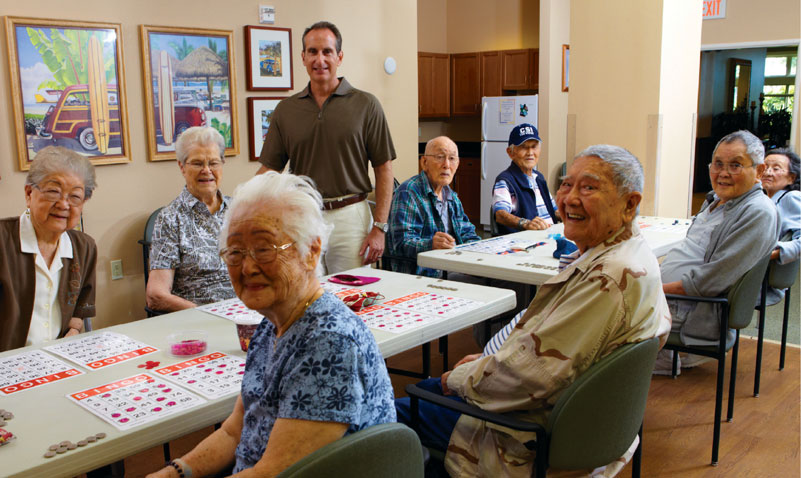
Steve Metter visiting with the residences on BINGO MONDAY!
GM: How have these assisted living properties had an impact on your life, personal and professional?
SM: The Plaza communities have impacted my life in so many ways. These communities have allowed me to fulfill a promise to my parents, created diversification for MW Group, Ltd., provided a new successful platform for our limited partners, generated hundreds of new jobs and most importantly we’ve had the honor and privilege to care for many of my friends’ and our community’s loved ones.
On a personal level, my children and their classmates have had the opportunity to visit, entertain and work in our Plaza communities. Recently we had a great time teaching my son’s class about the need and responsibilities in caring for our elders. Last holiday season my wife Susan and all three kids made bracelets for some of our residents and presented them on Christmas morning. My family and I enjoyed it so much … I think it will become an annual event.
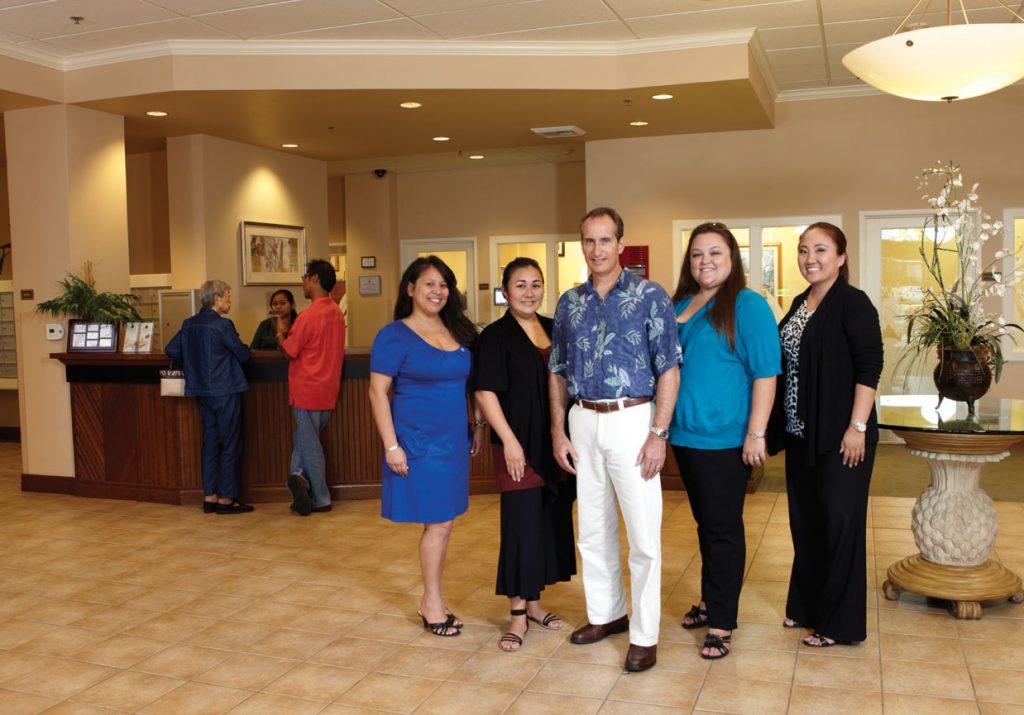
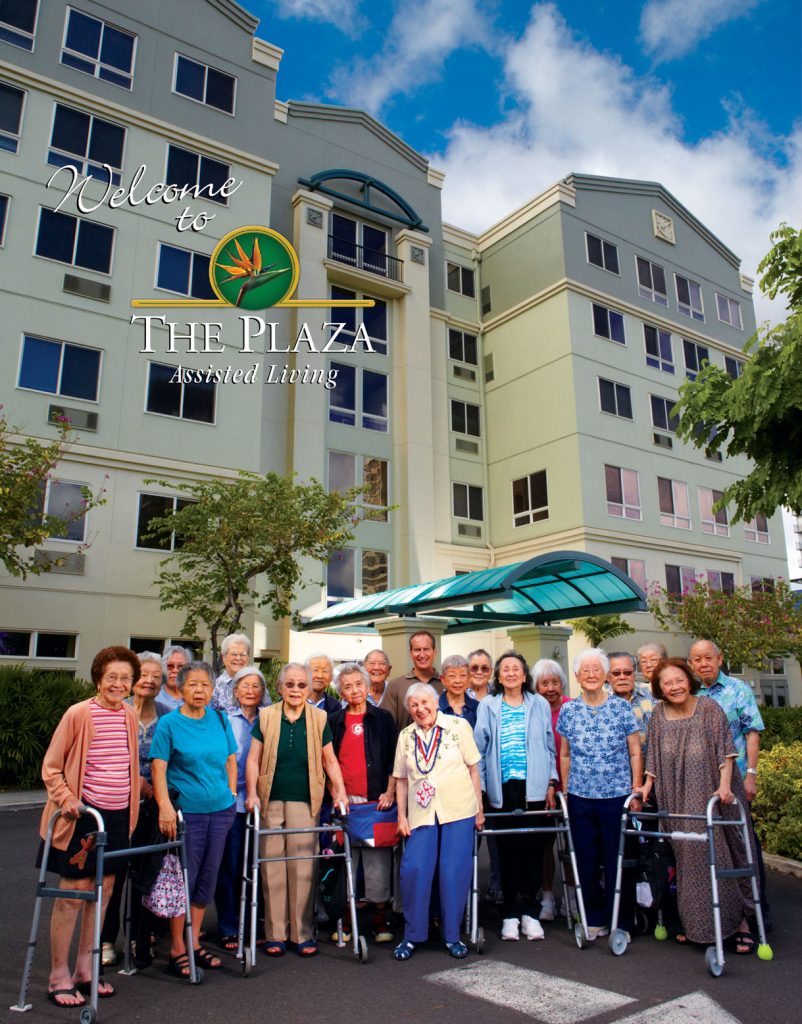
The lobby entrance of The Plaza at Punchbowl (Lt–Rt) U’ilani Kapuaakuni, Business Office Manager; Ashley Yokoyama, Administrator; Steve Metter, Developer; Tricia Medeiros, Regional Director; Shannon Miyazaki, Administrator
GM: What is the best part of caring for so many senior residents?
SM: Having lived through caring for an aging parent, I have firsthand knowledge of what people go through and the difficulties you experience. Everyone just wants to make sure that his or her parent has the best life possible, especially during the last years. I talk to friends and business associates and so many have parents who are aging and experience the similar worries that I did. I am grateful and humbled to be a part of something that has, and will, help so many families in our community.
GM: What are some of the staffs’ key traits that enable The Plaza to maintain a highly successful assisted living operation?
SM: The most important trait in our staff is passion. Our team members must be passionate about our mission. They need to care about
people of all ages because we touch the lives of not only the seniors but also their families, friends and other care givers. We can provide
technical training and education, but they must genuinely be caring and compassionate in order to be successful.
The Plaza was fortunate enough to hire Tricia Medeiros as the Administrator of The Plaza at Punchbowl. She later went on to become the
Regional Director of the company and is responsible for operations across all of our properties. Her belief is to find genuine, caring and driven people, and help them advance as we open new communities. Currently, all of our administrators at the various Plaza locations have held previous management positions within our company and were able to grow and expand their knowledge of assisted living under her direction and later become leaders of their own properties.
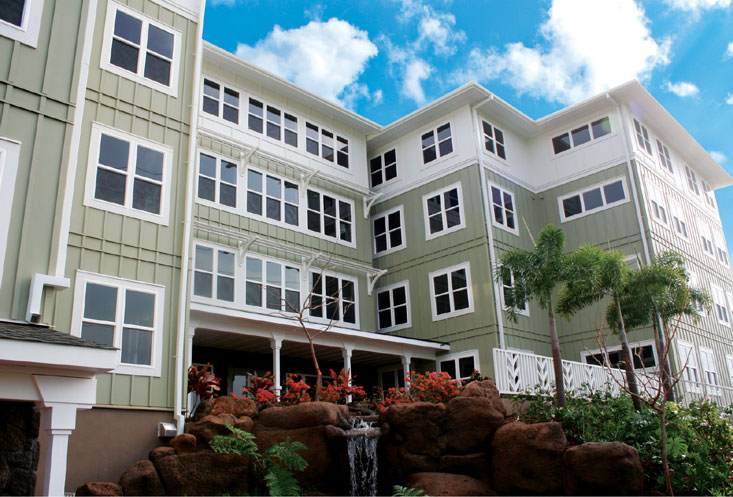
Entrance of The Plaza at Mililani
GM: What are some of the demographics of your residents? Age, level of mobility, prior occupation, financial history, where they lived prior, etc.
SM: The average age of our residents is in the mid-80s, but ages range from 60 to 100. The majority either lived in the immediate area or
has family who live near the community. Our residents are local people of all ethnicities and often will recognize former acquaintances from school or their neighborhood when they move in.
GM: What do you see in the future of long-term care in Hawai‘i?
SM: Hawai‘i’s senior population is one of the fastest growing groups in the country, and assisted living provides an option for seniors to live in an environment that fosters their independence. Services for seniors will need to continue to expand.
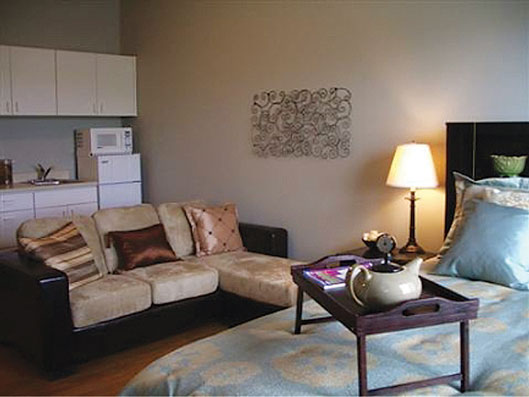
Bedroom at The Plaza at Mililani
GM: What is your best advice/tip for children of aging parents?
SM: Have the conversation with your parents early and do your research. Unfortunately, many of our residents move into our community after some kind of incident, and then it becomes a big rush to find an available apartment. In these circumstances, people often are forced to make a decision based on availability and not preference. I encourage people to go out and visit communities and learn about their differences. Families should make a well-informed decision. In addition, I think families will be surprised to see what state-of-the-art assisted living facilities offer. Prior to moving in, families should have a thorough understanding of the community’s dining experience, activities, staffing expertise, resources and overall social dynamics.
GM: In large housing facilities, how do you care for people with special needs such as dementia?
SM: Each one of our communities has a Memory Care Program. These are specially designated floors that create an environment for those residents with Alzheimer’s disease and other related dementias. The program floor is secured and allows residents to wander freely throughout the floor. In addition, the staff is trained to care for these residents’ special needs. The Plaza works very closely with the Alzheimer’s Association. The Plaza and the staff work hard to support the association because of all the services they provide our residents, staff and families. We hold support groups for the families in our communities, utilize the training they provide and continually
try to improve the residential experience.
GM: What are the benefits of living in an assisted living community?
SM: Most seniors want to reside in their homes as they age — we support that desire. But there may come a time that someone can no longer live alone in their home and need supportive services. Assisted Living provides an option for those who need services but want to live in an environment that fosters their independence. We’ve noticed that residents who were living alone in their own homes have improved health after moving into the community. This usually occurs due to improved nutrition, socialization, better exercise, health monitoring and medication management.
GM: What advice can you give if your aging parent is resistant to change?
SM: First, encourage them to visit the communities. Most find it surprisingly pleasant … like a very nice apartment complex or hotel. Next,
would be to experience it with a respite or short-term stay. When it comes to residents with dementia, reasoning with your parent may be difficult. Sometimes safety becomes a primary issue and nudging your parents may be necessary. The good news is that our staff has helped so many families through this transition with success.
I am grateful to be a part of The Plaza assisted living team. Our communities are filled with great people who have so much love, experience, memories, and wisdom to share with all of us.
The Plaza at Mililani
95-1050 Ukuwai Street, Mililani | 626-8807
• Five story building • 128 beds
Sweeping mountain views east and west.
The Plaza at Punchbowl
918 Lunalilo Street, Honolulu | 792-8800
• Six story building • 137 beds
Conveniently situated in the heart of Honolulu
with ocean views and near shopping, medical
facilities, and much more.
The Plaza at Moanalua
1280 Moanalualani Place, Honolulu | 833-8880
• Six story building• 160 beds
Unobstructed mountain and ocean views.
In the early 1990s, local businessman Steve Metter searched for a safe and affordable place for his aging father to live. Faced with limited options, it became his mission to build a quality community for the people of Hawai‘i who faced the same situation.
Exercises performed in water is truly magical. The liquid density in the pool increases the amount of workout that you would have compared with the equivalent exercise on land without the fear of falling or damaging fragile joints. It allows you to move in ways you never thought you were capable of. Many forms of land exercise are now being adapted to the pool.
Benefits of water exercise:
Increases flexibility and balance .
Increases muscular and bone strength.
Water’s buoyancy means less strain on knees, ankles and hips.
Improves cardiac fitness levels.
Burns calories by engaging the large muscle groups.
Relaxes the entire body.
Increases levels of serotonin resulting in overall feeling of wellness.
Types of water exercises:
Swimming — A complete whole-body and cardiovascular workout with interval training.
Water Aerobics — Whether in shallow or deep water, major muscle groups & full body movements are engaged.
Walking — Love to walk? Take it to the pool or ocean and double the output.
Aqua Zumba — A modified version of Zumba using water resistance to intensify the moves.
Ai Chi — Similar to Tai Chi. It combines deep breathing and slow/large movements.
Kick Boxing — Taking this sport from the gym to the pool using adapted punches and kicks.
Aquatic exercise is fun, challenging and gentle to your body. You receive in turn a healthier, stronger, younger and happier you.
Find out locations closest to you through the city parks and seniors club listings: 973-7258.
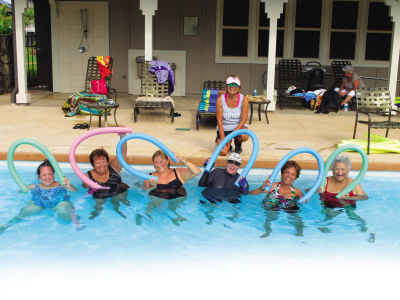
Joett and aqua participants at Franciscan Vista’s swimming pool.
Exercises performed in water is truly magical. The liquid density in the pool increases the amount of workout that you would have compared with the equivalent exercise on land without the fear of falling or damaging fragile joints. It allows you to move in ways you never thought you were capable of. Many forms of land exercise are now…
“$51? Are you sure that’s right?”
— Yes, the young lady told him.
“Does that include the tax?”
— Yes, she said again.
“Okay,” the man said and pulled a $50 and $1 out of his pocket.
“We had a nice time,” he told her.
— “We hope you join us again,” she said.
Through a stroke of good fortune, Mrs. Matthews and I had the opportunity to take a cruise to Alaska, a part of our great nation we had never visited before.
The gentleman in line ahead of me had paid a flat cruise fare — meals included. The $51 was for “incidentals” — drinks, massage, excursions — whatever. An article recently pointed out that it is almost — almost — cheaper to retire on an ocean liner than it is in a nursing home. I’m not sure that’s entirely true — but I do know they take pretty good care of you on the ship. There is a doctor on board. That can be important.
You can eat whatever you want, whenever you want. This includes ice cream. It may not be a big deal now, but believe me, at some point during your voyage, you will want ice cream. And it’s nice to know it’s always there.
If you can eat whatever you want, there are plenty of activities to work off those extra calories. I watched people playing basketball in 48 degree weather. It’s a good excuse to get more ice cream.
When you arrive at a new destination, you will feel the kind of excitement you felt as a child. It’s hard to put a price on that.
You will find yourself elbow to elbow with people from all over the world. EVERYBODY has a story and if you are the least bit interested, that person is happy to share a story with you. And you will have the chance to share your story as well. Psychologists will tell you, this is a path to good mental health — listening AND sharing.
Maybe this is the message of these notes this time around. Cruising can happen where ever you are. You don’t necessarily have to be on a ship in the middle of the North Pacific to practice cruising. You can walk around the block, head over to the library or your local senior center.
The important thing is to LISTEN AND SHARE. You will be amazed by what your fellow “passengers” have to tell you.
By the way, the fellow with the $51 charge at the end of his voyage — he got his money’s worth.
“$51? Are you sure that’s right?” — Yes, the young lady told him. “Does that include the tax?” — Yes, she said again. “Okay,” the man said and pulled a $50 and $1 out of his pocket. “We had a nice time,” he told her. — “We hope you join us again,” she said. Through a stroke of…


 Grief does not discriminate. No matter who you are, losing a loved one can be an overwhelming life experience. Imagine dealing with looking for important documents and organizing burial wishes while dealing with the loss. Many people don’t realize the need for getting affairs in order before they or a loved one dies. Being prepared protects families and loved ones, and alleviates stress for everyone involved.
 Flu viruses change often and each year’s virus is just a little different than the year before. Since different forms of the viruses appear each winter, a new vaccine is manufactured each year according to the circulating strain that will fight the viruses most likely to occur that year. The protection received from a flu shot also lessens with time, especially in older people. This is another reason why seniors need a flu shot every year. It helps keep seniors protected from the flu and stay healthy. Flu season is usually between November and April. It takes at least two weeks for the shot to start working, so try to get the flu shot in October or early November.

 Kids Voting Hawai‘i is a non-profit, nonpartisan, grassroots organization. Its mission is two-fold: to prepare schoolchildren for a lifetime of voting, and to encourage adult voter participation.
 GM: Did you have a mentor in broadcasting?
 In 1987, when Rotary International raised the ‘testosterone curtain’ and allowed women to be inducted, I joined the Rotary Club of Honolulu. It was a year before leaving TV news to head to KSSK to work with Michael Perry and Larry Price every morning. With radio, I found an avenue for ‘service above self’— a way to make a difference with wonderful, dedicated businesses and community leaders.
 In 1995, when I was serving as the first woman President of the Rotary Club of Honolulu, Lyla Berg brought the Kids Voting idea to the club, and we ran with it. Rotarians statewide staffed the adult polling sites, where K-12 students went with their folks to cast their own paper ballots. By 2002, Kids Voting Hawai‘i shifted to cyberspace, and Hawai‘i students were the first in the nation to vote statewide by computer, thanks to the cutting-edge Internet technology of Commercial Data Systems.
 Kids Voting Hawai‘i continues to provide K-12 students with curriculum and classroom activities that address civic responsibility and compliment the Hawai‘i State Social Studies Standards. Our youth are inspired to explore the candidates and student issues, and engage their peers and parents in discussion. This hands-on experience in democracy is made possible by volunteers, including retired educators with Alpha Delta Kappa.
 Everywhere I go, I invite folks my age, who are retired, talented and looking for meaningful ways to spend their time to find a need and fill it. Your experience is a gift. Your knowledge will rub off on younger generations. You will set an ideal example for your friends, who also may have some time on their hands that can be spent wisely.
 Everybody suffers from stress from time to time, given the tremendous challenges, options and responsibilities in our busy lives. Stress depresses respiration and causes shallow breathing which can lead to irritability, frustration and fatigue. Many people turn to unhealthy habits like smoking, overeating, and excessive drinking to counteract stress. Instead, you can follow this 10-minute, self-care acupressure routine to alleviate everyday tensions.
 This 10-minute self-care routine is shown sitting, although you can also practice these techniques lying down.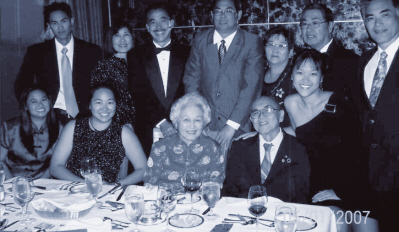
 In the early 1990s, local businessman Steve Metter searched for a safe and affordable place for his aging father to live. Faced with limited options, it became his mission to build a quality community for the people of Hawai‘i who faced the same situation. Steve’s determination was the foundation for The Plaza Assisted Living.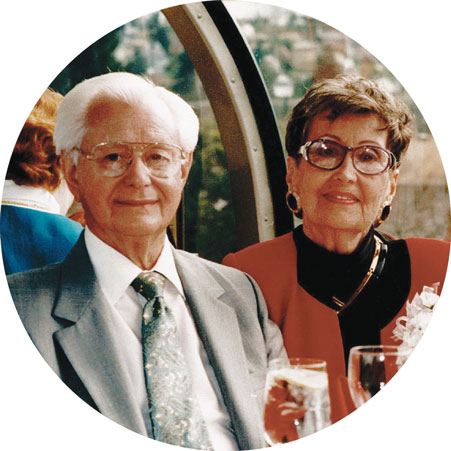
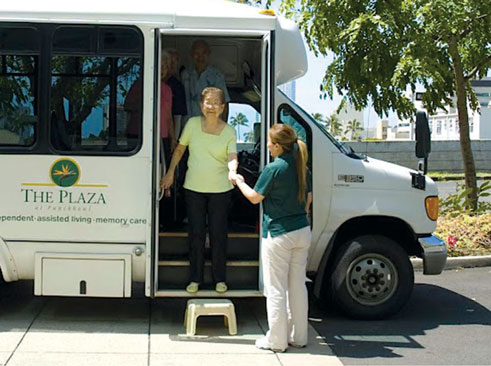 GM: Where are your communities located?