Refugees don’t flee FROM America, they come TO America. There is promise here. There is hope.
“The Greatest Generation.” That’s what Tom Brokaw called my parents and their peers, with good reason. They were asked to defend and support their country in whatever way they could.
My father was in the Navy, served as a medical corpsman in the Pacific. He didn’t talk much about that time in his life. Few in his generation do. But their patriotism is unquestioned. The world seems to be a more complex place now.
There will be disagreements among us about how best to solve America’s problem. But when we agree to disagree and move forward toward that goal — solving those problems, we remain patriots. Boomers may never be labeled the Greatest Generation. We have an obligation, though, to make certain we leave an honorable legacy for those who come after us. Did we serve our community, our country to the best of our ability? If we can say yes, then we can be counted as patriots.
It’s important to take your hat off when Old Glory passes by. But it’s also important to know, despite it’s problems, that flag represents the hopes and dreams — not just yours, but those of your children and millions of others around the world.
Patriotism can’t be measured in any kind of units. You can’t earn more “patriot” points than the last generation or your neighbor. You CAN remember that while we are all different — we are all Americans.
The Elderhood Project airs on KHON2 Friday morning news at 5:45 a.m. and Thursday news at 5 p.m.
Refugees don’t flee FROM America, they come TO America. There is promise here. There is hope. “The Greatest Generation.” That’s what Tom Brokaw called my parents and their peers, with good reason. They were asked to defend and support their country in whatever way they could. My father was in the Navy, served as a…
Hawaii’s family caregivers are starting to get the support they need. These caregivers are among the 247,000 sons, daughters, husbands and wives who help loved ones stay independently at home for as long as possible — providing help with everyday tasks.
In mid-April nearly 500 Hawaii residents joined elder advocacy groups and resource providers in paying tribute to family caregivers at an event at the Japanese Cultural Center. The event was to recognize the extraordinary contributions they make, highlight helpful community resources and provide an update of recent legislative efforts to support caregivers and their families.
During the 2014 legislative session AARP supported a measure that would allow family caregivers be more involved in the patient healthcare process. Senate Bill 2264 (the CARE Act) was a Kupuna Caucus bill backed by many House and Senate legislators and community groups. It was intended to give caregivers the instruction needed to safely care for loved ones when they’re discharged from the hospital.
AARP believes caregivers should be informed and recognized for their role in coordinating the care of loved ones transitioning from hospitals to home. Research found that family caregivers are under pressure to provide increasingly complex medical tasks — like wound care, injections, and medication management — when loved ones return home from the hospital. Caregivers often receive little or no training to provide care and are often the only option available to families, who may not be able to afford professional home care.
How serious are the challenges facing Hawaii’s caregivers? The answer may be found in personal stories of caregivers like Keri Yamamoto, a caregiver and occupational therapist, whose uncle was admitted twice last year to a local hospital. She was “highly dissatisfied” with the discharge procedure. She testified in Support of SB 2264. On Maui, caregiver Michele Paularena, also supported the bill when her husband was discharged from the hospital without adequate instructions on how to administer the medications prescribed.
While SB 2264 did not survive this session, the House Finance Committee passed a concurrent resolution (HCR 78) that calls for the establishment of a family caregiving working group to examine and assess the role of caregivers in the hospital discharge process. AARP welcomes the opportunity to work with hospitals and community stakeholders to ensure caregivers are properly instructed in the care of loved ones at discharge.
Hawaii needs coordinated care putting patients and families first. As our population ages, it’s essential that family caregivers are supported and our community recognizes the limits of what they can do on their own.
Hawaii’s family caregivers are starting to get the support they need. These caregivers are among the 247,000 sons, daughters, husbands and wives who help loved ones stay independently at home for as long as possible — providing help with everyday tasks. In mid-April nearly 500 Hawaii residents joined elder advocacy groups and resource providers in…
For those who joined or renewed their Medicare Advantage plan this year, don’t forget to take time to unwrap the bundles of information you should have received from your plan by now. Annually, Medicare plan sponsors are required to send new and existing members information on premiums, benefits, cost sharing and all covered services. It should also explain how to access benefits and get help from the plan.
Here are examples of some of the materials:
Welcome Letter — Confirms enrollment and may be used to verify coverage, if you need services before your membership card arrives
Medicare Membership Card — The card you will use to receive health and/or drug benefits
Evidence of Coverage — This booklet offers details about your Medicare Advantage Plan
Summary of Benefits — This booklet summarizes key features of the plan and costs
Drug Formulary — A list of drugs covered by your plan
Provider & Pharmacy Directory — A listing of your plan’s in-network providers
Medicare Plan Ratings — Medicare Health and Prescription Drug rating based on your plan’s quality and performance
Multi-Language Interpreter Service — Notice that plan provides free interpreter services
Privacy Notice — Explains how medical information about you may be used or shared, and how you can get this information
Martha Khlopin hosts the popular weekly radio program “Medicare Moment with Martha — The World of Medicare” sponsored by AlohaCare. It airs on KHNR-690AM on Saturdays from 11 – 11:30 am and on KGU-99.5FM on Sundays from 10 – 10:30 am. For information, call 808-973-0754, mkhlopin@alohacare.org. (Calling this number will direct an individual to a licensed insurance agent/broker). AlohaCare Advantage (HMO) is a HMO plan with a Medicare contract. Enrollment in AlohaCare Advantage depends on contract renewal. H5969_400253_1 CMS Accepted 02012014
For those who joined or renewed their Medicare Advantage plan this year, don’t forget to take time to unwrap the bundles of information you should have received from your plan by now. Annually, Medicare plan sponsors are required to send new and existing members information on premiums, benefits, cost sharing and all covered services. It…
Americans in general have strong work ethic, so a life of extended leisure doesn’t appeal to everyone. With the average U.S. life expectancy estimated at 80.1 years, there’s no reason why you can’t pursue meaningful work in retirement especially if your health is good and your mind is sharp. The desire for activity and income are other important reasons you may decide to return to the workforce and stay well beyond age 65.
Retirees today can consider a number of opportunities, such as turning special expertise into a consulting gig, taking a part-time job, starting a small business or volunteering for non-profit work. Let’s take a closer look.
Become a consultant. Many retired professionals turn their past into thriving consulting businesses, often providing services to their former employers.
Others blog about their fields of expertise. Speaking engagements, seminars and webinars are additional ways you can share your knowledge, which can bring income and provide you with the professional and in-tellectual stimulation your former work life provided.
Get a part-time job. If your former field offers part-time opportunities, you may be the lucky ones to land a less-than-full time job with betterthan- average compensation.
Some seniors go back to school to get another degree, training or certification that will qualify them for a challenging part-time job in a field of interest. Or, decide to take a low stress, entry-level job simply to remain active — bagging groceries, working a cash register or becoming a barista to stay busy while lining your pockets with a little extra cash.
Start your own small business. Merchandising and auction sites such as eBay and Etsy are where people turned their hobbies of collecting or crafting into thriving businesses.
In your former work life, you may not have had as much time to devote your hobby as you would have liked. Now you can pursue selling your collectibles or handmade treasures and enjoy the rewards of a small business.
Volunteer. Many retirees take advantage of their open calendars to ramp up volunteering for organizations they support.
While giving your services freely to your favorite nonprofit won’t pad your pocketbook, it can be extremely rewarding and meaningful. Whether you choose to help your favorite church, hospital, professional organization or animal shelter, volunteering your time can enrich your life and benefit your community in important ways.
It’s up to you to create a rewarding retirement.
If you choose to continue working for a paycheck, your financial advisor can help you examine how additional income will impact your overall retirement finances.
Remember, the point of a work commitment in retirement is not to replicate your former 40-plus hour workweek. Ideally, your retirement career is about staying active and engaged in ways that keep you young.
Whether or not you pursue a new line of work in retirement, be sure to leave room for activities and interactions that will make your golden years as rewarding as they can be.
Michael W. K. Yee, CFP 1585 Kapiolani Blvd., Suite 1100, Honolulu 808-952-1222 ext. 1240 | michael.w.yee@ampf.com
Michael W K Yee, CFP®, CFS®, CRPC®, is a Financial Advisor CERTIFIED FINANCIAL PLANNER practitioner™ with Ameriprise Financial Services, Inc. in Honolulu, HI. He specializes in fee-based financial planning and asset management strategies and has been in practice for 26 years.
Ameriprise Financial, Inc. and its affiliates do not offer tax or legal advice. Consumers should consult with their tax advisor or attorney regarding their specific situation.
Brokerage, investment and financial advisory services are made available through Ameriprise Financial Services, Inc. Member FINRA and SIPC.
Americans in general have strong work ethic, so a life of extended leisure doesn’t appeal to everyone. With the average U.S. life expectancy estimated at 80.1 years, there’s no reason why you can’t pursue meaningful work in retirement especially if your health is good and your mind is sharp. The desire for activity and income…
Tucked away in Niu Valley, Kilohana Senior Enrichment Center is a little-known resource for East O‘ahu families. The adult day care is operated by Arcadia, Oahu’s only provider of continuum care. For almost 50 years, Hawai‘i’s families have looked to Arcadia as a trusted resource for senior living.
The center serves seniors and their caregivers during the workday with a safe, stimulating environment. Seniors can enjoy activities, games, wellness exercises, and nutritious meals with plenty of space for private time. Caregivers have the freedom to work or attend daytime activities with peace of mind knowing loved ones are in good hands.
In addition to socialization, Kilohana offers a personal care plan based on a client’s needs and managed by Arcadia’s interdisciplinary care team. Services are available Monday — Friday 7:30 am — 5:30 pm.
Kilohana Senior Enrichment Center, like Central Union Church Adult Day Care & Day Health, is operated by Arcadia. The Arcadia family of companies includes 15 Craigside, Arcadia Retirement Residence and Arcadia Home Health Services. For more information on Kilohana Senior Enrichment Center call 808-373-2700 or visit arcadia-hi.org.
Tucked away in Niu Valley, Kilohana Senior Enrichment Center is a little-known resource for East O‘ahu families. The adult day care is operated by Arcadia, Oahu’s only provider of continuum care. For almost 50 years, Hawai‘i’s families have looked to Arcadia as a trusted resource for senior living. The center serves seniors and their caregivers…
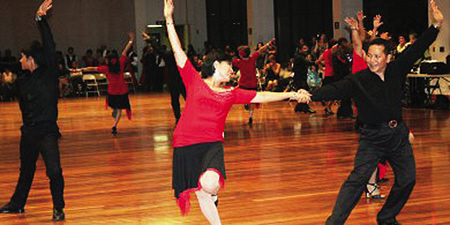
If you find your exercise regimen becoming boring and a chore, stop fighting it and switch to ballroom dancing!
AARP The Magazine, March 24, 2011 issue, reports that dancing is not only fun, but it’s therapeutic. Dance can, among other things, boost your cardiovascular health and bone strength as well as improve balance. Joe Verghese, professor of Neurology at Albert Einstein College of Medicine, reported that “unlike many other physical activities, dancing involves significant mental effort and social interactions.” Frequent dancing, which involves both intellectual and social stimulation, was reported as the only physical activity shown to reduce the risk of getting dementia.
So while learning dance steps with a partner, brain health and general well-being is improved while having fun exercising, socializing, and forming new friendships.
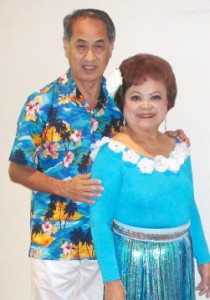
Herbert and Shirley Ota, President of HBDA
Retired Computer Specialist, Herbert Ota is a living testimony benefiting from ballroom dancing. While vacationing on a cruise, Herbert collapsed when the cruise ship docked in Vienna, Austria. On October 25, 2013, Herbert was immediately taken to a hospital where emergency triple by-pass surgery was performed.
Three months later, Herbert was on the dance floor with his wife Shirley eagerly learning the romantic Bolero with directors Ben & Faith Agbayani of the Hawaii Ballroom Dance Association (HBDA), Hawai‘i’s oldest and largest dance organization founded by Eugene Ichinose.
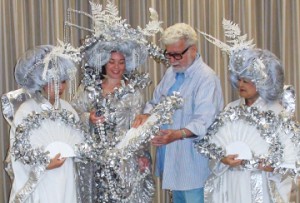
Preparing for the Cabaret III performance, (left to right) Millie Chun, Allyson Doherty, Jack Cione, Shirley Ota
They religiously attend dance rehearsals five times a week with a team of eight couples from the Pearlridge Chapter. They showcased their dance number at the HBDA 55th Anniversary Ball on May 3, 2014 at The Palladium in Honolulu. This celebration was a gala affair, with different dance exhibition teams representing different chapters, each choreographed by HBDA’s own creative dance instructors. In addition, Herbert had also rehearsed and prepared for CABARET III, an HBDA fundraiser directed by Jack Cione. It was a new extravagant musical comedy production with a cast of 82 performers in lavished costumes from the HBDA, Arcadia and Craigside.
With all of Herbert’s scheduled dance rehearsals, he is recuperating well and gaining his strength back from his open-heart surgery. He is looking simply great, a testament to the wonders of dance therapy with the HBDA.
You are never too young or too old to learn to dance. If you would like to get in good shape, stay physically fit and mentally alert, while having fun and making new friends, contact any one of our HBDA chapters.
HBDA is “the place to learn to dance”. You are invited and more than welcome to come, and dance with us!
If you find your exercise regimen becoming boring and a chore, stop fighting it and switch to ballroom dancing! AARP The Magazine, March 24, 2011 issue, reports that dancing is not only fun, but it’s therapeutic. Dance can, among other things, boost your cardiovascular health and bone strength as well as improve balance. Joe Verghese,…
“Public service is the rent one pays for the space he/she occupies here on Earth…”this motto is something my father used to say often, recalls Ronald T. Y. Moon, the former chief justice of the Hawai‘i State Supreme Court. “He was a living example…a very community-minded person. His actions prompted me to join the judiciary, thereby committing to public service.”
Before retiring in 2010, Moon—an attorney for 16 years and judge for 28— put the “law of the land” to work for more than 40 years. As judge, he says he was proud to support the interests of his state and country, and witness hundreds of citizens perform their civic duty as jury members within the court system. He notes that jury duty is one of the key ways citizens can engage in civics and participate in the democracy of which we all depend on.
As this issue of Generations coincides with the Fourth of July, we sat down with Moon and asked him to reflect on what it means to be an American — as a retired chief justice, Korean-American and private citizen.
From the Plantation to the Judiciary
As a third generation Korean-American, Moon doesn’t take our democracy, freedom or rights for granted.
Moon’s grandparents on both sides came to Hawai’i in the first wave of Korean immigration, between 1903 and 1905. The family lived in Wahiawa. After leaving the plantation, Moon’s paternal grandfather opened a tailor shop in Wahiawa that served as the family business for two generations. The Moon family (parents Duke and Mary, Moon and his three younger siblings) lived above the store.
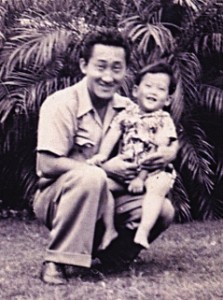
Left: Grandfather Moon and Ronald (10 months). Below: Toddler Ronald with dad enjoying a day at the Honolulu Zoo.
Academics were impressed upon Moon by his parents (his father wasn’t educated beyond high school due to lack of finances; his mother attended vocational business school), who believed that education was necessary if one was to be productive in life. Yet, Moon admits that he wasn’t the best student. He attended Leilehua High School and town high schools. He says that it wasn’t until he was admitted to Mid-Pacific Institute (MPI) that his parents’ advice sunk in.
“The school gave me the guidance, supervision and motivation that I needed,” Moon says. “It was difficult for my teachers and counselors, specifically the Dean of Boys and my American History teacher, Lester Cingcade.” Cingcade was instrumental in seeing that Moon, “Stop being a kid and grow up!”
At MPI in the late ‘50s, during Moon’s junior and senior years, there were “rules upon rules” for which any violation of them would result in a “charge” that would send students to the Senate Court (school’s student court). Cingcade was the advisor and honor students were the judges.
During Moon’s first year at MPI, he was in Senate Court on nearly a weekly basis for violating rules, ranging from disrupting class and holding a girl’s hand on campus to his hair touching his ears and dust on his dorm room’s window sill, etc. Punishment included “hard labor” such as pulling weeds, collecting garbage from the cafeterias, or not being able to go home on weekends.
“I believe that being a defendant in Senate Court convinced me that I would very much appreciate one day being on the “other side” of the courtroom,” Moon says.
In fact, in his senior year at MPI, Moon got the opportunity to “defend” one of his good friends. Moon explains that his classmate got caught plagiarizing. Instead of writing a report on the American classic, Moby Dick, he used the comic book edition. The senior English instructor recommended to the school that he be expelled. “This meant that after four years of attending MPI and living away from home, my friend wouldn’t graduate,” Moon says. “I knew that his parents — a schoolteacher and service station owner — were not wealthy people. Private schools are so competitive and they sacrificed to pay for their son’s way through boarding school. It didn’t seem right that he’d be kicked out in our senior year.”
With Cingcade’s voice drumming in his head “to stop being a kid and to grow up,” Moon decided to secretly visit the teacher and make a case on his friend’s behalf. As a result, Moon’s friend was allowed to stay on campus and graduate. (Later, he became a very successful businessman, and he and Moon are still very good friends to this day.)
“That experience gave me an awareness that I enjoyed helping people,” Moon recalls.
College Conundrum
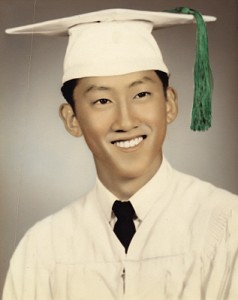
Mid-Pacific Institute, Class of ‘58
Although Moon started to find focus at MPI, he didn’t graduate with college ambitions. Rather, he attempted to persuade his father to allow him to take care of the family business. “My father, however, wasn’t going to have anything to do with me unless I went to college. If I was going to skip college, then he wanted me out of the house and living on my own … I was not to rely on the mom-and-pop shop. It was just that way,” Moon recalls.
To determine Moon’s future, the family visited the well-connected and educated reverend at the Wahiawa Korean Christian Church, where they were very involved in the parish activities.
“If you had a question, it was customary to visit the reverend for guidance,” Moon explains. “The reverend stated that I would go to Iowa, as he knew of a very good school [University of Dubuque] that has a seminary … and that I was going to be a good minister one day.”
Moon attended the University of Dubuque and then transferred to Coe College, where he studied toward becoming a social worker.
A older cousin, James Choi, who was studying at the University of Iowa Law School encouraged Moon to submit his application.
“He advised me that in order to get a good job in social work, I’d probably need to earn a doctorate degree. He suggested that I try to become a lawyer … that way, as a social worker, I could understand the law and better help people,” Moon says.
In 1965 Moon graduated from the University of Iowa Law School and obtained his doctorate of jurisprudence.
After school, Moon returned to Honolulu. “It was the right thing to do to come home in ’65. At the time, memories of the war with Japan and the Korean War were still fresh in America’s mind. I didn’t feel very comfortable in a nearly all-White community. If you looked Asian, you reminded them of the enemy.”
Once Moon returned to the Islands, he became law clerk to United States District Court Judge Martin Pence. He served under Pence for one year.
In 1966, he joined the staff of the Prosecuting Attorney of Honolulu where he was deputy prosecutor. Later, Moon left public service to become a partner in the law firm of Libkuman, Ventura, Moon and Ayabe until Gov. George Ariyoshi appointed him to the Hawai’i State Judiciary as a circuit court judge.
Then, Gov. John Waihe‘e elevated Moon to the office of Associate Justice of the Hawai’i State Supreme Court in 1990. In 1993, Moon was promoted to chief justice.
No Injustice in Judgment
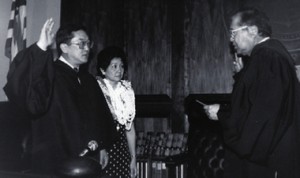
Swearing in as Chief Justice with wife, Stella Moon, by Chief Justice Herman Lum in 2003.
Judge Pence, from the U.S. District Court, had a great influence on the development of Moon’s judging philosophy that revolved around two key points — judicial independence and treating all who appeared before the judge with respect.
“Pence essentially taught me judging,” Moon says. He educated Moon on how to review cases and how to remain objective despite outside pressures, such as the media, politicians, big-business, special interest groups, and even protests outside of the courthouse.
“Pence insisted that judging always comes down to the facts of the case from evidence only admitted in court. Once determining the facts, you then apply the applicable law to those facts,” Moon says. “You don’t let the outside influence your decisions. That is what judicial independence is all about. That’s what I tried to do throughout my career.”
Moon continues to promote judicial independence in Hawai’i, and is averse to the fact that judges in many other states are elected rather than selected under a system like Hawaii’s that utilizes citizens and lawyers in the selection process. “When judges are elected — and they need to waves signs, ask for donations, gain votes — they become politicians,” he says.
To get votes, you have to be popular, Moon notes. “When a big issue comes up and you make a ruling … and it’s not a popular decision … You lose votes and perhaps lose your job. Judges can’t be placed in that kind of situation.”
Moon’s second guiding principle — to treat people with respect, courtesy and civility — stems from the overarching ideologies of his father, Cingcade and Pence.
“I told the judges who I supervised that they should not scold, admonish or belittle people, like ‘Judge Judy’ on TV,” Moon says. “They shouldn’t exhibit condescending behavior toward the people that come before them.”
Democracy On Trial
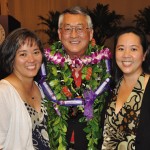
Induction into the Royal Order of King Kamehameha I.
After spending four decades in the legal system, Moon has witnessed the pros and cons of the legal system. One of the greatest weaknesses, he fears, is our lack of civic knowledge. And he questions whether it poses a threat to American democracy.
“The kind of ignorance that I’m talking about is illiteracy in civics — understanding government, its makeup and how it works … being able to name the vice president, your state’s senators or the three branches of government — executive, legislative, judiciary,” Moon explains. “Our inability to do so disappoints me a great deal.”
Moon sites a recent study by the Center for the Study of the American Dream at Xavier University in Cincinnati, Ohio, which reveals that one-third of native-born citizens fail the civics portion of the naturalization test, in stark contrast to the 97.5 percent pass rate among immigrants applying for citizenship.
“Some people may argue that immigrants had time to study,” Moon says, “but I contend that native-born citizens have lived here all their lives, spend 12 to 18 years in school, have access to unlimited media and resources … yet they can’t name the governor of their own state or identify the law of the land, such as The Constitution? It’s just amazing and depressing!”
Moon explains, “It’s because of these kinds of reports year after year when I was serving in the judiciary, especially as a chief justice, that I understood clearly why nearly 25 percent of people don’t show up for jury duty in Hawai’i (and up to 75 percent in other states such as Florida), and why voting is at an all-time low. People are oblivious to their civic responsibilities.”
Our country is like a family: Everyone has to pitch in or it doesn’t work. As citizens of the American “family,” we all have certain responsibilities, like going to school, voting, obeying the law… and jury duty.
Any jury pool assembled to try a criminal or a civil case is supposed to be drawn from all socioeconomic classes of the general population. When a quarter or more of the people summoned don’t show up, the person who is in trial is potentially robbed of the opportunity to be fairly judged by his/her peers.
Moon explains that he understands that jury duty is not an attractive thing to most people. In fact, he’s heard “every excuse in the book” to get out of it. Moon says, “But I always ask people who try to skip jury duty to imagine a situation where their friend, family member, spouse, or themselves is charged with a crime and a jury trial is set to determine their guilt or innocence. Wouldn’t they want a good, fair and well-balanced jury? Wouldn’t they want a peer to represent them in the jury? Would they want a reluctant jury member who doesn’t want to give service — or doesn’t believe in the jury system — sitting in judgement of them?”
Use Your Voting Voice
“Civic literacy is important so everyone can understand democracy and see how things are done in government,” Moon says.
Moon points out that the first general election in 1960 after Hawai’i became a state, voter turnout was 94.6 percent. Since then, the rate has been gradually slipping. In disbelief, Moon says that in 2008, “even when we had a local boy running for president, Hawai’i was last of all the states with a 43.6 percent voting rate.”
To vote is to respect the history that granted us that privilege. To vote is to help your state and country choose positive leaders. Whether or not your candidate wins, the point is that you used the voice and power that was given you.
Retiring From The Bench
After Moon’s first term as chief justice ended, he considered retiring. He knew his wife Stella would like to spend more time with him, but she also encouraged him to go for a second term — he says, “as long as I thought I’d enjoy myself.”
Moon decided to apply, and in 2003 he was retained to serve a second term as Chief Justice of the Hawai’i State Supreme Court. He retired in September 2010 — three years shy of completing the term because under Hawai’i law all judges must retire at age 70.
“I feel that for me, the age limit was very appropriate. I had 40-plus years in the legal field — nearly 18 of which were as chief justice — the longest serving chief justice since statehood. I was ready to go!”
“I’m indebted to Stella, my biological and adopted children, my parents and grandparents for the tremendous support and love they’ve extended to me in my pursuit of love, peace and joy in my career throughout the years,” he says.
Going Out On Top
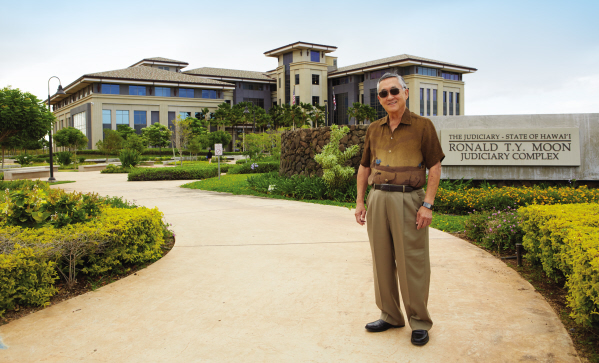
To cap his career, the West O‘ahu court complex in Kapolei was named the Ronald T. Y. Moon Judiciary Complex just days before his retirement. It currently serves as the new home of family court for the 1st Judicial Circuit.
“I was very flattered and honored that it was named after me,” Moon says. He notes that his predecessor Chief Justice Herman Lum had the original idea 20 years earlier and spent a lot of time trying to convince the legislature to build a one-stop shop family court center.
“When Lum retired and I took his place, the family court was still a very good concept. Luckily at the time, Kapolei was new and the ‘second city’ was looking for community foundations, such as a courthouse,” he says.
In retirement, Moon continues his lifetime civil service by offering dispute resolutions, such as mediation and arbitration. He also aids high-risk teens in Waipahu at Kick Start Karate, founded by former Honolulu Police Chief Lee Donohue. In addition, Moon sits on several boards, including Mid-Pacific Institute, St. Louis School, Wahiawa United Church of Christ and Ohana Pacific Bank.
“I have the opportunity to learn new things and read material that isn’t strictly law… it’s so refreshing,” Moon laughs. “Retirement, which is your last phase of life… is ultimately the best. I just love it. Maybe I should have retired earlier!”
Whether working or retired, Moon encourages everyone to get involved in civics in whatever way best suits them. “I understand that everyone is busy trying to make a living, but we should all do what we can to get involved in the community — PTA, Lions or Rotary Club, team coach, tutoring and so forth,” Moon says. “We fulfill our civic duties by investing in our communities and country … thereby enjoying, strengthening and preserving our rights and freedoms.”
It was a family affair at the Kapolei Judiciary Complex ceremony and Chief Justice Ronald Moon’s retirement celebration. From left to right: Moon’s wife Stella; mother Mary; daughter Julie and sons Scott and Ronald Jr. (not pictured); and step-daughters Jan and Jill; and step-son Herb (not pictured).
Before retiring in 2010, Moon—an attorney for 16 years and judge for 28— put the “law of the land” to work for more than 40 years. As judge, he says he was proud to support the interests of his state and country, and witness hundreds of citizens perform their civic duty as jury members within…
With Independence Day on the horizon and summer shifting into gear, homeowners are encouraged to address pending roof-related issues to ensure the safety and longevity of one’s home. A professional roofing company should be contacted for any roof upgrades. It is recommended that a few estimates from companies verified by the Better Business Bureau or referrals from friends and family be looked into first.
By researching the company’s portfolio and references, customers can weed out inexperienced, fly-by-night operations that could produce shoddy results, costing more in the long run.
It is also recommended that homeowners check with the State’s Regulated Industries Complaints Office: 808-587-3295 or www.cca.hawaii.gov/rico/business_online/, to determine the status of a company’s licensing information and history.
Once you’ve nailed down two or three estimates, you can do a real in-depth comparison by asking those companies for information on the industry’s new and popular roofing materials. Don’t let price be the determining factor — consider the quality of materials.
When choosing a roofing company, make sure they are licensed and bonded with a general liability insurance. This is to insure peace of mind and the safety of your home. The end result, a happy homeowner with a new roof.
This 4th of July, let’s all raise our flags to honor our veterans who sacrificed their own lives for our freedom.
With Independence Day on the horizon and summer shifting into gear, homeowners are encouraged to address pending roof-related issues to ensure the safety and longevity of one’s home. A professional roofing company should be contacted for any roof upgrades. It is recommended that a few estimates from companies verified by the Better Business Bureau or…
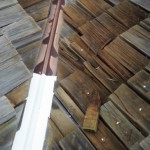
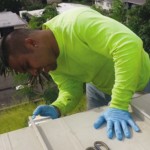
If your goal is to age in place, don’t let your roof age with you. Consider getting a roof inspection to determine its structural integrity and lifespan. Regular inspections — approximately every three years — can detect problems or issues before they have a chance to cause major damage.
Do not attempt to climb a ladder or inspect the roof yourself. Hire a licensed, professional roofer who can examine your roof’s structure, checking it for hazards such as:
Leaks that can cause mold to grow and lead to major health problems, especially for asthmatics and people with allergies. Mold is often devastating for furniture, carpets and curtains. Precious books, photos, artwork, video and audiotapes can also be ruined by the fungus.
Gradual breakdown of rafters and flashing can provide an inviting environment for pests, such as rats, centipedes, roaches and ground termites.
An old roof provides little protection against the most unwanted visitor of all — a hurricane. Even Hawai‘’ seasonal tropical storms can generate destructive winds, especially in neighborhoods on high ridges.
What’s a homeowner to do?
Know your roof’ history and keep track of replacement and repair dates so you’l know when it’ nearing the end of its lifecycle.
Notice signs of deterioration, such as pieces of shingle in the yard or granulated finish from shingles in the drain spout.
Keep gutters clean and hire help to trim back overhanging vegetation regularly. Maintenance is critical to a roof’ health
If your goal is to age in place, don’t let your roof age with you. Consider getting a roof inspection to determine its structural integrity and lifespan. Regular inspections — approximately every three years — can detect problems or issues before they have a chance to cause major damage. Do not attempt to climb a…
There’s nothing like a lazy weekend morning to enjoy a family breakfast together. This take on pancakes is healthier in many aspects, but the flavors will overcome any fear of “healthy” eating.
Ingredients:
2 cups of lowfat buttermilk, divided
1 cup buckwheat flour
1 cup all-purpose flour
1-1/2 tsp. baking powder
1/2 tsp. salt
1/4 tsp. baking soda
2 eggs, lightly beaten
2 Tbsp. canola oil
2 bananas, thinly sliced
Cooking spray for pan or griddle
Sweetened, shredded coconut
1/2 cup macadamia nut, chopped
Syrup (maple or coconut)
Directions:
Combine the dry ingredients in a bowl and set aside. In another bowl, whisk together the buttermilk, eggs, canola oil and 1 Tbsp. of syrup. Stir the dry ingredients into the buttermilk mixture and add half of the sliced banana. Heat pan or griddle on medium heat, prepare with cooking spray and pour 2 – 3 tablespoons of batter per pancake onto the heated surface. Cook for 2 minutes or until batter starts to bubble, then flip and cook another two minutes.
To serve, top each stack of pancakes with sliced banana, coconut and chopped macadamia nut. Then let everyone drizzle on their own syrup and enjoy!
There’s nothing like a lazy weekend morning to enjoy a family breakfast together. This take on pancakes is healthier in many aspects, but the flavors will overcome any fear of “healthy” eating. Ingredients: 2 cups of lowfat buttermilk, divided 1 cup buckwheat flour 1 cup all-purpose flour 1-1/2 tsp. baking powder 1/2 tsp. salt 1/4…
“Sweethearts” Sharon and Larry Tulba dancing up a storm at the Dept. of Parks and Recreation’s Annual Senior Valentine’s Dance at the Blaisdell.
I love reading and writing. And, so do you probably or you wouldn’t be reading this issue of Generations Magazine. There are times though when words on a page cannot convey what is going on around us. I recently traveled to the Lanakila Senior Center for a KHON Elderhood Project story. Dozens of seniors were involved in all kinds of classes. They were learning how to play the ‘ukulele, how to prepare tax returns, learning how to hula.
I watched the kumu of the hula class who was about the same age as some of her students. She would face the class, raise her left arm and give instructions, “Raise your right arm.” She was the mirror image for her students. Her left was their right. Can you imagine the skill and practice that it takes?
Day after day I see that kind of dedication and passion on the part of and in behalf of our seniors. It could be with Lanakila or with any of the dozens of City & County Parks and Recreation programs or other community groups.
When I saw the smiles of the seniors in the hula class, the ongoing learning curve of those playing ‘ukulele, the grins of satisfaction of those completing their taxes preparation class, I realized how important these activities are — not just for the seniors but for all generations.
I love reading and writing. And, so do you probably or you wouldn’t be reading this issue of Generations Magazine. There are times though when words on a page cannot convey what is going on around us. I recently traveled to the Lanakila Senior Center for a KHON Elderhood Project story. Dozens of seniors were…
Tom Coffman’s portrait of Supreme Court justice Edward Nakamura is both an insightful biography and an engrossing political history of Hawai‘i. The Nisei life-story may sound familiar: born to immigrant parents, graduated from McKinley High, veteran of the 442nd Regimental Combat Team, attended University of Hawai‘i under the GI Bill, active during Statehood years; but it is strewn with surprise, resulting from Nakamura’s unshakable creed and unique angle of vision.
By working from the political gains of the ILWU, Justice Nakamura played a central role — unpublicized — in devising arguably the most progressive program of legislation in an American state: universal health care, temporary disability insurance, collective bargaining rights for public workers — all of which forever changed the Hawai‘i worker’s landscape.
Vaulted from relative anonymity onto the Hawai‘I Supreme Court, Nakamura was acclaimed for his powerful intellect, his writing, and, most of all, his iron will and integrity. In retirement, he became a dissenting moral force. He fought mismanagement in the State Retirement System, helped to block a highly controversial Supreme Court appointment, and agitated for separating the high court from the Bishop Estate. Nakamura in many ways acted as the public conscience and he left an inspiring legacy of far-reaching social legislation.
The book won the 2013 Ka Palapala Po‘okela Award of Excellence in nonfiction, presented by the Hawai‘i Book Publishers Association. (University of Hawai‘i Press, paperback, $14.99)
Tom Coffman’s portrait of Supreme Court justice Edward Nakamura is both an insightful biography and an engrossing political history of Hawai‘i. The Nisei life-story may sound familiar: born to immigrant parents, graduated from McKinley High, veteran of the 442nd Regimental Combat Team, attended University of Hawai‘i under the GI Bill, active during Statehood years; but…




 If your goal is to age in place, don’t let your roof age with you. Consider getting a roof inspection to determine its structural integrity and lifespan. Regular inspections — approximately every three years — can detect problems or issues before they have a chance to cause major damage.
 Do not attempt to climb a ladder or inspect the roof yourself. Hire a licensed, professional roofer who can examine your roof’s structure, checking it for hazards such as:

 Tom Coffman’s portrait of Supreme Court justice Edward Nakamura is both an insightful biography and an engrossing political history of Hawai‘i. The Nisei life-story may sound familiar: born to immigrant parents, graduated from McKinley High, veteran of the 442nd Regimental Combat Team, attended University of Hawai‘i under the GI Bill, active during Statehood years; but it is strewn with surprise, resulting from Nakamura’s unshakable creed and unique angle of vision.