
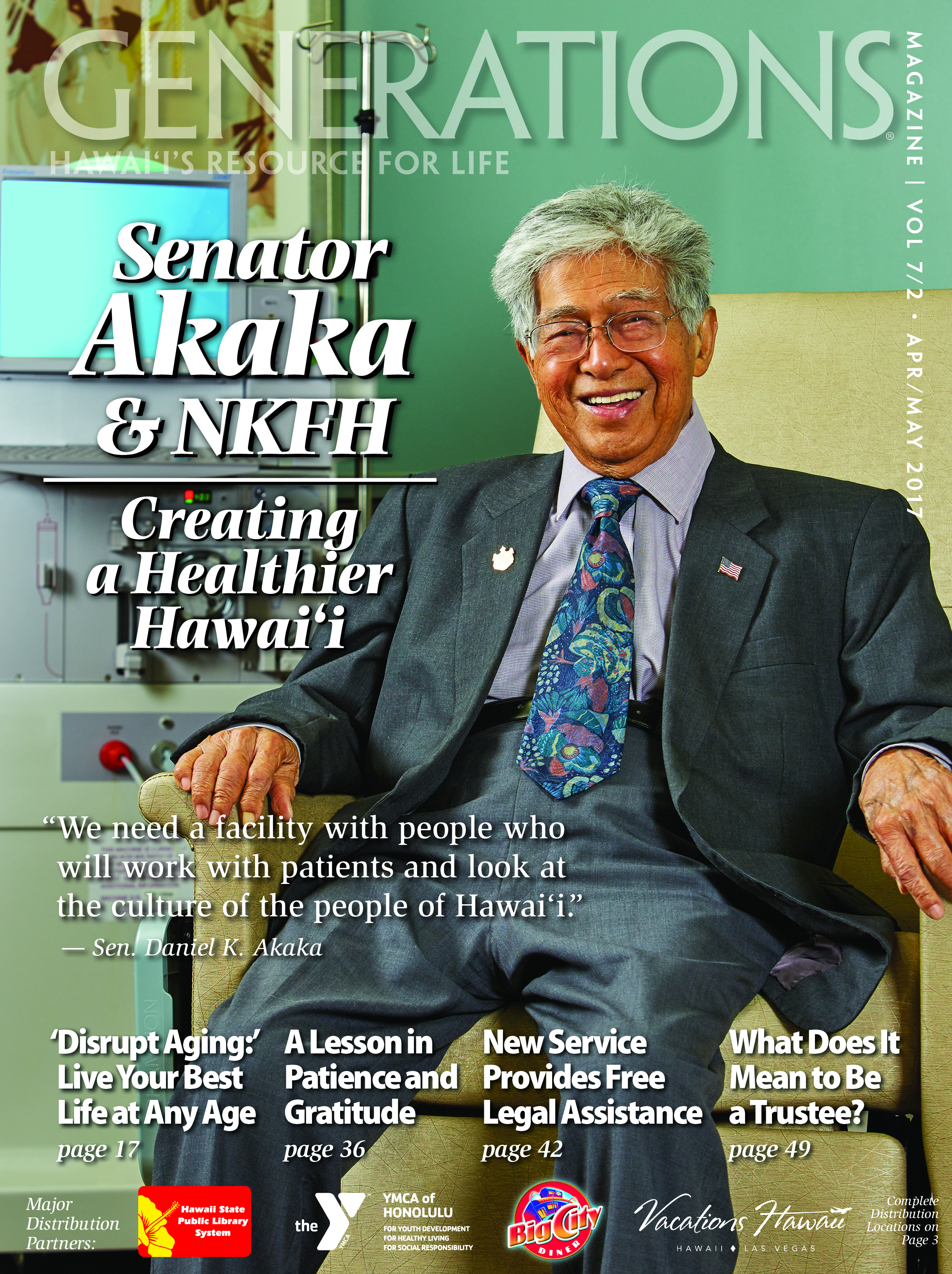
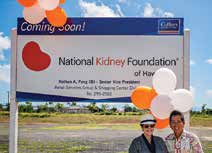
The National Kidney Foundation of Hawaii (NKFH) is aiming high with a new clinical community resource center. It broke ground in July and Sen. Daniel Kahikina Akaka wants all of us to support the last bit of fundraising. The new center in Kapolei will house many clinical community programs to help people at risk of chronic kidney disease get early screening and teach them how to stay healthy.
At 92, Sen. Akaka is still working to help the people of Hawai‘i. His warm, sunny smile continues to encourages us to celebrate goodness with gratitude for all we have. He retired several years ago, but while in Washington, he learned how many persons in Hawai‘i suffer from chronic kidney disease (CKD). Since he came home, he has been helping NKFH tackle this disease.
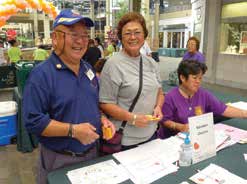
“I was astounded that kidney disease was such a big problem for us,” Sen. Akaka said. “Hawai‘i has 30 percent more kidney disease than other states; Native Hawaiian, Pacific Islanders, Filipino and Japanese communities are most affected — a major segment of our community. When I retired from public service, I made the Kidney Foundation of Hawaii the focus of my continuing community work. The need is so great and NKFH has many successful programs that help people stay healthy. If we can help get the word out, they can help more people at risk for kidney disease.” One person can’t solve such a big problem alone, so Sen. Akaka is asking all of us to learn more about CKD. We can help involve our families and mo‘opuna in healthy habits that protect our kidneys. We can encourage them to get screened for early signs of diabetes and high blood pressure — the two disorders that often lead to CKD. Currently, NKFH offers free educational materials, health programs and community screening events at various locations throughout the state every year.
Chronic Kidney Disease
The chronic or long-term decline of kidney function may start after a urinary tract infection or occur as a result of other disorders. Because kidney disease often starts “silently,” persons losing kidney function will not notice any symptoms until it is too late to save their kidneys.
The best way to know if your kidneys are healthy is to undergo simple urine and blood tests. Patients who already have mild chronic kidney disease may be able to slow the progress by testing their “numbers” regularly and adopting lifestyle habits that are healthy for their kidneys.
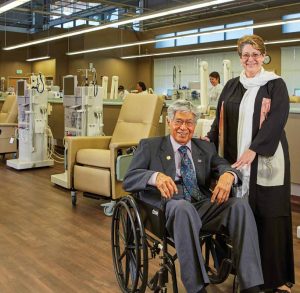
We met up with Sen. Akaka and NKFH Senior Director Diana Benningfield at the U.S. Renal Dialysis facility in Kapolei, which provides dialysis services for people whose kidneys no longer function. Here’s what we learned: Most dialysis patients have had diabetes or high blood pressure for some time. Eventually, these disorders damage the tiny filters inside the kidney called glomerular units that transfer waste products and toxins from the bloodstream to the urine. Eventually, the kidneys stop funtioning, causing toxins and am monia buildup in the blood and patients develop the symptoms of end-stage kidney disease.
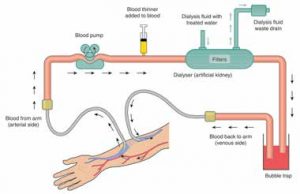
Without treatment, persons in kidney failure will die. Dialysis machines can keep patients alive, but the treatments may be very challenging for patients and their families. Dialysis machines pump a patient’s blood over membrane filters to remove waste products and ammonia, and return clean, filtered blood back into the patient. Each treatment may take several hours and may have to be repeated up to three times a week. A dialysis treatment schedule requires a lot of energy, and between treatments patients have to watch what they eat and how much fluid they drink.
Another option for patients with kidney failure is organ transplant. However, not all patients are candidates for a kidney transplant, and those who do qualify must join a waiting list until a healthy kidney donor with a good immunological “match” may be located. in Hawai‘i, patients may not have dialysis units nearby their homes and may have to face a long waiting list to receive dialysis treatment.
Sen. Akaka Community Center Promotes CKD Prevention
“Finding a cure for diabetes or high blood pressure goes on,” said Sen. Akaka, “but until then, we need to prevent diseases, not just find cures.”
To this end, the senator is raising funds to build the Daniel K. Akaka Community and Kidney Clinical Resource Center that will also house a new array of NKFH programs and services at Kapolei. The center will invite the community to a place where they can participate in health and wellness programs that support the prevention of chronic kidney disease.
Creating awareness for regular screening has been a major outreach project for NKFH for many years. The goal of the foundation’s publicity and innovative clinical programs is to screen as many adults and keiki as possible in order to detect kidney disease before dialysis is required. With early detection and health skills management, patients can work with their doctors and NKFH to control and slow the progression of CKD. Screening and education allow many people with kidney disease to maintain a robust quality of life and avoid going on dialysis.
The new clinical community resource center will also offer the public and patients with CKD a hub where all may learn and master new habits that will keep their kidneys healthy—such as cooking classes. Families can come to the center for screening tests, attend health classes, participate in healthy exercise and learn how to manage life with CKD. Nonprofits will be invited to the center to use its meeting rooms for gatherings and special activities.
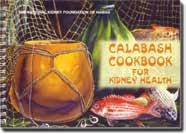
“Aside from the teaching kitchen, where people learn how to cook healthy meals, we also plan to have a commercial kitchen for creating new healthy food products,” said Glen Hayashida, president and CEO of NKFH. “When people ask us, ‘What can I eat now?’ we want to provide useful resources. Our cookbooks are popular and great for homemakers, but many new patients don’t know how to cook. We want the center to be a vital health resource.”

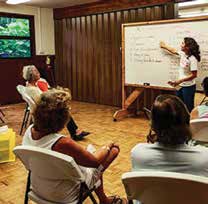 Everyone should seek education about kidney disease, regardless of gender or age.
Health Maintenance Skills Are a Necessity
Sen. Akaka supports the NKFH’s programs because he knows that a healthy lifestyle has positive benefits for ku¯ puna.
“The body needs exercise,” he said. These days, he goes to the gym every day, usually using the weight machines. Although he uses a cane to assist in walking, gym equipment allows him to exercise his upper body, lower body and core muscles.
With the help of his family, he began choosing healthier foods about 15 years ago, when he was 77. His wife, Millie, and daughter, Millanne Akaka Matson, started buying foods without preservatives. They said it used to be difficult to eat out because they could not be sure menu items were appropriate or healthy. Most of their food had to be homemade. But now, more restaurants offer healthy choices.
Earlier this year, the senator started a no-salt diet to reduce water retention.
Other health maintenance programs slated for the new center will be diabetes training classes, high blood pressure classes and fun, outcomebased physical fitness programs.
Right Kind of Learning for Hawai‘i’s People
“We need a facility with people who will work with patients and look at the culture of the people of Hawai‘i,” says Sen. Akaka. “There are many ways to deliver information and care. People receive guidance in different ways based on their upbringing and beliefs.”
Pukui, Haurtig and Lee researched the powerful connection between cultural traditions in Hawai‘i and how patients relate to healthcare in Na¯na¯ I ke Kumu: Look to the Source. The book is the basis for Sen. Akaka’s comment. He understands that resource center professionals must provide services to the community with cultural sensitivity and in a way that is acceptible to patients and their families. Getting individuals to accept their disease, comply with treatment and modify their lifestyles to achieve better health requires a comfortable “conversation.” Talk story takes time. We live in a land where the sitting down for a chat requires getting to know each other sharing a snack and telling stories of our past. The community center can draw people in and create an environment that encourages the way we learn in Hawai‘i.
A Little More Fundraising for the Clinical Community Resource Center

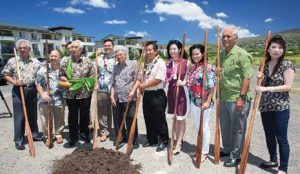
In July 2016, community leaders ceremonially broke ground for the new NKFH headquarters, a prime location to serve more than 40,000 West O‘ahu residents suffering from kidney disease. The ground floor of the $12 million, three-story building will house the Senator Daniel K. Akaka Community and Kidney Clinical Resource Center, including a library of his papers and books. The upper floors will have room for NKFH’s clinical and educational programs and services. Any additional space will be available for lease.
“I look forward to this kidney wellness center minimizing the impact of CKD for people who now suffer from the disease. It will be the source that eliminates the disease for future genertions,” said Sen. Akaka. “We have raised three-quarters of the funds already. Our grand opening is slated for January 2018.” Humble as ever, he said that he’s just playing a small role: It’s coming together because so many hardworking people are attached to it. “I’m just here to help,” he said.
“You can help, too, in a number of ways,” he said. “Just visit our website at www.kidneyhi. org to see how you can get involved — we always appreciate your kind support and kokua.”
Human and Financial Costs of CKD
The statistics for CKD in Hawai‘i are a big concern for our state. More than 168,000 people are already diagnosed with CKD and another 100,000 are at risk for kidney disease because they have diabetes or high blood pressure.
Of the 450 patients on the organ transplant waiting list, over 90 percent are waiting for kidneys. Most will die before they have the opportunity to get into a dialysis treatment program or to receive a kidney transplant operation. End-stage kidney failure is heartbreaking and reinforces the need for prevention and health maintenance.
For Sen. Akaka, funding the very high healthcare costs of dialysis and kidney transplants is a big concern for our state. NKFH programs are the best option for reducing the costs of CKD in Hawai‘i.
Sen. Akaka remembers his third-grade teacher at Pauoa Elementary engaging her students in mathematics with a piggy bank. She used it for several lessons, “teaching us math by counting the money,” he said. Then the teacher asked them to write down what they would buy with the money. “That was our composition lesson,” he said. For young Daniel, the practical application of mathematics to accounting would serve him well in life.
Many years later, he applied the piggy bank lessons to his work in Congress. While serving on the Senate Committee on Banking, he developed the consumer advocacy portion of the Dodd-Frank Wall Street Reform and Consumer Protection Act. The legislation was created in response to the financial crisis of 2008 and ensuing Great Recession. It brought new regulations and consumer protection initiatives to the financial industry.
A Matter of Hawaiian Values
Sen. Akaka frames his work with NKFH in terms of Hawaiian cultural values, which some call “plantation values.” He grew up farming taro on kuleana land in Pauoa Valley, the youngest of eight children. Working the land in a side valley up Nu‘uanu and managing the chores of a large family encouraged cooperation, shared responsibility, reciprocity and peacekeeping. “I was the niele (questioning) one,” he said, “I always wanted to know things.” Akaka, a Chinese name, came from his father, Kahikina Akaka, who was hapa Hawaiian and Chinese. His mother, Annie, was fullblooded Hawaiian.
“Spirituality and faith carried our family,” he said. The Akaka family way of life was daily prayer, with daily morning and evening devotions and Sunday services at Kawaiaha‘o Church. Righteousness was expected. Doing things “pono”— justly, with integrity and for the common good — was Daniel’s way of honoring the deeply held values that his parents taught him.
After attending Kamehameha Schools, he joined the Army Corps of Engineers during World War II from 1943 to 1947, first training at Schofield Barracks and then serving in the Central Pacific at Eniwetok in the Marshall Islands, and Guam and Saipan in the Marianas. After the war, he graduated from UH Ma¯noa to become a high school social studies and music teacher. He went into school administration and became the chief program planner for the state.
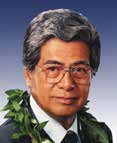
After winning his first congressional election in 1976, Daniel K. Akaka served 13 years as a U.S. Representative and then another 19 as a U.S. Senator. He always lived by the rule of “pono” righteousness, saying, “the just things [you accomplish] will remain constant through the times.” He is most famous for the Akaka Bill, which would have established a process for federal recognition of Native Hawaiians. Although the bill never passed, his vision is still part of every discussion and action that furthers self-governance for Native Hawaiians.
Another cultural principle that guides all his work is aloha. “I think the mission for Hawai‘i is to help the world know aloha,” he said. “If the world could live and have relationships like the people of Hawai‘i, the world would be a much better place.”
The Future Looks Bright
This community center approach to prevention has strong support. There is a good probability that community access to lifestyle training and support will help a large number of patients and their families at risk for CKD. Hawai‘i’s people will have a better opportunity to maintain their health and slow the onset and progression of the disease.
Every day is a new day of progress, education and hope for families struggling with CKD. Let’s help Sen. Akaka and NKFH find a cure, and also support our families and neighbors until the time when a cure is found.

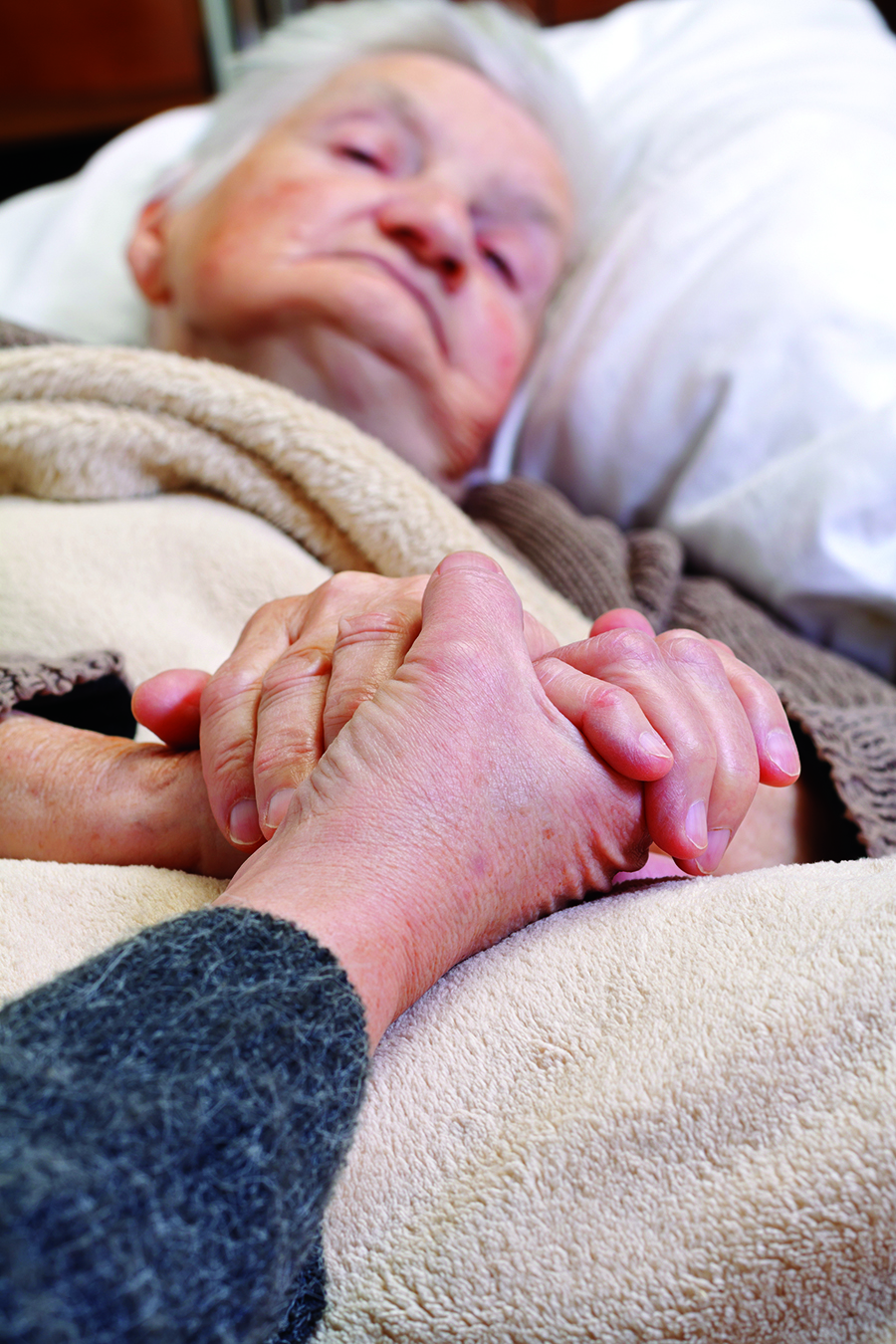 Ten thousand people die each year in Hawai‘i. For some terminally ill, the medical care they receive is insufficient to ease their pain, loss of autonomy or feelings of indignity as they begin the dying process.
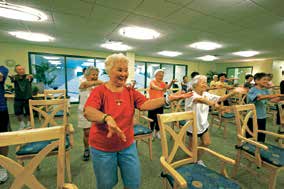 Balance. It’s something everyone takes for granted without a second thought about how crucial it is to daily living. However, it’s wise not to underestimate the importance of having good balance, especially in our senior years.
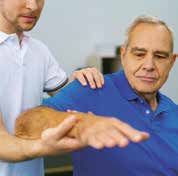 Aches and pains, having to avoid certain things, imbalance — people often have the misconception that these problems are a natural part of aging. There are physiological changes that naturally occur with aging, but these should only be contributing factors rather than the determining factor. The key factor is that the human body is highly adaptable. The unfortunate aspect is that this applies to both the bad as well as the good.
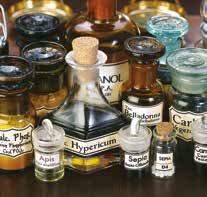 Homeopathy works on the bioenergetic level. Working through the body’s energy system and bearing some similarities to acupuncture, homeopathic medicine may deliver messages almost instantly through the body’s nerve pathways. Homeopathic medicines relieve everything from allergies to arthritis pain to flu symptoms.
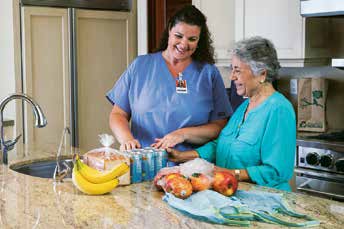 The in-home care business is one of the fastest and largest growing industries nationwide, and the demand for services will continue to grow into the foreseeable future. In fact, over the next 15 years, the entire baby boomer generation will pass the age of 65; consequently, when that occurs, there will be nearly 84 million seniors living in America—nearly onefifth of our national population.
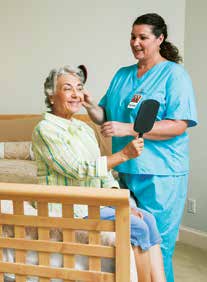 The success of the increased growth of in-home care services brings its own set of challenges, such as the recent shortage of nurses, physicians, support staff and other practitioners.
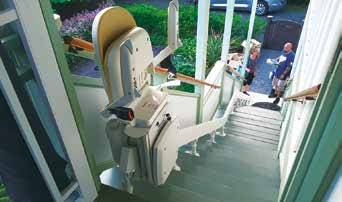 Do you know someone who has fallen and experienced detrimental effects on their physical health, confidence and emotional state? A “stairlift” is a viable solution for those who want to stay in their homes and it provides peace of mind for the family.
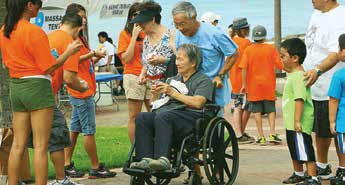 Every year, 60,000 Americans are diagnosed with Parkinson’s disease (PD). Of those, many will rely on their families for support.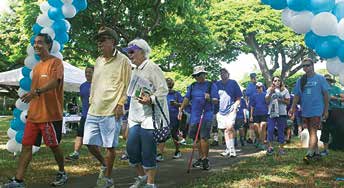
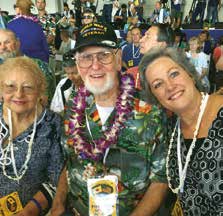 I’ve been a volunteer caregiver for about 25 years now and know well that it is undoubtedly the most difficult and underappreciated job on the planet. However, in caring for my own father, I found that it is also a privilege and a sacred trust, sharing the most meaningful moments of your loved one’s life. But amid the cleaning, meal planning and cooking, and arranging medications and doctor visits, exhaustion can consume you, making time pass by without you being able to fully appreciate precious final years — possibly even days.
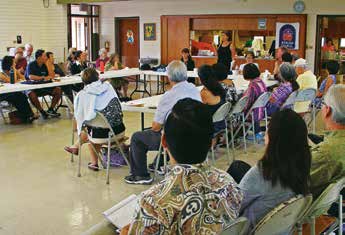 Kokua Council, one of the oldest senior citizen advocacy groups in Hawai‘i, plays an important role in a complex web of community organizations. Kokua’s main focus is on the informational, advocacy and educational needs of seniors.