Category: Articles

  • Parting With Treasured Belongings

    Photo of junkHave you heard these questions before: “How do I get my Mom to let go of her things?”, “Why does my Dad not want to get rid of his junk?” and “I’m not making much progress with them, what am I doing wrong?” Most times the answer isn’t black and white, as it really depends on the emotional attachment a person has to those items. Every item has a memory or a story that tugs at their heart, and for those reasons, they can’t get rid of them.

    So how do you help family members let go of what they treasure when the need arises to downsize to a smaller home or simply de-clutter the one they are living in now? One way is to ask neutral questions like:

    “When was the last time you used it?”

    “How often do you use those items?”

    “When will you use it again?”

    Another way is to bring in professionals. They will ask those same questions of clients as they work through years of personal belongings. They understand that people have a hard time letting go, but they also have an unbiased opinion about the actual value, rather than the perceived value, of those treasures.


    SENIOR MOVE MANAGERS / DE-CLUTTER HAWAII

    808-221-8345 cynthia@smmhawaii.com
    www.smmhawaii.com

    Have you heard these questions before: “How do I get my Mom to let go of her things?”, “Why does my Dad not want to get rid of his junk?” and “I’m not making much progress with them, what am I doing wrong?” Most times the answer isn’t black and white, as it really depends…

  • Disability Benefits Q&A

    Social Security LogoQ

    I’m applying for disability benefits. Do I automatically receive Medicare benefits if I’m approved for disability benefits?

    A

    You will receive Medicare after you receive disability benefits for 24 months. When you become eligible for disability benefits, we will automatically enroll you in Medicare. We start counting the 24 months from the month you were entitled to receive disability, not the month when you received your first payment. Special rules apply to people with permanent kidney failure and those with “Lou Gehrig’s Disease” (amyotrophic lateral sclerosis). Learn more about Social Security disability benefits by reading our publication at www.socialsecurity.gov/pubs/10029.html.

    Q

    I have been getting Social Security disability benefits for many years. I’m about to hit my full retirement age. What will happen to my disability benefits?

    A

    When you reach “full retirement age” we will switch you from disability to retirement benefits. But you won’t even notice the change because your benefit amount will stay the same. It’s just that when you reach retirement age, we consider you to be a “retiree” and not a disability beneficiary. To learn more, visit our website at www.socialsecurity.gov/disability


    For questions, online applications or to make an appointment to visit a SSA office, call from 7am–5pm, Mon–Fri:

    1-800-772-1213 (toll free)  |  www.socialsecurity.gov
    I’m applying for disability benefits. Do I automatically receive Medicare benefits if I’m approved for disability benefits?

  • Respiratory Care: Breathing Exercises

    In the last issue we discussed how people diagnosed with chronic respiratory failure and chronic obstructive pulmonary disease (COPD) are at higher risk for infection. This issue, we focus on ways to ease their breathing problems.

    Struggling to breathe forces the body to start using neck, stomach, back and chest muscles. They hurt as badly as after a fully body workout!

    Two exercises on the American Lung Association’s website help strengthen lungs:

    Pursed Lip Breathing

    This exercise reduces the number of breaths you take and keeps your airways open longer. More air is able to flow in and out of your lungs, so you can be more physically active. To practice it, simply breathe in through your nose and breathe out at least twice as long through your mouth, with pursed lips.1

    Belly Breathing, aka Diaphragmic Breathing

    As with pursed lip breathing, start by breathing in through your nose. Pay attention to how your belly fills up with air. You can put your hands lightly on your stomach, or place a tissue box on it, so you can be aware of your belly rising and falling. Breathe out through your mouth at least two to three times as long as your inhale. Be sure to relax your neck and shoulders as you retrain your diaphragm to take on the work of helping to fill and empty your lungs.1  


    CARE CENTER OF HONOLULU
    1900 Bachelot Street, Honolulu HI 96817

    808-531-5302  |  www.ccoh.us

    1
    American Lung Association Breathing Exercises:
    www.bit.ly/ALA_BreathingExercises

    In the last issue we discussed how people diagnosed with chronic respiratory failure and chronic obstructive pulmonary disease (COPD) are at higher risk for infection. This issue, we focus on ways to ease their breathing problems.

  • Family Caregivers’ R & R

    It’s a mistake for family caregivers to forget about their own well-being while caring for their loved ones. Many feel guilty for taking time off for a spa day or a staycation. I encourage them to accept it’s perfectly OK to get away and return reinvigorated and refreshed.

    I also endorse going on escapades, like Neighbor Island trips or to faraway places, via tour groups, private treks or whatever suits your preferences.

    One of the biggest regrets Baby Boomers have is an unfulfilled bucket list because they had other obligations. Maybe it’s time to ask for support from family members to care for loved ones while you fulfill some of those dreams.

    The key to a fun getaway is planning. For more than a decade, my husband and I have regularly crisscrossed the world with six couples we have known for over 50 years. The friend who plans out and leads our five-star dream itineraries researches ideas on the internet and in YouTube videos, and he negotiates with local vendors, hoteliers and tour guides to keep costs down.

    Make your motto: Live and die without regrets — and take time off, before it’s too late.

    World Class Vineyards in Bourgogne, France.  Kneeling: Annette Pang and Kathleen Ching, Middle: Ronald & Penny Mau, Russell Ching, Wendell Pang, Steve & Tina Chung, Cynthia & Guy Seu, Back: Loretta & Tyler Yajima
    World Class Vineyards in Bourgogne, France.  Kneeling: Annette Pang and Kathleen Ching, Middle: Ronald & Penny Mau, Russell Ching, Wendell Pang, Steve & Tina Chung, Cynthia & Guy Seu, Back: Loretta & Tyler Yajima

    BABY BOOMER TRAVEL TIPS
    www.annettepang.com

    It’s a mistake for family caregivers to forget about their own well-being while caring for their loved ones. Many feel guilty for taking time off for a spa day or a staycation. I encourage them to accept it’s perfectly OK to get away and return reinvigorated and refreshed.

  • Is Assisted Living a Negative?

    Despite the great advancements in retirement community resident care in recent years — some through government involvement, but most through business owners seeking to create a better quality of life for seniors — one of the challenges faced when discussing senior living options is the negative stigma that immediately comes to mind about “assisted living.”

    This stigma is primarily due to confusion about the different senior care options available. Many people think that seniors will lose their independence in an assisted living environment or not receive adequate care.

    Pat and Rodney photo
    Pat and Rodney

    Mike Wong experienced this personally last year when his father, Rodney, faced medical issues requiring placement in a skilled nursing facility, where 24-hour nursing care would be available. Mike faced a dilemma, as the primary caregiver for both Rodney and his wife, Pat, was Rodney. Should his father be placed in a skilled nursing facility or could his parents move together to an assisted living community that also offered 24-hour care?

    Mike explains, “It was important to all of us that my parents’ lifestyles would not be negatively impacted. The decision was challenging, and we had difficult conversations as a family as we negotiated our transition. Both are now happy and have found their groove in the community. I am overjoyed that my parents are happy. I see them thriving!”


    REGENCY HUALALAI
    A Regency Pacific Retirement Community

    75-181 Hualalai Road, Kailua-Kona HI 96740
    808-329-7878  |  www.regency-pacific.com

    Despite the great advancements in retirement community resident care in recent years — some through government involvement, but most through business owners seeking to create a better quality of life for seniors — one of the challenges faced when discussing senior living options is the negative stigma that immediately comes to mind about “assisted living.”

  • Seniors and Technology

    Technology is ever-advancing these days with information on new devices everywhere. For early adopters this is seen as helpful and even normal. However, for some seniors, adapting to new devices can be challenging due to physical limitations. Vision loss is one of the more common problems experienced, as is Age Related Macular Degeneration (AMD) that typically affects older adults.

    Millions of Americans every year are affected by AMD, which destroys central vision leaving only the peripheral vision. Those affected may be unable to see the faces of their family members, drive a car, or read a newspaper. Using a mobile device can have the same results. Nearly 1 in every 3 adults over the age of 75 is currently affected with AMD. According to Dr. Chris Knobbe, clinical associate professor emeritus at the University of Texas Southwestern Medical Center, “AMD is an epidemic — world-wide. Globally, 1 in every 11 persons over the age of 50 has some degree of AMD.”

    The good news is technology is improving for those with vision loss like AMD. Currently there are many tools which can help individuals to read their devices, from simple magnifiers and brighter reading lights, to more sophisticated screen readers and applications. The accommodation of selecting larger fonts and web page sizes has also been available across media to make information more legible. These visual aids have helped those with vision impairments to maximize their usable vision and make better use of devices and technology. The use of voice command devices has also become more mainstream and should be considered for those with vision impairments. Amazon has ECHO, a home voice command device, Samsung has a smart TV which listens to voice commands, and Sony has their smart watch with voice commands.

    Bridging these gaps between seniors and technology can also be a challenge for caregivers sometimes, given the limitations that vision loss can have on using devices. But once these hurdles are cleared, research shows that adults older than 65 using smartphones or other electronic devices are more likely to become daily internet users. While some seniors may be reluctant to adopt technology due to their limitations, caregivers can help by doing a few simple things:

    • Avoid complex devices with distracting features.
    • Use technology that accommodates physical limitations.
    • Choose devices relevant to user needs and values.
    • Encourage technology that is socially rewarding.
    • Be their technical support.

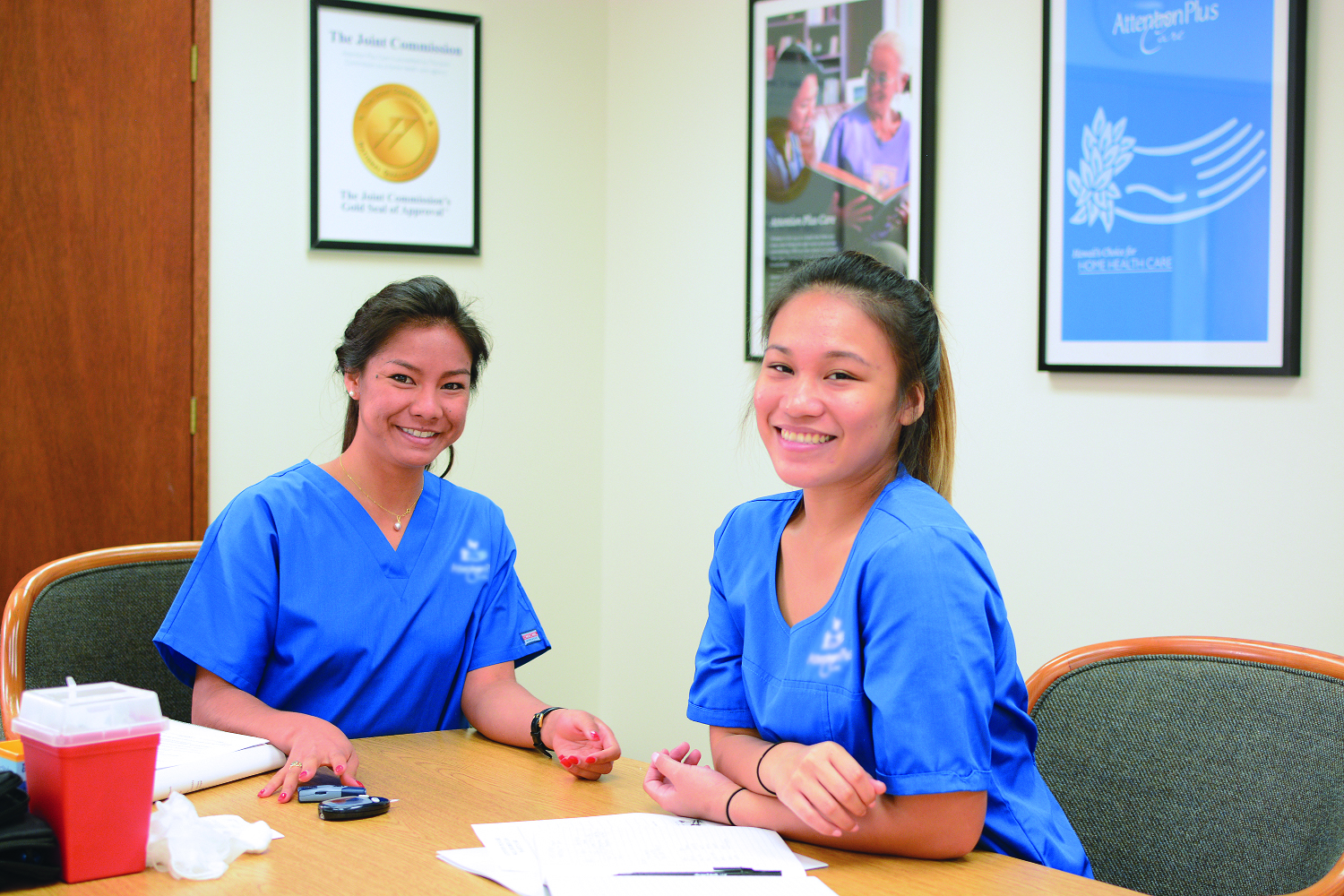
    Once on the internet, seniors using devices with social media apps, such as Facebook, Instagram, and Twitter, are more in touch and engaged with others. Forrester Research also showed in their report, “Digital Seniors”, that 60 percent of all U.S. seniors (those 65 and older) are online and, of those, roughly half are also using Facebook. “Many people have the misunderstanding that seniors are averse to technology. I don’t find that true at all,” said registered nurse, Kari Wheeling. “It’s the simpler things like Arthur-itis, or forgetting their glasses on their head, that gets in the way.”


    ATTENTION PLUS CARE HOME HEALTH CARE
    Accredited by The Joint Commission

    1580 Makaloa St., Ste. #1060, Honolulu HI 96814
    808-739-2811 | www.attentionplus.com

    AGING IN HAWAII EDUCATIONAL OUTREACH PROGRAM by Attention Plus Care — a program providing resources for seniors and their families, covering different aging topics each month. For class information and upcoming topics, call 808-440-9356.

    Technology is ever-advancing these days with information on new devices everywhere. For early adopters this is seen as helpful and even normal. However, for some seniors, adapting to new devices can be challenging due to physical limitations. Vision loss is one of the more common problems experienced, as is Age Related Macular Degeneration (AMD) that…

  • Skip Costly Equipment: Use the Mighty Can

    Not everyone has spare cash to spend on expensive physical therapy equipment to use at home, so why not learn how to utilize household items to get the same results? Specialized equipment, although beneficial if used correctly, is not necessary to live a life without pain. Creativity can often duplicate or at least mimic the results of expensive therapy equipment.

    For example, proper squatting while holding onto the kitchen sink or a door frame is more effective than almost all exercise equipment. Similarly, rather than dumbbells or machines, cans or exercise bands are excellent replacements. Not only does the right exercise determine the level of benefit, but the technique of each exercise is equally important to achieve immediate alleviation.

    Just like with car maintenance, the body will not work correctly if not kept healthy. Even if only one cog is out of place it causes a chain reaction of inefficiency and problems. That is because, with any injury, the body will naturally compensate, causing unconscious bad habits that result in aches and pains that do not go away. Any bad habit will take hard work to fix, so that’s why motivation is the key to physical therapy. A little bit of hard work is well worth it to prevent suffering.

    Since nothing needs to be purchased for successful physical therapy, the universal factor among successful individuals is the motivation to put in hard work.


    PRIME PHYSICAL THERAPY
    600 Queen St. C-2, Honolulu HI 96813
    808-286-0194 | www.primepthawaii.com

    Not everyone has spare cash to spend on expensive physical therapy equipment to use at home, so why not learn how to utilize household items to get the same results?

  • Stepping Down Pain Free

    Knee pain while descending stairs is often due to the force on your kneecap (patella), which studies show is 3.5 X your body weight. If you weigh 140lbs, the force on your patella can be as much as 490lbs! That is a lot of stress on your knee, and the pain will be magnified if you have weak muscles or degeneration of the cartilage in the joint.

    Strengthening the hip and knee, specifically the larger gluteal and quadricep muscles, will help absorb the force that travels through the knee. Stretching tight muscles at the side and back of the thigh, as well as the calf, can help prevent tracking problems of the patella.

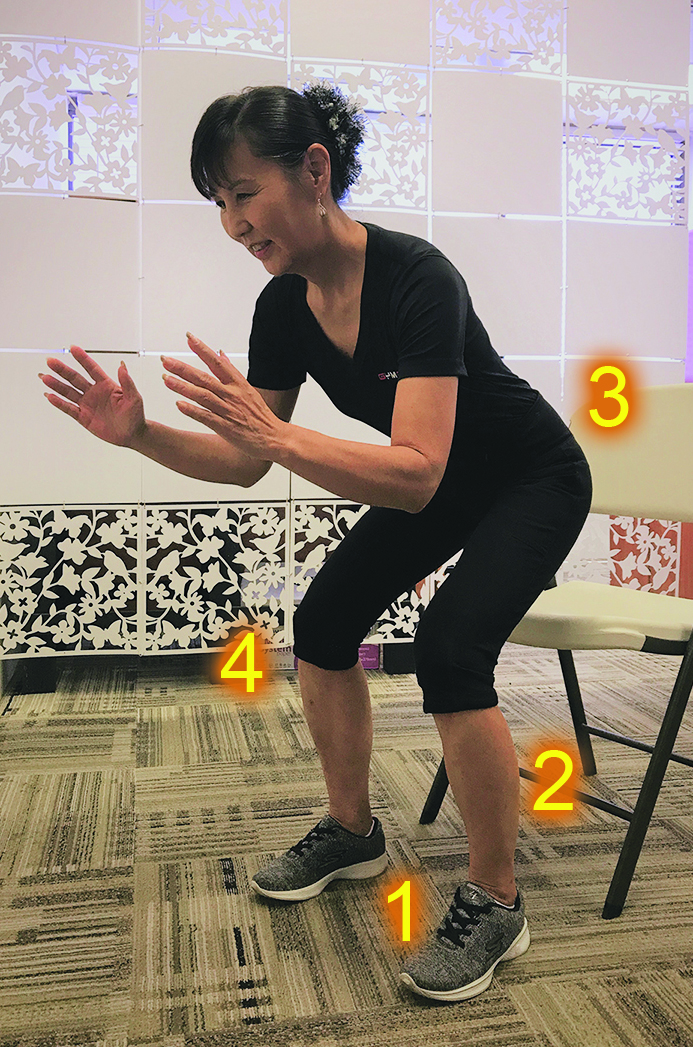
    This exercise will help reduce pain when going down stairs, as it uses the proper mechanics to build the correct muscles. Begin by standing tall on a step or platform sideways, holding onto a stable object.

    1. Slowly lower one leg over the outer edge and squat down, touching your toe to the ground.
    2. Keep upright, knee aligned over your first and second toe.
    3. Sit your bottom back when squatting, with more weight on the heel of the bent leg. Return to standing tall.

    Moon Physical Therapy, LLC
    320 Ward Ave., Ste. 107, Honolulu HI 96814

    Aquatic, Land-based and Manual Therapy and
    Cardiopulmonary Rehab Programs

    808-597-1005 | www.moonpt.com
    Like me on Facebook: Moon Physical Therapy, LLC

    Knee pain while descending stairs is often due to the force on your kneecap (patella), which studies show is 3.5 X your body weight. If you weigh 140lbs, the force on your patella can be as much as 490lbs! That is a lot of stress on your knee, and the pain will be magnified if…

  • New Guidelines for High Blood Pressure

    Let us start with this little fact: almost half of all adults in the United States are affected by hypertension. Recently published revised guidelines for the detection of high blood pressure mean that 46 percent of all Americans 18 years and older are now considered to have hypertension (otherwise known as high blood pressure). This is a staggering statistic, equating to about 103 million adults in the United States.

    What are the new guidelines?

    The new guidelines from the American College of Cardiology and the American Heart Association define hypertension as blood pressure readings greater than or equal to 130/80. Prior to this change, the standard definition of hypertension was anything equal to or greater than 140/90. With these new, stricter guidelines millions more adults are now considered hypertensive.

    What is hypertension?

    Imagine your heart as a pump. The heart pumps blood to the rest of the body through pipes called arteries, which — like rubber tubes — can expand and contract. The pressure of blood filling the arteries is what we measure and call blood pressure. If the force of this pressure in the pipes or arteries is too high, that is what we call hypertension or high blood pressure. With the new guidelines, anything equal to or greater than 130/80 is now considered hypertension.

    In a perfect world, the top number should be less than 120. This is called the systolic pressure and it is the pressure measured when the blood is filling the artery and it expands. The bottom number is called the diastolic pressure and, optimally, this number should be less than 80. It is the pressure of the artery when the heart is at rest — in other words, when the heart is not pumping blood.

    Why are these numbers important?

    Your doctor and healthcare providers measure these numbers regularly because hypertension is known as the “silent killer.” Unlike when you have a visible injury, cold or cut, you may not realize anything is wrong unless you get checked regularly by your primary care provider. As the blood pressure in your body increases and stays elevated over time, your risk for complications such as a stroke or heart attack increase significantly.

    If you want to avoid any complications from this chronic epidemic, please talk with your healthcare provider and see him or her regularly to help prevent, manage and treat hypertension.


    HOUSE CALL MEDICAL PRACTICE LLC

    808-726-5062 | Housecallmed@gmail.com
    www.housecallmedhawaii.com

    Let us start with this little fact: almost half of all adults in the United States are affected by hypertension. Recently published revised guidelines for the detection of high blood pressure mean that 46 percent of all Americans 18 years and older are now considered to have hypertension (otherwise known as high blood pressure).

  • Biking for Seniors

    As we age, exercise becomes more and more important — not only for our bodies, but for our minds as well. But fitness doesn’t always have to happen from inside the local gym. You can get on a path to a fit and healthy lifestyle by incorporating cycling into your daily routine. Instead of driving the short distance to the store or park, try biking there instead! This can sometimes be quicker and more convenient for you — and certainly better for your body, your wallet, and the planet.

    It’s important to start small, but for most people getting back on the bicycle is really just like riding a bike — you never forget! Bicycling reminds us of the freedom of our childhood, where we could expand and explore our world all from two wheels. Bicycles can be used for the same thing in our older years! Look for a bicycle with a step-through frame and upright seating position for comfort and stability. And don’t forget your helmet! Start on multi-use bike paths, which are physically separated from motorized traffic, or quiet residential roads. Consider joining up with a group of friends to ride or meet new friends at an organized group ride in your area!

    If you haven’t been on the saddle for years (or decades), or never learned how to ride a bicycle, the Hawaii Bicycling League (HBL) offers free Adult Learn to Ride workshops that can get you rolling safely, at any age (bikes, helmets, and friendly instructors all are provided)!

    HBL is a local non-profit founded in 1975, with the mission to enable more people to ride bicycles for health, recreation, and transportation, through advocacy, education, and events.

    If a two-wheeled ride isn’t your cup of tea, check out HBL’s Senior Cycling Program! Kupuna 50 years of age (and up) get to rediscover their youth with HBL’s recumbent tricycles on Oahu’s car-free bike paths. The adult three-wheelers are great for those that have poor balance or bad joints, or those that don’t know how to bike. Senior Rides are scheduled five times a month at the Pearl Harbor Bike Path and Magic Island multi-use paths and are for all levels of riders. Recumbent trikes, along with all the bells and whistles, are provided free of charge through this fun program designed to get you outdoors and healthy!

    However you decide to get your roll on, the Hawaii Bicycling League has you covered. Whether you are an adult looking to learn how to ride a bike for the first time or are someone ready to regain comfort and confidence with cycling on the roads of Hawai‘i, HBL will get you there.


    HAWAII BICYCLING LEAGUE
    3442 Waialae Ave., Suite 1, Honolulu HI 96816

    808-735-5756 bicycle@hbl.org www.hbl.org

    As we age, exercise becomes more and more important — not only for our bodies, but for our minds as well. But fitness doesn’t always have to happen from inside the local gym. You can get on a path to a fit and healthy lifestyle by incorporating cycling into your daily routine.

  • Yoga Just for Kūpuna

    At the YMCA of Honolulu, our programs and services are tailored to meet all ages, abilities and goals — and so are our yoga classes! All health and fitness facility Y Branches offer a range of yoga classes for kūpuna, from ones that will bring on a light sweat to others that will give you a soothing stretch while seated on a chair.

    As a sanctuary for those getting stronger and doing their best to keep healthy, we at the YMCA encourage our seniors to explore yoga, as it:

    • Strengthens bones and protects joints
    • Builds balance and flexibility
    • Sharpens the mind and improves mood
    • Minimizes hypertension
    • Improves the respiratory system
    • Encourages calm and mindfulness

    When practiced with our experienced yoga instructors on a regular basis, you can be sure you’ll enjoy many of these benefits!

    Feeling unsure about trying it out? We understand. Here are a few tips that will help you enjoy your first senior yoga class at the Y!

    • Talk to our yoga instructor before class. Let them know if it’s your first time (or your first few times) and what conditions you may be challenged with that could make you feel dizzy or cause pain. Ask them any questions you may have about the class.
    • Talk to your fellow students. We have a large kūpuna population who enjoy working out at each of our Y’s and who love yoga! Most of these members regularly attend their classes and are eager to meet and help you! You can also ask them how yoga has helped them in their lives — to encourage you to keep coming!
    • Use a wall, use the props. When you go to a yoga class, there will be yoga props available, such as blocks, straps, and pads for your knees. Use everything you can to feel comfortable and make the class manageable — especially during your first few times. For standing and balancing poses, use a wall to prop yourself up to ensure you feel stable while trying the poses out.

    YMCA of Honolulu

    www.ymcahonolulu.org/

    Contact your closest Y Branch for membership, discount opportunities and other activity schedules and information.


    SENIOR YOGA CLASSES

    Kaimuki-Waialae: 808-737-5544

    Hatha Yoga                             M / 2:15 pm
    Senior Stretch Yoga                W / 10:30 am

    Kalihi: 808-848-2494

    Gentle Yoga                            M, W, F / 12:10 pm
    Tu, Th / 10:15am
    Yin/Yang Yoga                        Tu, Th / 4:30 pm
    with Back Care

    Leeward: 808-671-6495

    Gentle Yoga                            M / 8 am
    Stretch & Relax                       Tu, Th / 8 am
    M / 7:30 pm
    Iyengar base Yoga                  W / 8 am

    Mililani: 808-625-1040

    Senior Yoga                             M, W / 7 am
    Hatha Yoga                              W / 9:45 am
    F / 10 am
    Su / 9:05 am
    Chair Yoga                              Tu / 12:15 pm
    F / 11:15 am
    Stretch and Relax                   M, W / 5:30 pm
    Hatha Yoga                             M / 6:45 pm
    Yin Yoga                                  F / 6:45 pm

    Nu‘uanu: 808-536-3556

    Gentle Yoga                            Tu / 10 am
    Hatha Yoga                             Th / 10:05 am

    Windward: 808-261-0808

    Sunrise Stretch                        M, F / 6:30 am
    W / 6:15 am
    Sunrise Yoga                           Tu, Th / 6:30 am
    Gentle Yoga                             M, F / 11:30 am
    Senior Chair Stretch                Tu / 11:45 am
    Basic Yoga                               W / 12:15 pm
    Hatha Yoga                              Sa / 9:15 am

    At the YMCA of Honolulu, our programs and services are tailored to meet all ages, abilities and goals — and so are our yoga classes! All health and fitness facility Y Branches offer a range of yoga classes for kūpuna, from ones that will bring on a light sweat to others that will give you a soothing…

  • Pride, Quality of Life and Independence

    The Americans with Disabilities Act (ADA) is for the physically challenged and disabled community. The elevator industry, with the help of the government and educators in civil law, has been addressing ADA issues over the years. Elevator and lift manufacturers have many solutions to meet and exceed the ADA requirements.

    Today, here in Hawai‘i, there is a continued effort to address the ADA conditions that affect our elderly and disabled community. The work to provide those communities with the freedom to live independently and safely, while making their lives easier, relies on multiple solutions.

    One example of these different kinds of solutions is a residential chair lift. This provides the senior community, and those who are physically challenged, the ability to have the mobility and access to parts of their home they may not have seen in years, or the ability to leave their home safely and with ease. In some instances, a chair lift can also provide an extra pair of helping hands, such as carrying the laundry or even groceries up and down the stairs.

    This provides them with a higher quality of life while maintaining their pride and independence.


    ACCESS LIFTS HAWAII
    1525 Young St., Honolulu HI 96826

    808-955-4387 www.accessliftshawaii.com

    The Americans with Disabilities Act (ADA) is for the physically challenged and disabled community. The elevator industry, with the help of the government and educators in civil law, has been addressing ADA issues over the years. Elevator and lift manufacturers have many solutions to meet and exceed the ADA requirements.