Category: Health

  • Going to the Dentist After COVID-19

    Hopefully, the COVID-19 virus is now under control and life is back to normal. Regardless, one of the lessons we learned through this pandemic is better personal hygiene.

    Dentists were asked to help contain the spread if the virus by limiting their care to only emergency visits. The main concern was patients spreading it to each other while in the office. Just as concerning was the direct exposure of the virus to dentists and their staff — and possible spread to their families.

    Once this crisis is over, it should be very safe to visit your dentist again. Dental offices have high infection control standards. Many place disposable plastic barriers on dental chairs and equipment that are used during treatment and are changed between patients. Surfaces are wiped down with disinfectant solutions. Gloves are changed after each patient and masks are worn during procedures.

    Rest assured that dentists have been and will continue to ensure your safety at their offices.


    DR. PAUL K. TANAKA, DDS
    4747 Kilauea Ave., Ste. 113, Honolulu, HI 96816
    808-737-6229 | office@paultanakadds.com
    www.paultanakadds.com

    Hopefully, the COVID-19 virus is now under control and life is back to normal. Regardless, one of the lessons we learned through this pandemic is better personal hygiene. Dentists were asked to help contain the spread if the virus by limiting their care to only emergency visits. The main concern was patients spreading it to…

  • Mindfulness & Memory

    Mindfulness is something that when practiced throughout the day, can be beneficial but challenging. We often allow our minds to just wander aimlessly, which causes a disconnect.

    To begin to reconnect, inform your brain of your intention. Pay attention to what you feel as you connect to your brain and talk to it as an old friend. This is a form of mindfulness meditation, since you are paying attention inwardly.

    Check throughout the day where your mind is at and what it is doing, and if possible, just focus on being in the here and now. Experience everything you are doing in the moment with your senses and your breath. Make sure your breathing is calm and steady. This awareness activates different areas of your brain, making it healthier and more flexible.

    Mindfulness has a cumulative effect. Do it regularly and often, and you’ll remember exactly why you went into that room.


    BODY & BRAIN ENERGY HEALING CENTER, MĀNOA
    2851 E Manoa Road, Ste. 1-207, Honolulu, HI 96822
    808-691-9642 | www.bnbenergyhealing.com/manoa

    If you have ever forgotten why you walked into a room or you find yourself making small mistakes, you’ve probably chalked it up to an aging brain. Age is only a minor contributor to this condition. The main factor is how you utilize your brain. Learn how to guide your brain instead of following or…

  • Working Out at Home

    Due to the novel coronavirus, gyms and fitness studios closed, and many classes are completely canceled or available online only. Now, it is more critical than ever to improve your fitness to fight off COVID-19, as well as the common cold and flu.

    A strong, healthy immune system is the best defense for fending off illnesses caused by viruses, bacteria and fungi.

    Walking is a great way to get moving, especially at a brisk pace. Add some resistance training and you’ll keep your body strong and fit.

    Functional fitness becomes more important as we age in order to achieve or maintain a robust quality of life.

    Functional fitness helps you feel better, makes you less prone to injury, improves balance and brain health, and builds and tone muscles.

    Improving or extending your “doability” will enable you to continue doing what you love.

    Activities such as taking care of grandchildren, traveling, gardening and socializing are all enhanced by improving your functional fitness so that your body can move freely and without pain.

    Here’s a simple plan to follow that you can do in your own home without any fancy equipment. The plan can be modified to your fitness level.

    20-Minute Workout — No Equipment

     Functional Warm-Up (5 minutes)
    Do the following moves for 30 seconds. Repeat the entire sequence three times.

    1. March in Place. Increase the height of your knee lift as you progress.
    2. Jumping Jacks. Reduce impact by keeping one foot on the ground at all times.
    3. Squat Reach. Feet hip width apart, squat down, keeping knees apart and chest up, then stand up and reach. Increase the depth of your squat and the height of your reach as you go.

     Functional Fitness Workouts (15 minutes)
    Do each of these moves for 10 repetitions. Repeat the entire sequence three times. Rest as needed.

    1. Chair Stands. Sit on a chair, then stand, using your hands if needed.
    2. Stepping Over a Dog. Lift leg high and step in all directions; forward, backward and sideways.
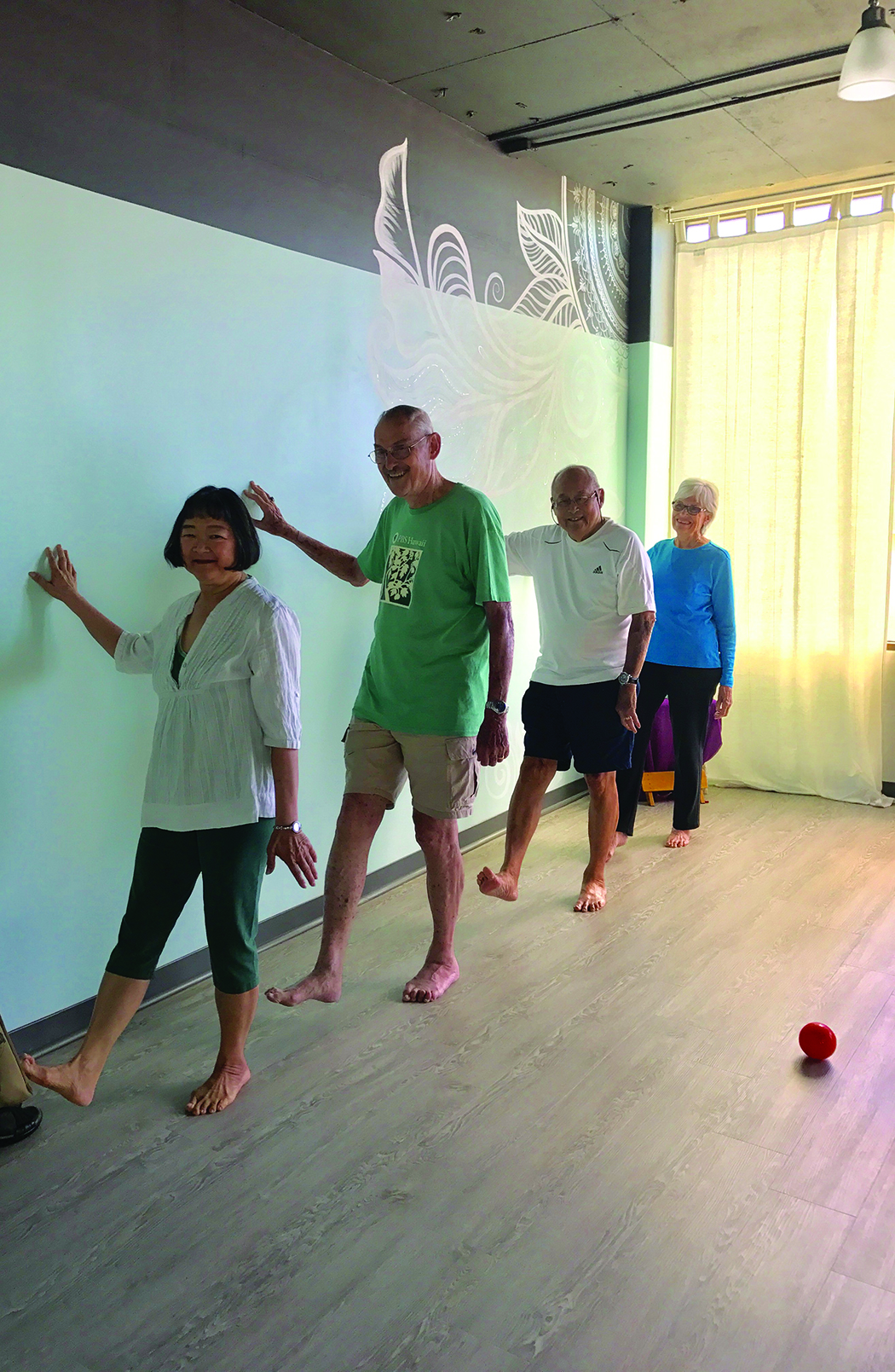
    3. Tandem Walking. Walk as if on a balance beam with one foot in front of the other.
    4. Bridge. Lie down with feet flat on a mat. Raise and squeeze your butt, then lower.
    5. Pushups on Your Knees. If you can’t get on the floor, use a wall or bench.

    Cool down with a 10-minute walk.


    FRAN PATOSKIE
    CPT, GFI, Certified Fascianation Method Practitioner
    808-349-5598 | franpatoskie@gmail.com

    Due to the novel coronavirus, gyms and fitness studios closed, and many classes are completely canceled or available online only. Now, it is more critical than ever to improve your fitness to fight off COVID-19, as well as the common cold and flu.

  • Share Aloha, Not Germs

    Hawaii Dental Service (HDS) is sharing oral health tips seniors can practice every day to help limit the spread of harmful viruses.

    Don’t Share Food, Drinks or Utensils

    It may seem like common sense, but sharing eating utensils, food and drinks with a friend or loved one may come with certain risks. These acts of sharing can easily transfer germs from one body to another. HDS recommends everyone has their own eating utensils, food and drinks during meals.

    Don’t Share Toothbrushes, Floss, Toothpaste

    Sharing a toothbrush, floss or toothpaste may also lead to health problems because every mouth may harbor hundreds of different bacteria and viruses that can be transferred from mouth to mouth. It also makes both users susceptible to tooth decay, gum disease and oral infections. Every person should have his or her own toothbrush,
    floss and toothpaste at home.

    Brush, Floss and Visit the Dentist!

    Brush twice a day, floss daily and visit your dentist regularly! Poor oral health directly impacts your overall health. Healthy habits help you and your loved ones combat germs so you can live well and smile more.


    HAWAII DENTAL SERVICE
    Kahala Howser, Wellness & Events Manager
    808-521-1431 | khowser@hawaiidentalservice.com
    www.HawaiiDentalService.com

    Hawaii Dental Service (HDS) is sharing oral health tips seniors can practice every day to help limit the spread of harmful viruses.

  • Telehealth Services Expand

    In direct response to the COVID-19  pandemic, Medicare announced the temporary expansions of telehealth services. Even after the pandemic ends, telehealth is here to stay.

    Telehealth is the virtual visit between doctors and patients using phones and computers,  which enables medical care in the comfort of your home.

    Your physician can facilitate the following services through a telehealth appointment:

    • Routine visits for minor ailments, such as skin
    conditions and sinus infections
    • Annual checkups and other preventive care
    • Order prescription refills or testing supplies
    • Maintenance for patients with chronic conditions,
    such as diabetes
    • Reviewing test results from previous visits

    USING TELEHEALTH EFFICIENTLY

    Be prepared for your visit! Have your device, microphone and speaker set up ahead of time. Complete any online forms in advance and have any questions and information for your doctor ready to be reviewed.

    Stay connected with your doctor through the ease and convenience of telehealth visits!


    MDX HAWAI‘I
    500 Ala Moana Blvd., Ste. 2200, Honolulu, HI 96813-4993
    808-522-7500 | www.mdxhawaii.com
    Headquartered in Honolulu, MDX Hawai‘i has over 35 years of experience serving the people of Hawai‘i. Our physician network represents over 630 primary care physicians, and 2,200 specialists, hospitals and ancillary providers. MDX Hawai‘i contracts with Humana HMO, Humana PPO and AARP/UnitedHealthcare PPO Medicare Advantage Plans.

    In direct response to the COVID-19  pandemic, Medicare announced the temporary expansions of telehealth services. Even after the pandemic ends, telehealth is here to stay. Telehealth is the virtual visit between doctors and patients using phones and computers,  which enables medical care in the comfort of your home.

  • A Wake-Up Call for Your Eyes

    Age-related macular degeneration (AMD) is the leading cause of vision loss, affecting more than 10 million Americans — more than cataracts and glaucoma combined. AMD is the deterioration of the macula, the small central area of the retina that controls visual acuity.

    Western medicine offers no cure for AMD. However, AcuNova, a widely used protocol in Europe, was developed by John Boel of Denmark. AcuNova is a type of acupuncture treatment that has shown remarkable results for people who have been medically diagnosed with  degenerative eye disorders. About 80 percent of patients have experienced increased brightness, better acuity and a larger visual field after just 10 treatments.

    Treatment involves placing acupuncture needles on points in or around specific joints of the hands and feet (not in the eyes). It is thought that these needles generate a frequency that affects areas of the brain responsible for vision. Blood flow is increased to both the optic nerve and the retinal structure of the eye. This aids in “waking up” dormant neuronal cells that have become “unhealthy” over a period of time.

    The average patient starts with two sessions per day for five days over a two-week period, for a total of 20 treatments. Maintenance treatments then are staggered as needed.


    NEEDLES OF HOPE
    1314 S. King St., Ste. 1050, Honolulu, HI 96814
    808-450-2527 | kathy@needlesofhope.com
    www.needlesofhope.com

    Age-related macular degeneration (AMD) is the leading cause of vision loss, affecting more than 10 million Americans — more than cataracts and glaucoma combined. AMD is the deterioration of the macula, the small central area of the retina that controls visual acuity.

  • Tighten Your ‘Internal Belt’

    Core training is one of the most popular concepts in the field of fitness and physical therapy. Core stability training is often associated with strengthening your abdominal muscles — the “abs.” The ab muscles play a very important role, but the core also includes multiple muscles in he mid-lower back, pelvic floor, hips and buttocks.

    This ring of muscles, or the “internal belt,” holds us up during the day, reducing falls, decreasing back pain and improving posture and even bladder control.

    Whether you are lifting your grandchild or playing your favorite sport, your core muscles help maintain the body in proper alignment to avoid injury.

    I often see patients who fall victim to the latest fitness trends that train the core improperly, leading to spine or leg injuries. Crunches, side-bends and rotational exercises with weights or kettle bells are not bad, but as we age, they often create more problems than benefits.

    Exercises that engage the muscles by bracing the entire trunk — as though you are wearing an
    internal belt rather than sucking the stomach in and flexing forward — are more effective for improving core stability.

    If you have poor posture and a weak core, try this simple, effective exercise to begin developing core strength and control:

    Start by finding an open wall.

    1. Stand at the wall facing outward. Then place your heels about 6 inches away from the bottom portion of the wall. While keeping your foot planted, lean back against the wall with your back flush to the wall.
    2. Pull your shoulders and arms back so they touch the wall.
    3. Push your shoulders down with your palms facing out.
    4. Tighten your abdominals so your lower back touches the wall — as if a force is sucking your back up against it.

    Stand tall and breathe, hold for 30 seconds and then relax. Repeat 10 to 15 times.

    This simple exercise will tighten your internal belt and help you avoid injuries.


    MOON PHYSICAL THERAPY LLC
    Aquatic, Land-Based and Manual Therapy, and Cardiopulmonary Rehab Programs
    320 Ward Ave., Ste. 107, Honolulu, HI 96814
    808-597-1005 | www.moonpt.com
    Like me on Facebook: Moon Physical Therapy LLC

    Core training is one of the most popular concepts in the field of fitness and physical therapy. Core stability training is often associated with strengthening your abdominal muscles — the “abs.” The ab muscles play a very important role, but the core also includes multiple muscles in he mid-lower back, pelvic floor, hips and buttocks.…

  • Need a Hearing Aid? Buyer Beware!

    Hearing loss is one of the most common health issues for seniors. The good news is that modern hearing aids are very effective in correcting hearing loss. Be aware that not all hearing aids are the same and not all providers are equal. Here are some tips that will ensure that you or a loved one get the best results when buying a hearing aid.

    Shop around: Don’t pay too much. By making a few phone calls, you will be surprised at the range of prices for the same make and model. Don’t rush: If you are told that a special price is only good if you buy “right now,” just walk away.

    Ask for a home trial: Make sure your provider offers a home trial period so you can see how the hearing aid performs where you live and work.

    Check out the provider’s service plan: Your hearing aid can give you years of quality hearing ability if you have reliable service plan.

    Feel good: Your audiologist and hearing aid specialist are important persons in your care team. Choose professionals who you feel comfortable with and who treat you well.

    Be sure to ask for a written, low-price guarantee on all major makes and models, and a risk-free home trial so you can be absolutely sure and satisfied with your purchase.


    OHANA HEARING CARE
    1296 S Beretania St., Ste. 102, Honolulu, HI 96814
    808-593-2137 | www.ohanahearingcare.com

    Hearing loss is one of the most common health issues for seniors. The good news is that modern hearing aids are very effective in correcting hearing loss. Be aware that not all hearing aids are the same and not all providers are equal. Here are some tips that will ensure that you or a loved…

  • Staying Healthy During Flu Season

    With so many different virus strains circulating, a flu shot is not the only defense for staying healthy. Preventative measures are the key to keeping illness at bay and avoiding giving the unwanted gift that keeps on giving. By being proactive and having a plan, you can raise the odds of staying flu-free.

    Aside from sanitary best practices, such as washing your hands often, eating lots of fruits and vegetables, getting adequate rest and managing stress levels , exercise should be a part of your wellness plan. Among the obvious benefits of increased strength, energy and stamina, staying active on a regular basis helps with gut health, an important component of a robust immune system. Most people understand the concept, yet few will put it into action if exercise is not already part of their daily routine. Finding time throughout the day to stretch or do squats, even if it’s only in one-minute intervals, will boost your immunity.

    Beyond taking care of the physical body, emotional health is important, too. Fear can have adverse effects on the immune system. Be mindful of what information you are feeding your brain and how it makes you feel. Avoiding news and conversations that incite fear can be one of the most important things you can do. Positive emotions combined with self-care can help you thrive.


    BODY & BRAIN ENERGY HEALING CENTER MĀNOA
    2851 E Manoa Road #1-207, Honolulu, HI 96822
    808-691-9642 | www.bnbenergyhealing.com/manoa

    With so many different virus strains circulating, a flu shot is not the only defense for staying healthy. Preventative measures are the key to keeping illness at bay and avoiding giving the unwanted gift that keeps on giving. By being proactive and having a plan, you can raise the odds of staying flu-free.

  • How to Protect Yourself Against Coronavirus

    Persons over 55 with chronic diseases can die from the flu and COVID-19, the disease caused by the coronavirus. These diseases enter your lungs through your eyes, nose or mouth. Most people pick up viruses left on surfaces by infected persons. Flu bugs can live on surfaces, clothing and towels for up to two weeks! Since we touch our faces up to 90 times a day, breaking that habit will help keep us healthy.

    Stay clear of surfaces that other people have touched and their rubbish, as well as clothing sick people have worn. Wash your hands before putting on glasses, touching your hair, scratching your nose or mouth, or eating.

    Hand Washing

    Good hygiene is the best defense against viruses. Visit www.cdc.gov and read “When and How to Wash Your Hands.” Soap, water and friction cleanse your hands. Even hand sanitizer requires the friction of rubbing the hands together to lift off the oils that viruses stick to.

    Rub your wet, soapy hands together front and back — get under the nails. Continue 20 seconds — the time it takes to sing a full version of Happy Birthday. Rinse well and dry hands with a paper towel before turning off the faucet with the towel. Keep the towel to open the restroom door. Consider all faucets, doors and flush handles contaminated.

    Gloves

    Wearing gloves at the doctor’s office, and while shopping and running errands will protect your hands, but the greatest advantage may be that gloves remind you not to touch your face.

    Paper Masks

    Paper masks do not protect healthy people from viruses — in fact, they can carry them to their faces as they apply or adjust the mask. Masks are for symptomatic and sick people. Since droplets from an uncovered sneeze can travel up to 30 feet, always cover sneezes and coughs with the tight crook of your elbow. And of course, always wash your hands after blowing your nose!

    Symptoms

    COVID-19 causes a temperature and cough — not cold symptoms. If you have these symptoms, isolate yourself and call your doctor promptly.


    Get up-to-date information online:
    STATE OF HAWAI‘I DEPARTMENT OF HEATH WEBSITE
    www.health.hawaii.gov

    Persons over 55 with chronic diseases can die from the flu and COVID-19, the disease caused by the coronavirus. These diseases enter your lungs through your eyes, nose or mouth. Most people pick up viruses left on surfaces by infected persons. Flu bugs can live on surfaces, clothing and towels for up to two weeks!…

  • Hydrating Helps Prevent Falls

    It is part of our practice to ensure our patients drink ample water during a physical therapy session. The fact that water counts for 95 percent of the brain, 82 percent of blood and 73 percent of muscle tissue explains how important it is to be hydrated.  Dehydration can pose serious health problems for older adults, especially with Hawai‘i’s hot, humid weather. Dehydration  symptoms that increase fall risk are dizziness, weakness, fatigue, confusion and low blood pressure.

    Blood pressure can drop so low with dehydration that a condition called “orthostatic hypotension” can occur. As a person rises from lying down or sitting, blood rushes out of the brain, causing dizziness, faintness and weakness. This can result in a collapse or fall. Drinking more fluid would increase blood volume and help prevent a drop in blood pressure, thus reducing the risk of falling.

    If you feel dizzy or light-headed when changing positions from prone to sitting or standing, we recommend waiting roughly 20 seconds before moving to allow more blood circulation and for the dizziness to subside. If you still feel light-headed, lie back down immediately. If you commonly experience this type of dizziness, drinking more fluids may be your solution.

    Drinking plenty of fluids and eating foods with high water content every day is a great way to keep your body properly hydrated to prevent possible falls and injuries.


    MAKAI MOBILE REHAB LLC (In-Home Physical Therapy)
    Yunsim Suehisa, PT, DPT Physical Therapist
    808-277-4073 | ysuehisapt@gmail.com
    www.makaimobile.com

    It is part of our practice to ensure our patients drink ample water during a physical therapy session. The fact that water counts for 95 percent of the brain, 82 percent of blood and 73 percent of muscle tissue explains how important it is to be hydrated.  Dehydration can pose serious health problems for older…

  • Colon Cancer Testing

    More than 50,000 Americans die each year from colorectal cancer. The heartbreaking thing is that most of these deaths could have — and should have — been prevented.

    Screening is the No.1 way you can reduce your risk of colon cancer. If found early, colon cancer is one of the most treatable forms of the disease.

    Know Your Options

    From colonoscopies to at-home stool tests, there is an option for everyone to get screened. The only questions are what method to use, when to get screened and how often.

    There are several different ways to be screened for colon cancer, including laboratory tests on your stool, simple procedures and imaging tests. It’s important to discuss with your doctor which screening option is best for you given your medical condition and preferences.

    The U.S. Preventive Services Task Force (USPSTF) recommends colon cancer screenings starting at age 50 through age 74. According to the USPTSF, your stool should be tested every one to three years. You should also have a direct visualization of your colon through a simple procedure every three to 10 years.

    Advocate for your health! Do not put it off. Talk to your doctor about getting checked.


    MDX HAWAI‘I
    500 Ala Moana Blvd., Ste. 2200, Honolulu, HI 96813-4993
    808-522-7500 | www.mdxhawaii.com
    MDX Hawai‘i has over 34 years of experience serving the people of Hawai‘i. Our physician network represents over 630 primary care physicians, and 2,200 specialists, hospitals and ancillary providers. MDX Hawai‘i contracts with Humana HMO, Humana PPO, and AARP/UnitedHealthcare PPO Medicare Advantage Plans.

    More than 50,000 Americans die each year from colorectal cancer. The heartbreaking thing is that most of these deaths could have — and should have — been prevented. Screening is the No.1 way you can reduce your risk of colon cancer. If found early, colon cancer is one of the most treatable forms of the…