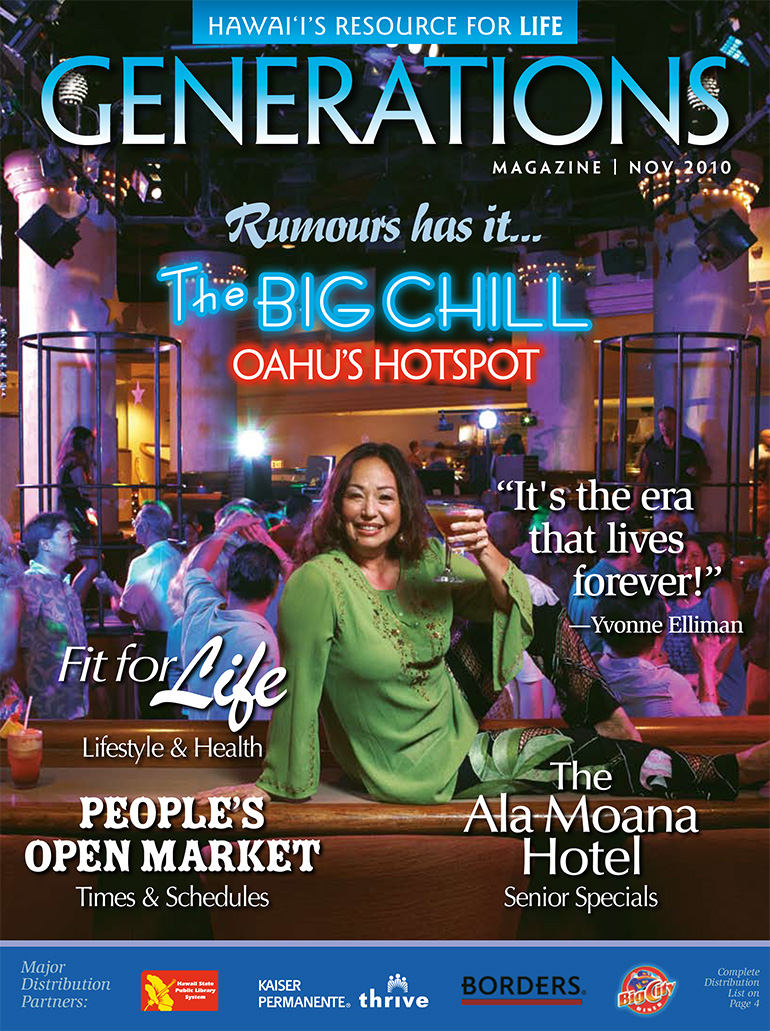
Category: Cover Story

  • Rumours has it: The Big Chill

    Rumours has it: The Big Chill

    Remember watching the classic movie The Big Chill? Yes, it was the movie about a group of idealistic college buddies who had not seen each other for years. They reunite, reconnect and reminisce about the good ol’ days.

    The Big Chill, at Rumours Nightclub at the Ala Moana Hotel, was named after the classic movie. Malcolm Sur, the creator, original DJ and boogie man himself says he named the weekly event “The Big Chill” because he wanted a place where his friends could hang out, have a great time and party— something he felt Honolulu was lacking in the ‘80s.

    The Big Chill, home to the longest running nightclub in the state, is party central every Friday night. “Simply put, it’s all about the music,” Sur says.

    The passion for good music from “back in the day” still lives strong every Aloha Friday, from 5 p.m. to 9 p.m. For Friday-night regular, Jodi from Mililani, who has been coming to The Big Chill for more than 20 years, dancing is the greatest way to stay in good health and enjoy herself with good friends. “I’m with my girls, and no worries about work,” she says. “It’s Friday night!”

    Since 1984, Rumours Night Club has been a hotspot for company parties, class reunions and pau hana with friends. If you like to boogie down, it’s the place to go. The club has an extensive collection of hits from the ‘60s and ‘70s—from Motown and Marvin Gaye to The Temptations and Earth Wind & Fire. Then there are the “let’s get on the dance floor” songs by Rick James, Kool & The Gang and, of course, the King of Pop, Michael Jackson.

    According to Malcolm, there are people who have been coming to the club since day one. He calls them the “Original Chillers.” In fact, he heard of a story about an original chiller who recently passed away on the Mainland and in his obituary headline read, “Original Chiller is Gone.”

    Twenty-four years after opening, Malcom is starting to see some old familiar faces. The 20-somethings from the ‘80s are now empty nesters and are entering retirement. They have more free time … and they’re looking for a good time. Many of them are finding their way back to one of their favorite haunts, dancing the night away to the tunes of their times. Even Yvonne Elliman, a celebrated Hawai‘i recording artist from the ‘70s, still loves to come down to Rumours and groove to tunes like, “Play That Funky Music White Boy.”

    With new general manager Vince Depietro and assistant manager Pauline Keb, expect more to come in terms of parties. “Rumours Night Club and The Big Chill has withstood the test of time and the locals love our easy parking at the Ala Moana Center,” Keb says. She books parties in the club’s two private party rooms, which are always great for celebrating birthdays, class reunions, retirement parties and even yakudoshi.

    As the writer of this article, I’m also a regular patron of Rumours. I love the energy my fellow baby boomers still exhibit in their middle years. In fact, I celebrated my 50th yakudoshi at the Big Chill. What a party we had!
    The Big Chill, at Rumours Nightclub at the Ala Moana Hotel, was named after the classic movie. Malcolm Sur, the creator, original DJ and boogie man himself says he named the weekly event “The Big Chill” because he wanted a place where his friends could hang out, have a great time and party— something he…

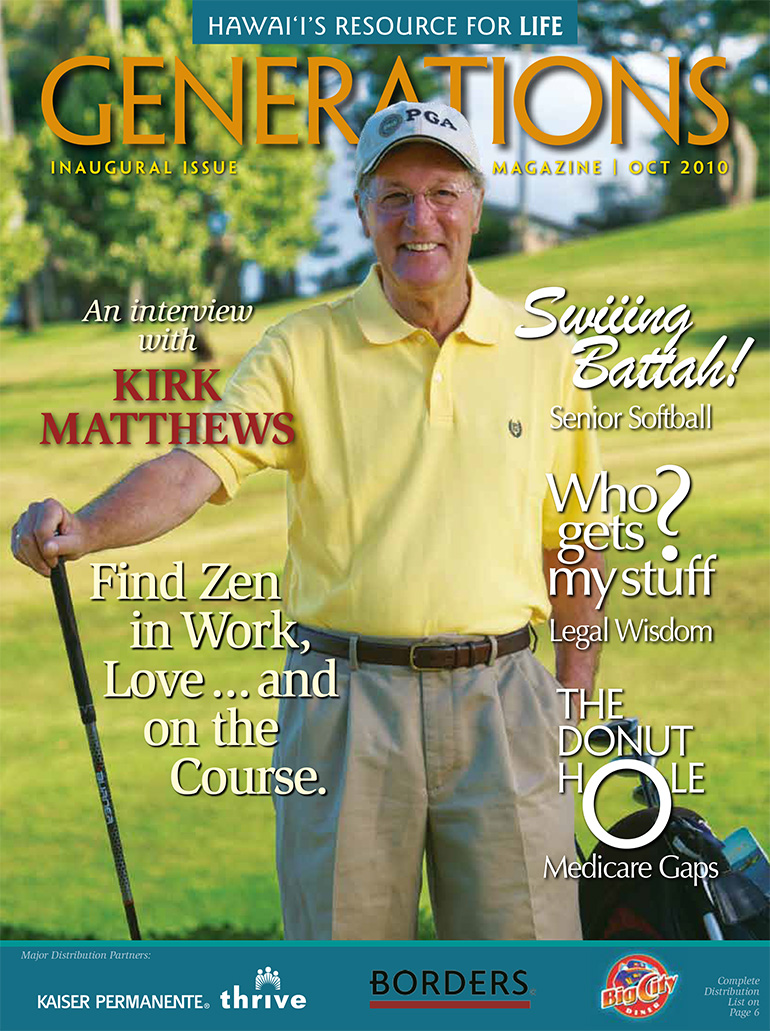
  • Behind the Scenes with Kirk Matthews

    Behind the Scenes with Kirk Matthews

    Finding Joy in Life… On and Off Screen

    GM: Where did you grow up? In a big city? Or small-town America?

    KM: I grew up in little towns all around Oregon. I went to high school on a former Indian reservation, Siletz. Graduating class of 12.

    GM: What was your first job? Was it in media or in a different field?

    KM: My first broadcasting job was in Coos Bay Oregon at a small radio station. I had the opportunity to do EVERYTHING. It was a great learning experience.

    GM: What brought you to the Islands? Sand, sun and surf?

    KM: [big smile] Love, actually. I first came here in 1981 to tape some shows for a Portland TV station. Later, I met my wife who came to Portland from Hawaii but was so homesick; she had to come back here in 1983. I followed her … gladly.

    GM: Where did you meet “Mrs. Matthews?” — Linda Coble.

    KM: I knew that she was coming to my station in 1981 in Portland to audition for the job as the first female anchor at the place. I was waiting in the parking lot to get a look at her. I fell in love at first sight. I wooed her and pursued her. She was highly successful on television in Portland but she was homesick for Hawaii. Every night, after the news, she would ride her stationery bike with headphones on listening to The Brothers Cazimero, tears streaming down her face. She came back to Hawaii in 1983 — I was hot on her heels. We were married in 1984.

    GM: Tell us just one funny story about being married to Linda.

    KM: [laughter] Oh, where to start! She doesn’t know her left from her right. If she’s driving, I have to point. If I’m driving, she has to point. A typical conversation in the car would go: Kirk: “Should I turn left?” Linda: “Right.” Kirk: “Okay, right.” Linda: “No, not right, left.” Kirk: “If it’s not right, what’s left?” Linda: “RIGHT…we missed the turn.” [laughter]

    GM: Everyone knows you from KHON’s Hawaii’s Morning News. How do you get up so early every day? KM: I’ve been doing that at KHON for a long time. I have a very understanding wife who doesn’t mind when I go to bed early. I have a quiet alarm that goes off at 2:30 every morning. And I have a brain that says, “You’re a lucky man. Get up, dress up and show up.”

    GM: The Elderhood Project is one of KHON’s feature shows. You host the program … can you tell us a little bit more about it?

    KM: The Elderhood Project was conceived several years ago as a way of addressing the needs of seniors and their caregivers. I have been amazed at the number of programs, volunteers and others who have a deep interest in the subject. Someone once said, “at some point you will either be a caregiver or a care-getter.” I hope we can continue to delve into the subject for a long time to come.

    GM: Over the years, you’ve had the opportunity to interview hundreds of people. What was your favorite interview or story?

    KM: That is the hardest question to answer. I’ve had the opportunity to talk with major movie stars, national leaders, people who shape our lives with their decisions. My favorite interview is – the one that’s coming up next.

    GM: Let me rephrase the previous question … if you could interview anyone in the world, who would it be?

    KM: The obvious answer would be Barack Obama. A close second would be the chance to sit down with Quincy Jones or author James Lee Burke and talk about the creative process. It’s one of the few things that separates us from the rest of the creatures on the planet.

    GM: Thinking back on your personal life and career, did you have a mentor growing up or on the job?

    KM: [smiles] Oh, man. My dad, my mom. Mr. Lakes, an English teacher. Mr. Roth, who created a high school orchestra out of thin air. Bob Sevey. Almost everyone I meet every day has something of value to offer.

    GM: When you’re off the clock and have time to relax, what’s the perfect day for you?

    KM: The perfect day would go like this … Read stories to 1st graders in the morning. Lunch with seniors at noon. Golf with Linda and dinner downtown at Du Vin. Watch a suspense movie at home in the evening. Can you arrange that?

    GM: [laughter] Sure. And an interview with Generations Magazine to top it all, right?

    GM: Golf is big in Hawaii, obviously. You play golf too. How’s your game?

    KM: I am not a very good golfer. I love to go to the golf course with Linda. If we get paired with another couple, it’s always fun. It’s five hours we have together where we focus on something else other than our everyday concerns. It’s Zen. That’s the only way I can explain it.

    GM: With so many hours spent on the golf course, do you have any funny stories from the green? Out of control golf carts, stray balls …

    KM: Two Japanese guys in a cart came back up the fairway toward us. “Did you find a sand wedge?” they asked. “No, sorry.” They looked at us suspiciously and said again, “Did you find a sand wedge?” “No, no we didn’t.” They zoomed off in disgust and pointed to the hot dogs in our hands. “All they wanted was a sandwich!” [laughter]

    GM: If you weren’t in media or broadcasting, what would you be doing?

    KM: We talked about this on the news. I would be a teacher. My father was a teacher and a coach and I remember the joy he experienced when one of his students “got it.” Dad referred to it as the light bulb over the head. I enjoy reading to the students in class when I have the opportunity.

    GM: Can you talk about some of your other community involvements?

    KM: Linda and I have been involved with Rotary since 1987. It’s a worldwide service organization. My friend Matt Levi runs a martial arts school and I help out with awards ceremonies and a Scrabble tournament several times a year. I read to youngsters in the schools and whenever friends ask, I try to help out with various non-profits.

    GM: Along with your strong interest in the education of Hawaii’s young people … what are your other passions in life?

    KM: Reading and music. I own 2 ukuleles, a trumpet, several flutes, harmonicas and a guitar. I play them all. I also own a set of golf clubs. I play those just about as well. [smiles]

    GM: Since you’re getting up there in years, what are your retirement plans. With family on the Mainland, do you plan to retire in Hawaii?

    KM: Good question. My mother is 83. She lives in Oregon. I have a daughter in Oregon and one in LA. The easy answer is, I don’t plan to retire. Right now, Linda and I feel like we have family in two places. We are at home here.

    GM: After years of doing live TV, you must’ve had some unpredictable moments. Any funny stories to share about KHON2?

    KM: On my lawyer’s advice, I am going to skip this question. [nudge and a wink]

    GM: We heard that you are having some health problems now. Care to talk about it?

    KM: Sure. I was diagnosed with skin cancer some time back. I am currently going through radiation therapy. My advice: Pay attention to everything! If something doesn’t look right or feel right, see your doctor. Plus get your regular exams, checkups, immunizations, etc.

    GM: Thank you for sharing. Any words of wisdom for people going through maturity in life, whether it is personal or professional?

    KM: I would refer back to my answer about getting up early to do the show … when the alarm rings, thank your lucky stars that you heard it. Get up, dress up and show up. If you don’t have a paying gig, find something that gives you joy. You can’t buy joy. But if you’re lucky, you can find it.

    GM: I know there is a lot to love about the Islands, but what do you like most about Hawaii?

    KM: There’s no question about that—the people. I could live almost anywhere. I picked here for the same reason Linda did. The people. When I walk through Safeway or Long’s and people feel comfortable enough to say howzit to me, that’s my reward. I want to do whatever I can to make this the best place possible. And with the people’s help, that will happen.

    GM: You live a pretty healthy, active life … but do you have any favorite indulgences?

    KM: Friday night movies at home. Pizza. Linda— not in that order.

    GM: Although you spend much of your time in the public eye, is there still something people don’t know about you? KM: It’s a small island. Folks probably know everything about me. I know more lyrics to Broadway show tunes than most people should probably know.

    GM: Do you have a favorite restaurant or bar in town?

    KM: The one that brings free pupus.

    GM: Well…let me show you the way.


    Look for Kirk’s monthly column The Elderhood Project 

    GM: Where did you grow up? In a big city? Or small-town America? KM: I grew up in little towns all around Oregon. I went to high school on a former Indian reservation, Siletz. Graduating class of 12. GM: What was your first job? Was it in media or in a different field? KM: My…

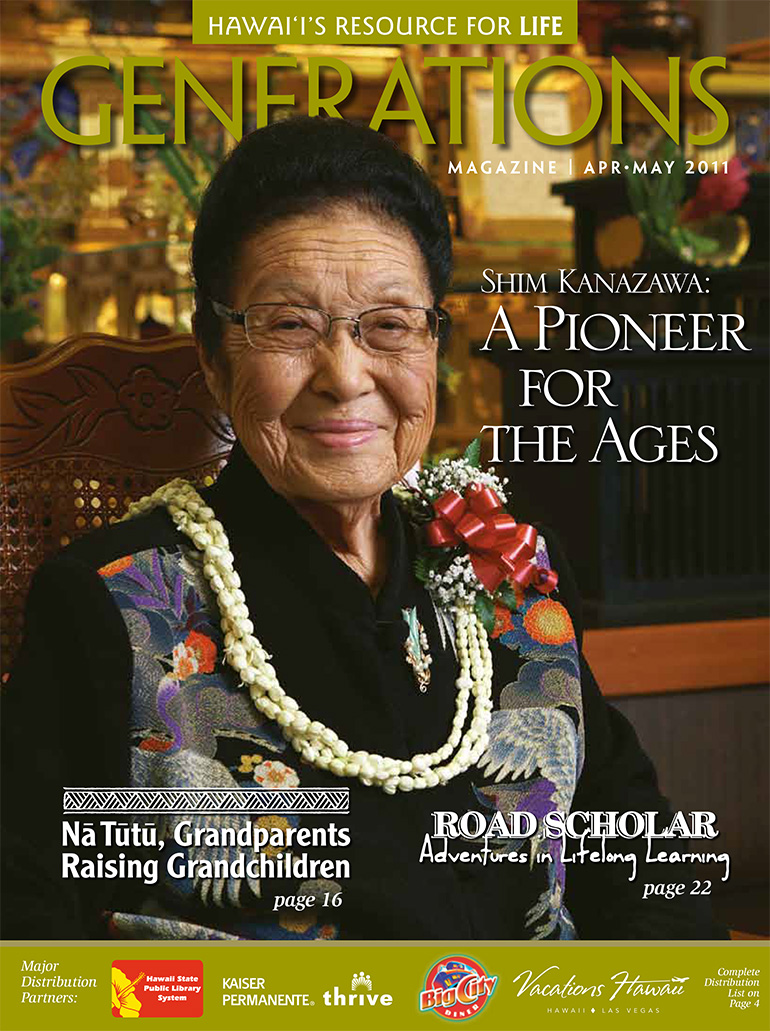
  • Shim Kanazawa: A Pioneer for the Ages

    Shim Kanazawa: A Pioneer for the Ages

    Shimeji Kanazawa, or “Shim” as most of us know her, is Hawai‘i’s original pioneer of aging issues. She has advocated for programs and services that help our senior population for five decades. In doing so, she Shim has worked with every governor, from Gov. Quinn to Gov. Abercrombie. Shim is an honorary member of the Governor’s Policy Advisory Board of Elderly Affairs and the only member since its inception in the ‘60s.\

    GM: Where did you grow up? What schools?

    SK: I was born in Kamuela Hawai‘i, and I was the eldest of 11 children. I attended Waimea School, Hilo Intermediate School and Hilo High School, class of 1934. In 1948, I attended Chamberlain School of Retailing in Boston Massachusetts. In 1990, I was awarded the Honorary Doctorate of Humane Letters degree from the University of Hawai‘i for my public service over six decades.

    GM: What kind of influences were your mother and father?

    SK: My parents immigrated from Shizuoka Prefecture (Japan) and taught us by example the value of diligent, hard work. Although there were 11 children, all of us felt loved as if we were the only child; and learned to value cultural traditions of respect, especially to elders within our family and the community at large.GM: You grew up on the Big Island and then became a vice principal at Kohala School. Tell us this story. Was this your first job?

    SK: My first job after graduating high school was as the mimeograph operator for the Hilo teachers curriculum group, which was developing an instructor’s booklet. That same year I was hired at Kohala Elementary and High School in a secretarial position. On occasion, during James W. O’Neal’s absence, I was the acting vice principal for Kohala School. Mr. O’Neal authorized me to teach secretarial skills to students, which contributed toward their degree. From 1934 to August 1941, I resided at the Kohala School teacher’s cottage.

    GM: Tell us the story about the Swedish ViceConsulate and your work with them.

    SK: In February 1942, the Swedish Vice Consulate Department of Japanese Interest was established to protect matters concerning Japanese nationals residing in the territory. Mr. Gustaf W. Olson was the vice consul for Sweden and also the administrator for Queens Medical Center. I was the executive secretary and my responsibility, with the help of a few assistants, was to oversee Consulate operations. Our job was to assure that the POWs who were transported through Hawai‘i, and those held in internment camps such as Honouliuli, were treated in accordance with the civil, military and international laws.

    GM: You are well known as the founder of Project Dana. How did this come about?

    SK: In 1988, I attended a National Federation of Interfaith Volunteer Caregivers meeting in Florida, as a trustee and treasurer for Mō‘ili‘ili Hongwanji Mission. I was impressed with reports from 40 states describing their elder care programs. I enlisted the assistance of the executive director Virginia Schiaffino-Kasinki of The National Federation of Interfaith Volunteers Caregivers, Inc., now known as the Interfaith Caregivers Alliance, to establish a similar pilot program for Hawai‘i. Initially the program was focused on the Hongwanji community, however with the broad vision, diligent voluntary work and coordination of our administrator Ms. Rose Nakamura, Project Dana expanded to incorporate all denominations of churches and temples. Although I may have been given the title of “founder,” it was only through the guidance of Ms. Nakamura. She, along with her dedicated staff, developed Project Dana from a “good idea” to a valuable asset for our kūpuna. Project Dana is known for its Best Practice Program in care giving to the elderly and disabled persons so that they can continue to live in their choice of location for as long as possible. There are more than 850 interfaith volunteers servicing more than 1,000 kūpuna each year. Over the years, Ms. Nakamura has received numerous prestigious awards for her contributions, garnering national recognition for Project Dana. In 2011, Project Dana is celebrating its 22nd anniversary. For the project’s next phase, I’d like to propose a partnership between the youth and the elderly. Together, they could share their talents and resources, supporting each other in relationships that benefit both the individuals and the community.

    GM: What people don’t know is that you have worked with every governor on aging issues—
    from Gov. Quinn to Gov. Abercrombie. Tell us about your involvement.

    SK: Gov. Quinn appointed me as chair of the Family Life and Law Committee. Along with judge Betty Vitousek who served as vice chair, we worked with the legislature to establish the Family Court System in Hawai‘i. With my 1972 appointment to the Commission on Aging established by Gov. John Burns, my focus shifted from the children and youth arena to issues challenging the elderly. I continued to serve on the Board of the Executive Office on Aging as commissioned by Gov. George Ariyoshi.

    GM: The State of Hawai‘i’s Executive Office on Aging was pretty much your idea? Tell us more about those early years.

    SK: With the wide impact of the state’s aging community, The City and County Parks and Recreation Department was the forerunner of the Commission on Aging. The city created an Elderly Affairs Office under the executive branch.

    Through the newly formed Executive Office on Aging, we proposed and provided  comprehensive health, education and social services to the older residents of the State of Hawai‘i.

    GM: Every 10 years the White House Conference on Aging is held, and you have lead Hawai‘i’s
    contingent for the last 50+ years. Can you tell us about these conferences?

    SK: In 1961, 1971 and 1981, I led a delegation of approximately 12 community leaders to Washington, D.C. The conference convenes to discuss current issues facing the aging  population. The goal was to have our concerns addressed in national legislation, which in turn would benefit the elderly throughout the nation. In 1981, I was fortunate to be selected under President Jimmy Carter’s administration to serve on the National White House Aging Committee
    in Washington, D.C., which gave me an opportunity to share the plight and success of eldercare in Hawai‘i.

    GM: Tell us about President Carter appointing you to advise him on aging issues.

    SK: President Jimmy Carter’s administration selected approximately 15 people to serve on the Federal Council on the Aging in Washington, D.C. We met about twice a year during a two-year term, advising the president and the Senate Committee about current matters and trends of the older Americans.

    GM: Tell us about your lifetime appointment as honorary board member of PABEA?

    SK: Gov. Benjamin Cayetano appointed me to serve on the Policy Advisory Board of Elder Affairs, which I continue to honor today.

    GM: How did you come to be the first woman President of the Board of Kuakini Medical Center?

    SK: Through my involvement working with elderly affairs and legislative issues, I met Masaichi Tasaka, past CEO of Kuakini Medical Center, in 1976. He appointed me to the Board of Directors and eventually I served as the Board President in 1981. One of my proudest moments while serving on the board was enlisting the expertise of Mary Kawena Pukui to suggest an  appropriate name for the newly constructed long-term care facility. “Hale Puˉlama Mau,” or House of Cherishing Care, was selected as the structures name and reminder of the facilities mission.

    GM: Tell us about your involvement with Mō‘ili‘ili Community Center.

    SK: My late husband, Kinji Kanazawa, was born and raised in Mō‘ili‘ili on Kaheka Lane. He was instrumental in retaining the property from government confiscation during the war years. Since 1986, I’ve been involved with MCC by serving on the Board of Directors, and participating in their various committees. For the past three years I have chaired the annual membership meeting committee. I appreciate the multi-generational and cultural component MCC provides to our community.

    GM: What should people in retirement do with their lives?

    SK: Keep up a healthy lifestyle, keep busy, pursue hobbies, do things for others, focus on volunteerism, and keep families together.

    Shimeji Kanazawa, or “Shim” as most of us know her, is Hawai‘i’s original pioneer of aging issues. She has advocated for programs and services that help our senior population for five decades. In doing so, she Shim has worked with every governor, from Gov. Quinn to Gov. Abercrombie.

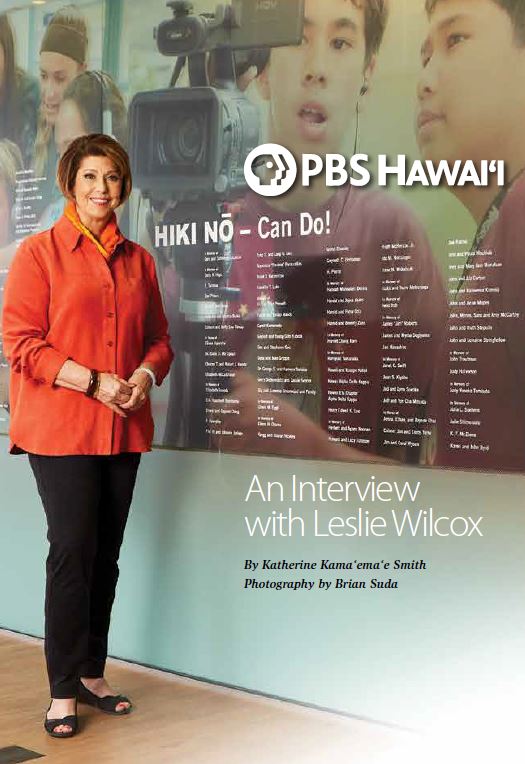
  • An Interview with Leslie Wilcox

    An Interview with Leslie Wilcox

    Our “can do!” island culture values resourcefulness and cooperation when faced with challenges. “We know a guy” and where to get things, and have honed skills tūtū taught us. We don’t expect anything in return for helping out. “If can, can; if no can, no can.” We put ourselves to the task.

    PBS Hawai‘i (KHET or KMEB call letters in your guide) is our TV station. Our donations built it and it serves us. But don’t take it for granted. Paula Kerger, president of the Corporation of Public Broadcasting national nonprofit, recently applauded our “can do!” public television station: “This is truly, I would say, the most exceptional station in our country…
    it understands what it means to be a part of the fabric of our community.”

    “NOVA,” “Get Caught Reading,” “HIKI NŌ,” “PBS News Hour,” “Long Story Short with Leslie Wilcox”— we are fans! But how much do we know about our TV station?

    Snuggle up. We turned the tables and interviewed PBS Hawai‘i President and CEO Leslie Wilcox. Be prepared for some learning moments! And into the bargain, Leslie shares memories about growing up on O‘ahu — another reason PBS Hawai‘i expresses the heart and soul of our islands.

    Generations Magazine readers watch PBS, but they may not understand how it got started.

    LW: Well, Hawai‘i public television goes back to 1965, when a University of Hawai‘i professor set up closed-circuit instruction on campus. With the Public Broadcasting Act of 1967, the UH initiative became a member of the new Public Broadcasting Service [PBS]. In 1969, they introduced “Sesame Street.” It was controversial in some states, but Hawai‘i welcomed the educational program.

    We were first located in a vacant lower Mānoa corner of UH near some Quonset huts. Back then, the TV station was part of the state government. Later, in 1972, the State Legislature funded a two-story building on the site. From the start, our public television station racked up a number of Hawai‘i firsts — including the first local station to provide live satellite broadcasts.

    Can everyone can get PBS on an HDTV?

    LW: Yes, plus via cable, satellite or online. We serve most of the Hawai‘i community free via our KHET and KMEB over-the-air broadcast signals — including financially disadvantaged communities where it’s not profitable for commercial TV stations to direct their signal. For example, we recently strengthened free service to the under-resourced, rural southern end of the Big Island. Many people do not have digital access and we care about them. That’s why we broadcast  educational programming 24 hours a day on two channels — our main channel and PBS KIDS 24/7.

    When state funding ended in 2000 and we became a private, nonprofit, community-supported organization, we began leasing the space we had long occupied at UH Mānoa. I joined in 2007. Years later, due to UH space needs, we lost our lease and had to move all of our operations.

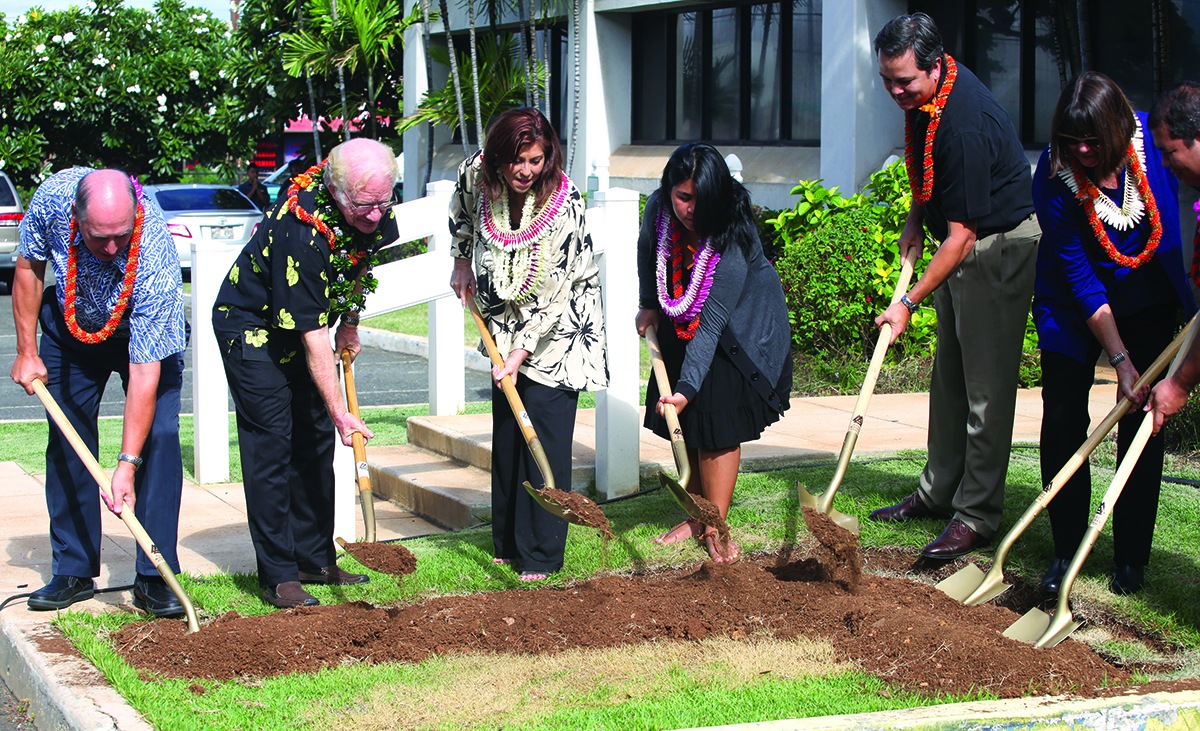
    From the old to the new, groundbreaking in Nov. 2014: (LR) Neil Hannahs, former PBSH board chair; Robbie Alm, then-board chair of PBSH; Leslie Wilcox, president and CEO of PBSH; Victoria Cuba, student engineer at PBSH; Cameron Nekota, PBSH board member; Sheryl Seaman, architect, G70; and Justin Izumi, VP, Allied Builders System.
    From the old to the new, groundbreaking in Nov. 2014: (LR) Neil Hannahs, former PBSH board chair; Robbie Alm, then-board chair of PBSH; Leslie Wilcox, president and CEO of PBSH; Victoria Cuba, student engineer at PBSH; Cameron Nekota, PBSH board member; Sheryl Seaman, architect, G70; and Justin Izumi, VP, Allied Builders System.

    When did PBS Hawai‘i make the big move?

    LW: We moved in 2016, but before that, we raised $30 million to build a big new facility across town. Relocation at first seemed like bad news and a tough blow, but like many changes, it worked out for the better. We had hopes, dreams, hard work and a “can do!” attitude. As always, “the village” of Hawai‘i nei offered support. And we had a strong staff committee headed by Karen Yamamoto managing the move.

    In May 2016, we settled into our beautiful, future-facing multimedia building at the corner of Nimitz Highway and Sand Island Access Road in Kalihi Kai — the PBS Hawai‘i Clarence T.C. Ching Campus. It’s the best work environment I’ve ever had — open, cheerful, welcoming, functional to the max. Thanks to our terrific unpaid board of directors and funding  by Hawai‘i individuals, businesses and charitable foundations, the facility and land are debt-free .

    We’re delighted to be owners, not renters of the only locally-owned, statewide broadcasting company. All others are commercial businesses owned by large companies based elsewhere.

    PBS consistently provides content and services to inform, educate and enlighten our fellow islanders. We gather  feedback from stakeholders, viewers and our statewide independent community advisory board.

    New building in Kalihi Kai

    We want to inspire lifelong learning from childhood through active retirement and elder years. The PBS Hawai‘i mission, with its pillars of education and journalism, is a great fit with my personal philosophy. Education certainly lifted my prospects in life. And journalism increases a flow of new information. For more than three decades in journalism, I felt like I was being paid to learn.

    At PBS Hawai‘i, our traditional values of integrity and fairness endure, but our methods and approaches have changed repeatedly over time with waves of new technology and with shifts in societal perspectives. Sometimes, even media professionals have difficulty dealing with change. As former Sony CEO Howard Stringer said, “We all have to remember not to hang on to the status quo long after the status has lost its quo.”

    Also, PBS values adaptability and versatility. Our lean, dedicated staff has the energy, creativity and know-how to produce a significant amount of local content — weekly TV programs and frequent online offerings. We are “can do!”  people.

    Is it true that you are not funded by the state?

    LW: Yes. We’re Hawai‘i’s sole member of the trusted private nonprofit Public Broadcasting Service. A related national entity is the private nonprofit Corporation for Public Broadcasting. It distributes federal funding to some 350 public TV and radio stations. These funds only make up 15 percent of our annual budget. We leverage PBS federal grant monies into many more private dollars, thanks to generous individual, business and foundation donors. For a number of reasons, it’s good to have different kinds of revenue streams. For example, if a funder seeks to control our editorial content, we need to stand strong — and we can, with other sources of funding.

    We remember you reporting news on the air at KGMB-TV and KHON2. Did journalism bring you to Hawai‘i?

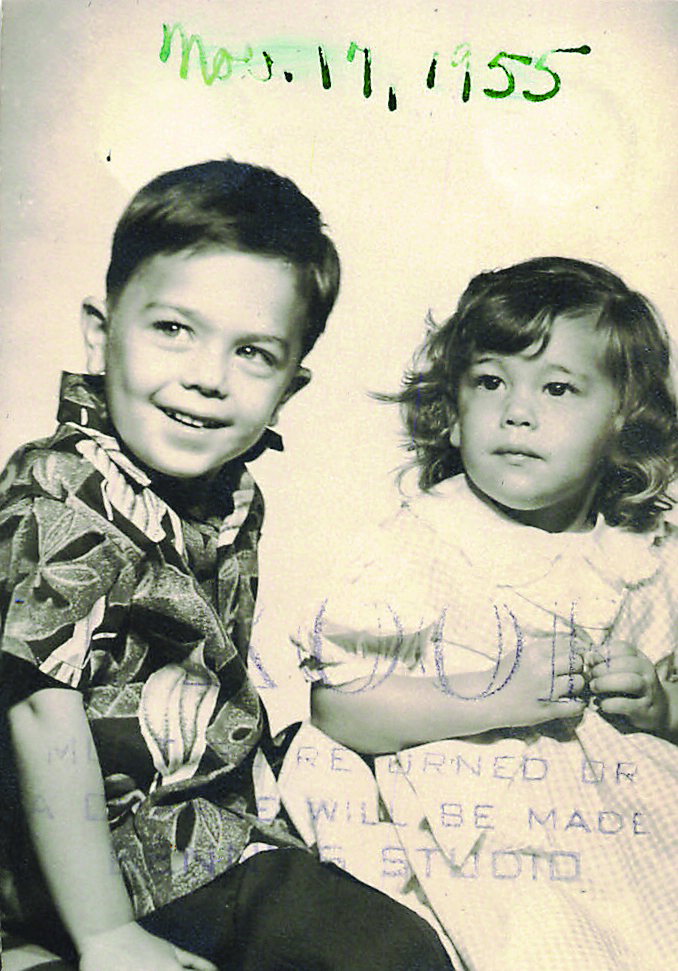
    LW: Actually, I was born and raised on O‘ahu. My Portuguese forebears, Joao and Faustina Fraga Silveira, sailed here while Hawai‘i was still a monarchy. They had actually met on the ship, settled in Kalihi and had 16 children, 13 of whom survived childhood. One of the grandchildren was my mother, Blanche. During World War II, she met Paul Wilcox, a soldier stationed here. He fell in love with my mother and Hawai‘i. Dad had a great broadcast voice and became one of Hawai‘i’s early radio disc jockeys with a late-night show called the “Midnight Owl.” He later worked in radio sales. I’m in the middle of five siblings. I attended Holy Nativity School, Āina Haina Elementary, Niu Valley Intermediate and Kalani High before going to college.

    Small-kid times were spent in what were once jokingly called “the boonies,” meaning Kuli‘ou‘ou Valley, with Quonset huts here and there, a farm market, and backyards where families grew veggies and flowers. Kuli‘ou‘ou was the last  residential valley in East Honolulu. As a kid, I remember pink bulldozers tracking down Kalanianaole Highway to build Henry Kaiser’s huge new Hawaii Kai marina community around the ancient Hawaiian fishpond, Kuapā. Pink was Mrs. Kaiser’s favorite color. I can still remember the sparsely settled lands, dotted here and there with small farms.

    My older brother Pat and I would walk across the highway, wade out to a little islet and pretend to be island castaways.
    When fishermen abandoned fresh aku heads there, we’d stage aku-head swordfights. And we played with sea cucumbers, which squirted seawater. Dumb kids. I wouldn’t do this today.

    In high surf, waves rolled across the road into the fishpond. The backwash left mullet stranded on the land. We kids were there to pick them up and proudly take a “fresh catch” home for dinner!

    Freedom and make-believe are treasures of a post-war Hawai‘i childhood.

    LW: The world was certainly a safer place; baby boom children kept themselves occupied and were allowed to roam. On Saturdays, our mothers might say, “Just make sure you come home before dark. And don’t bother anyone or get into trouble.” No cellphones or bottles of water required.

    When I was still in grade school, my family moved into the new Niu Valley subdivision, then considered a middle-class community. I was older and now our keiki explorations involved crawling around in mountain lava tubes, reef diving to look for eel holes and lots of skateboarding down steep streets. I have the scars to prove it.

    I learned to surf with my friend David’s old homemade board and reveled in the freedom. We also surfed Kawaikui Beach. When we got thirsty, we dove down and drank fresh water flowing through pockets in the sand. Highway work
    stopped the flow of artesian water. Niu pier is long gone, too. Great memories.

    What was your first job after high school?

    LW: Waitressing at the old Snack Shop on the grounds of the Royal Hawaiian Hotel. My pink uniform had a big bow in the back ironed with starch from Chinatown; it was hard as a board.

    I won a journalism scholarship to USC, but just before high school graduation, my parents divorced and bankruptcy followed. I stayed home to help support the family. Fortunately, I was able to pay for and attend UH Mānoa after the Honolulu Star-Bulletin, then the largest newspaper in Hawai‘i, gave me an errand-person job. Amazingly, it turned into a full-time reporting position when I was barely 19. I’m forever grateful to my former Star-Bull colleagues, who at times teased but also generously helped an awkward rookie.

    Were there other mentors along the way?

    LW: I’ve had too many guides and mentors to mention, and they remain in my heart. Some offered guidance, others taught by example in a critical moment. I learned from “the village” that I came to know as a journalist — at many locations across the state and under stressful, sorrowful or even dangerous circumstances.

    Also I learned from reading. Books open up history, context, new ideas, other worlds, flights of fancy and knowledge of how things work. I didn’t travel outside Hawai‘i until I was 16 (for a journalism competition), but through reading, I had already crossed continents, gone back in time and seen the future. Reading continues to inform my writing and expand my understanding.

    Also, my extended family members are observant and curious. “I wonder why…” was a common beginning to a sentence. It wasn’t a gossipy or nosy interest. The question connects things to history, science or community. This curiosity cultivated my sense of wonder, too. When I was 15, I researched the purchase of a big parcel of land in our neighborhood — I wondered who bought it and how it might affect life in the area. Come to think of it, that was pretty niele [nosy]!

    Sounds like you were cut out to be a reporter. How was the transition to television?

    LW: The first thing I learned in TV is that perception is reality. My newspaper background taught me how to gather and write news. But I was pitiful presenting news on camera. If you report with a quivering voice, your viewers are going to think something is shaky about your report, too!

    KGMB-TV news director and icon Bob Sevey had recruited me, knowing I had no television experience. I told him that my own mother thought I looked and sounded goofy and unsure, and asked him for his professional advice. His candid,
    old-school response: “Wilcox, you’ll get there. You’d better — this is a sink-or-swim business.”

    I didn’t grow up watching women role models on television news. Men dominated the business. Fortunately, three talented women were successfully navigating the newsroom — Linda Coble, Bambi Weil (who later became Judge Eden Hifo) and Carolyn Tanaka. Finally, I got it together by deciding simply to be myself. I pictured my dear no-nonsense auntie and my favorite math teacher, Mr. Charles Hirashiki, watching at home — and I delivered the news to them. It worked.

    After mastering broadcasting, what spurred you to take the helm of PBS in 2007?

    LW: The magnetic pull of PBS Hawai‘i was and is still this: it is locally owned and locally managed to serve fellow islanders. We enrich others by telling authentic Pacific stories and opening windows to the world. I wanted to be a part of this mission.

    One misconception about public media is that the “public” stands for government. It actually stands for you and me, and our whole community. After 13 years, still I am amazed and inspired by people who send us money to keep doing what we’re doing.

    I like working for a local organization with strong national and international alliances through public broadcasting. Yet, our volunteer board members and professional staff live in the islands. We are approachable and accountable.

    Some of our sponsors choose to share with others something they deeply value. Your readers may not know that Maui grandparents Jim and Susan Bendon of Sprecklesville sponsor the lessons of Daniel Tiger [“Daniel Tiger’s Neighborhood”] for all of Hawai‘i’s children. Retired UH professor Belinda Aquino still provides education for all of us by underwriting broadcasts of “Nature” and “NOVA.” Rick Nakashima of Ruby Tuesday restaurants supports the “Get Caught Reading” literacy initiative. I can’t imagine a better job.

    What were the most important changes you brought to PBS when you started?

    LW: I came with a deep respect for what this station had already achieved, but media technology and capabilities were changing rapidly, so I encouraged a corporate culture that welcomed new skill sets. Then you need to react and respond quickly in these fast-changing times, so I adopted a “flat” organizational structure that allows information from different sources to move quickly through the organization.

    That brings us to “Long Story Short with Leslie Wilcox.” How do you get your guests to reveal so much new information?

    PBS creative media executive Robert Pennybacker developed “HIKI NO¯ ,” and “Hawai‘i’s New Wave Storytellers.” He began reaching out to teachers in public, private and charter schools, and mentoring them in journalism and video production. The teachers ably train their students to write and produce their own stories. The skills will be used again in school, life and work — from oral and written communication, media technology and critical thinking to teamwork, collaboration and perseverance. “HIKI NO¯ ,” video magazine presents student perspectives, conveyed through responsible and creative storytelling. “HIKI NO¯ ,” airs at 7:30 pm Thursdays. During the COVID-19 school closures. students pivoted and continued reporting from home with stories about life in the shadow of the pandemic. Every story is conceived, written, reported, taped, edited and produced by students.
    PBS creative media executive Robert Pennybacker developed “HIKI NŌ,” and “Hawai‘i’s New Wave Storytellers.” He began reaching out to teachers in public, private and charter schools, and mentoring them in journalism and video production. The teachers ably train their students to write and produce their own stories. The skills will be used again in school, life and work — from oral and written communication, media technology and critical thinking to teamwork, collaboration and perseverance. “HIKI NŌ,” video magazine presents student perspectives, conveyed through responsible and creative storytelling. “HIKI NŌ ,” airs at 7:30 pm Thursdays. During the COVID-19 school closures. students pivoted and continued reporting from home with stories about life in the shadow of the pandemic. Every story is conceived, written, reported, taped, edited and produced by students.

    LW: When people know that you earnestly want to know them and their views, it’s usually easier for them to relax and express themselves. In my gut is always the “I wonder why or how” question, but active listening is what I mainly do I’m not thinking of my next question while the guest is answering the current question.

    How about the wonderful forums and discussions? That’s more than listening.

    LW: We’re here to ask the questions that people at home want answered. PBS Hawai‘i takes a “can do!” approach to convening diverse voices and maintaining a respectful discussion. We offer a safe, trusted space where community members with opposing opinions may be heard. “Insights on PBS Hawai‘i,” “KĀKOU: Hawai‘i’s Town Hall” and “What’s It Going to Take?” are discussion forums. Our moderators, Daryl Huff, Yunji DeNies and Lara Yamada, are comfortable being around people with conflicting opinions, and they know that if conversations can be kept civil and even respectful, there’s a better chance of people really hearing each other and finding common ground.

    Shouting over others, name-calling and public shaming run counter to island values. At PBS Hawai‘i, we want to keep things real and at the same time respectful, non-partisan and fair.

    * * *

    Leslie, we thank you, your dedicated board of directors and the entire PBS Hawai‘i family for sharing this inside look — and we are so very grateful for all they do. I learned a lot more about PBS Hawai‘i — and all the work that goes into creating and delivering us wonderful, high-quality programs. Going forward, I encourage our readers to join me and support PBS Hawai‘i however we can. After all, it’s our TV station! “Can do!”

    To learn more about PBS Hawai‘i, visit www.PBSHawaii.org and www.wikipedia.org. We don’t have to wait to donate — online we can give a one-time gift or subscribe to make monthly donations all year long.


    Photography by Brian Suda

    Our “can do!” island culture values resourcefulness and cooperation when faced with challenges. “We know a guy” and where to get things, and have honed skills tūtū taught us. We don’t expect anything in return for helping out. “If can, can; if no can, no can.” We put ourselves to the task. PBS Hawai‘i (KHET…

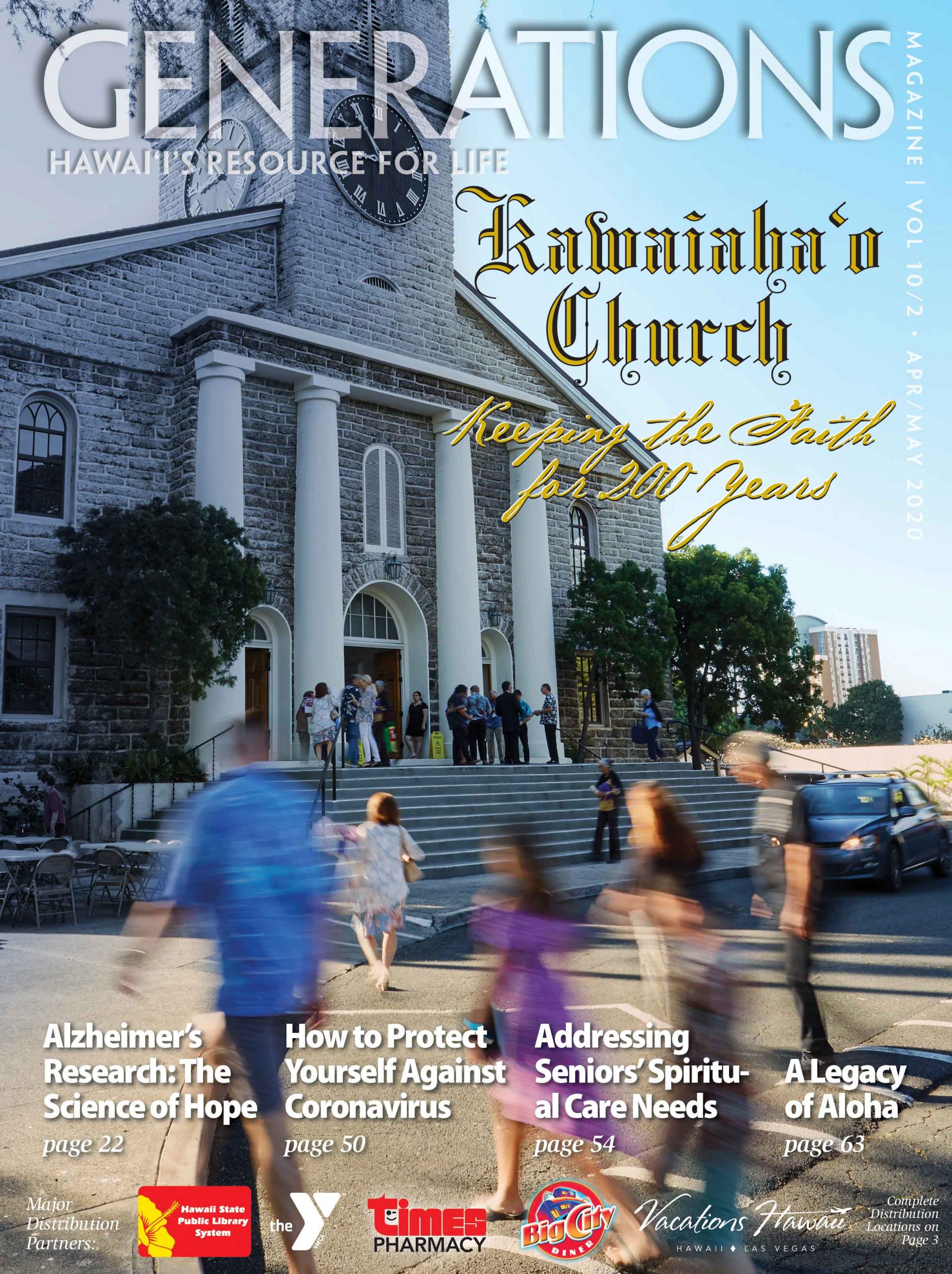
  • Kawaiahaʻo Church – Keeping the Faith for 200 Years

    Kawaiahaʻo Church – Keeping the Faith for 200 Years

    So was the faith of one Hawaiian youth who fled tragedy in 1810 and wound up in Connecticut, where he found consolation and forgiveness in the God of Jacob. His name was Henry ‘Ōpūkaha‘ia. The seed of his faith brought Christianity to Hawai‘i in 1820.

    In his epic historical novel Hawai‘i, James A. Michener created fallible heroes and villains who have lived in our memories for over 60 years now. But when the missionaries are interpreted in the norms of their times, the tenets of their beliefs, we see their abiding faith to bring the gospel of peace to Henry Ōpūkaha‘ia’s people. The fruits of their labor persist, and in 2020, we celebrate 200 years of teaching God’s word and singing sacred hymns that inspire faith, hope and love.

    Today, Kawaiaha‘o Church is pastored by Rev. Kenneth Makuakāne, who says, “God has worked in so many hearts and lives over the past 200 years and  we are so proud that Kawaiaha‘o Church has been instrumental to the growth of the Christian faith here in Hawai‘i. The bicentennial is a good opportunity to reflect and better understand the relationships between the ali‘i, maka‘āina and missionaries.”

    Carrying a Seed of Faith to Kawaiaha‘o

    To understand what has been accomplished here, we go back to Kawaiaha‘o in King Kamehameha’s kingdom. It was an ‘ili land section of the Mānoa ahupua‘a and the name of a watering hole and spring on the dry plain above Waikīkī. Legend says a chieftess named Ha‘o liked to bathe here. In April of
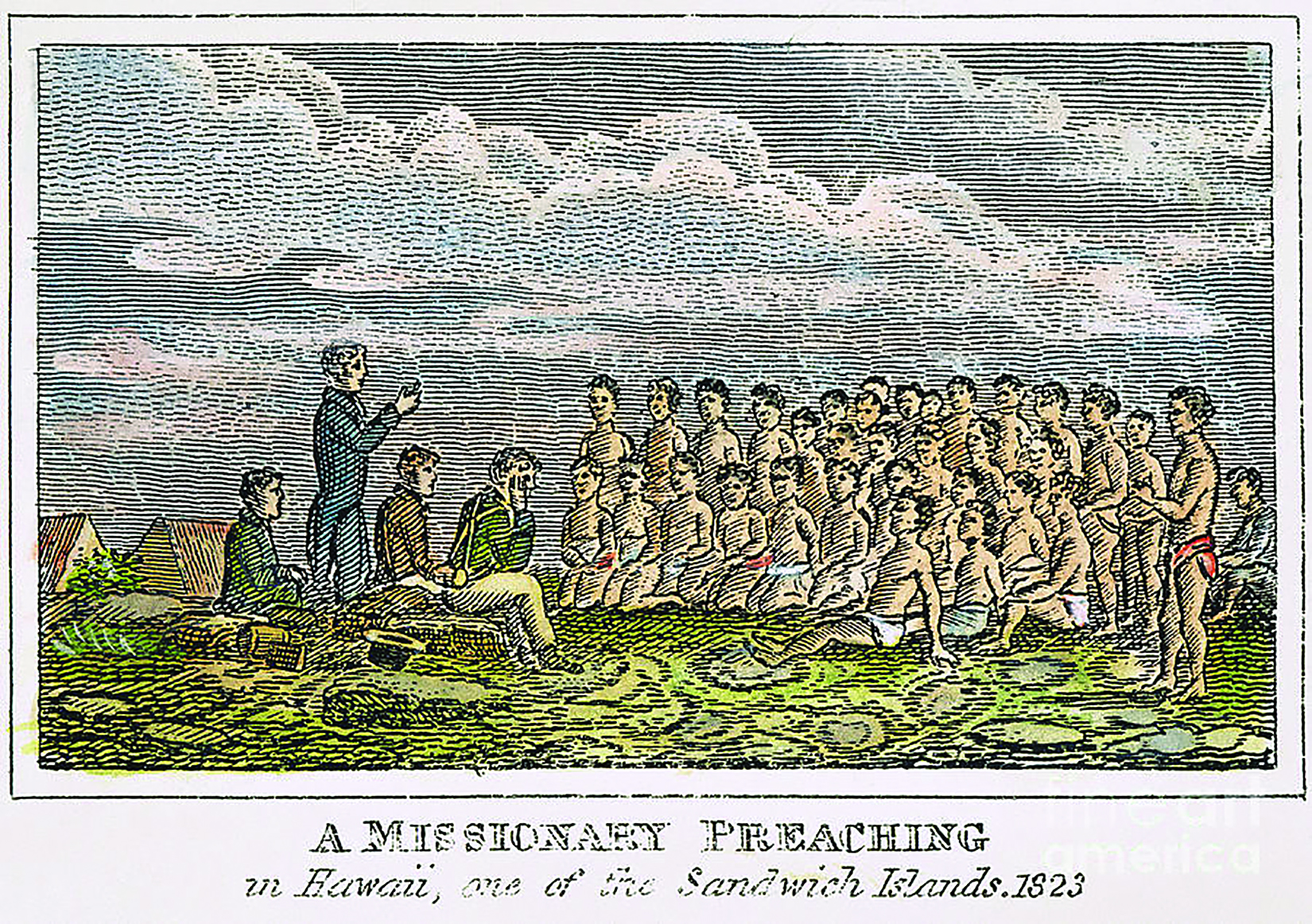
    1820, when young newlyweds Hiram and Sybil Bingham arrived in Honolulu with the first company of missionaries from the American Board of Commission for Foreign Missions (ABCFM) on the brig Thaddeus, the ali‘i allowed them to stay and build a hale at Kawaiaha‘o spring.

    They endured a five-month voyage that left Boston in October 1819, sailing down the Atlantic coast of the Americas to Cape Horn and then northwesterly across the open Pacific to the Sandwich Islands. Seven missionary couples included four ministers, a farmer, a doctor and a printer. Their four young Hawaiian companions were returning home from New England, where they ended up after working on trading ships: William Kanui, Thomas Hopu, John Honoli‘i and George Kaumuali‘i, a son of the King of Kaua‘i. Missing was Heneri (Henry) ‘Ōpūkaha‘ia, who died of typhus fever in 1818 at age 26, without seeing his beloved homeland again.

    When Henry was 10, a raiding chief killed his parents. The chief threw a spear at Henry, who was fleeing with his 3-month-old brother on his back. The spear killed the baby and spared Henry. He was taken in by the man who killed his parents, but ran away to his uncle, the kahuna at Hiki‘au heiau in Kailua. There he began training to care take the temple, but his grief led to despair. Soon, he talked a ship’s captain into taking him away from Hawai‘i. The boy, who carried the name “gutted belly,” left for the sea at the age of 16 and ultimately landed New Haven, Conn., living in the home of the cousin of the head of the Yale Christian seminary.

    Hea Iesū Ia Kākou La
    (Jesus Calls O’er the Tumult)

    Until about 1816, Christians believed that underdeveloped peoples without written language were not able to receive the “Word of God” because they could not read the scriptures themselves. A tenet of “freedom of Christ” championed by Martin Luther during the Reformation was that God speaks directly to the individual through the Bible, prayer, circumstance and conscience. But Henry, and a few other Hawaiians and Native Americans, were learning to speak English! Henry’s academic aptitude became the flash point for the founding of the first Foreign Mission School in 1816.

    His culture’s oral tradition taught Henry ‘Ōpūkaha‘ia to listen carefully and memorize large amounts of data. This avid learner read scripture and chose Jesus Christ as his savior. The seed of his faith grew and he passionately lobbied that the gospel should be preached to his people in Hawai‘i. After his untimely death, his memoir was published by Edwing Dwight and sold to support the Hawaiian mission.

    Passengers on the Thaddeus expected to find the Hawai‘i Henry left: raiding warriors killing children and adults, chaos and depravity, human sacrifice to the gods. They came to face hell — to share the good news of peace with God at the expense of their very lives.

    Instead, in March 1820, as they sailed along West Hawai‘i toward Kawaihae, High Chief Kalanimoku and his wives approached in their double-hull canoes. But it was not a raid; it was their custom to greet all arriving ships to determine where they hailed from and what their intention might be. As the welcoming party paddled off, surprised and thankful Revs. Bingham and Thurston climbed up the rigging and joyfully serenaded them with a hymn.

    After uniting the islands, Kamehameha the Great reigned in peace, outlawed ambushing and murder of travelers, and refused human sacrifices when he was sick and dying. He passed away in May 1819. The kapu system was customarily suspended to mourn his passing. When the new king, Liholiho, Dowager Queen Keopuolani, Queen Regent Ka‘ahumanu and High Kahuna Hewahewa chose not to reinstate it, the old kapu religion of Pā‘ao and the Tahitians was gone. Before the Thaddeus arrived, the harsh kapu rules were lifted, large carved ki‘i of the old gods burned and heiau closed. Henry ‘Ōpūkaha‘ia would have been gratefully surprised to see Hawai‘i at peace.

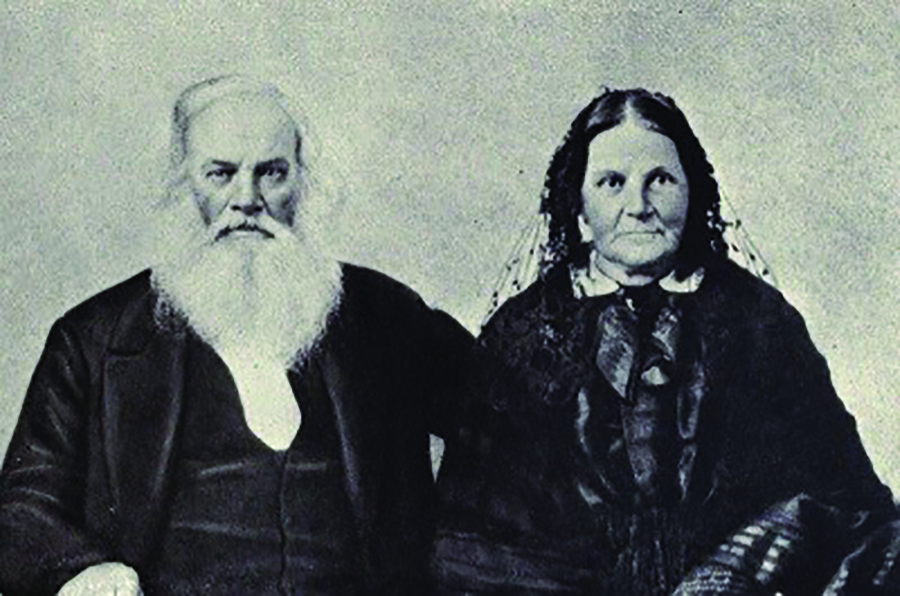
    Reverend Asa & Lucy Thurston
    Reverend Asa & Lucy Thurston

    The missionaries sought out King Liholiho for permission to live in Hawai‘i. After some days of consideration, the chiefs allowed Rev. Asa and Lucy Thurston to reside in a home in Kona. A few days later, Rev. Hiram and Sybil Bingham sailed on to O‘ahu, where they were permitted to build a thatched hale by a spring hole named Kawaiaha‘o. At the first Sunday worship services in their home, curious Hawaiians enjoyed curious foreign music and singing. Soon, Bingham was preaching God’s word three times a week in Hawaiian and once a week in English. Henry ‘Ōpūkaha‘ia’s Christian brothers and sisters were fulfilling his one dying wish.

    Reverend Hiram & Sybil Bingham
    Reverend Hiram & Sybil Bingham

    When Kawaiaha‘o was growing and Ka‘ahumanu’s laws were enacted, Lāhainā was still the royal seat of government. The high chiefs all had residences in Honolulu, which had a protected port that Kamehameha I had developed for sandalwood trade with Canton and Macao. A small fort and canon protected the pier, storehouses and royal residences near the dock. Some whaling captains brought their ships and crews in for provisioning, but most preferred anchorage in Lāhainā Roads, where alcohol was prohibited.

    An 1810 map shows footpaths along the Waikīkī plain connecting high chiefs with their lower chiefs and advisors. Behind the beach and dry plain, cooler farmlands reached up to the lush valleys of Mānoa and Nu‘uanu, where the nourishing waters of Kāne, the god of life and fresh water, flowed.

    Pā Nahe Maila Kō Iesu Kāhea
    (Softly and Tenderly, Jesus is Calling)

    Each of the missionaries had responded to the personal call of God. The curious young newlyweds, 5,000 miles and three climate zones away from home, prayed that God would speak directly to the hearts of Native Hawaiians. To this end, they worked diligently to convey the holy scriptures in Hawaiian. Christians can demonstrate the love of God by their pious lives, but knowledge of the living and invisible God comes from reading what God says about Himself in the holy scriptures.

    First, they captured all the sounds of spoken Hawaiian in an alphabet that could be used to phonetically write Hawaiian words. Soon, classes were offered to teach Hawaiians to write their own words on chalkboards. Writing letters became all the rage in 1825. By 1837, The Hawaiian Kingdom was the most literate nation on Earth. Literacy estimates were 90 percent — higher than Scotland’s at that time. Missionary printing presses furiously stamped out spelling books, hymnals, dictionaries and newspapers. The Hawaiian’s thirst for learning was unquenchable.

    The next giant task was to translate the Bible, so Hawaiians could read and interpret the scriptures themselves. The Hebrew, Latin and Greek training that the missionaries received in seminary helped, and the ali‘i designated Native Hawaiian poets and scholars to assist in the translation process. The New Testament was translated by 1832; the Old Testament by 1839. The translators were surprised to find similarities between Hebrew and Hawaiian languages, which made translating the Old Testament easier than the new.

    With reading and hearing the soft and tender call of the Lord, some high ali‘i accepted Christ, beginning with Queen Keopuolani in 1823, Queen Regent Ka‘ahumanu in 1824 and many more in the later 1920s. But the “Great Awakening,” a massive move of the Holy Spirit, didn’t start until 1837. Most of the smaller congregational churches were built between 1840 and 1860.

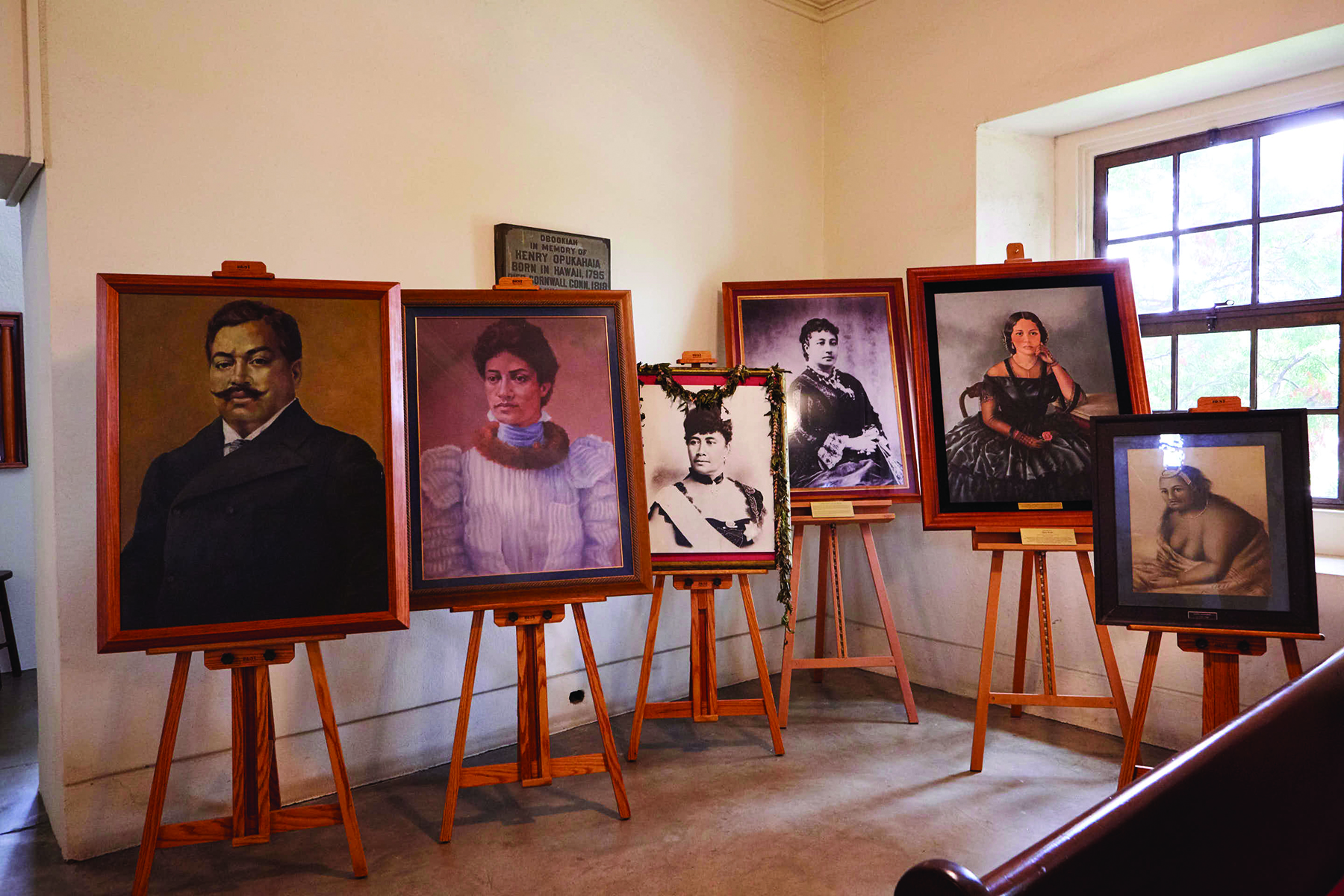
    Portraits of Hawaiian royalty are honored and respectfully displayed in Kawaiaha‘o Church. (L–R) Prince Jonas Ku¯ hio¯ Kalaniana‘ole, Princess Ka‘iulani, Queen Lili‘uokalani, Princess Bernice Pauahi Bishop, Princess Elizabeth Keka‘aniau and Queen Ka‘ahumanu.
    Portraits of Hawaiian royalty are honored and respectfully displayed in Kawaiaha‘o Church. (L–R) Prince Jonas Kūhiō Kalaniana‘ole, Princess Ka‘iulani, Queen Lili‘uokalani, Princess Bernice Pauahi Bishop,Princess Elizabeth Keka‘aniau and Queen Ka‘ahumanu.

    Iesū Ke Kumu o Kōna Ekalesia
    (The Church’s One Foundation)

    As an increasing number Native Hawaiians attended services, large thatch meeting houses were constructed at Kawaiaha‘o. The faithful walked miles to Sunday Sabbath meetings that lasted several hours and involved sharing hymns, lessons and meals.

    Most of the missionaries kept detailed journals of their experiences. Titus Coan penned one of the earliest descriptions of a volcanic eruption and a flow that nearly reached Hilo. Hiram Bingham described services at Kawaiaha‘o Church, the translation work and the royal school for ali‘i children. Lucy Thurston wrote about her life in Kailua. When she found a lump in her breast, a physician operated to remove it as she lay on her kitchen table, comforted by God, whiskey and something hard to bite on. Her extreme faith and courage saved her life.

    In 1827, Rev. Bingham reported to the ABCFM about a lovely garden tea party Mrs. William Richards from Waine‘e mission and her sister, Sybil Bingham, prepared for the ali‘i on the lawn at Kawaiaha‘o. King Liholiho and Ka‘ahumanu, with all the first- and second-rank high chiefs and several others connected to them through marriage, were on the guest list.

    Rev. Bingham’ report read: “Twenty-one chiefs of the Sandwich Islands mingling in friendly, courteous and Christian conversation with seven of the mission family whom you have employed among them. Contemplate their former and their present hopes. They have laid aside their vices and excesses, their love of noise and war… the privileges they now enjoy, but you will hear these old warriors lamenting that their former kings, their fathers and their companions in arms had been slain in battle or carried off by the hand of time before the blessed Gospel of Christ had been proclaimed on these benighted shores.”

    To celebrate the bicentennial, Kawaiaha‘o Church is holding another tea party on the church lawn — complete with cookies and cakes, fragrant tea and entertainment by the Puamana trio.

    Hoe Amau! (Pull For Shore)

    Sunday services at Kawaiaha‘o attracted thousands of people, a third of whom sang from their own copy of the hymn book, bound in hand-woven or cloth covers. Rev. Bingham admired their pleasing attention to scripture reading and preaching, “while angels wait to witness the effect of the word of God on their hearts.” His work to make the word of God available to Hawaiians was hard but very rewarding.

    As the congregation grew, so did the church. The 1821 Kawaiaha‘o meeting hall was a thatched hale with glass windows, wooden doors and a pulpit, but the congregation sat on mats on the ground, as was the Hawaiian custom. Larger meeting halls were subsequently built to accommodate a Sabbath Day service for 3,000 or 4,000 attendees, and numerous reading and writing classes.

    In 1838, Rev. Bingham planned and oversaw the beginning of construction for the novel “Stone Church,” as it came to be called, with a design based on the Goshen Congregational Church in Goshen, Conn., where he and Asa Thurston were ordained. The difference was that it was not built from any type of stone, brick or wood, but 14,000 slabs of inshore coral. Divers cut out each 1,000-pound slab with knives and teams of men hauled them onto canoes for transport to Kawaiaha‘o. It took great energy and over five years to build. King Kamehameha III commissioned the building with the support of Regent Kina‘u, Gov. Kekuanao‘a and other ali‘i. In 1839, the cornerstone was laid — rock from the Waianae estate of High Chief Abner Pākī.

    Rev. Bingham never saw the church completed. The ABCFM reassigned him to New England in 1840 because the board thought that he had become too involved with political aspects of the Hawaiian Kingdom. The success of the mission and the rising costs of supporting over 200 missionaries in the Pacific led the board to limit support. Pastors were taking side jobs to support their families. By 1863, support ended and missionaries had to either find full employment in Hawai‘i or return to America. Many chose to stay.

    Ka Haku Nō Ku‘u Pu‘uhonua
    (A Shelter in the Time of Storm)

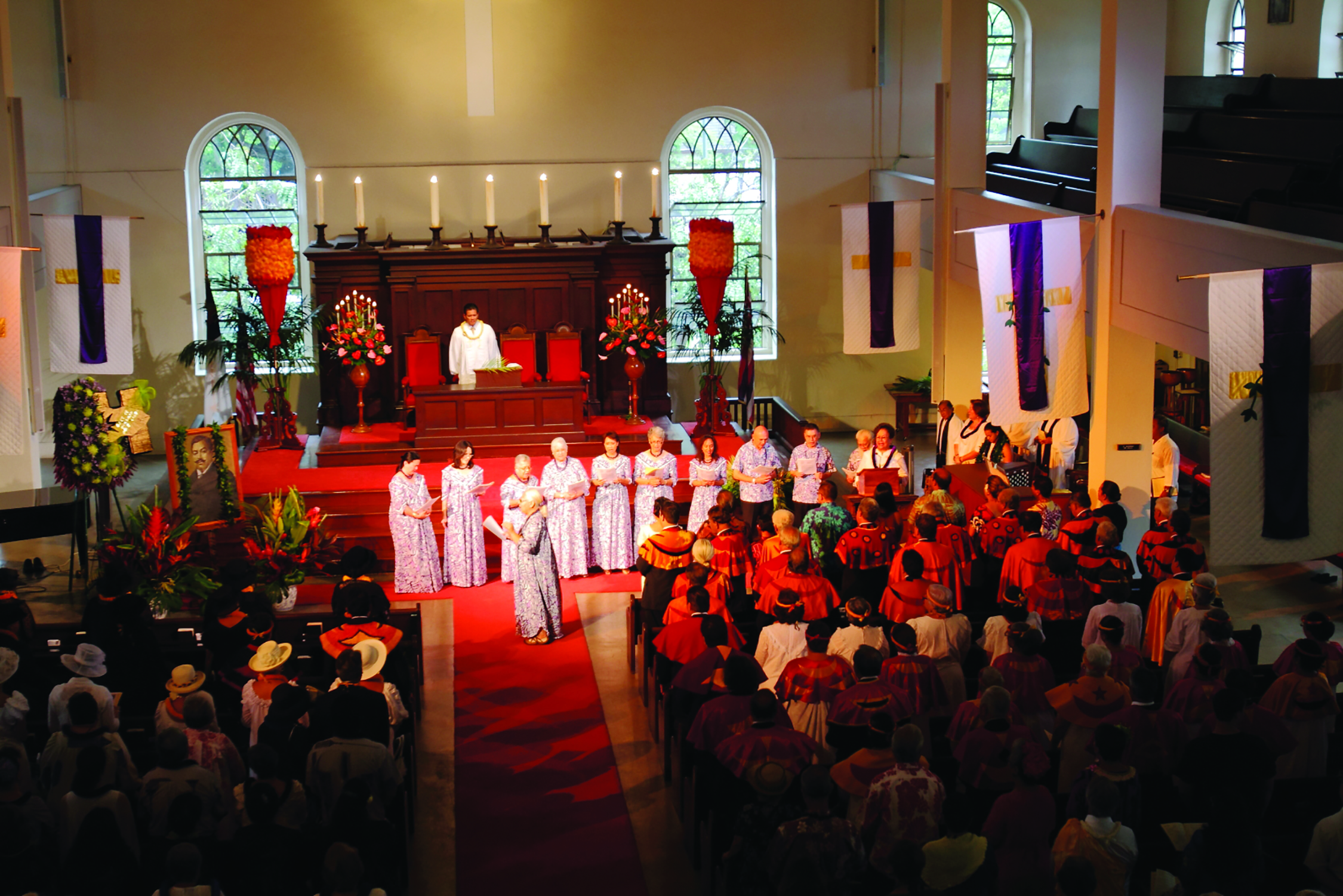
    Christian churches have always been places of refuge since the apostles formed the first seven churches. Pre-contact Hawaiians set aside certain lands as sanctuaries for the oppressed and understood this concept very well. During the reign of Kauikeaouli Kamehameha III, Kawaiaha‘o became a place where kings and commoners gathered in the shelter of their God and fellowship of other Christians. This tradition continues today.

    “‘Ōlelo Hawai‘i was the language of Kawaiaha‘o and it is still a significant part of worship. We have scripture readings in ‘ōlelo Hawai‘i, manaleao and fluent speaker communities in both languages, sermonettes in ‘ōlelo Hawai‘i, and two Sundays a month, “Ka Halawai” all-Hawaiian services,” says member Malia Ka‘ai-Barrett.

    In 1843, when Kauikeaouli moved the royal seat of government to Honolulu. Kawaiaha‘o Church became the site of many milestone events of the Hawaiian Kingdom constitutional monarchy. In February 1843, when Lord Paulet and his men took control of the Hawaiian Islands for Britain under threat of force, Finance Secretary Dr. Geritt Judd secretly scribed the king’s letter of protest to Queen Victoria. Hiding in Queen Ka‘ahumanu’s crypt in the graveyard and writing by the light of a single candle, he asked Britain to return sovereignty to the Kingdom of Hawai‘i.

    Seven months later, when sovereignty was restored by Admiral Thomas, it was from the steps of Kawaiaha‘o Church that King Kauikeaouli addressed the nation and spoke these famous words: “Ua ma au ke ‘ea o ka ‘āina i ka pono! The life of the land is perpetuated in righteousness!” In 1959, his words became our state motto.

    Other beloved ali‘i nui of Hawai‘i were members of Kawaiaha‘o: Charles Lunalilo, David  Kalākaua and Lydia Lili‘u Loioku Walania (Queen Lili‘uokalani) were all inaugurated as monarch at Kawaiaha‘o.
    In the 20th century, King Kalākaua initiated the preservation of traditional culture. He is most remembered as “The Merry Monarch” for his love of hula, chant and music. But he also created a knowledge base of genealogies, mele, kaona and nā mea hūnā in the Hale Nāua. Over 25 Hawaiian language nū pepa (newspapers) memorialized Hawaiian syntax and grammar, so we can read the original language today.
    Throughout the years of overthrow, annexation and statehood, Kawaiaha‘o was a “city of refuge,” where Hawaiians could meet, socialize freely, and pray in sing in their native tongue. In her darkest hours of house arrest, Queen Lili‘uokalani practiced the Christian faith and wrote in The Queens Prayer hymn, “Do not regard the treachery of men, but forgive and cleanse.” She encouraged her people not to revolt and risk bloodshed, but to rise to the power of aloha.
    There is little doubt that the missionaries’ Hawaiian pīāpā alphabet, schools for reading and writing, and printing presses helped preserve not only the language — but a body of literature and knowledge.
    Mele Au Ka Lono Lani
    (I will Sing the Wondrous Story)
    Music with scriptural lyrics is an important way the Kawaiahaʻo Church shared God’s word.  Missionaries and their church members translated their hymns into Hawaiian; members taught the songs to their children. God spoke through the uplifting words and it was said that choirs were good in all the Hawaiian churches, but “congregational singing at Kawaiaha‘o thrilled the heart.”
    Over two centuries, several famous Kawaiaha‘o musicians and singers found renown. Victoria Kamāmalu Ka‘ahumanu IV played the melodeon and led the choir. Later, Queen Lili‘uokalani, who composed The Queen’s Prayer and Aloha ‘Oe, played the organ and led the choir. The first leader of the Royal Hawaiian Band, Heinrich “Henri” Berger, who composed Hawai‘i Pono‘i, led the Kawaiaha‘o choir and delighted in the Hawaiian talent for singing. He said, “The Hawaiian had the one thing he needed, his voice… and the Hawaiians combined the old chant with the new hymn.”
    Bernice Pauahi Bishop, the founder of Kamehameha Schools, sang in the Kawaiaha‘o choir like her mother before her, Laura Konia Pākī. Her beloved “song contest” concept comes from the church “Aha Hīmeni.” On each island, every church choir would prepare a hymn to perform for the others. The competition was hot, but most delightful was the fellowship and pā‘ina luncheon with all the vocalists and musicians.
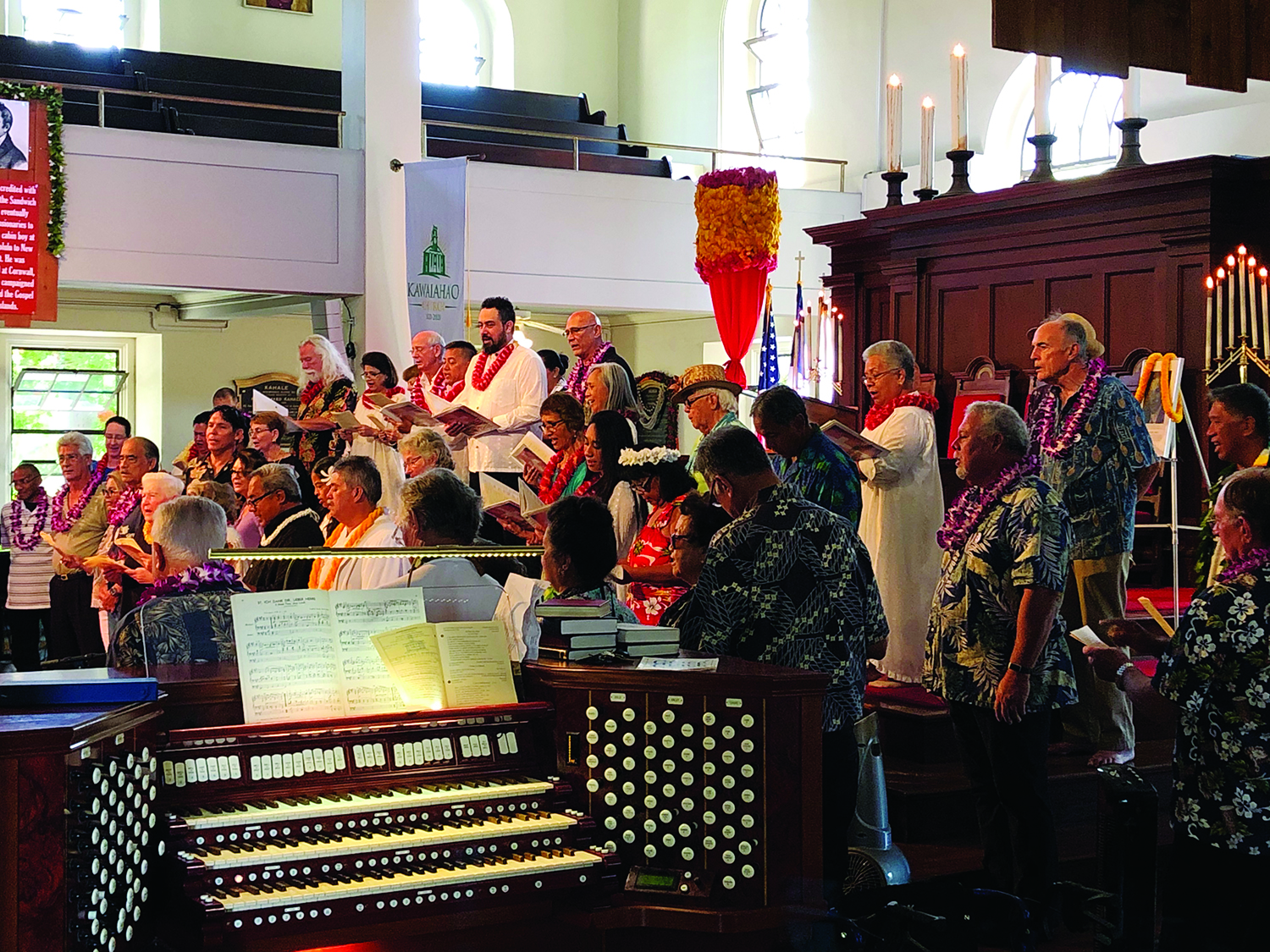
    Today, sacred music still brings stirs faith in the hearts of people attending services at Kawaiaha‘o. Principal Director of Music Nola A. Nahulu oversees programs for a large choir, a bell choir directed by Phyllis Haines and Hula Hālau o Kawaiaha‘o, directed by Kumu Hula Ardis Gomes. The church also supports the Hawaii Youth Opera Chorus (HYOC) managed by Kawaiaha‘o member Malia Ka‘ai-Barrett.
    Kahu Makua Kenneth Makuakāne, a recognized vocalist and guitarist, pastors this big church with the help of a devoted team of church lay leaders.
    “God is alive and well here through our ministries at Kawaiaha‘o Church School, youth ministries, outreach to the homeless and more. We want Kawaiaha‘o Church to continue to stand as a pillar of faith in our community, a church without walls, and a place where everyone feels welcome to worship,” says Pastor Makuakāne.
    For 200 years, the congregation has been faithfully singing songs to the triune God, Ka Makua Mau, Ke Keiki a me Ka Uhane Hemolele (Father, Son and Holy Spirit) They read the same word of God that inspired Henry ‘Ōpūkaha‘ia. They preach and teach the same simple faith in God that brought the missionaries to his ancestors’ shores. It is the same faith that inspired Peter Galuteria to compose a new hymn for the 200th anniversary celebration — Ka Ekalesia O Kawaiaha‘o, which will be sung in all the United Churches of Christ throughout Hawai‘i during the month of April.
    Lā Maika‘i! (O Happy Day!)
    So was it the Americans who brought Christianity to Hawai‘i? Sort of. But were it not for the powerful encouragement and passionate faith of one young Hawaiian — and the amazing grace of God to grant his dying wishes, we would not be celebrating with Kawaiaha‘o this year. I believe that Henry is still praying for his people.
    A few weeks ago, another 16-year-old reported his reflections about the story of Henry ‘Ōpūkaha‘ia to the Kawaiaha‘o congregation. His name is Noah Rasor.
    “When I found out that Henry was just 16 years old when he jumped on board a ship looking for a new life, I was amazed. I’m 16 and can’t imagine the amount of courage it must have taken to get on a large boat with people you never met before and ask for refuge. Not only that, he sailed to the Americas and China. Knowing that ‘Ōpūkaha‘ia was able to overcome adversity and change Hawai‘i forever, despite being so young, encourages and inspires me to go out in the world and to not be afraid of challenging situations , but instead to face those scenarios head-first.”
    Henry ‘Ōpūkaha‘ia is still encouraging and inspiring young Christians like he motivated the missionaries! This faith, which traces back over 2,000 years to the first disciples of Christ, still kindles kindness, joy and thankfulness at Kawaiaha‘o.

    Please note: The Kawaiaha‘o Church community is suspending services and gatherings, and the Bicentennial Celebration during the pandemic. Visit www.kawaiahao.org for future schedules and advisories.


    In his epic historical novel Hawai‘i, James A. Michener created fallible heroes and villains who have lived in our memories for over 60 years now. But when the missionaries are interpreted in the norms of their times, the tenets of their beliefs, we see their abiding faith to bring the gospel of peace to Henry…

  • Choosing Peace: Our Care, Our Choice

    Choosing Peace: Our Care, Our Choice

    {Play}We are compassionate people who avoid pain and go to great lengths to protect our loved ones from suffering. So why is there controversy about Hawai‘i’s Our Care, Our Choice Act, the aid-in-dying law that allows terminal patients to have medications that will ensure a peaceful passing?

    One night sticks in my memory. Mild-mannered Pete had an aggressive brain tumor that slowly paralyzed him; no therapy would cure it. His wife, Carole, was a genius at finding ways to overcome his growing disabilities — taking him out for lunch,
    to concerts or playing with the grandkids. Pete never experienced the crushing pain I saw with patients on chemotherapy.

    One evening, Carole called and told me Pete’s breathing sounded like gurgling. I rushed to the house to help; I knew the end was near.

    It’s impossible to know what to do or say, but being with loved ones seems to help. Hospice was at the house to ensure Pete was not experiencing pain. His frail chest rose and fell at a rapid pace as he struggled for air for over an hour. Our priest came in and performed the last rites. Pete kept hanging on.

    The family could do nothing but watch him struggle. Even in his delirium, Pete was fighting death to the end. Hospice gave him more morphine and finally the death throes stopped — the first silence in many hours. Tears gave way to funeral preparations and paperwork. Eventually, Carole and the kids’ memories healed; consolation came.

    I don’t have children and won’t be able to afford skilled nursing, so I plan to die at home. Last year, arguments for “dignity in dying” and others against “assisted suicide” honestly confused me.

    Quality of life is my focus. I am in my 70s, and over the summer, I injured my back and couldn’t walk. Physical therapy cured my back, but being disabled for a while made me seriously consider how I would handle being dependent on others for daily care. Will I choose to fight a terminal disease to the last breath like Pete? Not a chance; I am a lover, not a fighter. I’d really like to die in my sleep, peacefully, like my mom did. Can I do that?


    What “Choice” Are We Talking About?
    Getting at the facts about our Hawai‘i law…

    “Compassionate Choice,” “Medical Assisted Death,” “Assisted Suicide” and “Dignity in Dying” are ways people refer to aid-in-dying laws in many states that allow terminal patients to avoid suffering when they die. The various names reflect deeply held feelings people may have about death, dying or end-of-life. Even between friends, the taboo topic is oven avoided, because bringing it up unleashes our worst fears and saddest memories.

    Generations Magazine believes that our readers can only plan for the future and live well if they have all the facts. Smart seniors manage to live independently, enjoy life and prepare themselves for the future, whatever it brings. Akamai seniors also need to consider their options based on Hawai‘i’s recently enacted aid-in-dying law.

    So we found people with the most information about Hawai‘i’s Our Care, Our Choice Act (OCOCA), which has been in effect since Jan. 1, 2019. You can decide the pluses and minuses, understand the knowns and unknowns, and read the facts about how the law is working after its first year in practice.

    Let’s start with an interview with the daughter of a terminally ill woman who used medical aid-in-dying via the OCOCA last year. Kim McAden was very sad to lose her mom, but was glad to be able to honor her mother’s decision to stop prolonging her suffering once there were no more options for a cure.


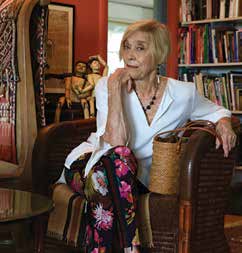
    The amazing Jeanne Elder (below), age 80, plant designer and owner of Exclusively Bromeliads, sits in her favorite chair in her home in Kane‘ohe, posing for a photo for her daughter. Born on a farm in North Carolina, Jeanne raised her family as a Navy wife, while forging a design career in Miami. Divorce, intelligence and passion led her to new horizons in Hawai‘i — beloved mother, successful businesswoman and world traveler.
    The amazing Jeanne Elder (below), age 80, plant designer and owner of Exclusively Bromeliads, sits in her favorite chair in her home in Kane‘ohe, posing for a photo for her daughter. Born on a farm in North Carolina, Jeanne raised her family as a Navy wife, while forging a design career in Miami. Divorce, intelligence and passion led her to new horizons in Hawai‘i — beloved mother, successful businesswoman and world traveler.

    The Passing of Jeanne Elder,
    Easter Sunday, 2019
    An interview with her daughter, Kim McAden

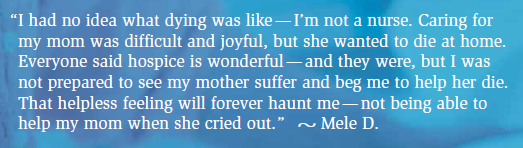
    “My mother, Jeanne Elder, always had this in her mind since the 1970s. She did not want to be disabled by a terminal disease. I think she didn’t want to be trapped and unable to make her own decisions — particularly if there was no hope for recovery.

    “When my mom was diagnosed with melanoma three years ago, the disease had already escaped the lymph nodes. She went through immunotherapy on O‘ahu and in San Diego. The side effects she suffered were very troubling for her and for us.

    “In January 2019, she had pain in one arm and found the disease had metastasized to her spinal cord. By the end of  February, the cancer progressed and she could walk no longer, but she was not ready to quit. ‘I will still fight,’” she said.

    “By April, Mom felt she had lost her battle with cancer. She didn’t want to leave us, but with melanoma winning, she decided to participate in the Our Care, Our Choice law enacted January 2019. I remember what she said: ‘This needs to happen. I am a resident of Hawai‘i and this is my decision. It’s the law; they have to let me do this.It is my decision.’

    “As her caregiver, I encountered many problems carrying out her wishes under the new law. I was her advocate and my e experience as a purchasing manager for biotech companies gave me the sourcing skills I needed to help her, but everyone in this situation may not have these skills.

    “The Social Worker Association of Hawai‘i was outstanding — they admitted that my mom was their first patient seeking a psychological evaluation for an OCOCA prescription. They offered to put out feelers to their members on Facebook and by email. The in-home psychological evaluation they lined up helped qualify Mom for OCOCA and I cannot emphasize enough what a kindness this assistance was to our family.

    “Mom’s attending oncologist also faced uncharted territory with my mother’s case. After much soul searching, he worked with his staff to create new policies and protocols concerning medical aid-in-dying. When they were in place, he visited my mother at Hospice Hawaii for a final evaluation. It was comforting to know we had his support. We will be eternally grateful for his love and care.

    “Jeanne Elder was a charming, adventurous, passionate, beautiful, independent woman. She fought against the stereotypes beautiful woman face and enjoyed great respect. She owned a successful business and a beautiful home; she took great joy in traveling the world.

    “I wish everyone could understand how peaceful my mom’s passing was. She never lost her dignity. In her bedroom were family, friends, flowers and music. She passed in 30 to 45 minutes. She fell asleep in about 10 minutes and had just a little labored breathing, but her death was very peaceful and beautiful. I feel like she’s a part of all of us now.

    “For readers who are family caregivers and advocates, I encourage them to honor and respect their loved one’s wishes. Be strong, take one step at a time and don’t get overwhelmed. Download all the information you can, ask questions and expect things to change every day. If the pressure gets too great, it’s okay to back out or take a rest — but do try to find someone to take your place. I think this goes for all family members and attending medical staff. There are lots of support resources for you — you are not alone. May your path forward be filled with peace and love, knowing your loved one’s wishes were honored.”

    Kim recalls her mother’s zest for life as she sits in her mother’s chair.
    Kim recalls her mother’s zest for life as she sits in her mother’s chair.

    Is Our Care, Our Choice About Avoiding Pain?
    Pain is not what I am worried about…

    Our first inclination is to think of medically assisted death as a way to avoid pain. But in fact, doctors today have many medications to treat pain. The main service hospice provides is “palliative care,” which does not necessarily treat the condition, but keeps the patient comfortable and controls pain.

    Nevertheless, hospice professionals point out that terminal patients suffer two more things — the debilitating outcomes of their disease and the effects of the curative therapies they undergo, such as surgery, chemotherapy or radiation. Convulsions, incontinence, tremors, hallucinations, disabilities and increasing dependency can rob patients’ dignity. Doctors and hospice nurses will try to modify these problems, but what the patient might consider good quality of life may not return.

    Some patients will resign themselves to decline and embrace death. Others deny the inevitable and fight for every last breath. Until last year, a terminal patient’s only options were to discontinue medications and efforts to keep them alive on machines. And the only way they could hasten their death was to refuse water and food.


    OCOCA Patient Zero Advises,
    “Plan Your Peace”
    An interview with John Radcliffe, former lobbyist and business owner…

    The first terminal patient in Hawai‘i to request a prescription for OCOCA medications to induce sleep and death is still living and able to give us guidance! I call him “Patient Zero.” John Radcliffe was diagnosed with terminal stage 4 cancer in June 2014. When he heard that an aid-in-dying bill was proposed at the Hawai‘i Legislature, he stepped out of retirement to exercise one of his talents — lobbying. John’s passion for the right to legally choose how and when he would die ran deep. He wanted to help extend that choice to everyone while fighting his own terminal cancer. His advice to patients facing death is to take action and plan your end-of-life while you can.

    “I had ‘inoperable cancer’ and they gave me six months to live,” says John. “No law would allow me to choose a peaceful death if my suffering got to be too intense. If I wanted to die at home, there was no way to protect my loved ones from watching me struggle and suffer at the end.

    Advocacy for OCOCA crested when hematologist-oncologist and palliative care expert Charles Miller, MD, became the attending physician for a terminally ill patient, professional lobbyist John Radcliffe (left). Two old family friends joined the fight to give everyone in Hawai’i the legal option of medical aid-in-dying. The legislative act became law a year ago.
    Advocacy for OCOCA crested when hematologist-oncologist and palliative care expert Charles Miller, MD, became the attending physician for a terminally ill patient, professional lobbyist John Radcliffe (left). Two old family friends joined the fight to give everyone in Hawai’i the legal option of medical aid-in-dying. The legislative act became law a year ago.

    “Chemotherapy was rough, but when I felt good enough, I helped push the various aid-in-dying bills in the Hawai‘i’s House of Representatives and Senate. And what do you know? When the law passed, I was still alive — after over 80 rounds of chemo! So I was the first terminal patient in the state to begin the process of getting a prescription for the peaceful death cocktail of medications.”

    John is very clear in his advice to newly diagnosed terminal patients with six months or less left to live.

    “Don’t delay! If you believe your diagnosis, get your affairs in order and plan how you want to spend your last days — how, where and with whom you want to die,” he says. “Cancer is unique for every patient — it goes wherever it wants in your body. It’s going to destroy you and nobody can give you advice (but they will try!). Friends insisted I take every herb, root, berry and leaf. But we have excellent healthcare in Hawai‘i, so if you trust your doctors, do what they tell you.

    “It is most important to free yourself of stress and pressure. You don’t know how much time you really have to find a little peace and happiness for your end-of-life. People don’t think about what really counts and how they will die until it’s upon them. I was fortunate to outlive my first prognosis, but I am pretty content now. If things get rough, I have the confidence of knowing that a peaceful death is within my control. I’m not ready today, but I will know the time,” he says.

    John was a teacher in Chicago before he moved to O‘ahu in 1980. A lobbyist and small business owner, he was the perfect terminal patient to “test the waters” and determine if the law would work for the first patient. He already knew Dr. Chuck Miller, former head of hematology and oncology at Kaiser Permanente, and now working part-time in his retirement as an aid-in-dying specialist for Kaiser. Dr. Miller helped advocate for OCOCA by providing our legislature medical data and testimony based on his decades of clinical experience with thousands of terminal cancer patients.

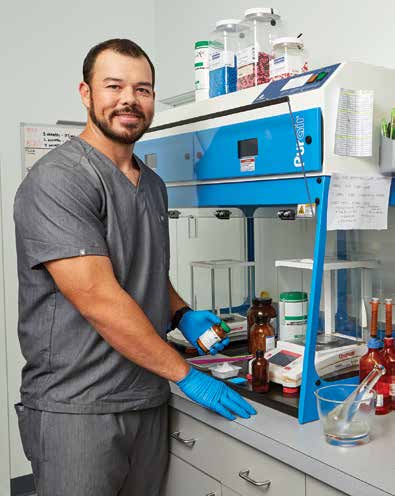
    But after John qualified for OCOCA and Dr. Miller prescribed the approved medications, it took John 60 days to get his prescription filled! By law, the drugs must be formulated by a pharmacist licensed by the State of Hawai‘i to “compound” or mix up the specific combination of medications. Fortunately, ElixrRx in Kailua meets all the state standards.

    When John eventually does choose to use his medications, he will have to take an anti-nausea pill 45 minutes before he drinks the drugs. The powders come in separate vials, so he, a nurse or family member will mix them together and add water. Then, John must drink the medication cocktail himself. A nurse or loved one may help him hold the cup or put a straw in the cup, but he will “administer” the drugs to himself. That’s how the law works.

    In the last four, going on five “bonus” years of John Radcliffe’s life, he has connected with family and enjoyed some of the retirement for which he worked so hard. “A son I never knew I had searched me out. He brought my grandchildren and great grandbabies to visit me! They are a wonderful family, and getting to know them (they all look like me) has brought unspeakable joy,” says John. He says substituting stress with joy has helped him develop a profound sense of gratitude for every day.

    “And in a way, my life is really better than it has ever been,” he says.

    John expresses the contentment medical aid-in-dying can bring to terminally ill patients while they are still living. In Oregon and Washington, a quarter of the patients who receive prescriptions for the medications don’t take them. Just knowing that they have options is enough. So, John Radcliffe’s advice to “plan your peace” is solid.


    Medical Aid-in-Dying is Old News
    Where can I find the official facts for Hawai‘i residents?

    Medical aid-in-dying is now legal in nine states. For 25 years, Oregon citizens have been able to self-administer medications to hasten death. In 1992, Gov. Ben Cayetano’s Blue Ribbon Committee proposed a Hawai‘i Death with Dignity law, but it was defeated by the slimmest of margins. By 2017, support among Hawai‘i registered voters for Our Care, Our Choice was close to 80 percent. Still, the bill was tabled until the 2018 legislative session, when it passed by a wide margin.

    In April 2018, Gov. David Ige signed the Our Care, Our Choice Act. As previously mentioned, the law went into effect just over a year ago. National nonprofit Compassion & Choices, with decades of experience in Oregon and many other states, provided essential data and patient experiences for Hawai‘i legislators to consider. Our law resembles Oregon’s but has added patient safety provisions that reflect our more conservative culture. (CLICK HERE here for online resources.)


    Dr. Charles Miller, MD, Director of the Aid-in-Dying Program, Kaiser Permanente
    Dignity, autonomy, control over my options at my end-of-life — now that interests me…

    Chuck Miller, MD, began volunteering with Compassion & Choices in 2002. He came to Honolulu in 1999, was head of hematology and oncology at Tripler Army Medical Center, and chief of hematology-oncology at Kaiser Permanente. After retiring, he supported Hawai‘i’s OCOCA legislation and now practices part-time at Kaiser Permanente to help administer the aid-in-dying program for terminally ill patients. He explains that his medical opinions are not necessarily the policies of Kaiser, because he is still researching ways to improve OCOCA procedures.

    “I am very impressed with Kaiser and its integrated healthcare system that delivers good palliative care to terminal patients. Every patient is unique, and Kaiser brings together all the medical, social and coordinated hospice support needed for each patient’s individualized journey.

    “People always ask me why people would choose medical aid-in-dying if they’re going to die anyway. Intuitively, we guess it is a move to avoid pain, but doctors have great options for managing pain. Hospice is all about managing pain for terminal patients.

    “What I observe is that medical aid in dying gives people back the control that they lose to their disease. Overwhelming disease and complicated treatments rob their identity, self-worth and autonomy. Terminal disease is the tail wagging the dog, which is the patient family and care team. So, planning out how, when, where and with whom you will die has the effect of restoring autonomy and a sense of control and self-esteem.

    “Experience from 22 years of legal medical aid in dying in Oregon shows us that some patients who ask for the medication don’t take it. We see the same thing in Hawai‘i. This year, a total of 44 Kaiser patients made requests for medical aid in dying; 42 were deemed eligible by the state DOH. Of those, 21 patients received prescriptions and 10 self administered the medications. Another 15 died of their diseases without taking the medication. Still, all had options and felt in control.

    Filling OCOCA prescriptions is a specialty service of pharmacists like Jake Blechta, who is licensed by the State of Hawai‘i for compounding medications.
    Filling OCOCA prescriptions is a specialty service of pharmacists like Jake Blechta, who is licensed by the State of Hawai‘i for compounding medications.

    “The patients I feel bad about are the ones who want the OCOCA option but don’t survive the 20-day waiting period. I can tell at that first evaluation meeting whether the patient is going to live for three weeks. This year, six of my terminal patients died too soon to meet state requirements. I encourage terminally ill patients to plan end of life options as soon as they know they have six months or less to live. Don’t wait. See if your family doctor will support you through end-of-life.

    “The good news is that the Hawai‘i law is working as intended. OCOCA patients experienced peaceful deaths, and there were no incidents of coercion, abuse or medications falling into the wrong hands. Kaiser follows up with OCOCA families and all expressed satisfaction that the patient received the treatment they wanted.

    “It’s so important that family caregivers seek hospice care as loved ones near end-of-life. Hospice services help both patient and family before, and immediately following death. Besides administering pain medications, they interact with the doctor who pronounces time of death, help fill out records and call the mortuary to collect the body. For the sake of your family, engage hospice for terminal patients.

    “If we all tell a friend about what we learned about OCOCA this year, we can offer many more terminal patients this important option.”

    Aid-in-Dying Prescriptions:
    Pharm D Jake Blechta
    ElixRx Pharmacy, Kailua

    So, what will self-administering the aid-in-dying medication really be like?

    After a patient’s request to qualify for medical aid in dying is approved by DOH, his or her doctor prescribes medications that induce sleep and s peaceful death.

    Jake Blechta, Pharm D, owns ElixRx, an independent specialty pharmacy on O‘ahu. In 2019, Blechta filled the most aid-in-dying prescriptions in the state. He is specially licensed to “compound” the prescription for each individual patient, according to legal guidelines.

    “I counsel all my patients how to take their prescriptions, but Kaiser treatment teams have already reviewed drug affects and how to self-administer, so families do not have many questions.

    “OCOCA-qualified patients receive two different anti-nausea pills to take one hour before they plan to drink the main drug. After an hour, they or their caregiver mix the powdered drug compound into six ounces of liquid. They may use any non-dairy beverage the patient is used to drinking — water, juice or even a cocktail — and mix it very well. The resulting liquid is pretty thick and the patient must drink it right down, because I don’t think it tastes very good.

    “Patients can expect to fall asleep quickly, within the first hour, and then pass peacefully in their sleep within four hours. It appears that some patients get the drugs for reassurance and end up not needing to take them,” says Blechta.

    •  •  •

    So there we have it. Death and dying will always challenge us. For some, it is a matter of faith; others want to make sense out of our lives, say goodbyes or make amends. Getting our affairs in order takes many forms.

    Plantation values teach us to prepare for the worst; hope for the best. The days usually roll out somewhere in the middle of what we can handle. If you have loved ones who are terminally ill, support their choices with joy. If you are nearing the end of your life and need help to get your ducks in a row, be sure to share your plans with your loved ones, family and medical team. You may need some assistance choosing your peace.

    Terminal Patients Must Meet the Following DOH Requirements:
    • Hawai‘i state resident 18 years of age or older
    • Diagnosed terminal illness with six months or less to live
    • Able to self-administer the aid-in-dying medication
    • Make two oral requests not less than 20 days apart to your Hawai‘i-licensed attending physician
    • Mentally capable of making a voluntary, informed decision (without coercion)
    • Able to complete one written request and declaration signed by two independent witnesses and written in a specific format
    • Meet the OCOCA criteria with a consulting attending physician and a mental health counselor

    Online Resources
    – DOH: The Our Care, Our Choice Act www.tinyurl.com/DOH-OCOCAInfo
    – DOH Written Request Form www.tinyurl.com/DOHWrittenReqForm
    – DOH Attestation Form www.tinyurl.com/DOHAttestationForm (Medicare can pay for the  medication but only from Hawai‘i state funding.)
    – SHIP Hawaii: 808-586-7299 on O‘ahu, 888-875-9229 on neighbor islands
    – Compassion & Choices Hawaii Resources www.compassionandchoices.org
    – Kōkua Mau Resources www.kokuamau.org

    By Katherine Kama‘ema‘e Smith

    Photography by Brian Suda

    Dying at home can be traumatic for loved ones. We long for a peaceful walk into a beautiful sunset. But most have never seen anyone die and that first indelible experience will stick with us. We may wish to die in our sleep, suffer an accident where we “never knew what happened” or drop dead…

  • The Gift of Food

    The Gift of Food

    Food, the source of life, is central to our Hawai‘i mixed plate of cultures. The fine-dining spots of Waikiki and golf and spa resort eateries throughout the islands accommodate the most discerning palates. In plantation days, Western and Eastern cuisines met at potluck tables. “M-m-m! That’s good! How you make that?” Those words began a century of what foodies now call “Fusion Cuisine,” combinations of exotic ingredients and earthy basics, mixed cooking styles that create an endless variety of tastes and textures. This is what we love. Destinations throughout the world have food traditions — but none have as many as Hawai‘i.

    PHOTOGRAPHS OF HAWAII FOODBANK'S DONATIONS TO DYNAMIC COMPASSIONS IN ACTION/OHANA PRODUCE PLUS AND DCIA/OPP FOOD DISTRIBUTION PROGRAM AT THE WAIMANALO DISTRICT PARK.
    Hawaii Foodbankʻs donations to Dynamic Compassions in Action/Ohana Produce Plus and DCIA/OPP Food Distribution Program at Waimanalo District Park

    Naturally, the gift of food starts with fishers, farmers and ranchers, whose wisdom and toil produce an abundant harvest from the ʻaīna. We know how food gets distributed at the market to people who can afford to buy it. For those who can’t, every day, a network of Hawai‘i nonprofits work together to collect food donations and deliver them to the hungry. They serve seniors on a fixed income, low-income families, disabled persons and homeless persons who may not be getting enough food to sustain health or the energy to work. They help children who may not be getting the nutrition they need to thrive and do well in school. This story explores some benevolent organizations in Hawai‘i that are working hard to distribute food to persons in need. We encourage our readers to celebrate all the volunteers, food producers, wholesale and retail outlets, food service professionals and administrators fighting food insecurity and hunger in Hawai‘i.

    Photo of elderly woman being helped by of Hawaii Meals on Wheels
    Photo courtesy of Hawaii Meals on Wheels

    HUNGER IN HAWAI‘I IS AN ECONOMIC ISSUE

    The United States produces more food crops and livestock than any other nation, yet one in six persons goes without sustenance at least one day a week. Food insecurity affects American families with low income, fixed-income seniors over 65, disabled persons and the homeless population. In Hawai‘i, the poverty rate dropped from 12.5 percent of the population in 2014 to 9.5 percent in 2017 (the latest published statistics). Poverty and anticipation of falling into it are at the heart of food insecurity.

    Food insecurity is a lack of certainty that you can afford enough food to keep you and your family from going without meals. It can be caused by anything that competes for dollars needed for food. It can happen in households where all individuals are employed. In deprived neighborhoods without local food stores, food insecurity is always present. For seniors and disabled persons, mobility problems, cost of medication and availability of assistive care can lead to food insecurity. Resorting to eating less nutritious and smaller portions of food is a common method of making ends meet when bills for housing and prescriptions are due. Add to that the high cost of living in Hawai‘i — the highest in the nation by a good margin — and economic pressures are intense. Experts estimate that 35 percent of all persons over the age of 65 have protein deficiencies and worry about their ability to live independently. It’s easy to see that identifying reliable, free food resources can relieve insecurity, improve health and promote well-being.

    Aloha Harvest picking up donations
    Aloha Harvest picking up donations

    AN INCREASING NUMBER OF SENIORS WILL EXPERIENCE FOOD INSECURITY

    MealsonWheelsAmerica.org reported that 10 percent of seniors live in poverty and face increasing levels of food insecurity. Baby boomers are retiring at a rapid rate, so our fixed-income population is growing. The fastest-growing age group in Hawai‘i is seniors over 80 years old. Seniors in Hawai‘i have the most extended longevity in the U.S., so the number of homebound seniors and disabled persons will also continue to rise. Hawai‘i Meals on Wheels (HMoW) reports that the median age of their clients in 2018 was 86 years for females and 83 years for males. The organization served 99,531 meals to 800 homebound clients. HMoW clients, mostly Asian and female, are unable to shop or prepare meals, and receive limited social contact and caregiving services. Overall food assistance to seniors in Hawai‘i amounted to over 700,000 meals for 6,300 persons. Fortunately, Hawai‘i food assistance charities and agencies that were developed decades ago have the systems, reputation and capacity to expand their services. But expanding requires more money and volunteers. These charities can only continue to grow with help from federal, state and local funding, private donations and people with a heart to donate their time.

    Hawaii Foodbank preparing donated food to distribute
    Hawaii Foodbank preparing donated food to distribute

    WHERE DOES HAWAI‘I FOOD COME FROM?

    Food production in our state is not sufficient to meet all our consumption. In 2012, The Office of Business Economic Development and Tourism (OBEDT) and Hawai‘i Department of Agriculture (HDOA) reported that we import 85 percent of our food from outside the state. Our food supply would only last 10 days if a disaster shut down shipping. Therefore, OBEDT and HDOA recommended a plan to increase food security by increasing local production. It may be surprising to find out that we don’t import only frozen foods and spam. Bananas, mangoes, lemons, every kind of vegetable you can name and even taro come from other places. Hawai‘i also relies on “the barge” to bring ingredients for bakeries and restaurants, packaged goods for convenience stores, food for school cafeterias, hotel kitchens, foodservice companies and food processing plants.

    A good example of our food supply is Love’s Bakery, which siloes enough flour for two week’s production so that it will be able to make baked goods — even if a disaster delays ships. The Hawai‘i Farm Bureau Federation and Farmers Union United, and the University of Hawai‘i Department of Agriculture extension service encourage farmers in rural areas to increase edible crops. On Maui, Mahi Pono LLC plans to grow food crops on 41,000 acres of former Pu‘unēnē Mill sugar lands. Supermarkets offer Moloka‘i sweet potatoes and locally grown tomatoes and fruits that were once only available at neighborhood farmers’ markets. A new generation of poi eaters demands taro products in local groceries. Now that revised sugar mill water diversions allow more normal streamflow, Maui taro farms that were nearly extinct a generation ago, are revitalizing old patches. A growing source of fresh produce is rural homeowners who have orchards and grow small plots of vegetables. In times of high yield, these “gentleman farmers” donate produce to local charities.

    Hawaii Meals on Wheels preparing individual meals.
    Hawaii Meals on Wheels preparing individual meals.

    Another positive trend is increasing consumer demand for fresh and organically grown fruits and vegetables. Hawai‘i Farm Bureau Federation and Farmers Union United are helping local farmers develop small and boutique farms. Locally grown produce tends to be harvested when ripe, yielding the highest concentration of beneficial nutrients, robust texture and flavor. Hawai‘i farmers can deliver local ingredients that tell a story, showcase the chef’s creativity and add nutrition into their menus,

    DISTRIBUTION OF FOOD TO THOSE IN NEED

    Throughout our state, many charities receive and deliver donated food to persons who need it — food pantries, soup kitchens, foodbanks of staples and nonperishable food, meal plan cafeterias, delivered hot meals programs and farmer markets. Support comes from public funds and private donations. Thousands of happy volunteers with good hearts collect, sort, package, redistribute, or serve the food to tens of thousands of clients. These agencies and charities manage the logistics of regular food distribution with a remarkably small but highly skilled and dedicated staff. It would be impossible to name every group, but taking a look at the four largest on O‘ahu reveals how food redistribution and food recovery operations work. In addition to HMoW, Lanakila Meals on Wheels, Hawaii Foodbank and Aloha Harvest are meeting much of the need on O‘ahu.

    Lanakila Meals on Wheels kitchen crew.
    Lanakila Meals on Wheels kitchen crew.

    HOW DOES MEALS ON WHEELS WORK?

    Hawaii Meals on Wheels

    The simple image of an elderly lady accepting a tray containing a hot meal from a Hawaii Meals on Wheels’ (HMoW) volunteer is accurate but far from the big picture of all this agency accomplishes. HMoW partners with 10 kitchens in hospitals and nursing homes on O’ahu to distribute hot meals once a day to 800 homebound clients. Over 400 HMoW volunteers deliver about 100,000 hot meals each year on 53 routes. The areas are close to the commercial kitchen partners so that hot foods arrive hot and cold foods, cold. Poor nutrition and isolation are two of the biggest problems facing the homebound. These stressors can lead to heart disease and cognitive decline — even shorten life as much as a smoking habit or alcoholism.

    Lanakila Meals on Wheels packing individual meals
    Lanakila Meals on Wheels packing individual meals

    HMoW meals must be customized to the client’s medical needs and dietary restrictions by certified dietitians, and designed for taste by professional chefs. Some examples are low-salt, high-fat or low-cholesterol meals. Patients with diabetes or kidney disease need special meals. Others need pureed foods or thickened liquids.

    HMoW volunteers take to the road every day, delivering the gift of food between 9am and noon. Over time, they develop relationships with their clients and become an extra pair of eyes to observe how clients are doing. Volunteers may be the first people to report a client’s illness, change in behavior or serious injury. Any senior who needs a hot meal each day and is unable to warm a meal on their own may apply to the Hawai‘i Aging and Disability Resource Center (ADRC) for food assistance by calling its statewide intake number: 808-768-7700. Food-insecure clients qualify if they are homebound and unable to shop and cook their own meals. Because the number of requests continues to rise, HMoW needs cash donations and volunteers to sustain and grow this valuable program.

    Hawaii Foodbank: Church of the Crossroads Donor Tour
    Hawaii Foodbank: Church of the Crossroads Donor Tour

    If you wish to volunteer at Hawai‘i Meals on Wheels, call its main number: 808-988-6747. You may make donations by mail (P.O. Box 61194, Honolulu, HI 96839) or online at www.hmow.org.

    Lanakila Meals on Wheels

    Lanakila Pacific has provided meals to homebound seniors and individuals with disabilities through its Lanakila Meals on Wheels program for over 48 years. As the largest and only island-wide provider of home delivered meals, Lanakila Meals on Wheels delivers both hot and frozen meals to individuals, six days a week, Monday through Saturday. Most individuals’ meals are paid for through state and federal funds, or as part of their Medicaid benefits. If able, families can also self pay for their meals or possibly use Supplemental Nutrition Assistance Program (SNAP) benefits to pay for their home-delivered meals (Lanakila Meals on Wheels is an approved SNAP vendor).

    Hawaii Foodbank: Dynamic Compassion in Action
    Hawaii Foodbank: Dynamic Compassion in Action

    In Lanakila Pacific’s Kupuna Wellness Centers, seniors gather Monday to Friday for wellness activities and lunch, focusing on healthy living and enjoying older adulthood. Activities include exercise programs, outings, guest speakers and games. Seniors enjoy visiting with friends, learning new things and having fun. Lanakila Kupuna Wellness Center locations on O‘ahu include Pohulani Elderly Apartments on Coral Street, Wahiawa¯ District Park on Kilani Street, Waianae District Park on Farrington Highway and West Loch Elderly Village on Renton Road. It also partners with four other senior centers to provide meals to all seniors 60 years and older, though each location may have some additional requirements. Partner centers include Mō‘ili‘ili Community Center on South King Street, Lanakila Multipurpose Senior Center on Lanakila Avenue, Unity House on Pauahi Street and Kokua Kalihi Valley on Linapuni Street.

    Aloha Harvest receiving donations from various vendors
    Aloha Harvest receiving donations from various vendors

    Lanakila Pacific runs two commercial kitchens that prepare the meals. Each meal contains one-third of the recommended daily allowances and consists of an entree, starch, vegetable, fruit, margarine and bread, and low-fat milk. Lanakila Meals on Wheels menu items are developed by dietitians and local chefs to ensure that they meet or exceed USDA nutritional guidelines while incorporating the flavors we all love.

    Members within a short drive of the kitchen may receive hot meals. Those who are able to warm their meals can opt for frozen meals.

    Aloha Harvest receives surplus foods from restaurants
    Aloha Harvest receives surplus foods from restaurants

    The Lanakila Meals on Wheels program relies on a dedicated team of volunteers to help with packing and delivering meals and supporting the seniors in the Kupuna Wellness Centers. Relationships the volunteers build with the program participants can feel as close as family — and like family, the Lanakila Kupuna Wellness Centers throw holiday parties to celebrate. For many years, Coldwell Banker has supported the Thanksgiving party with volunteers, entertainment, gifts for attendees and a monetary donation. Lanakila Meals on Wheels delivers a traditional Thanksgiving meal and an emergency food care package to participants on Thanksgiving Day; a Hawaiian meal and a Christmas gift on Christmas Day.

    “We know that many people on O‘ahu are relying on us for their only or primary source of nutrition. Having reliable access to healthy food doesn’t just fill the tummy and reduce hunger, but it helps improve many chronic illnesses, such as high blood pressure, diabetes, high cholesterol and other diet-related illnesses. “We want people to have access to nutritious food to help keep them healthy, as well as provide friendly visits and wellness checks to support their ability to live independently with dignity,” says Lori Lau, director of Lanakila Meals on Wheels.

    Give it Fresh Today together with Aloha Harvest
    Give it Fresh Today together with Aloha Harvest

    To become a Lanakila Pacific volunteer or make a donation, call 808-356-8519 or email mow@lanakilapacific.org. To find the location for Kupuna Wellness Centers nearest to you, visit www.lanakilapacific.org or send an email to kupunawellness@lanakilapacific.org.

    Hawaii Foodbank

    The largest foodbank in the state is Hawaii Foodbank, a certified member of Feeding America that screens and stores perishable and nonperishable food, and then distributes through approximately 200 charitable agencies on O‘ahu and Kaua‘i. The amount of food donated and distributed trends with the economy. Currently, Hawai‘i Foodbank serves one in eight people, including kūpuna, keiki and families struggling to make ends meet.

    Hawaii Foodbank also partners with The Food Basket to serve Hawai‘i County and Maui Food Bank to serve Maui County. It is a partner agency of Aloha United Way and Kaua‘i United Way.

    Small, private and backyard farm donations
    Small, private and backyard farm donations

    Ron Mizutani, who directs Hawaii Foodbank, says, “We have many senior clients and senior volunteers. Currently, about 1,900 seniors over 60 on O‘ahu qualify for the Senior Food Box Program. Kūpuna who meet income guidelines can be certified to receive one box of dry milk, cheese, cereal, peanut butter, rice, canned meat, fruits and vegetables per month. We also offer kūpuna fresh produce through the senior farmers market nutrition program. Each qualified senior receives $50 worth of vouchers to use in exchange for fruits and vegetables. Six thousand seniors participated last year.”

    Shoppers can help people in need of food during the holidays by taking part in the annual Check-Out Hunger program in supermarkets on O‘ahu, Maui and Kaua‘i from now through Jan. 15, 2020, and on Hawai‘i Island from Dec. 1 through Jan. 31, 2020. Participating stores have displays with green tear pads. You may choose to buy breakfast for a child for a week, a month of lunches for a senior or a month of family dinners. Tear off the coupon and give it to the checker to scan with your groceries.

    “Our motto is ‘Hawaii Foodbank provides food so that no one in our family goes hungry,’” says Ron. “The easiest way for people to find available services on O‘ahu is to dial 2-1-1, Aloha United Way’s social service hotline.”

    Ron says they always need more volunteers; many of their 6,000 volunteers are seniors. To sign up, call 808-954-7866 or email volunteer@ hawaiifoodbank.org. To make a cash donation, visit www.hawaiifoodbank.org/donate or mail a check to Hawai‘i Foodbank, 2611 Kilihau St., Honolulu, HI 96819-2021.

    Aloha Harvest Food Rescue Program

    You may not be as familiar with Aloha Harvest because they rescue and redistribute food products before they outdate or become waste. They pick up excess prepared and perishable food from restaurants and retail stores and deliver them the same day to charities who feed the hungry. For 20 years, Aloha Harvest has been soliciting donations of prepared, perishable and hot foods, and trucking them to soup kitchens, local food pantries and other outlets that distribute them to the hungry.

    Phil Acosta, executive director of Aloha Harvest, says, “There is an unhealthy interdependence among basic needs for housing, healthcare and food. All are necessary, but big-ticket needs get more attention; when money is scarce, food is the easiest thing to cut back. Unfortunately, without food, we can’t stay healthy enough to work and pay the rent. The way we look at it is — feeding the hungry helps all three needs.”

    Phil, the operations manager of Mele Pepa Latu, and community resource coordinator Leslie Pyo conduct logistics and dispatch for six trucks that last year redistributed over 1.7 million pounds of rescued food on O‘ahu. They warehouse none. Every day starts and ends with empty trucks! Their food donations come from hotels, restaurants, supermarkets, convenience stores and a few farmers. They deliver packaged sandwiches, baked goods, pans of prepared foods from Waiki ¯ki ¯ hotel kitchens and O‘ahu restaurants to 170 outlets — shelters, soup kitchens with protection from liability under the Bill Emerson Good Samaritan Food Donation Act.
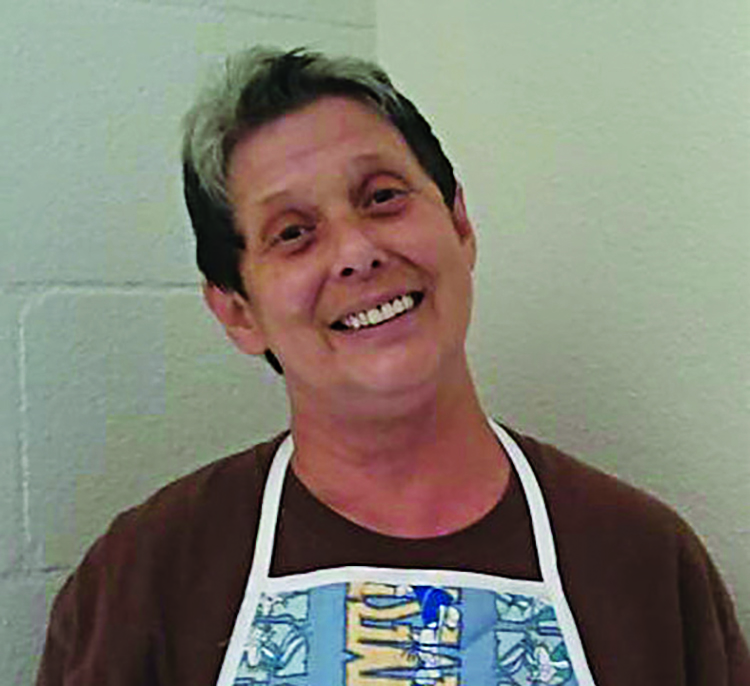
    Before starting Aloha Harvest, Phil ran a family nonprofit for homeless persons. He estimates that 475 million pounds of excess perishable and prepared food go to waste every year on O‘ahu. Therefore, Aloha Harvest is just scratching the surface of food rescue in Hawai‘i. Not all the foods they distribute are destined to become waste. Some are very desirable excess products donated to help food-insecure people. But Phil estimates that up to 40 percent of excess perishable food in Hawai‘i can be rescued and distributed.

    “Hawai‘i has plenty of food to go around if we just redistribute the excess food that we don’t consume,” he says. His distribution model is efficient and low-cost. His goal in 2020 is to bring on more drivers, trucks and volunteers to expand their impact. Donations from farms, food service professionals, retailers and manufacturers are welcome every day. Charitable cash donations that pay salaries or insure and maintain delivery trucks may be made online at www.alohaharvest.org or by mail to Aloha Harvest, 3599 Wai‘alae Ave., Unit 23, Honolulu, HI 968816. Food professionals who wish to donate food may call Mele or Leslie at 808-537-6945.

    SMALL CHARITIES FEEDING THE HUNGRY DESERVE OUR ATTENTION, TOO

    Waste Not Want Not – Maui

    Food distribution and food rescue strategies move abundance to people in need in small communities too. Melanie Kehaunani King runs a nonprofit on Maui called “Waste Not Want Not.” Small farmers and people who grow fruits and  vegetables on their properties call Mel when they have excess yield or if fruits are the wrong size for the market. She harvests and hauls the produce to Hale Makua, a rehabilitation and long-term care facility, where they incorporate fresh produce into their foodservice menu. “We need volunteers and donations of fresh produce,” she says. “Folks on Maui with excess crops can just give me a call at 808-359-9103 to schedule a pickup.”

    ■ Key Project – Kahalu‘u Key Project is a cultural community organization in Kahalu‘u that is an outlet for both Hawai‘i Foodbank and Aloha Harvest. Key Project distributes bags of food twice a month and farms wetland taro that teen volunteers may harvest and take home for their families. For more information about community activities at Key Project, or to donate or volunteer, visit www.projectkey.org, email info@projectkey.org or call Kalai Kukahiko at 808-239-5777. Mail donations to Key Project, 47-200 Waihe‘e Road, Kaneohe, HI 96744.

    ■ Give it Fresh Today Produce Donation Project – Kaimuki

    The Hawai‘i Farm Bureau Federation sponsors a farmers market at Kapiolani Community College, 4303 Diamond Head Road in Honolulu, every Tuesday afternoon from 4 to 7pm and Saturday morning from 7:30 to 11am. At the market, Give it Fresh Today solicits donations of vegetables and fruit for charities that feed the hungry. Stop by their booth to donate produce. For further information, email giveitfreshtoday@gmail.com.

    The gift of food is a traditional value in Hawaii and community organizations that collect and give out food reduce food insecurity and help feed those in need earn our admiration and respect every day. The ones highlighted here are joined by many small volunteer and nonprofit food distribution efforts in your local community. Celebrate them.

    This year, look for ways you can help them deliver the gift of food. Share this article with your family; if you suspect a neighbor of friend is food-insecure but too shy to ask for help, give them a copy. Put a food charity on your list of organizations to consider for donations of food, volunteer time or a cash donation. Together, we can make sure that nobody goes hungry.

    We know how food gets distributed at the market to people who can afford to buy it. For those who can’t, every day, a network of Hawai‘i nonprofits work together to collect food donations and deliver them to the hungry. They serve seniors on a fixed income, low-income families, disabled persons and homeless persons who…

  • Kō Ā Moana: Those of the Ocean

    Kō Ā Moana: Those of the Ocean

    Anona and Joseph “Nappy” Napoleon love the sea. Their kuleana is to respect and care for the sea by practicing and perpetuating cultural traditions of their ancestors who lived on and near the ocean. We call them “watermen.” Kō ā moana may be men or women, surfers, fishermen, paddlers, sailors or divers. They know the power and majesty of the sea in every season and type of weather. They trust their ancestral skills and honed talents, and mentor the next generation to carry them on. It’s clear that that they are more comfortable and happier on the water than on land. With kō ā moana at the helm, dark swells become waterslides, rough seas promise exciting adventures and being alone on the open ocean brings calm and freedom.

    “The ocean brought us together,” says Anona as she smiles at Nappy. “And it keeps us together, too.” For the last 55 years, the Napoleons raised five sons by the sea and taught many mo‘opuna the ways of the sea. Their love affair with each other and the ocean honors the family traditions of the Nāone ‘ohana of O‘ahu, and the Napoleon ‘ohana of Kaua‘i, Hawai‘i Island and O‘ahu. Their steadfastness ushers in new generations of kō ā moana, people of the ocean.

    Joseph “Nappy” Napoleon, Champion Paddler and Steersman.
    Joseph “Nappy” Napoleon, Champion Paddler and Steersman.

    The Man Behind the Woman

    Joseph “Nappy” Napoleon, Champion Paddler and Steersman. Hawaiian Waterman Hall of Fame Inductee, 2010.

    On Sunday, Oct. 13, Uncle “Nappy” Napoleon, Hawai‘i’s revered champion paddler, will don a green shirt to compete in his 62nd world paddling championship — the Moloka‘i Hoe. This race across the Ka‘iwi Channel starts at Hale o Lono Harbor on Moloka‘i’s west shore. After some five hours and 41 miles of paddling across the shallow Penguin Banks and then braving the “washing machine” of the deep churning Ka‘iwi Channel, paddlers make land at Duke Kahanamoku Beach in Waikīkī. Of the seven most dangerous channels in the world, Ka‘iwi outranks the English Channel for rough seas.

    Nappy first paddled across this channel in 1957, and in 1958, he won the inaugural Moloka‘i Hoe official competition. Among his five additional wins was the 1966 event, when 40-knot winds and 20-foot swells in the channel savaged the race. Only six of 12 canoes finished. One crew lost their canoe. Nappy’s team prevailed, despite capsizing three times and losing the outrigger. Beating out all the international competition for wins in ’61, ’69, ’72 and ’73 was much easier than in ’66.

    Although Nappy is a renowned expert steersman, he is a competitive paddler first — often helping his team paddle hard to make landfall.

    “In the early days, I used to steer the canoe on a high line and surf down to Waikīkī. But nowadays, I pick lines depending on conditions,” says Nappy.

    In 2001 and again in 2003, his “60s” team won their division. In the sixth seat, he is moving all the time — adjusting the trajectory of his canoe with every push of the currents, helping paddle up a bump or cutting a diagonal to the next swell. He is the king of riding swells — what the Napoleon ‘ohana calls “connecting the bumps.” This skill builds on a deep knowledge of the sea under all conditions and a “feel” for how the canoe responds to the most delicate tension on the steering paddle. Sometimes Nappy zigzags between swells coming from two directions. Other times, he’s surfing downwind. If you watch Nappy’s canoe turn around a regatta pilon, don’t blink — or you’ll miss it. If turning on a dime were easy, all the canoes would do it that way.

    “Way back, Ben Finney came to me and asked me to help him figure out a paddling strategy for pulling Hōkūle‘a through the doldrums,” says Nappy. (The doldrums is a band of flat ocean near the equator where winds cease. Sailboats can get becalmed for days and weeks.)

    Photo by Michael A Tongg
    Photo by Michael A Tongg

    Nappy was not convinced that paddling a huge sailboat would work. Eventually, Hōkūle‘a carried a portable outboard motor with a long shaft to drive through the calms.

    “I met Mau Pialug when he came here from Micronesia, but I decided not to go to Tahiti with Hōkūle‘a anyway because Herb Kane wanted full-blooded Hawaiian crew members. I stuck to paddling and racing.”

    Two years ago was the first time Nappy Napoleon was racing Moloka‘i Hoe without his wife at his side. Team Napoleon’s channel beacon and anchor was at home, recovering from a stroke. Now Nappy’s life is much more than racing or coaching at Ānuenue Canoe Club. He is part of a family caregiving team supporting the love of his life.

    The Woman Behind the Man
    The Woman Behind the Man: Anona Nāone Napoleon, PhD, Mākaha Surf Queen, Champion Paddler, Surfing Coach. Hawaiian Waterman Hall of Fame Inductee, 2014

    The Woman Behind the Man

    Anona Nāone Napoleon, PhD, Mākaha Surf Queen, Champion Paddler, Surfing Coach. Hawaiian Waterman Hall of Fame Inductee, 2014

    Anona Nāone came from a Kaimukī surfing and kayaking family and was one of the only girls surfing big waves at Waimea Bay in the late ’50s. She taught surfing and was sponsored to try out for the 1960 and 1964 Olympic kayaking teams. Tragedy struck in 1960, when she suffered a severe diving accident that left her temporarily paralyzed for nearly a year. Nevertheless, she recovered fully to compete in and win the 1961 International Mākaha Surfing Contest, claiming the coveted Mākaha Surf Queen title.

    Anona was not only beautiful but also a brilliant student at Star of the Sea Catholic School. She went on to the University of Hawai‘i and returned to teach at Star of the Sea — the place that inspired her to follow a vocation in education.

    A teaching career did not keep this woman of the ocean from pursuing competitive water sports. Anona eagerly joined ‘Onipa‘a, one of two women’s crews to first paddle across the Ka‘iwi Channel. For 20 years, women were not allowed to complete in paddle races across Ka‘iwi. But in 1975, the men of Waikīkī Surf Club agreed to coach a team of seasoned female athletes from Outrigger, Lanikai and Kailua canoe clubs for their first open ocean voyage. The Healani Canoe Club put up a second canoe and both teams completed the crossing.

    When the first women’s world championship of paddling, Nā Wāhine o Ke Kai, was first held in 1979, Anona’s canoe crossed the Ka‘iwi with the best time. Her crews also won in ’87, ’88 and ’89. In 1998, Anona Napoleon came in first at  the International Polynesian Canoe World Sprint Championships in Fiji.

    Part of being a woman of the ocean is perpetuating the Hawaiian nohona — the Hawaiian ways of doing things. In 2003, Anona took on a new challenge to apply Hawaiian values and methods to her teaching profession.

    Anona went back to college and earned her doctorate in education. Her thesis focused on developing culturally responsive primary education curricula based on the Hawaiian method of conflict resolution — ho‘oponopono. Like the successful culturally focused social and healthcare services explored by Mary Kawena Pūku‘i in the book Nānā I Ke Kumu, Anona’s work created objectives and lesson plans that would engage students using traditional Hawaiian learning styles and mentoring methods.

    Waikīkī Beach Boy and the Mākaha Queen

    Nappy was born in Kealakekua on Hawai‘i Island, where, as a small boy, he remembers paddling everywhere and racing canoe with his cousin. The family moved to Kapahulu, O‘ahu, and he remembers Waikīkī Beach when he was 10 years old. Nobody under 16 could race, but when the canoes were short a man, Nappy would be allowed to jump in on a training run. He was a natural who pulled hard and never got tired.

    “I was lolo, you know. Not so good at schoolwork and only made it through the seventh grade,” Nappy says. “I was a hard worker, though, and a strong paddler — racing canoes with my cousin when I was little. I went to Ala Wai Trade School, paddled with Outrigger Canoe Club and worked at Waikīkī beach giving canoe rides to tourists for 75 cents, and surf lessons for four dollars an hour. Now, the lessons are expensive! I knew all the guys at Beach Boys concession: Sam ‘Steamboat’ Mokuahi, ‘Rabbit’ Kekai, ‘Chick’ Daniels, the Kahanamokus — I carried Duke’s board. After he retired, he came to the beach to talk story and I listened. I remember how much fun it was to cut the waves in ‘Ka Moi,’ his big koa canoe. It weighed more than 600 pounds.

    “I had a lot of friends, but I didn’t like parties — didn’t go out much. I was friends with Anona’s brothers, who worked for Aloha Airlines, and went with them to dive Pāpi‘i, Kaunakakai-side, Moloka‘i. They all looked after Anona and I did, too. I was another big brother to her. One day in 1959, I got up the courage to tell her that I didn’t want to be her big brother anymore.”

    Nappy and Anona’s wedding in 1965
    Nappy and Anona’s wedding in 1965

    It worked. Nappy and Anona dated for six years, during which time she trained for the Olympics. Being a Beach Boy didn’t lend itself to raising a family, so Nappy landed a job making cement tiles. “I told ’em I can work hard. Just show me what to do.” Eventually, that job led to a career in construction.

    The Sea Brings Us Together

    Anona and Nappy wed in 1965. They were a handsome couple, brought together by their love of the sea. “Kō ā Moana,” those of the ocean, raise their kids by the sea, showing them how to respect the power and beauty of the sea in every kind of weather. A year later, Joseph (Joey) was born; two years later, twins Aaron and Darryn. Later on, David and Jonah. The Napoleon family spent every weekend and summer at the beach, morning ’til night. The kamali‘i came to trust their ability to ride the waves, currents and winds. They also learned to mālama the treasures of beach and reef.

    Getting to know their island was part of the mentoring. Sometimes Nappy and Anona took the boys out of school so the family could surf a famous spot together. That is how seriously Anona and Nappy felt about passing on the knowledge of their kūpuna — water sports, surfing, paddling, swimming and always having fun as a family.

    The Napoleon family Joseph “Nappy,” Anona, David, Jonah, Joey, Darryn and Aaron.
    The Napoleon family (clockwise, L–R) Joseph “Nappy,” Anona, David, Jonah, Joey, Darryn and Aaron. The Napoleon boys grew up at the beach — every weekend, every summer. Besides fun and exercise, they came to know the ocean in every season, every kind of weather. Nappy and Anona mentored them in the skills and traditions of their ancestors — conservation, stewardship and confidence in their abilities to paddle, surf, fish, gather and look out for one another at all times.

    Today, Napoleon mo‘opuna number 15 and great-grandchildren, 24. Grandson Riggs is a 20-year-old stand-up paddler who remembers being out in Grandpa’s canoe when he was 8 years old, with Nappy behind him, telling what to do. Nappy calls Riggs and his dad, Aaron, “naturals” because they instinctively knew how to do well in races. In 2012, when Riggs was 12, he rode his stand-up paddleboard across the Ka‘iwi solo in seven hours — the record for the youngest person to make that crossing.

    “My boys and mo‘opuna are ocean people,” says Nappy. “One time, Anona and I took the boys by Publics reef break near the zoo and waves were pretty good. I went out with them, and when I looked back, those kids were doing 360s and surfing right into the wall! When I came out, Anona said, ‘I thought you were watching the boys?’ I told her, ‘Hey — no need. They know what they’re doing.’”

    Preservation is not “knowing about” traditions but practicing them. Nappy and Anona also modeled their devotion to each other, deep respect for one another’s talents and the happiness that comes when a family sticks together. These were lessons well-learned; the boys are raising their own families, and 39 Napoleon mo‘opuna will carry on the legacy to be humble, share aloha and go after your passion. “You know, our boys helped build this house. Nappy taught them construction skills, too, and they could figure out the plan — even when the installers were stumped,” says Anona.

    (L–R, front row) Chloe Napoleon, Cayla Napoleon, Mom, Reef Napoleon, Kaho¯ku¯ Napoleon, (middle row) Thandy Napoleon, Titus Fessenden-Napoleon, Oshen Ku¯ pau, Isaiah Teves, Izan Teves, (last row) Taaron Napoleon, Sepa Napoleon, Clayton Napoleon, Dad, Ma¯ healani Napoleon, Haze Napoleon, Na¯ lani Napoleon, Kainani Napoleon
    (L–R, front row) Chloe Napoleon, Cayla Napoleon, Mom, Reef Napoleon, Kaho¯ku¯ Napoleon, (middle row) Thandy Napoleon, Titus Fessenden-Napoleon, Oshen Ku¯ pau, Isaiah Teves, Izan Teves, (last row) Taaron Napoleon, Sepa Napoleon, Clayton Napoleon, Dad, Ma¯ healani Napoleon, Haze Napoleon, Na¯ lani Napoleon, Kainani Napoleon

    We Love Being Together

    Since her stroke in 2018, Anona has been rehabbing at home in Pālolo Valley. Some days are easier than others, but the Napoleon family is also paddling this canoe with her. For 55 years, Nappy has said that he is “a lucky guy” and that he owes all his success to his wife. They love being together, and with Nappy at her side, Anona is safe and confident, surrounded by the love of her family. Anona requires care every day, so Christie (son Aaron’s wife’s friend’s sister) provides home care on weekdays. Nappy covers nights. Every weekend, a homecare agency comes in to help.

    This summer, Nappy was able to teach a summer paddling program three mornings a week for 35 ‘Iolani School students at Ānuenue Canoe Club headquarters. After a couple of hours, he’s back with Anona doing chores or enjoying the shade under the mango tree in the yard.

    “His mom was disabled,” says Anona. “He cooked and took care of the house for her. And before we got married, he helped me when I was laid up.”

    Her sweet, melodic voice doesn’t match her resume — world-class athlete, PhD teacher, mother and grandmother. With the grace and dignity of her ancestors, Anona shares aloha, smiles and lets the love of her life do the talking.

    “I hope I did not talk too much about paddling,” says Nappy. “You know I love to paddle, but my life is really about my wife.”

    In one of life’s huli, Anona is the center of attention again. Her accomplishments raised the bar for women in water sports, while she was preparing thousands of Star of the Sea students for high schools and college and bringing up five sons.

    At her induction into the Hawaiian Waterman Hall of Fame, Anona said, “The reason I stand before you tonight is because of the men in my life, including my husband, Nappy… Thank you for 50 wonderful years.”

    From the nurturing of her family to the protection of her brothers and the unconditional support of her husband, the men in her life recognized her talents. With the encouragement of her academic peers and the love, respect and trust of her sons and their families, Anona is still the graceful, humble and smiling beacon. Her family takes this opportunity to fuss over her, paying back and forward the blessing of her deep and unfailing aloha.

    The man behind the woman, who has for years said, “All I am comes through my wife,” applies his tireless energy to caring for her now. “It’s not a big deal,” says Nappy. “I love to do it and I have lots of help. We still love being together; we still happy.”

    A Lesson from Paddling

    Remarkably, aging in place requires some of the same skills as paddling. Caregiver training is minimal, and you just have to jump in and do it. Every day brings new swells, winds and weather. But you must be very good at keeping a steady pace to make headway. As a caregiver, you must follow the pattern of the swells to your advantage, staying just in front of the wave as long as you can. You learn to use its natural energy and less of yours.

    At the end of a good ride down a wave comes a lull, where steady paddling is required to move forward to the next crest. Paddling up takes a bit more energy, but by keeping steady and on course, you will soon be off and gliding easily again.

    An important Hawaiian point of view that Anona teaches her mo‘opuna and her students helps us in caregiving, too. It’s this: The ocean between us does not separate us, it connects us to each other. In aging, the time between today and our elder years connects all of us. We are all on the same voyage. The line we follow, the path we choose, may alter how long it takes to get there, or how difficult the going may be. Our skills to navigate rough seas and ride the waves can make the journey easier. As we fly our colors in the regatta of our elder years, it’s not about racing to the finish line — it’s about getting there and enjoying the ride with our family and friends.

    As Anona Napoleon says, “It’s about aloha. Be humble, show your aloha freely to everyone, and above all, have fun.”

    Nappy and Anona founded the Ānuenue Canoe Club in 1983 at the Hilton Hawaiian Village lagoon. For 36 years, Anona, Nappy and son Aaron, also an accomplished waterman, have taught thousands of Honolulu and visitor children to paddle, including kids from A¯nuenue Hawaiian Immersion School. Club members  trained for races and regattas year round. Nappy is the head coach, and at 78, he competes with a “70s” Ānuenue crew. Join the healthy fun of paddling, visit www.AnuenueCanoeClub.org.

    Anona and Joseph “Nappy” Napoleon love the sea. Their kuleana is to respect and care for the sea by practicing and perpetuating cultural traditions of their ancestors who lived on and near the ocean. We call them “watermen.” Kō ā moana may be men or women, surfers, fishermen, paddlers, sailors or divers.

  • Breast Cancer Warriors: A Sisterhood

    Breast Cancer Warriors: A Sisterhood


    Generations Magazine recognizes Breast Cancer Awareness Month with a resource article about women affected by this disease. Their stories, the education and research that Susan G. Komen Breast Cancer Foundation® provides, and new treatment trends available in Hawai‘i will encourage you to become part of the More Than Pink movement. By 2026, Komen Hawaii® wants to reduce the annual number of breast cancer deaths by 50 percent and we can help. The two most significant risk factors for breast cancer are being female and aging. So, learning about breast cancer detection, treatment, and support options and passing on the information to families and neighbors helps senior women seek diagnosis and rapid treatment.

    Susan G. Komen Breast Cancer Foundation in Hawai‘i

    Susan G. Komen Breast Cancer Foundation was started in 1987 by Nancy G. Brinker, who promised her sister, Suzy, that she would end breast cancer disease. It grew into a multinational charity that funds more breast cancer research than any other private charity. Our local branch, Komen Hawaii, raises over $200,000 annually, with 75 percent going to local nonprofits and agencies for breast cancer education, diagnostic screening and treatment support services — the rest to national breast cancer research.

    The Komen Hawaii annual fundraising event, Race for the Cure,® is a 5K run and 1-mile walk in Kapi‘olani Park on Sunday, Oct. 13, 2019. Everyone who wants to end this disease can participate, volunteer or make a donation. Coworkers from YMCA classes, Zippy’s morning coffee friends, Thursday mahjong players and church choir members can band together to support a brave cancer patient, survivor or caregiver running or walking. Many teams just raise money. The run is all about sticking together. The slogan “More Than Pink” includes all persons fighting breast cancer —
    survivors, meta-thrivers, previvors, men with breast cancer, caregivers and families.

    Surviving Breast Cancer is Not for Sissies

    The Hawaii Race for the Cure began in 1995, only months after Vivian Murray and her husband noticed a lump in her breast. Two weeks later, she underwent a double mastectomy. Now Vivian is a 25-year cancer-free breast cancer survivor. She was an avid runner and two weeks after her surgery, she wrapped her chest for extra support so she could run a 5K at Kamehameha Schools Kapalama Campus — a race organized to support breast cancer patients.

    “Undergoing treatment or helping a loved one affected by breast cancer is a team sport, and Race for the Cure is a great place to connect with others who understand the breast cancer journey.” – Vivian Murray
    “Undergoing treatment or helping a loved one affected by breast cancer is a team sport, and Race for the Cure is a great place to connect with others who understand the breast cancer journey.” – Vivian Murray

    “There were only a few of us for the first race; we ran through downtown and Chinatown,” says Vivian. “We talked story as we gathered for the survivor group photo. Technically, I didn’t know if I was going to survive, but I was glad I participated because I met another woman who was a 20-year survivor and she gave me hope. Somehow, I encouraged others, as well. The next year, we ran at Kapi‘olani Park. Each year, it brings us together in a happy, healthy environment where we can hang out with others who understand. Really, only other cancer patients can appreciate what you have gone through.”

    “My neighbor reached out, too, suggesting which clothes were easy to get on and off while chest muscles were healing, and how to a golf club for support when getting out of bed so as not to put pressure on the surgical area,” says Vivian.

    “She even opened her shirt to show me her chest and the kind of healing I could expect. For years, my husband had trouble looking at my scars, but he assured me that he married the ‘whole package.’ Not all women are so fortunate; some suffer divorce after their operation.”

    Vivian saw that Komen Hawaii needed more help, so she and a coworker from Kamehameha Schools volunteered to work the event. Komen Hawaii’s strict cost control practices impressed her to expand her commitment for the next eight years — first as race director and later as chair.

    “They pinch pennies to get as much money as possible to those helping breast cancer patients,” says Vivian. “Even since I stepped down, I still run the 5K. Not all participants run or walk; some just come to cheer on others. We even have a
    Hiamoe Division that allows you to sleep in. So long as you pay the fee, we send you your T-shirt!

    “Undergoing treatment or helping a loved one affected by breast cancer is a team sport,” says Vivian. “And Race for the Cure is a great place to connect with others who understand the breast cancer journey — men, women and caregivers all. It can be a happy break from your treatment schedule. Together we make a difference.”

    A difference, indeed! In 2017-18, Komen Hawaii issued over $200,000 in local grants to Castle Medical Center, Kalihi-Pa¯lama Health Center, Kokua Kalihi Valley Comprehensive Services, La¯na‘i Community Health Center, Maui Memorial Medical Center Foundation and Waimanalo Health Center to fund public breast cancer education, screening and treatment assistance. This year, the University of Hawai‘i Cancer Center received a grant to develop a community awareness campaign to dispel myths about clinical trials for new cancer drugs. The Susan G. Komen Breast Cancer Foundation funds more breast cancer research than any other private institution in the U.S.

    8 Warning Signs of Breast Cancer

    The Susan G. Komen Breast Cancer Foundation promotes early detection and treatment of breast cancer. It is important to know your normal. If you have any of these signs, see your healthcare provider or visit a hospital clinic.

    • Lump, hard knot inside the breast or underarm areas
    • Swelling, warmth, redness or darkening
    • Change in size or shape
    • Dimpling or puckering of the skin
    • Itchy, scaly sore or rash on the nipple
    • Pulling or stretching in nipple or breast
    • Nipple discharge that starts suddenly
    • New pain in one spot that doesn’t go away

    “Undergoing treatment or helping a loved one affected by breast cancer is a team sport, and Race for the Cure is a great place to connect with others who understand the breast cancer journey.”
    – Vivian Murray

    “More Than Pink has re-energized me because it focuses the fight against breast cancer on new treatment regimens and new drug research that offers hope.” – Julia Hughes
    “More Than Pink has re-energized me because it focuses the fight against breast cancer on new treatment regimens and new drug research that offers hope.” – Julia Hughes

    More Than Pink Supports Meta-Thrivers

    In 2019, over 268,000 new cases of invasive breast cancer are expected to be diagnosed in the U.S.

    An estimated 42,000 breast cancer patients will die, but some will thrive in a “new normal.”

    Julia Hughes was diagnosed with aggressive stage IV metastatic breast cancer. Metastatic tumors shed cells that travel through the lymph system to invade at “distant sites.” Julia lives her new normal by receiving monthly rounds of Kadcyla® ado-trastuzumab emtansine — chemo bound to an antibody that seeks out tumor cells — and the support of her husband, sons and church family.

    “In July 2014, after a routine checkup, my OB/ GYN told me to come back in six months,” says Julia. “By then, they identified several areas of stage II breast cancer and started chemo. After six rounds, the tumor evolved to metastatic stage IV. I panicked. My doctor told me to get my affairs in order and look into hospice.

    “Six months to live! I was teaching third and fourth grades in ‘Aiea, and my two boys were still in school! I did not want to give up. “This June was my 51st round of Kadcyla — I am alive,” says Julia. “I aim to see my sons graduate from Harvard and UH West O‘ahu. I still have inoperable metastases in my spine, but chemo and God’s grace are keeping them at bay. I don’t call myself a ‘meta-thriver’ because cancer is not who I am — it’s just a part of my new life.”

    One week each month, Julia undergoes chemo treatment, followed by a hard week of recovery. The other two weeks, she volunteers at ‘Ohana Christian Church for Adopt-A-Class outreach, which supports six Ewa Beach public schools. She recently served as PTSA president for Campbell School.

    Julia works hard to maintain her new normal. You cannot help but be impressed by Julia’s joyful attitude and energy. She recommends Christine Miserandino’s Spoon Theory website (www.ButYouDontLookSick.com). Christine lives with lupus and encourages patients with cancer and chronic disease to ride the waves of energy. On some days, personal hygiene will eat up all your strength. On other days, you will feel strong enough to go to the store. Both days are considered to be successful.

    “Cancer rerouted me and robbed me of my plans for my life,” says Julia. “Everyone’s journey is unique and everyone’s ‘cancer story’ is different. If you want to know how I am or how someone with cancer is doing, just ask.”

    “I don’t want people to say ‘Why aren’t you done with chemo yet?’ or ‘You’ll be cured soon’ or ‘Try this or try that’ or ‘My aunt died from cancer but you are doing good,’ etc.,” Julia says. “I do want people to offer me grace when I have a hard time continuing a task or try to give more energy than I have. Treat everyone with kindness, not just cancer patients. And yes, I do appreciate when my friends and family just accept me for me. If you have friends living with cancer, I advise you to treat them normally, but understand the deliberate effort they are making to balance their energies just to spend a little time with you.”

    Julia says, “Just because I exercise my sense of humor does not change the fact that 24/7, I am vigilant for any change in my disease. Tomorrow is not guaranteed. My dad survived Vietnam and never grumbled. He worked hard and always had a joke for us kids. Like him, I am a happy person and a thinker.”

    “A couple of years ago, I did the Race for the Cure walk,” Julia says. “It was fun, but I am not a survivor. I want to be a survivor, but… This year, More Than Pink brings together all breast cancer patients. Our battles are unique and early diagnosis didn’t work for some of us.

    “More Than Pink has focuses the fight against breast cancer on new treatment regimens that offer hope,” Julia says. “If you ever question if God is listening, look at how he answered my prayers over four years ago! When I die, I hope He will say, ‘Well done, my faithful servant.’”

    New Clinical Trials May Be Your Best Option

    “Today’s chemotherapy drugs were used in clinical trials 20 years ago,” says Dr. Jessica Rhea, medical director of the Komen Hawaii Education Committee and director of Clinical Trials at University of Hawai’i Cancer Center. “The standard of care for cancer today is to get into to a clinical trial if one is appropriate for your type of cancer and your medical profile.”

    ʻShe and her staff encourage cancer patients and their families to visit www. uhcancercenter.org for the latest information. If you have doubts, click the red video button at the top, right corner of the homepage and watch YouTube videos about five myths that keep us from joining clinical trials. New trials may treat early or late disease stages, rarely use placebos, and are designed for your safety.

    New Advancements in Cancer Treatments

    Biopsies now include tumor cell marker testing that identifies cancer cell antigens and receptors, targets for immune therapies and tests to monitor treatments. The trend is to customize treatment to increase effectiveness. Chemo combinations or “cocktails” may work better in any stage of breast cancer when combined with new drugs, antibodies and immune modulators like these:
    ♦ New tyrosine kinase inhibitors weaken cancer cells
    ♦ PARP inhibitors improve the effectiveness of chemotherapeutics
    ♦ CDK 4/6 inhibitors interrupt the multiplication of cancer cells
    ♦ PI3 kinase inhibitors make it harder for tumors to grow
    ♦ Antibody-targeted chemotherapy delivers chemo drugs directly to tumor cells
    ♦ New anti-angiogenesis drugs block blood vessel growth in tumors
    ♦ “Biosimilar” generic-type cancer drugs reduce the cost of therapy
    ♦ Immune therapeutic agents • New tumor monitoring agents

    “Komen Hawaii® creates a space that nurtures all persons affected by breast cancer, no matter how they may identify themselves. We are breast cancer warriors — everyone.” – Anaeliz “Mina” Colon
    “Komen Hawaii® creates a space that nurtures all persons affected by breast cancer, no matter how they may identify themselves. We are breast cancer warriors — everyone.” – Anaeliz “Mina” Colon

    Previvors Take Action Against Genetic Odds

    Anaeliz “Mina” Colon was in high school when her mother, in her early 30s, was diagnosed with breast cancer.

    “Genetic testing was very new,” says Mina. “But because my grandma also had breast cancer, the doctors decided to test mom. She was positive for BRCA2, a gene mutation associated with increased risk of developing breast cancer. I wanted to be tested right away, but my parents counseled me to wait.

    “The summer after I graduated from college, I met with a genetic counselor and underwent testing. My risk of getting breast cancer was 87 percent, too. I’m a very straight-line thinker, but the emotional reality of carrying my mother’s cancer genes shook me. An intense emotional inner dialogue finally led back to logical thought. I didn’t take action for several weeks, but eventually took the ultimate curative step and had a prophylactic double mastectomy.

    “After the breast tissue was removed, the doctor inserted expanders in my chest to receive reconstructive implants,” Mina says. “When the doctor adds fluid to the bag, it swells gradually to stretch the skin and accept the implant. That takes a while, and post-op recovery spans three to four weeks. The experience was emotional, but I could not feel luckier now that I had this option.

    “Support systems are of utmost importance with anyone having a mastectomy. My family was an integral part of my experience — mom, dad, grandparents, uncles and aunties. My uncle in Hawai‘i helped me so much by encouraging me to move here.

    “With my family’s and my boyfriend’s support, I didn’t care what the rest of the world thought; but the one emotional hurdle was my disappointment that I would not be able to breastfeed my children,” says Mina. “Mom and Dad raised me always to put logic first, but I still needed support from others who actually had gone through the same procedure. I wanted to talk with women my age who had preventative cancer surgery — about body image, having sex with my boyfriend, freezing my eggs, etc.

    “My need to interact led me to start my own website — www.ThisIsMySelfie.com. It worked. Followers meet in person once a month. We meet people with similar experiences and want to find others who understand — we are siloed together.

    “My journey is not over; I had a scare this year. And some days, I hold a ‘Why me?’ pity party. The biggest difficulty with knowing you carry breast cancer genes is the hard decision to go ‘all in.’ Faith was not a part of my journey; my family gave me confidence and support and helped me come to peace within.

    “Being a previvor can be lonely. I don’t bring it up much with other breast cancer patients — maybe it’s the ‘guilt’ of knowing others are dying. I can’t feel sorry for myself when others are going through massive treatments. I think the best rule in the breast cancer community is never to compare stories.

    “The uniqueness of every person affected by breast cancer is why Komen Hawaii is so vital,” says Mina. “They create a space that nurtures all persons affected by breast cancer, no matter how they may identify themselves. We are breast cancer warriors — everyone.”

    Celebrate Breast Cancer month by updating your knowledge about breast cancer signs and treatments. Volunteer or make a donation to support the More Than Pink fight against breast cancer and encourage your friends and family members who are fighting this disease to participate in the Race for the Cure. Come out with your grandchildren to support the cause. We can make a difference.


    SUSAN G. KOMEN BREAST CANCER FOUNDATION®

    808-754-6659 | info@komenhawaii.org | www.komenhawaii.org

    Komen Breast Care Helpline: 877-465-6636 Mon–Fri, 4am–5pm (HAT) helpline@komen.org

    Komen Hawaii funds education, treatment assistance and connections for all who are affected by breast cancer — supporters, caregivers, survivors, metathrivers, women of all ages and men with breast cancer.

    Komen also offers financial assistance to under-insured and low-income breast cancer patients to help with the cost of treatments and prescription medications. They advocate for breast cancer patients on a national level and seek to reduce deaths by 50 percent by 2026.

    Besides tumor markers and new drugs, mutated genes have been discovered that predispose women to develop breast cancer. These genes are passed down, accounting for cancer clusters within families. Now, genetic counseling is available to young women with parents and grandparents who fought breast cancer. Genes associated with breast cancer are BRAC1, BRAC2, CHEK2, ATM, PALB2, BARD1, RAD51D and MSH6.


    Race For the Cure Hawai‘i – Sunday, Oct. 13, 2019

    Visit www.komenhawaii.org to donate, register as an individual, join a team, start or re-form your own team.

    Race Day Schedule

    4:30am – Shuttle run from Parking Area
    10:30am & back from Kapi‘olani Park
    —————————
    5–6am Race Registration & Packet Pick-up
    6am Welcome / Group Warm-up
    7am RACE START (5K run/walk)
    7:15am RACE START (one mile fun walk)
    7:45am Stage Program Begins; Entertainment, Expo, Awards Ceremony, Giveaways, later in the morning, Survivor Photo

    Generations Magazine recognizes Breast Cancer Awareness Month with a resource article about women affected by this disease. Their stories, the education and research that Susan G. Komen Breast Cancer Foundation® provides, and new treatment trends available in Hawai‘i will encourage you to become part of the More Than Pink movement.

  • CITY MILL SENIOR VALUE

    CITY MILL SENIOR VALUE

    Cover photo for Generations Magazine for June and July 2019We grew up valuing the wisdom of our elders — skills or ideals that “uncle” or “tutu” taught us, like sticking together, working smart and showing respect for our family and neighbors.

    In July, City Mill Ltd. will celebrate 120 years of business in Honolulu. Their success is grounded in four generations of family wisdom. Our grandparents and parents loved shopping there, and today, we receive that same kindly respect and assistance every time we visit the store.

    Vice President Carol Ai May and President Steven Ai are the third generation of their family running City Mill. This brother and sister are also part of a group of family caregivers who assist their mother and stepmother, now in their nineties. Their family culture of helping others began in the 1890s.

    “Our father, David C. Ai, took over City Mill from his father, Chung Kun Ai, in 1961,” says Steven. “C.K. Ai was mentored in business by James I. Dowsett at the end of the 19th century, and became a respected businessman and leader of the Chinese community in the Territory of Hawai‘i. His ‘mill’ was once the biggest rice mill in the islands, hence ‘City Mill.’ The other side of his business was importing lumber from the Northwest. In the 1950s, many single-wall wood homes were built with our lumber, and we still try to sell hardware and fixtures for maintaining these homes. Later, Dad moved from commercial lumber into retail hardware.”

    Three generations of City Mill Ltd.: When Steven and Carol were children, their grandfather, C.K. Ai, lived in their home. Following the wisdom of elders, helping the community and respecting others became a family and business culture to be celebrated. (L–R) David Ai, C.K Ai, Carol Ai, Lani Ai and Steven Ai.
    Three generations of City Mill Ltd.: When Steven and Carol were children, their grandfather, C.K. Ai, lived in their home. Following the wisdom of elders, helping the community and respecting others became a family and business culture to be celebrated. (L–R) David Ai, C.K Ai, Carol Ai, Lani Ai and Steven Ai.

    City Mill Company Culture Values Community

    Carol explains how their compassionate way of working with the O‘ahu community developed.

    “We were in elementary school when Gung Gung (grandfather) passed away, but our grandparents lived in our home and we watched our parents care for them,” Carol says. “Our dad is gone now, too, but he passed down Gung Gung’s wise teaching: ‘When you drink water, remember the source.’ It means that everything we have is due to the community support of our business, so be humble and honor those who helped make you successful along the way. This adage is still our family and company value. We donate to community charities and treat our employees like family; when disasters strike and power goes down, we stay open so people can get the supplies they need to protect their homes.”

    “Respect and compassion for others is the heart of our City Mill customer service,” says Carol. “Up until 1998, we used to hire people with plumbing, electrical or carpentry background. But now we hire people with good attitudes who like helping others. We figured that we can train associates about our products, but attitude and empathy come from within. We are looking for people who can help others and manage with compassion.”

    PHOTOGRAPHS OF CITY MILL'S OWNERS, EMPLOYEES and CUSTOMERS AT THE MILILANI AND IWILEI STORES FOR GENERATIONS MAGAZINE.
    Client Earl Omoto and Christopher Griffin talk shop.

    Seniors Make Great Employees

    Almost 300 employees are the face of City Mill to its many thousands of customers. The Ai family demonstrates how they value seniors by providing excellent customer service, but they also place a high value on senior employees.

    “Seniors make great employees because they are helpful and knowledgeable,” says Carol. “We observe that they are less likely to regard their job as a steppingstone and they eagerly bond with the ‘team’ at any one of City Mill’s six stores.”

    Ruby Cooper, Inventory Control Supervisor, Age 70

    Ruby applied at the Mililani store 19 years ago, when she was 51 years old. Her husband was career military and they saw a lot of the world, but when they settled in Honolulu, Ruby was looking for a career where she could interact with people.

    “I’m not good with names, but I know all our repeat customers’ faces,” says Ruby. “What our company does best is making eye contact and acknowledging the presence of every customer, every day. That’s our expertise. All who come in the door get the same help, young or old. Hey, people know what they want. All we have to do is listen and get them what they need. It’s a big store, but our garden guys are happy to escort a customer all the way to electrical — with a smile.”

    Ruby oversees receiving, stocking and taking inventory of all the items in the Mililani store. She is a certified forklift operator and gets to work at 5 a.m., to manage inventory. When the doors open, she becomes a floor manager, handling customers calls and backing up the cashiers. Ruby says her job keeps both her mind and body active, and customers never guess that she is 70 years old. On Ruby’s bucket list is a little more traveling, walking the beach with her Cavalier Spaniel and spending more time with her family.

    Ruby Cooper loves the work she does and the people around her, from workmates to her senior patrons.
    Ruby Cooper loves the work she does and the people around her, from workmates to her senior patrons.

    “At my age, I have to accept that I can’t load a 94-pound bag of cement anymore,” says Carol. “So I say to seniors — realize your limitations, be smart and find new ways to work around activities that have become risky. Don’t stop doing what makes you happy — just do it differently. I love my job, so I plan to work here as long as I can contribute to the team — that’s a great comfort.”

    Steven Ai says senior employees like Ruby add value to City Mill because they stick around and get very good at their jobs. They are eager to fit in and make friends with the other employees. In time, they develop good working relationships with customers. City Mill’s oldest employees are in their 80s, and common reasons seniors leave are: 1) they have to give up their driver’s license; or 2) their family wants them to stay home.

    Christopher Griffin, Sales Associate, Age 67

    Christopher Griffin is a human resources manager from Massachusetts. When he retired and moved to Hawai‘i, he opted for a more physically active job. He says his sales associate job is like a daily yoga class or a workout at the gym because the large City Mill floor plan requires him to cover a lot of ground.

    “My job is healthy in so many ways,” says Christopher. “When I shopped at City Mill, I was so impressed. As a human resources guy, I knew this was a great company by the generous way the employees treated me and each other. The hiring process required me to interview with a whole panel of employees. What a novel idea — workers instinctively know who is going to fit in and work hard. I am so grateful that they picked me.”

    Here’s what the employees saw in Griffin: he is politely upbeat and engaging. He calls himself a “MacGyver” because he likes to help people find solutions for their maintenance and home improvement problems. And that’s what clients want.

    “Everybody who comes in here is looking for answers,” says Christopher. “Even when we don’t share the same native tongue, we can find the perfect material, hardware or fitting they need.

    “There’s a lot of camaraderie among the employees, too — most have worked here many years, and when I started, they taught me about all these products,” says Christopher, “The more I learned, the better I could help customers. City Mill’s commitment to the O‘ahu community means our team is helping folks all over this island. I am so grateful for the team I work with: Donna, Tina, Irene, Ricky, Devon, Russell … I could name them all!

    From Shirtsleeves to Shirtsleeves in Three Generations”

    David Ai was the second generation. He encouraged Steven and Carol to pursue their passions and provided them with excellent educations. Both have business experiences outside City Mill. Steven studied business, and then worked in financial accounting and management consulting. After Carol earned her degree at Tufts University, she worked in commercial bank marketing and advertising before starting a juice company. Later, they became the third generation of City Mill.

    Carol says, “My dad warned us about the old adage, ‘Shirtsleeves to shirtsleeves in three generations.’ It refers to the typical life cycle of a family-owned business: the first two generations grow the company and it fails in the third generation. Steven and I were determined not to fail, but when mainland big box home stores came to Hawai‘i in the ’90s, we faced a considerable challenge. Lowe’s and Home Depot moved in and built their stores near ours, but folks still come to us for personalized service; we see a strong future.”

    Carol raised her two sons with this challenge: “If you decide that you want to work at City Mill, you must first earn bachelor degrees and MBAs, work outside the company for five or more years and get promoted along the way.” Both sons met this high standard and now one is working at City Mill. Before joining the team, he earned his MBA, did retail consulting, was a financial planner at Nike and Gap Inc., and then started two of his own businesses.

    “As the fourth generation, my son brings technology, supply chain and digital/social media knowledge — current ways of doing business,” says Carol. “We don’t have to teach him our City Mill company culture because he grew up with it. He designed an online store so our customers can shop at home and pick up their orders in the store. Everything we do continues to focus on the very best service we can deliver to our customers.”

    Helping Seniors Add Value to Their Lives

    Behind every City Mill customer is a home or office repair, or a maintenance or improvement project. Seniors are replacing old stuff, downsizing, renovating or simplifying their active lifestyles. They are continually adding value to their homes, retirement businesses or pastimes. City Mill provides them materials and personalized, helpful tips.

    Photo of 72-year-old Earl Omoto
    Earl Omoto, 72

    Earl Omoto, Commercial Diver & Homeowner, Age 72

    Many City Mill senior customers are entrepreneurs. Earl Omoto is a semi-retired commercial diver who specializes in installing and repairing moorings — some up to 3,000 pounds. He also owns a rental property, which he recently renovated himself. His project included “snow coating” the shingle roof, replacing the flooring, retiling and re plumbing bathrooms, interior and exterior painting, and building custom counters and tables.

    “I always shop City Mill first for supplies,” says Earl. “I like to be treated like a customer, not a browser. They have enough staff so you never have to hunt for a salesperson. The guys in red shirts know where everything is! I always compliment the team because I want them to keep doing exactly what they are doing.”

    “Another thing I like is that nobody is ‘king’ at City Mill,” says Earl. “All the sales people work together — if one can’t help, he calls the next one to get you what you want. Wendell in plumbing, Gary and John in lumber, Glenn and Ron — are plenty helpful with a smile. When I needed help on my remodel, they gave me good suggestions.”

    Earl’s rental house is all ready to go. He says he took his time and did a good job. He considers himself lucky because he has no health challenges, and to stay that way, he works out at the gym three or four days a week. He also likes to play his guitar. On his bucket list is a second trip to Hong Kong and Macau for sightseeing, shopping and fun.

    The City Mill Team gave Christopher a warm send-off the day of our photoshoot. He will be caring for a family member on the mainland for a while. His City Mill family understands the importance of helping seniors and  honoring family. (L–R, top) Desiree, Charles, Cody, Chris, Dennis, Tanya, (bottom) Donna, Brian and Melvin.
    The City Mill Team gave Christopher a warm send-off the day of our photoshoot. He will be caring for a family member on the mainland for a while. His City Mill family understands the importance of helping seniors and honoring family. (L–R, top) Desiree, Charles, Cody, Chris, Dennis, Tanya, (bottom) Donna, Brian and Melvin.

    Owen Oda, Handyman & Small Renovations, Age 65

    “I go to City Mill a lot because it’s a store that makes sense,” says Owen. “They sell hardware in bins that are clearly labeled with a picture and specs for each bolt, nut, screw or washer. It’s easy to find what you need and you can buy the exact number you want. I appreciate efficiency.

    “For my small jobs, I need pieces of plywood and two by fours cut to exact lengths and dimensions. City Mill employees in the lumber dept will do the precise cuts for me — no waiting around. They can cut jalousie glass to size and thread pipes — and it’s not expensive. Best of all, their employees know what they’re doing, and they are eager to help.”

    A handyman for 15 years, Owen says he may be just a little weaker than in his youth, but he stays very healthy by drinking lots of water every day. His bucket list includes seeing his kids settled and then helping with the grandchildren.

    “Another thing; when I walk into the store, they always ask me if I need a wagon and if I will need help getting items off the upper shelves,” says Owen. “That’s a good service for seniors like me, but I watch them do the same thing for every customer! Do you know that all the cashiers know me by name? There are very few stores like City Mill — it’s a good place.”

    Seniors Value Kindness

    Seniors respond positively to authentic respect and kind concern. We repay kindly businesses with loyalty and referrals. We remember the days when most companies focused on serving the customer — when personal attention and pampering was not restricted to high-end boutiques or hotel spas. Every shopkeeper appreciated our purchases; we were served with respect at the feed store, bakery, barber shop and corner seed shop.

    Hoo-ray for City Mill! The Ai family business model values people, including seniors. Their genius is not only preserving a deeply held family ideal, but also practicing it in their lumber and hardware business, and teaching generations of employees and customers to value each other and to respect the sources of their success.

    In July, the City Mill team will celebrate 120 years of business — helping generations of Honolulu builders and homeowners find the right materials for their projects. When you next visit City Mill, congratulate the salespersons, cashiers and managers. Let them know how much you appreciate the way they value seniors. The message on the backs of their red T-shirts sounds like an ad, but it’s the wisdom of the Ai family business: “What are you working on? I can help.”


    CITY MILL COMPANY LTD.
    660 N. Nimitz Highway, Honolulu HI 96817
    808-533-3811 | www.citymill.com
    Check online for details of their other locations:
    Ewa Beach, Hawaii Kai, Kaimuki, Kaneohe and Mililani.

    In July, City Mill Ltd. will celebrate 120 years of business in Honolulu. Their success is grounded in four generations of family wisdom. Our grandparents and parents loved shopping there, and today, we receive that same kindly respect and assistance every time we visit the store. Vice President Carol Ai May and President Steven Ai…

  • I Ke Aloha a Nā Mele Kahiko o Hawaiʻi (“Because for the love of the old songs of Hawai’i)

    I Ke Aloha a Nā Mele Kahiko o Hawaiʻi (“Because for the love of the old songs of Hawai’i)

    At home in O‘ahu, Harry relaxes in the living room of their 1931 house, recently renovated so that they might age in place. Next to his chair is a bookcase full of vintage recordings.
    At home in O‘ahu, Harry relaxes in the living room of their 1931 house, recently renovated so that they might age in place. Next to his chair is a bookcase full of vintage recordings.

    It’s Sunday afternoon! “Welcome to ‘Territorial Airwaves,’” echoes the AM940 Hawai‘i announcer, followed by a long steamy blast of a cruise ship’s horn. And then, like a playful ocean breeze, the cadence of Harry B. Soria’s happy voice bids us e komo mai and stay awhile. Gently, he calls us back to simpler days with the hapa-haole and not-so-haole music of old Hawai‘i — passed down in families and among Hawai‘i musicians for a hundred years. Listeners who grew up in the heyday of radio may have danced to these tunes or seen live performances; for the younger audience, Harry B. is the guardian, guru and guide back to Hawai‘i’s best music — from monarchy to statehood and beyond to the 60s, 70s and 80s.

    If you are thinking that “Territorial Airwaves” weekly broadcasts are small potatoes, think again. Passengers on Hawaiian Airlines tap their feet to the “Territorial Airwaves” in-flight audio selection. Harry B. and his radio show have earned nine Nā Hōkū Hanohano awards, including the 2017 Krash Kealoha Industry Award for lifetime achievement. For nearly 40 years, Harry B. has been entertaining and educating audiences with the backstory of Hawai‘i’s most celebrated composers, musicians and performers — collapsing the time between us and the free-wheeling innocence and excitement of Hawai‘i’s past.

    Music evokes our emotions and memories, but here we have a profound and enduring connection to the sky, land, sea and people of Hawai‘i. We are a chop suey people with a broad taste for jazz, salsa, swing, romantic “pili mai” love songs and tender family ballads; but we also adore paniolo cut-time, sassy ‘okole hao tavern songs, ‘auana hula and hukilau ditties. ‘Auwe! We cope with sad goodbyes by singing songs about waves lapping at the shore, pikake-scented tradewinds brushing by palms and moonlight sparkling on the ocean. Territorial music is not a collection of tunes, but our heritage — fused to our fondest memories

    Celebrating 40 Years of Broadcasts

    “Territorial Airwaves” will celebrate its 40th anniversary of broadcasting Friday, June 14, at the Monarch Room of the Royal Hawaiian Hotel, where Harry B. used to broadcast live. He and his wife, Kumu Hula Kilohana Silve, are planning a massive ho‘olaule‘a with a traditional buffet dinner, a broad array of fantastic Hawaiian entertainment and a huge silent auction. Funds from this celebration will support the preservation of Hawai‘i music through The Hawaiian Music Archives Foundation. Tickets to this splendid event cost $150 per person and are now available at www.TerritorialAirwaves.com.

    Over the last 40 years, Harry B. has collected and cataloged over 70,000 recordings and 10,000 vinyl and acetate records, as well as thousands of liner notes, photographs and memorabilia.

    The foundation will create a public repository where this music history of Hawai‘i may be safely preserved and made available to the public.

    “The Hawaiian Music Archives Foundation will prepare a user-friendly digital archive system so young musicians and the public may easily access this wonderful music resource,” says Harry B.

    Kilohana says that two hālau will be assisting at the event. “Harry is too ha‘aha‘a to say this but preserving recorded and notated Hawaiian music is an important worldwide legacy project. The international live broadcast of ‘Hawaii Calls’ planted cultural seeds in many countries; fans of Hawaiian culture, dance and music literally cover the globe. Those who listened to Hawaiian music as kids now stream ‘Territorial Airwaves’ broadcast online. They pass on to their families the dream that ‘Someday, I’m going to get to Hawai‘i.’”

    Harry smiles. “Dad always wanted me to make a trans-Pacific broadcast of ‘Territorial Airwaves’ like he did with his ‘Voice of Hawaii’ show on KGU and NBC in the 1930s. Fortunately, technology caught up with us and live streaming allows music lovers from every country to listen. The foundation will make digital recordings and image files available in perpetuity to everyone.”

    100 Years of the Soria Family in Hawai‘i

    This year also marks 100 years in Hawai‘i for the Soria family, called “the first family of Hawai‘i Radio.” In the 20s, Harry B.’s grandfather, Harry G. Soria, was friends with Marion Mulroney, who operated KGU radio, the station affiliated with the Honolulu Advertiser. He sold airtime and commercial spots for them. In 1934, his son Harry B. Soria (Harry B.’s father), got a job at the Star Bulletin’s rival radio station, KGMB, where he pioneered remote broadcasting — by laying a wire from the old Star Bulletin building across Bishop Street and down Alakea to do a promotion at the famous Radio Repair company. He booked the Bright Brothers to perform and it was a hit. Soon, Harry G. recruited his son to KGU to host an on-location traveling show called “Going To Town with Harry Soria,” which drew attention to Honolulu shops, events and community gatherings. Listeners from O‘ahu and Neighbor Island plantation communities tuned in and flocked to enjoy Honolulu’s growing urban scene.

    Harry B. Soria Sr.’s remarkable career in announcing, marketing and record production earned him the moniker, “The Voice of Hawaii.”

    Webley Edwards, produced and announced “Hawaii Calls” live dance party, broadcast from the Moana Hotel.
    Webley Edwards, produced and announced “Hawaii Calls” live dance party, broadcast from the Moana Hotel.

    1935–1975: 40 Years of “Hawai‘i Calls” Radio

    A year later in 1935, Webley Edwards had an idea to do an on-location dance party show at the Moana Hotel at Waikīkī with a shortwave radio hookup to NBC in San Francisco and a connection to the Mutual Broadcasting Network of local stations across the U.S.

    Harry B. tells us that the first time Webley tested the hookup, the telephone operator said “Hawai‘i calling…,” so Edwards named his new show “Hawaii Calls.” Edwards directed and produced the show, which always started with the live sound of waves coming in at Waikīkī Beach and Edwards’ lilting voice reading his script. Harry Owens and the Royal Hawaiian Orchestra set the mood and featured all the best musicians in Hawai‘i.

    Besides dance numbers, “Hawaii Calls” showcased the biggest singing stars like Alfred Apaka, Johnny Almeida, Ray Andrade, Marlene Sai, Ray Kinney, Dave McIntyre and Don Ho, all under the musical direction of Al Kealoha Perry. Performers and songs heard on “Hawaii Calls” became so popular on the mainland that the Lexington Hotel in New York City presented a live Hawaiian show every night; Hawai‘i big bands and vocal stars flew to New York for gigs that would last three months or longer. Hawai‘i music and hula was the rage.

    Disc jockey Harry B. Soria Sr. spinned 78s on KGU Radio in the old Honolulu Advertiser building.
    Disc jockey Harry B. Soria Sr. spinned 78s on KGU Radio in the old Honolulu Advertiser building.

    Radio was big entertainment in the 30s and big business on the weekends. At KGU studios on the third floor of the Honolulu Advertiser building, Harry B. Soria Sr. ran his own live-audience radio shows —with Charles E. King, Johnny Almeida, the Bina Mossman Glee Club and the trans-Pacific NBC broadcast of “The Voice of Hawaii.” The audience was separated from bands and performers by a plate glass screen; broadcast mics were “inside the booth.” Audience response was piped in and controlled with a switch by the program director.
    Harry Sr. also broadcast his own shows that featured the most popular recorded
    music of the day, live interviews and called-in listener requests that he personally announced.

    When commercial air travel to Hawai‘i began after WWII, mainlanders who had grown up on tunes from the Land of Aloha could not wait to visit Honolulu; innovative radio had created a national market for Hawaiian culture. After 40 years, “Hawaii Calls” signed off the air in 1975, a year which was also the flash-point for a Hawaiian cultural renaissance. Television was the new darling, and after a few more years, Harry Sr. retired.

    Harry B. Soria, Jr. broadcasting on KCCN 1420 AM radio in Honolulu, Hawaii. Much of the equipment in this studio of 1980 is no longer used in the industry. Today, Harry B. continues to create the sound of yesteryear in state-of-the-art broadcast facilities.
    Harry B. Soria, Jr. broadcasting on KCCN 1420 AM radio in Honolulu, Hawaii. Much of the equipment in this studio of 1980 is no longer used in the industry. Today, Harry B. continues to create the sound of yesteryear in state-of-the-art broadcast facilities.

    Hawai‘i Music History — The Trunk of Destiny

    One weekend in 1976, 28-year-old Harry B. Soria Jr., asked his dad if he had saved any 78 rpm vinyl records from the “old days.” Harry Jr. remembered singers, musicians and composers coming to their home in ‘Āina Haina when
    he was a kid. His father never encouraged him to take up a career in radio, so he was happily working in the private sector doing accounting and financial services. But he was fascinated by Honolulu Skylark’s KCCN 1420 AM radio show, where she played old 78s from pre-statehood days. Harry Jr. had a heart
    for Hawaiian culture and knew that these old Hawaiian recordings were an important connection to the past.

    Harry Sr. led him to a dusty steamer trunk in their garage filled with the contents of his desk from Monday night, Dec. 8, 1941— his last radio broadcasting day after the attack on Pearl Harbor. The Japanese had used the “Voice Of Hawaii” trans-Pacific broadcast frequency to navigate their bombers to the Hawaiian Islands.

    Hawai‘i’s business community anticipated that the Japanese might attack the Territory of Hawai‘i and put a disaster plan in place in 1941. Harry Sr. was charged with screening all long-distance calls to and from Hawai‘i, so that no classified information would be available to foreign forces. On Sunday, Dec. 7, he listened to a conversation between President Franklin D. Roosevelt and governor of the territory, Joseph Poindexter. On Monday, he cleared out all the records from his office. Announcers like Webley Edwards became war correspondents, and Harry Sr. became a lead radio and long-distance telephone censor for U.S. Navy Intelligence, assigned to Midway Island until 1946.

    A Passion for Authentic Hawaiian Music

    The trunk held plenty of 78 records, acetate records, tape recordings, lead sheets for live musicians, broadcast playlists, contracts and memos. This valuable cache of Hawaiian music history began Harry Jr.’s quest to learn about and preserve as much old Hawaiian recorded music as he could. Until his death in 1990, Harry Sr. mentored Harry Jr., sharing the history of authentic Hawai‘i music.

    Harry Jr. was catching Skylark’s show one day when she posed a rhetorical question about a strange shuffling noise in the background of “Hawaiian Vamp” by Johnny Noble, recorded live at the Moana Hotel.

    “I asked Dad about the background noise and he explained that the ballroom floor was open to the shore, and sand would blow in or get tracked in. As couples danced, the sand underfoot made a shuffling noise on the wood floor that the live mics picked up. When I told Skylark, she wanted me to do my own show. But Dad counseled me to keep my day job and pursue radio as a hobby.”

    In June 1979, Harry Jr. became the third generation of Soria men in radio as “Harry B.” with his weekly broadcast of “Territorial Airwaves” on KCCN 1420 AM. His “history of Hawaiian music” theme was well-received by the audience
    for this hugely popular AM station that outperformed most of the FM channels. So, Harry B. began living his dream, doing one show a week, fulfilling his passion and kuleana to preserve Hawaiian recorded music.

    Harry B. Soria, Jr. broadcasts “Territorial Airwaves” in a modern studio. Above: Young traditional musicians Raiatea Helm and Nā Hoa tapped into Harry B.’s territorial music collection to discover authentic vintage tunes and lyrics that helped them develop their successful careers.
    Harry B. Soria, Jr. broadcasts “Territorial Airwaves” in a modern studio. Above: Young traditional musicians Raiatea Helm and Nā Hoa tapped into Harry B.’s territorial music collection to discover authentic vintage tunes and lyrics that helped them develop their successful careers.

    Guardian, Guru and Guide of Hawaii Music

    “I felt a deep responsibility as a Hawai‘i boy and the son of radio greats to  preserve traditional Hawai‘i recordings and broadcasts of the era between the monarchy and statehood — all the music that traveled through the ‘ether,’” says
    Harry B. “Dad lived to 85 and he was my consultant for almost 11 years. I realized that music is an expression of the the times. Driving through town, he would tell me things like, ‘That medical complex on the corner of Ke‘eaumoku and Beretania used to be Dairyman’s Purity Inn ice cream parlor,’ or ‘This is the tune that made the Manhattan Cake Walk dance all the rage!’ I would just listen and write down all he shared. Soon, I patched together a slice of time that I felt I knew and understood. The more I learned, the more comfortable I became with ideas, motivations and limitations of life in the Territorial era.

    “Dad always encouraged me and listened to every show. As soon as I got home, the phone would ring. He would say, ‘Great broadcast. You know, I was thinking about what you said and that song was actually…’ That was how I learned so much! I worked for several firms and finally retired from Sony Corporation in 2014, but never missed a show. Radio, nostalgia and history were my passion.

    “Some folks said my gig would never last, but it’s about to outrun ‘Hawaii Calls’ as the longest regular Hawai‘i music broadcast. When I started, there was negative sentiment about the whole territorial period after the fall of the monarchy, including the popular music and shows of Waikīkī. Since the cultural renewal has taken root, young musicians want to learn the musical stylings and lyrics that are preserved in our early recordings,” says Harry B.

    Harry in Paris, where he and Kilohana support L’Association France-Hawaii and an annual hula festival.
    Harry in Paris, where he and Kilohana support L’Association France-Hawaii and an annual hula festival.

    Harry B.: Music Historian and Curator

    Today, Harry B. is the nexus of Hawai‘i music history, the guardian of a vast amount of information about the works and cultural impact of composers, musicians, producers and broadcasters who pioneered the Hawai‘i radio and music industry. Harry B. has grown a large fan base that includes young musicians who want to follow the traditions of territorial steel guitar and slack key
    guitar, big band arrangements and swing style. Readers 50 years old and older have been listening to “Territorial Airwaves” and learning about old Hawaiian music their whole lives.

    Also to his credit are some 30 albums of authentic Hawaiian music recordings that he produced on the Cord International label.

    Considering the magnitude of his legacy — over 70,000 archived song recordings, 10,000-plus vintage vinyl records and thousands of photos, liner notes, original album covers and memorabilia — we asked Harry B. what advice he gives to seniors and retirees. He says that he and his wife, Kilohana, have a family mantra, which is to approach every day with the intention to “stay relevant.”

    Kilohana and Harry B. host a keiki hula workshop in Chigasaki, Japan.
    Kilohana and Harry B. host a keiki hula workshop in Chigasaki, Japan.

    Harry B.’s Advice: Follow Your Passion and Remain Relevant

    Like all of us, Harry B.’s life turned up and down. He encourages other seniors to
    pursue their passions.

    “In the private sector, companies go through business cycles and hard times,” says Harry. “My jobs have been downsized and outsourced; companies have been sold or closed. I went through a divorce. But my mission to preserve the music was a constant. The satisfaction of moving forward on my mission always kept me going. I knew I was on track because young musicians and vocalists were taking an interest in traditional tunes. They were coming to me for songs that had been forgotten. They wanted original recordings of the pioneers and experts of steel guitar and original arrangements and phrasing of classics. I was privileged to help artists like Nā Hoa and Raiatea Helm find their music heritage.”

    A Mākaha Sons show poster for a 2008 performance at Carnegie Hall in NYC; Harry B. was emcee.
    A Mākaha Sons show poster for a 2008 performance at Carnegie Hall in NYC; Harry B. was emcee.

    Even though Harry B. Soria is a public figure, at one point he found himself alone in his private life.

    Harry B. Soria, Jr., along with Pumehana Silve for Generations Magazine.
    Harry B. Soria, Jr., along with Pumehana Silve for Generations Magazine.

    “At age 60 and approaching retirement, I felt disappointed. I had no grandchildren and after my divorce, I could not believe I would be living out my life as a single man,” he says.

    But as we say in Hawai‘i, “‘A‘ale pohō.” In 2015, Harry met Kumu Hula Sandra Kilohana Silve of Hālau Hula o Mānoa and president of L’Association France-Hawai‘i in Paris. After graduating from the University of Hawai‘i in 1972, Kilohana studied art history and French language in Paris. She became a teacher of art history, worked as an art critic and shared her culture. She married and raised her daughter in France.

    Kumu Hula Kilohana trained with Kumu Hula Emma Bishop, Ellen Castillo, George Holokai and Kimo Alama Keaulana, and studies chant under Kumu Sam ‘Ohu Gon of Hālau Mele. In Paris, Kilohana developed a hula hālau that expanded to Rome through one of her students. Another student choreographed a hula to Edith Piaf’s “La Vie En Rose,” translated into Hawaiian by Sam Gon. Besides starting an international hula festival in France, she aided the Chigasaki Makana Hula Festival in Japan. A Juneau, Alaska, branch of her hālau performed for the annual Alaska Folk Festival.

    Kilohana was widowed and returned in 2005 to live in Mānoa, where she became a docent at Mānoa Heritage Center and continues to teach and choreograph hula for haumana in Europe, Asia, Alaska and Greenland. With decades of success behind them and the support of long-standing audiences, Harry B. and Kilohana understand the dichotomy between art and the business of performance. Each has respect for the other’s cultural kuleana and talent. In 2017, they married.

    Passing On a Legacy to the Community

    “We fell in love and never looked back,” says Harry. “We never argue and our daughter is a joy. I have two very French grandsons with Hawaiian names. It’s amazing, but our public and private lives are compatible on both sides of the world. We are blessed to find love late in life.”

    Harry B, offers us the last seven years of his weekly broadcasts free-for-the-clicking on his interactive, fun website, www.TerritorialAirwaves.com. He also posted a big photo gallery of radio, recording and television stars going back to the 20s. Dubbed “The Encyclopedia of Hawai‘i music,” Harry B.’s website is a treasure trove of historical notes on performances, venues, studios and music producers.

    Says Harry, “We aspire to remain  as relevant as we possibly can. As I reach
    70 and ‘Territorial Airwaves’ turns 40, the Hawaiian Music Archives Foundation will preserve and make public my personal recording collection and the collections of other Hawai‘i music enthusiasts wherever they live. All these precious materials have been given to me by my father and Hawai‘i music lovers. But we are the stewards — they belong to Hawai‘i.

    We Want More Hawaiian Music!

    If we had to say goodbye to steel guitar slides, ‘ukulele chalanglang, honky-tonk piano vamps or resonant slack key, would aloha die? Of course not. Lapping waves and swaying palms would inspire composers to new musical creations, but we might miss the textures and tunes of Hawai‘i that the kūpuna used to tell our story of aloha. Thanks to the kuleana and vision of the Soria family, authentic Hawaiian recordings of the past will be preserved. Tomorrow’s musicians will have the opportunity to hear the sounds and language of the kūpuna and weave their flowers into the golden lei of Hawaiian music.

    Join Us in Support of the Hawai‘i Music Archives Foundation

    At Generations Magazine we cherish and promote the benefits of “legacy”— passing on traditions, achievements and wisdom to the next generation. We encourage our readers who love the music of Hawai‘i to support the Hawaiian Music Archives Foundation in any way you can. Perhaps your hula class or choir can donate a small gift or do a benefit performance. Get a group of friends to buy a gala ticket for a promising musician or broadcaster who loves old Hawaiian tunes. Or just go to the “Territorial Airwaves” website and make a donation. If you’ve enjoyed listening to “Territorial Airwaves” over the last 40 years, maybe this is the time to say “mahalo” and help Harry B. make all this music available to your grandchildren.

    If you are descended from the great families of Hawaiian music of the 40s 50s and 60s, supporting the archives honors the talent of your kūpuna. There is nothing more important to an artist than to be remembered in the public space of a museum. These music archives are a beautiful digital museum of territorial Hawaiian music and beyond to the 80s.


    “Territorial Airwaves” Radio Show

    KKNE Traditional Hawaiian 940 AM

    Airs at 12 Noon Fridays and Sundays at 5 pm

    Listen online at www.TerritorialAirwaves.com

    40th Anniversary Celebration!
    Friday, June 14, 2019
    Monarch Room, Royal Hawaiian Hotel
    Tickets: www.TerritorialAirwaves.com

    It’s Sunday afternoon! “Welcome to ‘Territorial Airwaves,’” echoes the AM940 Hawai‘i announcer, followed by a long steamy blast of a cruise ship’s horn. And then, like a playful ocean breeze, the cadence of Harry B. Soria’s happy voice bids us e komo mai and stay awhile. Gently, he calls us back to simpler days with…

  • Medical Cannabis: A Therapeutic Resource for Seniors

    Medical Cannabis: A Therapeutic Resource for Seniors

    Since 2017, licensed Hawai‘i cannabis growers have been formulating and dispensing medical products to qualified state-registered patients. A majority of their clients who are benefiting from cannabis treatments are seniors.

    Different strains of the plants grown for use as medical cannabis are used for particular health outcomes. Above: two strains of flower buds; cannabis seeds used in extracts.
    Different strains of the plants grown for use as medical cannabis are used for particular health outcomes. Above: two strains of flower buds; cannabis seeds used in extracts.

    Maui Grown Therapies dispensary in Kahului has been open over a year. Leading their Science & Medical Advisory Board is Dr. Andrew Weil, director of the University of Arizona Center for Integrated Medicine, an advocate for alternative medicine and an early pioneer in the research of medical cannabis. Joining the other five physician advisors are Greg Yim, MD, a pediatric neurologist with Hawaii Pacific Health in Honolulu, and Gregory Park, MD, a specialist in internal medicine and medical oncology in private practice on Maui.

    “Dispensary” sounds like a military tent where a supply officer hands out pills too big to swallow and nasty-tasting tonics. Maui Grown Therapies’ waiting area is as comfortable and welcoming as any teaching hospital or fancy clinic on the mainland, just smaller. Pleasant patient education specialists greet clients, listening carefully to their needs, and teaching them about professionally packaged botanical therapeutics formulated from cannabis grown at the Maui Grown Therapies production center upcountry.

    Whatever visions I retained from KITV 4 news reports on cannabis shops in Colorado with young people lined up waiting to buy weed were shattered in a moment. An interview with Teri Freitas Gorman, Director of Community Relations and Patient Affairs for Maui Grown Therapies convinced me that I was behind the times. Teri and I have worked together on community projects for many years; her recent work with medical cannabis is good news for seniors. Medical Cannabis companies across our state are producing and selling a well-researched, state-regulated healing resource for persons with cancer, rheumatoid arthritis and ALS — hopeful options for those suffering with debilitating pain, wasting and nausea. In this article, we will explore the most up-to-date facts about modern medical cannabis products, specifically formulated to relieve symptoms associated with chronic maladies we encounter with aging.

    What is medical cannabis?

    Cannabis is the botanical name of a genus of plant grown for 5,000 years in Asia, India, the Middle East, Africa, Europe and South America. Flowers and leaves were used to make tinctures and poultices or smoked like tobacco, and it was prized for its relaxing and mildly intoxicating effects. Cannabis found its way to mainland America in the 1920s. In the 1930s, Harry Anslinger, Commissioner of the Federal Bureau of Narcotics and newspaper publisher William Randolph Hearst Sr. began a campaign to outlaw cannabis that ultimately led to the Marijuana Tax Act of 1937. The cannabis of the time was much lower in tetrahydrocannabinol (THC) than modern cultivars, and many people continued to grow and smoke it “underground” for relaxation and a mild “high” that seemed to stimulate the senses.

    Pot Lotion
    Lotion
    Pot Butter
    Butter
    Marijuana chocolate and baked goods
    Chocolates and baked goods

    In the 1950s and ’60s, veterans and hippies began growing illegal cannabis in Hawai‘i. Cannabis was added to the list of Schedule 1 Controlled Substances in President Nixon’s Comprehensive Drug Abuse and Control Act of 1970. Also included was hemp, a form of cannabis that does not have intoxicating effects but is a source of strong fibers used to make rope, fabric, paper, industrial products and building materials.

    Over the past 80 years, illegally grown cannabis has been selectively cultivated for its ability to induce a euphoric mental state (and in a few individuals, anxiety and paranoia).

    THC (Tetrahydrocannabinol)

    Dr. Andrew Weil, researchers at NIH and Dr. Raphael Maechoulam in Jerusalem began isolating the molecular components of Cannabis and designing scientific experiments to reveal how these botanicals work on the human nervous system. Research has grown worldwide. The cannabis plant produces more than 100 different complex molecules called cannabinoids. Tetrahydrocannabinol is the best known because of its euphoric effects.

    Cannabis cannabinoids are very similar in structure to naturally occurring human “endocannabinoids” like the neurotransmitters anandamide and 2-AG. These are just two of many lipids present in our nervous system that normally interact with receptors in our bodies that modulate signals associated with eating, sleeping and pain response. THC docking on receptors may prevent natural endocannabinoids from approaching the receptors and thereby interfere with pain, nausea or impulse signals to the brain.

    Different strains of the plants grown for use as medical cannabis are used for particular health outcomes. Above: two strains of flower buds; cannabis seeds used in extracts.

    CBD (Cannabidiol)

    Another significant component of cannabis is Cannabidiol (CBD), which is not psychoactive like THC, and is a powerful anti-anxiety and anti-inflammatory agent that causes general relaxation of the body. Its mechanism of action is not yet fully understood, but researchers identified a separate receptor, mainly on immune system cells, but also in selected cells of the central nervous system, to which CBD attaches. They theorize that CBD modulates a protective effect on the nervous tissue, as well as an analgesic effect.

    Patients with chronic pain understand the “echo” of repeated pain impulses which make it impossible to relax. Induced relaxation reduces the intensity of chronic pain. Medical cannabis dispensaries have formulated products that are CBD-rich, or have equivalent amounts of THC and CBD, and CBD-dominant preparations that are nearly entirely CBD with no intoxicating effects it all. Cannabis products offer relaxation, better sleep and pain reduction for those struggling with chronic pain.

    Because cannabidiol-based products do not produce intoxicating effects, creams and oils containing CBD may be available over the counter at health food and vitamin stores or online. It’s important to know these products may not be regulated or tested for purity or for CBD content. Hemp, the source for over-the-counter CBD oils, is known as a powerful bio-remediator because the plant draws up heavy metals and toxins from soil. It’s great for environmental cleanup, but untested plant products pose a possible health risk to consumers.

    Even though some hemp-derived CBD extracts are produced in the United States, most are still imported from overseas and consumers should be wary about the origin, purity, and content of over-the-counter CBD products. All Hawaii-licensed dispensaries grow their cannabis and manufacture cannabis products under strict guidelines and are required to pass some of the nation’s most stringent lab tests before any product may be dispensed.

    Terpenes

    Other aromatic hydrocarbons found in cannabis are called terpenes, which account for the scents of various cultivars of the plant. The effects on inflammation, mood, alertness and relaxation by essential plant oils containing terpenes are well documented. The presence of terpenes in cannabis formulations and how they interact with THC and CBD is under investigation.

    By regulation, each dispensary must produce its own products through a vertical system that starts with farming and results in uniquely formulated products.
    By regulation, each dispensary must produce its own products through a vertical system that starts with farming and results in uniquely formulated products.

    How many dispensaries are licensed in Hawai‘i?

    Although medical cannabis has been legal in Hawai‘i since 2000, Hawaii Statutes protecting patients and a licensing system that regulates cannabis farming and therapeutic manufacturing was not in place until 2015. Of eight approved licensees, six have opened dispensaries and sell their own products: three on O‘ahu, two on Maui and one on Kaua‘i. The two licensees on the Big Island will open dispensaries in early 2019. Licensees may only dispense products manufactured from cannabis they grow themselves, so therapeutic products vary from one dispensary to another. Finding the product that works best is a trial-and-error journey for each patient. Because Federal Law prohibits transporting cannabis through federally controlled waters or airspace, cannabis products may not be carried legally interisland or to-and-from the mainland.

    What kinds of products are sold in dispensaries?

    First off, medical insurance does not cover the cost of medical cannabis therapies, which fall into the same category as “over-the-counter” medications. Dispensaries provide traditional dry plant buds for inhalation through smoking or vaporization, and a variety of preparations for non-smokers. Cannabis concentrates, resins and distillates may also be inhaled. Serums, lotions and creams may be rubbed into the skin for localized pain relief. Cannabis tinctures, capsules or lozenges may be ingested. Hawai‘i’s DOH is currently considering approving edible cannabis products for medical use.

    Top: A dispensary waiting room. Above: A dispensary showroom. Styling is unique to each dispensary, and very welcoming. But entry to areas where products are displayed is restricted to patients with Hawaii 329 cards.
    Top: A dispensary waiting room. Above: A dispensary showroom. Styling is unique to each dispensary, and very welcoming. But entry to areas where products are displayed is restricted to patients with Hawaii 329 cards.

    I think most patients are surprised at the wide array of cannabis medications available. While your doctor may register you as a qualified patient, he or she may not recommend the exact product for your condition. That selection is up to you. Most dispensaries provide educational support to help patients to make an informed choice. Educational staff are trained to answer questions, explain the product properties, how the products perform with other clients and how to determine (titrate) your correct dosing. Because everyone is different and various ratios of THC to CBD offer distinct therapeutic effects, it may take a little trial and error to select a formulation that is optimal for your treatment needs.

    As Teri at Maui Grown Therapies explained, “Our patient education specialists spend a lot of time learning about the client’s needs. Our knowledge and detailed feedback from patients allow us to suggest products and a dosing with a high probability of success. Our practice to ‘Start low and go slow,’ allows patients to find their optimal dose. We also track our patients’ progress to ensure they are getting meaningful relief.

    “Another important point is that an effective treatment plan will continue to work safely for a very long time. As a plant medicine, cannabis is unlike some pharmaceutical drugs that can require larger doses over time and risking overdose,” she said. “More importantly, there is no recorded instance of anyone dying from a fatal dose of cannabis. Dr. Weil says that cannabis is a striking example of a safe and effective botanical remedy that is underutilized and still misunderstood by many conventional practitioners.”

    Two MD views on medical cannabis

    A Psychiatrist’s Point of View

    Thomas L Cook, M.D., is a board-certified psychiatrist. His Mending Minds Clinic in Honolulu treats Post Traumatic Syndrome Disorder (PTSD) patients, many of whom are combat veterans.

    “I believe that medical cannabis is the most neglected first-line therapeutic agent in medicine today,” says Dr. Cook. “I certify patients with qualifying conditions so they can apply for Hawaii 329 Cards. I also prescribe the type and concentration of cannabis to treat their symptoms, and I follow their progress.”

    “Many combat veterans have been treated with stimulants like Adderall®, which can make PTSD worse. They are jumpy and hypervigilant all the time. Medical cannabis calms much more effectively than antidepressant pharmaceuticals, with very few side effects. It seems to ‘re-program’ the amygdala, a part of the brain that triggers the fight-or-flee response. “Releasing patients from the passive, hypnotic state of PTSD involves psychotherapy and healing techniques like somatic experiencing.

    “PTSD patients also suffer sleep deprivation. On cannabis, they experience restorative sleep like they had as a child. Relief from these debilitating symptoms allows combat veterans to engage in therapeutic integrative strategies where they can master peacetime activities like sports, volunteer work and leadership on the job. “Cannabis has many other applications in medicine — it’s a profound antioxidant, it stimulates stem cells and lowers blood pressure. It’s very good for inflammatory disorders like Crone’s disease, rheumatoid arthritis, lupus and multiple sclerosis.

    “To be clear, “says Dr. Cook, “Cannabis does not cure depression, but it can quell some symptoms that prevent patients from healing. I treat patients with depression at Alleviant Health Center. Classical depression can take a long time to heal. Along with psychotherapy, I offer patients quick-acting Ketamine infusion treatments so they can avoid emergency room crises and psychiatric hospitalizations on their journey to wellness.”

    Products with a low, legal level (below .3%) of THC are sold over the counter, but only dispensaries can sell those with a higher level of THC. Edible medical cannabis products may soon be approved by the Department of Health.

    An Oncologist’s Point of View

    Oncologist Dr. Gregory Park of Wailuku has been treating cancer patients for many years and serves as a director for Maui Grown Therapies.

    “Cancer patients’ acceptance and willingness to try medical cannabis is striking. My patients are looking for anything that can make their journey more comfortable. When they realize cannabis comes in creams, tinctures, capsules and oils that they can rub in or take by mouth — they want to try it.

    “Most important to my patients is that cannabis therapies can relieve nausea and pain without altering their mental state. If they know they’re not going to get ‘high,’ they are open to cannabis.

    “I find that informed seniors are pretty matter-of- fact. They read a lot and once they make up their minds, they cut right to the chase. One patient came in and said, ‘Well, I need my card. I tried it from my friend.’ That was it. After she was registered, she was just as definitive about her good results on cannabis; with a big smile she just said, ‘It works!’

    “In Hawai‘i, it seems that physicians working in large medical groups have more skepticism about medical cannabis than those in private practice. Acceptance is highest among doctors who treat chronic pain, because cannabis is a good alternative pain treatment that is not physically addictive. Some opioid-dependent patients can reduce the amount of opioids or even discontinue them altogether when they find a cannabis regimen that manages their pain.”

    Who qualifies to register as a patient?

    Persons qualified to purchase medical cannabis in Hawai‘i are regulated by the Hawaii Statutes Act 329. No client may enter a dispensary showroom without a “329 Card” issued by the Hawaii State Department of Health (DOH). Patients with any one or more “qualifying” disorders or symptoms may be certified by a physician or Advanced Practice Registered Nurse (APRN) with whom they have a bona fide (good faith) patient-doctor relationship. This means that a licensed medical professional must examine you to certify that you have a qualifying disorder or symptom as defined on www.bit.ly/DOH329Qualify. Then you may file an online application with DOH requesting your 329 card. The application costs $38.50 and an extra $3.50 handling fee, payable when you apply online. If you seek online entry assistance at a clinic, the fee may be $10 – $15 higher. If you are approved, the DOH will send you a “329” patient ID card that allows you to legally buy medical cannabis products in any licensed dispensary in the state. This month’s Resource Guide (p. 36) lists dispensaries and intake clinics in Hawai‘i.

    Further in this article, we have detailed all the steps interested seniors must take to complete online registration with the DOH.

    Experiences of real clients

    Susan Ramos, Maui, Age 60

    Susan suffers constant back pain from severe degenerative disc disease, arthritis, bone spurs, five herniated discs and scoliosis. Eventually she will have corrective surgery, but until then, her job in the hospitality industry requires her to stand and sit most of the day. Six months ago, her son, who treats his chronic back pain with products from Maui Grown Therapies suggested that Susan might get some relief from medical cannabis.

    “My son gave me hope,” says Susan. “I knew how much he suffered after falling off a truck, years back. The idea that something could even take the edge off my pain was almost too good to be true.”

    Susan knew nothing about medical cannabis or the dispensary — she feared that if someone saw her there, they might think that she’s a drug addict. Nothing could be further from reality.

    “My son was so good. He took me inside and held my hand. The waiting room was a surprise — like walking into a spa! The people in the attractive waiting room were just like me, in their 60s or older. I expected to see young people with dreadlocks and tie-dye shirts.

    “The educational specialist was so kind and knowledgeable, but it was like she was talking in French because there were so many options and information. My doctor never gave me a prescription, so I had to decide what product to buy. I told her that my back pain keeps me awake all night, but I cannot be too relaxed or fuzzy when I’m on the job. I ended up with two products: five drops of CBD and THC oil under the tongue at night before I go to bed, and THC oil to rub on my back during the day. They worked, and I began sleeping at night. During the day, the oil gives me relief from the constant pain.”

    Susan says relieving her pain is a huge benefit. Cannabis fits well with her lifestyle and exercise/treatment plan, which includes Pilates, water aerobics and regular chiropractic adjustments. She says the best outcome is being able to work while she is awaiting surgery.

    Susan Liliha Warner, O‘ahu, Age 75

    Susan is a client of Aloha Green Apothecary on King Street in Honolulu. She was a special education teacher on the mainland and returned to Wai‘anae when she retired. Here, Susan volunteered a patient advocate and as an elementary school aid, writing curriculum for special education students. She has smoked her whole life and has chronic obstructive pulmonary disease (COPD). Bone spurs on her spine cause her to experience severe chronic pain.

    “I was reading about medical cannabis and the new dispensaries on O‘ahu. I know that THC can give temporary relief from asthma, so I wanted to get some THC, but a diagnosis of COPD did not qualify me to buy THC in Hawai‘i.

    “I don’t like the term ‘debilitating’ but my awful, chronic back pain is a qualifying symptom that would get me a 329 card. I was taking six ibuprofen tablets every morning for my back pain, and my Kaiser doctor was worried about the effect ibuprofen was having on my kidneys. I asked him to register me for medical cannabis, but he said no. Apparently Kaiser has federal contracts, so they will not have anything to do with cannabis until it is federally approved and legal. I eventually found a nurse practitioner in Ewa licensed to examine my medical records and certify me as a qualified patient who can benefit from cannabis.

    “I like the floating feeling of THC, so that is what I bought on my first visit to the dispensary.

    They had a cartridge that I could put right in my vaporizer to inhale it. It opened my airways and felt great.

    Dispensary items come in various forms: smokable flower buds and resin concentrates, or concentrated oral tinctures. Inquire about various options at your dispensary.
    Dispensary items come in various forms: smokable flower buds and resin concentrates, or concentrated oral tinctures. Inquire about various options at your dispensary.

    “Then they put me on to CBD oil for the pain in my back. I was amazed at the powerful, warm relaxation that went through my whole body. More amazing is that rubbing on CBD, which I call ‘oiling my joints,’ allowed me to get off ibuprofen! I admit that I had to take a few after I tiled my kitchen floor, but on regular days, CBD takes away all the pain.” The medical cannabis clinic and the dispensary Susan uses “both keep track of me and how I am doing, which gives me added comfort.”

    “When I was relying on ibuprofen, I had to wait until it was time for the next dose, no matter how much pain I had. People with chronic pain know how long it takes to get pain back under control once the meds stop working. Well, those days are over for me. Because there are no adverse side effects to CBD oil, I can reapply it whenever I get that first twinge, and never have to wait for the next dose.” Susan would recommend learning more about medical cannabis treatment options to anyone in constant pain.

    Getting your own 329 card

    To become eligible to purchase medical cannabis you must first and foremost talk to your primary care physician, who knows your medical history. You must make an appointment and have a face-to-face meeting with a physician or APRN nurse who can certify that you have a qualifying condition that can benefit from medical cannabis. If your doctor does not certify patients, you can make an appointment to see a doctor or APRN who does. They will review your medical records and examine you to determine if you have a qualifying condition. Once certified, you may apply online for registration. If they don’t offer that service themselves, doctors refer their patients to an intake clinic that helps qualified patients and their caregivers file their online applications for DOH 329 cards.

    A qualified patient who needs assistance may even designate one caregiver to accompany them to the dispensary or to purchase cannabis products for them.

    On O’ahu, Aloha Green Apothecary provides regular free public “Cannabis 101”, educational program workshops at local Hawaii Public Libraries. To find a program near you, visit www.agapoth.eventbrite.com.

    And Maui Grown Therapies presents a monthly cannabis education series called “Lunch & Learn” at UH Maui College, featuring Michael Backes, researcher and author of the book, Cannabis Pharmacy. Andrew Weil and Backes will also be featured in a free Medical Cannabis Symposium at the Maui Arts & Cultural Center on Thursday, April 18. For details see www.mauigrown.com

    Medical cannabis legal considerations

    Hawaii Statutes on cannabis are designed to protect and regulate both the patients and the dispensaries.

    • 4 ounces of cannabis or the equivalent may be purchased in any 15 day period (8 oz/month).
    • Patients must follow Hawai‘i’s smoke–free law. Qualified patients must consume medical cannabis within a private residence, out of public view.
    • Driving under the influence of cannabis carries the same penalty as a DUI for alcohol. Never drive while medicated with cannabis.
    • Using cannabis is prohibited in a moving vehicle, at work, in school, at public parks and beaches, in recreation centers and other places open to the public.(If you have a valid 329 card, you may have up to 4 oz. of cannabis in your possession at any time.)
    • Interisland or overseas transport of cannabis is prohibited by Federal law.
    • Registered patients or their caregivers may grow an “adequate” supply of medical cannabis; not to exceed ten plants at one grow site location identified on their 329 card. Growing locations are allowed at the patient’s or a caregiver’s residence. Alternatively, cannabis may be grown on one site owned by a patient or by the caregiver. Federal lands, military bases and national Parks prohibit the consumption or cultivation of cannabis under federal laws that carry steep fines.
    • In early 2019, out-of-state patients may apply for a 329-V(visitor) card from the DOH provided they have a valid certification to use medical cannabis for a Hawai‘i qualifying condition in their home state. Visitor cards are valid for 60 days and may be renewed once per year.


    Teri Gorman suggests visiting the Hawaii State DOH Medical Cannabis Program’s website at  www.health.hawaii.gov/medicalcannabis/ to learn about program regulations and legal protections provided to Hawaii’s registered patients.

    Drug interactions with cannabis

    Very little research has been done on how cannabinoids may react with prescription drugs; its status as a Schedule 1 drug has prevented researchers, even at NIH, from pursuing studies. However, physicians have observed that patients who use cannabis report very few drug interactions and most are insignificant.

    Still, medical cannabis has the potential, like other plant botanicals, to interact with some prescription medications or lessen their effectiveness.

    Therefore, it is important for seniors to disclose all medications they are taking (including supplements, over-the-counter products and cannabis) to their healthcare providers and to their pharmacists.

    A March 8, 2018 article in “US News and World Report” by staff writer Michael O. Schroeder says that, in particular, the effects of medications that relax or sedate the body and lower blood pressure may be enhanced by administration of CBD.

    He also points out that the intoxicating effects of THC and alcohol can be psychologically addictive for some people. Lowering blood pressure too much and any medications that cause dizziness may lead to accidents and falls, important health concerns for independent seniors. To protect yourself from falling, make sure your healthcare provider knows everything you are taking.


    Live well

    We thank all the medical professionals and seniors who participated in this issue’s resource article on medical cannabis. There will be much more research and information available to Hawai‘i seniors in coming years. You may learn more at public educational events sponsored by your local dispensaries and intake clinics on your island. Medical cannabis is one option for seniors aging in place and living well in Hawai‘i. See our Resource Guide for contact and reach information.

    Since 2017, licensed Hawai‘i cannabis growers have been formulating and dispensing medical products to qualified state-registered patients. A majority of their clients who are benefiting from cannabis treatments are seniors. Maui Grown Therapies dispensary in Kahului has been open over a year. Leading their Science & Medical Advisory Board is Dr. Andrew Weil, director of…