

In the foreground of the crystal blue waters of Spencer Beach Park at Ōhai‘ula Beach in Kawaihae on Hawai‘i are jagged lava stones neatly stacked on top of each other, their corners coming together like a jigsaw puzzle. It is Pu‘ukoholā Heiau — one of the last ancient Native Hawaiian heiau (temple) built, marking the end of the traditional kapu system.
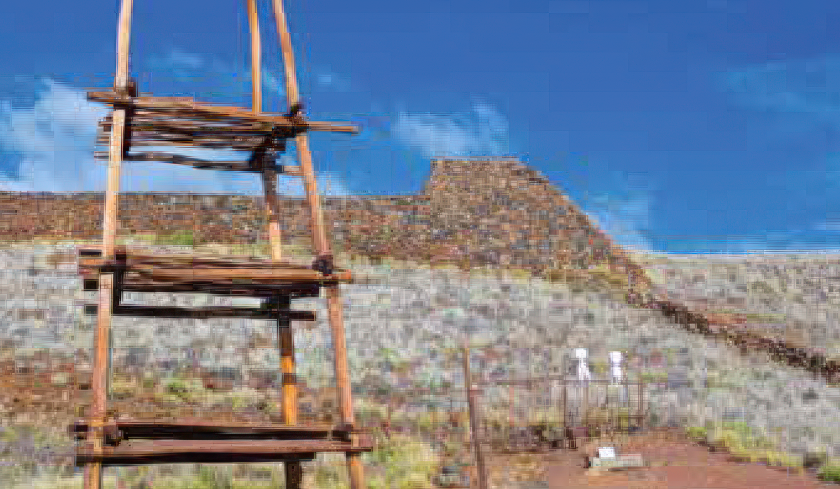
King Kamehameha I was to fulfill a prophecy and secure his unification of the Hawaiian Islands —“Ho‘oku‘ikahi,” to “unify as one.” A prophet told Kamehameha that to conquer and unite all the islands, he must first build a large heiau at Pu’ukoholā and dedicate it to war god Kūkā‘ilimoku. Nearly 10,000 pairs of careful hands passed along lava rocks across 25 miles in a human chain. The mortarless stone temple took a year to complete. Finally, Kamehameha carried out the last step of this spiritual journey — the sacrifice to Kū of his adversary and first cousin, Keoua.
Kamehameha reunited the Hawaiian Kingdom in 1810. During his reign, he stored his ammunition at Mailekini Heiau, below Pu’ukoholā, to protect Kawaihae Harbor. The submerged remains of another heiau, Hale o Kapuni, dedicated to shark akua (deities), are believed to lie just offshore.
King Kamehameha’s Pelekane (royal courtyard) is situated along the coast directly below Pu’ukoholā Heiau and Mailekini Heiau at the Pu’ukoholā Heiau National Historic Site. Upon European contact, this is where ali‘i met with foreign dignitaries and the first group of New England Protestants made their new home. The residence of shipwrecked American sailor John Young, who served as Kamehameha’s advisor, is also located here. Recognizing the historical and cultural significance, Congress designated all of these buildings as National Historic Sites in 1972.
On Aug. 15 and 16, the 54th Ho‘oku‘ikahi Establishment Day Hawaiian Cultural Festival (nps.gov/puhe/festival.htm) celebrating Hawai‘i’s history and culture will be held at the Pelekane. The festival traditionally begins with a ho‘okupu (gift-giving ceremony). Activities include ulana lauhala (lauhala weaving), kuiki (quilting), lei making, kapa-making, hulu ali‘i (chiefly feather work) and traditional Hawaiian games. There will also be informational booths, workshops, food, canoe rides and live music. Admission is free.
If you are unable to attend the festival, know that Pu’ukoholā will always be there for you and future generations to witness Hawai‘i’s history.
Leave a Reply