

In Japanese culture, rank is important. It signifies accomplishment, perseverance and strict adherence to righteous values. Hiromi Nakai Peterson has attained the rank of eighth dan (Hachidan), the highest rank in Shodo, the traditional Japanese art of artistic calligraphy. Derived from “sho” (writing) and “do” (way or path), it represents a spiritual discipline rather than just a technique, similar to martial arts. The art originated in China and was introduced to Japan around the sixth to seventh centuries.
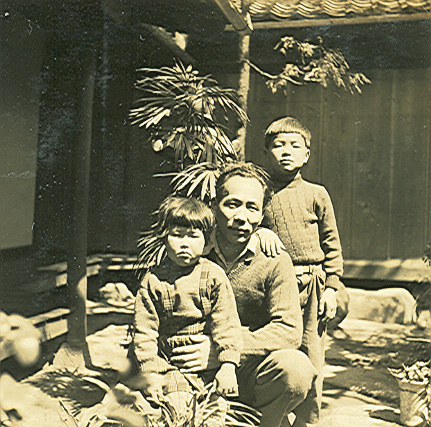
in 1953. PC: Hiromi Peterson
Hiromi was born in Hiroshima City, Japan, three years after the atomic bomb was dropped. The city was still in a state of profound devastation, resembling a “wasteland of crooked steel and charred rubble.” But, miraculously, she and her family survived. Whether by divine intervention or by geographic good fortune, a hill called “Hijimayama” partially protected her family residence from the terrible blast of blinding light and radiation that emanated from the first atomic bomb dropped on humanity.
Hiromi’s Shodo introduction and education started quite early. In Japan, Shodo is taught as part of the regular curriculum. She also attended Shodo classes with her two older sisters, starting in kindergarten. After high school, she enrolled at the Kyoto University of Foreign Studies to learn English. After graduation, she returned to Hiroshima and taught high school English.
During a summer break, she attended summer school at the University of Hawai‘i at Mānoa, where she met William Peterson, a professor of computer science. After months of courtship, traveling between Hawai’i and Japan, William proposed to Hiromi. They eventually married, despite her family’s disapproval. The atomic bombing was most likely the reason.
Hiromi studied Shodo in Hawai‘i with an informal group. They took written exams and sent them to Japan for credit. Hiromi’s rank rose. Her formal Shodo education started when she met Amaishi sensei (teacher), who owned and operated a Shodo school and published a Shodo magazine in Japan. Amaishi sensei is the owner and executive of Shodo schools throughout Japan.
To obtain her seventh dan, Hiromi sent her written exam to Amaishi sensei. Then for her eighth dan exam, she travelled to the sensei’s school for her exam. Hiromi passed her eighth dan exam, received her teaching certificate and also received her professional name of “Toka” (“to” means east; “ka” means flower).
In Shodo there are three basic styles. Kaisho is regular block script, Gyosho is semi-cursive script and Sosho is cursive script. Peterson sensei has become highly skilled in both Gyosho and Sosho.
Peterson sensei also taught Japanese language at Punahou School for 30 years. She co-authored a Japanese textbook, which was donated to Punahou. She also co-authored a teacher’s manual. Her former students express their indebtedness to her for her patient, warm and supportive demeanor.
The life lessons Shodo offers are many and profound, all positively affecting the soul. “The practice of Shodo is like meditation,” she says. “It involves breathing, focus and clarity of mind. As you practice, it coordinates the hand, mind and body. The more you practice, you learn to let go and to go beyond. It leads to freedom. I begin each day with Shodo. It brings together all the goodness in hopes that the hours of the day will give us peace and serenity.”
Like a phoenix rising from the dark and forsaken ashes of Hiroshima, Peterson sensei attained cultural and artistic heights. She sought her own path with a clear, spiritual mind and an unwavering devotion to Shodo.

Leave a Reply