It’s hard to believe that it’s already been one year since we revived Generations Magazine and brought it back for you—our readers. Our goal continues to be to publish a resource magazine that is of great value to you, your families and friends. Please continue to share each issue with your neighbors and relatives, as everywhere I go I get requests for more copies. I know we are appreciated when we receive new subscribers each month—thank you.
In celebration of our first anniversary, we want to share a few happenings with you. First, by the time this issue is published, we will have a totally new Web site. Please visit us at www.generations808.com. Secondly, we will restart our Generations Magazine radio show on Oct 25th. On KNDI channel AM 1270, we will air “live” every Tuesday and Thursday from 7 to 8 p.m. The radio show is partnering with the state’s Executive Office on Aging and other county agencies to air important news and events. We will also have special guests, so tune in and call in with your questions.
As we wrap up this issue, I’d like to send out two big special mahalos to the magazine’s art director Wilson Angel and editorial consultant Aimee Harris. Without their hard work and diligence, Generations Magazine would not be the resource magazine that it is today. Thanks also go to our photographer Brian Suda, and Sherry Goya who handles our distribution and advertising sales. Many more thanks go to our contributing writers who offer their expertise and provide such real life and useful information. And lastly, to our advertisers—thank you! We cannot print without your confidence in us.
As always, please feel free to send us stories, events and pictures you’d like to see in the magazine.
My sincerest thanks to all of you for your support of our mature community!
Live Well!
Percy Ihara, Editor/Publisher
One year and counting… It’s hard to believe that it’s already been one year since we revived Generations Magazine and brought it back for you—our readers. Our goal continues to be to publish a resource magazine that is of great value to you, your families and friends. Please continue to share each issue with your…
So, what’s your money worth? Well, after 40 years of participating in coin & collectibles conventions, I’ve learned that the answer lies with whom you ask.
Recently, buyers have offered a few hundred dollars for exceptional items worth $10,000. What happens when buyers are unaware of the rarity and value of an item? And, what if sellers are willing to take any offer they can get? In either event, I believe that it’s prudent to price and compare, seller beware.
If you are a seller, below are a few tips of the trade:
If the buying-selling environment intimidates you, bring someone with you who’s quick with writing and calculating.
Bring your calculator, pen, paper and device with Internet access.
Do not give the air or attitude of complete trust or that you don’t care!
Before you walk in, make a list of what you intend to sell. If you’re selling precious metals or gemstones, note the karat or fineness of each piece and make it obvious to the buyer.
If you don’t know the karat of your piece, then write down what karat the buyer says it is.
When your item is placed on the scale, have your pen ready and actually look at what the scale says (don’t be shy) and write it down. (On the scale, ask to see the gram weight).
Before the buyer does an acid test, ask how they can tell what karat your piece is before they start. Write down what color the cap is on each acid tube they use for your piece. Keep it for future reference.
For the current price of gold, visit the Web site called, KITCO and click onto “Live Market Quotes.” If you don’t have Internet access, ask the buyer to find out what the price of gold or silver is at that moment and write it down. If the buyer is unwilling to get that information for you, be very suspicious because the price of gold will determine how much he/she will offer you.
If you have done all these, then you will be ready to figure out if what you are offered is fair.
How to Calculate What’s Fair
Step 1: Take the weight in grams and divide it by 31.1. That will give you the actual Troy ounce (the weight of precious metals) of the piece.
Step 2: Figure out the amount of pure gold or silver. Times the Troy ounce amount by the karat or fineness. To find the karat value, divide the actual karat by 24 (for example, 18 karat divided by 24=0.75).
Step 3: Multiply the amount of pure gold by the current price of gold. That ending figure is the actual and true pure value of your piece of jewelry.
Example: If your piece is 33 grams, 14 karats (14 divided by 24=0.583) and gold is at $1,800 per ounce, the calculation would be: 33 divided by 31.1=1.061 X .583 X $1,800= $1,113.41 in pure value.
So, what’s your money worth? Well, after 40 years of participating in coin & collectibles conventions, I’ve learned that the answer lies with whom you ask. Recently, buyers have offered a few hundred dollars for exceptional items worth $10,000. What happens when buyers are unaware of the rarity and value of an item? And, what…
The prostate is a walnut-sized gland that forms part of the male reproductive system. The prostate is located just below the bladder, where urine is stored. The prostate also surrounds the urethra, the canal through which urine passes out of the body. It is common for the prostate gland to become enlarged as a man ages. Benign Prostatic Hyperplasia (BPH) is non-cancerous enlargement of the prostate gland. It affects more than 50% of the men over age 60. Testosterone and other hormones may play a role.
Common symptoms of BPH:
Weak urinary stream
Urgency to urinate
Leaking or dribbling of urine
More frequent urination, especially at night
How is BPH diagnosed?
Often it is the symptoms that lend to the diagnosis of BPH. A routine check up that includes a digital rectal examination may reveal BPH. To rule our cancer, a prostate specific antigen (PSA) blood test might be done. Other tests include urine flow study, rectal ultrasound, cystoscopy and/or biopsy.
Are lifestyle modifications effective?
Decreasing fluid intake before bedtime, moderate alcohol consumption, reducing caffeine intake, and timed toileting may help. Do not urinate in a rush; try to relax while using the bathroom. Avoid medications with anti-cholinergic effects such a Benadryl that can make symptoms worse.
What herbal remedies are available?
The best-studied herbal remedy is Saw Palmetto, which is an extract of the fruit of Serenoa repens. Also, Serenoa repens may provide mild to moderate improvement in urinary symptoms and flow measures. Beta-sitosterol is another herbal remedy that may be effective.
What is the treatment for BPH?
BPH cannot be cured. The focus of treatment is on improving the symptoms. Many medications are available such as Flomax, Uroxatral, Hytrin or Cardura. Common side effects are lightheadedness and headaches. Proscar and Avodart belong to another class of medications that gradually reduce the size of the prostate gland over months.
When is surgery indicated?
If symptoms are bothersome and affect a person’s quality of life, then a surgery called Transurethral Resection of the Prostate (TURP) is indicated. Other alternatives include laser and Transurethral Microwave Therapy (TUMT), which are less invasive and may be performed in the physician’s office.
Send in your requests of medical topics for Dr. Ritabelle to write about in future issues to Percy Ihara.
The prostate is a walnut-sized gland that forms part of the male reproductive system. The prostate is located just below the bladder, where urine is stored. The prostate also surrounds the urethra, the canal through which urine passes out of the body. It is common for the prostate gland to become enlarged as a man…
In this economic and political environment, investors are being forced to cope with unprecedented circumstances. At the same time that our economic recovery appears to be slowing, the S&P downgrades the U.S. credit rating for the first time. Confidence that government policymakers can do anything significant to help improve the environment is low.
Here are two realities to give you an appropriate perspective on the challenges that lie ahead:
The economy is being tested, but a repeat of 2008 is not inevitable.
Recent memory can have a significant impact on investor behavior. The fall 2008 financial crisis that pushed the global economy to the brink (and contributed to a 50 percent-plus drop in the value of the S&P 500 stock index) remains etched in most of our memories. Now, as European governments (Greece, Ireland and Spain to name a few) try to manage their debt, fears grow that the U.S. may face a similar situation soon. But it is not a foregone conclusion that we’re headed for the same result as three years ago. Circumstances are different today. For instance, many of the economic problems in the last downturn were related to the housing market bubble and excessive consumer debt. Today, housing prices are dramatically lower and consumers have begun to wind down their debt. There are other challenges facing the economy today, but a “double-dip” recession in the U.S. is far from certain.
2. Market gyrations should not overtake your investment strategy.
Are you a long-term investor? Most everybody should be, at least with a portion of your portfolio. Even if you are retired or close to it, you may need to invest some of your money in stocks to help meet increasing income needs over the course of what could be a long retirement. If you are uneasy with your current asset mix, review your holdings to determine if there is a more appropriate investment for your circumstances. Keep your portfolio well diversified. Avoid putting too much of your money into a single asset or asset class. This will limit the risk of a dramatic change in its price.
Yes, there’s a lot of unnerving financial news out there, but don’t let today’s headlines overwhelm your long-term investment decisions.
For more information, please contact Michael W. Yee at (808) 952-1240.
In this economic and political environment, investors are being forced to cope with unprecedented circumstances. At the same time that our economic recovery appears to be slowing, the S&P downgrades the U.S. credit rating for the first time. Confidence that government policymakers can do anything significant to help improve the environment is low. Here are…
I am headed off this summer to a place I’ve never been before, with people I’ve never met before, and I couldn’t be more excited.
Linda and I were asked to host a tour group to Nova Scotia. There will be ferry rides, lobster and bus tours and lobster and hikes and lobster and … did I mention there will be lobster?
My point is this – we [meaning all of us of a certain age] tend to get set in our ways and avoid anything that even remotely resembles a radical change. I am as guilty of that as anyone. But when this opportunity presented itself, Linda and I looked at each other and asked, “If not us, who? And if not now, when?”
So, here we go …
We will use all our high-tech tools to stay in touch with the folks here at Generations Magazine and at KHON2. But we will also make a lot of time during our daily routine to learn more about the people around us – and about each other. Even though Mrs. Matthews and I have been married 27 years, I still learn something new about her almost every day. For example, she is a much better golfer than I am, which means we’ll be eating more lobster than golfing on our little trip to the Great White North. See you in the fall!
I am headed off this summer to a place I’ve never been before, with people I’ve never met before, and I couldn’t be more excited. Linda and I were asked to host a tour group to Nova Scotia. There will be ferry rides, lobster and bus tours and lobster and hikes and lobster and ……
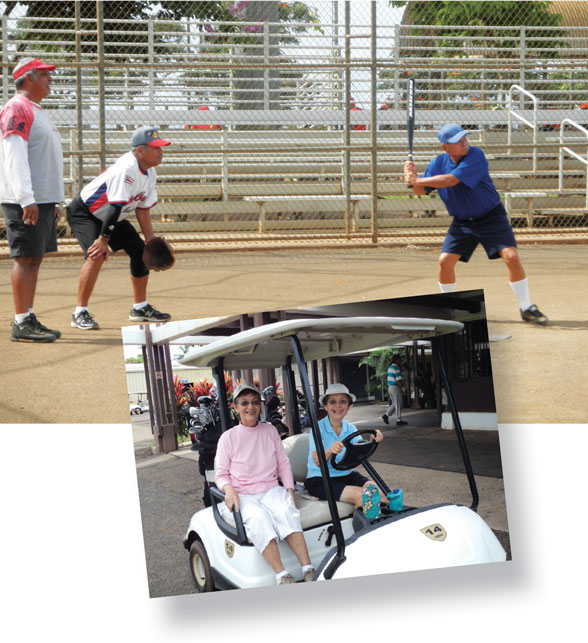
The Department of Parks and Recreation Adult / Seniors Program strives to improve the quality of life for seniors 55 years and older in the community. Many of the city’s parks offer a range of activities for recreation, wellness and leisure time with friends and family. Class fees vary from site to site.
The department also has 38 social clubs on O‘ahu. Clubs members plan out their own activities, which may include community service projects, excursions, guest speakers, crafts, games, luncheons, etc.
To join the fun, locate a class or club near you. Please call: Makua Ali‘i Senior Center, 973-7258; or Randy Yasuhara, 768-3045.
Adult Water Aerobics
The Adult Water Aerobics class at Waipahu District Park Swimming Pool will keep you active and fit. To participate in this class, please call Waipahu Swimming Pool Manager Sunny Leutu at 671-7911.
Senior Golf Program
Prepare to have a great day golfing in the Parks and Recreation’s Senior Golf Program with Jane Nakanishi and Michiko Hori. The club plays every other month at various municipal golf courses. For a great game of golf, please call Randy Yasuhara at 768-3045.
Senior Softball
Improve your pitch with the help of umpire Bill Andrade, catcher Les Lunasco and batter Gerald Ching. The Parks and Recreation’s senior softball league plays Wednesday mornings at Patsy T. Mink Central O‘ahu Regional Park (CORP) softball fields. For league info, please call the Makua Ali‘i Senior Center at 973-7258.
Zumba Gold
Zumba Gold instructor Lynn Ramirez leads Sharon Akiyama, Mildred Tomita and Becky Nakasone through a fun and vigorous workout in Waipahu District Park’s Zumba Gold class. For more class information, please call Waipahu District Park Program Director Jo-Ann Yatogo at 675-7129.
The Department of Parks and Recreation Adult / Seniors Program strives to improve the quality of life for seniors 55 years and older in the community. Many of the city’s parks offer a range of activities for recreation, wellness and leisure time with friends and family. Class fees vary from site to site. The department also has…
Wouldn’t it be so easy if you knew right away who was going to take advantage of you? Sadly this is not the case, and con artists have perfected the art of scamming for generations.
We can protect our friends and family by knowing our consumer rights. If someone comes knocking on your door to sell you a product or service; here are some easy-to-remember tips to help “knock out” scams in your neighborhood:
Don’t let the door-to-door sales person rush you into making a decision; ask for their contact and business information and let them know that you will check out their business with Hawai‘i’s Better Business Bureau (BBB).
Check if the business representative has all the necessary licensing that is required for the job or service performed. And, verify the license info and person with the Department of Commerce and Consumer Affairs (DCCA).
Get everything in writing; especially if they are offering you any special discounts, rebates, warranties or services outside of the standard contract or invoice.
A consumer purchasing a product at their home, may take advantage of the 3-day cooling off period for a refund following a sale if a cancellation notice is sent in writing within three (3) business days. The law does NOT apply if a buyer only calls to initiate the contract with the seller. Contact your BBB for more information about door-to-door sales practices or Federal Trade Commission’s (FTC) 3-day cooling off rule.
For more information about topics affecting marketplace trust, visit www.bbb.org.
Wouldn’t it be so easy if you knew right away who was going to take advantage of you? Sadly this is not the case, and con artists have perfected the art of scamming for generations. We can protect our friends and family by knowing our consumer rights. If someone comes knocking on your door to…
“We believe that the future of HUOA is dependent upon our youth.” — Jane Serikaku
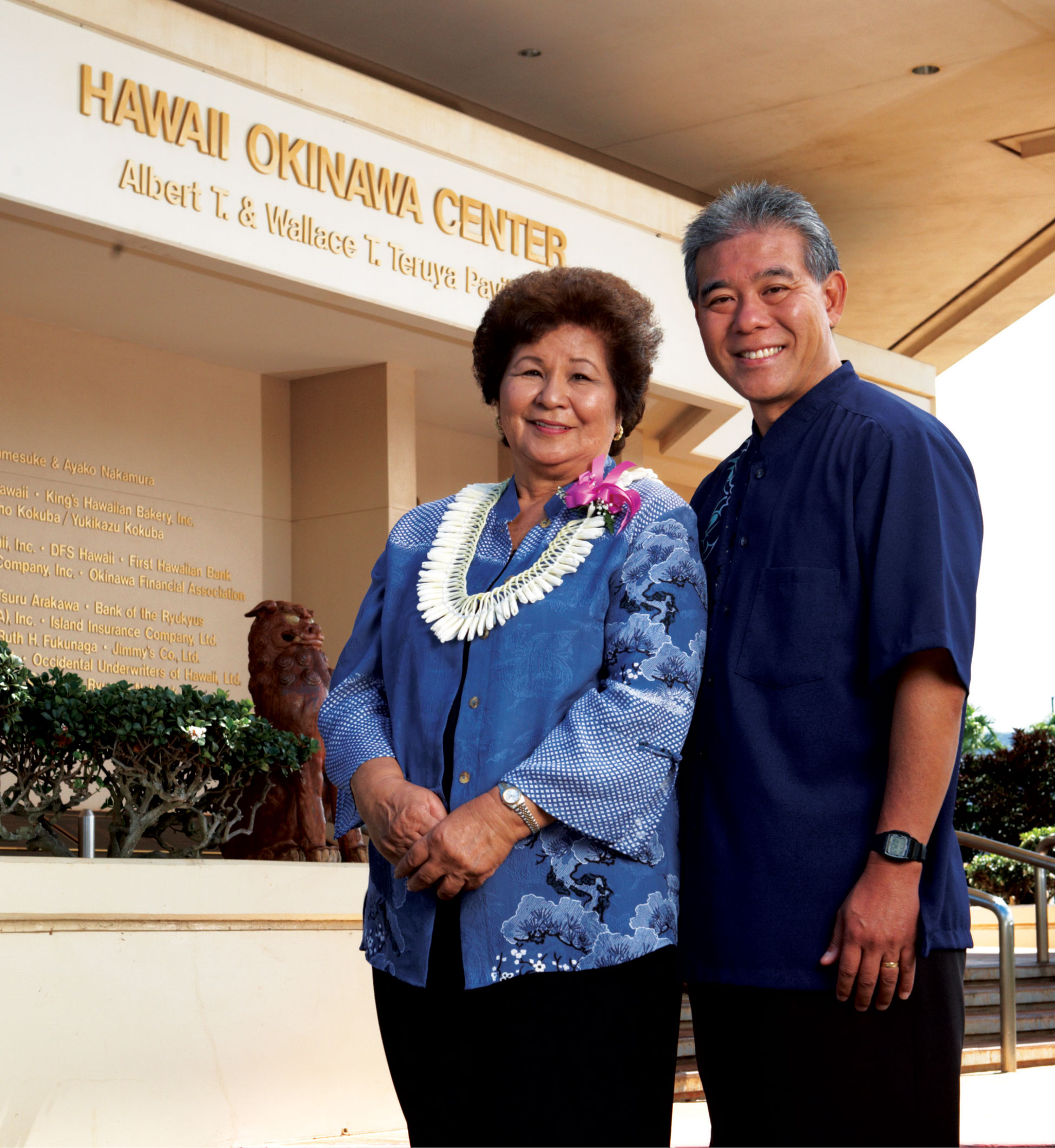
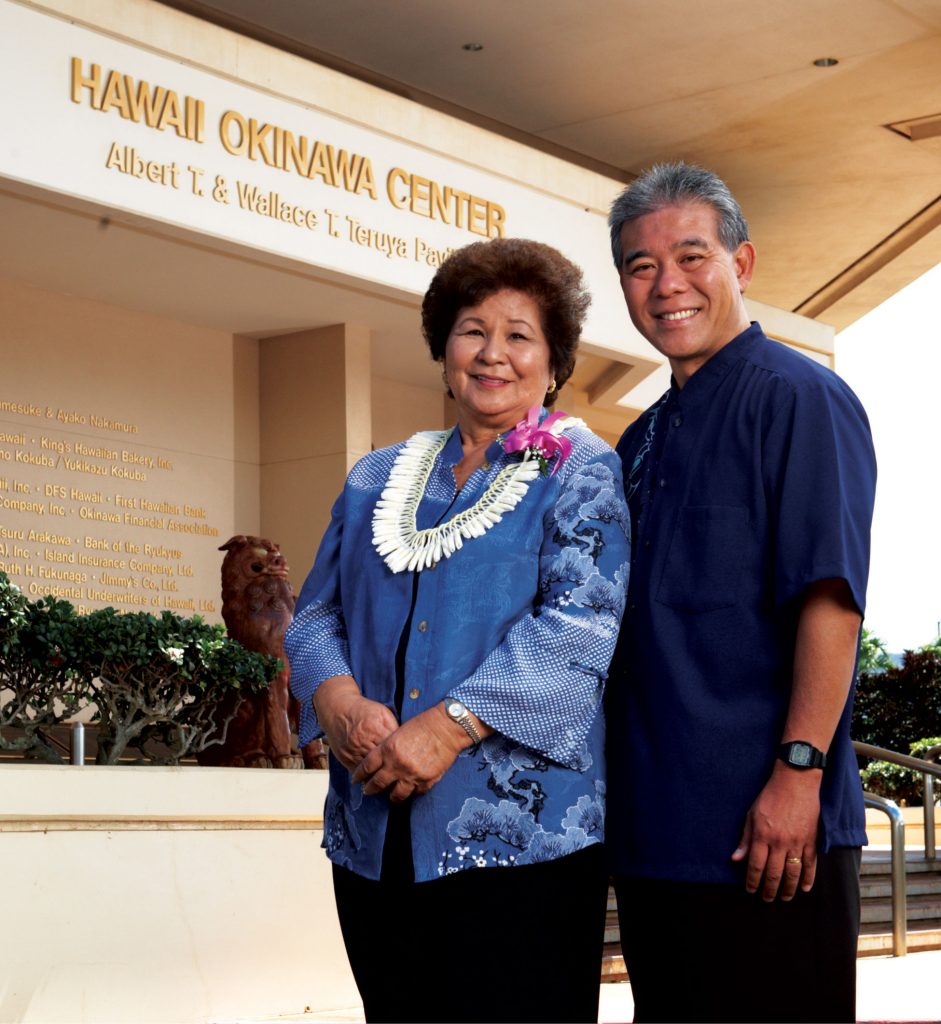
Jane Serikaku, HUOA Executive Director Norman Nakasone, HUOA President
When we first meet someone new in Hawai‘i, we often ask, “Where you wen’ grad?”, as it gives us an idea of where they grew up and a lot of times we know someone in common.
Likewise, Okinawans ask, “Are you Uchinanchu”? If yes, then the next question is, “What club do you belong to?”
Today, there are 49 active Okinawan clubs that make up The Hawai‘i United Okinawa Association (HUOA), a non-profit organization whose mission is to promote, perpetuate and preserve Okinawan culture. Its combined membership exceeds 40,000 people. The club to which someone belongs is often based on from which Okinawan city, town or village his/her family originated. Okinawan immigrants who settled in Hawai‘i recreated their village communities using names like shi (city), cho (town), son (village) and aza (ward/neighborhood). Today the clubs are known more by Shijinkai, Chojinkai, Sonjinkai and Azajinkai. The term jinkai literally means “peoples club or organization.”
Okinawans started immigrating to Hawai‘i in 1899. The then governor, Shigeru Narahara, allowed civil rights leader Kyuzo Toyama to recruit 26 men to work on Hawai‘i’s ‘Ewa plantations.
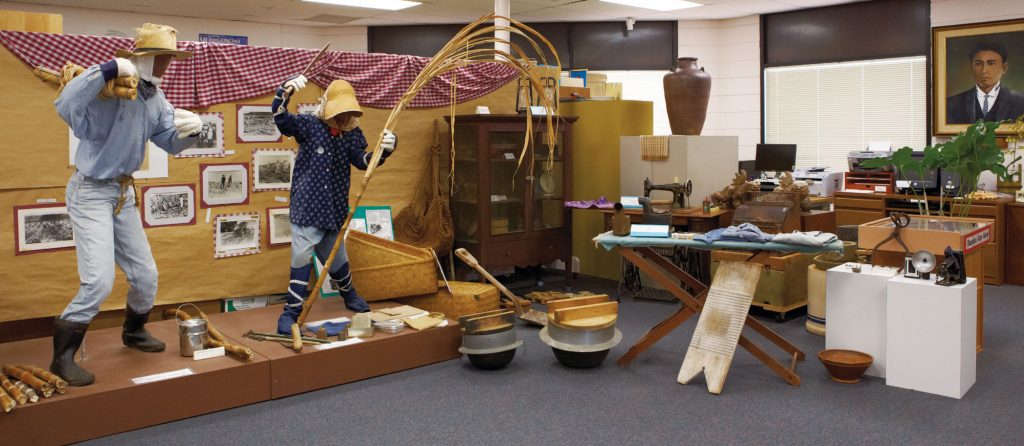
From 1900 –1907, open immigration brought thousands of workers who were hoping for a better life to the plantations. Plantation work was hard and demeaning — 10-hour days, 6 days a week under the brutal sun. Okinawans also endured double discrimination from both the local population and their fellow Japanese workers who treated them as second-class citizens. At the peak, some 1,700 Okinawan immigrants had settled in Hawai‘i.
The Hawai‘i Okinawa Center (HOC) Gallery is situated at the Yeiko and Kameko Higa Building at the HOC. Visitors and researchers are welcomed to browse at the displays of traditional Okinawan crafts: lacquer ware, pottery, doll-making and unique fabrics; as well as artifacts from the early-immigrant plantation days, and a collection of rocks bearing names of cities, towns and villages in Okinawa from where they were sent. Resource and reference materials, written in Japanese and English, are also available for use at the gallery. For information, call 676-5400 or visit online at huoa.org.
Chimu’ubii, or remembrance, is an important value within the Okinawan community. With each passing decade, the paths on which Okinawans in Hawai‘i traveled become increasingly distant. The homeland and villages are far away. And many customs and traditions have faded. Yet, these are the cultural traits that helped the Okinawan’s adopt Hawai‘i as home, assimi-late to American society and provide for their families. Hawai‘i’s vibrant Okinawan clubs play an important role in preserving Okinawan culture and its unique attributes.
In 1951, the clubs united to form the Hawai‘i Okinawa-Jin Rengo-Kai (United Okinawan Association of Hawai‘i) in order to provide relief for Okinawa after WWII. Through this local community effort, HUOA (name changed in 1995) became a major partner in the local Okinawan community. It focused on improvements in agriculture, public health, medical services, education and leadership training.
Nearly 30 years later, the HUOA built the Hawai‘i Okinawa Center in honor of its hard-working Issei (first generation forefathers), who persevered for the sake of future generations. The Center perpetuates the “Uchinanchu spirit.” It hosts regular performing art events and various cultural classes. But perhaps most importantly, it provides children and young adults opportunities to learn about their culture and to be part of the Okinawan community.
“We believe that the future of HUOA is dependent upon our youth,” says Jane Serikaku, HUOA Executive Director. As a retired educator of 30 years, she wanted to give young adults the chance to become totally immersed in the Okinawan culture, history and its people. As such, she created a Young Leadership Study Tour to Okinawa, which was patterned after the 1980 Leadership Tour offered by the Okinawan Government. Many participants returned excited and became leaders of their own club and/or became leaders of HUOA.
Jane has also been the HUOA coordinator for the Okinawa-Hawai‘i High School Student Exchange program for the past 21 years. “In the Exchange Program, 25 Okinawan students arrive in Hawai‘i in March and experience a two-week home stay with families and attend school with our students,” Jane explains. “In exchange, our Hawai‘i students engage in a two-week home stay experience in Okinawa in June.”
As a nonprofit, the Hawai‘i Okinawa Center has a very small staff. Its activities, events and services are mostly supported by volunteers.“We are extremely appreciative of the many volunteers who spend their days at our Center working to keep our Takakura Garden and Issei Garden well manicured and beautiful,” Jane says.
She notes that additional volunteers maintain the library of treasured books, offer translation services, help with family history research, assist in the office or fundraise at craft fairs. “We hope that this love for the Hawai‘i Okinawa Center will continue in the years to come,” Jane says, “and that more people will volunteer to take good care of their ‘home away from home.’”
In the near future, the HUOA is looking to expand. “We have our eyes set on the land just across the street,” Jane says. “We’d like to build a Hawai‘i Okinawa Plaza as a means of financially supporting the Hawai‘i Okinawa Center for future generations.”
Special thanks HUOA member club Hui O Laulima for use of its book, Chimugukuru, as reference source for this article.
The Local Okinawa Families That Built Hawai‘i
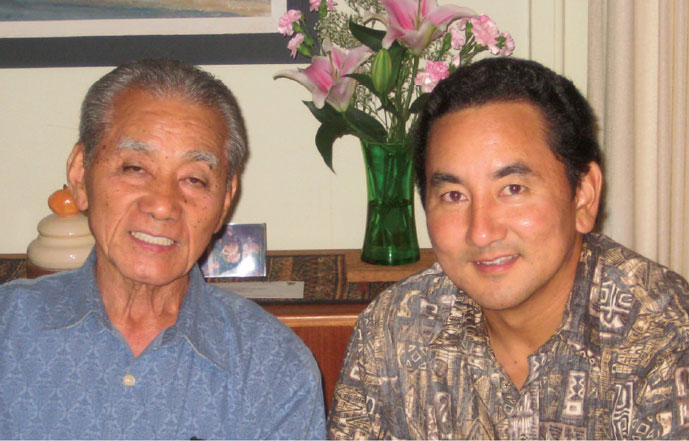
Herbert Shimabukuro and son Chris
From Kaua‘i to the Court House
Choyu Shimabukuro grew up in Haneji, Okinawa, an area outside of Nago. He later immigrated to Wahiawa¯, Kaua‘i. Choyu, which means long courage, passed on the Okinawan values of hard work to his son Herbert. As such, Herbert moved to O‘ahu and attended Farrington High School and The University of Hawai‘i. He later attended law school at George Washington University in Washington D.C. His career in law and as a judge spanned some 40-plus years.
Herbert’s belonged to the Haneji Club for more than 50 years. He served as President for one year in 1987 and then for a second term from 2001-2010. Over the years, the club has offered Herbert and his family wonderful fellowship.
His son, Chris, has fond memories of attending many of the club’s activities, including the Annual Picnic, volunteering at the Okinawan festival, and playing on softball and volleyball leagues. Chris says that he appreciates how the club has given him a sense of identity.
Chris is now a Vice President of the HUOA and has chaired the organization’s homeless Community Outreach Picnic and co-chaired the Aloha Aina Earth Day recycling event. He is also the Development Director at ‘Iolani School, one of the finest private institutions in the nation.
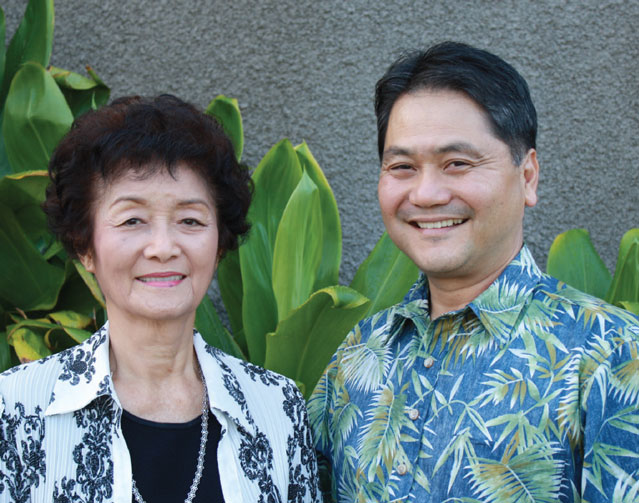
Cyrus Tamashiro and his mother Louise
From Hilo to Kalihi
In 1941, immigrants Chogen and Yoshiko Tamashiro opened the first Tamashiro Market in Hilo, Hawai‘i. It was a small store specializing in fresh pork from livestock farmed by the Tamashiro family. On April 1, 1946, a tsunami struck and demolished most of Hilo’s business district, including the family’s store. Chogen move the business to O‘ahu to its current location on North King Street.
The Tamashiro’s older son, Walter Hajime, took over the operation in 1954. He built the business by specializing in seafood. He started with a few pieces of ‘opelu, then a whole aku (skipjack tuna). The few pieces of fish grew to tubs of fish, larger fish and dozens of varieties. Brother Johnny Tamashiro and brother-in-law Larry Konishi joined Walter in 1962, and together they expanded the Market’s reputation as the home of the finest seafood. In fact, Tamashiro Market was one of the first retailers to sell poke on a large scale and has offered more than 30 preparations since the 1970s. Today, Walter’s sons Cyrus, Guy and Sean continue the family business.
The Tamashiro family has been involved with their Okinawan Nago Club many years, as well as fundraising of the Okinawan Cultural Center. In 2012, Cyrus will become the President of the Hawai‘i United Okinawan Association.
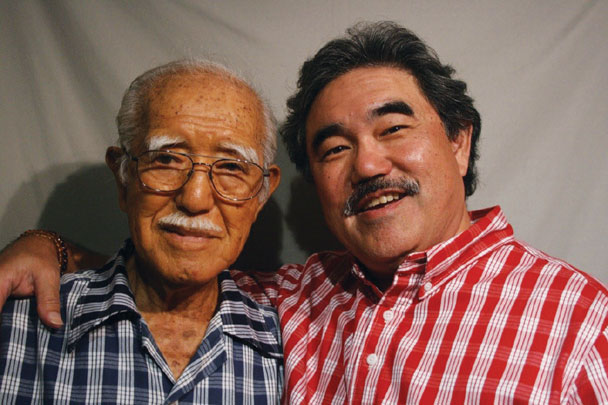
Goro Arakawa and son David
Arakawa Store
In 1904, Goro Arakawa was one of the earliest plantation workers’ to work on Hawai‘i’s Ewa plain. During The Great Strike of 1909, he empathized with the workers demands for higher wages and better standard of living. To help the community, he partnered with Mr. Tamanaha to open the Arakawa Store in 1912.
Goro was one of 9 children—5 boys and 4 girls—who worked at the family store. Goro was chosen to attend New York University to study retailing and marketing. Seeing that his siblings worked long, hard hours at the store, he was pressed to study hard for the family. When Goro returned to Hawai‘i, he made the Arakawa Store one of the first retailers to accept credit cards in the state of Hawai‘i.
In the late 1980s, Goro became involved with the Hawai‘i United Okinawan Association when the Arakawa family was approached about fundraising for the Okinawan Cultural Center.
Goro was also the spark plug for the founding of the Waipahu Plantation Village, an outdoor replica of a Hawai‘i sugar plantation village.
Goro’s son, David, carries on the family Okinawan tradition of giving back to the community. As a past HUOA President and former Prosecuting Attorney, David is now the President of the United Japanese Society of Hawai‘i, the umbrella of all the Japanese associations.
Cover & Feature Story Photography by Brian Suda “We believe that the future of HUOA is dependent upon our youth.” — Jane Serikaku When we first meet someone new in Hawai‘i, we often ask, “Where you wen’ grad?”, as it gives us an idea of where they grew up and a lot of times we know…
It’s been three years since Social Security’s Retirement Estimator went online. Within months of coming out, the online application was praised as one of the highest-rated online services, and it has consistently remained so every year.
Results from the American Customer Satisfaction Index show Social Security’s online Retirement Estimator in one of the top two spots, with a score of 90. (Social Security’s online benefit application took the top spot.) The Retirement Estimator ranks higher than the Web sites of any other public and private sector agencies and companies, including the likes of Netflix and Amazon.
Now that Social Security’s most popular online application is available in Spanish at www.segurosocial.gov/calculador, even more people can use the Retirement Estimator.
The Retirement Estimator is a convenient, secure and quick financial planning tool that lets workers calculate how much they might expect to receive in Social Security benefits when they retire. The attractive feature of this calculator is that it uses your earnings information on file at Social Security, without displaying your personal information. So you get an instant, personalized estimate of your future retirement benefits.
The Estimator even gives you the opportunity to run different scenarios and “what if” situations. For example, you can change the date you expect to retire or change expected future earnings to create and compare different retirement options. This can help you as you plan ahead.
To use the Retirement Estimator, you must have enough Social Security credits to qualify for benefits and you cannot be receiving benefits currently.
Experience the best online service now by visiting Social Security’s Retirement Estimator at www.socialsecurity.gov/estimator. Then, once you’ve sketched out your retirement plans, you’ll know where to go when the time comes to apply for benefits: online at www.socialsecurity.gov.
RETIREMENT
Q: What is a Social Security “credit?”
A: During your working years, earnings covered by Social Security are posted to your record. You earn Social Security credits based on those earnings. The amount of earnings needed for one credit rises as average earnings levels rise. In 2011, you receive one credit for each $1,120 of earnings. You can earn up to a maximum of four credits a year. Most people will need a minimum of 40 credits (or 10 years of work) to be eligible for retirement benefits. Learn more by reading the online publication How You Earn Credits at www.socialsecurity.gov/pubs/10072.html.
Q: What’s so easy about applying online for benefits?
A: There’s no need to go to a local Social Security office or wait for an appointment. You can apply in less than 15 minutes. Once you submit your electronic application, you’re done. In most cases, there are no forms to sign or documents to mail. Try it at www.socialsecurity.gov.
Q: What is the earliest age that I can begin receiving retirement benefits?
A: You can get a reduced benefit as early as age 62. Keep in mind that your monthly benefit amount will be about 33 percent higher if you wait until age 66 and nearly 80 percent higher if you defer payments until age 70. Find out how much you can expect to receive by visiting our Retirement Estimator at www.socialsecurity.gov/estimator.
MEDICARE
Q: Who is eligible for ‘Extra Help’ with Medicare prescription drug costs?
A: Medicare beneficiaries with limited income and resources may qualify for ‘Extra Help.’ The extra help can save you money. It pays part of the monthly premiums, annual deductibles and prescription co-payments under the new Medicare prescription drug program. The extra help is estimated to be worth an average of $4,000 per year. See if you qualify and apply online at www.socialsecurity.gov/prescriptionhelp.
It’s been three years since Social Security’s Retirement Estimator went online. Within months of coming out, the online application was praised as one of the highest-rated online services, and it has consistently remained so every year. Results from the American Customer Satisfaction Index show Social Security’s online Retirement Estimator in one of the top two…
Are you dreaming of a leisurely retirement enjoying a second cup of morning coffee, or is a sunrise round of golf more your speed? Either way, know the facts so you can guide your retirement dreams to reality.
Historically the road to retirement hasn’t been smooth for women. In fact, the Social Security Administration (SSA) reports that 17 percent of all elderly, single women live in poverty. By recognizing the following myths for what they are, you can take control of your financial future.
Myth #1 — Social Security will take care of me in retirement.
The reality is that Social Security income probably won’t be enough. At the start of 2011, the average monthly retirement benefit reported was $1,177. Plus, women’s benefits were almost a third lower than men’s. Not only do women earn less than men, they also take more time away from work than men (U.S. Department of Labor). Add the uncertain future of Social Security to these statistics, and you can see why it’s important to plan for additional income sources.
A benefits estimator is available online at the Social Security Administration’s Web site at www.ssa.gov. Use it to get an estimate of future benefits depending on when you plan to retire.
Myth #2 — I won’t need nearly as much to live on when I retire.
The assumption sounds reasonable when you consider the costs associated with raising children and commuting to work each day. On the other hand, if you want to spend your leisure time traveling, it will come with a cost. It’s probably safe to assume that you’ll have higher health care costs — and potentially long-term care costs — in your later years, as well.
As a rule of thumb, you’ll need 60 to 80 percent of your current income in retirement (adjusted for inflation) to maintain your current lifestyle. Of course, it depends on how you plan to spend your time once you’ve retired.
Myth #3 — My 401(k) contributions will fund my retirement without my involvement.
It’s true that a 401(k) is a smart way to save for retirement with pre-tax dollars. Since many employers offer a matching feature, you may have an opportunity for instant return on your invested dollars.
The good news is that many women are contributing to their employer-sponsored plans. SSA data suggests that in 2008, 51 percent of women employed full-time participated in their plan through work.
However, you shouldn’t sit back and let the plan manage itself. Instead, taking an active role in your investment selection can maximize benefits. If you have several years until retirement, choosing too conservative of investments may cause you to fall short. On the other hand, if retirement is approaching, you may need to move aggressive investments to the more conservative side. Remember to review your choices regularly to make sure your investment selection is still in line with your goals.
If these decisions seem daunting, you don’t have to make them alone. Establish a relationship with professionals who can help you at critical times. Face your unique financial challenges with reality and eager anticipation of your retirement dream.
For more information, please contact Michael W. Yee at (808) 952-1240.
Are you dreaming of a leisurely retirement enjoying a second cup of morning coffee, or is a sunrise round of golf more your speed? Either way, know the facts so you can guide your retirement dreams to reality. Historically the road to retirement hasn’t been smooth for women. In fact, the Social Security Administration (SSA)…
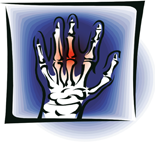
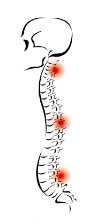
Arthritis is inflammation of one or more joints. Osteoarthritis is the commonest form of arthritis. It is also known as degenerative joint disease. According to the Arthritis Foundation, this chronic disease affects more than 27 million Americans. More than half the seniors over age 65 have evidence of osteoarthritis. Osteoarthritis occurs when the joint cartilage breaks down over time. It most commonly affects joints of the hands, hips, knees, lower back and neck.
Risk factors for osteoarthritis
Previous joint injuries
Older age
Female gender
Bone deformities
Occupations with repetitive stress on a particular joint
Common symptoms of arthritis
Joint pain
Joint stiffness
Swelling
Loss of flexibility
Grating sensation
How is osteoarthritis diagnosed?
X-ray imaging of affected joints may reveal narrowing of the joint space, which indicates that the cartilage is worn out. Bone spurs may be seen around the joint.
What lifestyle modifications are recommended?
Maintaining function and preventing disability is key to living well with arthritis. Exercise is important to preserve joint function and improve flexibility. Yoga and Tai Chi offer gentle exercises that help balance, posture and flexibility. Physical therapy is useful to strengthen the muscles around the joints and increase range of motion. Weight loss is recommended for persons who are overweight as it reduces the stress on weight bearing joints. Assistive devices such as canes or walkers prevent falls.
How is osteoarthritis treated?
There is no cure for osteoarthritis. Tylenol, Ibuprofen and other pain relievers reduce joint pain and maintain joint movement. For severe pain narcotics are often prescribed. Injections of steroid or hyaluronic acid into the joint may provide pain relief for longer periods. Studies on glucosamine and chondroitin have show mixed results. Both heat and cold packs can relieve pain in the joints. There are many over-the-counter creams for temporary relief of arthritis pain.
When is surgery needed?
Sometimes joint pain is so severe that it affects a person’s daily activities. Joint replacement is considered as a treatment when severe joint pain or dysfunction is not relieved by less invasive therapies. Joint replacement surgery involves removing the damaged surfaces of the joints and replacing them with metal prosthesis. The surgery is usually done by an orthopedic surgeon. Hip and knee joints are the commonly replaced joints and can last for 15 to 20 years depending upon use. Following joint replacement surgery, seniors are able to enjoy an active, pain-free lifestyle.
Arthritis is inflammation of one or more joints. Osteoarthritis is the commonest form of arthritis. It is also known as degenerative joint disease. According to the Arthritis Foundation, this chronic disease affects more than 27 million Americans. More than half the seniors over age 65 have evidence of osteoarthritis. Osteoarthritis occurs when the joint cartilage…

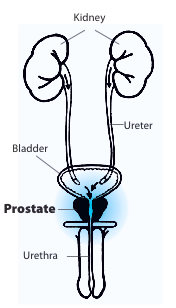 The prostate is a walnut-sized gland that forms part of the male reproductive system. The prostate is located just below the bladder, where urine is stored. The prostate also surrounds the urethra, the canal through which urine passes out of the body. It is common for the prostate gland to become enlarged as a man ages. Benign Prostatic Hyperplasia (BPH) is non-cancerous enlargement of the prostate gland. It affects more than 50% of the men over age 60. Testosterone and other hormones may play a role.
 I am headed off this summer to a place I’ve never been before, with people I’ve never met before, and I couldn’t be more excited.
 Adult Water Aerobics
 Senior Softball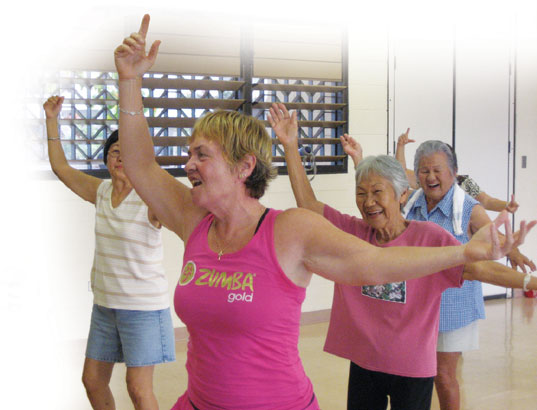

 Arthritis is inflammation of one or more joints. Osteoarthritis is the commonest form of arthritis. It is also known as degenerative joint disease. According to the Arthritis Foundation, this chronic disease affects more than 27 million Americans. More than half the seniors over age 65 have evidence of osteoarthritis. Osteoarthritis occurs when the joint cartilage breaks down over time. It most commonly affects joints of the hands, hips, knees, lower back and neck.
 Common symptoms of arthritis