WANT THIS ISSUE?
Download your own personal copy of this issue in PDF format. Click the button below:

WANT THIS ISSUE?
Download your own personal copy of this issue in PDF format. Click the button below:
Cover Story: The Fountain of Youth & Ms. Medicare
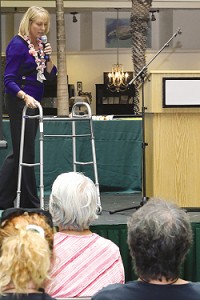 The number of falls among Hawai‘i’s kupuna is growing at an alarming rate, and impacting families and health care organizations. Annually in Hawai‘i, an average of 86 seniors die, 1,912 are hospitalized and 8,010 are treated in emergency rooms as a result of falls. Among adults 65 and older, these falls are not only common, but related death rates have risen sharply over the past decade. Further studies show seniors 75 and older who fall are four or five times more likely to be admitted to long-term care facilities for a year or longer.
Recent reports show Hawai‘i’s seniors are visiting hospital emergency rooms on a rate of every hour, 24 hours a day, seven days a week. This impact on our hospitals and physicians has resulted in close to $102 million in charges.
“The good news is many falls and fall-related injuries are preventable, with current knowledge and collaborative community outreach programs,” explained Gina Beckford, RN, and client service supervisor at Attention Plus Care.
Towards this end, fall prevention has become a larger area of focus and major priority for healthcare providers, seniors and payer sources alike. By promoting the safety and welfare of our seniors, the largest aging population in the country can be made aware of the facts, and of implementing interventions to prevent fall related injuries that can limit independence and mobility. To help raise awareness and address these issues, participating agencies are working with the state Department of Health to help advise seniors, family members and caregivers to know and incorporate the following steps, which are considered to be the four pillars of fall prevention:
Additionally, a Statewide Task Force on Falls Prevention, the Hawai‘i State Fall Prevention Consortium will be hosting the 4th Biennial Fall Prevention Conference on Oct. 16, 2015, at the Hawai‘i Convention Center. The theme for the conference is “Promising Practices in Fall Prevention and Beyond.” The event will bring together over 300 healthcare professionals raising awareness on falls prevention in older adults.
“As a task force member and corporate sponsor, I highly recommend professional and community members to attend this event,” said Beckford. With everyone’s support and active participation, we can help our seniors to avoid falls and ensure a safer and higher quality of life!
For more information and details on fall prevention and free community workshops on Aging in Hawai‘i hosted by Attention Plus Care, please call: 808-440-9372.
Attention Plus Care, Accredited by the Joint Commission
1580 Makaloa St., Ste. #1060, Honolulu, HI 96814
808-739-2811 | www.attentionplus.com
The number of falls among Hawai‘i’s kupuna is growing at an alarming rate, and impacting families and health care organizations. Annually in Hawai‘i, an average of 86 seniors die, 1,912 are hospitalized and 8,010 are treated in emergency rooms as a result of falls. Among adults 65 and older, these falls are not only common,…
With Thanksgiving approaching, we are reminded to be appreciative of what we have; oftentimes, this leads to opening up our hearts (and wallets) to those in need. Unfortunately, there are those who would use dishonesty to profit from a giving heart.
Earlier this year the Federal Trade Commission and Attorneys General of 50 states prosecuted and fined four national cancer charities allegedly run by one family, which collected over $187 million but spent nearly all of it on themselves.
Fake charities are everywhere, and the level of energy con artists use to make their schemes seem legitimate can make it difficult to differentiate them from real giving organizations. When donating to charities, it is important to take the time to get to know the charity and conduct your own investigations about their mission.
If a charity is contacting you via phone — listen to their pitch, but give them no personal information and hang up. Telephone solicitation is expensive and some of the money you give will be used to pay the person who called you. If you are interested, investigate the charity online and donate directly to them to eliminate that “middle man” who just called. This will ensure that all of your money will go to the charity and not the person calling you on the phone.
Today’s cost of operating a charity makes it virtually impossible for a charity to direct 100 percent of your contribution to program activities. Yet, be aware that efficient charities spend about 75 percent on programs and services, and less than 25 percent on fundraising and administrative fees. The best way to make sure your donation helps the right people is to do a little research.
Lastly, keep a record of all your donations and who you help support. This can help you plan your charitable giving and avoid just responding to the numerous solicitations (junk mail) you will receive once you do decide to give.
To report suspected elder abuse, contact the Elder Abuse Unit at: 808-768-7536 | ElderAbuse@honolulu.gov www.ElderJusticeHonolulu.com
With Thanksgiving approaching, we are reminded to be appreciative of what we have; oftentimes, this leads to opening up our hearts (and wallets) to those in need. Unfortunately, there are those who would use dishonesty to profit from a giving heart. Earlier this year the Federal Trade Commission and Attorneys General of 50 states prosecuted…
 Dropless Cataract Surgery is a new option for cataract patients that reduces the need for eye drops after surgery.
Traditionally, after patients undergo cataract surgery they must adhere to a strict three- to four-week schedule that includes several types of drops. These drops are critical because they reduce risk of inflammation and infection.
Complications arise when cataract patients miss a scheduled dose, are physically unable to instill the drops, or have to rely on the availability of a caregiver to administer the drops. Some patients cannot afford expensive prescribed drops.
During Dropless Cataract Surgery, a sterile mixture of antibiotic and anti-inflammatory medication is deposited in the back of the eye (the vitreous). These drugs help fight infection and inflammation during the entire recovery period. Post surgical complications are properly controlled without patients and caregivers following a strict eye-drop schedule.
Dropless Cataract Surgery represents a watershed for ophthalmology in Hawai‘i. The introduction of this important treatment option helps us reach the ultimate goal for our patients—better vision with a reduced risk of complications and a convenient and positive patient experience.
Jenkins Eye Care
615 Pi‘ikoi St. Suite 205, Honolulu, Hawai‘i 96814
808-591-9911 | www.jenkinseyecare.com
Twitter, Facebook & YouTube: Jenkinseyecare
Dropless Cataract Surgery is a new option for cataract patients that reduces the need for eye drops after surgery. Traditionally, after patients undergo cataract surgery they must adhere to a strict three- to four-week schedule that includes several types of drops. These drops are critical because they reduce risk of inflammation and infection. Complications arise…
With Thanksgiving approaching, we are reminded to be appreciative of what we have; oftentimes, this leads to opening up our hearts (and wallets) to those in need. Unfortunately, there are those who would use dishonesty to profit from a giving heart.
Earlier this year the Federal Trade Commission and Attorneys General of 50 states prosecuted and fined four national cancer charities allegedly run by one family, which collected over $187 million but spent nearly all of it on themselves.
Fake charities are everywhere, and the level of energy con artists use to make their schemes seem legitimate can make it difficult to differentiate them from real giving organizations. When donating to charities, it is important to take the time to get to know the charity and conduct your own investigations about their mission.
If a charity is contacting you via phone—listen to their pitch, but give them no personal information and hang up. Telephone solicitation is expensive and some of the money you give will be used to pay the person who called you. If you are interested, investigate the charity online and donate directly to them to eliminate that “middle man” who just called. This will ensure that all of your money will go to the charity and not the person calling you on the phone.
Today’s cost of operating a charity makes it virtually impossible for a charity to direct 100 percent of your contribution to program activities. Yet, be aware that efficient charities spend about 75 percent on programs and services, and less than 25 percent on fundraising and administrative fees. The best way to make sure your donation helps the right people is to do a little research.
Lastly, keep a record of all your donations and who you help support. This can help you plan
your charitable giving and avoid just responding to the numerous solicitations (junk mail) you will
receive once you do decide to give.
To report suspected elder abuse, contact the Elder Abuse Unit at: 808-768-7536 | ElderAbuse@honolulu.gov | www.ElderJusticeHonolulu.com
With Thanksgiving approaching, we are reminded to be appreciative of what we have; oftentimes, this leads to opening up our hearts (and wallets) to those in need. Unfortunately, there are those who would use dishonesty to profit from a giving heart. Earlier this year the Federal Trade Commission and Attorneys General of 50 states prosecuted and…

Synchronized swimming is alive and beautifully executed by Mermaids Hawai‘i, home-pooled at Windward YMCA in Kailua. Since 1971, they have been “teaching and performing water ballet for fascinated crowds.” It’s not a paid act — just teacher Alice Robert’s vision to “dance” in the pool like her Hollywood idol, the great Esther Williams, and to pass on the sport to future generations.
The Mermaids are waiting for her favorite singer/songwriter, Kumu Hula Keali‘i Reichel, to show up at one of their free shows.
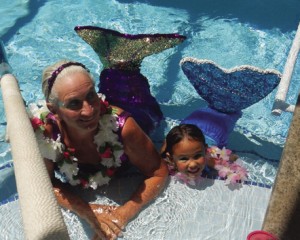
“We swim to some of his songs,” says Alice, “while our hula dancers accompany us, poolside. I think he’d enjoy seeing us swim to his music— it’s perfect for synchronized swimming.”
The Mermaids are every age, from five to 86. They have a lot of swimmers, but need “land volunteers” to help with performance logistics: making and laundering costumes, running the sound system, taking pictures, setting up and breaking down. It’s fun! To be a mervolunteer, call Alice.
The Mermaids are rehearsing for a free Oct. 25 Halloween Show at Windward YMCA, in Kailua. Call 808-864-8122 for details.
Mermaids Hawai‘i
Artistic Director Alice P.S. Roberts
808-864-8122
Synchronized swimming is alive and beautifully executed by Mermaids Hawai‘i, home-pooled at Windward YMCA in Kailua. Since 1971, they have been “teaching and performing water ballet for fascinated crowds.” It’s not a paid act — just teacher Alice Robert’s vision to “dance” in the pool like her Hollywood idol, the great Esther Williams, and to…
You read the title of this column correctly. Many Medicare plans are launching reward and incentive plans. Points earned can be redeemed for prizes or gift cards. Incentives are awarded for healthy activities that result in positive health outcomes. You could earn points for:
Recent Center for Medicare and Medicaid (CMS) guidance to Medicare plan sponsors gives plans and your primary physician more control over when some health incentives may be earned. Now incentive or points may be awarded at the start of an activity or at other times during a required activity. Limits on monetary incentives also were lifted. The plans I reviewed offered points that you may redeem for items via a website. The guidance allows plans to offer gift cards as well. Reward and incentive plans are optional, so not every Medicare plan sponsor has or will offer them.
So during the next Medicare open enrollment season, or if you become newly eligible for Medicare, you may want to inquire if the Medicare plans you are considering offer a rewards and incentive program.
808-543-2073 | getmedicare@aol.com
www.Get2insurance.com
Morning Drive With Martha
A radio program with Martha Khlopin
KNDI-1270AM: Weekdays, 4:30 am–6 am
You read the title of this column correctly. Many Medicare plans are launching reward and incentive plans. Points earned can be redeemed for prizes or gift cards. Incentives are awarded for healthy activities that result in positive health outcomes. You could earn points for: Completing an Annual Wellness Visit(AWV) Tobacco cessation Maintaining a certain Body…
Caregiving became a full-time responsibility for Lahaina resident Montella Lopez in her mother’s final years. In the six times her mother was discharged from the hospital, Lopez said she received little or no instruction on how to care for her mother at home.
As Hawai‘i’s population ages and the number of people with chronic conditions increases, pressures on unpaid caregivers mount. Thousands of Hawai‘i caregivers like Lopez are providing complex care for which they are unprepared— such as medication management and wound care.
In response to this urgent need, a group of advocates and elder-support agencies are calling on state lawmakers to approve legislation requiring Hawai‘i’s hospitals to offer family caregiver instruction—at the time of discharge. The Hawai‘I CARE Act Coalition wants all hospitals to recognize and support the critical role of family caregivers to ensure safe hospital-to-home transitions.
This summer, a Legislative Family Caregivers Working Group has held monthly meetings to assess the role of family caregivers in hospital discharge procedures. Working Group members are reviewing proposed CARE Act legislation that features three commonsense provisions:
Allows patients to designate a family caregiver, and put that person’s name in the hospital record.
Notifies the family caregiver prior to the patient’s discharge from the hospital.
Requires hospitals to offer caregiver instruction— at discharge — for medical tasks they need to provide for the patient at home.
Hospitals opposing the proposed legislation say they already follow federally established guidelines for patient discharge. Advocates emphasize that guidelines only require discharge instruction for patients—not family caregivers who may be required to carry out those instructions.
New research on family caregivers in Hawai‘I has created greater urgency for legislative action in support of an estimated 154,000 relatives, partners, friends and neighbors who assist older loved ones at home. According to the AARP Public Policy Institute report, family caregivers statewide provided unpaid care worth $2.1 billion in 2013.
In the past two years 17 other state legislatures passed bills providing for greater involvement and instruction of caregivers at the time of hospital discharge. Hawai’i seems to be falling behind.
It’s time to support our family caregivers who make it possible for their parents and grandparents to live more independently and remain in their homes and communities. Given our rapidly aging population and prohibitive cost of paid eldercare in the islands, Hawai‘i should be leading the way in support for caregivers — not falling behind.
Residents are urged to support the CARE Act in Hawai‘i by signing an online petition at action. www.tinyurl.com/AARPISupportCAREAct.
AARP Hawai‘i state office:
808-545-6006 | Toll-Free: 866-295-7282
www.aarp.org/hi | facebook.com/AARPHawaii
twitter.com/AARPHawaii
Caregiving became a full-time responsibility for Lahaina resident Montella Lopez in her mother’s final years. In the six times her mother was discharged from the hospital, Lopez said she received little or no instruction on how to care for her mother at home. As Hawai‘i’s population ages and the number of people with chronic conditions…
If you’re like most people, you periodically set aside time to clean out your home, garage or closets. It’s equally important to organize your finances. This checklist can help you get started:
Michael W. K. Yee, CFP
1585 Kapiolani Blvd., Ste. 1100, Honolulu
808-952-1222 ext. 1240 | michael.w.yee@ampf.com
Michael W K Yee, CFP®, CFS®, CRPC®, is a Financial Advisor and CERTIFIED FINANCIAL PLANNER practitioner™ with Ameriprise Financial Services, Inc. in Honolulu, HI. He specializes in fee-based financial planning and asset management strategies and has been in practice for 30 years. Ameriprise Financial Services, Inc. Member FINRA and SIPC.
© 2015 Ameriprise Financial, Inc. All rights reserved. File #12606695
If you’re like most people, you periodically set aside time to clean out your home, garage or closets. It’s equally important to organize your finances. This checklist can help you get started: Cancel unused credit cards: Don’t throw away money on annual fees for credit cards you don’t use. First, cash in any rewards points…
Hundreds of families, including my own, go through the aging process. Historically, and particularly in Hawai‘i, our cultures require us to take care of our kupuna in our homes. However, in current times, adult children have very busy lives working full-time and raising children and grandchildren.
Today, an increasing number of families are turning to retirement communities for their aging loved ones. Retirement communities are no longer drab and dreary places with sad faces and worn wheelchairs. Residents experience vibrant and beautiful living spaces that promote wellness, recreation, socialization and health for older adults who all grew up in the same era. This means that residents share the same interests and find comfort in the same likes and dislikes.
When family members visit their loved ones, they may find them exercising in the pool, arranging tropical floral bouquets, laughing with friends over coffee or volunteering in the community thrift store. The best part, however, is knowing that mom or dad have physical and emotional support, activities to look forward to, will never go hungry, and most importantly, are safe.
Hawai‘i’s cultures are finally accepting and embracing the option of retirement communities. As I work with my clients, I am finding that our kupuna are independently choosing this lifestyle. They will tell me, “I don’t want to burden my children.” Parents cherish their independence and don’t want to burden their children; children want to do what’s best for their parents.
Pohai Nani
45-090 Namoku St., Kane‘ohe, HI 96744
808-236-7807 | gishol@good-sam.com
Hundreds of families, including my own, go through the aging process. Historically, and particularly in Hawai‘i, our cultures require us to take care of our kupuna in our homes. However, in current times, adult children have very busy lives working full-time and raising children and grandchildren. Today, an increasing number of families are turning to…
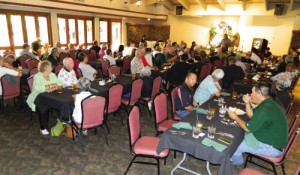 The 2015 season for the Na Koa Football Club started on Aug. 31 and will continue every Monday for 11 more lunches at the Willows Restaurant, starting at 11am. This season, the University of Hawai‘i Rainbow Warriors will play 12 straight games without a week off. There is no bye for Na Koa boosters either. Coach Norm Chow kicked off their first lunch meeting to a round of applause as he announced, “This is the best football team in the three years I have been at UH.” He beamed as he talked about his players’ and coaches’ stats, noting his admiration for each one.
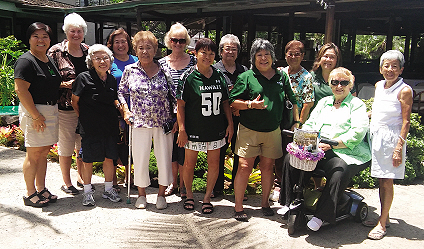
I noticed that women made up one-third of the audience; some with their husbands, but many alone or with a girlfriend. All listened intently to Coach, tracking every question and answer. One woman told Coach that although the stands may not always be filled, Na Koa boosters, UH fans and alums continue to support him, his staff and players. Coach thanked her and said he would take that message back to his staff and players. I caught him after lunch and asked, “Why do you think one-third of today’s meeting were women?” He grinned, “Women enjoy football!”
After lunch, I met Dana Chandler, the ultimate Rainbow Warrior booster — with season tickets for every UH sport. She’s a Cal Poly graduate, who calls Hawai‘i her home now for 35 years. She joined Na Koa to help our student athletes. Bea Shimamoto is a UH alumna who loves football and men/women’s volleyball. She can’t make all the Na Koa lunches because she attends every away game and stays to vacation. Bea broke into a big smile when I mentioned the November UNLV game. She’ll be there. Maybe you will, too!
Both women see the educational aspect of football, preparing young men for leadership, career and raising a family. They relate to Coach Chow because of his positive attitude, family-oriented coaching method and teaching skills. He is a great spokesperson for UH because he deeply appreciates his staff, his players and their families. In return, Coach Chow and his program enjoy the enthusiastic support of 550 members of Na Koa Football Club. As he says,
“For over 25 years, Na Koa is a large part of the UH Football tradition; their support is critical to the program’s continued success, both on and off the field of play.”
Na Koa Football Club
Joyce Lau, Membership & Events Manager
808-956-4513 | joyce@nakoa.org
www.nakoa.org
The 2015 season for the Na Koa Football Club started on Aug. 31 and will continue every Monday for 11 more lunches at the Willows Restaurant, starting at 11am. This season, the University of Hawai‘i Rainbow Warriors will play 12 straight games without a week off. There is no bye for Na Koa boosters either.…
The one estate planning document that everyone 18 and older should have is an Advance Health-Care Directive. It is not the sexiest tool in the estate planning toolbox, but it can head off family strife, heartache, and needless attorney’s fees as no other document can.
Karen Ann Quinlan, Nancy Cruzan, and Terri Schiavo. Sound familiar? They were three beautiful young women whose legacies are protracted legal battles over how they would be cared for after they lost the ability to speak for themselves.
Karen’s case determined that “medical treatment” includes life-sustaining measures (such as use of a ventilator to keep a person breathing), and that those measures can be declined by a patient or someone acting on the patient’s behalf.
Karen’s parents succeeded in having the ventilator that was keeping her alive removed, but Karen lived another 10 years because her parents did not believe that food and water should be withheld from her.
Nancy’s case went a step further. In that case, the battle was between Nancy’s family, who believed that Nancy would not want to be sustained on a tube, and the State of Missouri, who asserted that only the patient can make that decision.
Unfortunately, Nancy had never given written instructions about her wishes. After Nancy’s family presented sufficient evidence to convince the court that Nancy did not want to be kept alive on a tube, food and water were withdrawn.
She died 13 days later, but eight years had passed since the car accident that had rendered her incapacitated and launched the legal battle over her care.
Terri’s case involved the question of who has the authority to make end of life decisions on behalf of an incapacitated person. The law of Florida, where Terri lived, automatically conferred that authority on her spouse.
When the dust cleared following the legal battle between Terri’s husband and her parents over whether her feeding tube should be removed, Florida law was upheld, and Terri’s husband gave the order that led to Terri’s death 13 days later.
These cases teach us is that we have a right to say “enough is enough” when it comes to our medical care, including tube feeding. We also have the right to name who will speak for us when we cannot speak for ourselves.
The only way to be sure that your wishes will be known and carried out is by having a clear and comprehensive advance health-care directive.
Scott Makuakane, Counselor at Law
Focusing exclusively on estate planning and trust law.
Watch Scott’s TV show, Malama Kupuna
Sundays at 8:30 pm on KWHE, Oceanic channel 11
www.est8planning.com
O‘ahu: 808-587-8227 | maku@est8planning.com
The one estate planning document that everyone 18 and older should have is an Advance Health-Care Directive. It is not the sexiest tool in the estate planning toolbox, but it can head off family strife, heartache, and needless attorney’s fees as no other document can. Karen Ann Quinlan, Nancy Cruzan, and Terri Schiavo. Sound familiar?…