Category: May – June 2023

  • Grief & Bereavement — Part VI

    Businessman and lawyer discuss the contract document. Treaty of the law. Sign a contract business.While the attorney is an expert in the estate planning process, the client is the expert about their own life, grief and choices. The attorney, as counselor, helps clients find solutions and make choices as they compassionately facilitate the estate planning process.


    Holistic planning involves more than probate avoidance and tax minimization. It is person-centered, value-driven and process-oriented. The law historically prioritizes a different approach, viewing planning as document-centered, worth-driven and procedurally oriented. This approach is visible in the emphasis Congress, legislatures and estate planning attorneys place on the crafting of laws and drafting of documents.

    The binary nature of estate planning documents simply does not help clients. We must allow space for each client to express emotions and intentions if we are to craft a successful and complete plan.

    Statistical studies demonstrate the dismal success rate of estate planning and end-of-life planning. In Roy O. Williams and Amy A. Castoro’s Bridging Generations, they analyzed the success rate of more than 3,250 estate plans over a 52-year period and found a success rate of about 30%. The authors define success as “future generations retaining the family’s financial assets while remaining a unified family.”

    When dissecting the failure rate further, the study finds that 3% of the failures occurred due to bad drafting or tax planning. The remaining 97% of failures occurred because intentions were not honored, monetary legacies were misspent, lost or stolen and family relationships fractured.

    Professor Thomas Shaffer, in his article titled “Estate Planning Games” — a play on the book written by E. Berne, Games People Play — encourages attorneys to meet clients with curiosity.

    Attorneys are advised to consider the client’s needs rather than starting with the needs of the attorney. In other words, Shaffer affirms that we must start with the question: Why? Why are you here? Why is what you said important to you? Then, the process can organically grow from there.


    STEPHEN B. YIM, ATTORNEY AT LAW
    2054 S. Beretania St., Honolulu, HI 96826
    808-524-0251 | stephenyimestateplanning.com

    While the attorney is an expert in the estate planning process, the client is the expert about their own life, grief and choices. The attorney, as counselor, helps clients find solutions and make choices as they compassionately facilitate the estate planning process. Holistic planning involves more than probate avoidance and tax minimization. It is person-centered,…

  • Financial Freedom in Your Golden Years

    Aging is a process that’s changing. We’re now living longer and more active lives. And as we approach our later years, many of us have strong feelings about where and how we want to spend this period of our lives.

    While residential care homes can be wonderful places, most people want to remain in their homes and “age in place” for as long as possible. This can, however, present some unique challenges. As we age, our physical and mental health can decline, sometimes quite quickly. That’s why it’s vital to create the right support system for ourselves or loved ones.

    From housekeeping to managing medication and meal preparation, there are many common areas where people need assistance. Fortunately, there are companies that specialize in home care services. They can help resolve these issues. These services do come with a price tag, though, so it’s important to consider your family budget.

    Financial management is another important consideration that’s often overlooked. As we age, our financial capacity decreases — and according to the Journal of the American Geriatrics Society (April 2017), women may be impacted more than men.

    That’s why it’s important to consider financial management early. This includes:
    • Paying bills
    • Depositing checks and balancing bank statements
    • Providing budgeting and longterm planning
    • Managing health insurance and medical claims
    • Evaluating government and pension benefits
    • Facilitating communication with legal, financial
    and tax professionals

    Finding a financial manager can be challenging, but there are options available. You can ask a trusted family member or friend to help, or consult with your tax preparer to see if they offer this service. Corporate trust companies and private fiduciaries also offer financial management services.

    Working with a financial manager is a partnership that requires careful consideration and structuring. But with the right approach, this relationship can help ensure  controlled and wise management of your finances as you age — and help you focus on enjoying life to the fullest.


    HAWAII FIDUCIARY SERVICES LLC
    3615 Harding Ave., Ste. 309, Honolulu, HI 96816
    808-777-4200 | kholt@hifiduciaryservices.com
    HawaiiFiduciaryServices.com

    Aging is a process that’s changing. We’re now living longer and more active lives. And as we approach our later years, many of us have strong feelings about where and how we want to spend this period of our lives.

  • Don’t Do It Yourself: DIY Estate Plans

    You can devise your estate plan without lawyers or accountants. All you need is a credit card, a computer, a printer and access to the internet. Armed with those four things, you can create one or more documents that may — or may not — accomplish what you expect.

    But you will probably never know. The ultimate success or failure of an estate plan is rarely revealed during the lifetime of the one who created the plan.

    You have seen or heard ads touting websites that claim to save you oodles of money by sidestepping your lawyer and designing your estate plan for you. But ask yourself this: why would you trust a website to come up with your estate plan? Your last name may not be Musk or Bezos, and you may not have as much stuff as Elon or Jeff, but everything you own is everything you own. You probably care a great deal about where it goes after you are gone. It most likely also makes a difference to you who will make decisions for you if there is ever a time when you cannot make them for yourself.

    You may respond, “You’re a lawyer who makes a living putting together estate plans for clients. Of course, you do not like those legal websites. They cut into your bottom line.” Well, not really. It would be more profitable for the legal profession if you go ahead and do your estate plan online. There is far more money to be made in dealing with screwy estate plans after they go wrong compared to administering them when they’ve been set up correctly.

    However, most estate planning lawyers would rather earn a living by helping people create estate plans that work. This is more gratifying than assisting families in crisis trying to make the best of estate plans that missed the mark.

    In the real world, computer-driven estate plans rarely work as intended. An effective estate plan involves more than a set of documents — even very well-drawn documents that would stand up in any court in the land, as they say. But why would you want your estate plan to have to stand up in court? Wouldn’t it be better to have an estate plan that will help your family stay out of court?

    Bottom line: There is a lot of great information on the internet. There is also a lot of misinformation. Do you have the discernment necessary to sort through it and put your estate plan in order? If not, there is something to be said for working with live professionals instead of an impersonal website that cares more about your credit card authorization than what happens to you, your family and your stuff when you become incapacitated or die.


    SCOTT MAKUAKANE, Counselor at Law
    Focusing exclusively on estate planning and trust law.
    808-587-8227 | maku@est8planning.com
    est8planning.com

    You can devise your estate plan without lawyers or accountants. All you need is a credit card, a computer, a printer and access to the internet. Armed with those four things, you can create one or more documents that may — or may not — accomplish what you expect.

  • Keep up With Social Security Online

    We strive to provide the public with accurate and helpful information. In addition to the resources available on our website at ssa.gov, we also regularly post useful information on our blog and on social media. We invite you to read our posts and share items of interest with your family and friends.

    ◆ You can subscribe to our blog. We post articles about programs, policies, current topics, and new online services. Read more and subscribe at blog.ssa.gov.
    ◆ You can follow us on Facebook at facebook.com/socialsecurity. You can also share Facebook posts with family and friends.
    ◆ We have many informative videos on YouTube.
    Our videos cover online services, applying for retirement and disability benefits, Social Security-related scams and much more. You can view our videos at youtube.com/SocialSecurity.
    ◆ You can join our many Twitter followers at twitter.com/socialsecurity. We use Twitter to announce new My Social Security features and other service or program changes.
    ◆ We share stories and resources that can help you and your loved ones. Check out our Instagram page at instagram.com/SocialSecurity. Check out all our social media channels at ssa.gov/socialmedia.


    For more information, visit socialsecurity.gov
    or call 1-800-772-1213 (TTY 1-800-325-0778).

    We strive to provide the public with accurate and helpful information. In addition to the resources available on our website at ssa.gov, we also regularly post useful information on our blog and on social media. We invite you to read our posts and share items of interest with your family and friends.

  • Coalition Guide to Caring for Kūpuna

    The Hawai‘i Family Caregiver Coalition was formed to develop new partnerships at local and state levels to advance a coordinated approach to address the needs of  Hawai‘i’s family caregivers. As caregiving touches everyone, the mission of the Hawai‘i Family Caregiver Coalition (HFCC) is to improve the quality of life of those who give and receive care by increasing community awareness of caregiver issues through continuing advocacy, education and training.

    A Team Effort

    HFCC has released Aging & Disability Issues 2023 (https://hfccoalition.org/wp-content/uploads/2023/03/Booklet-Aging-Issues-23-web.pdf), its 18th annual publication that offers an overview of legislative issues dealing with aging, disability, caregiving and long-term supports and services. The purpose of the report is to call attention to the priority issues which deserve the serious attention of our lawmakers, advocates and the public. The publication is a joint project of HFCC, the Policy Advisory Board for Elder Affairs, the Executive Office on Aging, the Hawai‘i Pacific Gerontological Society and the Maui County Office on Aging.

    The report has seven sections. It highlights priorities for the current legislative sessions; many local advocacy groups that focus on issues of concern for elderly and disabled people — as well as for their caregivers — have collaborated and are in agreement about themes they wish to see state lawmakers address.

    Specific bills are addressed also, by bill number. Resources for additional information are also listed.

    People are most likely to be motivated to support public policies when they perceive that a problem may affect them personally. In addition to a summary of bills, Aging & Disability Issues 2023 includes personal stories which describe the difficulties any of us could experience if faced with aging or disability. These stories provide a human face to legislative issues by illustrating how these issues are embodied in the very human experiences of individuals and families.

    Our current governor and legislators have demonstrated their commitment to care for our vulnerable disabled and elderly, and to find the resources which make this  possible in a fiscally responsible manner. Just as importantly, everyone has a shared responsibility to care for our kūpuna and for those who face difficult challenges due to disabilities. Aging & Disability Issues 2023 is a guide for Hawai‘i’s elected officials, organizations and citizens to fulfilling these responsibilities to our kūpuna and persons with disabilities.


    HAWAI‘I FAMILY CAREGIVER COALITION (501(c) 3 nonprofit)
    2630 Oahu Ave., Honolulu, HI 96822
    808-265-5716 | gsimon@aarp.org
    hfccoalition.org

    The Hawai‘i Family Caregiver Coalition was formed to develop new partnerships at local and state levels to advance a coordinated approach to address the needs of  Hawai‘i’s family caregivers. As caregiving touches everyone, the mission of the Hawai‘i Family Caregiver Coalition (HFCC) is to improve the quality of life of those who give and receive…

  • Gain Skills to Avoid Medicare Fraudsters

    With our state’s senior population growing at a rapid rate, protecting kūpuna against the threat of Medicare fraud and abuse is essential.

    More than 10,000 Americans turn 65 each day, becoming eligible for Medicare as they blow out their birthday candles. As of 2020, one in four Hawai‘i residents is 65 or older, with this population growing at an annual rate of 17%.

    Hawai’i also has the highest life expectancy in the country, with an average of 83.1 years of age. Together, these facts mean that by 2030, a third of Hawai’i’s total  population will be Medicare eligible.

    By 2037, more than 500,000 residents will be eligible for Medicare in Hawai‘i. Current figures show 295,405 enrolled in the program.

    This population shift has huge economic impacts. Hospital and drug costs are expected to exceed $1 trillion nationwide by the end of 2022. Medicare loses $70 billion annually to fraudulent claims — a serious potential solvency issue.

    Online scams have already caused a loss of over $17 million in Hawai‘i. To combat Medicare fraud and abuse, the federal government continues to lean on the Hawai‘i Senior Medicare Patrol, or SMP Hawai’i.

    This 25-year-old program is administered by the Hawai’i State Department of Health, Executive Office on Aging. Relying heavily on volunteers, its programs empower and assist Medicare beneficiaries, their families and caregivers to take steps to prevent, detect and report healthcare fraud, errors and abuse.

    SMP Hawaii services include outreach, counseling and education.

    Inquiries or concerns about non-healthcare fraud and abuse are referred to appropriate agencies. These might include scams related to investment, romance, caregivers, gift cards, imposters, Social Security benefits, wire transfers, ransomware, phishing, spoofing, agent misconduct, genetic testing, COVID test kits and more.

    Kūpuna worked hard to accrue assets meant to sustain them into old age. Losing these to scams can be devastating. Arming kūpuna and their families with information is therefore critical, as knowledge is the best deterrent against fraudsters.


    SENIOR MEDICARE PATROL (SMP) HAWAII
    Department of Health — Executive Office on Aging
    250 S. Hotel St., Ste. 406, Honolulu, HI 96813
    808-586-7281 | Toll Free: 1-800-296-9422
    info@smphawaii.org | smphawaii.org
    Facebook: smphawaii808
    This project was supported in part by grant number 90MPPG0053 from the US Administration for Community Living (ACL), Department of Health and Human Services, Washington, DC, 20201. Grantees undertaking projects under government sponsorship are encouraged to express freely their findings and conclusions. Points of view or opinions do not, therefore, necessarily represent official ACL policy. The Hawai‘i Department of Health – Executive Office on Aging has administered SMP Hawaii since 1997.

    With our state’s senior population growing at a rapid rate, protecting kūpuna against the threat of Medicare fraud and abuse is essential. More than 10,000 Americans turn 65 each day, becoming eligible for Medicare as they blow out their birthday candles. As of 2020, one in four Hawai‘i residents is 65 or older, with this…

  • Getting Off the Ground & Back Down

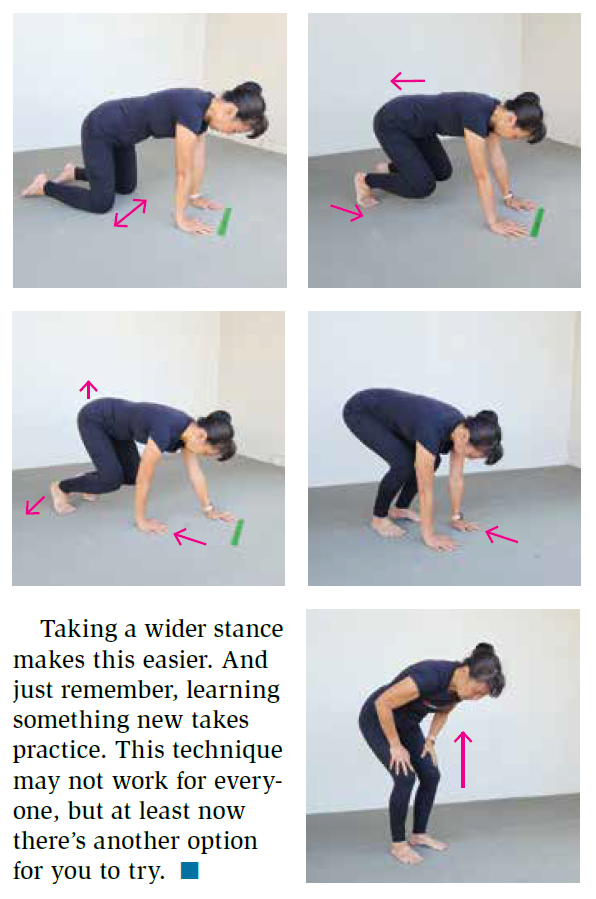
    We’re traditionally taught that to get someone off the floor, have them lean on a chair, get one leg up and push to straighten the knee until the other leg can plant the foot to have 2 legs to stand on. This requires a significant amount of compression force through the knee and very strong quad (front leg) muscles.

    I remember going through this method and always struggling when someone had knee pain or very weak legs. And then my mom taught me a different way.

    Mom’s technique to get up
    1. Get on your hands and knees and separate your feet as much as you can.
    2. Tuck your toes to get onto your feet, then push yourself back until you’re on your tippy toes.
    3. Walk your hands towards your feet until your feet are flat on the ground.
    4. Lower yourself into a partial squat position, where you can place your hands on your knees.
    5. Get yourself centered and steady, then start walking your hands up your thighs until you are standing upright.

    Getting down to the ground
    1. Place your hands on your knees and push your butt backwards as if you’re going to sit in a chair.
    2. Steady yourself and slowly reach down to touch the ground.
    3. Walk your hands forward and slowly lower yourself down until your knees are low enough to get on all fours.


    GYMGUYZ Urban Honolulu
    Home Personal Training & Mobile Fitness
    808-638-2525
    gymguyzurbanhonolulu@gymguyz.com
    gymguyz.com

    We’re traditionally taught that to get someone off the floor, have them lean on a chair, get one leg up and push to straighten the knee until the other leg can plant the foot to have 2 legs to stand on. This requires a significant amount of compression force through the knee and very strong…

  • Summer Foods for Healthy Eyes

    Smiling middle aged mature grey haired woman looking at camera, happy old lady in glasses posing at home indoorSummer means tons of local produce is in season and readily available. A variety of nutrients and antioxidants can likewise be found in Hawai‘i’s abundance of crops and seafood, which help to improve eye health and decrease the risk of certain ocular diseases.

    Local eye doctors urge everyone residing in the state to take advantage of summer’s supply of fresh foods, looking out for these local ingredients to support strong eye health:

    Pineapple and lychee are great sources of vitamin C and packed with antioxidants
    Avocados provide loads of vitamin E
    Taro is packed with nutrients such as zinc, iron, potassium and vitamins A, C, E plus B6
    Mangoes, sweet potatoes and papaya are great sources for consuming beta-carotene
    • Local species of mushrooms and seaweed provide beta-glucans
    • Leafy, green vegetables such as watercress, taro greens and bok choy are rich in lutein and zeaxanthin
    • Omega-3 fatty acids are found in many varieties of local fish: tuna, opah, sablefish (also known as butterfish) and swordfish.


    HAWAIIAN EYE CENTER
    606 Kilani Ave., Wahiawa, HI 96786
    808-621-8448 | Hawaiianeye.com

    Summer means tons of local produce is in season and readily available. A variety of nutrients and antioxidants can likewise be found in Hawai‘i’s abundance of crops and seafood, which help to improve eye health and decrease the risk of certain ocular diseases. Local eye doctors urge everyone residing in the state to take advantage…

  • HBP: Know Your Numbers, Save Yourself

    Doctor measuring blood pressure of young man in clinicBlood pressure measures how hard the blood pushes against the walls of your arteries as it moves through your body. Measurements are taken when your heart beats and gain when it rests. Also known as hypertension, high blood pressure (HBP) can increase. Often described as a “silent killer,” HBP has no apparent symptoms. If left untreated, HBP increases your risk for heart disease — including heart failure or heart attack — as well as stroke, kidney problems and other threats.

    Coupled with family history, certain physical traits and lifestyle choices can put you at greater risk for HBP.

    While having high blood pressure is serious, there are many ways to manage it.

    Knowing your numbers and monitoring and controlling your blood pressure are essential. See your doctor at least yearly to check your blood pressure and determine if you need to take medicine, change your diet or monitor your blood pressure at home.

    It’s important to take medications exactly as prescribed and supply your doctor with a comprehensive list of all medicines, vitamins, herbal remedies and supplements you take.


    KAISER FOUNDATION HEALTH PLAN, INC.
    711 Kapiolani Blvd., Honolulu, HI 96813
    808-432-5915 (TTY 711) | kp.org
    To learn more about this and other topics, visit kp.org/health and kp.org/seniorhealth. This article contains health and wellness or prevention information.

    Blood pressure measures how hard the blood pushes against the walls of your arteries as it moves through your body. Measurements are taken when your heart beats and gain when it rests. Also known as hypertension, high blood pressure (HBP) can increase. Often described as a “silent killer,” HBP has no apparent symptoms.

  • Water: It Makes You Smile From Within

    Hydration is essential to staying fit and healthy, especially during warm summer months. As you venture outdoors to cool off, keep your flask filled with water. It’s the best beverage for your teeth and body. Water has many benefits; there’s no sugar or acids that can affect your oral and overall health.

    Did you know water can help improve your smile?

    • Water keeps your mouth cleaner and healthier than other drinks. Sip water between bites or after a meal to wash away sugars, acids and other bacteria that cause tooth decay or gingivitis.
    • Water helps you maintain a whiter smile. Sipping water after eating pigment-rich foods can prevent the formation of stains.
    • As you get older, some medical conditions and medications can cause dry mouth. Drinking water helps produce saliva to help defend your body against gum disease and tooth decay by washing away food particles and acid.

    Drinking water aids your digestive system, preventing constipation and abdominal discomfort. It helps you stay alert and focused, aiding in cognitive function. The H2O molecule also supports joint health as well as the appearance of the skin. To prioritize water as your main drink of choice, carry a water bottle with you.


    HAWAII DENTAL SERVICE (501(c) 4 nonprofit)
    Kahala Howser, Wellness & Events Manager
    808-521-1431 | khowser@hawaiidentalservice.com
    HawaiiDentalService.com

    Hydration is essential to staying fit and healthy, especially during warm summer months. As you venture outdoors to cool off, keep your flask filled with water. It’s the best beverage for your teeth and body. Water has many benefits; there’s no sugar or acids that can affect your oral and overall health.

  • Adult Day Cares: A Social Hub for Seniors

    Adding some sparkle to your social life can be a challenge at any age, especially in life’s later decades. For many, adult day care is a low-stress foray into an activity-filled social life.

    Adult day care centers are key providers of long-term care services. They provide activities, health monitoring, socialization and assistance with daily activities. These programs allow individuals to continue to live in their homes and to receive needed care in a supportive, professionally staffed, community-based setting. Adult day care also benefits family caregivers, enabling them to remain in the workforce or take needed respite. Educational programs and support groups are also tailored to caregivers.

    These programs provide cost-effective care while supporting individual autonomy, allowing individuals to age in place. This enhances quality of life for seniors and family caregivers. Adult day care centers are not often recognized for the important role they play in addressing the needs of the senior population in the state.

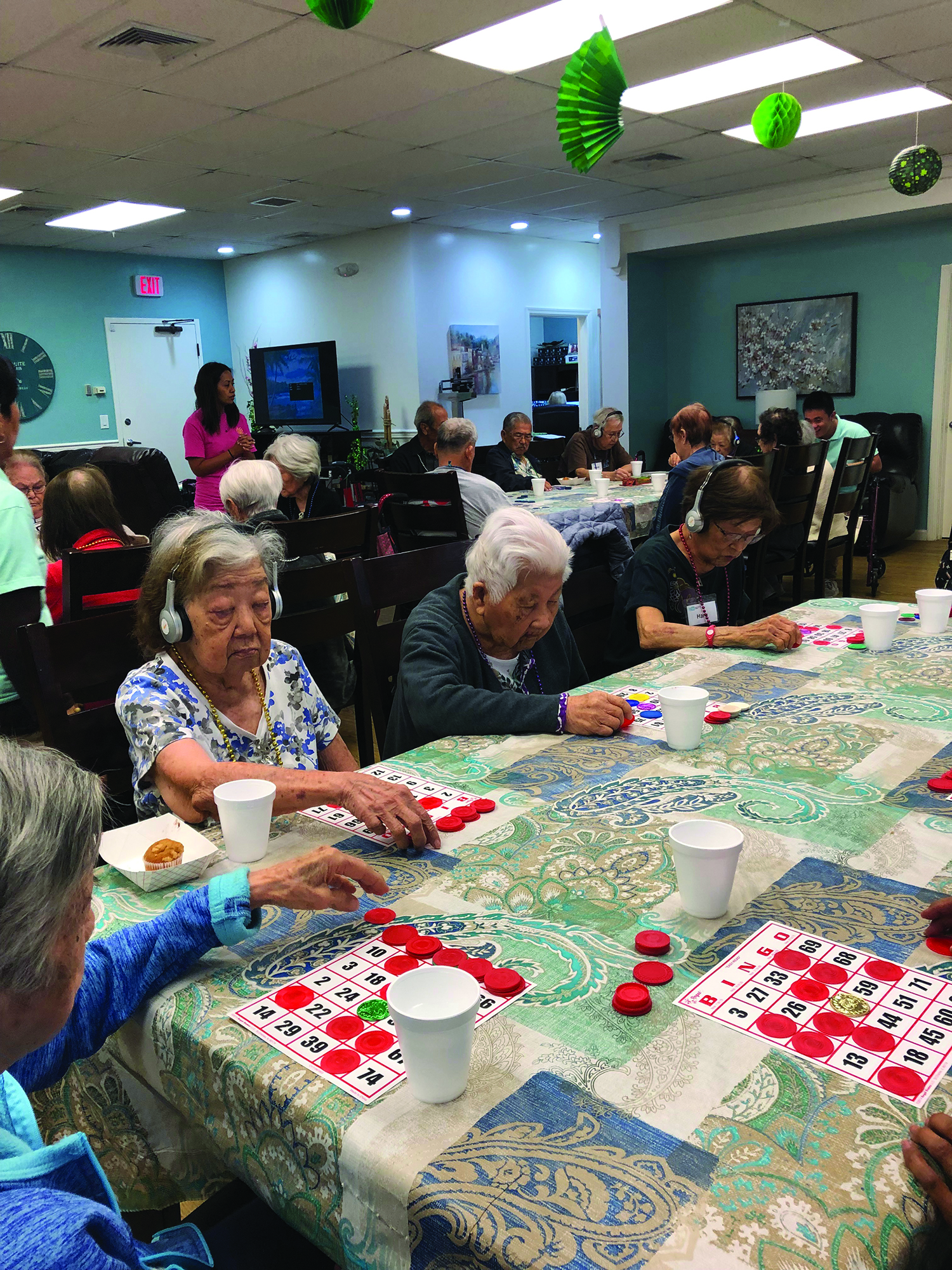
    Operating during daytime hours, centers like Hale Hau’oli Hawai‘i offer a safe and supportive environment. Older adults are afforded an opportunity to get out of the house and be mentally and socially engaged. Seniors who can no longer structure their own daily activities, those who are isolated and desire companionship, those who can’t be safely left at home alone — perhaps someone who lives with a caregiver who also works outside the home — may particularly benefit.

    Centers typically offer various packages to meet the unique needs of each individual. Costs can vary depending on factors including the hours a person wants to attend, whether it’s a weekday or weekend and types of assistance required.

    The services provided by the center can also affect prices, such as medical monitoring, personal care assistance or transportation services. Some centers may offer different pricing tiers based on these or other considerations, so it is essential to query different facilities to learn the options.


    HALE HAU‘OLI HAWAII (501(c) 3 nonprofit)
    98-1247 Kaahumanu St., Ste. 207, Aiea, HI 96701
    808-292-4665 | kwyatt01@aol.com
    halehauolihawaii.org

    Adding some sparkle to your social life can be a challenge at any age, especially in life’s later decades. For many, adult day care is a low-stress foray into an activity-filled social life. Adult day care centers are key providers of long-term care services. They provide activities, health monitoring, socialization and assistance with daily activities.