After gaining years of experience working and caring for the elderly, I can imagine many ways to describe what “aging” means. There are multiple factors that determine if one is considered old. In other words, a high number of years someone has been on this Earth does not define them as being old. In today’s world of medical technology, health products and smarter lifestyles, it may be hard to identify our kūpuna.
Is 65 really old? Is it still considered senior?
As approximately 10,000 baby boomers (those born between 1944 and 1964) are turning 65 every day, we will experience an increased influx of aging people over the next couple of decades. However, considering the way our seniors are aging, it may be more of a staggered increase rather than all at once.
Twenty years ago, a 65-year-old may have looked and acted differently than the 65-year-old of today. With advances in healthcare and the pursuit of healthy lifestyles, is it possible that today’s 65-year-old looks and feels younger … maybe more like a 45-year-old?
Here are some interesting perspectives from the population in question regarding getting older based on a study that was done by Human Development Specialist Nina Chen: “Getting older means more years to add to your life, less activity, less hair, more medicine, more wrinkles, arthritis and more forgetful. When people get older, they lose their dignity and independence. Being old means not being able to do anything.”
Positive outlooks documented were: “Being old means more experiences and having privileges, for instance, senior discounts, senior centers, affordable housing for seniors and senior support groups. Getting older means getting wiser. Older people are just like a walking library. They have true stories — not fiction.”
Lifestyle choices and changes can alter the way we age in general. Below are some changes that may improve how we age:
Stop smoking to allow more oxygen into your cells
Stop drinking alcohol to keep your tissues healthy
Exercise consistently to maintain mobility
Eat healthy foodsto give your body the fuel it needs to regenerate cells
Drink more waterso toxins absorbed from the environment will be flushed out \
Stay out of the sun to avoid skin damage Retirement leads to less stress; The age of retirement for full benefits is now 70.
Make and keep friends to stay engaged and thriving in society
Aging looks different depending on your perspective. Although the average lifespan continues to lengthen, it has increased more in the past century than in all of humanity’s existence combined.
Individual self-worth and dignity are important factors as we age. For older individuals, this means living life to the fullest each day and doing what you want to do. Don’t regret what you haven’t experienced. Get out there and seize the day — “Carpe Diem!”
ATTENTION PLUS CARE HOME HEALTHCARE
Accredited by The Joint Commission
1580 Makaloa St., Ste. 1060, Honolulu HI 96814 808-739-2811 | www.attentionplus.com AGING IN HAWAII EDUCATIONAL OUTREACH PROGRAM by Attention Plus Care — a program providing resources for seniors and their families, covering different aging topics each month. For class information and upcoming topics, call 808-440-9356.
After gaining years of experience working and caring for the elderly, I can imagine many ways to describe what “aging” means. There are multiple factors that determine if one is considered old. In other words, a high number of years someone has been on this Earth does not define them as being old. In today’s…
As parents age, many adult children step into the role of caregiver. However, for those who live far from their parents, caregiving presents different challenges. Planning, communication and a team approach can significantly improve the process.
♦ Don’t Wait for a Crisis
Taking care of someone else is always easier if you plan ahead and address concerns as soon as possible. If you wait for a crisis — a fall, serious illness or disease diagnosis — scrambling to make arrangements can be more chaotic, emotionally overwhelming and often limits available options. Preparation is the key. Familiarity with your parent’s healthcare team, community and financial resources, and your parent’s choices can make caregiving more manageable and less stressful. Even if you have family and friends at home, working as a team with a plan based on your parent’s preferences will help.
♦ Define and Discuss Your Concerns and Theirs
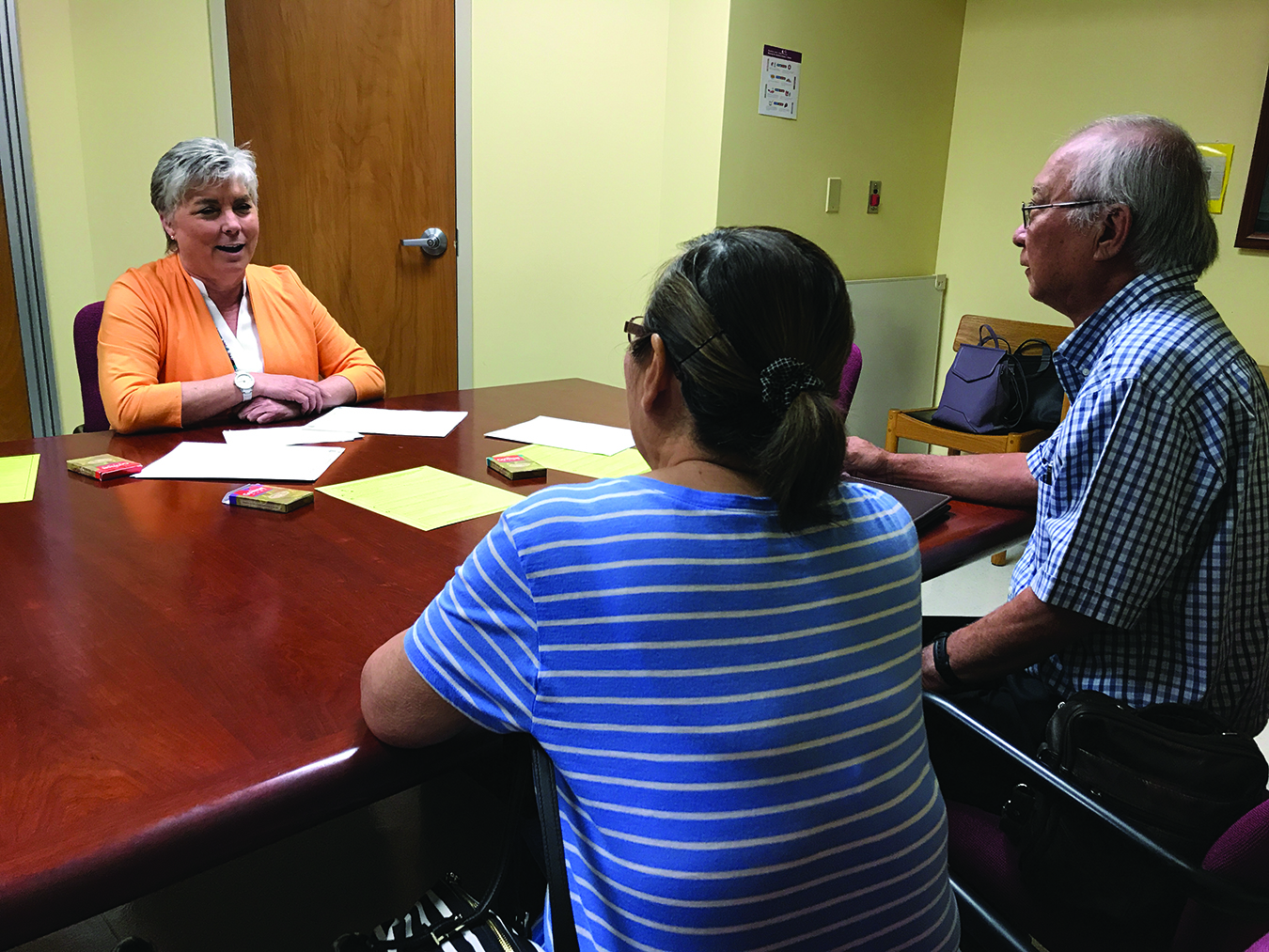
The Queen’s Medical Center’s Community and Post-Acute Care Services Director Hermina Taylor, MSN, FNP-BC, APRN-RX, and licensed social worker for the Queen’s Clinically Integrated Physician Network Jamie Fukui-Chiang have worked with elderly patients for a combined total of more than 50 years. They say the first step is to define your concerns.
For example, are your parents doing fine now, but you want to get a plan in place. Or, are you already worried your mom is isolated and not eating? Are you concerned your dad might fall from mounting clutter in the home? Or, is one of your parents a caregiver for the other and getting burnt out? These and other issues are common challenges as people age and each concern can lead to different types of help.
Next would be to talk with your parents about your concerns and ask about their concerns. You may be worried about the growing clutter in their home and potential fall risks. However, your mom might be much more concerned about your dad’s growing confusion. Although it may be uncomfortable and/or they may resist, Fukui-Chiang says, “It matters what they see because that’s what they’ll work on.”
♦ Know Their Wishes
For current concerns and long-term or end-of-life issues, you need to know your parents’ wishes and their realistic options. Parents may not want to have these discussions for fear of being a burden, but Taylor suggests you let them know. “This will relieve my burden, so please share with me. I don’t want to have to make those decisions for you. I need to know what you want.”
Lori Protzman, RN, coordinator for the Queen’s Advance Care Planning Clinic, meets with adults and families to discuss healthcare planning, quality-of-life values and choices, and related documentation to ensure wishes are followed.
If, for example, you think there’s a fall risk, is your parent willing to have a free fall assessment done or wear a medical alert button? Or, if confusion or memory is an issue, are they willing to let you talk with their doctor? If they want to live independently no matter what, are there financial resources available for professional caregivers in the home? And, who do they want to give signing authority to if they can no longer sign for themselves?
The only way to know what they want is to talk with them. Dr. John Houk, a primary care physician for 38 years, says, “You can make them safe in a care home, but they may be miserable. You always want to balance keeping them safe with ensuring the quality of life they value.”
Houk discourages families from using random online resources and says a case manager can be helpful, especially in complex or complicated situations. A case manager can see what is happening in the home, such as safety or nutrition issues. Your parent’s physician may be able to identify helpful resources for you or there are reliable city, state, and national resource information online (see “Resources” below).
♦ Discuss and Document End-of-Life Wishes
End-of-life care discussions can be emotional and uncomfortable, but they are crucial for easing decision making when that time comes. Experts suggest all adults have some type of advance care planning written out, but especially after age 60.
Without knowing what your parent would want, that decision will likely be on you and having to guess can be excruciating. What would your parents want if they could no longer feed themselves or breathe on their own? You can discuss this with them and their physician, attend a presentation by a group like Kōkua Mau or meet with a program like the Queen’s Advance Care Planning Clinic. These experts can help families understand their options, make informed decisions, and discuss issues like financial resources and roles family members will take.
♦ Work as a Team
If you have a family working together, assign one person to be the physician contact. If you have siblings or other trusted relatives and friends, each person can take a certain role. Fukui-Chiang had clients with a daughter living abroad and a son on the mainland. They each took certain roles and responsibilities and had regular phone and email communication with the care team. Houk knows a family that divided tasks by shopping, organizing pills, managing finances and home repairs. The key is to find the way it can work for your family and the resources available.
Although the medical team may not be able to share information without permission, you can still tell them your concerns. Call or send a note if you are worried about certain issues. The healthcare team can provide an objective view of the issues and better identify priorities if they have all the information.
Caregivers should also understand the new trend toward team-based healthcare for many physician offices. Taylor explains, “Care is getting so complex. Navigating the system is more complex. We need multiple disciplines working collectively to provide a comprehensive plan of care. Patients and caregivers are part of the team.” So, rather than talking to the physician directly, you may talk to the medical assistant. Instead of seeing the physician for each visit, you might see the nurse practitioner. The team, including a possible care manager, works under the guidance of the primary care physician. The structure is proving more effective for providing high-quality care.
♦ Make Check-Ins Count
To ensure they’re doing OK, ask more direct questions that require detailed answers. Fukui-Chiang says to ask, “What did you eat for dinner last night?” instead of “Did you eat?” Rather than “Did you take your meds?” ask “When did you refill your meds?” Ask “Do you have money to pay your bills?” instead of “Did you pay your bills?” Houk recommends making sure parents have adequate nutrition, regular exercise and socialization.
Experts say the most important thing you can do is to be an educated caregiver.
Taylor explains, “Every person and situation is unique and there’s no one right way to do things. Know your resources.” information.
As parents age, many adult children step into the role of caregiver. However, for those who live far from their parents, caregiving presents different challenges. Planning, communication and a team approach can significantly improve the process.
When you think of great partnerships, what comes to mind? Abbott and Costello? Sonny and Cher? Cecilio and Kapono? How about your brain and your ears?
Your hearing health depends greatly on how well your brain and ears work together. Your brain counts on the ears to collect sounds and deliver them to be interpreted as meaningful information. It is this partnership that enables us to understand and communicate with others.
As we age, many of us develop hearing loss. Even a mild loss may lead to miscommunication and frustration for all. Failure to get early treatment only compounds the problem and can have serious impacts on your quality of life.
When your ability to hear declines, your brain receives less stimulation because it’s not working to identify different sounds and nuances. Over time, this lack of exercise for your brain can lead to memory loss or even dementia. You may also experience difficulty following conversations in a group setting and are more likely to socially withdraw, which over time, can lead to depression and anxiety.
The good news is there are many treatment options. If you think you or a loved one suffers from hearing loss, don’t delay another day. Visit a hearing healthcare professional and take the first step toward a world of better hearing.
When you think of great partnerships, what comes to mind? Abbott and Costello? Sonny and Cher? Cecilio and Kapono? How about your brain and your ears? Your hearing health depends greatly on how well your brain and ears work together. Your brain counts on the ears to collect sounds and deliver them to be interpreted…
Renewable cleaning is a smart “Green Cleaning” program that applies to general sanitation but focuses on the use of eco-friendly practices and products to create a healthier home environment. It utilizes safe and friendly natural cleaning products that are non-toxic, biodegradable and sustainable. Water is a key source for renewable cleaning because it is a favorable nonpolluting resource that is readily available.
Six Quick Tips for Renewable Green Cleaning
1) Use safe, natural cleaning products made from non-toxic ingredients.
2) Don’t use room deodorizers or other air fresheners that contain unhealthy chemicals.
3) Avoid aerosol products. Spraying fills your home with microscopic droplets that remain suspended for hours and are easily inhaled.
4) Use chlorine-free dishwasher detergent. The chlorine in conventional detergents is easily vaporized by hot dishwasher water and then released into your home’s air.
5) Dust with a damp cloth so that household dust is removed from surfaces, not stirred back into the air.
6) Ask guests and family to remove their shoes when entering your home. That way they won’t track in pollutants.
Renewable cleaning is a smart “Green Cleaning” program that applies to general sanitation but focuses on the use of eco-friendly practices and products to create a healthier home environment. It utilizes safe and friendly natural cleaning products that are non-toxic, biodegradable and sustainable. Water is a key source for renewable cleaning because it is a…
The reality is most of us sit too much. A study published by Microsoft revealed that U.S. workers spend an average of seven hours per day on a computer — more hours than they sleep at night! Sitting at a desk for hours on end can result in increased muscle tension at the neck, back and shoulders. And if it’s not addressed, over time it can lead to spinal pain, headaches and even more serious symptoms —pain, tingling or numbness down the arms.
Here are some tips to help you stay healthy behind your desk:
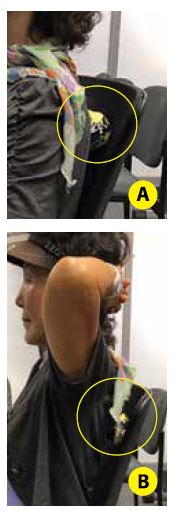
A) If you are like most people, you’re likely to have difficulty maintaining good posture while sitting. So, the first thing is to break the habit of poor posture. Use two tennis balls taped together placed between the shoulder blades as a reminder to sit upright. It will provide instant feedback the moment you begin to slouch.
B) Increase mobility of the spine by leaning back on the tennis balls, extending your upper back and looking up with hands clasped together. Hold a few seconds and repeat five to 10 times per day.
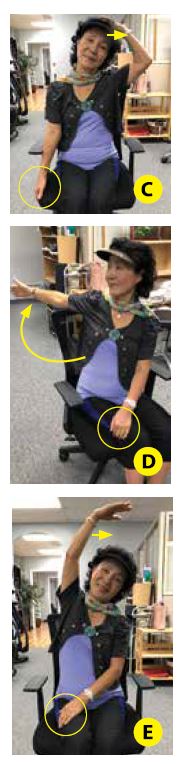
C) Stretch the neck 30 seconds by gently pulling your head to the side as the opposite hand grabs the chair to hold the shoulder down, switch sides and repeat.
D) Grab your opposite thigh and pull with your hand so your torso rotates as you reach back and extend the arm, elbow and wrist. Turn your head and breathe, hold 20 to 30 seconds, switch sides and repeat.
E) Continue to grab the opposite thigh and with the other hand over your head lean your body to feel a stretch along your side, breathe and hold for 20 to 30 seconds. Switch sides and repeat.
It is recommended that you get up and move every 30 minutes for 1 to 2 minutes. But if you find it difficult to do so, try these tips to increase blood flow and bring oxygen to your brain, which will increase your energy and level of concentration.
The reality is most of us sit too much. A study published by Microsoft revealed that U.S. workers spend an average of seven hours per day on a computer — more hours than they sleep at night! Sitting at a desk for hours on end can result in increased muscle tension at the neck, back…
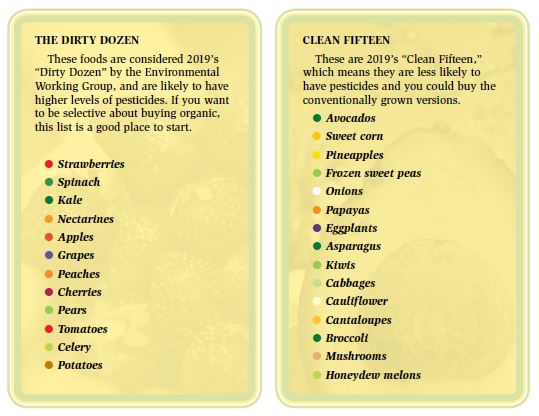
Last year in the United States, sales of organic food and products topped $48 billion — that’s up almost 10 percent over the previous year, according to the Organic Trade Association. And while this growing industry is showing no signs of stopping, organic farming is hardly a trend; it’s how our parents and grandparents tended to their crops and cattle. Then in the 1950s, pesticides and artificial fertilizers were introduced — creating what is now called “conventionally-grown” food. So what’s the difference and why does it matter?
Certified organic means no pesticides, synthetic fertilizers or antibiotics
GMOs (genetically modified organisms) are not allowed when growing organically
Regenerative practices used in organic farming help keep the soil and our food full of minerals
Organic practices are better for the environment and the health of farm workers
Organic dairy has higher levels of heart-healthy fats and no hormones or antibiotics
While the argument to eat organic seems simple, choosing organic isn’t always easy — it’s harder to find and usually more expensive. But there are ways to go organic on a budget.
Stores like Walmart, Target and Foodland have a good selection of affordable options
Look for generic in-store brands to save more
Costco has great organic choices. Partner with a friend or family member to make it cheaper
Buy grains, nuts and cereals at the bulk bins • Start a garden and grow your own food
Eat more plant-based meals. Organic whole grains and veggies are cheaper than meat
Farmers markets are great, but make sure to ask where the produce is from and if it’s organic
Subscribe to a local, organic CSA service
If eating organic is still too steep, it’s more important that you get enough greens and fruit in your diet. The USDA recommends seniors get at least two servings of fruit and five servings of veggies every day. If that seems like a lot, juicing and smoothies are a great way to get them in. Just make sure, no matter what you choose, to wash everything before you eat it!
Go local! You can’t get any more natural and organic than the varieties found here in Hawai‘i. Consider swapping an apple with a juicy mango, or try a jabong instead of a grapefruit. How about soursop? Or lychee? The list goes on. The diversity is not only good for you, it will help your plate look as colorful and as multicultural as our islands!. Photos courtesy of 808 Organics
Last year in the United States, sales of organic food and products topped $48 billion — that’s up almost 10 percent over the previous year, according to the Organic Trade Association. And while this growing industry is showing no signs of stopping, organic farming is hardly a trend; it’s how our parents and grandparents tended…
We grew up valuing the wisdom of our elders — skills or ideals that “uncle” or “tutu” taught us, like sticking together, working smart and showing respect for our family and neighbors.
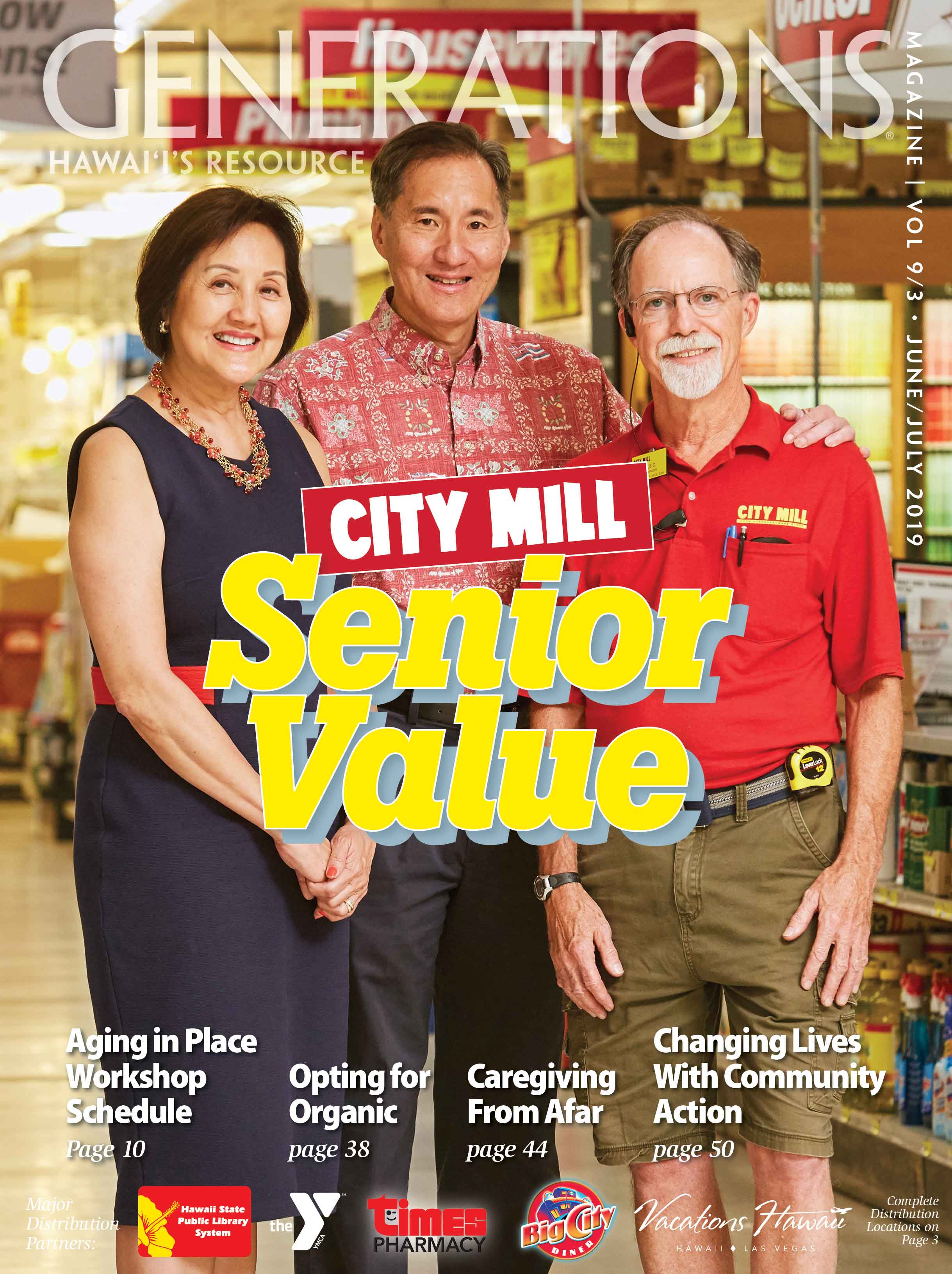
In July, City Mill Ltd. will celebrate 120 years of business in Honolulu. Their success is grounded in four generations of family wisdom. Our grandparents and parents loved shopping there, and today, we receive that same kindly respect and assistance every time we visit the store.
Vice President Carol Ai May and President Steven Ai are the third generation of their family running City Mill. This brother and sister are also part of a group of family caregivers who assist their mother and stepmother, now in their nineties. Their family culture of helping others began in the 1890s.
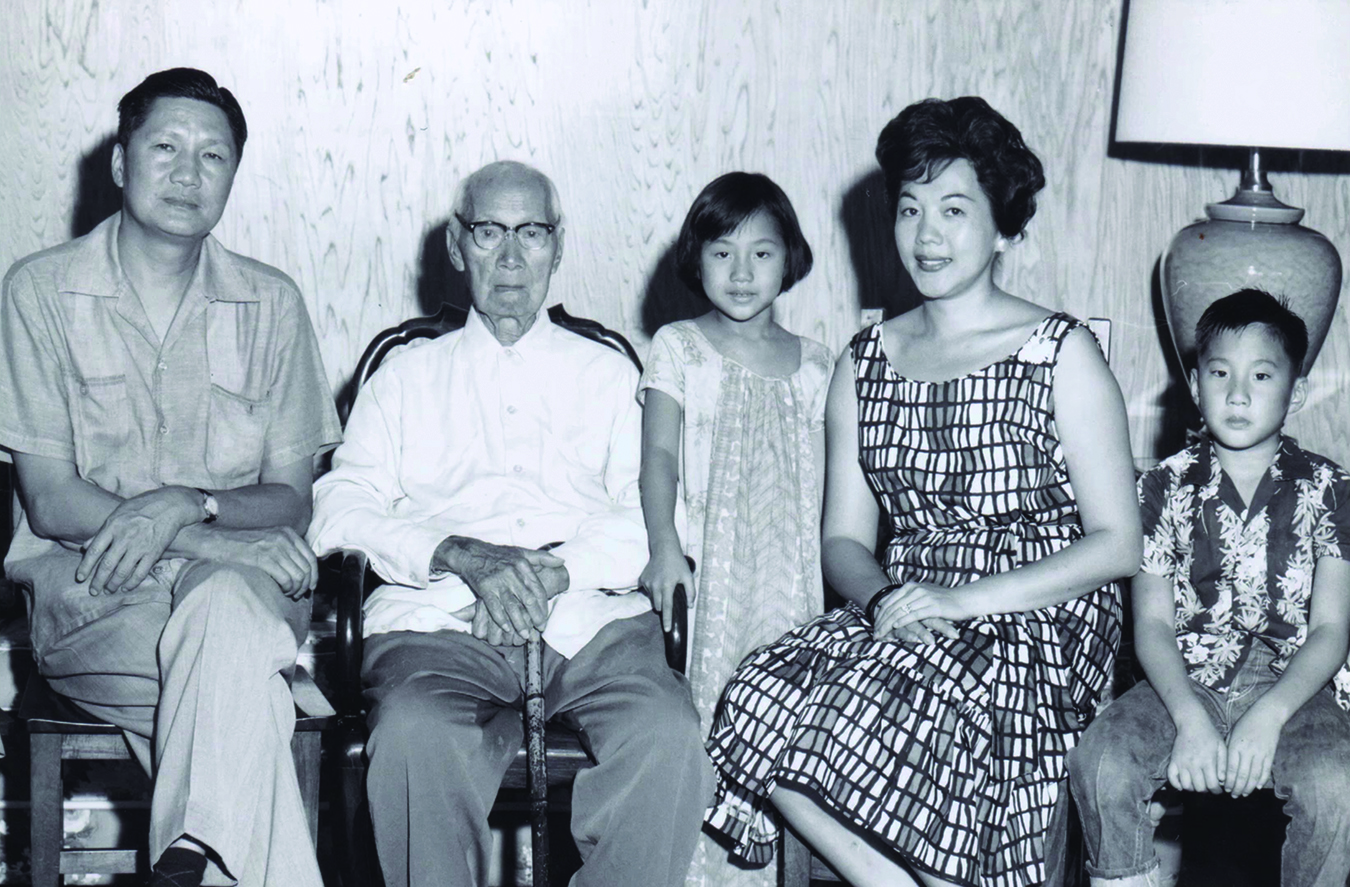
“Our father, David C. Ai, took over City Mill from his father, Chung Kun Ai, in 1961,” says Steven. “C.K. Ai was mentored in business by James I. Dowsett at the end of the 19th century, and became a respected businessman and leader of the Chinese community in the Territory of Hawai‘i. His ‘mill’ was once the biggest rice mill in the islands, hence ‘City Mill.’ The other side of his business was importing lumber from the Northwest. In the 1950s, many single-wall wood homes were built with our lumber, and we still try to sell hardware and fixtures for maintaining these homes. Later, Dad moved from commercial lumber into retail hardware.”
Three generations of City Mill Ltd.: When Steven and Carol were children, their grandfather, C.K. Ai, lived in their home. Following the wisdom of elders, helping the community and respecting others became a family and business culture to be celebrated. (L–R) David Ai, C.K Ai, Carol Ai, Lani Ai and Steven Ai.
City Mill Company Culture Values Community
Carol explains how their compassionate way of working with the O‘ahu community developed.
“We were in elementary school when Gung Gung (grandfather) passed away, but our grandparents lived in our home and we watched our parents care for them,” Carol says. “Our dad is gone now, too, but he passed down Gung Gung’s wise teaching: ‘When you drink water, remember the source.’ It means that everything we have is due to the community support of our business, so be humble and honor those who helped make you successful along the way. This adage is still our family and company value. We donate to community charities and treat our employees like family; when disasters strike and power goes down, we stay open so people can get the supplies they need to protect their homes.”
“Respect and compassion for others is the heart of our City Mill customer service,” says Carol. “Up until 1998, we used to hire people with plumbing, electrical or carpentry background. But now we hire people with good attitudes who like helping others. We figured that we can train associates about our products, but attitude and empathy come from within. We are looking for people who can help others and manage with compassion.”
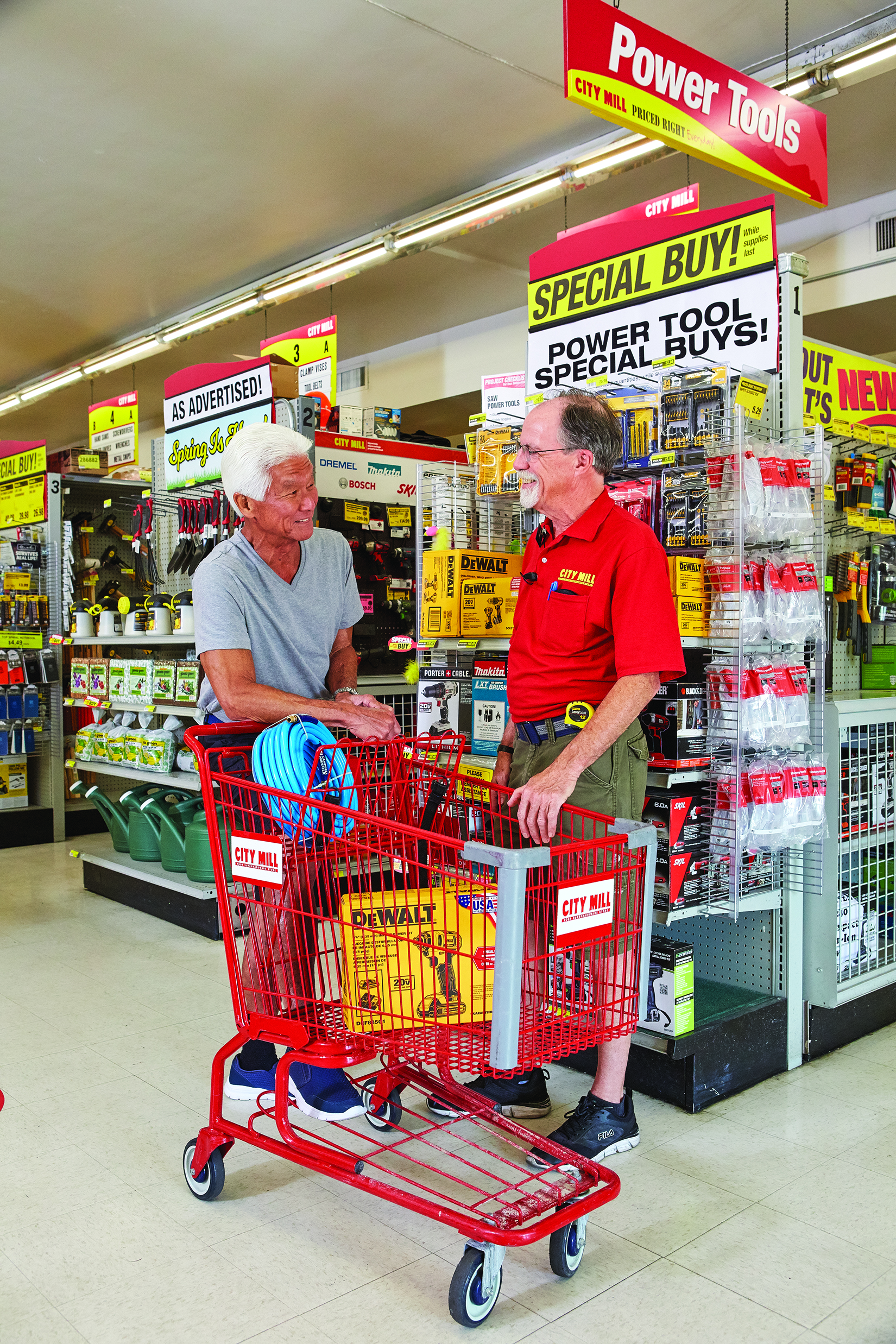
Client Earl Omoto and Christopher Griffin talk shop.
Seniors Make Great Employees
Almost 300 employees are the face of City Mill to its many thousands of customers. The Ai family demonstrates how they value seniors by providing excellent customer service, but they also place a high value on senior employees.
“Seniors make great employees because they are helpful and knowledgeable,” says Carol. “We observe that they are less likely to regard their job as a steppingstone and they eagerly bond with the ‘team’ at any one of City Mill’s six stores.”
Ruby Cooper, Inventory Control Supervisor, Age 70
Ruby applied at the Mililani store 19 years ago, when she was 51 years old. Her husband was career military and they saw a lot of the world, but when they settled in Honolulu, Ruby was looking for a career where she could interact with people.
“I’m not good with names, but I know all our repeat customers’ faces,” says Ruby. “What our company does best is making eye contact and acknowledging the presence of every customer, every day. That’s our expertise. All who come in the door get the same help, young or old. Hey, people know what they want. All we have to do is listen and get them what they need. It’s a big store, but our garden guys are happy to escort a customer all the way to electrical — with a smile.”
Ruby oversees receiving, stocking and taking inventory of all the items in the Mililani store. She is a certified forklift operator and gets to work at 5 a.m., to manage inventory. When the doors open, she becomes a floor manager, handling customers calls and backing up the cashiers. Ruby says her job keeps both her mind and body active, and customers never guess that she is 70 years old. On Ruby’s bucket list is a little more traveling, walking the beach with her Cavalier Spaniel and spending more time with her family.
Ruby Cooper loves the work she does and the people around her, from workmates to her senior patrons.
“At my age, I have to accept that I can’t load a 94-pound bag of cement anymore,” says Carol. “So I say to seniors — realize your limitations, be smart and find new ways to work around activities that have become risky. Don’t stop doing what makes you happy — just do it differently. I love my job, so I plan to work here as long as I can contribute to the team — that’s a great comfort.”
Steven Ai says senior employees like Ruby add value to City Mill because they stick around and get very good at their jobs. They are eager to fit in and make friends with the other employees. In time, they develop good working relationships with customers. City Mill’s oldest employees are in their 80s, and common reasons seniors leave are: 1) they have to give up their driver’s license; or 2) their family wants them to stay home.
Christopher Griffin, Sales Associate, Age 67
Christopher Griffin is a human resources manager from Massachusetts. When he retired and moved to Hawai‘i, he opted for a more physically active job. He says his sales associate job is like a daily yoga class or a workout at the gym because the large City Mill floor plan requires him to cover a lot of ground.
“My job is healthy in so many ways,” says Christopher. “When I shopped at City Mill, I was so impressed. As a human resources guy, I knew this was a great company by the generous way the employees treated me and each other. The hiring process required me to interview with a whole panel of employees. What a novel idea — workers instinctively know who is going to fit in and work hard. I am so grateful that they picked me.”
Here’s what the employees saw in Griffin: he is politely upbeat and engaging. He calls himself a “MacGyver” because he likes to help people find solutions for their maintenance and home improvement problems. And that’s what clients want.
“Everybody who comes in here is looking for answers,” says Christopher. “Even when we don’t share the same native tongue, we can find the perfect material, hardware or fitting they need.
“There’s a lot of camaraderie among the employees, too — most have worked here many years, and when I started, they taught me about all these products,” says Christopher, “The more I learned, the better I could help customers. City Mill’s commitment to the O‘ahu community means our team is helping folks all over this island. I am so grateful for the team I work with: Donna, Tina, Irene, Ricky, Devon, Russell … I could name them all!
From Shirtsleeves to Shirtsleeves in Three Generations”
David Ai was the second generation. He encouraged Steven and Carol to pursue their passions and provided them with excellent educations. Both have business experiences outside City Mill. Steven studied business, and then worked in financial accounting and management consulting. After Carol earned her degree at Tufts University, she worked in commercial bank marketing and advertising before starting a juice company. Later, they became the third generation of City Mill.
Carol says, “My dad warned us about the old adage, ‘Shirtsleeves to shirtsleeves in three generations.’ It refers to the typical life cycle of a family-owned business: the first two generations grow the company and it fails in the third generation. Steven and I were determined not to fail, but when mainland big box home stores came to Hawai‘i in the ’90s, we faced a considerable challenge. Lowe’s and Home Depot moved in and built their stores near ours, but folks still come to us for personalized service; we see a strong future.”
Carol raised her two sons with this challenge: “If you decide that you want to work at City Mill, you must first earn bachelor degrees and MBAs, work outside the company for five or more years and get promoted along the way.” Both sons met this high standard and now one is working at City Mill. Before joining the team, he earned his MBA, did retail consulting, was a financial planner at Nike and Gap Inc., and then started two of his own businesses.
“As the fourth generation, my son brings technology, supply chain and digital/social media knowledge — current ways of doing business,” says Carol. “We don’t have to teach him our City Mill company culture because he grew up with it. He designed an online store so our customers can shop at home and pick up their orders in the store. Everything we do continues to focus on the very best service we can deliver to our customers.”
Helping Seniors Add Value to Their Lives
Behind every City Mill customer is a home or office repair, or a maintenance or improvement project. Seniors are replacing old stuff, downsizing, renovating or simplifying their active lifestyles. They are continually adding value to their homes, retirement businesses or pastimes. City Mill provides them materials and personalized, helpful tips.
Earl Omoto, 72
Earl Omoto, Commercial Diver & Homeowner, Age 72
Many City Mill senior customers are entrepreneurs. Earl Omoto is a semi-retired commercial diver who specializes in installing and repairing moorings — some up to 3,000 pounds. He also owns a rental property, which he recently renovated himself. His project included “snow coating” the shingle roof, replacing the flooring, retiling and re plumbing bathrooms, interior and exterior painting, and building custom counters and tables.
“I always shop City Mill first for supplies,” says Earl. “I like to be treated like a customer, not a browser. They have enough staff so you never have to hunt for a salesperson. The guys in red shirts know where everything is! I always compliment the team because I want them to keep doing exactly what they are doing.”
“Another thing I like is that nobody is ‘king’ at City Mill,” says Earl. “All the sales people work together — if one can’t help, he calls the next one to get you what you want. Wendell in plumbing, Gary and John in lumber, Glenn and Ron — are plenty helpful with a smile. When I needed help on my remodel, they gave me good suggestions.”
Earl’s rental house is all ready to go. He says he took his time and did a good job. He considers himself lucky because he has no health challenges, and to stay that way, he works out at the gym three or four days a week. He also likes to play his guitar. On his bucket list is a second trip to Hong Kong and Macau for sightseeing, shopping and fun.
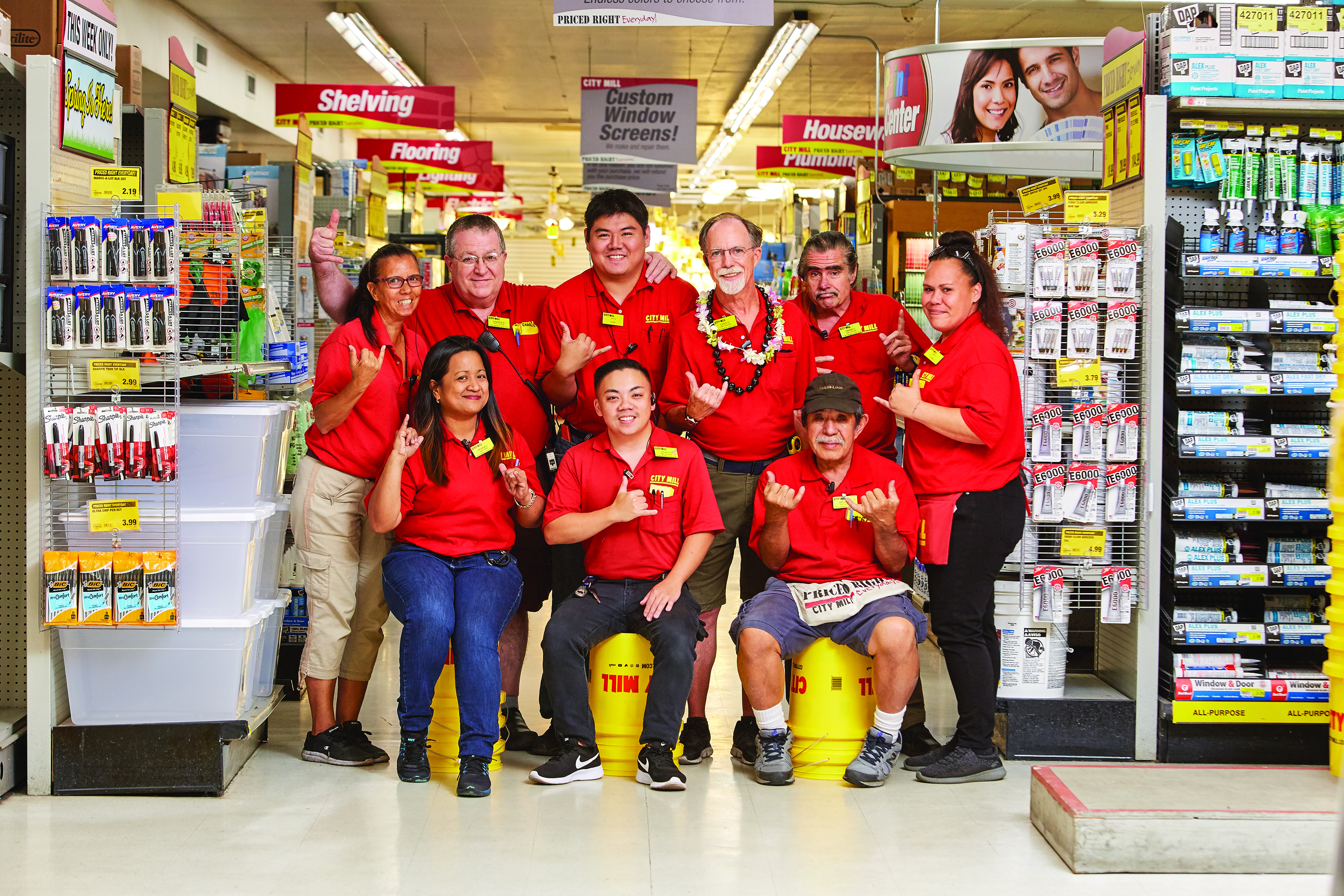
The City Mill Team gave Christopher a warm send-off the day of our photoshoot. He will be caring for a family member on the mainland for a while. His City Mill family understands the importance of helping seniors and honoring family. (L–R, top) Desiree, Charles, Cody, Chris, Dennis, Tanya, (bottom) Donna, Brian and Melvin.
Owen Oda, Handyman & Small Renovations, Age 65
“I go to City Mill a lot because it’s a store that makes sense,” says Owen. “They sell hardware in bins that are clearly labeled with a picture and specs for each bolt, nut, screw or washer. It’s easy to find what you need and you can buy the exact number you want. I appreciate efficiency.
“For my small jobs, I need pieces of plywood and two by fours cut to exact lengths and dimensions. City Mill employees in the lumber dept will do the precise cuts for me — no waiting around. They can cut jalousie glass to size and thread pipes — and it’s not expensive. Best of all, their employees know what they’re doing, and they are eager to help.”
A handyman for 15 years, Owen says he may be just a little weaker than in his youth, but he stays very healthy by drinking lots of water every day. His bucket list includes seeing his kids settled and then helping with the grandchildren.
“Another thing; when I walk into the store, they always ask me if I need a wagon and if I will need help getting items off the upper shelves,” says Owen. “That’s a good service for seniors like me, but I watch them do the same thing for every customer! Do you know that all the cashiers know me by name? There are very few stores like City Mill — it’s a good place.”
Seniors Value Kindness
Seniors respond positively to authentic respect and kind concern. We repay kindly businesses with loyalty and referrals. We remember the days when most companies focused on serving the customer — when personal attention and pampering was not restricted to high-end boutiques or hotel spas. Every shopkeeper appreciated our purchases; we were served with respect at the feed store, bakery, barber shop and corner seed shop.
Hoo-ray for City Mill! The Ai family business model values people, including seniors. Their genius is not only preserving a deeply held family ideal, but also practicing it in their lumber and hardware business, and teaching generations of employees and customers to value each other and to respect the sources of their success.
In July, the City Mill team will celebrate 120 years of business — helping generations of Honolulu builders and homeowners find the right materials for their projects. When you next visit City Mill, congratulate the salespersons, cashiers and managers. Let them know how much you appreciate the way they value seniors. The message on the backs of their red T-shirts sounds like an ad, but it’s the wisdom of the Ai family business: “What are you working on? I can help.”
CITY MILL COMPANY LTD.
660 N. Nimitz Highway, Honolulu HI 96817 808-533-3811 | www.citymill.com Check online for details of their other locations: Ewa Beach, Hawaii Kai, Kaimuki, Kaneohe and Mililani.
In July, City Mill Ltd. will celebrate 120 years of business in Honolulu. Their success is grounded in four generations of family wisdom. Our grandparents and parents loved shopping there, and today, we receive that same kindly respect and assistance every time we visit the store. Vice President Carol Ai May and President Steven Ai…
This is a great appetizer because of its big, two-level crunch — first, the happy pop of the tobikko and then the satisfying crunch of the crostini. It’s perfect for afternoon gatherings with a favorite white wine or beer.
INGREDIENTS
‘Ahi spread
2 lbs. ‘ahi, ¼-inch or less, diced
1/2 cup tobikko fish eggs
1/2 cup green onion, thinly sliced
2 Tbsp. sesame oil
1 Tbsp. light soy sauce
1/4 tsp. wasabi paste or wasabi oil
1/2 tsp. kosher salt, fresh ground Black pepper, to taste
Crostini
1 baguette, sliced into rounds 1/4” thick Extra-virgin olive oil Garlic salt
DIRECTIONS (Serves 10):
In a bowl, combine all of the ‘ahi spread ingredients and keep well chilled until ready to serve. To make the crostini (you can also purchase prepared crostini), brush each slice of bread with a little olive oil and bake at 400ºF for 10 minutes or until crispy. Remove from the oven and sprinkle with garlic salt or an herbed salt blend. Top each crostini with a rounded teaspoon of the ‘ahi spread and serve. Total time: 30 minutes
CHEF MICHI’S COOKING FRESH | cookingfreshforyou@gmail.com
Queens POB III – 550 S. Beretania St. | Honolulu Community College – 874 Dillingham Blvd. Cooking FRESH Food Truck: Corner of Pahoakalani & Cartwright
This is a great appetizer because of its big, two-level crunch — first, the happy pop of the tobikko and then the satisfying crunch of the crostini. It’s perfect for afternoon gatherings with a favorite white wine or beer.
A lot of people, especially those new to the islands, say Hawai‘i doesn’t have seasons, but longtime locals know that’s not true — we have whale season, hurricane season and the most important, mango season!
Friday, June 21, 2019 – 4:30pm – 9pm Saturday, June 22, 2019 – 10am – 9pm FRANK F. FASI CIVIC GROUNDS – 550 S. King Street, Honolulu
Whether you prefer to eat your mango in bread, jam or just off the tree, come celebrate Hawai‘i’s favorite fruit at Mango Jam Honolulu. It’s a free annual event for the whole family with live entertainment, food and craft booths, cultural activities, a beer garden and a farmers market.
Located in the backyard of Honolulu Hale, Mango Jam Honolulu features some of the best Mango offerings on O‘ahu. Park for free at the Frank F. Fasi Municipal Parking Lot or across the street at the new Joint Management Traffic Center.
With an all-day musical lineup, catch Iron Mango, 10 Feet, Kapena and more on the Mango Stage. Browse Mango Row for the latest designs and crafts from Hawai‘i creatives. Pick up a snack or cocktail at the Mango Lounge and Cafe, or grab some local goodies from the Mango Market.
Saturday kicks off with a recipe contest to find the best “Sweet Mango Delight” and “Savory Mango Masterpiece.” Then, who will be crowned master of the mango? Taste along as chefs from two popular local restaurants — Vino and Sansei — battle it out during the BBQ Cook-off.
With free cultural activities for the whole family, you can practice pounding poi with a papa and pohaku at a ku‘i ‘ai class, get hands-on with lomilomi massage and lā‘au lapa‘au, or show off your skills at the Makahiki games.
So don’t miss the sweetest celebration of the summer! Check www.mangojamhonolulu.com for more details and a full lineup of the annual two-day event.
A lot of people, especially those new to the islands, say Hawai‘i doesn’t have seasons, but longtime locals know that’s not true — we have whale season, hurricane season and the most important, mango season! Whether you prefer to eat your mango in bread, jam or just off the tree, come celebrate Hawai‘i’s favorite fruit…
If hula is the heartbeat of the Hawaiian people, then get ready for some cardio, because the 42nd Annual Prince Lot Hula Festival is almost here!
Featuring two days of hula, a Hawaiian-themed craft fair, cultural demonstrations and more, the largest non-competitive hula event in Hawai‘i returns for the third year.
PRINCE LOT HULA FESTIVAL — ‘Iolani Palace Saturday & Sunday, July 20 – 21 at 9 am
Everyone is welcome to this free, family-friendly event, and is encouraged to bring a chair or mat and enjoy the show from the lawn.
This celebration honors Prince Lot Kapuāiwa, who helped revive Hawaiian culture. During his reign as Kamehameha V (1863 to 1872), he repealed laws that banned traditional practices such as hula. He also created the Royal Order of Kamehameha to honor his grandfather, Kamehameha the Great.
Aloha e komo mai. Come and join the festivities with the whole family. Make it an aloha day! Photos courtesy of Moanalua Gardens Foundation of the 2018 event.
Founded in 1978 by the Moanalua Garden Foundation (MGF), the festival invites hālau from every major island and attracts thousands of residents and visitors each year. This year’s theme is I Mua E Nā Pōki’i, Move Forward, O Youth and represents the passing of hula traditions to the next generation, the keepers of the culture.
Saturday’s opening ceremonies will include the Royal Order of Kamehameha, presentation of MGF’s Malia Kau Award to renown Kumu Hula Iris Naleialoha Napaepae-Kunewa of Hawai‘i Island, followed by an impressive lineup of premier hālau hula who will perform both kāhiko (ancient) and ‘auana (contemporary) hula.
As part of the opening program on Sunday, MGF will honor chanter Kamuela Chun from Hilo with its Namakahelu Oli Award. Local food and refreshments will be available for purchase and limited edition T-shirts and souvenir kōkua buttons will be for sale. So come down and enjoy the fun, food and festivities in the magnificent setting of ‘Iolani Palace.
For a complete schedule and hālau line-up, visit Moanalua Gardens Foundation online.
MOANALUA GARDENS FOUNDATION 808-839-5334 | www.moanaluagardensfoundation.org A nonprofit organization founded in 1970, Moanalua Gardens Foundation is committed to preserving and perpetuating the native culture and environment of Hawai‘i through education and stewardship of Kamananui (Moanalua) Valley and celebration of the Prince Lot Hula Festival at ‘Iolani Palace. MGF depends upon grants and donations to cover festival costs. To make a donation or become a member, visit the foundation online.
If hula is the heartbeat of the Hawaiian people, then get ready for some cardio, because the 42nd Annual Prince Lot Hula Festival is almost here! Featuring two days of hula, a Hawaiian-themed craft fair, cultural demonstrations and more, the largest non-competitive hula event in Hawai‘i returns for the third year on Saturday and Sunday,…
Growing up in Hawai‘i, I played a ten-hole harmonica by ear, but lost interest because I could only play the same old songs and was not getting any better. As the years sped by and before I found anything interesting to enrich my life, I became a senior facing retirement. Doing nothing was not an option so I began to search for the elusive experience that would bring harmony into my life.
One day, I went to a concert and saw a group of seniors playing with a tremolo 21-hole harmonica. Everyone wore attractive red and white uniforms that enhanced the lively group’s sense of harmony. I was amazed by the variety of songs they played — sometimes with two harmonicas simultaneously. At the end of this wonderful performance, I knew this is what I had been searching for.
My retirement dream of doing something worthwhile became a reality when I joined the Small World Harmonica Band, an ethnically diverse group from all walks of life. I was immediately introduced to an exciting world that not only renewed my interest in playing the harmonica but also made me a member of a friendly social group.
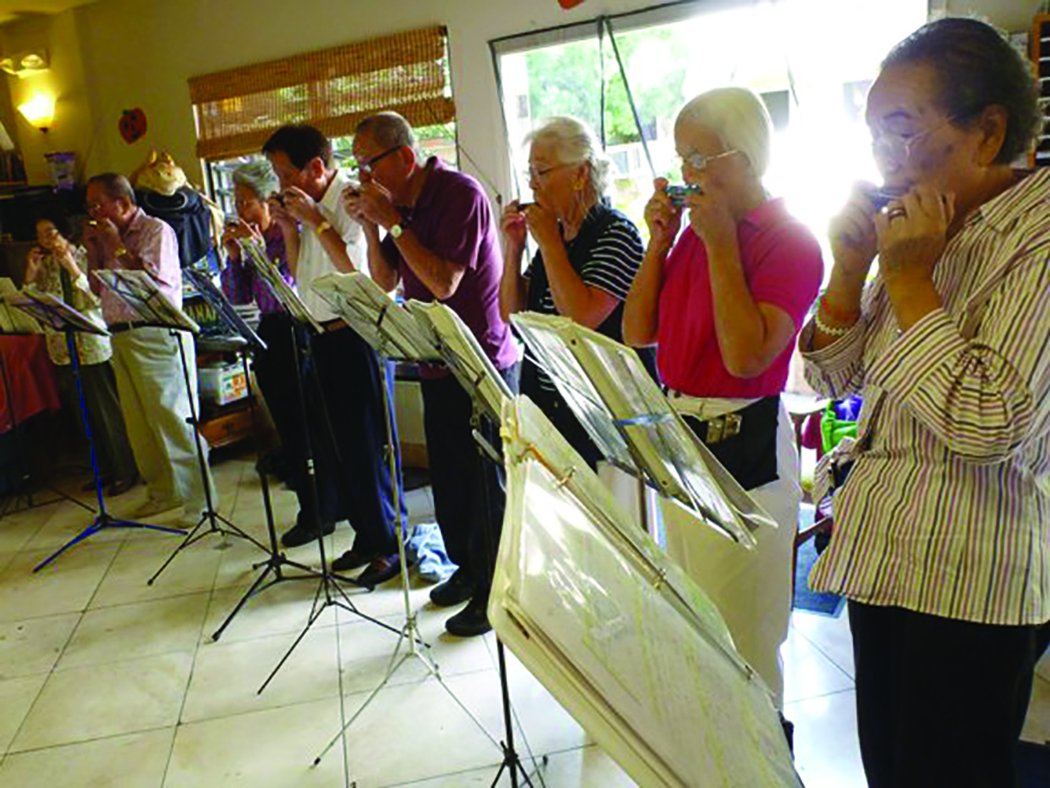
The beginner’s group met weekly in free classes; we learned to read numerical notes, breathing techniques, and how to hold and properly clean the harmonica. It also provides health benefits by exercising the lungs and stimulates the mind from reading numerical notes and transposing them into music. After learning the fundamentals, we began to play a variety of music including Japanese, Korean, Chinese, Filipino, Hawaiian, American and Latin songs.
Stanley plays with his harmonica group at events and senior centers.
By diligently practicing, I finally felt comfortable performing at care homes, senior centers and adult living facilities. Entertaining this audience, many in wheelchairs who smile and applaud as we play music of their bygone days, is a heartwarming and memorable experience. But, the real beneficiaries of this entertainment, I truly believe,
are the players themselves, since it lifts their spirits and gives them a good feeling.
The Hawai‘i Harmonica Society will celebrate its 22nd annual recital and concert at the Mission Memorial Auditorium, City Hall Annex, on Saturday, July 13, from 10 am to noon. This program is free and open to the public, and free parking is available at the municipal parking lot at Beretania and Alapai Streets (Beretania Street entrance).
Anyone interested in joining a group and learning to play the harmonica, contact any of the phone numbers listed below — I’m sure you’ll find it enjoyable.
Growing up in Hawai‘i, I played a ten-hole harmonica by ear, but lost interest because I could only play the same old songs and was not getting any better. As the years sped by and before I found anything interesting to enrich my life, I became a senior facing retirement. Doing nothing was not an…
I’ve never been old before so this is a new experience for me. After retiring from a 37-year career, I found myself adrift. What should I do now? The days seemed very long as I pondered what I should fill them with. Life looks very different when you remove yourself from the “working world.” You feel as though you are invisible when you are with other people.
“What do you do?
“I’m retired.”
“Oh. What did you use to do?”
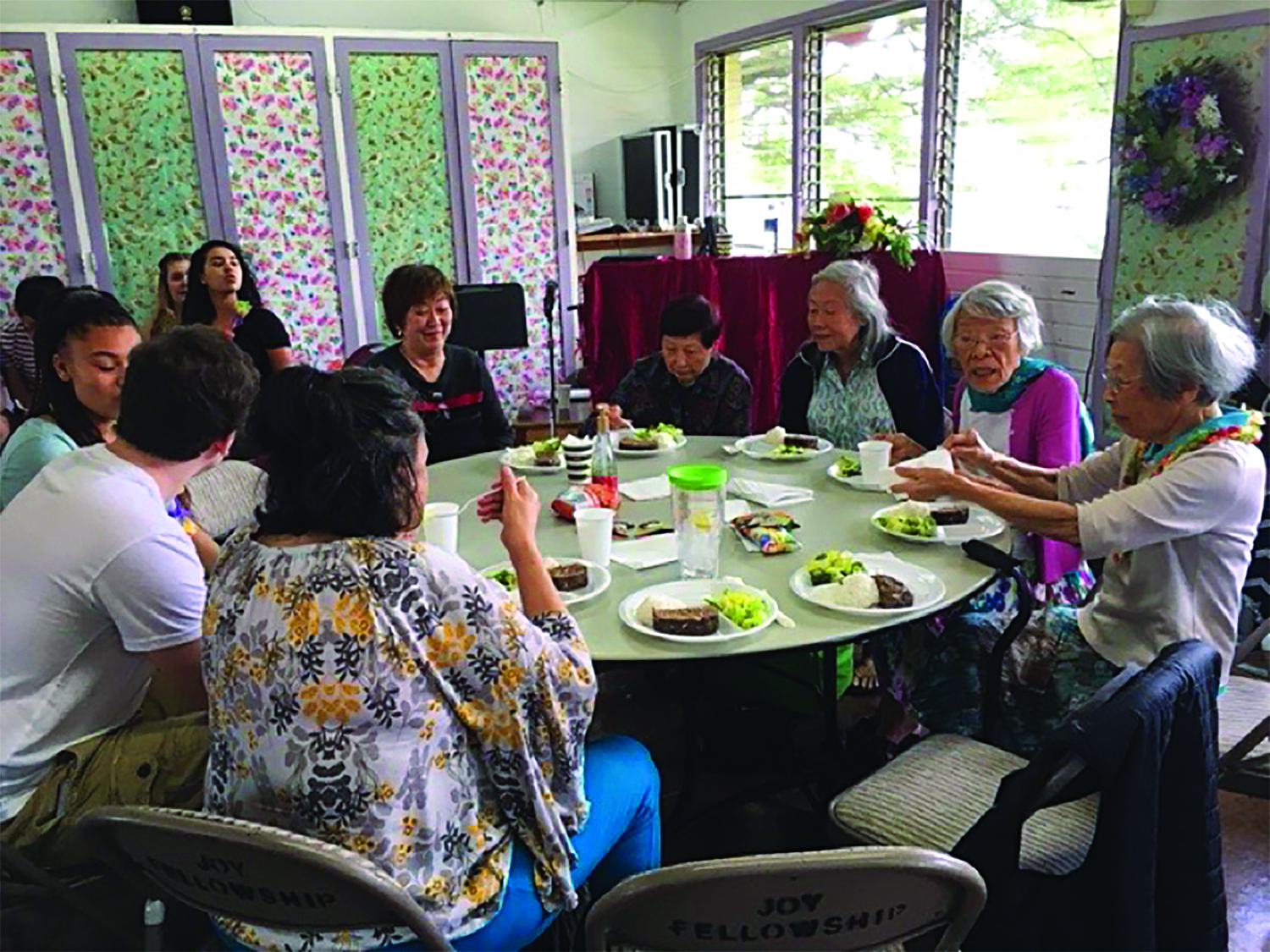
Joy Fellowship members always cherish getting together at every meeting.
Already you begin to feel as though life is now passing you by — at least in the eyes of others.
The next phase in this process of aging out of the working world is to rethink whether you should have retired or not.
“Maybe it was too soon. Maybe I should have kept working.”
This definitely did not help me in adjusting to the life I am now living.
Finally, I realized there was no turning back. I needed to face what was ahead and make the most of it.
Now that you are not part of a work community, you can feel isolated. Well, I’ve always heard that if you want a friend then be a friend. Maybe it was time to try this out. As I began taking the initiative and making lunch appointments, I found that others were going through the same experiences as I was. This shared feeling made me feel better.
Then I began to hear about different activities available during the week for retirees — but nothing sounded good to me. Then I heard about something at our church that was open to all. You didn’t need to attend our church or even go to church at all, so I decided to try it out. It turned out to be just what I needed.
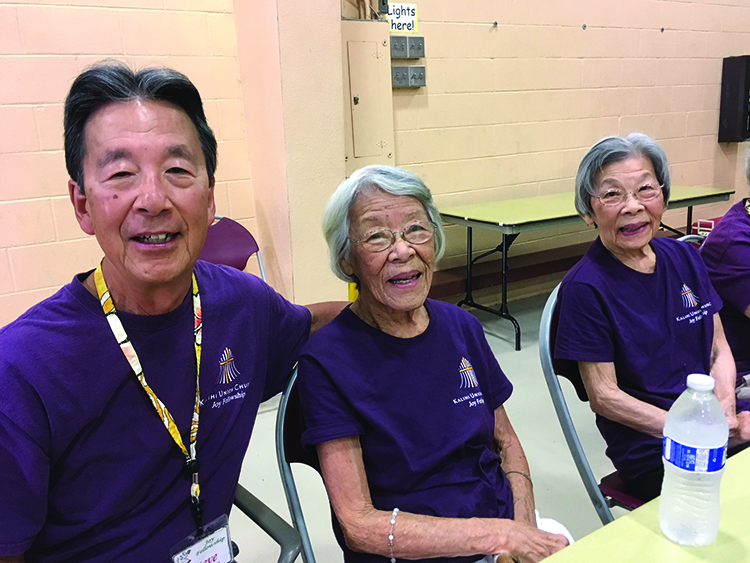
(L–R) Steven enjoys the company of his friends, Ginny and Ada.
Joy Fellowship meets every Thursday from 9 am to noon and is open to non-church or other church seniors. It is a well-planned time that includes a variety of activities — crafts, singing, sharing, exercises, a short message of interest — to keep people involved and entertained. The morning ends with a healthy lunch.
There are also special events during the year, such as monthly visits from the Kalihi Union Church Preschool (it’s great to see seniors and children together), a day trip to Ho‘omaluhia Botanical Gardens (includes a ride in a school bus, unless you drive) and a Senior Olympics usually held during the summer. Currently, there are about 80 seniors attending.
It’s not easy in today’s world to find a place you can go to and feel cared for — especially if you are a senior. Joy Fellowship is open to all and perhaps if you are reading this, you will be motivated to check them out on Thursdays at Kalihi Union Church.
I’ve never been old before so this is a new experience for me. After retiring from a 37-year career, I found myself adrift. What should I do now? The days seemed very long as I pondered what I should fill them with. Life looks very different when you remove yourself from the “working world.” You…

 After gaining years of experience working and caring for the elderly, I can imagine many ways to describe what “aging” means. There are multiple factors that determine if one is considered old. In other words, a high number of years someone has been on this Earth does not define them as being old. In today’s world of medical technology, health products and smarter lifestyles, it may be hard to identify our kūpuna.