Category: July – August 2022

  • Pickleball: A Hole Different Ball Game

    Pickleball: A Hole Different Ball Game

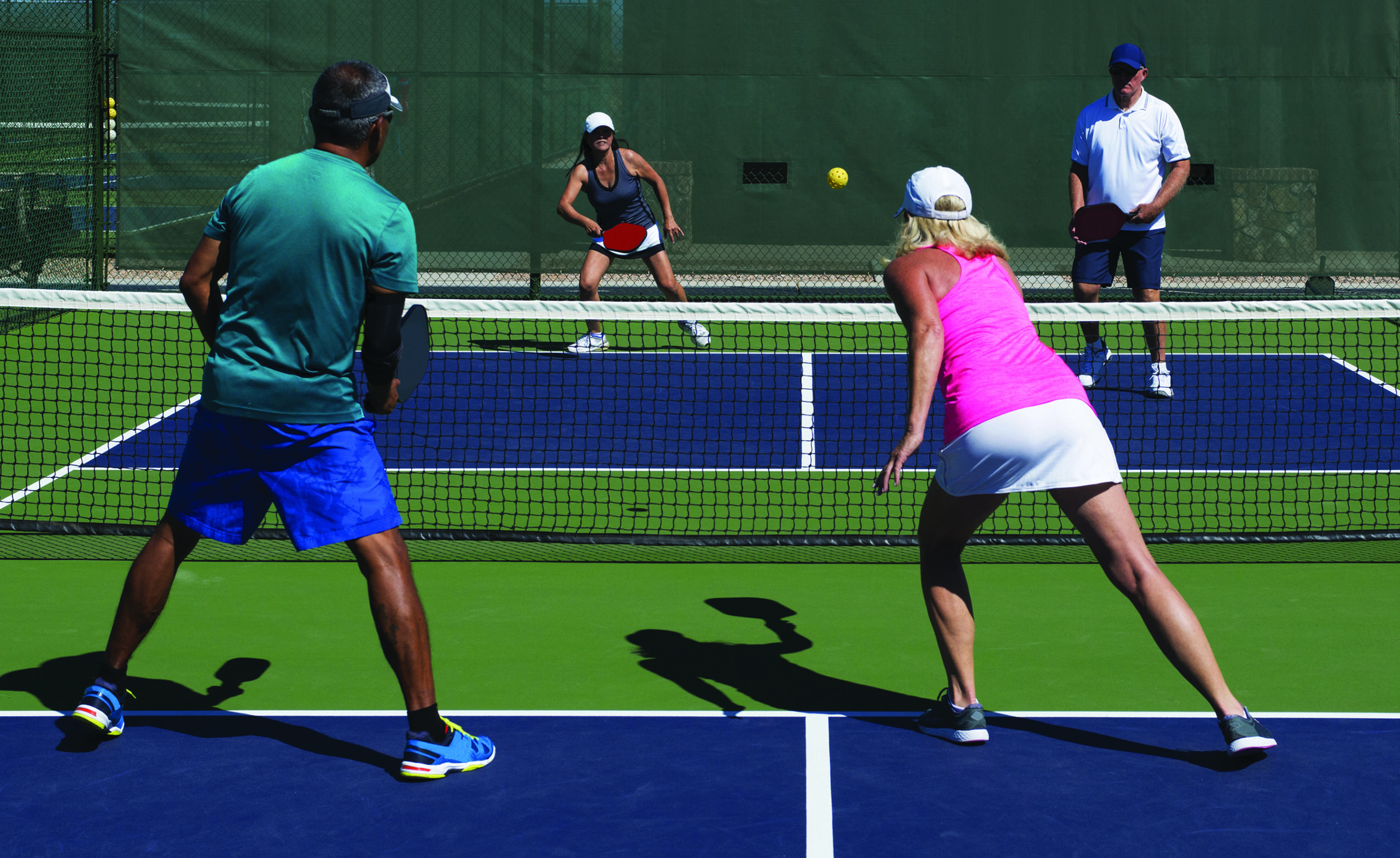
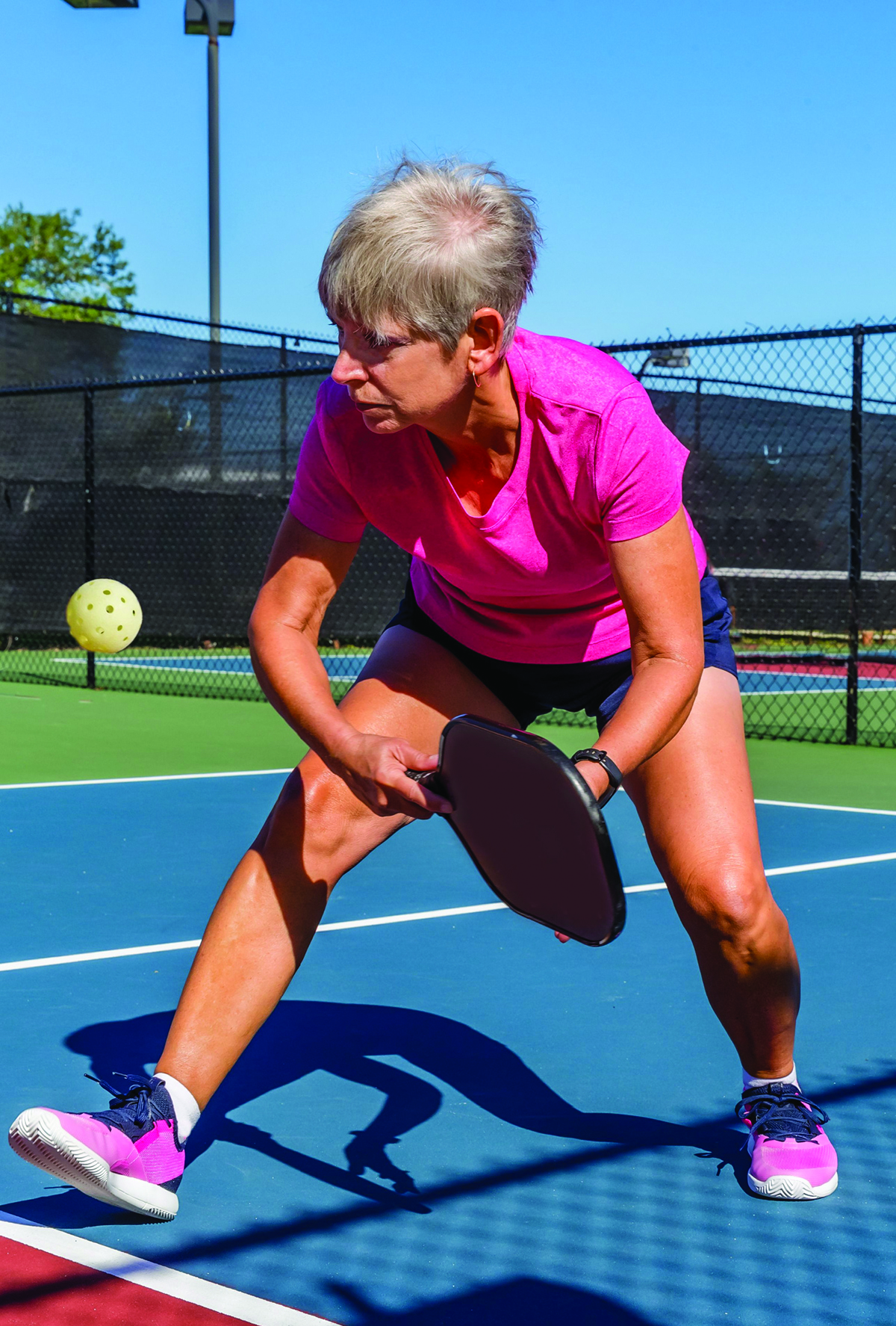
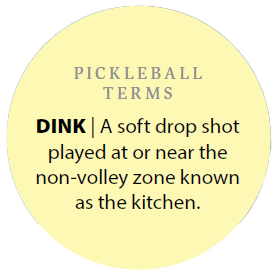
    photo of Pickleball - Mixed Doubles Action of Colorful CourtFew places can outshine Hawai‘i when it comes to healthy outdoor activities. The weather and the environment provide countless opportunities for exercise, whatever your fitness level. Canoe paddling challenges the physically fit, just as a short walk in a park or on a beach might challenge someone who has mobility issues. One sport that welcomes all fitness levels is pickleball.

    Pickleball has been booming in popularity in the islands for the past decade. Its growth has largely been a grassroots effort by players volunteering their time and effort to ensure that all levels of ability and commitment to the sport are accommodated. For some players, the social aspect is their motivator; for others it is a chance to test their skills in competitive and tournament play. The game is especially suitable for seniors, not just for the physical health benefits it provides but also for the opportunity to socialize and the mental exercise involved in keeping focused and in keeping score. If you’re curious about the game, please join me in finding out more about it.
    How pickleball was created

    When you ask people why they play pickleball, the answer always includes the word: Fun! Those three letters embody the spirit in which the game was created back in 1965 on Bainbridge Island in Washington state. The island is a favorite for family summer vacations but the weather isn’t always suitable for the beach. One cold damp day, neighbors Bill Bell and Joe Pritchard took their kids to the Pritchards’ small backyard badminton court with some ping pong paddles and a plastic wiffleball, and made up a game for them all to play. The kids loved the new game, and so did the adults! Another neighbor, Barney McCallum, joined in and the three friends made up the rules of the game on the fly.
    Pickleball — perhaps named for a family dog called Pickle — was strictly a family recreation until summer ended and everyone went back home to Seattle. Barney McCallum created a pickleball court on the street where he lived; Joe Pritchard incorporated a game of pickleball at his campaign rallies when he was running for Congress; and Father Fitterer, another visitor to the island and then president of Seattle University, started a pickleball night at the university’s new gym when it opened in 1969. As word of the game spread and people discovered how much fun it was, the demand for the plywood pickleball paddles Barney was making became so great that he incorporated a business to handle it in 1972. Pickle-Ball Inc. is still a major supplier of pickleball equipment, which has changed considerably over the past 50-plus years.
    Getting started

    Pickleball is the fastest-growing sport in the US according to a randomized research survey done by YouGov in August 2022. They found that 14% of the 2,500 adults aged 18 and over that they surveyed had played the game at least once in the previous 12 months. That figure extrapolates to 36.5 million people nationwide. So it’s not surprising that a plethora of businesses have sprung up around the sport. Many cater to tournament players — there is even a professional league only
    for players aged 50 and over.

    But you don’t have to buy the high-end equipment the professionals use. Paddles can be found for less than $30 online. More expensive options may include a net, two paddles, two outdoor and two indoor pickleballs. Outdoor pickleballs have smaller holes to offset the effects of the wind — definitely a game “hazard” in Hawai‘i! Besides the larger holes, indoor pickleballs are usually a bit softer and a different color, making them easier to see in a gym environment.

    The only other equipment needed to get started is a pair of sports shoes suitable for wear on an outdoor court, such as tennis shoes. (Running, walking and crosstraining shoes are not suitable for pickleball because they are designed for movement in one direction only.) If you intend to play indoors, the shoes you buy should be designed for play on hardwood or smooth composite surfaces. For both indoor and outdoor play, safety glasses made for pickleball are recommended. Add in a sun hat, visor or cap, a large bottle for water to keep you hydrated, some snacks to keep up your energy and you’re all set!
    Prepping for play

    As with all new activities you want to add to your health routines, you should check first with your healthcare team whether pickleball is suitable for you. It does come with some risk of injury, especially for those new to exercise or racquet sports. Travis Lytle, physical therapist at IMUA PT on Maui, recommends “5 to 10 minutes of stretching the calves and hamstrings to help minimize the chances of a pulled hammy or developing plantar fasciitis (foot/heel pain).” He also recommends “working on light gripping (a sponge or small ball) for 2 to 3 minutes a few times a day to help improve forearm strength for those not used to holding onto a racquet for 45 to 60 minutes.” He adds that “The quickest way to develop ‘tennis elbow’ is not prepping the muscles for repetitive use during pickleball or tennis.” And, as with starting any new sport or gym routine, he highly recommends “easing into the new activity slowly as it will decrease your chance of injury.”

    Where do I find a game?
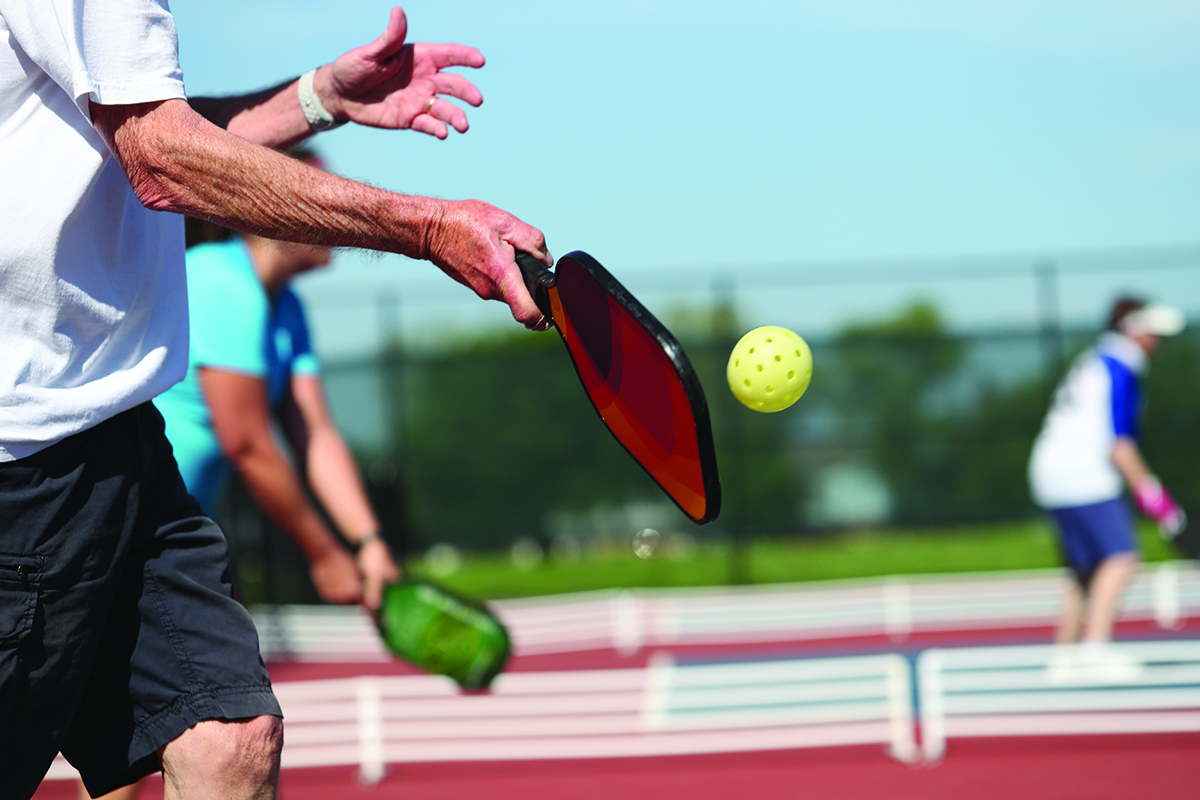
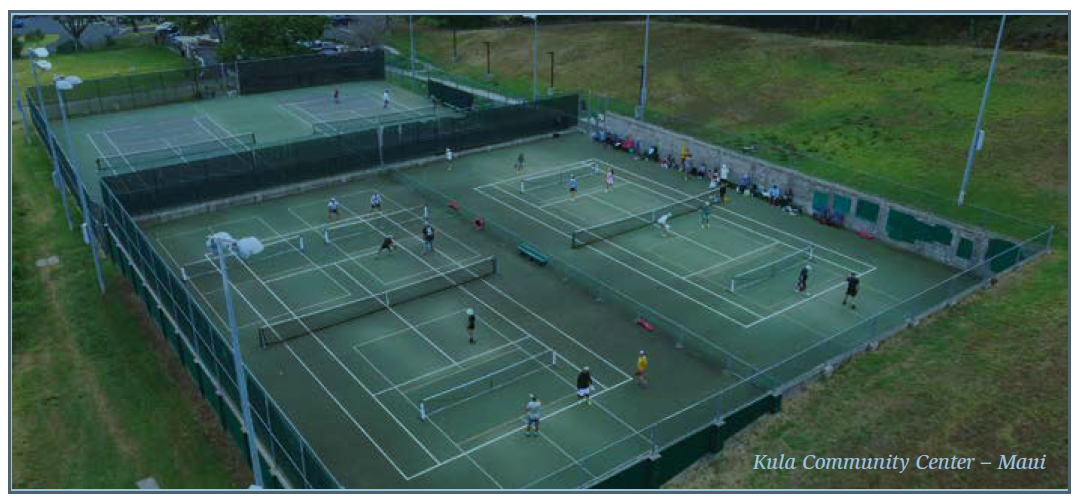
    Pickleball is played outdoorsIt would also be a good idea to go watch some games, as speaking with players at your local court can give you a better sense of what’s involved. Most pickleball courts — both indoor and out — are maintained by your local county’s parks and recreation department, and a quick call to them can help you find places and times that pickleball is being played. USA PIckle Ball, the nonprofit national governing body for the sport, has local players volunteer to update an easily searchable website called Places2Play: places2play.org. Each location is tagged with information about hours and whether it is free to play or has a drop-in or membership fee. Other tags to look out for are “Beginners Welcome,” “Recreational Focused” and “Senior Crowd.” There will often also be a contact number to connect you with a local player who can give you more specific details.

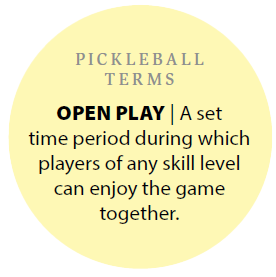
    One thing to ask about is “Open Play.” In keeping with pickleball’s origins as a family and neighborhood activity promoting friendship and fun, Open Play is a way of welcoming everyone to play, no matter their age or skill level. It might be done via a sign-in sheet or by having players place their paddle (with their name on the handle) in a stack with up to three other paddles. As a court becomes available, the next four players in line get their turn.

    A game usually lasts about 15 to 25 minutes, so it is quite a quick turnaround of players. It’s not unusual for players to stay for several games, socializing and maybe sharing a potluck while waiting for their next turn on the court. Numerous research studies have shown that being out among people enjoying a good time together is very beneficial for your health.
    Gameplay

    Pickleball is a game of focus, quick reflexes, and strategy, but doesn’t rely so much on strength and extreme agility. In fact, many players who have come to the game after playing another court sport — such as tennis or volleyball — are surprised to find themselves beaten by players far less athletic than they are. A short person, overweight and maybe even wearing a knee brace can best a tall, fast-moving player simply by knowing where to position themselves and by keeping relatively still but placing the ball strategically so that their opponent has to reach down to return it. Adjusting to the small dimensions of the court can be a challenge for some players used to ranging over the larger area of a tennis court.

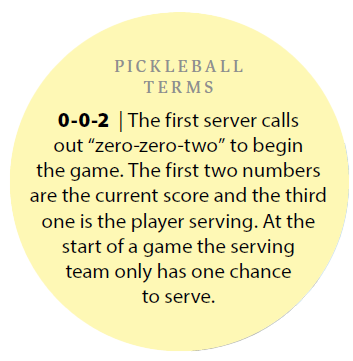
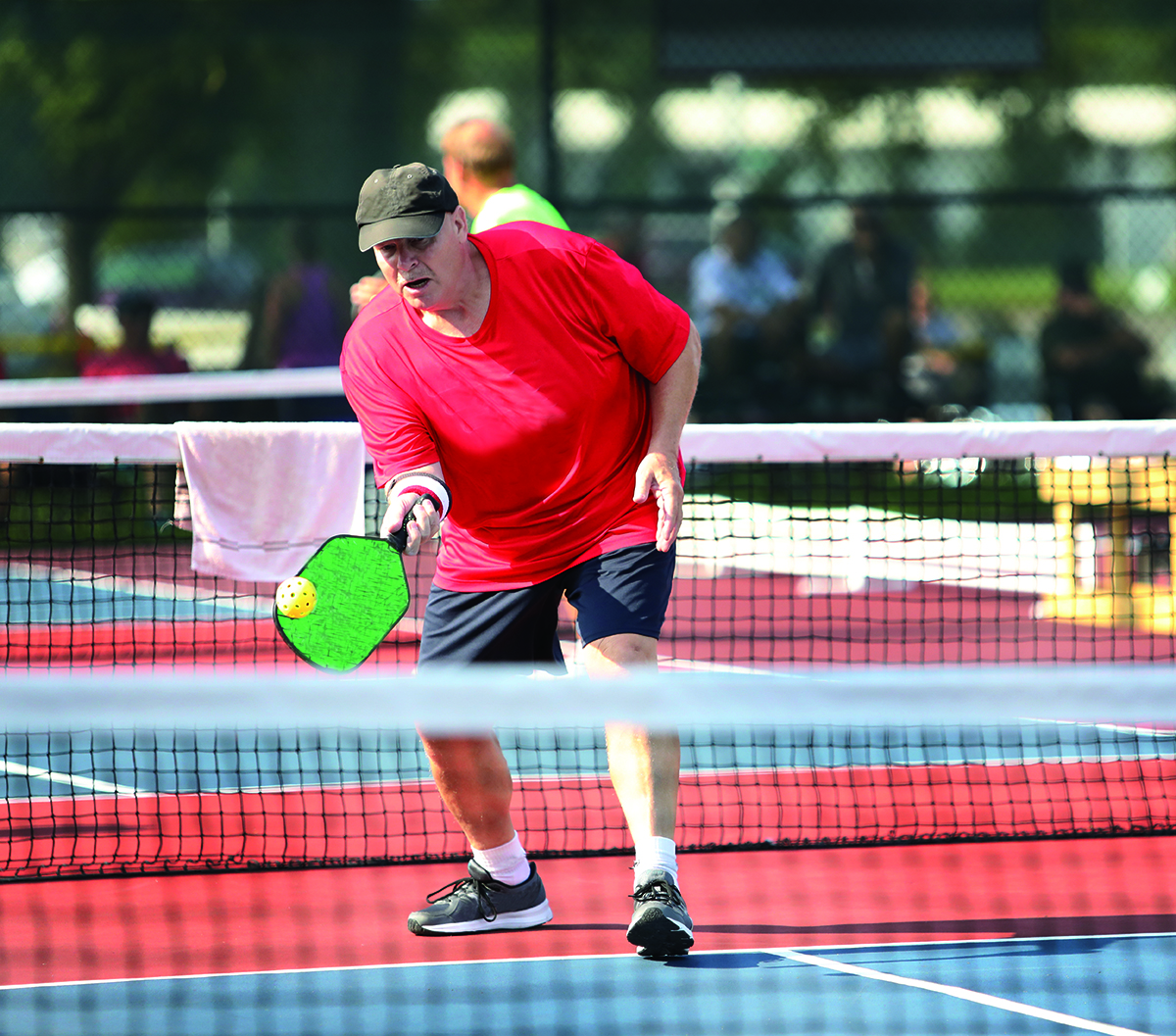
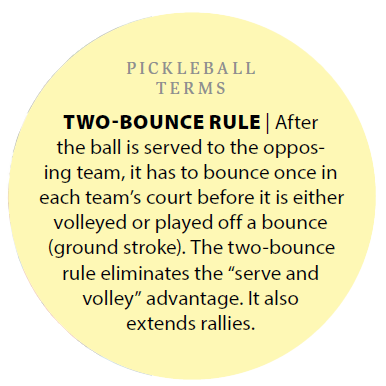
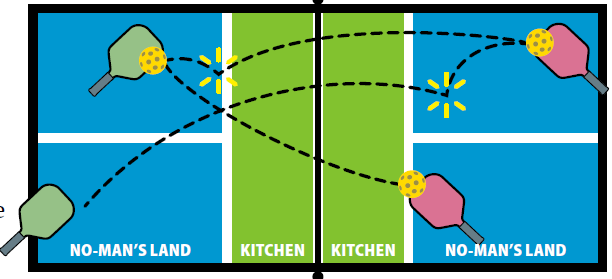
    The game begins by deciding which player or team has first choice of the side of the court they’ll be playing on and whether they will serve or receive. The first serve is always made diagonally from behind the back line of the right side of the court and it follows the two-bounce rule. The receiving team must let the ball bounce before returning it and the serving team must then also let it bounce before returning it. The aim of this rule is to extend rallies by eliminating an opening volley that may be impossible to return. After this opening play, both teams can either play the ball off a bounce (ground stroke) or volley it.
    Tennis vs. pickleball

    Many pickleball players also play tennis or did so in their younger days, but the two games are quite different. Tennis favors using a long backward sweep of the arm (backstroke) in order to give power to the ball’s return. Pickleball favors a smaller backswing because the court is so much smaller, requiring quick returns. The net is also lower: 36 inches at the sideline and 34 inches in the middle. (When the game was first created on a badminton court, the net’s new height was measured by one of the parents putting it at the height of their hip.) The dimensions of a pickleball court are 44 feet by 20 feet, the same as a badminton court.

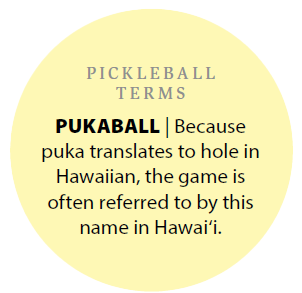
    You can never hit a volley from within 7 feet of the net, or even have your body’s momentum carry you into that non-volley zone (aka “the kitchen”) after your volley. Again, this rule dates from the time the game was invented as a family game. Standing close to the net makes volleying too easy, putting the defender at an unfair disadvantage and ruining the fun of the game. A summary of the most important rules can be found on the USA Pickleball website: usapickleball.org/what-is-pickleball/official-rules/rules-summary/.

    Tennis uses an overhand serve but pickleball serves are always underhand and the contact point of the ball on the paddle must be below your waist, with the highest
    point of the paddle being below your wrist. You only get one chance to get your serve into play, whereas in tennis you get two chances. Only the serving team can score points, and the two players in the serving team switch sides of the court after each point is won.
    Senior women at a tennis court. Active seniors living a healthy lifestyle. Staying active in retirement.Upping your game

    The Pickleheads website has a succinct, illustrated page showing how to play the game here: pickleheads.com/blog/how-to-play-pickleball. There are also hundreds of videos on YouTube showing you how to up your game skills, but the better option is to attend a coaching clinic. What works for someone else might not work for you in terms of technique and avoiding injury. Clinics may be offered by your local county Parks & Recreation Department (often for free) or by a local pickleball club for a fee. For example, the O‘ahu Pickleball Association (OPA) has weekly group lessons for Newbies (nets, balls and paddles included), Beginners, Advanced Beginners and Intermediate. You can find the details about all these clinics on the OPA website: oahupickleballassociation.org/learn-pickleball/classes-clinics-workshops/.

    Many of the common mistakes made by beginners occur because the smaller dimensions of a pickleball court call for strategies that go against what you instinctively want to do.
    The “no man’s land” between the kitchen line and the baseline may seem like a good place to stand but playing from there can make it easier for your opponent to return your shot. If they place their shot behind you, there’s also a risk that you will stumble and fall as you run back to try to return it.

    While it’s tempting to return a shot coming at you at head or shoulder height, the ball is more than likely going to go out-of-bounds, so you should just let it go by.

    It is also very easy to step into “the kitchen” when following through on a shot, which will incur a fault.

    As a beginner, you are still developing an understanding of the game and developing your own individual style of play. It’s a good time to practice a variety of shots so that you have the element of surprise on your side, rather than playing predictably. Remember to keep your eye on the ball and to be mindful of where it is relative to your paddle so that you can anticipate making the best return shot. Communicate with your partner, especially when a return shot could be taken by either of you. Don’t poach a shot from them by jumping over the center line into their side of the court — at the very least, you are leaving your side of the court wide open and undefended for your opponent’s return shot.
    DIY pickleball

    Once you’ve learned the game, you might like to return to its Bainbridge Island roots by creating a pickleball court in your yard or chalking one up on the street—if it’s a quiet one! But even if you don’t have the desire to get fully immersed in the game, investing in a paddle and some balls is a good health choice to make. A 12-year-long statistical study done by researchers at the National Cancer Institute and the National Institute on Aging, published in 2022, found that of all the activities older people can do to minimize the risk of early mortality, racquet sports are one of the most beneficial. That is because they require synchronized action from many muscles for correct form, hand-eye coordination, and intermittent bursts of very high intensity. These benefits, combined with the social element and mental exercise, are what make pickleball clubs eligible for affiliation with the Blue Zones Project, which promotes healthy lifestyles.

    A final word

    The final word is still: Fun! A prime reason for pickleball’s popularity is that the players love the game and want to share that enthusiasm with others and inspire them to feel the same way. A more experienced player is expected to play more “gently” with someone who is still learning. Just because you can win doesn’t always mean you should if it’s at the expense of someone else still developing their skills. Pickleball is intended to be a game of fair play and good sportsmanship that promotes a culture of fun and friendly competition.

    NATIONWIDE
    USA Pickleball (National Governing Body) usapickleball.org
    usapickleball.org/about-us/contactus/
    facebook.com/usapickleballassociation
    • Places to Play: places2play.org/state/hawaii

    O‘AHU
    Oahu Pickleball Association (Club) oahupickleballassociation.org
    oahupickleballassociation.org/contact/
    instagram.com/oahupickleballassociation/
    • Where to play: bit.ly/OPA-PickleballCourtsMap meetup.com/Oahu-Pickleball-Association

    Japan Hawaii Pickleball Association (Club)
    japanhawaiipickleballassociation.org/
    aloha@japanhawaiipickleballassociation.org
    facebook.com/aloha.jhpa
    • Places to Play: japanhawaiipickleballassociation.org/hawaii

    Kailua Pukaball Ohana (Club)
    facebook.com/pilahi.gregg.3

    City and County of Honolulu (Dept. of Parks & Rec.) honolulu.gov/parks
    808-768-3003 | parks@honolulu.gov
    facebook.com/honolulu.parks
    instagram.com/honolulu_parks/
    • Where to play: bit.ly/honolulu-gov-pickle-ball-courts

    MAUI
    County of Maui (Dept. of Parks & Rec.) mauicounty.gov/119/Parks-Recreation
    808-270-7230 | parks.dept@mauicounty.gov
    • Where to play: Call for locations

    Aloha Pickleball Complex (Future Facility) Maui Research & Technology Park, Kihei, Maui
    alohapickleball.com

    BIG ISLAND
    Kona Pickleball Hui (Club) konapickleballhui.weebly.com
    konapickleballhui@gmail.com
    • Where to play: bit.ly/KPH-PickleballCourtsMap
    Old Kona Airport, 75-5530 Kuakini Hwy., Kailua-Kona

    Big Island Rogue Pickleball Hui (Club) bigislandroguepickleballhui.com
    bigislandrph@gmail.com
    facebook.com/groups/bigislandroguepickleballhui
    instagram.com/bigislandroguepickleballhui/
    • Where to play: Details online

    Holua Racquet & Paddle (Facility) holuaracquetandpaddle.com
    808-989-4611 | holuaracquetandpaddle@gmail.com
    • Where to play: 78-7190 Kaleiopapa St, Kailua-Kona

    KAUA‘I
    Pickleball Association Kauai (Club)
    pakauai.org
    facebook.com/PAKauai
    instagram.com/pakauai808/
    • Where to play: pakauai.org/court-locations

    County of Kaua‘i (Dept. of Parks & Rec.) kauai.gov/Parks
    808-241-4460 | parks@kauai.gov
    • Where to play: Call for locations


    PICKLEBALL PROFILES
    Lani Larrua
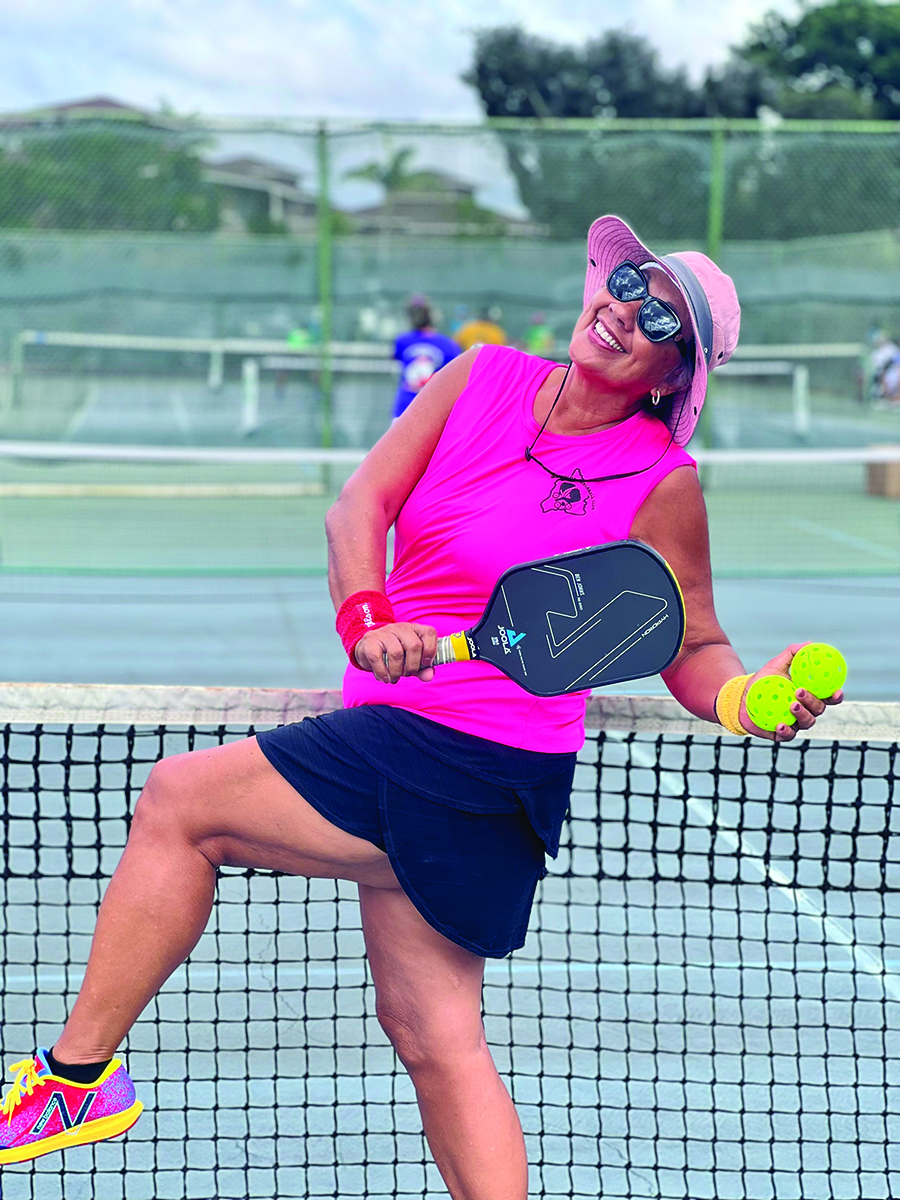
    When her husband of 38 years passed away, Lani found that her social life changed. Six years ago, she started playing pickleball on the private courts at Waikoloa Village, where she lives on the Big Island. A pastor and sworn chaplain for the Hawai‘i Police Department, Lani observes that for some people, playing pickleball has “almost taken the place of going to church” as a way of finding new social networks among kind and accepting people. She describes the game as a cross between ping pong, badminton and tennis and attributes the “weird” rules to the game’s origins as a family game. Family play is growing on the Big Island and it’s a great way for kids to “see a whole other side of their parents — having fun, laughing, not always winning. Pickleball is healthy, good, fun behavior. It keeps the body moving. A body in motion is a body alive.” And “killing the ball” gets rid of stressors!
    Todd Richter
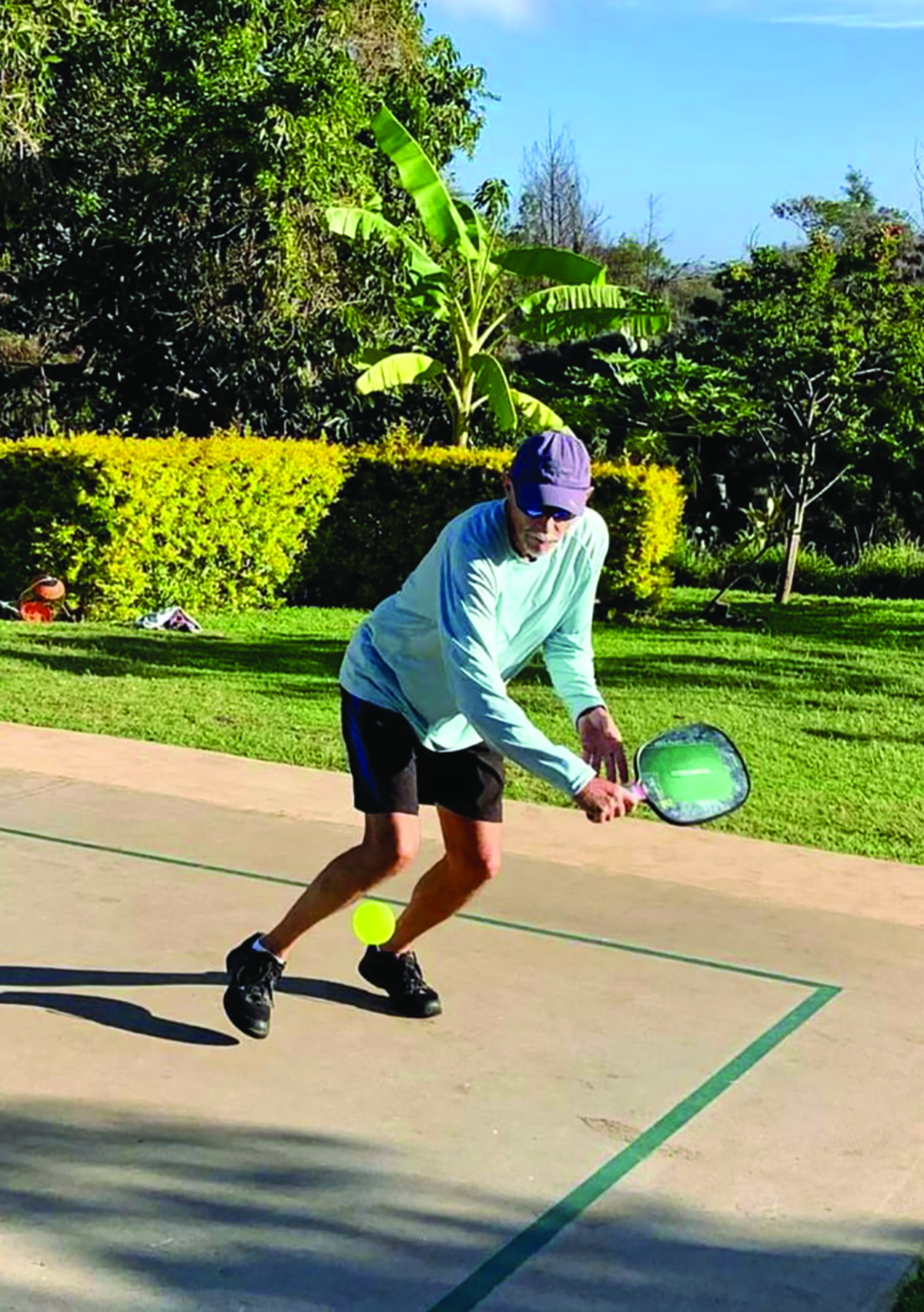
    Todd was first introduced to pickleball in the mid-1980s. A friend he played tennis with invited him to play at the court her parents had built in their backyard. He liked the game and played it almost weekly, but the parents sold the property a year later and it wasn’t until 2016 that Todd became heavily involved with it. By then, he was working for the County of Maui Department of Parks & Recreation and a visitor called to inquire about places to play pickleball, offering to give free lessons. It soon became obvious the county needed to cater to a growing demand for places to play and Todd helped facilitate that. He retired in 2020, and enjoyed playing pickleball competitively in tournaments. “Over the past couple years, I’ve felt my urge to play tournaments kind of disappear. What keeps me playing now is for fresh air and exercise, and for fun. Because pickleball is fun to play.”
    Nolan Ahn
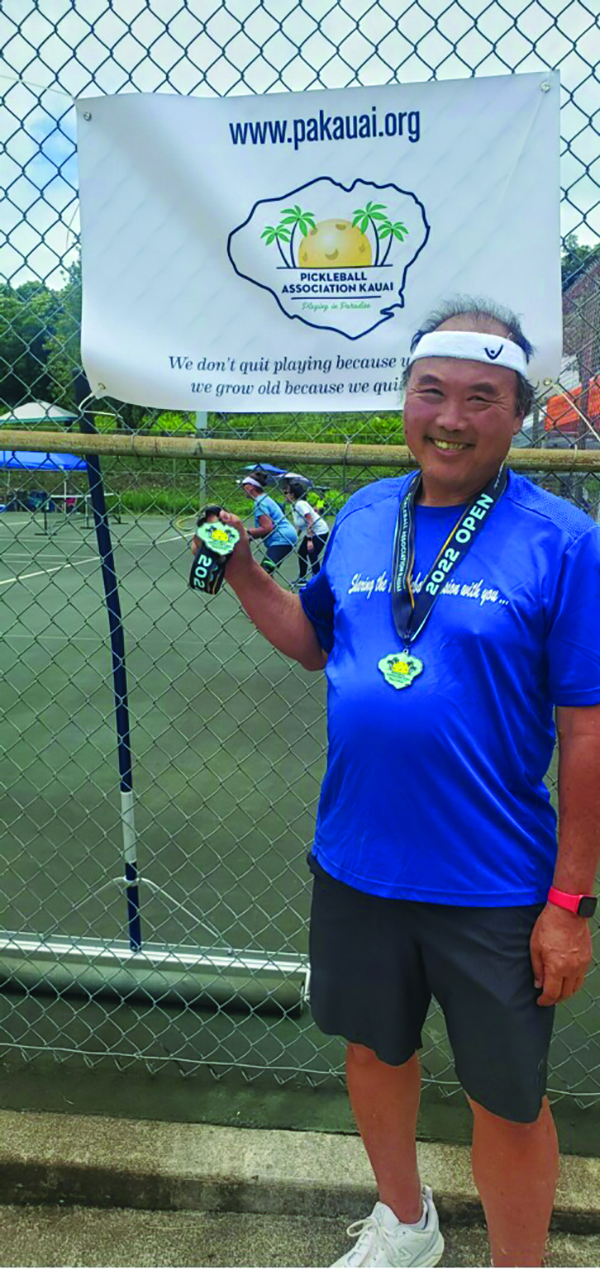
    Nolan Ahn is the founding president of the Pickleball Association Kauai (PAK). In his March 2023 President’s Report on the PAK website, he gives an account of the “demise of my hiking days” on account of his two replacement hips and having “unsure feet.” Neither of those two byproducts of aging have kept him from pickleball. Nolan enjoys the competitive side of the game and is looking forward to competing nationally as a “super senior” in the age 75-79 bracket. “Everybody has health issues as they age, so the playing field levels out.” He has already gold medaled in state tournaments in younger brackets. Age brackets put a positive spin on getting older. “Just hang in there… soon you’ll be the youngest in a new bracket.” He is also proud that PAK is a participating Blue Zones organization “supporting healthy lifestyles as we age.”
    Margie Katras
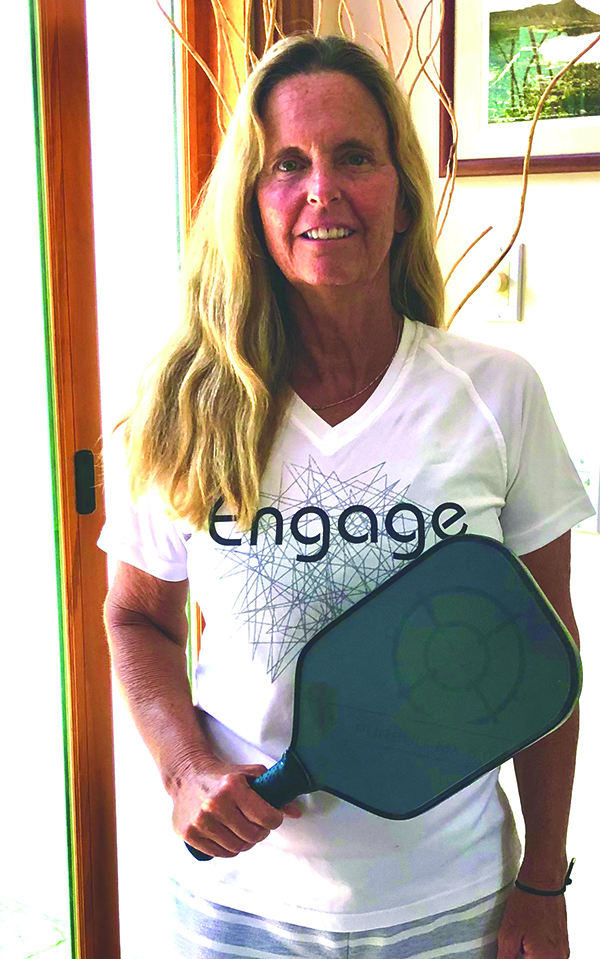
    Margie was a tennis player and coach but found that she wasn’t learning any more and that injuries were making the game less pleasurable as she aged. She was watching some other people play pickleball at the tennis courts one day and decided to try it. “Just one game and I was hooked! It was like beginning a new life just as my tennis life was coming to an end. It’s easy to learn and you meet a lot of people from different backgrounds.” She now coaches pickleball and describes the gameplay as “cat and mouse,” requiring players to stay focused. Margie admits that tennis is still her No. 1 love, and looks forward to the day when there are more courts dedicated to pickleball so the two sports don’t have to compete for space and time. “It’s like the difference between skiers and snowboarders,” she says. Ski field operators soon realized they had to provide dedicated runs for the new sport.
    Few places can outshine Hawai‘i when it comes to healthy outdoor activities. The weather and the environment provide countless opportunities for exercise, whatever your fitness level. Canoe paddling challenges the physically fit, just as a short walk in a park or on a beach might challenge someone who has mobility issues. One sport that welcomes…

  • Grief & Bereavement — Part I

    Grief is a natural response to the loss of someone special. The process of grieving allows the griever to adapt to a new world of existence without the loved one. If allowed to proceed through the grieving process with minimal guilt, anxiety, stress, unresolved issues and conflict, we can help each griever experience their grief fully and allow the griever to validate and honor the life of the deceased, and affirm and strengthen relationships with survivors.

    When one thinks of making an estate plan, visions of rolling-hill estates and large brokerage accounts may come to mind. Clients often say that they want to establish an estate plan “to minimize tax and avoid probate.” Attorneys spend a great deal of time in post-graduate law school to learn the complex tax and probate laws to help clients with these goals. When we examine these goals in more depth, we find that they often represent unmet human needs which are expressed by avoiding probate and minimizing taxes. Clients experience these needs with emotions and feelings.

    In realizing that each one of us will die one day, to different degrees, we experience fear, anxiety and anticipatory grief, because unlike any other living species existing on the planet, we humans share an acute awareness of our ultimate demise.


    STEPHEN B. YIM, ATTORNEY AT LAW
    2054 S. Beretania St., Honolulu, HI 96826
    808-524-0251 | www.stephenyimestateplanning.com

    Grief is a natural response to the loss of someone special. The process of grieving allows the griever to adapt to a new world of existence without the loved one. If allowed to proceed through the grieving process with minimal guilt, anxiety, stress, unresolved issues and conflict, we can help each griever experience their grief…

  • Choosing a Dignified Death

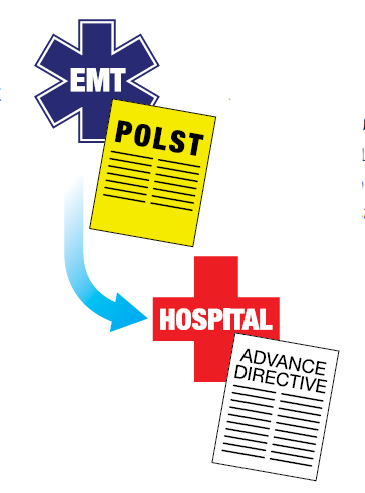
    A Provider Order regarding Life Sustaining Treatment (POLST) says what measures should be used to keep you alive in a medical emergency. It is different from an Advance Directive in that it will be followed by emergency personnel, provided that they are aware of its existence. If you don’t have a POLST, emergency medical technicians (EMTs) are required to do whatever they can to restore and stabilize your heartbeat and breathing and take you to an appropriate facility for treatment. They will not read your Advance Directive and try to figure out how it might apply to your situation.

    In some cases, resuscitation is not appropriate or wanted. A POLST, being a medical provider’s order, will be followed by the EMTs. Your Advance Directive will not come into play until you are in the hospital. At that point, the EMTs may not have done you any favors by keeping you alive. If you would not want to be  resuscitated, talk with your doctor about having a POLST. If you would want the EMTs to follow normal lifesaving procedures, you do not need a POLST.

    Your POLST should be printed on lime green paper so it is immediately recognizable. Post a copy by your bed and carry one with you when you leave home. Make sure loved ones know where to find it in an emergency.


    SCOTT MAKUAKANE, Counselor at Law
    Focusing exclusively on estate planning and trust law.
    www.est8planning.com
    808-587-8227 | maku@est8planning.com

    A Provider Order regarding Life Sustaining Treatment (POLST) says what measures should be used to keep you alive in a medical emergency. It is different from an Advance Directive in that it will be followed by emergency personnel, provided that they are aware of its existence. If you don’t have a POLST, emergency medical technicians…

  • How Will Rising Interest Rates Affect You?

    The Federal Reserve (the Fed) has begun what it says will be a series of interest rate increases in an effort to slow the economy and temper the current surge in the inflation rate. At the start of 2022, the federal funds rate stood at near zero percent. By May, the Fed moved the federal funds rate 75 basis points (0.75 percent) higher.

    What does this mean for you and your money? While Fed actions directly impact large financial institutions, they also resonate throughout the financial markets. In indirect ways, your personal finances can be affected by Fed policy.

    Four ways the Fed’s rate hikes in 2022 could impact your bottom line:

    1. HIGHER BORROWING COSTS

    While the Fed’s rate hikes don’t directly affect most types of consumer loans, the direction the Fed sets on interest rates tends to carry over throughout debt  markets. This could include:

    Home mortgages: Adjustable-rate mortgages will be the most directly affected, as they change in conjunction with general interest rate trends in the market. If you have a fixed rate mortgage, you won’t see any change.

    Automobile loans: While a variety of factors affect how interest rates are set on vehicle loans, you can expect these rates to increase as well.

    Student loans: Federal student loan rates are set and will not be directly affected. However, borrowers working with private lenders will likely see rates move higher as they are tied to the Fed funds rate.

    2. MODESTLY HIGHER SAVINGS RATES

    Investors have not earned much in terms of interest on bank savings accounts, money market accounts or certificates of deposit in recent memory. While it seems reasonable to expect that yields may improve modestly, the change may not be dramatic. Even with historically low interest rates, investors have directed significant sums to these types of vehicles. In the current market environment, some investors still have a desire for such “safe haven,” high liquidity investments regardless of the interest rate earned.

    3. THE BOND MARKET

    Fed interest rates strategies don’t impact the bond market directly, but Fed policy is watched closely by bond investors. This year, along with raising short-term rates, the Fed has also begun reducing the role it plays as a buyer in the broader bond market. That action could lessen demand for longer-term bonds, which can drive up interest rates. Even before the Fed initiated its new policies, the bond market already anticipated the change and interest rates began moving higher on  most types of bonds.

    4. THE STOCK MARKET

    The stock market also tends to react to the Fed’s news, and with the central bank taking steps to slow the economy, investors anticipated the potential negative effects on publicly-traded companies. As a result of this and other factors, stocks lost value at the start of the year. It may be a good time to talk with your financial advisor about whether any of the changes mentioned above require you to update your financial plan.


    MICHAEL W. K. YEE, CFP,® CFS,® CLTC, CRPC®
    1585 Kapiolani Blvd., Ste. 1100, Honolulu, HI 96814
    808-952-1222, ext. 1240 | michael.w.yee@ampf.com
    www.ameripriseadvisors.com/michael.w.yee
    Michael W. K. Yee, CFP®, CFS®, CLTC, CRPC®, is a Private Wealth Advisor, Certified Financial Planner™ practitioner with Ameriprise Financial Services, LLC in Honolulu, HI. He specializes in fee-based financial planning and asset management strategies and has been in practice for 37 years. Investment advisory products and services are made available through Ameriprise Financial Services, LLC, a registered investment adviser. Investment products are not insured by the FDIC, NCUA or any federal agency, are not deposits or obligations of, or guaranteed by any financial institution, and involve investment risks including possible loss of principal and fluctuation in value. Ameriprise Financial Services, LLC. Member FINRA and SIPC. ©2021 Ameriprise Financial, Inc. All rights reserved.

    The Federal Reserve (the Fed) has begun what it says will be a series of interest rate increases in an effort to slow the economy and temper the current surge in the inflation rate. At the start of 2022, the federal funds rate stood at near zero percent. By May, the Fed moved the federal…

  • Newborns & Social Security Numbers

    Getting a newborn a Social Security (SS) number is important for his or her future. Feel free to share this time-saving information with prospective parents.

    If the child is born in a hospital, the easiest way to apply for a SS number is right at the hospital. When information for the child’s birth certificate is given at the hospital, parents will also be asked whether they want to apply for a SS number for the child. If the parents say “yes,” they will be asked to provide both of their SS numbers, if possible. Even if the parents don’t know both of their SS numbers, they can still apply for a number for their child.

    There are many reasons why a child should have a SS number. For example, a SS number is needed to claim a child as a dependent on income tax returns. A child may also need a number if parents plan to do the following for the child:

    • Open a bank account.
    • Buy savings bonds.
    • Get medical coverage.
    • Apply for government services.

    Read Social Security Numbers for Children at www.ssa.gov/pubs/EN-05-10023.pdf.

    Applying at the hospital will allow parents to focus on the new family member.


    800-772-1213 (TTY 800-325-0778) M–F, 8 am–5 pm
    SSA Office Locator: www.socialsecurity.gov
    Advance Designation FAQ: www.ssa.gov/faq (Other Topics)
    Representative Payees Information: blog.ssa.gov

    Getting a newborn a Social Security (SS) number is important for his or her future. Feel free to share this time-saving information with prospective parents. If the child is born in a hospital, the easiest way to apply for a SS number is right at the hospital.

  • Help Protect Our Kūpuna Against Crime

    Every year, Hawai‘i residents are swindled out of money through many forms of crime. The Federal Trade Commission estimates that 2.4 billion robocalls made every month. Over 3,500,000 older adults are swindled out of nearly $5 billion in personal savings each year. The average loss is $34,200-plus for every senior who falls victim to a scam. More than $17 million per year are lost to internet crimes (2021) — and cases are expected to rise by 10 percent this year. During the first two years of the pandemic, the US Office of the Inspector General received over 1,500 COVID-related complaints. In addition, Medicare loses $70 billion per year to fraudulent claims.

    Senior Medicare Patrol (SMP) Hawaii aims to mitigate those losses through the help of volunteers who educate and empower kūpuna and their ‘ohana before they become victims of healthcare fraud or another scam.

    You can help protect our kūpuna by becoming a volunteer. You can choose to be a counselor, presenter, information distributor, fair exhibitor or provider of clerical support. Training is available and volunteers learn at their own pace.

    Gaining satisfaction from helping others without ever leaving home is just one of the benefits of becoming an SMP volunteer. Becoming a volunteer also offers the opportunity to stay informed of latest scams, such as phony government agencies, fake tech support, family or friends imposters, online shopping gimmicks,  romance scam artists… the list goes on. Volunteers can also sharpen their computer skills to become a tech savvy senior, and learn about Medicare and community resources while having fun and making new friends who also have an interest in championing a worthy cause.


    SENIOR MEDICARE PATROL (SMP) HAWAII
    Department of Health — Executive Office on Aging
    250 S. Hotel St., Ste. 406, Honolulu, HI 96813
    808-586-7281 | Toll Free: 1-800-296-9422
    info@smphawaii.org | smphawaii.org
    This project was supported in part by grant number 90MPPG0053 from the US Administration for Community Living (ACL), Department of Health and Human Services, Washington, DC, 20201. Grantees undertaking projects under government sponsorship are encouraged to express freely their findings and conclusions. Points of view or opinions do not, therefore, necessarily represent official ACL policy. *Sources: Star Advertiser, March 27, 2022; Consumer Affairs, Nov. 25, 2021; Comparitech, Jan. 11, 2022

    Every year, Hawai‘i residents are swindled out of money through many forms of crime. The Federal Trade Commission estimates that 2.4 billion robocalls made every month. Over 3,500,000 older adults are swindled out of nearly $5 billion in personal savings each year. The average loss is $34,200-plus for every senior who falls victim to a…

  • Talk Story: A Favorite Senior Pastime

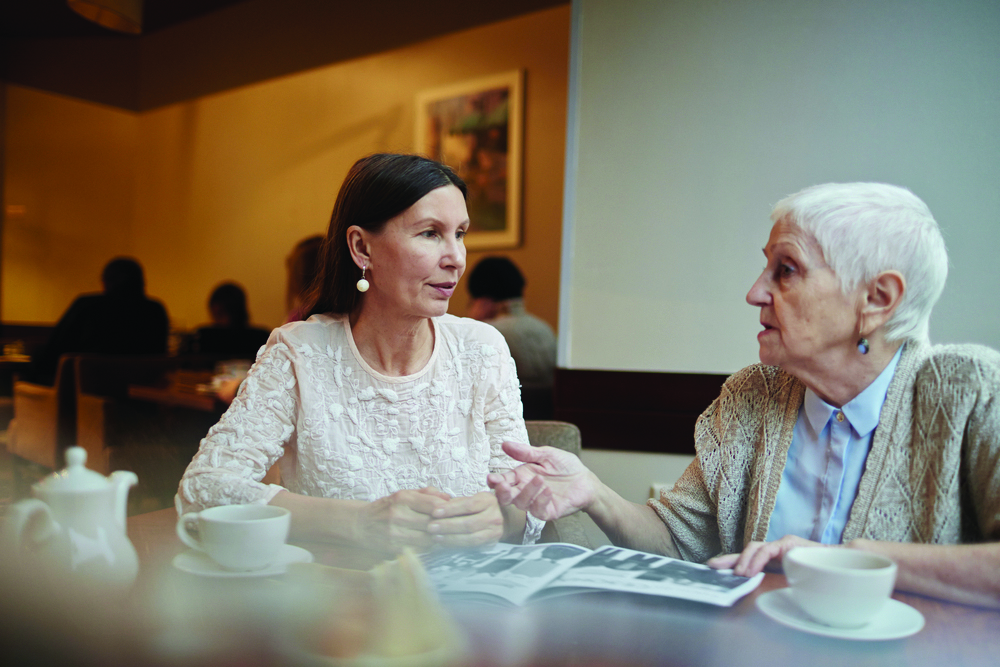
    Elderly females talking and looking through magazine in cafeTalk story is a special and cherished activity among seniors at Roselani Place. Our activities  director conducts a talk story twice a month and I also offer them from time to time. Talking story with our residents allows us to not only engage with them, but also encourages them to reminisce about the good old days, and learn more about one another.

    Talk story — sharing history, ideas, opinions and the events of the day with others — is one of the great oral traditions in Hawai‘i. Ancient Hawaiians were known to be great storytellers. Formal storytelling would usually take place in the chief’s court, where renowned orators would perform. Talk story continues to culturally sustain us and keeps us connected with others.

    Talking story in today’s world entails getting together with old friends or new acquaintances to socialize. Small talk and pleasantries naturally develop into in-depth conversations in which treasures of the past are recalled and revealed. Through talk story, we can discover and share where we grew up, where we are from, what school we attended, who we know and who we are related to. The reservoir of topics is endless.

    And when I talk story with our residents, I realize just how memorable talk story can be.


    ROSELANI PLACE (501(c) 3 nonprofit)
    88 South Papa Ave., Kahului, Maui, HI 96732
    808-871-7720 | Toll Free: 800-554-9853
    info@roselaniplace.com | www.roselaniplace.com

    Talk story is a special and cherished activity among seniors at Roselani Place. Our activities  director conducts a talk story twice a month and I also offer them from time to time. Talking story with our residents allows us to not only engage with them, but also encourages them to reminisce about the good old…

  • Caregivers Must Ask Others for Help

    When it’s a family caregiver’s sole responsibility to manage the care of a loved one, there will come a time when stress will get to a level where the caregiver becomes unable to perform self-care or continue to provide for their loved one. Getting others involved to help the caregiver will bring much-needed relief. Family caregivers can feel emotionally and physically drained with the constant tasks that come up, sometimes unexpectedly. Here are some examples of unexpected events:

    FALLS: A loved one may be fragile enough to experience a fall that may result in some devastating outcomes, including head trauma, a broken hip or another broken bone. This would involve a trip to the emergency room and a call to the doctor to report the fall.

    SKIN TEARS: Open skin is a magnet for infections, which will only serve to complicate care. Skin tears need proper attention.

    URINARY TRACT INFECTIONS: UTIs are hard to recognize when caregivers are busy. A sudden change in behavior, more confusion than usual or hallucinations are among the first signs. Often, our kūpuna do not have strong immune systems that signal the presence of a UTI with a fever or other typical sign of infection.

    These challenges are common when caring for an elderly loved one and family caregivers need to be prepared to manage them and also allow others to step in to help as needed. Communicating the plan to others will make these problems seem less traumatic. Consider these recommendations for involving others when providing primary care for a loved one in need.

    • Allow family members/friends to manage others that may be dependent as well, such as children, grandchildren or siblings.

    • Seek out healthcare agencies that can provide respite and take over the family caregiver’s tasks a few times a week for a number of hours, or even a full day.

    • Ask friends to run errands, such as picking up prescriptions, food and supplies, etc.

    • Keep family members informed of all situations so they know when the tasks will increase as the loved one needs more advanced care. Plans can be altered to include other family members and friends.

    • Just because family lives far away does not mean they cannot contribute. Ask for funds to pay for services and supplies.

    • Consider support groups, including those online, to prevent feeling isolated. You may learn some new ways to feel more at peace.

    • Find something to be grateful for every day. Meditate on these before starting your caretaking day, so you have a centered heart.

    As the family caregiver takes on more tasks for their loved one, a wider circle of support should be available to routinely step in to provide ongoing respite. Don’t be afraid to ask for help! It will give both the caregiver and the loved one a better quality of life.


    ATTENTION PLUS CARE HOME HEALTHCARE
    Accredited by The Joint Commission
    1580 Makaloa St., Ste. 1060, Honolulu, HI 96814
    808-739-2811 | www.attentionplus.com
    AGING IN HAWAII EDUCATIONAL OUTREACH PROGRAM
    by Attention Plus Care — a program providing resources for seniors and their families, covering different aging topics each month. For class information and  upcoming topics, call 808-440-9356.

    When it’s a family caregiver’s sole responsibility to manage the care of a loved one, there will come a time when stress will get to a level where the caregiver becomes unable to perform self-care or continue to provide for their loved one. Getting others involved to help the caregiver will bring much-needed relief.

  • The Best Summer Drinks for Your Teeth

    Lemonade, iced tea, smoothies and juices all sound delicious during hot summer days. But beware of the sugar content, especially if you’re drinking more than one glass a day.

    You probably already guessed that the most important drink is water! It’s good for your body and teeth. Most flavored and carbonated drinks have high sugar content, dehydrating additives and other chemicals to enhance flavor, and make you feel like you’re quenching your thirst.

    Water helps cleanse your palate, dilute the acids in your mouth, and rinse away bacteria or food debris from your teeth and gums. Water also regulates your brain function and energy levels and helps fight dry mouth caused by some medications. Dry mouth isn’t only uncomfortable, it also raises your risk of gum disease and tooth decay. It’s best to keep a bottle of water nearby and sip from it throughout the day.

    If you must indulge in a sweet drink or food occasionally, be sure to rinse your mouth with water to flush out sugar and acids that can break down the enamel of your teeth. Also, be sure to brush your teeth twice a day, floss daily and see your dentist twice a year to live well and smile more at every age.


    HAWAII DENTAL SERVICE (501(c) 4 nonprofit)
    Kahala Howser, Wellness & Events Manager
    808-521-1431 | khowser@hawaiidentalservice.com
    www.HawaiiDentalService.com

    Lemonade, iced tea, smoothies and juices all sound delicious during hot summer days. But beware of the sugar content, especially if you’re drinking more than one glass a day. You probably already guessed that the most important drink is water! It’s good for your body and teeth.

  • Prevent Computer Vision Syndrome

    Work-from-home “virtual” employees must take precautions in order to preserve the health of their eyes.

    Computer vision syndrome (CVS) isn’t a specific set of symptoms — it’s an umbrella term to describe the varying eye discomfort and symptoms caused by screen-related issues. It is almost impossible to avoid progressive vision issues with regular computer use. Adding some basic tools to your home office is vital to help maintain your ability to work via a screen on a regular basis.

    Middle-aged businessman working at nightStudies have estimated that between 70 to 90 percent of workers worldwide who use computers regularly experience symptoms related to CVS. CVS, also known as digital eye strain, can occur from extensive use of any device with a digital screen. Symptoms include dry eyes, blurred vision, headaches, and neck and shoulder pain. Any combination of the following factors can lead to CVS: uncorrected refractive errors (nearsightedness, farsightedness and astigmatism), poor lighting, screen glare, and poor workstation setup for posture and viewing.

    Some experts believe daily computer use may be a contributing factor to the rise in nearsightedness and dry eye disease.

    The first step in protecting yourself from CVS is to correct any refractive error by visiting your eye care professional. Having the proper glasses, contact lenses or surgery to correct these issues will decrease any added strain on your eyes.

    Next, make sure to properly arrange your workstation by:

    • Positioning your monitor between 20 and 28 inches away from your eyes.
    • Adjusting your chair to allow you to view the screen’s center just below eye level at 15 to 20 degree downward angle.
    • Changing screen contrast and brightness to a level comparable to the surrounding light.
    • Using screen covers, lower lighting and curtains or blinds to reduce glare.

    Also, take regular breaks and blink frequently to rehydrate your eyes; every 20 minutes, focus on an object at least 20 feet away for 20 seconds (the 20/20/20 rule); and try over-the-counter lubricating eye drops.

    If CVS symptoms become chronic, speak with your eye care professional about computer glasses or treatment for dry eyes.


    HAWAIIAN EYE CENTER
    Steven Rhee, DO, Medical Director and Cornea Specialist
    Wahiawa 808-621-8448 | Waipahu 808-678-0622
    www.hawaiianeye.com

    Work-from-home “virtual” employees must take precautions in order to preserve the health of their eyes. Computer vision syndrome (CVS) isn’t a specific set of symptoms — it’s an umbrella term to describe the varying eye discomfort and symptoms caused by screen-related issues. It is almost impossible to avoid progressive vision issues with regular computer use.

  • The Brotherhood of Senior Softball

    Seniors take their sports seriously, but with perspective gained over years of competition, the element of fun has become paramount for most players. Although they have a passion for playing, winning isn’t everything. Camaraderie, reunion and ‘ohana, fitness and fun are the most important elements of a senior’s game plan.

    Baseball may be America’s pastime, but softball is the the No. 1 sport among seniors in Hawai‘i. There are a lot of fields and a lot of leagues. Each league has eight to 20 teams. There can be 20-plus players on a team roster. It can be played year-round, it doesn’t cost much to play and costs nothing to watch.

    Kūpuna softball has been played on O‘ahu for the past 46 years. The goal is to keep kūpuna healthy and active through an activity they enjoy.

    The seniors league runs year-round and is mainly played at the Patsy Mink Central O‘ahu Regional Park (CORP) in Waipahu. There is also a seniors league in Kohala, Manoa, Ala Wai and others that play on different days of the week at other fields. There is a league of some kind just about every day of the week. Over 400 seniors participate in leagues throughout the islands.

    Makua Ali‘i Softball League

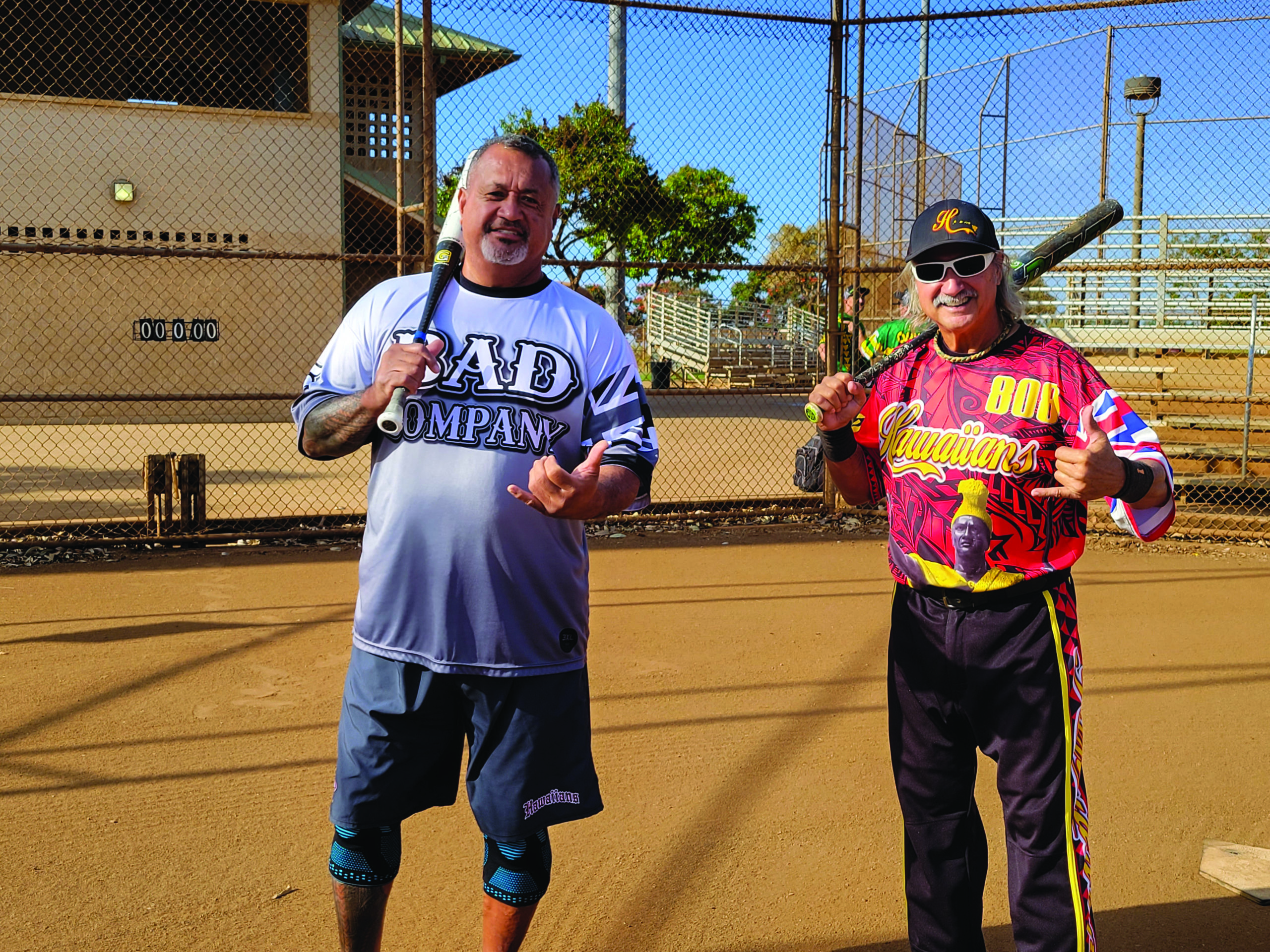
    Fetuosasae “Fetu” Sua, 64, and Randy Madeiros, 69, have played together on teams and leagues in the past. Now, Fetu is the catcher and outfielder for Bad Company and Randy is the captain and pitcher for the Hawaiians.

    “I play on a Friday league for 50-and-over players,” says Randy, who has been playing softball since age 20 and in the senior league for 11 years. “I also play on a Saturday league at Kapi‘olani, which is an 18-and-over league. I’m the old guy out there in that league. I also play in a co-ed league on Sunday in Kailua. I play a lot.”

    Fetuosasae “Fetu” Sua, 64, and Randy Madeiros, 69, are looking forward to the 46th Annual Hawai‘i State Senior Tournament. PC: Jeffery Kimoto
    Fetuosasae “Fetu” Sua (left), 64, and Randy Madeiros, 69, are looking forward to the 46th Annual Hawai‘i State Senior Tournament. PC: Jeffery Kimoto

    But the name of the slow-pitch softball league he enjoys on Wednesdays is the Makua Ali‘i Softball League. There are 22 teams in the league on O‘ahu that play all year long. Three other islands participate in the statewide league in addition to O‘ahu: Kaua‘i, Maui and the Big Island. Each island has its own competition. Winning teams  on each island meet up at the annual tournament.

    Players must be 60 and over to participate in the league. Age brackets are 60 to 65, 65 to 70 and 70-plus. The older you are, the more age brackets you can play in. If you are a very competitive senior, you can play in a younger age group. But the younger players can’t play in an older age group.

    Each team is also allowed one 55 to 59 year old on the field. “The young whippersnappers want to hit it out of the ballpark — but consistency is the key,” says Randy, who was 58 when he joined the league as the “young guy.”

    “A player 55 to 59 years old is considered to be a young puppy,” says Randy. “There are many 70 and over players. We have a few players in their 80s. A retired fireman on the Firehouse team is still in the league at 87. Valued senior players are consistent and maybe place the ball over the second or third baseman’s head instead of trying to hit out of the park… just out of his reach.”

    “There are guys over 70 who will play on the 60 to 65 team because they are competitive,” says Fetu. “They may be 72 but they hit like they are 67,” Fetu laughs. “But age takes its toll after a while.” Fetu is in his third year in the Makua Ali‘i Senior Softball League.

    The Competition

    “The Makua Ali‘i Softball League can be a real competitive league,” says Fetu. “Although I want to compete at the highest level, I also want to have fun. And anyway, any team on any given day can be the worst or can be the best. It depends on who shows up to play. As for me, I get good respect when I step into the batter’s box. I am a pretty big individual.”

    “We’re not getting paid for this… it’s about bragging rights,” Fetu adds. “You are really lucky if you get a trophy, too.”

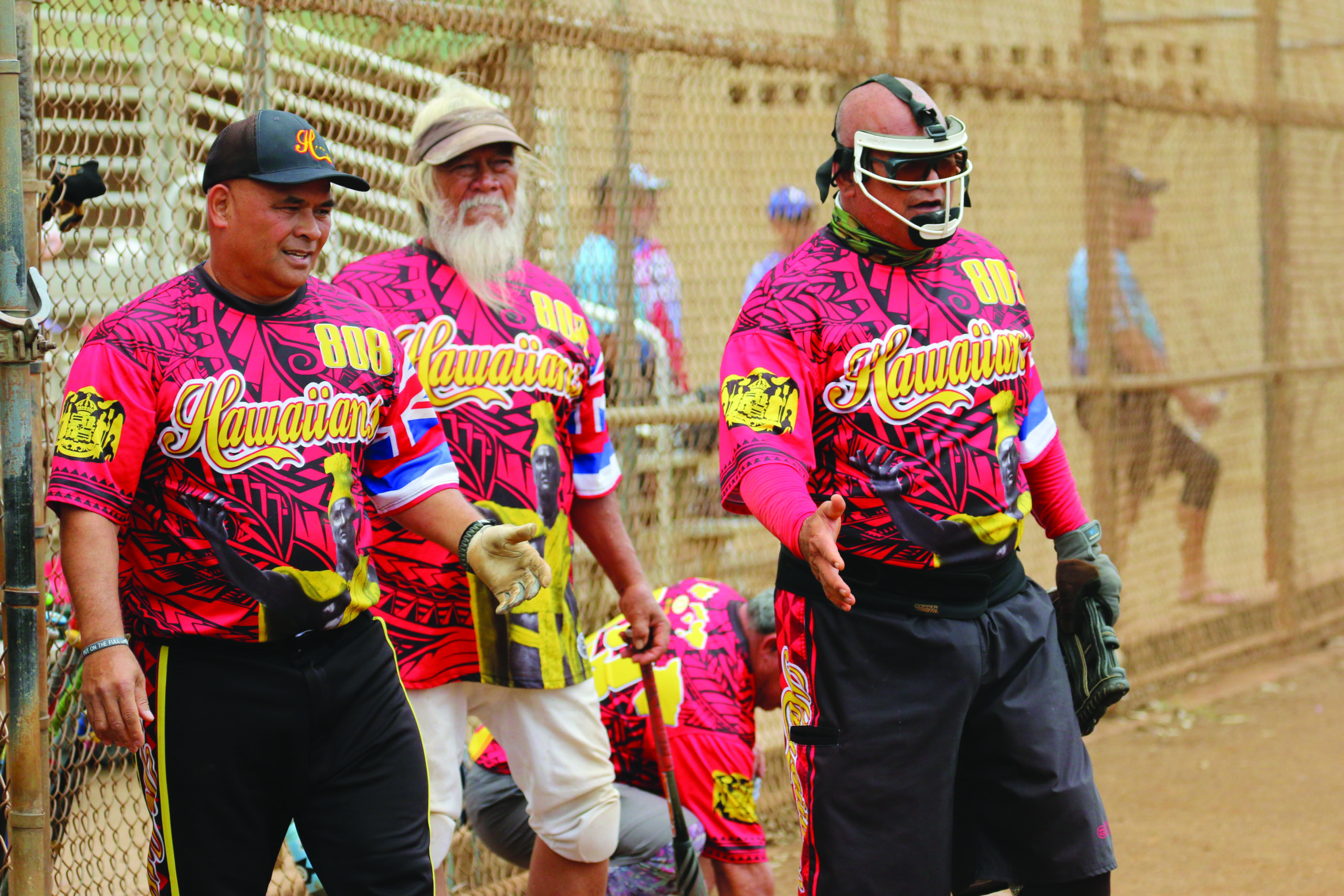
    Hawaiian team members include (L–R) Jacob Thomas, 59, shortstop; Warren Ho‘ohuli, second base/catcher; and John Iokia, 68, first base/third base. PC: Jeffery Kimoto
    Hawaiian team members include (L–R) Jacob Thomas, 59, shortstop; Warren Ho‘ohuli, second base/catcher; and John Iokia, 68, first base/third base. PC: Jeffery Kimoto

    ‘Ohana & Exercise

    “After a game, we talk about the game… the best hit you had, how fast you ran, great catches,” says Fetu. “The next thing you know, we are having a barbecue and a few beers and talking story until midnight.”

    “At this age, instead of sitting around in a rocking chair, it is really good exercise,” says Fetu. “We may not run as fast but we do try to run.”

    “The brotherhood of softball definitely requires some physical activity!” adds Randy. “At our ages, that’s a good thing.”

    For Love of the Game

    The competition level within each team depends on the team’s philosophy.

    “But the bottom line is, it’s all for fun,” says Randy. “When we unite together and play the game we love, it’s awesome! I look forward to Wednesdays. Yes, it’s mainly a fun thing, but then again, we don’t show up on Wednesdays to lose! We have fun and we try to win. I look forward to participating every week and being part of the brotherhood of softball — players my age — and having a fun time.”

    “Competing is important, but so is just having  fun,” says Fetu. “We just want to go out there and have a good game. We may win or lose, but we wish everybody the best — for nobody to get hurt and go home safely to their families.”

    The statewide tournament will be held Tuesday through Friday, Aug. 2 to 5, at CORP on O‘ahu. More than 60 teams may be participating.

    How to Get On a Team

    There are no tryouts for the Makua Ali‘i Softball League. If you fit the age requirement, let the individual team know you have been watching and let them know you want to play ball.


    SENIOR SOFTBALL USA HAWAI‘I
    Jeffrey Kimoto, Director
    808-212-5953 | JeffreyKimoto@gmail.com
    www.oahuseniorsoftball.org
    https://oahuseniorsoftball.org/docs/schedule.pdf
    * The C&C of Honolulu is starting a 60+ senior league on Thursdays.

    Seniors take their sports seriously, but with perspective gained over years of competition, the element of fun has become paramount for most players. Although they have a passion for playing, winning isn’t everything. Camaraderie, reunion and ‘ohana, fitness and fun are the most important elements of a senior’s game plan.

  • Clean Your Closet Like There’s No Tomorrow

    A happy senior couple moving boxes into or out of the back of their car. They are moving house, perhaps downsizing. They are looking at the camera, smiling.It’s shocking! How did I accumulate all this stuff? An embarrassment of riches may be a first-world problem — having too much of too many good things — but it is a reality for many of us, even those who don’t qualify as full-fledged hoarders. But even simple clutter has its own risks; for starters, the chronic and repeated stress caused by frantic and frustrated searching, and the risk of falling over precious possessions left in precarious places. In addition, clutter is distracting, saps time and energy, diminishes productivity and steals attention from more worthy endeavors. Overabundance can suck the pleasure right out of all this privilege.

    The reasons why we clutter are numerous, some rooted deep in the limbic system of the brain. What would happen if we ran out? And who hasn’t indulged in retail therapy to offset a bad day? It’s actually kind of patriotic to support our economy, right? Another good rationale is holding onto the past. Out of guilt or sentiment, you can collect trunks of useless gifts, for example. And if you don’t have a use for them, chances are very good that no one else will, either. But I think that if I dispose of something, I will need it, so there it sits, collecting dust and causing guilt.

    Whatever the reason for our lifelong accumulation of treasures, sadly, the burden of clutter doesn’t even end when we die. If you have ever been left with a loved one’s home full of belonging, you may realize the impact that a cluttered home can have on others after we are gone. The process of disposing of an estate at an already stressful time can be costly and time-consuming.

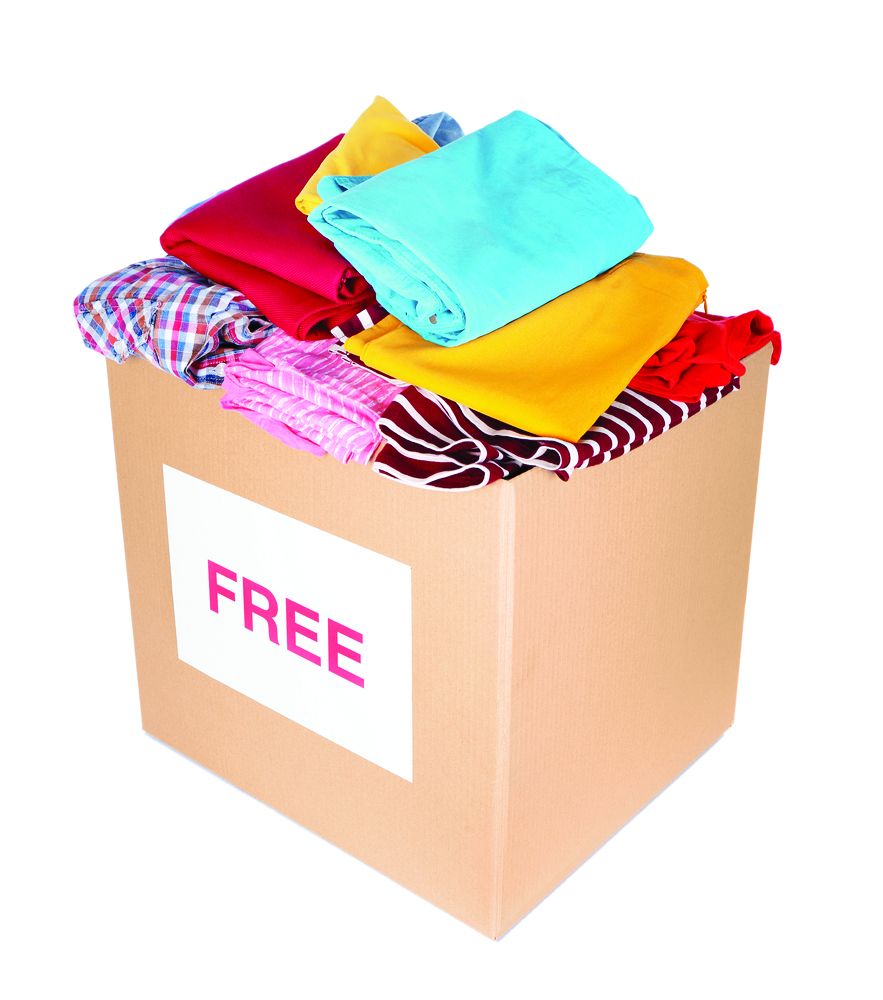
    Donation box with clothes isolated on whiteNo, Ingrid, you can’t take it with you.

    From the country that brought us an adult playground filled with budget-friendly, flat-packed DIY furniture comes a methodology that also exemplifies the sleek, stoic and sparse sensibilities of the Swedish lifestyle and hallmarks of Scandinavian minimalism.

    Döstädning (pronounced duo-stad-ning), or Swedish death cleaning, is a decluttering and organization method stemming from the Swedish words “dö” (death) and “städning,” (cleaning). As the name denotes, death cleaning is designed to help its practitioners prepare for death. But it isn’t as morbid as it sounds. It is simply a way to make the downsizing process efficient and uplifting rather than overwhelming and depressing.

    Döstädning is not about everyday dusting or mopping — it is about a permanent state of organization that makes your everyday life run more smoothly in the present, with an eye toward the future. The practical and pragmatic exercise involves getting rid of all the stuff you don’t need anymore so that no one else will be burdened with the task after you are gone. As it has often been described, it is meant to help you “clean your closet like there’s no tomorrow.”

    And no, you don’t have to be Swedish to do it. The task of clearing out unnecessary belongings can be undertaken at any stage of life. But the goal is to do it well before others must do it for you… Unburdened by baggage (emotional and actual), you may find yourself less stressed and more focused once you’re living in a clean,  organized space.

    So let go of what doesn’t matter. Dig deeper into what is important. By “cleaning up your act,” you will be doing yourself a favor as well as those who will survive you. And getting rid of items  can serve as a reminder that things don’t last forever, including us.

    A large cardboard box filled with Yard Sale or Tag Sale items to be sold at a discount in order to make room and make some money at the same time. Yard Sales are an important part of our economyHow Do You Start the Cleanse?

    There have been many recent books written on the subject. Just search the internet for “Swedish death cleaning” and you will come upon many books that capture this bit of Scandinavian wisdom, encouraging readers to embrace minimalism, put things in order and possibly even broach sensitive conversations. Some of them have step-by-step instructions in addition to a description of the philosophy behind the methodology. If you want to get going immediately, here is a starter from “The Gentle Art of Swedish Death Cleaning.” and “Swedish Death Cleaning: A Beginner’s Guide (with Tips & Things to Know).”

    Approach the project with this in mind: Which items will be of any value to others after you die?

    STEP 1: Once you have evaluated your intent and mindset, begin the process. Reach out to friends and family and gently inform them of what you are doing, assuring them that you are simply decluttering your home. Explain the philosophy behind this method — that this cleaning strategy is ultimately about decreasing their stress. Discuss which belongings they would be interested in preserving. Affirm that your feelings will not be hurt if they do not want a particular item.

    STEP 2: Deal with items with high sentimental value last as to avoid getting lost in reminiscence. Put these aside for later. Start with items that you cannot see — belongings stored in attics, closets and drawers that are generally of little sentimental value and easier to part with. Move on to bigger items, such as furniture, collectibles and books. Donate or sell everything that your friends and family members do not want.

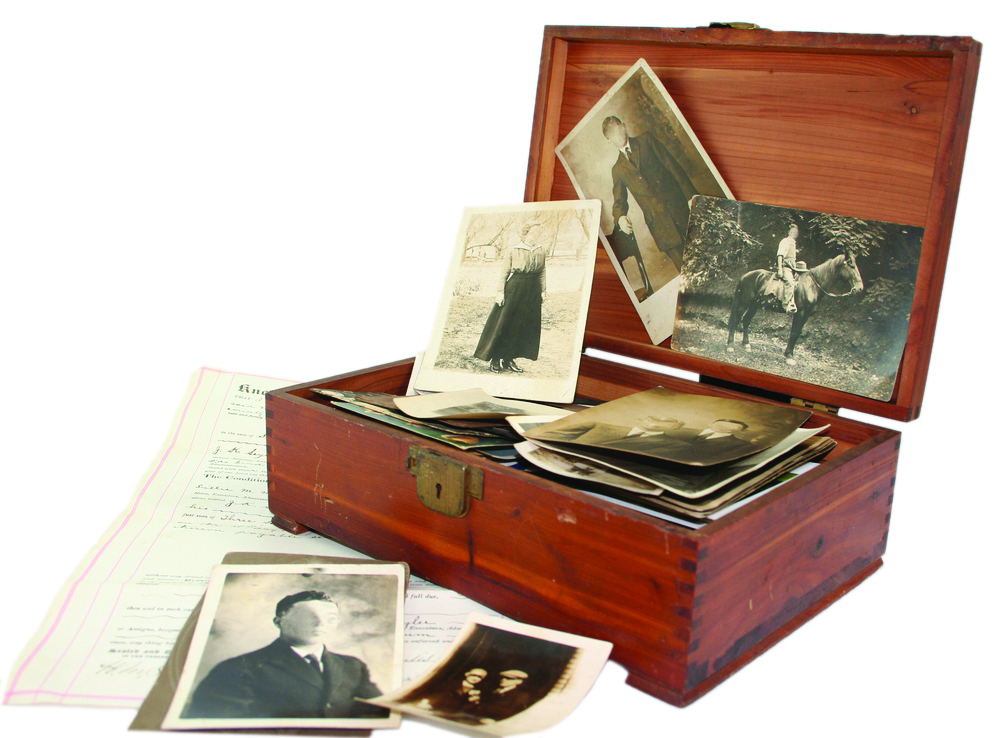
    photo of a Box of memoriesSTEP 3: Next, organize your closets, clothes and shoes. Now is the time to get rid of all the things you have been holding on to “just in case.” The rule is, if you have not worn it within the last year, donate or sell it. Just like other possessions, if a certain clothing item has sentimental value to you, ask a loved one if it is something they would like to keep. If their answer is no, donate or sell it. Take comfort knowing that your favorite dress will “spark joy” for its new owner. Neatly organize your remaining clothes.

    STEP 4: Lastly, sort through sentimental items — photographs, heirlooms and letters. Again, discuss with loved ones which items they would like to keep; create a box for the rest. This box will contain those belongings  that are special to you but insignificant to others. Leave instructions stating what should be done with the box — even if that means throwing it away.

    Remember, if any of the items you are keeping have significant value, leave instructions for whoever will clear out your home. Remember, Swedish death cleaning is meant to be an invaluable gift that you can give your loved ones that simplifies their lives, as well as yours.


    It’s shocking! How did I accumulate all this stuff? An embarrassment of riches may be a first-world problem — having too much of too many good things — but it is a reality for many of us, even those who don’t qualify as full-fledged hoarders. But even simple clutter has its own risks; for starters,…