Category: Jan – Feb 2023

  • Manual vs. Electric Toothbrushes

    Couple of toothbrushesA healthy smile requires everyone to commit to three simple actions: Brush twice a day, floss daily and see your dentist twice a year. You may have also considered new technology to make your oral hygiene routine a little easier and more efficient. New models of electric toothbrushes have prompted consumers to consider upgrading their manual toothbrushes to spinning brush heads that sometimes come with Bluetooth capabilities. So, which is better, manual or electric?

    Studies show powered toothbrushes are slightly better at reducing plaque and gum disease. If cost isn’t a factor, electric toothbrushes are found to be safe and effective. They can also connect to your smartphone and track how well and long you brush. Manual toothbrushes are affordable, simple and your local grocer or convenience store may carry models with different brush handles that give you a better grip so you can reach all tooth surfaces.

    All brushes, manual or electric, can be effective for removing plaque if used correctly — for at least two minutes at each brushing. All brushes will have to be replaced every three to four months. Choose a toothbrush that you like and will use properly with a fluoride toothpaste. Don’t forget to floss daily and see your dentist for an exam and cleaning twice a year so you can live well and smile more.


    HAWAII DENTAL SERVICE (501(c) 4 nonprofit)
    Mark Sweet, DDS, Dental Director
    808-521-1431 | mark.sweet@hawaiidentalservice.com
    www.HawaiiDentalService.com

    A healthy smile requires everyone to commit to three simple actions: Brush twice a day, floss daily and see your dentist twice a year. You may have also considered new technology to make your oral hygiene routine a little easier and more efficient. So, which is better, manual or electric?

  • Self-Renewal Tips for Caregivers

    Caregivers are some of the most selfless people you will find, constantly putting the needs of others before their own. In Hawai‘i, over 65,000 people are family  caregivers for almost 30,000 loved ones living with Alzheimer’s or another dementia. In my seven years of experience working with family caregivers, I’ve seen caregivers who make many sacrifices, sometimes neglecting their own health and often postponing vacations for years. If this is you, it’s time to focus on self-renewal.

    Go back in time

    What types of things did you like to do when ou had more free time? What did you enjoy in your youth? Make a list of three things that you absolutely love and turn these things into activities. For example, acknowledge your love for dogs, then plan an activity that engages a favorite furry friend. If you love music, make plans to see your favorite performer in concert.

    It is important not to get stuck in feelings of guilt for taking this needed time away from caregiving. Schedule activities from your “absolutely love” list into your calendar ambitiously this year.

    Branch out to avoid burnout

    Isolation and caregiving go hand in hand. When people are getting close to burnout level, they may distance themselves from friends, family and social activities. But the best thing you can do for the person you are caring for is stay physically and emotionally strong.

    Burnout stems from the decrease in self-care. It entails more than maintaining physical health; emotional support is an important part of self-care. Have you ever considered meeting fellow caregivers and talking story? Support groups offer comfort and reassurance, and can be a great source of practical advice. The  Alzheimer’s Association Hawai‘i Chapter offers free support groups for family caregivers every month. The groups are filled with wisdom, tears and even humor. To find a caregiver support group in your neighborhood call the Alzheimer’s Association 24/7 Helpline at 800-272-3900.

    Examine your coping strategies

    Make a list of the positive things you do to relieve stress. Turn those into activities and add them to your coping list. Do what is realistic for everyday life.

    Restore your energy

    This year, focus on ways to recharge yourself, even if that means simply starting with two minutes a day just for you to breathe. Give yourself more energy by giving yourself more time.

    What do you need to feel healthier or stronger? Eat well and exercise regularly to increase energy levels. Slow it down. Multitasking is part of the caregiving cycle, but try to limit multitasking in order to be more mindful. Consider building a relaxing sleep routine and finding ways to clear your mind before bedtime.

    Talk to someone

    If you are waking up tired each morning, it may be time to talk to someone. Caregiver depression has been called a silent health crisis. Between 40 and 60 percent of caregivers experience depression. This can happen to anyone who puts their own physical and emotional needs on the back burner for an extended amount of time.

    Depression affects individuals in different ways and at different times. For example, some may experience depression right after a loved one has been diagnosed with Alzheimer’s, while others may experience it as the disease progresses. There is no shame in depression. For more information, visit www.alz.org/help-support.

    For the caregivers reading this, know that you are invaluable, so promise to focus on your own vitality. Seek what will support your spirit and strengthen hope. Make 2023 your year.


    Support for Alzheimer’s disease or a related dementia:
    24/7 Helpline 800-272-3900 | 808-591-2771
    www.alz.org/Hawaii
    www.alz.org/help-support/i-have-alz/younger-onset
    Walk to End Alzheimer’s donations: act.alz.org/aloha

    Caregivers are some of the most selfless people you will find, constantly putting the needs of others before their own. In Hawai‘i, over 65,000 people are family  caregivers for almost 30,000 loved ones living with Alzheimer’s or another dementia. In my seven years of experience working with family caregivers, I’ve seen caregivers who make many…

  • Benefit of Live Music in Nursing Homes

    a hawaiian band performs for a hula show at waikikiMuch more than just a time-filler, live music holds therapeutic benefits for nursing home residents. According to a 2016 study, live music has been shown to reduce cortisol levels in the body, allowing for a stronger immune system, reduction in depression, better memory and many other benefits. It’s no wonder that nursing homes schedule in a healthy dose of live music!

    Music also has the power to unlock positive emotions and memories. And attending performances with others creates a space for building relationships. The low physical and cognitive requirements allow for a range of abilities to enjoy this shared experience.

    Even those in a later stage of dementia can benefit from this sensory stimulation. Hearing music that evokes memories can help a resident reflect on their life and feel a stronger sense of meaning, as well as make them feel connected to the community outside of the nursing home walls. This in turn can contribute to a stronger sense of self and a positive outlook. Additionally, the musical performances are a diversion from the day-to-day activities, keeping life interesting and providing fresh experiences for our kūpuna.


    MANOA COTTAGE KAIMUKI
    748 Olokele Ave., Honolulu, HI 96816
    808-800-4089 | info@manoacottage.com
    www.manoacottage.com

    Much more than just a time-filler, live music holds therapeutic benefits for nursing home residents. According to a 2016 study, live music has been shown to reduce cortisol levels in the body, allowing for a stronger immune system, reduction in depression, better memory and many other benefits. It’s no wonder that nursing homes schedule in…

  • The Gift of Caring for Others

    Those of us in the home healthcare business have the opportunity to witness and share amazing stories of families in need each and every day. These stories come from the connections and meaningful moments between care providers and those they care for.

    By allowing an agency caregiver into a home in crisis, family members are often able to learn new caregiving methods and skills. But as hired caregivers become part of the family, they in turn have the opportunity to learn from their clients — how to live, and sometimes, how to love.

    Home healthcare supervisors and schedulers working behind the scenes enable these situations to become daily experiences. Hearing about the successes, the accomplishments, the new diagnosis and the struggles our families go through allows us to share in these moments, giving the professional caregiver the gift of experience and emotional growth.

    Watching others go through life-changing events becomes an event in our own lives. By listening and understanding, we can share in these deep moments of  exchange.

    Providing care to families and their loved ones also enables us to acknowledge the gift of giving of ourselves. We are frequently filled with concerns about our families:

    Will she survive this bout of pneumonia?
    How will he make it home after his hip surgery?
    Is she getting enough to eat?
    How can we make a difference?

    Some caregivers break down and cry when a client must move into another situation that may be more suitable for their care needs.

    “My best self comes out when I realize how everything from subtle influences to helping educate family members can end up saving their lives in some way,” said Margie Esprecion, RN. “Catching the signs and symptoms of an illness, or convincing a 90-year-old to visit their doctor, or noticing the need for an emergency intervention makes me feel like I made a difference.”

    We have seen caregivers recognized by family members and clients as angels. The gratitude shown by the family encourages caregivers to keep learning and providing the best care they are capable of. They write words of appreciation — “compassionate, thoughtful, considerate, intuitive, attentive, comforting, respectful” — bringing us joy and satisfaction, recognizing our efforts, and supporting and encouraging the client-caregiver relationship, and acknowledging our purpose:

    To provide nurturing moments for the one who cares and the one who needs the care.

    Sometimes we must just pause and appreciate everyone who has taught us how to become better human beings.

    This is the gift of caring for others.


    ATTENTION PLUS CARE HOME HEALTHCARE
    Accredited by The Joint Commission
    1580 Makaloa St., Ste. 1060, Honolulu HI 96814
    808-739-2811 | www.attentionplus.com
    AGING IN HAWAII EDUCATIONAL OUTREACH PROGRAM by Attention Plus Care — a program providing resources for seniors and their families, covering different aging topics each month. For class information and upcoming topics, call 808-440-9356.

    Those of us in the home healthcare business have the opportunity to witness and share amazing stories of families in need each and every day. These stories come from the connections and meaningful moments between care providers and those they care for.

  • Time Flies When You’re Having Fun

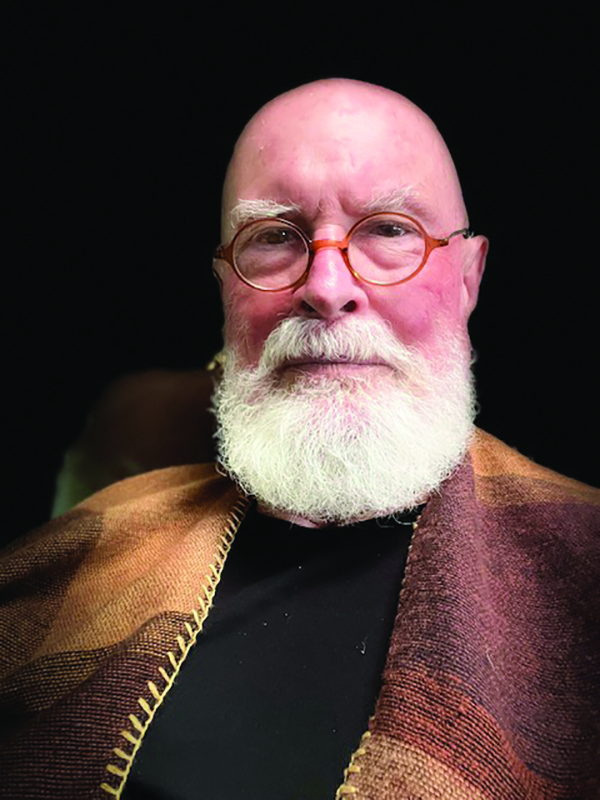
    photo of Frank B. Shaner
    Frank B. Shaner

    I’m turning 75 in a month. I’m ok with that. But then I think to myself, “Wait a minute! It was just 1965 a week ago! What the hell happened?” Smack dab in the middle of the 1960s, my innocence ended.

    I graduated from Kaimuki High School, experienced the Bay of Pigs, and the assassinations of JFK, Martin Luther King Jr. and Bobby Kennedy. The Vietnam conflict was still raging, Jimi Hendrix died of an overdose and there was “one small step for man, one giant leap for mankind.” I joined the Army and traveled overseas, then left the army and went to college. All this happened just moments ago — or so it seems. I’d never really looked back before now.

    My life has been a roller coaster ride. And it’s been one hell of a trip, hanging on to this rocket, gripping this monster with my arms and legs wrapped around this force of nature, and having the time of my life. Yes, there have been rough patches, but I’ve always found myself surfacing on the other side, arising to embrace a new day and tackling the latest challenge.

    I like to think of myself as a realist. I know we are all going to die and that 75 is actually not the new 50. Sorry to disappoint you. It ends up that 75 is really more like — wait for it — the old 74. What is also true is that time does fly by when you’re having fun. Sometimes I’m having so much fun in life (and this might be difficult to understand) that sometimes I won’t bathe, just so I can keep all the beautifulness of the day on me. Think about it: When you shower, you’re scrubbing the remains of the day off your body and watching it all go down the drain. The residue of those good moments does not have to go down the drain.

    So just to slow life down, I sometimes choose to be introspective and contemplative — in other words, miserable. You know, when you have those days and you think, “Damn, will this goofy day ever end?” But you actually need a couple of those days every once in awhile to stretch out time, so life won’t fly by so fast. Therefore, every now and then, I throw in one of those days, just to slow down the momentum.

    So there’s my simple philosophy at turning 75. Have the time of your life every day if you can. Bathing is optional after a good day. Decelerate time by throwing in an occasional rotten one. Don’t be afraid to have a downhearted day now and then.

    After almost seven-and-a-half decades of life, I’ll leave you with just a few more insights. Don’t be afraid to live well, no matter how old you are. Don’t let this time wormhole throw you for a loop. Appreciate it for its time-bending effects.

    The biggest mistake we make in life is thinking we have endless time, so just keep letting the good times roll until they can’t hele on no mo’.

    I like to think of myself as a realist. I know we are all going to die and that 75 is actually not the new 50. Sorry to disappoint you. It ends up that 75 is really more like — wait for it — the old 74. What is also true is that time does…

  • McDating: Romance Under Golden Arches

    (L–R, front) George, Venetia, (back) Millie,Jr. Lee, Siri, Annette (background) and Ann
enjoy cards and camaraderie each week at
George’s house.
    (L–R, front) George, Venetia, (back) Millie, Jr. Lee, Siri, Annette (background) and Ann enjoy cards and camaraderie each week at George’s house.

    Turns out, you just might find more than two all-beef patties, special sauce, lettuce, cheese, pickles, onions on a sesame seed bun at your local McDonald’s.

    Venetia Angel, 63, routinely visited her local McDonald’s in Pukalani on Maui. One evening, she approached a group of senior ladies who were playing cards. She noticed them there often. That evening, she asked what they were playing. Although she did not know the game called “books and straights,” they insisted she join them the next night. Before she knew it, she was meeting the group, aged from 60-something to 93, at McDonald’s for cards, camaraderie and coffee six nights a week, from 7 to 11 pm, when the fast food venue closed.

    And as it happens, a group of senior men (70 to to 90-plus) who regularly met at an adjacent convenience store migrated to McDonald’s around that same time, when the store downsized the number of booths it offered customers who liked to people-watch. Some went elsewhere, but several found a new roosting place under the Golden Arches. They just happened to seat themselves right next to the ladies’ table to drink their coffee and talk story. The ladies soon found themselves reserving that adjacent table for the gentlemen.

    “They weren’t part of our group, but they became part of our group,” says Venetia. “If we had a birthday to celebrate, we would make sure to bring enough cupcakes for the gentlemen.”

    Eventually, Venetia found herself calling to check on them if they didn’t show up or if their card game was cancelled. “I was just checking to see if they were ok,” says Venetia, named the “mother hen” of the group.

    The two groups soon became enmeshed, setting the stage for a budding senior love story.

    “This is how it started,” says Venetia. “A gentlemen who always seemed to position himself close to me heard I was going to go to Costco to have my tires changed. ‘What are you going to do while you’re waiting?’ Charley asked. ‘How about I pick you up and take you to lunch? I’m buying,’ he said.” Because her late husband, the love of her life, could never be replaced, she never even considered spending time with another man. “That last comment convinced me to take a chance,” Venetia says.

    When Charley, in his mid-70s, picked her up, he opened her door and even reaching across her to fasten her seatbelt. She was impressed with his old-school etiquette. But that ended when he reached across the lunch table and tried to hold her hand. “We’re not dating!” she said.

    Later, her asked her to spend his birthday with him. “Why don’t you go with your daughter instead?” said Venetia. “No, I want to go with you,” said the smitten senior. He let her pick the restaurant. Before they dined, they stopped at the hospital to visit one of the men’s group members. His daughters said, “Oh, you look so nice together! You look like you are ready for a fun date.” “We are not on a date!” Venetia again insisted. But to Charley, it was a date. He continued to hover over Venetia every chance he got.

    So when the McDonald’s ladies asked him to join in the card game, he sat right next to the target of his new-found affection, swinging his arm over the top of the bench behind Venetia. “So now you are a couple?” the ladies asked. “No, no, no,” Venetia responded reflexively. After noting some flirtatious behavior by two of the other senior ladies, Venetia said, “You know, Charley, I think you should ask one of the other ladies to go out with you.”

    He soon started dating Annette, who was in her late 60s. They found new love, comfort and companionship in each other in their golden years, spending every day together at her home, and sharing meals at McDonald’s or Sheik’s. They held hands as Charley pecked tender kisses on her cheek.

    But Annette’s Alzheimer’s was getting worse. The ladies’ group suggested that she move in with him or he move in with her “so he could watch out for her and so could we.”

    But eventually, she was moved into a care facility on O‘ahu.

    “Charley got real sad when his girlfriend moved away,” says Venetia.

    About a half-dozen members of the group who had met at McDonald’s for over a year before the pandemic, started cautiously and carefully meeting at George’s home in 2020. George was one of the men’s group members. “His son thought is would be perfect, so we could keep him company as we played cards, even though he doesn’t usually play.” Most of the time, five of them met at the 90-year-old’s home, masked and vaccinated, only one day a week, bringing food to share with the entire group, chipping in money for toilet paper and utility costs, and sharing information about current boosters.

    Heartbroken Charley stopped by, searching in vain for Annette. Although she may have forgotten him due to her dementia, Charley would never forget his Annette.

    “I ended up spending a lot of time with George,” says Venetia. “I have my own room in his home. I’m there almost all the time cooking, sweeping, sanitizing, and taking him to his appointments and surgery. I’m not his caregiver. We’re friends. We have each other.”

    If Venetia was asked, she would say they, too, are not dating. “We just all got to know each other just sitting at McDonald’s and talking. Now we are family.”


    Turns out, you just might find more than two all-beef patties, special sauce, lettuce, cheese, pickles, onions on a sesame seed bun at your local McDonald’s. Venetia Angel, 63, routinely visited her local McDonald’s in Pukalani on Maui. One evening, she approached a group of senior ladies who were playing cards. She noticed them there…

  • A Perfect Match Forged in Honesty

    An IBM executive from Croatia ranking high on the intellect scale meets a “spiritual hippy” from Hawai‘i ranking high on the intuitive scale — a feminist and natural caretaker, formerly a gourmet vegetarian caterer, hospice worker, midwife, organic farmer and house sitter.

    Do Opposites Attract?

    As it turns out, their bonds run very deep. Their commonalities are not merely superficial junctures because their initial interactions superseded the usual Dating 101 themes and banter.

    Rose Singarella and Mladen Karcic, both 53 when they met through an online dating site, did not wade in the shallows during their initial conversations, but plunged right into the deep end. Mladen’s mother was seriously ill; Rose was still recovering from the loss of her fiance. She had promised him that she would look for love again. So with pain still fresh from her own loss, Rose sought to help Mladen grapple with his mother’s illness and eventual death. It just doesn’t get any deeper than that.

    Leaving the Door Open

    “There wasn’t anything in particular that Mladen said in his profile,” Rose said. “It was simple, straightforward and just so real. More than anything he said, I just intuitively knew he was honest, genuine and had integrity. So I wrote to him, even though I was in Santa Fe and he lived in Virginia.”

    Rose had expanded her search from the Santa Fe area where she was housesitting to the entire US after several fruitless matches. “I was determined to meet my soulmate,” says Rose. “I just knew he was out there.”

    Mladen had confined his search to the Virginia-DC area, so when he got Rose’s inquiry from almost 2,000 miles away, he responded by saying he didn’t think a long-distance relationship was going to work. But he changed his mind the next day. He emailed her with an apology for being so curt, and said he was willing to explore.

    “I left the door open,” Mladen said. They emailed each other regularly for a few weeks. Shortly thereafter, he took his profile off the internet due to emerging priorities. “My mother is dying of cancer,” he told Rose, “and I need to drive up to New York every weekend to be with her.” Rose wrote him a long letter about grief, loss and dying, which struck a chord with Mladen.

    During the weekly five-hour drive each way, they talked via cell phone. “We were not talking about romance,” says Rose. Other than discussing that they both were seeking a long-term relationship, they did not talk about marriage or even dating. “We were talking about grief, loss, spirituality and the aging process,” says Rose. “I had a lot of compassion for what he was going through.” Their conversations formed a deep bond between the two.

    “I always say it was his dying mother who brought us together,” says Rose.

    They continued their remote conversations for the next three months, not yet meeting each other face to face. Shortly after his mother passed, Mladen emailed Rose: “I’ve got to get to Santa Fe as quick as I can to meet the angel who got me through one of the worst times of my life.” A few weeks later, they finally met.

    Pursuing the Possibilities

    They both decided to move forward with the relationship. Rose thought it was important to cultivate their relationship by seeing each other as often as possible, so they promised each other they would meet frequently, at least every two weeks, taking advantage of Mladen’s cross-country business trips for IBM.

    During their fourth or fifth date, Rose told Mladen, “‘I can’t imagine living without you.’ It was very clear to me that he was my life-mate. You know when you know. But Mladen thought I was a little bit nuts.” Although he was flattered, he was also shocked. It took him about a year to catch up to Rose’s level of commitment.

    They continued meeting at various locations across the country for about six months, when, during one of Mladen’s visits to Santa Fe, he said, “I’m not leaving without you.” So she packed her sparse worldly possessions in her car and they drove to Virginia together. They were married in 2012, eventually transitioning to Maui in July 2020. The fact that they were able to share such pain on that level so quickly is a testament to their willingness to honestly and courageously wade into tender and perilous territory — cutting to the core — cutting to the quick. The pressure did not crush, but rendered a diamond, resilient and beautiful, crystalizing into a deep relationship.

    A Fairytale Ending

    At age 66, it is clear today that the Kīhei couple are not opposites, but complementary companions — pieces of a puzzle that fit together perfectly in love and life — an impeccable matchup of talents and temperaments.

    “I feel so close to her, like she really understands me,” says Mladen. “We are really compatible. We both enjoy travel, culture and music. But more than that, she has taught me a lot and has brought a lot to the relationship. She is very nurturing. I feel very well taken care of.”

    Rose still feels the same way that she did the day of her blurted-out announcement so many years before. The secret to their success, she says, is honesty, truth and lack of pretense. Add to that, the bravery it takes to expose vulnerabilities.

    Be True to Yourself & Others

    Rose recommends that prospective dating site users be honest in their portrayal of themselves through both words and images in their profile — as much as individuals are able to have the personal insight to relay the truth about themselves. “Sometimes it is difficult to talk about yourself. But the worst thing you could do to yourself and a prospective match is lie. Don’t be tempted to include white lies in your profile about your age or even a few pounds. Do not be deceitful about past wives and existing children. Don’t take glamour photos. Be natural; be yourself. It becomes obvious when you meet the person if they lied on their profile.”

    She recommends having a trusted friend review your profile and photos before posting them. “Make sure the type of message you are sending is in line with what you are seeking, whether it is a long-term relationship or a fling.”

    Rose recommends that app users expand their search area as much as possible. “Chances are your soulmate may not live on the same island or even continent as you do. We would never have met if it wasn’t for Match.com, and we wouldn’t have ignited this relationship if I hadn’t expanded my search area and he hadn’t  reconsidered an initial long-distance relationship. And you must consider traveling and even moving. I don’t believe you can cultivate a relationship if you spend a lot of time apart.”

    Sharing the Love

    Rose and Mladen met Susan Schwartzkopf (see “Spreading Happiness One Chocolate at a Time,” pg. 14) when she responded to an ad they placed to sell their  furniture. Susan had just arrived on Maui that morning and moved into an unfurnished condo. Upon their meeting, Rose thought, “This girl is going to be my friend.” Rose is now in the process of helping Susan with her online dating profile. She also offered to review Susan’s preliminary picks for red flags.

    The internet is infested with scammers and posers ready to pounce on unsuspecting prey. This may be exponentially true for online dating sites. It even has its own name: Cat-phishing is an online romance scam and a form of fraud.

    “I learned a lot about online dating,” says Rose. “I want to protect her.”



    Rose Singarella and Mladen Karcic, both 53 when they met through an online dating site, did not wade in the shallows during their initial conversations, but plunged right into the deep end. Mladen’s mother was seriously ill; Rose was still recovering from the loss of her fiance. She had promised him that she would look…

  • Spreading Happiness One Chocolate at a Time

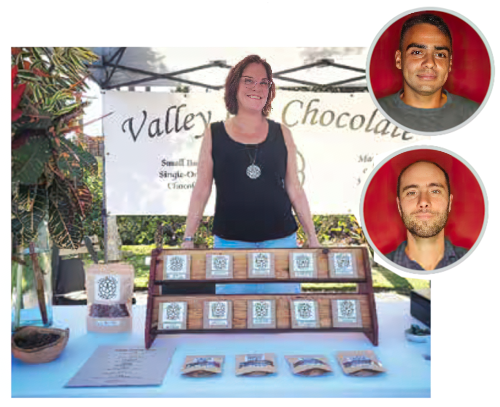
    Valley Isle Chocolates, a small family business on Maui, is beginning the New Year with a new kitchen space, new equipment, new packaging and new ideas for the future. Now, they are very busy making chocolates, developing recipes and selling their wares at many farmers markets and local brick-and-mortar stores. At the end of last year, Susan Schwartzkopf “and sons” moved production from their certified home kitchen to a commercial kitchen space in Kahului.

    “It’s really taken off very quickly,” says Susan, “and we’ve grown very quickly, as well.”

    Susan’s son, Samual, had been coming to Maui regularly, farming with friends here. He wanted to live here permanently, so he bought almost eight acres in Ha¯na that he and his best friend, Sam Phillips, have planted with turmeric, citrus, bananas, lilikoi and pineapple. They are now preparing the land for a cacao orchard,  clearing it and planting a panax windbreak. Samual and Sam, who are now in their mid-30s, have known each other since high school.

    “Sam is like my second son,” says Susan. “I call them ‘my Sams.’” Susan moved to Ki¯hei almost two years ago to join them in their new venture. Her mother had just passed away from a long chronic illness, giving Susan the freedom to pursue new interests and adventures. Because her decision to move to Maui coincided with the height of the pandemic, she rented an apartment sight unseen. “I had never been here before. It was quite a leap.”

    Samual is also an experienced chef and restaurant manager. He also took over a catering business and had opened a restaurant in Vermont, unfortunately, just before the peak of the pandemic, ending that endeavor but leading him to another. These serendipitous events sparked his permanent move to Maui. “We came up with the idea of cacao because we wanted to be good stewards of the land on Maui, and contribute to the economy and culture,” says Susan. “So we started studying and learning everything we could about cacao and chocolate. As we learned more, our ideas began to grow.”

    In 2021 they produced their first chocolate products, giving them away to friends and family — their built-in taste testers and unofficial quality controllers. Next, they bought their own roaster, a key to making perfect chocolate. They went on to tweak and perfect their recipes until they were market-ready just a few months later, starting in Kīhei.

    Until their orchard produces cacao beans, they have been getting their ethically sourced, raw cacao beans from small farms around the world, including from the Kona area. Currently, there are growers in Hāna and Lahaina, as well, but Susan and the Sams are looking forward to using their own home-grown Maui beans in the future. For now, they are producing organic, small batch, single-origin chocolates from beans they import from small farms in Madagascar, Trinidad, Ecuador,
    Panama, Tanzania and Indonesia.

    The three chocolatiers began by experimenting with recipes, but basically, all of their products use three ingredients — roasted cacao, coco butter (also from the bean) and organic cane sugar. Variations include recipes with Hawai‘i sea salt or Maui macadamia nuts.

    The co-owners and roommates “all do everything.” They use their new malanger, which grinds the cocoa bean nibs, and a tempering machine. They use their own recipes to make their special chocolates, temper it themselves, pour it into molds and then package everything — products and samples — by hand. Preprinted labels have made the process a bit quicker. Previously, Susan would hand-write the type of chocolate on the labels. Their 100 percent hands-on efforts — with the Sams doing the heavy lifting at the farm and chocolate production, and Susan taking care of finance, business and marketing end — are propelling this enterprise forward. As well as a wide range of chocolate products, they have also begun selling a few new products — cacao shell tea, roasted whole beans and cacao nibs; simply, broken up cocoa beans. They’re basically chocolate in it’s purest form.

    Dark chocolate increases “good” HDL cholesterol, which can help lower the risk of heart attack and stroke. Cacao contains healthy fats and other compounds that have been attributed with increasing the levels of the hormones serotonin and dopamine in your brain, which impacts your mood. A chef in Lahaina has even requested the roasted nibs as a palette cleanser or amuse-bouche for her restaurant clientele. “Of course, they are not sweet,” says Susan. “It is a taste that people really either like or aren’t so crazy about.”

    As for the future — it looks sweet. Although the three chocolatiers “can’t make their products fast enough,” they are developing plans for expansion, continuing to experiment and are looking into other products, such as specialized holiday chocolates, including for Valentine’ Day. They have a part-time employee as well, but foresee the need for more help in the near future.

    “It is a beautiful plant and product, and a beautiful thing to do — growing on Maui and producing something that so many people love,” says Susan. “There is no such thing as too much chocolate. The more chocolate the better!”


    VALLEY ISLE CHOCOLATE — Maui
    Susan Schwartzkopf, Co-Owner
    802-451-6964 | valleyislechocolate@gmail.com
    www.valleyislechocolate.com
    Visit the website for store and farmers market locations.

    Valley Isle Chocolates, a small family business on Maui, is beginning the New Year with a new kitchen space, new equipment, new packaging and new ideas for the future. Now, they are very busy making chocolates, developing recipes and selling their wares at many farmers markets and local brick-and-mortar stores. At the end of last…

  • How to Downsize the Right Way

    Downsizing sounds like a great idea… until  you begin to wrap your head around the massive task of moving. The thought of leaving a longtime home, with all of its associations — the height chart on the laundry room doorframe, the grave of a beloved pet — can be heart-wrenching. Add to that the cost of moving and the burden of offloading half (or more) of your possessions, and the project can quickly overwhelm even the most capable older adult.

    The best way to tackle downsizing, according to the experts, is by breaking the process down into smaller, more manageable bits that you can accomplish in a matter of hours or days. Professional organizer Susan Santoro recommends taking photos of your home before you dig into decluttering.

    “These photos will help you if you have any moments of regret over items you’ve let go,” says Susan. “You should also take photos of each item that is special to you that you will be letting go.”

    Then, start with drawers that hold unsentimental items, such as leftover electronics, and go from there. Set a time limit and a goal for the number of spaces to go through each day.

    Divide Into Piles

    There are many ways to tackle cleaning out your home, from the KonMari (https://konmari.com) method of keeping only that which sparks joy, to Project 333 (https://bemorewithless.com/project-333) which advocates keeping only 33 pieces of clothing and accessories. One trick that works for most people is to completely empty the drawer, closet, box or whatever space you’re working on and divide items into three piles.

     The keep pile is for items you are sure you want to hold on to.
     The donate pile is for things that have useful life left, but that you don’t need anymore.
     The trash pile is for possessions that, upon reflection, no one will find value in. You can make a separate pile for trash items with sensitive information that need to go through a shredder before getting discarded.

    Kids Don’t Want It All

    Don’t make the mistake of keeping numerous items for children or grandchildren without asking them.

    “Talk with children and family to determine what items they would like to keep and what they are not interested in,” suggests Susan. “This information will make it easier for you to make decisions.”

    Because younger generations are more interested in experiences than stuff, “understand that your children may want very few items, regardless of how special those items are to you,” says Susan. Sadly, it’s unlikely anyone wants your china. Instead, check out ideas online (search for “family china nobody wants”).

    Do not criticize their choices or try to shove extra items their way. Instead, think of the joy your “unwanted” items will give someone who runs across them on eBay or in a thrift shop. If you think you have a friend who would love to get your unclaimed juicer, make sure that they don’t feel obligated to accept your gift.

    That being said, offer to keep items available only until a certain date. If someone really wants it, they’ll find a way. Mark the offer on your calendar and toss or donate the items that have not been picked up by the “expiration date.”

    Paperwork

    Photos can be kept as is or filed electronically. If the task seems mind boggling, hire someone to digitize them for you. Go through them first and keep only the best of those with recognizable people and places.

    You only need to keep the last seven years of tax returns. Prior iterations should be shredded and used as packing material or recycled. Check with your attorney or accountant regarding other documents. Business documents and agreements belong in a safe or safe deposit box, with digital copies on your computer.

    Furniture

    Measure your new space and make sure your existing furniture will fit. You’d be surprised how many people fail to do this and find themselves with a moving van full of unworkable couches and tables! Instead find a furniture layout app (https://niblockhomes.com/top-5-furniture-layout-apps) to use. If you still have the big, bulky pieces popular a decade or two ago, consider donating them and getting sleek new pieces for your new place.

    We all tend to hang on to things that are imbued with sentimental value. If a spouse has passed away, most of us will want to keep the old bed and their favorite chair. We look at the dining room set and think of all the meals served there as the kids grew up.

    Downsizing is a good time to take a photo of these relics for memory’s sake and switch to items that will be a better fit in your new life. It’s not disrespectful, it’s simply moving on to the next phase of life that will be here whether you spend it sleeping in a king-size bed or a double.

    Sell It

    You may be able to sell unwanted items, but make sure not to become so involved in making a small amount of money that your move is delayed. Some people hold a garage sale and make everything free on the last day. You can advertise multiple items on Craigslist and then make them all available on one day, at one time to save yourself a lot of hassle. You can even choose to use eBay or Facebook Marketplace, but be aware it can be a time-intensive process unless you are willing to take offers. Perhaps you have a family member who will post items for you in exchange for a cut of the profits. If you have very valuable items, you can contact an estate liquidator or even a museum.

    Get rid of bulk items. You do not need to bring a huge pack of batteries or toilet paper from Costco. Tell your inner frugal-Meister to take a deep breath and learn to walk past the bulk sales aisle, as much as it may hurt at first.

    Hire Help

    Downsizing can take months or years in some homes. Start as early as you can, but know that sometimes getting help with the task is the smartest way to go. The National Association of Productivity & Organizing Professionals (www.napo.net) is a good place to find someone who organizes for a living and will be able to help with everything from your emotional well-being to how to post that paisley chair on Craigslist.

    A professional organizer can be used just to get you started or as a stalwart partner for the whole process. These are not cleaners; they are not there to do your windows. Organizing pros can help you make those tough decisions, whisk away items that are bound for the dump and tell you funny stories about other clients they’ve had to keep your spirits up while you both work. They can also search a book collection for old stock certificates that may have been hidden between pages (true story!) and they’ll know where to get grandpa’s stamp collection valued.

    Whether you’re planning a move or not, there is no time like today to pare down your possessions. Consider it a gift to your heirs, who will otherwise have to go through everything themselves eventually.

    You may find that you begin to feel a weight come off your shoulders as possessions leave and your home becomes more spacious and airy. You may even begin to think of new projects you’d like to tackle as you master downsizing!


    SCSA (Society of Certified Senior Advisors)
    The SCSA educates and supports specialists in aging dedicated to improving lives of older adults.
    1-800-653-1875 | www.csa.us

    Downsizing sounds like a great idea… until  you begin to wrap your head around the massive task of moving. The thought of leaving a longtime home, with all of its associations — the height chart on the laundry room doorframe, the grave of a beloved pet — can be heart-wrenching. Add to that the cost…

  • Kupuna Collective Meets with Sen. Hirono

    (L–R) Christy Nishita, Ph.D., UH Center on Aging; JennyLee, UH Center on Aging; Sen. Mazie Hirono; Derrick Ariyoshi, Elderly Affairs Division; Kathy Wyatt, Hale Hauoli Adult Day Care; Michelle Cordero-Lee, Hawaii Meals on Wheels; En Young, Pacific Gateway Center.
    (L–R) Christy Nishita, Ph.D., UH Center on Aging; Jenny Lee, UH Center on Aging; Sen. Mazie Hirono; Derrick Ariyoshi, Elderly Affairs Division; Kathy Wyatt, Hale Hauoli Adult Day Care; Michelle Cordero-Lee, Hawaii Meals on Wheels; En Young, Pacific Gateway Center.

    Sen. Mazie K. Hirono met with the Kūpuna Collective, a network of support organizations that focus on maximizing the health, independence and engagement of Hawai‘i’s older adults, for a roundtable conversation about supporting seniors in Hawai‘i in early October 2022.

    During the roundtable, Sen. Hirono discussed issues including food security, senior care workforce shortages and the recently-passed Inflation Reduction Act (IRA), which will lower healthcare costs for the nearly 280,000 seniors in Hawai‘i who get their healthcare through Medicare.

    “The Kūpuna Collective came together at the start of the pandemic to meet the needs of our kūpuna in Hawai‘i who weren’t able to take advantage of mass food distributions and vaccine initiatives,” said Sen. Hirono. “The collective was able to identify gaps in services and respond quickly by leveraging resources and justifying their needs to donors through careful data collection and analysis. When seniors across our state were struggling to afford food, this group came together to help make sure they had enough to eat, and it has continued working to support our seniors with access to vaccines, daily meals to meet their medical needs, digital resources, and more. Our community owes the Kūpuna Collective a debt of gratitude. With the recently-passed Inflation Reduction Act, we’re also meeting the needs of our seniors by lowering the cost of healthcare and prescription drugs, and making sure seniors on Medicare can get the vaccines they need free of cost, thanks to a provision I authored.”

    The discussion included En Young, executive director at Pacific Gateway Center; Derrick Ariyoshi, executive for the Elderly Affairs Division with the City and County of Honolulu; Lindsey Ilagan, Hawaii Public Health Institute Kūpuna Program manager and co-convener of the Kūpuna Collective; Christy Nishita, interim director of the UH at Mānoa Center on Aging and co-coordinator of the Kūpuna Collective; Michelle Cordero-Lee, Lanakila Pacific Meals on Wheels Program CEO; and Kathy Wyatt, Hale Hauoli Adult Day Care owner and director.


    UH CENTER ON AGING
    cnishita@hawaii.edu
    www.hawaii.edu/aging | www.hiphi.org/kupuna

    Sen. Mazie K. Hirono met with the Kupuna Collective, a network of support organizations that focus on maximizing the health, independence and engagement of Hawai‘i’s older adults, for a roundtable conversation about supporting seniors in Hawai‘i in early October 2022.

  • Social Security Benefits Increase in 2023

    Senior couple are enjoying a dance in the living room of their home.The 8.7 percent cost-of-living adjustment (COLA) will begin with benefits payable to more than 65 million Social Security (SS) beneficiaries in January 2023. Increased payments to more than 7 million Supplemental Social Security (SSI) beneficiaries will begin on Dec. 30, 2022.

    The purpose of COLA is to ensure that the purchasing power of SS and SSI benefits is not eroded by inflation. The increase is aimed at helping to cover the rising cost of food, housing, healthcare and other essentials, otherwise known as inflation. Rising prices on a variety of goods and services have lifted inflation to its highest level in 40 years. The consumer price index for September shows prices rose 8.2 percent over the last year, despite the Federal Reserve’s efforts to stabilize costs by hiking interest rates. Every month in 2022, inflation far exceeded the 5.9 percent cost-of-living (COLA) increase that was set at the end of 2021, meaning that 2021’s COLA did not meet current economic strains.

    Will this newest cost-of-living adjustment (COLA) be enough to make a significant difference for SS and SSI recipients? What problems might they still face?

    Dollars & Cents

    • The average retired person will see an increase of about $140 per month. The average monthly payment to a retired beneficiary will be $1,827.
    • The maximum amount of earnings subject to the Social Security tax (taxable maximum) will increase to $160,200.
    • The earnings limit for workers who are younger than “full” retirement age will increase to $21,240. (SSA deducts $1 from benefits for each $2 earned over $21,240.)
    • The earnings limit for people reaching their “full” retirement age in 2023 will increase to $56,520. (SSA deduct $1 from benefits for each $3 earned over $56,520 until the month the worker turns “full” retirement age.)
    • There is no limit on earnings for workers who are “full” retirement age or older for the entire year.
    • Although the vast majority of recipients are retired, around 3 million children also receive SS payments, as well as people with disabilities and those who have lost spouses.

    Another important change affecting seniors in 2023 is the decrease in Medicare Part B premiums. For SS beneficiaries receiving Medicare, their new higher 2023 benefit amount was available in December through the mailed COLA notice and in their my Social Security’s Message Center. The combination of a SS benefit increase and a Medicare payment decrease is a first. If people were expecting their Medicare premiums to gobble up a substantial portion of their COLA, the good news is, that won’t be the case in 2023.

    The Bottom Line

    Because older people are more likely to spend money than save it, they may actually help mitigate a recession. But seniors need to pay for things that are in higher inflation categories, healthcare being the No. 1 example, so they tend to be more heavily impacted by inflation. Although these changes were enacted so that inflation
    no longer drains value from SS benefits, even with the COLA increase and Medicare payment decrease, low-income seniors and others may still struggle with today’s high prices.


    SSA COLA:
    www.ssa.gov/news/press/factsheets/colafacts2023.pdf
    SSA Full Retirement Age Chart:
    www.ssa.gov/benefits/retirement/planner/agereduction.html
    2023 Medicare Changes:
    www.medicare.gov

    The 8.7 percent cost-of-living adjustment (COLA) will begin with benefits payable to more than 65 million Social Security (SS) beneficiaries in January 2023. Increased payments to more than 7 million Supplemental Social Security (SSI) beneficiaries will begin on Dec. 30, 2022.

  • January – February 2023

    January – February 2023

    The January-February 2023 issue of GENERATIONS MAGAZINE features Hawaii music legend and icon Henry Kapono and how, at nearly 75, this remarkable musician keeps his career and family rolling happily forward. We’ll give you the breakdown on this month’s increase in Social Security benefits. Editor Debra Lordan takes a look a love, chocolates and senior…