Category: February – March 2014

  • What Does Gender Have to Do With Retirement?

    When it comes to planning for retirement, women feel less prepared than men. That’s according to the New Retirement Mindscape® 2013 City Pulse index survey, commissioned by Ameriprise Financial. Only 38 percent of women surveyed say that they feel on track for retirement (or the remainder of retirement) compared to 46 percent of men.

    Women’s lack of confidence in the realm of retirement readiness may be tied in part to planning. Seventy-five percent of men surveyed reported that they’ve done at least some preparation for retirement, compared to 70 percent of women. And over half of men (55 percent) say they’ve contributed to a 401(k) plan, while only 47 percent of women claim they’ve done the same.

    What accounts for the gender divide? It may have to with the fact that women often face three unique financial hurdles on the road to retirement, including:

    1. Women often take time away from work to be caregivers. While caregiving is often the best option for a family’s situation, the reality is that spending time out of the workforce — whether to raise children or to provide care for a family member — can have a negative impact on one’s earning potential. Women (and men) who anticipate pausing their careers at some point in time to focus on other priorities should consider setting aside extra money at other times when they’re able to do so, in order to offset the loss of income.
    2. On average women live longer than men. This results in the need for additional retirement funds and increased health and long-term care costs. Yet, only 15 percent of women surveyed in the New Retirement Mindscape survey say that they’ve estimated the amount of money they’ll need to pay for healthcare during retirement, compared to 21 percent of men. It’s critical to create a plan for how you’re going to handle healthcare expenses.
    3. Women tend to be more conservative with investments. This may not be all bad, but defining and taking the appropriate amount of risk with your investment portfolio may be beneficial. Although, it’s important to have a balanced approach in your investments.

    Gender aside, baby boomers are feeling unprepared for retirement. With fewer years left to build up a nest egg, it’s important to focus on what you can control. Here are five steps you can take to feel more prepared for retirement:

    1. Think about what you want retirement to look like. Do you want to travel? Relocate? Spend more time with your grandkids? When you have a clear vision of retirement, it’s easier to determine what it will take to get there.
    2. Take advantage of employer-sponsored retirement plans. Make sure you’re maxing out your 401(k) contributions if you’re able. If you’re selfemployed, take the time to establish your own retirement plan.
    3. Consider purchasing long-term care insurance.
    4. Break down your expenses into two categories — essential and lifestyle. Determine if there’s anything you could forego on the lifestyle side.
    5. Focus on saving more, especially while you’re still working.

    Planning for retirement is complex and it’s not the same for everyone. Each person’s situation is unique. The key is to outline your goals for retirement, and then determining a path to get there. Consider meeting with a financial advisor who can help you with this.


    Michael W. K. Yee at (808) 952-1222 ext. 1240

    Michael W K Yee, CFP®, CFS®, CRPC®, is a Financial Advisor and CERTIFIED FINANCIAL PLANNER practitioner™ with Ameriprise Financial Services, Inc. in Honolulu, HI. He specializes in fee-based financial planning and asset management strategies and has been in practice for 25 years. To contact him, michael.w.yee@ampf.com, 808.952.1222 ext 1240, 1585 Kapiolani Blvd., Suite 1100 Honolulu, Hawai‘i 96814.
    Advisor is licensed/registered to do business with U.S. residents only in the states of Honolulu, Hawai‘i.
    1 The Money Across Generations IISM study was commissioned by Ameriprise Financial, Inc. and conducted by telephone by GfK in December 2011 among 1,006 affluent baby boomers (those with $100,000 or more in investable assets); 300 parents of baby boomers; and 300 children of baby boomers at least 18 years old. The margin of error is +/- three percentage points for the affluent boomers segment and +/- six percentage points for the parents and children of boomers segments.
    2 United States Department of Labor, Wage and Hour Division, Family and Medical Leave Act http://www.dol.gov/whd/fmla/
    Ameriprise Financial and its representatives do not provide tax or legal advice. Consult with your tax advisor or attorney regarding specific tax issues.
    Brokerage, investment and financial advisory services are made available through Ameriprise Financial Services, Inc. Member FINRA and SIPC.
    ©2012 Ameriprise Financial, Inc. All rights reserved.
    When it comes to planning for retirement, women feel less prepared than men. That’s according to the New Retirement Mindscape® 2013 City Pulse index survey, commissioned by Ameriprise Financial. Only 38 percent of women surveyed say that they feel on track for retirement (or the remainder of retirement) compared to 46 percent of men. Women’s…

  • Hearing Loss Types & Tips

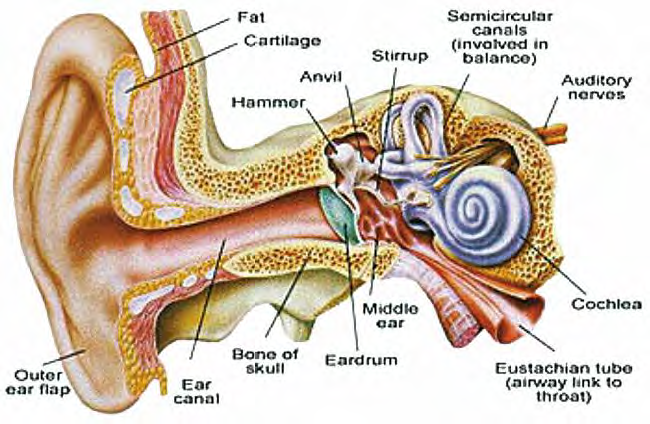
    Hearing loss is one of the most common conditions affecting older adults. Approxi mately 47 percent of adults 75 years of age or older have a hearing impairment. Men are more likely to experience hearing loss than women. It may be embarrassing and often leads to social isolation or depression, as many find it hard to have a conversation with friends and family. There are other unintended consequences to a person’s quality of life such as trouble understanding a doctor’s advice, responding to warnings and hearing phone calls or alarms.Generations Magazine - Hearing Loss Types & Tips - Image 01

    Hearing loss is a common problem caused by noise, aging, disease and heredity. Hearing is a complex sense involving both the ear’s ability to detect sounds and the brain’s ability to interpret those sounds.

    What are the different types of hearing loss?

    There are two general categories of hearing loss.

    • Sensorineural hearing loss occurs when there is damage to the inner ear or the auditory nerve. This type of hearing loss is usually permanent.
    • Conductive hearing loss occurs when sound waves cannot reach the inner ear. The cause may be earwax build up, fluid or a punctured eardrum.

    What is Presbycusis?

    A type of sensorineural hearing loss is called Presbycusis and comes on gradually as a person ages. Presbycusis can occur because of changes in the inner ear, auditory nerve or hearing pathways in the brain. Some of its causes are aging, loud noise, heredity, head injury, infection, illness, certain prescription drugs and circulation problems such as high blood pressure. Presbycusis may make it hard for a person to tolerate loud sounds or to hear what others are saying.

    How is hearing loss treated?

    Seek help right away, hearing problems that are ignored or untreated can get worse. The physician will refer to an audiologist, otolaryngologist or ear, nose and throat specialist. The audiologist uses an audiometer to test the ability to hear sounds of different pitch and loudness. These tests are painless. Audiologists will select a hearing aid best suited to the senior. Assistive and adaptive devices such as telephone amplifying devices, TV and radio listening systems can help seniors to live well with less than perfect hearing. Hearing aids, special training, certain medicines and cochlear implants are some of the choices for people with hearing problems.

    Tips to use when talking with someone who has a hearing problem:

    • Face the person and talk slowly and clearly.
    • Stand in good lighting and reduce background noises to a minimum.
    • Use facial expressions or gestures to give useful clues.
    • Repeat if necessary, using different words.
    • Include the hearing-impaired person when talking, this helps keep the senior from feeling alone and excluded.
    • Be patient and stay positive.

    Hearing loss is one of the most common conditions affecting older adults. Approxi mately 47 percent of adults 75 years of age or older have a hearing impairment. Men are more likely to experience hearing loss than women. It may be embarrassing and often leads to social isolation or depression, as many find it hard…

  • Are Your Medications Working?

    Generations - 2014-02 - Medications Working - Image 01It is sometimes difficult to be sure whether we, as seniors, are taking our multiple medications correctly. Help has arrived. If you have a Medicare drug plan and take medications for more than one chronic health condition — such as hypertension, diabetes or cardiac disease — you may be eligible for Medication Therapy Management (MTM) at no cost to you. Local pharmacists can review your medications and discuss any concerns. Contact your drug plan to see if your plan will cover MTM.
    • Get more benefit from the drugs you’re taking.
    • Know how to best take your medications.
    • Clear up any concerns about reactions, side effects, costs and insurance.

    Whether you qualify for MTM or not, remember that each medication prescribed by your doctor is meant to serve a particular purpose, but when taken incorrectly, a drug can become ineffective or even dangerous. Problems often arise when no one has a clear record or understanding of all the medications you have been prescribed.

    If you are prescribed drugs by more than one doctor, or visit more than one pharmacy, you will want to be sure that all of your doctors and pharmacists are aware of all your prescriptions. Be sure to include all herbal and nonprescription agents as well.

    For more information, call Pharmacare Hawaii at 808-840-4123.

    It is sometimes difficult to be sure whether we, as seniors, are taking our multiple medications correctly. Help has arrived. If you have a Medicare drug plan and take medications for more than one chronic health condition — such as hypertension, diabetes or cardiac disease — you may be eligible for Medication Therapy Management (MTM)…

  • Don’t Be Limited By Your Fitness

    On the KHON2 Elderhood Project, we meet many seniors and the ones who impress me most are those who stay active. Recently, our cameras went to a softball tournament where we watched seniors as they laughed and joked with each other. But when the gloves were put on and the ball was pitched, they were no longer seniors. Rather, they became competitive, energetic athletes having fun on the field. They were turned young again … a feeling that they take with themselves off the field and into their everyday lives.

    If you go to the Ala Wai Clubhouse and watch the seniors ballroom dancing, you can see that gleam in the eye, the high heel lifting delicately, the smile on the face. Although dancing is great exercise, you can just tell that there’s more to it.

    Experts will tell you that exercise is important as we age. I agree. But to me, it’s about more than just the exercise. It’s that chemical reaction in the brain that surges and tells you, “I can do this!”

    The publisher of this magazine Percy Ihara and I play golf from time to time. We walk, we talk, we swing the club — not wisely, but with spirit. When we’re through, we laugh and talk about the round. That may be the most important part of our game. If you have the chance to join others in your activities — than do it. It is an important part in keeping us young.

    Why is it important to stay active? To explain why, here’s a funny for you…

    A woman comes home from shopping and says to her husband who’s watching television, “Let’s run upstairs and make love!”

    He replies, “You have to choose.”

    Stay active, and you won’t have to pick between activities.


    The Elderhood Project airs on KHON2 Friday Morning news at 5:45a.m. and Thursday at 5p.m.

    On the KHON2 Elderhood Project, we meet many seniors and the ones who impress me most are those who stay active. Recently, our cameras went to a softball tournament where we watched seniors as they laughed and joked with each other. But when the gloves were put on and the ball was pitched, they were…

  • Boo! Now Give Me Your Money

    Fear has always been a tool criminals use to get money from others. Whether it is created by holding a weapon to a cashier to get their compliance, or simply using a verbal threat against someone on the street to make him/her surrender their wealth, a robber wants his victim to believe they have to act quickly to avoid being harmed.

    The Office of the Prosecuting Attorney’s Elder Abuse Unit has seen fear also being used to scam seniors out of their money and assets. Unlike direct threats to their safety, however, many fear-based scams involve the illusion that the victim will lose their wealth, their security, or someone close to them if they don’t act quickly.

    One such scam that is occurring in Hawai‘i is the Distressed Relative Scam. This scam relies on the victim making a quick emotional decision, before they have time to verify the facts or to ask for advice from others. The victim will get a message, either a telephone call or an email, relating to them that a family member is in dire straights and money will solve the problem.

    An example of the charade can include a “doctor” calling the victim to inform them that their family member was injured while traveling and money needs to be sent immediately so that the loved one can be saved. Another has involved the con-man (or woman) claiming to be their grandchild or some other relation to the victim and informing them they were unlawfully arrested and need bail money to escape the mistreatment they are receiving in jail.

    Generations - 2014-02 - Boo Now Give Me Your Money - Image 01
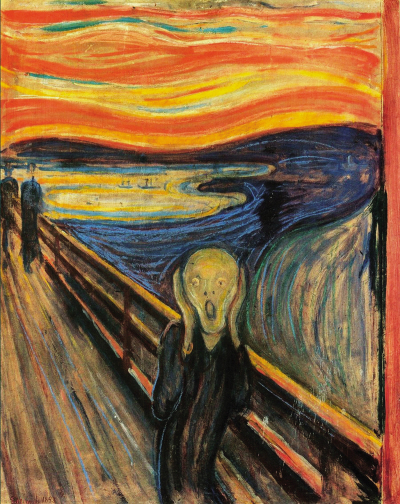
    The Scream by Edvard Munch (1893)

    The perpetrator of this scam goes on to instruct the victim how they can either wire the money to them or tells them to get a Green Dot loadable charge card from Walgreens or Wal-Mart and put money into the card’s account and relay the account number on the back of the card to them.

    When hearing about this scam in the light of day, one can easily realize that there is something suspicious about the above scenarios. But as any parent or grandparent will tell you, the call they dread the most is one informing them that someone precious to them needs help. It is a message like this that will force them to panic and act before they think clearly about what is being said.

    Fear is also incorporated into other types of scams seniors encounter — such as when seniors receive a call from “the bank” saying that suspicious activity is occurring on their account, and then they are asked to give the caller their personal account information so that “the bank” can secure the account’s money. Additional scams include the lottery and sweepstakes scams featured in the December/January 2014 issue of Generations, and Sweetheart Swindles featured in the August/September 2013 issue.

    If you are ever contacted by someone and feel pressured to make a decision out of fear, then it is time to stop and verify the facts. This can be as easy as calling a relative to compare notes or calling Crime Stoppers at 808-955-8300.


    To Report Suspected Elder Abuse, call:
    Adult Protective Services
    808.832.5115
    ElderAbuse@honolulu.gov
    or visit www.ElderJusticeHonolulu.com.
    All reports are confidential.

    Fear has always been a tool criminals use to get money from others. Whether it is created by holding a weapon to a cashier to get their compliance, or simply using a verbal threat against someone on the street to make him/her surrender their wealth, a robber wants his victim to believe they have to…

  • Tony Lenzer Recognized With 2013 Andrus Award for Community Service

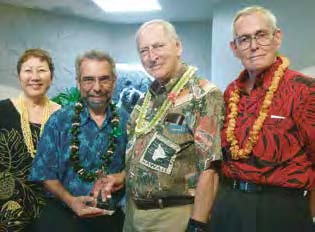
    Dr. Anthony (Tony) Lenzer was recently selected as the Hawai‘i recipient of the 2013 Andrus Award for Community Service—AARP’s most prestigious volunteer recognition. He accepted the award from AARP national president Rob Romasco at a volunteer recognition luncheon in November. The Andrus Award is an annual award for exemplary volunteer leadership named after AARP’s founder Ethel Percy Andrus (1884-1967) who exemplified AARP’s motto: “To serve, not to be served.”

    Lenzer’s distinguished career in gerontology began in Ann Arbor, Michigan, as executive secretary of a legislative council on aging. He held that job for four years, while doing doctoral work, then taught seven years at the University of Michigan’s School of Public Health where he helped set up a Chronic Disease and Aging Program.

    He came to Hawai‘i in 1969 with his wife and five children to help the University of Hawai‘i develop its gerontology program, teaching the first course on aging in 1970.

    In ensuing years he helped to establish key aging-related organizations. Among them: Hospice Hawai‘i, the Hawai‘i Pacific Gerontological Socie- ty and the Hawai‘i Family Caregiver Coalition, of which he is president. He also chairs the legislative committee for the Policy Advisory Board for Elder Affairs in the Executive Office on Aging.

    Lenzer has been volunteering with AARP and other organizations since retiring from the UH Center in 1994. He’s a volunteer board member for five organizations that advocate for aging, caregiving and disability policies at the Legislature. He helped create the annual “Aging and Disability Issues” report and is working with AARP now to help people understand the complex Affordable Care Act.

    In the words of AARP Hawai‘i state director Barbara Kim Stanton: “No one has done more to advance our understanding of what it means to grow older in Hawai‘i and prepare a generation of state policymakers to begin addressing the challenges and opportunities of our aging population.”

    Generations Magazine - Tony Lenzer Recognized With 2013 Andrus Award for Community Service - Image 01
    Left to right: AARP state director Barbara Kim
    Stanton, AARP volunteer national president Rob
    Romasco, 2013 Andrus Volunteer Award Winner
    Tony Lenzer and volunteer Hawai‘i state president
    Gerry Silva.

    Dr. Anthony (Tony) Lenzer was recently selected as the Hawai‘i recipient of the 2013 Andrus Award for Community Service—AARP’s most prestigious volunteer recognition. He accepted the award from AARP national president Rob Romasco at a volunteer recognition luncheon in November. The Andrus Award is an annual award for exemplary volunteer leadership named after AARP’s founder…

  • Caregiver Legislation On The Table

    Family members, partners and close friends are an important source of support for older people who need help taking care of themselves at home. In Hawai‘i, these caregivers provide most of the care for loved ones who need help with activities such as bathing, dressing and transportation. Many caregivers also perform complex tasks such as providing wound care, managing medications and operating medical equipment.

    But despite the importance of caregivers in the day-to-day care of our ku¯puna, they are often left out of discussions involving a patient’s care while in the hospital. And when loved ones are discharged from the hospital, caregivers often receive little or no instruction on how to help prevent readmission.

    To address this issue, AARP Hawaii is urging passage of a bill in the 2014 state Legislature that would allow patients to designate a caregiver as part of their medical record — or that hospitals voluntarily adopt this practice. The bill requires hospitals to notify and meet with the designated caregiver to discuss the patient’s plan of care prior to discharge or transfer to another facility. It also requires hospitals to instruct caregivers in how to care for loved ones after they are discharged.

    “This bill will have the two-pronged effect of supporting family caregivers and keeping health care costs in check,” says Steve Tam, AARP Hawaii director of advocacy. “It enables caregiv- ers to support their loved ones at home and in the community, and discourages costly and unnecessary hospital readmissions.”

    The federal Centers for Medicare & Medicaid Services (CMS) estimates that $17 billion in Medicare funding is spent each year on unnecessary hospital readmissions. The bill is intended to reduce readmissions by engaging caregivers more intentionally in the care of their loved ones. It also comes as hospitals across the country are seeking to avoid admission penalties under the federal Affordable Care Act.

    In Hawai‘i, family caregivers already play a critical role in the care of our elderly and disabled populations. On any given day an estimated 247,000 residents provide unpaid care valued at a staggering $1.9 billion annually, according to 2009 data. Caregivers are often members of the individual’s immediate family, but friends and other community members also serve as caregivers.

    AARP is dedicated to helping Hawai‘i’s caregivers by providing the tools, information and support they need to care for their loved ones and themselves. For information on the status of this legislation, or to get involved as an advocacy volunteer, contact Steve Tam at 808-545-6005.

    For information on resources for caregivers available online, visit the AARP Caregiving Resource Center at www.aarp.org/caregiving.


    AARP Hawai‘i state office: 808-545-6024 | Toll-Free: 866-295-7282 | aarp.org/hi | facebook.com/AARPHawaii twitter.com/AARPHawaii

    Family members, partners and close friends are an important source of support for older people who need help taking care of themselves at home. In Hawai‘i, these caregivers provide most of the care for loved ones who need help with activities such as bathing, dressing and transportation. Many caregivers also perform complex tasks such as…

  • Welcome to the Generations808.com

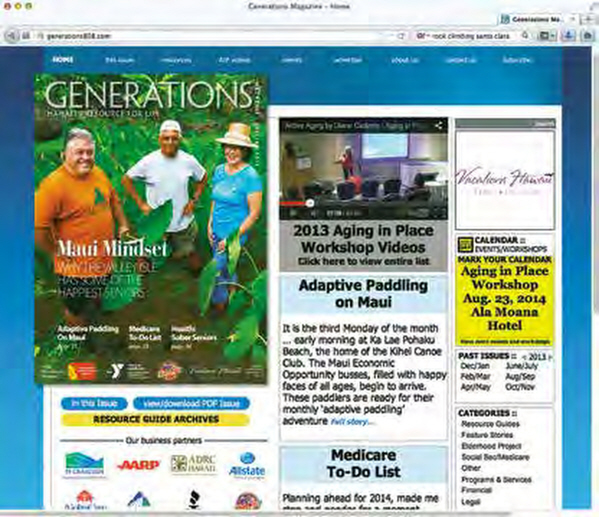
    Main navigation menu: Use these topics to navigate to the various pages in our site. As you run the cursor over the word, it’ll become bold. These topics will always exist on every page. Throughout the homepage, there are also various other buttons that’ll take you to any one of these topics.

    Home is the main page.

    This Issue will take you to the current issue’s table of contents with live links to individual articles.

    Resources will take you to resource guide archives.

    AIP Videos show a list of the Aging In Place Workshop speakers.

    Events: contains the events calendar.

    Advertising contains all of our advertising and marketing information.

    About Us is just a little background.

    Contact Us via mail, phone or email.

    Subscribe provides a subscription form so you can enjoy Generations Magazine delivered to your door every other month.

    Generations - 2014-02 - Web Navigation - Image 01

    Main navigation menu: Use these topics to navigate to the various pages in our site. As you run the cursor over the word, it’ll become bold. These topics will always exist on every page. Throughout the homepage, there are also various other buttons that’ll take you to any one of these topics. Home is the…

  • Healthy New Year’s Resolutions

    Every one of us, regardless of our age, can make plans and set goals. Each new year is a new beginning … a time to start fresh and hopefully get it right.

    Write down what you would like to see happen in the year ahead. It’s a way to solidify your dreams and desires, and move into the new year with an upbeat, positive attitude.

    The top New Year’s resolution is to lose weight and live a healthier lifestyle. We all start with good intentions and then seem to fall back into bad habits. Experts say it takes 21 days for a new activity to become a habit and six months for it to become part of our personality. It doesn’t happen over night, so be persistent and patient. Obsessing over the occasional slip won’t help you achieve your goal. Do the best you can each day and take one day at a time. The key is to start small and set realistic goals for yourself.

    Here is a list of things you can start doing today to feel better and move toward a healthier lifestyle in 2014.

    • Start each day with a 8 oz. glass of water. Water has many benefits. It carries nutrients to our cells, flushes the kidneys, lubricates joints and prevents constipation. The goal is to work up to 1 to 2 liters a day.
    • Eat more fruits and vegetables. Start by adding a salad to your daily diet or making yourself a green smoothie. Fruits and vegetables protect your body from disease and help fight cancer cells. The goal is 3 to 5 servings a day.
    • Eat a handful (1 oz.) of raw nuts every day. Walnuts, macadamia nuts, almonds. Healthy proteins and fats are important for preserving muscle and brain function.
    • Move your joints every day. Moving helps keep and improve function. Start at your neck, look left to right and then up and down. Go to the shoulders, arms out to the side, palms up and make small to large circles from the shoulder joint. Go both directions. Same with the wrist. Work your way down the body.
    • Try not to sit for longer than 15 minutes. Sitting for long periods slows the metabolism and can raise insulin and cholesterol levels. Taking a 10-minute walk every 2 hours can improve your health dramatically.
    • Practice taking deep breaths. Breathe in through the nose and out the mouth. This clears the lungs of toxins, increases energy, calms the mind and allows you to think more clearly.
    • Educate yourself on staying healthy. For example, Dr Oz came out with an updated version of YOU: The Owners Manual. It contains a lot of great info on health and longevity.

    Remember empowerment comes from doing!


    Join Diane online at www.shapingup808.com,
    or call 808-221-3905; email shapingup@hawaii.rr.com.

    Every one of us, regardless of our age, can make plans and set goals. Each new year is a new beginning … a time to start fresh and hopefully get it right. Write down what you would like to see happen in the year ahead. It’s a way to solidify your dreams and desires, and…

  • The First Thing

    At the National Kidney Foundation of Hawaii we are often asked about Chronic Kidney Disease (CKD) and what a person should do to find out how if he or she has the disease.

    There is good reason for concern. According to recent research, the lifetime risk of having moderate kidney disease for Americans is nearly 60 percent. Moreover, CKD is often called a “silent killer” because people can have the disease without exhibiting any apparent symptoms until the disease is in late stages.

    CKD is a disease in which the kidneys are unable to filter blood as well as they should. The effect is to have waste products build up in the body and lead to further health problems, including cardiovascular disease, among other things. The disease is usually irreversible and can lead to kidney failure over time if it is not treated. However, if CKD is detected early, treatment with medication and lifestyle changes may slow down the progress of the disease or even prevent kidney failure altogether. There is no cure for CKD, and the only treatment options for kidney failure are dialysis or a kidney transplant.

    So what’s the first thing someone should do if they want to know whether they might have Chronic Kidney Disease? Since early stages of the disease do not typically involve symptoms that a person can “feel” perhaps the first thing to do is have yourself screened for CKD. Your personal physician can order a simple blood test and/or urinalysis that will provide good indications of your kidney health. You might also attend a free screening offered by the National Kidney Foundation of Hawaii, which is designed to provide basic information that might warrant a visit with your doctor. Also, you may want to visit www. kidneyhi.org about an upcoming screening currently scheduled for March 14 at the Ala Moana Hotel as part of World Kidney Week.

    Screening is particularly important for people who have high blood pressure or diabetes, as these two conditions are the leading cause of CKD. Additionally, you may be at greater risk if members of your family have a history of kidney failure or if you are over the age of 60 (although CKD can strike people at any age). Certain ethnic groups have a higher incidence of CKD, including Hawaiians and other Pacific Islanders, Asians, African Americans and Hispanics, although no ethnic group is immune.

    First Thing: Learning the truth by getting a simple screening will enable you to make changes that just may save your life.

    __________________________________

    National Kidney Foundation of Hawai‘i
    808-589-5976 | jeff@kidneyhi.org
    www.kidneyhi.org | www.kidney.org

    Generations - 2014-02 - The First Thing - Image 01

    1 Epidemiology. 2007 July; 18(4): 501–506. doi: 10.1097/EDE.0b013e3180646338
    2 AKA Framingham Offspring Study
    3 http://www.kidney.org/news/monthly/phosphorus.cfm?homestatic=PhosphorusInfographic?homeslider=Phosphorus
    4 Food and Nutrition Board, Institute

    At the National Kidney Foundation of Hawaii we are often asked about Chronic Kidney Disease (CKD) and what a person should do to find out how if he or she has the disease. There is good reason for concern. According to recent research, the lifetime risk of having moderate kidney disease for Americans is nearly…

  • February – March 2014

    February – March 2014

    WANT THIS ISSUE?

    Download your own personal copy of this issue in PDF format. Click the button below:

    DOWNLOAD IT NOW

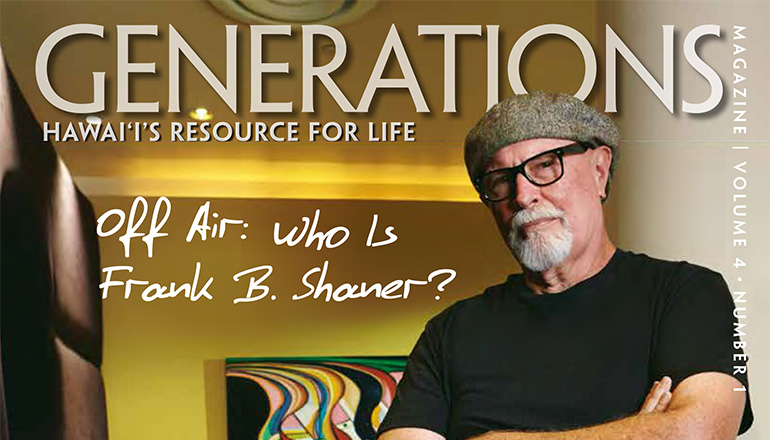
    Cover Story: Off Air: Who is Frank B. Shaner?