Category: December 2010

  • The Hawaii Alliance for Retired Americans (HARA)

    2011 will be a year of change for most of us, especially if you’re a senior. Some things are out of our control, such as changes in Medicare enrollment, health care reform, the country’s (and our family’s) financial stability. That is why it’s important for us to affect change when and where we can.

    Are you at a place in your life where you want to do something to affect change? Are you a retired union member? If so, we have just the place for you to volunteer and start to affect change in our state.

    The Hawai‘i Alliance for Retired Americans (HARA) is the state affiliate of the Alliance for Retired Americans (ARA), a national advocate on senior and aging issues with more than 3 million members. ARA ensures social and economic justice and full civil rights for all citizens so we may enjoy lives of dignity, security and personal and family fulfillment. The alliance believes that all older and retired persons have a responsibility to create a society that incorporates these goals and rights. The alliance encourages seniors to take advantage of their retirement and use it as an opportunity to pursue new and expanded activities with their unions, civic organizations and communities.

    Founded in 2001, HARA consists of 10 organizations with shared goals. HARA ensures that our state is a good place to retire and age. It supports the aspirations of seniors to remain healthy and lead a full and productive life, while aging in place at home.

    HARA is a strong voice for Hawai‘i’s retirees and seniors; a diverse community-based organization with national roots; a grassroots organizer, educator, and communicator; and a trusted source of information for decision-makers.


    To learn more about HARA or to join, please email Al Hamai, HARA president, he will get you involved in advocacy work here in the Islands; hamaia001@hawaii.rr.com. For more information, please visit www.retiredamericans.org.

    Our Mission: HARA strives to better the health, economic security and quality of life for Hawai‘i’s seniors and retirees.

    Our Vision: That Hawai‘i’s seniors and retirees enjoy “choices,” which result in an improved standard of living and a better, higher quality of life.

    Our Legislative Agenda: Some issues that ARA/HARA are now engaged in include: Expand the Kupuna Care Program; protect and expand Social Security, Medicare and Medicaid; urge people to take advantage of the benefits under the new health reform act; safeguard pensions and other retirement benefits; provide adequate, accessible and affordable housing and transportation services; and educate members about issues affecting its members and families.

    2011 will be a year of change for most of us, especially if you’re a senior. Some things are out of our control, such as changes in Medicare enrollment, health care reform, the country’s (and our family’s) financial stability. That is why it’s important for us to affect change when and where we can.

  • Ward off the Flu

    It’s the holiday season, meaning most of us will be out and about more often than usual. Shopping malls, restaurants, parties, church services— wherever we are, it’s a good idea to remember that crowds provide the perfect environment for influenza viruses (the flu) to spread by coughs and sneezes.

    Symptoms appear one to four days after the virus enters the body. These include fever, fatigue, cough, sore throat, runny or stuffy nose and muscle or body aches. Adults may pass the virus beginning a day before and up to a week after they develop symptoms. Children may infect others for longer than a week.

    The 2009 H1N1 influenza virus and various seasonal flu viruses are still circulating throughout the world. While there’s no reason to panic, you should be aware that outbreaks due to any of these strains remain a threat.

    “The best protection against influenza is immunization,” says Dr. Phil Bruno, infectious disease physician specialist and chairman of the infectious disease control committee for Kaiser Permanente’s Hawai‘i Region. “The good news is adults and children over the age of 8 will need only one vaccine this season. The 2010-2011 trivalent influenza vaccine will provide protection against the 2009-H1N1 influenza virus, the seasonal H3N2 influenza virus and the influenza B virus.”

    According to Dr. Bruno, children who are 6 months to 8 years old may need two doses of the vaccine administered at least four weeks apart this year if they have never received seasonal or 2009-H1N1 influenza vaccines before, or if they have received only one dose of seasonal influenza vaccine in the past.

    “The CDC recommends influenza immunizations for everyone who’s 6 months and older,” Dr. Bruno says. Influenza immunization protects you, your family and your community. It’s important for you and your loved ones to be immunized.”


    For more information on the flu, visit kp.org/flu

    It’s the holiday season, meaning most of us will be out and about more often than usual. Shopping malls, restaurants, parties, church services— wherever we are, it’s a good idea to remember that crowds provide the perfect environment for influenza viruses (the flu) to spread by coughs and sneezes.

  • New Law Equals Medicare Savings

    The “Extra Help” and the “Medicare Savings Programs” now allow more people with Medicare to pay $2.50 for generics drugs, $6.30 for brand name drugs, never experience the “donut hole” and to get help from the State of Hawai‘i in paying for their Medicare Part A and/ or B Premiums.

    Making ends meet shouldn’t mean going without your medications. If you have limited income and resources, Medicare’s “Extra Help” program sets it up so that you pay no more than $2.50 for each generic drug and $6.30 for each brand name drug. The Centers for Medicare and Medicaid Services estimates that “Extra Help” can save Medicare members as much as $3,900 per year.

    People Qualify and Don’t Even Know It

    The new law will allow more people to qualify for “Extra Help” and the “Medicare Savings Programs.” Even if you were turned down for “Extra Help” or for the “Medicare Savings Programs” in the past, you should reapply. If you qualify, you’ll get help paying for Medicare prescription drug coverage premiums, co-payments and deductibles and Medicare premiums.

    To qualify, you must make less than $16,821 a year (or $22,626 for married couples). Even if your annual income is higher, you still may be able to get some extra help with your drug coverage. Your resources must also be limited to $12,510 (or $25,010 for married couples). Resources include bank accounts, stocks and bonds, but not your house or car. (Medicare Savings Programs asset levels are $6,600 for a single person and $9,910 for a couple)

    There’s No Cost or Obligation to Apply

    It’s easy and free to apply for “Extra Help” and the “Medicare Savings Programs.” You, a family member, trusted counselor or caregiver can apply online at www.socialsecurity.gov or call Social Security at 1-800-772-1213 (TTY users should call 1-800-325-0778) and ask for the Application for Help with Medicare Prescription Drug Plan Costs.

    You can also call Sage PLUS, the Hawai‘i State Health Insurance Assistance Program (SHIP), at 586-7299 or 1-888-875-9229 to reach a certified counselor in your area.

    For an application for the Medicare Savings Programs you can call your local Med-QUEST Office at 808-524-3370 or 1-800-316-8005. All the information you give is confidential.

    Now it’s even easier to qualify for “Extra Help” from Medicare and get help from the State of Hawai‘i in paying for Medicare premiums. A new law changed how your income and assets are counted in 2010:

    • Life insurance policies don’t count as resources (for prescription drug assistance).

    • Household expenses—like food, mortgage, rent, heating fuel or gas, electricity, water, and property taxes—paid by relatives, friends and others do not count as income.

    • Asset amounts are now higher to receive assistance from the State of Hawai‘i in paying for the Medicare Part A/B Premiums, also known as the Medicare Savings Programs (MSP).

    • If you apply for the “Extra Help” through Social Security, your application will automatically be sent to the State of Hawai‘i for consideration.

    The “Extra Help” and the “Medicare Savings Programs” now allow more people with Medicare to pay $2.50 for generics drugs, $6.30 for brand name drugs, never experience the “donut hole” and to get help from the State of Hawai‘i in paying for their Medicare Part A and/ or B Premiums.

  • Hoarding Habits

    Who are hoarders and clutterers? Television shows like Mission Organization and Hoarders on A&E TV have brought to the forefront this behavior that is often observed but rarely addressed. On a more sobering note, it has opened our eyes to thousands who may find themselves living with fear, isolation, shame and self-neglect. The elderly are particularly at risk due to debilitating mental or physical decline, or a transmission of a pre-existing, underlying mental condition, such as obsessive-compulsive behavior manifesting itself into old age. Is this a problem? For many, their hoarding habits boarder on eccentricity, uniqueness or a Bohemian lifestyle. For others, it is facing eviction notices, visits by social workers, the police, and definitely the resident manager.

    Dr. Harry Moody of the Institute for Human Values in Aging, International Longevity Center in New York, says, “Hoarders are refusing to let go of the past.” He posited that our capitalist society of “more is best” contributes to our “collecting our way into immortality.”

    Hanging onto our past creates a dead sea— water pours in, but no water flows out. We need to understand the process of holding on, and letting go early. Referring to Erik Erikson’s last two stages of life, Generativity vs. Stagnation, and Integrity vs. Despair, we equate Generativity to generosity, or the giving of ones self (and one’s stuff), and Integrity to the feeling of peace within one’s self after having accomplished what was meaningful in life. Contrarily, we face Stagnation and Despair when, as a result of hoarding, we experience feelings of being “stuck,” resentment, a sense of not having reached our goals in life; at worst, time has run out, as we face mortality in the last life stage. To attain the stage of Generativity and Integrity successfully, we need to be giving and receiving many “thanks” instead.

    Interestingly, there is a difference between hoarding and cluttering and collecting. According to Dr. Monika White, President and CEO for Healthy Living, clutter has a disorganized environment. Collections are usually interesting, inherited or things that have order and value.

    On the other hand, hoarders usually collect large quantities of the same item, of no evident value, or too much of an item that eventually gets ruined, such as 100 rolls of wet toilet paper or written materials (newspapers, magazines). Hoarders also often express the “my neighbor is trying to poison me” syndrome. The individual is usually single, delusional, paranoid, isolated, suspicious and litigious. Many also suffer from some kind of impairment such as hearing or vision loss. They face eviction by being a nuisance, making false complaints of fumes or radio static, or mistaking entries and theft; yet, there is rarely evidence to warrant official action.

    The prevalence of hoarding is unknown because it is a very BIG secret. Doctors, lawyers, anyone can be a hoarder. Between 18 to 42 percent of hoarders are diagnosed with obsessive-compulsive behavior. Twenty percent have dementia, mostly female and single.

    White says that hoarding and obsessive-compulsive behavior are partly genetic and partly learned. Hoarders tend to mimic the lifestyle their parents with obsessive-compulsive disorder, have some degree of dementia, past experiences of deprivation, sentimental attachment to items, or a strong need to keep in control. The individual is unable to move on, perpetually living in the past. Hoarders are usually more competent than not, often extremely intelligent and witty.

    It’s important that hoarders are protected against discrimination and violation of their rights to self-determination. In order for agencies such as the Adult Protective Services (APS) to intervene, a written psychiatric evaluation that supports a protective order and a judge’s decision must occur first. Further, social workers and other health and welfare professionals must determine that the least restrictive alternatives have been tried, and the individual lacks capacity to the point of endangering him/herself or others because of the hoarding behavior.

    If you know someone who struggles with hoarding, document all your concerns, observations and complaints. Keep note of your actions and calls. Establishing a track record is essential from any perspective; legal, social or medical.

    Call the following organizations for help:

    Hawai‘i Department of Elderly Affairs Division: 768-7700

    Honolulu Gerontology Program: 543-8468

    Catholic Charities Hawai‘i: 521-4357

    Adult Protective Services: 832-5115


    Lei Shimizu, MSW, LSW Coordinator Information & Assistance Services, Elderly Affairs Division Department of Community Service City & County of Honolulu

    Who are hoarders and clutterers? Television shows like Mission Organization and Hoarders on A&E TV have brought to the forefront this behavior that is often observed but rarely addressed. On a more sobering note, it has opened our eyes to thousands who may find themselves living with fear, isolation, shame and self-neglect.

  • The Caregiver Foundation: Your First Steps on the Care Giving Journey

    The first few steps on a care-giving journey can seem fairly simple but within just a few days the path turns rocky and is full of turns and twists that confuse even the most experienced caregiver or capable family member.

    The Caregiver Foundation is a Hawai‘i-based, not-for-profit organization that supports the practical and emotional needs of caregivers and those they love. Its Caregiver Support Groups are complemented by extensive on-line support at www.thecaregiverfoundation.com. The support groups meet once a month at various locations, where caregivers learn about issues from experienced professionals. More importantly, the groups provide caregivers an opportunity to share their experiences, frustrations and successes. The popular four-session Caregiver Boot Camp is held, free, wherever requested.

    The foundation also provides direct services, ranging from professional money management to comprehensive care coordination services. Some services are provided at no cost and others have fees at substantially lower rates than found commercially. Community speakers, family consultations, resource articles, and an on-going information and referral service are just some of the foundation’s services.

    Along the way of care giving, you might discover that love is not enough. What do you do when taking care of loved one at home doesn’t work?

    Telling Mom she was moving to a nursing home was the hardest thing I have ever done …

    Moving your loved one to a nursing home is difficult. He or she may feel abandoned, unloved, rejected. There may be angry accusations and emotional pleas. You may even feel guilty for making the decision.

    But GUILT is an emotion that results from having done something wrong and identifies actions that should be changed. It is often misused in care giving. If we took Mom to the side of the forest and left her there, then we would have done something wrong, and could feel appropriately guilty.

    Choosing a nursing home is not deciding to give up caring for your loved one. It is recognizing your own limitations and understanding that sometimes the best care is not always your care. And the best place of care may not be in your home.

    Choosing to move someone to a home has to be done after taking into account the broader situation. Remember—there are no right choices— every decision you make is wrong for somebody. So caregivers often deal with feelings of regret, anger, failure, disappointment and grieving. These emotions require that you have patience with yourself. Try to understand your loved one’s feelings, and have a clear understanding of how the facility operates.


    The Caregiver Foundation of America—Hawai‘i Chapter helps caregivers, and those they love, with practical and emotional assistance. Visit www.thecaregiverfoundation.com or call (808) 625-3782.

    The first few steps on a care-giving journey can seem fairly simple but within just a few days the path turns rocky and is full of turns and twists that confuse even the most experienced caregiver or capable family member.

  • Tools to Help Your Decide When to Retire

    These days, everyone is taking a new look at their finances—and no one is looking more closely than the millions of baby boomers who are nearing retirement age. While some boomers expected to retire at one of the traditional milestones, such as age 62, the current economy is forcing many of them to re-evaluate their plans. Many are wondering if they should work longer, or how their Social Security benefit—or their spouse’s benefit—would be affected if they continued working.

    To help them find answers, Social Security has published a fact sheet called When To Start Receiving Retirement Benefits. You can read it online at www.socialsecurity.gov/pubs/10147.html.

    As most workers know, your choice of a retirement age—from 62 to 70—can dramatically affect your monthly Social Security benefit amount.

    If you choose to start receiving benefits early, the monthly payments will be reduced based on the number of months you receive benefits before you reach your full retirement age. The rate of reduction will depend on the year you were born. The maximum reduction at age 62 will be:

    • 25 percent for people born between 1943 and 1954
    • 30 percent for people born after 1959

    If you wait until your full retirement age, your benefits will not be reduced. And, if you should choose to delay retirement, your benefit will increase up to 8% a year from your full retirement age until age 70. However, there is no additional benefit increase after you reach age 70, even if you continue to delay taking benefits.

    Social Security also has created several retirement planners to help you make an informed decision. Social Security has an online calculator that provides immediate retirement benefit estimates. The online Retirement Estimator uses information from your own earnings record, and lets you create “what if” scenarios. You can, for example, change your “stop work” date or expected future earnings to create and compare different retirement options.

    *To use the Retirement Estimator, visit www.socialsecurity.gov/estimator. *Read When To Start Receiving Retirement Benefits at www.socialsecurity.gov/pubs/10147.html.

    *And for general information about Social Security, visit www.socialsecurity.gov.

    Retirement decisions are unique to everyone. Make sure you are up to date with the important information you will need to make the choice that’s right for you.

    These days, everyone is taking a new look at their finances—and no one is looking more closely than the millions of baby boomers who are nearing retirement age. While some boomers expected to retire at one of the traditional milestones, such as age 62, the current economy is forcing many of them to re-evaluate their…

  • Work After Work: Our new age of life and the moral necessity for “returnment”

    Returnment n. 1) The act of giving back, or returning in some small way, what the world has given you. 2) Especially as an alternative to retirement.

    At the turn of the 20th century, the average life expectancy was only 47. Today, it is rapidly approaching 80. Our fastest growing age group is folks over the age of 85, with someone in this country turning 50 every eight seconds. More importantly, older adults are healthier than previous generations and this has created an unprecedented average lifespan. An average 60-year-old person today is closer to a 40 or 50 years old health-wise when compared to a 60-year-old 20 or 30 years ago.

    Our old model of retirement suggested that people work until the ages of 60 to 65, and then a person felt fortunate if there were a few years of leisure before their physical health deteriorated and/or death ensued. Today, that is all changing. Many older adults have to work, or want to work, in their later years.

    Our seniors have already expressing that they will not approach retirement in a traditional fashion. For example, many boomers are already having great difficulty relating to the terms senior, elderly, old and mature. Most of them will also resist the term “retirement.”

    As one recent retired teacher said, “I have retired from teaching, but I am not retired. I tell you I am going to find another word that is different from the word retirement. Retirement lends itself for people to say, ‘Well, he is tired, that’s the end of it.’ There has to be another word other than retirement.”

    I believe there is a great spiritual need and moral necessity for redefining “retirement” with “returnment.” I define “returnment” as “the act of giving back, or returning in some small way, what the world has given to you.” Other words could be used such as stewardship, trusteeship or even aloha. I like this new word because it captures not only our new age of life, but also the psychological and spiritual needs of this time of life as well.

    The pursuit of the traditional retirement life of primarily leisure and consumption will lead to not only a tremendous loss of talent, experience and resources, but intensified inter-generational economic and resource conflicts, and ultimately for most individuals, regret and despair. It is not enough to honor our kūpuna, we need to engage them as a renewable resource.

    To live the rest of our lives uninvolved and unengaged will be unrewarding and unacceptable. If you are not engaged in your later years, you are just dying longer not living longer.

    President Obama has called for a new commitment to volunteerism by all age groups. We need to challenge the 80 million strong boomers to step up, get involved and set the example. This growing age group will have more time than any other age group and they have energy and experience that we need and can use.

    The good news is that surveys indicate that up to 80% of all boomers expect to work or volunteer part time in their later years, and 70% said that they would work even if they had enough money to live comfortably, according to a survey by the Rutgers Community Center for Workforce Development. The care giving professions of teaching, childcare, nursing and human services are in great need of replenishment and expansion.

    With “living with purpose” being one of the primary drivers of people over age 50, community service through non-profit organizations (NPOs) is a real win/win opportunity. We cannot afford for boomers in their aging lives to be perceived as socially useless and only living a life of consumerism. There is a great need, opportunity and moral necessity for tapping into their wisdom, experience, wealth, finances and time.

    Just imagine if only a portion of the people here in Hawai‘i retiring each year now were to pursue a life of “returnment.” What problems could be addressed? How many children’s lives would be different? What new kind of energy would be created? What level of hope?

    “This time, like all times, is a very good one, if we but know what to do with it.” ~Ralph Waldo Emerson


    Jay C. Bloom, President of Bloom Anew 808-753-4331 | www.BloomAnew.com

    At the turn of the 20th century, the average life expectancy was only 47. Today, it is rapidly approaching 80. Our fastest growing age group is folks over the age of 85, with someone in this country turning 50 every eight seconds. More importantly, older adults are healthier than previous generations and this has created…

  • Come Zumba with Us!

    The greatest party has arrived here in Hawai‘i. The Zumba® Fitness craze is exploding in popularity across the Islands. The Zumba program fuses hypnotic Latin rhythms with easy-to-follow moves for all ages, shapes and sizes. This one-of-a-kind fitness program aims to get you hooked and make you want to workout.

    Zumba fanatics achieve long-term benefits from this one-hour, calorie-burning, body-energizing workout and conditioning.

    The routines feature interval training sessions, with movements designed to engage your body and mind. Fast and slow rhythms are combined with resistance training to burn fat and tone and sculpt your body. Add some Latin flavor and international zest into the mix and you’ve got a Zumba class!

    In only a few short years, Zumba has spread like wildfire, positioning itself as the single most influential movement in the fitness industry.

    Debbie Azama-Park and Genie Brown are just two of the approximately 300 instructors in Hawai‘i. You can find Zumba classes just about anywhere, including most fitness clubs.

    As a long time fitness member, Debbie continues to exercise in her adult life. She has practiced yoga for 18 years, yet she wanted to add a cardio portion to her physical regimen. Then Zumba came into her life. “The music is key to working out with Zumba,” she says. “You cannot sit still when the music is going. The Cumbia music is my favorite of the Latin rhythms.”

    Debbie knows that trying something new is always a little challenging, but she always says to never give up. She encourages, “If you love music, it will get easier and the music will keep you going.”

    Genie Brown from Mililani has been teaching since early 2009. As a long-time fitness instructor, she confesses that she did not care for Zumba at first. She was not a dancer and sometimes she felt a little awkward. “Shaking around at an older age was not easy at first,” she says, “but I wanted to teach Zumba because I felt that teaching a fun class would be more inspiring. Participants just let loose and put their own attitude into their moves.”

    Genie’s students benefit from class in a variety ways. For example, student Stephanie of Mililani lost 6 pounds in only a couple of months, and Jan found out that her blood pressure went down. Phil of Wahiawaˉ lost eight pounds, but the bigger benefit is that he can now fit into his pants again.

    According to Genie, everyone should walk a minimum of 10,000 steps per day. In a normal 45-minute Zumba class, students take more than 5,000 steps. This is half of the daily recommended steps in just 45 minutes. Zumba also helps with flexibility, strength and back pain … not to mention it almost guarantees a good night’s sleep!

    So if you want to enjoy a longer, healthier life, call Debbie Azama-Park at 625-1040 or Genie Brown at 531-3558 for a class. Active aging is here to stay and so are the Zumba parties.

    The greatest party has arrived here in Hawai‘i. The Zumba® Fitness craze is exploding in popularity across the Islands. The Zumba program fuses hypnotic Latin rhythms with easy-to-follow moves for all ages, shapes and sizes. This one-of-a-kind fitness program aims to get you hooked and make you want to workout.

  • Dr. Rio Banner, MD: Health Visionary

    Dr. Rio Banner, MD: Health Visionary

    In Hawaii, we live an average of 81 years— longer than almost anywhere else in the world. But when it comes to successful aging, the key is to not only live longer, but to live longer as a healthy individual. The way to better health is taking care of ourselves as we age, which helps prevent the decline of our physical and mental abilities. And although any doctor would agree with that, the health care industry has traditionally emphasized treatment over prevention. But things are changing. A new model of health care is emerging—the Medical Home. It focuses on preventive, patient-centered care and has been gradually taking shape nationwide. Dr. Rio Banner, medical director at AlohaCare, tells us about this fundamental shift in our health care system and how it may contribute to a healthier you. As a preventive health specialist, he also gives us a rundown of ways to stay healthier, including cutting-edge therapies that some believe may help to restore a more youthful health.

    GM: Can you begin by telling us a little bit about your background in the medical field?

    RB: Of course. I received my medical degree in 1970 and have a master’s degree in public health, which I earned from the University of Hawai‘i at Mānoa. My interest in medicine was inspired by my cousin, who was a medical missionary in India while I was in high school. After my training, I chose to study public health in Hawai‘i because of its cultural diversity. My 16 years at Wai‘anae Coast Comprehensive Health Center (WCCHC)— first as a staff physician, then additionally as medical director—were so exciting because I was helping everyone from Native Hawaiians to immigrant Southeast Asian families. What a great experience.

    GM: Now you’re the medical director at AlohaCare. How did that come about?

    RB: Back in 1994, the state decided to take bids for the managed care of QUEST, which is Hawai‘i’s Medicaid care for low-income families. At WCCHC, which serves a majority of QUEST recipients, we were concerned that our patients’ care would be diminished, depending on who won the bid. So, we decided to partner with several Hawai‘i community health centers and individual health care providers to create a self-governed, island-wide, non-profit, managed health care plan called AlohaCare that would serve this population best. I left WCCHC at that point to be medical director of AlohaCare and have been here ever since. I’m also an internal medicine consultant at Kahi Mohala Behavioral Health Psychiatric Hospital.

    GM: Can you explain to us what’s happening in health care today? Seems preventive care is a major component of the paradigm shift.

    RB: That’s right—it is. You know, we take preventive measures in other aspects of our lives all the time without thinking about it. For example, most of us understand that changing our car oil periodically will help our car run better and longer. And, it can cost less than fixing the problems that could otherwise develop. Same with people! So this is the direction health care is heading. The recent Health Care Reform is said to be based on the philosophy of prevention.

    GM: Can you outline the foundations of this new health care model?

    RB: It’s called the Medical Home model, and it’s been developing since at least the 1960s—in fact, Hawai‘i’s community health centers have been using core aspects of it for years. In a nutshell, it’s a fully interactive, team-based approach to care.

    Who’s on the team? To begin with, you are. You are the center of the team. You know yourself best, and you are the only person who can make healthy lifestyle choices for yourself. Supporting you are health care providers, such as a primary care provider, nurses, specialists and insurers; other experts, such as behavioral health specialists, dietitians and outreach workers; and, if you choose, your family members. Your team works together, creating a web of health care knowledge about you and supporting your optimal health, both when you’re well and when you’re not.

    GM: What do you mean when you say “your team works together”?

    RB: First of all, a major component to teamwork is sharing information. Organizations are going electronic with health records, enabling providers to pull up a patient’s medical history, including pharmaceuticals, on the spot. That means your entire Medical Home team—including you—will be able to easily review your complete medical records and make better health care decisions because of it.

    Second, the way we interact with our doctors is going to change. You’ll still have a “home” doctor, or primary care provider. But instead of just seeing one doctor at a time, as we typically do today, you may sometimes see several providers—say, for example, your primary care provider, a nurse practitioner and a specialist—all together in the same room during your appointment to talk about your care. G

    GM: For those of us in our older years, how’s this new model of care going to be a benefit?

    RB: Seniors will find this team-oriented health care approach helpful for many reasons. According to the U.S. Census, about 80 percent of older Americans have at least one chronic health condition, and 50 percent have two or more. Naturally, then, they tend to spend more time at the doctor and take more medications than younger folks. It becomes increasingly difficult to navigate the health care system and track prescriptions, follow-up appointments, test results, etc. But the new system keeps dots connected and you at the center of the action. The result? Better care and ultimately better health.

    GM: Intuitively speaking, this sounds really great. But what’s it going to cost us?

    RB: What’s expensive is fixing a car after it breaks down, instead of taking better care of it in the first place. That’s what the U.S. is doing now, and costs are through the roof. Of course, that’s a simple answer to a complex question. Sometimes this kind of care may cost a bit more, depending on a patient’s situation. Other times it may cost far less, especially when preventive care is embraced. Numerous studies and pilot programs have been done on the Mainland, even by private employers such as Boeing, with overall results showing a huge cost savings.

    GM: In the meantime, what can we “older folks” start doing to improve healthy longevity?

    RB: I want to say this loud and clear: It’s never too late to improve your health. I hope your readers take this to heart and really start living these suggestions today. Eat nutritious, diverse foods. Exercise every day and maintain a healthy weight. Control your cholesterol level. Take calcium. Drink plenty of water. Always use sunscreen. Get medical screenings on time, such as for prostate cancer, colorectal cancer and glaucoma. Wear your seatbelt. Set up your household to be free of things you can trip over, slip on or fall from.

    GM: Will do. And you promised you’d have something “revolutionary” in the area of anti-aging. What is that?

    RB: That’s right. I’m the father of 13-year-old twin girls, so I have good reason to want to be at my best for as many years as possible. As AlohaCare’s medical director, one of my roles is to research innovative solutions for better health care. And I’ve become very excited about two emerging preventive care opportunities that may soon revolutionize not only the way we think about aging, but literally how we age.

    The first is the explosion of knowledge about our genes—the “information” packets found within the center of each cell in our body. Since the chemical structures of the human chromosome were discovered about 60 years ago, scientists are finding not only the molecular causes of disease, but also the specific treatments for them. Because each person’s genetic code is unique, we’re on the verge of understanding a specific personal prevention, prescription or treatment for each of us to best face age-old challenges such as diabetes, arthritis or cancer. This will be truly personalized care.

    A second opportunity is optional hormone replacement therapy. I’m not referring to certain controversial name-brand hormones currently prescribed for menopause. Rather, they are natural hormones that are exact matches to our body’s hormones, not synthetic molecules. As men and women age, the levels of our natural hormones, such as estrogen, progesterone, testosterone, melatonin, thyroid and Vitamin D, gradually decrease. The more they drop, the more they result in bodily deterioration, which includes anything from fatigue and loss of skin tone to depression, osteoporosis and cancer. By boosting our hormone levels to our younger levels, we can actually improve our immunity and nervous system, and slow deterioration, thereby helping prevent injury and illness.

    GM: Wow. As you continue your research on these subjects, we hope you’ll drop by Generations Magazine again and tell us more.

    RB: I certainly will!


    About AlohaCare – AlohaCare was founded in 1994 by local community health centers to provide managed health care for Hawaii’s most needy and under-served individuals. The non-profit organization has since grown to Hawai‘i’s third largest health care insurer, providing Medicaid (QUEST) and Medicare coverage for more than 75,000 members across the state. AlohaCare contributes to the health of Hawai‘i’s communities by improving access to health care; promoting quality care and disease prevention; and supporting health partnerships, projects and education.

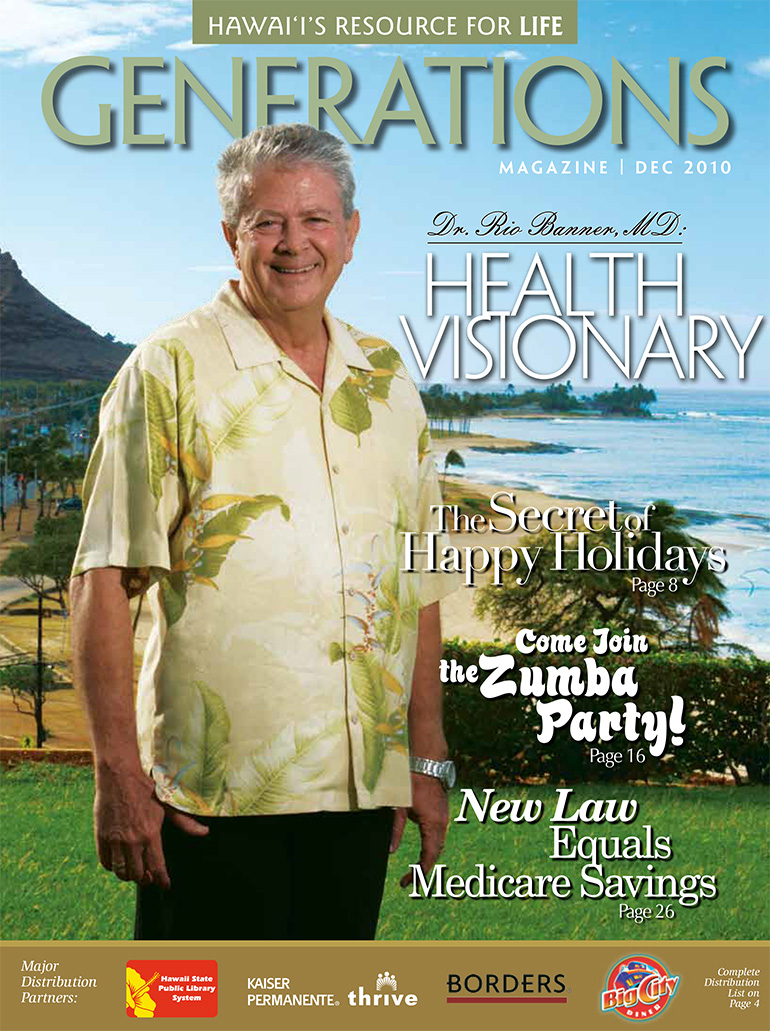
    In Hawaii, we live an average of 81 years— longer than almost anywhere else in the world. But when it comes to successful aging, the key is to not only live longer, but to live longer as a healthy individual. The way to better health is taking care of ourselves as we age, which helps…

  • Beware: It’s the Return of the Estate Tax

    The good news is that the federal estate tax took a vacation in 2010. The bad news is that it spent the whole year lifting weights and taking steroids. The estate tax is coming back in 2011, as big and bad as it has been in a long time. Now is the time to review your estate plan and make changes that could drastically affect how much of your estate goes to your loved ones, and how much goes to the IRS.

    Between 2001 and 2009, Congress gradually reduced the maximum rate of the federal estate tax from 55% to 45%. It also gradually increased the “coupon” (the amount of property that you could pass tax-free) from $675,000 per person in 2001 to $3.5 million per person in 2009. That means that with basic estate planning, a married couple could pass up to $7 million free of federal estate tax, if they both died in 2009.

    Then, in 2010 only, the estate tax was repealed. But like a horror film character who just won’t die, the estate tax returns again on January 1, 2011—only with a $1 million coupon and a 55% tax rate!

    To pay for the 2010 estate tax vacation, Congress replaced the estate tax with an increased capital gain tax. Before 2010, any assets that passed to someone when you died would be valued at fair market value at the date of death. If your surviving spouse or heirs sold any assets that had increased in value during your lifetime, they would not have to pay capital gain tax on any of that growth. This is called a “step-up in basis.”

    But in 2010, property that passes at death does not automatically receive this step-up in basis. Instead, each individual has a limited amount of property that can be “stepped-up” in value at the time of death. Property that does not receive this step-up value will be subject to tax on the increase in value from the date you first acquired the property. This means that the property could be exposed to huge capital gain tax liability if it is sold by your heirs!

    Now is the time to look into how your estate will be affected by the return of the estate tax. Contact your trusted advisors to find out what changes should be made to your “rule book” —the set of documents that will say what happens to your stuff after you are gone. You may have some prime opportunities to make a huge difference in the amount of your estate that goes to your loved ones. You may even be able to “disinherit” the IRS entirely.


    SCOTT MAKUAKANE is a lawyer whose practice has emphasized estate planning and trust law since 1983. He hosts Est8Planning Essentials, a weekly TV talk show which airs on KWHE (Oceanic channel 11) at 8:30 p.m. on Sunday evenings. For more information about Scott and his law firm, Est8Planning Counsel LLLC, check out www.est8planning.com.

    The good news is that the federal estate tax took a vacation in 2010. The bad news is that it spent the whole year lifting weights and taking steroids. The estate tax is coming back in 2011, as big and bad as it has been in a long time. Now is the time to review…

  • Tis the Season for Holiday Scams

    The holiday season is a happy time celebrated with food, family and friends. Unfortunately, it’s also a time for fraud at the hands of identity thieves, computer hackers and deceptive sellers. Hawai‘i’s Better Business Bureau (BBB) offers advice on how to recognize and avoid common holiday scams.

    Online Shopping Scams

    Some Web sites use tantalizingly low prices to lure in victims. If the price seems too good to be true, it probably is. Also, scammers often request wire payment through Western Union or MoneyGram because the money cannot be easily tracked or retrieved. Never wire money to strangers and always use a credit card to pay for items online. If the site or seller is fraudulent, you can dispute the charge with your credit card company.

    Identity Theft at the Mall

    Don’t let yourself be bogged down with packages or so rushed that you lose track of your wallet. Know where your credit and debit cards are at all times, and only carry the ones you’re going to use. Also, cover the keypad when entering your personal identification number while purchasing items or when getting money from the automated teller machine (ATM).

    Phishing E-mails

    Phishing e-mails fraudulently represent a trustworthy source. It is a way for ID thieves to get your personal information, or for hackers to install malicious software on your computer. Beware of unsolicited e-mail from unfamiliar people and companies. Don’t click on any links or open any attachments the e-mail contains. Always be sure your computer has current antivirus software and security patches installed.

    Charitable Giving Scams

    Beware of tear-jerking appeals that tell you little about what the charity or its cause. Ask questions about how your donation will be used. For example, if a charity claims to help the homeless, ask how and where this is taking place. Also, don’t succumb to pressure to give money on the spot. A charity that needs your money today will welcome it just as much tomorrow … after you’ve confirmed that it is legitimate.

    Have a happy, scam-free holiday!


    Bonnie Horibata is vice-president of Hawai‘i’s Better Business Bureau. BBB provides objective advice, business and charity reports, and information about topics affecting marketplace trust at bbb.org.

    The holiday season is a happy time celebrated with food, family and friends. Unfortunately, it’s also a time for fraud at the hands of identity thieves, computer hackers and deceptive sellers. Hawai‘i’s Better Business Bureau (BBB) offers advice on how to recognize and avoid common holiday scams.

  • The Secret of Happy Holidays: Spending with Discretion

    As we enter the third holiday season after the onset of the “Great Recession,” American consumers may be battling penny-pinching fatigue. We’ve scrimped. We’ve saved. When do we get to reward ourselves?

    Sure, it would be fun to celebrate the holidays with a big spending binge, but if there’s one lesson to be learned from the recession, it’s the importance of fiscal prudence. Don’t let the impulse to buy your way to happy holidays overrule your good judgment. Here are some tips for keeping your holiday spending within reason and the limits of your wallet.

    Step back from the hype. Retailers want you to get caught up in the holiday spirit and spend with abandon. Instead, take a more mindful approach to holiday shopping and consciously commit to responsible spending. Reinforce your conviction by imagining how good it will feel to enter January with money in the bank rather than paying off credit card bills.

    Make a firm budget. Think realistically about how much you have available to spend. If you’re tempted to spend lavishly, force yourself to imagine the painful consequences of overextending yourself. Keep track of your purchases and monitor your progress to avoid getting carried away.

    Narrow your list. If you’ve fallen into a trap of “gift-sprawl,” make this the year to pull in the reins. Prioritize your list and give according to your ability.

    Start early. Last-minute shoppers tend to spend more on impulsive purchases. Spreading your holiday shopping across 12 months is easier on your monthly budget. It’s also easier to find deals in the off season when retailers are anxious to move last year’s merchandise and make way for the new.

    Shop on a cash-only basis. When possible, pay with cash rather than checks, debit cards or credit cards. The tangible aspect of spending cash allows you to see how quickly money goes and can help you stick to your budget.

    Think outside the store. Save money by giving homemade gifts rather than store-bought items. Encourage your kids to skip the malls and give of themselves. Grandparents are likely to appreciate a child’s artwork or helping hands far more than a scented candle.

    Rethink excess. Does everyone in your family really need a dozen presents under the tree? Some large families and groups of friends choose to limit overall spending by drawing names so that each person receives one nice gift rather than buying for the entire gang.

    Put people first. Our consumer society encourages us to get carried away with material things. Yet the most meaningful part of the holidays is spending time with the people we love and sharing our abundance with those who are less fortunate. It doesn’t cost a thing to step back from the shopping rat race and savor the moments.


    Michael W. Yee is a senior financial advisor with Michael W. Yee, a financial advisory practice of Ameriprise Financial Services, Inc. As a financial advisor, Yee provides customized financial advice that is anchored in a solid understanding of client needs and expectations, and provided in a one-on-one relationship with his clients. For more information, please contact Michael W.Yee at (808) 952-1240. Advisor is licensed/registered to do business with U.S. residents only in the states of Hawaii. Brokerage, investment and financial advisory services are made available through Ameriprise Financial Services, Inc. Member FINRA and SIPC. Some products and services may not be available in all jurisdictions or to all clients. © 2010 Ameriprise Financial, Inc. All rights reserved.

    As we enter the third holiday season after the onset of the “Great Recession,” American consumers may be battling penny-pinching fatigue. We’ve scrimped. We’ve saved. When do we get to reward ourselves? Sure, it would be fun to celebrate the holidays with a big spending binge, but if there’s one lesson to be learned from…