Category: Programs & Services

  • Good News for Seniors Taking Insulin

    If you or someone you know is a Medicare beneficiary and is also prescribed insulin, the new Insulin Senior Savings Program is worth looking into.

    This program is offered through certain Medicare Advantage Prescription Drug Plans and also through stand-alone Medicare Part D Prescription Drug Plans. It is designed to cap the price of many insulins at just $35 a month for a 30-day supply for every month of 2022.

    The purpose is to encourage members to stay on their medicine all year by offering a much lower, more consistent cost. Basically, it means the price of the insulin will not be affected by the deductible stage, the initial coverage stage or the coverage gap, also known as the “donut hole.”

    Medicare estimates that the Insulin Senior Savings Program will save members close to $500 a year. The surprising thing is that this benefit is an included part of quite a few Medicare Advantage Plans offered in Hawai‘i this year, even some with $0 monthly premiums.

    For more information, beneficiaries should reach out to a Medicare specialist.


    THE MEDICARE GEEK
    1221 Victoria St., #3103, Honolulu, HI 96814
    808-724-4993 | robin@themedicaregeek.com
    www.themedicaregeek.com

    If you or someone you know is a Medicare beneficiary and is also prescribed insulin, the new Insulin Senior Savings Program is worth looking into.

  • Social Security FAQs

    Smiling Vietnamese florists checking bills and sales receipts and keeping bookkeeping neatYou may need Social Security when you  least expect it and we’re here to make sure our information is always accessible to you.

    Whether you’re planning for your retirement years in advance or thinking about applying today, you probably have questions.

    Our Frequently Asked Questions at www.faq.ssa.gov has answers to your questions about our programs and services. We feature our most-asked questions at the top of the page to quickly help you find answers to the most common questions, such as:

    • What should I do if I receive a call from someone claiming to be a Social Security employee?
    • How do I change or correct my name on my Social Security number card?
    • How can I get a Social Security Statement that shows a record of my earnings and an estimate of my future benefits?
    • How do I apply for a new or replacement Social Security card?

    You can also browse by topics, such as disability, Social Security payments, retirement and Medicare. We also have a publications library at www.ssa.gov/pubs with information on many topics. And we provide each publication in text, audio and downloadable formats.


    Social Security seal800-772-1213 (TTY 800-325-0778) M–F, 8:30am–3:30pm
    SSA Office Locator: www.socialsecurity.gov
    Advance Designation FAQ: www.ssa.gov/faq (Other Topics)
    Representative Payees Information: blog.ssa.gov

    You may need Social Security when you  least expect it and we’re here to make sure our information is always accessible to you. Whether you’re planning for your retirement years in advance or thinking about applying today, you probably have questions.

  • Continue Vigilance While Protecting Kūpuna

    Kūpuna are the most vulnerable to online  scams due to social isolation during the pandemic. We must stay vigilant, as  scammers use more sophisticated ways to steal your personal identity, shame you of your self-worth and steal your life’s legacy. Here are some important tips to avoid becoming a victim:

    PREVENTION

    • Medicare will never call you needing confirmation to pay for medical products or services. Just hang up and call SMP Hawaii.
    • Scammers send urgent emails or text messages meant to make you panic: “Act now! Click here!” Stop and look at the fine print. Take time to think clearly before doing anything.
    • Never click on a link in a text or email, even it’s from someone you know. Scammers can “spoof” or disguise their calls, texts or emails as being from a known and trusted source.

    DETECTION

    Find billing errors and abuse by diligently checking to verify your medical statements and bills:
    • Keep accurate records of doctor visits, lab tests and surgical equipment, etc.
    • Organize and file copies of medical bills received and payments made.
    • Review your Medicare Summary Notice or Explanation of Benefits from your health plan for accuracy, and look for suspicious charges for services that you did not receive.

    REPORTING

    What to do if you mistakenly provided your Medicare number or other personal health information to a possible scammer, including:

    • a caller offering a Medicare-approved knee brace, (genetic) testing or other service.
    • at a fair booth or stand as an enticement to receive free services or a special gift.
    • in response to an ad offering money and/or exclusive benefits.

    Call Senior Medicare Patrol Hawaii or visit www.smphawaii.org to report the instances above or to schedule counseling, request a group presentation, or to volunteer to stay informed and safe. In June, SMP Hawaii will celebrate 25 years of helping kūpuna, their families and caregivers.


    SENIOR MEDICARE PATROL (SMP) HAWAII
    Department of Health — Executive Office on Aging
    250 S. Hotel St., Ste. 406, Honolulu, HI 96813
    808-586-7281 | Toll Free: 1-800-296-9422
    info@smphawaii.org | www.smphawaii.org
    This project was supported in part by grant number 90MPPG0053 from the US
    Administration for Community Living (ACL), Department of Health and Human
    Services, Washington, DC, 20201. Grantees undertaking projects under government
    sponsorship are encouraged to express freely their findings and conclusions. Points
    of view or opinions do not, therefore, necessarily represent official ACL policy.

    Kūpuna are the most vulnerable to online  scams due to social isolation during the pandemic. We must stay vigilant, as  scammers use more sophisticated ways to steal your personal identity, shame you of your self-worth and steal your life’s legacy. Here are some important tips to avoid becoming a victim…

  • Paving the Way for a Healthy, Secure Future

    One year ago, I made a lifestyle change. I went from a vegan diet to pescatarian diet. After adding fish over a year ago, I lost a few pounds. Then my wife and I decided to go on the keto diet together. I also started an exercise program. Seniors must exercise to stay physically and mentally fit to help prevent Alzheimer’s and other forms of dementia.

    Seniors also need to prepare financially. In the past, retirement money didn’t have to last that long. In 1965, men had a life expectancy of 68 years and women lived an average of 71 years. Men lived only three years in retirement; women, six years. Healthier lifestyles and advancements in science and medicine have now enabled retirees to live well into their 90s. So now our money has to last 20 to 30 years after we stop working.

    Social Security, regular investments (stocks, mutual funds) and retirement plans (401(k)s, IRAs) must take into account this extended life span.

    I will be 73 years old soon. My father is 97 years old. My mother passed away four years ago at age 93. I have three children, 10 grandchildren and 15 greatgrandchildren. I would like to spend many more years with them. I am ready.

    Are you ready? Look at your options. Don’t spend your golden years in illness and poverty. Make plans now for a healthy, secure future.


    FINANCIAL BENEFITS INSURANCE INC.
    1311 Kapiolani Blvd., Ste. 504, Honolulu, HI 96814
    808-792-5194 | emotosue@fbihi.com
    www.fbihi.com | FB: Financial Benefits Insurance

    One year ago, I made a lifestyle change. I went from a vegan diet to pescatarian diet. After adding fish over a year ago, I lost a few pounds. Then my wife and I decided to go on the keto diet together. I also started an exercise program. Seniors must exercise to stay physically and…

  • SSA Supports Small Businesses

    Running a small business is often a 24/7 endeavor. Managing employees, inventory, scheduling, services and marketing can be challenging for small business owners — even in normal times. Although the COVID-19 pandemic has been testing all of us, it has been especially challenging for small business owners.

    Smiling Vietnamese florists checking bills and sales receipts and keeping bookkeeping neatIf you’re a small business owner or you work for one, the Social Security Administration’s (SSA) online suite of services can help make life easier. Our business services allow you to file W-2/W-2Cs online and verify your employees’ names and SS numbers against our records.

    Our online services at www.ssa.gov/employer will save you valuable time when you need information on filing electronic W-2s and verifying Social Security numbers. Small business owners can also take advantage of the SSA’s Business Services Online at www.ssa.gov/bso/bsowelcome.htm.

    Small business owners must register to use this free service, which also offers fast and secure online W-2 filing options to Certified Public Accountants, enrolled agents and individuals who process W-2s and W-2Cs.

    For more information about electronic wage reporting, visit www.ssa.gov/pubs/EN-05-10034.pdf to download and read our publication.


    800-772-1213 (TTY 800-325-0778) M–F, 8:30am–3:30pm
    SSA Office Locator: www.socialsecurity.gov
    Advance Designation FAQ: www.ssa.gov/faq (Other Topics)
    Representative Payees Information: blog.ssa.gov

    Running a small business is often a 24/7 endeavor. Managing employees, inventory, scheduling, services and marketing can be challenging for small business owners — even in normal times. Although the COVID-19 pandemic has been testing all of us, it has been especially challenging for small business owners.

  • Medicare Payment Help is Available

    Having trouble paying for Medicare or other health costs? Medicare Savings Programs (MSP) are available to help older adults pay their monthly Part A/B premiums, annual deductibles, or copayments for visits and services. MSPs are administered by the Hawaii Med-Quest Division.

    Qualified Medicare Beneficiary (QMB) Program pays Medicare Parts A and B premiums, deductibles, copayments and coinsurance.
    Specified Low-Income Medicare Beneficiary (SLMB) Program pays Part B premiums.
    Qualifying Individual (QI) Program pays Part B premiums.
    Qualified Disabled and Working Individuals (QDWI) Program pays Part A premiums for working beneficiaries under 65 with disabilities. QMB, SLMB and QI Programs also eliminate lifetime penalties if you enrolled late for Medicare.
    Extra Help is a low-income subsidy program that helps 1) pay for prescription drug (Part D) premiums/deductibles, 2) lowers copays for covered medications and 3) provides full coverage during the Coverage Gap. Extra Help is administered by the Social Security Administration.

    Contact Hawaii SHIP for an appointment.


    HAWAII SHIP
    Free, local, one-on-one Medicare counseling is provided by the Hawai‘i State Health Insurance Assistance Program.
    250 South Hotel St., Ste. 406, Honolulu, HI 96813
    Oahu: 808-586-7299 | Toll free: 888-875-9229
    www.hawaiiship.org

    Having trouble paying for Medicare or other health costs? Medicare Savings Programs (MSP) are available to help older adults pay their monthly Part A/B premiums, annual deductibles, or copayments for visits and services. MSPs are administered by the Hawaii Med-Quest Division.

  • Detecting Financial Incapacity in Seniors

    This is a blurred image taken through window of old man with gray hair on trainRecently, the SEC, NASAA and FINRA published a report to help advise financial professionals in detecting signs of diminished capacity among older investors. Some red flags:

    • The senior seems unable to process even the simplest concepts.
    • The senior appears to have memory loss.
    • The senior appears to have difficulty speaking and/or communicating.
    • The senior appears to be unable to appreciate the consequences of his or her decisions.
    • The senior makes decisions that are inconsistent with his or her current long-term goals or ongoing commitments.
    • The senior’s behavior is erratic.
    • The senior refuses to follow appropriate financial advice.
    • The senior appears to be confused about “missing funds,” even though reviews show no signs of unauthorized money movements.
    • The senior is unaware of or does not comprehend recent financial or legal transactions.
    • The senior appears to be disoriented in his or her surroundings or social settings.
    • The senior appears uncharacteristically unkempt or lacking in personal hygiene.
    • The senior appears uneasy around family or friends who are helping with finances.

    Reacting appropriately to these signs requires compassion and a complete understanding of the financial, social and physical environment surrounding the senior.

    Seniors with no responsible family support should be referred to the proper government agency, such as the Adult Protective Service or the Office of Public Guardian.

    If seniors do have responsible family support, financial professionals need to discuss their observations with them and recommend steps to protect the financial well-being of the senior — always applying both compassion and wisdom.

    A senior will often turn to a trusted person to help preserve their financial independence and personal dignity. In many cases, involving the professional services of a daily money manager is the wisest and most prudent action to take.


    THE CAREGIVER FOUNDATION (501(c) 3 nonprofit)
    926 3rd St., Pearl City, HI 96782
    For Daily Money Manager information:
    808-625-3782 | info@thecaregiverfoundation.org
    www.thecaregiverfoundation.org
    ADULT PROTECTIVE SERVICES HAWAII
    Oahu: 808-832-5115
    Kauai: 808-241-3337
    Maui/Molokai/Lanai: 808-243-5151
    E. Hawaii (Hilo/Hamakua/Puna): 808-933-8820
    W. Hawaii (Kau/Kona/Kohala/Kamuela): 808-327-6280
    PUBLIC GUARDIAN
    Honolulu: 808-534-6100

    Recently, the SEC, NASAA and FINRA published a report to help advise financial professionals in detecting signs of diminished capacity among older investors. Some red flags: The senior seems unable to process even the simplest concepts. The senior appears to have memory loss. More…

  • It Takes Our Entire State to Protect Kūpuna

    We’re home, still feeling isolated during the pandemic. The phone rings; a welcomed sound. We look forward to hearing from a family member or friend — a warm voice to spend time with. We answer the phone, and minutes later, our whole life is turned upside down. Does this sound familiar?

    Too often, unfortunately, many of our kūpuna fall victim to scammers who want their health, financial or other personal information. Our seniors face dire consequences as these comments from Senior Medicare Patrol (SMP) Hawaii reveal:

    “ I bought a COVID-19 test kit that Medicare won’t pay for!”
    “I think someone’s using my Medicare number!”
    “ They swabbed my cheek and said Medicare would cover 100 percent for genetic tests!”
    “ I got a bill for a knee brace that I don’t need!”

    Our reputation, savings, assets and ultimately, our life legacy are at risk when we trust the person on the phone, email or social media, to help us. “Free,” “discounts,” “take action immediately or else” and “urgent” are words that make us panic and not think clearly.

    Here’s a larger view of the problem:

    • 10,000-plus Americans turn 65 each day and many of them become eligible for Medicare.
    • One in four Hawai‘i residents is 65 or older. This group will represent a third of our state’s total population in less than a decade.
    • Medicare loses approximately $70 billion each year — a modest guesstimate since it’s difficult to truly measure its  annual loss.
    • By 2022, hospital and drug costs are expected to exceed $1 trillion.

    SMP’s volunteer-based program is funded by the US Administration for Community Living and is administered by the Hawai‘i Department of Health, Executive Office on Aging. SMP Hawaii “empowers and assists beneficiaries, their families and caregivers to prevent, detect and report healthcare fraud, errors and abuse through education and counseling.”

    SMP Hawaii can refer you to many community resources and help to report suspected cases of healthcare fraud to appropriate authorities. Contact us for more information or to learn more about how to volunteer, because it takes every person in our entire state to protect our precious kūpuna.


    SENIOR MEDICARE PATROL (SMP) HAWAII
    Executive Office on Aging , Hawaii Department of Health
    Advocacy, Education and Outreach Section
    250 South Hotel St., Ste. 406, Honolulu, HI 96813
    808-586-7281 | 1-800-296-9422
    info@smphawaii.org | www.smphawaii.org

    We’re home, still feeling isolated during the pandemic. The phone rings; a welcomed sound. We look forward to hearing from a family member or friend — a warm voice to spend time with. We answer the phone, and minutes later, our whole life is turned upside down. Does this sound familiar? Too often, unfortunately, many…

  • Retirement Made Easy

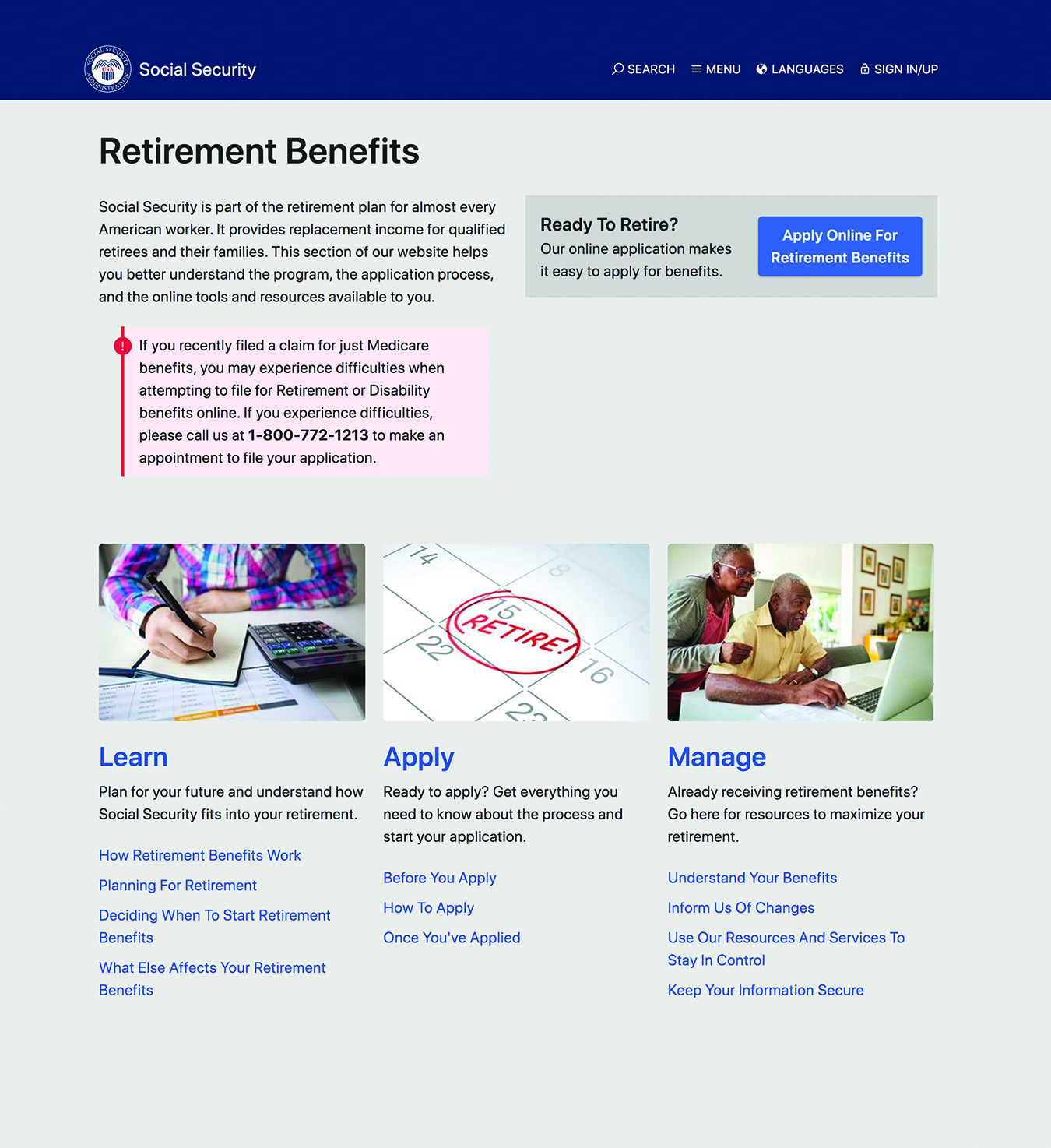
    Preparing for retirement is one of the most significant decisions you can make. A great place to start is the Social Security Administration‘s retirement portal. The portal is easy to use, whether you are ready to learn about, apply for or manage your retirement benefits.

    But first, create your personal my Social Security account to manage your retirement benefits. Then, learn about the benefits and be better prepared to apply for them online.

    Visit our retirement benefits portal today to “Learn,” “Apply” and “Manage” your retirement benefits. While you’re there, subscribe to receive retirement information and updates.

    800-772-1213 (TTY 800-325-0778) M–F, 8:30am–3:30pm
    SSA Office Locator: www.socialsecurity.gov
    Retirement Portal: www.ssa.gov/benefits/retirement

    Preparing for retirement is one of the most significant decisions you can make. A great place to start is the Social Security Administration‘s retirement portal. The portal is easy to use, whether you are ready to learn about, apply for or manage your retirement benefits.

  • What is a Fiduciary?

    Judge gavel with scales of justice, Business people and male lawyers discussing contract papers at law firm in office. Concepts of law.We hear the word “fiduciary” used more and more. But what does it mean? The origin of the word comes from the Latin word “fidere,” which means “to trust.”

    Today, we use “fiduciary” as a noun, meaning a trustee, a word most of us are familiar with. Fiduciary is also an adjective, referring to a relationship of trust and good faith between the fiduciary and the person for whom the fiduciary acts.

    A fiduciary assumes responsibility for the affairs of another person (usually called the principal, ward or beneficiary).

    There are three important duties that are required of a fiduciary:

    • The Duty of Care is the responsibility to make decisions in good faith and in a reasonably prudent manner.
    • The Duty of Good Faith requires the fiduciary not to act in a fraudulent or deceitful way or to the detriment of the person.
    • The Duty of Loyalty means acting only for the benefit and of the person without any self-interest or economic conflict.

    In summary, a fiduciary has legal and ethical obligations to act in the best interest of the person in all situations and to put those interests before his or her own.

    What we don’t often realize is that this word applies to various types of professional relationships in our lives, such as:

    • trustee and beneficiaries
    • estate executor and heirs
    • guardianship or conservatorship and ward
    • attorney and client
    • doctor and patient
    • directors of corporations and shareholders
    • real estate agents and buyers or sellers
    • financial advisors and clients

    Fiduciaries may perform many roles for you during your life and after your passing.

    While choosing a fiduciary for your medical, financial and estate planning needs may not be easy, finding the right fiduciary should provide peace of mind that your interests are looked after in a responsible manner.


    HAWAII FIDUCIARY SERVICES, LLC
    3615 Harding Ave., Ste. 309, Honolulu, HI 96816
    808-777-4200 | kholt@hifiduciaryservices.com
    www.HawaiiFiduciaryServices.com

    We hear the word “fiduciary” used more and more. But what does it mean? The origin of the word comes from the Latin word “fidere,” which means “to trust.” Today, we use “fiduciary” as a noun, meaning a trustee, a word most of us are familiar with. Fiduciary is also an adjective, referring to a…

  • Are You Ready for Medicare?

    Turning 65? Congratulations! You  are now eligible for Medicare! But what do you do next? Firstly, it’s important to know that your Initial Enrollment Period or IEP begins three months before you turn 65 and ends three months after your 65th birthday. Secondly, you aren’t required to sign up for Medicare. However, if you enroll after your IEP, a Late Enrollment Penalty will be added to your monthly premiums for life. Lastly, you must sign up for Medicare with the Social Security Administration (SSA), a Hawaii SHIP (State Health Insurance Assistance Program) partner. SSA.gov provides instructions on how to enroll online for Original Medicare Part A (hospital  insurance) and Part B (medical insurance). {Play}

    Once you’ve enrolled, contact the Department of Health, Hawaii SHIP to schedule a one-on-one counseling session to find the best plan option that meets your healthcare needs. Our Medicare-certified counselors will walk you through your IEP. They will explain Parts A through D, the  differences between Original Medicare and Medicare Advantage and how to avoid late enrollment penalties. You may also learn that you qualify for financial assistance to pay prescription drug costs, premiums, co-payments and coinsurances. Best of all, the service is free, unbiased and confidential.


    HAWAII SHIP
    Free, local, one-on-one Medicare counseling provided by the Hawai‘i State Health Insurance Assistance Program.
    250 South Hotel St., Ste. 406, Honolulu, HI 96813
    Oahu: 808-586-7299 | Toll free: 888-875-9229
    www.hawaiiship.org

    Turning 65? Congratulations! You  are now eligible for Medicare! But what do you do next? Firstly, it’s important to know that your Initial Enrollment Period or IEP begins three months before you turn 65 and ends three months after your 65th birthday. Secondly, you aren’t required to sign up for Medicare.

  • Advance Designation

    The Social Security Administration’s Advance Designation program allows you to pre-select a trusted individual if a time comes when you need a representative payee to help manage your money. Advance Designation enables you to identify up to three people, in priority order, who you would like to serve as your potential representative payee.

    SSA recently celebrated the one-year anniversary of its Advanced Designation program. Since its launch in March 2020, more than one million eligible individuals have opted to participate.

    You may choose an Advance Designation if you are capable of making your own decisions and are:

    • An adult or emancipated minor applying for benefits and do not have a representative payee.
    • An adult or emancipated minor beneficiary/recipient and do not have a representative payee.

    You can submit your Advance Designation information when you:

    • File a claim for benefits online at www.ssa.gov/benefits.
    • Use the application available in your personal my SSA account at www.ssa.gov/myaccount.
    • Call SSA directly.

    In the event that you can no longer make your own decisions, you and your family will have peace of mind knowing you already chose someone you trust to manage your benefits.


    800-772-1213 (TTY 800-325-0778) M–F, 8:30am–3:30pm
    SSA Office Locator: www.socialsecurity.gov
    Advance Designation FAQ: www.ssa.gov/faq (Other Topics)
    Representative Payees Information: blog.ssa.gov

    The Social Security Administration’s Advance Designation program allows you to pre-select a trusted individual if a time comes when you need a representative payee to help manage your money. Advance Designation enables you to identify up to three people, in priority order, who you would like to serve as your potential representative payee.